Wednesday, July 16, 2025

World Nuclear News


Simulator aids upgrade of Sellafield robots

Wednesday, 16 July 2025
A simulation of the Pile Fuel Cladding Silo - one of the oldest waste stores and one of the highest hazard facilities on the UK's Sellafield site - is making it safer to upgrade robots handling waste within it.

Simulator aids upgrade of Sellafield robots
A PFCS waste handling robot (Image: RAICo)

The Pile Fuel Cladding Silo (PFCS) was built in the 1950s and is based on the simple design of a grain silo. The concrete structure is 29 metres long, 10 metres wide and 18 metres high and is divided into six tall compartments. It contains irradiated cladding materials removed from fuel assemblies used in some of the UK's earliest reactors at Windscale and Chapelcross. It stopped receiving waste in the early 1970s and now holds more than 3200 cubic metres of intermediate-level waste.

The PFCS was originally designed to remain sealed forever, but equipment has now been installed to enable the safe removal of the wastes so the facility can be decommissioned. Within the silo is a Waste Container Handling Facility, a concrete room where robots process waste containers.

One such robot is a large six-axis industrial robot arm, which unbolts empty containers, sends them to be filled with waste, then securely bolts the returning containers for onward transfer. The arm also swabs the outside of the container to check for contamination and puts the swab in a deposit box for analysis.

Executing pre-programmed tasks is routine. However, when physical upgrades are needed, such as adding new swabbing tools to the robot arm, operators have to take the robot out of service, and suit up in full protective gear to make changes. Changes then need multiple test runs, often with several human re-entries to adjust the setup. Each entry creates risks to human health and risk of damaging the robot, whilst trial runs for new setups create downtime. Even pure software upgrades require downtime while the new programme runs on the robot, monitored by cameras and personnel in the facility.

Simulator developed

Through the PFCS Operational Simulator (OpSim) project, a team from the Robotics and Artificial Intelligence Collaboration (RAICo) has developed a simulation that allows these changes to tooling or operational procedures to be tested and validated in the simulation before deployment into the facility. Once validated, software updates can be transferred digitally to the robot with almost no downtime, and physical updates need far fewer entries to make changes.

RAICo is a collaboration between the UK Atomic Energy Authority (UKAEA), Nuclear Decommissioning Authority (NDA), Sellafield Ltd, the University of Manchester and AWE Nuclear Security Technologies aimed at accelerating deployment of robotics and AI to solve shared nuclear decommissioning and fusion engineering challenges.

The PFCS OpSim project harnessed cutting-edge robotics, purpose-built 3D software, and a team that combined RAICo and Sellafield Ltd expertise in digital technologies and nuclear decommissioning environments.

To map the waste handling facility, a robotic quadruped, Spot, entered the silo with a LiDAR scanner, which uses lasers to collect precise positional data of everything in the space. Those data points were converted into 3D CAD assets, which were used to build a precise digital replica of the PFCS. That was done using RAICo's in-house 3D visualisation software platform, RHOVR (Remote Handling Operations Virtual Reality), which harnesses the Unreal Engine - better known for its use in video games - to create hyper-realistic 3D environments.

Next, an off-the-shelf simulator of the robot's hardware and software was acquired, and integrated into the RHOVR setup – the most technically challenging element of the project – so the team could run robot programmes in a photorealistic virtual environment. Finally, the simulator was validated over six months, before being formally demonstrated at RAICo1 in March this year.

The demonstration was successful and a working version has since been established at Sellafield Ltd's Engineering Centre of Excellence, where it is already being used to execute and verify existing robot programmes in the simulation environment, as well as for providing visual demonstrations of how the PFCS facility operates.

Additional applications

Many Sellafield facilities have similar setups, for example the Waste Transfer Route - the pathway of waste to storage and disposal - uses similar robots in similar sealed rooms for bolting and unbolting waste containers. That opens the door to future projects through the RAICo programme that could adapt the simulator to a wide range of use cases across the Sellafield site.

"This collaboration with RAICo has continued to help Sellafield approach complex robotic operations in hazardous environments," said Rav Chunilal, head of robotics and artificial intelligence at Sellafield Ltd. "By working seamlessly together we've developed a simulator that allows us to test and deploy changes virtually, reducing downtime and risk, and making it safer for our operators. It's accelerating our mission and setting a new benchmark for innovation in nuclear decommissioning which can be repeated across Sellafield and other NDA group operating companies."

NDA Head of R&D Kate Canning added: "This is a great example of a solution that can be deployed across the NDA group, bringing even greater benefits. It demonstrates the value of NDA group's participation in the RAICo programme which is accelerating deployment of transformational technologies across our sites and facilities."

The first batch of waste was successfully retrieved from the PFCS in August 2023 and it is expected to take many years to empty the silo.

Kairos Power installs third test unit reactor vessel

Wednesday, 16 July 2025
Kairos Power has installed the reactor vessel for its third Engineering Test Unit, which is under construction in Oak Ridge, Tennessee. The non-nuclear prototype will be used to pilot new manufacturing techniques and construction processes to lower the cost of building the company's commercial reactor.
Kairos Power installs third test unit reactor vessel
(Image: Kairos Power)

Kairos is following an iterative approach for the development of its Fluoride Salt-Cooled High-Temperature Reactor (KP-FHR) technology. Its first Engineering Test Unit (ETU 1.0) is a full-scale, electrically heated prototype of the Hermes reactor which carried out more than 2000 hours of pumped salt operations demonstrating the design and integration of key systems, as well as exercising the supply chain and establishing new capabilities, including the production of the high-purity fluoride-lithium-beryllium (FLiBe) salt coolant.

The non-power Engineering Test Unit 2 (ETU 2.0) followed ETU 1.0 and will demonstrate modular construction methods: as part of the project the company is ramping up output of ASME U-stamped pressure vessels, producing specialised reactor components, and gaining proficiency in modular construction methods. Kairos Power has established a dedicated shop in its Albuquerque facility for KP-FHR vessel production.
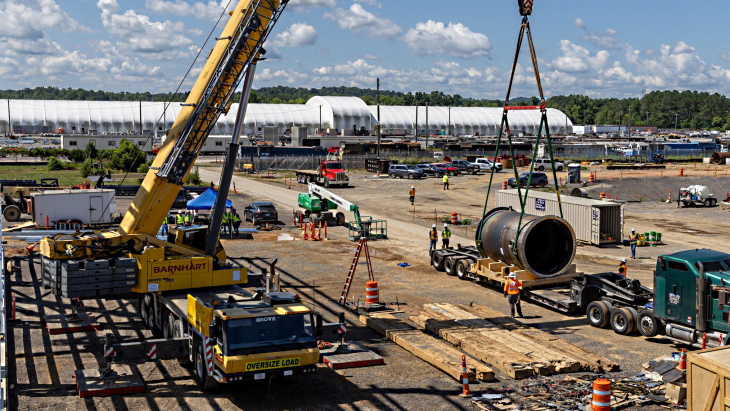

(Image: Kairos Power)

Kairos has now announced the installation of the 14-foot-tall (4.3 metres) reactor vessel of its third Engineering Test Unit (ETU 3.0). The non-nuclear mockup is being built adjacent to the site of Hermes - a low-power reactor currently under construction to advance the company's commercial KP-FHR reactor.

The ETU 3.0 reactor vessel was fabricated in partnership with Cambridge Vacuum Engineering and the University of Sheffield's Advanced Manufacturing Research Centre, using cutting-edge electron beam welding technology. The ETU 3.0 vessel project allowed Kairos to evaluate the advanced welding technique to enable faster, more cost-effective production of reactor vessels with precise tolerances for future commercial deployments.
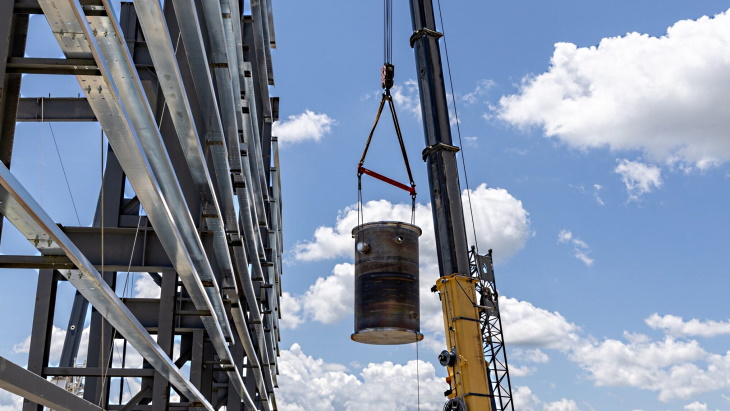

(Image: Kairos Power)

The KP-FHR is one of five technologies selected in 2020 to receive federal funding for risk reduction projects under the US Department of Energy's (DOE's) Advanced Reactor Demonstration Program (ARDP), with the department investing up to USD303 million in the Hermes reactor project. Under its agreement with the DOE, Kairos receives fixed, performance-based payments from DOE upon demonstrating the completion of pre-determined project milestones.

"Kairos Power's novel contract with DOE allows us to remain agile while demonstrating continued progress as a responsible steward of public funding," said Kairos Power CEO and co-founder Mike Laufer. "ARDP support is helping us to move quickly through progressively sophisticated iterations, gaining essential learning that will enable commercial deployment of our advanced reactor technology on a meaningful timeline."
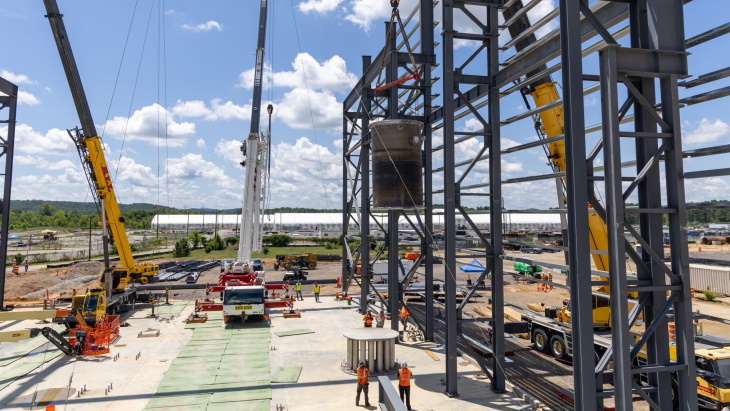

(Image: Kairos Power)

The ETU 3.0 building is being constructed around the reactor vessel in a streamlined sequence, which allowed the oversized component to be moved into position before the roof and other elements are in place. Kairos is collaborating with Barnard Construction to build the facility, using it as a proving ground to refine civil construction methods and quality assurance procedures for the Hermes reactor.

In addition to piloting new construction methods and manufacturing processes, ETU 3.0 will ultimately support the Hermes reactor as an operator training centre and test platform for remote handling and maintenance equipment. The facility will help improve operator safety and reduce downtime by prequalifying procedures for maintaining and replacing high-temperature reactor systems and components.

Hermes is the first non-light-water reactor to be permitted in the USA in more than 50 years. It will not produce electricity, but Hermes 2 - a two 35 MWt-unit plant for which the US Nuclear Regulatory Commission issued a construction permit in November - will include a power generation system.

The ETU 3.0 building will also house a Modular Systems Facility where plant equipment modules for ETU 3.0 and the Hermes reactor will be staged, assembled, and tested prior to installation. Kairos said the modular reactor construction methods being piloted with the ETU series and Hermes will be foundational to reducing construction costs and timelines for future plant deployments.

"The ability to test innovative production methods with our non-nuclear iterations is a game-changer for us," said Kairos Power Vice President of Manufacturing Craig Gerardi. "By serving as a vehicle to exercise the supply chain and gain construction proficiency, the ETU programme helps build confidence in our ability to deliver reactors for Kairos Power customers."

The commercial version of the KP-FHR is expected to be deployed in the 2030s.

Reactor vessel installed at Xudabao 1


Wednesday, 16 July 2025
The reactor pressure vessel has been installed at unit 1 of the Xudabao nuclear power plant in China's Liaoning Province. It will be one of two CAP1000 reactors planned for the first plant, where two VVER-1200 reactors are also under construction.
Reactor vessel installed at Xudabao 1
(Image: CNNC)

The vessel - weighing more than 300 tonnes - was hoisted into position within the reactor building on 13 July. The vessel will house the nuclear reactor and is the core of a nuclear power plant.

"The successful installation of the pressure vessel not only provides sufficient space and technical preparation for the subsequent installation of key equipment such as steam generators, main pipelines, pressurisers, and reactor internals, but also marks the steady progress of Xudabao nuclear power plant unit 1 from the civil construction stage to the equipment installation stage," China National Nuclear Corporation (CNNC) said.
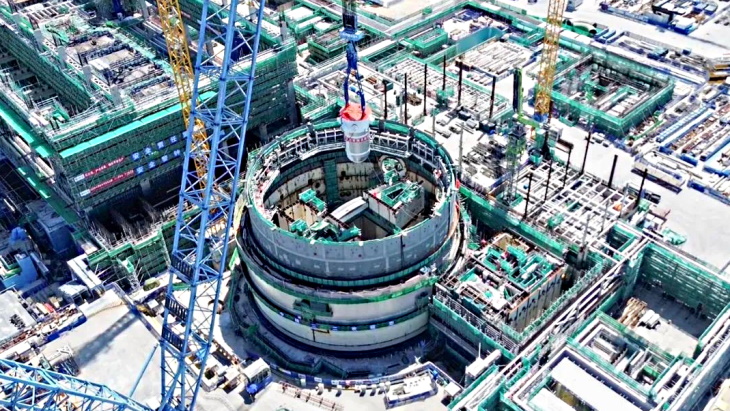

(Image: CNNC)

On 6 November 2023, the Ministry of Ecology and Environment announced that the National Nuclear Safety Administration had decided to issue a construction licence for Xudabao units 1 and 2, which will both feature 1250 MWe CAP1000 reactors - the Chinese version of the Westinghouse AP1000. A ceremony was held later that month at the Xudabao site near Xingcheng City, Huludao, to mark the start of construction of unit 1.

The Xudabao project was originally expected to comprise six CAP1000 reactors, with units 1 and 2 in the first phase. Site preparation began in November 2010. The National Development and Reform Commission gave its approval for the project in January 2011. CNNC noted that the total investment in units 1 and 2 exceeds CNY48 billion (USD6.6 billion).

However, with a change in plans, construction of two Russian-supplied VVER-1200 reactors as Xudabao units 3 and 4 began in July 2021 and May 2022, respectively.

The Xudabao plant is owned by Liaoning Nuclear Power Company Ltd, in which CNNC holds a 70% stake with Datang International Power Generation Company holding 20% and State Development and Investment Corporation owning 10%. The general contractor is China Nuclear Power Engineering Company Ltd, a subsidiary of CNNC.

Two further CAP1000 reactors are proposed for units 5 and 6 at the Xudabao plant.

Site named for first SOLO microreactor in US


Wednesday, 16 July 2025
Italy-based micro-modular reactor developer Terra Innovatum Srl has signed a memorandum of understanding with Rock City Admiral Parkway Development in Illinois to host the first deployment site for its SOLO reactor.
Site named for first SOLO microreactor in US
(Image: Terra Innovatum)

The memorandum of understanding (MoU) foresees the Rock City site - a six-million square-foot industrial park in Illinois in the USA - becoming the site for the first-of-a-kind SOLO micro-modular reactor with an option to deploy up to 50 on the site in the future.

The reactor(s) would supply power to the businesses operating at the park.

Alessandro Petruzzi, Co-founder and CEO of Terra Innovatum, said: "Rock City is the perfect location for our first deployment as it showcases the massive real-world application potential of our micro-modular reactors and is in close proximity to a hotbed of nuclear research and talent."

Joe Koppeis, Founder and Board Director of Admiral Parkway, said: "We are excited to partner with Terra Innovatum’s team to bring their innovative energy technology to the world. Once SOLO secures regulatory approval, we will be honoured to host the first-of-a-kind and take the next steps towards wider commercialisation."

Special purpose acquisition company GSR III Acquisition Corp, which is listed on the Nasdaq stock exchange, is in the process of a business combination with Terra Innovatum which, when it closes, would see the micro reactor developer becoming a public company listed on Nasdaq.

The MoU says that, pending US Nuclear Regulatory Commission (NRC) and other necessary approvals, Terra Innovatum will supply power via the initial unit for a 15-year term, with an option to extend to 45 years.

Background

Terra Innovatum is developing its SOLO micro modular reactor design, intended to form the basis for a scalable modular energy platform from MWe to GWe-class. A SOLO unit is designed to deliver approximately 1 MWe. The design features a solid heterogeneous composite moderator and is intended to accommodate both traditional zircaloy-clad low-enriched uranium (LEU) fuel or, when available, LEU+ and high-assay low-enriched uranium (HALEU) fuels. Heat removal is accomplished by helium gas which eliminates the need for water from the reactor coolant system.

The reactor is intended to feature autonomous operation, on-line safeguards-by-design, and a defence-in-depth structure of radiological barriers with the intent to minimise or eliminate emergency planning zone requirements beyond the operational boundary.

The NRC is currently engaged in pre-application activities with Terra Innovatum.

China's largest uranium mining project enters production


Tuesday, 15 July 2025
Exactly one year after construction began, China has produced its first barrel of natural uranium from its largest domestic project - the National Uranium No.1 demonstration project - in Ordos in the Inner Mongolia Autonomous Region.
China's largest uranium mining project enters production
The National Uranium No.1 well field (Image: CNNC)

China National Nuclear Corporation (CNNC) broke ground for the project on 12 July 2024. The project integrates automation, remote centralised control and big data analysis. It uses CO2 and O2 in-situ recovery (also known as in-situ leaching), where uranium is extracted through a closed-loop circulation of the uranium solution without lifting the ores to the surface for processing - a technique said to avoid water, gas and solid wastes and minimise carbon emissions.

CNNC has now announced that the project successfully produced the first barrel of uranium products on 12 July.
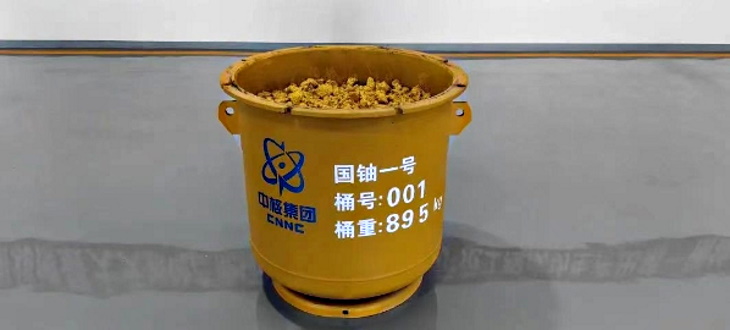

(Image: CNNC)

"As the largest natural uranium production capacity project in China's nuclear and mining industry in the past 70 years, the successful production of the first barrel of uranium marks that China's uranium resource development has officially entered a new era of green, safe, intelligent and efficient," CNNC said. "After completion, it will provide a solid resource guarantee for national energy security and nuclear industry development, and will also greatly enhance the international competitiveness of China's natural uranium industry."

CNNC noted that in the past, China's uranium development was mainly concentrated in volcanic and granite uranium mines in the south. However, over the past two decades, major breakthroughs have been made in the prospecting of sandstone uranium mines in the north. In 2023, China released the top ten uranium prospecting results, predicting more than 2.8 million tonnes of uranium resources. The main uranium resources are concentrated in the sandstone uranium mines in the north, among which the Ordos Basin has become the country's largest uranium resource base.

The technology used at the National Uranium No.1 project will be "fully applied and accelerated to the development of uranium resources in China's northern basins such as Songliao, Erlian, Ordos, and Yili, supporting the construction of a number of new uranium mining bases and fully guaranteeing the demand for uranium resources for nuclear energy development," CNNC said. "In the future, the National Uranium No.1 technology will 'go abroad' and be promoted to uranium mines around the world to ensure the safe and orderly development of global nuclear power."

"This demonstration project is a major achievement in China's third-generation uranium mining and processing technology," said Yuan Xu, chairman of CNNC subsidiary China National Uranium Corporation.

The project is part of China's nuclear energy development plan, with natural uranium being the basis of the nuclear fuel cycle, and with demand forecast to increase as nuclear energy capacity expands across the world.

China currently has 58 operable reactors providing capacity of 56.93 GWe. There are a further 32 reactors under construction which will provide a further 34.2 GWe of capacity and there are dozens more at the planning or proposed stage. According to World Nuclear Association's information paper on China's nuclear fuel cycle, China aims to produce one-third of its uranium domestically, obtain one-third through foreign equity in mines and joint ventures in other countries and to purchase one-third on the open market.

Inner dome hoisted into place at Lufeng 6


Tuesday, 15 July 2025
The inner containment dome has been installed at unit 6 of the Lufeng nuclear power plant in China's Guangdong province. It is the first of two HPR1000 (Hualong One) units under construction at the site, where four CAP1000s are also planned.
Inner dome hoisted into place at Lufeng 6
(Image: CGN)

The steel dome - measuring 45 metres in diameter and almost 14 metres in height, and weighing about 238 tonnes - was raised some 60 metres above ground level using a crawler crane and lowered into position on top of the walls of the double containment structure. An outer dome will subsequently be installed over the inner one.

"The project construction team accurately predicted the difficulties of hoisting through simulation and deduction of the whole process, and comprehensively used 3D laser simulation and real-scene replication technology, finite element analysis, real-time meteorological monitoring and other technical means to ensure that the dome was successfully hoisted into place in one go," said Zhang Weixiao, the person in charge of the dome hoisting operation.
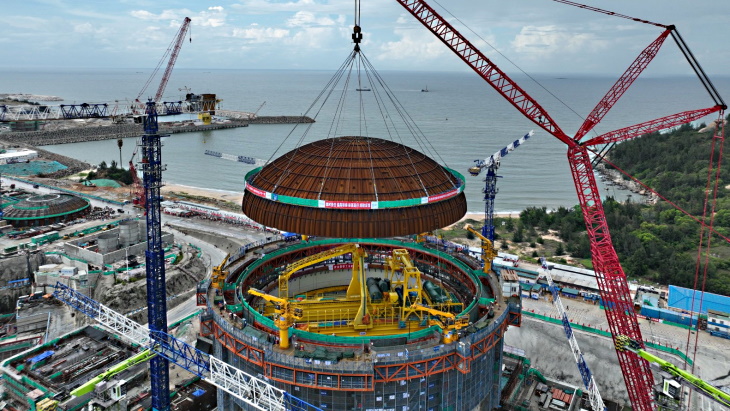

(Image: CGN)

The main function of the dome is to ensure the integrity and leak tightness of the reactor building, and it plays a key role in the containment of radioactive substances.

China General Nuclear (CGN) said the installation of the dome "marks the successful capping of the reactor building of the Hualong One nuclear power unit, and the project construction officially shifted from the civil construction stage to the equipment installation stage".

The construction of Hualong One reactors as units 5 and 6 at the Lufeng plant was approved by the State Council in April 2022. First concrete for unit 5 was poured on 8 September 2022, with that for unit 6 following on 26 August 2023. Units 5 and 6 are expected to be connected to the grid in 2028 and 2029, respectively.

The proposed construction of four 1250 MWe CAP1000 reactors (units 1-4) at the Lufeng site was approved by China's National Development and Reform Commission in September 2014. However, the construction of units 1 and 2 did not receive State Council approval until 19 August last year. The first safety-related concrete for the nuclear island of unit 1 was poured on 24 February this year. Approval for units 3 and 4 is still pending. The CAP1000 design is the Chinese version of the Westinghouse AP1000.

According to CGN, once all six units are in operation, the Lufeng plant will generate about 52 TWh, which will reduce standard coal consumption by almost 16 million tonnes and reduce carbon dioxide emissions by more than 42 million tonnes

Carney heads to Hamilton to meet steelworkers as U.S. trade talks continue

By The Canadian Press
 July 16, 2025 


Prime Minister Mark Carney will make an announcement on the steel industry during a visit to Hamilton.

OTTAWA — Prime Minister Mark Carney is scheduled to be in Hamilton today to make an announcement related to the steel industry.

It has been more than a month since U.S. President Donald Trump doubled tariffs on steel and aluminum from 25 to 50 per cent, adding further economic insult to the two industries in Canada.

Carney met with his cabinet virtually on Tuesday and told reporters before that meeting he doesn’t think Trump will agree to any trade deals without including some tariffs.

Carney will tour a steel company in the city and meet with workers during his visit to Hamilton.

Carney and Trump have been negotiating a new economic and security pact since early May and last week Trump unilaterally pushed the deadline for reaching that from July 21 to Aug. 1.

He told Carney in a letter on July 10 Canada will be hit with 35 per cent tariffs that day, with the White House saying the current plan is for that to apply only to those Canadian imports not covered under the existing Canada-U.S.-Mexico Agreement.

Carney says negotiations with the U.S. are likely to intensify as that Aug. 1 deadline approaches.

This report by The Canadian Press was first published July 16, 2025.

David Baxter, The Canadian Press
Carney casts doubt on Canada securing a tariff-free deal with Trump


By Spencer Van Dyk
 July 15, 2025 


Canada's prime minister is forging ahead with plans to come to a trade agreement with the United States. CTV National's Colton Praill on the upcoming meeting.

Most countries will likely have to accept some baseline tariff rate on their goods by the United States, Prime Minister Mark Carney signalled Tuesday morning, on his way into a meeting with his cabinet on Parliament Hill.

“There is not much evidence at the moment — from the deals, agreements and negotiations with the Americans, for any country or any jurisdiction — to get a deal without tariffs,” Carney said in French, when asked whether he believes it’s possible to have the levies removed entirely.

Canada, he added, is uniquely positioned to have effectively free trade with the United States.

A slate of stacked U.S. tariffs on Canadian goods, as well as Canadian countermeasures, have been in place for months.

Following the G7 summit in Kananaskis, Alta., last month, Carney signalled he and U.S. President Donald Trump agreed to iron out a trade deal before July 21. But, in a letter addressed to Carney and posted to Truth Social last week, Trump said he’ll be hitting Canada with 35 per cent tariffs on Canadian products starting Aug. 1. Carney subsequently revised the deadline to reach a deal to that date.

Carney also told reporters before Tuesday’s cabinet meeting that he expects talks with the United States will “intensify” in the next few weeks.

“At the same time, we need to recognize that the commercial landscape globally has changed,” he said. “It has changed in a fundamental manner, and we will continue to focus on what we can most control, which is building a strong Canadian economy. It’s part of what we’ll be discussing at cabinet today.”

The prime minister added that the situation needs to be “stabilized,” especially for the sectors that are particularly affected by Trump’s tariffs.

Carney is also set to meet with Canada’s premiers in Huntsville, Ont., next week.

In a post on social media Tuesday afternoon, Conservative Leader Pierre Poilievre criticized Carney for conceding that a fully tariff-free deal with Trump may not be possible.


“Another unilateral concession from a man who said he would never back down to the U.S. president,” he wrote.

Also in a statement Tuesday, NDP interim leader Don Davies wrote: “Conceding to a bully never ends.”

“That is why New Democrats urge the Carney government to cease offering unilateral concessions without securing reciprocal benefits from the U.S.,” he added.
Carney comments a ‘wake-up call’: trade lawyer

William Pellerin, an international trade lawyer with McMillan and former litigator for Canada in trade disputes with the United States, said Carney’s comments on Tuesday can serve as a “bit of a wake-up call for Canadians and Canadian businesses that we might not get back to a place of no tariffs.”

Speaking to CTV News, Pellerin said businesses should prepare for that to be the case.

Pellerin said there is “a lot of scenario planning” underway for Canadian businesses and industry, while Carney’s comments could be “laying the groundwork or setting expectations” for Canadians.

“I think there’s still quite a bit of optimism and hope that we will get to a reasonable place with the United States as our, by far, largest trading partner,” he said. “But today might have been kind of the first opening, or the first time that we’ve really heard that we might not get there.”

Speaking to reporters earlier on Tuesday, Carney indicated Canada has one of the lowest effective tariff rates compared to other countries. According to Pellerin, Canada is “actually not doing terribly.”

He said while there are some sectors that have been hit with more punishing tariffs — such as steel and aluminum — the vast majority of goods being compliant with the Canada-U.S.-Mexico free trade agreement brings the average, or effective, tariff rate down.

“If Canada could get to a place where we have just a very low baseline tariff that applies only to a certain subsect of products, I think we could be OK,” Pellerin said. “But certainly, right now, the steel industry and others are really suffering.”
Most prefer ‘hard’ approach to Trump: survey

Amid the ongoing negotiations with the U.S., new data from the Angus Reid Institute show nearly two thirds of survey respondents want to see the Canadian government take a harder line.

According to the new numbers, 63 per cent of people want to see a “hard approach,” which the polling firm characterizes as “refusing difficult concessions even if it means a worsening of trade relations with the U.S.”

Meanwhile, 37 per cent of people prefer a “soft approach,” which the firm considers “making difficult concessions to keep a good relationship with our biggest trading partner.”

“When the political rhetoric trickles down to things like household income and people feeling secure or insecure as to whether or not they’re going to have a job next year, that’s really where we have to see how much of that elbows up rhetoric continues to hold,” said Angus Reid Institute president Shachi Kurl, in an interview with CTV News.

The Angus Reid survey also laid out which concessions in which sectors — such as supply management, the digital services tax, fresh water, and defence spending, for example — Canadians may or may not be willing to make.

The data from Angus Reid about a hard versus soft approach to negotiations were taken before Trump’s letter threatening 35 per cent levies.

Kurl said there was already a “significant amount of division” among Canadians when it comes to their confidence in Carney’s ability to effectively negotiate with Trump, even before the president’s latest threat.

Nearly half of respondents (48 per cent), she said, are confident the two leaders can hash out a deal, whether they trust Carney can negotiate one, or because they believe Trump will back down on his threat.

Conversely, Kurl said, 45 per cent say they’re not confident in an imminent deal, whether that’s because they don’t trust the prime minister, or because they believe Trump is “too unpredictable and too capricious.”

“And therefore, no matter what we do, we can stand on our head, it still won’t matter,” she said.

“So those really represent an almost even division between those who are confident and those who are not confident,” Kurl also said.

With files from CTV News’ Rachel Aiello and Colton Praill

Spencer Van Dyk

Writer & Producer, Ottawa News Bureau, CTV News
Statistics Canada says income gap hit record high in first quarter

By The Canadian Press
July 16, 2025 

A Statistics Canada sign is pictured in Ottawa 
THE CANADIAN PRESS/Sean Kilpatrick

OTTAWA — The income gap between the country’s highest and lowest income households reached a record high in the first quarter of 2025, Statistics Canada said Wednesday.

The agency said the difference in the share of disposable income between households in the top 40 per cent of the income distribution and the bottom 40 per cent grew to 49 percentage points in the first three months of the year.

Statistics Canada said the measure has increased each year following the onset of the COVID-19 pandemic. Latest updates on investing here

For the first quarter of 2025, it said the increase came as the highest income households gained from investments, while the lowest income households saw wages decline.

Those in the bottom 20 per cent of the income distribution saw the weakest growth in disposable income in the first quarter at 3.2 per cent compared with a year ago as their average wages edged down 0.7 per cent.

The lowest income households also saw the largest drop in net investment income as their investment earnings fell 35.3 per cent, while net transfers received, including increased government support measures, rose 31.2 per cent.

The average disposable income for those in the top 20 per cent of the income distribution increased at the fastest pace of any income group in the first quarter of 2025 as they benefited from a 7.7 per cent increase compared with a year earlier.Trade War coverage on BNNBloomberg.ca

The highest income households saw a 4.7 per cent increase in average wages and a 7.4 per cent gain in investment income.

Statistics Canada said the wealth gap also increased as the top 20 per cent of the wealth distribution accounted for 64.7 per cent of Canada’s total net worth in the first quarter, averaging $3.3 million per household.

The bottom 40 per cent of the wealth distribution accounted for 3.3 per cent of net worth, averaging $85,700 per household.

---

This report by The Canadian Press was first published July 16, 2025.
Central Asian Nation's Crypto Boom Sparks International Alarm


By RFE/RL staff - Jul 15, 2025


International concern is growing over a cryptocurrency exchange in Kyrgyzstan, Grinex, which reportedly facilitated billions in transactions, raising suspicions that it aids Russia in evading Western sanctions.

Kyrgyz officials have offered little transparency regarding the oversight and licensing of Grinex and its affiliated companies, including A7A5, a ruble-pegged stablecoin.

Financial analysts and civil society organizations warn that this lack of regulatory oversight could position Kyrgyzstan as a hub for illicit financial activities, jeopardizing its international reputation.


Silence from Kyrgyz officials is adding to international concerns about alleged transactions worth billions of dollars on a cryptocurrency exchange registered in the Central Asia country.

Grinex, the platform at the center of the controversy, reportedly facilitated $9 billion in transactions between January and April this year, primarily using a ruble-pegged stablecoin (a type of cryptocurrency) known as A7A5.

These revelations, first brought to light by The Financial Times in late June, raise concerns that Grinex could be a crucial player in Russian efforts to circumvent Western sanctions imposed after Moscow launched its ongoing full-scale invasion of Ukraine in 2022.

Grinex was founded weeks after U.S. sanctions dismantled Russia’s Garantex platform, which is only sole exchange handling A7A5, considered the first stablecoin -- a cryptocurrency with an exchange rate stabilized by its ties to conventional assets such as currencies, gold, or oil -- pegged to the Russian ruble.

The similarities in how the two platforms operate, coupled with the timing of its establishment, have raised suspicions that Grinex is the successor to Garantex and provides Moscow with a digital workaround on the biting international sanctions imposed on it.

Adding to the intrigue is the involvement of Ilan Shor, a Moldovan oligarch and fugitive convicted of masterminding a $1 billion banking fraud in his home country.

Shor, now reportedly living in Russia, is suspected of having ties to both A7A5 and Grinex through a network of companies stretching from Moscow to Bishkek.

But when pressed about oversight of Grinex or its affiliated companies, Kyrgyz regulatory agencies and government ministries offered little more than deferrals and vague assurances.

No Comment

The Financial Market Regulation and Supervision Service (FMRS), responsible for implementing Kyrgyzstan’s 2022 Law on Virtual Assets, confirmed to RFE/RL’s Kyrgyz Service that a company named Grinex is listed in its registry.

However, FMRS official Chynara Baktybekova said “the listing is in Russian and may not correspond to the international Grinex exchange currently under international scrutiny.”

“We will respond to media inquiries within the timeframe prescribed by the law. We are not ready to comment at this time,” Baktybekova added.

When asked about the licensing status of Old Vector, the company behind the A7A5 token, Baktybekova stated that it is registered but does not require a full license, only a permit, as it issues tokens rather than operating an exchange.

As for A7-Kyrgyzstan, the guarantor of the A7A5 token, Baktybekova advised RFE/RL to contact a different division within FMRS.

However, repeated attempts to reach that division went unanswered.

The Ministry of Finance and the National Bank of Kyrgyzstan both declined to comment, stating that oversight of crypto exchanges falls outside their jurisdiction.


The Ministry of Economy and Commerce did not respond to multiple written and phone inquiries.

A June investigation by the Center for Information Resilience, an NGO dedicated to exposing human rights violations and threats to democracy through open source investigations and research, that the A7 strategy is aimed at "moving money across borders" and is "likely to present a significant challenge to existing sanctions regimes."
'An Ideal Environment For Illicit Activities'

The pattern of bureaucratic silence has frustrated journalists, financial analysts, and anti-corruption activists seeking clarity on how such large-scale transactions could take place in Kyrgyzstan’s nascent crypto sector.

“This lack of transparency creates an ideal environment for illicit financial activities,” cautioned Aizada Abdyldaeva, a financial law expert at the American University of Central Asia in Bishkek.

“Kyrgyzstan is at risk of becoming a preferred jurisdiction for entities seeking to evade international controls.”

Temirlan Moldokulov, a Bishkek-based political analyst, echoed those concerns:

“If our regulators can’t say who’s moving billions through our system, how can we assure foreign partners we aren’t facilitating sanction evasion?”

The Grinex controversy follows weeks of speculation about Shor’s alleged involvement with Capital Bank, one of Kyrgyzstan’s commercial banks.

Responding to those claims, President Sadyr Japarov publicly denied any foreign influence at the bank.

“Capital Bank is under state control. Don’t believe such rumors,” Japarov said in a televised interview in June. “The bank’s profits go directly to the state budget.”

While the president’s remarks addressed Capital Bank specifically, they have done little to quell unease about broader vulnerabilities in Kyrgyzstan’s financial system.

A Sanctions Backdoor?

Kyrgyzstan is one of the few Central Asian countries to have enacted a legal framework for digital assets. The 2022 law introduced a licensing regime for exchanges and token issuers, a move hailed at the time as progressive. However, critics say the framework lacks teeth.

“The law looks good on paper, but enforcement is weak and registries are secretive,” said Nurlan Aitkulov, an economist in Bishkek.

Analysts caution that this regulatory void, combined with Kyrgyzstan’s proximity to Russia and its reliance on remittances from Kyrgyz workers in Russia, could entice malicious actors to exploit the country as a financial hub for circumventing sanctions.

Western diplomats in Central Asia have privately expressed concern about Kyrgyzstan’s potential role in undermining international sanctions.

A senior European official in Brussels, speaking on condition of anonymity, told RFE/RL that “jurisdictions like Kyrgyzstan will come under increasing scrutiny.”

The U.S. Treasury’s Office of Foreign Assets Control (OFAC) has stepped up targeting of crypto-based sanction evasion networks globally.

'A Matter Of National Security'

Kyrgyzstan’s financial system is no stranger to controversy. From the collapse of banks amid political upheavals to previous allegations of money laundering through the aviation fuel sector, the country has long struggled with corruption and weak institutions.

“The crypto boom has added a new layer of complexity to an already fragile system,” said Aizada Abdyldaeva, the financial law expert.

“Without stronger oversight, we may see a repeat of past scandals—only on a digital scale.”

Civil society organizations have called on the government to publish the whole registry of virtual asset service providers and clarify the legal status of Grinex and its affiliates.

“This is not just a matter for regulators—it’s a matter of national security,” said Aijan Akmatova, a researcher with Bishkek-based think tank Taza Koom.

As international investigators dig deeper into Grinex and its network, Kyrgyzstan’s official silence is fueling speculation both domestically and abroad.

“This is a litmus test of Kyrgyzstan’s commitment to transparent governance and international collaboration,” warned Moldokulov. “The longer the silence persists, the more severe the potential repercussions could be.”

The Grinex episode has put Kyrgyzstan’s fintech ambitions at risk. If the country is perceived as a hotspot for sanctions evasion, it could face international backlash, jeopardizing its aspirations to become a regional leader in digital finance.


The story of Grinex and A7A5 continues to unfold, with journalists and blockchain intelligence firms continuing to trace the money and the networks behind it.

For Bishkek, the crossroads are clear: tighten oversight and restore trust, or risk being cast as a new epicenter in the shadowy world of financial crime.

By RFE/RL
TRUMP INC. CRYPTO GRIFT
US House set to vote on landmark crypto bills this week


By AFP
July 15, 2025


Image: — © Digital Journal

US lawmakers are on the verge of passing landmark legislation that will give the much-maligned crypto world much-wanted legitimacy, riding on President Donald Trump’s recent embrace of the industry.

The US House of Representatives is set to vote on three pieces of legislation this week, including one on the use of stablecoins — cryptocurrencies pegged to safe assets like the dollar — that if passed would immediately go to Trump for his signature.

The raft of legislation comes after years of suspicion against the crypto industry amid the belief in the Biden administration that the sector, born out of the success of bitcoin, should be kept on a tight leash and away from mainstream investors.

But after crypto investors poured millions of dollars into his presidential campaign last year, Trump reversed his own doubts about the industry, even launching a Trump meme coin and other ventures as he prepared for his return to the White House.

According to federal financial disclosure forms released last month, Trump pocketed more than $57 million from the crypto venture, World Liberty Financial, that he launched with his sons last year.

Trump has, among other moves, appointed crypto advocate Paul Atkins to head the Securities and Exchange Commission (SEC).

He has also established a federal “Strategic Bitcoin Reserve” aimed at auditing the government’s bitcoin holdings, which were mainly accumulated by law enforcement from judicial seizures.

And thanks to his backing, Trump could soon be signing the stablecoin bill — dubbed the GENIUS Act — that the US Senate passed last month and that sets rules such as requiring issuers to have reserves of assets equal in value to that of their outstanding cryptocurrency.

– ‘Long time coming’ –

Stablecoins are considered the safest and least volatile of digital currencies because their value is tied to traditional currency or secure assets such as gold.

Another provision of the bill empowers banking regulators to oversee stablecoin issuers in the United States.
'


The US legislation comes after years of suspicion against the crypto industry amid the belief that the sector born out of the success of bitcoin should be kept on a tight leash – Copyright AFP Giuseppe CACACE

The legislation could extend the US dollar’s influence in the world of cryptocurrency, with dollar-backed stablecoins seen as financial havens from local currencies prone to big fluctuations.

The US House is also considering the CLARITY Act that would establish a clearer regulatory framework for digital assets — including cryptocurrencies and other blockchain-based assets. If passed the bill would require passage in the Senate.

The act would clarify and divide regulatory authority between the Securities and Exchange Commission (SEC) and the Commodity Futures Trading Commission (CFTC).

Gerald Gallagher, General Counsel at Sei Labs, a digital asset firm, said the bills could be a game changer for the industry.

“GENIUS and CLARITY provide security and certainty for investors that previously were not available, either intentionally or unintentionally,” he told AFP.

“This has been a long time coming.”

The Republican-led House is also considering a bill it calls the Anti-CBDC Surveillance State Act that aims to block the issuance of a central bank digital currency (CBDC) – a digital dollar issued by the US Federal Reserve.

Republicans argue that a CBDC could enable the federal government to monitor, track, and potentially control the financial transactions of private citizens, undermining privacy and civil liberties.

It also would require passage in the Senate before going to Trump for his signature.

Crypto week legislation hits snag in U.S. Congress, some stocks fall

By Reuters
July 15, 2025 

An advertisement for the cryptocurrency, Bitcoin, is displayed on a building in Hong Kong on  (AP Photo/Kin Cheung, File)

The fate of long-awaited cryptocurrency legislation in the U.S. Congress was cast into doubt Tuesday, as a procedural vote to consider the measures was shot down by lawmakers from both parties, and shares of some companies in the sector fell.

House Republicans had billed this week as “Crypto week,” and were keen to advance numerous pieces of legislation aimed at providing clarity to the digital asset industry and long-sought legitimacy to the sector.

But those efforts hit an early snag on Tuesday, when several conservative Republicans joined with Democrats in blocking a procedural vote to allow consideration of three crypto bills as part of a dispute over how the measures should be packaged and considered.Latest updates on crypto news here

Shortly after the vote, House Speaker Mike Johnson told reporters that he planned to continue discussing the matter with members and hoped to vote on it again shortly.

Shares of crypto-related stocks including Circle Internet and Coinbase Global dropped on the news but then pared losses. Circle Internet fell over 4 per cent while Coinbase was down 1.5 per cent.

The House was attempting to pass a series of crypto-related bills, most notably a bill that would establish a regulatory framework for stablecoins.

Stablecoins, a type of cryptocurrency designed to maintain a constant value, usually a 1:1 dollar peg, are commonly used by crypto traders to move funds between tokens. Their use has grown rapidly in recent years, and proponents say they could be used to send payments instantly.

That bill -- and another the House is considering that would define when a crypto token is a commodity -- would be a huge win for the crypto industry.

The House also was set to consider a bill that would prohibit the U.S. from issuing a central bank digital currency. Republicans say there is a risk this could give the government too much control over Americans’ personal finances.

That bill has not been considered in the Senate and the Federal Reserve has not indicated a desire to develop a central bank digital currency.

---

Reporting by Chris Prentice and Caroline Valetkevitch; editing by Pete Schroeder and David Gregorio

Why crypto giant Tether bought a South American farming company

By Reuters
 July 16, 2025

Young cows stand in a barn at Mystic Valley Dairy in Sauk City, Wis
 (AP / Carrie Antlfinger)

NEW YORK — Crypto powerhouse Tether, the world’s largest digital assets company, is leveraging its recent acquisition of a South American agricultural firm to make a strategic play for the multi-trillion dollar a year global commodities trade.

The company aims to embed its stablecoin, a digital currency pegged to the U.S. dollar that trades in crypto exchanges, into the core of markets where raw materials are bought and sold, promising to slash cross-border payment costs and times from days to seconds.

New York-listed Adecoagro, a company that produces dairy in Argentina, rice in Uruguay and sugar and ethanol in Brazil, among other products, agreed in April to sell 70 per cent of its shares to Tether in a deal valued at around US$600 million.Latest updates on crypto news here

It is another sign that the quickly-expanding crypto industry is moving into brick-and-mortar businesses, and broadening investments in physical assets.

“The crypto industry is increasingly focused on bridging digital finance with tangible assets,” said Joe Sticco, chief executive of Cryptex Finance, a company that created indexes that mirror cryptocurrencies’ market caps.

He said that by adding income-generating assets like farmland or food processing plants, Tether could strengthen its balance sheet and provide a hedge against inflation.

Tether’s main business segment is USDT, a digital currency backed mostly by U.S. Treasuries. Launched in 2014, USDT has grown sharply in trading volumes amid rising interest in cryptocurrency and token prices.

It is a way to make payments outside of the traditional global financial system. The big difference between USDT and bitcoin or another cryptocurrency like ethereumis that USDT is designed to track the U.S. dollar, the currency dominating global trade.
Commodities trading

Tether has issued US$143 billion in USDT so far, and it said in its first quarter report that it has US$149 billion in reserves, including US$120 billion in U.S. Treasuries.

“Tether wants to boost the use of its stablecoin to make cross-border payments, something that I think will grow a lot in financial markets, particularly in commodities markets,” said Marcos Viriato, the chief executive of Parfin, a South American company providing technology for transactions with cryptocurrencies.

“If a company in Brazil sells commodities to someone in Bolivia, the payment through conventional channels could take more than three days. With USDT it would take seconds,” he said, adding that operation costs would also be much lower.

Parfin has a pilot project with Brazil’s third largest bank, Banco Bradesco, where Brazilian commodities exporters sell products to clients abroad who pay with stablecoins. Bradesco then uses Parfin’s infrastructure to convert those USDT to local currency, which is deposited in exporters’ accounts.Latest updates on commodities here

“Tether’s investment approach prioritizes companies that expand our distribution network and enhance the real-world utility of stablecoins, with Adecoagro as a prime example,” Tether said in response to a Reuters request for information on the deal.


The company said it is evaluating, alongside Adecoagro’s management and other industry experts, how stablecoins could enhance efficiency and liquidity in commodity trading.

Tether reported late last year that it had financed a physical crude deal between a major oil company and a commodities trader, which was settled using USDTs, the first time a deal on these terms was done.

Reuters reported earlier this year that Russia was using cryptocurrencies in its oil trade with China and India to skirt Western sanctions. Venezuela has also sought to use digital currencies to trade.

Sugar token

Another possible option for Tether as it enters the agriculture world is the so-called tokenization of commodities, said Gracy Chen, chief executive of crypto exchange Bitget.

Tether already has a gold token, which mirrors gold’s value and is backed by gold reserves. It could look now into a sugar or corn token, that could be used for hedging or as a collateral in pre-harvest financing, Chen said.

“In effect, they are turning farmland, sugar mills and renewable energy plants into programmable financial instruments,” she said.

Tether said that it sees “significant potential in exploring the tokenization of real-world assets, including agricultural commodities,” although it stressed that there were no immediate plans to launch a sugar or corn token.

Instead, for now, the crypto company will use its acquisition for a different application. Tether said it will tap renewable energy produced by Adecoagro in its operations in South America, such as the electricity coming from sugarcane mills, to power a bitcoin mining operation.

---

Reporting by Marcelo Teixeira, editing by Deepa Babington
Canadians have already lost $103 million to crypto investment scams this year: Canadian Anti-Fraud Centre

 July 16, 2025 

Canadians lost $224,201,739 to cryptocurrency investment in 2024, and so far have lost $103,172,872 in 2025, according to the Canadian Anti-Fraud Centre.
 (Pexels / Jakub Zerdzicki)

Canadians lost $224,201,739 to cryptocurrency investment in 2024, and so far have lost $103,172,872 this year alone, according to the Canadian Anti-Fraud Centre.

Cryptocurrency fraud usually involves fake videos generated with artificial intelligence (AI), that feature prominent politicians or celebrities promoting fake websites.

Two Ontarians CTV News spoke with collectively lost $58,600 after falling victim to separate AI-generated videos advertising fraudulent cryptocurrency investments.

“We got stung big time and we don’t want it to happen to anyone else,” said Don Perkins of Stittsville, a community in Ottawa.

It was in January when Perkins and his wife, Guylaine Perkins, said they saw a video of then Finance Minister, Chrystia Freeland, appearing to talk about an investment opportunity that could make them rich.


According to the AI-manipulated video, Freeland spoke about the “opportunity” Canadians could invest in, making them rich.
A fake, AI-generated video appears to show former Finance Minister, Chrystia Freeland, talking about a cryptocurrency investment opportunity.

“We bought into it and got swindled by a pair of smooth talking individuals,” Perkins said.

The Perkins said they started out investing with just a few hundred dollars, but eventually handed over their life savings of $42,600.

It wasn’t until they tried to withdraw the funds that they realized they lost all their money.

“When we went to access the money, they wouldn’t give it to us and said we would have to give them $10,000,” said Perkins.

Brenda Dionne of Whitby also had a similar experience when she saw an AI-generated video of what seemed to be Prime Minister Mark Carney claiming Canadians could make money investing in cryptocurrency.

An AI-generated video appears to show Canadian Prime Minister Mark Carney and Italian Prime Minister Giorgia Meloni discussing investing in cryptocurrency.

Dionne told CTV News that after she handed over her banking information, the fraudsters cleaned out her bank account and took her life savings of $16,000.

“I could see her doing it and I said ‘I don’t want you taking money out of my account,’” said Dionne. “I could see her doing it. I could see her taking my money.”

According to the Canadian Anti-Fraud Centre (CAFC), in 2024, crypto investments represented over 70 per cent of overall reported losses to investment fraud.


Most of those frauds involved altered videos that used AI to make it appear as if someone was saying to invest in a platform which was actually completely fake.

“If you open up your search engine and you search up cryptocurrency investments, the first five or ten are more than likely to be fraudulent platforms,” said Jeff Horncastle with the CAFC.

The centre says that when watching videos online, it’s important to remain skeptical and do your own research.

The CAFC also urges Canadians to exercise caution when viewing videos that seem too good to be true, or showing public figures saying something out of character, like investing in different platforms. They said these deepfake videos often rely on sensational or provocative content to manipulate others.

The Perkins both have health problems and said they invested in hopes of boosting their retirement savings, but instead lost it all.

“I have a bag in my stomach and go to dialysis three times a week. My wife can hardly walk and needs a wheelchair most of the time,” said Perkins. “This was a portion of our life savings that we had set aside.”

CTV News reached out to Prime Minister Mark Carney’s office about the fake, AI-generated videos but did not get a response.


Pat Foran

CTV News Toronto Consumer Alert Videojournalist


Aramco-Backed MidOcean in Advanced Talks for Major Stake in Canada LNG Unit

MidOcean Energy, the LNG investment platform backed by Saudi Aramco, has emerged as the front-runner to acquire a significant minority stake in Petronas’s Canadian gas and LNG business, according to people familiar with the talks, cited by Bloomberg. The deal, now reportedly in late-stage negotiations, could value the assets between $6 and $7 billion, making it one of the largest LNG transactions of the year.

Petronas’s Canadian unit includes extensive upstream operations in British Columbia and a 25% stake in the LNG Canada terminal, a major West Coast export project now under construction and slated to begin operations in 2026. A completed transaction would give Aramco exposure to North America’s fast-growing LNG export corridor through MidOcean. 

MidOcean was launched by U.S.-based EIG Global Energy Partners and became central to Aramco’s LNG strategy following its 2023 equity infusion. Since then, MidOcean has snapped up stakes in liquefaction projects in Australia, Peru, and now aims to enter Canada, cementing its role as a global LNG consolidator.

Petronas, meanwhile, is seeking to monetize non-core assets to reallocate capital toward decarbonization and domestic priorities while maintaining strategic LNG positions. The Canadian divestment aligns with that strategy.

While sources told Bloomberg that other suitors could resurface, MidOcean is currently viewed as the preferred bidder. Final terms may be announced later this summer, pending regulatory review and corporate approvals.

Aramco’s potentially indirect foothold in Canada reflects rising Gulf interest in supply basins outside the Middle East, as demand from China, South Korea, and India fuels long-term LNG growth.

By Charles Kennedy for Oilprice.com