Monday, July 28, 2025

The New Frontline: How Geoeconomics Is Rewriting Global Power Dynamics – Analysis


By 

When European leaders met Chinese President Xi Jinping in Beijing in July 2025, the diplomacy was extravagant, but the underlying tensions could not be ignored. The EU cited a record €360 billion trade deficit with China, condemned Beijing for distorting global markets with massive industrial subsidies, and threatened tariffs on Chinese electric vehicles. Beijing subsequently signalled tight retaliatory curbs on key rare earth exports in response. It was more than an appropriate diplomatic spat; it was the new war. No tanks, no missiles, no other form but trade tariffs, investment bans, or tech controls.

Welcome to geoeconomic war.

Geoeconomic warfare, in its simplest terms, is the use of economic means — sanctions, trade restrictions, cyberattacks, investment screening — to achieve national security objectives. This symbolises the transition from troops to diplomats — from bullets and bombs to currencies, data, and supply chains. This is less direct than kinetic war, but no less disruptive.

Recent Geoeconomic Flashpoints

A flow of geoeconomic confrontations has unfolded in the last few years. Russia has endured an 18th round of Western sanctions in 2024 over the Ukraine invasion, with various restrictions on LNG shipping and other key tech exports. China faced sanctions for allegedly sending dual-use items to Russia’s military effort. Beijing, in response, used its dominant position over critical minerals like gallium and germanium, essential for global chip production. If anything, these economic weapons caused greater harm than conventional war, cutting off economies from each other, diverting trade routes, and disaggregating global systems.

The US also ramped up its economic war on China with new semiconductor trade restrictions, expansion and AI firms using advanced GPUs blocklist in 2025. In response, China targeted US carmakers in mainland China, retaliating against earlier punitive tariffs on agricultural goods. 

The US, and especially under a new administration, has imposed broad “reciprocal tariffs” since early 2025, a significant directional change toward protectionism. Beginning on April 2, 2025, there was an initial 10% tariff on all imports into the US from around the world, with a further increased rate on more than 60 economies that were identified as the “worst offenders” or where there was a significant bilateral trade surplus with the US. Those are sanctions established under various legal authorities, such as the IEEPA, with the aim of eliminating trade imbalances and employing economic leverage.


The US effective tariff rate has skyrocketed to the highest level in more than a century, evoking the protectionism of the 1930s. Exporters to the US from countries including the European Union, Japan, Vietnam, Taiwan, and Cambodia now face tariffs that are 20% to almost 50% higher than before. Supporters have welcomed a more aggressive use of tariffs as a weapon in an ongoing effort to address domestic and international trade imbalances. However, opponents warn of a disastrous global trade war in which many of America’s key trading partners have already issued countermeasures and threaten to issue more, even further breaking up global supply chains.pastedGraphic.png

The Role of Multinational Corporations (MNCs)

In this new style of warfare, multinational corporations (MNCs) have emerged to serve as both targets and tools. Apple, Samsung and TSMC are caught between the US demand to “de-risk” from China and the Chinese insistence on local compliance. Hostility towards Tesla through audits or data law crackdowns in China is not merely regulatory friction: instead, it has strategic intent behind it. Corporations are now in a game where national loyalty can matter more than market logic.

Reconfiguring Alliances and Power

Geoeconomic warfare also reconfigures global alliances. The Global South that was once lured by aid is now being wooed with infrastructure and access to markets. New configurations of power around BRICS, the Chinese Belt and Road initiative, and alternatives to SWIFT — like China’s CIPS — are changing flows of power around the world. The West faces a threat from China not through any conventional war but through a geoeconomic counter-system.

Impact on Bangladesh: Opportunity and Risk

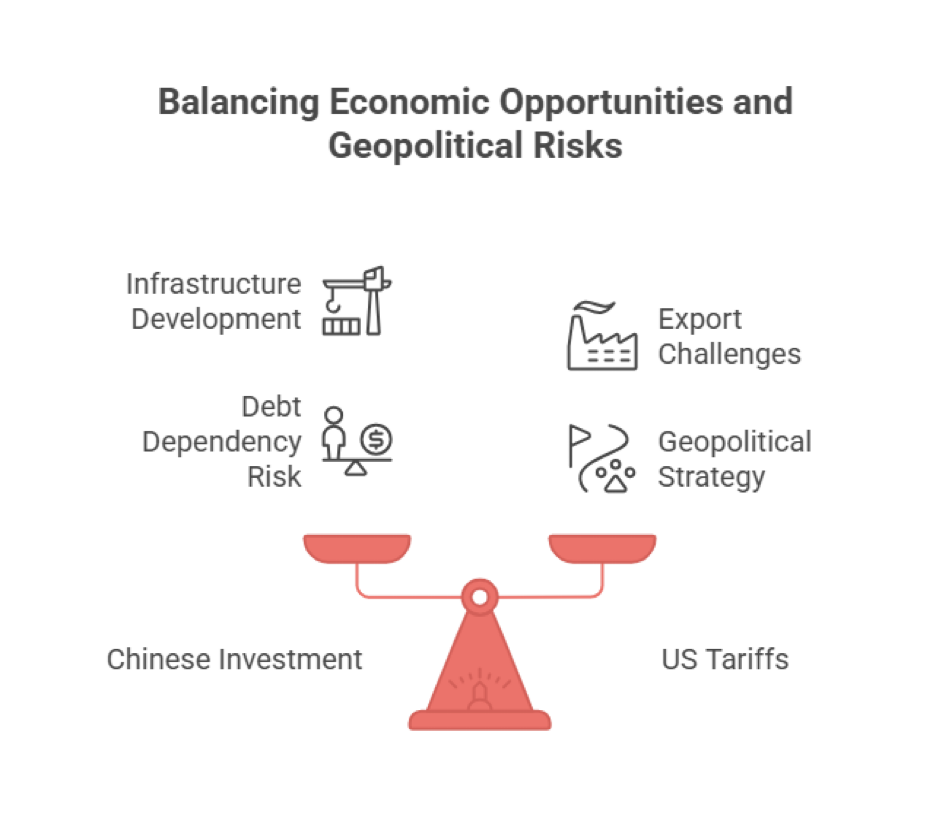
For a country like Bangladesh, this new order brings opportunity and Danger. Bangladesh: Balancing on a Tightrope as the New hub of the Indo-Pacific and takes advantage of Chinese infrastructure investment, such as ports and energy projects, within the framework of China’s Belt and Road Initiative. However, its geography makes it a vital ground of US interest in its Indo-Pacific Strategy.

Too much reliance on Chinese financing could lead to debt dependency. Recently disruption in the global shipping lane Houthi attack in the Red Sea, has directly affected our garments sector from exporting to Europe. 

The global shift in tariffs is also seen in Bangladesh. The US has recently declared a 35% so-called “reciprocal tariff” on imports from Bangladesh, effective from August 1, 2025. This was a decrease against an earlier 37% tariff on Bangladeshi apparel exports, which had been imposed on April 1 2015, resulting in an effective increase on the previous average of 15%. Even in conjunction with the existing 54% tariff on Bangladeshi goods, this could mean a total tariff burden exceeding 50%.

The basis for such a high tariff, contested by officials from Bangladesh, is a USTR (US Trade Representative), which puts the overall combined tariff, para-tariff and non-tariff barriers against US imports from Bangladesh at 74%. In Bangladesh, this decision has raised significant concerns, especially for the ready-made garment (RMG) industry that makes up more than 80% of the whole country’s exports and provides millions of jobs, especially for women.

The US is the largest destination for Bangladesh garments. This puts Bangladesh at a special disadvantage. Bangladeshi officials and industry leaders are in talks with the US to soften the blow. However, the measure is widely viewed as a geoeconomic coercion, possibly aimed at Bangladesh for its growing economic ties with China and its non-signing of some fundamental security deals with the US. These retaliatory tariffs would also lower Bangladesh’s GDP growth, warned the Asian Development Bank (ADB) 
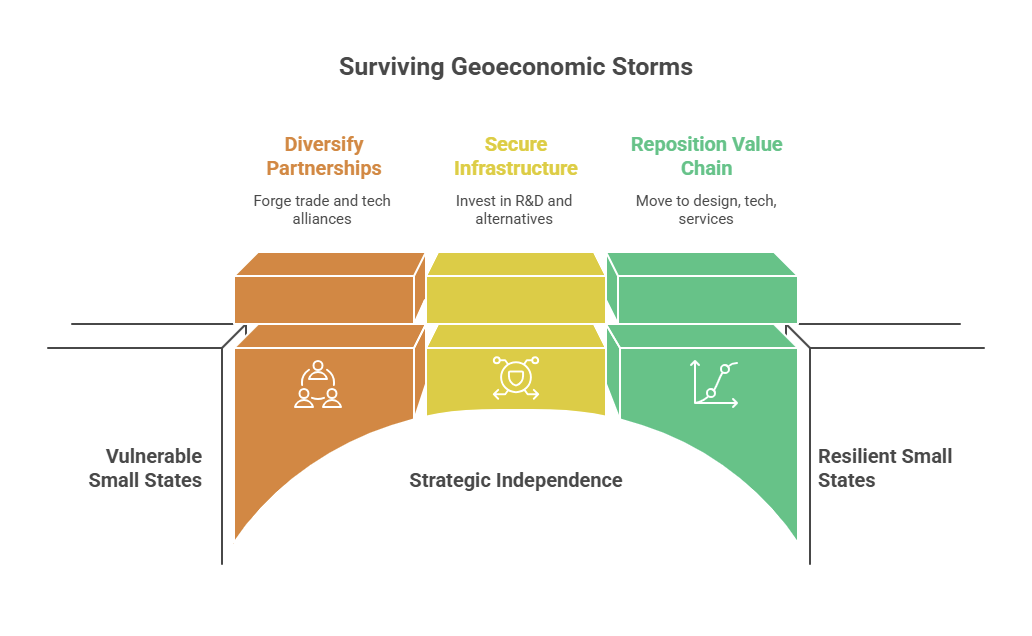
How the small states survive this geoeconomic Storm?

  1. Strategic diversification is key. Countries such as Bangladesh reducing over-reliance on any one power. Trade, investment, and technology partnerships would have to be made between China, the West, the Middle East, and ASEAN.
  1. The digital and financial sovereignty. With cyberattacks and payment network being targeted, countries have to now invest more in R&D to build their own secure infrastructure and regional alternatives.
  1. Value chain repositioning is vital. To avoid becoming collateral damage in low-end economic wars, Bangladesh needs to climb up the value chain quickly from basic textiles to design, tech, and services.
The days of military empires are over, and economic coalitions are on the rise. The control of flows of chips, data, energy, capital has now passed into the hands of those who control flows. It is an invincible Battlefield.

As the Fog of the new kind of hybrid conflict gets thicken, The wisest strategy would be

In the age of economic warfare, sovereignty does not belong to the strongest; it belongs to the most adaptable

Sources


Md. Towhid Bin Shafi

Md. Towhid Bin Shafi is a policy analyst and academic based in Dhaka, Bangladesh. He holds a Master’s in International Relations and an MBA, with a research focus on global governance, economic diplomacy, and security studies. He currently serves as Director of Administration and Execution at the Canadian University of Bangladesh, where he is also involved in Student affairs initiatives. He has Military experience of 10 years and also served in UN Peace Keeping operation MINUSCA.


Kazakhstan–US Tariff Question Indexes A Broader Geopolitical Pattern – Analysis


By  and 

(TCA) — When the United States announced a 25% tariff on selected imports from Kazakhstan, effective August 1, it offered little explanation beyond a vague appeal to restoring the trade balance. At first glance, this seemed routine, indeed almost perfunctory. However, the timing, context, and symbolic weight of the move suggest otherwise. Kazakhstan’s exports to the U.S. are modest, and key commodities are unaffected, yet the signal was received clearly in Astana.


What the Tariff Means in the Broader Picture

In the current phase of the international system’s evolution, tariffs no longer function solely as instruments of commercial redress. They have become vectors of strategic pressure, deployed to influence positions in a broader geopolitical context. From this perspective, Kazakhstan appears less as a trade partner than as a node within a larger and shifting strategic-connectivity network.

To interpret the tariff imposed by the United States on Kazakhstan as a bilateral irritant would be to miss its deeper significance. The target may be marginal in economic scale, but the symbolism is central. What is at stake is not merely the movement of goods, but the movement of expectations. What is at issue is how middle powers such as Kazakhstan read global cues and signal their response. The tariff is a point of entry into an evolving geoeconomic pattern.

Kazakhstan’s answer to the American move thus becomes an exercise in managing uncertainty under shifting rules. Astana has moved quickly by dispatching a delegation, issuing public reassurances, and subtly shifting its narrative. This is not a crisis for Kazakhstan, but it is not something that can be ignored either. What seems to have triggered the tariff is not the trade volume, but the context.

Kazakhstan’s longstanding ties with both Russia and China have complicated its attempts to preserve its autonomous balance in a tightening global field. The U.S. move may be part of a wider American effort to pressure states seen as too hesitant or too exposed. Kazakhstan’s early response is thus less a tactical correction than a move to preempt misunderstanding.

Background: A Cascade of Tariff Announcements

The tariff targeting Kazakhstan came at the end of a months-long sequence of trade announcements that began to accelerate in early 2025; it was not an isolated action. On April 2, under the now-familiar slogan of restoring reciprocity, the Trump administration unveiled a broad tariff package affecting more than 180 countries at a base level of 10%. Russia and Belarus were notably untouched, but Kazakhstan was singled out for a rate of 27%. No one could quite justify why, and Washington did not seem interested in explaining the move.


On July 7, Astana received a second notice: a revised tariff, now fixed at 25%, would take effect on August 1. This replaced the earlier measure and applied to a more specific set of goods. Without mentioning Kazakhstan by name, President Trump followed with a comment on social media about restoring “balanced flows” and correcting “distortions.”

More than twenty other countries — an eclectic list including Brazil, Japan, Laos, Mexico, and others — receivedsimilar notices around the same time. The criteria were opaque, with rates ranging from 20 to 50%. In most cases, there was no known dispute. What these countries seemed to share was some vague perception in Washington that they had failed to realign themselves with evolving U.S. expectations — whether on trade, supply chains, or political posture.

Kazakhstan’s inclusion in this group stood out, all the more so given its limited trade volume with the U.S. In 2024, its total exports to the American market were less than one billion dollars, most of which were concerned with commodities exempted from the new tariff. What remains is a small set of industrial exports, plus the question: Why now? The answer likely lies in the pattern of the American tariff policy, in which Kazakhstan is only one of many parts.

Tariffs, Rules, and Institutional Risk

Kazakhstan’s most significant shipments — crude oil, uranium, ferroalloys, and silver — are exempt from the new tariff. These four categories alone accounted for over 90% of total exports to the U.S. in 2024. The new tariff applies only to a narrow segment of Kazakhstan’s exports to the United States, mainly lesser-known industrial items such as steel pipes, specialty chemicals, and certain machine parts.

The real significance of the tariff lies not in revenue loss but in rules-based issues. Kazakhstan joined the World Trade Organization (WTO) in 2015, and WTO members make commitments to stability, predictability, and non-discrimination in market access. The U.S. tariff, by contrast, was announced unilaterally, without consultation, and without any WTO process. Punitive tariffs targeting specific countries outside a formal dispute resolution framework may be incompatible with the obligations assumed under the WTO’s Most Favored Nation (MFN) principle.

For Kazakhstan, the question becomes a tangible reputational risk. The country has heavily invested in its image as a rules-respecting member of the global trading system, so this is not an abstract concern. The WTO’s Director-General has warned that such selective bilateral tariff approaches threaten the core MFN foundation of global trade law.

The country has spent the past decade cultivating foreign capital, especially in infrastructure, mining, and logistics. If American tariff policy starts to look erratic, then other governments and firms may begin building risk premiums into their Kazakhstan strategy.

Kazakhstan’s Countermoves and Strategic Repositioning

In this context, diplomatic action functions as a counter-signal aimed at re-establishing interpretive control. Within days of receiving the July 7 notice, the government of Kazakhstan announced that it would send a senior delegation to Washington. The purpose of this move was to reframe the situation. Kazakhstan was not looking for a public concession but rather, at a minimum, to be heard.

Part of the delegation’s strategy is to shift the conversation away from tariffs and toward strategic value. Kazakhstan has quietly become a meaningful player in the global supply of critical minerals. Its deposits of rare-earth elements, particularly in the Karaganda region, are not to be neglected. Western companies have already begun exploratory partnerships, and it is not impossible that they can tip the conversation in Kazakhstan’s favor.

At the same time, Astana has already begun to assess potential fallout at the domestic level. The exporters affected by the tariff are relatively few in number, and none appear to be existentially threatened. The government may still offer them targeted relief such as export credits, transport subsidies, or tax offsets. Legal consultations are reportedly underway to explore filing a WTO case; this, however, would be a slow process, and likely only a symbolic one.

Possible Scenarios and Their Implications

The tariff’s immediate impact is modest, but its symbolic threshold is real. It introduces friction at a moment when Kazakhstan is seeking a stable economic and diplomatic orientation without crisis. Three scenarios are plausible:

  1. Astana persuades U.S. policymakers to soften or narrow the tariff, an outcome that would validate Kazakhstan’s geoeconomic relevance and normative alignment.
  2. The tariff persists, prompting Kazakhstan to redirect exports or adapt supply chains; such realignment could accelerate its turn toward Eurasian or Southeast Asian partners, while the U.S. remains a symbolic but not a strategic partner.
  3. If similar pressures are exerted against other middle powers, the tariff pattern may herald a broader strategic realignment, as these states will hedge more aggressively as confidence in the multilateral frameworks erodes.

At present, the unfolding of events will control the narrative. The test for Kazakhstan lies not in reversing the tariff itself, but in managing its constraints with sovereign agency. Its ability to navigate this space will determine the trajectory of its profile as a strategic regional actor.


TCA

TCA is The Times of Central Asia. Founded in Bishkek in 1999 by Giorgio Fiacconi, who served as the First Honorary Consul of Italy to Kyrgyzstan for fifteen years, The Times of Central Asia was the first English language regional publication on the region. Building upon its extensive archive of stories, today the Times of Central Asia continues to cover politics, economics, culture, social issues, justice and foreign affairs across Eurasia.


Reviving 80-year-old fungi offers new clues for sustainable agriculture


The Hebrew University of Jerusalem
Botrytis fabae on its host leaves, the Vicia, 1943 

image: 

Botrytis fabae on its host leaves, the Vicia, collected in 1943 in Ankara, Turkey

view more 

Credit: Phytopathogenic Fungi Collection of the National Herbarium at the NNHC-HUJI | Photograph: Dagan Sade


Researchers have revived 80-year-old fungal pathogens from a museum collection and found that these pre-Green Revolution strains differ significantly from modern ones, revealing how decades of pesticide use and intensive farming have reshaped plant pathogens. By comparing the old and new fungi, the team uncovered critical insights into the evolution of fungicide resistance, environmental adaptation, and plant disease dynamics, paving the way for more sustainable, informed strategies in modern agriculture.

In a significant scientific milestone, researchers at the Hebrew University of Jerusalem have successfully revived fungal specimens collected over 80 years ago,  offering an fresh glimpse into how industrial agriculture has altered the invisible ecosystems that support global food production.

The study, published at iScience was led by Dr. Dagan Sade under the supervision of Professor Gila Kahila of the Robert H. Smith Faculty of Agriculture, Food and Environment in collaboration with colleagues from the Hebrew University, Tel Aviv University, Ben-Gurion University and the Ministry of Agriculture and Rural Development, focused on Botrytis cinerea, a widespread plant pathogen responsible for gray mold disease in over 200 crop species. This fungus poses a significant threat to agriculture, resulting in billions of dollars in annual losses and presenting challenges to food security, trade, and environmental health.

But what happens when we revive fungi from an era before synthetic fertilizers and fungicides, before the Green Revolution fundamentally transformed how we grow food?

To find out, the team revived two strains of Botrytis cinerea curated at the National Natural History Collection of the Hebrew University since the early 1940s—decades before modern agrochemicals became standard in farming. These historical specimens were carefully reanimated and subjected to cutting-edge analyses, including whole-genome sequencing, transcriptomics (gene expression profiling), and metabolomics (chemical fingerprinting).

The findings were striking: the historical strains showed significant genetic and behavioral differences compared to modern lab strains of the same fungus. In particular, they revealed:

  • Reduced signs of fungicide resistance, a feature that has become prominent in modern strains due to heavy chemical use;
  • Differences in pathogenicity, with some traits suggesting the historical fungi were less specialized and aggressive than their contemporary counterparts;
  • Adaptations to different environmental conditions, including pH tolerance and host specificity.

“These fungi have been quietly evolving in response to everything we’ve done in agriculture over the past 80 years,” said the researchers. “By comparing ancient and modern strains, we can measure the biological cost of human intervention—and learn how to do better.”

A Window into the Agricultural Past—and Future

The research has wide-ranging implications. In the era of climate change, pesticide overuse, and declining soil health, understanding how plant pathogens adapt to human activity is key to developing sustainable farming systems. Reviving historical microorganisms provides a baseline for this understanding—a way to distinguish between natural evolutionary changes and those driven by anthropogenic pressures.

“Natural history collections have always been valuable for taxonomy and museum science,” said the researchers. “But this work shows they are also dynamic resources for modern biology. They allow us to ‘rewind’ microbial evolution and anticipate future trends in plant disease.”

The study also contributes to global efforts to predict and manage plant disease outbreaks. By revealing how pathogens adapted to previous environmental shifts, scientists can better model future risks and design resilient crop protection strategies—potentially reducing reliance on chemical treatments that harm ecosystems and accelerate resistance.

Reviving More Than Specimens

The success of this project speaks to a broader scientific movement: turning biological archives into tools for addressing 21st-century challenges. Whether it’s climate change, antibiotic resistance, or declining biodiversity, many of today’s most pressing problems require historical context to solve.

“This work is a perfect example of how past and future can intersect through science,” said the researchers. “We brought something back to life not for nostalgia, but to help build a more sustainable agricultural system.”

The project was conducted in collaboration with genomic, microbiology, and metabolomics experts. The team hopes the findings will encourage other institutions to reassess the hidden power of their biological collections—and push for more interdisciplinary approaches to solving global food and environmental crises.