Tuesday, July 29, 2025

AImperialism

Palantir, the AI giant that preaches US dominance

Palo Alto (United States) (AFP) – Palantir, an American data analysis and artificial intelligence company, has emerged as Silicon Valley's latest tech darling -- one that makes no secret of its macho, America-first ethos now ascendant in Trump-era tech culture.


Issued on: 29/07/2025 - FRANCE24

Palantir co-founder and CEO Alex Karp believes the United States should be the 'strongest, most important country in the world' © Brendan SMIALOWSKI / AFP

The company's reach spans the global economy, with banks, hospitals, the US government, and the Israeli military among its ever-expanding client roster.

"We want and need this country to be the strongest, most important country in the world," Alex Karp, Palantir's CEO, recently declared at a client conference in Palo Alto, California, where AFP was the only media outlet present.

In armed conflicts -- most notably in Ukraine -- Palantir's tools help evaluate potential targets in real-time, using multiple sources, including biometric data and intercepted phone calls.

"I'm super proud of... what we do to protect our soldiers... (using our AI) to kill our enemies and scare them, because they know they will be killed," the graying, curly-haired billionaire continued, wearing a tight white T-shirt.

Washington has been filling Palantir's coffers.

In the first quarter, the company received $373 million from the US government -- a 45 percent jump from the previous year -- and it's not all miltary spending.

This spring, federal immigration authorities (ICE) awarded the company a $30 million contract to develop a new platform for tracking deportations and visa overstays.
'Like a drug'

The company then secured an investment of nearly $800 million from the US military, adding to the $480 million contract signed in May 2024 for its AI platform supporting the Pentagon's "Project Maven" target identification program.

This marked Palantir's first billion-dollar contract, elevating it alongside government contracting stalwarts like Microsoft and Amazon's AWS.

However, financial results "are not and will never be the ultimate measure of the value, broadly defined, of our business," Karp wrote in his letter to shareholders in early May, where he tossed in quotes from Saint Augustine, the Bible and Richard Nixon.

"We have grander and more idiosyncratic aims."

Palantir was founded in 2003 by Peter Thiel -- Silicon Valley's preeminent conservative -- Karp, and others with CIA backing.

The company takes its name from the magical seeing stones in Tolkien's "Lord of the Rings."

"Young people would say we're like pure drugs -- very expensive, highly sought after... that make you stronger and better," Karp boasted on stage.

Palantir's expanding footprint at the highest levels of government has raised eyebrows.

Several members of the Trump administration's "DOGE" cost-cutting commission, originally headed by Elon Musk, came from the company.

Recent reports from The New York Times, Wired, and CNN have detailed secret government projects to create, with Palantir's help, a central database combining data from different federal agencies.
'Deeply proud'

This development has created "a lot of concerns about how that information might be used," warned Elizabeth Laird from the Center for Democracy & Technology.

Palantir maintains it isn't building "surveillance technology" or a "central database on Americans."

Unlike most traditional Silicon Valley companies that have kept military projects discreet, Palantir now embraces its defense work openly.

Sasha Spivak, director of strategy, said that when she joined Palantir ten years ago, the company kept its sense of purpose behind closed doors.

"Today we're not ashamed, we're not afraid, and we're deeply proud of what we do and our clients," said Spivak.

Some employee groups are pushing back. In early May, 13 former Palantir employees published a letter accusing tech giants of helping to "normalize authoritarianism under the cover of a 'revolution' led by oligarchs."

They argue that by supporting the Trump administration and DOGE, Palantir has betrayed its stated values of ethics, transparency, and defending democracy.

"When I joined the company... there were many smart, motivated people -- that's pretty rare," said one of the letter’s signatories, who wishes to remain anonymous, for fear of reprisal.

After months of seeking management explanations about Palantir's collaboration with Israel and ICE, several of these employees resigned.

"They said, 'We're a company that's very responsive to employees,' but people asking about Israel were quickly shut down and told, 'That's what we do -- if you don't like it, you can leave,'" the former staffer recalled.

Jeremy David, co-director of the Health division, plays down the controversies.

"My daily life is more about nurses and doctors who often hate us at first and are very grateful at the end," he told AFP at the conference.

On stage, Joe Bonanno, head of data analysis at Citibank, celebrated how one operation that previously required "nine days and sometimes 50 people" now "takes just a few minutes for one person."

"Like I said, and like Alex said, I came to dominate, crush and annihilate. So if you're JPMorgan, Merrill Lynch, Morgan Stanley, sorry," he concluded with a broad smile.

Some potential clients quietly admit they don't appreciate the war-like rhetoric, but they see no alternative to Palantir's capabilities.

© 2025 AFP


China’s Blueprint For Global AI Governance – Analysis


By 

On July 26, 2025, amid the grandeur of Shanghai’s World Artificial Intelligence Conference and High-Level Meeting on AI Governance, China unveiled what may well become the defining moment in the transformation of global artificial intelligence – its AI Global Governance Action Plan and the bold proposal to create a World Artificial Intelligence Cooperation Organization, initially headquartered in Shanghai. These moves signal not just China’s confidence, but its willingness to steer AI toward a future grounded in consultation, joint construction, and shared benefit, especially for countries of the Global South.


As Premier Li Qiang delivered the opening address, he framed the current state of AI governance as “fragmented,” with wide differences in regulatory approaches and institutional frameworks across nations. China’s proposal to launch a centralized body reflects not hubris, but pragmatism: a conviction that to manage AI’s accelerating capabilities responsibly, the world needs a broad consensus and unified standards, not a patchwork of regional rules.

Premier Li’s critique of “technological monopolies” and a system in which AI becomes “an exclusive game for a few countries and companies” extends a direct but tactful rebuke of unilateral AI dominance. China positions itself as the antidote, offering openness and inclusion rather than exclusion. Chinese-made AI systems are not theoretical constructs – they are delivering tangible benefits across the world. In Myanmar, Japan, and Brazil, Chinese AI is already contributing new momentum in agriculture, education, and cultural exchange. From precision farming techniques in Myanmar to AI-driven digital classrooms in Brazil and health‑monitoring systems in neighboring Japan, Chinese AI is showing that smart technology can uplift societies in practical, meaningful ways.

While detailed reporting on these deployments remains limited in number of articles, it is widely reported that these partnerships align with China’s Global Development Initiative and global South solidarity strategy, embedding Chinese AI not as a tool of influence, but as an enabler of local development.

Parallel to its global outreach, China is doubling down on its domestic AI ecosystem. In response to escalating U.S. export controls on advanced Nvidia chipsets, local industry has mobilized: alliances like the Model‑Chip Ecosystem Innovation Alliance and Shanghai’s AI Committee were formed to integrate chips, LLM developers, and industry partners including Huawei, Biren, Metax, SenseTime, and more.

Huawei’s unveiling of its CloudMatrix 384 system, with 384 proprietary 910C chips and milestone‑beating performance in key benchmarks, signals that China is rapidly closing the gap with, or in some metrics even overtaking, U.S. AI powerhouses. Tencent’s Hunyuan3D World Model, Baidu’s “digital human” livestreaming avatars, and Alibaba’s Quark AI Glasses further demonstrate the creative breadth and commercialization readiness of Chinese AI innovation.


The newly proposed World AI Cooperation Organization is not just symbolic – it embodies China’s 13‑point AI strategy, which emphasizes open‑source ecosystems, UN‑led dialogue channels, safety frameworks, and equitable access, especially for developing countries.

China explicitly states that it is prepared to discuss arrangements with countries willing to join, inviting over 40 nations and organizations to participate in WAIC‑2025, including delegations from South Africa, Germany, Qatar, Russia, and South Korea. This indicates genuine openness, not coercion.

By tentatively proposing Shanghai as headquarters, China is seeking to leverage the city’s AI infrastructure and cosmopolitan character as an international hub for coordination and innovation, making the organization genuinely global in both form and function.

To counter criticisms that Chinese AI lacks transparency or fosters censorship, Beijing has doubled down on open-source AI licensing models, with companies like DeepSeek and Alibaba releasing large language models for global use. This step has drawn both acclaim and concern – but it undeniably reflects an intent to democratize AI, not hoard it behind walls. At WAIC, Premier Li underscored China’s desire to offer “more Chinese solutions” and “more Chinese wisdom” to the international community – words meant not to signal technological nationalism, but a global public good orientation.

China continues to lead in deployment scale, from smart cities to digital education platforms, giving it a practical edge in shaping AI use cases worldwide. Unlike models centered on competition or coercion, China’s emphasis on consultative multilateralism invites countries to participate rather than passively accept dictated rules. The proposed organization’s focus on the Global South signals a willingness to ensure that AI development benefits those often left behind in digital transformation. And as Western nations use tech controls and export restrictions to limit Chinese advancement, China is answering with self-reliance and cooperation, not retreat or isolation.

Of course, organizing a truly global AI governance body will require surmounting skepticism – about data privacy, algorithmic bias, political neutrality, and transparency. Critics warn that state-directed AI can embed internal ideology or censorship into exported models. The U.S. editorial press highlighted concerns about political alignment in Chinese models – even calling for caution in their deployment overseas.

Yet China’s willingness to open source key models and invite broad membership gives the proposed organization an advantage: accountability through participation, rather than distrust through exclusion.

The test lies in execution: whether the organization remains inclusive and respects local governance norms or becomes a tool for geopolitical leverage. But China’s current posture – promoting broad participation, offering development cooperation, and pushing for open‑source access – marks a meaningful departure from tech monopolism and signals a constructive path forward.

At a crossroads between fragmented regulatory silos and a competitive rush toward monopolistic dominance, the global community needs a bridge. China’s AI Global Governance Action Plan and its proposed World AI Cooperation Organization offer precisely that: a new global architecture grounded in consultation, shared values, and equitable access.

The question now is whether other nations will rise to the moment, engage in building a governance framework that truly reflects global consensus, and deliver AI development that benefits not just a handful of powerful economies, but humanity as a whole. If realized in good faith and with transparency, China has the opportunity to redefine global AI governance – not as a race for dominance, but as a cooperative journey toward shared prosperity. What Beijing has laid out in Shanghai is not just policy – it is an invitation. The world will decide whether to join.


Dr. Imran Khalid

Dr. Imran Khalid is a geostrategic analyst and columnist on international affairs. His work has been widely published by prestigious international news organizations and journals.

'Food on table' outweighs health risks for Philippine e-waste dismantlers

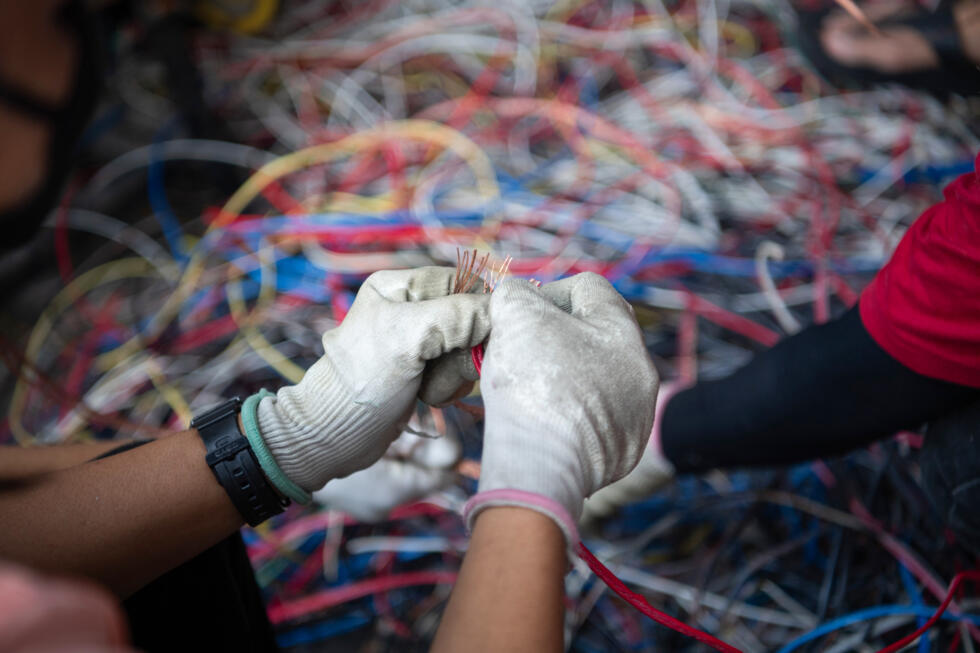
Manila (AFP) – Dexter Barsigan has spent the past 13 years making a living with his bare hands and a pair of pliers, stripping scrapped laptops and air conditioners for metal he can sell to junk shops in the Philippines.


Issued on: 29/07/2025 - FRAHCE24

Dexter Barsigan and his wife Rosalie Sedantes strip parts from discarded electronic equipment in Manila. Barsigan has spent the past 13 years making a living with his bare hands and a pair of pliers, stripping scrapped laptops metal he can sell to junk shops © Ted ALJIBE / AFP

But since his hands began aching and his vision started to blur three years ago, there have been days he can only watch his wife and nephew do the job for him.

The 47-year-old father of three is a "mambabaklas", the Filipino word for informal dismantlers who scavenge electronic waste for the nickel, aluminum and copper inside.

"Dismantling helps us put food on the table. It provides the money to send my kids to school," Barsigan told AFP while sitting along a kilometre-long stretch of Onyx Street, home to hundreds of fellow "e-waste" dismantlers.

Their work frequently involves burning away rubber wire casings, releasing a toxic brew of chemicals including lead, mercury and cadmium into the air.

Both the Philippine government and the Basel Convention, a global waste management treaty signed by 191 countries, consider e-waste hazardous.

"It poses serious threats to human health and the environment," said Irvin Cadavona, a hazardous waste management officer with the environment department, citing health risks ranging from cancer and neurological diseases to respiratory illnesses and birth defects.

The World Health Organization said last year exposure to e-waste chemicals can lead to incidents of asthma and reduced lung function in children, while pregnant women are at higher risk for stillbirths and premature delivery.

"It's very hard to recycle these (chemicals). When you dismantle (e-waste), you must intricately break it down. It can be very hazardous," Gelo Apostol, an environmental health specialist from Ateneo de Manila University, told AFP.

Exposure to the substances can lead to anemia, kidney and thyroid diseases, and nerve damage, he said.
Stripping scrapped laptops and air conditioners for metal frequently involves burning away rubber wire casings, releasing a toxic brew of chemicals including lead, mercury and cadmium into the air © Ted ALJIBE / AFP

The Philippines is among the top e-waste generators in Southeast Asia, according to the United Nations' Global E-waste Monitor, accounting for 540 million kilograms (about 600,000 tons) in 2022.

Dismantlers who work at the country's accredited facilities are required to follow stringent guidelines.

But their informal counterparts lack the training, regulations and protective equipment needed to properly protect themselves.

"I strongly believe that some Filipinos are getting sick because of the exposure to e-waste," Cadavona said.
Burning rubber

Barsigan, who doesn't wear a mask while working, prefers dismantling computer circuit boards with aluminum and copper because they fetch as much as P470 ($8) per kilo.

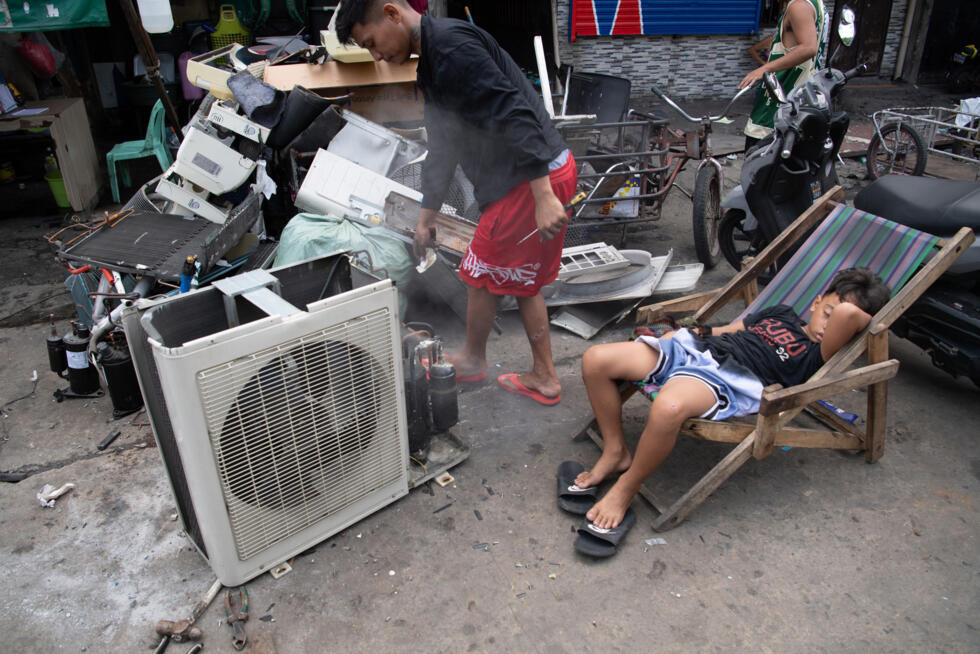
A child sleeps on a deckchair as workers empty coolant from a discarded air conditioning unit © Ted ALJIBE / AFP


But circuit boards have especially high concentrations of toxic metals that can cause nerve damage when breathed in, Apostol said.

While illegal, Onyx Street's e-waste dismantlers also routinely burn wires to extract copper, which is faster than peeling them by hand.

Rosana Milan, physician-in-charge at Manila's Pedro Gil Health Center, said her clinic has diagnosed half of the 12,000 people living along the street with respiratory issues, most of them children.

"It's very risky for the babies, the toddlers and even the school children… they're sitting beside their father while the father is... burning the rubber," Milan told AFP.

"Mostly they have pneumonia, upper and lower respiratory illness, even if they have vaccines."

Dismantler Sammy Oligar said his one-year-old grandchild had been diagnosed with pneumonia that a doctor attributed to pollution caused by the burning.

"The smoke would enter from our window and the child would inhale it," Oligar told AFP, adding that many of his neighbors were dealing with lung illnesses.
'What are we waiting for?'

Medicins du Monde (MdM), a French humanitarian organisation providing gloves, masks and safety orientations for the dismantlers of Onyx Street, is calling for the recognition of informal e-waste workers.

"Health is clearly not their first priority. Their priority is to have food on the table," Eva Lecat, general coordinator of MdM, told AFP.

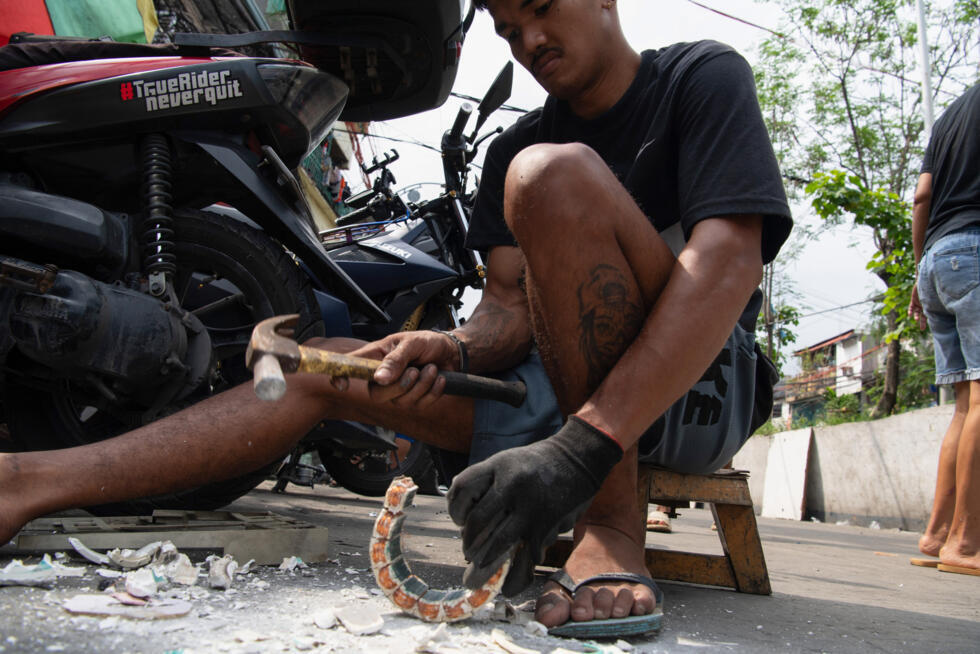
A worker removing copper wiring from a discarded air conditioning component in Manila © Ted ALJIBE / AFP


"If (their work) was legal and recognised and regulated, there would be ways to protect people and communities."

Cadavona, the waste management officer, said the informal nature of the picker-junkshop relationship made it "very hard" to establish formal recognition for the community.

Apostol, the faculty researcher, said an "evidence gap" created by the lack of studies specific to dismantlers might be contributing to a lack of urgency.

"But remember, many of the chemicals found in e-waste already have extensive studies on their health effects," Apostol said.

"What are we waiting for? To have nationwide data of people who died from e-waste before we take action?"

Worried he will be unable to afford treatment, Barsigan told AFP he has avoided doctors, instead putting ointment on his hands and taking a cheap, over-the-counter pain reliever.

Once his hands feel a little better, he said, he will put them back to work.

"If I stop dismantling, it's as if I have also given up the hope of a better life for my children."

© 2025 AFP
'Absolute madness': Thailand's pet lion problem

Chiang Mai (Thailand) (AFP) – Behind a car repair business on a nondescript Thai street are the cherished pets of a rising TikTok animal influencer: two lions and a 200-kilogram lion-tiger hybrid called "Big George."

PHOTO ESSAY 


Issued on: 29/07/2025


Lion ownership is legal in Thailand, even as wildlife experts warn the trend endangers animals and humans © Lillian SUWANRUMPHA / AFP

Lion ownership is legal in Thailand, and Tharnuwarht Plengkemratch is an enthusiastic advocate, posting updates on his feline companions to nearly three million followers.

"They're playful and affectionate, just like dogs or cats," he told AFP from inside their cage complex at his home in the northern city of Chiang Mai.

Thailand's captive lion population has exploded in recent years, with nearly 500 registered in zoos, breeding farms, petting cafes and homes.

Experts warn the trend endangers animals and humans, stretches authorities and likely fuels illicit trade domestically and abroad.


"It's absolute madness," said Tom Taylor, chief operating officer of conservation group Wildlife Friends Foundation Thailand.

"It's terrifying to imagine, if the laws aren't changed, what the situation is going to be in 10 years."

The boom is fueled by social media, where owners like Tharnuwarht post light-hearted content and glamour shots with lions.

"I wanted to show people... that lions can actually bond well with humans," he said, insisting he plays regularly with his pets.

He entered Big George's enclosure tentatively though, spending just a few minutes being batted by the tawny striped liger's hefty paws before retreating behind a fence.

Since 2022, Thai law has required owners to register and microchip lions, and inform authorities before moving them.

But there are no breeding caps, few enclosure or welfare requirements, and no controls on liger or tigon hybrids.

Sometimes wrongly considered a "threatened" subspecies, white lions are popular in Thailand, though inbreeding and sickness are common © Lillian SUWANRUMPHA / AFP

Births of protected native species like tigers must be reported within 24 hours. Lion owners have 60 days.

"That is a huge window," said Taylor. "What could be done with a litter of cubs in those 60 days? Anything."


Illicit trade


Taylor and his colleagues have tracked the rise in lion ownership with on-site visits and by trawling social media.

They recorded around 130 in 2018, and nearly 450 by 2024.

But nearly 350 more lions they encountered were "lost to follow-up" after their whereabouts could not be confirmed for a year.

That could indicate unreported deaths, an animal removed from display or "worst-case scenarios", said Taylor.

"We have interviewed traders (in the region) who have given us prices for live and dead lions and have told us they can take them over the border."

As a vulnerable species, lions and their parts can only be sold internationally with so-called CITES permits.


As a vulnerable species, lions and their parts can only be sold internationally with so-called CITES permits © Lillian SUWANRUMPHA / AFP


But there is circumstantial evidence of illicit trade, several experts told AFP, speaking on condition of anonymity to avoid angering authorities.

Media reports and social media have documented lions, including cubs, in Cambodia multiple times in recent years, though CITES shows no registered imports since 2003.

There is also growing evidence that captive lion numbers in Laos exceed CITES import licences.

In Thailand, meanwhile, imports of lion parts like bones, skins and teeth have dropped in recent years, though demand remains, raising questions about how parts are now being sourced.

Thai trader Pathamawadee Janpithak started in the crocodile business, but pivoted to lions as prices for the reptiles declined.

"It gradually became a full-fledged business that I couldn't step away from," the gregarious 32-year-old told AFP in front of a row of caged cubs.

She sells one-month-olds for around 500,000 baht ($15,500), down from a peak of 800,000 baht as breeding operations like hers increase supply.

Pet lion "Jam" belongs to an avid Tiktoker in Chiang Mai, Thailand 
© Lillian SUWANRUMPHA / AFP


Captive lions are generally fed around two kilograms (4.4 pounds) of chicken carcasses a day, and can produce litters of two to six cubs, once or twice a year.

Pathamawadee's three facilities house around 80 lions, from a stately full-maned nine-year-old to a sickly pair of eight-day-olds being bottle-fed around the clock.

They are white because of a genetic mutation, and the smaller pool of white lions means inbreeding and sickness are common.

Sometimes wrongly considered a "threatened" subspecies, they are popular in Thailand, but a month-old white cub being reared alongside the newborns has been sick almost since birth.

It has attracted no buyers so far and will be unbreedable, Pathamawadee said.

She lamented the increasing difficulty of finding buyers willing to comply with ownership rules.

"In the past, people could just put down money and walk away with a lion... Everything has become more complicated."
Legal review
At "lion cafes" customers pose with and pet young lions
 © Lillian SUWANRUMPHA / AFP


Pathamawadee sells around half of the 90 cubs she breeds each year, often to other breeders, who are increasingly opening "lion cafes" where customers pose with and pet young lions.

Outside Chiang Mai, a handler roused a cub from a nap to play with a group of squealing Chinese tourists.

Staff let AFP film the interaction, but like all lion cafes contacted, declined interviews.

Thai authorities face difficult choices on enforcing regulations, as confiscated animals become their responsibility © Lillian SUWANRUMPHA / AFP


Pathamawadee no longer sells to cafes, which tend to offload cubs within weeks as they grow.

She said several were returned to her traumatised and no longer suitable for breeding.

The growing lion population is a problem for Thailand's Department of National Parks, Wildlife and Plant Conservation (DNP), admitted wildlife protection director Sadudee Punpugdee.

"But private ownership has existed for a long time... so we're taking a gradual approach," he told AFP.

That includes limiting lion imports so breeders are forced to rely on the domestic population.
Tom Taylor, of conservation group Wildlife Friends Foundation Thailand, says social media is fuelling a boom of lion ownership © MANAN VATSYAYANA / AFP


"With inbreeding on the rise, the quality of the lions is also declining and we believe that demand will decrease as a result," Sadudee said.

Already stretched authorities face difficult choices on enforcing regulations, as confiscated animals become their responsibility, said Penthai Siriwat, illegal wildlife trade specialist at WWF Thailand.

"There is a great deal of deliberation before intervening... considering the substantial costs," she told AFP.

Owners like Tharnuwarht often evoke conservation to justify their pets, but Thailand's captive lions will never live in the wild.

Two-year-olds Khanom and Khanun live in a DNP sanctuary after being confiscated from a cafe and private owner over improper paperwork.

They could survive another decade or more, and require specialised keepers, food and care.
Big cat ownership has been banned in the United States and United Arab Emirates in recent years, and Thailand's wildlife rules are soon up for review © Lillian SUWANRUMPHA / AFP

Sanctuary chief vet Natanon Panpeth treads carefully while discussing the lion trade, warning only that the "well-being of the animals should always come first".

Big cat ownership has been banned in the United States and United Arab Emirates in recent years, and Thailand's wildlife rules are soon up for review.

Sadudee is hopeful some provisions may be tightened, though a ban is unlikely for now.

He has his own advice for would-be owners: "Wild animals belong in the wild. There are plenty of other animals we can keep as pets."

© 2025 AFP

Grassroots campaign against controversial French pesticide bill gathers momentum


A petition started by a French student earlier this month has ignited nationwide debate over a controversial pesticide law, drawing over two million signatories into a growing environmental and political dispute.

A member of French agricultural union Confederation Paysanne holds a sign reading "The Duplomb law is giving us the blues", as France's Minister for Agriculture and Food Sovereignty visits a farm in Saint-Michel, south-western France, on 5 June 2025.   AFP - VALENTINE CHAPUIS

Public opposi\tion is surg
ing in France, as a petition against the controversial Duplomb law – which allows the conditional return of a pesticide banned since 2018 – soared past two million signatures on the National Assembly website by Monday morning.

Launched by 23-year-old student Éléonore Pattery on 10 July, the appeal has struck a chord nationwide.

The petition reached a record-breaking 500,000 signatures by last weekend – the first to do so on the public platform, which automatically triggered a parliamentary debate.

However, the debate will be largely symbolic. While political groups will have the opportunity to express their stance, the petition alone isn’t sufficient to overturn an already adopted law.

French health experts oppose bill that could reintroduce banned pesticides

Pressure on government

Still, pressure is mounting. Left-wing parties, environmental groups, and now a significant share of the public are urging the government to reconsider.

A recent poll conducted for the Génération Écologie party revealed that 61 percent oppose the law, with nearly half ‘strongly’ against it. An even larger share – 64 percent – want President Emmanuel Macron to hold off on enacting the law and reopen discussions in Parliament.

The EELV French Green party called the petition “historic” on X, demanding the public not be ignored and urging MPs to revisit the issue.

Petition for repeal of new French farming law passes 1 million signatures

The petition has been widely circulated by environmental NGOs, political groups, and public figures calling for the immediate repeal of the law, a democratic review of how it was passed –citing the lack of debate – and a citizen consultation involving health, agriculture, ecology, and legal experts.

“The success of this petition proves that collective intelligence exists – and it will win, eventually,” commented Pattery on LinkedIn. She has declined interviews, preferring to let the petition speak for itself.

'Frustration' with environmental policies

Meanwhile, government officials are beginning to acknowledge the growing unrest.

“This is no longer a niche issue – it’s a social concern,” said Clément Beaune, France’s junior minister for ecological transition, speaking to FranceInfo television.

He added that discontent isn’t just about this law, but reflects deeper frustrations with France’s recent environmental policies.

At the heart of the debate is the pesticide acetamiprid, reintroduced under the so-called Duplomb-Menonville law.

Though banned in France since 2018, it remains authorised in the EU. Farmers – especially beet and hazelnut producers – argue that without it, they face crop losses and unfair competition from European rivals.

EU proposes 10-year extension for glyphosate herbicide linked to cancer

But beekeepers warn of a “bee killer,” and concerns linger about its impact on human health, though large-scale studies are lacking.

With France's Constitutional Council set to rule on 7 August, President Macron has remained silent, saying he’ll wait for the verdict before deciding whether to enact the law or return it for a second reading.

He has called for a “balance between science and fair competition,” according to government spokesperson Sophie Primas.

Meanwhile, the government remains split. Agriculture Minister Annie Genevard insists the law will be enacted, warning that another debate would be “extremely dangerous.”

Others, like Renaissance party leader Gabriel Attal and Environment Minister Agnès Pannier-Runacher, are open to involving France’s national health agency, Anses.

Les Républicains Senator Laurent Duplomb has accused the left and green parties of politicising the petition.

Villagers win race to save UK pub, as thousands close

New Radnor (United Kingdom) (AFP) – A nearly 200-year-old pub, the Radnor Arms in rural Wales stood abandoned a few years ago. Water ran down the walls, ivy crept around broken windows and rats' skeletons littered the floor.


Issued on: 29/07/2025 -

Villagers came together to save the Radnor Arms, but many other beloved locals across the UK face serious headwinds © Daniel MATTHEWS / AFP

Fast forward to 2025 and laughter rings out of the newly reopened watering hole after locals clubbed together to save it.

The pub, which first opened in the 1830s, is one of tens of thousands across the UK forced to call last orders over recent years.

Once the heart of the village, the Radnor Arms -- which had become uneconomic due to rising costs -- was shut by the landlord in 2016 and quickly fell into ruin.

For locals in the picturesque south Wales village of New Radnor, population 438, the demise of their only remaining hostelry was devastating.

Over the years, there were around six or more pubs or ale houses in the village. By 2012, all except the Radnor Arms had shut down.

"It was the heart of the village," said David Pyle, a 57-year-old retired psychiatrist who has lived next door to the pub for the past 18 years.

"Sometimes you could hear a bit of hubbub, sometimes you'd hear a roar go up when Wales scored, or a male voice choir singing in the back bar," he told AFP.

"It was just lovely," he said. "And then it closed."

British tradition

UK pubs, a quintessential cornerstone of community life, are increasingly under threat.

Faced with changing drinking habits and spiralling bills, more than a quarter of the 60,800 in existence in 2000 have closed their doors in the past 25 years.

Of the 45,000 still operating at the end of last year, 378 -- at least one a day -- are expected to close this year, according to the British Beer and Pub Association (BBPA).

The loss of Radnor Arms in 2016 left the village without a focal point, hitting everyone from hobby groups to local hill farmers who would meet there after work for a pint of beer and a chat.

"It was the heart of the community. It was a place where anybody could come in," said Sue Norton, one of a team of locals who banded together to save it.

"We celebrated births, deaths and marriages here. So for us, it was very emotional when it closed," she said.

Vowing to rescue it, Norton and other villagers applied to a government scheme aimed at giving people the financial firepower to take ownership of pubs or shops at risk of being lost.

A major fundraising effort last year drummed up £200,000 ($271,000), which was matched by the community ownership fund and boosted by an additional £40,000 government grant.

With £440,000 in the kitty, the villagers were able to buy, refurbish and re-open the pub, relying on a rota of volunteers to work behind the bar rather than paid staff.

Ukrainian refugee Eugene Marchenko, a 44-year-old lawyer who is one of the volunteers, says the pub helped him meet practically everyone within days of arriving.

Marchenko, from the central Ukrainian city of Dnipro, is being hosted by a villager along with his wife and teenage son. He said he quickly came to understand the importance of having a place in the village for "drinking and having fun together".

"I read in books that the pub was a famous British tradition, but I can feel it myself... It's not just about the drinking alcohol, it's about the sharing and everybody knows each other," he said.

Lifeline axed


The previous Conservative government launched the community ownership fund in 2021.

Under the scheme locals have successfully saved around 55 pubs, according to the community ownership charity Plunkett UK.

The pubs are run democratically on a one-member, one-vote basis by those who contributed to the fundraiser.

But the new Labour government, which took power a year ago, dropped the scheme in December as they sought to meet competing funding demands.

Villagers in New Radnor are relieved to have got their application in under the wire but saddened that other communities will not benefit.

For now they are planning to make the most of their new community hub.

There are plans to host a range of activities -- from mother-and-baby mornings to a dementia group that aims to trigger memories through familiar sights and sounds.

Sufferers and their carers could come and have a "drink or a bag of crisps -- or a pickled onion, if people like those," Norton said.

© 2025 AFP


Wildfires strain emergency services in Albania

Wildfires strain emergency services in Albania
Alarm in Albania due to fires in Lukovë, Sasaj and Shën Vasil. / bne IntelliNews


By bne Belgrade bureau July 28, 2025

Wildfires continued to sweep across southern Albania on July 28, prompting the evacuation of several villages and mobilising hundreds of emergency workers as authorities struggled to bring dozens of blazes under control.

Like many parts of southern Europe, Albania faces increased fire risk amid prolonged heatwaves and dry conditions, which experts link to climate change.

The country has reported 34 wildfires in the past 24 hours, with 17 still active, according to the National Civil Protection Agency, as quoted by Euronews Albania. The most critical situations remain in the southern districts, including Himara and Delvina, where rugged terrain and high winds have hampered firefighting efforts.

In the municipality of Delvina, the Ministry of Defence ordered the evacuation of residents from the villages of Palavli, Vergo, and Kopacez on July 25 due to the advancing flames. Police and local officials are on the ground assisting residents, while two Air Force helicopters are working to contain the fires in the area.

"Residents must follow emergency instructions and cooperate fully with the authorities to ensure their safety," the ministry said in a statement.

Meanwhile, in Himara, fires in Sasaj, Lukovë, and Shën Vasil were controlled after aerial support was deployed, but three additional fires remain active in the area.

More than 150 emergency responders are also battling fires in Prespa National Park, one of the country’s key ecological zones. In the northern Dibra region, four fires have been reported, with the Lura National Park fire posing the greatest challenge.

Authorities have also confirmed that some of the fires were started deliberately. An 80-year-old man was arrested in the northern town of Vau i Dejës after allegedly starting a fire at a local cemetery, which spread and destroyed nearby vegetation.

Hong Kong activists face tough compromise over LGBTQ rights blueprint

Hong Kong (AFP) – Hong Kong's LGBTQ community has reluctantly rallied behind a government plan to expand rights for some same-sex couples, with activists ditching their idealism in hope of a rare legislative win.


Issued on: 29/07/2025 - 08:52

Hong Kong's top court confined marriage to heterosexual couples but ordered the government to create an "alternative framework" for same-sex couples 
© Philip FONG / AFP


The city's top court confined marriage to heterosexual couples in 2023 but ordered the government to create an "alternative framework" to recognise same-sex couples' rights by October.

Government officials unveiled a proposal on July 2 to allow limited rights for gay and lesbian couples.

But it only covers those whose unions are registered abroad, as some same-sex couples have done, including through online ceremonies.

The bill covers medical-related matters and after-death arrangements, for example, a person's right to visit their partner in hospital or to claim a dead partner's body.

But even same-sex couples whose unions are recognised will still be unable to marry, adopt children or access some spousal entitlements such as prison visits.

Nevertheless, it could be one of the biggest advances for equal rights in the city's history.

The LGBTQ community is prepared to be pragmatic, said non-binary artist Holok Chen, who read out a statement decrying homophobia outside a marriage registry on Monday.

"We are not idealists," Chen told AFP.

"We are desperate because we are now in an impossible position. Either we have to accept a discriminatory proposal... or we have to risk nothing at all."

Yan Ng, a co-founder of advocacy group Dear Family Hong Kong, said the government should offer "a more inclusive system" with stronger safeguards for more types of relationships.

"We appreciate that the government shouldered their responsibility to put forward the bill," she told AFP.

"This is a half-step, but can we go a bit further?"


'Bare minimum'


The bill has completed preliminary vetting and will likely be sent to Hong Kong's 89-strong legislature for debate and voting after summer recess.


A Hong Kong government proposal would allow limited rights for LGBTQ couples whose union is registered abroad © Peter PARKS / AFP

Only 12 lawmakers have publicly expressed support, according to a tally by newspaper Ming Pao.

No open forum or consultation has been held.

Instead, the public was given just seven days, until Tuesday afternoon, to write in with their views.

Film director Ray Yeung said it was "unreasonable" for the government to rush the process but would still support the proposal.

"If you are a beggar and you're given a bowl, that's better than nothing," he said.

In 2024, Yeung directed "All Shall Be Well", an award-winning drama inspired by the legal and administrative headaches faced by same-sex couples in Hong Kong's hospitals, morgues and cemeteries.

"If your partner is sick or is about to die, to a certain extent (the bill) can help you, it provides a bare minimum of rights."

Films like Yeung's have been credited with helping to shift public opinion over the years. A 2023 survey showed that 60 percent of polled Hong Kong people supported same-sex marriage.

Kelley Loper, one of the legal academics behind that survey, told AFP the draft bill will "only grant a very limited number of rights" and failed to satisfy what top judges demanded.

"I expect the courts will eventually determine that the partnership scheme is insufficient and the gaps are unconstitutional," said Loper, a professor at the University of Denver Sturm College of Law.

Pro-Beijing lawmaker Priscilla Leung argued that there was no consensus on LGBTQ equality, saying that eight out of 10 of her constituents voiced "strong objection".


No more 'megaphone'

LGBTQ activists have reluctantly rallied around a government proposal to recognise some rights for same-sex couples © Vinci AO / AFP

Years of planning and patience by the LGBTQ community have come down to this one month of "chaotic" discourse, according to activist Sean Hau.

"The issue went from a snail's pace to the speed of a rocket," said Hau, another co-founder of Dear Family Hong Kong.

"Mobilising used to be very visible, because we have a space to speak with a megaphone... We might not be able to do that now."

Hong Kong's Pride Parade was first officially held in 2008 and activists once freely campaigned on the streets.

But Beijing cracked down on political freedoms in the Chinese finance hub after months of huge and sometimes violent democracy protests in 2019.

Chen, the artist, was closely watched by police on Monday during their performance art event.

A few days before that, they were escorted away by officers after displaying a large rainbow flag outside the legislature.

The community has turned to online petitions and letter campaigns, including one initiated by democracy activist Jimmy Sham who recently completed a prison term for subversion.

Non-binary performance artist Holok Chen (L) holds a banner reading: "If the love is meant to endure, why should it be confined to portals and digital boundaries" © May JAMES / AFP


Among the dozens who filed written submissions to the legislature was HKSpectrum, an advocacy group for LGBTQ youth founded in 2021.

"Rights related to medical matters and after-death arrangements are not just problems for the elderly. Young people may face them too," said Ash, one of the group's activists.

Matthew, another group member, told AFP that discussion was muted among teens on social media, highlighting the need to raise awareness.

"We must work harder and try different things so that more people will pay attention."

© 2025 AFP


New legal action launched against Syria’s Assad after French court ruling

New legal proceedings have been set in motion against Syria’s former president Bashar al-Assad, after France’s top court cleared the way for prosecution now that he no longer holds office.


Issued on: 29/07/2025 - RFI

Former Syrian President Bashar al-Assad attending the Arab League Summit in Jeddah, on 19 May 2023. Assad was ousted from power by a rebel coalition 18 months later, in December 2024. AFP - -

French prosecutors have asked magistrates to issue a new arrest warrant for Syria’s former president Bashar al-Assad over a deadly 2013 chemical attack, following the annulment of a previous warrant due to presidential immunity.

The move comes after France’s top court, the Court of Cassation, last Friday quashed a 2023 warrant targeting Assad while he was still in power. The court ruled that heads of state are protected by personal immunity – even in cases involving alleged war crimes or crimes against humanity.

However, the court's president, Christophe Soulard, said that since Assad was toppled by Islamist-led fighters in December 2024, fresh arrest warrants may now be issued, and the investigation can proceed.

France’s highest court to rule on arrest warrant for ex-Syrian president Assad

French authorities have been investigating the sarin gas attacks on Adra and Douma, near Damascus, which took place on 4 to 5 August 2013.

More than 1,000 people were killed, according to US intelligence. Assad is accused of complicity in war crimes and crimes against humanity for his role in the command structure behind the attack.

On Friday, the National Anti-Terror Prosecutor’s Office confirmed it had requested “the issuing and international dissemination” of a new warrant against Assad.

Assad and his family fled to Russia following his ouster, according to Russian officials.

Setback for accountability

The Court of Cassation’s ruling on Friday has drawn criticism from human rights advocates who had hoped the court would set a precedent by lifting immunity in the face of grave international crimes.

“This ruling represents a setback for the global fight against impunity for the most serious crimes under international law,” said Mazen Darwish, head of the Syrian Centre for Media and Freedom of Expression, which is a civil party in the case.

Still, the court did uphold indictments in related cases under the principle of universal jurisdiction, which allows French courts to prosecute serious international crimes committed abroad.

In particular, the court backed legal action against former Syrian central bank governor Adib Mayaleh, accused of funding the Assad regime during the conflict.

Mayaleh, a naturalised French citizen, is charged with complicity in war crimes and crimes against humanity.

Darwish welcomed this element of the ruling as a “great victory,” stating it reinforces that no foreign official can hide behind immunity in cases of international crimes.

France's top court annuls arrest warrant against Syria's Assad


Broader legal efforts

The French inquiry into the 2013 attack is based on testimonies from survivors, defectors, and extensive photographic and video evidence.

Arrest warrants have previously been issued for Assad, his brother Maher – commander of an elite military unit – and two generals.

In January, French magistrates issued a separate arrest warrant against Assad over a 2017 bombing in Deraa that killed a French-Syrian civilian.

Syria’s civil war, triggered by a brutal crackdown on anti-Assad protests in 2011, has left over half a million people dead and displaced millions.

Assad’s fall marked the end of his family’s five-decade rule.

Facebook political ad ban threatens to upend Orban's Fidesz's digital strategy

Facebook political ad ban threatens to upend Fidesz's digital strategy
Political ad of government-affiliated National Resistance Movement targets opposition leader Peter Magyar. / bne IntelliNews
By bne IntelliNews July 29, 2025

Fidesz, which has consistently outspent its political rivals in the digital arena, may soon see its competitive edge erode as Meta plans to suspend all political advertising on Facebook and Instagram across the European Union from this autumn.  

The EU’s updated Political Advertising Regulation, passed in March 2023 and set to apply from October 10, requires all political ads to include clear disclosures, including who paid for them, the intended audience, and which election the ad is related to.

The company cited "unworkable complexity and legal uncertainty" under the bloc’s new transparency rules for its decision to block all political ads across its platforms in EU member states.

The decision is expected to hit Hungary’s ruling Fidesz party particularly hard, as it had heavily relied on Meta’s ad ecosystem. The restriction removes a central pillar of Fidesz’s digital strategy, which has relied on Facebook’s unmatched reach and microtargeting capabilities to reinforce its political dominance.

Hungary’s ruling party stepped up its presence in digital space after an unexpected setback in the 2019 local government election, losing Budapest and other key cities to the opposition.

According to political think tank Political Capital, in the five months leading up to last summer’s EU and municipal elections, Hungary’s ruling party spent a whopping HUF3.4bn (€8.6mn) on Facebook alone, vastly more than any rival.

Even in the nine months following the vote, the ruling party accounted for HUF1.1bn of the HUF1.3bn spent in total by Hungarian actors, some 84% of all ads.

Meanwhile, opposition forces remain constrained by limited resources. The fragmented nature of their messaging and smaller reach on Meta’s platforms contrasts sharply with the coordinated and well-funded ecosystem supporting the Orban government.

The disparity underscores Fidesz’s dominance in Hungary’s online campaign landscape, although experts note that its effectiveness is fading.

Despite dominating Hungary’s media landscape and turning state media into a mouthpiece of the government, Fidesz’s social media presence has faced growing backlash, with posts swarmed by critical comments.

Analysts attribute Prime Minister Viktor Orban's decision to strengthen the party’s digital presence with the launch of an online digital army in May to changing EU rules. The grassroots social media network dubbed "Fighters’ Club" is tasked with waging ideological battle against Peter Magyar’s surging Tisza Party and other critics online. Digital recruits are expected to follow daily instructions from the government’s communications centre to amplify pro-government narratives online.

The prime minister, in his keynote address on Saturday, announced the launch of Digital Civic Circles intended to counterbalance the opposition’s online momentum by building a loyal virtual community around Fidesz. Critics argued that the new movement will complement the Fighter’s Club to target less radical Fidesz supporters.

Not so Crazy in Love: Why is Donald Trump demanding that Beyoncé be prosecuted?

Why is Donald Trump demanding that Beyoncé be prosecuted?
Copyright AP Photo

By David Mouriquand
Published on 

Donald Trump's feud with A-list celebrities continues. The US president is alleging that Kamala Harris spent campaign money on celebrity endorsements in 2024 – despite an investigation finding this claim to be false - and is demanding that Queen B be prosecuted. Here's everything you need to know.

Amid mounting pressure for the Trump administration to release the Epstein files - as opposed to releasing files regarding the assassination of Martin Luther King Jr. and Hillary Clinton’s use of a private email server – the US President is looking back to last year.

He is alleging that Kamala Harris spent campaign money on celebrity endorsements – even if a previous investigation has found this claim to be false.  

In a recent post on Truth Social, Trump has demanded that Beyoncé (and other celebrities) be prosecuted for campaigning for Harris during the 2024 presidential election.  

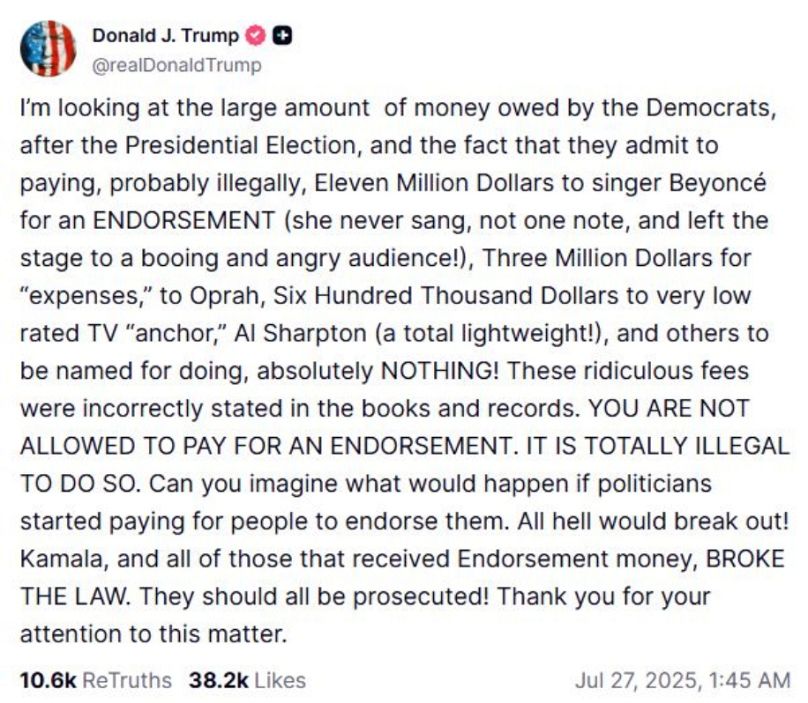
Apparently still bruised from his lack of A-list talent support during the election, Trump wrote: “I’m looking at the large amount of money owed by the Democrats, after the Presidential Election, and the fact that they admit to paying, probably illegally, Eleven Million Dollars to singer Beyoncé for an ENDORSEMENT (she never sang, not one note, and left the stage to a booing and angry audience!), Three Million Dollars for “expenses,” to Oprah, Six Hundred Thousand Dollars to very low rated TV ‘anchor,’ Al Sharpton (a total lightweight!), and others to be named for doing, absolutely NOTHING!”

Trump's post
Trump's post Truth Social

He continued: “These ridiculous fees were incorrectly stated in the books and records. YOU ARE NOT ALLOWED TO PAY FOR AN ENDORSEMENT. IT IS TOTALLY ILLEGAL TO DO SO. Can you imagine what would happen if politicians started paying for people to endorse them. All hell would break out! Kamala, and all of those that received Endorsement money, BROKE THE LAW. They should all be prosecuted! Thank you for your attention to this matter.” 

Kamala Harris with Beyoncé on the 2024 campaign trail
Kamala Harris with Beyoncé on the 2024 campaign trail AP Photo

Regarding Trump’s claim, it is true that Harris’ team spent funds on rallies and events, which featured celebrity endorsers like Beyoncé, Oprah and Lady Gaga.

However, the publicly shared financial records from the 2024 presidential campaign show that those expenses went toward production costs and staff, not to the celebrities themselves.

This was subsequently confirmed by a New York Times investigation published in November 2024.  

Beyoncé publicly supported Harris last year and made a speech a rally on reproductive rights. She previously threatened Trump’s campaign team with legal action for its unauthorized use of ‘Freedom’ in a social media video, days after the singer approved the song as the official anthem for Kamala Harris’ presidential campaign

At the time, Trump spoke dismissively about Beyoncé’s appearance at a Harris rally in Houston, saying: "Beyoncé would come in. Everyone’s expecting a couple of songs. There were no songs. There was no happiness.”

This year, Trump also called for a “major investigation” into Bruce Springsteen after the music legend made several remarks criticising Trump at his Manchester show earlier this year.  

Trump alleged that Springsteen was paid by Kamala Harris for his “POOR PERFORMANCE DURING HER CAMPAIGN FOR PRESIDENT” (posted online on Truth Social in all caps, naturally). 

He went on to ask: “ISN’T THAT A MAJOR AND ILLEGAL CAMPAIGN CONTRIBUTION?”  

In addition to Springsteen, Trump also took aim at other artists, including Bono and (once again) Beyoncé, during his rant: “HOW MUCH DID KAMALA HARRIS PAY BRUCE SPRINGSTEEN FOR HIS POOR PERFORMANCE DURING HER CAMPAIGN FOR PRESIDENT?. WHY DID HE ACCEPT THAT MONEY IF HE IS SUCH A FAN OF HERS? ISN’T THAT A MAJOR AND ILLEGAL CAMPAIGN CONTRIBUTION? WHAT ABOUT BEYONCÉ? …AND HOW MUCH WENT TO OPRAH, AND BONO???  

He carried on, escalating things: “I am going to call for a major investigation into this matter. Candidates aren’t allowed to pay for ENDORSEMENTS, which is what Kamala did, under the guise of paying for entertainment. In addition, this was a very expensive and desperate effort to artificially build up her sparse crowds. IT’S NOT LEGAL! For these unpatriotic “entertainers,” this was just a CORRUPT & UNLAWFUL way to capitalize on a broken system. Thank you for your attention to this matter!!!” 

This was followed up by a bizarre back and forth, in which Trump shared a fake clip on social media of him attacking The Boss with a golf ball. 

The post drew heavy criticism and mockery online, with many posting “reality shots” of Trump on the golf course, and others commenting on how “this is not what a president does.”  

Numerous musicians came to Springsteen’s defence, including Pearl Jam frontman Eddie Vedder and veteran rocker Neil Young.   

Elsewhere, South Park creators Matt Stone and Trey Parker responded to the White House’s reaction to their latest episode which mocked Trump, showing him in bed with Satan and depicting him as having a micro-penis.

Trump, not Satan.  

White House spokesperson Taylor Rogers said: “Just like the creators of South Park, the Left has no authentic or original content, which is why their popularity continues to hit record lows. This show hasn’t been relevant for over 20 years and is hanging on by a thread with uninspired ideas in a desperate attempt for attention.” 

This led Parker to respond at Comic-Con International, with his trademark deadpan style: “We’re terribly sorry.”  

They weren’t.