Issued on: 28/07/2025 - FRANCE24
Disclaimer: This video contains images that may be distressing to some viewers.As starvation tightens its grip in Gaza, one man, Rajab Alreefi, is doing everything he can to bring moments of relief to children. An active skateboarder, father, and founder of the Gaza Skateboard Team, Rajab wants to raise awareness of the situation in Gaza through skateboarding. However, hunger is forcing him to stop.
When Israelis Call It Out: Finding Genocide in Gaza
It’s been almost an article of faith among Israeli officials: the state they represent is incapable of genocide, their actions always spurred by the noblest, necessary motivations of self-defence against satanic enemies who wish genocide upon Jews. Over time, as Holocaust scholar Omer Bartov writes, “Ethical concerns and moral qualms were brushed aside as either marginal or distracting in the face of the ultimate cataclysm that is the genocide of the Jews.”
This form of reasoning, known otherwise as “Holocaust-ism” or “Shoah-tiyut”, is a moral conceit left bare in the war of annihilation being waged in Gaza against the Palestinian populace. Israeli human rights groups have taken note of this, despite the drained reserves of empathy evident in Israel proper. (A Pew Research Center poll conducted last month found that a mere 16% of Jewish Israelis thought peaceful coexistence with Palestinians was possible.)
In its latest report pointedly titled Our Genocide, the Israeli human rights organisation B’Tselem offers a blunt assessment: “Israel’s policy in the Gaza Strip and its horrific outcomes, together with statements by senior Israeli politicians and military commanders about the goals of the attack, leads us to the unequivocal conclusion that Israel is taking coordinated action to intentionally destroy Palestinian society in the Gaza Strip. In other words: Israel is committing genocide against Palestinians in the Gaza Strip.”
The infliction of genocide, the organisation acknowledges, is a matter of “multiple and parallel practices” applied over a period of time, with killing being merely one component. Living conditions can be destroyed, concentration camps and zones created, populations expelled, and policies to systematically prevent reproduction enacted. “Accordingly, genocidal acts are various actions intended to bring about the destruction of a distinct group, as part of a deliberate, coordinated effort by a ruling authority.”
Our Genocide suggests that certain conditions often precede the sparking of a genocide. Israel’s relations with Palestinians had been characterised by “broader patterns of settler-colonialism”, with the intention of ensuring “Jewish supremacy over Palestinians – economically, politically, socially, and culturally.”
B’Tselem draws upon three crucial elements centred on ensuring “Jewish supremacy over Palestinians”: “life under an apartheid regime that imposes separation, demographic engineering, and ethnic cleansing; systemic and institutionalized use of violence against Palestinians, while the perpetrators enjoy impunity; and institutionalized mechanisms of dehumanization and framing Palestinians as an existential threat.” The attacks on Israel by Hamas and other militant groups on October 7, 2023 was a violent event that created a “sense of existential threat among the perpetrating group” enabling the “ruling system to carry out genocide.” As B’Tselem Executive Director Yuli Novak notes, this sense of threat was promoted by an “extremist, far-right messianic government” to pursue “an agenda of destruction and expulsion.”
Israeli policy in the Strip since October 2023 could not be rationalised as a focused, targeted attempt to destroy the rule of Hamas or its military efficacy. “Statements by senior Israeli decision-makers about the nature and assault in Gaza have expressed genocidal intent throughout.” Ditto Israeli military officers of all ranks. Gaza’s residents had been dehumanized, with many Jewish-Israelis believing “that their lives are of negligible value compared to Israel’s national goals, if not worthless altogether.”
The report also notes the use of certain terminology that haunts the literature of genocidal euphemism: the creation of “humanitarian zones” that would still be bombed despite supposedly providing protection for displaced civilians; the use of “kill zones” by the Israeli military and the absence of any standardized rules of engagement through the Strip, often “determined at the discretion of commanders on the ground or based on arbitrary criteria.”
Wishing to be comprehensive, the authors of the report do not ignore Israel’s actions in the West Bank and occupied East Jerusalem. Airstrikes have regularly taken place against refugee camps in the northern part of the territory since October 2023. Even more lethal open-fire policies have been used in the West Bank, with the use of kill zones suggesting “the broader ‘Gazafication’ of Israel’s methods of warfare.”
Another group, Physicians for Human Rights-Israel (PHRI), has also published a legal-medical appraisal on the intentional destruction of Gaza’s healthcare system, finding that the Israeli campaign in Gaza “constitutes genocide under the 1948 Genocide Convention.” The evidence examined by the group “shows a deliberate and systematic dismantling of Gaza’s healthcare system and other vital systems necessary for the population’s survival.” The evolving nature of the campaign suggested a “deliberate progression” from the initial bombing and the forced evacuation of hospitals in the northern part of the Strip to the calculated collapse of the healthcare system across the entire enclave. The dismantling of the health system involved rendering hospitals “non-functional”, the blocking of medical evaluations, and the elimination of such vital services as trauma care, surgery, dialysis, and maternal health.
Added to this has been the direct targeting of health care workers, involving the death and detention of over 1,800 members, “including many senior specialists”, and the deliberate restriction of humanitarian relief through militarized distribution points that pose lethal risks to aid recipients. “This coordinated assault has produced a cascading failure of health and humanitarian infrastructure, compounded by policies leading to starvation, disease, and the breakdown of sanitation, housing, and education systems.”
PHRI contends that, at the very least, three core elements of Article II of the Genocide Convention are met: the killing of members of a group (identified by nationality, ethnicity, race or religion); causing serious bodily or mental harm to members of that group and deliberately inflicting on the group those conditions of life to bring about its destruction in whole or in part.
In accepting that genocide is being perpetrated against the Palestinians, Our Genocide makes that most pertinent of points: the dry legal analysis of genocide tends to be distanced from a historical perspective. “The legal definition is narrow, having been shaped in large part by the political interests of the states whose representatives drafted it.” The high threshold of identifying genocide, and the international jurisprudence on the subject, had produced a disturbing paradox: genocide tends to be recognised “only after a significant portion of the targeted group has already been destroyed and the group as such has suffered irreparable harm.” The thrust of these clarion calls from B’Tselem and PHRI is urgently clear: end this state of affairs before the Palestinians become yet another historical victim of such harm.
Dystopian Killing Fields and Starvation in Gaza
Intentional Policies
Starvation as a way of life. Starvation as a way of death. Starvation as policy, justification and vengeance. As the state of Israel hums along frittering, scratching and violating international human rights conventions, the chroniclers are kept busy on the morgue’s relentlessly growing inventory and peace’s loss. Of late, a vast number of humanitarian organisations have decided to express their collective outrage in a statement at what is happening in Gaza.
The statement as run by Doctors Without Borders on July 23 is stark: “As the Israel government’s siege starves the people of Gaza, aid workers are now joining the same food lines, risking being shot just to feed their families. With supplies now totally depleted, humanitarian organisations are witnessing their own colleagues and partners waste before their eyes.” Two months after the implementation of the controlled aid scheme by Israel, utilising the grotesquely named Gaza Humanitarian Foundation, over 100 organisations were “sounding the alarm and urging governments to act: open all land crossings; restore the full flow of food, clean water, medical supplies, shelter items, and fuel through a principled, UN-led mechanism; end the siege; and agree to a ceasefire now.”
Outside Gaza, and even within the Strip, abundant supplies of food, clean water, medical supplies, shelter items and fuel sat untouched. Humanitarian organisations had been prevented from accessing them. “The Government of Israel’s restrictions, delays, and fragmentation under its total siege have created chaos, starvation, and death.” A paltry figure of 28 trucks a day were being allowed into the Strip.
The relevant gore is recounted: massacres at food sites in the Gaza Strip are impossible to ignore; the figures from the UN suggest that 875 Palestinians had been slaughtered while seeking sustenance as of July 13. The frequency of these “flour massacres” is also receiving comment from those in the employ of the operation being run by GHF, policed by private contractors and the IDF. Retired US special forces officer Anthony Aguilar, who resigned from working with the GHF, told the BBC that he had “witnessed the Israeli Defense Forces shooting at crowds of Palestinians.” During his entire career, he had never seen such “brutality and use of indiscriminate and unnecessary force against a civilian population, an unarmed, starving population.”
The NGO statement goes on to note the rise of cases of acute malnutrition, most prevalent among children and the elderly. (The World Food Programme has warned that one in three Gazans do not eat for days at a time, with 90,000 women and children requiring treatment.) “Illnesses like acute watery diarrhea are spreading, markets are empty, waste is piling up, and adults are collapsing on the streets from hunger and dehydration.”
In the face of this, international law’s decrees appear like the neglected statues of a distant land. The three sets of Provisional Measures Orders from the International Court of Justice, handed down since 2024, have warned Israel to observe its obligations under the UN Genocide Convention and address the humanitarian crisis in the Strip. In its modifying order of provisional measures handed down on March 28, 2024, the ICJ instructed Israel to “take immediate and effective measures to enable the provision of urgently needed basic services and humanitarian assistance to address famine and starvation and the adverse conditions of life faced by Palestinians in Gaza”. These include the provision of “food, water, electricity, fuel, shelter, clothing, hygiene and sanitation requirements, as well as medical supplies and medical care” and “increasing the capacity of land crossing points and maintaining them open for as long as necessary”.
The latest concession from Israel to deal with this engineered humanitarian catastrophe is a promise to open humanitarian corridors to permit UN convoys into the Strip. In addition to that, COGAT, the Israeli military agency overseeing humanitarian affairs in Gaza, has announced that Jordan and the United Arab Emirates will be permitted to parachute humanitarian aid to those in Gaza. UK Prime Minister Sir Keir Starmer has made a small team of British military planners and logisticians available to assist Jordan in this endeavour. On July 27, the IDF also released a statement claiming it had made the first airdrop including “seven packages of aid containing flour, sugar, and canned food”. These efforts, in their practical futility, are a reiteration of the humanitarian airdrops conducted by the US military and Jordan’s air force in March last year.
These drops will do little to alter the cruel, strangulating model of aid delivery in place, emboldening the fittest recipients capable of outpacing their adversaries. Those recipients will also be fortunate not to be injured or killed by the dropped packages, instances of which were recorded in March last year. “Why use airdrops,” asks Juliette Touma, chief spokeswoman for the United Nations agency for Palestinian refugees, “when you can drive hundreds of trucks through the borders?” Using trucks was “much easier, more effective, faster, cheaper.” Precisely why using them is so unappealing to the IDF.
Instead of focusing on isolating Israel, its allies prefer piecemeal approaches that prolong the suffering of the Palestinians. Measures such as those announced by Starmer to “evacuate children from Gaza who need medical assistance, bringing them to the UK for specialist and medical treatment” only serve to encourage the Israeli war machine. The aid drops serve to do much the same. The objective is one of inflicting a sufficient degree of harm that will encourage the eventual depopulation of the enclave. Israel’s allies, with intentional or unintentional complicity, will clean up.
Binoy Kampmark was a Commonwealth Scholar at Selwyn College, Cambridge. He lectures at RMIT University, Melbourne. Email: bkampmark@gmail.com. Read other articles by Binoy.
Debunking Israeli Propaganda in Times of Genocide
We live in interesting but brutal times. It is evident that myths are biting the dust with long held narratives dissolving when exposed to the harsh and bloody reality. Nowhere is this more evident than with all the myths that propped up Israel for many decades. Israel was portrayed as a fragile yet resilient little country living in a “bad neighbourhood.” But now, given Israel’s incessant wars, much of this mythology is being jettisoned; it is no longer needed when arrogance, hubris and sadism drive the Israeli ethos. The image of the little David is giving way to a vengeful genocidal creature infused with a dash of the Old Testament….
Below is a discussion of some of the collapsing myths. Myths are built on narratives which in turn are built on descriptive words. Much of the discussion centres around clarifying the deceptive nature of words, which in turn will expose the false narratives.
Rabble really
The army is venerated in Israel, and a lot of effort is put into glorifying the military; there are festivals with singers, balloons, and blue and white pom-poms galore.1 American Jewish girls go giddy when meeting the tanned and smiling soldiers. Of course, if one glorifies the military, then all the units can only be “élite”; even the lowliest soldier is given a sergeant rank; and of course they must be “the most moral ” in the world. It is also known by its incongruous acronym: IDF.
Contrast the glamorous image of the Israeli military with its actions in Gaza, West Bank and beyond. Israeli snipers are targeting children – extra-points for pregnant women (you can even purchase a T-shirt with “one shot, two kills ” logo on it). Soldiers are cheering when blowing up hospitals, universities, mosques, schools,…. it is no secret, it is all visible in Telegram videos or on Al_Jazeera’s newscasts. To make matters worse, GHF, the so-called Israeli “humanitarian ” group, dispenses food and water in Gaza today in such a way as to concentrate refugees, and then target them.2 Soldiers are looting everywhere, and even one unit has been set up with the express intention of looting areas they’ve conquered. Looting is tolerated throughout, and even made part of its tactics on the ground.3
The Israeli military is engaged in genocide and doesn’t hide the fact. Groups of soldiers engaged in ecstatic dancing chanting “death to the Amalek ” – a biblical term for the one to be killed en masse; including women and children.4 Early in October 2023, the Israeli military put a 95-year-old veteran of the infamous 1948 massacres on tour to lecture the soldiers. Dressed in a military uniform, he engaged in some motivational speeches: “Be triumphant and finish them off and don’t leave anyone behind. Erase the memory of them. Erase them, their families, mothers and children. These animals can no longer live.”5 The pronouncements made by the military official rabbis are even worse. And one cannot forget (former Minister of Defence) Yoav Gallant’s statement: “I have ordered a complete siege on the Gaza Strip. There will be no electricity, no food, no fuel, everything is closed. We are fighting human animals and we are acting accordingly.”6
The Israeli airforce regularly drops huge bombs in the middle of densely populated refugee camps. According to Euromed, the total number of bombs dropped on Gaza are equivalent to all the bombs dropped on several of the major cities during WWII. And in order not to waste bombs, Israeli warplanes which couldn’t drop their ordnance in Iran during the June 2025 attack were instructed to bomb Gaza. Israelis also never miss an opportunity to profit from such events; Israelis flock to the border area to sit on sofas to witness the bombing spectacle. These war tourists have to pay extra for a cappuccino.
Israeli sadism only escalates; everyday there must be a new turn of the screw – it is not satisfied with merely bombing or shooting civilians. The latest Israeli military order is that from now on Palestinians will not be allowed to bathe in the sea.7 Israeli snipers, warships… will target civilians entering the sea. One Telegram video shows a gleeful Israeli soldier using mortar bombs to target civilians sitting on a beach.
The Israeli military used to be well organised and soldiers operated on the basis of strict orders. Today, the ethical rot has set in at all levels. Officers and lower soldiers alike murder, steal, torture everywhere. Soldiers perpetrate heinous crimes in full camera view, yet the perpetrators expect full impunity.
Simply put: the Israeli military can no longer be referred to as an army, but it must be described for what it actually is: a criminal rabble.
Israeli way of war
Israelis like to say that they “live in a bad neighbourhood.” In fact, it is so bad that Israel has bombed most of its neighbouring countries numerous times and attempted to murder most of the leadership in those countries.8 “Decapitation strikes” are deemed a great success and yet another proof of the Israeli cunning and prowess. Another target are the potential or actual negotiators. The Israeli military has murdered several negotiators in Lebanon, Gaza, Tehran (Ismael Haniyeh), and during the June 2025 attack against Iran the lead negotiator with the Americans was also murdered. And then Israel declares “ceasefires ” that impose conditions on the victims, but Israel continues to murder and bomb – there have been over 1,000 violations of the so-called ceasefire in Lebanon. Drones and warplanes fly overhead without regard to any declared ceasefire. Maybe all this is not surprising given the official Israeli (especially Netanyahu’s) disdain for “peace” which is considered to be a dirty word; they prefer “conflict management.” Ceasefires are merely meant to provide time for the Israeli military to reorganise and then bomb and murder in their “business as usual” fashion.
The Israeli military’s brutality even gets pompous sounding names like the Dahiya Doctrine. This refers to the levelling of the Dahiya neighbourhood in Beirut 2006 – it is a disproportionate level of violence “in response” to Hezbollah daring to resist the Israeli attack. And of course, Israelis justify this by seeking to reestablish “deterrence” which is yet another fraudulent military concept.9 But then the Israeli military applies other fraudulent and morally reprehensible doctrines, e.g., the Hannibal directive. This directive orders the Israeli military to kill Israeli Jews who may have been captured by Palestinians or other enemies. Officials prefer to kill Israelis rather than to have them taken as hostages. In fact, about half of the Israeli civilians killed on 7 October 2023 were killed by the Israeli military.10
The Israeli military justifies its actions because it is “at war.” The resistance in Gaza has no tanks, airplanes, etc. Thus the best equipped army in the world is attacking a mostly defenceless population; maybe it is a bit of a stretch to call this a “war.” Norman Finkelstein, the great historian, once made the same point and suggested that the Israeli “mowing the lawn ” attacks should be referred to as “massacres.” That is a rather more accurate and succinct descriptor; in the current historical context “genocidal actions” is perhaps more accurate.
Squatters really
A mythology surrounding the early Israeli colonists became pervasive early on. The brave sun tanned pioneers were “making the desert bloom”11 conveying the notion that they were just taking over empty and unproductive land. The word that went along with this myth was that the Jewish interlopers were “settlers ” – another rather neutral word that has no association with the native population they came to displace. For some time while communal living had romantic appeal, settlers lived in kibbutzim. Young Europeans would flock to experience this only to find out a less glamorous picture often involving corruption and sexual abuse.12
After the 1940s, the program of ethnic cleansing saw hundreds of Palestinian towns and villages razed to the ground or simply taken over. Many Israelis took over houses and even helped themselves to furniture, carpets, etc. The takeover of houses is an on-going project with zealot usurpers using advanced mapping technology to target houses, especially in East Jerusalem. While a Palestinian family is out of a house doing normal daily chores, they find upon their return that their house has been taken over, and it is impossible to eject the squatters because the police sides with the latter.
During the late 1960s and early 1970s saw a wave of land confiscation in the West Bank, and the building of “settlements ” on top of hills. The real zealots went to Al Khalil/Hebron to take over houses, hotels, and other buildings.13 They even set about closing off streets so they could go undisturbed to the Ibrahimi mosque which also had been usurped by the zealots. The zealots’ aim is to constantly steal houses, and to make the life of ordinary Palestinians intolerable.
Other settlements were built as suburbs of Jerusalem or as cities with all the amenities provided at subsidised rates. Purpose-built “apartheid” roads connected these developments to the main Israeli cities, but also were meant to sever the links between Palestinian communities. And although the residents of such places are portrayed as mere suburbanites, they often clash with Palestinians when they seek to annex more land. Although annexation is such a neutral word, it hides the violence dispensed by the suburbanites to achieve their aims. The Jews recently arrived from Venezuela sought to expand the borders of their development and requested the zealots to do the dirty violent work.14 The condition for this assistance was that new arrivals would also participate in the violent eviction and usurpation of the neighbouring Palestinian land. Even the “suburbanites ” participate in violence; the soldiers are on standby to protect the usurpers.
It is important to avoid propaganda-tainted language, and to use words that clearly describe a reality and associated power relationships. For this reason many words cry out for an alternative description. The word “settler” demands a more accurate substitution, and the word “squatter” would certainly be a more suitable and accurate descriptor. It is time to stop calling the armed violent young men who harass and brutalise Palestinians in the West Bank “settlers”!
Where has “proper” gone?
Israel always has been a country with flexible and expanding borders. Yet, when it suited them, they would make a distinction between “Israel proper” and the occupied areas. The implication was that there could be negotiations regarding the occupied areas, there couldn’t possibly be negotiations about anything in Israel proper – this was conceded land, and there was nothing to talk about. And the “proper” areas expanded! After the wars of 1948, 1967, 2006… the borders of Israel “proper” expanded to incorporate newly stolen land.15 What the current batch of wars have revealed is that there is no more talk about “Israel proper”, and the reason for that is that Israel is expanding at present – stealing land in Lebanon, Syria, Gaza and the West Bank. While the borders keep expanding, the “proper” hasn’t incorporated the newly usurped land.
A feature of the “Israel proper” concept is that Israel desires to have buffer zones or no-man’s land between its “recognised” borders and its neighbours. But the buffer zones have to be on Lebanese or Syrian soil; the buffer is never on the Israeli side. The Israeli military has created a no-man’s land on the border with Gaza, but all the bulldozed land and acreage sprayed with herbicide is on the Palestinian side of the military-imposed border. And if the UN feels that it needs to conduct some face-saving military patrols, then the UN can defend Israel by sitting in the Lebanese “buffer zone”; UNIFIL shouldn’t even dream of sitting right on the border or having its soldiers cross into Israel for some R&R.
Never again?
All western societies have been indoctrinated with holocaust mythology; one constant refrain has been “never again”. Fair enough. But if any lessons were learnt then this slogan should apply to all; it should read Never again for Everybody. The Gazan population certainly should not be the victim of genocide today – yet there is no doubt that that is exactly what is going on. A brief perusal of the so-called “holocaust studies centres” around the world reveal that they have been silent during this period – they are immersed in studying the 1940s; there seem to be no lessons for the current situation. One such centre features a large “Find memory; Find humanity” slogan on its website, yet (July 2025) has absolutely nothing to say about the genocide in Gaza. It is all about selective memory and humanity.
Pogroms were violent attacks against a religious or ethnic group in the Russian Empire and usually depicted as criminal in nature. Yet today young armed Israeli Jews regularly invade Palestinian villages and towns and brutalise or murder the native population. If violence was deemed intolerable in the past, then why the silence about the ongoing pogroms in the West Bank today?
Careful what you wish for
Several so-called influencers, the contemptible creatures appearing on TikTok/Instagram, etc., called for genocide in Gaza. One of the influencers went so far as to state that if there were a button to get rid of all the Palestinians, he would press the button.16The calls for genocide are also commonly found at the podium of the Knesset. The wife of an Israeli soldier, hysterically shouted from podium not to let the sacrifice of her husband’s effort (having to work overtime) be wasted, and thus “don’t stop before…” the Israeli army exterminates all Palestinians.17
Israeli society is rather warped, and it is constantly polled about all sorts of unusual issues. One of the recent questions was “are Palestinian children in Gaza innocent?” 75% of the respondents said “no.” In one motivational speech given to the soldiers about to invade Gaza, a high ranking officer also stated “the children are not innocent” – this follows Deuteronomy’s edict to kill the women and the children.
After the first hearing about Gaza was held at the ICJ (26 January 2024) at a demonstration in London, dozens of counter-demonstrators wearing Israeli flag capes were chanting “no ceasefire.” By this time several hospitals and universities had already been destroyed. Is this what the counter-demonstrators wished to continue?
Maybe a thought experiment will demonstrate the extreme hypocrisy of these influencers and counter-demonstrators. Imagine that a Palestinian influencer were to ask for a button get rid of all Israeli Jews, or that a Palestinian politician were to utter a similar statement. What do you think the reaction would be? The ultimate hypocrisy is for Jews who bow to the mere mention of the holocaust to call for genocide against Palestinians.
While the London police did nothing to suppress the counter-demonstrators yelling support for the genocide, they do actively suppress pro-Palestinian statements against the genocide! In a recent video, the police in Scotland are even tearing down Palestinian flags.18 And in the US, Trump is actually suppressing all protests and commentary against Israeli brutality by labelling it as antisemitism.
My holy vs. your holy
About one thousand mosques and several churches have been obliterated since 2023.19 Some of the mosques/churches were centuries old and could be deemed cultural heritage sites – of course, they didn’t receive a UNESCO label because Israel blocked such designations.20 The media tends to ignore the destruction of mosques or refers to Israeli justifications for their destruction. The few christian churches bombed in Gaza did elicit mention, and after the bombing of a Catholic church even Pope Leo XIV stated that “he was deeply saddened…” by the loss of life.21 What makes the Pope’s comment memorable is the fact that he didn’t mention that it was Israel that bombed the church. Anonymous bombs just seem to fall out of the sky.
While the intentional destruction of Palestinian holy sites or mosques doesn’t seem to merit any mention, when a synagogue is damaged this elicits a major outcry. But to highlight the double standard, the establishment of a synagogue, or purportedly finding a reference to a Tomb or mere place of sojourn by a well known rabbi, then Israeli Jews consider this to be a claim to the land. Thus an enterprising religious scholar found a reference to a Tomb of Rabbi Ashi in Lebanon, then this became a land claim.22 Israelis grab any justification to steal yet more land however flimsy the claim to the land may be.
Mind their comfort please
The many wars that Israel has waged recently have outraged many around the world giving rise to demonstrations and the like. Yet, the frequent media concern is with the “comfort ” of Jews witnessing the demonstrations! Although Israel is conducting a genocide, Jews should feel comfortable and not reminded of sordid events. Even a bake sale meant to raise funds for Gaza was deemed to interfere with Jewish comfort.23 Did white South Africans living in Europe object to anti-apartheid demonstrations on the basis that it made them feel uncomfortable? Fat chance! However, in the current context several governments have appointed “anti-semitism ambassadors ” who will work to ban demonstrations or manifestations of support for the Palestinians. Maybe a case can be made that supporters of the Israeli genocide in Gaza or the unprovoked attack against Iran should be made to feel uncomfortable.
Western values and Israel
Much is made of “western values” purportedly freedom of speech, association, respect for the rule of law, and respecting immigrants. These values are what makes Europe a “garden” and everywhere else a “jungle.”24 These values have also been used to justify the continued EU assistance to Ukraine, and thus war. Russia has invariably been castigated for not observing “western norms.” But, when it comes to genocidal Israel and its violent tendencies, the same insufferable politicians are silent or connive to send weapons and assistance to Israel.
Europe is meant to absorb huge migrant flows, yet Israel imposes a discriminatory migrant policy – only Jews need to apply. Israel’s incessant wars are creating migrant flows that inevitably end in Europe, and no European official seems willing to point this out. What we witness instead is that European officials travel to Egypt to offer enticements for Egypt to absorb Palestinian refugees; a few years ago the same gang offered several billion Euros to Erdogan to reduce the Syrian and Iraqi migrant flows.
Myopic history
Reading the mainstream media one would get the impression that Palestinian history started on 7 October 2023. Everything before that doesn’t seem to merit mentioning. All the “mowing the lawn” military operations aren’t a thing of the past, they are in a memory hole. The Goldstone report documenting the mass crimes committed in 2009 is also in the memory hole. Of course, it is too much to expect the mainstream media to even mention relevant history that goes back a few more years. The media don’t report on the caged nature of Gaza, surrounded by razor wire and watchtowers. And as Dov Weissglas, the advisor to Ariel Sharon, stated the residents of Gaza would be kept “on a diet” – that is, Israeli bureaucrats would calculate the minimum caloric intake needed to survive, and they would allow just this amount of aid to trickle into Gaza.
Watch our words!
While it is important to use accurate words to describe Israeli state policy, it is also important for pro-Palestinian activists to change the words they use to refer to the current reality. One finds that the word “occupation” is used often to describe the Israeli military, and even to the extent that it is used as a synonym. Similarly, the “apartheid” descriptor is used without much reflection, e.g., apartheid wall, apartheid roads, etc. Both occupation and apartheid indicate a co-existence with the native population. Apartheid meant coexisting economically, but living separately – there was an interaction between blacks and whites. The word occupation suggests that it is temporary, and that interaction is possible. But the genocide in Gaza indicates that Israel prefers erasing the Palestinians, and that way ending the occupation. The three strategists drawing up the path of the wall built in the West Bank were explicit about the temporary nature of the structure. It would remain in place to control the Palestinian population, but they foresaw that the wall will be removed once the Palestinian population has been expelled.
There is another problem with the word “apartheid.” While much effort was placed to declare that Israel was guilty of the “crime of apartheid,” it only referred to the “occupied territories.” The third class status of Palestinians living in Israel was unmentionable to those drawing up the legal case. Apartheid was deemed a crime on one side of the line, but just fine on the other side (in “Israel proper”).
Worse than 1960s apartheid in South Africa
The so-called West slowly adopted some sanctions and divestment of South Africa beginning in the 1970s; the public had engaged in some form of boycott of South African products before that. Ronnie Kasrils, the great anti-apartheid fighter and member of the African National Congress, stated that the situation now for the Palestinians is worse than that experienced by the black population at the height of the oppressive apartheid years. While Western countries grudgingly sanctioned and divested from South Africa, one wonders when will there be some official opposition to Israel’s genocidal actions.
Tough times for the propagandists
The Israelis and their supporters spent much effort painting Israel as a valiant little country trying to become a success story surrounded by hostile neighbours. Israelis were portrayed as pioneers thriving despite the odds. The propagandists working for Israel had appropriated victimhood, and justified Israel’s actions as “self defence.” Alas, all this mythology has been ruined because Israeli officialdom chose to wage wars, expel the native population, commit genocide in Gaza, attack Iran, attack Yemen, and steal yet more land from its neighbours. It requires more than lipstick to doll up this pig. Today Israeli propaganda relies on threats, and strong armed techniques to censor and muzzle dissent. Much of this is done by control over the media which seems to work in tandem with Israeli propagandists. Student protestors are threatened and even imprisoned; conscientious journalists are fired….
For all moral world citizens, the task is to oppose all the ghastly things Israel does every day, to reject their sorry justifications ( “self defence”); reject the portrayal of Israel’s proclaimed enemies (demonising Hamas, and the Palestinians in general); reject the portrayal of the Israeli military (why should anyone want to be an “ally” of this country?), reject Israel as a ethnocracy where rights and status are determined by whether or not one is Jewish (reject “Jewish democracy” if it excludes or discriminates against segment of the population; it is not much different from “white democracy” during South Africa’s apartheid years). In many ways, if one appeals to “western values”, the mantra often repeated by western officialdom, then one must also be willing to judge Israeli’s actions and institutions by the same standard. Just because Israel holds a gay pride parade doesn’t make them a beacon of shared values. Our opposition can start with acts as simple as challenging the manager of our local supermarket why they stock Israeli avocados and oranges; indeed, the boycott against apartheid in South Africa started by boycotting their oranges. But these are small steps when bolder action is needed – it is long overdue.
Notes:
Before, During, and After Savagery
A review of Hamid Dabashi’s After Savagery
 “But the state of Israel was not created for the salvation of the Jew; it was created for the salvation of Western interests.”
— James Baldwin, “Open Letter to the Born Again” (September 29, 1979). Quoted in Hamid Dabashi, After Savagery: Gaza, Genocide, and the Illusion of Western Civilization (Haymarket Books, 2025): 159.
Baldwin’s assessment is shared by many others, such as Noam Chomsky, who discussed in his book (The Fateful Triangle, 1999 edition) Israel’s role as a “strategic asset.” (p. 69, 70, 103, 137) However, others, such as Jean Bricmont and Diana Johnstone countered that assessment in a 2024 article, “The Myth of Israel as ‘US Aircraft Carrier’ in Middle East.” They write:
But the crucial evidence, totally missing from their analysis, is the slightest example of Israel actually serving American interests in the region.
If no examples are given, it’s simply because there are none. Israel has never fired a shot on behalf of the United States or brought a drop of oil under U.S. control.
We can start with a common sense argument: If the U.S. is interested in Middle East oil, why would it support a country that is hated (for whatever reasons) by all the populations of the oil producing countries?
Bricmont and Johnstone attribute the unstinting US support of Israel as being influenced by money injected into the US political arena by the Jewish lobby, in particular AIPAC.
The question of which side leads in determining US support for Israel is debatable. What is indisputable is that the US and Israel are in lockstep despite all the violations of international law by Israel (US is a serial violator of international law, as well), despite several massacres carried out by Israel, and despite the mightily ramped up genocide being perpetrated by Israeli Jews against Palestinians currently.
Genocide and the understanding of what unleashes the bloodshirtiest of human actions is the subject of Hamid Dabashi’s After Savagery, scheduled for release by Haymarket Books on 30 September — while the savagery is ongoing. The urgency for a worldwide response calls for informing those unaware or those insouciant to the Jewish Israeli genocide that is being perpetrated on Palestine (It is not just a genocide in Gaza, as a 1 July 2025 Al Jazeera headline makes clear: “Israel has killed 1,000 Palestinians in the West Bank since October 7, 2023.”). After Savagery, however, is not just about the genocide in Gaza, it is about why some humans commit genocide. So After Savagery is also about “before savagery.” What are the conditions that lead to savagery today. And most importantly, how genocide can be prevented from happening.
Dabashi quotes many sources to attest to the genocide that is happening now in Palestine.
“What we are seeing in Gaza is a repeat of Auschwitz,” says the Burmese genocide expert and Nobel Peace Prize nominee Maung Zarni. “This is a collective white imperialist man’s genocide,” he further explains. (154-155)
Asked to describe what he witnessed in Gaza, Dr. Perlmutter replied, “All of the disasters I’ve seen, combined—forty mission trips, thirty years, Ground Zero, earthquakes, all of that combined—doesn’t equal the level of carnage that I saw against civilians in just my first week in Gaza.” And the civilian casualties, he said, are almost exclusively children. “I’ve never seen that before,” he said. “I’ve seen more incinerated children than I’ve ever seen in my entire life, combined. I’ve seen more shredded children in just the first week … missing body parts, being crushed by buildings, the greatest majority, or bomb explosions, the next greatest majority. We’ve taken shrapnel as big as my thumb out of eight-year-olds. And then there’s sniper bullets. I have children that were shot twice.” (103-104)
“Yes, it is genocide,” has affirmed Amos Goldberg, a professor of Holocaust history at the department of Jewish history and contemporary Jewry at the Hebrew University of Jerusalem: “It is so difficult and painful to admit it, but despite all that, and despite all our efforts to think otherwise, after six months of brutal war we can no longer avoid this conclusion.” (142)
Dabashi traces the roots of Zionism to a longstanding settler-European colonialism. And the author lays bare the insidiousness of Zionism and how this racism impacted Palestinians:
Today, the birth of Palestine as a “question” rather than a nation-state marks precisely the birth of Palestine as a constellation of refugee camps. The land was stolen from Palestinians, the state stealing the land was a European settler colony garrison state that rules over Palestinians with cruelty, the rules for the inscription of life were dictated to Palestinians in draconian terms, and the camps as the fourth inseparable element are precisely where generations of Palestinians are born and raised, before being killed by the Israeli military. (127-128)
Part of this racism towards Muslims, of which the majority of Palestinians are, is the use of the term “Muselmann.” Writes Dabashi, “This is perhaps a mini encyclopedia of European ignorance, Islamophobia and antisemitism all wrapped up in an attempt to unpack the word ‘Muselmann,’ but in fact loading it with more racist dimensions.” (120) And the new Muselmann, is the Palestinian, “the Untestifiable, the human animal, as Israeli warlords have said.” (xxvi)
Zionist Israel and its racism and discrimination is compellingly described. My colleague B.J. Sabri and I needed no convincing of Israeli racism.1
And this racism, not exclusive to Israeli Jews, points to “what ultimately matters for the world at large is the categorical inability to fathom a Palestinian as a human being.” (96) Thus, “Witnessing this savagery in Gaza, we can clearly link the Jewish Holocaust to the Palestinian genocide, and see genocidal Zionism as the logical colonial extension of European fascism.” (xv)
Before Savagery
Many personages appear in After Savagery, such as, to name a few, Sven Lindqvist, Frantz Fanon, Joseph Conrad, and James Baldwin who opposed racism; Edward Said, Giorgio Agamben, Ghassan Kanafani and his Danish wife Anni Kanafani (née Høver), Mario Rizzi, Mahmoud Darwish who spoke to the beauty of Orientalism and Arab culture; others such as Ilan Pappe and UN special rappateur Francesca Albanese who denounce unflinchingly the depredations of Israeli Jews against Palestinians. Dabashi delves deeply into the Eurocentric perspective on colonialism, borne of Western philosophy and figures like Immanuel Kant, Hegel Heidegger, and others whose thinking was impoverished by being shackled by their own racism.
Dabashi writes:
“According to Hegel, Africans, or any other people, can only become civilized to the degree and so far as they abandoned their own cultures and convert to Christianity, founding a state according to Christian principles.” (91)
How are “we” to escape the indoctrination of feted philosophers and the inculcation of Western thought? How do “we” humanize Palestinians? The mere fact that the humanity of Palestinians requires affirmation for so many people points to the pervasiveness of racist Eurocentric narratives.
After the unbridled savagery in Gaza, it is not only European philosophy that reaches its ignoble ends. We need equally to think of the modes of knowledge production about Gaza itself, about Palestine, as the simulacrum of the world outside the purview of the discredited Eurocentric imagination. We no longer need to worry about the critique of Orientalism. We need to think of how to produce knowledge about Gaza and Palestine and the rest of the world. We need to reverse the anthropological gaze, to produce an anthropology of Zionism and Western Philosophy. (105)
The book covers a lot of ground. It delves deeply into ontology, epistemology, semantics, literature, art, filmmaking, poetry, politics, religion, exilism, and — especially — philosophy. After Savagery is not focused solely on the here and now of what is transpiring in historical Palestine. The book goes into the history, background, and philosophy that enables genocide. The book is scholarly and is well footnoted. If that is what the reader is looking for, then Hamid Dabashi’s After Savagery is well worth the read.
NOTE:



_Cropped.jpg)
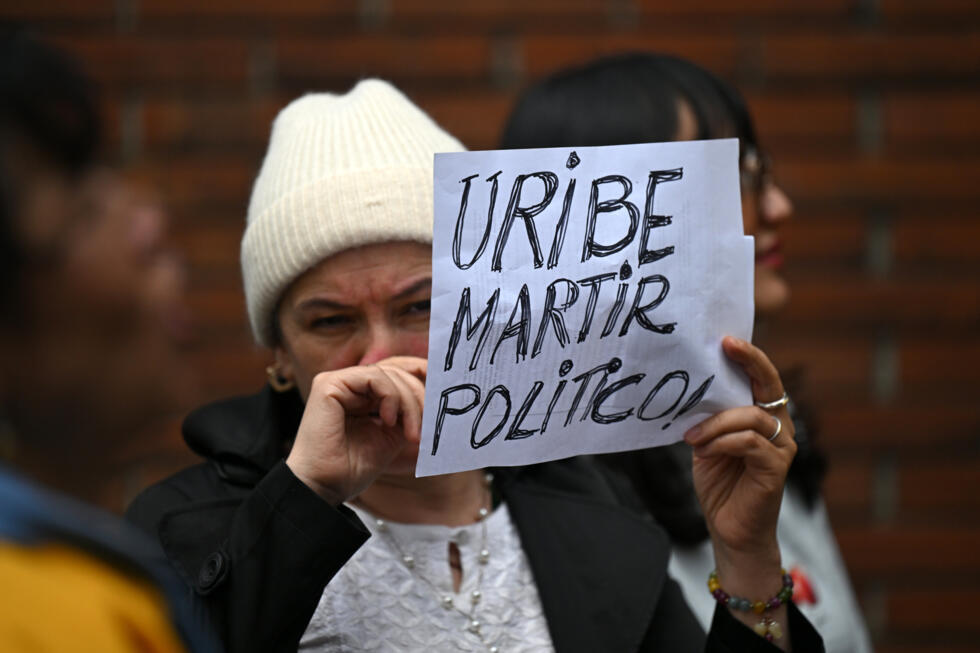
 A man of short posture and deliberate speech, Uribe is a divisive figure: loved and hated in equal measure © Luis ACOSTA / AFP