Friday, August 01, 2025


Ottawa and BC Bet Big on Second Canadian LNG Terminal


  • BC and Ottawa each commit $200M to Cedar LNG, Canada’s second LNG export terminal.

  • The $5.9B floating facility co-owned by the Haisla First Nation and Pembina, is expected to begin operations by late 2028.

  • Cedar LNG touts low emissions, powered by hydroelectricity and designed to displace higher-emission LNG and coal.

The British Columbia government has agreed to invest CAD$200 million in the Cedar liquefied natural gas project — the second Canadian LNG project expected to come online after LNG Canada, the first, shipped its first cargo from its LNG export terminal in Kitimat in early July.

Cedar LNG, jointly owned by the Haisla First Nation and Pembina Pipeline Corp, has an in-service date of late 2028. The project consists of a floating natural gas liquefaction plant and marine export terminal located in the Douglas Channel near Kitimaat Village, a Haisla community about 380 kilometers west of Prince George, BC.

It will have the capacity to liquefy approximately 3.3 million tonnes of natural gas per year for export to Asian markets. 

The federal government has also agreed to contribute $200 million to Cedar LNG. Originally valued at $3 billion, Ottawa now says it will cost an estimated $5.9 billion to build, CBC News reported in March.

British Columbia Premier David Eby and Energy Minister Adrian Dix attended the announcement at the project site.

“Our market position, our proximity to the Asian market, makes it the best LNG in the world, and it's the lowest-emission LNG in the world,” Dix told a news conference on Tuesday. “And that is an achievement.

“It’s not just a question of displacing coal or other dirtier fuels,” he added. “It’s displacing other LNG, which has dramatically higher emissions.”

The $200 million will be put towards electrifying the plant, including a new transmission line and substation.

Cedar LNG is considered low emissions because the plant will be powered by hydroelectricity, including from the recently completed Site C dam.

Like LNG Canada, Cedar would be fed gas from the Coastal GasLink pipeline, in Cedar’s case via an 8-kilometer-long pipeline spur.

To turn it into liquid form, the gas must be cooled to 163 degrees below zero. To do that requires a great deal of power, with massive compression units running 24/7.

CBC News states:

While proponents of a Canadian LNG industry say liquefied natural gas from Canada could help reduce global greenhouse gas emissions by replacing coal in countries that still rely on the dirtier fuel, environmentalists argue LNG creates its own emissions through the liquefaction and transportation process, as well as through the drilling and flaring of natural gas.

Opposition Leader John Rustad criticized the long permitting times in BC, noting it’s taken many more years for the industry to get off the ground compared to the United States.

“Americans didn't even consider starting it until 12 years ago. We’ve managed to get one plant up, one major plant up and running. They have 16,” he said.

Premier Eby though is bullish on Canadian LNG, especially in light of the Trump trade war.

“If you are a government in Asia looking for reliable energy sources, that you can count on, nobody would be looking at the United States right now,” he said via this Global TV News clip.

Cedar LNG fits in with Prime Minister Mark Carney’s plan to fast-track major project reviews to make Canada an “energy superpower.”

His government’s Bill C-5 was recently passed.

The legislation fulfils a campaign promise by Carney to speed up approvals of what he calls nation-building projects, including mines and oil pipelines. Proponents of such projects often face duplicate environmental permitting processes involving the federal and provincial governments and affected First Nations. 

A new poll suggests Canadians are more in favor of energy infrastructure than previously. The poll by Environics Research found that 73 percent of Canadians support building new oil pipelines.

Talk of Canada as an energy superpower however may be premature.

The Trump administration has been touting LNG from Alaska, a similar product with the same export markets in mind. Trump recently said the United States and Japan are to form a joint venture for Alaskan LNG.

It was unclear whether he was talking about the proposed $44 billion Alaska LNG project, which Reuters says consists of an 800-mile pipeline carrying gas to a planned liquefaction plant for export.

Several Japanese companies have expressed interest in buying LNG from the project, along with Thailand's PTT and India's GAIL.

A recent Oilprice.com piece says floating LNG terminals like Cedar LNG have a bright future:

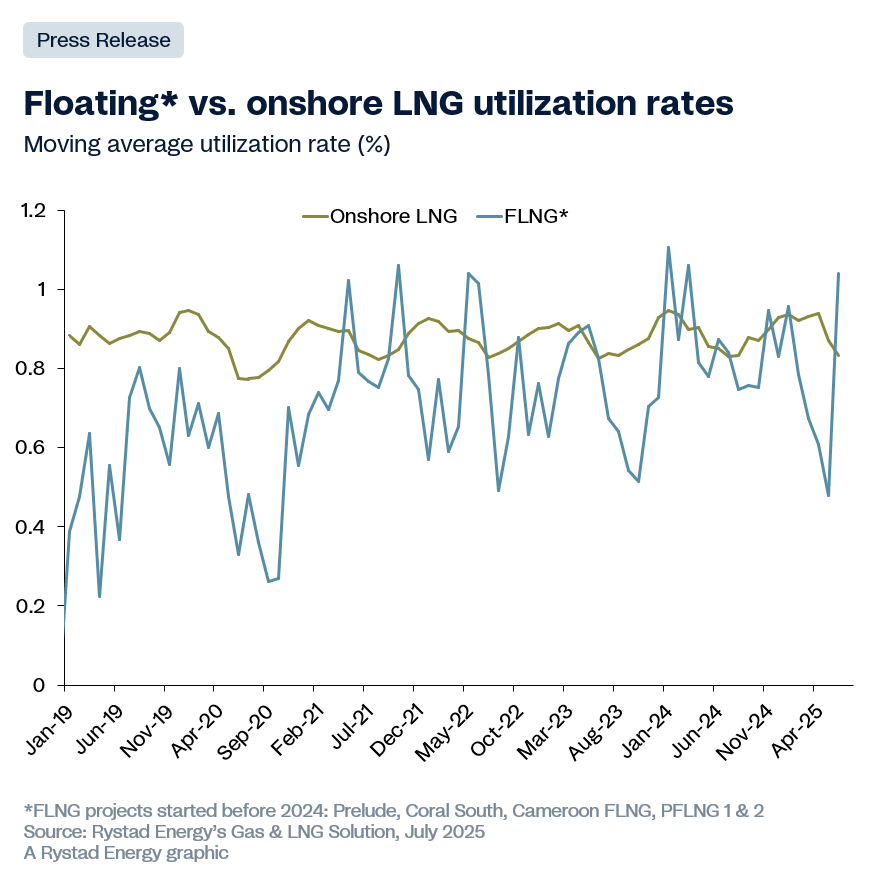
Floating liquefied natural gas (FLNG) terminals are gaining momentum on the global LNG market, with capacity expected to triple by 2030 according to research from Rystad Energy. Once hindered by technical and operational challenges, FLNG projects are now achieving utilization rates comparable to onshore terminals. With LNG demand rising alongside the growing viability of smaller gas fields, FLNG is emerging as a faster, more flexible and cost-effective solution capable of adapting to shifting market dynamics while unlocking previously stranded reserves.

By Andrew Topf for Oilprice.com


Floating LNG Capacity Set to Skyrocket by 2030

  • Global FLNG capacity is expected to more than triple by 2030, reaching 42 million tonnes per annum, due to its increasing viability and adaptability.

  • FLNG projects have overcome initial technical challenges and now achieve high utilization rates comparable to onshore terminals, with capital expenditure per tonne significantly declining.

  • The accelerated project timelines of FLNG units, averaging around three years for newbuilds, make them a preferred solution for developers seeking faster returns and reduced risk.

Floating liquefied natural gas (FLNG) terminals are gaining momentum on the global LNG market, with capacity expected to triple by 2030 according to research from Rystad Energy. Once hindered by technical and operational challenges, FLNG projects are now achieving utilization rates comparable to onshore terminals. With LNG demand rising alongside the growing viability of smaller gas fields, FLNG is emerging as a faster, more flexible and cost-effective solution capable of adapting to shifting market dynamics while unlocking previously stranded reserves.

Rystad Energy estimates global FLNG capacity will reach 42 million tonnes per annum (Mtpa) by 2030, climbing to 55 Mtpa by 2035, almost four times the 14.1 Mtpa recorded in 2024. Terminals commissioned before 2024 achieved an average utilization rate of 86.5% in 2024 and 76% to date in 2025, figures comparable to global onshore LNG facilities.

FLNG has come a long way in less than a decade. The only real roadblocks were early teething issues that come with any new technology, as seen with projects like Shell’s Prelude, which faced cost overruns and unstable output. But since then, the industry has matured significantly, including Prelude itself. Utilization rates are improving, the technology is proving reliable across a range of environments, and the economics are starting to make more sense. From navigating permitting challenges in Canada to unlocking remote offshore reserves in Africa and Asia, FLNG is finally going mainstream,

Kaushal Ramesh, Vice President, Gas & LNG Research, Rystad Energy
Learn more with Rystad Energy's Gas & LNG Solution.

Without a prior blueprint to follow, early FLNG projects, such as Shell's Prelude, built in South Korea by the Technip–Samsung consortium, became a negative demonstration of FLNG's early limitations. Costs ballooned to $2,114 per tonne for liquefaction alone. However, as the industry gained operational and construction experience, capital expenditure per tonne has declined significantly, bringing costs in line with onshore LNG projects.

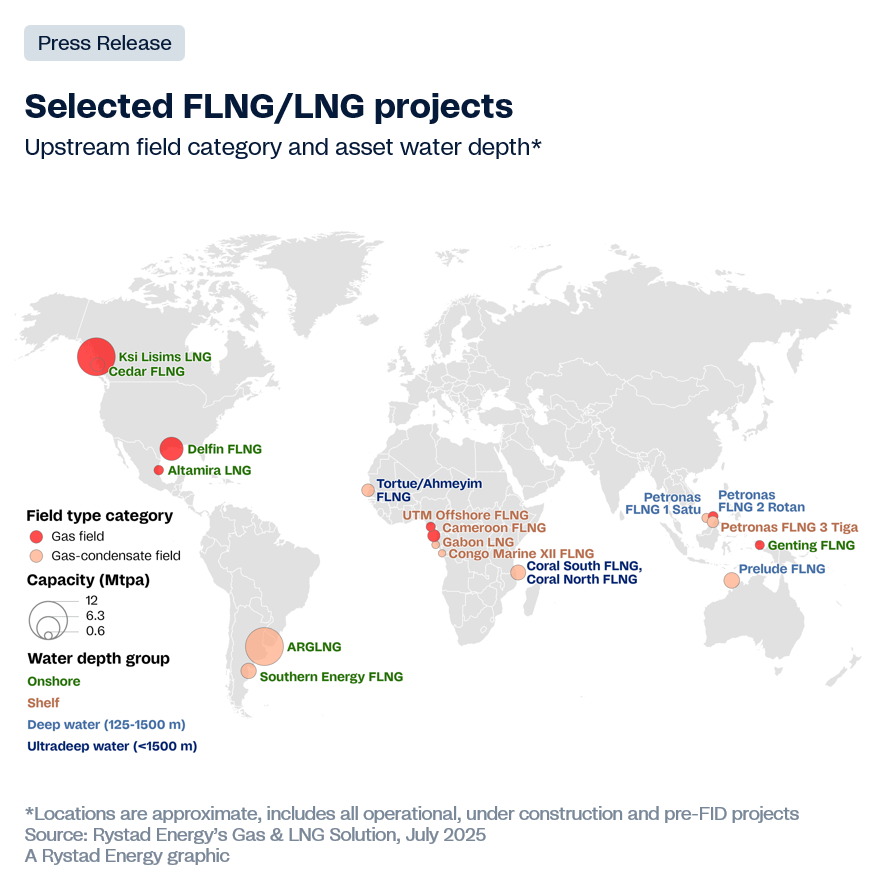
Proposed developments along the US Gulf Coast now average around $1,054 per tonne. Delfin FLNG, a proposed project in the US, sits just above that average at $1,134 per tonne, while Coral South FLNG in Mozambique, which is similar in scale, reports a comparable liquefaction cost of $1,062 per tonne. However, we note that project concepts are not entirely comparable. Some are complex integrated producers with upstream components as part of the LNG facilities, while others simply liquefy pipeline-spec gas.

In parallel, FLNG developers are increasingly turning to vessel conversions as a cost-efficient alternative to newbuild facilities. Projects such as Tortue/Ahmeyim FLNG, Cameroon FLNG and Southern Energy’s FLNG MK II have achieved notably lower capex levels of $640, $500 and $630 per tonne, respectively, by repurposing Moss-type LNG carriers. These conversions benefit from the vessels’ modular spherical tank design, which allows for simpler integration of prefabricated liquefaction modules. With several Moss-type LNG tankers expected to retire in the coming years, more could be repurposed, expanding the pipeline of lower-cost FLNG solutions.

FLNG vessels are also proving their operational flexibility across diverse environments, from deepwater to ultra-deepwater fields and even onshore supply. Should certain projects stall, their vessel could be relocated or sold, demonstrating the inherent mobility and adaptability of FLNG assets.

In the current energy environment, where markets remain tight but face the risk of oversupply, speed to first production is critical. Extended construction timelines delay revenue generation and expose projects to a higher risk of cost overruns. Rystad Energy data also shows that FLNG units can be delivered significantly faster than onshore liquefaction facilities, enabling quicker final investment decisions and more agile execution. On average, newbuild FLNG projects are completed in approximately three years, compared to about 4.5 years (capacity-weighted) for operational onshore plants. For FLNG vessels currently under construction, the average projected build time is even lower at 2.85 years. This accelerating timeline is a key factor in the growing preference for FLNG, as developers seek to minimize exposure and accelerate returns.

By Rystad Energy


FRACKING BY ANY OTHER NAME

The Great Geothermal Talent Shortage

  • Geothermal energy is emerging as a scalable, carbon-free solution thanks to new drilling technologies adapted from oil and gas.

  • The sector faces a major workforce challenge, as it lacks enough geologists, engineers, and specialists to meet projected growth.

  • With AI and data centers driving new energy demand, geothermal could meet up to 64% of that growth by the early 2030s if workforce and technology barriers are overcome.

Geothermal energy is poised for a breakthrough in the United States. One of the vanishingly few clean energy forms that made it through the Trump administration’s One Big Beautiful Bill unscathed, the time is right for the carbon-free energy source to take center stage. With a positive policy environment and rapid advancements in technology, there’s only one critical hurdle in geothermal energy’s way – an exceedingly shallow talent pool.

The geothermal revolution will need a whole lot of geologists – but a huge number of those qualified are already (quite gainfully) employed in the oil and gas sector or the mining industry. It will also need drilling engineers, pressure control specialists, and data scientists, among other specialized roles. “Geothermal needs more than geologists—this is an all-hands-on-deck moment,” Marcus Oesterberg, chief operating officer of geothermal company Ignis H2 Energy, recently told the Wall Street Journal.

“This is no longer a niche, backroom segment of energy,” Oesterberg continued. “It’s stepping into the spotlight as a viable, front-line solution in the global energy transition. And to meet that moment, we need to expand our thinking around talent.”

As geothermal energy gains traction, it will likely need to borrow or poach talent from the oil and gas industry, since the knowledge and experience those workers have is extremely applicable in this new context. But experts say that geologists and other would-be geothermal employees simply aren’t aware of the opportunities. Class sizes for geothermal-specific college courses remain small compared to classes oriented toward oil and gas – but there is hope that this can change with some awareness-raising. 

“If we can figure out a way to educate the younger generation that you can actually have a career that you can be proud of and help solve a problem the world is facing, but also work in the extractive industry, I think that could go a long way,” says Jeanine Vany, executive vice president of corporate affairs for Canadian geothermal firm Eavor.

Today, geothermal energy is still a small and nascent sector, providing just 0.4 percent of U.S. utility-scale electricity generation as of 2023. But recent breakthroughs in advanced geothermal indicate that it could soon take up a significantly larger share of the U.S. energy mix. Until now, geothermal energy has only been feasible in places where the heat from the Earth’s core naturally reaches the Earth’s surface, like in geysers and hot springs. 

But scientists have been making major headway on drilling ever deeper into the ground to access geothermal heat from virtually anywhere on Earth. Borrowing hydraulic fracturing technology from the oil and gas sector, companies have been making major headway digging to new depths. Some researchers are even playing around with technology from nuclear fusion to essentially melt through rock to dig deeper and faster. 

“The most audacious vision for geothermal is to drill six miles or more underground where temperatures exceed 750 degrees Fahrenheit,” the New York Times reported in 2023. “At that point, water goes supercritical and can hold five to 10 times as much energy as normal steam.” This ‘superhot’ form of geothermal “could provide cheap, abundant clean energy anywhere.” 

While we’re not quite there yet, we’re getting closer at a rapid clip – and advanced geothermal could not come at a more opportune time. Energy demand in the United States is growing for the first time in a decade, driven by power-hungry artificial intelligence and the rapid spread of data centers. Meeting this growing need is critical to national energy security, and geothermal could go a long way to satisfying it without compromising climate goals. A recent report from the Rhodium Group found that “geothermal could economically meet up to 64% of expected demand growth by the early 2030s” as long as their baseline assumptions prove accurate.

By Haley Zaremba for Oilprice.com

Enbridge Books Record Core Earnings on Power and Gas Demand

Enbridge posted record core earnings, or EBITDA, for the second quarter of the year on the back of strong liquids flows through its pipelines and soaring demand for power generation and feedgas for LNG in North America. 

The Canadian pipeline giant on Friday reported record adjusted EBITDA of U$3.36 billion (C$4.6 billion) for the second quarter, up by 7% from a year earlier. 

The company expects to finish the year in the upper end of its adjusted EBITDA guidance range, president and CEO Greg Ebel said. 

Enbridge’s adjusted earnings rose to US$1.01 billion (C$1.4 billion), or US$0.47 (C$0.65) per common share, up from US$870 million (C$1.2 billion), or US$0.42 (C$0.58), per common share for the same period of 2024.  

The C$0.65 earnings per share beat the analyst consensus estimate of C$0.57.  

The higher Q2 earnings that also beat Wall Street expectations were the result of strong liquids flows on the Mainline system which Enbridge operates. The pipeline system moves more than 3 million barrels a day of crude oil and liquids from Western Canada to the demand markets in the United States. In total, Enbridge moves 40% of all North American crude. 

But surging power and gas demand is also contributing to higher profits. 

“We are capitalizing on growing power demand and strong natural gas fundamentals,” Ebel said in a statement. 

Enbridge has recently approved the 600-MW Clear Fork solar project in Texas that will support Meta’s data center operations.   

In British Columbia in Canada, Enbridge is expanding Aitken Creek—the only underground natural gas storage facility in the province. The expansion will provide enhanced flexibility for Enbridge’s LNG related customers as Canada’s first LNG export project has just started operations

“We remain excited about our suite of opportunities in natural gas, liquids, and power infrastructure, and are well set up to win in multiple ways as we deliver energy to our customers across North America,” Ebel noted.   

By Charles Kennedy for Oilprice.com


Pakistan Buys First U.S. Oil Cargo After Trade Deal

Pakistani refiner Cnergyico will import Pakistan’s first U.S. crude oil cargo in October following the trade and energy cooperation deal the two countries signed earlier this week.

Cnergyico will import on October 1 million barrels of American crude via top commodity trader Vitol, Usama Qureshi, vice chairman of the biggest refiner in oil-import-dependent Pakistan, told Reuters on Friday.

The cargo of West Texas Intermediate (WTI) crude is set to load from Houston in August and arrive in Pakistan in late October, the executive said.

“This is a test spot cargo under our umbrella term agreement with Vitol. If it is commercially viable and available, we could import at least one cargo per month,” Qureshi added.

The cargo will not be for resale and will help diversify Pakistan’s predominantly Middle Eastern supply of crude oil.

This first U.S. crude purchase by Pakistan follows the trade deal announced earlier this week.

Following months of negotiations, the United States and Pakistan this week signed a trade deal that will involve the joint development of Pakistan’s oil resources.

“We have just concluded a Deal with the Country of Pakistan, whereby Pakistan and the United States will work together on developing their massive Oil Reserves,” U.S. President Donald Trump said on social media.

“We are in the process of choosing the Oil Company that will lead this Partnership. Who knows, maybe they’ll be selling Oil to India some day!” Trump also said on Truth Social.

Pakistan is an importer of energy, but it may hold substantial reserves of oil and gas in shale formations.

This year, Pakistan also updated its oil and gas reserves estimate, revising the oil reserves part upwards by 23% from a year earlier, to 238 million barrels. The revision came on the back of seven fields where discoveries were made in the period.

By Tsvetana Paraskova for Oilprice.com


Pakistan Strikes Oil in Sindh Province

Pakistan’s leading exploration and production firm, Oil & Gas Development Company Limited (OGDCL), on Friday announced an oil discovery in an exploration license in the southeastern province of Sindh.

OGDCL, the operator of the Tando Allah Yar (TAY) exploration license, found oil at exploratory well Chakar–1, where tests showed that the well flowed 275 barrels of oil per day.  

A second drill stem test (DST) is now being conducted to further assess its hydrocarbon potential. 

The discovery at Chakar–1 marks the 13th discovery in the TAY exploration license, and “reflects the joint venture’s sustained efforts to assess and unlock the hydrocarbon potential of the block,” OGDCL said in a statement. 

The results to date reinforce confidence that the area has geological potential and support ongoing exploration and appraisal efforts to further delineate its resource base. 

The new oil discovery comes as Pakistan is looking to develop its domestic resources to reduce dependence on imported oil and gas. 

Earlier this year, Pakistan recorded the first substantial increase in its domestic oil reserves since 2020, with new discoveries and higher production leading to a 23% annual increase in reserves to 238 million barrels as of December 2024. 

The key fields contributing to the increase include Pasakhi/Pasakhi North East, Rajian, Kunar, Sono, Thora, Jhandial, and Lashari Centre, according to a report by Arif Habib Limited cited by Pakistani media.

Natural gas reserves in Pakistan remained relatively flat last year compared to the gas reserve estimate for 2023.

In recent weeks, Pakistan has signed cooperation agreements with Turkey and the United States to develop its resources. 

Turkish energy firms will explore for oil and gas offshore Pakistan under agreements with local companies, Turkish Foreign Minister Hakan Fidan said last month. 

This week, the United States and Pakistan signed a trade deal that will involve the joint development of Pakistan’s oil resources. 

By Tsvetana Paraskova for Oilprice.com