ANOTHER BRIC IN THE WALL
South Africa braces for heavy job losses as stiff US tariffs take hold
As sweeping new US tariffs take effect on Thursday, dozens of countries are facing sharp new duties on their exports. South Africa is among the hardest hit, with key goods now subject to a 30 percent tariff and up to 100,000 jobs on the line.
Issued on: 07/08/2025 - RFI


Almost 100,000 jobs at risk
Lesetja Kganyago, governor of South Africa’s central bank, said the tariff could cost up to 100,000 jobs. The country already has an unemployment rate of nearly 33 percent.
The United States is South Africa’s second-largest trading partner after China. Top exports to the US include cars, iron and steel, and citrus fruits.
Speaking on 702 Radio, Kganyago said farming would take a major hit. "Here the impact is on citrus fruit, table grapes and wines," he said.

Diplomatic tensions
Officials in Pretoria say the tariff is not just about trade. It also reflects growing tensions with Washington over domestic and foreign policy.
Trump has falsely claimed that white farmers are having their land seized and has voiced strong opposition to South Africa’s land reform and affirmative action laws.
The White House is also angry over South Africa’s decision to file a genocide case against Israel at the International Court of Justice.
South Africa currently holds the G20 Presidency and will host the first G20 leaders’ summit in Africa in November 2025. Officials had hoped Trump would attend, but he said late last month he might skip the event, citing frustration with South Africa’s foreign policy.
"Since the last 30 years, there have been disagreements with the US administration on a number of issues, but the diplomatic lines of engagement have always been open," Lamola told French news agency AFP on Tuesday. He said relations had "reached a low".
(with newswires)
As sweeping new US tariffs take effect on Thursday, dozens of countries are facing sharp new duties on their exports. South Africa is among the hardest hit, with key goods now subject to a 30 percent tariff and up to 100,000 jobs on the line.
Issued on: 07/08/2025 - RFI
Workers at the Steel and Engineering Industries Federation of Southern Africa works with steel products at the company's facility in Benoni, east of Johannesburg, South Africa, on 29 July 2025
. REUTERS - Siphiwe Sibeko
By:Melissa Chemam with RFI
The tariff hike, ordered by US President Donald Trump, is part of a wider effort to reset global trade on terms more favourable to Washington.
South Africa’s reliance on exports like cars, steel and citrus – combined with an already fragile economy – leaves it particularly exposed.
The South African government had spent months trying to negotiate a deal to avoid the penalty. It offered to buy US liquefied natural gas and invest $3.3 billion (€2.8 billion) in US industries in exchange for lower tariffs. The offer was rejected – even after a last-minute effort to improve it.
Trade and Industry Minister Parks Tau said the talks had been unusually difficult.
"These are very complex negotiations, certainly unprecedented," he said. "At this stage, we must focus on the task at hand and not on finding those responsible."
Foreign Minister Ronald Lamola called for unity. "We're talking about our economy. This is not the time for political calculations, whether in the opposition or within the national unity government," he said.
"We must all speak with one voice. And we can't just blame South Africa; this is a global phenomenon."
President Cyril Ramaphosa said last week that the government would act to ease the impact of the tariff.
By:Melissa Chemam with RFI
The tariff hike, ordered by US President Donald Trump, is part of a wider effort to reset global trade on terms more favourable to Washington.
South Africa’s reliance on exports like cars, steel and citrus – combined with an already fragile economy – leaves it particularly exposed.
The South African government had spent months trying to negotiate a deal to avoid the penalty. It offered to buy US liquefied natural gas and invest $3.3 billion (€2.8 billion) in US industries in exchange for lower tariffs. The offer was rejected – even after a last-minute effort to improve it.
Trade and Industry Minister Parks Tau said the talks had been unusually difficult.
"These are very complex negotiations, certainly unprecedented," he said. "At this stage, we must focus on the task at hand and not on finding those responsible."
Foreign Minister Ronald Lamola called for unity. "We're talking about our economy. This is not the time for political calculations, whether in the opposition or within the national unity government," he said.
"We must all speak with one voice. And we can't just blame South Africa; this is a global phenomenon."
President Cyril Ramaphosa said last week that the government would act to ease the impact of the tariff.
US President Donald Trump received South African President Cyril Ramaphosa in the Oval Office of the White House in Washington, D.C., USA, on 21 May 2025. REUTERS - Kevin Lamarque
Emergency support measures
Pretoria has launched a producer support programme to help exporters find new markets. Willem van der Spuy, head of exports at the Department of Trade, Industry and Competition (DTIC), said the aim is to reduce dependence on a few major partners.
"Through this support office, we will connect producers with embassies and potential buyers to penetrate new markets. But also, in general, to help the country diversify its exports," he said on Tuesday.
The DTIC has also set up an Export Support Desk to advise affected companies. Tau described the move as part of a broader effort to help the country through "a trying moment".
He said the new tariff is a direct threat to jobs in key industries, including automotive, agro-processing, steel and chemicals.
"We are working with urgency and resolve to implement real, practical interventions that defend jobs and position South Africa competitively in a shifting global landscape," Tau said in a statement.
Trump’s executive order, signed on 31 July, set tariff rates ranging from 10 to 41 percent on dozens of countries. African states face duties between 15 and 30 percent.
Emergency support measures
Pretoria has launched a producer support programme to help exporters find new markets. Willem van der Spuy, head of exports at the Department of Trade, Industry and Competition (DTIC), said the aim is to reduce dependence on a few major partners.
"Through this support office, we will connect producers with embassies and potential buyers to penetrate new markets. But also, in general, to help the country diversify its exports," he said on Tuesday.
The DTIC has also set up an Export Support Desk to advise affected companies. Tau described the move as part of a broader effort to help the country through "a trying moment".
He said the new tariff is a direct threat to jobs in key industries, including automotive, agro-processing, steel and chemicals.
"We are working with urgency and resolve to implement real, practical interventions that defend jobs and position South Africa competitively in a shifting global landscape," Tau said in a statement.
Trump’s executive order, signed on 31 July, set tariff rates ranging from 10 to 41 percent on dozens of countries. African states face duties between 15 and 30 percent.
Almost 100,000 jobs at risk
Lesetja Kganyago, governor of South Africa’s central bank, said the tariff could cost up to 100,000 jobs. The country already has an unemployment rate of nearly 33 percent.
The United States is South Africa’s second-largest trading partner after China. Top exports to the US include cars, iron and steel, and citrus fruits.
Speaking on 702 Radio, Kganyago said farming would take a major hit. "Here the impact is on citrus fruit, table grapes and wines," he said.
Workers at the Steel and Engineering Industries Federation of Southern Africa (SEIFSA) at the company's facility in Benoni, east of Johannesburg, South Africa, on 29 July 2025. REUTERS - Siphiwe Sibeko
About 6 to 8 percent of South Africa’s citrus crop is exported to the US. For farmers in Citrusdal, 200 kilometres north of Cape Town, that trade is vital.
"At the moment it's about 25 to 30 percent of our business," said Gerrit van der Merwe, speaking from his 1,000-hectare orange farm.
Until now, South Africa’s exports to the US had been tariff-free under the African Growth and Opportunity Act (AGOA). That status now appears to be ending.
More than 70 percent of arable land in South Africa remains in the hands of the white minority, based on the latest figures from 2017. Many commercial farmers are among those most exposed to the impact of the new tariffs.
About 6 to 8 percent of South Africa’s citrus crop is exported to the US. For farmers in Citrusdal, 200 kilometres north of Cape Town, that trade is vital.
"At the moment it's about 25 to 30 percent of our business," said Gerrit van der Merwe, speaking from his 1,000-hectare orange farm.
Until now, South Africa’s exports to the US had been tariff-free under the African Growth and Opportunity Act (AGOA). That status now appears to be ending.
More than 70 percent of arable land in South Africa remains in the hands of the white minority, based on the latest figures from 2017. Many commercial farmers are among those most exposed to the impact of the new tariffs.
South Africa criticises US plan to resettle white Afrikaners as refugees
Diplomatic tensions
Officials in Pretoria say the tariff is not just about trade. It also reflects growing tensions with Washington over domestic and foreign policy.
Trump has falsely claimed that white farmers are having their land seized and has voiced strong opposition to South Africa’s land reform and affirmative action laws.
The White House is also angry over South Africa’s decision to file a genocide case against Israel at the International Court of Justice.
South Africa currently holds the G20 Presidency and will host the first G20 leaders’ summit in Africa in November 2025. Officials had hoped Trump would attend, but he said late last month he might skip the event, citing frustration with South Africa’s foreign policy.
"Since the last 30 years, there have been disagreements with the US administration on a number of issues, but the diplomatic lines of engagement have always been open," Lamola told French news agency AFP on Tuesday. He said relations had "reached a low".
(with newswires)
Currently, Brazil is the only other country to face a 50% import tax on all its products across the board.
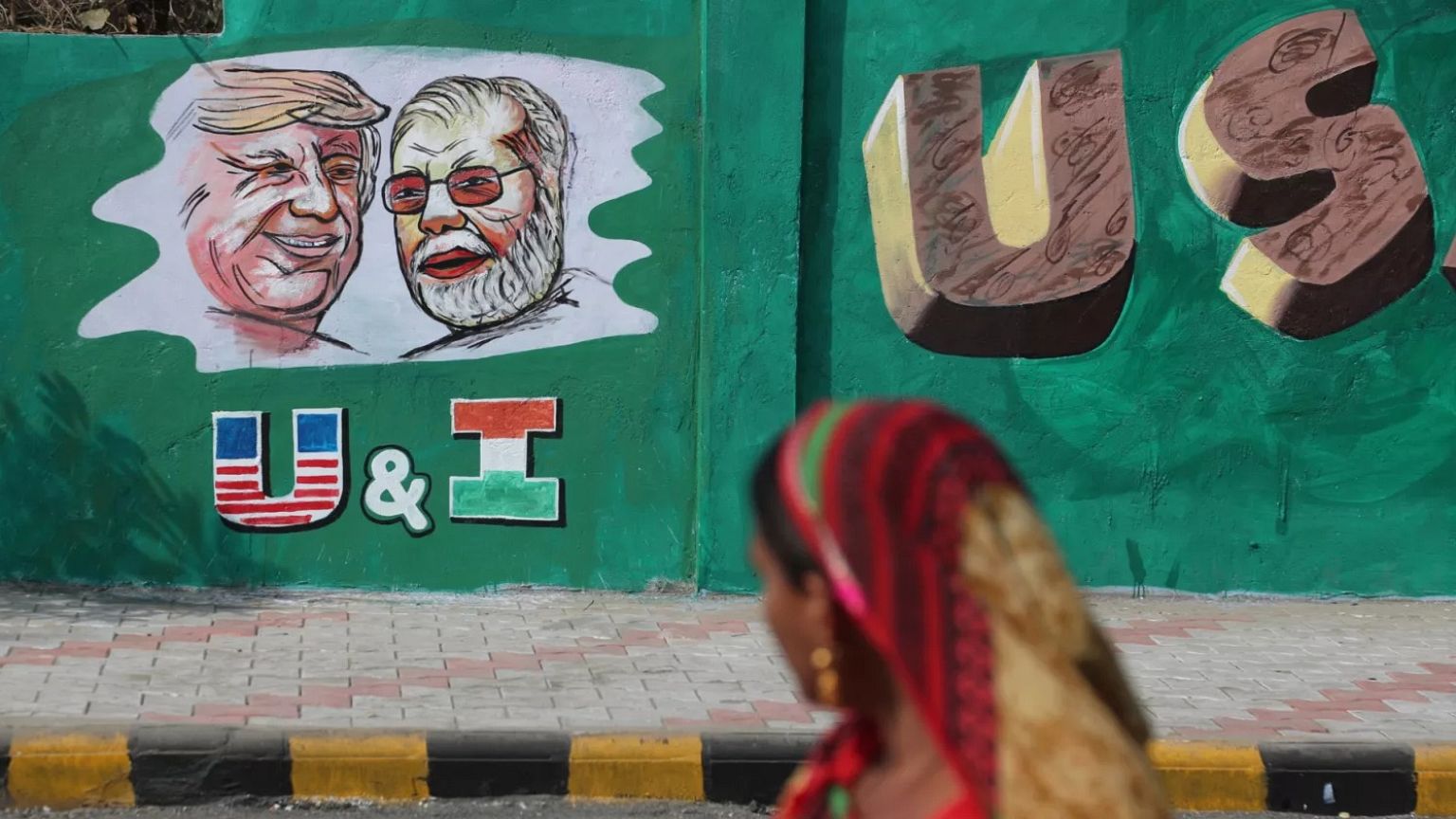
Copyright Copyright 2020 The Associated Press. All rights reserved
By Una Hajdari with AP
Published on 06/08/2025
Brazil and India now face the world’s steepest blanket tariff at 50%, with India targeted for Russian oil purchases undermining US sanctions.
President Donald Trump on Wednesday hit India with an extra 25% tariff over its Russian oil deals, bringing total US tariffs on the ally to a steep 50%.
Currently, Brazil is the only other country to face a 50% import tax on all its products across the board.
This does not include the steel, aluminium and copper tariffs, also at 50%, levied on every single country in the world apart from the UK.
The tariffs would go into effect 21 days after the signing of the order, meaning that both India and Russia could still have time to negotiate with the administration on a more favourable deal.
Trump's moves could scramble the economic trajectory of India, a major Asian economy, which until recently was seen as an alternative to China by US companies looking to relocate their manufacturing.
China, which also buys oil from Russia, is currently experiencing a stay on the full tariff measure — currently all Chinese products face a 30% levy — as it negotiates more favourable tariff measures with the US administration.
Trump had previewed for reporters on Tuesday that the tariffs would be coming, saying the US had a meeting with Russia on Wednesday as the Trump administration tries to end Moscow's all-out war in Ukraine.
“We’re going to see what happens," Trump said about his tariff plans. "We’ll make that determination at that time.”
The Indian government on Wednesday called the additional tariffs “unfortunate".
“We reiterate that these actions are unfair, unjustified and unreasonable,” Foreign Ministry spokesperson Randhir Jaiswal said in a statement, adding that India would take all actions necessary to protect its interests.
Jaiswal said India has already made its stance clear that the country’s imports were based on market factors and were part of an overall objective of ensuring energy security for its 1.4 billion people.
Related
India attacks US and Europe's 'double standards' in their trade relationship with Russia
Ajay Srivastava, a former Indian trade official, said the latest tariff places the country among the most heavily taxed US trading partners and far above rivals such as China, Vietnam and Bangladesh.
India is widely regarded as an ally, with Indian Prime Minister Narendra Modi having visited the US in February of this year.
“The tariffs are expected to make Indian goods far costlier with the potential to cut exports by around 40%-50% to the US,” he said.
Srivastava said Trump's decision was “hypocritical” because China bought more Russian oil than India did last year.
“Washington avoids targeting Beijing because of China’s leverage over critical minerals which are vital for US defence and technology,” he said.
Coming to terms with the deficit
In 2024, the US ran a $45.8 billion or €52.5 billion trade deficit in goods with India, meaning America imported more from India than it exported, according to the US Census Bureau.
US consumers and businesses buy pharmaceutical drugs, precious stones, textiles and apparel from India, among other products.
India has not supported the Ukraine-related sanctions by the US and its allies on Moscow even as its leaders maintain that they want peace.
Ostensibly, the steep tariff is a means to deprive the Kremlin of revenue to fund its ongoing war in Ukraine, forcing Trump's goal of bringing the Russian government to the negotiating table and possibly agreeing to a ceasefire followed by long-term peace in Ukraine.
But oil prices have fallen, with a barrel trading on Wednesday morning at $65.84 or €75.53, up by 1% on the day new tariffs were announced.
Tariff showdown shatters once robust populist alliance between Trump and Modi
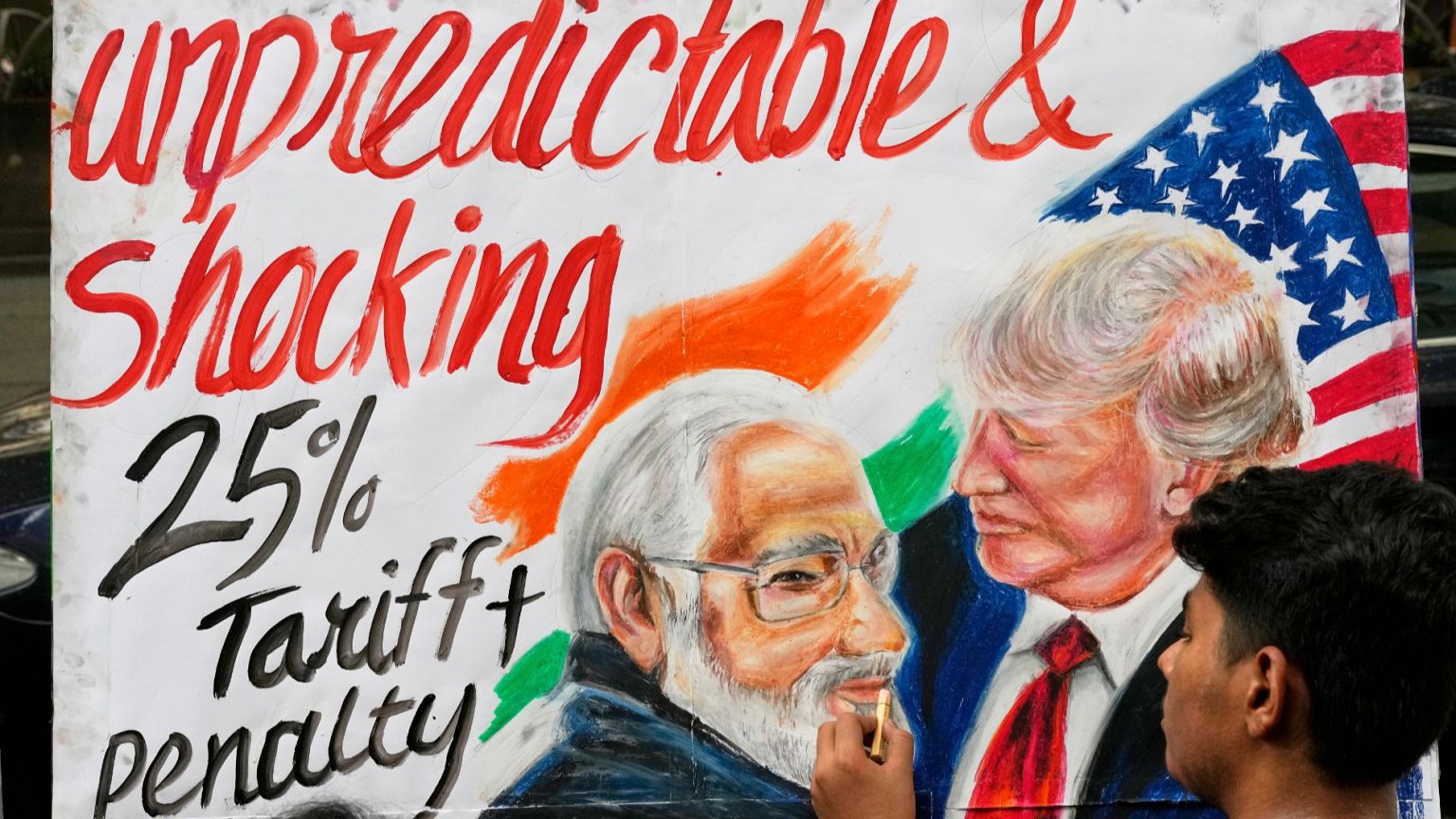
Copyright Copyright 2025 The Associated Press. All rights reserved.
By AP with Una Hajdari
Published on 05/08/2025
Once allies during the populist wave launched in Trump's first term, the US president and Indian PM Narendra Modi are now on a collision course over tariffs and Washington’s warming ties with Pakistan.
The men shared bear hugs, showered praise on each other, and made appearances side by side at stadium rallies — a big optics boost for two populist leaders with many ideological similarities. Each called the other a good friend.
In India, the bonhomie between Prime Minister Narendra Modi and US President Donald Trump was seen as a relationship like no other. That is, until a series of events gummed up the works.
From Trump’s tariffs and India’s purchase of oil from Russia to a US tilt towards Pakistan, friction between New Delhi and Washington has been hard to miss. And much of it has happened far from the corridors of power and, unsurprisingly, through Trump’s posts on social media.
It has left policy experts wondering whether the camaraderie the two leaders shared may be a thing of the past, even though Trump has stopped short of referring to Modi directly on social media. The dip in rapport, some say, puts a strategic bilateral relationship built over decades at risk.
“This is a testing time for the relationship,” said Ashok Malik, a former policy adviser in India’s Foreign Ministry.
The White House did not immediately respond to a message seeking comment.
Simmering tensions over trade and tariffs
The latest hiccup between India and the US emerged last week when Trump announced that he was slapping 25% tariffs on India as well as an unspecified penalty because of India’s purchase of Russian oil.
For New Delhi, such a move from its largest trading partner is expected to be felt across sectors, but it also led to a sense of unease in India — even more so when Trump, on social media, called India’s economy “dead”.
Trump’s recent statements reflect his frustration with the pace of trade talks with India, according to a White House official who was not authorised to speak publicly and spoke on condition of anonymity to describe internal administration thinking. The Republican president has not been pursuing any strategic realignment with Pakistan, according to the official, but is instead trying to play hardball in negotiations.
Trump doubled down on the pressure Monday with a fresh post on Truth Social, in which he accused India of buying “massive amounts” of oil from Russia and then “selling it on the Open Market for big profits".
“They don’t care how many people in Ukraine are being killed by the Russian War Machine. Because of this, I will be substantially raising the tariff paid by India to the USA,” he said.
The messaging appears to have stung Modi’s administration, which has been hard-selling negotiations with Trump’s team over a trade deal by balancing between India’s protectionist system while also opening up the country’s market to more American goods.
“Strenuous, uninterrupted and bipartisan efforts in both capitals over the past 25 years are being put at risk by not just the tariffs but by fast and loose statements and social media posts,” said Malik, who heads the India chapter of The Asia Group, a US advisory firm.
Malik also said the trade deal the Indian side has offered to the US is the “most expansive in this country’s history,” referring to reports that India was willing to open up to some American agricultural products. That is a politically sensitive issue for Modi, who faced a yearlong farmers’ protest a few years ago.
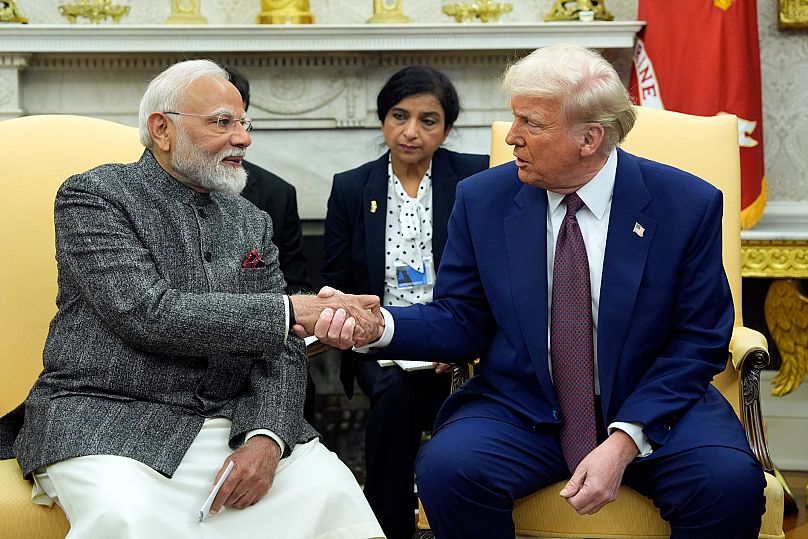
President Donald Trump meets with India's Prime Minister Narendra Modi in the Oval Office of the White House. February 2025 Copyright 2025 The Associated Press. All rights reserved
Trump appears to be tilting toward Pakistan
The unravelling may have gained momentum over tariffs, but the tensions have been palpable for a while. Much of it has to do with Trump growing closer to Pakistan, India’s nuclear rival in the neighbourhood.
In May, India and Pakistan traded a series of military strikes over a gun massacre in the disputed Kashmir region that New Delhi blamed on Islamabad. Pakistan denied the accusations. The four-day conflict made the possibility of a nuclear conflagration between the two sides seem real and the fighting only stopped when global powers intervened.
But it was Trump’s claims of mediation and an offer to work to provide a “solution” regarding the dispute over Kashmir that made Modi’s administration uneasy. Since then, Trump has repeated nearly two dozen times that he brokered peace between India and Pakistan.
For Modi, that is a risky — even nervy — territory. Domestically, he has positioned himself as a leader who is tough on Pakistan. Internationally, he has made huge diplomatic efforts to isolate the country. So Trump’s claims cut a deep wound, prompting a sense in India that the US may no longer be its strategic partner.
India insists that Kashmir is India’s internal issue and had opposed any third-party intervention. Last week Modi appeared to dismiss Trump’s claims after India’s opposition began demanding answers from him. Modi said that “no country in the world stopped” the fighting between India and Pakistan, but he did not name Trump.
Trump has also appeared to be warming up to Pakistan, even praising its counterterrorism efforts. Hours after levying tariffs on India, Trump announced a “massive” oil exploration deal with Pakistan, saying that one day, India might have to buy oil from Islamabad. Earlier, he also hosted one of Pakistan’s top military officials at a private lunch.
Sreeram Sundar Chaulia, an expert at New Delhi’s Jindal School of International Affairs, said Trump’s sudden admiration for Pakistan as a great partner in counterterrorism has “definitely soured” the mood in India.
Chaulia said “the best-case scenario is that this is just a passing Trump whim”, but he also warned that “if financial and energy deals are indeed being struck between the US and Pakistan, it will dent the US-India strategic partnership and lead to loss of confidence in the US in Indian eyes".
Related
India’s oil purchases from Russia are an irritant
India had faced strong pressure from the Biden administration to cut back its oil purchases from Moscow during the early months of Russia's invasion of Ukraine. Instead, India bought more, making it the second-biggest buyer of Russian oil after China. That pressure sputtered over time and the US focused more on building strategic ties with India, which is seen as a bulwark against a rising China.
Trump’s threat to penalise India over oil, however, brought back those issues.
On Sunday, the Trump administration made its frustrations over ties between India and Russia ever more public. Stephen Miller, deputy chief of staff at the White House, accused India of financing Russia’s war in Ukraine by purchasing oil from Moscow, saying it was "not acceptable".
Miller's remarks were followed by another Trump social media post on Monday in which he again threatened to raise tariffs on goods from India over its Russian oil purchases.
“India is not only buying massive amounts of Russian oil, they are then, for much of the oil purchased, selling it on the open market for big profits. They don’t care how many people in Ukraine are being killed by the Russian War Machine," Trump wrote.
Some experts, though, suspect Trump's remarks are mere pressure tactics.
“Given the wild fluctuations in Trump’s policies,” Chaulia said, “it may return to high fives and hugs again.”
India had faced strong pressure from the Biden administration to cut back its oil purchases from Moscow during the early months of Russia's invasion of Ukraine. Instead, India bought more, making it the second-biggest buyer of Russian oil after China. That pressure sputtered over time and the US focused more on building strategic ties with India, which is seen as a bulwark against a rising China.
Trump’s threat to penalise India over oil, however, brought back those issues.
On Sunday, the Trump administration made its frustrations over ties between India and Russia ever more public. Stephen Miller, deputy chief of staff at the White House, accused India of financing Russia’s war in Ukraine by purchasing oil from Moscow, saying it was "not acceptable".
Miller's remarks were followed by another Trump social media post on Monday in which he again threatened to raise tariffs on goods from India over its Russian oil purchases.
“India is not only buying massive amounts of Russian oil, they are then, for much of the oil purchased, selling it on the open market for big profits. They don’t care how many people in Ukraine are being killed by the Russian War Machine," Trump wrote.
Some experts, though, suspect Trump's remarks are mere pressure tactics.
“Given the wild fluctuations in Trump’s policies,” Chaulia said, “it may return to high fives and hugs again.”
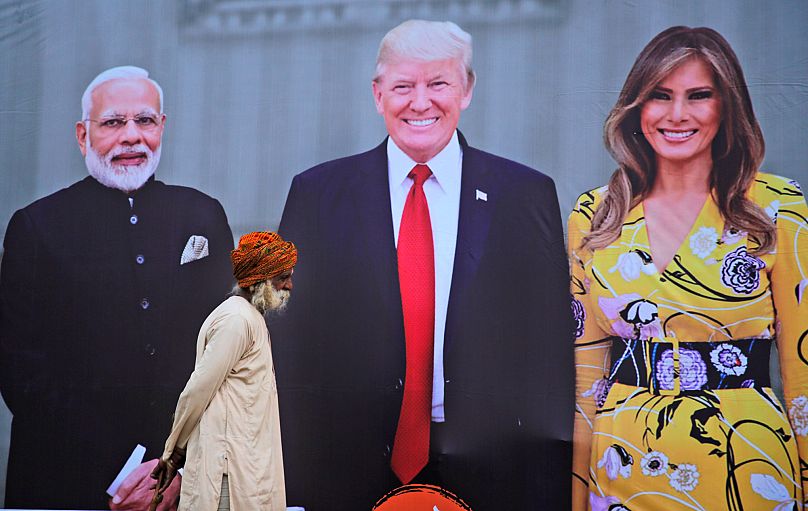
Trump and the First Lady Melania Trump visited India during his first term. February 2020. Copyright 2020 The Associated Press. All rights reserved.
India says it will safeguard its interests
Many expected India to react strongly over Trump's tariff threats considering Modi’s carefully crafted reputation of strength. Instead, the announcement prompted a rather careful response from India’s commerce minister, Piyush Goyal, who said the two countries are working toward a "fair, balanced and mutually beneficial bilateral trade agreement".
Initially, India’s Foreign Ministry also played down suggestions of any strain. But in a statement late Monday, it called Trump’s criticism “unjustified and unreasonable” and said it will take “all necessary measures to safeguard its national interests and economic security".
It said India began importing oil from Russia because traditional supplies were diverted to Europe after the outbreak of the Ukraine conflict, calling it a “necessity compelled by global market situation".
The statement also noted US trade with Russia.
“It is revealing that the very nations criticising India are themselves indulging in trade with Russia,” the statement said.