Saturday, August 09, 2025

‘The ceasefire never took effect inside Iran’
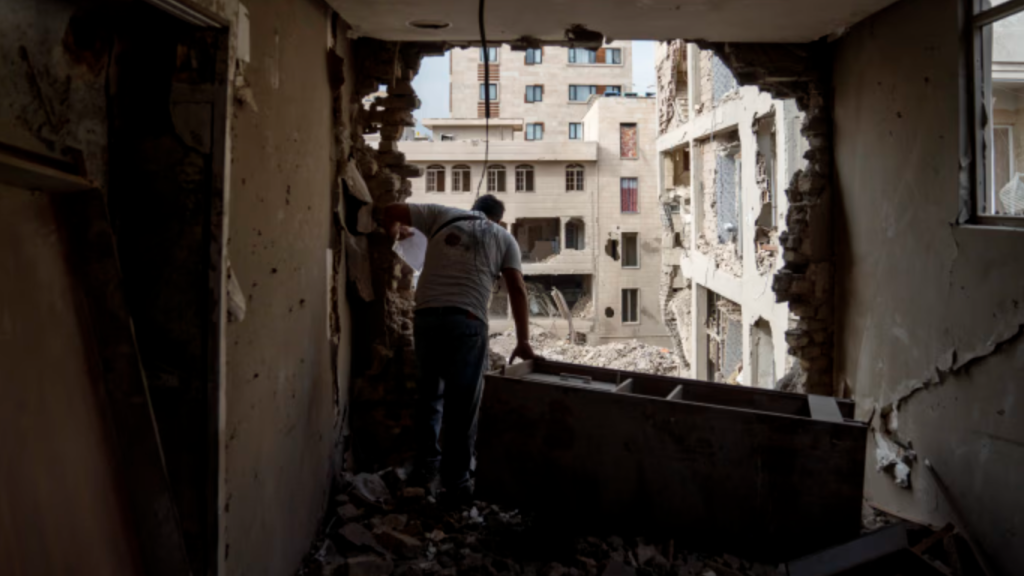


Damage Israeli strike on Tehran

A version of this interview was first published at Alternative Viewpoint.

Nasrin Parvaz became a civil rights activist after the rise of the Islamic regime in 1979. For this, she was arrested in 1982 and imprisoned, enduring eight years of torture. On being released, Parvaz again took up political activism.

She was later forced to flee to Britain in 1993 as a refugee, where she continued her activism, speaking out against different kinds of oppression in Iran and elsewhere. Having acquired the skills to write about her life and create fiction at the Freedom from Torture writing workshop, Parvaz has gone on to become a prolific writer and poet.1

Speaking to Farooq Sulehria, Parvaz discussed the fallout of the recent US-Israeli war on Iran and the Islamic regime’s response.

US President Donald Trump said on July 23 that the US might yet again attack Iran? Do you think Washington is likely to do so?

It depends on what they want from the regime and if the regime is willing to accept this or not. For example, if the regime resists a request for them to step down and reform their leadership then yes, the US may once again attack.

In January 1979, the US asked the Shah to leave the country and a month later escorted [Ayatollah Ruhollah] Khomeini into Iran. Of course, Western governments decided this without letting any journalists into their meeting. The people of the world did not know what the West had decided for Iran.

Today, once again it is the same. We do not know what the Western governments’ plans are. Only in fifty years time will the West release their papers with evidence of what they decided in 2025 for Iran and why they started illegally bombing the country.

Israel and the US have not been ignorant of the regime chanting “Death to Israel, Death to America” for the past 46 years; they are not only hearing it for the first time now. 

One of the reasons the West needs to change the regime at this particular moment is that they are afraid of people rising up in Iran as much as the regime is. Any change brought about by the people in Iran would inspire others in the region to stand up for their rights against Western-installed and backed regimes in their countries.

Israeli-US bombings are designed to kill people’s revolutionary spirit as much as they are designed to destabilise the regime. This is done by assassinating the regime’s personnel, so people cannot find any reason to rise up against a new regime. 

It is like how the West asked [former dictator Bashar al-]Assad to leave Syria and replaced him with another criminal who was on the US’s wanted list.

Some on the left, both inside and outside of Iran, opposed regime change while not supporting the Ayatollahs.

Yes, fortunately many leftists opposed regime change because we know what it means. Regime changes only benefit the West and those at the top of the organisations. They bring nothing but misery for citizens.

Iran has experienced two regime changes: first, in 1953 when Britain and the US removed [Prime Minister Mohammad] Mosaddegh in a coup and brought back the Shah, who had fled from Iran; second, in 1979.

The West is now publicly promoting the monarchy in order to have an alternative for another governmental regime change in Iran. The Shah's son [Reza Pahlavi] praised the bombs landing in Iran that killed civilians.

[Pahlavi] has no interest in the wellbeing of innocent Iranians, just like the Islamic regime, the Israeli government and Trump.

Now that Washington and Tel Aviv have failed to effect regime change, how do you assess the situation? Can we say the failure of the US-Israeli plan is a good thing?

The US and Israel’s plans are not finished. A coup is presently taking place at a brutally slow pace. This is a regime change.

Israel also has not finished its attacks and is assassinating more regime personnel. They use drones to explode apartments, houses and cars where regime members are present.

But with the death of each criminal, more innocent people who live in neighbouring buildings and streets are killed. Everyday people see fires and they know that it is Israel destroying the infrastructure of their society.

The regime says these are the result of gas faults or create other fictions to hide the truth. It does not want to show weakness. The West looks the other way, not reporting any of the killing in Iran.

The ceasefire never took effect inside Iran. Only Iran stopped bombing Israel.

Mainstream media are not reporting this, but one hears from Iranian sources about sabotage activities on an almost daily basis. Do you think Israel has changed its plan and that the war is not over?

The Iran-Israel conflict is not new. Israel has been undertaking military activities in Iran and sabotaging the regime for many years. They have hit nuclear sites and other places before.

To give just a few examples of Israeli sabotage before this round of attacks:

  • In 2024, Israel initiated a series of direct confrontations including in April that year, when the Israeli Air Force launched airstrikes targeting an air defence radar site at an airbase near Isfahan, in central Iran.
  • On February 14, 2024, attacks were carried out against nuclear facilities and natural gas pipelines, and nuclear scientists were killed.
  • In April 2024, an Israeli airstrike demolished the Iranian consulate in Damascus, Syria, killing 16 people. Iran retaliated with missile and drone attack on Israel.
  • On July 31, 2024, Hamas leader [Ismail] Haniyeh was assassinated by Israeli airstrikes during a visit to Tehran.
  • On October, 26, 2024, Israel attacked Iran, striking air defence systems and sites associated with its missile program.

Even now, Israel is still launching drones into Iran every day.

Do you think the Iranian regime is weak after the war? Or has it gained some popularity by defying the might of the US and Israel?

The regime is weak, because it has lost many of its top personnel.

The regime has not gained any popularity over the Israel-US attacks on Iran. It is not like the 1980s, when people supported the regime during the Iran-Iraq war before returning from the battlefields in death shrouds.

People were already against the regime before the Israel-US attacks and there were many uprisings in Iran. This war did not make people support the regime.

Before the Israeli bombings, another uprising was beginning to form in Iran. Truck drivers in more than 163 towns had been on strike for three weeks. More than 40 of them have been arrested.

It was one of the biggest workers’ strikes in Iran to date. Their strike could have led to a national uprising because of a lack of food distribution, especially in bakeries that are essential to local people that had been affected.

During the last few days, despite Israeli operations inside Iran, people have come out of the shock of being bombed and have started demonstrating and picketing against the regime.

There is news of increased repression within Iran, with dissidents being imprisoned and receiving harsh punishments. What does this indicate? Does it show that the regime has found some renewed legitimacy after the war and is using this to silence dissidents?

Arrests and executions are a part of life in Iran; this struggle continues. There are prisoners who have been behind bars for 25 years.

However, during the bombings the number of arrests was much higher than normal. Thousands of people have been arrested. Prisoners who had been in prison for years were executed with the justification that they were Israeli spies.

War has always been an excuse to suppress people. More than 5000 prisoners were executed during the Iran-Iraq war in 1988. Fifty prisoners were taken from the wing I was in and they never came back.

Afghans have been expelled in their hundreds of thousands. Iran otherwise champions the cause of Muslims. How are Iranians inside reacting to the expulsion of Afghans?

It is not only Western governments, such as Britain, which use immigrants as a scapegoat. The Islamic regime also blames poverty, lack of jobs, water shortages and electricity failures on Afghan refugees. Just like in Britain, some people in Iran believe the lies of the government and have become racist, turning against innocent people from Afghanistan.

Even before Israel attacked Iran, the regime had already created an anti-immigrant climate, where Afghans faced regular police violence and discrimination. 

In 2024 the regime ordered all undocumented Afghans to return to their country. In May 2025 the regime ordered mass deportations of more than 4 million immigrants. They gathered and deported them like slaves.

Afghans born in Iran with valid visas have been deported. More than one million refugees were deported in 2025. Many of them were born and raised in Iran during the past four decades. Many of these people are totally integrated into Iran society. They have been ripped away from their lives and friends.

The Iranian regime is uprooting Afghan people from their homes and communities. Children who were born in Iran are taken out of their schools and the only environment they grew up in to be deported to Afghanistan. 

People have had their homes raided simply for being of Afghan origin. They have been arrested and forcibly returned to Afghanistan.

Some Afghans, who were searched and arrested in the street, were not allowed to go home to pack their things. Some could not receive their rental deposits back after leaving. They were just put on a bus and taken to the border. Many arrived in Afghanistan with no money, food or shelter.

Women, girls, activists and journalists who have been deported face high risk of human rights violations at the hands of the Taliban. Severe restrictions on women and girls await them. Girls are very upset about not having the right to continue their studies.

Afghans have the lowest class status in Iran. The regime justifies its attack on Afghans by accusing them of collaborating with Mossad to carry out internal terrorist attacks in Iran. Yet Israel assassinated top officials whose addresses would have been inaccessible to Afghans.

Afghans are paid less than Iranian workers. Most of the recently built buildings in Iran, especially in Tehran, were built by Afghans.

However some people have been brainwashed by the regime into blaming Afghans for their own financial woes and treating them badly. 

For years Afghans have had no right to go to certain towns or areas. They have experienced terrifying discrimination, humiliation, ill-treatment and injustice from the regime and some of its citizens. Many have faced violence, detention, and abuse.

It is not only Israel that displaces Palestinians from their homes. The Iranian regime is doing the same with Afghans; the difference is that, unlike Israel, the Islamic regime does not drop bombs on them.

After Israel’s attacks, the regime was like a wounded animal that struck out in anger and deported more than half a million Afghans in mere weeks. This is the largest forced return in recent memory.

Israel’s bombings increased anti-Afghan xenophobia in Iran. Poverty and the current anti-immigrant policies have killed some people’s empathy. Unfortunately, not many people support Afghans. They believe regime propaganda that Afghans are Israeli spies.

I have seen clips on social media showing Afghans detained in prisons without water and food while waiting to be deported. They have to care for babies without essentials such as baby food.

Some local people brought baby milk, nappies, bread and water for them. They tried to pass these things to the locked up Afghans underneath the door of their cages.

Many of these people will end up in Afghanistan carrying painful memories of state racism and an uncertain future. They have left behind everything they built and must start over with nothing but courage and hope.

Afghan women are being sent back to a system that hates women for being women. Single women are denied shelter as they lack a male guardian. They are being deported to hell.

Everyone deserves safety and dignity, no matter where they are from. Collective expulsion is illegal. Yet it is deliberate state policy. No access to asylum. No due process.

The fact that a European regime such as Israel can treat people in Palestine as it does, is why the Islamic regime can create this terror without condemnation.

Western governments handed power to the Taliban in 2021, which caused more Afghans to seek asylum in surrounding countries. Thousands of women and children fled to Iran as refugees.

Europe has said in the past that Afghans will be safe in Iran, and that they should seek protection regionally. As we can see, they are not safe at all in the hands of the Islamic regime or the Taliban.

Thanks to the Western governments that restored the Taliban in Afghanistan, half the population — that is women — essentially live in prisons.

Afghan women must have the right of refuge based on gender apartheid. But gender-based apartheid is not recognised anywhere, especially in Iran, a country that practises gender apartheid. Women are at risk in Afghanistan and should not be deported there, but no one cares.

Women in Western countries have to open their eyes to what their governments have done to women in Afghanistan. They should outstretch their hands towards Afghan women and try to guarantee refugee rights for women living under gender apartheid.

The Western governments that installed the Taliban in power owe the Afghan people. They should give humanitarian visas and safe passage to Afghan women and their families out of Iran in order to save them from the Taliban.

Why does the Iranian regime express concern for Palestinians in the name of Islam, but not Afghans. Do people in Iran point out these double standards?

I do not believe that the Islamic regime is worried for Palestinians. When they say Palestine, what they really mean is Hamas. They say they support Palestinians, but they only support Hamas. 

Some people in Iran do not know the truth and believe what the regime says. They think the regime is supporting Palestinians.

Since people in Iran have been kept poor, some accuse the regime of giving their money to Palestinians and hold a grudge towards Palestinian people. Some people do not see the regime violating their rights and instead blame other people as directed by the regime.

Assad’s regime is gone. In Lebanon, Hezbollah has been weakened. Tehran’s influence is declining in Iraq, according to some analysts. How will the shifting regional situation determine the regime's future?

The West has been trying to reshape the Middle East for a long time. Western governments have been preparing to attack Iran for many years.

Just as the lies told to justify the Iraq war were exposed, the same will be the case with this unlawful attack on Iran. Israel has been telling the world that Iran will have a nuclear bomb in a few months since 2012, yet for some reason now was the right time to attack Iran.

We cannot ignore people and their desires in 2025. We are not living in 1953, when the West changed Iran’s history with a coup.

The Iranian population, especially women, are educated and trying to change the country for good, rather than for what the West wants. People deserve a better life rather than seeing child labour or homeless children every time they leave their home. People want to get rid of unemployment and gain the right to have unemployment benefits and more rights that improve their lives.

I hope the West does not succeed in replacing the regime with a puppet. I hope people determine the future of their own country.

China and Russia did not lend any meaningful support to Tehran during the Israel-US war on Iran, not even diplomatic support of any consequence. Why?

These governments exploit other countries as much as they exploit their own people. Both Russia and China have been using up Iran’s resources.

They do not care about what is happening to the people in the country. They do not care what will happen to the regime, as long as they secure their profits.

The help they will give the regime will be to open their doors to fleeing regime members when they are forced to run from angry Iranian citizens, so that they can drink tea and wine with Assad.

A section of the left declared the Ayatollah’s regime as a bastion of anti-imperialism during the US-Israeli war on Iran. How do you respond to leftist efforts to brand Iran’s theocratic regime as anti-imperial?

It does not matter how a person sees itself. The thing that matters is what they do rather than what they say.

These people are pro-regime, like the Tudeh party that acted against the people and sided with the regime because of its slogans, “Death to America, Death to Israel.” The regime also had another slogan against Russia, but as time passed they realised it was profitable to lean on Russia instead.

These parties see themselves as leftists, but they always act like right-wing organisations. For me, a leftist party would stand with the people, not with those in power.

Unfortunately, some European parties that call themselves leftist, support the Islamic regime because of its slogans against the US and Israel. They refuse to stand with the Iranians who have been oppressed by the regime for the past 46 years. They are used to standing with institutional power.

During the 2022 Woman Life Freedom movement, some of these leftist parties did not support the people’s struggle against the regime. Some of them were so disillusioned that they said this movement must be organised by the US. They stood with the regime while school girls were arrested, raped and their bodies were dumped in the street.

  • 1

    Her publications include One Woman’s Struggle in Iran: A Prison Memoir, which won the Women’s Issues category at the 2019 International Book Awards, and The Secret Letters from X to A (Victorina Press, 2018). Her prison memoir has been published in Spanish and German, with forthcoming translations into Turkish and Kurdish by Aram Yayinevi in 2025. The translator for these editions, Mahmut Yamalak, has been imprisoned in Turkey for 31 years, serving a life sentence. 

    Additionally, her novel The Secret Letters from X to A is set to be published in Turkish by Aram Yayinevi in 2025. Her latest novel, Coffee, received a long-list nomination for The Bath Novel Award in 2023. Furthermore, her poems and short stories have been featured in several anthologies, such as Songs of Freedom—A Poetry Anthology by Ten Iranian and Afghan Women Poets (Afsana Press, 2024). Her works have also appeared in prominent publications, including The GuardianThe Morning StarLBC, and Huck, among others.

    Parvaz has also translated poems from Farsi into English, which have been published in Modern Poetry in Translation and various other anthologies. Additionally, she published a novel in Farsi about the 1988 massacre of prisoners in Iran, of which she was an eyewitness. Furthermore, her paintings have been accepted for inclusion in exhibitions at numerous galleries, including Sotheby’s and OXO Tower Wharf.

    She pursued a degree in psychology and later obtained a master’s degree in international relations. Following this, she completed a postgraduate diploma in applied systemic theory at the Tavistock and Portman NHS Foundation Trust, where she collaborated with a team of family therapists. She is a member of Exiled Writers Ink (EWI) and the Society of Authors (SOA). 

    Most recently, she spoke about her experiences at a TEDx event in April 2025. For further information, please visit Nasrin Parvaz official website.

The Treaty of Lausanne still casts a long shadow


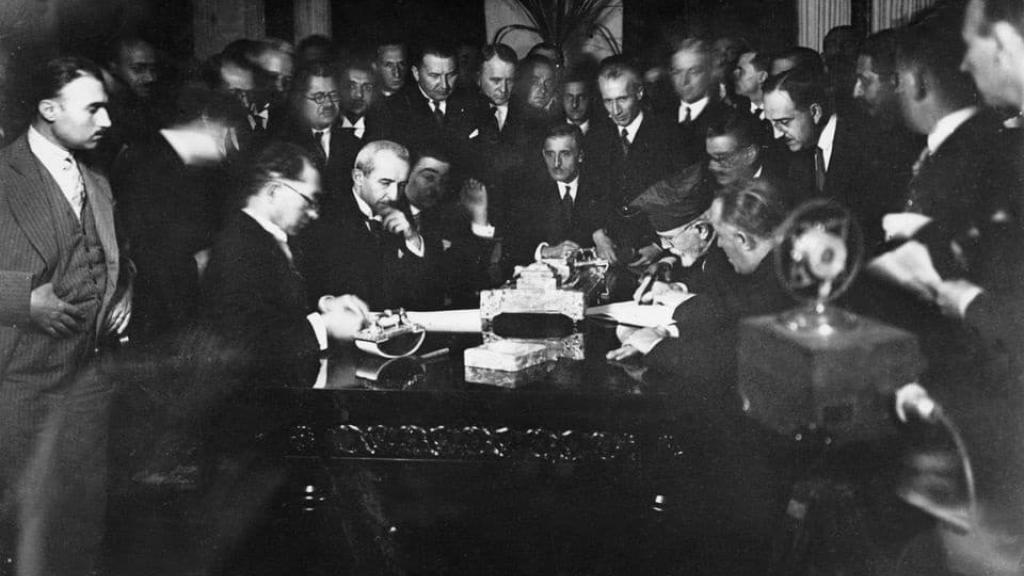
treaty signing

In November 1922, representatives of the World War I victors met with their Turkish counterparts in the Swiss lakeside city of Lausanne. They were tasked with negotiating a diplomatic settlement to replace the Treaty of Sèvres (1920), which had never been ratified. Australia, which had no independent foreign policy at the time, was party to the Treaty by virtue of its status as a member of the British Empire.

On July 24, 1923, the two sides signed the Treaty of Peace with Turkey, commonly known as the Treaty of Lausanne. This ratified the new boundaries of the Turkish state, granted amnesty for all crimes against humanity committed by the Ottoman state since 1914, and agreed to “mutual ethnic cleansing” between Greece and Turkey.

Significantly, it dropped Kurdish self-determination, as promised in the earlier Treaty of Sèvres. Although Turkey agreed to “assure full and complete protection of life and liberty to all inhabitants of Turkey without distinction of birth, nationality, language, race or religion,” the promise proved hollow. Immediately after the proclamation of the Republic of Turkey, President Ataturk banned the Kurdish language and afterwards continued the Young Turk policies of forced assimilation, even to the point of genocide. The leaders of the West, Australia included, have been like the Three Wise Monkeys; seeing, hearing, and speaking no evil about the crimes of the Turkish state; indeed even branding legitimate Kurdish resistance as “terrorism”.

So, what were the origins of the brutal ideology of the new state and why did the Allies renege of their promises? To understand the first point, we must step back in time to developments in the declining years of the Ottoman Empire. The empire had once been powerful and dynamic. Following the conquest of Constantinople in 1453, it expanded enormously, spreading through what is present day Iraq and Syria, down the Red Sea Coast to include Mecca, across Egypt and the North African littoral, and engulfing the Balkan Peninsula in southeastern Europe, including today’s Greece, Albania, Bulgaria, and Serbia. Between 1541 and 1686, the Ottomans ruled Hungary and their further expansion was only halted by the lifting of the siege of Vienna in 1683.

Although the empire was a byword for barbarism in Christian Europe, we have to be careful of “orientalist” stereotypes. The Christian kingdoms of the time were no exemplars of what we call human rights today. Muslim Turks were dominant but the empire practised what, at risk of anachronism, we might call a rough form of multiculturalism. The empire was home to a bewildering patchwork of peoples, often living cheek-by-jowl, speaking many languages, and practising religions. Non-Turks, Jews, and Christians could and did rise to important administrative, business and military positions. In 1492, when Ferdinand and Isabella expelled the Spanish Jews from Iberia, they found a safe haven in the Ottoman city of Salonika, where they thrived until they were deported to the Nazi death camps in 1944.

It is a truism that empires rise, decline and fall. Thus it was with the Ottoman Empire, which in the 19th century was widely known as “the sick man of Europe.” In 1832, Greece won its independence and nationalist revolts followed throughout the Balkans, creating waves of Muslim refugees. In 1830, France annexed Algeria and in 1882 Egypt was lost to Britain. Naturally, educated Ottoman citizens resented the empire’s decay and wondered how it might be arrested. They turned to Western Europe for ideas of how the system might be reformed.

By the late years of the 19th century, Ottoman patriots came to see the autocratic rule of the Sultan as a barrier to progress and looked towards British-style constitutional monarchy as a check on absolutism. They were also drawn to European ideas of science, civic reform and political liberalism. One secretive group emerged as the Committee for Union and Progress. Although they became more widely known as the Young Turks, they were initially reflective of the empire’s ethnic diversity. Their ideas brought them into conflict with traditionalist supporters of the autocratic status quo.

In 1908, the Young Turks seized power under the battle cry of LIBERTY! They aimed to create a powerful, rationally organised state protected by a modern military, with guarantees of democratic rights. They soon forgot their promises and succumbed to the European idea of the “ethnically pure” nation state. Their Ottoman patriotism had degenerated into a narrow Turkish nationalism, accompanied by dictatorial intolerance and brutality. The heartlands of the empire in Anatolia and European Turkey would be “purified” of non-Turkish languages and cultures. Young Turk paranoia was increased by further loss of territory in the Balkan Wars of 1912.

Before the Young Turks went to war on the side of Germany and Austria-Hungary in 1914, they began an ambitious programme of “ethnic social engineering”. Non-Turks would be permitted to make up no more than 5–10% of any “Turkish” town or district. This would be achieved by population transfers: Kurds, Armenians, Greeks and others would be forced out and Turks would be moved in. Or Kurds would be forcibly assimilated. The Young Turks were also planning mass murder: “disloyal” elements would be exterminated.

The day after the Allied landings in Gallipoli, the Young Turks began the Armenian genocide. It was premeditated. Armenian units in the Ottoman army had been disarmed and dispersed. Armenian civilians who were not immediately killed were sent on death marches into the Syrian desert. It is likely that as many as 1.4 million Armenians and 500,000 Greeks, together with tens of thousands of Assyrians, were murdered in what was the first genocide of the 20th century. At the same time, the deportations and forced assimilation of Kurds proceeded apace.

Unfortunately for the Young Turks, they had chosen the losing side in World War I. They were forced to agree to Allied occupation of Istanbul and the Bosphorus, and their leaders either fled or were put on trial for their crimes. The Empire lost further vast territories. Under the terms of the Sykes-Picot agreement of 1916, much of the Ottoman’s Arab majority vilayets were handed over to Britain and France, and the Muslim holy cities of Medina and Mecca were lost forever.

The question remained of what would become of Anatolia and the rump European portions of the empire adjacent to Istanbul. The US President, Woodrow Wilson, proposed that,

The Turkish portions of the present Ottoman Empire should be assured of a secure sovereignty but the other nationalities which are now under Turkish rule should be assured an undoubted security of life and an absolutely unmolested opportunity of autonomous development… (Point 14 of Wilson’s Fourteen Point proposal for the post-war peace treaties.)

The other Allied powers had different ideas. Under the Treaty of London in 1915, Italy had been promised a share of the Turkish islands and the Anatolian mainland. They had no reasonable claim, but Greece could point to the large Greek majorities in significant areas of western Anatolia as justification for their claims in that region. For their own reasons, the Allies were also sympathetic at the time to Kurdish aspirations for their own state in eastern Anatolia, and for the expansion of an independent Armenia.

On August 10, 1920, the powerless Turkish government signed the Treaty of Sèvres. The Treaty triggered widespread anger in Turkey and across the colonial and Muslim world. It did not embody the Wilsonian principles of self-determination, except in the case of the Kurds. Kurdish representatives at Sèvres successfully argued for a separate Kurdish state. Article 64 spelled this out:

If within one year from the coming into force of the present Treaty the Kurdish peoples within the areas defined in Article 62 shall address themselves to the Council of the League of Nations in such a manner as to show that a majority of the population of these areas desires independence from Turkey, and if the Council then considers that these peoples are capable of such independence and recommends that it should be granted to them, Turkey hereby agrees to execute such a recommendation, and to renounce all rights and title over these areas.

The Treaty was never ratified. Turkish nationalists, led by Mustapha Kemal — later known as Ataturk, the Father of Turks — were determined to resist and carve out a Turkish ethno-state. War broke out between the Turks and the Greeks and their Allied supporters. The conflict, known to the Turks as the War of Independence, was fought with horrific brutality. For instance, the Aegean city of Smyrna, today’s Izmir, was burned to the ground and the Greek population put to the sword. Both sides committed appalling atrocities. Some Kurds fought alongside the Turks, but others stood aside or pushed for their own interests.

The Western Allies recognised the Turkish victory and Turkish claims by signing the Treaty of Lausanne. Three months later, the Ottoman parliament dissolved itself and proclaimed the Republic of Turkey. The Treaty gave Turkey most of what it wanted. The current boundaries of the new state were ratified. The Allies gave a blanket amnesty for all crimes committed by the Turkish state right back to 1914, including the Armenian, Greek and Assyrian genocides.

Moreover, the Treaty approved the forced population transfers between Turkey and Greece, and Turkey and Bulgaria. In what we may fairly call mutual ethnic cleansing, some 1.5 million Greeks and 500,000 Turks were forced out of their homelands. Ironically, many expelled “Greeks” spoke Turkish, and many deported “Turks” spoke Greek. Indeed, cinemas in the Greek city of Thessaloniki — the former Ottoman Salonika — regularly showed Turkish films right up to the 1960s as a result of the deportations. (See Bruce Clark, Twice a Stranger: How Mass Expulsion Forged Modern Greece and Turkey.)

Ataturk was determined that the new Republic would be a state ruled by and for ethnic Turks. Non-Turkish populations would be assimilated to the Turkish nation, forcibly if necessary, for despite the forced transfers and earlier exterminations, hundreds of thousands of Armenians, Greeks and Assyrians remained within the Republic’s boundaries. Kurds made up as much as 20% of the population, but the new state denied their existence: they were “Mountain Turks,” and their language and customs were banned from the outset.

Incredibly, the Kurds have resisted Turkification to this day, often rising up to resist their oppressors. The state has responded with great brutality, as in the genocide at Dersim in 1937-38. Military operations and mass deportations have left much of eastern Anatolia depopulated and economically underdeveloped. The policy of cultural genocide even flouts the provisions of the Treaty of Lausanne, which explicitly bound Turkey to respect other languages and cultures.

Sadly, the world has ignored the history of criminal abuse that followed Lausanne.

Back at the time of the signing of the Treaty, Turkey was something of a pariah. It had fought on the side of the defeated Central Powers and there was some awareness that it had committed horrendous crimes against humanity. The Allies worried that the Republic might seek an alliance with the Soviet Union and were prepared to ignore the obvious flouting of the terms of Lausanne if it kept Turkey within the Western fold. Britain and France also wanted a secure boundary between Turkey and their new oil-rich possessions in Iraq and Syria. When Turkey joined NATO in 1952, the Allies were even more prepared to ignore the abuses.

Turkey has enjoyed a strangely sympathetic press here in Australia, and this is bound up with the myth that Australia “became a nation” in 1915 when the ANZACs landed at Gallipoli. In fact, they were part of a British invasion force and Australia was not consulted when Britain went to war.

Australian attitudes to its foes in the many wars it has fought have seldom been cordial or respectful. The Germans were bloodthirsty “Huns.” The Japanese were scarcely human “Nips” or worse, part of a dreaded “yellow peril.”

In contrast, the Turks are seen as “the gallant enemy” — “Johnny Turk” who fought the ANZACs so valiantly at Gallipoli. Thousands of Australians regularly make a pilgrimage to Gallipoli to mark the anniversary of the Allied landings 110 years ago, including Defence Minister Richard Marles, who went last year as a guest of the Turkish government. Ataturk, despite his crimes against humanity, is venerated as a super-hero worthy of the title of Father of Turks. Thus, many accept without evidence that Ataturk wrote the following words for his Interior Minister, Sukru Kaya, to use in a speech at Canakkale in 1934:

Those heroes that shed their blood and lost their lives ... You are now lying in the soil of a friendly country. Therefore rest in peace. There is no difference between the Johnnies and the Mehmets to us where they lie side by side in this country of ours. You, the mothers, who sent their sons from faraway countries, wipe away your tears. Your sons are now lying in our bosom and are in peace. After having lost their lives on this land, they have become our sons as well.

In primary school and regularly thereafter, Australian kids are drilled in the national myth, with Ataturk’s alleged words seen as holy writ. We were never told that the Armenian genocide began the day after the landing at Suvla Bay. Even less is said about Kaya’s involvement in the genocide and the subsequent crimes against the Kurds. It is worth remembering that John Howard, whose government first listed the Kurdistan Workers’ Party (PKK) as a terrorist organisation, has been a key promoter of the ANZAC myth as part of the sanitisation of Australian colonial history. The two matters are closely intertwined and the Treaty of Lausanne continues to cast a long shadow.

This is an edited transcript of a speech given by John Tuly to the conference, “Treaty of Lausanne - Partition, Denial, Massacre, Kurdish Struggle & the Future of Kurdistan” on July 24. John Tully is honorary professor at the College of Arts and Education at Victoria University in Melbourne, Australia.


Imperialism, repression and resistance: The long war against Kurds in Iran


For most of the media, the United States and Israel’s war on Iran has become last month’s story, but this story is far from over, and has many prequels. Like other conflicts and wars in the region, Iran’s troubled relations with the US and Israel — and also with the Iranian Kurds — have their roots in the poisonous soil of European imperialism.

The border between Rojehlat (eastern or Iranian Kurdistan) and the other parts of Kurdistan has hardly changed since the 17th century, but the division of the rest of Kurdistan by the 1923 Treaty of Lausanne, and the treaty’s failure to recognise a Kurdish state, weakened the position of Kurds everywhere. While Lausanne followed the imperial conflict of World War I, World War II — in many ways a continuation of the first — was followed by the creation of Israel and international recognition of the Zionists’ settler-colonial project.

World War I helped catalyse the Russian Revolution and subsequent global competition between the forces of Communism and capitalist imperialism. World War II allowed this to transform into the Cold War between East and West. In both periods, as still today, an overriding mission of Western governments has been the crushing of any emergence of communism, or even socialism.

Their geographical separation from World War II, and relatively late entry into the conflict, gave the US economic, political and military dominance, and enabled the growth of the US’s military-industrial complex, whose power President Dwight Eisenhower warned about in his farewell address in 1961. This power has been used to intervene in other countries to prevent the emergence of left forces and unseat governments out of line with US capitalist interests.

During the 19th century, Iran fell under increasing economic dominance by European imperial powers. Iran’s leaders gave away economic concessions in exchange for short-term gains, and early last century, the British Anglo Persian Oil Company took control of oil fields in southwest Iran.

In 1953, it was Iran’s turn to undergo a CIA regime change — a joint operation organised by the US and the old imperial power, Britain. Iran’s parliament had voted to nationalise the oil industry — a challenge to Western commercial interests that was deemed intolerable. Prime Minister Mohamad Mosaddegh was removed in a coup, and power was consolidated under the Shah, Mohammad Reza Pahlavi, who had first been put in control by Britain and Russia during the war, when his father had refused to let the Allies use the trans-Iranian railway.

Pahlavi maintained his rule through his notorious secret police, the Savak, but, by the 1970s, economic hardship and inequality were becoming increasingly unbearable. In 1978–79, a mass movement strengthened by workers — especially oil workers — crippled the country and forced Pahlavi to flee.

The rise of the Islamic Republic

Support for the left was surging, and workers’ strike committees were creating kernels of alternative organisation when Ayatollah Ruhollah Khomeini returned from exile in France. Khomeini was able to appeal to the more conservative elements, especially small business owners and the rural or recently rural poor, while neutralising potential opposition through superficially progressive rhetoric.

One by one, Khomeini crushed those opposing him — secular leftists, Islamic leftists, women, groups seeking national autonomy. He had no hesitation in carrying out mass assassinations to impose his version of Islamic rule and himself as supreme leader. He was able to do this because he initially had the West’s backing — as a safe anti-left alternative — and because many left party leaders failed to understand the threat he posed, casting him as a “progressive bourgeois” who they should work with rather than oppose.

In November 1979, Iranian student activists took over the US embassy in Tehran, taking 66 US citizens hostage and demanding the extradition of Pahlavi, who had gone to the US for cancer treatment. Fifty-two of the hostages were not released until January 1981. Khomeini supported the hostage-taking, calling the US “the Great Satan”. 

In 1980, the US cut diplomatic relations with Iran and implemented sanctions in response to the hostage taking, which were subsequently increased several times, with drastic impacts on people’s living standards. During the 1980s, the US gave support to Iraq in the Iran-Iraq War, and, in 1984, President Ronald Reagan designated Iran a “state sponsor of terror” following attacks on the US military in Lebanon by the Iranian-backed Hezbollah.

With the US’s “war on terror” following 9/11, President George Bush declared Iran to be part of an “axis of evil”, alongside Iraq and North Korea. Meanwhile, fears that Iran was developing nuclear weapons led to more sanctions by the US, EU and United Nations. In 2015, Iran agreed to a deal whereby they would limit nuclear development and submit to regular inspections in exchange for the lifting of these sanctions. However, in 2018, US President Donald Trump pulled out of the agreement and reinstated sanctions.

In the early summer of 2019, explosions blamed on Iran hit oil tankers in the Gulf of Oman, and Iran shot down a US drone. The next year, the US assassinated Iranian general Qasem Soleimani, head of Iran’s elite Quds Force.

Under Pahlavi, relations between Iran and Israel had been good, reflecting shared alignment with the US and against pan-Arabism. Israel helped develop Iran’s military and secret service. Relations changed with the revolution, when Khomeini declared Israel an enemy of Islam and handed the Israeli embassy to the Palestine Liberation Organisation (PLO) — though the Iran-Iraq war forced Iran to continue to rely on buying Israeli weapons for some years.

Iran’s support for Palestinians was both ideological — as fellow Muslims — and strategic. It wanted to win support as defenders of Islam, and to distract attention from continued economic hardship. After Israel invaded Lebanon in 1982 — a time when 11 members of the Kurdistan Workers Party died fighting alongside the PLO — Iran helped organise Lebanese Shia and create Hezbollah.

The end of the Cold War, and the defeat of Iraq in the Gulf War, left Iran and Israel competing for regional dominance under the US, the one remaining superpower.

Kurdish resistance

Kurds — who make up 12–15% of Iran’s population — suffered under the ethnic nationalism of Pahlavi and were active in the revolution. They fought for autonomy, not to replace one autocratic centralised regime with another. The Kurdish provinces held out the longest against Khomeini’s Islamic Republic.

Kurdish resistance was largely led by the leftist Kurdish Democratic Party of Iran (KDPI) and Komola, the Society of the Revolutionary Toilers of Iranian Kurdistan. In August 1980, Khomeini declared a jihad against the “infidel” Kurds, licensing extreme brutality by the regime’s Islamic Revolutionary Guard Corps. By the end of 1981, Kurdish resistance was largely defeated, with small-scale fighting continuing into 1983.

Kurdish struggles for rights and freedom have become entangled in rivalries between regional powers, exploiting these divisions and being exploited by them. In the Iran-Iraq war, support given to Iran by Kurds persecuted by the Iraqi government helped bring the full wrath of Saddam Hussein down on Iraqi Kurdish towns and villages, including Halabja, where Hussein’s military massacred 5000 people in a chemical attack. (Palestinian reverence for Hussein as a supporter of their cause has undoubtedly complicated relations with the Kurds.)

The Islamic Republic proved to be every bit as racist towards non-Persians as Pahlavi had been, as well as prejudiced against Sunnis, which most Kurds are. Rather than attempt to win Kurdish support, the government has kept control over the Kurdish regions through economic deprivation and pervasive securitisation.

Overt political opposition of any kind is impossible in Iran, where even campaigning on ecological issues can land you in prison, and the remnants of the KDPI and Komola moved across the border with their families to refugee camps in Iraq.

The Kurdistan Free Life Party (PJAK) was founded in 2004 to propagate the ideas of Abdullah Öcalan in Rojhelat, but Öcalan’s influence there was already strong, as demonstrated by the mass protests at the time of his capture in 1999. PJAK guerrillas are based in the border mountains.

Anti-regime protests

Iran under the mullahs [religious clerics] has seen several waves of mass protest — against lack of freedoms, poor economic conditions and lack of vital services — each put down with extreme violence.

In 2019, anti-government uprisings were taking place in over two-thirds of Iranian provinces when the government unleashed its security forces, leaving 1500 people dead. Between then and the 2022 protests triggered by the government killing of Jina Amini for a misarranged headscarf, there were mass strikes by groups struggling to survive on starvation wages and pensions, and protests by farmers unable to get the water needed for their crops, as well as protests for women’s rights. More recently, there have been more protests about the lack of clean water.

The Iranian regime demands the total subservience of women, and also takes every opportunity to oppress its Kurdish minority. Of the many communities that make up the population of Iran, Kurds have been left with the least to lose, and, despite strongly patriarchal tribal traditions, many Iranian Kurds have also been exposed to the Kurdish freedom movement and its focus on women’s freedom.

The protests — which developed into an uprising — were especially strong in Kurdish areas and among the Baluch minority at the other end of the country. The Kurdish movement’s slogan of Jin Jiyan Azadi — Women Life Freedom — became the call of the resistance, alongside anti-regime slogans such as “Death to the Dictator”.

People rose up in resistance in every province, and there was tremendous support among students. But outside the Kurdish regions, the uprising failed to achieve the mass mobilisation of workers needed to stop the functioning of the economy and bring down the government. The tight grip of the Iranian Revolutionary Guard Corps on every aspect of life has made this much harder to achieve than it was in 1979, and reports of brave and inspiring resistance began to be overtaken by accounts of brutal and sadistic state violence.

Last September, two years on from the uprising, Amnesty International reported that “people in Iran continue to endure the devastating consequences of the authorities’ brutal crackdown” and that “authorities have also further escalated their assault on human rights, waging a war on women and girls”. Hengaw Organisation for Human Rights reported that 143 Kurds lost their lives in the uprising.

Although the Iranian Kurdish parties outlawed in Iraq did not intervene practically, they were attacked by Iranian missiles and drones, and, under Iranian pressure, Iraq has forced them to disarm and relocate away from the border. This has not impacted PJAK, whose bases are hidden in the mountains.

Shifting balance of forces in the Middle East

This last year has seen seismic changes in the political balance in the Middle East, with Israel, armed and backed by the US and their Western friends, gaining hegemonic power over an increasing area at the expense of Iran — and Russia. Besides their genocidal attack on Gaza and Iran-backed Hamas, Israel crippled Hezbollah. This seriously weakened the Iranian presence in Syria. With Russia — President Assad’s other backer — distracted by war in Ukraine, Ahmed al-Sharaa and his Hayat Tahrir al-Sham were able to take control in Damascus.

There is evidence that Britain and the US supported this takeover, and they have been quick to rebrand al-Sharaa from “terrorist” to welcomed head of state. Israel took advantage of the change of regime in Syria to bomb the country’s military bases and ensure that it will never be able to challenge Israeli dominance.

For many years, Israel has carried out limited attacks against Iran, including assassinations and sabotage, often targeting its nuclear program. With Iran’s regional allies, Hamas, Hezbollah and Assad, weakened or vanquished, the Zionist state is determined to consolidate its dominance.

On June 13, it launched a well-prepared attack, which included the assassination of 30 generals and nine nuclear scientists, as well as attacks on Iran’s nuclear facilities and military resources. This was framed as preventing the imminent development of an Iranian nuclear bomb, but Israel has been making the same claim that Iran is on the threshold of achieving a bomb for over a decade.

At the time the attack took place, the US was attempting to negotiate a new deal that would restrict and monitor Iran’s nuclear developments in exchange for lifting sanctions. As Israel had planned, the US stopped their negotiations and followed Israel with an attack of their own, employing weapons that could penetrate Iran’s underground facilities, which Israel did not have the means to do themselves. It is thought that Israel hoped to draw the US into a full regime change war, but the US made clear that their intervention was a one off — at least for the time being.

For Iranian Kurds, this 12-day war brought brief hopes that they might be able to use the chaos to build democratic autonomy — as in Syria — alongside fears that, like other attempts at regime change from outside, this would end in years of violence and instability. PJAK explained that what was happening was “a war of power and conflicting interests, not a war of liberation for peoples and nations”. More immediate concerns that the Iranian regime would take out their anger on their own minorities and political opponents proved well founded.

Post-war repression

A month after the ceasefire, Hengaw reported that since the beginning of the war at least 1800 people had been arrested, 500 of them Kurds, and that most had been accused of espionage for Israel. While Israel clearly has many spies in Iran, there is no reason to believe that these are the people being arrested, as this is used as a convenient charge for destroying government opponents. Six people (including three Kurds) have already been executed for espionage. 

At least 29 civilians were killed by government forces during checkpoint raids, and there has been increased pressure on political prisoners, heavy sentences — including death — for political activists and increasing use of the death penalty.

Israel’s attack was the result of years of planning and demonstrated how deeply Mossad had infiltrated into Iran. However, it is unclear how much damage has been done to Iran’s ability to produce a nuclear weapon, and it can be argued that it now has a much stronger incentive to do so.

Israel was shocked by the extent of the Iranian response and the damage it inflicted in Tel Aviv. But even after agreeing to a ceasefire, Israel made clear that, as in Lebanon, it has no intention of abiding by it and will cut Iran down to size whenever it wants. Its defence minister stated, “I have instructed the [Israel Defence Forces] to prepare an enforcement plan against Iran, which includes maintaining Israel’s air superiority, preventing the advancement of nuclear capabilities and missile production, and responding to Iran’s support for terrorist activities against the State of Israel.” 

Trump stated just this week that if Iran rebuilds their nuclear facilities, “we’ll wipe it out faster than you can wave your finger at it”.

Meanwhile, plans for a “Zangezur Corridor” could prove a trigger for new conflict in the region. This corridor would link (pro-Israel) Azerbaijan to Azerbaijan’s Nakhichevan exclave — and hence Turkey — through a slice of Armenian territory along the border with Iran. Washington has proposed that the US should build and manage it. But what is seen as an east-west link by Azerbaijan and Turkey is regarded as a barrier to north-south trade by Iran and Russia, and Iran has moved its forces to the border.

There is no end in sight for further fighting, both across Iran’s borders and internally. On July 19, an Iranian drone killed a PJAK fighter in Iraq. PJAK retaliated by killing three members of Iran’s Revolutionary Guard Corps. 

Meanwhile, alongside the continuing crackdown, Kurds in Iran have been mourning the deaths of three environmental activists who died fighting wildfires because the Iranian government has no interest in stopping fires destroying Kurdish lands.

This is an edited transcript of a speech given by Sarah Glynn to a Green Left forum, “The Kurds and the Israeli-US war on Iran” on August 1.  Sarah Glynn is Strasbourg-based writer for Green Left, a socialist activist and co-author of several books including Climate Change is a Class Issue


Friday, August 08, 2025

Rare ceremonial heads discovered in Peru shed light on 'Warriors of the Clouds'


A drone view shows archaeologists working on an ancient pre-Hispanic structure belonging to the Chachapoyas culture, known as the "Warriors of the Clouds," at the Ollape archaeological site, in Chachapoyas, Amazonas, Peru, on Aug 5, 2025.
PHOTO: Reuters

August 08, 2025 

CHACHAPOYAS - Archaeologists in Peru's Amazon region have uncovered two rare, 1,000-year-old ceremonial stone club heads along with roughly 200 ancient structures and a unique zigzag frieze.

The discoveries were made at the Ollape site in the Amazonian district of La Jalca in an area where the Chachapoyas civilisation, or "Warriors of the Clouds," developed between 900 and 1,450 A.D.

According to lead archaeologist Pablo Solis, these findings offer a new understanding of the less-studied society that inhabited the area.

The intricately crafted club heads are believed to have held ceremonial significance, hinting at ritual practices of a society whose cultural footprint remains largely unexplored.

The intricate zigzag pattern is the first of its kind to be found in the region, and the number of structures suggests Ollape was an important ceremonial and residential hub.

Peru is rich in archaeological discoveries, with researchers frequently uncovering ancient remains. The country is home to numerous historical sites, including the famous Machu Picchu in the Andean highlands of Cusco and the mysterious Nazca lines etched into the desert along the coast.


Prague zookeepers turn to puppets to parent baby vultures


Prague Zoo curator of birds Antonin Vaidl feeds a lesser yellow-headed vulture, which hatched three weeks ago, by using a puppet that imitates a parent bird, at the zoo, in Prague, Czech Republic, on Aug 8, 2025.
PHOTO: Reuters

August 08, 2025 


PRAGUE - Zookeepers feeding two baby vultures in Prague are using a hand puppet designed to look like the chicks' parents, a technique they hope will ensure the birds learn to identify with other vultures - not humans.

Staff at Prague Zoo had to start hand-feeding the lesser yellow-headed vultures when their parents stopped nesting. After using the approach with other birds, they quickly made a hand puppet that looks like an adult vulture's head.

"If we raised (the bird) in direct contact with humans, it would become imprinted to humans, and then it would be difficult to breed that individual within the species," said Antonin Vaidl, Prague Zoo's curator of bird breeding.

Human imprinting increases the risk of a chick struggling to build a relationship with a mate in adulthood.

Hand puppets have previously been used with other bird species at the zoo including rhinoceros hornbills and Javan green magpies, with their design reflecting distinctive features such as a large colourful beak.

Prague is one of three European zoos to breed the lesser yellow-headed vulture, also known as the savannah vulture.
CLIMATE CRISIS

Greece wildfires: Three dead as winds disrupt ferries, evacuations

AFP
8 Aug, 2025 


Three people, including two Vietnamese tourists, died in Greece as wildfires were fuelled by strong winds. Photo / Aris Messinis, AFP

Three people including two Vietnamese tourists have died in Greece as ferocious winds whipped up wildfires and disrupted ferry travel for tens of thousands of summer holidaymakers.

More than 200 firefighters backed by 11 water bombers and seven helicopters were battling a blaze in Keratea southeast of Athens, Costas Tsigkas, head of the association of Greek firefighter officers, told ERT state television.

“It’s a difficult fire,” he said, citing gusts of wind and reporting that several communities had been evacuated.

Firefighters discovered the body of an elderly person inside their burned home in Keratea and the wind was hampering water bombers’ ability to operate, fire service spokesman Vassilis Vathrakogiannis told a press briefing.

An AFP journalist in the nearby town of Palaia Fokaia, around 45km south of Athens, saw fire consume a house and thick smoke choke the air.

Firefighters were sprinting to direct hoses and douse the flames, while a helicopter swooped overhead to drop water.

Earlier, a separate blaze on the island of Cephalonia was brought under control, local officials said, while the situation “has improved” on the Peloponnese peninsula west of Athens, Vathrakogiannis announced.

The civil protection ministry had said wind gusts would reach 88km/h, especially in the southern Aegean and the Sea of Crete.

National weather service EMY said the gusts would weaken after midnight, but the civil protection ministry placed several areas under the highest alert for wildfires on Saturday, including the Attica region, which includes Athens.

Over 200 firefighters and multiple aircraft battled the blaze in Keratea, southeast of Athens. Photo / Aris Messinis, AFP

The coastguard had earlier said a Vietnamese man and woman from a cruise ship group had died at the Sarakiniko beach on the tourist island of Milos in the Cyclades.

“The man and woman were found unconscious in the sea and were taken to the local health centre,” a coastguard spokeswoman said.

“The woman fell in the water and the man apparently tried to save her.”

The gales confined many ferries to port, the main mode of transport connecting thousands of islands and their crucial tourism sector.

The coastguard said most ferries were unable to depart on schedule from Piraeus and other Athens ports, especially to the Cyclades or Dodecanese islands. Several services were cancelled and others postponed.

At Piraeus, hundreds of travellers crowded outside a ferry bound for the Cycladic islands of Paros and Naxos, waiting for news on a possible departure.

Nearby, stranded travellers surrounded by rucksacks and suitcases formed a huge queue outside a ticket office and made desperate phone calls hoping to make rearrangements to save their journeys.

“There’s huge lines, huge commotion, everyone’s waiting in the sun and it’s a very tough time,” said Philip Elias, an American tourist.

Maritime connections with the Saronic islands near Athens including Aegina, Hydra, Poros and Spetses and the Ionian Sea were unaffected, the coastguard said.


Strong winds are common in Greece at this time of year, and firefighters have already faced several major blazes this summer, including on the islands of Evia and Chios as well as in the western Peloponnese.

– Agence France-Presse

Greece fights wildfires amid gale-force winds


Locals try to extinguish a wildfire burning in Keratea, near Athens, Greece, on Aug 8, 2025.
PHOTO: Reuters

PUBLISHED ON August 08, 2025

ATHENS - At least one person died and homes and farmlands were destroyed as wildfires stoked by gale-force winds broke out across Greece on Friday (Aug 8), from the southern outskirts of the capital Athens to regions near Ancient Olympia.

A major blaze broke out in the small town of Keratea southwest of Athens. Firefighters discovered the body of an elderly man in a burned-out structure there, Greek Fire Brigade Spokesman Vassilis Vathrakogiannis said during a briefing.

In the region of Ancient Olympia in the southwest of the country, huge flames devoured olive groves and forestland. Another fire broke out on the touristy island of Kefalonia.

Much of the region around Athens has seen barely a drop of rain in months.

Wind gusts of up to 80 kilometres per hour fanned the flames, setting olive tree orchards alight. Homes were engulfed as locals wearing flimsy face masks assisted firefighters.

Witnesses said the wind gusts were so strong that dousing some areas was near impossible.

"The wind would push it back," a Keratea resident told Reuters.

High winds are expected through the weekend and beyond.

At Ancient Olympia, an extensive region in the western Peloponnese that includes the site of the first Olympic Games, firefighters were battling a blaze fanned by interchanging winds.

"If the wind doesn't die down we will have huge problems," Ancient Olympia vice-mayor Georgios Linardos told state broadcaster ERT.

Gale-force winds caused extensive delays in the sailing of ferry boats from ports around Athens. On the island of Milos, two Vietnamese holidaymakers drowned at sea amid the high gusts, a coast guard official said.


Read Also

world
Massive French wildfire now contained, 16,000 hectares affected, local authorities say


Greece and other Mediterranean countries are in an area dubbed "a wildfire hotspot" by scientists, with blazes common during hot and dry summers. These have become more destructive in recent years due to a fast-changing climate, prompting calls for a new approach.

Parched southern France is currently facing its worst wildfire in decades, where fires are contained but not over.

Source: Reuters