Monday, August 11, 2025


In Trump’s Competition with China, China is Winning


 August 11, 2025

Donald Trump doesn’t have much interest in numbers and the real world, but that is where the rest of us live so it is worth checking in periodically. Trump and many others — including many Democrats —  are anxious to see the United States as engaged in a Cold War-type competition with China.

I have argued that this is a foolish way to shape foreign policy. The first Cold War was not a lot of fun. We threw a lot of money in the toilet building weapons, most of which were thankfully never used. But we did have hot wars in Korea and Vietnam, as well as a large number of interventions in various countries around the world. And we did have a number of flashpoints, most notably the Cuban missile crisis, where a wrong step could have annihilated the world.

Anyhow, to my view we should not see the Cold War with the Soviet Union as a model to be emulated. But apart from my personal views, there is a fundamental difference between the Soviet Union and China. At its peak, the Soviet economy was roughly half the size of the U.S. economy. China’s economy is already one-third larger than the U.S. economy and growing far more rapidly. This was true before Donald Trump took office, but the growth gap has been even larger in the first six months of this year.

China’s economy has been growing at more than a 5.0 percent annual rate. Meanwhile the US economy grew at just a 1.2 percent annual rate. Put in dollar terms, China’s economy has grown by roughly $1 trillion in the last six months, while the US economy has grown by just $180 billion.

This comparison doesn’t really mean much to any of us in our daily lives. People care about whether they have jobs, rising wages, and living standards. Things don’t look great on the wages and living standards front either, but I’ll leave that one for now.

The point here is that if we envision ourselves in a Cold War competition with China, we’re losing badly. I know that China’s growth statistics must always be viewed with skepticism (that may be true here soon as well), but there is little doubt that over long period of times they are pretty much on the mark.

Over the last half century China has gone from Sub-Saharan Africa living standards to upper middle-income living standards. This means that even if the 5.0 percent growth reported for the first half of the year may not be exactly right, it is likely in the ballpark.

So, we shouldn’t be like Donald Trump and say we can ignore the numbers. We are behind China and falling further behind. Those are the facts that the New Cold Warriors need to recognize.

This first appeared on Dean Baker’s Beat the Press blog.

Dean Baker is the senior economist at the Center for Economic and Policy Research in Washington, DC. 

A global market based on gold bars shudders on tariff threat


WATCH COSTCO GOLD BAR PRICES INCREASE


Stock image.

The global gold market relies on a network of banks, refineries and couriers that can fly bullion between key trading hubs at a moment’s notice in pursuit of the highest prices. On Friday, a shock US ruling suggesting that the metal would be subject to tariffs plunged that system into chaos.

The apparent decision by the US Customs and Border Protection agency — announced privately in a letter to a Swiss refiner on July 31 and made public Friday — sent gold futures in New York soaring to a record, as insiders warned the tariffs would have dire consequences for the market. Then, just as quickly, prices tumbled after the Trump administration suggested imports of gold bars wouldn’t face tariffs after all.

It was the latest example of President Donald Trump’s trade war triggering wild gyrations in markets, for equities, raw materials and finished products alike.

Gold bullion is typically treated more as a financial instrument than a physical product, and slapping tariffs on it would have such profound consequences that many traders argued Friday the ruling had to be a mistake.

“The problem was that the government didn’t look outside of the question of the physical format and did not take into consideration that this widget was actually gold,” said Robert Gottlieb, a former precious metals trader and managing director at JPMorgan Chase & Co.

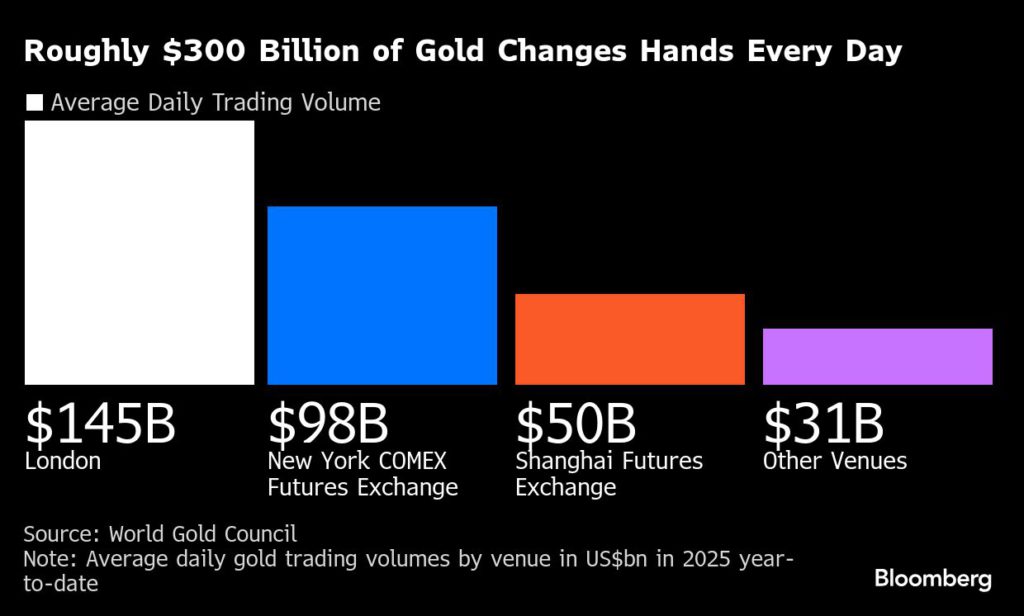
A complex and sometimes fragile system for making and moving gold bars underpins the global market for the metal, including the futures exchanges in New York and Shanghai as well as a huge over-the-counter market overseen by London banks. Key consumer hubs in Mumbai, Dubai and Hong Kong rely on it as well.

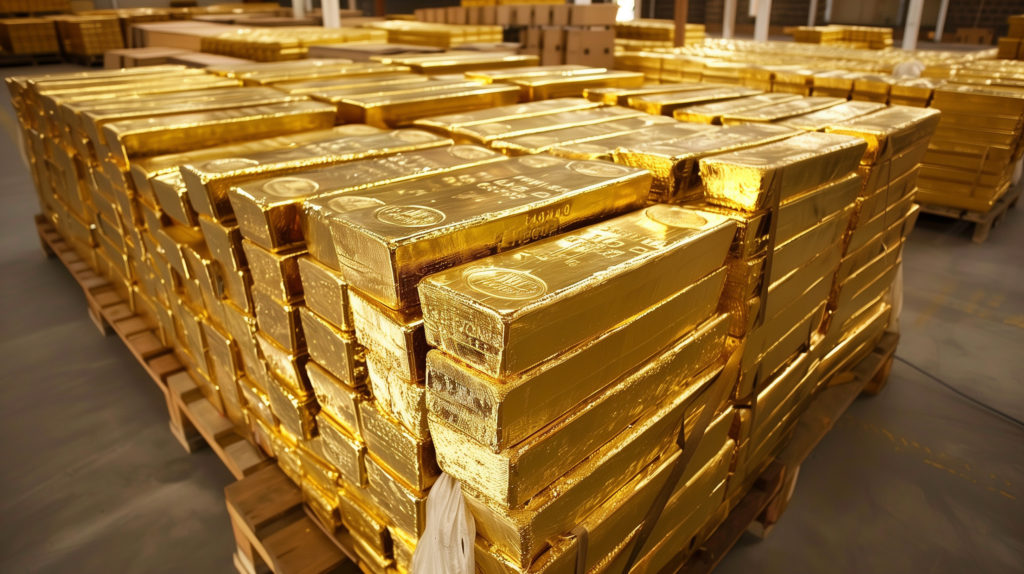
There is more than $1.1 trillion in gold bars stored in vaults to underpin trading in New York and London alone, with much of it stored by major dealers including JPMorgan and HSBC Holdings Plc.

Refineries in Switzerland play a crucial role in facilitating the flow of gold between London and New York. A trade group representing them said Friday that the apparent tariffs would render any future US shipments unviable. Asian refineries put a temporary halt on US-bound sales. At the epicenter of the turmoil in New York, observers warned that tariffs would pose a major threat to the gold futures market itself.

“The disbelief isn’t just that several billion dollars have been made and lost overnight,” said Ross Norman, a four-decade veteran of the industry who now runs Metals Daily, a pricing and analysis website. “The problem is we’re not in a good position when things become disrupted. When things blow out, you get lots of injuries.”

The dysfunction was immediately reflected in the spread between prices on CME Group Inc.’s Comex exchange in New York and the global benchmark price set in London. New York futures hit a new high above $3,530 an ounce on Friday, while the London market was more than $100 lower.

That was a record gap, but the 3% spread would be nowhere close to covering the apparent cost of import levies, which would differ from country to country under Trump’s reciprocal tariff regime.

Typically, if New York prices rise sufficiently, the large-format bars that are traded in London are melted down in Switzerland and recast as smaller, 1-kilogram (2.2 pound) bars that are deliverable on Comex. But with Switzerland facing a 39% reciprocal tariff, Comex prices would have needed to rise to about $4,700 an ounce for the shipments to become feasible.

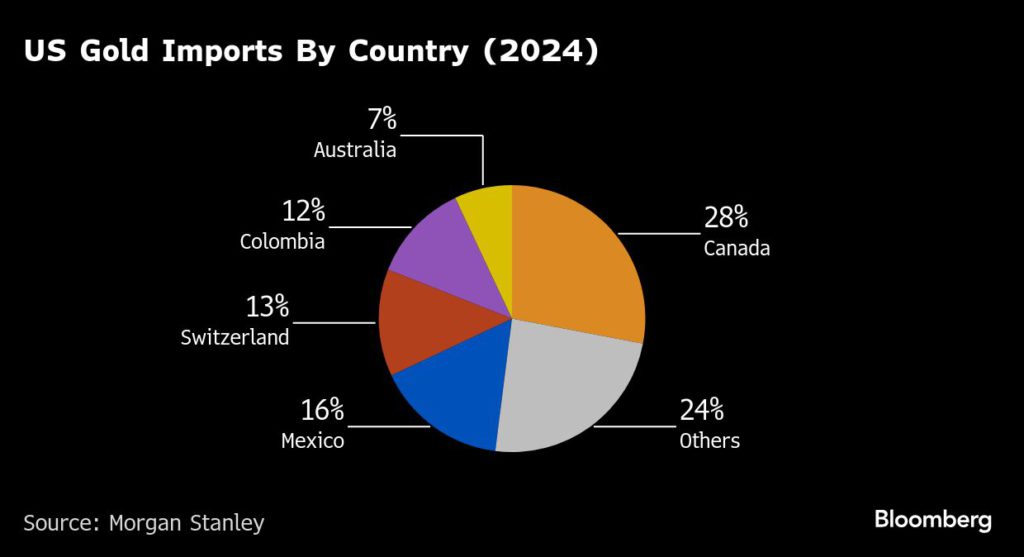
To plug the gap, US buyers might have been able to turn to other key suppliers, including Canada and Mexico. But Trump has threatened stiff tariffs on those countries, too.

Unlike gold miners, independent refineries survive on razor-thin margins. The Swiss trade group warned Friday that shutting them out of such a significant market would have adverse consequences for the global gold trade.

The hope — similarly held among the investors, traders, banks, and logistics firms blindsided by the US ruling — was that the White House would step back from the brink. It may do just that: The administration intends to post an executive order clarifying what it called misinformation about the gold tariffs, according to an official.

“From day to day, we learn more about new rules that could dramatically change the landscape of each commodity,” said Darwei Kung, head of commodities and portfolio manager at DWS Group. “Perhaps more change will result from the negotiation in the days to come.”

(By Mark Burton, Jack Ryan and Yvonne Yue Li)


U.S. Pressure is Firming Up a Multipolar World

by  | Aug 7, 2025 

U.S. tariffs wear the cloak of financial policy to address trade imbalances, but they mask deeper geopolitical ambitions. That strategy may backfire. The pressure of U.S. tariffs is firming up the multipolar world it is meant to prevent. 

Pressure from sanctions has already fused Iran even tighter with Russia, Iran and even Saudi Arabia. It is now, stunningly, contributing to the birth of relations with Egypt, a Middle Eastern power with whom Iran has had broken relations since 1979.

In 2024, Iran and Egypt both became members of BRICS, a large and growing international organization whose primary purpose is to balance U.S. hegemony in the new multipolar world. 

In June, Iranian foreign minister Abbas Araghchi met with Egyptian Foreign Minister Badr Abdelatty and President Abdel Fattah el-Sisi in Cairo. Araghchi posted that “After many years, diplomacy between Iran and Egypt has entered a new phase. The level of political interaction and cooperation, and more importantly, the level of trust and confidence in relations between the two countries, is unprecedented.” Abdelatty said “There is a mutual desire to develop our relations, taking into account the concerns and perspectives of each side.”

The meetings produced a region shifting agreement “to launch periodic consultations at the sub-ministerial level to address aspects of bilateral cooperation.”

U.S. foreign policy is also pushing other nations toward BRICS. On July 27, Secretary of State Marco Rubio said, “Maduro is not the President of Venezuela and his regime is not the legitimate government…. Maduro is the leader of the designated narco-terrorist organization Cartel de Los Soles.” 

Miguel Tinker Salas, Professor of Latin American History at Pomona College and one of the world’s leading experts on Venezuelan history and politics, told me that Venezuela is “very much interested in joining BRICS.” 

The realization of that interest has been frustrated so far, Salas says, by “some tensions with Brazil over Venezuela’s admission in the wake of the past presidential election.” Russia has supported Venezuelan membership. Venezuela is lobbying hard to join BRICS, and in January, Maduro expressed optimism about joining, saying “As far as BRICS is concerned, I hope that the way will be cleared and that the reality will be recognized – Venezuela is part of BRICS.”

Venezuela has increased ties with BRICS nations. Russia says “the Russian-Venezuelan strategic partnership is developing in a wide range of areas.” Venezuela is also “actively building a political dialogue with India” and “actively cooperating with Iran.” China is the largest exporter to Venezuela.

Most of the biggest nations in BRICS are facing pressure from U.S. sanctions and tariffs. On July 30, the U.S. slammed Brazil with 50% tariffs on all exports. The move revealed that Trump’s tariff strategy is not all about trade imbalances. Last year, the U.S. had a $7.4 billion trade surplus with Brazil. Washington claimed the tariffs were meant to pressure Brazil to drop charges against former president Jair Bolsonaro who faces charges for his involvement in an alleged conspiracy to subvert the 2022 Brazilian elections.

Brazil criticized the interference in its domestic affairs and the violation of its sovereignty and took its case to the World Trade Organization. Brazilian President Lula da Silva reminded the U.S. that “Brazil is a sovereign nation with independent institutions and will not accept any form of tutelage.” He said, “The political motivation behind the measures against Brazil violates national sovereignty” and warned against “threats that could compromise the independence of national institutions.” 

But the U.S. tariffs are not just about Bolsonaro or interfering in Brazil’s domestic affairs either. Politico reports that it was Trump’s anger at the BRICS summit in Rio de Janeiro that led him to hit Brazil with the massive tariffs. “BRICS tipped the scale,” said Mauricio Claver-Carone, a close ally of Secretary of State Marco Rubio and Trump’s former special envoy to Latin America.

But if the tariffs were meant to weaken BRICS, it seems to be having the opposite effect with Brazil saying the U.S. pressure will strengthen the organization’s agenda, pushing them, and others, away from U.S. dependence and towards the multipolar world represented by BRICS. American threats and unreliability as a trade partner have further cemented Brazil’s view that the economic partnerships with other BRICS+ countries need to be further fostered. As Al Jazeera and others have reported, “This dispute only strengthens the case for accelerating such integration.”

And Brazil is not alone. The U.S. is using tariffs to try to force India to choose sides, something the country, who is committed to multipolarity, is not likely to do. In the new multipolar world, nations do not have to choose between sides or line up consistently behind American hegemony. As India’s Foreign Minister Subrahmanyam Jaishankar explains, in a multipolar world, countries can deal “with contesting parties at the same time with optimal results” for their “own self-interest.”

The U.S. has placed 25% tariffs on India’s exports to the United States. But it does not stop there. India will be hit with an additional 100% tariff if they refuse to stop purchasing Russian oil. Russia is the top supplier of oil to India, accounting for 35% of its imports, and that amount is increasing. 

Rubio made the need to choose sides clear when he said that India “buys its oil from Russia…. And that – unfortunately that is helping to sustain the Russian war effort. So it is most certainly a point of irritation in our relationship with India.” Stephen Miller, deputy White House chief of staff, said that Trump has said very clearly “that it is not acceptable for India to continue financing this war by purchasing the oil from Russia.”

Despite the pressure to fall back in line with U.S. hegemony, India has made it clear that they will continue to purchase oil from Russia. India’s foreign ministry says that “The government is committed to prioritizing the welfare of Indian consumers. Our energy purchases will be based on price, availability and market conditions.” Tellingly, India’s foreign ministry spokesperson Randhir Jaiswal said India has a “steady and time-tested partnership” with Russia.

Like India, China is also being threatened with 100% tariffs on exports to the U.S. if they continue to buy Russian oil. And like their BRICS partners in India and Brazil, China is refusing America’s attempts to enforce its hegemony. China has responded that it is a sovereign nation and that it will purchase its oil in accord with its own internal policies. Asked about the U.S. warning and the consequence of disobeying, China’s Foreign Ministry Spokesman Guo Jiakun replied that “China will take energy supply measures that are right for China based on our national interests. Tariff wars have no winners. Coercion and pressuring cannot solve problems. China will firmly safeguard its own sovereignty, security and development interests.”

BRICS has long said that they oppose alliances and blocs and that they are against no one. But hostile U.S. pressure against many countries is building BRICS. American attempts to maintain its hegemony through the weaponization of the economy may be having the opposite effect, exerting pressure that is fusing the multipolar world more firmly together. 

Ted Snider is a regular columnist on U.S. foreign policy and history at Antiwar.com and The Libertarian Institute. He is also a frequent contributor to Responsible Statecraft and The American Conservative as well as other outlets. To support his work or for media or virtual presentation requests, contact him at tedsnider@bell.net.


Trump’s Tariffs against Latin America


Part of a global battle


President Donald Trump answers questions from reporters after signing an executive order about the 2028 Los Angeles Olympic Games, in the South Court Auditorium of the Eisenhower Executive Office Building on the White House campus, August 5, 2025

Trump’s threat of imposing a crippling 50 per cent tariff on all Brazilian imports to the United States took everyone by surprise, especially, considering the US enjoys a trade surplus with the South American giant (surplus it has enjoyed since 2007). Lula made it clear that Brazil would reciprocate in kind.

Trump tariffs against Brazil are in line with his overall policy of applying tariffs on all countries in the world. Under Trump US imperialism seeks to establish a global system that it suits itself such that it can impose or change any rule any time it wants and attack any country it dislikes.

As with many other global institutions, Trump, following in the footsteps of previous US administrations, is prepared to run roughshod over World Trade Organisation rules that US imperialism itself was central in establishing in 1995.

Thus, his attack on Mexico is not surprising either, country with which it has a substantial trade deficit caused by its southern neighbour’s incorporation into US supply chain arrangements ever since the 1994 North American Free Trade Agreement (Nafta).

The US has had a trade deficit with Mexico ever since 1995, exactly one year after Nafta.

To Trump’s chagrin, Mexican President Claudia Sheinbaum has vigorously defended her country’s sovereignty and has skilfully navigated US provocations.

To the charge of Mexico being a drug-trafficking hub, she has pointed out to US negotiators that the “the US itself harbours cartels, is the largest narcotic consumer market, exports the majority of armaments used by drug barons and hosts money-laundering banks.” She has also resolutely refused the deployment of US troops on Mexican soil.

Back in January 2025, Trump threatened Colombia with sanctions and 25 per cent tariffs on all its exports to the US. When Colombia’s President Gustavo Petro did not allow US planes carrying deported Colombians in, refusing to receive them in military aircraft and handcuffed, Trump threatened to make the tariffs “extendable to 50 per cent [plus] exhaustive inspections of Colombian citizens and merchandise, and visa sanctions for Colombian officials” plus “sanctions on banking and other areas.”

In response, Petro announced he would impose 50 per cent tariffs on US products entering the Colombian market. Furthermore, Petro, condemning the war on Gaza, argued that Colombia should break from Nato to avoid alliances involving militaries that “drop bombs on children.”

By the end of July Trump announced 50 per cent tariffs on imports of copper but when he realised it would substantially increase costs for US manufacturers — making its price nose-dive by 22 points with US traders facing heavy losses — he was forced to abandon it. He amended the tariff to apply only on semi-manufactured products such as wire and tube, excluding refined copper (until January 2027). In 2024, Chile, Canada and Peru accounted for more than 90 per cent of US refined copper imports.

On July 7, in a tweet Trump declared that Jair Bolsonaro was being witch-hunted by the Brazilian authorities. Bolsonaro is being tried for insurrection, coup plotting and his involvement in staging a January 6 Capitol assault-style riot against parliament and the judiciary buildings in Brasilia. Trump claimed Bolsonaro “is not guilty of anything, except having fought for the people.” Trump’s message sought to depict Bolsonaro as a political leader being politically persecuted, but nothing could, of course, be further from the truth.

Lula’s immediate response was that the US president’s statements were an interference in Brazil’s internal affairs and demanded respect for Brazilian sovereignty: “The defence of democracy in Brazil is a matter for Brazilians.” And in a sharp barb, Lula added: “We do not accept interference or tutelage from anyone. We have solid and independent institutions. No-one is above the law. Especially those who attack freedom and the rule of law.”

Trump’s attacks against Latin America are part and parcel of US imperialism’s efforts to destabilise governments it doesn’t like.

Adding to the comprehensively tight sanctions regime being applied to Cuba and Venezuela and to a lesser extent to Nicaragua, Trump is now targeting Cuban and especially Venezuelan migrants, falsely presenting them as members of criminal organisations.

And, in a human-trafficking operation run with far-right El Salvador President Nayib Bukele, Trump is sending hundreds of them to CECOT, El Salvador’s concentration camp.

Reversing decades of US encouragement of migration aimed at weakening their governments, Trump has terminated the Temporary Protection Status (TPS) of hundreds of thousands of Nicaraguans, Cubans and Venezuelans, a key component of the ICE campaign of terror against Latinos.

The Trump administration, following from his Democrat and Republican predecessors, is seeking to expand its military presence in Latin America as much and as quickly as possible. It has deployed troops on Mexico’s southern border; Ecuador’s President Daniel Noboa has succeeded in getting the constitution amended to allow the US to have military bases on the Galapagos islands; the US holds regular and massive joint military manoeuvres in Guyana (where it has at least one military base); and the US also has a number of military bases in Central America, Colombia, the Caribbean, Peru, and a new military base in Argentina.

Though Trump’s tariffs on Latin America are chaotic and simplistic, they have a strategic objective: to slow down, reduce and if possible, eliminate altogether the drive to a multipolar world.

In short, to stop China’s drive to foster a new geopolitics not determined by the weaponisation of the dollar, economic sanctions or military aggression. One in which relations are not dictated by coercive zero-sum games but by voluntary collaboration in mutually beneficial economic relationships.

US imperialism (and the Trump government) find the ever-closer relationship and collaboration between the Community of Latin American and Caribbean States (Celac) and China simply intolerable. US officials repeatedly argue that China’s trade relations and co-operation with Latin America represent an existential threat to the US.

Cuba, Venezuela and Nicaragua have forged strong links with China and so has Brazil. Lula was presiding over the Brics summit in Rio de Janeiro when Trump launched the dig about fascist Bolsonaro.

Claudia Sheinbaum attended as an observer and Mexico is rapidly developing links with China. In Peru China has built the port of Chancay (a Belt and Road initiative) — the largest deepwater port on the western coast of South America.

Honduras has cut ties with Taiwan and recognised the People’s Republic of China and Colombia has joined the Brics.

Furthermore, China is the main trading partner of South America and the second-largest trading partner of Central America. Trump has threatened all Brics countries with 100 per cent tariffs.

The US Southern Command recognises that China’s trade with Latin America has gone “beyond raw materials and commodities to include traditional infrastructure (road, bridges, ports) and ‘new infrastructure’: electric vehicles, telecommunication, and renewable energy.”

Benefits never offered by the US to countries in its “backyard.” This ever-closer relationship explains Trump’s aggression towards the countries mentioned, to browbeat them economically and politically into drawing away from China.

A US success story is Panama, where President Jose Mulino’s capitulation to Trump’s threats to retake the Panama Canal by military means led him to accept Washington’s pressure to exit China’s Belt and Road Initiative, “one of the most ambitious infrastructure projects ever conceived.”

These contradictions are as a matter of course presented as the outcome of US-China rivalry, inevitable between these superpowers.

However, such a framework is deceptive since the nature of the contradictions stems from two conceptions of how to organise the global economy.

The US considers itself the “indispensable nation” which has always engaged in zero-sum games whose outcome produces winners (the US and its economically developed accomplices) and losers (the vast majority of humanity who reside in the global South).

Trump’s tariffs intend to keep it that way, while Latin America’s orientation towards Asia, China and the Brics is correctly pushing in the opposite direction: to a fairer, multipolar world.

Francisco Domínguez is a member of Executive Committee, Venezuela Information Centre. Read other articles by Francisco, or visit Francisco's website.