Monday, August 11, 2025

Should the U.S. Recognize North Korea as a Nuclear Weapons Power?

DESPITE IT NOT HAVING NUKES


by  | Aug 11, 2025 | 

The issue of North Korea’s nuclear program has long been the principal stumbling block to the normalization of U.S. relations with that country.  True, Washington has endeavored to make the communist regime a pariah in the international system for a variety of reasons since the Korean War.  Beginning with George H.W. Bush’s administration in the early 1990s, however, U.S. leaders have become obsessed with shutting down Pyongyang’s nuclear program.  Washington has insisted that the so-called Democratic People’s Republic of Korea (DPRK) abandon any ambitions to abandon ambitions to be in the exclusive global nuclear weapons club of the global nuclear weapons club.

Washington should desist. The stakes – avoiding nuclear war – are much too high.

Washington’s continuing refusal to contemplate accepting a nuclear North Korea torpedoed promising signs of an improvement in bilateral relations during Donald Trump’s first term.  Trump conducted two cordial summits with DPRK leader Kim Jong-un, one in June 2018 and the other in June 2019.  The latter (brief, mostly ceremonial) meeting included Trump’s stroll across the Demilitarized Zone (DMZ) between North and South Korea.   Promising signs of a thaw in relations between Washington and Pyongyang faded, though, during the more substantive summit in Hanoi in late February 2019, when hawks in both Congress and Trump’s own administration (most notably ultra-hawkish national security advisor John Bolton) convinced the president not to compromise on the nuclear issue or Pyongyang’s insistence on the immediate lifting of sanctions.

In addition to sabotaging potentially constructive diplomatic initiatives, reckless hawks periodically even have flirted with suggestions that the United States eliminate DPRK nuclear sites with bombing and missile strikes.  In 1994, Bill Clinton’s administration adopted substantive plans to execute such a mission.  Former President Jimmy Carter fortunately helped defuse the impending crisis and prevailed on Clinton to accept his proposal for multilateral negotiations to steer Pyongyang toward the goal of a purely peaceful nuclear program under rigorous international restrictions.  Carter’s efforts likely prevented a horrific war, but they also produced years of fruitless negotiations, since it became obvious that the DPRK had no intention of accepting such restraints.

The U.S. demand that Pyongyang return to nuclear virginity has become increasingly detached from reality as the DPRK has made steady progress on building a small arsenal of nuclear weapons.  Experts at the U.S. Arms Control Association estimate that North Korea has assembled approximately 50 such weapons.  The DPRK also is building an increasingly capable ballistic missile system to deliver such weapons.  Over the past several years, there is growing evidence that Pyongyang already has tested missiles that have sufficient range to reach the continental United States.

It is long past time for Washington to abandon its utopian agenda and accept the reality, however unpleasant, that North Korea is a nuclear weapons power.  Such a shift in policy also would mean moving to normalize the full range of diplomatic and economic relations with Pyongyang and initiating an ongoing security dialogue to minimize the risk of dangerous incidents between the two countries.  It is irresponsibly dangerous to maintain Washington’s current approach of trying to isolate Pyongyang and force the regime to comply with demands that North Korea be a non-nuclear member of the international system.

DPRK leaders no longer even bother pretending that they are willing to negotiate about rescinding or limiting their country’s nuclear program.  In April, Kim Yo-jong, North Korea dictator Kim Jong-un’s sister and powerful adviser, warned: “If the U.S. and its vassal forces {Washington’s East Asian allies] continue to insist on anachronistic ‘denuclearization,’ it will only give unlimited justness and justification to the advance of the DPRK aspiring after the building of the strongest nuclear force for self-defense.”

In late July, she softened her comments a little, contending that her brother’s personal relationship with President Trump was “not bad,” but she also stated:  “Any effort to leverage personal relations to deny North Korea status as a nuclear power ‘will be thoroughly rejected.’”  She added: “It is worth taking into account the fact that the year 2025 is neither 2018 nor 2019.”  Specifically, the North’s “capabilities and geopolitical environment have radically changed.”   She was especially referring to Pyongyang’s growing military ties to Russia and the prospect of Moscow’s greater support for the DPRK’s nuclear aspirations in exchange for the military aid that Pyongyang already is giving to Russia in its war against Ukraine.

Trump apparently tried to improve the atmosphere slightly on July 31 when he stated that he remained open to meeting with Kim Jong-un again.  Such a statement at least should ease fears that the president might try to apply his “Iran model” to North Korea and bomb the DPRK’s nuclear installations.  Such a move would be extraordinarily perilous since, unlike Iran, North Korea already has an operational nuclear arsenal.  However, Trump vitiated most of the beneficial potential of his conciliatory diplomatic gesture when he emphasized that the purpose of  a new summit meeting would be to continue “the dialogue on denuclearization.”

U.S. officials must adjust their policies on nuclear proliferation to make them correspond to current and looming global realities.  Israel is and has been for many years an undeclared nuclear-weapons state.  That status is hardly a secret.  North Korea has now also barged into the ranks of such powers.  It does no good to deny such obvious realities.  Indeed, it is worse than useless to ignore the larger implications of Pyongyang’s new capabilities in the nuclear arena.

Policymakers in Washington have some urgent issues that must be addressed, and reducing the danger of a disastrous military collision with the DPRK should be at the top of the list.  A more sustainable policy will require some big changes on the part of the United States.  The first step should be to sign a peace treaty with Pyongyang to replace the 1953 armistice that halted the fighting during the Korean War.  After 62 years of a twilight “frozen conflict,” it is time for both sides to move on.

A full peace treaty will require the establishment of formal diplomatic relations between the United States and the DPRK.  If Kim’s regime is wise, it will also use that occasion to face reality and officially establish relations with the government in Seoul.  Even if Pyongyang foolishly declines to do so, Washington still must move to develop a steady, more constructive relationship with its longtime adversary.  Lifting economic sanctions as soon as possible would be another essential step.  Establishing a communications hotline between the military commands in the two countries also is imperative to prevent a tragic accident or miscalculation that could lead to a nuclear clash.

Even under the best of circumstances, establishing decent relations between the United States and North Korea’s bizarre, horridly repressive government will not be easy.  However, the alternative of stubbornly persisting in Washington’s current, utterly impractical policy is a blueprint for catastrophe.


Dr. Ted Galen Carpenter is a contributing editor to 19FortyFive and a senior fellow at the Randolph Bourne Institute and the Libertarian Institute.  He also served in various senior policy positions during a 37-year career at the Cato Institute.  Dr. Carpenter is the author of 13 books and more than 1,300 articles on defense, foreign policy and civil liberties issues.  His latest book is Unreliable Watchdog: The News Media and U.S. Foreign Policy (2022).


Water on Mars, Blood on Earth


Mars Missions vs Earth’s Thirst: NASA’s Perseverance rover cost $2.7 billion. The global space economy exceeds $500 billion annually. Meanwhile, the UN estimates $11 billion per year could provide clean water and sanitation for everyone on Earth. In Somalia, over 8 million people face water scarcity, while Cape Town nearly ran dry in 2018 due to mismanagement and climate stress.

UN Peacekeeping & Global Paralysis: The UN Peacekeeping Force has no standing army and relies on member states. It often lacks the mandate to intervene in active genocide or occupation. In Gaza, over 30,000 Palestinians have been killed since October 2023—many of them children. The UN has condemned the violence but remains politically paralyzed.

“Civilized Apes” & Technological Brutality: Tomahawk missiles are “smart,” but their targets are often not. Civilian casualties in drone strikes remain high—up to 90% in some operations, according to leaked Pentagon data. The U.S. dropped 7,423 bombs in Afghanistan in 2019 alone, despite declaring peace talks.

The Myth of Chosenness: The idea of “God’s chosen people” has been used to justify conquest, apartheid, and exclusion. Yet many theologians argue that chosenness should mean greater responsibility—not superiority. Rabbi Abraham Joshua Heschel, a Holocaust survivor, said:

“God is not in the machinery of war, but in the cry of the oppressed.”

What is the United Nations Peacekeeping Force for? If they—and the so-called superpowers—stand by and look away while Palestinians—women and children—are slaughtered by the Israeli Jews?

What kind of deity chooses one people to dominate another? What kind of deity watches in silence while children are bombed in their sleep?

God Mother of “us” all—are you watching?

I have seen this part of the world. And I have seen the other side. And I have come to realize: There is neither truth nor justice in this world. Only greed. And more greed.

Sammy Attoh is a Human Rights Coordinator, poet, and public writer. A member of The Riverside Church in New York City and The New York State Chaplains Group, he advocates for spiritual renewal and systemic justice. Originally from Ghana, his work draws from ancestral wisdom to explore the sacred ties between people, planet, and posterity. Read other articles by Sammy.


In Trump’s Competition with China, China is Winning


 August 11, 2025

Donald Trump doesn’t have much interest in numbers and the real world, but that is where the rest of us live so it is worth checking in periodically. Trump and many others — including many Democrats —  are anxious to see the United States as engaged in a Cold War-type competition with China.

I have argued that this is a foolish way to shape foreign policy. The first Cold War was not a lot of fun. We threw a lot of money in the toilet building weapons, most of which were thankfully never used. But we did have hot wars in Korea and Vietnam, as well as a large number of interventions in various countries around the world. And we did have a number of flashpoints, most notably the Cuban missile crisis, where a wrong step could have annihilated the world.

Anyhow, to my view we should not see the Cold War with the Soviet Union as a model to be emulated. But apart from my personal views, there is a fundamental difference between the Soviet Union and China. At its peak, the Soviet economy was roughly half the size of the U.S. economy. China’s economy is already one-third larger than the U.S. economy and growing far more rapidly. This was true before Donald Trump took office, but the growth gap has been even larger in the first six months of this year.

China’s economy has been growing at more than a 5.0 percent annual rate. Meanwhile the US economy grew at just a 1.2 percent annual rate. Put in dollar terms, China’s economy has grown by roughly $1 trillion in the last six months, while the US economy has grown by just $180 billion.

This comparison doesn’t really mean much to any of us in our daily lives. People care about whether they have jobs, rising wages, and living standards. Things don’t look great on the wages and living standards front either, but I’ll leave that one for now.

The point here is that if we envision ourselves in a Cold War competition with China, we’re losing badly. I know that China’s growth statistics must always be viewed with skepticism (that may be true here soon as well), but there is little doubt that over long period of times they are pretty much on the mark.

Over the last half century China has gone from Sub-Saharan Africa living standards to upper middle-income living standards. This means that even if the 5.0 percent growth reported for the first half of the year may not be exactly right, it is likely in the ballpark.

So, we shouldn’t be like Donald Trump and say we can ignore the numbers. We are behind China and falling further behind. Those are the facts that the New Cold Warriors need to recognize.

This first appeared on Dean Baker’s Beat the Press blog.

Dean Baker is the senior economist at the Center for Economic and Policy Research in Washington, DC. 

A global market based on gold bars shudders on tariff threat


WATCH COSTCO GOLD BAR PRICES INCREASE


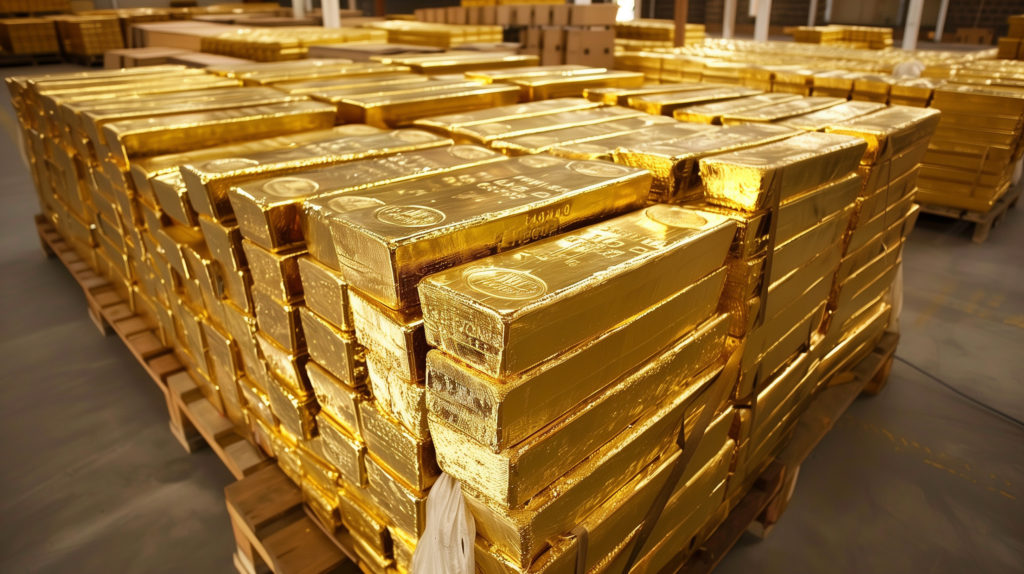
Stock image.

The global gold market relies on a network of banks, refineries and couriers that can fly bullion between key trading hubs at a moment’s notice in pursuit of the highest prices. On Friday, a shock US ruling suggesting that the metal would be subject to tariffs plunged that system into chaos.

The apparent decision by the US Customs and Border Protection agency — announced privately in a letter to a Swiss refiner on July 31 and made public Friday — sent gold futures in New York soaring to a record, as insiders warned the tariffs would have dire consequences for the market. Then, just as quickly, prices tumbled after the Trump administration suggested imports of gold bars wouldn’t face tariffs after all.

It was the latest example of President Donald Trump’s trade war triggering wild gyrations in markets, for equities, raw materials and finished products alike.

Gold bullion is typically treated more as a financial instrument than a physical product, and slapping tariffs on it would have such profound consequences that many traders argued Friday the ruling had to be a mistake.

“The problem was that the government didn’t look outside of the question of the physical format and did not take into consideration that this widget was actually gold,” said Robert Gottlieb, a former precious metals trader and managing director at JPMorgan Chase & Co.

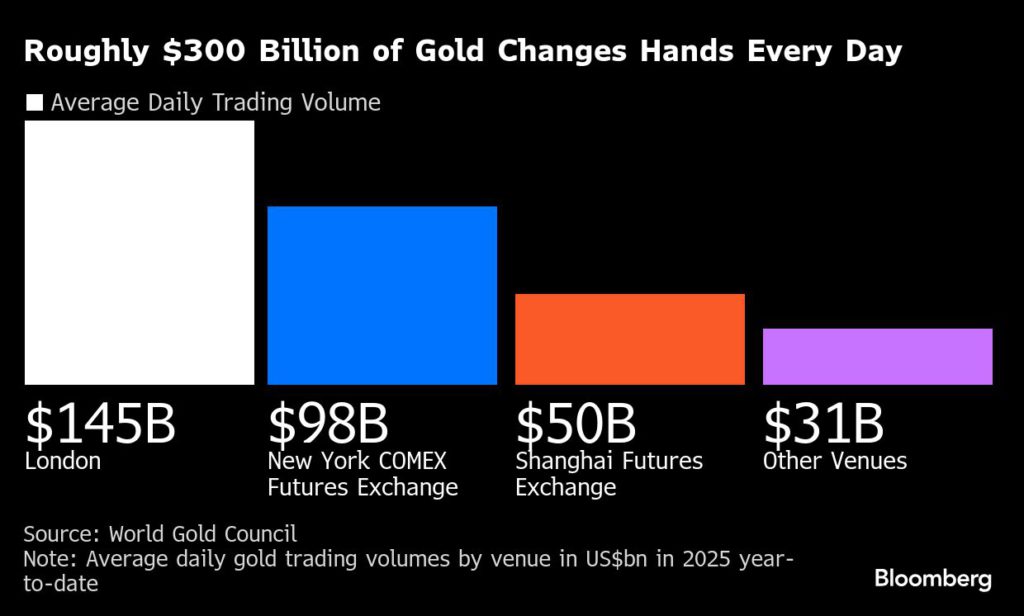
A complex and sometimes fragile system for making and moving gold bars underpins the global market for the metal, including the futures exchanges in New York and Shanghai as well as a huge over-the-counter market overseen by London banks. Key consumer hubs in Mumbai, Dubai and Hong Kong rely on it as well.

There is more than $1.1 trillion in gold bars stored in vaults to underpin trading in New York and London alone, with much of it stored by major dealers including JPMorgan and HSBC Holdings Plc.

Refineries in Switzerland play a crucial role in facilitating the flow of gold between London and New York. A trade group representing them said Friday that the apparent tariffs would render any future US shipments unviable. Asian refineries put a temporary halt on US-bound sales. At the epicenter of the turmoil in New York, observers warned that tariffs would pose a major threat to the gold futures market itself.

“The disbelief isn’t just that several billion dollars have been made and lost overnight,” said Ross Norman, a four-decade veteran of the industry who now runs Metals Daily, a pricing and analysis website. “The problem is we’re not in a good position when things become disrupted. When things blow out, you get lots of injuries.”

The dysfunction was immediately reflected in the spread between prices on CME Group Inc.’s Comex exchange in New York and the global benchmark price set in London. New York futures hit a new high above $3,530 an ounce on Friday, while the London market was more than $100 lower.

That was a record gap, but the 3% spread would be nowhere close to covering the apparent cost of import levies, which would differ from country to country under Trump’s reciprocal tariff regime.

Typically, if New York prices rise sufficiently, the large-format bars that are traded in London are melted down in Switzerland and recast as smaller, 1-kilogram (2.2 pound) bars that are deliverable on Comex. But with Switzerland facing a 39% reciprocal tariff, Comex prices would have needed to rise to about $4,700 an ounce for the shipments to become feasible.

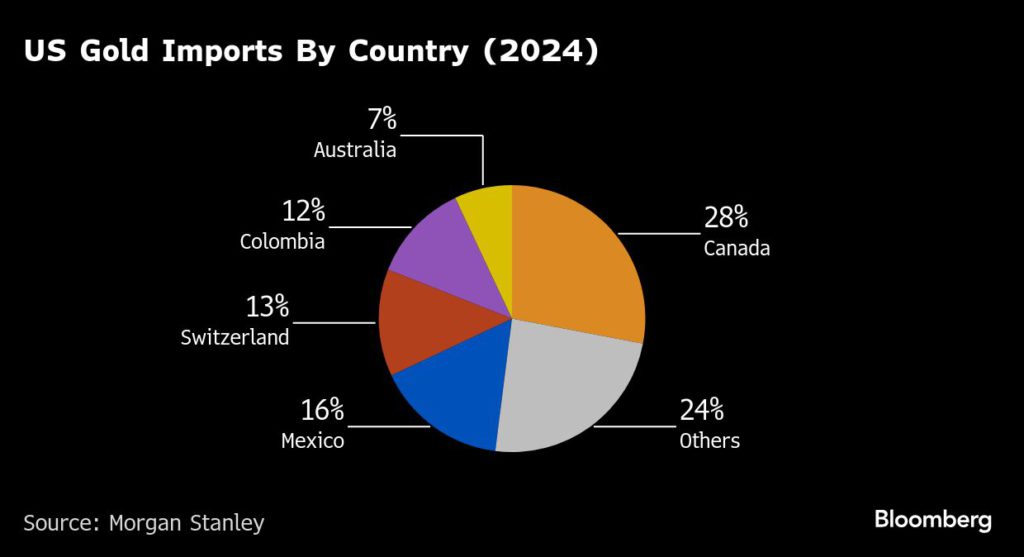
To plug the gap, US buyers might have been able to turn to other key suppliers, including Canada and Mexico. But Trump has threatened stiff tariffs on those countries, too.

Unlike gold miners, independent refineries survive on razor-thin margins. The Swiss trade group warned Friday that shutting them out of such a significant market would have adverse consequences for the global gold trade.

The hope — similarly held among the investors, traders, banks, and logistics firms blindsided by the US ruling — was that the White House would step back from the brink. It may do just that: The administration intends to post an executive order clarifying what it called misinformation about the gold tariffs, according to an official.

“From day to day, we learn more about new rules that could dramatically change the landscape of each commodity,” said Darwei Kung, head of commodities and portfolio manager at DWS Group. “Perhaps more change will result from the negotiation in the days to come.”

(By Mark Burton, Jack Ryan and Yvonne Yue Li)


U.S. Pressure is Firming Up a Multipolar World

by  | Aug 7, 2025 

U.S. tariffs wear the cloak of financial policy to address trade imbalances, but they mask deeper geopolitical ambitions. That strategy may backfire. The pressure of U.S. tariffs is firming up the multipolar world it is meant to prevent. 

Pressure from sanctions has already fused Iran even tighter with Russia, Iran and even Saudi Arabia. It is now, stunningly, contributing to the birth of relations with Egypt, a Middle Eastern power with whom Iran has had broken relations since 1979.

In 2024, Iran and Egypt both became members of BRICS, a large and growing international organization whose primary purpose is to balance U.S. hegemony in the new multipolar world. 

In June, Iranian foreign minister Abbas Araghchi met with Egyptian Foreign Minister Badr Abdelatty and President Abdel Fattah el-Sisi in Cairo. Araghchi posted that “After many years, diplomacy between Iran and Egypt has entered a new phase. The level of political interaction and cooperation, and more importantly, the level of trust and confidence in relations between the two countries, is unprecedented.” Abdelatty said “There is a mutual desire to develop our relations, taking into account the concerns and perspectives of each side.”

The meetings produced a region shifting agreement “to launch periodic consultations at the sub-ministerial level to address aspects of bilateral cooperation.”

U.S. foreign policy is also pushing other nations toward BRICS. On July 27, Secretary of State Marco Rubio said, “Maduro is not the President of Venezuela and his regime is not the legitimate government…. Maduro is the leader of the designated narco-terrorist organization Cartel de Los Soles.” 

Miguel Tinker Salas, Professor of Latin American History at Pomona College and one of the world’s leading experts on Venezuelan history and politics, told me that Venezuela is “very much interested in joining BRICS.” 

The realization of that interest has been frustrated so far, Salas says, by “some tensions with Brazil over Venezuela’s admission in the wake of the past presidential election.” Russia has supported Venezuelan membership. Venezuela is lobbying hard to join BRICS, and in January, Maduro expressed optimism about joining, saying “As far as BRICS is concerned, I hope that the way will be cleared and that the reality will be recognized – Venezuela is part of BRICS.”

Venezuela has increased ties with BRICS nations. Russia says “the Russian-Venezuelan strategic partnership is developing in a wide range of areas.” Venezuela is also “actively building a political dialogue with India” and “actively cooperating with Iran.” China is the largest exporter to Venezuela.

Most of the biggest nations in BRICS are facing pressure from U.S. sanctions and tariffs. On July 30, the U.S. slammed Brazil with 50% tariffs on all exports. The move revealed that Trump’s tariff strategy is not all about trade imbalances. Last year, the U.S. had a $7.4 billion trade surplus with Brazil. Washington claimed the tariffs were meant to pressure Brazil to drop charges against former president Jair Bolsonaro who faces charges for his involvement in an alleged conspiracy to subvert the 2022 Brazilian elections.

Brazil criticized the interference in its domestic affairs and the violation of its sovereignty and took its case to the World Trade Organization. Brazilian President Lula da Silva reminded the U.S. that “Brazil is a sovereign nation with independent institutions and will not accept any form of tutelage.” He said, “The political motivation behind the measures against Brazil violates national sovereignty” and warned against “threats that could compromise the independence of national institutions.” 

But the U.S. tariffs are not just about Bolsonaro or interfering in Brazil’s domestic affairs either. Politico reports that it was Trump’s anger at the BRICS summit in Rio de Janeiro that led him to hit Brazil with the massive tariffs. “BRICS tipped the scale,” said Mauricio Claver-Carone, a close ally of Secretary of State Marco Rubio and Trump’s former special envoy to Latin America.

But if the tariffs were meant to weaken BRICS, it seems to be having the opposite effect with Brazil saying the U.S. pressure will strengthen the organization’s agenda, pushing them, and others, away from U.S. dependence and towards the multipolar world represented by BRICS. American threats and unreliability as a trade partner have further cemented Brazil’s view that the economic partnerships with other BRICS+ countries need to be further fostered. As Al Jazeera and others have reported, “This dispute only strengthens the case for accelerating such integration.”

And Brazil is not alone. The U.S. is using tariffs to try to force India to choose sides, something the country, who is committed to multipolarity, is not likely to do. In the new multipolar world, nations do not have to choose between sides or line up consistently behind American hegemony. As India’s Foreign Minister Subrahmanyam Jaishankar explains, in a multipolar world, countries can deal “with contesting parties at the same time with optimal results” for their “own self-interest.”

The U.S. has placed 25% tariffs on India’s exports to the United States. But it does not stop there. India will be hit with an additional 100% tariff if they refuse to stop purchasing Russian oil. Russia is the top supplier of oil to India, accounting for 35% of its imports, and that amount is increasing. 

Rubio made the need to choose sides clear when he said that India “buys its oil from Russia…. And that – unfortunately that is helping to sustain the Russian war effort. So it is most certainly a point of irritation in our relationship with India.” Stephen Miller, deputy White House chief of staff, said that Trump has said very clearly “that it is not acceptable for India to continue financing this war by purchasing the oil from Russia.”

Despite the pressure to fall back in line with U.S. hegemony, India has made it clear that they will continue to purchase oil from Russia. India’s foreign ministry says that “The government is committed to prioritizing the welfare of Indian consumers. Our energy purchases will be based on price, availability and market conditions.” Tellingly, India’s foreign ministry spokesperson Randhir Jaiswal said India has a “steady and time-tested partnership” with Russia.

Like India, China is also being threatened with 100% tariffs on exports to the U.S. if they continue to buy Russian oil. And like their BRICS partners in India and Brazil, China is refusing America’s attempts to enforce its hegemony. China has responded that it is a sovereign nation and that it will purchase its oil in accord with its own internal policies. Asked about the U.S. warning and the consequence of disobeying, China’s Foreign Ministry Spokesman Guo Jiakun replied that “China will take energy supply measures that are right for China based on our national interests. Tariff wars have no winners. Coercion and pressuring cannot solve problems. China will firmly safeguard its own sovereignty, security and development interests.”

BRICS has long said that they oppose alliances and blocs and that they are against no one. But hostile U.S. pressure against many countries is building BRICS. American attempts to maintain its hegemony through the weaponization of the economy may be having the opposite effect, exerting pressure that is fusing the multipolar world more firmly together. 

Ted Snider is a regular columnist on U.S. foreign policy and history at Antiwar.com and The Libertarian Institute. He is also a frequent contributor to Responsible Statecraft and The American Conservative as well as other outlets. To support his work or for media or virtual presentation requests, contact him at tedsnider@bell.net.