It’s possible that I shall make an ass of myself. But in that case one can always get out of it with a little dialectic. I have, of course, so worded my proposition as to be right either way (K.Marx, Letter to F.Engels on the Indian Mutiny)
Monday, August 11, 2025
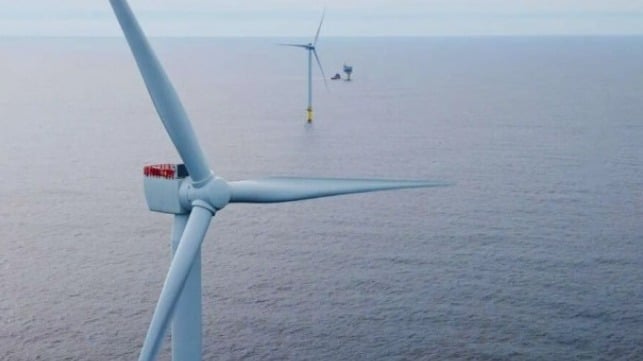
Ørsted Blames Trump’s Pressure on Offshore Wind as it Seeks Capital
Ørsted needs to raise capital to fund the construction of Sunrise Wind (Ørsted file photo)
Ørsted, one of the leading developers of renewable energy including offshore wind projects, is turning to its shareholders to raise additional capital, citing the pressure on the industry from the Trump administration. The company surprised investors by announcing it will sell rights to raise $9.4 billion, nearly half the company’s current market valuation, causing its stock price to collapse nearly 30 percent on Monday, August 11.
The company cited a “material adverse development” in the U.S. market for offshore wind development. Ørsted had bet heavily on the U.S. market, paying high valuations to win leases before the Trump administration launched its crackdown on the industry and costs began to soar across the global supply chain. Several years ago, the company walked away from two large wind farms planned for New Jersey, and this year said it would not proceed with the UK’s largest wind farm project, Hornsea 4, due to rising costs.
Major wind developers have followed a business model of taking the risk to win the leases and investing the time to gain permit approvals before starting the development of the wind farms. With strong investment interest, they were selling portions of the projects, often to private equity or investment managers raising the capital to fund future projects.
Ørsted reports that after the Trump administration suspended permitting for Equinor’s New York offshore wind farm earlier this year, investors have soured on the U.S. market. They view the risk as too high based on the continuing opposition from the Trump administration.
Ørsted was in discussions with an investor to purchase a portion of its Sunrise Wind project, a 924 MW offshore wind farm located roughly 30 miles off the coast of New York's Montauk Point. Work is underway both onshore and off for the project, with the first foundations having recently gone in. However, the board reports it has decided to end discussions on a possible sale of a portion of Sunrise Wind, meaning it will also not benefit from expected project financing and resulting in an incremental cost of approximately $6.2 million.
The company is calling the rights offering the best solution, while some analysts said it was the only option left for Ørsted. The Danish Government, which owns half of Ørsted, has indicated it will participate in the rights offering. The company says two-thirds of the proceeds will be required to fund the construction of Sunrise Wind, and the remainder will be used to develop future projects.
The company highlights that it currently has 8.1 GW of offshore wind projects under construction by 2027. It reports continued “good progress” across its entire construction portfolio according to plan, with almost 70 percent of the offshore wind turbines installed at Revolution Wind, its other U.S. project, which is due to be completed in 2026 and supply power to Connecticut and Rhode Island.
Operationally, it said the business is recovering and lowering costs. It cited strong earnings of DKK 13.9 billion ($2.2 billion), supporting its full-year EBITDA guidance of DKK 25-28 billion. The rights issue announced today, management said, would strengthen Ørsted’s capital structure and provide financial robustness in the years 2025 through 2027.
Solar Stocks Outshine Oil and Gas Benchmarks AfterDESPITE Trump Climate Credit Cuts
Despite the Trump administration’s rollback of many clean energy credits under the “One Big Beautiful Bill Act” (OBBBA), solar stocks have outperformed oil and gas benchmarks in 2025.
First Solar, SolarEdge, and Sunrun all reported strong Q2 results, with boosts from domestic manufacturing incentives, cost efficiencies, and record storage installations.
While OBBBA phases out key residential solar tax credits after 2025, potentially slowing growth, leading players are leveraging manufacturing expansion.
Last month, U.S. President Donald Trump signed into law ‘One Big Beautiful Bill Act’, rolling back many clean energy credits enacted by former President Joe Biden under the Inflation Reduction Act (IRA) of 2022. As widely expected, OBBBA is far from beautiful for various industries within the solar and wind energy sectors. However, the solar sector has continued to defy bearish expectations one month after OBBBA was passed, thanks in large part to robust U.S. and global solar demand as well as specific provisions within the OBBBA that favor solar manufacturing in the United States. The solar sector’s favorite benchmark, Invesco Solar ETF (NYSEARCA:TAN), has outperformed its oil and gas peers, returning 10.9% in the year-to-date compared by -0.7% return by the oil and gas benchmark, the Energy Select Sector SPDR Fund (NYSEARCA:XLE), and 8.6% gain by the S&P 500.
OBBBA favors solar manufacturing through provisions that incentivize domestic production and streamline the tax credit process, while also setting deadlines for construction and placement in service of solar projects. Specifically, it maintains and clarifies the tax credits for solar projects under Sections 48E and 45Y, while also phasing them out for wind and solar projects placed in service after December 31, 2027, unless construction began within 12 months of the Act's enactment.
First Solar (NASDAQ:FSLR) is one of the companies heavily favored by OBBBA. UBS recently reiterated its Buy rating and hiked its price target on FSLR to $275 from $255, good for nearly 50% upside, saying the company will receive a significant boost to the bottomline from OBBBA credits. According to UBS, the present value of 45X tax credits for the company is worth $75 per share, while the company is expected to grow net cash to $25 per share by the second quarter of 2026. UBS says its PT is conservative, pointing out that it did not factor in extra earnings when First Solar’s finishing factory comes online. First Solar's 3.5 GW per year manufacturing facility in Louisiana is expected to be commissioned in the second half of 2025. This facility is part of First Solar's broader strategy to scale its American manufacturing footprint to over 10 gigawatts (GW) by 2025,according to Made in Alabama. The Louisiana factory, along with a new facility in Alabama, are key components of this expansion.
FSLR shares have been on a tear over the past week after the company postedQ2 earnings that exceeded Wall Street estimates, driven by surging solar module sales to third parties. According to First Solar’s CEO Mark Widmar, the company is more favored by OBBBA than it was by Biden’s IRA credits.
Israel-based SolarEdge (NASDAQ:SEDG) beat top- and bottom-line estimates on Thursday, with revenue of $289.4M (+9.0% Y/Y) beating by $14.91M while non-GAAP EPS of -$0.81 beat by $0.03. The company shipped 247 MWh of batteries for solar applications and 1,194 MW of inverters during the quarter. SolarEdge issued upbeat guidance, saying it expects revenues in the range of $315 million to $355 million, well above the Wall Street consensus at$304.33M; Non-GAAP gross margin of 15% to 19%, including ~2% in tariff impact while Non-GAAP operating expenses are expected to come in at $85 million to $90 million. Regarding regulatory changes under OBBBA, SolarEdge CEO Shuki Nir said the company’s multi-year strategy of onshoring manufacturing to the U.S. will help it preserve 45X advanced manufacturing credits over the next 7 years.
Meanwhile, some residential solar companies are also defying bearish projections. California-based residential solar company Sunrun (NASDAQ:RUN) surged nearly 30% on Thursday after posting strong second quarter earnings driven by robust cost efficiencies as well as a record 70% storage attachment rate. Sunrun installed a record 392 MWh of storage capacity during the quarter, good for a 48% Y/Y increase while solar capacity installations clocked in at 227 MW, up 18% Y/Y. Meanwhile, subscriber additions grew 15%, bringing the company’s total subscribers to 941,701 as of June 30.
For the full year, Sunrun has projected aggregate subscriber value growth of 14% to $5.7B-$6 and upped its guidance for contracted net value creation to $1B-$1.3B from $650M-$850M.
"Our actions to drive cost efficiencies and value optimization resulted in the strongest Upfront Net Subscriber Value the company has ever reported, expanding our margins by seventeen percentage points compared to the prior year," CFO Danny Abajian said.
Susquehanna maintained its Positive rating on RUN and raised its price target to $13 from $12, noting that the company is well positioned to capitalize on the ongoing shift towards third-party ownership offerings, a market where it commands a 33% share. The Wall Street analysts expect Sunrun to grow installation volumes despite the looming phase out of residential clean energy tax credits. Residential solar companies are expected to be negatively impacted by the One Big Beautiful Bill Act (OBBBA). Specifically, the elimination of the Section 25D tax credit for residential solar systems after 2025 will significantly reduce the affordability of solar for homeowners, potentially leading to a slowdown in near-term growth. By Alex Kimani for Oilprice.com
Minister confirms environmental authorisation for South African new build
South Africa's Minister of Forestry, Fisheries and the Environment has upheld a 2017 decision to grant Eskom environmental authorisation to construct and operate a new nuclear power station in Duynefontein, in the Western Cape.
(TheDigitalArtist/Pixabay)
The authorisation for Eskom's Final Environmental Impact Report for a new nuclear power plant at Duynefontein was originally granted by South Africa's Department of Environmental Affairs, but had been the subject of challenges from various environmental organisations. Those appeals have now been dismissed.
Minister of Forestry, Fisheries and the Environment Dion George announced his decision to uphold the 2017 decision on 8 August.
"In considering these appeals, I have carefully reviewed the Environmental Impact Assessment Report (EIAr), as well as the independent peer review conducted in respect of the project," George said.
"In the end, my decision was made in respect of the principles of the National Environmental Management Act, 1998 (Act No. 107 of 1998), and with full appreciation of the environmental, social and economic considerations involved."
The granting of an Environmental Authorisation "does not exempt an applicant from complying with any other applicable legal requirements or obtaining permits from other competent authorities," George said.
Eskom would still be required to obtain additional statutory authorisations before proceeding with the project, including a nuclear installation licence from the National Nuclear Regulator (NNR); approval from the National Energy Regulator of South Africa; water use licences from the Department of Water and Sanitation; and other approvals.
Duynefontain is next to Eskom's existing Koeberg nuclear power plant. In March 2016, the state-owned utility submitted site licence applications to the NNR for Duynefontein and another site, Thyspunt, to construct and operate "multiple nuclear installations (power reactors) and associated auxiliary nuclear installations." The Department of Environmental Affairs in 2017 authorised 4000 MWe nuclear capacity to be built at either site.
Loyiso Tyabashe, Group Chief Executive Officer of the Nuclear Energy Corporation of South Africa Ltd (Necsa), today welcomed the ministerial decision.
"This approval marks an important milestone for the nuclear industry and South Africa’s journey towards implementing a balanced energy mix that enables socio-economic development and is climate friendly. The Minister’s decision shows rigour of the process that was followed to choose appropriate site for nuclear new build and reflects confidence in nuclear technology as a safe, clean, and reliable energy solution. Necsa continues to work with the Department of Electricity and Energy as well as Eskom as a partner and commits to contribute its technical expertise to maximise the benefits of nuclear energy, " he said.
In January 2024 the South African government published plans to procure 2.5 GWe of new nuclear capacity. However in August 2024 the government paused the procurement process to allow for further public consultation.
Radiant signs deal to supply microreactor for US military base
California-based Radiant said an agreement it has signed with the Defense Innovation Unit and the Department of the Air Force is the first-ever deal designed to deliver a mass-manufactured nuclear microreactor to a US military base.
A rendering of Radiant's transportable micoreactor being deployed at a military base (Image: Radiant)
The company is developing the 1 MWe Kaleidos high-temperature gas-cooled portable microreactor, which will use a graphite core and TRISO (tri-structural isotropic) fuel. Earlier this year, it was one of eight technology developers selected as potential microreactors suppliers made eligible to receive funding under the Advanced Nuclear Power for Installations programme: an initiative launched in 2024 by the Defense Innovation Unit in collaboration with the Department of the Army and the Department of the Air Force, with the goal of "working to design, license, build, and operate one or more microreactor nuclear power plants on military installations".
"We're proud to be the first agreement designed to deliver mass-manufactured nuclear microreactors for a US military base," said Radiant CEO and Founder Doug Bernauer. "In 36 months, Kaleidos reactors will arrive via truck and within 48 hours plug in, power on, and provide resilient, cyber-secure power to our nation's Air Force for years without refueling."
Radiant says it plans to test its first reactor in 2026, with initial customer deployments beginning in 2028.
In July, Radiant was one of the two companies selected by the US Department of Energy to perform the first tests in the National Reactor Innovation Center's Demonstration of Microreactor Experiments test bed at the Idaho National Laboratory.
Detailed site survey begins at Dukovany
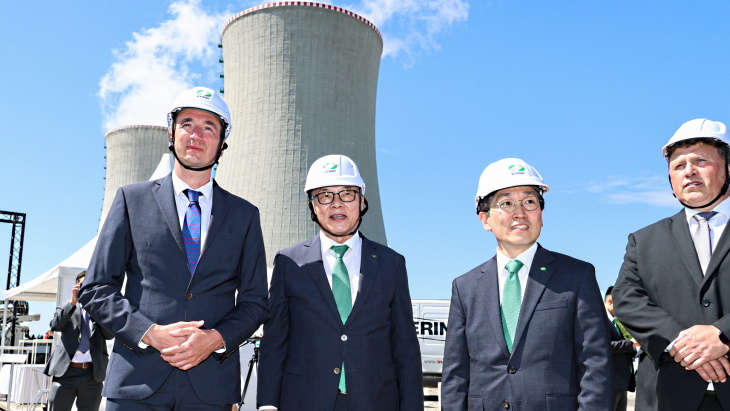
A ceremony has been held at the Dukovany nuclear power plant in the Czech Republic to mark the start of a detailed site survey in preparation for the construction of two Korean-supplied APR1000s there.
(Image: KHNP)
The ceremony was attended by Korea Hydro & Nuclear Power (KHNP) President Hwang Joo-ho, project development company Elektrárna Dukovany II (EDU II) President Zavodski, Czech Minister of Industry Lukáš Vlček, South Korean Ambassador to the Czech Republic Hong Young-ki, and executives from local survey company CEZ EP.
KHNP said the detailed site survey will be conducted over about the next 12 months. It said, as the first step in the nuclear power plant project, the characteristics of the proposed construction site will be investigated and used as basic data for the design.
(Image: KHNP)
"The detailed site survey is the first on-site process for the Dukovany nuclear power plant project and the practical starting point for the APR1000 design," Hwang Joo-ho said. "This is a crucial task for the timely execution of the contract, and we will conduct the survey thoroughly and systematically according to plan."
The Czech government selected KHNP as its preferred bidder in July 2024 for two APR1000 units near the current Dukovany plant, about 200 kilometres southeast of Prague. Two more units at the Temelin nuclear power plant are also being considered and, according to KHNP "if the Czech government decides within the next three years to proceed with Temelin units 3 and 4, KHNP will be eligible to sign additional contracts with EDU II after further negotiations".
The contract with KHNP for new nuclear capacity at the Dukovany site was signed on 4 June. The aim is to start construction in 2029.
The Czech Republic currently gets about one-third of its electricity from the four VVER-440 units at Dukovany, which began operating between 1985 and 1987, and the two VVER-1000 units in operation at Temelín, which came into operation in 2000 and 2002.
Construction gets under way of first unit at Jinqimen plant
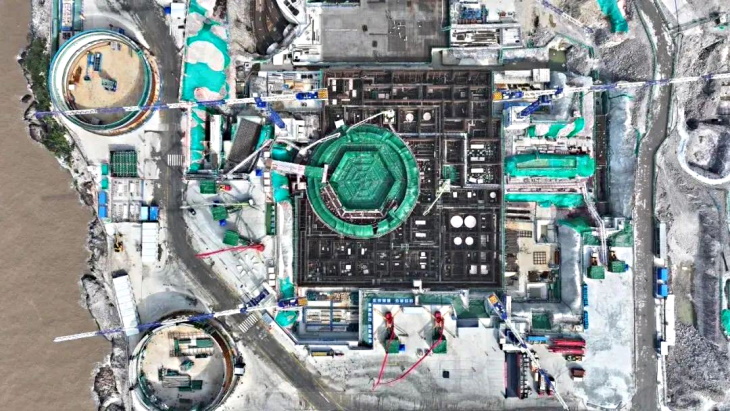
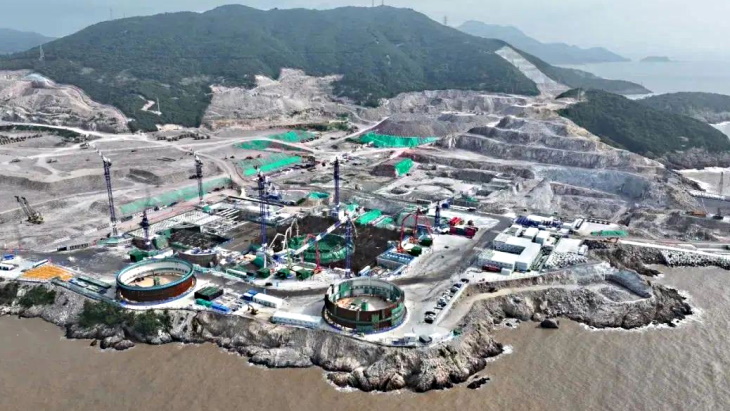
The first safety-related concrete has been poured for the nuclear island of unit 1 at the Jinqimen nuclear power plant in Ningbo, Zhejiang province, China National Nuclear Corporation announced. It is the first of six Hualong One units planned for the plant.
(Image: CNNC)
A ceremony was held at the plant site on 10 August to mark the pouring of first concrete for unit 1, a milestone that means the unit has officially entered the construction phase, China National Nuclear Corporation (CNNC) said.
The construction of two 1200 MWe Hualong One reactors as Phase I of the Jinqimen plant was approved by China's State Council at a meeting on 29 December 2023. A ground-breaking ceremony was held in February 2024 to mark the start of work on the units.
(Image: CNNC)
China's National Nuclear Safety Administration issued a construction licence on 5 August for units 1 and 2 at the Jinqimen plant, clearing the way for first concrete to be poured for the foundation of the reactor building of the first unit.
CNNC subsidiary CNNC Zhejiang Energy Co Ltd is responsible for project investment, construction and operations management of the new plant, which will eventually house six Hualong One units. Another CNNC subsidiary, China Nuclear Engineering & Construction Corporation, is responsible for the construction of the nuclear island, conventional island, and key facilities of the Jinqimen nuclear power project.
(Image: CNNC)
Once all six units have been completed, the total installed capacity of the Jinqimen plant will be about 7.2 GWe, and the annual grid-connected electricity will be some 55 TWh, which according to CNNC is equivalent to half of Ningbo's total electricity consumption in 2024. The plant, it said, will reduce carbon dioxide emissions by about 45 million tonnes.
Following the pouring of first concrete for Jinqimen unit 1, the number of nuclear power units under construction controlled by CNNC has reached 13, with an installed capacity of 15.138 GWe. The Jinqimen plant becomes the company's third nuclear power base in Zhejiang Province.
Scientists may have discovered a new mineral on Mars
Exploring the surface of Mars. PHOTO: Adobe Stock.
Researchers have pinpointed a previously unknown mineral on Mars, indicating the red planet’s surface may be more actively changing than previously believed. While scientists have a solid understanding of Mars’ surface appearance, uncovering its precise composition remains a challenge.
Recently, a team of researchers believes they have identified a completely new mineral, derived from an unusual layer of iron sulfate exhibiting a distinctive spectral signature.
In a paper published on August 5 in Nature Communications, astrobiologists led by Janice Bishop from the SETI Institute detailed the detection of an uncommon ferric hydroxysulfate mineral near Valles Marineris, a colossal canyon that runs along Mars’ equator. The region, thought to have once hosted flowing water, could hold vital clues about the natural forces that shaped the planet’s surface and whether microbes once inhabited Mars.
Sulfur, a common element on both Mars and Earth, frequently bonds with other elements to create sulfate minerals. These sulfates dissolve readily in water, but because Mars has been dry for so long, these minerals likely remained on the surface since the planet lost its liquid water. Examining these minerals can reveal crucial insights into Mars’ early environmental conditions.
The research team focused on sulfate-rich zones near Valles Marineris, targeting areas that displayed unusual spectral signals from orbit, as well as layered sulfate deposits and notable geological features, Bishop explained in a statement.
In one region, they discovered layered deposits of polyhydrated sulfates, beneath which lay monohydrated and ferric hydroxysulfates.
Laboratory experiments showed that the ferric hydroxysulfate observed on Mars could only have formed in the presence of oxygen, with the formation process releasing water. These conditions also suggest it formed at high temperatures, pointing to volcanic activity as a likely source. The mineral’s unique structure and thermal properties indicate it may be entirely new to science.
Bishop explained that the material we produced in the lab seems to be a new mineral due to its unique crystal structure and thermal stability. However, we must find this mineral on Earth first before we can officially recognize it as a new mineral species.
This is not the first time researchers have potentially discovered new minerals on Mars. Back in March 2025, Roger Wiens, a Mars exploration expert and a professor of earth, atmospheric and planetary sciences at Purdue University in Indiana, directed NASA’s Perseverance rover to target some unusually pale rocks on the Martian surface with its laser. He and his team found that these rocks contain unusually high levels of aluminum linked to the mineral kaolinite. This finding was notable on its own, but what truly made it remarkable is that kaolinite typically forms only in very warm and wet conditions.
Their discovery, published in Nature Communications Earth & Environment, indicates that Mars might have been more Earth-like—warmer, wetter, and more complex—than scientists previously believed.
Once considered waste, oilfield brines are being repurposed into valuable resources. (Stock image by anatoliy_gleb.)
Mexico’s state-owned oil company, Petróleos Mexicanos (PEMEX), is exploring lithium extraction from oilfield brines in a bid to diversify its portfolio and advance the country’s energy transition.
Chief executive officer Victor Rodríguez said in the unveiling of the company’s 2025–2030 Strategic Plan last week that high concentrations of lithium, comparable to Bolivia’s, have been detected in drilling operations across five states.
The company is assessing direct lithium extraction (DLE) technologies to isolate and process the metal into carbonate or hydroxide, essential materials for batteries and clean energy technologies.
As part of the plan, PEMEX may launch a new subsidiary, PEMEX Lithium, to produce so-called “petrolithium,” lithium sourced from petroleum brine. The move aligns with President Claudia Sheinbaum’s push for energy diversification and resource sovereignty.
Sheinbaum has framed the company’s expansion into lithium as a deliberate shift away from dependence on oil production, refining, and fuel sales, opening new revenue streams in the process.
The initiative could pave the way for collaboration with the national lithium company, LitioMx, mirroring global trends in which oil majors invest in lithium to future-proof their operations.
Mexico holds an estimated 1.7 million tonnes of lithium reserves. While smaller than other Latin American producers, the country has 82 known deposits across 18 states, with the largest concentrations in Sonora, Puebla, and Oaxaca. Experts say that with targeted investment and development, Mexico could emerge as a significant player in the global lithium market.
Analysts warn that PEMEX faces steep challenges in the sector, including its lack of experience in non-energy mining, the technical hurdles of clay-based lithium extraction, and the need to meet sustainability standards.
The government is positive and views PEMEX’s participation as a natural extension of its role in the shifting global energy landscape, with potential partnerships on the horizon with universities, innovation centres, and public enterprises abroad.
Gemfields sells Fabergé luxury brand for $50 million
The buyer is SMG Capital, a US investment company controlled by the technology investor Sergei Mosunov.
The deal closes a chapter that began in 2013, when Gemfields bought Fabergé from private equity group Pallinghurst for $142 million. The miner put the brand on the market in December after unrest in Mozambique forced a temporary halt at its Montepuez ruby mine.
Founded in 1842 and transformed under Peter Carl Fabergé, who became goldsmith to the Russian Imperial Court in 1882, the brand has faced headwinds from a slump in the luxury goods market, a downturn that has hit diamond miners hardest. Fabergé posted revenues of $13.4 million in 2024, down from $15.7 million in 2023.
Fabergé, which was founded in 1842 and taken over and transformed by Peter Carl Fabergé in 1882, when he became official goldsmith to the Russian Imperial Court. The brand has come under pressure amid a downturn in the luxury goods market, which has hit diamond miners the hardest. It made revenues of $13.4 million in 2024, down from $15.7 million the previous year.
“The sale marks the end of an era,” Gemfields chief executive Sean Gilbertson said in a statement. “Fabergé has played a key role in raising the profile of the coloured gemstones we mine, and we will miss its marketing leverage and star power.”
The company will use the proceeds to support operations in Mozambique and Zambia.
Timeless treasures
Fabergé most iconic jewels and objects include the legendary series of ornate Easter eggs, first commissioned by Tsar Alexander III in 1885 for his wife, Tsarina Maria Feodorovna. Before the 1917 revolution, the company produced 50 of these creations for the Russian royal family. The Bolsheviks later seized Fabergé’s workshops, forcing the family into exile across Europe.
A Fabergé Easter Egg. (Image courtesy of Gemfields.)
The brand passed through multiple owners over the 20th century, fetching $180 million in 1984 and acquiring the Elizabeth Arden brand three years later. It was sold to Unilever in 1989 for $1.55 billion and relaunched by the Fabergé family in 2009.
Gemfields shares have fallen about 70% since peaking at 19.4p in April 2022, dragged down by oversupply in the emerald market. The company recently delayed commissioning a second processing plant at Montepuez, citing illegal mining, permit issues and logistical setbacks.
By late morning Monday, Gemfields’ stock was up 4% at 5.95p in London and 0.74% higher in Johannesburg, valuing the company at 2.35 billion rand ($132 million).
TEMPER TANTRUM TRUMP
Trump says gold imports won’t be tariffed in reprieve for market
President Donald Trump said Monday imports of gold will not face US tariffs, weighing in after a federal ruling caused chaos and confusion in global bullion markets.
“Gold will not be Tariffed!” Trump posted on social media.
Gold futures traded on New York’s Comex and the global benchmark for spot prices in London were little-changed after Trump’s post. Spot gold pared some losses, though it was still down more than 1.2% on the day.
No formal, updated policy had yet been posted by US agencies as of Monday afternoon.
A White House official suggested last week the administration would issue a new policy clarifying whether gold bars would face import taxes, after US Customs and Border Protection stunned traders by deciding the imports would be subject to duties.
The ruling determined that one-kilogram and 100-ounce gold bars would be subject to Trump’s country-based tariffs that took effect Aug. 7. The move came in the form of a letter that was issued to a Swiss refiner inquiring about gold’s treatment, then posted publicly on the agency’s website.
Had the decision remained in place, it would have had sweeping implications for bullion around the world and potentially for the smooth functioning of the US futures contract. Gold’s role as a financial asset and global currency sets it apart from other commodities such as copper that have been roiled by tariffs.
Traders, analysts and executives across the industry had understood the bars would be exempt from Trump’s so-called “reciprocal” tariffs,” including a 39% levy on goods from Switzerland, a major exporter.
The confusion over the CBP letter had caused US gold futures to surge to a record on Friday, and traders said that shipments were freezing up in response to the shock news.
Bullion markets stabilized later Friday when a White House official told Bloomberg in a written statement that the Trump administration intends to post an executive order in the near future to clarify what it called misinformation about tariffing of gold and other specialty products.
The latest statement adds to a tumultuous year for gold, which has soared to unprecedented levels amid strong buying from central banks and as Trump’s trade war drives haven demand.
Earlier this year, physical flows were upended as traders rushed billions of dollars worth of gold and silver into the US as New York prices traded at large premiums in anticipation of potential tariffs. However, that trade came to a crashing halt after the US included gold and silver in its list of exemptions from the tariffs announced in early April.

_16342.jpg)
_51865.jpg)
_20523.jpg)
_50257.jpg)