Wednesday, August 20, 2025


China’s EVs Surge Into Georgia, Challenging U.S. Car Dominance

THE COUNTRY NOT THE STATE

  • Chinese EV imports to Georgia jumped nearly 88% year-on-year, making China the country’s second-largest EV supplier after the U.S.

  • BYD’s growing presence reflects both affordability and rising demand, though infrastructure like charging stations remains limited.

  • The EV surge aligns with Georgia’s ruling party’s pro-China stance, as political ties with the U.S. and EU

In Tbilisi, whether you are inching through traffic or weaving down side streets, you cannot escape the same slogan splashed across the backs of some passing cars: “Build Your Dreams.” 

That is a branded motto etched onto vehicles made by BYD, China’s largest automaker. Each vehicle is a moving data point in a quiet shift, signaling the rise of Chinese electric vehicles on the streets of the Georgian capital, home to nearly half of the country’s population, as well as in other cities.

According to official data for January-July 2025, China accounted for just over 10 percent of Georgian imports, ranking fourth behind Turkey, the United States and Russia.

Passenger cars are the country’s largest import product, accounting for 20 percent of all imports, reflecting the sector’s significance, both for domestic demand and Georgia’s role as a regional re-export hub. China’s increasing presence underscores its strategic interest in gaining a larger share of the country’s auto market.

While Georgia’s annual number of imported cars has remained relatively steady in recent years, the share of electric vehicles is surging. During the first half of this year, the country imported 3,616 EVs, an 88 percent jump from 1,922 during the same period last year. Until recently, China did not even rank among Georgia’s top five car-supplying countries. 

China is now the second-largest EV supplier after the US, and overall imports of Chinese cars, both electric and conventional, have risen roughly 79 percent this year.

Electric vehicles still make up a relatively small share of the overall auto market in Georgia, where nearly every second person owns a car. A major reason is that most Georgian consumers have long relied on cheap, second-hand cars from the US that are easy to repair locally. EVs do not fit this model, which helps explain why the US remains the country’s main car supplier. 

While China cannot compete with the US in conventional car imports, it has already captured nearly 12 percent of Georgia’s EV market in just a couple of months. Demand is rising sharply; the appeal of EVs is strong. They are cheaper to run than gasoline-powered cars. But widespread adoption requires infrastructure, especially charging stations, that Georgia currently lacks. Market signals suggest that is about to change. Add to that the fact that Chinese EVs are more affordable than their Western-made counterparts, and it is clear they are poised to capture an increasing share of the Georgian market. 

Growing Chinese economic influence goes hand in hand with politics. The ruling Georgian Dream party’s pro-China stance is well known, with Prime Minister Irakli Kobakhidze praising Communist China as the “best example of state modernization” and arguing that Beijing sets a positive example for other global powers. 

In a twist of political irony, BYD Center in Tbilisi has just recently taken over the former headquarters of the United National Movement, the one-time governing party, now a major opposition force. Built in 2010 for party operations, the building had slipped out of the opposition’s hands amid financial and political pressures from the government.

Transparency International Georgia noted the geopolitical shift in its latest report: “As Georgia’s relations with the United States and the European Union deteriorate, Georgian Dream is strengthening its alliances with authoritarian regimes hostile to the United States, such as China.”

By Eurasianet.org


Colorado River Running Out of Water

  • Lake Powell risks hitting “dead pool” by year-end, threatening water releases to 40M people and up to ~3,000 MW of hydropower from Glen Canyon/Hoover.

  • Low water imperils hydropower and cooling for thermal/nuclear plants, complicates data-center siting and fracking.

  • As the U.S. grid already faces a big capex build-out, drought drives operating costs higher

That the Colorado River’s flow has been declining is not new in water circles. Truth is that the states bordering the Colorado divided up the water supply on the basis of a wet year, a century ago, and have been fighting over the diminishing supply for some time. (From a negotiating standpoint this made a lot of sense at the time. Dividing relatively scarce water resources among various political bodies is like slicing up a pie among hungry people and everyone wants a big piece. Except here government officials were able to essentially riff on the old economist’s joke and simply assume a bigger pie. And this policy, based on faulty data, worked until recently. Now reality and droughts have returned.)

Something like 40 million people depend of Lakes Mead and Powell for drinking water. But what made the headlines recently is the announcement that the water in Lake Powell, a main reservoir, could fall to “dead pool” levels by December, thereby preventing the release of water to downstream, and that would stop hydroelectric generation that serves seven western states. These hydroelectric facilities in the Glen Canyon and Hoover Dams can produce over 3000 megawatts which is both relatively cheap and obviously, environmentally benign although both facilities have been producing power below maximum capacity due to water constraints. We’re not used to thinking about water as an intermittent resource but that may be our new reality. So now do we face a water and an electricity shortage simultaneously?

Water shortages are becoming common, resulting from overuse, groundwater pollution, negligent agricultural practices, and changing climate conditions. Water supply constraints could affect the siting of data centers (water for cooling) and prospects for fracking. In addition, hydropower still plays an important role in power generation and in some countries (Brazil, Norway, Canada, and parts of Africa) a dominant role. We have argued that the US electric grid has not spent enough to modernize, let alone keep up with new demand. So a new deficit of generation resources, caused by water shortages, comes at the wrong time. Water storage in the electricity business is like a gigantic battery you can turn on and off. Except in this case, it’s water behind a dam spinning turbines to generate electricity.

Low water levels mean more than hydro generation loss. Generators require cooling water to run huge nuclear and fossil fuel units. French utility EDF had to curtail power generation at nuclear plants due to jellyfish clogging water intakes. (The jellyfish bloom is attributable to warmer water temperatures.) And in August 2022, they had to curtail generation at five nuclear stations due to excessive temperatures in river water. The water industry has, for a long time, been concerned with climate change. There is some irony in the fact that the electric industry, which continues to hasten climate change through its policies and actions, might have to face the consequences of a water shortage. Wait a minute! The electric company’s customers will face the adverse financial consequences via accelerated rates, not the electric company.  And remember that a power short in the southwest will suck in power from elsewhere. It might become everyone’s shortage.

Let’s conclude with the financial consequences of water shortages. First, the power industry is in the early stages of a massive capex boom to accommodate a broad societal move to electrification. This will drive up power prices as new facilities cost far more than those installed decades ago. These are capital costs. Now, with a looming water shortage, utility operating costs are poised to escalate as well as water generation is replaced by much higher cost fossil fuel powered generators. To sum up, watch the southwest for the rest of the year because a water crisis, if the pools reach bottom, could turn into an energy crisis and an affordability crisis.

By Leonard Hyman and William Tilles for Oilprice.com


US targets Chinese steel and lithium for forced-labor scrutiny


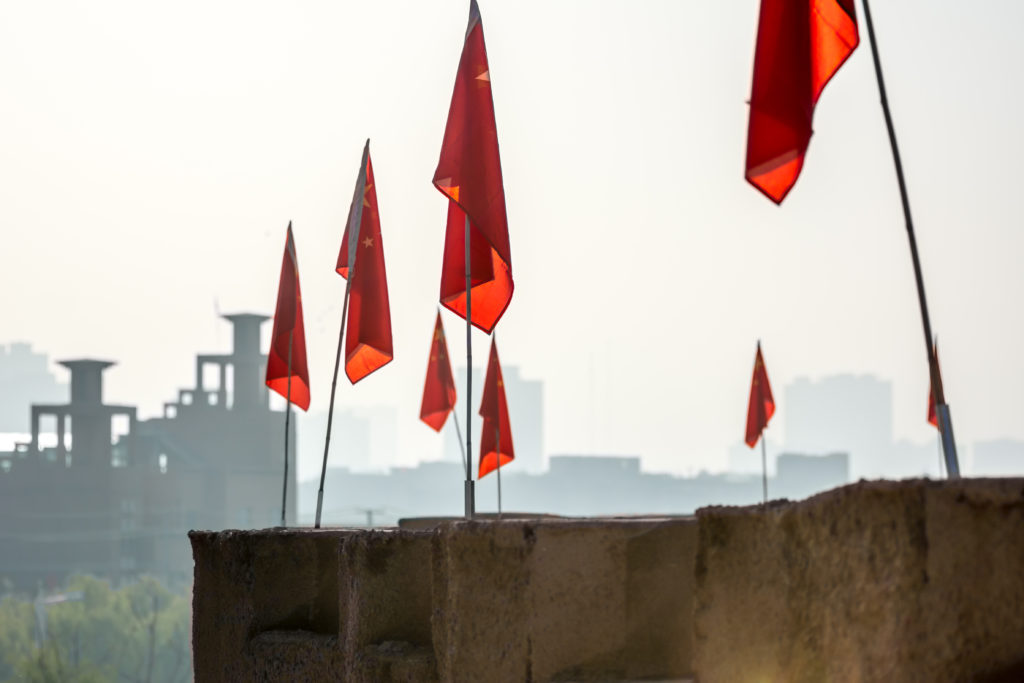
Kashgar, Xinjiang, China. Stock image.

The Trump administration said it will step up scrutiny of imports of steel, copper, lithium and other materials from China to enforce a US ban on goods allegedly made with forced labor in the country’s Xinjiang region.

The announcement of new “high-priority sectors” targeted under the four-year-old Uyghur Forced Labor Prevention Act was included Tuesday in an annual update to the US government’s enforcement efforts. It also dovetails with President Donald Trump’s broader trade goals, as he seeks to lower the US trade deficit with China and pressures Beijing to curb shipments of fentanyl and precursor chemicals.

“America has a moral, economic, and national security duty to eradicate threats that endanger our nation’s prosperity, including unfair trade practices that disadvantage the American people and stifle our economic growth,” Homeland Security Secretary Kristi Noem said in a statement.

Still, the administration went ahead with the announcement at a time when Trump has sought to improve relations with his counterpart, Xi Jinping. The US president last week extended a pause on higher tariffs on goods from China for 90 days as he seeks an in-person meeting with the Chinese leader.

Under the 2021 law, the US government assumes that anything made even partially in the Chinese manufacturing hub of Xinjiang is produced with forced labor and cannot be imported into the US. Companies may win exemptions if they can provide “clear and convincing evidence” forced labor was not used.

The measure is meant to help combat alleged repression of Uyghurs and other minorities in the province of Xinjiang. Beijing has repeatedly denied accusations that minorities are compelled to work against their will.

Although the law applies to all goods, it originally singled out apparel, cotton and cotton products, tomatoes and silica-based products — including polysilicon — as high-priority sectors for enforcement. Under former President Joe Biden, the government expanded the products subject to extra scrutiny to include aluminum, polyvinyl chloride and seafood.

The Trump administration’s Tuesday announcement expands the list again to encompass red dates, caustic soda and lithium, as well as steel and copper.

The US doesn’t import significant tonnage of copper from China, according to data from Morgan Stanley. In 2024, the US imported about 470,000 tons of steel from China, equal to 0.5% of domestic consumption, according to the Commerce Department.

(By Jennifer A. Dlouhy)


US urged to tackle illicit gold boom fueled by soaring price

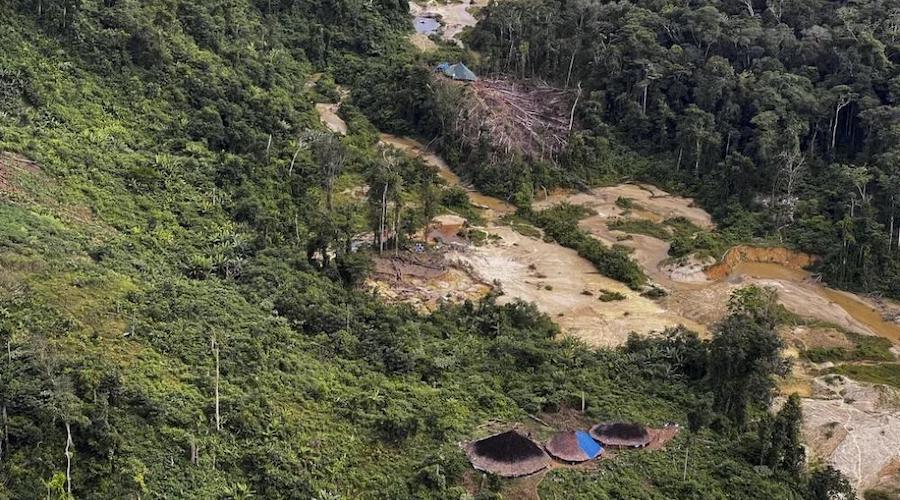
Illegal gold mining in the Yanomami traditional territory. (Image by the Brazilian Air Force).

US authorities are being pressed to step up efforts to combat the illegal gold trade, one of the largest and fastest-growing illicit economies in the Western Hemisphere as bullion prices surge.

An illegal gold mining and trafficking boom in several South American nations has become a crisis too large for the US to ignore, according to a report from the Financial Accountability and Corporate Transparency Coalition, or FACT, released Wednesday. In Colombia and Peru, top growers of the plants used to make cocaine, illegal gold is estimated to generate more money for organized crime than the drug trade itself.

The Washington-based financial advocacy group called on Congress to pass a bill that cracks down on the environmental and social impacts of illicit gold mining. FACT also wants illegal mining to be a building block for prosecuting money laundering and for gold to be included in cross-border currency reporting.

“By making illegal gold mining, trafficking and associated money laundering less profitable and more likely to result in serious consequences, the US can play a powerful role in reducing the financial incentives driving this devastating criminal economy,” FACT wrote.

The US lacks the tools to effectively respond to the illicit gold trade, a situation that’s been further complicated by shifting priorities in the Trump administration and staffing reductions this year, the report said. Behind the surge in illicit gold is a tripling of bullion prices over the past decade and lax law enforcement as authorities remain squarely focused on tackling the drug trade.

FACT urged the US to increase enforcement and prosecution efforts against transnational criminal networks involved in the illicit gold trade, implement gold-specific sanctions and resume funding for international projects related to combating illegal gold mining. The administration should also require collection of basic information about the real owners of companies as well as strengthen international information sharing and due diligence requirements for the US Mint, according to the report.

“The recommendations are expected to resonate with folks in the US who are concerned about organized crime in Latin America — who see that as a threat to US interests and stability,” Julia Yansura, FACT’s program director for environmental crime and illicit finance, said in a telephone interview.

(By James Attwood)

Afghanistan says China seeks its participation in Belt and Road Initiative

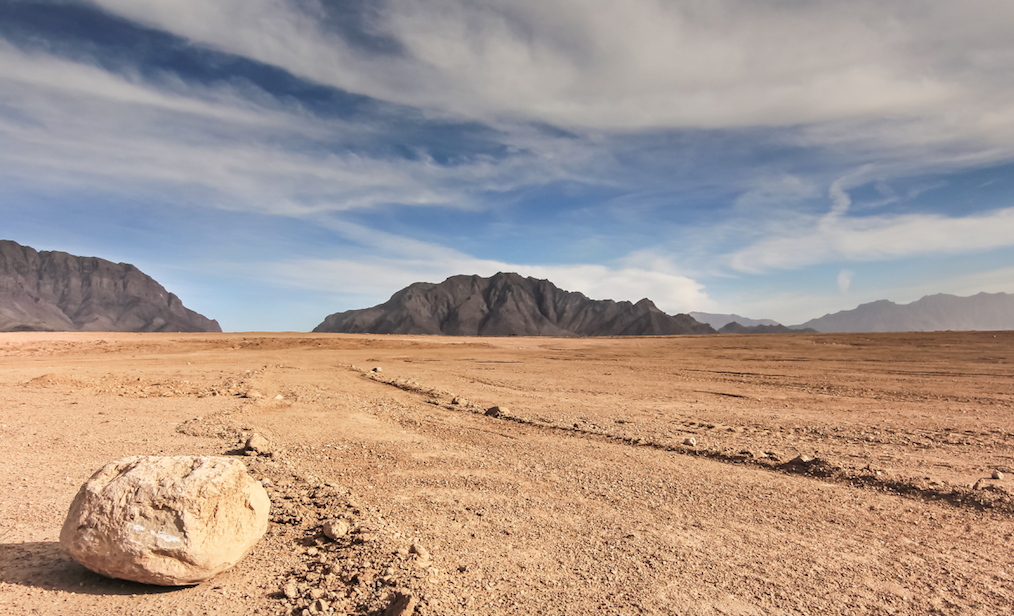
Afghanistan plain. Stock image.

China wants Afghanistan to formally join its Belt and Road Initiative, the Afghan foreign ministry said in a post on X after the two countries’ foreign ministers held talks in Kabul on Wednesday.

China’s Wang Yi told his Afghan counterpart Amir Khan Muttaqi that it’s “interested” in the country’s participation in the project. In addition, Wang pledged to advance mineral exploration, with plans to begin some mining projects this year.

The Belt and Road Initiative is China’s flagship global infrastructure and investment program, launched by President Xi Jinping a decade ago, that aims to improve connectivity and economic integration across Asia, Africa, the Middle East, Europe, and beyond. For China, Afghanistan’s location is crucial as it sits at the crossroads of these regions.

China was among the first countries to embrace the Taliban government after the US withdrawal in 2021. China adopted a diplomatic approach that allowed it to expand its influence and tap Afghanistan’s vast mineral resources. Wang also visited Kabul in 2022, where he discussed boosting trade and efforts to rebuild the country’s economy.

Muttaqi described China as a key trade partner, saying annual trade has reached $1 billion. He proposed expanding banking and transport links and called for joint commissions to manage talks on trade and investment.

China’s Foreign Ministry didn’t immediately respond to a request seeking to confirm the Taliban’s statement.

The high-level talks give a boost to the Taliban’s push for legitimacy on the world stage, showing that key regional players are willing to engage with it despite the lack of formal recognition. Russia recently became the first country to formally recognize the Taliban administration in Afghanistan.


(By Eltaf Najafizada)


Codelco pegs El Teniente output at 316,000t after deadly collapse

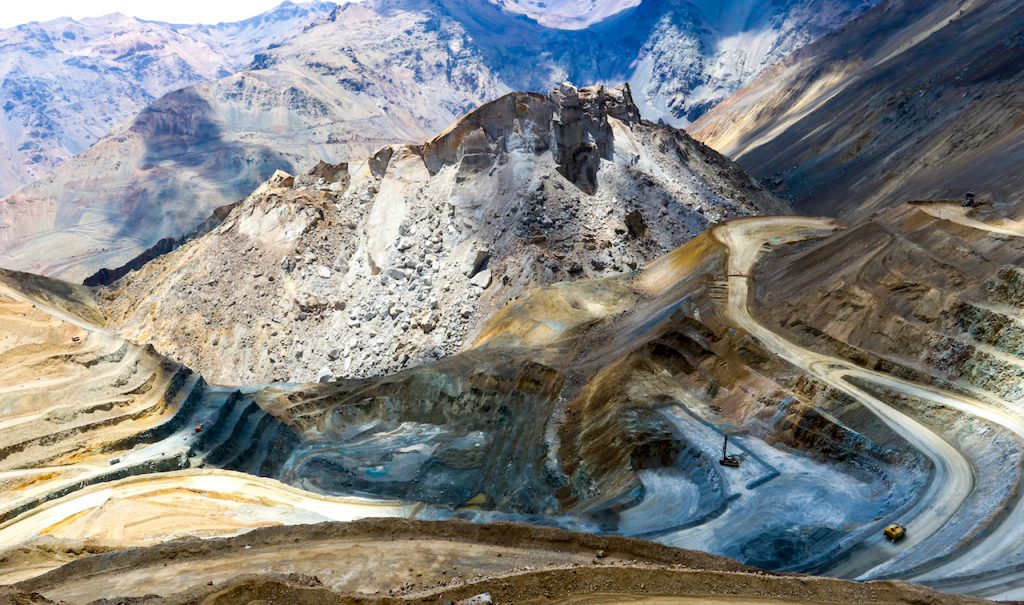
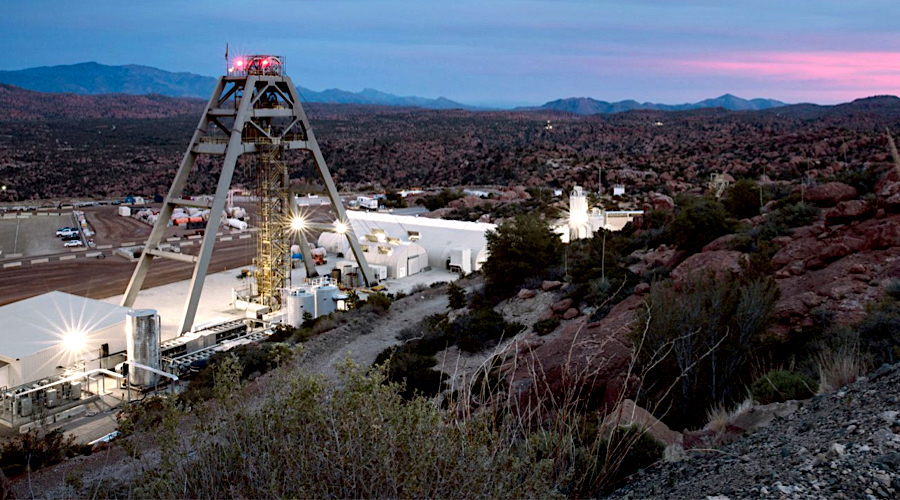
El Teniente is the world’s biggest underground copper mine and the sixth largest by reserve size. (Image courtesy of Codelco)

Chilean miner Codelco expects to produce 316,000 metric tons of copper at its El Teniente mine this year, CEO Ruben Alvarado said on Wednesday, after a deadly collapse at the site in late July.

The world’s biggest underground copper mine last year produced 356,000 metric tons of the red metal.

The firm also estimates a $340 million hit from the incident, which killed six workers, Alvarado added.

Codelco will lower its 2025 production guidance due to the loss at the mine, chairman Maximo Pacheco told Reuters after a congressional hearing, adding that the company is still working to hit its target of 1.7 million tons of copper per year by 2030.

(By Fabian Cambero and Paolo Laudani; Editing by Sarah Morland)

APACHE LANDS

Trump raises stakes over Resolution Copper project with BHP, Rio Tinto CEOs at White House

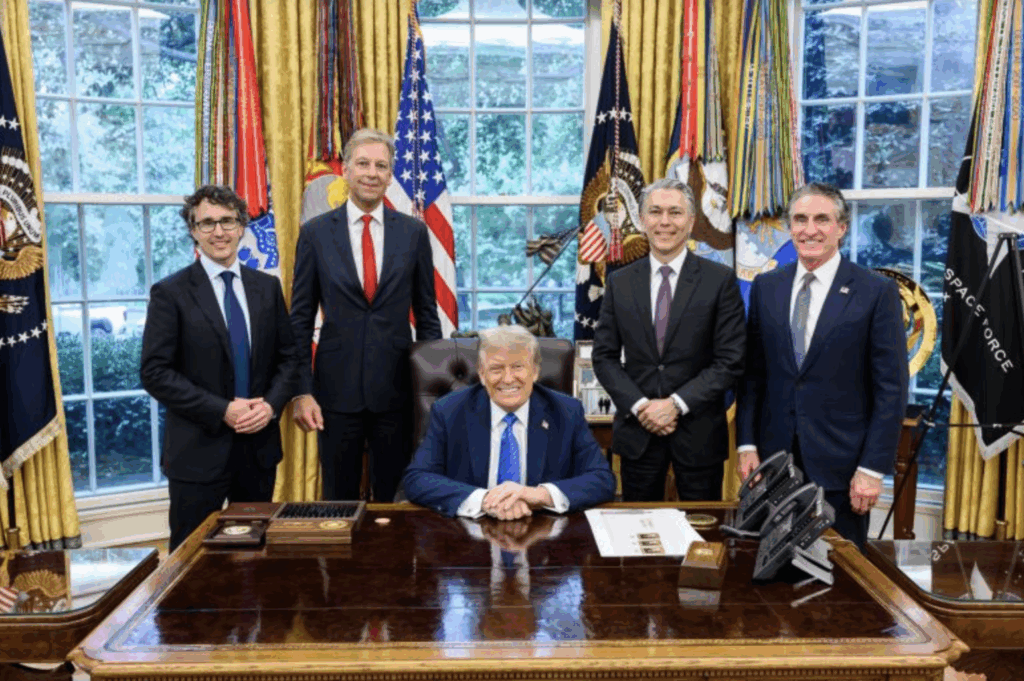
From left: Incoming Rio Tinto CEO Simon Trott, current CEO Jakob Stausholm, US president Donald Trump, BHP CEO Mike Henry and Secretary of the Interior Doug Burgum. Image from Mike Henry via LinkedIn.

President Donald Trump met with the chief executive officers of the world’s two biggest mining companies to discuss a copper project that could supply the US with a quarter of its demand for decades to come, adding greater weight to his push to boost local output of the vital metal.

Rio Tinto Group’s Jakob Stausholm; his incoming replacement, Simon Trott; and counterpart at BHP Group, Mike Henry, met the US leader to discuss the Resolution project in Arizona, according to LinkedIn post by Stausholm. In a separate post, Trump criticized a court judgment that set back the development, insisting the US’ need for greater domestic production was urgent.

The Trump administration has made the revival of US metals and minerals production a key priority, including copper, a commodity vital for the energy transition as well as conventional uses in pipes. As part of that push, Washington imposed tariffs on a wide range of products made from the metal earlier this year, although flows of refined material were not covered.

“Today, I visited the White House with Simon Trott to meet with US President Donald Trump, Secretary of the Interior Doug Burgum, and other officials to discuss Rio Tinto’s crucial role in delivering American copper and other critical minerals,” Stausholm said in the post. They discussed Resolution and the potential the project had to provide domestic supply, he added.

The talks centered on the “industry’s capacity to deliver long-term domestic supplies of copper and other critical minerals,” Rio said in a statement.

Still, even with Trump’s support, building a mega-mine in America remains a challenging and drawn-out endeavor. It takes 29 years on average between discovery and commercial mine production in the US, the longest timeline of any country except Zambia, according to S&P Global.

Most easy-to-reach deposits, including one located above Resolution, were depleted during the 20th century. Now, miners must go deeper, into earth so hot it would have been impossible for workers to survive a century ago, presenting a host of technical obstacles that jack up project costs.

If developed, the Arizona project could supply the US with 25% of its annual copper needs for as many as 40 years, according to Rio Tinto, but it has been delayed for decades due to permitting, environmental concerns, and litigation.

Final environmental approval for the mine was given in June. However, opponents then lodged an appeal seeking a review of the decision. On Tuesday, they won a delay in approving a land swap that’s key to the development.

Trump criticized the court’s decision in a social media post that coincided with the visit by the Rio Tinto and BHP executives.

A Copper Mine in Arizona, ‘Resolution,’ was just delayed by a Radical Left Court for two months — 3,800 Jobs are affected, and our Country, quite simply, needs Copper — AND NOW!” the president said on Truth Social.

Benchmark copper futures have advanced about 11% this year, and last traded above $9,708 a ton on the London Metal Exchange. The record price was set last year at a little above $11,000.

In June, Rio Tinto said it had incurred gross costs of $321 million associated with US tariffs on aluminum, but added that a “substantial part” of that sum had been clawed back from higher premiums on US sales.

(By Paul-Alain Hunt)

Trump blasts appeals court for halting Resolution Copper land transfer

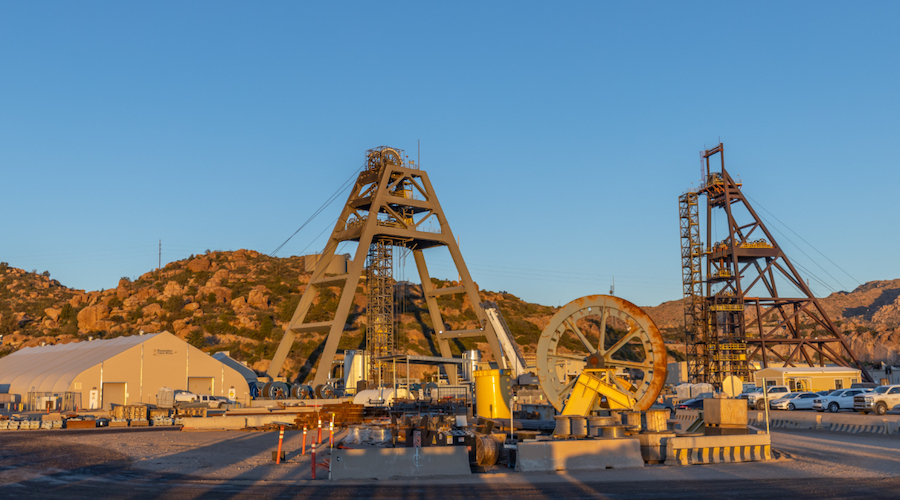
The mine is estimated to produce as much as 40 billion pounds of copper over 40 years. (Image courtesy of Resolution Copper.)

US President Donald Trump on Tuesday criticized an appeals court’s decision to temporarily block federal officials from completing a land transfer needed for Rio Tinto and BHP to develop Arizona’s Resolution Copper project.

Trump’s post on his Truth Social platform came after he and Interior Secretary Doug Burgum met at the White House with the CEOs of Rio and BHP, two of the world’s largest mining companies, which have been trying to develop Resolution for more than a decade.

The San Francisco-based 9th US Circuit Court of Appeals ruled on Monday that the transfer – which had been slated for Tuesday – should be halted while the court weighs a request from the San Carlos Apache tribe to block the project for religious, cultural and environmental reasons.

It was only the second time any court has ruled in favor of the Apache or their allies in more than five years of myriad legal maneuvers against Resolution, slated to become one of the world’s largest supplies of a metal used to build nearly every electronic device.

Trump called the court a “radical left court” and said that those who oppose the mine “are Anti-American, and representing other copper competitive Countries.”

“It is so sad that Radical Left Activists can do this, and affect the lives of so many people,” Trump said in the post. “We can’t continue to allow this to happen to the USA!”

Trump did not outline any actions he plans to take to sway the court, but said that “our Country, quite simply, needs Copper — AND NOW!” He did not provide evidence for his claims about the court and opponents of the project.

Terry Rambler, chairman of the San Carlos Apache, said in a statement that he and the tribe were “working to save the US from making a disastrous decision that would give up American resources to foreign interests.”

Rambler noted in his statement that BHP is based in Australia, while Rio is based in Australia and the UK and its largest shareholder is a Chinese aluminum company.

Rio has said it plans to keep all of Resolution’s copper inside the US should the mine be approved. The company controls one of the two US copper smelters.

Rambler said he believes that Rio is likely to export Resolution’s copper to China.

“I look forward to sitting down with the administration and providing factual information that will help protect American assets,” Rambler said.

Court

The appeals court made clear it takes “no position on the merits” of the Apache’s arguments and would expedite its review. Judges asked for filings to be submitted by October 14, but have not yet scheduled a hearing date. Ten of the appeals court’s 29 members were appointed by Trump.

Rio said it was “confident the court will ultimately affirm” the land transfer. Rio CEO Jakob Stausholm and his successor Simon Trott, who will take the company’s reins next month, were at the White House meeting with Trump.

BHP CEO Mike Henry thanked Trump and Burgum on social media “for their strong leadership to reinvigorate mining and processing supply chains in and for America.”

Trump’s post comes less than a month after he imposed a copper tariff on wiring and pipe, but not the copper concentrate produced by mines themselves, a levy falling far short of what the mining industry had expected. That will allow other countries to import copper into the US without fear of tariff implications.

History

The mine’s construction would cause a crater that would swallow a site where the Apache worship. Congress and then-President Barack Obama approved the mine in 2014 after it was added at the last minute to a must-pass military funding bill with the condition that an environmental report be published.

The underground mine – which Trump approved in his first term before successor Joe Biden reversed him – would supply more than a quarter of US appetite for copper and be a key part of Trump’s plan to boost US mining.

Apache Stronghold, a nonprofit group comprised of some Apache and conservationists, asked the US Supreme Court to block the transfer, a request that the high court denied in May.

Meanwhile, the tribe itself made the same request of federal courts. It failed last week at the district court level and appealed over the weekend.

(By Ernest Scheyder and Trevor Hunnicutt; Editing by Franklin Paul, Stephen Coates and Sonali Paul)

US appeals court temporarily blocks  land transfer for Resolution Copper

The Resolution underground mine could meet 25% of the US domestic copper needs. (Image courtesy of Resolution Copper.)

A US appeals court on Monday temporarily blocked federal officials from completing a land transfer needed for Rio Tinto and BHP to develop Arizona’s Resolution Copper project.

The San Francisco-based 9th US Circuit Court of Appeals granted a temporary administrative injunction while it considers the merits of a request from the San Carlos Apache tribe to block the transfer. The transfer had been slated to occur on Tuesday.


DarkSky International Launches New Port Marine Terminal Lighting Program

DarkSky International
Port Tampa Bay

Published Aug 20, 2025 9:10 AM by The Maritime Executive


[By: DarkSky International]

DarkSky International, the leading global authority on light pollution, has launched a groundbreaking new certification program to bring responsible lighting to industrial-scale ports. The DarkSky Approved Port Marine Terminal Lighting Program is designed to significantly reduce light pollution, safeguarding sensitive coastal ecosystems and nearby communities, while enhancing safe and efficient working conditions.

A model for sustainable industrial-scale lighting
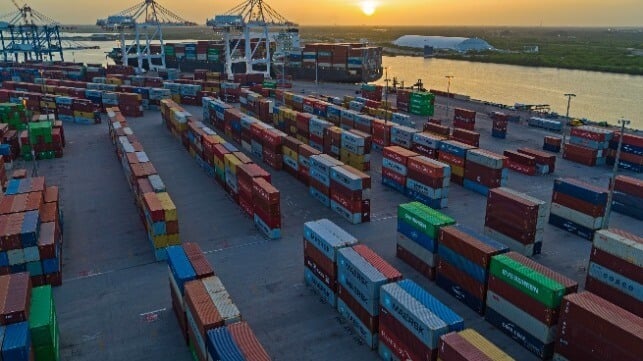
Initiated in 2023 in partnership with Port Tampa Bay, this pioneering project aims to transform Berths 301 and 218, active material handling terminals, into a model for responsible industrial lighting—while protecting sensitive wetlands and an adjacent nature preserve. Through this collaboration, the port engineering team selected state-of-the-art LED fixtures with advanced optical controls, dimming capabilities, and shielding to reduce glare and minimize light trespass beyond the port property—virtually eliminating uplight spilling into the night sky and helping protect critical marine and coastal habitats. These improvements were achieved while still meeting OSHA-required light levels and maintaining uniformity.

A trusted third-party certification
DarkSky Approved Port Marine Terminal Lighting is the latest addition to the DarkSky Approved programs suite, a trusted, third-party validation program that recognizes lighting products and projects that protect the night. Grounded in DarkSky’s Five Principles for Responsible Outdoor Lighting, developed in partnership with the Illuminating Engineering Society (IES), this DarkSky program represents a significant leap in applying these principles to large-scale industrial environments.

“The program marks a pivotal shift in how we approach lighting at an industrial level,” said Ruskin Hartley, CEO of DarkSky International. “Our partnership with Port Tampa Bay shows that dark sky quality and community-friendly lighting can be effectively scaled, reducing light pollution while maintaining and even improving operational efficiency and working conditions. It’s a win not only for Port Tampa Bay, but the community and nighttime environment as well.”

Why It Matters
More than 22% of the world’s coastal waters are exposed to artificial light at night, disrupting marine ecosystems, including wetlands and beaches critical for birds, pinnipeds, and nesting sea turtles, as well as habitats for fish and coral. Port terminals are often intensely illuminated, with glare and light trespass spilling into nearby communities and fragile environments. With the majority of the world’s population living along coastlines and global trade continuing to grow, balancing development with environmentally responsible lighting has never been more urgent.

The new certification fills a critical gap, guiding ports in transitioning to LED lighting with proper optical control, shielding, and dimming systems. These solutions ensure light is used only where and when it’s needed, while virtually eliminating unnecessary spill into surrounding areas.

Leading by Example
“Port Tampa Bay believes nature and industry can coexist,” said Paul Anderson, Port Tampa Bay President & CEO.  “Our partnership with DarkSky illustrates our ongoing commitment to environmental stewardship. We’re proud to help pioneer this important program and guide the maritime industry toward more sustainable practices.”

Throughout 2024, DarkSky and Port Tampa Bay engaged lighting designers, marine infrastructure experts, and environmental advocates to ensure the program meets both operational needs and ecological goals. The resulting guidelines are now available for adoption by other ports and marine facilities worldwide.

The products and services herein described in this press release are not endorsed by The Maritime Executive.


Great Lakes Announces the Delivery of its Newest Hopper Dredge

Great Lakes Dredge

Published Aug 20, 2025 5:43 PM by The Maritime Executive


[By Great Lakes Dredge & Dock Corp.]

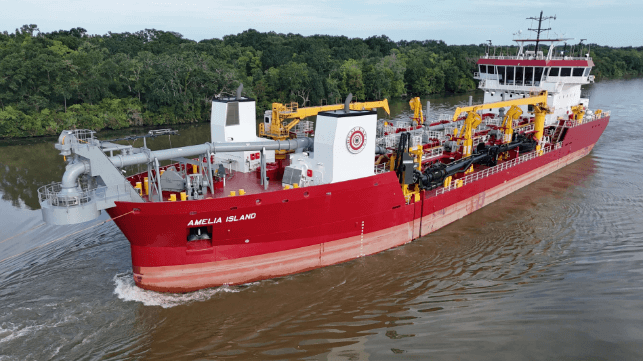
Great Lakes Dredge & Dock Corporation ("Great Lakes" or the “Company”) (NASDAQ: GLDD), the largest provider of dredging services in the United States, today announced it took delivery of its newest Jones Act-compliant hopper dredge, the Amelia Island from the Conrad Shipyard in Morgan City, Louisiana.

The Amelia Island supports the Company’s vision of continued modernization and diversification of our fleet. The Amelia Island is specially designed for efficient and safe operations along shallow and narrow waters throughout all U.S. coastlines. The vessel is approximately 346 feet in length, 69 feet in breadth, 23 feet in depth with 16,500 total horsepower installed. The dredge features two 800mm trailing suction pipes capable of dredging depths up to 100 feet with a hopper capacity of 6,330 yd³. The main engines and generators are EPA Tier IV rated for low emissions. These vital capabilities of the Amelia Island position it at the forefront of modern dredges, allowing it to execute projects along all U.S. coasts, ports, channels, and coastal developments.

Lasse Petterson, President and Chief Executive Officer, commented, “The delivery of our sixth hopper dredge, the Amelia Island marks a significant milestone as our dredging newbuild program is now complete, leaving us with the largest and most advanced hopper fleet in the United States. Engineered with a high level of automation, this vessel is well-suited for diverse operations such as beach renourishment, coastal protection, channel deepening, and maintenance dredging. Already with a full schedule for 2025 and 2026, the dredge will be going immediately to work.”

The Amelia Island joins her sister ship, the Galveston Island, another modern dredge built to enhance vital maritime infrastructure nationwide and reaffirms our commitment with the U.S. Army Corps of Engineers and our dedication to the U.S. dredging industry.
 

The products and services herein described in this press release are not endorsed by The Maritime Executive.


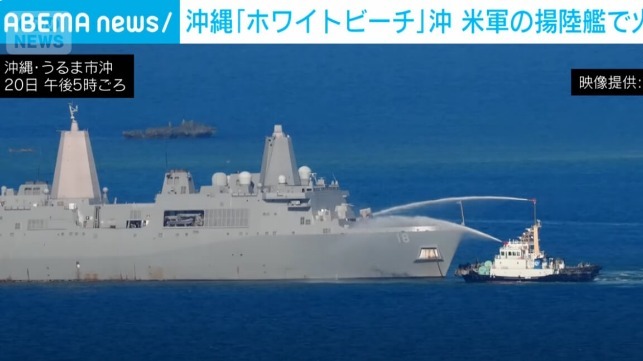
Video: Fire Aboard USS New Orleans is Extinguished with Japanese Assistance

USS New Orleans
Navy is reporting a fire aboard the USS New Orleans anchored off Japan (USN file photo)

Published Aug 20, 2025 1:47 PM by The Maritime Executive


The U.S. 7th Fleet reported as of 0400 Thursday morning Japan time that a fire aboard the amphibious transport vessel USS New Orleans had finally been extinguished. Earlier they had reported the fire was contained, but they had twice requested the assistance of Japanese forces to fight the fire aboard the vessel, which is currently anchored off Okinawa.

The U.S. Navy has released few details only reporting that the cause of the fire is currently under investigation. Two sailors were reportedly taken to the New Orleans’ medical facilities for minor injuries, but the vessel is stable with no reports of pollution. The plan calls for the crew to remain aboard the ship, which according to media reports did not have a detachment of Marines aboard when the fire began. 

The Japanese media is reporting that the ship, which was commissioned in 2007, has been anchored off Okinawa for the past few days. It is assigned to the 7th Fleet and has been based in Sasebo, Japan, since 2019. The ship is 24,400 tons displacement and 684 feet (208 meters) in length with a maximum capacity of approximately 800 Marines.


The fire appears to have begun in the forward part of the vessel around 4:00 p.m. local time on August 20. Spectators reported seeing smoke coming intermittently from the forward part of the vessel or midship. Video on Japanese TV showed tugs near the forward part of the ship spraying water on the hull.

The fire was reported to the Japan Coast Guard, which sent a patrol boat to determine the extent of the situation. Around 5:00 p.m. local time, the Coast Guard reports it received a request for assistance from the U.S. Navy. However, that first call was withdrawn within the hour, and the U.S. Navy was instructing vessels to stay about one mile away. The request for assistance from the Japanese was reinstated around 7:30 p.m. local time. The Navy reports that the crew of a sister ship from the San Antonio-class amphibious transport dock class, USS San Diego, which was moored at White Beach Naval Facility, assisted in fighting the fire.


The Japan Self-Defense Force reported its vessels were conducting firefighting efforts to aid the crew of the USS New Orleans. The Japan Coast Guard was providing assistance. The US 7th Fleet command thanked the Japanese for their aid.

The reports emphasized that there have been no requests to evacuate any of the U.S. personnel from the vessel. A spokesperson for the 7th Fleet said additional information would be provided as it becomes available.


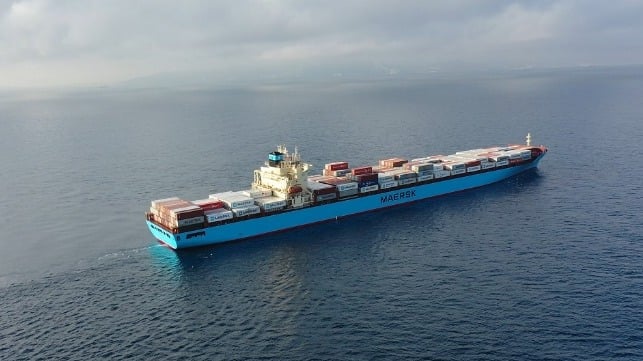
External Fire Teams Reach Marie Maersk Off Africa

Maersk containership
Crew of the Marie Maersk continues to battle the container fire with aid from external crews (Maersk file photo)

Published Aug 20, 2025 12:32 PM by The Maritime Executive


The container fire that started a week ago aboard the Marie Maersk is continuing to burn, according to the latest update from the company. Additional resources have been brought to the vessel, which is holding off the coast of Africa, and they believe the fire is contained while plans are being developed for the ship.

The crew reported smoke coming from containers on the morning of August 13 as the vessel was sailing from Rotterdam bound for Malaysia and China. At the time, they said the vessel was moved toward the coast near Liberia so that shoreside resources could aid the crew. Tugs and an OSV arrived, bringing firefighting equipment to the vessel, and over the weekend, Maersk said the crew had been successful in stopping the spread of the fire.

“The external firefighter crew is on board Marie Maersk since yesterday (Tuesday) and actively fighting the fire alongside the Marie Maersk crew,” Maersk said in its latest update. “As reported, the fire has been contained but not suppressed completely, and a port of refuge is also still under contemplation.”

Maersk has not said the extent of the fire, such as the number of bays involved or the number of containers. The ship has a capacity for 19,000 TEU, although heading east toward Asia, the load could be smaller or include a significant number of empties.

The company reports it is “in close contact with all customers who have cargo on board.” It said it is, wherever possible and known, giving customers an indication whether their cargo was likely impacted by the fire or not.

At 213,971 dwt and 1,039 feet (399 meters) in length, the vessel is one of the largest in the Maersk fleet. A limited number of ports on the west coast of Africa are equipped to handle the largest containerships. The current reported position puts the vessel off southern Liberia. Multiple vessels, however, are also passing the location due to the number of ships diverting around Africa due to the closure of the Red Sea.

Maersk has reported that the crew is safe. The vessel, which was built in 2013 and is registered in Denmark, is said to be in stable condition, with all machinery, steering, and navigational equipment fully operational.