It’s possible that I shall make an ass of myself. But in that case one can always get out of it with a little dialectic. I have, of course, so worded my proposition as to be right either way (K.Marx, Letter to F.Engels on the Indian Mutiny)
Friday, August 22, 2025
UPDATE
U.S. Deports More Cruise Ship Crewmembers as Visa Review Expands
GESTAPO NATION
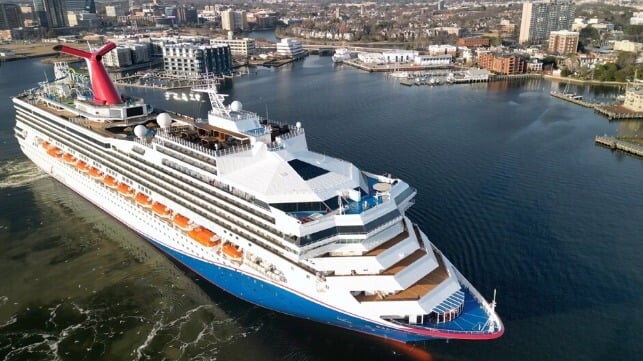
A total of 28 crewmembers out of the 1,000 working on Carnival Sunshine had been detained and deported (Carnival Cruise Line file photo)
Advocates for the Philippine community report that U.S. Customs and Border Protection (CBP) is continuing its enforcement efforts, rapidly deporting individual crewmembers off cruise ships that it says have violated their work visas. This comes as the Trump administration confirmed on Thursday, August 21, that it was expanding its review of all current U.S. visas and specifically suspending work visas for foreigners as commercial truck drivers.
The Pilipino Workers Center (PWC) reports CBP officers once again met the Carnival Cruise Line ship Carnival Sunshine last Sunday, August 17, when the ship returned to Norfolk, Virginia, from its weekly cruise. Four Filipino crewmembers out of a crew of over 1,000 people were reportedly taken into custody, removed from the ship, placed in a hotel under guard overnight, and flown out of the United States the following day.
The advocacy groups contend that the crewmembers are being “fast-tracked” for deportation with no legal process. They said no evidence, no charges, and no hearings are being conducted. Instead, the crewmembers are told they must sign deportation paperwork or face the potential of a $250,000 fine or jail time. As part of the deportation, they are also barred from returning to the United States for 10 years.
The group reports the four crewmembers taken into custody on Sunday were told they were being targeted because they participated in an online chat group that had links to child pornography. No evidence was presented, and the group says all four individuals denied the allegations.
The groups report that 28 crewmembers from the Carnival Sunshine have now been removed from the ship and deported since the crackdown began this spring. Over 100 crewmembers from various cruise ships around the United States, all holders of valid crew visas for work on commercial vessels, have been deported.
CBP confirmed the actions to 13News Now in Virginia, saying that the individuals were “found inadmissible and were denied entry into the United States,” as part of “ongoing cruise vessel operations” where immigration law is being enforced. The Pilipino Workers Center reports it is speaking with the Philippine government about the matter.
The U.S. State Department confirmed on Thursday that it is reviewing what it said are 55 million U.S. visas, looking for any violations that could lead to deportation. Associated Press noted there are 12.8 million foreigners with residency papers known as a “Green Card” and an additional 3.6 million people in the U.S. on visas. It believes the remainder of the 55 million figure is outstanding multi-entry visas where the people are not currently in the country.
Secretary of State Marco Rubio posted online that as part of the review, his department was suspending visas for commercial truck drivers. He wrote that foreigners operating large tractor-trailer trucks endanger American lines and undercut American truck drivers. The Trump administration has already increased rules to ensure English language competency for commercial truck drivers.
A portion of the drivers now being targeted are the ones who move containers from the U.S. ports and around the country. Advocates highlight an existing shortage of drivers and the potential to further impact supply chain operations.
Report: Turkey Bars Ships with Ties to Israel and Suspends All Trade
Shipping between Turkey and Israel will reported be barred until there is a ceasefire in Gaza (UN OCHA file photo)
The Turkish government has reportedly taken steps to suspend trade with Israel and stop the movement of ships between the two countries, as well as possibly international shipping with an Israeli connection. The full extent of the moves is unclear pending official government statements, but it comes after the Houthis made it clear they were tracking shipping between the countries.
Officially, Turkey said it had suspended trade with Israel more than a year ago in May 2024, but both reports from Bloomberg and Reuters have tracked ongoing trade. Turkish ships have also been used to transport aid to the residents of Gaza (one is currently holding off the coast of Israel), and international shipping has made port calls between the two countries.
The Trade Ministry of Turkey told Reuters today, August 21, that it was moving to restrict exports on a wide range of products until a ceasefire is declared in Gaza. This is said to include building materials such as iron, marble, steel, cement, aluminum, and bricks, as well as fertilizer and construction equipment. Turkey has been a leading supplier of construction materials to Israel, with the Bank of Israel reporting more than $5.3 billion in exports from Turkey to Israel in 2023 before the prior embargo. Even after the 2024 move, unofficial numbers show $100 to $200 million a month in Turkish goods arriving in Israel, according to a report in the Israeli newspaper Globes.
Other reports today have indicated that the Turkish government is also quietly imposing restrictions on all shipping to Israel. Turkish media and Reuters were reporting without an official announcement, Turkey is beginning to impose a ban on any direct ship traffic between the two countries. The report said the instructions were being delivered verbally by the port authorities to agents and other representatives of the shipping companies.
Ships registered in Turkey are reportedly being told they can no longer call in Israeli ports. Israeli shipping companies are told their vessels are barred from Turkey’s ports.
Globes and Reuters, however, are suggesting the ban is more comprehensive. Their reports cite unnamed sources that say Turkish authorities are also asking for statements confirming ships are not linked to Israel or engaged in operations linked to Israel. They are also saying that transportation of military or hazardous cargoes to Israel is banned. It is believed the effort will also forbid the handling of any cargo or transshipment of cargo through Turkey to Israel.
At the beginning of August, the Houthi militants in Yemen increased their threats against ships and shipping companies calling in Israeli ports. As part of it, they cited the tracks of ships sailing between Israeli ports and Turkey as well as Egypt, warning that it was a violation of the group’s “embargo” on Israeli ports.
Turkey’s new move comes after repeated protests in multiple countries, primarily in the Mediterranean region, over the handling of cargo to Israel. Multiple ships have been targeted with accusations that they were carrying military equipment and materials to support the Israeli war effort. Shipping companies with U.S. government contracts to transport materials have also been accused of aiding the war effort.
The protests have also grown to include an Israeli-owned cruise ship carrying tourists to ports in the Eastern Mediterranean. The Mano Cruises Crown Iris was forced to skip ports and has also reported delays as protestors vented their anger over the war during the ship’s port visits.
Equinor Will Not Proceed with Australian Offshore Wind Projects
ONE STEP FORWARD, TWO STEPS BACK
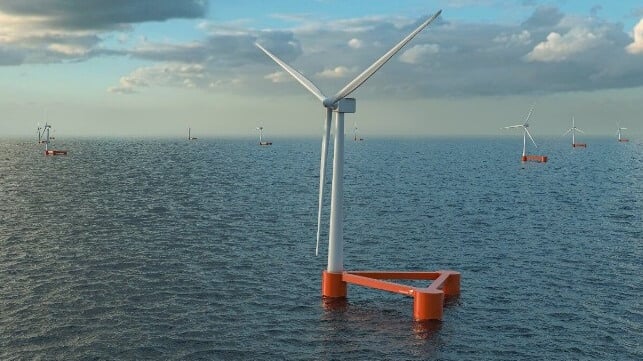
Novocastrin would be one of the first, large, deep-water floating wind farms (Equinor)
Equinor, one of the leading developers in the offshore and renewable energy industry, is not proceeding with its development projects in Australia, marking another setback for the developing industry. The Norwegian company had been working in Australia for the past few years and was positioned to be one of the first to develop a project.
Australia’s Energy Minister, Chris Bowen, said that Equinor and its Australian partner, Oceanex Energy, had been unable to agree on terms for the next phase of the development project. They had been selected by the government in February to receive a feasibility license to proceed with the research for the project, but according to Bowen, the company has decided to decline the license for the proposed Novocastrian Offshore Wind Farm.
Oceanex has spent years developing the plan and the local expertise for the project, which is one of the projects selected for the Hunter coast of New South Wales. The plan calls for a mega 2 GW floating wind farm located more than 12 miles offshore south of Newcastle. The proposed timeline expected construction to begin in 2028 and operations by 2031.
No official reason was given for the decision not to proceed, but it is being pointed out that Equinor has withdrawn from a number of projects both in Australia and elsewhere in recent months. Novocastrian was positioned according to Oceanex to be “at the forefront of deep-water deployment.”
Equinor had launched its partnership with Oceanex in 2022, citing the strong potential for offshore wind energy in Australia and the government’s strong desire to develop the industry. Oceanex is also developing offshore plans for the Illawarra and South Coast regions.
Equinor last month quietly withdrew from another project, its third in Australia, the Bass Offshore Wind Energy project. To be located near Tasmania in the Bass Strait, it calls for 70 to 100 turbines with a capacity of 1.5 GW. Equinor was working with the Australian company Nexsphere, which assumed full ownership of Bass from Equinor. Unlike Novocastrain, Bass has not yet been selected for a feasibility license.
Bowen said that Oceanex wants to continue to pursue the project, but it lacks the access to capital required. He believes that both Oceanex and Nexsphere will be shopping for new international partners.
The changing economics for offshore wind energy and the challenges of developing a new market have weighed heavily on Australia’s plans. Last month, Blue Float Energy, which is developing the plans for a Victoria offshore project, reported it was not proceeding. The plan calls for a 2 GW project for the Gippsland region, but reports said the company’s lead investor, Quantum Capital, determined the project was no longer commercially viable.
The changing economics have also challenged projects in other parts of the world. Ørsted recently announced it would not proceed with the Hornsea 4 project in the UK in its current proposed form. The company has also reported that it was unable to secure an investment partner in the United States for its Sunrise Wind project. It is planning to sell rights to its current shareholders to raise more than $9 billion, which will primarily be used to complete construction of the U.S. project.
Bowen reiterated that the Australian government remains firmly committed to renewable energy. Analysts, however, question whether the government can meet its goals as the leading offshore projects have stalled before reaching feasibility and the final investment decision.
Alaska Carrier is Latest to Suspend Transport of EVs Due to Fire Risk
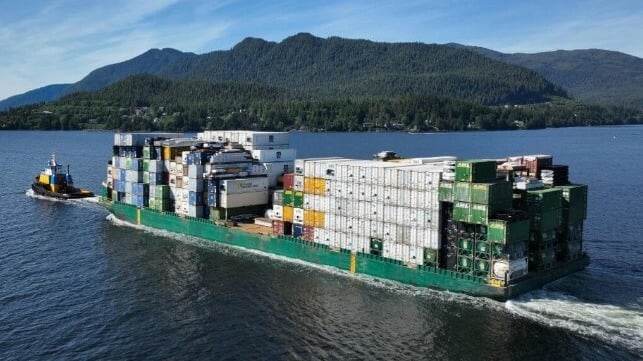
Alaska Marine Lines cited the fire danger in saying it will suspend transport of EVs and plug-in hybrids (AML)
Fire concerns and the potential for toxic, runaway fires spurred by lithium-ion batteries continue to weigh heavily on the shipping industry. Lynden’s Alaska Marine Lines has become the latest carrier to report it will no longer ship electric vehicles or plug-in hybrid electric vehicles due to the increased safety risk.
The company operates a vital cargo barge service across Alaska as well as to Hawaii. It is a vital connection for moving commercial freight and is used by Alaskans for shipping materials or to bring items from the “Lower 48.”
“Although we have previously shipped EVs and PHEVs, the increased complexity and fire risk associated with shipping large lithium-ion batteries on vessels at sea has caused us to reevaluate how to best keep our employees and equipment safe. While issues with lithium-ion batteries are infrequent, the inability to extinguish or contain this type of fire, especially while at sea, can lead to catastrophic results,” the company said in a customer statement released on August 12.
The new policy is effective immediately for Central Alaska, Western Alaska, and Hawaii. The company said it would continue to carry the vehicles for the next few weeks until September 1 for Southeast Alaska. The decision does not impact other hybrid vehicles, smaller electric recreational vehicles, e-bikes, and four-wheelers. Alaska Marine Lines said it will continue to reassess the ability to safely ship these vehicles as industry standards and safety procedures improve.
Alaska Public Media highlights that the restrictions will be especially hard for the Southeast, where electric vehicles are growing in popularity. It reports that the State of Alaska’s Alaska Marine Highway System and its ferries will continue limited transport of EVs.
The ferry system limits just two EVs per trip, and a spokesperson told KCAW Alaska that special precautions are in place on the ferries. They have designated spaces with more area around the two spots for EVs, and each ferry carries two special fire blankets designed to smother EV battery fires.
Alaska Marine Lines’ policy follows a similar decision announced by Matson in June. The carrier reported that its vessel from California to Hawaii and Guam would no longer transport EVs despite the precautions that it had put in place to control possible fires.
Similar policies have also emerged in Europe. Havila, for example, which carries cars on the Norwegian Coastal voyages, announced in 2023 that it was banning EVs and hydrogen vessels from its ships.
Marie Maersk Back Underway to Get Additional Assistance With Container Fire
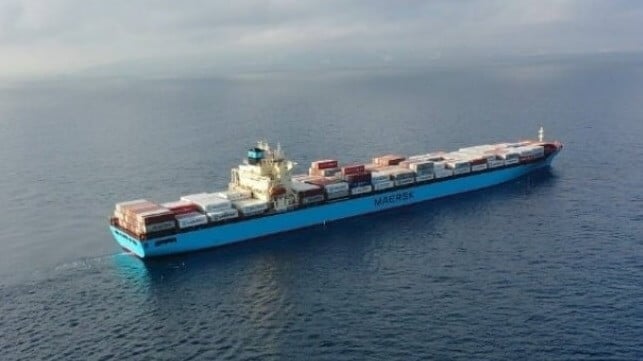
Marie Maersk is underway to get assistance with container fire (Maersk file photo)
More than a week after the crew of the containership Marie Maersk reported smoking coming from containers, the fire is controlled but likely still burning. The ship has resumed sailing as it works to get additional help from shore in its efforts to extinguish the fire.
“One container, which has been flooded with water, still shows an elevated temperature while being under control,” reports a spokesperson for Maersk. “Marie Maersk is sailing slowly eastwards off the West African coast to meet another supply vessel with additional firefighting equipment which will be loaded onboard.”
The last AIS signal from the containership showed it sailing at more than 10 knots eastward into the Gulf of Guinea. It had been holding off Liberia on the West Coast during the first phase of the firefight. The ship was bound from Rotterdam to Malaysia and then China when the smoke was spotted on the morning of August 13. The ship initially moved closer to shore so that equipment and personnel could be brought out to aid the efforts.
An external firefighting team boarded the vessel on Tuesday, August 19. Maersk reports together with the crew of Marie Maersk, they have the fire under control, while it is still not completely extinguished.
“The expert Crisis Response Team of Maersk remains in constant touch with the vessel crew, salvage operator, flag state authority, and classification society to take qualified decisions about the next steps,” the spokesperson told The Maritime Executive on August 22. The port of destination is “under contemplation,” with the goal of finding the best solution for the crew, Maersk’s customers and their cargo.
The ship has a rated capacity of just over 19,000 TEU, but it is unclear exactly how many containers are currently aboard and how many might be empties. Maersk says that due to the prevailing conditions in the affected cargo bays, it cannot confirm the exact impact of the fire on each container. The expectation is that the ship will be taken to a port of refuge to offload the damaged containers and ascertain the full extent of the damage.
Saturation Diving Begins Effort to Remove Fuel from MSC Elsa 3 Casualty
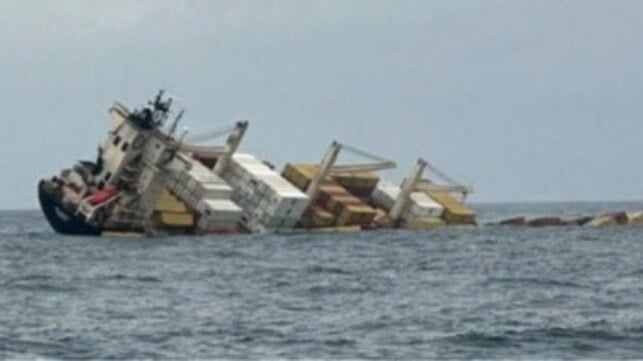
Divers will begin tapping the fuel tanks aboard the wreck of the MSC Elsa 3 (DGS)
Salvage efforts at the wreck site of the casualty MSC Elsa 3 have moved into a critical phase, reports India’s Directorate General of Shipping. Starting on August 20, saturation diving began on the hulk as the salvage team hired by MSC and the insurers started the efforts to pump the remaining fuel from the vessel.
It is a challenging operation because of the depth of the wreck, which lies at approximately 51 meters (167 feet), and the potential for adverse weather conditions. The operations were suspended in July after the first phase capped vents and ports that were thought to be weeping small amounts of fuel. The site, which is 14 nautical miles off the Indian state of Kerala on the West Coast, is exposed to the seasonal monsoons.
The salvage plan submitted by SMIT Salvage, the firm engaged by the shipowners and the Protection and Indemnity insurer North Standard, targets completion of the fuel extraction by September 25. SMIT was hired as a specialist for this phase of the effort, replacing the earlier salvage firm. They note the schedule is a tentative timeline for oil removal and associated activities, which may be impacted by weather conditions.
Estimates are that there was a total of 450 metric tons of fuel aboard the containership when it went down on May 25. It consists of approximately 85 tons of diesel, and the remainder is VLSFO (Very Low Sulfur Fuel Oil). Since the vessel sank, there have been small quantities of fuel on the surface, which have dissipated in the sea conditions.
The Directorate General is advising local fishermen and other vessels not to enter a one-nautical-mile exclusion zone around the operation. It is being supported by Diving Support Vessels and other crafts to ensure the safety and monitor for pollution.
In addition to the fuel removal, the DGS reports that so far, 655 tons of plastic nurdles have been collected from the coastal areas. There was a total of 650 containers aboard, of which the DGS says 66 have been recovered after washing up on the coast along with various other debris. Sri Lanka, which is hundreds of miles away, reports debris has also washed up on its shores.
MSC Mediterranean Shipping Company, the owners of the vessel, and the insurance companies continue to face a growing list of legal challenges associated with the casualty. The company has moved to limit its liability while rejecting the extent of the damage claims made by Kerala in court. The court has detained five MSC containerships while they were making port calls in India as security against various claims by fishermen and shippers who had cargo on the ship. Four of the vessels have been released after bonds were posted, but the MSC Akiteta II has been stuck in port for a month as it was attached as part of the $1 billion claim made by Kerala.
The company told the court that India is threatening trade and its supply chain. It said the terms in the case are setting a bad precedent that shipping companies would not be able to meet. Sri Lanka has filed separate claims for the impact on its environment from the wreck.
Greece Orders Owner to Remove Wreck After Grounded Cargo Ship Sinks
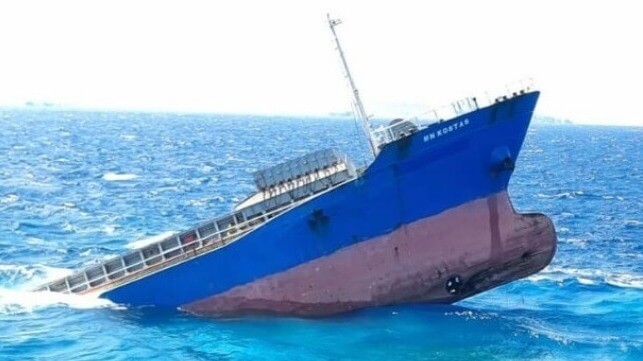
Cargo ship MN Kostas went down nearly a month after it grounded off Crete (Hellenic Coast Guard)
Greek authorities are investigating the circumstances of a cargo ship that sank off Crete on August 19 nearly a month after the vessel grounded and while a salvage operation was underway, The MN Kostas (5,800 dwt) however has been declared a shipwreck and maritime hazard with the Hellenic Coast Guard reporting the owner has been informed and ordered to remove the hulk.
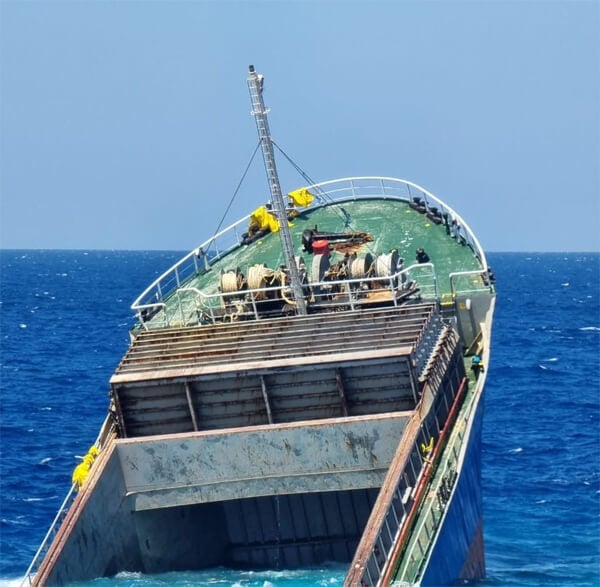
Pictures from the site show the 106-meter (348-foot) vessel’s bow and forward section protruding from the water. The Hellenic Coast Guard termed it a “vertical sinking to the starboard side,” reporting the vessel went under during the morning hours of August 19.
Salvage operations had been underway for most of the month after the vessel grounded on July 24, approximately 3 nautical miles west of the northeastern tip of Crete. The vessel had loaded a cargo of gypsum in the port of Sitia on Crete and departed that evening bound for Lebanon. Built in 1994, the vessel was registered in Sierra Leone and had a crew of 14 aboard who were rescued and brought to shore by fishing boats and the port authority.
The captain and watch officer of the MN Kostas were being investigated for causing a shipwreck and failing to avoid collisions, which in this case was the reef. The authorities stated that the reef was marked on navigation charts.
The forward section of the vessel is protruding out of the water (Hellenic Coast Guard)
A local salvage company, Seagate, was retained after the grounding. It reports that 37 tons of diesel fuel were removed along with other potential pollutants, including lubricants and paints. They had also brought in a crane and a second ship and offloaded most of the gypsum cargo before the vessel sank. The Coast Guard reports ventilation and other opening had been sealed during the salvage operation.
Earlier this year, the same ship was cited for charges of failing to pay its crew, with the International Labour Organization reporting the crew was due nearly $18,500 in pay. It said the crew had only received half pay for four months, but that the situation was corrected. The vessel was managed by a shipping company based in Crete.
Australia Investigating After Bulker Blacks Out and Drifts Toward Newcastle
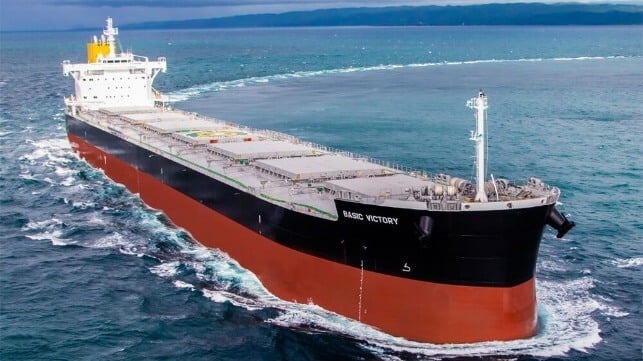
The bulker drifted within three miles of shore before it was able to restart its engine (Tsuneishi Cebu)
The Australian Transport Safety Bureau (ATSB) is investigating the circumstances around an incident where a larger bulker lost power and drifted dangerously close to Newcastle. It will be looking for critical safety issues, and if they are identified, the ATSB will immediately notify the operators of the ship and the port, and other relevant parties, so that appropriate and timely safety action can be taken.
The incident began on the morning of July 30 when the Marshall Island-registered bulker Basic Victory was holding offshore awaiting its berth. Newcastle is one of the busiest ports in Australia, reporting that it handles over 4,400 ship movements each year. Over 152 million tonnes of cargo are handled annually at the port.
The bulker, which was built in the Philippines in 2021, was about 20 miles off the Port of Newcastle while waiting to berth when it reported around 8:00 a.m. local time that its main engine had failed. The ship was drifting towards the coastline north of Newcastle and by about 1730 that afternoon had closed to within three miles of the nearest land.
The ship’s master reported the propulsion failure to Newcastle vessel traffic service and, as they were drifting close to shore, requested permission to anchor. Shortly afterward, the crew succeeded in restarting the main engine and the ship steamed clear of the coastline.
After the ship had berthed in Newcastle on August 7, ATSB reports its investigators boarded the ship for an inspection and to collect evidence, including interviewing the master and crewmembers. They also obtained recorded data and documentary evidence.
After repairs were completed, the Basic Victory sailed from Australia on August 9. The vessel is at sea bound for Japan, where it is due to arrive next week.
Australia has a reputation for its enforcement of safety regulations and detailed inspections of ships. The Australian Maritime Safety Administration has administered bans on ships that are repeat violators or have failed to undertake proper repairs and maintenance.
Helsinki Shipyard Cuts Steel for Canada's Next Polar Icebreaker
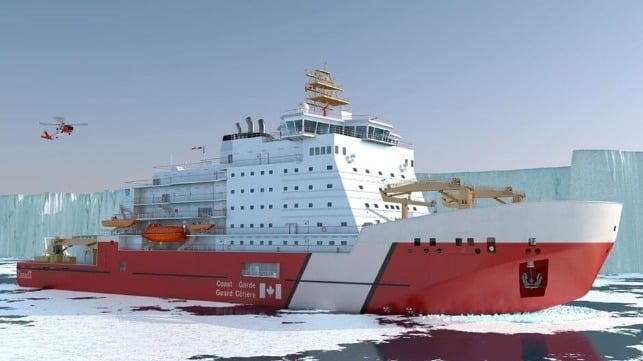
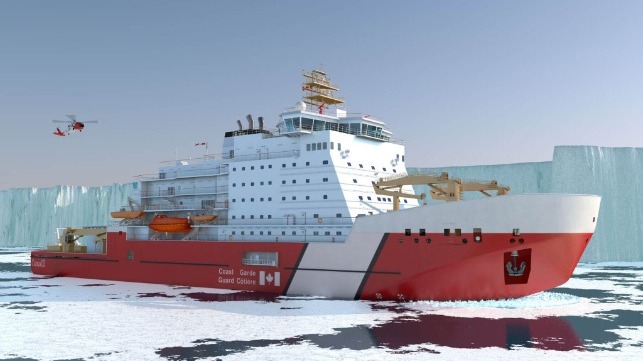
Chantier Davie's Helsinki Shipyard has cut steel for the Canadian Coast Guard's next polar icebreaker, the future CCGS Imnaryuaq. It is the second of the two different heavy icebreakers that the Canadian government has ordered under the National Shipbuilding Strategy.
Heavy icebreakers are unique and challenging vessels, requiring extra-thick hulls, special steel and heavy internal framing to brace the ship against ice pressure. Most icebreakers are built in Finland, and few other nations maintain an industrial base for icebreaker construction. To compete for Canada's business, Chantier Davie bought Helsinki Shipyard from its previous Russian owners, acquiring an experienced Finnish workforce along with tooling and yard capacity. It may not be located in Canada, but Helsinki can build the hull right away, and Chantier Davie can complete fitting-out at its yard in Quebec.
"With construction now underway on the Polar Max icebreaker, the project will progress while developing the skills and expertise of Canadian workers," said Canadian secretary of state for defense procurement Stephen Fuhr. "This international collaboration provides our workers with the opportunity to learn best practices and advanced methods that will strengthen Canada’s shipbuilding industry for years to come."
The Helsinki Shipyard / Davie hull is scheduled for delivery in 2030. The other polar-class hull on order under the NSS, Seaspan's polar icebreaker, has been delayed to make room for other government shipbuilding priorities. Canada's government began initial design work on the project in 2012, and Seaspan cut first steel earlier this year. It is scheduled to deliver in 2032, two years after Davie's Finnish/Canadian hull.
Canada's heavy icebreaker procurement program is an expensive venture. By comparison, the latest independent estimate for the U.S. Coast Guard's heavy icebreaker program puts the all-in unit cost at about US$1.7 billion per hull, about 175 percent over the original contract price agreed by Halter Marine. The Canadian orders cost far more: not including future overruns, Chantier Davie's one-ship program cost US$2.3 billion, and Seaspan's one-ship program cost a combined US$3 billion. Canada's parliamentary budget office estimates that the all-in procurement cost will be just over US$6 billion for the two hulls.
Le Groupe ALMACO to Outfit Canadian Coast Guard’s Polar Max Icebreaker
Le Groupe ALMACO, a proudly Canadian subsidiary of ALMACO Group, today announced it has signed an over 100M CAD Engineering, Procurement and Construction (EPC) contract with Chantier Davie Canada Inc. (Davie), Canada’s premier shipbuilder, for the outfitting of the Polar Max Icebreaker – a flagship project under the National Shipbuilding Strategy (NSS) and a cornerstone of the Canadian Coast Guard’s (CCG) future fleet. The move supports Le Groupe ALMACO and Davie’s shared vision of building local capabilities and fostering long-term industrial growth in the Canadian marine sector.
Polar Max: a Unique Project Executed Across Continents The execution plan for Polar Max is a truly international collaboration between Davie and ALMACO, spanning both Canada and Finland. The hull will be constructed at Davie-owned Helsinki Shipyard, with Le Groupe ALMACO delivering interior accommodation spaces and other essential areas during this stage. In parallel, in Québec, Davie’s skilled shipbuilders and Le Groupe ALMACO will lead the design, procurement, and fabrication of the 1,400-ton superstructure – the top part of the ship.
This dual-build approach not only leverages expertise across two continents but also accelerates the project timeline by allowing major work to proceed simultaneously in both locations and guarantee the timely delivery of the ship to the Government of Canada. Once the hull is transported from Finland to Canada, the superstructure will be integrated at Davie’s facility in Lévis, Québec. This approach follows a proven process, successfully used for the delivery of Combat Support Ship (CSS) Asterix to the Royal Canadian Navy (RCN). Work on the superstructure begins in late summer, with final integration and vessel delivery to Canada by 2030.
Expanding ALMACO Group’s Presence in Québec To support the Polar Max project and to create a long-term presence, ALMACO is expanding its operations in Canada. ALMACO set up operations in Québec already in 2022 and will open a new Le Groupe ALMACO office in Québec City in September 2025.
Québec’s role in the Polar Max program further reinforces its position as a global shipbuilding hub, recognized for innovation, technical excellence, and a highly skilled workforce. In delivering the project, Davie and ALMACO intend to collaborate extensively with subcontractors across Québec and Canada’s broader shipbuilding industry, ensuring that expertise and economic benefits are shared nationwide. As part of this effort, ALMACO’s role in the Polar Max will generate new jobs in Québec, creating opportunities for local talent and driving long-term growth in the province’s advanced marine sector.
The company has launched a major recruitment program, combining the know-how of ALMACO’s Europe-based employees with the skills of Canadian professionals. Le Groupe ALMACO is committed to employing local talent in all functions – from engineering and project management to manufacturing and other roles.
A Shared Commitment to Canada’s Maritime Future “Working with Davie again is a proud moment for us,” said Vilhelm Roberts, Executive Chairman of the Board and Co-owner of ALMACO Group. “We’ve maintained a close relationship with their team ever since the Asterix Project, and this new contract confirms our shared ambition to deliver world-class vessels while growing local expertise and capacity. We’re not just outfitting a ship—we’re helping to build the future of Canadian shipbuilding together.”
“Polar Max is a once-in-a-generation project that demands the very best from every partner involved, said Davie co-owner and CEO, James Davies. “Our work with ALMACO on Asterix proved that when we combine their world-class expertise with Canadian ingenuity, we deliver faster, better and with greater impact. This is a lasting partnership which will not only help deliver Polar Max on time and to the highest standard – it will also create jobs and develop skills and industrial capability here in Canada.”
Davie is a key player in Canada’s National Shipbuilding Strategy. ALMACO is honoured to support this important national initiative and looks forward to continuing its collaboration with Davie on Polar Max, and beyond.
“This is great news that ALMACO has chosen Québec to expand its activities and partner with Davie on the Polar Max Icebreaker project. The National Shipbuilding Strategy continues to generate exciting opportunities for Canada’s shipbuilding industry, creating high-value jobs and strengthening our economy while advancing shipbuilding expertise in Québec and across the country,” said the Honourable Mélanie Joly, Minister of Industry and Minister responsible for Canada Economic Development for Québec Regions.
“The Polar Max project is an excellent example of how Canadian industry and international partners can collaborate to deliver world-class capabilities while creating good-paying jobs here at home. With ALMACO expanding its footprint in Québec, we can expect more skilled jobs, greater shipbuilding expertise, and a stronger, more resilient Canadian marine sector. As a key project under the National Shipbuilding Strategy, the Polar Max icebreaker will contribute to a more modern, capable Canadian Coast Guard fleet and secure long-term economic growth and shipbuilding capacity for our country,” said the Honourable Stephen Fuhr, Secretary of State for Defence Procurement, Canada.
“Davie’s leadership in the Polar Max project is a powerful driver of economic growth for Québec,” said Christopher Skeete, Minister for the Economy. “The collaboration between Davie and the ALMACO Group will generate business opportunities in both jurisdictions’ naval sectors. It will also consolidate Québec’s position as a shipbuilding hub, while recognizing the strategic importance placed on the Arctic in the 21st century.”
A Trusted Partnership Renewed The Polar Max project represents a significant milestone in the long-standing collaboration between Davie and ALMACO Group. Their previous partnership to deliver the CSS Asterix to the Royal Canadian Navy in 2017 created lasting impact on the Canadian and international maritime industries. The Polar Max contract highlights the trust and shared commitment to delivering top-tier marine outfitting and advancing shipbuilding excellence in Canada.
Introducing Mobile Cabin Factory for Modular Cabins A local “cabin factory” will be established in Québec. This facility, a first of its kind in Canada, will allow Le Groupe ALMACO to produce pre-fabricated modular cabins on site, significantly improving project logistics, efficiency, and quality assurance. The move supports Le Groupe ALMACO and Davie’s shared vision of building local capabilities and fostering long-term industrial growth in the Canadian marine sector.
The products and services herein described in this press release are not endorsed by The Maritime Executive.
UC Irvine-led research team uncovers global wildfire paradox
Total burned area declined in past two decades while human impacts worsened
Irvine, Calif. —Researchers at the University of California, Irvine and other institutions have spotted a contradiction in worldwide wildfire trends: Despite a 26 percent decline in total burned area from 2002 to 2021, the number of people exposed to wildfires has surged by nearly 40 percent.
The study, published today in Science, revealed another statistic that may come as a surprise to people who rely primarily on Western news sources: While high-profile wildfire disasters in the United States, Canada and Australia often dominate headlines, the researchers found that 85 percent of all human exposures to wildfires during that period occurred in Africa.
Just five central African countries – Congo, South Sudan, Mozambique, Zambia and Angola – accounted for half of all global human exposure. In contrast, the United States, Europe and Australia collectively constituted less than 2.5 percent of the total.
“Nevertheless, the western U.S. and particularly California are hot spots of intense fires globally,” said senior author Mojtaba Sadegh, an associate professor of civil engineering at Idaho’s Boise State University who earned a Ph.D. in civil and environmental engineering at UC Irvine in 2015. “Our previously published study shows that California experiences a disproportionately large share of U.S. fire impacts, accounting for 72 percent of human exposures despite comprising 15 percent of the nation’s burned area.”
The researchers analyzed population data and more than 18.6 million fire records from 2002 to 2021 to find that an estimated 440 million people worldwide were exposed to a wildfire encroaching on their home during this period – a number roughly equivalent to the entire population of the European Union. They discovered that human exposure to wildland fire increased by 7.7 million people, an average of 382,700 persons per year during the study period. This surge in human exposure was prompted not by a global jump in fire activity but primarily by population growth and migration into fire-prone landscapes.
Another factor illuminated by the research is a significant rise in the intensity of wildfires in North and South America. This is linked to the climate change-driven amplification of “fire weather,” which includes conditions like increased heat, lower humidity and strong winds.
Extreme fire weather has grown by more than 50 percent over the past four decades globally.
In Europe and Oceania, the study noted a decline in wildfire exposures, mainly because of population shifts from rural to urban areas. This highlights how both social and environmental factors play critical roles in shaping wildfire risk.
“The global paradox of decreased burn area and increased human impacts we uncovered … is due largely to an increasing overlap between human settlements and fire-prone landscapes,” said co-author Amir AghaKouchak, UC Irvine Chancellor’s Professor of civil and environmental engineering.
Underscoring a growing human vulnerability to wildfires – particularly in regions that receive little international attention – the research emphasizes the urgent need for proactive mitigation strategies to protect communities from the burgeoning threat of wildfires. These include vegetation management techniques like prescribed fires, public education and engineering solutions to reduce human-caused ignitions.
“As climate change intensifies fire weather and global populations continue to expand into fire-prone zones, proactive mitigation will be increasingly critical to reduce the risk of future wildfire disasters,” AghaKouchak said.
Study collaborators included Matthew Jones of England’s University of East Anglia; Seyd Teymoor Seydi of Boise State University; John Abatzoglou and Crystal Kolden of UC Merced; Gabriel Filippelli of Indiana University Indianapolis; Matthew Hurteau of the University of New Mexico; Charles Luce of the U.S. Department of Agriculture Forest Service’s Rocky Mountain Research Station in Boise; and Chiyuan Miao of Beijing Normal University. Funding was provided by the U.S. National Science Foundation.
About the University of California, Irvine: Founded in 1965, UC Irvine is a member of the prestigious Association of American Universities and is ranked among the nation’s top 10 public universities by U.S. News & World Report. The campus has produced five Nobel laureates and is known for its academic achievement, premier research, innovation and anteater mascot. Led by Chancellor Howard Gillman, UC Irvine has more than 36,000 students and offers 224 degree programs. It’s located in one of the world’s safest and most economically vibrant communities and is Orange County’s second-largest employer, contributing $7 billion annually to the local economy and $8 billion statewide. For more on UC Irvine, visit www.uci.edu.
Media access: Radio programs/stations may, for a fee, use an on-campus studio with a Comrex IP audio codec to interview UC Irvine faculty and experts, subject to availability and university approval. For more UC Irvine news, visit news.uci.edu. Additional resources for journalists may be found at https://news.uci.edu/media-resources.
From November 18-22, 2024, four peers from Spain, Portugal, and Italy, selected by the European Commission, carried out an on-site mission in Land Brandenburg under the Union Civil Protection Mechanism (UCPM) Peer Review Programme. Requested by the authorities of Land Brandenburg in cooperation with the Federal Office of Civil Protection and Disaster Assistance (BBK), the review assessed wildfire risk governance and practice to provide actionable pathways for strengthening capabilities.
CMCC experts served as facilitators, leveraging experience from previous disaster risk management and wildfire peer reviews in Romania (2022), Moldova (2023), Greece (2024), and Italy (2024). The State School and Technical Facility for Fire and Disaster Protection of the State Brandenburg engaged national and regional stakeholders throughout the process.
This work has been instrumental in surfacing critical issues that demand attention. In Land Brandenburg - a German federal state with nearly 292,000 hectares of forest - the review led to a curious revelation: Not only were climate change and legacy land use part of the problem, but the presence of unexploded ordnance within the vast forest area also posed a significant challenge.
“These findings are significant because they shed light on hidden challenges and demonstrate how systematic, externally grounded peer review processes can drive actionable reform,” says CMCC researcher Veronica Casartelli, who played a key role in the development of the assessment framework.
The report provides a comprehensive overview of Land Brandenburg’s wildfire risk management system, highlights good practices already in place, and sets out tailored recommendations to bolster effectiveness. Designed to support mutual learning among UCPM countries, the findings and guidance are relevant beyond Brandenburg for regions across Europe facing escalating wildfire risk.
“UCPM peer reviews have consistently underscored the need to adopt a whole-of-government and whole-of-society approach, ensuring strong vertical and horizontal coordination across institutions and sectors. Equally urgent is the shift from a suppression-focused model to an integrated, prevention-oriented approach to wildfire risk management, grounded in strategic planning, cross-sectoral collaboration, and long-term investment in risk reduction.”