Tuesday, August 26, 2025


Tropical volcanic eruptions push rainfall across the equator


Eruptions increase rainfall in tropics in the other hemisphere


Princeton University, Engineering School


Volcanoes that blast gases high into the atmosphere not only change global temperatures but also influence flooding in unusual ways, Princeton researchers have found.

In an August 26 article in the journal Nature Geoscience, the researchers reported that major eruptions create distinct patterns of flooding depending on the location of the volcano and the dispersal of its plume. The patterns mostly divide along the line of the equator. When a volcano’s plume is generally contained in one hemisphere, flooding decreases in that hemisphere and increases in the other hemisphere. The pattern most strongly affects the tropical regions and demonstrates little to no effect on other regions.

Volcanoes that create plumes affecting both hemispheres, show a different pattern. These eruptions decrease flooding in the tropics in both hemispheres, while increasing flooding in arid regions.

For the study, the researchers examined three major eruptions: the 1902 eruption of Santa Maria in Guatemala, whose plume was concentrated in the northern hemisphere; the 1963 eruption of Agung in Indonesia, whose plume was concentrated in the southern hemisphere; and the 1991 eruption of Pinatubo in the Philippines, with a more symmetric plume.

Global air currents play a key role in the impact on flooding

Gabriele Villarini, one of the principal researchers, said the key to the patterns lies in global air currents. Trade winds that encircle the globe meet at the equator in a region called the Inter-Tropical Convergence Zone. The converging winds create a weather pattern split along a line that generally follows the equator. The zone forms a weather band in tropical regions on both sides of the equator in which warm, moisture-laden water rises, producing heavy rainfall. The change between summer and winter shifts the line north and south, causing the rainy and dry seasons normally experienced in much of the tropics.

Major volcanic eruptions shift this pattern, said Villarini, a professor of civil and environmental engineering and the High Meadows Environmental Institute. The volcanoes blast gases, most importantly sulfur dioxide, into the stratosphere. In this region of the upper atmosphere, the sulfur gas oxidizes and becomes tiny, suspended particles. These aerosols scatter incoming sunlight and absorb heat radiating from the earth. This simultaneously cools the earth at surface level and warms the stratosphere, which affects air circulation. Previous scientific studies have demonstrated the effect on global temperature, and related techniques have been proposed for geoengineering projects to combat global warming.

The Princeton team found that the changes in air circulation resulting from the eruptions change the position of the Inter-Tropical Convergence Zone, causing it to shift north or south away from the hemisphere experiencing the eruption. This shift directly alters rain patterns. The zone, with its moisture-laden air, shifts away from the eruption, causing greater rain and heavier flooding in the corresponding tropical region.

Villarini said the effects of the increased rainfall are generally strongest in the year after the eruption and lessen after several years.

Agung and Santa Maria impacts were both split at the equator

The researchers examined the Santa Maria (1902) and Agung (1963) eruptions because their plumes were confined to single hemispheres. As a result, the sulfur aerosols disproportionately concentrated in that hemisphere, shifting air currents and pushing the Inter-Tropical Convergence Zone further into the other hemisphere.

After the Agung eruption in the southern hemisphere, 50% of stream gauges saw reduced peak flows (a measure of river flooding) in the tropical regions of the southern hemisphere in the first year after the eruption. Stream gauges in the tropics of the northern hemisphere saw an increase of about 40% in peak flows.

The Santa Maria eruption in the northern hemisphere was followed by a 25% increase in sites with peak flooding in the southern hemisphere’s tropics, and a 35% increase in sites with decreased flows in the northern tropics. Additionally, Santa Maria saw increased higher peak floods in arid and temperate regions in the northern hemisphere. The researchers said about 25% of sites in those regions saw increases in the two years after the eruption.

Volcano plumes that straddle the equator depress flooding in the tropics and increase it in dry regions

The aerosol plume from the 1991 Pinatubo eruption spread about evenly across both hemispheres, the researchers found. Unlike the other two eruptions, Pinatubo decreased flooding in tropics in both hemispheres. Peak flows dropped at 20% of sites in the southern tropics and at 35% of sites in the northern tropics.

Arid regions showed the opposite effect. The researchers found that extremely dry regions experienced an increase in peak flows at about 35% of the sites on both sides of the equator following the Pinatubo eruption. Hanbeen Kim, lead author of the paper, said this increase is possibly due to a different air circulation mechanism called the monsoon-desert coupling. In this pattern, air sinks over Asian monsoon regions and rises over nearby arid regions. The rising air pulls moisture upward, causing greater rainfall in the arid areas.

The researchers found that for eruptions spread across both hemispheres, like Pinatubo, shifts in the Inter-Tropical Convergence Zone do not play a major role. Instead, they said, changes in flooding are caused by cooling and related atmospheric circulation changes, such as those over desert regions.

Villarini said that by demonstrating the major effect of volcanic eruptions on flooding worldwide, the research shows the importance of understanding how changes in climate can have important effects beyond their immediate results. He said that scientists and political leaders should understand these impacts when assessing the risks of changes in the climate.

The article, Global response of floods to tropical explosive volcanic eruptions, was published August 26 in the journal Nature Geoscience. Besides Villarini, authors include Gabriel Vecchi, the Knox Taylor Professor of Geosciences at Princeton and director of the High Meadows Environmental Institute; Hanbeen Kim, an associate research scholar at the High Meadows Environmental Institute; and Wenchang Yang, a researcher in geosciences at Princeton.

Mindset shift about catastrophes linked to decreased depression, inflammation


Stanford University


Catastrophes, by definition, are devastating, but they can often be catalysts for lasting, positive change – and if people can adopt that perspective, they may see some real benefits, a Stanford-led study suggests.

In a randomized, controlled trial, a one-hour intervention was given to a group of adults designed to shift their mindset, or core beliefs and assumptions, about having lived through a catastrophe like the COVID-19 pandemic, with the goal of seeing growth opportunities in the experience.

Those who received the intervention showed lower levels of depression three months later compared to a control group. Blood tests also revealed lower levels of C-reactive protein, an inflammatory marker linked to chronic stress and disease. The findings were reported in the journal Brain, Behavior, and Immunity.

“As much as we might wish to live untouched by trauma or catastrophe, the reality is that few of us are spared from such struggle,” said Alia Crum, the study’s senior author and an associate professor of psychology in the Stanford School of Humanities and Sciences. “The study was inspired by our desire to help people reflect on their experience of the pandemic with an eye on how it could help them grow.”

A balanced view
Crum’s team from the Stanford Mind & Body Lab and their colleagues conducted the study from October 2022 to February 2023 with two groups of adult participants. The control group viewed a series of videos with information about different phases of the COVID-19 pandemic and answered questions to test their knowledge. The intervention group viewed a series of videos showing that mindsets can be powerful drivers of health and well-being.

These videos also highlighted evidence that people often grow in characteristic ways as a result of living through catastrophic experiences such as the COVID-19 pandemic. Common areas of growth include developing a greater appreciation for life, increasing resilience, strengthening interpersonal relationships, deepening one’s spiritual faith, and pursuing new opportunities that would not have otherwise been possible.

After viewing the videos, the intervention group participants were asked to reflect in writing on their current mindsets about the long-term impact of the pandemic and potential areas of growth they could pursue in their own lives.

Cultivating a mindset is not the same as blind positive thinking, the researchers emphasized, and participants were not asked to ignore the pandemic’s negative impacts.

“We tried to be very nuanced and balanced but also bring in the genuine, research-based evidence that there are specific positive changes that a lot of people do go through when they live through something like the pandemic,” said Jesse Barrera, the study’s co-first author and former lab manager of the Mind & Body Lab.

In fact, previous research from Crum’s team revealed that people who saw the pandemic as a major catastrophe in early 2020 were actually more likely to also see it as holding some opportunities. This insight informed the intervention in the current study.

The researchers themselves also found an opportunity from the pandemic experience. They had to conduct their study remotely, which led to a new design where participants viewed the videos at home and mailed in dried blood spot samples for testing.

“In a lot of ways, the methodology that we came up with for this study was actually only an opportunity because of COVID-19,” said Lexi Straube, a Stanford medical student and co-first author. “This approach opens the door for more accessible strategies that can reach people during future public health crises or in communities that don’t have access to traditional clinical trials.”

Hope after catastrophe
More research is needed to replicate the findings with different groups of people, but the results provide hope for anyone who has experienced a challenging or traumatic life event, Crum said.

“We would have liked to avoid the COVID-19 pandemic, but it came regardless,” she said. “In the post-pandemic era, we face a choice: We can let it recede into memory, leaving us depleted and disillusioned, or we can choose to look back, learn from it, and grow – both personally and collectively.”


Additional Stanford co-authors include Zoƫ Huml, Mind & Body Lab research coordinator; recent doctoral graduate Sean R. Zion; current doctoral student Kris M. Evans; and postdoctoral scholar Chiara Gasteiger in the Department of Psychology in the School of Humanities and Sciences. Other co-authors on the study include researchers from Boston College; the University of Auckland, New Zealand; the University of California, Los Angeles; and the University of Pennsylvania.

This research received support from the Robert Wood Johnson Foundation and the California Initiative to Advance Precision Medicine.

Bank CEOs Rake In Big Profits as Wall Street Ramps Up Fossil Fuel Financing

The 65 biggest banks committed $869 billion to firms expanding the fossil fuel industry last year, a new report says.

August 25, 2025

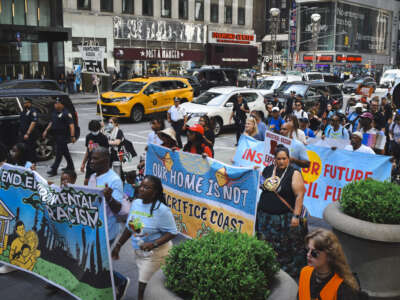
Climate activists rally outside Bank of America Tower in Midtown Manhattan as part of the March to End Fossil Fuels on September 19, 2023.
Erik McGregor / LightRocket via Getty Images

Big banks across the world are substantially increasing their financing of the fossil fuel industry, including for the industry’s expansion during a time of intensifying climate crisis, all while pulling back from previously stated climate commitments.

These are among the key highlights of the most recent Banking on Climate Chaos report, which found that the 65 biggest banks globally committed a whopping $869 billion to companies conducting business in fossil fuels in 2024, representing a huge $162 billion increase from 2023.

“These financial flows reflect the policy retreat of banks abandoning climate goals for short-term profits,” Campaign Director for the Climate and Energy Program at Rainforest Action Network Dianne Enriquez told Truthout.

Banking on Climate Chaos, co-authored by several organizations including Rainforest Action Network, Oil Change International, Indigenous Environmental Network, and Sierra Club, is an authoritative annual study — endorsed by hundreds of organizations across the world — of how banks finance the fossil fuel industry.

The report also shows that U.S. banks like JPMorgan Chase, Bank of America, Citigroup and Wells Fargo dominated the heights of fossil fuel financing. A Truthout analysis reveals that the CEOs of the top six U.S. banks that are financing fossil fuels together made over a half-billion dollars from 2022 to 2024. CEO pay is astronomically larger than the average incomes of communities most impacted by their fossil fuel financing.

Organizers in Louisiana are fighting the Trump administration’s efforts to expand methane export infrastructure. By Derek Seidman , Truthout June 6, 2025

“These billion-dollar industries are making money off of our backs while killing us,” Roishetta Ozane, founder of the Vessel Project in Lake Charles, Louisiana, which endorsed the report, told Truthout.

Ramping Up Fossil Fuel Financing

The most notable finding in the new report is that, during 2024, global banks “significantly increased their fossil fuel financing, including ramping up finance for fossil fuel expansion,” with the 65 biggest banks globally committing $429 billion to companies expanding fossil fuel production and infrastructure in 2024.

As the report notes, the “growth in fossil fuel finance is troubling because new fossil fuel infrastructure locks in more decades of fossil fuel dependence.”

“Global banks continue to fuel the climate crisis at an alarming scale,” Jessye Waxman, Sustainable Finance Campaign Advisor for the Sierra Club, told Truthout.

This comes amid intensifying climate chaos and the desperate need to vastly ramp down fossil fuel production, according to the United Nations’ Intergovernmental Panel on Climate Change (IPCC), which has called for “a substantial reduction in fossil fuel use” without delay.

U.S. banks dominated the list of banks increasing their fossil fuel financing, with JPMorgan Chase, Citigroup, Bank of America, Goldman Sachs, Wells Fargo, and Morgan Stanley holding six of the top eight spots. These banks all increased their fossil fuel financing from 2023 to 2024 by a range of 30 percent to 50 percent, amounting to nearly $70 billion more fossil fuel funding between them.

“U.S. banks are leading this surge,” said Waxman, who noted that JPMorgan Chase, Bank of America, Citigroup, and Wells Fargo alone “collectively represent over 21 percent of the total global fossil fuel financing covered in the report.”

The report shows that banks based in the U.S., Canada, Europe, and Japan account for around 83 percent of fossil fuel financing globally, highlighting the massive imbalance of fossil financing profiteering that comes from the Global North while disproportionately impacting the Global South. The report includes case studies on the banking behind contested companies and projects worldwide, such as Mozambique LNG and JSW Steel in India.

“Globally, people are paying dearly,” said RAN’s Enriquez.

All told, the 65 biggest banks in the report have committed a staggering $7.9 trillion in fossil fuel financing since 2016, the year the Paris Agreement, an international treaty to limit global warming to 1.5 degrees Celsius above pre-industrial levels, went into effect, the report notes.

Loopholes and Greenwashing

Banking on Climate Chaos also contains findings on howbanks finance fossil fuel corporations — findings that support the claim that banks have been “greenwashing” themselves by giving lip service to climate concerns even as they continue to bankroll climate catastrophe.

Notably, the report found that only 5.3 percent of financing to fossil fuel companies came at the project level, whereas 94.7 percent of it came at the corporate level. This corporate-level financing increased by nearly $117 billion from 2023 to 2024.

In other words, while banks have restricted direct financing of dirty fossil fuel projects that could garner bad publicity, they’ve simultaneously increased direct, unhindered financing to the corporationsdoing business in fossil fuels.

“Banks’ corporate financing loophole is a textbook case of greenwashing,” said Sierra Club’s Waxman, noting that the loophole “gives fossil fuel companies unrestricted capital to pursue harmful expansion.”

“It renders banks’ climate policies toothless by allowing them to maintain the illusion of responsibility, while behind the scenes, they continue to bankroll the fossil fuel industry,” said Waxman.

All this adds weight to accusations of greenwashing: Banks are making face-saving gestures even as they continue to bolster the corporate coffers of the fossil fuel industry.

Meanwhile, the report also highlights many banks’ rapid flight from the net-zero “commitments” that they so adamantly committed themselves to just a few years ago.

The prime evidence of this is the near-total collapse of the Net Zero Banking Alliance (NZBA), a United Nations-supported initiative to align global banks’ lending and underwriting practices with the goal of reaching net-zero carbon emissions by 2050.

Leading fossil fuel financiers like JPMorgan Chase, Bank of America, and Wells Fargo had previously celebrated their self-proclaimed climate concerns by joining the NZBA. But in the face of rising opportunities to capitalize on fossil fuel expansion — from corporate mergers and expanded drilling practices to a new oil-friendly Trump administration — these banks and many more have quit the NZBA entirely. U.S. lawmakers have suggested that banks like JPMorgan Chase have misled the public and investors as it backed away from its purported climate commitments.

All told, the report’s data and analysis support the notion that banks are not passive actors when it comes to the global climate crisis. Rather, banks are active agents maneuvering to keep bankrolling fossil fuels corporations, and they have revealed their climate commitments to be exceedingly thin.

CEOs Profit Big

The report starkly illustrates how U.S. banks dominated global fossil fuel financing in 2024, occupying half of the top dozen slots. JPMorgan Chase was the top bank financing fossil fuels ($53.5 billion), with Bank of America second ($46 billion), Citigroup third ($44.7 billion), Wells Fargo fifth ($39.3 billion), Goldman Sachs tenth ($28.5 billion), and Morgan Stanley twelfth ($27 billion).

Top executives at these banks have also personally profited enormously as they’ve overseen an expansion in fossil fuel financing in recent years. A Truthout analysis shows that, according to their banks’ most recent proxy statements, from 2022 and 2024, the CEOs of these banks together raked in well over a half-billion dollars — $543.75 million in total — in their total compensation.
CEO Compensation of Top Six U.S. Fossil Financing Banks, 2022-2024, based on 2025 Proxy Fillings.  Derek Seidman

In 2024, these six banks’ CEOs took in a total of $185,350,903 million, or an average of nearly $31 million.

Notably, this CEO compensation is astronomically higher than the per capita incomes of communities most impacted by the fossil fuel projects overseen by companies that their banks are financing.

One of those communities is Lake Charles, Louisiana, which is surrounded by fossil fuel and petrochemical facilities. As Truthout previously reported, local organizers like the Vessel Project’s Ozane are resisting the construction of facilities like Venture Global’s huge new LNG export terminal, Calcasieu Pass 2.

Banking on Climate Chaos notes that Venture Global LNG’s top two bankers in 2024 were Goldman Sachs and JPMorgan Chase.

In 2024, Jamie Dimon, CEO of JPMorgan Chase, was the top earner in 2024 with $39 million. (As of April 2025, Dimon also owned 7,186,564 units of JPMorgan stock, worth today around over $2 billion.) By contrast, the per capita income in Lake Charles, Louisiana, is $35,847. This means Dimon took in 1,087 times the per capita income of a Lake Charles resident last year. Ted Pick, CEO of Morgan Stanley, took in $24,881,032 in 2024, or 694 times the income of an average Lake Charles resident. (It’s worth noting that while Morgan Stanley’s April 2025 proxy statement reported Pick’s 2024 compensation at $24,881,032, an earlier February 2025 filing said his 2024 compensation was set as $34 million, which would be 948 times the income of an average Lake Charles resident).

The injustice of these stark disparities resonates with Ozane, who told Truthout she founded the Vessel Project amid the destruction caused by climate-induced disasters that included Hurricanes Laura and Delta. “I started connecting the dots and really looking at the intersection between these low-income neighborhoods facing these crises versus the polluters who are causing these climate-induced disasters,” Ozane said.

Ozane called Jamie Dimon’s 2024 compensation of $39 million “staggering,” especially given that it was “based off investments in fossil fuel projects that are not only killing the people in my community, but harming this entire world.”

“It highlights the troubling disconnect between the financial elite like Jamie Dimon and everyday people like myself and my community members,” she said. “It’s especially troubling when his bank finances a project like Venture Global, which is the largest polluter when it comes to methane gas, and it’s right there in my community, a community that is struggling.”


People Over Profit

Banking on Climate Chaos ends with robust demands aimed at curbing bank financing of fossil fuel expansion, instituting policies to advance the transition from fossil fuels and securing climate, protecting human and Indigenous rights, and securing a just and fair energy transition.

“Ultimately, we’d like for banks to immediately halt financing fossil fuel companies that are doing fossil fuel expansion,” Enriquez said.

Waxman also pointed out the need for regulators to “set strong, binding policies — at all levels from regional to state to national — that incentivize banks to clean up their act or face significant penalties.”

Ozane wants to see financial institutions from Citi and JPMorgan in the U.S. to Mizuho and MUFG in Japan take a more responsible approach to their investments and prioritize funding for renewable energy.

“It’s time for these institutions to align their practices with the urgent need for climate action and the urgent need to put people before profit,” she said.


This article is licensed under Creative Commons (CC BY-NC-ND 4.0), and you are free to share and republish under the terms of the license.


Derek Seidman is a writer, researcher and historian living in Buffalo, New York. He is a regular contributor for Truthout and a contributing writer for LittleSis.

Help Palestinian students reach UK universities

August 24, 2025

Over eighty Palestinian students set to study at UK universities – including Oxford, Cambridge, and Edinburgh – are currently unable to leave Gaza due to UK visa biometric data requirements. With no functioning visa centres in Gaza and no safe route to neighbouring countries, they are effectively blocked from taking up their places.

As recently outlined in the TelegraphTimesGuardianChannel 4 News and Times Higher Education, UK visas require applicants to enrol their biometric data before an application can be processed. Since 7th October 2023, the Visa Application Centre in Gaza has been closed, with UK Visas and Immigration citing safety concerns for staff and applicants. While there is a biometrics deferral protocol, put in place in 2023, requests have been ignored when students have requested to apply for a deferral. Although some have managed to submit requests via legal counsel, they must wait weeks for a decision as to whether or not they are eligible for a deferral request, and only then put in an application dossier. Requests to expedite this process have gone unanswered.

These eight students face an administrative block in the UK visa system that reinforces Israel’s illegal blockade on Gaza.

Positive Action in Housing, which is also backing the campaign, points out that instead of protection, the students face a biometric blockade:

  • Families are being asked to withdraw their family reunion applications because they are unable to submit biometrics in Gaza and risk being refused. Why are they being asked to withdraw an application?
  • Others are being refused outright for ‘failure’ to submit biometrics  because the process is so complex — no visa centre exists and the borders are sealed.
  • Lawyers themselves are struggling to navigate the 59-page visa rules, while Palestinians are left in limbo.
  • The Home Office insists Palestinians can “use existing routes.” But these routes are structurally blocked, and each delay means people are starved, bombed, and killed.

“This is not bureaucracy — it is cruelty by design. For Ukrainians, every barrier was lifted. For Palestinians, every door is closed,” says Robina Qureshi of Positive Action in Housing.

As pressure mounts on the government to find a way to support sustainable peace in the region, a first step is to let our universities do what they do best in building the capacity of these scholars and equipping them with cutting-edge resources in health, humanities, engineering, and social sciences. Inaction is preventing talented Palestinian students and scholars from taking up their places in the UK. This, in turn, is stifling a generation of leaders who need tools to rebuild their communities in Gaza.

The NUS is calling on the UK government to:

  • Grant student visas and ensure safe passage
  • Defer the biometrics to a safe third country
  • Evacuate the students from Gaza immediately
  • Hold an urgent meeting with Abtisam Mohamed MP to address the concerns raised by her and over 100 MPs.
How You Can Help: Write to your MP today — refuse to accept “existing routes” as an answer. Use this template letter and or email your MP, also here. Visit the campaign link.

Donate to the Gaza Appeal Fund

Positive Action in Housing has launched the Gaza Appeal Fund. All donations to go directly to help Palestinian families or individuals from Gaza who are in emergency need. Share this link with family and friends and encourage them to share too.

Israel Kills 5 Journalists in Strike on Gaza Hospital, Including AP Reporter

The attack sent shockwaves as a second strike on rescue teams was caught on live broadcast.

By Sharon Zhang , 
Published
August 25, 2025

Mariam Dagga, a Palestinian visual journalist who has freelanced for AP since the start of the war, stands in front of cameras in Khan Yunis in the southern Gaza Strip on January 18, 2025.Bashar Taleb / AFP

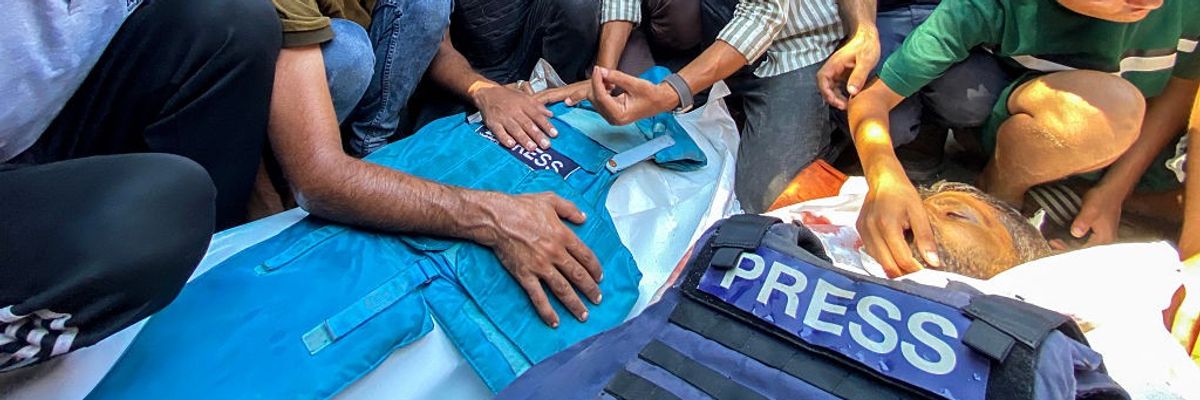
Israeli forces killed five journalists and those who came to rescue them in an apparent “double tap” strike on a major hospital in southern Gaza on Monday, in a massacre that health officials say left at least 20 Palestinians dead.

Gaza officials confirmed the journalists’ deaths. Hussam al-Masri, Mariam Abu Dagga, Mohammad Salama, and Moaz Abu Taha were killed immediately, while Ahmed Abu Aziz later died of his injuries. The journalists have done work for numerous outlets, with Dagga having worked for The Associated Press; al-Masri for Reuters; Salama for Al Jazeera; Salama and Aziz for Middle East Eye; and more.

The journalists were on the top floor of Nasser Hospital, the main hospital in southern Gaza, when Israel bombed them. Witnesses said that about 10 to 15 minutes later, as a group of civil defense workers responded to the attack, Israel bombed the hospital again, killing the medical workers as well. The hospital said that four of its staff had been killed.

The second strike was captured on a live broadcast on al-Ghad TV.

Double tap strikes violate international law, and have reportedly been increasingly used by Israeli forces in targeting Palestinian health workers in Gaza.

Related Story

Israel Kills Famous Gaza Reporter Anas Al-Sharif in Targeted Strike
Al-Sharif was hailed as the “voice” of Palestinians in Gaza, and was openly targeted by Israeli authorities.
By Sharon Zhang , TruthoutAugust 11, 2025

Israel acknowledged the strike, but said that it is opening an inquiry into the attack, claiming that Israeli forces do not target journalists — even as officials have openly bragged about their assassinations of Palestinian journalists, many of whom they have labelled as “terrorists.” A recent investigation found, in fact, that Israel has an entire intelligence unit tasked with justifying such killings.

Journalists often use the part of the hospital struck by Israel for live broadcasts, a surgeon who works at Nasser told The Washington Post. Euro-Med Human Rights Monitor reported seeing an Israeli surveillance drone over the facility before the attack, “providing further evidence that it was deliberate and intelligence-guided, with precise information collected about the site and the victims.”

The Associated Press wrote that Dagga frequently worked out of Nasser. In her latest report for AP, on August 14, she reported on malnourished children in the hospital who were dying or at risk of death because of Israel’s near-total blockade on food and supplies needed to treat severe starvation cases.

Al Jazeera has reported that over 270 journalists have been killed in Israel’s genocide. The journalist death toll in Gaza is the worst of any war in modern history, with more journalists killed than in the last seven major U.S.-involved wars combined, including both world wars.

UN experts have said that Israel is killing journalists in order to erase witnesses to its atrocities, especially as it embarks on its destruction of Gaza City.

“Palestinian journalists right now are crying. If I show you my colleagues that are sitting between their reporting and live shifts, they’re trying to hold their tears, trying to find the words to describe what is going on. Our colleagues were killed live on air,” said Al Jazeera journalist Hind Khoudary. “There’s no way there are any words to describe what’s happening.”

“How many times are we going to continue reporting on the killing of our colleagues or the killing of other journalists working with Al Jazeera and other news outlets?” Khoudary asked.

UN Special Rapporteur for the occupied Palestinian territory Francesca Albanese pleaded with countries to intervene to end Israel’s slaughter.

“Scenes like this unfold every moment in Gaza, often unseen, largely undocumented. I beg STATES: how much more must be witnessed before you act to stop this carnage?” she wrote.

As Press Freedom Groups Decry Latest 'Murder' of Journalists by Israel, Fury Grows Over Impunity


"Israel's broadcasted killing of journalists in Gaza continues while the world watches and fails to act firmly on the most horrific attacks the press has ever faced in recent history," said one press freedom advocate.


People mourn over the bodies of Palestinian journalists who were killed in an Israeli strike on Nasser hospital in the southern Gaza Strip, on August 25, 2025.
(Photo by AFP via Getty Images)


Brad Reed
Aug 25, 2025
COMMON DREAMS

Israel is drawing harsh criticism after it launched a pair of strikes at Nasser Hospital in southern Gaza on Monday that left at least 20 people dead, including journalists and healthcare workers.

As reported by CNN, Israel launched "back-to-back strikes on the Nasser Hospital in Khan Younis" that were "separated by only a matter of minutes." The second strike killed some emergency crew members who had rushed to the scene in the wake of the first strike.

The strikes drew immediate condemnation from press freedom groups who accused Israel of intentionally attacking reporters in Gaza and dismissed claims by Israeli Prime Minister Benjamin Netanyahu that the strikes were a "tragic mishap."

Thibaut Bruttin, the director general of Reporters Without Borders, said Israel attacked the journalists in an attempt to prevent them from delivering news about the famine in Gaza.

"How far will the Israeli armed forces go in their gradual effort to eliminate information coming from Gaza?" he asked. "How long will they continue to defy international humanitarian law? The protection of journalists is guaranteed by international law, yet more than 200 of them have been killed by Israeli forces in Gaza over the past two years."

He then called upon the United Nations Security Council to set an emergency meeting to enact "concrete measures... to end impunity for crimes against journalists, protect Palestinian journalists, and open access to the Gaza Strip to all reporters."

Sara Qudah, regional director at the Committee to Protect Journalists, called out the international community for letting Israel get away with launching military strikes against reporters.

"Israel's broadcasted killing of journalists in Gaza continues while the world watches and fails to act firmly on the most horrific attacks the press has ever faced in recent history," she said. "These murders must end now. The perpetrators must no longer be allowed to act with impunity."

The United Nations Relief and Works Agency for Palestine Refugees in the Near East (UNRWA) accused Israel of "silencing the last remaining voices reporting about children dying silently amid famine" in Gaza, while charging the international community with reacting with "indifference and inaction."

"This cannot be our future new norm," said UNRWA. "Compassion must prevail. Let us undo this man-made famine by opening the gates without restrictions [and] ⁠protecting journalists, humanitarian and health workers. Time for political will. Not tomorrow, now."

Former New York Times public editor Margaret Sullivan said that her fellow journalists needed to hold the Israeli government to account for its actions.

"Journalists everywhere need to stand in solidarity on this killing spree and resulting news blackout," she wrote on Bluesky.

And Drop Site News' Ryan Grim ripped into Netanyahu's claim that his government "deeply regrets the tragic mishap" that occurred at the hospital.

"Israel deeply regrets the tragic mishap of striking a hospital and then waiting 17 minutes until rescue workers gathered and striking it again," Grim commented sarcastically on X.

Israel has previously claimed that attacks on so-called "safe zones" and on aid workers were mistakes.
Israel's Conduct in Gaza Amounts to Genocidal Acts With an Intent to Commit Genocide

Beyond a shadow of a doubt, what we are seeing in Gaza amounts to the gravest of crimes.


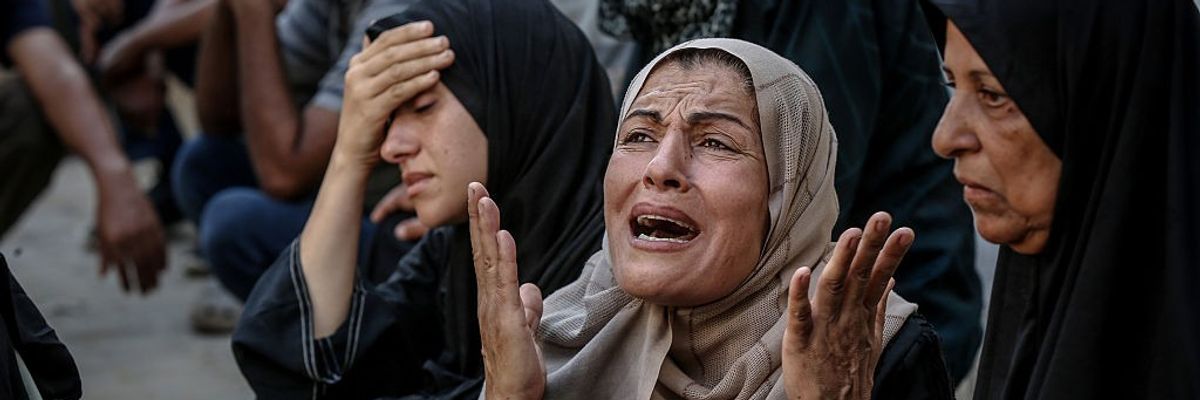
Relatives of the Palestinians, including children, who died as a result of Israeli attacks on different parts of Gaza City, mourn as the dead bodies were taken from the al-Shifa Hospital for burial in Gaza City, Gaza on August 25, 2025.
(Photo by Saeed M. M. T. Jaras/Anadolu via Getty Images)

C.J. Polychroniou
Aug 25, 2025
Common Dreams


Israel is committing genocide beyond a shadow of doubt, and all states party to the Genocide Convention “have an obligation to prevent and punish genocide,” says Dr. Melanie O’Brien, a renowned scholar of International Law, in the interview that follows. O’Brien is Associate Professor of International Law at the University of Western Australia; President of the International Association of Genocide Scholars; and Visiting Scholar at the University of Minnesota Human Rights Law Center.

C. J. Polychroniou: The two major international courts, the International Court of Justice (ICJ) and the International Criminal Court (ICC), though they differ from one another, both exercise jurisdiction over the issue of genocide. The ICJ can consider whether a state has committed genocide under the UN Convention of the Prevention and Punishment of the Crime of Genocide but cannot consider other crimes, such as war crimes and crimes against humanity. The ICC, on the other hand, prosecutes genocide committed by individuals but it also has jurisdiction over other crimes, like the ones mentioned above. Now, in January of last year, the ICJ ruled that the claim that Israel is committing genocide in Gaza was “plausible,” although an actual verdict is not expected until probably the end of 2027. Much later in that same year, in late November to be exact, the ICC issued arrest warrants against Israeli Prime Minister Benjamin Netanyahu and former defense minister Yoav Gallant, together with a former Hamas commander, citing allegations of war crimes and crimes against humanity on the basis of “reasonable grounds.” In addition, a report that was released in March 2024 by the UN special rapporteur on the situation of human rights in the Palestinian territories also accused Israel of violating at least three of the five acts listed under the Genocide Convention. Since then, we have seen an increasing number of international law experts, genocide scholars such as Israeli-born and former IDF soldier Omer Bartov, and international human rights organizations making the case that Israel is indeed committing genocide in Gaza. Can you spell out the legal definition of genocide as found in the Genocide Convention and then tell us how the the “plausibility” standard applied by the ICJ compares to the “reasonable grounds” standard used by the ICC to issue arrest warrants?


Together, we can defend the truth when it’s under siege.


Our fearless reporting exists only because of readers like you. With your support, we can continue delivering independent journalism that democracy depends on.


Melanie O’Brien: The 1948 Genocide Convention defines genocide as a list of five crimes committed with the intent to destroy, in whole or in part, a national, ethnic, racial or religious group. The crimes are: killing, causing serious bodily or mental harm, deliberately inflicting conditions of life calculated to bring about physical destruction, imposing measures intended to prevent births, and forcibly transferring children to another group. This is the same definition that is found in the Rome Statute of the International Criminal Court.

The International Court of Justice (ICJ) adjudicates disputes between states and therefore is a court for determining state responsibility for wrongful acts. The International Criminal Court (ICC) prosecutes and judges individuals accused of committing international crimes (war crimes, crimes against humanity, genocide, aggression). Thus, by their nature, these two courts have different standards applicable in their processes. The ICC follows common standards of proof found in domestic criminal law systems around the world. The “reasonable grounds” to believe an individual has committed a crime, which is required for the issuance of an arrest warrant, is a lower standard than the standard required to convict that same individual, which is “beyond a reasonable doubt.” The concept of “reasonable grounds” to believe means that, to obtain an arrest warrant, there must be sufficient facts and circumstances that would make a reasonable person believe the suspect has committed a crime.

The standard of “plausibility” applied by the ICJ is a standard used in the initial stages of a case. Before a case goes to the merits stage (where the Court would determine if a state has breached its international law obligations), there are procedural actions that can be taken by the parties to the case. One is the request for provisional measures, usually made by the state that has brought the case to the Court. The idea behind provisional measures is to freeze the situation as it is (i.e., so it does not worsen). The legal terminology used by the Court at this stage is that it decides whether it should issue an order to protect rights. This does not mean “human rights," but general “rights” under law that may be claimed by the state that is asking for these measures. At the merits stage, the Court will have to make a definitive determination, but at the provisional measures stage, the standard is lower. The Court must only determine that it is “plausible” that there are rights and that those rights need preserving before the merits stage is reached. If so, the Court will issue provisional measures orders that certain conduct be or not be carried out. Such an order has no impact on whether the case progresses to the merits stage or on the decision at the merits stage. In the case of South Africa vs. Israel, the Court agreed that there was a need to issue orders to protect the plausible rights of Palestinians to be protected from acts of genocide. At the time it issued these orders in early 2024, the ICJ did not state that Israel was committing genocide, but that there was a serious risk of the situation deteriorating. Part of the orders was for Israel to provide unhindered humanitarian aid to Palestinians, including through land crossing points.

C. J. Polychroniou: Is genocide an event or a process? And with that in mind, is Israel, in your own view, carrying out a genocidal campaign in Gaza?

Melanie O’Brien: Genocide is a process, not an event. It does not take place in one day or over a few days. It may be weeks, months, or even years. The process evolves through phases of discrimination and violations of other human rights, eventually escalating to the violation of the right to life, as the target group is killed or subject to conditions of deprivation.

When we are considering the situation in Gaza, we must look at what happened before October 7, 2023. Human rights organizations and the UN have long noted the situation of apartheid against Palestinians, and significant human rights abuses, with discrimination against Palestinians rife. This conduct should be taken into account and considered in the early stages of genocide, with the violence escalating from October 8, 2023, to encompass four of the crimes of genocide (killing, causing serious bodily or mental harm, deliberately inflicting conditions of life calculated to bring about physical destruction, imposing measures intended to prevent births). Israel has killed Palestinians through bombing, explosions and shooting. They are also causing the deaths of Palestinians through starvation and disease, a result of the conditions imposed on Gaza by Israel, denying food, water, medicine and healthcare. Putting people into concentrated locations is a guarantee that communicable diseases will spread, and with no healthcare to treat such diseases, with people’s immune systems compromised from malnutrition, deaths are inevitable. There has been reproductive violence as part of this campaign, with significant impact on women and babies/children, with an increase in miscarriages and the bombing of healthcare facilities, including maternity hospitals and fertility clinics. The entire situation causes physical and mental harm to Palestinians, as over 150,000 injuries have been sustained, and people are living in a situation of fear, starvation and death. There are also reports of torture (including sexual violence) of Palestinians detained by Israeli authorities. All of this conduct amounts to genocidal acts, and as a pattern of conduct, it also demonstrates an intent to commit genocide.

C. J. Polychroniou: Israel has claimed self-defense for its military and outrageously disproportionate response in Gaza, which has resulted (so far) in the killing of over 61,000 Palestinians and more than 151,000 wounded, forced replacement, and Gaza’s entire infrastructure virtually destroyed. Are there any legal defenses for war crimes and genocide under international law?

Melanie O’Brien: There is no excuse or reason for committing war crimes, crimes against humanity or genocide under international law. While there may be arguments from individuals in a criminal court in relation to their own criminal culpability, in terms of the state responsibility, there is no defense against committing international crimes. Self-defence must be proportionate and involve military necessity, and it must comply with the laws of war. Israel’s response to the horrific attacks of October 7, 2023, is disproportionate, does not demonstrate military necessity, and does not comply with the laws of war. Israel’s actions amount to war crimes, crimes against humanity, and genocide.

C. J. Polychroniou: Israel has targeted Gaza’s agricultural sector, destroying most of the local food systems, and weaponized aid to the point that there is mounting evidence of famine. What does international law say about using starvation as a weapon of war? Is it a matter of war crime or genocide?

Melanie O’Brien: It is prohibited to use starvation as a weapon of war. The laws of war require the provision of humanitarian aid in a timely manner and of sufficiency to ensure the survival of people. This is not occurring in Gaza, where people are malnourished and starving to death. They are also deprived of water, shelter and healthcare. This conduct could be prosecuted as a war crime, crime against humanity or genocide.

C. J. Polychroniou: One final question. What are the obligations of third states to prevent and punish genocide?

Melanie O’Brien: States party to the Genocide Convention have an obligation to prevent and punish genocide. The ICJ has said that the obligation to prevent arises with “serious risk” of genocide. That Court has already declared that there was a “serious risk” of genocide in Gaza in January 2024, therefore states were on notice at least from that point on that this risk existed and should have taken immediate action. There is no strict requirement as to what action a particular state must take. This is because there are many different acts a state could take to prevent genocide, and because different states will have varying ability to prevent genocide, depending on where it is being committed. For example, in the case of Gaza, the United States could have significant impact to prevent genocide, given its close relationship with Israel (e.g., by stopping the sale of arms to Israel). Whereas a country that is geographically distant and not a close ally would have less impact and therefore lower requirements to act on prevention. There is also no requirement that a state’s action to prevent are successful; as long as they take action, they are complying with their requirements.

The requirement to punish genocide can be carried out by third states through prosecuting offenders in their domestic courts. This requires states to ensure they have domestic laws that enable the prosecution of international crimes even if these crimes were committed in another country. Third states can also fulfil their obligation to punish genocide through supporting international criminal courts and tribunals. For example, by becoming a state party to the ICC and actively supporting the work of that court to prosecute offenders. The ICJ has held that the obligation to punish includes a duty to cooperate with international courts and tribunals, including through extraditing offenders under an arrest warrant by those courts. There is a general obligation to prosecute or extradite perpetrators of international crimes, including genocide, where a state should either prosecute that offender or extradite them to another country or an international court for prosecution.


Our work is licensed under Creative Commons (CC BY-NC-ND 3.0). Feel free to republish and share widely.


C.J. Polychroniou
C.J. Polychroniou is a political economist/political scientist who has taught and worked in numerous universities and research centers in Europe and the United States. His latest books are The Precipice: Neoliberalism, the Pandemic and the Urgent Need for Social Change (A collection of interviews with Noam Chomsky; Haymarket Books, 2021), and Economics and the Left: Interviews with Progressive Economists (Verso, 2021).
Full Bio >
Does the Democratic Party Have a Death Wish?

The Epstein files won't save the party and 40 years of kissing Wall Street's ass cannot be undone by a PR campaign.


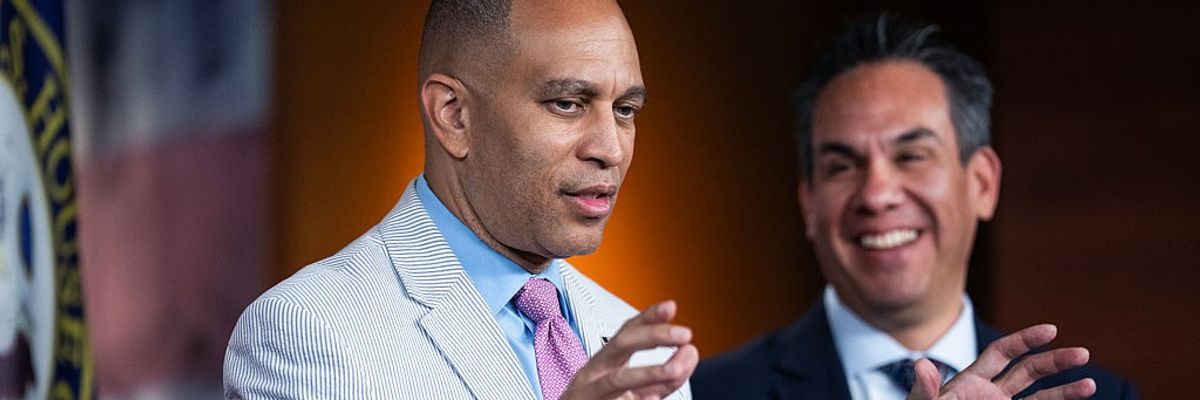
House Minority Leader Hakeem Jeffries, D-N.Y., left, and Democratic Caucus Chairman Pete Aguilar, D-Calif., conduct a news conference in the Capitol Visitor Center on Wednesday, July 23, 2025.
(Tom Williams/CQ-Roll Call, Inc via Getty Images)


Les Leopold
Aug 25, 2025
Common Dreams


The New York Times recently released a report showing what we already know—the Democrats are in decline as more voters now register as Republicans or Independents.

This is especially the case for young voters.

It’s not hard to figure out why. Just ask yourself this simple question: What is the Democratic Party vision for our country? What message of economic justice do they have for working people who have suffered mass layoffs and job insecurity in recent years and are finding themselves left behind?

What is their plan to help hard-working undocumented immigrants secure citizenship? How will they keep the wealth of the nation from gushing to the top one-tenth of the one percent?

Epstein!

That seems to be the current plan. The Democrats believe they can gain ground against Trump by forcing the release of the Jeffrey Epstein files. Supposedly this will split Trump from his conspiratorial base.

But what’s the chance of that helping the Democrats attract more registrants and votes?

Zilch.

And how about those record-breaking congressional speeches? Can anyone recall anything Corey Booker said during his 24 hours and 18 minutes on the Senate floor, or what Hakeem Jeffries said during his 8 hours and 44 minutes on the House floor? I sure can’t, and I suspect neither can those leaving the Democratic Party. Historic marathon elocution is surely an improvement on Biden’s difficulties forming sentences, but does it even attempt to put forth a vision for secure jobs and incomes for working people?

It’s time for a real second party of working people willing to turn trickle-down economics on its head. Working people, not Wall Street, should be the center of all economic policy.

The Democratic Party establishment is so fearful of “moving to the left” (meaning they do not want to attack the interests of their wealthy donors) they are having a tough time supporting Zohran Mamdani, the Democratic mayoral candidate in New York City, who is breathing new life into the party with a progressive and popular appeal to regular people and their economic concerns. How can party elites not support the man who won the Democratic primary and is leading in the general election?

If the party isn’t rallying around a bright new face with a knack for pitching attractive economic policies, please tell me why new voters should register as Democrats?

The Democrats have become conservatives. They want to protect the way things were from the Trump wrecking ball. And in many cases, they are on point. There are good reasons to protect public programs from drastic cuts, protect badly needed public servants from wasteful layoffs, stop cruel and unlawful deportations of immigrants, and save critically important programs like Medicaid.

But the Democrats also want to preserve the financialized Wall Street-driven economy that has moved wealth from working people into the hands of the few. They want to attract, not repel, donations from the wealthy. As a result, they have little to say to the working people who have lost their jobs due to private equity buyouts, mergers, and stock buybacks. After all, stopping that Wall Street gravy train would certainly piss off their donors. In short, they have no vision for a world in which working people, rather than their bosses, are front and center.

It is particularly disheartening to watch the Democrats all but abandon hard-working immigrants who are being deported rather than being moved into citizenship. As I’ve written before here and here, 63 percent of the voters in Michigan, Ohio, Pennsylvania, and Wisconsin support, “granting legal status to all illegal immigrants who have held jobs and paid taxes for at least three years and have not been convicted of felony crimes.” Only 34 percent are opposed.

How did the multitude of millionaire Democratic pollsters and consultants miss this? Oh, they saw it, but it would be too risky to defy Trump on this, they have no doubt warned party leaders.

Many of my friends and colleagues, nevertheless, truly believe that the Democratic Party can come to its senses and once again appeal to the economic needs of working people. If only we show them enough data about how attractive progressive populism is, they will put out powerful messages about halting mass layoffs and curbing corporate power.

But that is unlikely to happen for two key reasons. First, most of the party leadership doesn’t believe in those messages. They don’t think we should interfere with corporate capitalism, and they don’t want to put out messages that will offend the donor class. In fact, they see nothing wrong with economic inequality and have no desire even to refrain from trading their stocks and bonds while in office.

The second reason is that even if they give up on the Epstein messaging and instead promote progressive populism, few voters will believe the Democrats are for real. It’s too late. Forty years of kissing Wall Street's ass cannot be undone by a PR campaign. As our Rust Belt survey will show when it is fully released, the vast majority of voters, including Democrats, don’t trust the Democratic Party to deliver, even when they say the right things.

So, I’m trying to convince my friends and colleagues that it’s time for a new party of working people totally independent of the Democrats. It’s precisely what Rust Belt voters want. These poll findings have already been released:

In our YouGov survey of 3,000 voters in the Rust Belt States of Pennsylvania, Ohio, Michigan, and Wisconsin, 57 percent of the respondents supported a new political formation outside the two major parties. Only 19 percent opposed. This finding is especially notable because these voters were asked to support a very radical statement of anti-corporate populism.

Would you support a new organization, the Independent Workers Political Association, that would support working-class issues independent of both the Democratic and Republican parties. It would run and support independent political candidates committed to a platform that included
Stop big companies that receive tax dollars from laying off workers who pay taxes.
Guarantee everyone who wants to work has a decent-paying job, and if the private sector can’t provide it, the government will
Raise the minimum wage so every family can lead a decent life
Stop drug company price-gouging and put price controls on food cartels

Every demographic group supported this proposal, led by 71 percent of Rust Belt voters less than 30 years of age, and 74 percent of those who feel very insecure about losing their job.

How about a new second party instead of a third party?

I’m told repeatedly that third parties are impossible in America. The best they can do is spoil elections, as Ross Perot likely did for the Republicans in 1996, and Ralph Nader may have done for the Democrats in 2000.

The people who do the vital work of this country need decent wages, universal health care, and protection against incessant job destruction.

But we’re not talking about a third party. We’re talking about a second party. In more than 130 congressional districts the Republican in 2024 won by 25 percent or more. There is no viable second party in these one-party districts. An independent working-class candidate could hardly do worse. These one-party districts are the crucibles where a new political association of working people can cut its teeth.

But wait—don’t we need to elect a Democratic Congress to tame Trump’s rampage? Sure. There’s no contradiction between supporting Democrats and building a new independent party of working people. The two should function in entirely different Congressional districts. Independent worker candidates should not run in purple areas where elections are close. They should run in one-party Republican districts and states, just like the labor candidate Dan Osborn is doing in Nebraska.

But building a new independent worker political association will be a heavy lift, and it will take time. Most importantly it will take commitment and the energy of young people fighting for a new way, rather than those of us who are running our final laps.

It’s time for a real second party of working people willing to turn trickle-down economics on its head. Working people, not Wall Street, should be the center of all economic policy. The people who do the vital work of this country need decent wages, universal health care, and protection against incessant job destruction.

If that seems like too much to ask, it’s only because long ago the Democrats stopped asking.


Our work is licensed under Creative Commons (CC BY-NC-ND 3.0). Feel free to republish and share widely.


Les Leopold is the executive director of the Labor Institute and author of the new book, “Wall Street’s War on Workers: How Mass Layoffs and Greed Are Destroying the Working Class and What to Do About It." (2024). Read more of his work on his substack here.
Full Bio >