It’s possible that I shall make an ass of myself. But in that case one can always get out of it with a little dialectic. I have, of course, so worded my proposition as to be right either way (K.Marx, Letter to F.Engels on the Indian Mutiny)
Tuesday, August 26, 2025
WAR IS ECOCIDE
Ukrainian Drones Damage Russia’s Ust-Luga Oil and Gas Terminal
Russian officials are saying debris caused a fire at the Ust-Luga energy terminal
Ust-Luga, one of the main terminals in Russia’s oil and gas industry, was damaged by a long-range attack from Ukraine. It is the second time since the war began that Ukraine has been successful in attacking the facility, and it comes as both sides have increased their attacks against the energy infrastructure.
The Governor of the Leningrad Region, Alexander Drozdenko, started posting alerts about UAV attacks on Saturday, August 23, which continued into Sunday. The reports initially placed the drones at various points around the region, with Drozdenko reporting that at least 10 drones were destroyed on Saturday, prompting him to issue a warning for citizens to “refrain from being near industrial zones and enterprises, as well as visiting public places.”
On Sunday, August 24, Drozdenko acknowledged that at least 10 drones had attacked the port of Ust-Luga, although he said they were all destroyed. Debris from a drone was, however, reported to have caused a fire at the Novatek terminal. The reports said there were no casualties.
The extent of the damage is unclear, and many of the photos being posted online are from a 2024 fire at the plant. Drozdenko said the fire had been “localized” and that the fuel tanks were not damaged. By Sunday afternoon, the report was that the fire at Ust-Luga had been extinguished and Novatek was starting repairs and restoration work.
It is believed the gas processing equipment was struck, taking the plant offline. Some reports are suggesting it could take months to repair, which would be a major blow to Russia’s oil and gas industry.
Novatek has been operating the facility, which is located about 70 miles west of St. Petersburg, since 2013. Reports are that it handles more than seven million tons of gas condensate as well as more than four million tons of heavy and light oil. It is also a supplier of marine and jet fuel, kerosene, and diesel fuel.
The daring attack was staged more than 600 miles from Ukraine and was part of a larger assault on the energy system. Russia’s defense ministry is saying 95 drones were launched across 14 regions and all were downed with minor damage. It acknowledged 13 drones destroyed over Ust-Luga, as well as some damage to a nuclear power plant.
Russia has been striking Ukraine’s fuel import and distribution network and facilities. Last week, a tanker was reportedly damaged while unloading at the port of Izmail on the Danube.
Red Cat Plans to Start Marketing Ukraine's Drone Boats to the U.S. Navy
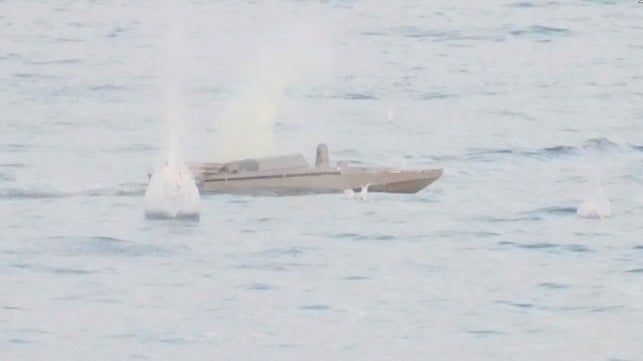
Ukrainian drone boat under fire in the Black Sea (Russian MoD)
An American military drone developer has set up a new division to sell Ukrainian-tested drone boat technology to the U.S. Navy, closing the loop on the cycle of innovation that has defined the Black Sea theater of the conflict.
As soon as the Russian full-scale invasion began in 2022, the Russian Navy's Black Sea Fleet imposed a naval blockade on Ukraine's seaports, repeatedly striking foreign-flag merchant ships off the coast. With American and European assistance, Ukraine countered with strikes of its own. Its forces sank the Black Sea Fleet flagship Moskva with antiship missiles, and followed up with strikes on Russian warships in Crimea using British/French Storm Shadow cruise missiles.
But Ukraine's real innovation was an exploding one-way drone boat, remotely controlled and cheap enough to be expendable. It was based on an American prototype that had been designed to counter a Chinese invasion fleet in the Taiwan Strait, according to the New York Times. Using this American-origin design, American Starlink connectivity, and American targeting support, Ukraine's defense intelligence agency (GUR) began regularly damaging or destroying Russian vessels in and around Crimea using swarm tactics.
After several design iterations, Ukraine's drone boats have also been up-gunned to carry strike UAVs and anti-aircraft missiles to counter Russian air patrols. Using a mix of short range missiles, these drone boats have become the first unmanned vessels in history to shoot down helicopters and fighter aircraft.
Using drones alone, the GUR's Group 13 helped Ukraine attain sea control of the western Black Sea, driving the Black Sea Fleet into the relative safety of the Novorossiysk area - without the benefit of a conventional navy. Its success made the Magura design instantly recognizable in defense circles.
The U.S. Navy has been investing in its own drone prototypes, reportedly with mixed results - but to date it has not publicly included the Magura series in its test and evaluation program. The defense robotics company Red Cat, a supplier of drones to Ukraine and to the U.S. Army, has offered a way to change that. It announced in May that it would begin marketing proven drone boats with "10,000+ hours of operating time in live combat missions" and "dozens of successful kinetic engagements against enemy assets," a description that only matches Ukraine's Magura series. Red Cat has now announced a new division to carry this product line forward in the U.S. market.
The new division - Blue Ops - will offer a seven-meter "Expeditionary Multi-Role Craft" matching the appearance and dimensions of the Magura V7, but built in the United States. It is intended for deep strike, interdiction and anti-ship warfare - like the V7 - and has autonomous capability, increased range and payload capacity. A spokesman confirmed that it is "based on technology already being built in various European countries and is being used in the Ukraine war." Red Cat plans to start production in the third quarter of 2025, in partnership with an existing manufacturer of USVs.
To head up the Blue Ops team, Red Cat has hired Barry Hinckley, a member of the Hinckley boatbuilding family, former tech executive, and former candidate for U.S. Senate. Hinckley has experience as a yacht broker, a startup founder and an offshore racing yachtsman. The division's co-leader will be Alexander "Sandy" Spaulding, the former president of Hinckley Yachts.
"The future of maritime defense depends on a fast, modular weapons system built in the U.S. That’s exactly what we’re delivering," said Barry Hinckley in a statement. "We’re not replacing large naval vessels—we’re building smaller, smarter, uncrewed platforms that extend their reach, provide forward protection, and can operate in places traditional ships can’t."
Ukraine Protests as Russia Opens Mariupol and Berdyansk to Foreign Ships
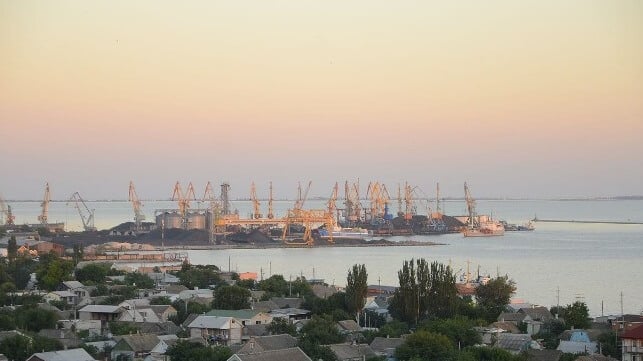
Berdiansk was a thriving seaport before the war (Andrew Butko / CC BY SA 3.0)
Ukrainian officials are protesting the release of a new list of ports open for foreign vessels, on which Russia is including the Sea of Azov ports of Mariupol and Berdyansk. Both ports have been occupied by Russian forces since 2022.
Before the Russian invasion, Mariupol was the tenth largest city in Ukraine and the second largest in the eastern region. It was a vital seaport handling metals, coal, and grain, and when the war began, multiple foreign ships were trapped in the port. The facilities are said to include 22 deep-water berths.
Mariupol was the scene of heavy fighting in the first part of 2022 and a siege that ended up focusing on the seaport, an asset which Russia considers a vital prize in its occupation. The city and seaport finally fell into Russian hands in May 2022, and after many months, the foreign ships were able to escape. Russia was reported to be using it as a supply port, but commercial port operations, however, have remained mostly suspended, other than the accusations by Ukraine that Russia is stealing minerals and grains and shipping them from the port.
Berdiansk was an equally important seaport, and it fell into Russia's hands in the first month of the war. It is located just 50 road miles west of Mariupol and was under Russian control by March 2022. Reports said Russia had reopened the seaport and was using it to transport military supplies.
The listing of seaports released by the Russian Federation on August 22 includes both Berdiansk and Mariupol as open ports able to handle foreign ships.
“We consider such actions as another attempt by Russia to legalize its occupation and consolidate illegal control over Ukrainian territories,” the Ministry of Foreign Affairs of Ukraine said in a statement issued yesterday, August 25. It “strongly condemns” the Russian actions and says it considers the order “null and void.”
Ukraine is calling for Western sanctions on any company or ship that uses either port to support commercial activities. In the past, it has also taken action against ships using the occupied seaports of Crimea. The courts have permitted it to seize and auction ships that carried commercial cargoes from Crimean seaports, and it has jailed and fined crewmembers on those ships.
Ukrainian media is reporting that Russia has been using both seaports to export grains grown in the east in the occupied areas of Ukraine. They contend that almost 212,000 tonnes of grain were shipped from Zaporizhia Oblast in 2023 to places including Turkey, Libya, Syria, and the Houthis in Yemen. Over 300,000 tonnes of grain, they report, have been moved through Berdiansk, while as much as 40,000 to 60,000 tonnes a month of minerals are being exported through the Port of Mariupol.
The move comes as Russia seeks to further consolidate its gains and exert control in advance of any potential peace talks. Reports said President Vladimir Putin told Donald Trump during their meeting in Alaska that Russia would keep the occupied territories, including the Sea of Azov ports and the regions of Zaporizhzhia, as part of a peace deal. Trump has suggested there would be some “swapping” of land in the peace agreement.
August 26, 2025-- After 140 years of vital, often invisible service, public health nurses (PHNs) deserve formal recognition as a distinct occupation, says a new study from Columbia University Mailman School of Public Health. The research argues that classifying PHNs under a unique federal occupational category would finally allow the U.S. to accurately count, compensate, and support this critical segment of the public health workforce. The findings are published in the journal Nursing Outlook.
PHNs blend clinical training with public health expertise—offering services that go far beyond bedside care. From emergency preparedness and policy advocacy to community engagement and disease surveillance, their role is unique and essential.
“Public health nurses are a well-defined, highly specialized profession and are widely recognized as a core component of the public health workforce,” said Heather Krasna, PhD,EdD, associate dean of Career and Professional Development at Columbia Mailman School. “Yet the U.S. Department of Labor does not categorize them separately from other registered nurses. Our study set out to change that.”
Krasna and colleagues analyzed responses to the National Sample Survey of Registered Nurses (NSSRN) and Public Health Workforce Interests and Needs Survey (PH WINS) to compare PHNs with other nurses. They also used Lightcast, a large-scale and comprehensive database of job postings, to gather real-time data on salary, education, skills, and experience for job postings for PHNs as compared with other nurses, and conducted a literature review as well.
From these national datasets and real-time job postings, Krasna and co-authors found PHNs perform a markedly different scope of work than traditional RNs, including:
--Leading community-level assessments and surveillance of health issues and events.
--Managing cases to prevent or resolve problems and coordinating care across systems.
--Promoting health education and communicating facts and ideas.
--Building partnerships and advocating for changes in policies.
--Playing a key role in emergency preparedness, outbreak investigations, and responding to disasters.
Despite their distinct contributions, PHNs currently fall under the same Standard Occupational Classification (SOC) code as all RNs (29-1141). This lack of differentiation limits the ability of federal agencies to track the size, compensation, or shortages in this workforce—making it harder to close gaps during health crises.
“A separate SOC code would allow us to finally answer essential workforce questions and build capacity,” said Krasna.
PHNs make up roughly 18 percent of the local and8 percent of the state health department workforce—serving on the front lines of issues like opioid addiction, climate-related disasters, and chronic disease prevention. Yet without formal recognition, their visibility and value remain diminished in the eyes of policymakers and funders.
The next opportunity to update SOC codes is in 2028. Columbia Mailman School’s study urges federal agencies to act now to ensure PHNs are classified—and counted—correctly.
Co-authors include Isabella Patino and Sarika Karra, Columbia Mailman School; and Jocelyn Leung, University of Minnesota.
The study was supported by the CDC and HRSA under awards U81HP47167 and UR2HP47371.
Columbia University Mailman School of Public Health
Founded in 1922, the Columbia University Mailman School of Public Health pursues an agenda of research, education, and service to address the critical and complex public health issues affecting New Yorkers, the nation and the world. The Columbia Mailman School is the fourth largest recipient of NIH grants among schools of public health. Its nearly 300 multi-disciplinary faculty members work in more than 100 countries around the world, addressing such issues as preventing infectious and chronic diseases, environmental health, maternal and child health, health policy, climate change and health, and public health preparedness. It is a leader in public health education with more than 1,300 graduate students from 55 nations pursuing a variety of master’s and doctoral degree programs. The Columbia Mailman School is also home to numerous world-renowned research centers, including ICAP and the Center for Infection and Immunity. For more information, please visit www.mailman.columbia.edu.
Image of the alvinellid worm, Paralvinella hessleri. A P. hessleri specimen with buccal tentacles extroverted, lateral view. Note that the animal has a bright yellow color
Credit: Wang H, et al., 2025, PLOS Biology, CC-BY 4.0 (https://creativecommons.org/licenses/by/4.0/)
A deep sea worm that inhabits hydrothermal vents survives the high levels of toxic arsenic and sulfide in its environment by combining them in its cells to form a less hazardous mineral. Chaolun Li of the Institute of Oceanology, CAS, China, and colleagues report these findings in a new study published August 26th in the open-access journal PLOS Biology.
The worm, named Paralvinella hessleri, is the only animal to inhabit the hottest part of deep sea hydrothermal vents in the west Pacific, where hot, mineral-rich water spews from the seafloor. These fluids can contain high levels of sulfide, as well as arsenic, which builds up in the tissues of P. hessleri, sometimes making up more than 1% of the worm’s body weight.
Li and his team investigated how P. hessleri can tolerate the high levels of arsenic and sulfide in the vent fluids. They used advanced microscopy, and DNA, protein and chemical analyses to identify a previously unknown detoxification process. The worm accumulates particles of arsenic in its skin cells, which then react with sulfide from the hydrothermal vent fluids to form small clumps of a yellow mineral called orpiment.
The study provides new insights into the novel detoxification strategy that P. hessleri uses for “fighting poison with poison,” which enables it to live in an extremely toxic environment. Previous studies have found that related worms living in other parts of the world, as well as some snail species in the west Pacific, also accumulate high levels of arsenic, and may use this same strategy.
Coauthor Dr. Hao Wang adds, “This was my first deep-sea expedition, and I was stunned by what I saw on the ROV monitor—the bright yellow Paralvinella hessleri worms were unlike anything I had ever seen, standing out vividly against the white biofilm and dark hydrothermal vent landscape. It was hard to believe that any animal could survive, let alone thrive, in such an extreme and toxic environment.”
Dr. Wang says, “What makes this finding even more fascinating is that orpiment—the same toxic, golden mineral produced by this worm—was once prized by medieval and Renaissance painters. It’s a curious convergence of biology and art history, unfolding in the depths of the ocean.”
The authors note, “We were puzzled for a long time by the nature of the yellow intracellular granules, which had a vibrant color and nearly perfect spherical shape. It took us a combination of microscopy, spectroscopy, and Raman analysis to identify them as orpiment minerals—a surprising finding.”
The authors conclude, “We hope that this ‘fighting poison with poison’ model will encourage scientists to rethink how marine invertebrates interact with and possibly harness toxic elements in their environment.”
In your coverage, please use this URL to provide access to the freely available paper in PLOS Biology: http://plos.io/4ks3PKo
Citation: Wang H, Cao L, Zhang H, Zhong Z, Zhou L, Lian C, et al. (2025) A deep-sea hydrothermal vent worm detoxifies arsenic and sulfur by intracellular biomineralization of orpiment (As2S3). PLoS Biol 23(8): e3003291. https://doi.org/10.1371/journal.pbio.3003291
Author countries: China
Funding: This work was supported by grants from Natural Science Foundation of China (No. 42476133 to H.W.), Science and Technology Innovation Project of Laoshan Laboratory (Project Number No. LSKJ202203104 to H.W.), National Key RandD Program of China (Project Number 2018YFC0310702 to H.W.), Natural Science Foundation of China (Grant No. 42030407 to C.Li), and the NSFC Innovative Group Grant (No. 42221005 to M.X.W.). The funders had no role in study design, data collection and analysis, decision to publish, or preparation of the manuscript.
Image of the alvinellid worm,Paralvinella hessleri. Close-up image ofP. hessleriworms close to the hydrothermal venting.
Image of the alvinellid worm,Paralvinella hessleri.AP. hesslericolonized hydrothermal vent in Iheya north hydrothermal field. The vent fauna showed apparent variation along the environmental gradients. The areas close to hydrothermal venting were covered with white mucus matt (P. hesslericolonies). The squad lobstersShinkaia crosnierioccupied the areas surrounding theP. hesslericolonies.Bathymodiolinaemussels stayed further away.
Credit
Wang H, et al., 2025, PLOS Biology, CC-BY 4.0 (https://creativecommons.org/licenses/by/4.0/)
HIV Virus Creative artwork featuring colorized 3D prints of HIV virus particles. The virus surface (red) is covered with proteins (dark blue) that enable the virus to enter and infect human cells, and additional proteins (teal spheres) that disguise the virus from the immune system. A colorized transmission micrograph of an H9 T cell (blue) appears in the background. Note: proteins not to scale.
A new HIV antiretroviral shows promise as a long-acting, oral prophylactic agent, according to a new study by Izzat Raheem, Tracy Diamond and colleagues from Merck & Co., Inc., Rahway, NJ, USA, published August 26thin the open-access journal PLOS Biology.
HIV pre-exposure prophylaxis (PrEP) is a key part of reducing the number of new HIV infections. The most common oral PrEP therapies, consisting of once-daily pills, are highly effective at protecting people from acquiring HIV, but they only work if taken properly. Currently, the only long-acting PrEP therapies require injection by a healthcare provider, which isn’t always feasible for people. Long-acting, oral PrEP therapies could facilitate adherence, provide greater privacy and discretion, reduce concerns about stigma, and improve accessibility for more people to initiate and continue on PrEP, ultimately helping to stem the tide of the nearly 1.3 million new HIV infections globally per year.
Researchers from Merck engaged in a lead optimization campaign to develop a novel nucleoside reverse transcriptase translocation inhibitor (NRTTI). NRTTIs are a new class of anti-HIV drugs that have shown potential for long-acting prophylaxis. They inhibit viral replication by more than one mechanism, including blocking translocation of reverse transcriptase on the growing viral DNA chain.
Using a known NRTTI, islatravir, as a starting point, researchers used several medicinal chemistry strategies to modify the structure and optimize it using both in vitro and in vivo assays. The lead compound, dubbed MK-8527, showed robust antiviral activity in vitro,and pharmacokinetics in animal studies demonstrated that it may be suitable as a long-acting oral therapy. Studies in humans are underway to assess the safety and tolerability of MK-8527 as a once-monthly oral pill in volunteers at low likelihood of HIV exposure, and at least one completed clinical study shows promising results.
In your coverage, please use this URL to provide access to the freely available paper in PLOS Biology: https://plos.io/4l6m2h7
Citation: Raheem IT, Girijavallabhan V, Fillgrove KL, Goh SL, Bahnck-Teets C, Huang Q, et al. (2025) MK-8527 is a novel inhibitor of HIV-1 reverse transcriptase translocation with potential for extended-duration dosing. PLoS Biol 23(8): e3003308. https://doi.org/10.1371/journal.pbio.3003308