Tuesday, August 26, 2025

 US

Master Boat Builders Expands Shipbuilding Operations
Master Boat Builder

Published Aug 25, 2025 7:08 PM by The Maritime Executive


[By Master Boat Builders]

Master Boat Builders, Inc. (Master Boat), an internationally recognized vessel and workboat manufacturer, today announced that it has invested $7.8 million to modernize and expand its shipbuilding operations in Mobile County by adding a new fabrication shop and floating drydock.

The expansion project creates 85 new jobs, adding to Master Boat’s skilled workforce of more than 300 workers and further contributes to Mobile County’s strength in shipbuilding and maritime services.

“This investment is about more than just expanding our ability to build more high-quality vessels. It underscores our commitment to increasing American shipbuilding capacity and we’re doing it right here along America’s Gulf Coast in Mobile County,” said Garrett Rice, President of Master Boat Builders. “By modernizing our facilities and growing our skilled workforce, we’re positioning our team to deliver critical vessels that support U.S. commerce and industry, all while training the next generation of American shipbuilders.”

“Mobile’s maritime industry continues to thrive, and Master Boat’s investment underscores our region’s leadership in shipbuilding,” said Bradley Byrne, Mobile Chamber president and CEO. “By creating new jobs, retaining existing ones and investing in workforce development, this project is a powerful example of how our business community is growing alongside our thriving port and maritime economy.”

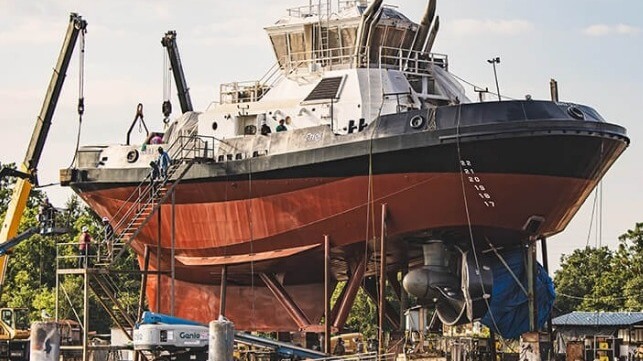
The expansion includes the construction of a new fabrication building, a floating dry dock to support new harbor tug contracts, workforce training initiatives and infrastructure improvements.

“Master Boat Builders is a 45-year-old, third generation, locally owned shipbuilder located in the Bayou. They have employed thousands of people over that span from local communities and currently employ over 300 people. If we can’t incentivize and support the growth of a business like Master, we shouldn’t be incentivizing anyone!” said District 3 Mobile County Commissioner Randall Dueitt. “This expansion not only secures and creates jobs for local families, but it also reinforces the fact that Mobile County is a leader in shipbuilding and maritime innovation and will be for years to come.”

This project also supports the region’s ongoing workforce development and training initiatives, reflecting the growing demand for skilled talent within the maritime and shipbuilding sectors.

“Master Boat’s expansion highlights the continued momentum of Alabama’s maritime industry and reinforces Mobile County’s position as a hub for shipbuilding and repair,” said Ellen McNair, Secretary of the Alabama Department of Commerce. “This investment not only creates quality jobs but also strengthens the region’s capacity to support a vital sector of our state’s economy.”

Work on this expansion began October of 2024 and is expected to be fully operational by October of this year.

The products and services herein described in this press release are not endorsed by The Maritime Executive.


Op-Ed: MARAD Should Follow Navy's Lead to Rebuild U.S. Maritime Strength
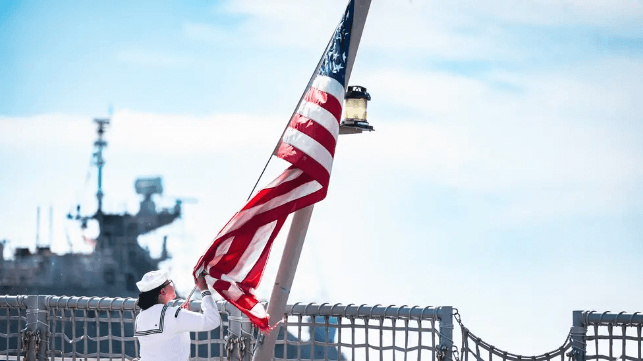
The Navy's new leadership is setting high expectations for solving challenges (USN file image)

Published Aug 26, 2025 4:21 PM by Denise Krepp


Earlier this week, CNO Admiral Daryl Caudle and Navy Secretary John Phelan delineated their goals for the Navy - readiness, accountability, and results. They also identified clear metrics for success. The Maritime Administration and the Department of Transportation should tap the table and immediately do the same.

While serving as the Maritime Administration (MARAD) Chief Counsel during the first Obama administration, I visited the rusty Ready Reserve Force (RRF) fleet. RRF crews repeatedly asked for additional funding, an ask I conveyed to the political appointees in the Department of Transportation (DOT). Sadly, fully funding the RRF wasn't a priority for the DOT and the Office of Management and Budget leaders of the day. The same could be said about increasing the maritime workforce, or strengthening shipbuilding.

MARAD also struggled with accountability and results. This struggle stemmed from long-standing conflicting priorities between MARAD, the US Agency for International Development (USAID), and the Departments of State and Energy. MARAD advocated for US financed goods to be shipped on US owned and crewed vessels. We fought to write the Congressionally-mandated cargo preference rule. The other agencies argued for simple money transfers. MARAD lost, and the result was the undercutting of the US maritime industry.

I applaud President Trump's Executive Order on April 9, 2025 entitled "Restoring America's Maritime Dominance." It is now the policy of the United States to revitalize and rebuild domestic maritime industries and workforce to promote national security and economic prosperity. It's a clear directive matched with much-needed dollars from Congress. It stops the decades long decay.

Admiral Caudle told Navy sailors and civilians that he wants to be judged by specific results at the end of his tenure, to include: 

  • Platforms delivered and repaired on time.
  • Fully manned and combat ready ships.
  • Ordnance production meeting contracted demand.
  • Backlogs in repair parts eliminated.
  • Sailors trained to the highest levels of mastery.

The Maritime Administration's equivalent is

  • A fully functioning Ready Reserve Fleet.
  • A robust merchant marine, sufficient to crew a two-front war AND regular operations.
  • A thriving US shipbuilding and ship recycling industry.
  • Stringent Jones Act compliance.

MARAD goals are intertwined with those set by the Navy. Both need a successful industrial base to build military and commercial ships. Success being ships built and repaired on time, on budget. Both need fully trained sailors. Both need fully manned ships. To put it bluntly, guns and butter have to move at the same time for the logistics tail in war to work.

I am encouraged by President Trump's executive order because it demonstrates top down coverage for a robust US maritime industry, something MARAD didn't have during my term in office. We fought with DOT to write the cargo preference rule and then got undercut by USAID and State. We fought to use Jones Act vessels during the 2011 Strategic Petroleum Reserve release and then got sidelined by the Department of Energy, which wanted the oil to move on foreign-flag vessels.

The Trump administration has given MARAD and DOT a once-in-a-lifetime opportunity. It's my recommendation that they seize it, match it with Secretary Phelan's directive of readiness, accountability, and results, and adopt CNO Caudle's warfighting charge to ensure the dominance of the US maritime industry and workforce.

K. Denise Rucker Krepp is a Coast Guard veteran and former chief counsel of the Maritime Administration. 

The opinions expressed herein are the author's and not necessarily those of The Maritime Executive.

Trump: "We're Going to be Buying Ships From South Korea"

SO MUCH FOR ONSHORING US SHIP BUILDING

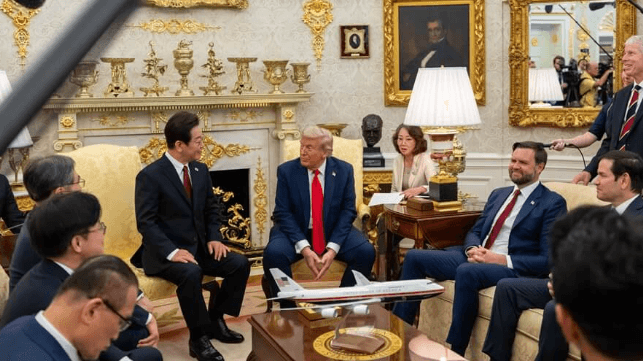
Lee at the White House
Courtesy of the White House

Published Aug 25, 2025 11:50 PM by The Maritime Executive


Shipbuilding was at the top of the agenda in talks between U.S. President Donald Trump and South Korean President Lee Jae Myung on Monday, and the outcomes included a pledge from Trump to buy ships from Korea. 

In hopes of securing lower U.S. tariff rates and keeping the multibillion-dollar Korean auto industry competitive on the U.S. market, Seoul pledged an investment of $150 billion in America's shipbuilding sector. The bid was successful: Korea won a 10-point reduction in its tariff rate, putting its manufacturers on the same footing as competitors in Japan and the EU. To get the Trump administration to seal the deal, Korean trade officials came up with a slogan - "Make American Shipbuilding Great Again," or MASGA.

This gesture won the attention of the administration's trade negotiators, yielding a more favorable 15 percent tariff on Korean cars, computer chips and other exports. Trump's meeting with South Korean President Lee Jae Myung was the first major bilateral press conference after the deal was concluded, and it appeared to yield a result that fulfills the hopes of Korean yards as well: an American intention to buy Korean hulls. 

"We're going to be buying ships from South Korea," Trump said. "We love their ships."

Trump told reporters that in the long term, "we're also going to have them make ships here with our people, using our people, and we're going to go back into the shipbuilding business again." As for timing, Trump emphasized that "it takes a while" and that "shipbuilding is a tough one to start." 

In addition to favoring Korean ships, Trump has also spoken highly of Finnish shipbuilding. Earlier this year, he told reporters that he has negotiated personally with Finnish President Alexander Stubb on the terms for purchasing used and new icebreakers from a non-U.S. shipyard. Two Finland-based yards, Helsinki Shipyard and Rauma, are said to be bidding for a program to build medium icebreakers for the U.S. Coast Guard (in cooperation with local partners in the United States). 

Korean state investment with U.S. guidance

Coinciding with the Trump-Lee meeting on Monday, the U.S. private equity giant Cerberus Capital Management announced a partnership with Korean shipbuilder HD Hyundai to launch a new "maritime investment strategy" focused on American shipbuilding opportunities. The new strategy, Cerberus Maritime, will also look for investment possibilities in the American maritime industry writ large, including maritime logistics, supply chains, infrastructure, ports and technology.

HD Hyundai will provide shipbuilding expertise and serve as an anchor investor in the partnership. In addition, it will bring with it the Korean government's state sponsor for shipping and shipbuilding, Korea Development Bank (KDB). The policy bank is known as a lender of last resort for Korean shipyards; it was the largest shareholder in DSME before it arranged the yard's sale to Hanwha in 2022. In its investment role with HD Hyundai and Cerberus, KDB will "facilitate investments into the Cerberus Maritime strategy" in recognition of the initiative's importance to Korean national objectives. 

Cerberus and HD Hyundai have worked together in shipbuilding before. In 2022, Cerberus bought the former Hanjin-owned shipyard in Subic Bay, the biggest yard in the Philippines. Cerberus has leased out part of the space to HD Hyundai, which is investing $550 million at the site and plans to begin building product tankers there by early next year.  


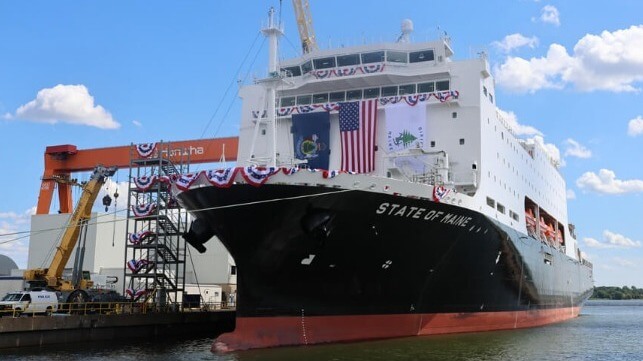
Third Training Ship Christened as Backdrop for US-South Korea Shipbuilding

State of Maine training ship
State of Maine's christening provided the background to highlight Hanwha and South Korea's focus on U.S. shipbuilding (American Maritime Officers)

Published Aug 26, 2025 8:49 PM by The Maritime Executive


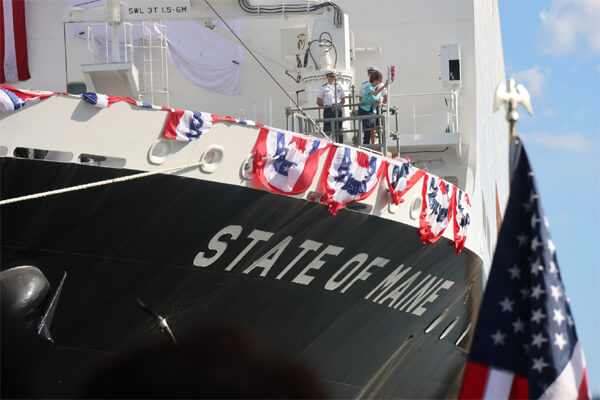
The third U.S. training ship, State of Maine, was christened on Tuesday, August 26, in a ceremony designed to highlight the emerging partnership between the United States and South Korea for shipbuilding. The event was rescheduled a week so that it could coincide with the visit to the United States by South Korean President Lee Jae Myung, and a day after he met with Donald Trump in Washington, D.C.

The South Korean President toured the Philadelphia shipyard that was acquired by Hanwha Ocean for approximately $100 million at the end of 2024. The company’s acquisition pre-dated the Trump initiative to revitalize U.S. shipbuilding and was seen as an entry into the U.S. naval market. The company looks to expand its work for the U.S. Navy and government ships, such as the training ships, and now to leverage the opportunities under the Trump programs. Hanwha aims to produce LNG carriers, naval modules and blocks, and, in the long term, naval vessels at its U.S. shipyard.

Hanwha has committed to a $5 billion program dedicated to the installation of additional docks and quays to increase capacity at the shipyard. It is also reviewing the build-out of a new block assembly facility, and through the expansion, Hanwha aims to increase Philly Shipyard’s annual production volume from less than two vessels to up to 20. 

In addition to the infrastructure investment, the U.S. subsidiary of Hanwha’s shipping arm, Hanwha Shipping, announced that it has ordered 10 medium-range (MR) oil and chemical tankers from Hanwha Philly Shipyard, with the first tanker expected to be delivered by early 2029. It previously announced it will buy a Korean-built LNG carrier and complete its outfitting at the U.S. yard to make it the first modern American-flagged LNG carrier built in 50 years. 


Elaine Chao doing the honors for the naming (American Maritime Officers)


Lee toured Hanwha Philly Shipyard, joined by officials from the Department of Transportation, the Maritime Administration, and others from the U.S. government, while attending the christening ceremony. 

Speaking through a translator, Lee said, "The Republic of Korea's shipbuilding industry is setting out to take on a new challenge to contribute to strengthening U.S. maritime security and rejuvenating America's shipbuilding industry." He highlighted the rapid growth of the country’s industry from “bare ground” to a powerhouse in just 50 years and referred to the “miracle of K-shipbuilding.”

"Through the MASGA (Make American Shipbuilding Great Again) project, we will achieve a 'win-win' outcome that would see the shipbuilding industries of both the United States and South Korea take a leap forward together," Lee highlighted. Yesterday, he promised Trump that South Korea would invest at least $150 billion into U.S. shipbuilding, along with other key industries.

Hanwha Vice Chairman Dong Kwan Kim expressed gratitude to the leaders of both countries and emphasized the importance of joint partnership in bolstering the shipbuilding industry. He said, “Today’s christening ceremony is the physical embodiment of our two nations working side by side to reindustrialize industry, expand our capacity to build ships, and invest in the skilled workforce that will drive the industry forward.”

The third ship of the National Security Multi-Mission Vessel (NSMV) program, State of Maine, is the first purpose-built training ship for the Maine Maritime Academy. At 525 feet in length, it can accommodate 600 cadets for training and, in times of humanitarian need, can handle up to 1,000 people and provide access to an advanced medical facility. The ship, which is due to arrive in Maine later this year, features eight classrooms, an auditorium, and training labs, including a specially-designed training bridge. It has a helicopter pad and is outfitted both to handle containers and roll-on/roll-off cargo to give the cadets hands-on training. 

“This vessel marks a new era for American maritime power,” said Acting Maritime Administrator Sang Yi, who represented Transportation Secretary Sean Duffy, who was detained in Washington and did not attend the ceremony. “MARAD’s mission to modernize sealift and empower the Merchant Marine hinges on relentless innovation and partnership. Together, we can build the fleet America needs to secure our future and dominate the seas.”

Elaine Chao, who has held various senior roles in the U.S. government, including Secretary of Transportation in the first Trump administration, was godmother for the vessel. In prior administrations, she served on the Federal Maritime Commission and as Secretary of Labor.

Philly Shipyard had delivered the first two vessels of the class to New York and Massachusetts. Hanwha Ocean is completing the project to build two additional training ships, which MARAD has assigned to the state maritime academies in Texas and California. The yard has also started work on the first of three LNG-fueled containerships for Matson and is completing a rock installation vessel for Great Lakes Dredge & Dock Corporation.


Samsung Heavy Industries Partners with Vigor as Korea Rolls Out MASGA

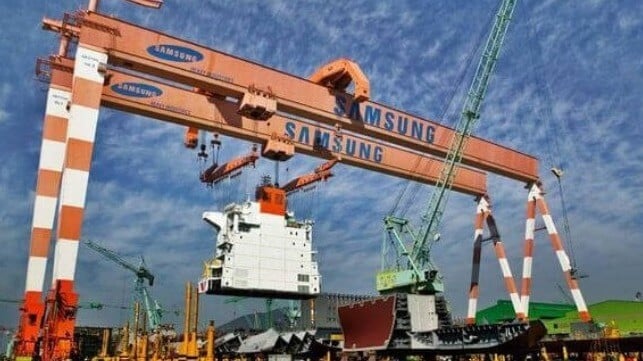
Samsung shipbuilding
Samsung Heavy Industries and Vigor Marine look to increase repair capabilities for the U.S.'s forward-deployed ships

Published Aug 26, 2025 7:01 PM by The Maritime Executive


South Korea’s Samsung Heavy Industries announced a partnership with Oregon-based Vigor Marine Group as part of the companies committing to U.S. investments during the Korean president’s visit to the United States. SHI looks to use the partnership as a way to break into the lucrative repair business for the U.S. Navy and Military Sealift Command (MSC) while also supporting South Korea’s “Make American Shipbuilding Great Again” (MASGA) initiative.

Hanwha Ocean was the first South Korean shipbuilder to win contracts under the U.S.’s maintenance, repair, and overhaul (MRO) program, and recently HD Hyundai Shipbuilding reported it has also won its first MRO contract. It comes as the U.S. looks to expand maintenance capabilities and expedite the projects by keeping the ships forward deployed as opposed to having to wait for limited shipyard space in the United States.

SHI reports it will leverage its expertise and efficiency in shipbuilding while adding a new element to the forward-deployed repair program. By partnering with Vigor Marine, they report the partnership will combine VMG’s deep customer relationships, proven ability to deliver complex projects on time and on budget, and innovative, commercial mindset with SHI’s world-class Korean shipyard facilities, skilled workforce, and advanced technology leadership. Vigor Marine Group will serve as the lead U.S.-based prime contractor.

“We understand the Navy’s evolving needs and have built a track record of delivering results in support of our national defense,” said Francesco Valente, President & CEO of Vigor Marine Group. “Partnering with Samsung allows us to extend that same capability to forward-deployed operations in the Indo-Pacific and potential shipbuilding opportunities here in the U.S. — helping the Navy increase its operational tempo while maintaining the highest quality standards.”
 
Vigor reports it will continue to develop new ways to perform maintenance and modernization work more efficiently and effectively, while SHI will employ its leadership in automation, digital shipyard technology, and advanced engineering. Together, they promise to introduce new levels of innovation to forward repair operations, streamlining processes, reducing downtime, and enhancing overall fleet readiness.

The deal was one of several announced during a trade meeting during President Lee Jae Myung’s visit to the United States and meeting with Donald Trump. Korean companies committed to a total of $150 billion in investment in areas ranging from shipbuilding to aerospace, semiconductors, batteries, and strategic minerals.

Samsung Heavy Industries and Vigor Marine report they will also explore opportunities to support a U.S. shipbuilding renaissance, including a return to Vigor Marine Group’s shipbuilding roots in the Pacific Northwest. Vigor CEO Valente said investment and implementation of SHI’s advanced technology could support new shipbuilding opportunities in the United States.

Vigor Marine, after being acquired by Carlyle in 2019, has consolidated its operations under a unified brand name with six locations, ranging from the Pacific Northwest to California and Alaska, as well as Virginia. The company has worked to expand its role as a preferred, full-service prime contractor in the defense and maritime sectors, offering advanced services and complete solutions for the U.S. Navy, U.S. Army, Military Sealift Command, state ferry systems, the cruise industry, the commercial fishing industry, and more.

HD Hyundai has also developed partnerships in the United States, including with Edison Chouest Offshore. As part of this week’s trade mission, it also announced an agreement with U.S. private equity giant Cerberus Capital Management and the Korea Development Bank for investments into the U.S. shipbuilding sector. Hanwha Ocean is also planning further investments after buying the Philly Shipyard in 2024 and committing to expanding its operations.


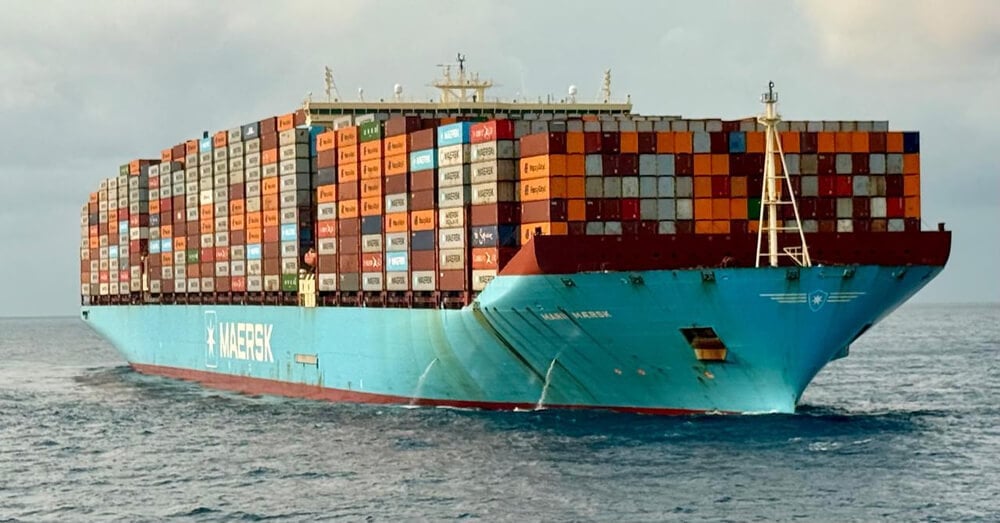
Marie Maersk Resumes Voyage with No Visible Damage From Container Fire

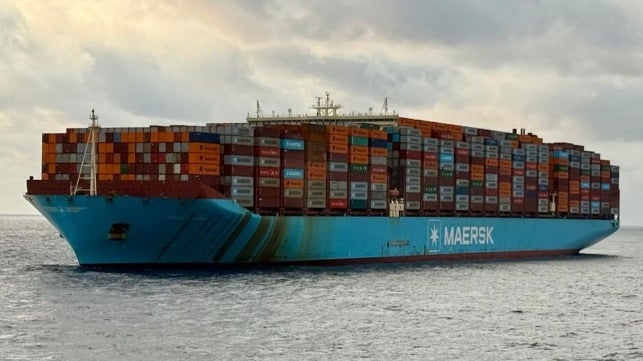
Maersk containership after fire
Marie Maersk as seen from supply ship on Friday, August 22 with no visible fire damage (Maersk)

Published Aug 25, 2025 1:39 PM by The Maritime Executive


The large Maersk containership, Marie Maersk, which has been battling a container fire for nearly two weeks, is reportedly back underway after teams determined it is safe for the vessel to proceed. With the help of external firefighting teams and equipment brought out to the ship while it was off Africa, Maersk has reported that the fire was contained.

The company released two pictures taken on Friday, August 22, when a supply vessel reached the scene with additional firefighting equipment. There is no visible fire damage to any of the boxes aboard what appears to be a heavily laden vessel. The ship has a rated capacity of just over 19,000 TEU. 

“After an inspection of affected areas of the vessel and careful consideration of all aspects together with authorities and class, it was deemed safe that Marie Maersk resumes her eastbound voyage around Cape of Good Hope on Sunday. Her next port of destination is under final review, and we will inform as soon as it has been decided,” Maersk reported. 


Marie Maersk with no visible fire damage to the containers aboard (Maersk)


The containership had spent a week lying off the west coast of Liberia after smoke was first detected coming from containers on August 13. The ship was moved closer to the coast so that fire equipment could be brought out. Late last week, the ship rounded the western coast of Africa and was then met with additional supplies offshore near Ivory Coast (Côte d'Ivoire).

A supply vessel with additional firefighting equipment reached the Marie Maersk on Friday evening and transferred special equipment onboard on Saturday, August 23. The AIS signal for the ship shows it now underway with a declared destination of Cape Town, South Africa. Its routing called for a stop in Malaysia before proceeding to China. The company has repeated said the navigational equipment and machinery was not damaged, and the ship was stable.

Maersk reports that the external firefighting team will remain on board, and “special measures” have been put in place to ensure a safe journey. An intermediate stop might be implemented, Maersk said, depending on the optimal place for handling the damaged containers and to mitigate onward disruptions in its network. Contingencies are in place in case the planned journey needs to be revised en route.

The company has not advised on the location of the boxes that were smoking or the nature of the cargo. In general, mis-declared and improperly packaged cargo is one of the most frequent dangers cited for the containership. Maersk has said the full extent of the damage would not be known until the vessel reaches a port and unloads containers from the area where the fire was located.


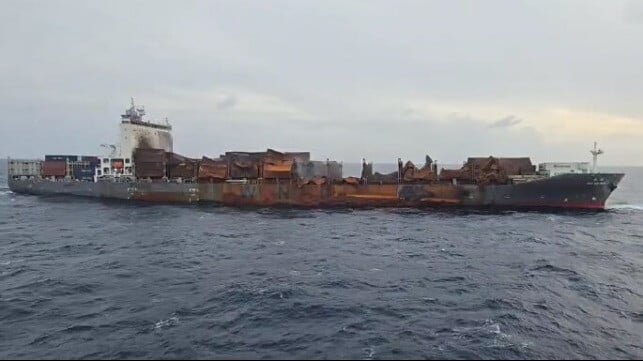
Fire-Damaged Wan Hai 503 is Being Towed to the Middle East

fire-damaged containership
Picture from mid-July showing the condition of the hulk after the fire (Indian DGS)

Published Aug 26, 2025 12:30 PM by The Maritime Executive


The fire-damaged containership Wan Hai 503 is going to be towed to the Middle East as the shipping company continues to search for a port of refuge. The vessel has been at sea for 11 weeks (a total of 78 days) since the fire began while it was off the coast of India. 

Wan Hai released the update saying the tow is underway toward the Middle East, but the final port of refuge is still under consideration. The move toward the Middle East came after Sri Lanka rejected an application for the vessel to be berthed, while India had, shortly after the fire began, ordered its ports not to accept the vessel. The crew reported that the ship experienced an explosion and subsequent fire while sailing from Colombo, Sri Lanka to Nhava Sheva, India on June 9. At the time it was approximately 50 nautical miles off the coast of India.

“At present, the vessel’s stability, structural integrity, and draft—together with the route assessed using weather-routing software—meet the requirements for safe towing,” reports Wan Hai. The shipping company working with the appointed salvage company said the process will be closely monitored to ensure a safe and smooth arrival at the designated port of refuge.

Last week, Hapag-Lloyd, which had cargo aboard the ship, gave an update putting its position approximately 177 nautical miles from Colombo, Sri Lanka, and close to the Indian EEZ boundary. India, in late June, had ordered the salvage tugs to pull the ship out of its EEZ, where the ship had remained for more than eight weeks while salvage efforts proceeded. 

For the past few weeks, the salvage reports have indicated that there were no visible flames or signs of fire, although one hold continued to show minor signs of smoldering. Temperatures have also been lowered aboard the ship. Salvors were able to board the ship and undertook the efforts to dewater the holds and engine room.

While the danger seems minimal at this point, they have struggled to find a port of refuge. Reports said they were looking to the east, working with Singapore Maritime & Ports Authority as the flag state for the ship.

The ship instead is going to be towed approximately 1,800 nautical miles crossing the Arabian Sea. Last year, the Maersk Frankfurt, which also suffered a significant container fire off the coast of India, also ended up making the trip to Khor Fakkan in the UAE before a port of refuge could be settled. However, in that case, the ship had not been abandoned and was traveling under its own power.

The UAE has large, deep-water ports that can serve as a refuge. It also has the container handling capabilities to clear the debris from the vessel.

The last pictures, which came from the Indian Directorate General of Shipping in mid-July, showed that after the fire was extinguished, nearly everything on the forward two-thirds of the ship in front of the deck house and bridge had been damaged. A few containers on the stern appear to have been blocked from the fire by the deckhouse. The vessel also appeared to be on an even keel and higher in the water after the dewatering efforts.


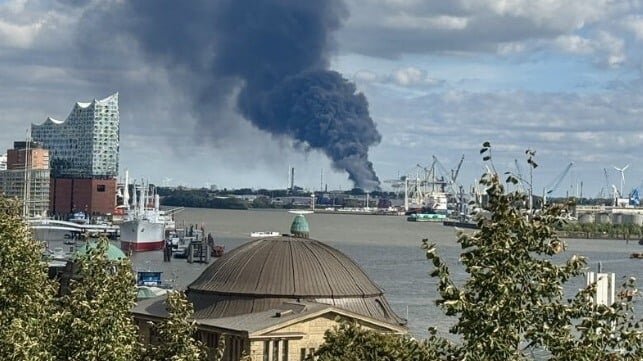
Warehouse Fire Disrupts Hamburg Port and Leaves 10 Injured

Hamburg warehouse fire
Smoke rising for the warehouse fire in the south-east section of the city (Jonas Schmidt-Chanasit on X)

Published Aug 26, 2025 3:32 PM by The Maritime Executive


A warehouse fire in Hamburg, Germany, that started midday on Monday, August 25, turned into a dangerous inferno as hundreds of gas canisters began exploding. Inland shipping and port operations were interrupted as residents were warned of toxic gases, and at last report, 10 people were injured.

The German media outlet DPA is reporting that the fire began with a car parked in a warehouse, which was storing hundreds of nitrous oxide cylinders in the south-east district of Hamburg. Firefighters attempting to reach the fire were forced back as the canisters exploded, sending debris flying. One fire truck was reportedly punctured by debris as well as a car on the nearby roadway.


Special heavy equipment was brought in from the airport along with fireboats and mobile water cannons. The nearby Aurbus cooper factory was closed due to the smoke from the fire, but the company provided heavy equipment to aid in the firefight. Multiple roadways were closed in the city, as well as several of the shipping canals in the port.

Boats were also used to evacuate at least 25 people, including several who were trapped in a parking area in the warehouse region. Those people were reported evacuated without injury. Six people in the area, however, were reportedly injured, including one who was in critical condition and another who sustained serious injuries.

Three firefighters were also injured during the explosions. One motorist was injured by the flying debris.


At its peak, over 320 firefighters were reported on the scene. The fire spread from the first warehouse to others in the area and neighboring buildings, as well as containers stored in the yard and parking areas. Overnight, parts of the building collapsed, and heavy equipment was brought in to clear some of the debris to give the firefighters better access.

The police and fire departments were reporting that 120 firefighters remained on the scene on Tuesday, but the majority of the fire was gone. Smoldering embers and pockets of fire remained and were expected to continue to burn for days.


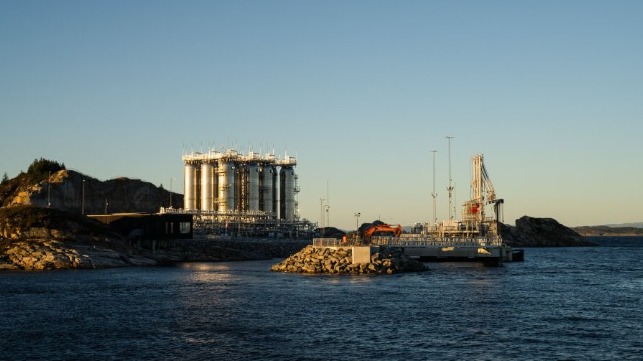
Northern Lights Injects First CO2 in Subsea Storage Well

The receiving jetty for the Northern Lights project (Equinor / Torstein Lund Eik)

Published Aug 25, 2025 4:51 PM by The Maritime Executive


The pioneering Northern Lights project has injected its first shipment of carbon dioxide for long-term storage in a subsea reservoir off the coast of Norway, launching a long-anticipated service backed by Equinor (as operator), TotalEnergies, Shell and the Norwegian government.

“With CO2 safely stored below the seabed, we mark a major milestone. This demonstrates the viability of carbon capture, transport and storage as a scalable industry. With the support from the Norwegian government and in close collaboration with our partners, we have successfully transformed this project from concept to reality,” said the CEO of Equinor, Anders Opedal, in a statement Monday.

Northern Lights is the first commercial-scale project of its kind, and it is the backbone of a constellation of Norwegian carbon-capture initiatives. The offshore reservoir serves as the final destination for carbon from a variety of onshore industries, notably the Heidelberg cement plant in the town of Brevik and the Hafslund waste incineration plant in Oslo. Other future users include Yara, Stockholm Exergi and Orsted, among others, through the provision of long-distance CO2 shipping. An initial small-scale liquefied CO2 shipping service is provided by K Line. 

Now that Northern Lights is up and running, its backers want to expand it rapidly. The current capacity is just 1.5 million tonnes per year, about the same as the annual emissions of 320,000 non-electric cars. With backing from the EU, its owners plan to add more infrastructure to more than triple that number to 5.0 million tonnes per year. This second development phase should be completed and ready for operation in late 2028. The scope includes an additional jetty, nine new storage tanks, and more injection wells. 

Over the long term, Equinor wants to have 30-50 million tonnes a year of CO2 transport and storage capacity by 2035, primarily in Europe and in the U.S. 


Havila Voyages Plans First Climate-Neutral Norwegian Coastal Round Trip

Norwegian coastal cruise
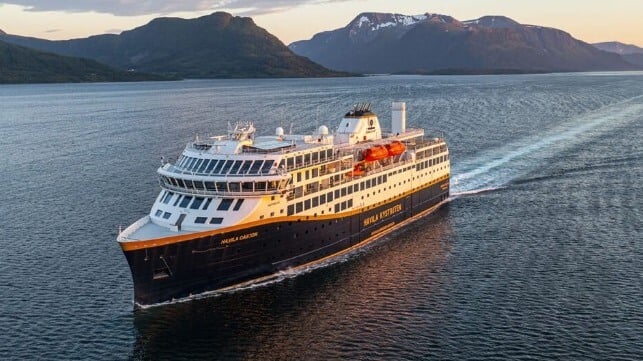
Havila Voyages is working to secure enough biogas to run a 5,000 nm climate-neutral round-trip cruise on the Norwegian coast (Havila)

Published Aug 26, 2025 7:47 PM by The Maritime Executive


Havila Voyages, which already operates four Norwegian coastal cruise ships fueled with LNG and equipped with batteries, reports it is preparing to take the next step: a climate-neutral round trip along the Norwegian coast. The trip will cover more than 5,000 nautical miles, and the company believes it can be part of an example of Norway’s leadership in transitioning the shipping industry.

“Right now, we are in the planning phase to test a full round voyage on the coastal route this fall, using biogas in combination with our large battery packs,” said Bent Martini, CEO of Havila Voyages. “We are in dialogue with suppliers to secure sufficient volumes to be able to fill the tanks 100 percent with biogas, and we believe we will succeed.”

Martini revealed that Havila Voyages is exploring the possibility of the sailing on its coastal route from Bergen to Kirkenes and back to Bergen. He said they hope to accomplish it as early as this fall.

“That would mean that one of our ships, already this fall, could prove that it is possible to sail over 5,000 nautical miles, the entire Coastal Route, climate neutrally.”

Havila built four 15,800 gross ton cruise ships using energy-efficient hull designs created to handle the varied conditions along the Norwegian coast. The ships, which can carry up to 650 passengers, including 179 between ports and 468 in cabins, are LNG fueled and equipped with a battery pack of 6.1 megawatt-hours (MWh). The company in June 2022 demonstrated the capabilities of the 86-ton battery pack, which it says allows them to operate emission-free for up to four hours. The Havila Castor sailed using just the batteries, cruising the historic Geirangerfjord.

“If Norwegian authorities are serious about their environmental ambitions, the ships on the coastal route can be a beacon for the green transition in shipping and create synergies for other parts of the industry,” says Martini. “The problem for the maritime industry, when politicians waver in their decisions as we saw in the world heritage fjords, is that no one dares to invest in the green shift.”

Martini points out that stricter environmental requirements are fully achievable with today’s technology, and he hopes politicians will stand by the standards they set.

“Our message to politicians and decision-makers is clear: climate neutrality should be an absolute minimum in the next contract. And we will deliver on that from day one.”

Havila made history in 2018 when Norway, for the first time, split the contract for the coastal operations. It received a nine-year agreement from 2021 to 2030 alongside long-term provider Hurtigruten. 

Hurtigruten has also made investments in the future, adding batteries and increasing efficiency for several of its vessels. The company has revealed a design study it is pursuing to create the first of a new generation of zero-emission cruise ships.

Starting on January 1, 2026, Norway begins a six-year phase-in of its zero-emission regulations for coastal shipping. It starts with smaller ships under 10,000 gross tons, and has already spurred programs for zero-emission battery and hydrogen ferries. By 2032, all Norwegian shipping will have to operate with zero emissions in the historic fjords and on coastal routes.


Two Canadian First Nations Buy Strategic Mining Port Terminal

Canadian port of Stewart
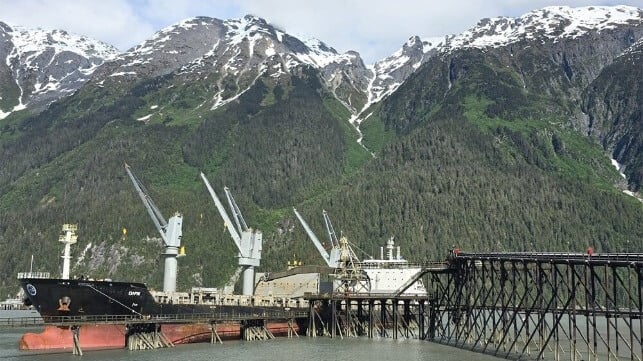
Port of Stewart Bulk Terminal is a strategic port for ore and logging (District of Stewart)

Published Aug 25, 2025 8:00 PM by The Maritime Executive


In a first-of-its-kind transaction for Canada’s British Columbia Province, two First Nations have formed a partnership with a Canadian logistics company and will acquire the Port of Stewart Bulk Terminal located in northwestern British Columbia along the U.S.-Canada border. It comes as there is an increasing push to tap Canada’s minerals and resources for economic advancement.

"This isn't just about us purchasing the first Indigenous majority-owned port in British Columbia's history," Andrew Robinson, chief executive officer of the Nisga'a Lisims Government, told The Canadian Press. “It's about economic sovereignty, reconciliation, and ensuring that wealth generated from our lands directly benefits our people and generations to come.”

The Nisga’a Nation and the Tahltan Nation Development Limited Partnership are partnering with Arrow Transportation Systems to launch the Port of Stewart Bulk Terminal. The new group is also consolidating the regional trucking operations of Arrow Transport’s Stewart Trucking Division and Tahltan-Arrow Transport to provide bulk transportation and logistics solutions in the Tahltan Territory.

They note that Northwest BC is home to more than half the province’s exploration and mining sector. They believe the new partnership will provide improved access to deliver critical minerals from mine to market.


The Port of Stewart is Canada’s most northerly ice-free port located to the north of Prince Rupert and supplying critical access to both British Columbia and Alberta. It is 80 to 90 miles from the Pacific Ocean at the end of the Portland Canal and provides support for the logging, mining, and exploration operations in the region.


“Together, we are making history,” said Kerry Carlick, President, Tahltan Central Government. “The acquisition of this strategic asset will drive economic growth, create opportunities, and strengthen our nations’ self-determination.” 

The terminal primarily handles ore and logging with a breakbulk wharf and RoRo capabilities for barges. It can accommodate vessels up to approximately 50,000 dwt for the transport of ore and logs. 

One of the key customers is Newmont, which operates the Brucejacket and Red Chris mines in the indigenous communities’ territories and transports copper concentrate to market from the port. Newmont is strengthening its ties with the First Nations to support long-term growth of the port as a regional hub and provide the port’s new owners commercial certainty needed to move forward with the investments.

The Province of British Columbia has also provided a C$5 million (US$3.6 million) grant to the two First Nations to support the purchase of the Port of Stewart Bulk Terminal. It is part of the government’s Northwest Strategy to support mining development and the indigenous peoples.


Video: Chilean Navy Rescues Survivor From the Rocks in Tierra Del Fuego

A Chilean Navy rescue swimmer climbs out of the surf and onto the rocks to reach the survivor (Armada de Chile)

Published Aug 24, 2025 10:57 PM by The Maritime Executive


Against all odds, the Chilean Navy has rescued a survivor from a fishing vessel that went missing off Tierra del Fuego on Thursday. The four fishermen aboard the vessel were harvesting sea urchins, and the crew disappeared along with their vessel, the Ana Belen.

Good Samaritan fishermen located the survivor - who was wearing a black wetsuit - in an area known locally as the Bahia Sea, near the western entrance to Beagle Channel. The maze of inlets at the westward fringe of Tierra del Fuego bears the full brunt of the region's stormy weather, and this creates real challenges for shore access. The survivor could not be reached by helicopter because of powerful downdrafts from the cliffs above, and heaving surf made it impossible to get a small boat near to the rocky shoreline.

To complete the retrieval of the survivor, a Chilean Navy helicopter dropped a rescue swimmer into the water near the rocks, and he swam through the waves and climbed up on shore to reach the fisherman. Then, together, they got back into the frigid water and swam out to a pickup point. 

"The extraction lasted approximately 25 minutes, which was vitally important since they had to swim to the rescue boat that was waiting for them in a safe place," said Serio Surriba, commander of the naval aviation unit in Puerto Williams. 

The survivor has been identified as Juan Andrés Rojas Casco, a Paraguayan national. The search for the three other missing fishermen continues, and the Chilean Navy has pledged to make "every effort to find the rest of the crew." 

The missing have been identified as Joel Bogado, Fernando González, and César González, also Paraguayan nationals. Casco, who knows the circumstances of the sinking, has provided information to help authorities in the search for the other men. The authorities believe that there is a strong possibility that the others - like Casco - made it to land and may still be alive, if they can survive the freezing winter temperatures of the Magallanes region.


NTSB: Barge Grounded in Prince William Sound After ATB's Lines Parted

Cordova Provider
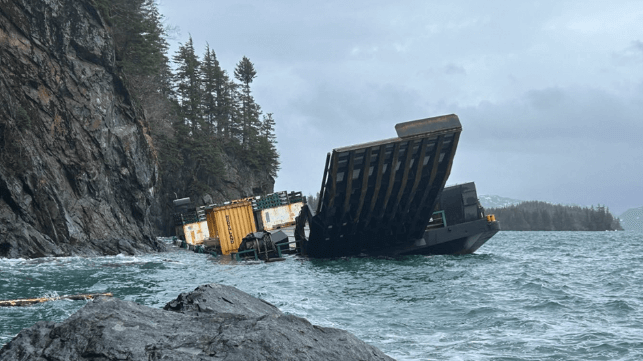
Cordova Provider aground (NTSB)

Published Aug 25, 2025 5:41 PM by The Maritime Executive


The National Transportation Safety Board has released the results of its investigation into the loss of the barge Cordova Provider, which ran aground in Prince William Sound and suffered so much damage that it was declared a total loss. 

Cordova Provider began life as an ice-class oil recovery barge, but in 2005 it was modified with a notch to serve as one half of a unique ATB. The other half, the tug Krystal Sea, was built at the Western Towboat yard at the same time. Instead of coupler pins like those found on an Articouple or Intercon system, the Krystal Sea/Cordova Provider fit together with a wedge-and-recess system that had no moving parts. Three wedges on the tug - one on the bow, one to port and one to starboard - would line up with corresponding recesses within the notch at the stern of the barge. Changes in relative draft could be compensated for by backing out of the notch and re-entering at a different set of recesses. 

Instead of a positive mechanical connection, the Krystal Sea was held in the slot by four breast lines (push lines) running from the barge to winches on the stern of the towboat, much like an inland towboat. When Krystal Sea/Cordova Provider were built, the lines and bridles were steel wire rope; the operator later exchanged the wire rope for Dyneema soft lines, which were lighter and safer for the crew to handle over the side. 

Krystal Sea/Cordova Provider operated in this configuration to move breakbulk cargo around Prince William Sound, within sheltered waters. On the morning of January 10, 2025, the ATB got under way from Valdez, headed across the sound for Cordova. The forecast called for winds of 45 knots, consistent with wintertime weather along the coast of the Gulf of Alaska. Six-foot seas were expected in the sound, rising to 10 feet after midnight. 

The ATB's call in Cordova was completed swiftly, and the ATB departed for Whittier at 2110. By 0200 hours the next morning, as Krystal Sea crossed the middle of the sound, seas rose to 4-6 feet, with wind and waves on the port quarter of the tug - typical conditions, according to the crew. 

At 0250, the mate on watch heard a line snap, followed by three more. All four of the Dyneema lines that held the tug and barge together had parted in the middle, and the Cordova Provider was adrift. The master came to the bridge and maneuvered to see if there was a way to regain control of the barge, but the surface conditions made this too dangerous to attempt. 

Instead, the Coast Guard put the master in contact with the operator of the escort tug Latouche, moored nearby. The Latouche arrived on scene at 0550 hours and attempted to retrieve the barge by getting a line onto a bitt on its stern. The crew succeeded, but the line parted shortly after. Latouche was forced to give up the chase as Cordova Provider drifted into dangerous shallows off Axel Lind Island. The barge then ran aground, sustained extensive hull damage on the rocks, and partially sank. It was later refloated, towed offshore and disposed of through sinking in deeper water.

Investigators' focus turned to the lines that connected the two vessels as an ATB unit. The operator had switched to soft shackles and Dyneema pennant lines in 2023-4, and the captain had inspected the rigging about five days before the casualty, finding nothing amiss. After the casualty, a technician from the firm that assembled the lines determined that they were in fair to good condition, with minor abrasion. Three had parted in the middle of the pennant section, and one parted at the soft shackle. All components were rated for a 100,000-pound breaking strength. 

NTSB concluded that the lines likely parted due to shock loading, with cascading failure after the first line parted. As the tug had served in similar conditions before, the reason for the break on this particular trip is unknown.