It’s possible that I shall make an ass of myself. But in that case one can always get out of it with a little dialectic. I have, of course, so worded my proposition as to be right either way (K.Marx, Letter to F.Engels on the Indian Mutiny)
Wednesday, August 27, 2025
Breathwork can induce altered states of consciousness linked with changes in brain blood flow
High ventilation breathwork while listening to music was associated with reports of blissful states and reduced negative emotions, accompanied by increased blood flow to emotion-processing brain regions
Researchers in the Clinical Neuroscience Department of Brighton and Sussex Medical School conducted breathwork research in a physiology lab and MRI scanner (from Air Hunger documentary).
Credit: Air Hunger, directed by Bob van de Gronde, CC-BY 4.0 (https://creativecommons.org/licenses/by/4.0/)
Breathwork while listening to music may induce a blissful state in practitioners, accompanied by changes in blood flow to emotion-processing brain regions, according to a study published August 27, 2025, in the open-access journal PLOS One by Amy Amla Kartar from the Colasanti Lab in the Department of Clinical Neuroscience at Brighton and Sussex Medical School, U.K., and colleagues. These changes occur even while the body’s stress response may be activated and are associated with reporting reduced negative emotions.
The popularity of breathwork as a therapeutic tool for psychological distress is rapidly expanding. Breathwork practices that increase ventilatory rate or depth, accompanied by music, can lead to altered states of consciousness (ASCs) similar to those evoked by psychedelic substances. High ventilation breathwork (HVB) might offer a non-pharmacological alternative, with fewer legal and ethical restrictions to large-scale adoption in clinical treatment. However, the neurobiological mechanisms and subjective experience underlying ASCs induced by HVB have not been studied extensively.
To fill this knowledge gap, Kartar and colleagues characterized ASCs induced by HVB in experienced practitioners by analyzing self-reported data from 15 individuals who participated online, 8 individuals who participated in the lab, and 19 individuals who underwent magnetic resonance imaging. Their task consisted of a 20- to 30-minute session of cyclic breathing without pausing while listening to music, followed by a series of questionnaires within 30 minutes of finishing the breathwork session.
The results showed that the intensity of ASCs evoked by HVB was proportional to cardiovascular sympathetic activation, as indicated by a decrease in heart rate variability, indicating a potential stress response. In addition, HVB-evoked ASCs were associated with a profound decrease in blood flow to the left operculum and posterior insula – brain regions implicated in representing the internal state of the body, including breathing. Also, despite HVB causing large and global reductions in blood flow to the brain, there was a progressive increase in blood flow during the session to the right amygdala and anterior hippocampus, which are brain regions involved in the processing of emotional memories. These blood flow changes correlated with psychedelic experiences, demonstrating that these alterations may underlie the positive effects of this breathwork.
During all experimental sessions, participants reported a reduction in fear and negative emotions, with no adverse reactions. Across participants and experimental settings, HVB reliably enhanced ASCs dominated by Oceanic Boundlessness (OBN), which is a term coined by Freud in 1920 that describes a set of related feelings including spiritual experience, insightfulness, blissful state, positively experienced depersonalization, and the experience of unity. OBN is considered as a defining aspect of ASCs evoked by psychedelic substances, such as psilocybin.
According to the authors, their study was novel and exploratory and requires replication by future research including larger sample sizes and a control group to separate the effects of music on the brain. Despite these limitations, the findings provide a better understanding of HVB and direct research to investigate its therapeutic applications.
The authors add: “Our research is the first to use neuroimaging to map the neurophysiological changes that occur during breathwork. Our key findings include that breathwork can reliably evoke profound psychedelic states. We believe that these states are linked to changes in the function of specific brain regions involved in self-awareness, and fear and emotional memory processing. We found that more profound changes in blood flow in specific brain areas were linked to deeper sensations of unity, bliss, and emotional release, collectively known as “oceanic boundlessness”.
Amy Kartar, lead author, adds: “Conducting this research was a fantastic experience. It was thrilling to explore such a novel area – while many people anecdotally recognize the health benefits of breathwork, this style of fast-paced breathing has received very little scientific attention. We are very grateful to our participants for making this work possible.”
Dr. Alessandro Colasanti, P.I., adds: “Breathwork is a powerful yet natural tool for neuromodulation, working through the regulation of metabolism across the body and brain. It holds tremendous promise as a transformative therapeutic intervention for conditions that are often both distressing and disabling.”
In your coverage, please use this URL to provide access to the freely available article in PLOS One: http://plos.io/41BY5Hp
Citation: Kartar AA, Horinouchi T, Örzsik B, Anderson B, Hall L, Bailey D, et al. (2025) Neurobiological substrates of altered states of consciousness induced by high ventilation breathwork accompanied by music. PLoS One 20(8): e0329411. https://doi.org/10.1371/journal.pone.0329411
Author countries: U.K., Japan, The Netherlands, U.S.
Funding: The author(s) received no specific funding for this work.
“The ultimate Yoga which gives emancipation, which destroys the sense of separateness which is the root of Desire, is to be made by the concentration of every ...
SPACE/COSMOS
Scientists reveal warped protoplanetary discs, reshaping ideas about how planets form
New ALMA observations reveal that the discs where planets form are often slightly warped, challenging long-held assumptions and offering clues about the subtle misalignments seen in our own Solar System
Visualisation of the warped disc around the young star MWC 758, with warping exaggerated by a factor four to make it visible. Both panels show properties of the disc inferred from CO emission. On the left-hand side, we see deviations in the line-of-sight velocity from the expected rotation if the disc were flat. The variations in velocity can be used to infer the warp structure. On the right-hand side we see variations in the gas temperature, from which we can see evidence of shadowing in areas of the disc.
Credit: Dr A Winter, Queen Mary University of London
The textbook picture of how planets form – serene, flat discs of cosmic dust – has just received a significant cosmic twist. New research, published in the Astrophysical Journal Letters, is set to reshape this long-held view. An international team of scientists, wielding the formidable power of the Atacama Large Millimetre/submillimetre Array (ALMA), has found compelling evidence that many protoplanetary discs, the very birthplaces of planets, are in fact subtly warped.
These slight bends and twists in the disc plane, often just a few degrees, bear a striking resemblance to the subtle tilts observed among the planets in our own Solar System. This discovery suggests the initial conditions for planetary systems might be far less orderly than previously thought, with profound implications for how planets grow and settle into their final orbits.
Dr Andrew Winter, the lead author of the study from Queen Mary University of London where he is Royal Society University Research Fellow in astronomy, said: "Our results suggest that protoplanetary discs are slightly warped. This would be quite a change in how we understand these objects and has many consequences for how planets formParticularly interesting is that the couple of degree warping is similar to the differences in inclination between our own Solar System planets."
Dr Myriam Benisty, director of the Planet and Star Formation Department at the Max Planck Institute for Astronomy said,“exoALMA has revealed large scale structures in the planet forming discs that were completely unexpected. The warp-like structures challenge the idea of orderly planet formation and pose a fascinating challenge for the future.
To uncover these subtle twists, the team meticulously analysed Doppler shifts – tiny changes in the radio waves emitted by carbon monoxide (CO) molecules swirling within the discs. These shifts act like a cosmic speedometer, revealing the gas's exact motion. As part of a major ALMA programme called exoALMA, researchers used this flagship observatory to map the gas's velocity across each disc in unprecedented detail. By carefully modelling these intricate patterns, they were able to detect when different regions of a disc were slightly tilted, thus revealing the warps.
"These modest misalignments may be a common outcome of star and planet formation," Dr Winter added, noting the intriguing parallel with our own Solar System. The research not only provides a fresh perspective on the mechanics of planet formation but also raises new questions about why these discs are warped – a mystery the team is eager to unravel.
Is it the gravitational pull of unseen companion stars, or perhaps the chaotic dance of gas and dust that twists these stellar cradles? The findings show that these subtle disc warps, often tilting by as little as half a degree to two degrees, can naturally explain many of the prominent large-scale patterns observed in the gas's motion across the discs. They even suggest these warps could be responsible for creating intriguing spiral patterns and slight temperature variations within these cosmic nurseries.
If these warps are a key driver of how gas moves within the disc, it profoundly changes our understanding of critical processes like turbulence and how material is exchanged – ultimately dictating how planets form and settle into their final orbits. Intriguingly, the nature of these warps appears to be connected to how much material the young star is actively drawing in towards its centre. This hints at a dynamic link between the disc's innermost regions, where the star is fed, and its outer, planet-forming areas.
This discovery offers a thrilling glimpse into the complex and often surprising realities of planet formation, fundamentally changing our cosmic blueprint and opening new avenues for understanding the diverse worlds beyond our Sun.
This research was conducted by the ‘exoALMA’ collaboration that is an international collaboration of institutions including the Max-Planck Institute for Astronomy (MPIA), University of Florida, Leiden Observatory (Leiden University), European Southern Observatory, Università degli Studi di Milano, Massachusetts Institute of Technology, Center for Astrophysics | Harvard & Smithsonian, Univ. Grenoble Alpes, Universidad de Chile, University of St. Andrews, Université Côte d’Azur, The University of Georgia, Monash University, University of Leeds, National Astronomical Observatory of Japan, University of Cambridge, Ibaraki University, Academia Sinica Institute of Astronomy & Astrophysics, The Graduate University for Advanced Studies (SOKENDAI), Wesleyan University, and The Pennsylvania State University.
ENDS
This press release is based on an article "exoALMA XVIII. Interpreting large scale kinematic structures as moderate warping", embargoed until its publication in Astrophysical Journal Letters.
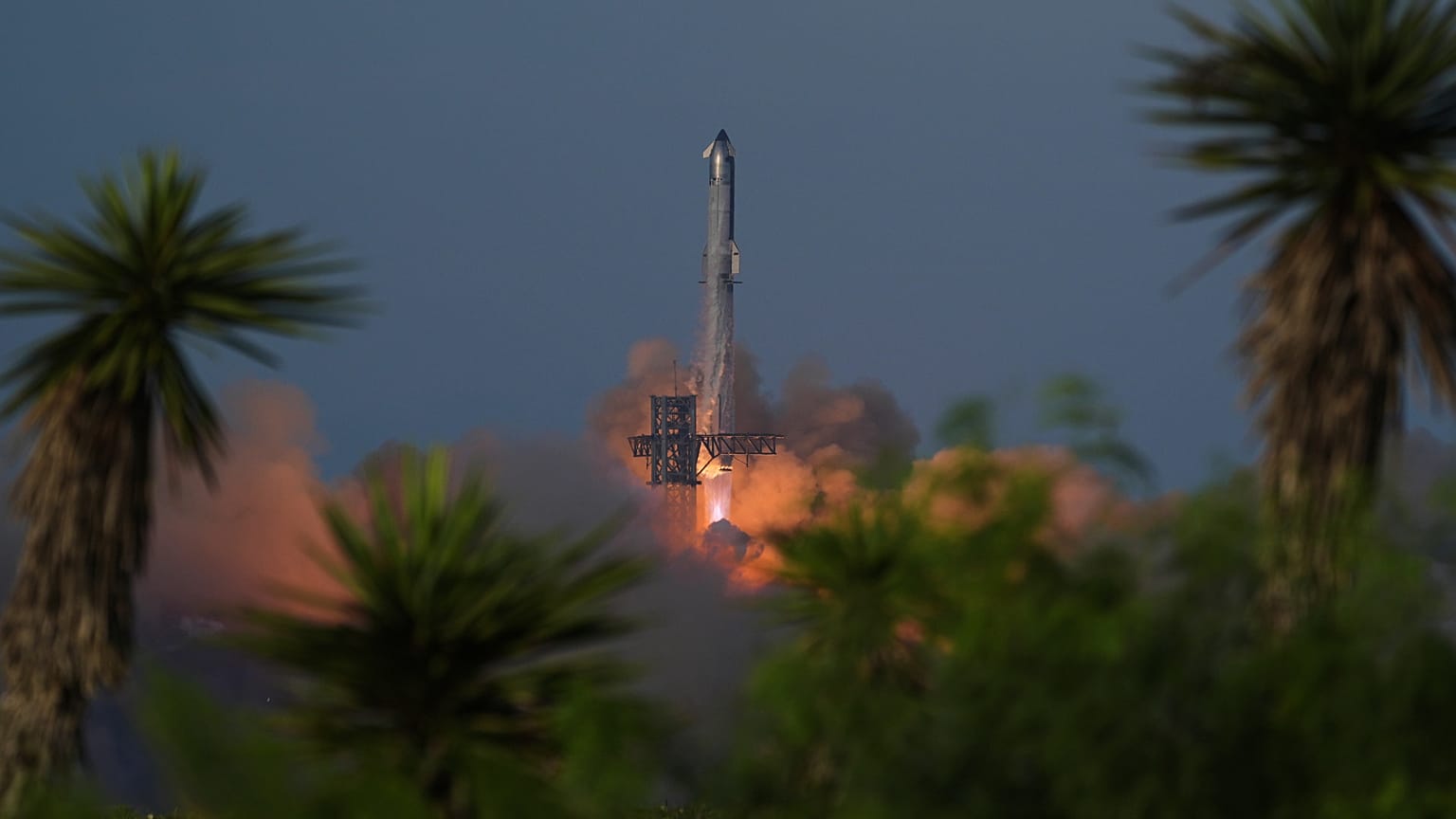
The rocket deployed eight dummy satellites into space, before splashing down as planned into the Indian Ocean.
SpaceX pulled off a successful launch of its mega rocket Starship on Tuesday, deploying its first batch of eight dummy satellites in space.
Starship blasted off from SpaceX's launch site in South Texas, known as Starbase, just after 6:30PM. After cruising in space for just over an hour, the rocket splashed down into the Indian Ocean, as planned.
The spacecraft's Super Heavy Booster separated from the Starship upper stage three minutes after launch and also successfully returned for a pre-planned splashdown in the Gulf of Mexico in the Atlantic.
No crew were on board of the demo launch, but Musk's ultimate goal is for the spacecraft to deliver people and cargo to the moon, and eventually also Mars.
The billionaire has repeatedly said his vision is for a fully reusable space vehicle that can do repeat return trips without crews as soon as 2026. He then aims for a space crew to be aboard in 2029.
Later this decade, NASA hopes two Starships will land astronauts on the moon. Success after several failed attempts
The mission marked the 10th test flight for the world's largest and most powerful rocket, breaking a streak of previously failed attempts.
The full Starship spacecraft exploded on its inaugural test flight in 2023, and again during tests in January and March. In the last and ninth attempt in May, the spacecraft tumped out of control and broke apart.
This time, SpaceX redesigned the Super Heavy Booster with larger and stronger fings for greater stability.
Cosmic butterfly reveals clues to Earth's creation
This image, which combines infrared data from the James Webb Space Telescope with submillimetre observations from the Atacama Large Millimetre/submillimetre Array (ALMA), shows the doughnut-shaped torus and interconnected bubbles of dusty gas that surround the Butterfly Nebula’s central star. The torus is oriented vertically and nearly edge-on from our perspective, and it intersects with bubbles of gas enclosing the star. The bubbles appear bright red in this image, illuminated by the light from helium and neon gas. Outside the bubbles, jets traced by emission from ionised iron shoot off in opposite directions.
Credit: ESA/Webb, NASA & CSA, M. Matsuura, ALMA (ESO/NAOJ/NRAO), N. Hirano, M. Zamani (ESA/Webb)
Clues about how worlds like Earth may have formed have been found buried at the heart of a spectacular 'cosmic butterfly'.
With the help of the James Webb Space Telescope, researchers say they have made a big leap forward in our understanding of how the raw material of rocky planets comes together.
This cosmic dust – tiny particles of minerals and organic material which include ingredients linked to the origins of life – was studied at the core of the Butterfly Nebula, NGC 6302, which is located about 3,400 light-years away in the constellation Scorpius.
From the dense, dusty torus that surrounds the star hidden at the centre of the nebula to its outflowing jets, the Webb observations reveal many new discoveries that paint a never-before-seen portrait of a dynamic and structured planetary nebula.
Most cosmic dust has an amorphous, or randomly oriented-atomic structure, like soot. But some of it forms beautiful, crystalline shapes, more like tiny gemstones.
"For years, scientists have debated how cosmic dust forms in space. But now, with the help of the powerful James Webb Space Telescope, we may finally have a clearer picture," said lead researcher Dr Mikako Matsuura, of Cardiff University.
"We were able to see both cool gemstones formed in calm, long-lasting zones and fiery grime created in violent, fast-moving parts of space, all within a single object.
"This discovery is a big step forward in understanding how the basic materials of planets, come together."
The Butterfly Nebula's central star is one of the hottest known central stars in a planetary nebula in our galaxy, with a temperature of 220,000 Kelvin.
This blazing stellar engine is responsible for the nebula's gorgeous glow, but its full power may be channelled by the dense band of dusty gas that surrounds it: the torus.
The new Webb data show that the torus is composed of crystalline silicates like quartz as well as irregularly shaped dust grains. The dust grains have sizes on the order of a millionth of a metre — large, as far as cosmic dust is considered — indicating that they have been growing for a long time.
Outside the torus, the emission from different atoms and molecules takes on a multilayered structure. The ions that require the largest amount of energy to form are concentrated close to the centre, while those that require less energy are found farther from the central star.
Iron and nickel are particularly interesting, tracing a pair of jets that blast outward from the star in opposite directions.
Intriguingly, the team also spotted light emitted by carbon-based molecules known as polycyclic aromatic hydrocarbons, or PAHs. They form flat, ring-like structures, much like the honeycomb shapes found in beehives.
On Earth, we often find PAHs in smoke from campfires, car exhaust, or burnt toast.
Given the location of the PAHs, the research team suspects that these molecules form when a 'bubble' of wind from the central star bursts into the gas that surrounds it.
This may be the first-ever evidence of PAHs forming in a oxygen-rich planetary nebula, providing an important glimpse into the details of how these molecules form.
Planetary nebulae are among the most beautiful and most elusive creatures in the cosmic zoo. These nebulae form when stars with masses between about 0.8 and 8 times the mass of the Sun shed most of their mass at the end of their lives. The planetary nebula phase is fleeting, lasting only about 20,000 years.
Contrary to the name, planetary nebulae have nothing to do with planets: the naming confusion began several hundred years ago, when astronomers reported that these nebulae appeared round, like planets.
The name stuck, even though many planetary nebulae aren't round at all — and the Butterfly Nebula is a prime example of the fantastic shapes that these nebulae can take.
The Butterfly Nebula is a bipolar nebula, meaning that it has two lobes that spread in opposite directions, forming the 'wings' of the butterfly. A dark band of dusty gas poses as the butterfly's 'body'.
This band is actually a doughnut-shaped torus that's being viewed from the side, hiding the nebula's central star — the ancient core of a Sun-like star that energises the nebula and causes it to glow. The dusty doughnut may be responsible for the nebula's insectoid shape by preventing gas from flowing outward from the star equally in all directions.
The new Webb image zooms in on the centre of the Butterfly Nebula and its dusty torus, providing an unprecedented view of its complex structure. The image uses data from Webb's Mid-InfraRed Instrument (MIRI) working in integral field unit mode.
This mode combines a camera and a spectrograph to take images at many different wavelengths simultaneously, revealing how an object’s appearance changes with wavelength. The research team supplemented the Webb observations with data from the Atacama Large Millimetre/submillimetre Array, a powerful network of radio dishes.
Researchers analysing these Webb data identified nearly 200 spectral lines, each of which holds information about the atoms and molecules in the nebula. These lines reveal nested and interconnected structures traced by different chemical species.
The research team were able to pinpoint the location of the Butterfly Nebula's central star, which heats a previously undetected dust cloud around it, making the latter shine brightly at the mid-infrared wavelengths that MIRI is sensitive to.
The location of the nebula's central star has remained elusive until now, because this enshrouding dust renders it invisible at optical wavelengths. Previous searches for the star lacked the combination of infrared sensitivity and resolution necessary to spot its obscuring warm dust cloud.
ENDS
This annotated image takes the viewer on a deep dive into the heart of the Butterfly Nebula, NGC 6302, as seen by the James Webb Space Telescope.
Credit
ESA/Webb, NASA & CSA, M. Matsuura, ALMA (ESO/NAOJ/NRAO), N. Hirano, M. Zamani (ESA/Webb)
This image set showcases three views of the Butterfly Nebula, featuring an optical and near-infrared view from Hubble (left and middle) and the latest Webb/ALMA image.
Credit
ESA/Webb, NASA & CSA, M. Matsuura, J. Kastner, K. Noll, ALMA (ESO/NAOJ/NRAO), N. Hirano, J. Kastner, M. Zamani (ESA/Webb)
Caption: This image, which combines infrared data from the James Webb Space Telescope with submillimetre observations from the Atacama Large Millimetre/submillimetre Array (ALMA), shows the doughnut-shaped torus and interconnected bubbles of dusty gas that surround the Butterfly Nebula’s central star. The torus is oriented vertically and nearly edge-on from our perspective, and it intersects with bubbles of gas enclosing the star. The bubbles appear bright red in this image, illuminated by the light from helium and neon gas. Outside the bubbles, jets traced by emission from ionised iron shoot off in opposite directions.
Credit: ESA/Webb, NASA & CSA, M. Matsuura, ALMA (ESO/NAOJ/NRAO), N. Hirano, M. Zamani (ESA/Webb)
Caption: This annotated image takes the viewer on a deep dive into the heart of the Butterfly Nebula, NGC 6302, as seen by the James Webb Space Telescope.
Credit: ESA/Webb, NASA & CSA, M. Matsuura, ALMA (ESO/NAOJ/NRAO), N. Hirano, M. Zamani (ESA/Webb)
Caption: This image set showcases three views of the Butterfly Nebula, featuring an optical and near-infrared view from Hubble (left and middle) and the latest Webb/ALMA image.
Credit: ESA/Webb, NASA & CSA, M. Matsuura, J. Kastner, K. Noll, ALMA (ESO/NAOJ/NRAO), N. Hirano, J. Kastner, M. Zamani (ESA/Webb)
Webb is the largest, most powerful telescope ever launched into space. Under an international collaboration agreement, ESA provided the telescope’s launch service, using the Ariane 5 launch vehicle. Working with partners, ESA was responsible for the development and qualification of Ariane 5 adaptations for the Webb mission and for the procurement of the launch service by Arianespace. ESA also provided the workhorse spectrograph NIRSpec and 50% of the mid-infrared instrument MIRI, which was designed and built by a consortium of nationally funded European Institutes (The MIRI European Consortium) in partnership with JPL and the University of Arizona.
Webb is an international partnership between NASA, ESA and the Canadian Space Agency (CSA).
Notes for editors
About the Royal Astronomical Society
The Royal Astronomical Society (RAS), founded in 1820, encourages and promotes the study of astronomy, solar-system science, geophysics and closely related branches of science.
The RAS organises scientific meetings, publishes international research and review journals, recognises outstanding achievements by the award of medals and prizes, maintains an extensive library, supports education through grants and outreach activities and represents UK astronomy nationally and internationally. Its more than 4,000 members (Fellows), a third based overseas, include scientific researchers in universities, observatories and laboratories as well as historians of astronomy and others.
The RAS accepts papers for its journals based on the principle of peer review, in which fellow experts on the editorial boards accept the paper as worth considering. The Society issues press releases based on a similar principle, but the organisations and scientists concerned have overall responsibility for their content.
The JWST/MIRI view of the planetary nebula NGC 6302 I.: a UV irradiated torus and a hot bubble triggering PAH formation'
Article Publication Date
27-Aug-2025
Cardiac arrest in space: New research shows that automatic chest compressions are more effective for CPR when both rescuer and patient are floating in microgravity
New research has found that a type of automatic chest compression is more effective to carry out CPR in space than the ‘handstand method’ that is currently recommended in emergency protocols for spaceflight. Treating cardiac arrest during spaceflight is challenging because both the rescuer and the patient are floating due to microgravity, which makes doing chest compressions challenging.
The research was conducted in a ‘flying laboratory’ in a modified A310 aircraft at the CNES (French space agency). Freefalling phases of parabolic flight were used to accurately recreate microgravity so CPR could be tested by researchers on a floating mannikin.
The researchers say they hope their findings will influence future guidelines (1) about CPR in space. They suggest that space agencies will need to balance risks from cardiac arrest against space and weight constraints when deciding whether to include automatic chest compression devices on future spaceflights.
Madrid, Spain – 27 August 2025: New research has found a more effective way to conduct cardiopulmonary resuscitation (CPR) in microgravity,* which causes the weightlessness astronauts experience in space.
The study found that a type of automatic chest compression, carried out by a standard mechanical piston device, reached the depth needed to be effective, while the current CPR methods recommended for space travel are undereffective regarding this depth criteria.
Treating cardiac arrest during spaceflight is challenging because both the rescuer and the patient are floating due to microgravity. The current NASA emergency protocol for the International Space Station recommends the hand-stand method of CPR, where the rescuer performs a handstand on the patient’s chest with their legs pressing on the side of the spaceship to create the pressure needed for chest compressions.
“We tested different ways of giving chest compressions aboard a ‘flying laboratory’ which recreated the microgravity conditions that astronauts experience in space. Use of a particular type of automatic chest compression device was the only method that gave the depth that is recommended by international resuscitation guidelines to keep blood flowing to the brain in a real life cardiac arrest. We hope that our findings will be incorporated into the next guidelines (1) for treating cardiac arrest in space,” Explained Nathan Reynette from the Cardiology Department at Université de Lorraine – CHRU de Nancy.
The research was conducted in a ‘flying laboratory’ onboard a modified civil aircraft, the only one of its kind in Europe, called the A310 Air Zero G at the Centre National d'Etudes Spatiales, the French space agency. Freefalling phases of parabolic flight were used to accurately recreate microgravity for 22 seconds during each parabola, with around 30 parabolas per single fight. The experiments were conducted over three flights. Chest compression depths and rates were monitored by a high fidelity CPR training manikin.
Earth-based chest compressions during CPR are based on the rescuer’s weight, which does not exist in microgravity. As a result, over the last 30 years, researchers have searched for alternative methods, such as the Handstand method, Reverse Bear Hug method and the Evetts Russomano method. Until now, despite numerous trials, none of the proposed methods were shown to reach the depth standards needed for effective chest compressions.
Three types of automatic chest compression devices were tested. Automatic chest compression devices are routinely used on Earth by doctors in restricted environments such as emergency helicopter, or where prolonged CPR needs to be carried out over a longer period of time, such as refractory cardiac arrest which can last for more than 40 minutes. This type of CPR is not considered to be superior to manual CPR in normal conditions but has been proven to be effective when chest compressions are challenging.
Three types of automatic chest compression devices were tested; a standard mechanical piston device, a compression band device, and a small-sized piston device. Best practice guidance, such as advice given by the European Resuscitation Council (2), suggests that to be effective chest compressions must reach a depth of between 50 to 60mm.
Of the three automatic chest compression devices tested, the standard mechanical piston device had the highest median compression depth. The median compression depth of the standard mechanical piston device was 53.0mm, which was considerably more than the other two automatic chest compression devices, that both had median depths of 29mm, and the manual handstand method of CPR which achieved a depth of 34.5mm.
Reflecting on whether future space missions will take automatic chest compression devices in their emergency medical kit, Mr Reynette said, “It will be up to every space agency whether they want to include automatic chest compression devices in their emergency medical kit. We know they have other considerations beyond effectiveness, such as weight and space constraints.
“While cardiac arrest is a high danger event, that could even terminate a space mission, it is a relatively low risk for now. Most astronauts are young, healthy and physically fit individuals who have intensive medical monitoring, including scanning for chronic heart disease, before going into space. Nevertheless, longer lasting space missions in future and space tourism could increase the risks of a medical emergency occurring.” He continued.
The research project was a collaboration between clinicians from the CHU de Nancy, medical researchers from University of Lorraine and University of Paris, engineers from the Laboratoire Georges Charpak of the Ecole Nationale des Arts et Metiers Paris Tech and from the Centre National d'Etudes Spatiales, the French space agency and Novespace.
“This research highlights once again the usefulness of automated chest compression devices to perform CPR in challenging environments. Space medicine often provides transferable lessons for emergency procedures in isolated environments on Earth, where space and clinical experience are also limited. Further research could explore whether automated chest compression devices could prove useful to carry out CPR in environments such as submarines and artic bases.” Mr Reynette concluded.
ENDS
Notes to editor
This press release accompanies an abstract at ESC Congress 2025.
It does not necessarily reflect the opinion of the European Society of Cardiology.
Funding: The study was supported and funded by the Centre National d’Etudes
Spatiales, French Space Agency
Disclosures : Authors reports no disclosures
References and notes :
*Microgravity is the condition in which people or objects appear to be weightless in space. It is popularly known as zero gravity, however technically in space very small gravitational forces still exist, so the term microgravity is more accurate.
German Society of Aerospace Medicine (DGLRM) and the European Society of Aerospace Medicine Space Medicine Group (ESAM-SMG) guidance on CPR in space: https://pubmed.ncbi.nlm.nih.gov/33138865/
The abstract « Cardiac arrest in space : how to perform cardiopulmonary resuscitation during spaceflight? » will be presented at the session Management of out-of-hospital cardiac arrest which takes place on 31 August from 10:15 to 11:00 am CEST at Station 5 - Research Gateway
It is the world’s largest gathering of cardiovascular professionals, disseminating ground-breaking science both onsite in Madrid and online – from 29 August to 1 September 2025. Explore the scientific programme. More information is available from the ESC Press Office at press@escardio.org.
The ESC brings together healthcare professionals from more than 150 countries, working to advance cardiovascular medicine and help people to live longer, healthier lives.