Wednesday, August 27, 2025


Saildrone Secures Class Certification for its Largest Unmanned Vessel
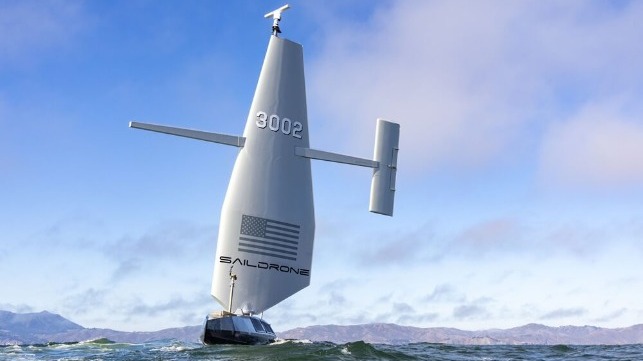
Saildrone
Courtesy ABS

Published Aug 27, 2025 2:04 PM by The Maritime Executive


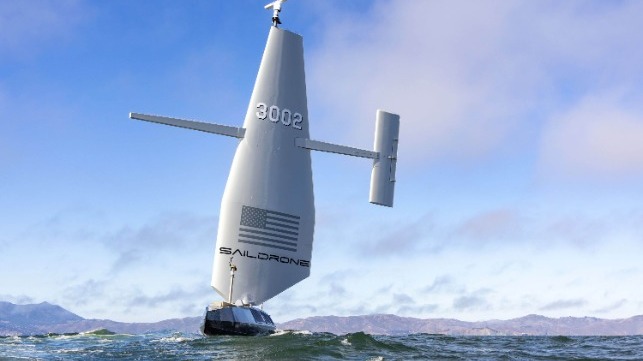
Saildrone, the California-based manufacturer of long-endurance ISR and survey drone boats, now operates the world's largest fully-classed unmanned surface vessel. In partnership with ABS, the company has obtained classification for its 20-meter Saildrone Surveyor after a rigorous review process. Among other benefits, the achievement allows the unmanned boats to operate in the waters of nations that require vessels to maintain a class certificate. 

"The ABS class certification is . . . a signal to governments and the maritime industry that Saildrone USVs are mature, safe, tested, and ready for scale," said Richard Jenkins, Saildrone's founder and CEO. "It’s been a very large investment and a multi-year process to achieve ABS class certification, but we are proud to be the first company in the world to do so."

ABS said in a statement that it has made a concerted effort to support unmanned vessel technology development.  

"ABS and Saildrone are pioneering new frontiers, setting the pace for innovation. This step forward is a result of our investments in ABS’ technical capability and helping to ensure our Rules are able to support innovation with an unwavering focus on safety,"
said Patrick Ryan, ABS Senior Vice President and Chief Technology Officer.

The two partners have been working together on certification for years. In 2023, ABS provided interim classification for Saildrone's 10-meter Voyager design, a popular choice for research and government customers like NOAA and the U.S. Navy. Saildrones have deployed everywhere from the Persian Gulf to the Arctic to the center of an Atlantic hurricane, collecting data for months at a time without human intervention - a key challenge for unmanned surface vessels. The company markets its vessels on a charter basis, and claims that its service model radically reduces carbon emissions compared to conventional vessels. 

Surveyor takes payload capabilities up a notch compared to previous models, and can support more technically demanding missions like subsea survey, acoustic doppler current profiler (ADCP) water column analysis and geotechnical data collection. It has been used commercially to map subsea cables for Meta, but it is built around the needs of the U.S. Navy: the large drone is built to ABS Light Warship standards, and is equipped with the kind of capability that the Navy needs to support persistent MDA and undersea warfare data collection. 


ABS Issues Certificate for World’s Largest Classed Unmanned Surface Vehicle
ABS
ABS Saildrone Surveyor

Published Aug 27, 2025 8:53 PM by The Maritime Executive


[By: ABS]

ABS awarded Classification to the Saildrone Surveyor, a fully autonomous deepwater unmanned surface vehicle (USV).

At 20 meters long and capable of unmanned operations across all of the world’s oceans, the Surveyor breaks new ground. The Surveyor is the largest class of USVs from Saildrone, a provider of maritime security, ocean mapping, and meteorological and oceanographic data using unmanned autonomous assets.

“ABS and Saildrone are pioneering new frontiers, setting the pace for innovation. This step forward is a result of our investments in ABS’ technical capability and helping to ensure our Rules are able to support innovation with an unwavering focus on safety,” said Patrick Ryan, ABS Senior Vice President and Chief Technology Officer.

“The ABS class certification is more than a certificate—it’s a signal to governments and the maritime industry that Saildrone USVs are mature, safe, tested, and ready for scale,” said Richard Jenkins, Saildrone founder and CEO. “It’s been a very large investment and a multi-year process to achieve ABS Class Certification, but we are proud to be the first company in the world to do so and proud that our systems have reached the highest standards as required by the ABS Class certificate.”

The 20-meter Surveyor is capable of long-endurance missions in the open ocean, collecting deep-ocean bathymetry and performing a wide range of maritime domain awareness tasks. This milestone follows the smaller 10-meter Voyagerwhich achieved ABS Class in 2023 and is designed for persistent surveillance in coastal and near-shore environments. Saildrone USVs are capable of fully autonomous operations with no human onboard and are remotely monitored 24 hours a day, seven days a week by the company’s global Mission Management team.

ABS is collaborating with industry, government regulators and stakeholders in the design and implementation of the world’s most advanced remote-control and autonomous technology. Learn more here.

The products and services herein described in this press release are not endorsed by The Maritime Executive.

 

Oceanbird Wing Sail Reaches for the Sky in Demonstration

wing sail wind-assisted propulsion
Prototype installed in Sweden for demonstrations and crew training (Oceanbird)

Published Aug 27, 2025 6:02 PM by The Maritime Executive


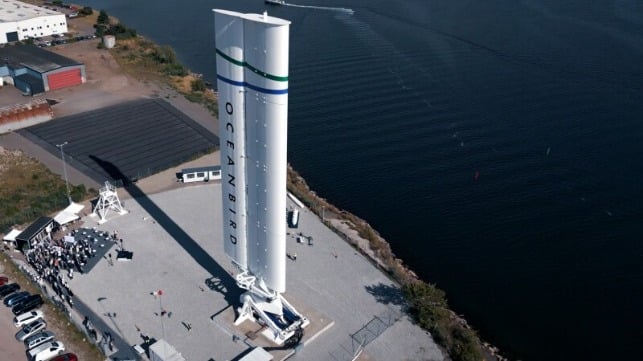
After more than three years of planning and research, Oceanbird unveiled its first prototype wing sail as the latest entry into the wind-assisted propulsion market. At an event in Sweden on August 25, the company said it is entering a new phase as it moves to commercial application, which will see the first sail installed aboard a vessel I 2026.

Oceanbird, the company, was launched in 2021 as a partnership between Sweden’s Wallenius Lines and Alfa Laval with the mission of developing the concept for commercial application. Wallenius first previewed its concept of a sail-powered car carrier in 2020. A Swedish R&D project team, consisting of Wallenius Marine, KTH Royal Institute of Technology, and SSPA/RISE, and supported by Swedish Transport Administration, spent over three years refining the design, while the company also worked on the business concepts.

“We believe that wind propulsion can grow into a significant new industry for Sweden — one that brings together engineering, sustainability, and maritime leadership,” said Magnus MackAldener, interim CEO & Head of R&D at Oceanbird, who moderated the inauguration. With the sail cutting the ribbon as it rose, MackAldener said they were ready to show it to the world and take orders.


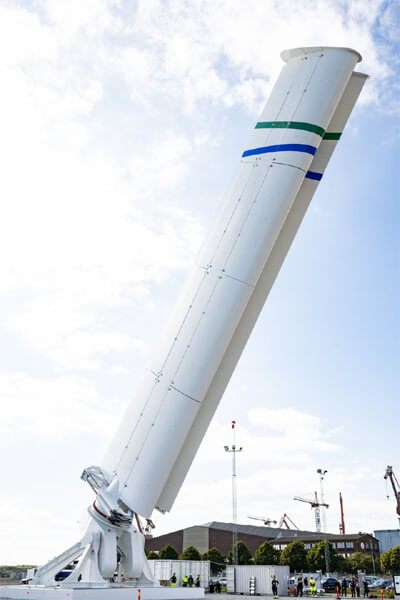
The prototype is installed at the Orsesund DryDocks in Landskrona, Sweden. It stands 40 meters (131 feet) and is 14 meters (46 feet) wide. It rose from the lowered position, unfolded its two segments, and demonstrated a full rotation. Oceanbird has installed a full control room at the yard for demonstrations and crew training.

The sail has a high-strength steel core. The aerodynamic surface is a composite of glass fiber, and it is made from 370,000 recycled plastic bottles. They are calling it Wing 560.

“We need pioneers who are willing to take risks, to innovate, and to lead the way into the green industrial transformation, and this is a great example of leadership. Oceanbird stands as proof of this success,” said Andreas Carlson, Sweden's Minister of Infrastructure and Housing at the inauguration.


During the event, the sail was raised and unfurled and demonstrated its rotation (Oceanbird)


The company highlights that it has undertaken extensive data simulations as well as physical tests. It conducted wind tunnel and model tests in open water and water tanks. It has also undertaken Lidar measurements. They report that a single wing can reduce fuel consumption and emissions by 10 percent, and with the full installation, it will be possible to achieve up to a 90 percent reduction in emissions if all the factors are aligned.

The next step is the assembly of a second, identical wing sail, which will be completed this fall at the yard. It will be installed on the Wallenius Wilhelmsen vessel Tirranna at the beginning of 2026. Built in 2009, the 30,000 dwt vessel with a capacity of 7,620 cars was fitted in July 2024 with the foundation for the wing sail. Preparations have been completed, and they will begin tests aboard the operational vessel.

The tests come as wind-assisted propulsion continues to generate interest in the industry. Several concepts of rigid sails and wind rotors are being installed in an increasing number of commercial vessels. Operations have confirmed the expected fuel savings on vessels ranging from tankers to bulkers and RoRos.


Japan Proposes Changes in Wind Energy Terms as Mitsubishi Withdraws

Japan offshore wind farm
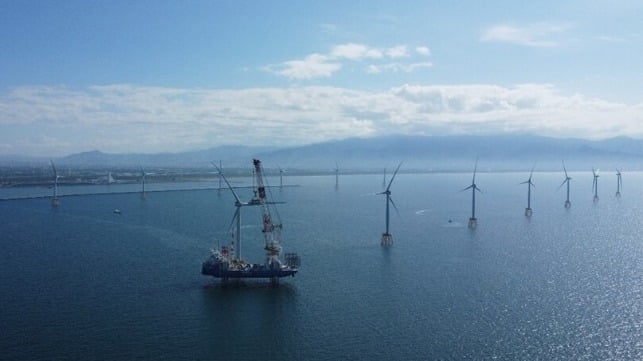
Japan has so far developed coastal offshore wind as it seeks to move to deep ocean floating wind farms (JERA)

Published Aug 27, 2025 7:08 PM by The Maritime Executive


The Japanese government is looking for means to revitalize its lagging efforts to develop offshore wind energy. The move comes as Mitsubishi, which in a consortium had won the first large auction, confirmed it has decided not to proceed with three wind farms.

Japan’s offshore wind energy sector has been slow to start and faces significant challenges due to the offshore topography. There are limited near-shore positions for fixed-bottom wind turbines. To achieve the government’s goals of 45 GW by 2040, the industry will have to develop floating wind technology. To date, Japan has developed only a few small near-shore wind farms with a total installed capacity of approximately 300 MW. 

The consortium with Mitsubishi won in December the first large-scale auctions that consisted of three offshore sites near Akita on the northwest of Honshu in the Sea of Japan and Chiba, which is approximately 25 miles from Tokyo. The two sites on the Sea of Japan called for 819 MW and 478.8 MW, while the site near Tokyo would have been 390 MW, and all were fixed-bottom projects. Work was expected to start this year and next, and collectively they called for nearly 1.7 GW.

Mitsubishi announced a review of the projects in February, citing increasing costs and changed economics, while reporting it would record a $354 million charge. The company, however, initially denied media reports earlier this week that indicated that the projects were being canceled. However, in a statement issued on August 27, Mitsubishi confirmed it has decided not to proceed with the development of the projects.

The company said that the business environment for offshore wind power has changed worldwide due to factors such as tight supply, inflation, exchange rates, and rising interest rates, since the pandemic and the Ukraine crisis. It called the changes unexpected and said that while it continues to recognize the role of renewable energy, it would not be proceeding with the three projects. The group was involved in the manufacture of wind turbine generators since 1982, but sold its joint venture to Vestas in 2020.

“To adapt to these unexpected changes, we have been pursuing various options, including reassessment of costs, project schedule, and revenue. However, after discussions among the partners, we have determined that establishing a viable business plan is not feasible given the current conditions,” the company said in its statement.

Japan’s Minister of Economy, Trade, and Industry, Yoji Muto, called the decision “deeply regrettable.” He said it would undermine trust in the industry.

The Ministry, along with the Ministry of Land, Infrastructure, Transport and Tourism, had just completed an expert panel review of the industry. It submitted a proposal to the government calling for revising the terms of the leases, adding a provision so that companies could apply for an additional 10 years. The leases in the first three rounds of auctions in Japan provided a 30-year total term and required removal and rebidding at the end of the term. Experts point out that companies would have approximately 20 years of operation after the time required for permitting and construction.

The panel said adding 10 years would give companies more time to improve cash flow, increase electricity sales, and provide for earlier capital recovery. They believe this will also attract a broader range of investors. They proposed changing the terms for future auctions, but did not address making the provision for the 10-year extension available for the existing leases.

The ministry said it plans to restage the auctions for the leases that Mitsubishi is not proceeding with.

In Europe, they have also begun to extend wind leases. Denmark in June issued the first extension for an offshore wind lease. It followed with two more agreements later that same month, also highlighting that the extended term would improve the economics of some of its oldest operating wind farms while also maintaining the flow of renewable energy.


Hanwha Shipping Details Largest U.S. Commercial Vessel Order in 20 Years

MR tanker American Pride
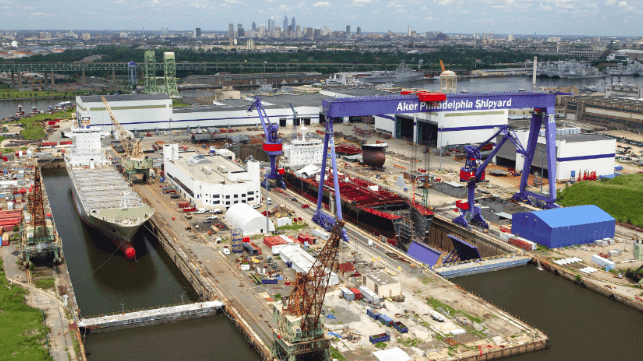
Hanwha looks to take the shipyard back to its heyday when it built 24 MR tankers in the early 2000s (Philly Shipyard)

Published Aug 27, 2025 2:55 PM by The Maritime Executive


Hanwha Shipping, the newly-launched U.S. shipping subsidiary of South Korea’s Hanwha Ocean, provided additional details on its shipbuilding plans, which it is calling the largest U.S. commercial vessel order in more than 20 years. The company looks to build out the U.S. Jones Act tanker fleet and launch the first modern U.S. LNG carriers for the international export market. 

“We are able to order these U.S.-made MR tankers because of Hanwha’s investment in building a world-class shipyard in Philadelphia,” said Ryan Lynch, President & CEO of Houston-based Hanwha Shipping. “Hanwha has made a long-term commitment to bringing cutting-edge technology from Korea to the Hanwha Philly Shipyard that will create thousands of good, advanced manufacturing jobs in the United States and spearhead the revitalization of America’s maritime industrial base.”

The hallmark of the initiative is an order for 10 medium-range (MR) oil and chemical tankers to be built in Philadelphia. The first tanker is expected to be delivered by early 2029, in what Hanwha Shipping terms “the highest-value commercial order seen at U.S. shipyards.”

The MR vessels will be fitted to transport crude oil, refined petroleum, and chemical products, and will significantly expand the U.S. Jones Act fleet of U.S.-built, U.S.-owned, and U.S.-crewed vessels operating between U.S. ports. 


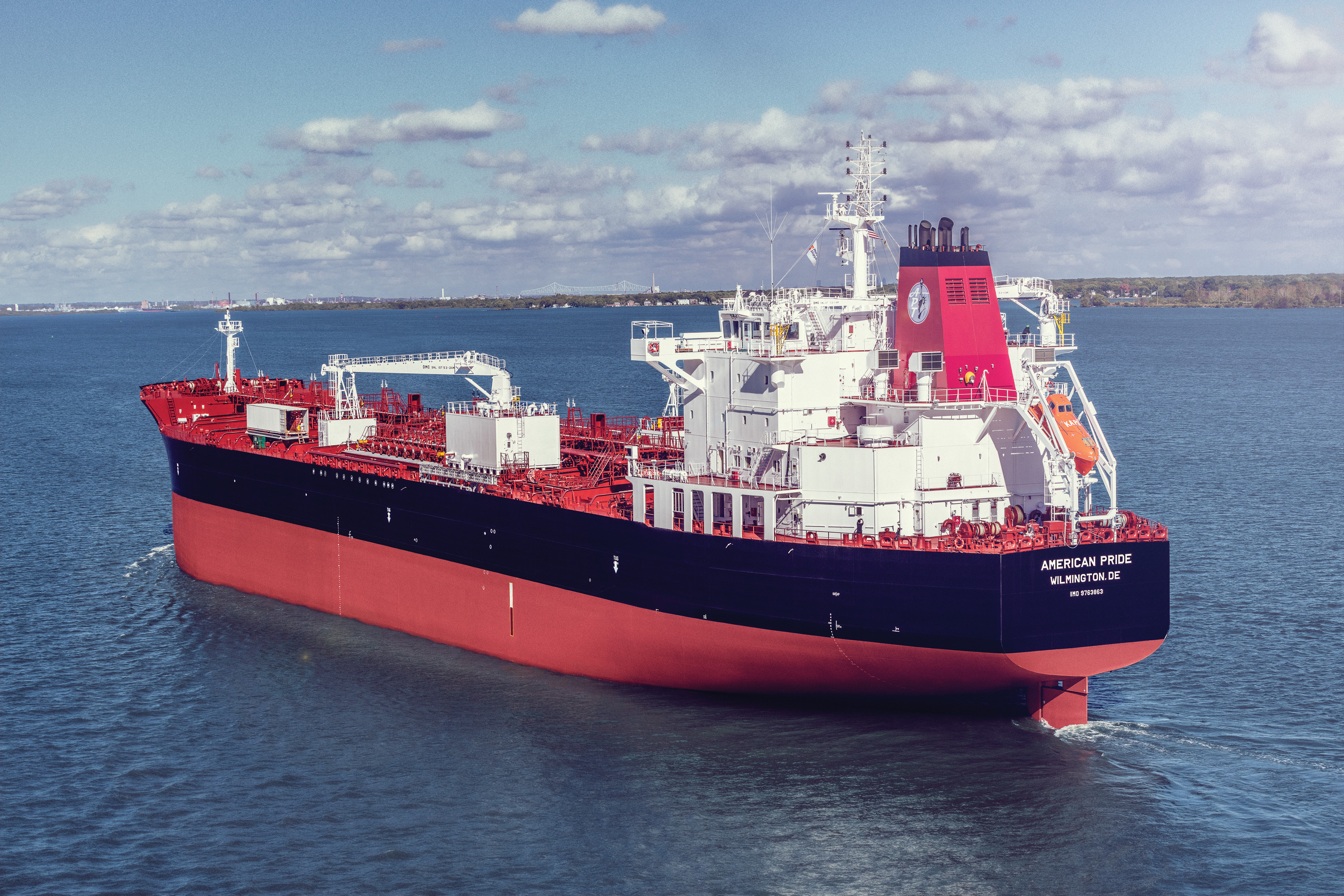
Delivered in 2017, American Pride was the 28th ship built by the yard since it started commercial operations in 2000 (Philly Shipyard)


The ships return the yard now known as Hanwha Philly Shipyard to its roots. Started in 2000 at the site of the former Philadelphia Navy Yard, the company, known as Aker Philadelphia Shipyard, started with contracts to build 46,000 to 50,000 dwt tankers. This included a dozen 600-foot MT46 Veteran-class tankers for Overseas Shipping Group and concluded in 2017 when it delivered American Pride, the fourth 50,000 dwt product tanker built for American Petroleum Tankers (APT), a subsidiary of Kinder Morgan. The yard delivered 24 tankers in addition to its six containership builds for Matson.

As the only company in the world with significant shipbuilding operations in both Korea and the U.S., Hanwha reports it plans to build new MR tankers in the U.S. by transferring its advanced shipbuilding technologies, processes, and supply chains to Hanwha Philly Shipyard. 

At the same time, Hanwha Shipping also exercised an option to order a second liquefied natural gas (LNG) carrier, following its first order announced a month ago. They will be the first U.S.-ordered LNG carriers for the export market in almost 50 years and respond to the Trump plan that calls for requiring a portion of U.S. LNG exports to be transported on U.S. ships. The ships will be built via a joint construction model between Hanwha Ocean and Hanwha Philly Shipyard as part of the U.S.-Korea partnership.

The orders are an element of a $5 billion infrastructure plan announced yesterday for Hanwha Philly Shipyard as part of South Korea’s commitment to supporting the growth of U.S. shipbuilding. After acquiring the shipyard at the end of 2024, the company plans to install two additional docks and three quays to increase annual capacity from less than two vessels to up to 20. Hanwha is also reviewing the build-out of a new block assembly facility as it targets work for LNG carriers, naval modules and blocks, and, in the long-term, naval vessels built at the U.S. shipyard.

The Hanwha group quietly launched Hanwha Shipping, based in Texas, in April 2024. According to the company, it aims to take a leading position in the American shipping ecosystem by deploying next-generation digital technologies and advancing the resilience and robustness of America’s energy security and maritime industrial base.


HD Hyundai to Merge Ulsan Shipyards to Expand Defense and Commercial Work

South Korean shipbuilding yard
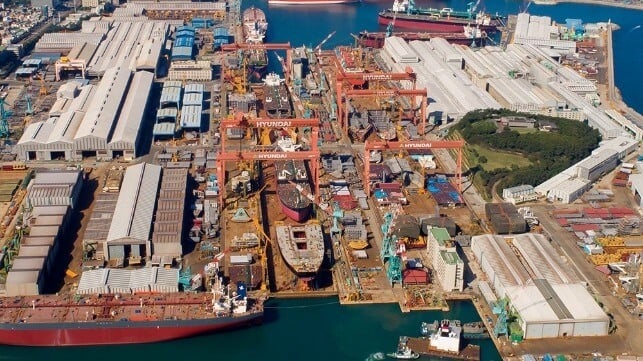
HD Hyundai will consolidate the ownership and management of its shipbuilding operations in Ulsan, South Korea (HD Hyundai file photo)

Published Aug 27, 2025 12:52 PM by The Maritime Executive


HD Hyundai, which is already South Korea’s largest shipbuilder, announced plans to reorganize by merging its shipbuilding operations in Ulsan to realize opportunities both in naval shipbuilding and repair, and the South Korean MASGA (Make America Shipbuilding Great Again) initiative. 

The company said that it looks to take a leadership role in the South Korean program following the meeting earlier this week between the country’s president, Lee Jae Myung, and Donald Trump, in which South Korea committed to investing at least $150 billion into U.S. shipbuilding and other key industries. As part of the agreement, the company announced a new partnership with U.S. private equity giant Cerberus Capital Management and the Korea Development Bank to pursue a maritime investment strategy.

Under the terms of the proposed merger, HD Hyundai Heavy Industries will acquire the mid-sized operation HD Hyundai Mipo with HHI as the surviving company. HD Hyundai’s shipbuilding holding company, HD Korea Shipbuilding & Offshore Engineering, owns 74 percent of HHI and 42 percent of Mipo, and after the merger will have a 69 percent position in the combined company.

HHI says the merger is an effective response to future changes in the shipbuilding industry and points to the opportunities to reduce unnecessary costs and structure by integrating its systems. Media reports are highlighting that China recently consolidated its two large shipbuilding companies and that Japan’s two largest shipbuilders have also reorganized.

In the first seven months of 2025, HD KSOE reported that it booked orders for a total of 82 ships worth $11.22 billion. It has achieved 62 percent of the annual order target of $18.05 billion for 2025. HHI specializes in larger vessels, including LNG carriers and containerships, while Mipo is considered a medium-sized operation building containerships, chemical tankers, and vehicle carriers.

One of the key markets the combined company will be targeting is defense shipbuilding, which HD Hyundai highlighted to investors as a rapidly growing segment as countries expand their investments. HHI reports it has built 106 naval vessels, more than any other domestic shipbuilder. It has experience with destroyers, frigates, submarines, and patrol boats, and looks to expand both internationally and specifically with the United States as part of the MASGA program.

“We will increase our competitiveness in the K shipbuilding and defense sectors by reorganizing the shipbuilding business,” the company told investors. It said the target is to grow defense revenues to $7.2 billion annually by 2035.

It also looks to expand its entry into the repair business. The company recently won its first MRO contract from the U.S. for the overhaul of a U.S. Military Sealift vessel, USNS Alan Shepard, a 41,000-ton displacement Lewis and Clark class dry cargo and ammunition vessel. As part of MASGA, they believe this business segment will grow rapidly.

They also look to expand their expertise in specialty ships, pointing to the opportunity for icebreakers due to the rise in Arctic development. South Korea previously announced that it plans to launch an Arctic shipping initiative and recently ordered a new Arctic research vessel.

The combined company will also accelerate its focus on green shipping. They will consolidate the R&D and design capabilities of the two shipbuilders. Mipo will also provide additional capacity to the combined company, as reports are that it is currently operating at a rate of 45 ships but has a capacity to reach 70 ships annually.

The combined company plans to launch by December a new overseas investment holding company to be based in Singapore. It will manage the operations of the shipyards in Vietnam and the newly launching yard in the Philippines, as well a the recently acquired tank and crane manufacturer in Vietnam that it has agreed to acquire from Doosan. HD Hyundai has also been exploring additional overseas operations, including possibly a shipyard in Morocco and Egypt, and has formed new relationships in the United States.


ECOCIDE

Ship Manager Fined $2M for MARPOL Offense After Crew Provides Evidence

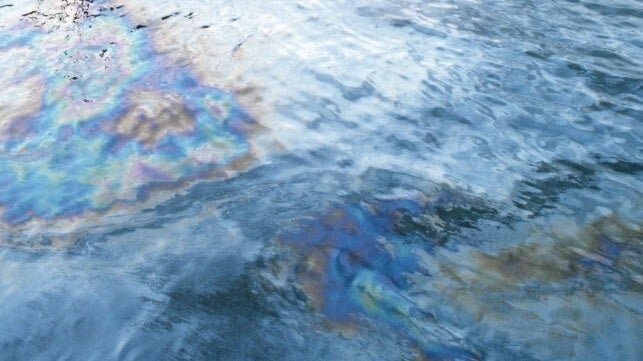
oil slick
Crewmembers first reported problems to the manager and later another crewmember provided evidence to USCG inspectors (file photo)

Published Aug 27, 2025 7:33 PM by The Maritime Executive


U.S. officials are reporting yet another case in which a MARPOL violation was discovered after a crewmember turned over evidence to the U.S. Coast Guard. The Department of Justice reported on August 25 that V.Ships Norway pleaded guilty to the violation and was sentenced to pay a $2 million fine.

“Dumping oil-contaminated waste into the waters around our ports and coasts violates the law and poses an unnecessary health and environmental hazard,” said Acting Assistant Attorney General Adam Gustafson of the Justice Department’s Environment and Natural Resources Division (ENRD). “The crew took pains to hide their illegal activity by knowingly keeping inaccurate records. We will not turn a blind eye to this kind of irresponsible and fraudulent activity.”

DOJ reports that between February 2022 and August 2022, a hose was connected between the incinerator waste oil tank and the sewage holding tank on the product tanker Swift Winchester (46,000 dwt). The vessel was at the time operating under the Marshall Islands flag and owned by Winchester Shipping and managed by V. Ships. The hose was a type of “magic pipe” that allowed oily waste to transfer into the sewage holding tank and then to be discharged directly into the sea, bypassing required pollution prevention equipment.

A low-ranking engine crewmember reported this to a superintendent at V.Ships. The superintendent investigated the matter and discovered what appeared to be oil in the sewage tank. DOJ acknowledges that V.Ships dismissed the Chief Engineer.  

In August 2022, the new Chief Engineer ordered the engine crew to clean the Oil Water Separator (OWS) filter. The engine crew took the filter onto the deck and hosed it down with a degreaser, and the oily waste washed directly overboard through a scupper.

Coast Guard members from the U.S. Coast Guard Marine Safety Unit Port Arthur conducted an examination of the vessel. While they were in the engine room, a crewmember disclosed the discharges and provided photographic and video evidence documenting the illegal discharges.

The M/T Swift Winchester was charged with entering Baton Rouge, Louisiana, on August 25, 2022, and Port Arthur, Texas, on September 7, 2022, with a knowingly falsified Oil Record Book.

V.Ships admitted that oily bilge water and oily waste were discharged from the vessel and that the discharges were omitted from the Oil Record Book.  

The vessel has been sold twice since the incidents. It today operates under a new name and flag.


Italian Coast Guard Detains Boxship for Not Ensuring it Meets Emissions Reg

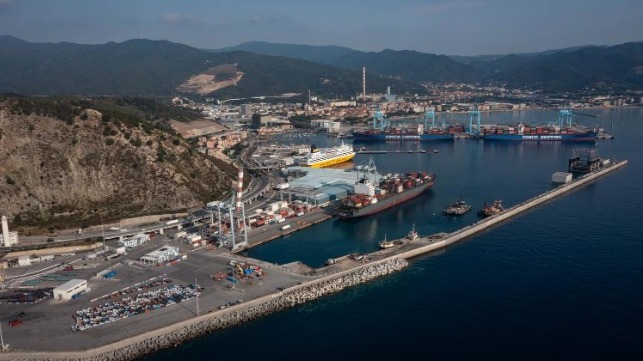
Vado Ligure Italy
Containership was detained after departing the Vado Ligure port in western Italy (APM Terminals)

Published Aug 27, 2025 4:21 PM by The Maritime Executive


Guardia Costeria is reporting that it has detained a smaller containership after it was unable to determine that the vessel was in compliance with emissions regulations. The Mediterranean became an Emission Control Area (ECA) this year, while the Italian authority reports that it has detained ten ships this year for failing to comply with international regulations.

The new situation arose in Genoa on August 21 when the Hansa Horneburg (23,644 dwt) arrived from the Italian port of Vado Ligure. The vessel, which is registered in Liberia and managed by Leonhardt & Blumberg of Germany, was built in China in 2007. It has a capacity for 1,732 TEU,

The Italian authority reports that it conducted an inspection of the vessel, and although it is equipped with valid certifications, it could not determine full compliance with the regulation relating to the containment of nitrogen oxide (NOx). The authority says that components of the electric generators did not display compliance identification, and it was unable to determine if they complied with the NOx technical code.


Guardia Costiera was unable to determine compliance with the emissions regulation (Guardia Costiera)


Guardia Costeria reports it undertook a comprehensive inspection from the bridge to the engine room as well as crew areas. It also conducted a safety drill aboard the vessel. The Italians said that since compliance could not be ensured, the vessel was being detained. This year and last, the vessel underwent inspections in the United States and Peru without incident. 

The increased diligence comes as the Mediterranean ECA became official on May 1, 2025, the fifth ECA zone under the IMO’s regulations. The IMO highlighted that ships operating in the new ECA would be subject to strict mandatory measures to prevent, reduce, and control air pollution. The focus is on sulfur emissions and particulate matter. Ships operating in the Mediterranean must comply with stricter content limits than those set by the global standard (0.10 percent mass by mass (m/m) for sulfur, compared with 0.50 percent m/m allowed outside SOx ECAs).

AIS signals show that the Hansa Horneburg remains in Genoa as of August 27. The Italian authority says it will be detained until the deficiencies are addressed under the supervision of the flag administration and the class society. It will also be required to pass a follow-up Port State Control Inspection.


NATO Patrol Aircraft Chase Russian Sub as U.S. Carrier Operates off Norway

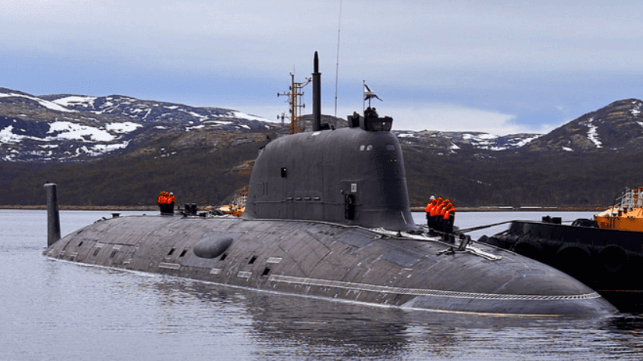
A Yasen-class sub assigned to Russia's Northern Fleet, 2021 (Russian MOD)

Published Aug 27, 2025 7:11 PM by The Maritime Executive


A substantial share of the NATO maritime surveillance aircraft fleet has been engaged in tracking a Russian submarine off the coast of Norway. The movements of Russia's attack subs are of interest every day, but this one has attracted extra attention because it is in the same region as the carrier USS Gerald R. Ford, which is currently operating alongside Norwegian allied forces in the North Sea. 

According to the UK's Daily Express, P-8 surveillance aircraft from the UK, the U.S. and Norway have saturated a search area near the Ford Carrier Strike Group since last week. 

More than two dozen sorties have been flown so far, including at least eight flown by the UK's Royal Air Force. Some of the capacity originated from an airbase in Sicily, on the other side of Europe, suggesting a high priority for diverting assets to this mission. A UK defense source told The Sun that the operation was "highly unusual," and several British sources called it a show of force from NATO. “It is telling Russia: ‘We see you,'” former Royal Navy Commander Tom Sharpe told the outlet. 

The Barents Observer has reported that three Yasen-class Russian attack subs departed the pens at Severomorsk earlier this week, based on satellite imagery.

USS Gerald R. Ford and her escorts departed the Mediterranean earlier this month and transited through the English Channel to reach the North Sea. On arrival, the Ford strike group met up with Norwegian units to conduct joint drills. The exercise is part of Ford's deployment to the U.S. 6th Fleet area of operations, and is intended to demonstrate the "U.S. Navy's ironclad commitment to the stability and security of the European theater." 

Separately, Russian fighters intercepted a U.S. Navy P-8A over the Black Sea on Wednesday, and the pilots filmed an interaction with the U.S. Navy plane. This particular P-8 had extended its rarely-spotted AESA radar, the Advanced Airborne Sensor pod - a powerful air and surface search device. The P-8 was on a mission to patrol the waters off Novorossiysk, the Russian Navy's bastion in the northeastern corner of the Black Sea. 


NATO says all countries to finally hit 2-percent spending goal


Brussels (Belgium) (AFP) – NATO on Thursday said all its members were finally set this year to hit the alliance's previous defence spending target of two percent of GDP -- as they gear up for a far more ambitious goal.


Issued on: 28/08/2025 - 

OTAN IS NATO SPELLED BACKWARDS
The 32-nation North Atlantic Treaty Organization (NATO) agreed at a June 2024 summit to massively hike defence spending over the next decade © JOHN THYS / AFP/File

The 32-nation military alliance agreed at a June summit in the Hague to massively hike defence spending over the next decade under pressure from US President Donald Trump.

The mercurial US leader rammed through a commitment from allies to cough up five percent of their GDPs on security-related spending in a move seen as key to keeping him engaged with NATO.

That headline figure breaks down as 3.5 percent on core defence spending and 1.5 percent on a looser range of areas such as infrastructure and cyber security.

The new target replaces the alliance's former military spending goal of two percent that was first set back in 2014.

NATO said in a statement that all allies were now expected to reach that goal in 2025 and that overall defence spending across the alliance would top $1.5 trillion for the year.

That comes after a group of stragglers -- including Spain, Belgium and Italy -- hastily announced plans to reach two percent ahead of the Hague gathering.

The struggle to reach that figure highlights how difficult it will be for NATO countries in Europe to achieve Trump's far higher new target set this year.

But officials insist European countries must make good on their pledge if they are to have the capabilities needed to ward off Russia.

Numerous Western militaries and intelligence services have warned that Moscow could be ready to attack a NATO country within three to five years if the war in Ukraine ends.

Washington -- which has underpinned European security since World War II -- meanwhile insists it wants to shift more of the responsibility for the continent's defences onto European countries.

The Pentagon is currently conducting a review of its worldwide deployments and has warned it could look to scale back its footstep in Europe to focus more on China.

While some European countries have lagged behind on defence spending, NATO members close to Russia such as Poland and the Baltic states are already set to reach five percent of GDP in the next few years.

Poland was projected to be the highest spending NATO country in 2025 at 4.48 percent.

The United States currently spends 3.22 percent of its GDP on defence, but makes up the lion's share of the alliance's total expenditure in dollar terms.

© 2025 AFP
Senegal passes law to protect whistleblowers in 'historic moment for democracy'

Senegalese parliamentarians have adopted a law to protect whistleblowers, in order to strengthen transparency in the country – a promise made by the government that came to power in April 2024.


Issued on: 27/08/2025 -

A plenary session at the Senegalese National Assembly in Dakar, February 2025. AFP - SEYLLOU

By:Melissa Chemam with RFI


Senegal has become the first French-speaking sub-Saharan country to adopt such a law, according to the Platform for the Protection of Whistleblowers in Africa (PPLAAF).

The text, adopted on Tuesday by members of parliament, aims to protect individuals who, in the course of their professional activity, report or disclose information relating to a crime, financial offence or harm to the public interest.

Whistleblowers can report their information anonymously if they wish, through internal channels within government departments or externally to the relevant authorities, the parliamentary report states.

Those who report information that leads to the recovery of illicit funds or assets will receive a reward of 10 percent of the amount recovered, or an amount determined by the relevant authorities.


Senegal calls on US to withdraw sanctions against ICC magistrates

Jimmy Kande, PPLAAF's West Africa director, called it "a historic moment for Senegalese democracy and for the entire continent" – although he said that he regretted the bill's limited scope.

"Whistleblowers seem to be limited to matters of corruption and economic crimes, whereas the scope would usually be much broader, covering environmental, health or human rights issues," he told RFI.

PPLAAF has published a critical analysis of the bill, highlighting key areas for improvement – including broadening the scope of protection, clarifying the notion of “Good Faith”, distinguishing whistleblowers from nominees, protection against retaliation and the creation of a special fund for whistleblowers.

The organisation also wants the new law to distinguish between whistleblowers and "nominees", who are fronts or proxies used by corrupt individuals to hide stolen assets, launder money or evade legal scrutiny.

A corrupt official might place assets in the name of a nominee to disguise their ownership, making them someone acting s a cover for illicit interests rather than exposing them.

France and Senegal look to reset ties as Macron hosts Faye in Paris

However, PPLAAF remains optimistic and hopes the move will inspire other African countries to do the same.

"Adopting a whistleblower protection law is a strong signal," Kande said. "It's there to encourage other countries in the region and other French-speaking countries to adopt laws that protect whistleblowers."

The National Assembly of Senegal also adopted three other laws aimed at strengthening transparency in the country: one on access to information, another on the creation of a body to combat fraud and corruption, and a third that extends asset declarations to magistrates and investigating judges.

(with newswires)


France and Senegal look to reset ties as Macron hosts Faye in Paris


Historical wounds, economic tensions and new areas of partnership topped the agenda on Wednesday as French President Emmanuel Macron sat down with his Senegalese counterpart, Bassirou Diomaye Faye, at the Élysée Palace.


Issued on: 27/08/2025 - RFI

Frencg President Emmanuel Macron hugs Senegalese President Bassirou Diomaye Faye as they arrive for a meeting at the Elysée Palace in Paris on 27 August 2025. 
AFP - THIBAUD MORITZ

No subject was taboo for the meeting, which came just weeks after France closed its last military bases in Senegal, ending more than six decades of permanent presence.

One of the most delicate questions on the agenda is Thiaroye – the 1944 massacre of Senegalese soldiers by French forces.

Dakar has long called for the full release of military and judicial archives and for recognition of the scale of the killings. Progress here would be seen in Senegal as a sign of greater balance and transparency in relations.
Mural in Dakar, Senegal, commemorating the Thiaroye massacre in 1944. © Erica Kowal/Flickr/wikemédia.org


Economic ties


Economic disputes are also on the table, including a row over the Dakar-Diamniadio express project. French construction company Eiffage is seeking about €150 million in unpaid bills.

At the same time, both governments want to highlight common goals in sustainable development, education and healthcare.

Beyond bilateral matters, Macron and Faye were expected to exchange views on regional crises and global challenges, from instability in the Sahel to international trade.

Later in the day Faye was due to take part as guest of honour at a major gathering of French business leaders hosted by Medef, the country’s largest employers’ organisation, in a sign of France’s push to position Senegal as a key partner for investment in Africa.

French military to leave Senegal amid ongoing withdrawal from Africa
French military withdrawal

The meeting takes place against the backdrop of France’s military departure from Senegal.

In July, the final French installations in Dakar – the Geille camp and a base at the capital’s airport – were handed over to Senegalese command.

Marked by flag-raisings and a symbolic exchange of keys, the ceremony closed a chapter that dated back to the colonial era.

The withdrawal followed negotiations launched in 2022 and sped up after Faye’s election, with his Pastef party promising to end foreign military bases on Senegalese soil.

It also fits into France’s wider reshaping of its military footprint in Africa, with troop withdrawals this year from Chad and Côte d’Ivoire.

Both governments insist this does not mean an end to security ties. Training missions and cooperation in fields such as maritime surveillance and cybercrime will continue, though without French troops permanently based in Dakar.

“We must reinvent our partnerships in response to the aspirations of a young generation – we no longer need bases to do that,” General Pascal Ianni, France’s commander for Africa, said at the July handover.

EU urged to uphold human rights, as Mauritania accused of abuse of migrants

Mauritania’s role as a key transit hub for African migrants seeking passage to Europe has come into sharp focus, following renewed claims by the NGO Human Rights Watch of abuse by its security forces.


Issued on: 27/08/2025 - RFI

The bodies of migrants who perished in a shipwreck off the coast of Mauritania lie covered on a beach near Nouakchott on 24 July, 2024. © AFP

In a new report, Human Rights Watch (HRW) reveals that Mauritanian security forces have carried out "serious human rights violations" against migrants and asylum seekers – ranging from torture to rape – over the past five years.

Mauritania has become a key staging post for undocumented migrants from across Africa who risk the perilous Atlantic crossing from West Africa to Europe, with many aiming to reach Spain.

The NGO added that these abuses had been “exacerbated” by the European Union and by Spain, which continue to outsource elements of their migration management to Mauritania, including support for its border and migration control authorities.

The 142-page report documented violations committed between 2020 and early 2025 by Mauritania’s police, coastguard, navy, gendarmerie and army during border and migration operations.

The victims were largely migrants and asylum seekers from West and Central Africa "seeking to leave or transit the country".

Worst year for migrant deaths on Spanish maritime routes, NGO warns


'Catalogue of abuses'


"For years, Mauritanian authorities followed an abusive migration control playbook – sadly common across North Africa – by violating the rights of African migrants from other regions," said Lauren Seibert, an HRW researcher on refugee and migrant rights.

The report cites a catalogue of abuse including torture, rape, beatings, sexual harassment, arbitrary arrest and detention, theft and collective expulsions.

HRW did, however, note that Mauritania’s government has recently taken steps that "may improve protection for migrants and their rights".

It has urged the EU and Spain to put human rights and saving lives at the forefront of their cooperation with Mauritania.

Spain faces record surge in migrants reaching Canary Islands


Influx to Canary Islands

Thousands of people have died in recent years attempting the dangerous journey from North Africa to Spain, particularly when aiming for the Canary Islands off Africa’s northwest coast.

For its report, HRW interviewed 223 people, including more than 100 migrants and asylum seekers, and examined documentary evidence as well as visiting detention centres.

In total, it documented abuses against 77 migrants and asylum seekers – men, women and children – along with one Mauritanian national.

According to Spanish government figures, a record 46,843 people reached the Canary Islands by boat in 2024.

Arrivals slowed in 2025, with around 11,500 arrivals recorded between January and July.

Mauritania’s government has rejected many of the report’s findings, while the EU insists its partnership with the country is “solidly anchored” in respect for human rights.

(with newswires)


EU's and Spanish migration policies ‘exacerbate’ rights abuses in Mauritania - HRW report

wreck of a traditional Mauritanian fishing boat known as a pirogue, also used by migrants to reach Spain's Canary Islands, sits on a beach near Nouadhibou, Mauritania (2021)
Copyright AP Photo/Felipe Dana

By Eleonora Vasques
Published on 

Human Rights Watch says EU's and Spain’s outsourcing of migration control to Mauritania has worsened abuses against asylum seekers, including torture, rape and mass expulsions. The report links these violations to a €210 million 2024 migration deal aimed at curbing departures to the Canary Islands.

Human rights abuses of asylum seekers in Mauritania have been exacerbated by the European Union and Spain, which are “continuing to outsource migration management” to the West African country, a report by Human Rights Watch published on Wednesday claimed.

The 142-page report documented violations to migrants and asylum seekers in Mauritania, including torture, rape, sexual harassment, arbitrary arrests, inhumane detention, extortion, theft, and mass expulsions, carried out mainly by Mauritania’s police, coast guard, army and navy.

“Dozens of people who had been held in Mauritania’s police-run migrant detention centres described inhumane conditions and treatment, including lack of food, poor sanitation, adolescent children at times detained with unrelated adults, and some beatings by guards,” the rights group said.

In March 2024, the EU and Spain signed a €210 million migration management agreement with Mauritania, to reduce departures from the West African coast, usually towards the Canary Islands. 

Even though arrivals via the West African route decreased by 46% between January and July 2025 compared to the same period in 2024, according to EU border agency Frontex, Mauritania remains a major transit country for Africans trying to reach Europe.

But the investment by the EU and Spain to halt arrivals at the EU coasts is having a negative impact on the human rights of asylum seekers and migrants, Human Rights Watch claimed.

“The report also highlights the negative impacts of Mauritania’s interceptions and forced returns of migrant boats, supported by the EU and Spain, while search-and-rescue in the Atlantic remains insufficient, contributing to ongoing deaths,” the rights group alleged.

Euronews has approached the European Commission, the Spanish and Mauritanian government for comment. 

The EU executive and Mauritania authorities did not respond at the time of publication, however, the Spanish ministry of interior told Euronews it “fully respects the work of Human Rights Watch, but it will not make any comment about the content of its report”.

“For years, Mauritanian authorities followed an abusive migration control playbook – sadly common across North Africa – by violating the rights of African migrants from other regions,” said Lauren Seibert, refugee and migrant rights researcher at Human Rights Watch. 

However, the rights group acknowledged that a recent reform approved by the Mauritanian government represents a step in the right direction. 

“Mauritania’s recent reforms show that a new approach is possible. The government should build on these efforts, scale up monitoring of security forces, and halt collective expulsions,” the expert said.