Thursday, August 28, 2025


In search of the perfect raspberry


Pioneering genome editing technique could be the future of fruit and farming


Cranfield University

Raspberry plantlet used as protoplast 

image: 

Ryan Creath holding a raspberry plantlet used as protoplast

view more 

Credit: Ryan Creeth, Cranfield University


One of our most popular summer soft fruits could last longer in the fridge thanks to pioneering new research conducted at Cranfield University. Researchers have recently published a new method to edit the DNA of raspberries, with the goal of creating more sustainable raspberry production and less food waste.

A first for gene editing in raspberry

The new study details a novel method for the isolation of single cells (protoplasts) from the leaf tissue of raspberry microplants grown in sterile tissue culture.

The protoplasts were then gene edited with CRISPR-Cas9, a revolutionary biotechnology that can be programmed to target any region of the genome and introduce changes to the DNA. This study is the first time CRISPR gene editing has been validated in red raspberry (Rubus idaeus) in a peer-reviewed publication.

Now that DNA-free gene editing has been validated in raspberry, it could enable much faster, more efficient and precise breeding of new raspberry cultivars with enhanced traits – this could mean tastier and more sustainable raspberries on supermarket shelves in the future.

For example, one of the genes edited in this study, NPR1, when edited in tomato, resulted in increased resistance to grey mould. In future, it may be possible to use this to create raspberry varieties with a longer shelf-life, reducing food waste and improving sustainability. These techniques could also lead to raspberry fruits that are sweeter, larger, seedless, or enable higher crop yields and greater resilience to heatwaves arising from climate change.

Crucially, gene editing will speed up variety improvement: precisely-improved versions of elite raspberry cultivars could be produced in approximately 12 months, ready for propagation and on-farm trialling. In comparison, traditional plant breeding relies on cross-pollination and the luck of random gene shuffling followed by a decade or more of field selection before near-market evaluation starts.

The final step is to find ways to regenerate whole raspberry plants from the gene-edited single-celled protoplasts, which is possible in many crops, but can be tricky in others. The regenerated plants would then go on to produce gene edited raspberries with beneficial traits like greater resistance to mould.

New opportunities in a new regulatory environment

Importantly, DNA-free gene editing does not result in the production of a genetically modified (GM) organism. The changes to the DNA in this study are indistinguishable on a genetic level to those that result from natural mutation over time or from those produced through traditional plant breeding. This is because there is no introduction of non-native (i.e., non-raspberry) DNA into the raspberry genome.

Instead, CRISPR is introduced into the raspberry protoplasts as Cas9 protein and guide RNA, which cause editing to the DNA but do not become physically inserted into the raspberry genome. This is crucial for compliance with the new Genetic Technology (Precision Breeding) Act (2023) that only permits non-transgenic changes to DNA in crop species for production and consumption in England.

“Precision breeding techniques are essential for tackling food waste, improving food sustainability and nutrition, and lowering the cost of food,” said Ryan Creeth, the PhD student who developed the new method alongside co-authors Dr. Zoltan Kevei and Prof. Andrew Thompson.

“It’s really important that we fully utilise cutting-edge techniques like DNA-free gene editing in a wider variety of crop species to successfully transfer research from academia into the real world. More research is required, particularly with the regeneration of gene edited raspberry plants. But it is a promising start for one of the nation’s favourite soft fruits”.

The research paper DNA-free CRISPR genome editing in raspberry (Rubus idaeus) protoplast through RNP-mediated transfection is published in Frontiers in Genome Editing.

Raspberry Plant in Glasshouse 

Ryan Creeth holding a raspberry plant in Cranfield University's Glasshouse plant growth facility

Protoplast stained with fluorescent viability stain white light

Protoplast stained with fluorescent viability stain

Ryan Creeth viewing protoplast using fluorescent microscope 

Ryan Creeth working in sterile cabinet with raspberry canes

Credit

Ryan Creeth, Cranfield University


No strong evidence for alternative autism treatments, study finds


University of Southampton


The most comprehensive quantitative review of research into complementary and alternative treatments for autism has found no strong evidence to support their use, and that the safety of these treatments was rarely assessed.

A new study from Paris Nanterre University, Paris Cité University and the University of Southampton, published today [28 August] in Nature Human Behaviour, assessed 248 meta-analyses, including 200 clinical trials involving over 10,000 participants.

Researchers were investigating the efficacy and safety of complementary, alternative and integrative medicines (CAIMs) to treat autism. They looked at 19 types of treatment, including animal-assisted interventions, acupuncture, herbal medicine, music therapy, probiotics and Vitamin D.

The team also created an online platform to make it easier for people to see the evidence they generated on different CAIMS.

Autistic people can find it hard to communicate, understand how people think or feel, be overwhelmed by sensory information, become anxious in unfamiliar surroundings and carry out repetitive behaviours.

All of this can interfere with their quality of life, and up to 90% report having used CAIMs at least once in their lifetime.

“Many parents of autistic children, as well as autistic adults, turn to complementary and alternative medicines hoping they may help without unwanted side effects,” says Professor Richard Delorme, Head of the Child and Adolescent Psychiatry Unit at Robert Debré Hospital in Paris.

“However, it is necessary to carefully consider evidence from rigorous randomised trials before concluding that these treatments should be tried.”

Researchers carried out an umbrella review – a type of study that pulls together evidence to give an overall ‘big picture’ summary.

Dr. Corentin Gosling, Associate Professor at the Paris Nanterre University and first author of the study, explains: “Rather than looking at individual trials, we reviewed all the available meta-analyses, which are a compilation of many trials. This allowed us to evaluate the full body of evidence across different treatments.

“Importantly, we also developed a free and easy-to-use online platform, which we will continue to test. Ultimately, we hope this tool will support autistic people and practitioners in choosing together the best treatment.”

While some treatments showed potential, most studies were supported by weak or poor-quality evidence, so the effects are not reliable. Concerningly, safety assessments were missing for most treatments, with less than half of CAIMs having had any evaluation of the acceptability, tolerability or adverse events.

Professor Samuele Cortese, NIHR Research Professor at the University of Southampton and co-senior author, concluded: “This study shows that when people want to know whether a treatment is effective, they shouldn’t just look at one single study. It’s essential to consider all the available evidence and how good that evidence is. Drawing conclusions from one low-quality study can be misleading.”

The study Complementary, alternative and integrative medicine for autism: an umbrella review and online platform is published in Nature Human Behaviour and is available online.

The online platform is available at: https://ebiact-database.com

The research was funded by Agence Nationale de la Recherche (ANR).

Ends

Contact

Steve Williams, Media Manager, University of Southampton, press@soton.ac.uk or 023 8059 3212.

Notes for editors

  1. The study Complementary, alternative and integrative medicine for autism: an umbrella review and online platform is published Nature Human Behaviour. An advanced copy is available on request.
  2. For Interviews please contact Steve Williams, Media Manager, University of Southampton press@soton.ac.uk or 023 8059 3212.

Additional information

The University of Southampton drives original thinking, turns knowledge into action and impact, and creates solutions to the world’s challenges. We are among the top 100 institutions globally (QS World University Rankings 2025). Our academics are leaders in their fields, forging links with high-profile international businesses and organisations, and inspiring a 22,000-strong community of exceptional students, from over 135 countries worldwide. Through our high-quality education, the University helps students on a journey of discovery to realise their potential and join our global network of over 200,000 alumni. www.southampton.ac.uk

www.southampton.ac.uk/news/contact-press-team.page

Follow us on X: https://twitter.com/UoSMedia

Bully-in-Chief Trump Delights in Cruelty

Violent imagery helped launch this made-for-TV president on his journey into the Oval Office. Now, he’s using it to govern with fear.


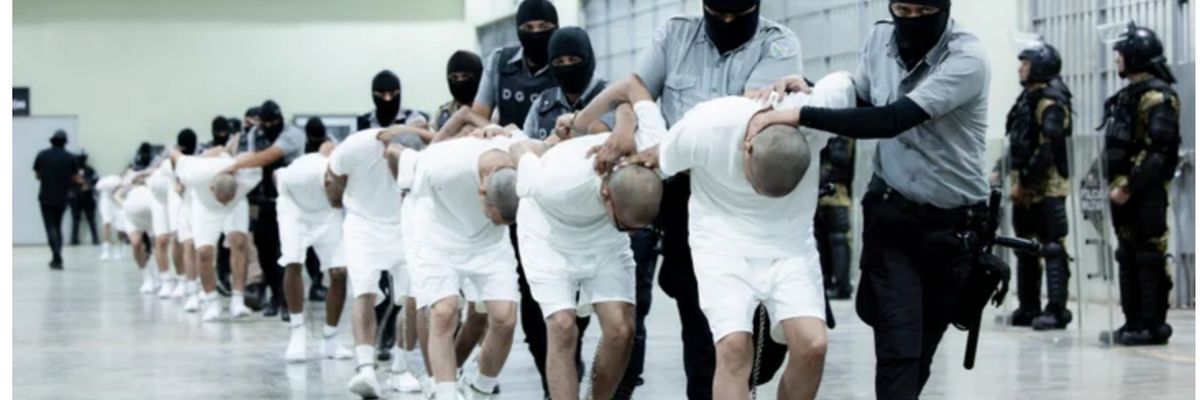
Some of the 260 Venezuelans illegally deported arrive at an El Salvador prison.
(Screenshot)

Andrea Mazzarino
Aug 27, 2025
TomDispatch

US President Donald Trump, his cabinet, and those who have profited from his rise seem to revel in public displays of cruelty.

Take former Department of Government Efficiency (DOGE) head Elon Musk, holding a chainsaw at a televised event to celebrate the firing of civil servants. Or Trump’s White House sharing a video featuring Immigration and Customs Enforcement (ICE) officers marching handcuffed immigrants onto a deportation flight, with Jess Glynne’s musical hit “Hold My Hand” playing in the background. Or how about ICE allowing right-wing TV host Dr. Phil to film its sweeping immigration raids for public consumption? And don’t forget those federal agents tackling Democratic California Sen. Alex Padilla to the floor (and handcuffing him!) when he asked a question at a Department of Homeland Security press conference. Or what about during the first Trump presidential campaign, when the then-candidate boasted that he could shoot someone on Fifth Avenue in New York City and he wouldn’t lose a voter?

Violent imagery helped launch this made-for-TV president on his journey into the Oval Office. Now, he’s using it to govern with fear.

As journalist Adam Serwer put it, “Cruelty is the point.” Physical attacks and threats serve both to dehumanize vulnerable Americans (especially people of color) and to suggest what could happen to individuals who speak out against the wealth gaps and other problems of our times.

The underbelly of MAGA malice is, of course, greed. Compare the scenes I’ve just mentioned to the president welcoming to his inauguration not public figures who had done positive things for the welfare of Americans, but billionaires who made seven-figure donations to that very event. At the Oval Office, he also loves to host those who have presented him with shiny baubles—like Apple CEO Tim Cook, who had given him a gold trophy with his company’s logo on it. (Even then, Trump used the occasion to mock his visitor’s slight frame.)

We have long lived in a country where unfettered capitalism at the expense of so many of us thrives on violence meant specifically to silence people at the bottom.

Or consider Vice President JD Vance, who got the U.S. military to raise the level of a river so he could take a birthday boat trip on it. And that, tellingly, was only weeks after a real flood in Texas had killed more than 100 people, while the administration slow-walked aid in response to the disaster. And don’t forget that the president spent about $45 million taxpayer dollars on a military parade on his birthday in Washington, the very city in which he’s decried the homeless population as “unsightly” (and has now sent the National Guard into its streets). Those same funds could have paid for a significant amount of housing for hundreds of people in that same city.

America’s leadership has come unmoored from the values of equality and self-determination outlined in this country’s founding documents. They would prefer to display a let-them-eat-cake America that today boasts more than 800 billionaires (compared with around 60 in 1990), one where the average hourly wage has risen just 20% over the past 35 years—less than half what working people need to afford basic necessities like housing, food, and healthcare.

Mind you, Donald Trump is anything but solely responsible for creating such steep inequalities. However, he’s shown us how little he cares to make things right by cutting spending on health insurance, schools, farm subsidies, and so much more, while attacking the working poor and those who stand up for them.
American Carnage

Violence against people of color—especially workers of color who dare strive for better conditions—was already baked into American history. After all, we’re a nation that supersized our economy by using free or low-wage work. For example, the lynching of Black slaves and later Black Americans was one way that American leaders showed marginalized groups what they might expect if they spoke out.

In thousands of documented incidents in the history of this country, White mobs, often led by wealthy landowners, whipped, beat, hung, or otherwise murdered Black people in public places. (No surprise, then, that to this day, police violence against Blacks is all too commonplace.) Historically, in many lynchings, law enforcement either carried out the violence directly, organized the mobs who did, or at least stood by and watched without intervening.

With recent police crackdowns on protesters in LA and on people simply showing up to work, it should hardly come as a surprise that many Black Americans are now being punished for incidents when all they did was exercise the sorts of rights that many of us take for granted like going to school, writing, or gathering without the permission of whites. Once upon a time, in places like pre-Civil War Virginia and North Carolina, the law forbade enslaved people from gathering for any reason, even to worship. Nor, in the post-Civil War South, were whites subtle in their condemnation of Americans of color who managed to advance economically or challenged the status quo.

In 1892, for example, the Memphis office of Black journalist Ida B. Wells was destroyed by a mob whose members threatened to kill her after she wrote an article condemning the lynching of three Black men who owned a successful grocery store. Incidents like that may look very different from the sorts of confrontations Americans are now witnessing on their streets, but they remind me that we have long lived in a country where unfettered capitalism at the expense of so many of us thrives on violence meant specifically to silence people at the bottom.

The point was driven home for me by a scene in Percival Everett’s timely 2024 novel James, a rendition of Mark Twain’s Huckleberry Finn told from the perspective of the title character, an escaped slave. The narrator watches a slave owner beat and hang a Black man who stole a pencil so that James could write something. As I read, it was easy for me to imagine life leaving the man’s body as he endured the lashes, and to feel his community’s terror. The lynched man’s last exchange during the beating involves him mouthing the word “Run!” to James, who is hiding in the bushes nearby.

The message of that scene should resonate today: If you want to express yourself or even just live in certain American towns and cities (including our capital!) in Donald Trump’s America, you’d better know that you’re risking your neck. Considered against such a historical backdrop, Trump and his followers could be thought to come by their moments of cruelty—as the saying goes—honestly (although if that’s honest emotion, what a world we’re now living in).
Our Contemporary Public Square

Since the president’s second inauguration, millions of Americans have turned out to stand up for fired federal workers, women, and LGBTQ+ people, as well as immigrants and people of color who have been the focus of ICE raids and extrajudicial detentions. The vast majority of those demonstrators have been peaceful, showing up in the streets or at immigration courts where they take down the information of those being detained so ICE can’t simply “disappear” them. Some have even waved Mexican flags to show solidarity with immigrant families hailing from that and other countries. Most importantly, such demonstrators committed their own bodies, including their eyes and ears, to ensure that people facing increasing state violence in Donald Trump’s America don’t always have to experience it alone.

In the Los Angeles area this spring and summer, ICE raids drew national attention for the frequent way they targeted Latino neighborhoods, with masked federal agents swarming public places and chasing workers based on skin color, type of job, and language. From just early to mid-June, tens of thousands of people actively protested such raids in Los Angeles, expressing solidarity with the people and neighborhoods targeted.

Imagine fearing getting tackled by the police and sustaining injuries, particularly in a country where nearly half of all adults are either uninsured or underinsured.

To be sure, a handful of those protesters made the demonstrations less productive by setting police and private vehicles on fire and vandalizing storefronts, causing significant damage. However, it just may be the understatement of the year to say that the law enforcement response to those protests was disproportionate to the threat. In addition to the Los Angeles Police Department (LAPD) and other local police responses, Trump ordered 2,000 National Guard members and 600 Marines into Los Angeles, despite the warnings of local leaders that doing so would only escalate the confrontations between protesters and law enforcement.

And those concerns turned out to be all too well-founded. The police violently attacked at least 27 journalists, using supposedly non-lethal crowd-control munitions and tear gas. All too sadly, for instance, an LAPD officer struck a photographer in the face with a rubber bullet, fracturing his cheek and tearing open his eye, forcing him to undergo five hours of emergency surgery and potentially leading to permanent vision loss. ICE agents typically shoved David Huerta, a labor union leader, to the ground while he was observing raids in the city’s fashion district. Huerta would be hospitalized for his injuries. State police shot a New York Post journalist in the forehead with a rubber bullet as he filmed anti-ICE protests from the side of the highway, causing him to fall and leaving him with severe bruising and neck injuries. The journalist said he thinks he was shot because he was isolated and so “an easy target.”

Meanwhile, at least five police officers were treated on the scene for injuries sustained when a few of the protesters threw rocks from highway overpasses onto cars and one fired paintballs at officers. They were also harmed by their own flash-bang grenades and tear gas. Numerous protesters were, of course, injured, some by being tackled by police officers and others by tear gas and “non-lethal munitions.” Hundreds were arrested then (and continue to be), including peaceful observers and legal monitors attempting to track “disappeared” immigrants through the system.

Not surprisingly, I found it hard to get anything like a full count of people injured or detained in those demonstrations, which leads me to think that one future project of the Costs of War Project that I’ve long been associated with might be to tally up injuries and possible deaths among Americans whose streets are clearly going to be increasingly overrun by law enforcement and National Guard troops in this new Trumpian era. With the president already sending federal law enforcement officers and the National Guard into this country’s capital, surely, in the months to come, he’ll do the same into minority-led Democratic-majority cities (including, undoubtedly, New York, should Zohran Mamdani be elected mayor there in November). In my own backyard—I live near Washington, DC—it’s likely that we’ll see an increase in violent confrontations, too.

The rhetoric of the president and his followers has played no small role in the escalations we’ve witnessed in Los Angeles and elsewhere as he focuses the anger of Americans against each other. For instance, before he deployed troops in LA, Trump stated, “We will liberate Los Angeles and make it free, clean, and safe again,” while describing protesters as “animals” and “a foreign enemy.” His close advisor Stephen Miller wrote on X, “Deport the invaders, or surrender to insurrection.” And note the ambiguity there. It’s not clear whether the invaders are immigrants, protesters, or both. Such statements give new meaning to the term “the bully pulpit” and the tacit permission the administration gave the police to hurt civilians (or else).

Imagine going to a protest and having to worry about some version of those crowd-control munitions or even a bullet getting lodged in your body. Imagine fearing getting tackled by the police and sustaining injuries, particularly in a country where nearly half of all adults are either uninsured or underinsured. Egged on by the highest office in the land, police violence makes a distinct point: it shows that, in the era of Donald Trump, Americans like you or me, should we decide to speak out, could find ourselves in danger.
Violence in Unexpected Places

These days, state violence (or the threat of it) arises even in places you might not expect. Recently, for instance, the Texas Senate attempted an untimely gerrymander meant to recarve that state’s electoral maps, diluting districts with large minority populations and so possibly delivering five more House seats to Trump’s Republicans in the 2026 midterm elections.

In a move of creative civil disruption, dozens of Texas Democratic senators, including significant numbers of women and minorities, promptly fled the state to ensure that there would be no quorum possible in that state’s senate and so delay a vote on the proposed new electoral map. The response from Texas Gov. Greg Abbott? To urge Trump to have the Federal Bureau of Investigation find and arrest those senators and force them back to Texas.

That Texas attempted gerrymander is exactly the sort of escalation of tactics that will only normalize the bullying of law-abiding Americans and could lead to the sort of democratic backsliding that, in 2028, might land us all in a full-fledged military dictatorship.

To counter such heavy-handed tactics, we should be ever clearer and more public about the violence that MAGA leaders are likely to commit against anyone who crosses their ravenous path. Sadly enough, television images of chainsaws, handcuffed migrants, and ICE raids don’t simply speak for themselves in the United States of 2025. They could just as easily offer the message that we should indeed hate minorities, poor workers, and homeless people as suggest that this president is violating basic freedoms guaranteed by our Constitution. While Trump and his followers may not always have the courage to say what they really mean, those of us who care about freedom of speech and assembly and other basic American freedoms certainly should—as loudly as we can.

If you have a few minutes, grab a pencil, a pen, or your laptop and make some noise about what you see “our” government doing, particularly when it involves such contempt for human life and dignity. Write your lawmaker, or a letter to the editor, or post something on social media. Make a sign and go to a protest. Stand up for America and against terror. After all, at this point in our history, what choice do we have? Where is there to run to?


© 2023 TomDispatch.com


Andrea Mazzarino
Andrea Mazzarino co-founded Brown University's Costs of War Project. She is an activist and social worker interested in the health impacts of war. She has held various clinical, research, and advocacy positions, including at a Veterans Affairs PTSD Outpatient Clinic, with Human Rights Watch, and at a community mental health agency. She is the co-editor of "War and Health: The Medical Consequences of the Wars in Iraq and Afghanistan" (2019).
Full Bio >
'Evil': Critics Recoil as Trump DHS Moves to Bar Disaster Aid for Undocumented Immigrants

"This is unfathomable discrimination against immigrants that will cost our country lives," said Rep. Pramila Jayapal.


Makatla Ritchter wades through floodwaters after having to evacuate her home when Hurricane Idalia inundated it on August 30, 2023 in Tarpon Springs, Florida.
(Photo by Joe Raedle/Getty Images)


Brad Reed
Aug 27, 2025
COMMON DREAMS

The Trump administration is reportedly putting new restrictions on nonprofit organizations that would bar them from helping undocumented immigrants affected by natural disasters.

The Washington Post reported on Wednesday that the Department of Homeland Security (DHS) is "now barring states and volunteer groups that receive government funds from helping undocumented immigrants" while also requiring these groups "to cooperate with immigration officials and enforcement operations."

Documents obtained by the paper reveal that all volunteer groups that receive government money to help in the wake of disasters must not "operate any program that benefits illegal immigrants or incentivizes illegal immigration." What's more, the groups are prohibited from "harboring, concealing, or shielding from detection illegal aliens" and must "provide access to detainees, such as when an immigration officer seeks to interview a person who might be a removable alien."

The order pertains to faith-based aid groups such as the Salvation Army and Red Cross that are normally on the front lines building shelters and providing assistance during disasters.

Scott Robinson, an emergency management expert who teaches at Arizona State University, told The Washington Post that there is no historical precedent for requiring disaster victims to prove proof of their legal status before receiving assistance.

"The notion that the federal government would use these operations for surveillance is entirely new territory," he said.

Many critics were quick to attack the administration for threatening to punish nonprofit groups that help undocumented immigrants during natural disasters.

Rep. Pramila Jayapal (D-Wash.) lashed out at the decision to bar certain people from receiving assistance during humanitarian emergencies.

"When disaster hits, we cannot only help those with certain legal status," she wrote in a social media post. "We have an obligation to help every single person in need. This is unfathomable discrimination against immigrants that will cost our country lives."

Aaron Reichlin-Melnick, senior fellow at the American Immigration Council, said that restrictions on faith-based groups such as the Salvation Army amounted to a violation of their First Amendment rights.

"Arguably the most anti-religious administration in history," he wrote. "Just nakedly hostile to those who wish to practice their faith."

Bloomberg columnist Erika Smith labeled the new DHS policy "truly cruel and crazy—even for this administration."

Author Charles Fishman also labeled the new policy "crazy" and said it looks like the Trump administration is "trying to crush even charity."

Catherine Rampell, a former columnist at The Washington Post, simply described the new DHS policy as "evil."
DC Grand Jury Refuses to Indict Sandwich-Throwing Man Opposed to Trump City Takeover

The Times described the grand jury's refusal to indict Sean Dunn as a "remarkable failure" by prosecutors and "a sharp rebuke by ordinary citizens."


A person walks past art work depicting former DOJ employee Sean Charles Dunn is displayed against a restaurant wall on August 17, 2025 in Washington, DC.
(Photo by Tom Brenner for The Washington Post via Getty Images)

Brad Reed
Aug 27, 2025
COMMON DREAMS

A grand jury on Tuesday reportedly refused to hand down a felony indictment against Sean Dunn, a former paralegal at the United States Department of Justice who hurled a sandwich at a Customs and Border Protection officer earlier this month.

Two sources have told The New York Times that federal prosecutors came up empty in their first attempt to get a grand jury to charge Dunn with felony assault against a federal officer, a crime that carries a maximum sentence of eight years in prison.

The New York Times described this development as a "remarkable failure" and "a sharp rebuke by ordinary citizens against the team of prosecutors who are dealing with the fallout from President Trump's move to send National Guard troops and federal agents into the city on patrol."

Video of Dunn hurling a sandwich at the officer quickly went viral earlier this month. Before he threw the sandwich, Dunn was heard calling the officers "fascists," and telling them they were not welcome in his city.

Shortly after, current US Attorney and former Fox News host Jeanine Pirro vowed to throw the proverbial book at Dunn for his food-tossing transgressions.

"He thought it was funny," Pirro said in a video she posted on social media. "Well, he doesn't think it's funny today because we charged him with a felony. And we're gonna back the police to the hilt! So, there. Stick your Subway sandwich somewhere else."

This is at least the second time in recent days that Pirro's office has failed to secure a grand jury indictment for alleged assault of a federal officer.

The New York Times reported on Monday that federal prosecutors had reduced charges against a woman named Sidney Lori Reid, who was accused of assaulting an FBI agent during a protest against Trump's immigration policies last month. The decision to refile Reid's case as a misdemeanor came after prosecutors failed on three separate occasions to convince a grand jury to charge her with felony offenses.
The Techlords and Their Ideology Are Mortal Enemies of Humanity

The techlords intend to bring humanity to the brink of collapse and then, in a magic trick, rise to power, saving the species or themselves as the last specimens.


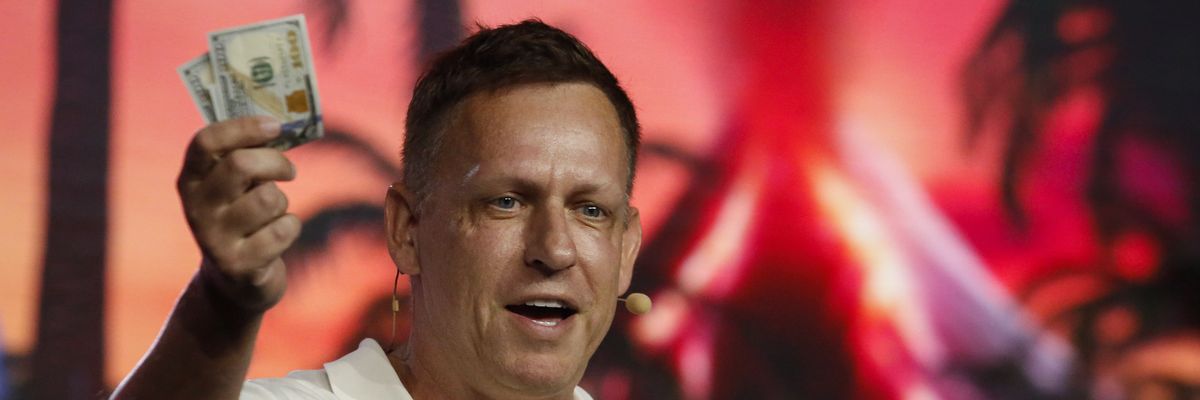
Peter Thiel, cofounder of PayPal, Palantir Technologies, and Founders Fund, holds hundred dollar bills as he speaks during the Bitcoin 2022 Conference at Miami Beach Convention Center on April 7, 2022 in Miami, Florida.
(Photo by Marco Bello/Getty Images)

João Camargo
Aug 27, 2025
Common Dreams

Sitting face to face on grey sofas, Peter Thiel and Ross Douthat continued another propaganda piece for the New York Times. Thiel is the billionaire owner and founder of Palantir, the world's largest private surveillance company, one of the biggest financiers of OpenAI and one of Silicon Valley's most influential ideologues. Douthat asked Thiel, "You would prefer the human race to endure, right?" After hesitating, Thiel replied, "I don't know." A glimpse of the impact of his response and the journalist's astonishment led him to amend his statement: "I, I would prefer, I would prefer." Would he, though?

Thiel is one of the main promoters of the archaic ideology that dominates the thinking of men such as Elon Musk, Jeff Bezos, Mark Zuckerberg, Tim Cook, Sundar Pichai, Andreessen Horowitz, Sam Altman, and Bill Gates. Although these tech moguls are presented as neutral or technology driven, reality is different. Their adaptation to the far-right is no longer surprising. The techlords have laid some of the cornerstones of authoritarian politics and provided the means for the rise of the new ideology of a return to the past.

So what do Thiel and the other techlords stand for? Their ideological base revolves around something called the "Dark Enlightenment", also known as the "Neo-Reactionary Movement." It is a mixture of libertarian doctrines with scientific racism, an anti-historical vision of a return to feudalism and an acceleration toward social and environmental collapse. According to Curtis Yarvin, another of its ideologues, this shadowy enlightenment is the formal recognition of the realities of existing power, aligning property rights with current political power and defending that "corporate power should become the organizing force in society." They seek to assert inequality not as an accident, but as a structure. For all practical purposes, the ideology of the techlords aims to overthrow any democratic illusion and install in its place a feudal division of territories, under which the supreme lords, technological monarchs, President-CEOs, the Techlords, would rule.

We can see what they aspire to in the most banal science fiction: a Star Wars world with a Supreme Emperor who rules the entire galaxy; a Dune world where noble houses dominate technologies, planets, resources and religions; or a Hunger Games world where, after a global rebellion, production has been forcibly distributed geographically and different peoples have to kill each other to entertain the elite. The ideology is so lazy that it has not evolved beyond the books that mostly teenagers read for entertainment during the holidays. The rejection of formal education, with these men abandoning university studies, so touted in the "self-made man" propaganda they peddle about themselves, has deprived them of essential information about history, biology, chemistry, physics, and other key areas of knowledge. The markets reward their audacious ignorance by offering praise and money in exchange for each usurpation. No wonder they think they are demigods and seek ideological rationalisations for their privilege. For the techlords, the reading of these works of popular science fiction culture is contrary to the instincts of people with a basic sense of justice. In Star Wars, they defend Emperor Palpatine and Darth Vader; in The Hunger Games, the Capitol and President Snow.

Techlords are not just dangerous. They are the ideological safe haven and unparalleled dissemination infrastructure for the new far-right.

In a work such as JRR Tolkien's Lord of the Rings, where eugenics runs through the narrative from all sides, the techlords seem to support the most perfidious position. Palantir, the company Peter Thiel created to surveil, steal data, and hand it over to authoritarian governments or whoever pays him, is a name taken from this fiction. Palantir is a crystal ball that reveals information, but is actually being used by the main villain, Sauron, to deceive and pervert wizards and kings, turning them against their territories and peoples. It would be difficult to interpret this name in any other way.

The ideology of the techlords is directly opposed to democracy, which they see as an obstacle to the accumulation and maintenance of wealth and power by the rich. They advocate corporate monarchies and authoritarian city-states controlled by themselves, praising Singapore as a model. To destroy democracy, they advocate dismantling the institutional apparatus of nation states, not because of any oppression or inequality, but to ensure that injustices have no social opposition and that, if opposition does arise, it can be strongly repressed. They advocate the removal of almost all public officials and services, increasing the numbers of the armed forces and police, building up the capacity for repression by the powers that be, no longer public, but corporate and business. The Department of Government Efficiency, led by Elon Musk, combined with the expansion of a militia-style political police force such as Immigration and Customs Enforcement, is a trial run of this. This month, the US government announced a $10 billion contract with Palantir to create a super database that aggregates information from all federal agencies and a platform to detect migratory movements in real time.

Another cornerstone of techlord ideology is accelerationism, which advocates the removal of all restrictions on capitalist growth and technological development, even if this leads to social and environmental collapse. As Zuckerberg said, "Move fast and break things." This idea does not differ fundamentally from neoliberal ideology but, unlike the latter, it does not hide the fact that social collapse is a goal of deregulation, rather than a side effect to be ignored or concealed. The removal of restrictions in accelerationism actually serves to create social breakdowns that allow the techlords to establish themselves as the new masters. Because they are accelerationists, they describe any opposition to their ideological infrastructure—social networks, "Artificial Intelligence," trips to Mars or outer space—as attacks on progress. This is the ideological strand that is trying to create a widespread feeling that the development of Large Language Models, touted as "Artificial Intelligence," is inevitable. There is no possibility that language models will not be biased and racist. Building on these and other prejudices, accelerationism argues that we must ignore the current suffering of billions of people in order to optimize technological developments that will create the environment in which future humans will colonize space. This suffering is destined for people other than the techlords, who are constantly building bunkers to hide in.

Added to the techlords' beliefs are other segments of science fiction, all of them anti-scientific: the imminent colonization of space, the physical fusion of humans with digital technology, the Singularity (the moment when AI surpasses human intelligence), and the childish idea that "Artificial Intelligence," Large Language Models, will solve all of humanity's problems. Authors such as Yuval Noah Harari and fields of "research" such as AI Safety are attempting to consolidate these ideas in popular culture and academia.

The science fiction in the minds of these billionaires, articulated with the orphaned leaders of the new fascist movements on the rise, has concrete and material effects. They are producing, in addition to suffering on a massive scale, a catastrophic waste of time and resources in the face of the greatest crisis in human history, the climate crisis. The techlords intend to bring humanity to the brink of collapse and then, in a magic trick, rise to power, saving the species or themselves as the last specimens. They lead a political movement that is rising today against the future of our entire species, seeking to subjugate all societies to a technological dystopia in which CEOs rule and behave like survivors of the apocalypse (and what is Elon Musk's reproductive frenzy if not his idea that he can be the warlord after the zombie apocalypse of The Walking Dead, i.e., climate collapse, and repopulate the world and the galaxy as a new Adam?).

Techlords are not just dangerous. They are the ideological safe haven and unparalleled dissemination infrastructure for the new far-right. They already use "Artificial Intelligence" to impose their ideology on education, information, public services, justice, the arts, and every field they can usurp. They have set the traps, and we have been caught in them for a long time. The mainstream digital space is a straitjacket of complacency and a black hole of energy and ideas. Algorithms isolate us and deprive us of information that is useful for our collective life. The techlords and their ideology are mortal enemies of humanity and will stop at nothing to impose their dystopias in the coming years, trying to prevent us from stopping the collapse of all human civilisations. To make the digital space controlled by Meta, Alphabet, Apple, and Amazon a battlefield is to accept fighting underwater with our hands tied and weights on our feet. But it is in their arrogant ignorance that their vulnerabilities lie. These giants do indeed have feet of clay that must be knocked down, and their ideology is central to this: They despise material reality, reject the collective and the social as realities, and are submerged in fiction. Moving away from their preferred playing field, social media, may be one of the first steps toward their demise.

Our work is licensed under Creative Commons (CC BY-NC-ND 3.0). Feel free to republish and share widely.

João Camargo
Joao Camargo is a climate activist in grassroots movement Climaximo in Portugal and in the Climate Jobs campaign. He's an environmental engineer and climate change researcher at the University of Lisbon and the author of two books: Climate Change Combat Manual (in Portugal and Spain) and Portugal in Flames - How to rescue the forests.
Full Bio >
Denmark Summons Trump Diplomat Over Report of Covert Operations in Greenland

Prime Minister Mette Frederiksen noted that the US has so far not denied the reports by Denmark's public broadcaster.


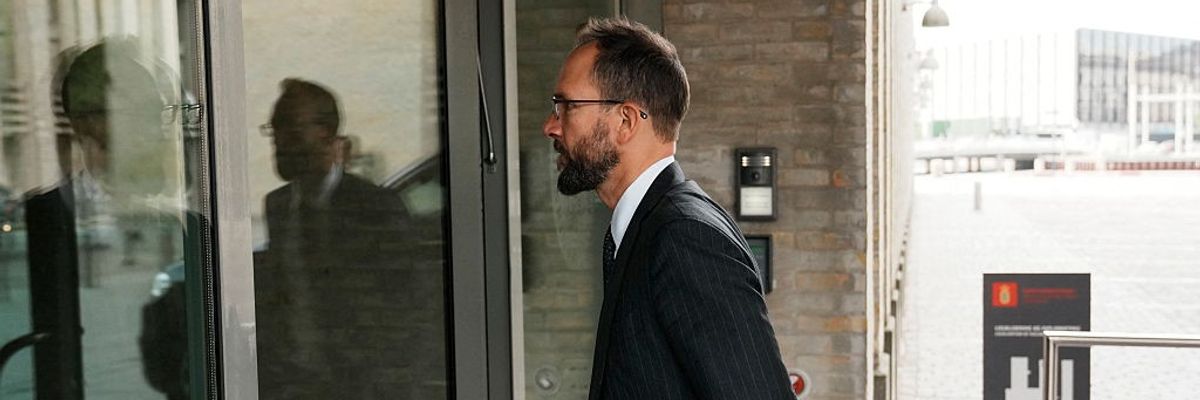
Mark Stroh, the US Chargé d'Affaires in Denmark, arrives the Ministry of Foreign Affairs in Copenhagen, on August 27, 2025.
(Photo by Thomas Traasdahl/Ritzau Scanpix/AFP via Getty Images)


Julia Conley
Aug 27, 2025
COMMON DREAMS


The top US official in Denmark arrived at the country's foreign ministry Wednesday after being summoned for talks about a recent report that US citizens with ties to the Trump White House have carried out a covert "influence" campaign in Greenland.

Denmark's foreign minister on Wednesday called upon Mark Stroh, the charge d'affaires in Denmark, after the main Danish public broadcaster reported that at least three people have been attempting to sow discord between Denmark and Greenland, an autonomous territory that is part of the Danish kingdom.

President Donald Trump has long expressed a desire to take control of Greenland, and has suggested he could use military force even though Denmark is a close ally and fellow member of the North Atlantic Treaty Organization.

Danish officials and Greenlanders have dismissed the idea, with Danish Prime Minister Mette Frederiksen warning the US that it "cannot annex another country."

"We want to be independent. So we are not for sale," resident Karen Cortsen told NPR earlier this year as the outlet reported that 85% of people in Greenland and Denmark opposed the president's push to "get" the vast, mineral-rich Arctic island.

According to the main Danish public broadcaster, the Trump administration has sought to reverse widespread public opposition to his plan, with at least three people connected to his administration carrying out covert operations to "foment dissent" in Greenland.

The broadcast network, DR, reported that eight government and security sources believe the individuals are working to weaken relations between Greenland and Denmark, compiling lists of Greenlandic citizens who support and oppose Trump's plans, and trying "to cultivate contacts with politicians, businesspeople, and citizens, and the sources' concern is that these contacts could secretly be used to support Donald Trump's desire to take over Greenland."

Danish Foreign Minister Lars Lokke Rasmussen said in a statement that "any attempt to interfere in the internal affairs of the kingdom will of course be unacceptable."

"We are aware that foreign actors continue to show an interest in Greenland and its position in the Kingdom of Denmark," Rasmussen said, adding that he had "asked the ministry of foreign affairs to summon the US charge d'affaires for a meeting at the ministry."

Trump has not yet confirmed an ambassador to Denmark. PayPal cofounder Kenneth Howery, a close friend of Trump megadonor Elon Musk, has been named as his nominee for the position.

Frederiksen told Danish media that "the Americans are not clearly denying the information presented by DR today, and of course that is serious."

"We have made it very clear that this is unacceptable," said the prime minister. "And it is something we will raise directly with our colleagues in the United States—who, if this were untrue, could very easily dismiss the claims."


GILEAD 

Far-right pastor shocks with statement godly women 'shouldn’t speak’ in public

GENDER APARTHEID USA


Matthew Chapman
August 27, 2025 
RAW STORY


Holy cross of Jesus Christ, Bible book, world map background and mission, gospel and evangelism concept. (Photo credit: artin1 / Shutterstock)

A Christian nationalist pastor launched into a tirade about how women are betraying the national order of God by being engaged in public life altogether, according to Right Wing Watch.

The pastor, Joel Webbon, was speaking on The Rift, a far-right splinter network founded by Elijah Schaffer, described by People for the American Way as "a racist, antisemitic, and deeply misogynistic right-wing host and commentator who was once fired from The Blaze for allegedly drunkenly groping a female colleague."

Webbon, speaking with Schaffer during an interview in Florida to discuss their future collaboration, completely agreed with Schaffer's angry take on women.

"I hate what women have become," said Schaffer. "And I do hate it when women expect men in society to uphold the natural masculine tendencies. Women are literally going after the top 10 percent of men ... they're going for tall, rich, famous men. And men, what do we get? The women, they're just w----s. They can't even cook a Hot Pocket." He went on to say that "women really are just a bunch of holes today ... And I think that a lot of the hatred that I have towards women, and a lot of the hatred a lot of men have towards women, is simply the product of generations of sin and rebellion that have created women to be something that they're not."

Webbon concurred, taking it a step further.

"We can't just pretend that it's a lack of accountability, that it's like, 'Oh, well, there's all these women who are on public platforms and they're speaking and they're doing this and they're doing that and it's just the fact that we don't acknowledge that women have faults and the fact that we never speak about their sin and that we never hold them accountable.' No, they shouldn't be speaking. Period. The public sphere is not the realm of women," he said.

Christian nationalism is an extreme splinter ideology that holds that Christians, or at least right-wing Christians, have a right to rule over America and fundamentally define its laws and culture. These groups have increasing influence in the Trump administration, with even the Department of Homeland Security using Christian nationalist rhetoric to recruit people for Trump's mass deportation project.