Thursday, August 28, 2025

Microsoft Workers Arrested After Occupying C-Suite to Protest Israel's Use of Azure in Gaza

"Brad Smith is the face of human rights at Microsoft," said one No Azure for Apartheid protester. "And yet Microsoft every day continues to abet this genocide."
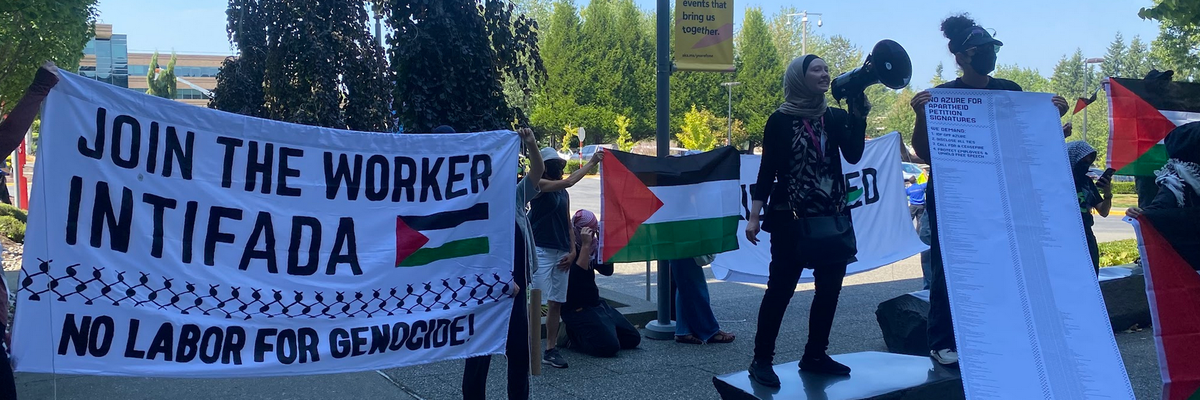

No Azure for Apartheid activists lead a rally outside Microsoft headquarters in Redmond, Washington on August 26, 2025.
(Photo by No Azure for Apartheid)


Brett Wilkins
Aug 27, 2025
COMMON DREAMS

Seven current and former Microsoft workers were arrested Tuesday after occupying the office of president Brad Smith to protest the company's complicity in "the first AI-powered genocide" as Israel kills and ethnically cleanses hundreds of thousands of Palestinians in Gaza.

The protesters gathered at Microsoft headquarters in Redmond, Washington and declared a "Liberated Zone" inside Building 34, which they renamed the Mai Ubeid building in honor of a Palestinian software engineer killed by Israel in Gaza in 2023. Demonstrators sounded noisemakers, draped banners, and delivered a "People's Court Summons" to Smith. They chanted, "Microsoft, Microsoft, you can't hide, we charge you with genocide!"

Seven protesters who locked themselves inside Smith's office were arrested by Redmond police. Other current and former Microsoft workers joined community members at a rally outside the building.

"Microsoft continues to militarize its campus to harass, brutally attack, and violently arrest its workers and community members," No Azure for Apartheid organizer and former Microsoft worker Abdo Mohamed told the Seattle Times.


The arrests came on the same day that Bloomberg revealed that Microsoft asked the Federal Bureau of Investigation for intelligence on pro-Palestinian protesters targeting the company, worked with local law enforcement in a bid to thwart demonstrations, and deleted internal emails containing protest details and words like "Gaza."

Tuesday's action followed a protest last week at which around 20 No Azure for Apartheid activists were arrested after setting up an encampment on the grounds of Microsoft headquarters. Earlier this month, protesters staged a demonstration at a Microsoft data center in the Netherlands that is reportedly being used by the Israel Defense Forces (IDF) to plan airstrikes on Gaza.

The No Azure for Apartheid protesters are calling on Microsoft to "cut ties with Israel, call for an end to the genocide and forced starvation, pay reparations to the Palestinians, and end the discrimination against workers."

"We are here because Palestine must be free, the genocide must end, the apartheid must end, and everything that's happened to the Palestinian people over the past 75 years must end," declared one No Azure for Apartheid organizer in a video of Tuesday's occupation that was posted online. "It must end and this is how we must end it. We must occupy the people who are letting it happen."

"We are here today not because we want to be here, it's because we need to be here," he said. "Brad Smith is the face of human rights at Microsoft. And yet Microsoft every day continues to abet this genocide."

"Every Palestinian phone call in the last few years has been stored on Microsoft servers," he continued as the other protesters shouted, "Shame!"

"That is a disgrace! That is untenable! There is no way to justify that," the protester asaid. "Every time we have come with these problems... Microsoft has dragged their feet."

The activist also pointed to Microsoft CEO Satya Nadella and the IDF's largest intelligence unit.


"Satya has dragged his feet. Brad has dragged his feet. Satya met with the head of Unit 8200 and that led to this plan to store Palestinian phone calls on Microsoft servers," he said.

A a joint investigation published earlier this month by The Guardian, +972 Magazine, and Local Call revealed that Unit 8200 is storing 11,500 terabytes of data containing roughly 200 million hours of Palestinians' phone call recordings on the Azure servers in the Netherlands. According to the article, former Unit 8200 head Yossi Sariel traveled to Microsoft headquarters in 2021 to meet Nadella.

"What happens as a result is that every phone call is recorded, it is transcribed from Arabic, it is translated, and it is used for targeting," the protester said.

Earlier this year, an Associated Press investigation detailed how Israeli forces are using artificial intelligence and cloud computing systems sold by US tech giants including Amazon, Google, Microsoft, and Open AI—which makes the popular ChatGPT chatbot—for the mass surveillance and killing of Palestinians in Gaza.

In addition to US tech, the IDF uses its own AI system called Habsora to automatically select airstrike targets at an exponentially faster rate than ever before. A November 2023 investigation by +972 Magazine and Local Call cited an Israeli intelligence source who said that Habsora has transformed the IDF into a "mass assassination factory" in which the "emphasis is on quantity and not quality" of kills.

Following the Hamas-led attack of October 7, 2023, IDF officers were told they could order any number of strikes as they believed were legal, with no effective limits on civilian harm. This led to massacres in which dozens or more civilians were killed in single strikes, often using US-supplied 1,000- and 2,000-pound bombs.

Microsoft said earlier this month that it has launched an investigation into how Unit 8200 is using Azure. This, after the company said in May that an internal review "found no evidence to date that Microsoft's Azure and [artificial intelligence] technologies have been used to target or harm people in the conflict in Gaza."

Big Tech's profiteering from Israel's annihilation of Gaza and occupation, settler colonization, and apartheid in the West Bank has sparked numerous protests, including by employees of complicit companies. At least dozens of workers at companies including Google, Meta, and Microsoft have been fired for Palestine advocacy. Others have resigned in protest.

Hossam Nasr, a former Microsoft software engineer, was fired after organizing an October 2024 "No Azure for Apartheid" vigil. Microsoft engineer Ibtihal Aboussad and another worker, Vaniya Agrawal, were fired after interrupting speeches by company executives.

Responding to Tuesday's protest, Smith said, "Obviously, when seven folks do as they did today—storm a building, occupy an office, block other people out of the office... that's not okay."

"There are many things we can't do to change the world, but we will do what we can and what we should," Smith added. "That starts with ensuring that our human rights principles and contractual terms of service are upheld everywhere, by all of our customers around the world."

Tuesday's protest came as the IDF ramped up Operation Gideon's Chariots 2—the US-backed campaign to conquer and occupy Gaza and ethnically cleanse around 1 million Palestinians—and amid a worsening famine that has killed hundreds of people, many of them children.
Germany’s declaration to stop sending weapons to Israel: symbolic gesture or major shift?

While Chancellor Friedrich Merz's announcement that Germany is stopping arms deliveries to Israel made international headlines as a shocking policy reversal, the details tell a different story.
August 27, 2025 
MONDOWEISS

German Chancellor Friedrich Merz arriving in the Netherlands for the 2025 NATO Summit on June 24, 2025. (Photo: Ministerie van Buitenlandse Zaken, CC BY-SA 4.0 , via Wikimedia Commons)


While German Chancellor Friedrich Merz’s announcement on Friday, August 8 to halt arms deliveries to Israel grabbed international headlines as a shocking policy reversal, the declaration’s fine print tells a different story. What appeared to be a major shift in Germany’s support for Israel’s genocide in Gaza may prove largely symbolic, with crucial loopholes that allow German companies to continue to profit from the atrocities in Gaza.

The devil lies in the details that most media coverage overlooked. According to media organization Jung und Naiv, the government’s statement apparently applies only to future contracts, leaving existing export permits uncanceled—a crucial caveat also noted by Oded Yaron in Haaretz. This means the vast majority of German weapons flowing to Israel will continue uninterrupted.

Merz qualified his statement by saying only weapons used in Gaza would be stopped, while Germany continues broader military cooperation. This became immediately apparent: on the same day as Merz’s declaration, German arms company ThyssenKrupp announced at its shareholder meeting that the German government had issued the second export license for INS Drakon, the final submarine in Israel’s fleet, which is sold for about 500 million Euros.

Germany’s strategic importance to Israel’s war machine

Germany’s role in Israel’s military operations cannot be understated. As Israel’s second-largest weapons supplier after the United States, Germany provided approximately 30% of Israel’s weapons from 2019-2023, according to the Stockholm International Peace Research Institute (SIPRI).

German weapons exports to Israel include submarines, Saar-6 corvettes, Matador shoulder-mounted missiles, engines and gearboxes for Merkava tanks, propellants and detonators for 155mm artillery shells, rifle scopes, and HeronTP combat drones, which were manufactured by Israel, leased to Germany and then returned to Israel for the purpose of bombing Gaza. German shipping companies transport explosives and rocket engines to Israel. German companies also provide technology transfer through joint ventures, such as the development of 155mm self-loading howitzer cannons between Rheinmetall and Israeli company Elbit Systems. Unconfirmed reports of small-caliber ammunition and 120mm tank shell sales remain under investigation.

Crucially, Israel depends desperately on German components and ammunition that U.S. companies, already stretched by orders from Ukraine and Europe’s rapid militarization, are unable to provide. The limiting factor is the materials that must be imported, whose prices are soaring on the global markets. Germany also hosts subsidiaries of Israel’s three biggest arms companies, which manufacture weapons and components for the parent companies in Israel. This dependency makes Germany’s role not just significant, but irreplaceable in key areas.

Industrial genocide and German tech

Israel’s genocide in Gaza is an industrialized genocide. Investigative reporter Yuval Avraham exposed in November 2023 how Israel deployed surveillance and artificial intelligence to generate tens of thousands of bombardment targets in Gaza. His follow-up reporting in April 2024 revealed that this automated system had depleted Israel’s ammunition stores.

German technology proves essential to the efficiency of Israel’s killing machine. The deadliest weapon Israel has used against Gaza is the 155mm howitzer artillery, and German technology enables the deadly efficiency of loading 45-kilogram (99-pound) shells into cannons, aiming and firing without pause, 24 hours per day. This relentless bombardment capability depends directly on German engineering.

The human cost of this German-enabled efficiency is devastating. German Renk engines power the Merkava tanks that killed 6-year-old Hind Rajab, her family, and the paramedics who came to rescue her on January 29, 2024. These same tanks participated in the Flour Massacre of February 29, 2024, and continue shelling hungry Palestinians at aid distribution centers.

Loopholes and workarounds


German company Sig Sauer, which supplies machine guns for Israeli infantry forces in Gaza, produces them in the United States and thus remains completely unaffected by Merz’s declaration. Similarly, German arms company Renk has announced it’s considering moving production to the United States to avoid any restrictions, with Israel’s Ynet reporting this as a foregone decision.

Under the Arms Trade Treaty (ATT), which Germany signed, the decisive factor is the territory from which weapons are physically delivered, not which country owns the manufacturing subsidiary. This creates obvious opportunities for circumvention that arms manufacturers are already exploiting.

A symbolic gesture

TheMarker’s podcast called Merz’s statement a sign of growing global opposition to Israel’s Gaza operations, incorrectly suggesting Israel could simply purchase what it needs from the United States. This misses the critical point: Germany’s unique role in providing components that American companies cannot currently supply makes any genuine German embargo potentially significant.

However, the policy, as announced—affecting only future contracts while preserving existing permits and providing multiple corporate escape routes—suggests political theater rather than substantive change. Real policy transformation would require canceling existing export licenses, including all weapons and dual use items, and imposing a three-way embargo: banning the sale, import, and transit of arms to Israel as prescribed by international law.

Until Germany addresses these fundamental gaps, Merz’s declaration remains largely symbolic—a gesture that generates headlines while preserving the deadly status quo that continues to fuel the destruction in Gaza.

BDS

Iowa City Council passes Israel divestment resolution

On August 5, the Iowa City Council unanimously voted to boycott and divest from Israel bonds and all companies complicit in the Gaza genocide and occupation of Palestine.
August 20, 2025  
MONDOWEISS

Iowa City (Iowa City Action For Palestine Facebook)


Earlier this month, the Iowa City Council unanimously approved a resolution that bars the city from directing any public money toward any entity “complicit in the current and ongoing humanitarian crisis in Gaza and occupation of Palestine,” including corporate investments and Israel Bonds.

“Tonight is a resolution that is rooted really in our community values of what we really stand for, which is peace, justice, dignity for every human,” Mayor Bruce Teague told the crowd at the City Council meeting. “This resolution does call for the city of Iowa City to boycott public investments and entities complicit in the ongoing humanitarian crisis (in) Gaza, including assistance and the oppression of the Palestinian people. I have no issues calling it what it is. It’s genocide, and that does not make me antisemitic at all.”

The chamber was packed with supporters, but Uchechi Anomnachi, a member with Iowa City Action For Palestine, says activists certainly didn’t view victory as a foregone conclusion.

“The meeting itself is actually not representative of how uncertain this seemed while we were working on it,” says Anomnachi. “We went into the meeting thinking, ‘This could go either way”’- and then a hundred people showed up to support us, and we could see the council members’ gears turning as they realized that it wasn’t politically viable to vote no in that room.”

Mondoweiss U.S. correspondent Michael Arria spoke with Anomnachi about how the resolution process developed, what Palestine activism looks like in Iowa, and what other ‘red state’ activists could learn the victory.

Mondoweiss: Can you explain the organizing around the resolution and the process to get it in front of city council?

Anomnachi Uche: The resolution prevents the city from making investments in companies that are on the American Friends Services Committee (AFSC) divestment shortlist.

The city has a certain number of securities investments, which means that it cannot trade securities with these companies. We wanted to look at the city government as a wealth fund because, in some ways, it is, and we wanted to think about how we could introduce BDS principles to the way that the city chooses its investments.

We worked with the city manager in the lead-up to it. We were inspired by a similar resolution that passed in Portland, Maine, in 2024. The resolution we passed is almost identical to the one in Portland, with some tweaks to make it more specific to Iowa City.

Iowa City passed a ceasefire resolution in January 2024, only a few months after the Al-Aqsa flood. That resolution had “both sides” language, so it was very of the moment.

With this one, we wanted the city to have a record of strongly condemning the violence perpetrated by Israeli settlers specifically, so we changed the language of the Portland resolution to reflect that position more strongly.

Then, we started investigating the city’s investment holdings. The city does trade securities. The city manager releases a quarterly report, and we dug through the report to see with whom the city was invested. The city was not invested with companies on the AFSC divestment shortlist. So we refocused towards this language of boycotting and wanted to make a public statement to block the council from investing in certain companies in the future.

I have to imagine a lot of our readers aren’t familiar with politics and activism in Iowa. Can you talk about the state of Palestinian organizing and some of the activism around this issue?

This isn’t really comprehensive because I obviously don’t know about everything that’s going on in the state, but activism surrounding Palestine in Iowa is so grassroots.

A group will spring up in Iowa City, Cedar Rapids, in the Quad Cities, and it will serve as a real point of genuine connection for people whose awareness of this issue has increased and who previously felt like there was nothing they could do about it.

This resolution was possible because of an emergency election in January, in which our totally awesome punk rocker city councilman, Oliver Weilein, won against an establishment Democrat.

The thing that has marked a lot of the politics here is a reactive posture to the state government, but this resolution was something proactive. It was a way for a ‘blue city’ to set what the state of blue politics looks like in Iowa and a way for us to keep Palestine in that conversation.

Iowa City has reputation as a progressive city in a deeply red state. The Iowa Republicans like to derisively call the County we’re in Johnson County, the People’s Republic of Johnson County. However, we’re still lagging behind in terms of Palestine fitting into that progressive platform.

Multiple Palestine groups in Iowa City worked on this issue; it was a coalition effort.


I belong to a group called Iowa City Action For Palestine, a newer organization that formed during the January 2024 push for a ceasefire resolution. That took a lot of hard work from a lot of committed people, but it also underscored how much more work there was to be done.

Even before 2024, there have been Palestinian community members in Iowa City who advocate for this as part of their everyday lives, including real OGs in in Palestine organizing who have been doing this work for 10-20 years.

We had a lot of help from another group, Iowans for Palestine, which has fought to keep this issue at the forefront of progressive politics in the city. Then there’s Jewish Voice for Peace of Eastern Iowa, which was a big coalition partner as well.

In many ways, Palestine activism was latent in Iowa City, but October 7 brought a renewed sense of purpose to many people who anticipated what was coming. Even beyond our blue bubble more broadly, I know there are people in Des Moines, there are people in the Quad Cities, people in Cedar Rapids working on this and we make an effort to support each other’s work, share knowledge, and resources.

Were the lawmakers who voted for this on board right away or was it a process in terms of getting them to that point?

It was definitely a process. Like I said, politics here is very reactive. There was a lot of worry about some sort of retaliation from the state government, which was always a very vague and amorphous worry.

We started out knowing that we had two city councilors out of seven who had made Palestinian human rights a centerpiece of their platforms and understood the conditions that we were trying to organize against. Weilein, and Mazahir Salih, who was the first Sudanese-American ever elected to public office back in 2017.

The two of them helped tremendously with getting, not just city politicians, but the city as an institution on board. They took meetings with the city attorney and the city manager.

We had a working group for the campaign that met very regularly. We planned out talking points. We were careful to include some things in the resolution that we could sacrifice if needed to get it passed. Weilein kept us up-to-date on what the talk was like in City Hall, so we could react very quickly to changes in attitudes.

We flyered neighborhoods for an email campaign, which eventually got drowned out when CUFI caught wind of it and started spamming councilors with thousands of emails.

The process in Iowa City specifically requires either the mayor or three city councilors to place any resolution on the agenda, and we were confident that we would have those three required to place it on the agenda.

The fourth vote that we targeted was the mayor, who believes strongly in the principles of diversity and, I think, really wants to see human rights protected in Iowa City. I think he felt maybe ignorant of the issue or fearful of how people would respond, originally.

There was definitely an effort to get people on board and make them see or feel that this was something worth standing up for. In the end, we are seeing a larger shift in public opinion on this issue that I think some people weren’t aware of. They had this fear of retaliation, but we had to keep reminding our mayor and our city councilors is that they have this power that has been vested in them to direct the finances of the city. That is discretionary power that the city council has. If the city council did not have that power, it would not be a body with any power, really.

We hope to keep building power at the grassroots level and bring this to representatives of the people directly because we know that the people are on our side. People don’t want to see what they’ve been seeing for the last two years, during this genocide.

What would you say to other people who want to organize around this issue, but are also living in Republican-controlled states where it seems like the odds are against them?

The biggest thing that I’ve learned through this process is that you have to ask for more.

We were dealing with a progressive city council in a progressive city, and we got what we asked for in terms of city investments, but there’s obviously still more for us to ask for. There’s still more levels at which we hope we can affect change.

These state governments want you to believe that you’re not allowed to ask for these things and that you can’t organize a boycott, but we’ve realized it’s totally feasible.

People asked [Iowa Governor] Kim Reynolds’s office for a comment on the resolution and she just said, “We support Israel.”

I’m assuming that by “we” she meant Iowans, but we want her to make her feel alone in saying that. We have the power at the grassroots to counteract whatever monetary benefit the state can provide by taking our money back. We can make it clear that the people don’t support Israel.

Whatever way you can do that in your red state is worth doing because even if the other shoe drops, you cannot put that genie back in the bottle. A boycott announces principles as something that guides your actions. Even if the state does organize some way to prevent or counteract your boycott, the principles that guide the action still stand.
Israel wanted to punish a Palestinian village. So it destroyed 10,000 of its olive trees.

Israel uprooted 10,000 olive trees in al-Mughayyir during a three-day siege of the West Bank Palestinian village. The Israeli army stated that uprooting the trees was intended to “deter” village residents and make them “pay a heavy price.”
 August 26, 2025 
MONDOWEISS

Palestinian residents of al-Mughayyer inspect damage caused by the three-day Israeli siege on the village, August 25, 2025. (Photo: Anne Paq/Activestills)

Israel just decimated the olive groves of the Palestinian village of Mughayyir, northeast of Ramallah, where olive oil production is an important part of the yearly income of most families. The Israeli army had imposed a curfew on the village last Thursday and began to search homes, arresting an unspecified number of Palestinians, including the village mayor, Ameen Abu Alia, over the course of three days. The siege on al-Mughayyir came following reports that an Israeli settler had been attacked near the village, after which the Israeli army’s bulldozers uprooted some 10,000 olive trees in the eastern plain of the village, according to the local farmers’ association. Some of the trees were up to 100 years old.

The Israeli army said that the curfew and destruction of the village’s farmland were aimed at capturing the attacker, but Israeli daily newspaper Haaretz quoted the Israeli army’s central command chief saying that “uprooting the trees was intended to deter everyone. Not just this village, but any village that tries to raise a hand against the [Israeli settler] residents.” The Israeli commander reportedly said that “every village should know that if they commit an attack, they will pay a heavy price and will be under curfew and surrounded.”

The village of Mughayyir has been in the crosshairs of the Israeli army and settlers for at least two years. Since October 2023, Israeli settlers have attacked Mughayyir multiple times, with the largest attack taking place in April 2024, during which settlers damaged farming barracks and homes, and killed one Palestinian who was defending his home from his rooftop. The Israeli army increasingly restricted the villagers’ access to their farmlands, especially their eastern olive crops, eventually making the entire eastern plain of the village inaccessible for Palestinians.

The village overlooks the slopes of the Jordan Valley right next to the Israeli Allon road — established in the early 1970s — that cuts across the eastern part of Palestine from north to south, running parallel to the edge of the Jordan Valley. Since 2019, the Israeli government has declared its intention to annex the entire area east of the Allon road, including all of the Jordan Valley.

Israeli settlers have ramped up their attacks on rural Palestinian communities in these areas since October 2023, expelling dozens of Bedouin families and emptying the area of any Palestinian communities. In recent months, Israeli settlers and the Israeli army have concentrated on harassing the villages adjacent to the Israeli road, restricting Palestinians’ movement and access to their lands.
Livelihoods uprooted

“At around 8:30 in the morning, the occupation army entered the village and imposed a curfew, and then they began to go into homes and search them,” Fayez Jabr, a farmer and villager in al-Mughayyir, told Mondoweiss. “Some homes were searched three or four times, and the occupation army arrested many young men and the mayor. Meanwhile, the occupation’s bulldozers went on to uproot olive trees in the eastern plain.”

“They uprooted thousands of trees in an area of four square kilometers, which represents up to half of Mughayyir’s olive production,” Jabr continued. “All the families of the village have been affected.”

Jabr added that the Israeli army also destroyed olive crops in other parts of the village’s farmland. “Four months ago, they uprooted 80 olive trees belonging to me and my cousin in the west of the village,” he said, indicating that the Israeli army confiscated farmland in the southern part of the village to construct a new settler road meant to connect to a settler outpost that had been recently established over a children’s park belonging to the village.

“Our farmlands in the south of the village were confiscated, and we have restricted access to farmland in the west,” Jabr detailed. “The most important farmland in the eastern plain has now been bulldozed.”

Jabr noted that the only olive trees left for the villagers were in the immediate surroundings of the village, around and between houses. “Before October 2023, my family and I used to make up to 80 tanks of olive oil, 16 liters each,” he reflected. “But in the past two seasons, we barely made 10 tanks.”

With the annual olive harvest less than two months away, the destruction of such a vast number of olive trees will impact an already struggling local industry. “We’ll be lucky if we make two tanks this year,” Jabr said.

The Israeli army’s ramping up of attacks on Palestinian farmland in the West Bank has escalated alongside the increasing expansion of Israeli settlement plans. Last week, the Israeli government approved the building of new settler neighborhoods in a strategic tract of land in the West Bank east of Jerusalem, known on Israeli maps as E-1. The plan is part of Israel’s larger objective of separating the north and center of the West Bank from the south to erase the territorial contiguity of a potential Palestinian state, including through a recently approved infrastructure project that would redirect Palestinian movement in the E1 area through a network of tunnels.

The E-1 settlement plan would see the connection of the illegal Israeli settlement of Maale Adumim to Jerusalem, expanding Israeli settler presence between Jerusalem and the Jordan Valley, and effectively splitting the West Bank in two. According to Israeli finance minister Bezalel Smotrich, the plan would “erase the Palestinian state with actions, not words.”

Meanwhile, Israeli settlers have been increasing their attacks against Palestinians across the West Bank. According to the UN Office of Coordination of Humanitarian Affairs (OCHA), “the monthly number of Palestinians injured by Israeli settlers more than doubled in June and July 2025 (about 100) compared with an average of 49 per month between January and May 2025 and 30 per month in 2024.”

Since October 2023, Israeli forces and settlers have killed at least 1,000 Palestinians in the West Bank, while Israeli forces have arrested more than 10,000.


Nearly 80% of whale sharks in this marine tourism hotspot have human-caused scars


Human-caused injuries are common in endangered whale sharks off Indonesian Papua, but simple changes to local fishing practices could help protect them

Frontiers

Whale sharks 

image: 

Whale shark in Cendrawasih Bay

view more 

Credit: M.V. Erdmann


Whale sharks, the largest living fish species, are classified as endangered on the IUCN Red List of Threatened Species. Over the past 75 years, populations have declined by more than 50% worldwide, and by up to 63% in the Indo-Pacific region. Because whale sharks take up to 30 years to become sexually mature, populations can only recover slowly from threats like hunting for fins, meat, and oil, habitat loss, and entanglement in fishing nets.

Now, an international group of researchers has shown that in the Bird’s Head Seascape off Indonesian West Papua, 62% of whale sharks have scars and injuries from preventable human causes. They argue that simple interventions could greatly lessen this burden on the local population of these gentle giants.

“We found that scars and injuries were mainly from anthropogenic causes, such as collisions with ‘bagans’ – traditional fishing platforms with lift nets – and whale shark-watching tour boats,” said Dr Edy Setyawan, the lead conservation scientist at the Elasmobranch Institute Indonesia, and the study’s corresponding author.

“Relatively harmless minor abrasions were the most common. Serious injuries from natural causes such as predator attacks, or from boat propellers were much less common."

Whale shark spotting

Between 2010 and 2023, Setyawan and colleagues studied presence by whale sharks to Cenderawasih Bay, Kaimana, Raja Ampat, and Fakfak within the Bird’s Head Seascape, a region hosting a network of 26 marine protected areas and a hotspot for marine megafauna and tropical marine biodiversity. Each whale shark sports its own unique pattern of white spots and stripes, which enabled the scientists to use photos by researchers and citizen scientists to identify each one individually. Setyawan et al. also recorded the date and time of each sighting, its GPS coordinates, the shark’s sex and maturity status, size, behavior, and any visible injuries.

Over this period, they observed a total of 268 unique whale sharks, of which 98% were sighted in Cenderawasih Bay and Kaimana. Whale shark sightings were almost exclusively seen near bagans, where they typically fed on baitfish like anchovies, herrings, and sprats – either swimming horizontally or in a vertical heads-up position. They were also observed to suck fish directly from bagans, which often damaged the nets. Most sighted individuals were juveniles between four and five meters long, while 90% were males.

52.6% of whale sharks were resighted at least once, up to 11 years apart. The record holder was a young male which was recorded 34 times over three years.

Of the 206 sharks recorded with injuries or scarring, 80.6% exhibited injuries that were attributed to human-made causes, while 58.3% had injuries that were likely from natural causes (note: some individuals had both anthropogenic and natural injuries). Serious lacerations, amputations, and evidence of blunt trauma from anthropogenic causes were relatively rare, observed in 17.7% of individuals. However, non-life-threatening abrasions were common and frequently due to whale sharks rubbing against bagans or boats.

Other fish in the sea

But where did the females, and older, sexually mature individuals hang out? The researchers have a good inkling.

“Previous studies from around the world have shown that adult whale sharks, especially females, prefer the deep ocean where they feed on prey like krill and schooling fish, while the younger males stay closer to shore in shallow, plankton-rich waters that help them grow quickly,” said co-author Mochamad Iqbal Herwata Putra, a senior manager at the Focal Species Conservation Program of the national foundation Konservasi Indonesia.

“Our own satellite tracking data also show that females and adults frequently use deep sea features such as canyons and seamounts.”

“Whale sharks in Cenderawasih Bay and Triton Bay (Kaimana) had high rates of residency and resighting, indicating that they should be viewed as valuable tourism assets for local communities and governments,” said Dr Mark Erdmann, the study’s last author and Shark Conservation Director for Re:wild.

Since the majority of the whale shark sightings took place at bagans, at a time when whale shark tourism is growing, the researchers expect the risk of injuries from bagans and boats to increase in the future – unless simple steps are taken to protect the whale sharks better.

“We aim to work with the management authorities of the marine protected areas to develop regulations to require slight modifications to the bagans, including the removal of any sharp edges from boat outriggers and net frames. We believe those changes will greatly reduce scarring of whale sharks in the region," said Erdmann.

ARACHNOLOGY

Spider uses trapped fireflies as glowing bait to attract more prey


British Ecological Society

Sheet web spider with fireflies caught in web 

image: 

Sheet web spider with fireflies caught in web

view more 

Credit: Tunghai University Spider


Ecologists have observed a species of nocturnal spider attracting prey to its web using the bioluminescent beacons of already trapped fireflies. This rare example of a predator exploiting its prey’s mating signal for its own gain is documented in the British Ecological Society’s Journal of Animal Ecology.

Researchers at Tunghai University, Taiwan have observed sheet web spiders Psechrus clavis capturing fireflies in their webs and leaving them there while they emitted bioluminescent light for up to an hour. The researchers even observed the spiders going to check on the captured fireflies from time to time.

Intrigued by this unusual behaviour the researchers set up an experiment to test whether this was a strategy used by the spiders to increase their hunting success. In the experiment, they placed LEDs that resembled fireflies, in real sheet spider webs and left other webs clear as controls.

They found three times the amount of prey was attracted to webs with the LEDs compared to the control webs. This increased to ten times more prey when they only looked at fireflies being captured.

The findings confirm that captured fireflies left as bait increase the hunting success rate of the spiders. The researchers also noticed that the majority of captured fireflies were male, who were likely mistaking the glow for potential mates.

Dr I-Min Tso, the lead author of the study said: “Our findings highlight a previously undocumented interaction where firefly signals, intended for sexual communication, are also beneficial to spiders.

“This study sheds new light on the ways that nocturnal sit-and-wait predators can rise to the challenges of attracting prey and provides a unique perspective on the complexity of predator-prey interactions.”

The researchers suggest that this behaviour could have developed in sheet web spiders to avoid costly investment in their own bioluminescence like other sit-and-wait predators, such as anglerfish. Instead, the spiders are able to outsource prey attraction to their prey’s own signals.

The sheet web spider Psechrus clavis is a nocturnal sit and wait predator found in subtropical forests of East Asia. It’s main source of prey, the winter firefly Diaphanes lampyroides, uses continuous, non-flashing bioluminescence to attract mates.

Video footage captured by the researchers in their experiment shows sheet web spiders employing different strategies when interacting with different prey species. Spiders would immediately consume any moths captured in their webs but would not immediately consume fireflies they captured.

“Handling prey in different ways suggests that the spider can use some kind of cue to distinguish between the prey species they capture and determine an appropriate response.” explained Dr I-Min Tso. “We speculate that it is probably the bioluminescent signals of the fireflies that are used to identify fireflies enabling spiders to adjust their prey handling behavior accordingly.”

The researchers conducted their field experiment in the conifer plantation forest at National Taiwan University’s Xitou Nature Educational Area.

Because they used LEDs to mimic the light signal emitted by fireflies, the researchers warn that although the wavelength and intensity of the LED set up was a close match to fireflies, it would be best if real fireflies were used in the field experiment. But they admit that this would be extremely difficult in practice.

-ENDS-


How AI can build bridges between nations, if diplomats use it wisely


AI is already changing the way many of us work, but in the delicate art of diplomatic relations between nations, a former diplomat has warned colleagues to be careful using the tool


Taylor & Francis Group


Dr Donald Kilburg, who was a member of the US Department of State, says the technology is already shaping work for the likes of embassy officials whose jobs are to protect their country’s interests abroad.

But the US army veteran and retired professor warns that algorithms cannot ‘read the room’, and can’t replicate the ‘empathy, intuition and deep cultural understanding’ of human diplomats.

He says: “AI can streamline diplomacy, but only humans bring the empathy and intuition that make negotiations succeed. Used wisely, AI can help diplomats get ahead and build stronger bridges between nations.”

The technology must be carefully monitored otherwise AI could ‘escalate tensions’ or miss ‘crucial cultural nuances’ during sensitive situations, he adds.

His book AI Use Cases for Diplomats cautions that basic notions of diplomacy and sovereignty are being challenged by the rise of AI.

As such, the author – who spent more than 20 years in foreign affairs – urges policymakers to act now to ensure AI does not replace human diplomacy but instead amplifies ‘its highest aspirations’.

“While they (AI systems) can draft initial responses to routine diplomatic communications or summarize lengthy policy documents in seconds, they lack the nuanced understanding of diplomatic protocol and cultural sensitivities that experienced diplomats possess,” says Dr Kilburg, who was a Public Affairs Officer in the Bureau of Global Public Affairs.

“Over-reliance on AI, in scenarios where human qualities are essential, risks undermining the very objectives of diplomacy.

“It is therefore critical for embassies and diplomatic missions to establish clear boundaries for AI use. This would ensure that technology serves as a complement to, rather than a replacement for, human expertise.”

AI Use Cases for Diplomats is a practical field manual for diplomats and policymakers, showing how to harness AI to strengthen diplomacy while keeping human judgment at the center. It covers all aspects of AI use in diplomacy including security and consular affairs.

The author describes diplomacy as ‘building bridges between nations through dialogue and negotiation’ and that AI is reshaping the terrain upon which statecraft operates in the age of TikTok and Twitter.

But he is optimistic that the technology has ‘transformative’ potential, from sharpening negotiation strategies to enabling unprecedented global collaboration. It can combat cyberattacks, detect deepfakes and overcome other modern challenges by providing solutions which go beyond traditional diplomatic approaches.

He explains: “The genie is out of the bottle, diplomats don’t have the option to ignore AI. The real challenge is to take hold of it now and learn to use it wisely.”

However, the book says the issue facing modern diplomats isn’t just learning to use AI effectively but when not to use the technology. This is especially an issue if algorithms are trained on Western diplomatic traditions, says the author.

AI can process vast amounts of data but Dr Kilburg says it can’t grasp, for example, ‘the emotional weight of a grieving mother’s testimony’ in peace negotiations. As such, the author identifies three areas for action – training and development, ethical frameworks, and global cooperation.

He recommends that diplomatic institutions such as embassies invest in AI training programmes that balance technical skills with ethical awareness. Core values to follow in the event of ethical dilemmas must be based on diplomatic principles but also evolve with technology, adds Dr Kilburg who has a degree in experimental psychology.

As for global cooperation, he writes that climate change and other pressing issues mean coordinated global action is needed. AI can enable this but only if nations work together ‘to ensure equal access and ethical deployment’.

As AI and technology become part of everyday life, Dr Kilburg says the essential question facing those engaged in the art of statecraft is: “Will tomorrow’s diplomats represent nations – or algorithms?”