Thursday, August 28, 2025

Opinion...

Zionism’s modern atrocities echo the horrors of Nazism

In truth, Zionism remains the last active settler-colonial project of the modern era. It is built on the bedrock of dehumanisation and elimination.


Protesters carry placards and Palestinian flags during the pro-Palestinian demonstration in Warsaw, Poland on August 17, 2025. [Jakub Porzycki – Anadolu Agency]

by 
Dr Aayesha J Soni,
AayeshaJ
August 25, 2025
MEMO


On 29 January 2023, the world heard the haunting final call of six-year-old Hind Rajab before she was killed by Israeli forces in Gaza. Trapped in a car surrounded by the bodies of her relatives, Hind pleaded for help as an Israeli tank loomed nearby. Hours later, the two paramedics who had secured permission to rescue her, Yousef Zeino and Ahmed Al-Madhoun, were themselves killed when their ambulance was bombed.

Hind Rajab was not just another casualty of war. She is Gaza’s Anne Frank — a child whose final moments testify to the brutality of our age. Just as Anne’s diary bore witness to Nazi persecution, Hind’s voice, cut short, records the atrocities committed under the banner of Zionism. Today, Israel’s actions in Gaza amount to a modern-day genocide, carried out with a cold inhumanity unprecedented in this century. The time has come to recognise Zionism for what it has become: a supremacist ideology with chilling parallels to Nazism.


The roots of Zionism


Zionism, founded in the late 19th century by the secular nationalist Theodor Herzl, emerged as a political project rather than a purely religious one. Cloaked in the language of Jewish self-determination, it quickly assumed the features of a colonial, exclusivist ideology — embedding racism, dispossession and, later, apartheid into its foundations.

By 1948, as the State of Israel was declared, Zionist militias unleashed terror campaigns that displaced more than 750,000 Palestinians — an event remembered as the Nakba (“catastrophe”). Villages were massacred, homes destroyed, and families driven into exile. To put this in perspective: in 1917, Arabs constituted 90% of the population of historic Palestine, while Jews represented about 10% and owned just 2% of the land.

The subsequent creation of Israel was never grounded in international legality. The League of Nations’ mandate on Palestine did not envision sovereignty for one ethnic or religious group at the expense of another. However, the conceptual “land of Israel”- exclusively white Jewish- has transformed into a modern-day reality. The Palestinian Arabs and North African Jews are treated as second-class citizens in Israel. While Jews worldwide enjoy the “right to return” and full Israeli citizenship, it is denied to the Arab Israelis and Ethiopian Jewish migrants to Israel even had their women subjected to forced sterilisations.


The supremacy of Zionism

Zionism today functions as an ideology of supremacy. Its defenders often insist that opposition to Zionism equals antisemitism. But this conflation collapses under scrutiny. There are more than 5,000 ethnic groups worldwide and only 193 recognised states. Few have achieved national sovereignty, and most ethnic movements had to integrate into broader, civic forms of nationalism.

For Palestinians, however, even the most basic right to self-determination has been systematically denied. Instead, Zionism has entrenched a system of dispossession, illegal settlements, and military occupation. It presents itself as a liberal democracy but, in reality, operates as a settler-colonial regime sustained through violence and exclusion.

Gaza and the modern face of atrocity


Since October 2023, Israel’s assault on Gaza has revealed, in stark detail, the true nature of this regime. Under the pretext of “self-defence,” it has systematically devastated the enclave: nearly 63,000 Palestinians killed, including more than 18,500 children; 2200 entire families erased; and civilian infrastructure reduced to rubble.

Israel has dropped 2,000-pound bombs on refugee camps, starved two million people as a weapon of war, and targeted humanitarian convoys — from the World Central Kitchen to the World Food Programme. Three American doctors who volunteered in Gaza described a chilling pattern of sniper-inflicted gunshot wounds to the heads and chests of children under 12. The deliberate targeting of children is not an accident of war — it is policy.

Almost every major humanitarian organisation — Amnesty International, Human Rights Watch, Médecins Sans Frontières, UNICEF, Oxfam, Christian Aid, and even the International Court of Justice — has condemned Israel’s offensive as a gross violation of international law, and in many instances, as genocide. Alarmingly, Israel has disregarded almost every clause of the Geneva Conventions and the Rome Statute.


Victimhood as strategy

Israel is perhaps the only colonial occupier in history that consistently positions itself as the eternal victim. The pattern is predictable: strike first, claim victimhood, and repeat. Whether in the mass killing of Palestinians or the assassination of Iranian scientists, Israel relies on a sophisticated propaganda machine and diplomatic alliances to reframe aggression as self-preservation.

In truth, Zionism remains the last active settler-colonial project of the modern era. It is built on the bedrock of dehumanisation and elimination.

The Holocaust, one of history’s greatest crimes, should serve as a universal warning against genocide. Instead, its memory is routinely invoked to sanitise Israel’s persecution of Palestinians and any condemnation of Israel’s actions is dismissed as antisemitism.

Let us be clear: antisemitism in all its forms must be condemned. But conflating antizionism with antisemitism is propaganda designed to shield Israel from accountability. At this historical moment, Israel does not need more indulgence — it needs uncompromising criticism.
Conclusion: Naming Zionism

There is no escaping the comparison. The systematic killing of children, the use of starvation as a weapon of war, the erasure of entire families and communities — these acts recall the darkest chapters of the 20th century. Nazism has been reincarnated in the form of Zionism, an ideology that mirrors its supremacist logic and genocidal consequences.

Zionists should be named and shamed in the same way that Nazi or apartheid sympathisers were. Only when society refuses to normalise such ideologies — when they are confronted with collective outrage and moral rejection — can their destructive power be broken.

The views expressed in this article belong to the author and do not necessarily reflect the editorial policy of Middle East Monitor.


ZIONISM IS ISLAMOPHOBIA

Israeli Government Social Media Urges Europe to 'Remove' Muslims

"What would the reaction would be if an Arab state wrote this about synagogues and Jews?" asked one critic.


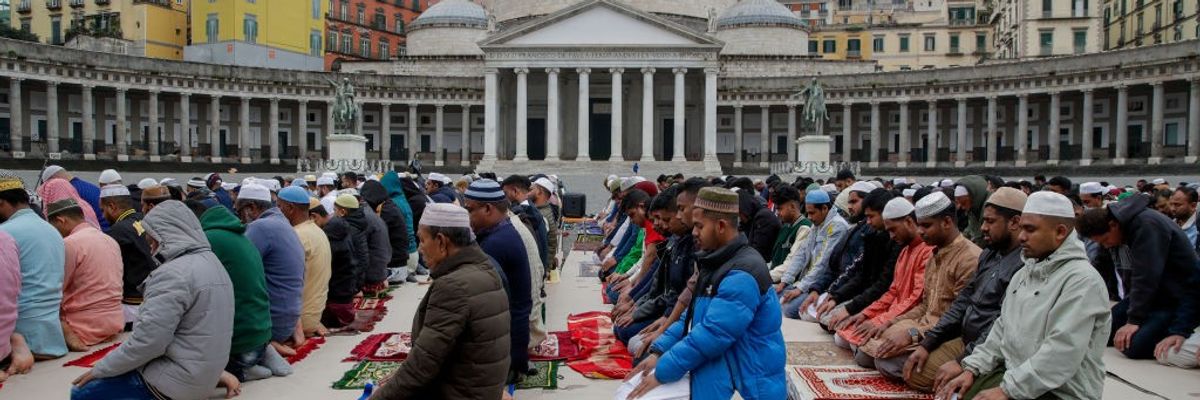
Muslims pray in Plebiscito Square in Naples on April 10, 2024.
(Photo by Salvatore Laporta/KONTROLAB/LightRocket via Getty Images)

Brett Wilkins
Aug 27, 2025
COMMON DREAMS

Israel faced backlash this week after its Arabic-language account on the social media site X published a message warning Europeans to take action against the proliferation of mosques and "remove" Muslims from their countries.

"In the year 1980, there were only fewer than a hundred mosques in Europe. As for today, there are more than 20,000 mosques. This is the true face of colonization," posted Israel, a settler-colonial state whose nearly 2 million Muslim citizens face widespread discrimination, and where Palestinians in the illegally occupied territories live under an apartheid regime.

"This is what is happening while Europe is oblivious and does not care about the danger," the post continues. "And the danger does not lie in the existence of mosques in and of themselves, for freedom of worship is one of the basic human rights, and every person has the right to believe and worship his Lord."

"The problem lies in the contents that are taught in some of these mosques, and they are not limited to piety and good deeds, but rather focus on encouraging escalating violence in the streets of Europe, and spreading hatred for the other and even for those who host them in their countries, and inciting against them instead of teaching love, harmony, and peace," Israel added. "Europe must wake up and remove this fifth column."


Referring to the far-right Alternative for Germany party, Berlin-based journalist James Jackson replied on X that "even the AfD don't tweet, 'Europe must wake up and remove this fifth column' over a map of mosques."

Other social media users called Israel's post "racist" and "Islamophobic," while some highlighted the stark contrast between the way Palestinians and Israelis treat Christian people and institutions.

Others noted that some of the map's fearmongering figures misleadingly showing a large number of mosques indicate countries whose populations are predominantly or significantly Muslim.

"Russia has 8,000 mosques? Who would've known a country with millions of Muslim Central Asians and Caucasians would need so many!" said one X user.

Israel's post came amid growing international outrage over its 691-day assault and siege on Gaza, which has left more than 230,000 Palestinians dead, maimed, or missing and hundreds of thousands more starving and facing ethnic cleansing as Operation Gideon's Chariots 2—a campaign to conquer, occupy, and "cleanse" the strip—ramps up amid a growing engineered famine that has already killed hundreds of people.

Israel is facing an ongoing genocide case at the International Court of Justice, while Israeli Prime Minister Benjamin Netanyahu and Yoav Gallant, his former defense minister, are fugitives form the International Criminal Court, where they are wanted for alleged war crimes and crimes against humanity including murder and forced starvation.


European nations including Belgium, Ireland, and Spain are supporting the South Africa-led ICJ genocide case against Israel. Since October 2023, European countries including Belgium, France, Malta, Portugal, Slovenia, the United Kingdom, Ireland, Norway, and Spain have either formally recognized Palestinian statehood or announced their intention to do so.
Entire UN Security Council Except US Says Gaza Famine 'Man-Made' as 10 More People Starve to Death


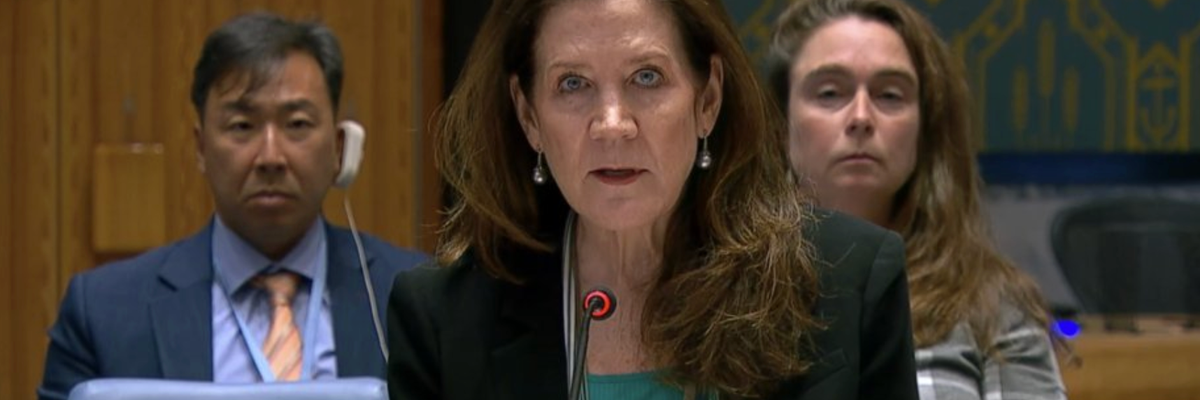
While acknowledging that "hunger is a real issue in Gaza," the US ambassador to the UN repeated a debunked claim that the world's leading authority on starvation lowered its standards to declare a famine.


US Ambassador to the United Nations Dorothy Shea speaks on August 27, 2025.
(Photo: US Mission to the United Nations/X)

Brett Wilkins
Aug 27, 2025
COMMON DREAMS

Every member nation of the United Nations Security Council except the United States on Wednesday affirmed that Israel's engineered famine in Gaza is "man-made" as 10 more Palestinians died of starvation amid what UN experts warned is a worsening crisis.

Fourteen of the 15 Security Council members issued a joint statement calling for an immediate Gaza ceasefire, release of all remaining hostages held by Hamas, and lifting of all Israeli restrictions on aid delivery into the embattled strip, where hundreds of Palestinians have died from starvation and hundreds of thousands more are starving.

"Famine in Gaza must be stopped immediately," they said. "Time is of the essence. The humanitarian emergency must be addressed without delay and Israel must reverse course."


"We express our profound alarm and distress at the IPC data on Gaza, published last Friday. It clearly and unequivocally confirms famine," the statement said, referring to the Integrated Food Security Phase Classification's declaration of Phase 5, or a famine "catastrophe," in the strip.

"We trust the IPC's work and methodology," the 14 countries declared. "This is the first time famine has been officially confirmed in the Middle East region. Every day, more persons are dying as a result of malnutrition, many of them children."

"This is a man-made crisis," the statement stresses. "The use of starvation as a weapon of war is clearly prohibited under international humanitarian law."

Israel, which is facing a genocide case at the UN's International Court of Justice, denies the existence of famine in Gaza. Israeli Prime Minister Benjamin Netanyahu and former Defense Minister Yoav Gallant are wanted by the International Court of Justice for alleged war crimes and crimes against humanity, including murder and forced starvation.

The 14 countries issuing the joint statement are: Algeria, China, Denmark, France, Greece, Guyana, Pakistan, Panama, the Republic of Korea, the Russian Federation, Sierra Leone, Slovenia, Somalia, and the United Kingdom.

While acknowledging that "hunger is a real issue in Gaza and that there are significant humanitarian needs which must be met," US Ambassador to the UN Dorothy Shea rejected the resolution and the IPC's findings.


"We can only solve problems with credibility and integrity," Shea told the Security Council. "Unfortunately, the recent report from the IPC doesn't pass the test on either."

Shea also repeated the debunked claim that the IPC's "normal standards were changed for [the IPC famine] declaration."

The Security Council's affirmation that the Gaza famine is man-made mirrors the findings of food experts who have accused Israel of orchestrating a carefully planned campaign of mass starvation in the strip.

The UN Palestinian Rights Bureau and UN humanitarian officials also warned Wednesday that the famine in Gaza is "only getting worse."

"Over half a million people currently face starvation, destitution, and death," the humanitarian experts said. "By the end of September, that number could exceed 640,000."


"Failure to act now will have irreversible consequences," they added.

Wednesday's UN actions came as Israel intensified Operation Gideon's Chariots 2, the campaign to conquer, occupy, and ethnically cleanse around 1 million Palestinians from Gaza, possibly into a reportedly proposed concentration camp that would be built over the ruins of the southern city of Rafah.

The Gaza Health Ministry (GHM) on Wednesday reported 10 more Palestinian deaths "due to famine and malnutrition" over the past 24 hours, including two children, bringing the number of famine victims to at least 313, 119 of them children.

All told, Israel's 691-day assault and siege on Gaza has left at least 230,000 Palestinians dead, maimed, or missing, according to the GHM.

Ireland calls for UN force to ensure aid reaches Gaza


Michael D.Higgins, the Ireland President, on February 11, 2024 in Dublin, Ireland
 [David Rogers/Getty Images]

MEMO
August 25, 2025 

Irish President Michael Higgins has called for the formation of a United Nations force to guarantee the delivery of humanitarian aid to the Gaza Strip.

In a press interview on Saturday with Ireland’s public broadcaster RTE, Higgins stressed the need to activate Chapter VII of the UN Charter, which allows the Secretary-General, with the approval of a certain number of General Assembly members, to establish such a force to secure aid access, even if the UN Security Council blocks it with a veto.

He described what he called Israel’s genocide against Palestinians in Gaza as “a tragic period” in the world’s history.”

“We are in an extraordinary moment where you have three members of the Israeli cabinet who are interested explicitly in illegality, but they’re not worried about international law,” Higgins said.

Opinion

How the UN could act today to stop the genocide in Palestine


As a key deadline approaches in the United Nations General Assembly, a little-used UN mechanism, immune from the US veto, could bring military protection to the Palestinian people - if we demand it.
 August 27, 2025 13
MONDOWEISS

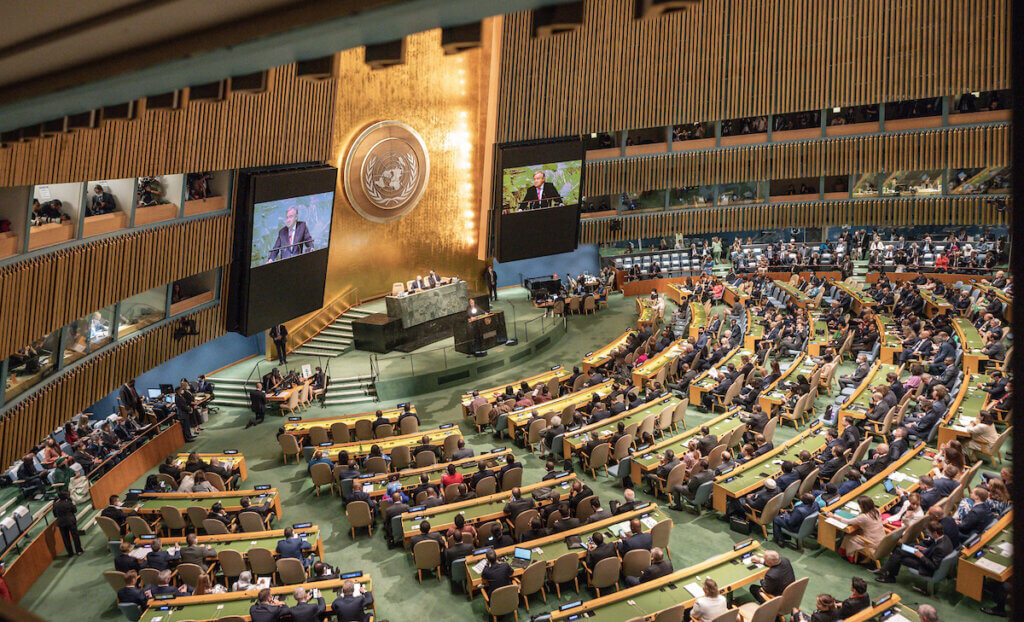
Antonio Guterres, Secretary-General of the United Nations, addresses the opening of the 77th General Debate of the UN General Assembly, September 2022. (Photo: Michael Kappeler/dpa via ZUMA Press/APA Images)

After twenty-two months of unprecedented carnage, three things are clear: (1) the Israeli regime will not end the genocide in Palestine of its own will, (2) the U.S. government, Israel’s principal collaborator, as well as the majority of Israelis, and the regime’s proxies and lobbies in the West, are fully committed to this genocide, and to the destruction and erasure of every remnant of Palestine from the river to the sea, and (3) other Western governments like the UK and Germany as well as far too many complicit Arab states in the region are fully dedicated to the cause of Israeli impunity.

That means that genocide (and apartheid) will only end through resistance against the Israeli regime, the steadfastness of the Palestinian people, the solidarity of the rest of the world, and the isolation, weakening, defeat, and dismantling of the Israeli regime.

As was the case in apartheid South Africa, this is a long-term struggle. But even in the face of Western government obstruction, there are things that can be done right now. Things like boycott, divestment, sanctions, demonstrations, disruption, civil disobedience, education, prosecutions under universal jurisdiction, and civil cases against Israeli perpetrators and complicit actors in our own societies. And yes, we can also demand intervention and protection for the Palestinian people.


Established by a Cold War-era resolution adopted in 1950, the Uniting for Peace mechanism authorizes the UN General Assembly (UNGA) to act when the Security Council is blocked by the veto of one of its permanent members. Under this mechanism, the UNGA could mandate a UN protection force to deploy to Palestine, protect civilians, ensure humanitarian aid, preserve evidence of Israeli crimes, and assist in recovery and reconstruction.

And the upcoming deadline set by the UNGA last year for Israeli compliance with the orders and findings of the International Court of Justice, with a promise of “further measures” in the wake of non-compliance, provides a critical moment for action. Indeed, the time for intervention is long past due.
Models of intervention

As I have written previously, any country can legally intervene (individually or in concert with others) to stop the genocide, crimes against humanity, and war crimes of the Israeli regime. Indeed, under the Geneva Conventions, the Genocide Convention, and other sources of law, states are legally obliged to do so in the face of such atrocities. International law requires intervention, the State of Palestine has invited intervention, and Palestinian civil society has appealed for intervention. But few states have met this solemn obligation, while Yemen, under Ansar Allah, has been mercilessly attacked by U.S. forces for doing so, and the genocide has been allowed to rage on for almost two years now. Thus, a multilateral mandate could provide the legal, political, and diplomatic cover that most states would need to participate in an intervention.

Here, caution is warranted. There are many proposals for intervention. But some of these are not about protection for the Palestinian people, let alone their liberation.

Some have called for civilian monitors for Gaza, essentially a few dozen observers in blue vests armed only with clipboards and radios. But there have been human rights monitors in the West Bank and Gaza for decades, before and throughout the current genocide. While these perform valuable work, they have no deterrent effect, and the Israeli regime views them as no impediment at all to its nefarious designs.

Others, including the French and the Saudis, have called for a so-called “stabilization force.” But the details of their proposal suggest that such an intervention would not be designed principally to protect the Palestinians from the Israeli regime, but rather to keep an eye on the Palestinian resistance, and to restore the cruel status quo ante before October 2023, with the caging of the Palestinian people, and their slow, systematic annihilation.

At the same time, many such proposals appear to be designed in large measure to resume the process of normalization of the Israeli regime, and to resuscitate the ruse of Oslo. Needless to say, a return to a kind of Oslo 2.0, as yet another smokescreen for Israeli impunity, wherein Palestinians are told they must negotiate for their rights with their oppressor, as their rights and land are continuously eroded and the regime’s status increasingly solidified and normalized, is not the answer.

Then there is Donald Trump’s proposal for direct U.S. occupation, ethnic purging, and colonial domination of Gaza, revealing once again the dangerous and deeply racist delusions of the U.S. empire. Finally, the Israeli regime itself has suggested the deployment of a proxy occupation force manned by forces from Arab states that collaborate with the regime. As is self-evident, these proposals are not about ending genocide and apartheid. They are about entrenching them.
The UN options

That brings us to the United Nations.

Mid-September will see the expiration of the deadline set last year by the General Assembly for Israel to comply with the demands of the International Court of Justice and of the UNGA or face “further measures.” Western delegations are scurrying to forestall this ratcheting up of Israeli accountability by shifting the focus to recognizing Palestine or by trying to resuscitate the long-dead corpse of Oslo and the so-called “two state solution,” i.e., another political process that normalizes Israel, marginalizes Palestinians, provides a smokescreen for continuing Israeli abuses, and offers an amorphous promise of a Palestinian Bantustan somewhere down the road. But the UN need not fall for this ruse.

Of course, the UN itself has much to answer for in this genocide. To be sure, some in the UN have been absolutely heroic: like the UNRWA workers, who have been murdered in their hundreds by the Israeli genocide, many along with their families; other UN humanitarians who have continued to work to relieve the suffering of the people of Gaza, in the face of enormous risk; the UN’s International Court of Justice, which has issued historic decisions affirming the rights of the Palestinian people in the face of enormous pressure not to do so; and the UN special rapporteurs, like Francesca Albanese, who have endured two years of smears, slander, harassment, death threats, and U.S. sanctions, just for telling the truth and applying the law.

But the political side of the UN has failed miserably. Some, like the UNSG, his senior advisors (on genocide, children in conflict, sexual violence in conflict, political affairs, etc.), the High Commissioner for Human Rights, and other senior political leadership, have failed miserably, not because they could not do more, but because they chose not to. And, of course, the enduring symbol of UN failure is the Security Council, rendered entirely useless under the constraints imposed on it by the U.S. and its Western allies. Uniting for Peace offers a chance to right the UN ship, and to rescue the legacy of the organization from the potentially fatal blow of yet another genocide on its watch.
Security Council scenarios

Of course, under Chapter 7 of the UN Charter, the Security Council has the power to deploy an armed force and to impose that force even against a country’s will.

But given that the U.S., UK, and France (all genocide complicit states) have veto power in the Council, there are only two possible outcomes from the Security Council in addressing a proposal for intervention: (1) A mandate that pleases the U.S., as Israel’s proxy, and which therefore would be framed in a way disastrous for the Palestinians, and could be imposed against the will of the Palestinians, under Chapter 7, or (2) A U.S. veto of any force that would actually be helpful.

Clearly, the Security Council, by design, is no friend to the occupied, the colonized, or the oppressed. As such, the road to protection and justice travels not through the Security Council, but around it.
Uniting for Peace in the UNGA

Thus, meaningful UN Security Council action is effectively impossible in a body dominated by the U.S. veto.

But here is the point: the world need not surrender in the face of that veto.

The UN General Assembly (UNGA), that will meet in September, is empowered under the Uniting for Peace resolution, to act when the Security Council is unable to act owing to the veto. There are historical precedents. And taking such extraordinary action has never been more urgent.

A UNGA resolution adopted under Uniting for Peace could

1. Call on all states to adopt comprehensive sanctions and a military embargo against the Israeli regime. While it lacks the power to enforce sanctions, it can call them, monitor them, and supplement them as required.

2. Decide to reject the UNGA credentials of Israel, as the UNGA did in the case of apartheid South Africa.

3. Mandate an accountability mechanism (like a criminal tribunal) to address Israeli war crimes, crimes against humanity, apartheid, and genocide.

4. Reactivate the UN’s long-dormant anti-apartheid mechanisms to address Israeli apartheid, and

5. Mandate an armed, multinational, UN protection force to deploy to Gaza (and, ultimately, to the West Bank), acting at the request of the State of Palestine, to protect civilians, open entry points via land and sea, facilitate humanitarian aid, preserve evidence of Israeli crimes, and assist in recovery and reconstruction.

All of these actions could be adopted by the UNGA with a two-thirds majority, thereby circumventing the U.S. veto in the Security Council. As Palestine has requested intervention, no Chapter 7 action by the Security Council is needed to deploy a protection force. Palestine would retain full authority over when and for how long the mission was to be deployed, obviating fears of yet another occupation force.

Very importantly, as affirmed by recent World Court findings, Israel would have no legal right to refuse, obstruct, or influence the mission. The Court has affirmed that Israel has no authority, no sovereignty, and no rights in Gaza or in the West Bank.

The process is simple: (1) First, a proposal is vetoed in the Security Council (this is inevitable, given the role of the U.S. as a proxy for Israel in the Security Council); (2) States call for an emergency special session (ESS) of the UNGA under the Uniting for Peace mechanism (this too is easy, as the 10th Emergency Special Session remains active, and can be easily resumed at the request of a member state); (3) A resolution is proposed by one or more sponsors, in close consultation with the state of Palestine; (4) The resolution is adopted with a two-thirds majority (a threshold required by the rules for “important matters” such as this. Previous voting patterns on Palestine indicate that this margin is achievable); (5) The UN Secretary-General is instructed to solicit troop contributions from countries, in consultation with the State of Palestine as the requesting entity, and: (6) The mission is assembled and deployed (while likely to be politically challenging due to predictably active U.S. interference, this is technically easy).

Legally, there are no hurdles. The rules allow it, the UNGA’s Uniting for Peace power has been repeatedly affirmed, and there are precedents, most notably the UNGA’s mandating of the 1956 UN Emergency Force to the Sinai (UNEF) over the objections of the UK, France, and Israel.

Of course, the U.S. and the Israeli regime will use every available carrot and stick to try to prevent the securing of the necessary two-thirds majority, seeking to water down the text, and bribing and threatening states to vote no, to abstain, or to be absent for the vote. The current lawless government in Washington may even threaten sanctions on behalf of the Israeli regime, as it has already done vis-à-vis the International Criminal Court and the UN’s Special Rapporteur. And they are likely to try to obstruct the protection force itself, once mandated.

As such, the global majority of states will need to stay the course in the face of U.S. and Israeli threats. And global civil society will need to be steadfast in its demands for protection and justice, ensuring the glare of public exposure under which states will be forced to vote for or against a force to protect the Palestinians from genocide. None will be allowed to hide behind the U.S. veto, throwing up their hands with the familiar refrain of “we tried but the U.S. vetoed it.”

Once mandated, let the protection force be deployed by air, land, and sea, accompanied by international media and supported by all diplomatic avenues to ensure its successful deployment and to press the regime and its Western backers to stand down. The world has a chance, belatedly, to stop a genocide and other crimes against humanity. All it needs is the will to do so.
Conclusion

In the face of historic atrocities such as these, that threaten the very survival of a people, and that could bury the nascent project of human rights and international law in their wake, every tool available must be deployed. The world has not done so. It must try, and quickly

Of course, we are not naïve. Success is not assured. But failure is guaranteed if we do not try.

And time is of the essence. Genocide continues to rage in Gaza and is spreading as well in the West Bank. Famine has been declared in Gaza. Israel is expanding its military presence in Gaza and is rampaging across the West Bank. And September 18 will mark the end of a one-year deadline set by the UNGA for Israel to comply with their demands and that of the World Court or face “further measures.” The time to act is now.
In defiance of voter base, DNC rejects resolution calling for Israel arms embargo

Democratic National Committee members rejected a resolution calling for an arms embargo on Israel, but pressure continues to mount on party leaders to adopt a stronger stance against the Gaza genocide.
 August 26, 2025 
MONDOWEISS

DNC Chair Ken Martin (Ken Martin Instagram)

On Tuesday, Democratic National Committee (DNC) members at the party’s summer meetings rejected Resolution 18, which called for the recognition of a Palestinian state, a ceasefire in Gaza, an arms embargo, and a suspension of military aid to Israel.

Instead, members backed a status quo resolution introduced by DNC Chair Ken Martin, which simply called for more aid to be allowed into Gaza and a two-state solution. Despite the support, Martin went on to withdraw the resolution.

“I know that there are some who are interested in making changes today, but as we’ve seen, there’s divide in our party on this issue,” said Martin. “This is a moment that calls for shared dialog. It calls for shared advocacy, and that’s why I’ve decided today, at this moment, listening to the testimony and listening to people in our party, to withdraw my amendment and resolution.”

Martin says he will establish a task force “comprised of stakeholders on all sides of this” so that they can “bring solutions back to our party.”


Resolution 18 had faced opposition from lobby groups like Democratic Majority for Israel (DMFI).

“Should it advance, it will further divide our Party, provide a gift to Republicans, and send a signal that will embolden Israel’s adversaries,” claimed DMFI president and CEO Brian Romick. “As we get closer to the midterms, Democrats need to be united, not continuing intra-party fights that don’t get us closer to taking back Congress.”

Polling has consistently shown that Democratic voters are, in fact, united on Israel. A majority of them oppose the genocide in Gaza and want the Israeli government held accountable for its actions in the region.

This month, YouGov and The Economist published a poll showing that 69% of Democrats believe Israel is committing genocide in Gaza. That includes 77% of Kamala Harris voters.

According to a June Quinnipiac survey, 12% of Democratic voters sympathize more with Israelis than Palestinians, while a July Gallup poll found that just 8% of Democratic voters support Israel’s military actions in Gaza and only 9% support Israeli Prime Minister Benjamin Netanyahu.

An April poll from Data for Progress and Zeteo showed that 71% of likely Democratic primary voters think the United States should end arms transfers to Israel until it stops its attacks on civilians and supports the rights of the Palestinians.

80% of likely Democratic primary voters under the age of 45 believe that military assistance to Israel should be restricted.

“Organizations like Democratic Majority For Israel, despite their name, don’t represent the vast majority of Democratic voters who support cutting off weapons to Israel, or the 69% of Democrats who believe Israel is committing genocide, according to the latest polling,” said IMEU Policy Project Executive Director Margaret DeReus in a statement after the vote. “It’s another sign of just how out of touch Democratic Party leadership is today that dark money groups like DMFI – that have spent millions in Democratic primaries to unseat progressives who stand for human rights for all people – were consulted ahead of DNC Chair Ken Martin’s decision to introduce his bland resolution, while advocates for Palestinian rights who represent most Democrats were once again shut out and ignored.”

“Sadly, this has been standard practice for a historically unpopular Democratic leadership that will not win elections until it decides to become a political party that actually listens to its voters,” DeReus continued.

While the Democratic establishment continues to embrace Israel, lawmakers are facing increasing anger over the issue in their districts.

Last week, voters at a town hall in New Jersey confronted Rep. Herb Conaway (D-NJ) for attending an American Israel Public Affairs Committee (AIPAC) trip to Israel during the congressional recess.

“SHAME!,” yelled Conaway’s constituents.


Rep. Wesley Bell (D-MO) was also interrupted by protesters at a recent town hall over his support for Israel. Multiple people were grabbed and shoved by Bell’s security team.


Bell ousted Cori Bush from her congressional seat last summer, with the help of nearly $9 million from pro-Israel lobbying groups.

“If people wanna support what we’re doing, hey, we’ll take it,” Bell recently told constituents. “Money is flowing everywhere.”


An event being held by AIPAC-backed House Minority Whip Katherine Clark (D-MA) was also interrupted by protestors. In her response to the activists, Clark said that Israel was committing genocide in Gaza, but walked the comments back days later after she faced backlash from pro-Israel groups.

Despite this growing anger, many Democratic leaders have consistently attempted to quash pro-Palestine sentiment from growing within the party.

In California, a party official attempted to introduce a bylaw that would have prohibited state and local parties from even referencing Israel’s genocide, ethnic cleansing, or apartheid.

In Virginia, state delegate Sam Rasoul, whose family was displaced by the genocide, was attacked by local Democratic politicians, including Senator Tim Kaine (D-VA), after he made an Instagram post condemning Zionism.

Allison Minnerly, the 26-year-old DNC member who sponsored Resolution 18, told Politico that Martin’s decision to pull his own amendment might point to growing concerns among party leadership.

“I think that there could have been more intentional conversation sooner,” said Minnerly. “I do think that his decision to pull his resolution now might reflect, maybe, some inner thoughts and fears that even the establishment Democratic Party, here at the DNC, is not aligned with the base and trying to avoid that conversation because it’s already created a problem with the party.”

'Let the Public See Where Democrats Really Stand': Full DNC Floor Vote Demanded on Gaza

"We are demanding a roll-call vote so that every DNC member is accountable for where they stand in this historic moment."


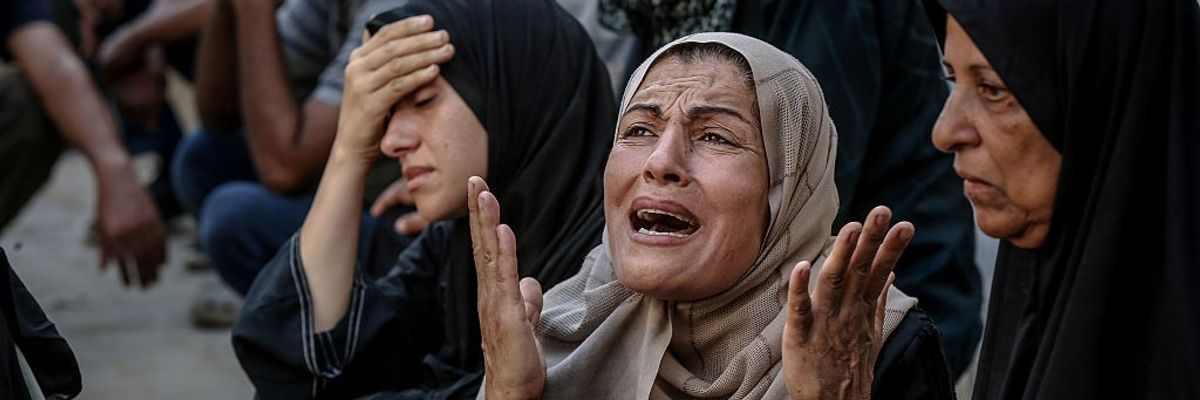
Relatives of the Palestinians, including children, who died as a result of Israeli attacks on different parts of Gaza City, mourn as the dead bodies were taken from the al-Shifa Hospital for burial in Gaza City, Gaza on August 25, 2025.
(Photo by Saeed M. M. T. Jaras/Anadolu via Getty Images)


Jon Queally
Aug 27, 2025
COMMON DREAMS

Those hoping that Democratic Party leaders have finally learned some lessons in the political thrashing they received in last year's elections are not yet done fighting for a resolution they argue would put the party back on the right side of moral history and also improve its prospects going forward against an increasingly authoritarian Republican Party led by President Donald Trump.

A day following a failed vote in the resolutions committee, members of the Democratic National Committee and grassroots groups demanding the DNC to take a stronger stand against US complicity with Israel's genocide in Gaza are not giving up—pushing now for a full floor vote to take place Wednesday on a resolution which calls for an immediate ceasefire, an arms embargo, and suspension of military aid to Israel.

"The DNC membership has the power to stand up and let the public see where Democrats really stand," said Allison Minnerly, the 26-year-old DNC member from Florida who introduced Resolution 18 before the resolutions committee, in a statement Tuesday night after the measure was rejected earlier in the day with a voice vote at the party's summer gathering in Minneapolis.

"A roll-call vote is the minimum standard of transparency in a democracy," said Minnerly in her statement, backed by allies within the DNC ranks as well as outside groups.

"A roll-call vote is the minimum standard of transparency in a democracy." —Allison Minnerly

Following the committee vote rejecting Resolution 18, chair of the College Democrats, Sunjay Muralitharan, bemoaned the defeat, including that no chance was offered for friendly amendments. "This move isn't just unjust, it's politically ineffective," he said. "Support for Israel's actions is in the single digits within our party's base. Deeply disappointed in this decision."

DNC chairman Ken Martin, who had introduced a competing resolution, Resolution 3, later took the unusual step of withdrawing his milqetoast proposal on Gaza after it passed the committee. In its place, he called for the creation of a task force to further discuss the issue.

"There's divide in our party on this issue," Martin said as he withdrew his resolution in favor of further discussion. "We have to find a path forward as a party, and we have to stay unified."


Minnerly and her coalition, however, say the issue is too important—and the conditions in Gaza, where a famine has been designated by the world's leading authority on such matters, too horrific—for the full membership of the Democratic Party leadership not to weigh in publicly and on the record.

As the daily massacres and starvation continue in Gaza, the coalition says there is no better moment for all DNC voting members to put themselves on the record.

"Resolution 18 represents the voices of not only young Democrats but all Democrats who believe that Palestinian lives matter too," said Zayed Kadir, chair of the High School Democrats. "It's time for the DNC to stand on principle and stop shying away from the conversation—the moment is now."

As such, in a statement released overnight, the coalition—which includes the American Muslim Democratic Caucus National, Roots Action, Florida Young Democrats, leaders of the High School and College Democrats, and many individual members—is calling for every member of the DNC to:Publicly pledge to support a roll-call vote on Resolution 18 from the floor;
Reject voice votes that hide accountability;
Stand with Democratic voters, the majority of whom oppose blank-check military aid toward an ongoing genocide.

The coalition began circulating a petition Tuesday night calling on members to tell "the DNC that the humanitarian crisis in Gaza needs urgent attention by sending a letter asking them to bring Resolution 18 back into the conversation and support it tomorrow (Wednesday)."

Aftab Siddiqui, representing the American Muslim Democratic Caucus National, suggested that taking up the resolution by the full DNC at the meeting would begin to show the party is learning from its past mistakes and start forging a new direction.

"Resolution 18 represents exactly the kind of principled politics that wins elections," Siddiqui said. "While Democrats lost ground in 2024 by wavering on core values, New York City's mayoral candidate, Zohran Mamdani, proved that moral courage on Gaza builds winning coalitions. The DNC must learn this lesson."

Ahead of and during Wednesday's plenary session, the coalition said it will publish "a transparency scorecard" to track which DNC members commit to demanding the roll-call vote. Those who do not, the group said, will be noted as opposing transparency.

Polling has shown that Democratic voters strongly favor the demands outlined in Resolution 18, a fact the coalition says the DNC must acknowledge if it wants to represent the people it claims to represent truly.

Nadia Ahmad, a delegate from Florida, said Democrats "cannot claim to stand for justice and human rights while blocking a resolution that calls for an arms embargo and humanitarian aid to Gaza."

The fight before the DNC, she added, "is about whether our party has the moral courage to listen to its members and the American people. We are demanding a roll-call vote so that every DNC member is accountable for where they stand in this historic moment.”
The Palestine Chronicle Case: When Truth Becomes the Crime

What is sought is not justice but intimidation—to cast suspicion on every Palestinian voice, to brand their words as weapons, their witness as crime.


Ramzy Baroud speaks in 2024.
(Photo: Ramzy Baroud/Facebook)


Mohamed El Mokhtar
Aug 27, 2025


The Palestine Chronicle is not a militant organization. It is a modest, independent publication, sustained by small donations and animated by a singular mission: to bear witness. It tells the untold stories of Palestine, documenting dispossession, resistance, and the endurance of a people condemned to silence. In a media landscape dominated by powerful conglomerates repeating the language of governments, the Chronicle insists on a journalism of proximity—grounded in daily lives, in the rubble of Gaza, in voices otherwise erased. Its true offense, in the eyes of its detractors, is not invention but truth.

At the heart of this endeavor stands Ramzy Baroud. His career is the antithesis of clandestine. For decades he has written, taught, and spoken in public, producing books translated into multiple languages, contributing columns to international publications, addressing audiences in universities and public forums across continents. He is not a shadowy figure; he is a man whose work has been consistent, transparent, and intellectually rigorous. His life is not untouched by the tragedy he describes: Many members of his family were killed under Israeli bombardments. Yet while mainstream media rushed to amplify unproven allegations against him, they remained deaf to his personal grief. His tragedy was ignored, his integrity overlooked, his voice distorted—because his engagement is unbearable to those who would prefer silence.

A Crime of Conscience, Not of Law

He is an engaged journalist in the noblest sense: independent, lucid, unflinching. His so-called crime is not collusion with violence but fidelity to memory. That is why he is demonized—not for what he has done in law, but for what he represents in conscience. America, unable to silence Palestinian voices through censorship alone, now instrumentalizes its justice system to achieve by indictment what it failed to achieve by argument. Having harassed universities, intimidated students, and punished professors for their solidarity with Gaza, it turns the courtroom into a new battlefield. And Congress, captive to the whims of its Zionist masters, joins the manhunt, targeting a journalist for the sole offense of telling the truth of his people. As for the mainstream press, it chooses cowardice: ignoring his family’s suffering, ignoring the emptiness of the charges, while echoing the accusations of power as if they were evidence.

Law Twisted into Weapon


The complaint filed against Ramzy Baroud and the organization (People Media Project) that runs the Palestine Chronicle rests on the Alien Tort Statute (ATS), grotesquely overstretched to criminalize editorial decisions rather than acts of war. It alleges that by publishing articles from Abdallah Aljamal—described by Israel as a Hamas operative killed during a hostage rescue—the Chronicle “aided and abetted” terrorism. But here lies the first fissure: This characterization of Aljamal comes exclusively from Israeli military sources, themselves a belligerent party. It has never been independently verified. The claim that he was both a journalist and a Hamas operative remains an allegation, not an established fact. To treat it as judicial evidence is to replace proof with propaganda.

Even if—hypothetically—Aljamal had, at the demand of a militant group, harbored hostages, such a circumstance would not in itself render him culpable: What ordinary civilian in a war zone can refuse the command of militants under threat of force? And even if it occurred, how could Ramzy Baroud have known of it? Even taken at face value, the allegation collapses upon scrutiny. No evidence demonstrates that the Chronicle or its editor had actual knowledge of Aljamal’s supposed operational role, nor that modest freelance payments—if any at all—bore any causal nexus to hostage taking. The federal judge, in February 2025, dismissed the original complaint precisely for lack of proof of knowledge or intent. The plaintiffs returned with an amended filing, repackaged in rhetoric and pathos, but still devoid of the material elements required under international law: actus reus (a substantial contribution to the crime) and mens rea (intent or knowledge).

To equate the publication of articles with material support for terrorism is not jurisprudence but a juridical contortion. It is the substitution of law by politics, the criminalization of journalism under the mask of counterterrorism. What is sought is not justice but intimidation—to cast suspicion on every Palestinian voice, to brand their words as weapons, their witness as crime.

Thus the legal emptiness is evident:Jurisdiction overstretched: the ATS was never intended to criminalize editorial contracts.

Elements unmet: no proven knowledge, no intent, no substantial assistance.
Factual foundation unstable: the Hamas label rests on unverified allegations from one warring party.

Political aim transparent: to silence Palestinians and punish one of their most articulate representatives for his independence.

This case is not justice. It is intimidation. It is not law. It is propaganda dressed in the robes of a courtroom. The allegation against Ramzy Baroud rests not on proof, but on the word of a belligerent army. An army that bombs, besieges, and kills—and then dictates who is journalist, who is terrorist, who is fit to speak. To transform those claims into evidence is to surrender law itself to war.

Ramzy Baroud is not a conspirator. He is a journalist of record, a man of books, a teacher, a witness. His own family has been buried under rubble. And yet, America has not mourned them, has not spoken of them. Instead, it chooses to hunt him—to turn his grief into accusation, his fidelity into crime.

Some congressmen have joined this manhunt, eager to please their Zionist patrons. Universities have been disciplined, their students silenced. The press, that great sentinel of truth, has abandoned him, repeating only the charges while ignoring his suffering. This is not democracy. It is servitude.

The elements of law are absent. There is no actus reus, no mens rea, no causal link. There is only suspicion. There is only the will to silence.

And so the true purpose stands naked: to criminalize the Palestinian word, to punish a journalist for speaking the truth of Gaza, to make an example of him so that others will be afraid to write.

But intimidation is not justice. A trial without evidence is not law. And silencing the witness will not erase the truth.

Law or Servitude

Here one hears Thurgood Marshall’s axiom: “The Constitution does not permit the discrimination of silence.” One hears Cochran’s defiance: “If the proof is not there, the case cannot stand.” One hears Vergès exposing the colonial reflex that brands resistance as terror. One hears Vedel’s warning: that when law is bent to politics, law ceases to exist.

Ramzy Baroud stands here not accused, but accusing. He accuses a system that bends to power, a Congress that bows to lobbyists, a press that betrays its duty, and a nation that dares call itself free while shackling its own justice.

Therefore, the American judicial system has a choice: to lend its authority to propaganda, or to defend the very principle that sustains law—that guilt must be proven, not declared. To condemn Ramzy Baroud would be to condemn journalism itself. To acquit him is to restore some dignity to justice. The choice is clear.


Our work is licensed under Creative Commons (CC BY-NC-ND 3.0). Feel free to republish and share widely.


Mohamed El Mokhtar
Mohamed El Mokhtar Sidi Haiba is a social and political analyst, whose research interest is focused on African and Middle Eastern Affairs.
Full Bio >
Microsoft Workers Arrested After Occupying C-Suite to Protest Israel's Use of Azure in Gaza

"Brad Smith is the face of human rights at Microsoft," said one No Azure for Apartheid protester. "And yet Microsoft every day continues to abet this genocide."


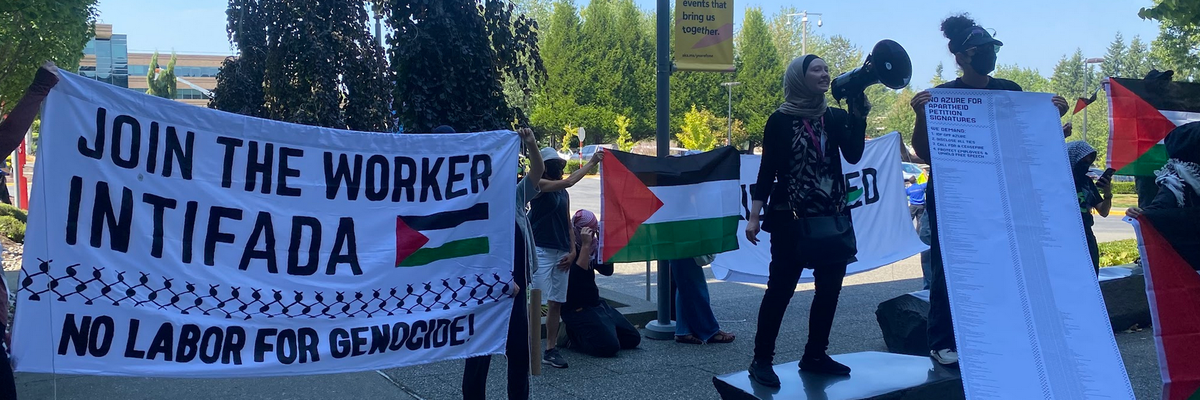
No Azure for Apartheid activists lead a rally outside Microsoft headquarters in Redmond, Washington on August 26, 2025.
(Photo by No Azure for Apartheid)


Brett Wilkins
Aug 27, 2025
COMMON DREAMS

Seven current and former Microsoft workers were arrested Tuesday after occupying the office of president Brad Smith to protest the company's complicity in "the first AI-powered genocide" as Israel kills and ethnically cleanses hundreds of thousands of Palestinians in Gaza.

The protesters gathered at Microsoft headquarters in Redmond, Washington and declared a "Liberated Zone" inside Building 34, which they renamed the Mai Ubeid building in honor of a Palestinian software engineer killed by Israel in Gaza in 2023. Demonstrators sounded noisemakers, draped banners, and delivered a "People's Court Summons" to Smith. They chanted, "Microsoft, Microsoft, you can't hide, we charge you with genocide!"

Seven protesters who locked themselves inside Smith's office were arrested by Redmond police. Other current and former Microsoft workers joined community members at a rally outside the building.

"Microsoft continues to militarize its campus to harass, brutally attack, and violently arrest its workers and community members," No Azure for Apartheid organizer and former Microsoft worker Abdo Mohamed told the Seattle Times.


The arrests came on the same day that Bloomberg revealed that Microsoft asked the Federal Bureau of Investigation for intelligence on pro-Palestinian protesters targeting the company, worked with local law enforcement in a bid to thwart demonstrations, and deleted internal emails containing protest details and words like "Gaza."

Tuesday's action followed a protest last week at which around 20 No Azure for Apartheid activists were arrested after setting up an encampment on the grounds of Microsoft headquarters. Earlier this month, protesters staged a demonstration at a Microsoft data center in the Netherlands that is reportedly being used by the Israel Defense Forces (IDF) to plan airstrikes on Gaza.

The No Azure for Apartheid protesters are calling on Microsoft to "cut ties with Israel, call for an end to the genocide and forced starvation, pay reparations to the Palestinians, and end the discrimination against workers."

"We are here because Palestine must be free, the genocide must end, the apartheid must end, and everything that's happened to the Palestinian people over the past 75 years must end," declared one No Azure for Apartheid organizer in a video of Tuesday's occupation that was posted online. "It must end and this is how we must end it. We must occupy the people who are letting it happen."

"We are here today not because we want to be here, it's because we need to be here," he said. "Brad Smith is the face of human rights at Microsoft. And yet Microsoft every day continues to abet this genocide."

"Every Palestinian phone call in the last few years has been stored on Microsoft servers," he continued as the other protesters shouted, "Shame!"

"That is a disgrace! That is untenable! There is no way to justify that," the protester asaid. "Every time we have come with these problems... Microsoft has dragged their feet."

The activist also pointed to Microsoft CEO Satya Nadella and the IDF's largest intelligence unit.


"Satya has dragged his feet. Brad has dragged his feet. Satya met with the head of Unit 8200 and that led to this plan to store Palestinian phone calls on Microsoft servers," he said.

A a joint investigation published earlier this month by The Guardian, +972 Magazine, and Local Call revealed that Unit 8200 is storing 11,500 terabytes of data containing roughly 200 million hours of Palestinians' phone call recordings on the Azure servers in the Netherlands. According to the article, former Unit 8200 head Yossi Sariel traveled to Microsoft headquarters in 2021 to meet Nadella.

"What happens as a result is that every phone call is recorded, it is transcribed from Arabic, it is translated, and it is used for targeting," the protester said.

Earlier this year, an Associated Press investigation detailed how Israeli forces are using artificial intelligence and cloud computing systems sold by US tech giants including Amazon, Google, Microsoft, and Open AI—which makes the popular ChatGPT chatbot—for the mass surveillance and killing of Palestinians in Gaza.

In addition to US tech, the IDF uses its own AI system called Habsora to automatically select airstrike targets at an exponentially faster rate than ever before. A November 2023 investigation by +972 Magazine and Local Call cited an Israeli intelligence source who said that Habsora has transformed the IDF into a "mass assassination factory" in which the "emphasis is on quantity and not quality" of kills.

Following the Hamas-led attack of October 7, 2023, IDF officers were told they could order any number of strikes as they believed were legal, with no effective limits on civilian harm. This led to massacres in which dozens or more civilians were killed in single strikes, often using US-supplied 1,000- and 2,000-pound bombs.

Microsoft said earlier this month that it has launched an investigation into how Unit 8200 is using Azure. This, after the company said in May that an internal review "found no evidence to date that Microsoft's Azure and [artificial intelligence] technologies have been used to target or harm people in the conflict in Gaza."

Big Tech's profiteering from Israel's annihilation of Gaza and occupation, settler colonization, and apartheid in the West Bank has sparked numerous protests, including by employees of complicit companies. At least dozens of workers at companies including Google, Meta, and Microsoft have been fired for Palestine advocacy. Others have resigned in protest.

Hossam Nasr, a former Microsoft software engineer, was fired after organizing an October 2024 "No Azure for Apartheid" vigil. Microsoft engineer Ibtihal Aboussad and another worker, Vaniya Agrawal, were fired after interrupting speeches by company executives.

Responding to Tuesday's protest, Smith said, "Obviously, when seven folks do as they did today—storm a building, occupy an office, block other people out of the office... that's not okay."

"There are many things we can't do to change the world, but we will do what we can and what we should," Smith added. "That starts with ensuring that our human rights principles and contractual terms of service are upheld everywhere, by all of our customers around the world."

Tuesday's protest came as the IDF ramped up Operation Gideon's Chariots 2—the US-backed campaign to conquer and occupy Gaza and ethnically cleanse around 1 million Palestinians—and amid a worsening famine that has killed hundreds of people, many of them children.