Saturday, August 30, 2025


Study: Maritime Industry is Trying Out AI, But is Still Skeptical

AI
iStock / Best Photos for All

Published Aug 28, 2025 2:58 PM by The Maritime Executive


Maritime companies are enthusiastic about AI's potential for streamlining business and operational tasks, but are struggling to move beyond small-scale experiments, according to a new industry study by Marcura and Thetius. 

The study found that 82 percent of maritime professionals are optimistic about AI's role in their sector, but nearly two-thirds worry that over-reliance on the technology could erode critical human skills and judgment. The overwhelming majority believe that AI tools still need human oversight to make sure that they perform as needed - and it's clear that AI will need human input for data collection, data labeling and prompts, in addition to human evaluation of the outputs. 

The study, which surveyed more than 130 maritime professionals and conducted in-depth interviews, paints a picture of an industry caught between promise and reality. Though 81 percent of companies are running AI pilot projects, only 11 percent have established formal policies to guide how these technologies should be scaled across their operations.

The research identified clear consensus on AI's most promising applications. Nearly all respondents — 97 percent — see benefits in reducing manual workflow inefficiencies, while 87 percent believe AI can improve charter party contract analysis and help spot potential pitfalls. 

However, more than two-thirds of respondents — 69 percent — expressed concerns that AI solutions might miss critical warning signs in contracts or voyage planning, potentially leading to costly business mistakes. 37 percent said they had personally witnessed AI failures in their organizations, and nearly a quarter of respondents said that AI vendors' claims often fail to match real-world results, 

The specialized nature of maritime operations are a key factor in these implementation challenges. As anyone in maritime who has tried to use ChatGPT knows, generic AI tools often struggle with the sector's idiosyncratic terms and acronyms, its unique rules and its operational realities - all of which are a foreign language and culture that outsiders have to learn, including software outsiders.

"A general AI agent might interpret 'SF' as 'standard form,' but in shipping, it means 'stowage factor,'" explained Janani Yagnamurthy, vice president of analytics at Marcura. "Off-the-shelf solutions might automate basic processes, but they miss the nuanced context that maritime professionals rely on."

The skepticism about AI was highest for legal and compliance tasks; though the legal profession as a whole has adopted widespread use of AI for basic tasks, shipping respondents rated their compliance departments as least-suited for AI usage at present, citing concerns about data governance, regulatory liability and misinterpretation of legal nuances by AI.

Maritime-specific, purpose built AI agents may perform better than generic tools for these tasks. Marcura says that its AI-powered contract analysis tools recently helped a dry bulk operator avoid more than $120,000 in potential losses by identifying missing clauses in the draft of an agreement.

Despite successes in specific applications, most companies are still just testing the waters, and only 17 percent have established transparent processes for how AI systems inform decisionmaking in their companies.

"When change happens, it's very natural to fear losing control," Yagnamurthy said. "Skilled maritime professionals have spent decades honing their judgment in high-stakes roles. The best AI functions like a co-pilot, not a replacement."

Familiarity and fluency with AI will also need improvement: 38 percent reported that inadequate training is the biggest barrier to scaling up the use of the technology in their business. Poor implementation and poor education of the users can lead to poor outcomes, multiple respondents said. "People train their AI models but they don’t train their people. If the crew and the office do not understand the AI outputs, it could lead to misuse, which creates mistrust. We need to first train our people and our minds," one shipmanager told the research team. 


Evolving Role for Ship Managers

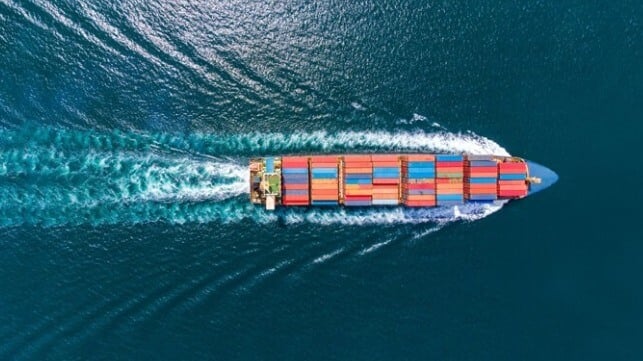
Ship managers expand their offerings as the industry grows more complex.
containership

Published Aug 29, 2025 8:53 PM by Allan E. Jordan


(Article originally published in July/Aug 2025 edition.)


Ship management is often identified as a tool for smaller fleets or individual shipowners to run their ships and keep up with the majors. The leading ship managers, however, say the practice is evolving from technical skills to incorporate consulting and advising as the shipping business is confronted with new challenges ranging from geopolitical issues to emerging technologies, increasing regulations and a shortage of seafarers.

The emergence of the ship management industry was driven by a basic desire to achieve cost efficiencies, often through scale, while also ensuring regulatory compliance - all to permit owners to focus on the commercial rather than technical aspects of operations. Historically, ship management was mostly used by owners with smaller portfolios who lacked in-house expertise and found value in outsourcing.

"It's been an industry driven by standardized solutions designed to streamline operations and costs," says Mark O'Neil, CEO of Columbia Group.

The model was designed, however, for a more stable and predictable era, when owners could rely on internal resources and conventional advisory partnerships to navigate relatively stable markets and regulatory environments.

Despite rapid growth and increasing demands on shipowners, ship management companies only handle about 20 percent of the global commercial fleet. The other 80 percent, notes Niraj Nanda, Chief Commercial Officer of Anglo-Eastern, which has been in the business for over 50 years, is managed in-house.

Integrated Approach

As ships have gotten bigger and economic pressures have increased, the scope of work for ship managers has changed.

Today, it requires an integrated approach to ensure safety, efficiency and regulatory compliance, according to Lisa Holum, Managing Director of OSM Thome Singapore. Tracing its roots back to the 1963 founding of Thome in Singapore and formed by the 2023 merger with OSM Maritime Group, OSM Thome encompasses not only technical management but also crew, compliance, procurement and sustainability initiatives.

"The ship management industry is undergoing a fundamental shift from being a cost-based, task-oriented service to becoming a strategic value partner to shipowners," explains Ajay Chaudhry, Co-CEO – Ship Management, Synergy Marine Group. "At Synergy, we believe the practice is being reshaped by three forces: regulatory pressure, technological maturity and rising expectations around crew wellbeing."

Emerging regulations around decarbonization and crew safety, for example, mean ship management is shifting from an operations focus to a value focus. The role of a ship manager is being fundamentally redefined with a shift towards risk mitigation, creating strategic advantages and providing access to specialized capabilities that owners cannot easily develop in-house.

"Owners give their vessels to a third-party manager so they can focus on their core competence of managing their vessels commercially while the manager specializes in operating ships efficiently and safely," says Ioannis Stefanou, Managing Director, Ship Management at Wallem Group. "When we partner with an owner, we don't just manage their vessels. We also offer consultancy advice and added value services to take care of their very expensive assets."

The pressures on shipowners are driving many of the changes in the industry.

"Ship management is moving towards more of a global solution," says Captain Kuba Szymanski, General Secretary of InterManager, the only organization dedicated to representing the ship management industry. "New requirements are making the role of a ship manager more like a business partner and not just a service provider."

Owners expect managers to deliver not only operational excellence but also guidance on decarbonization, digital solutions, regulatory compliance and crew challenges.

"We're moving beyond traditional ship management to offer a fully integrated maritime, logistics, leisure, energy and offshore services platform," highlights Columbia's O'Neil, noting that Columbia takes a holistic approach, combining digital tools, maritime HR, AI, sustainability and more.

Ownership Changes

Further driving change is a shift in the ownership profile of the shipping industry.

In addition to the emergence of massive fleets, shipping has become more specialized with unique vessels for each segment and new types of owners. Capt. Szymanski of Inter- Manager notes ship managers already occupy the "top end," serving LNG, LPG and tankers, but he sees the service "now drifting toward" bulk carriers and containerships.

Other sectors, including ro-ros, passenger vessels and cruise ships, have also turned to outside managers, especially as they enter new markets.

Ownership is moving from the traditional private families and legacy fleets to institutional investors, energy majors and first-time entrants who expect enterprise-grade governance, sustainability credentials and strategic alignment.

"We see a notable increase in leasing companies purchasing vessels, both newbuilds and resale tonnage, and then chartering them out on long-term or bareboat terms," says OSM Thome's Holum, who notes these new entrants rely on third-party managers. "Many of these lessors are financial institutions without in-house technical management expertise."

The new owners include private equity firms and other non-maritime investors as well. Adds Anglo-Eastern's Nanda: "These new stakeholders often lack operational expertise in ship management, creating opportunities for ship managers to provide end-to-end solutions."

Crew Scarcity

Stricter environmental regulations, rapid technological advances, geopolitical instability and economic volatility have meant that managing a ship has never been more complex.

However, the biggest challenge across all sectors of the industry may be crew scarcity and the related issues of aging seafarers and low participation rates from traditional sources of seafarers. The U.N.-led Maritime Just Transition Task Force recently highlighted that hundreds of thousands of seafarers must also be upskilled to prepare for the handling of methanol and then ammonia and hydrogen as future alternative fuels.

The largest ship managers operate their own training centers, and some run pre-sea training programs. Anglo- Eastern, for example, has expanded its simulation-based training facilities with the leading engine companies - MAN Energy Solutions (now Everllence), WinGD and Wärtsilä - and launched the industry's first LNG/Ammonia bunkering station skid at its Maritime Institute in Mumbai, India.

"A ship is only as good as the crew we can place on it," says Sebastian von Hardenberg, CEO of Bernhard Schulte Shipmanagement. "As we introduce future fuels to the maritime sector, safeguarding the crew and the vessels they operate through proper training must come first."

The company is taking proactive steps to close the skills gap, investing in training programs, simulation technology and collaborative forums. It established internal expert groups to design vessel-specific training modules covering everything from bunkering and emergency response to cargo handling protocols. In 2024, BSM launched its Smart Academy program to give undergraduate cadets training in a controlled and realistic work environment onshore and onboard, including training on a bridge simulator.

Wallem has an in-house saying that "The ships of the future will not be managed by the managers of the past." It notes that new skills are required as digitalization spreads through shipping. "The young generation of seafarers is tech savvy and computer skills come naturally to them," says Stefanou.

Wallem has set up training for the use of methanol and ammonia and helped customers with wind-assisted propul- sion. With a focus on crew wellbeing, it conducted over 7,000 hours of training in 2024 and has a "Mental Health Wellbeing Champion” onboard every ship.

Anglo-Eastern's Nanda says, "Attracting and retaining skilled seafarers remains a pressing issue, requiring innovative recruitment and training strategies." In June, the company launched its Mission 30 initiative with the goal of increasing the proportion of management-level officers under the age of 30 from one percent to 30 percent by 2030.

Next Challenges

"Owners increasingly need advisors who understand global complexity and can act as strategic partners, not just service providers," concludes Columbia's O'Neil. "The next big challenges include talent retention, the mental health of seafarers, geopolitical instability and generational shifts in expectations. Ship managers must evolve from reactive support to proactive problem-solvers."

All the companies point to their efforts to develop specialized services and teams to address the emerging challenges. V. Group, for example, launched V.ERDE to address decarbonization while OSM Thome launched its green services division, EVIGO.

Bernhard Schulte introduced LiveFleet, a single data source platform to monitor compliance with regulations, while Anglo-Eastern, through its newbuilding and project management divisions - Anglo-Eastern Technical Services (AETS) and SeaQuest - is expanding its involvement in future-fuel ship design.

"Beyond fuel and emissions, the next frontier of challenges lies in managing operational complexity, specifically around data governance, workforce transformation and asset lifecycle alignment," says Synergy's Chaudhry. "Owners today are overwhelmed with compliance obligations, ESG disclosures and performance benchmarking, often across multiple jurisdictions and systems. The ship manager's role is no longer operational alone. It's increasingly strategic helping owners anticipate disruption, adapt with agility and remain competitive in a rapidly changing seascape."

Lifecycle Custodians

Ship managers must now serve as "lifecycle custodians," expanding their services to encompass broader challenges. To protect the financial interests of their clients, managers must advise on a growing range of issues to help guide owners through the dynamic maritime industry and anticipate the challenges that lie ahead. – MarEx


Allan Jordan is the magazine's Associate Editor

This article originally appeared in the July-August 2025 issue of The Maritime Executive. Read the full issue online.
 

The opinions expressed herein are the author's and not necessarily those of The Maritime Executive.

 

India Pitches $1 Trillion Maritime "Roadmap" to Foreign Envoys

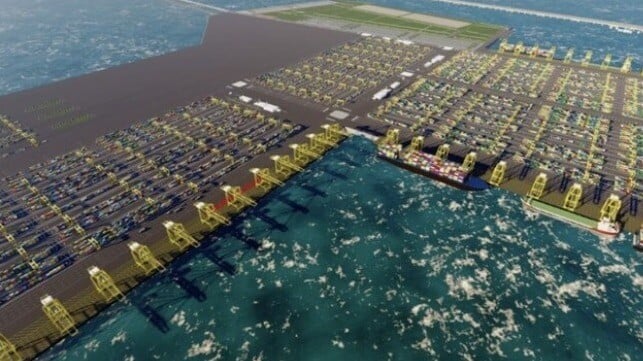
The vast Vadhavan Port complex is one of the many investment opportunities highlighted at the pitch meeting (Royal HaskoningDHV)

Published Aug 28, 2025 5:40 PM by The Maritime Executive


India's shipping ministry is shooting for the moon with its ambitions for the nation's maritime future. At a meeting for foreign ambassadors ahead of India Maritime Week, Union minister for shipping Sarbananda Sonowal pitched a $1 trillion "roadmap" for public and private investment in the nation's critical infrastructure. 

Speaking to representatives from 28 nations, Sonowal said that India is working to transform and modernize its ports, logistics and shipping systems. "These opportunities open up a $1 trillion maritime investment roadmap, with strong potential for joint ventures in developing ports and cargo terminal operations, multi-modal terminals, maritime services, shipbuilding, ship recycling and ship repairs, green hydrogen hubs, and sustainable shipping solutions," he said. 

To get ready, India's government has been overhauling the nation's maritime legal structure to bring it up to date and align it with international standards, making the country more accessible for foreign shipping investors. Five newly-passed legislative acts - the Bills of Lading Act, Carriage of Goods by Sea Act, Merchant Shipping Act, Coastal Shipping Act, and Indian Ports Act - are all part of a plan to update laws that date back to the era of British governance.

The investment pitch delved into specifics of opportunities for foreign partners. Port investors could spend on projects like Vadhavan Port, a gigantic transshipment-focused container port in Maharashtra with a proposed nameplate capacity of 23 million TEU at full buildout - enough to double India's entire container-handling capacity. Other opportunities include Galathea Bay Transshipment Port, a large-scale container facility planned in the Andaman and Nicobar Islands; and Tuna Tekra Terminal, a two million TEU container port on India's west coast, operated by DP World. The government is also looking to attract investors for LNG bunkering hubs, industrial parks and green fuel infrastructure. 

"India stands ready to collaborate and lead towards a maritime future that is prosperous, sustainable and inclusive," Sonowal said

 Rheinmetall 

Report: Lürssen’s Naval Shipbuilder Target for German Defense Consolidation

German naval shipbuilder yard
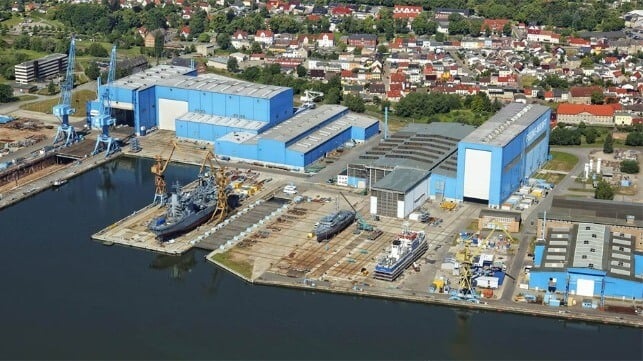
Lurssen is reported to be discussing the sale of its naval division with four shipyards in Germany (NVL)

Published Aug 28, 2025 3:53 PM by The Maritime Executive


Media reports in Germany are highlighting the potential for the sale of the shipbuilder NVL (Naval Vessels Lürssen) to defense industry major Rheinmetall as part of the further consolidation in the defense sector. The German government is reported to be encouraging the industry to explore steps to enhance its capabilities to meet the country’s urgent needs.

Rheinmetall, a manufacturer of tanks and ammunition, has in the past expressed interest in entering the naval shipbuilding sector. The company is now reported to be in discussions with NVL to acquire the operation, which is one of Germany’s leading naval shipbuilders.

The supervisory board of Rheinmetall is reported to be set to discuss the acquisition, writes the German newspaper Bild. The news outlet NDR followed up on the reports by speaking with the company’s CEO during an event on Wednesday, August 27. NDR reports he responded by saying, “We are always interested in expanding our product portfolio…We will only talk about it once decisions have been made.”

The German government has been encouraging the industry to explore opportunities while saying it needs to increase the country’s defense capabilities and to do so quickly. NVL is a current partner in the new frigate program with Damen that has become mired in problems with its electronics. Germany’s defense ministry has said it will look to rapidly grow its naval operations based on the increased dangers in the Baltic and North Sea.

The German Press Agency (dpa) reports Lürssen sent a letter to its workforce saying, in response to the needs of the government, it has “decided to intensify consolidation talks.”

Bild reports that the family that controls Lürssen is looking to focus on the company’s yacht shipbuilding operation. The group separated in 2021, putting Lürssen’s yacht and naval businesses into independent units. Lürssen also recently completed the sale in June of its naval shipbuilding operation in Australia to the local company Civmec.

NVL is the product of consolidation in the naval shipbuilding sector. Lürssen and German Naval Yards Keil agreed in 2020 to consolidate their operations. NVL’s operations now consist of four leading yards, including Peene-Werft in Wolgast and Blohm+Voss in Hamburg. Norderwerft in Hamburg and Neue Jadewerft in Wilhelmshaven are dedicated to repairs, refits, and modernisations of naval vessels and auxiliary ships. The products include a specialization in corvettes and patrol boats as well as frigates, minesweepers, and coast guard vessels, both domestically and internationally.

TKMS (Thyssenkrupp Marine Systems) and German Naval Yards are the other two large competitors in the sector. Media reports suggest that Rheinmetall was one of the potential suitors that also looked at TKMS as Thyssenkrupp was considering alternatives for the company before settling on the plan to spin off the naval shipbuilder later this year to shareholders. 


LA REVUE GAUCHE - Left Comment: Search results for PERMANENT ARMS ECONOMY


Pirates Scared Off from Tanker Attack by Approaching Patrol Boats

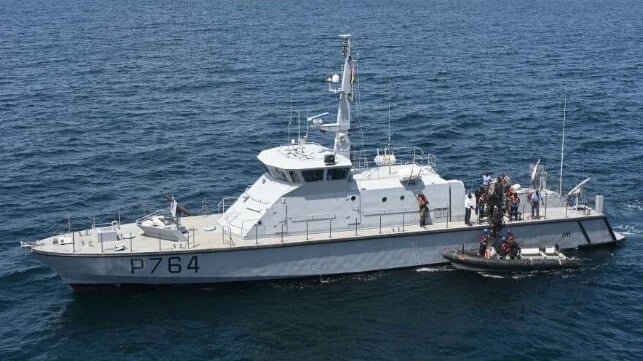
Togolese patrol boat
Togolese patrol boat on maneuvers with the Indian Navy in 2023 (Indian Navy)

Published Aug 29, 2025 12:43 PM by The Maritime Executive


The suspected attack on a small chemical tanker off the coast of Togo in West Africa is over, with the crew reported to be safe and AIS signals showing the vessel underway. The incident took place approximately 60 nautical miles south of Lome, Togo, but details remain unclear.

The joint French–British monitoring operation Maritime Domain Awareness for Trade – Gulf of Guinea (MDAT-GoG) records the incident as concluded and lists it as a small vessel coming in close proximity to the tanker, which has been identified in other reports as the Endo Ponete (7,250 dwt) registered in Malta. Maritime risk consultancy Vanguard Tech reports that a vessel had been attacked and termed it an attempted boarding, while Ambrey called it a boarding incident.

The vessel was getting underway from Togo and southbound for the Democratic Republic of Congo when the small boat approached. Vanguard reports the captain ordered the crew to muster and enter the citadel, and they notified the local authorities.

A Togolese patrol boat was dispatched, and according to the reports, the pirates fled when they saw the approaching naval support. In addition, the Nigerian Maritime Administration (NIMASA) and the Nigerian Navy were also coordinating and dispatched an additional boat to assist the tanker.

The tanker was searched, and the crew was released from the citadel. There are no reports of damage, but it is unclear if the vessel was boarded. 

Built in 2010, the tanker, which is 95 meters (312 feet) in length, is reported to have been operating in the region since being acquired by Endo Tankers in June 2023. It previously operated as the Mandume, registered in the Marshall Islands.

Product tankers have emerged as a favored target of the pirates in the region. In April, a product tanker was boarded and robbed while off the Nigerian coast, and in the past, product tankers have been robbed of fuel in the region near Cote d’Ivoire. In March, a product tanker was robbed and crewmembers kidnapped further south off the Central African coast.

MDAT-GoG reports this is the first incident in the region in at least 90 days. It reported a rash of incidents in the March and April timeframe, but overall, serious crime against merchant ships has been dramatically reduced after peaking in 2020 in the Gulf of Guinea region.


Italian Coast Guard Detains Boxship for Not Ensuring it Meets Emissions Reg

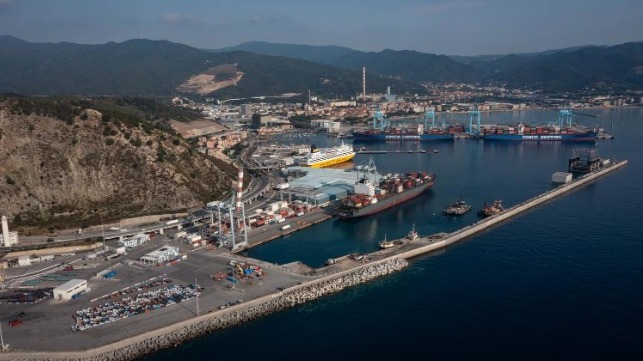
Vado Ligure Italy
Containership was detained after departing the Vado Ligure port in western Italy (APM Terminals)

Published Aug 27, 2025 4:21 PM by The Maritime Executive


Guardia Costeria is reporting that it has detained a smaller containership after it was unable to determine that the vessel was in compliance with emissions regulations. The Mediterranean became an Emission Control Area (ECA) this year, while the Italian authority reports that it has detained ten ships this year for failing to comply with international regulations.

The new situation arose in Genoa on August 21 when the Hansa Horneburg (23,644 dwt) arrived from the Italian port of Vado Ligure. The vessel, which is registered in Liberia and managed by Leonhardt & Blumberg of Germany, was built in China in 2007. It has a capacity for 1,732 TEU,

The Italian authority reports that it conducted an inspection of the vessel, and although it is equipped with valid certifications, it could not determine full compliance with the regulation relating to the containment of nitrogen oxide (NOx). The authority says that components of the electric generators did not display compliance identification, and it was unable to determine if they complied with the NOx technical code.


Guardia Costiera was unable to determine compliance with the emissions regulation (Guardia Costiera)


Guardia Costeria reports it undertook a comprehensive inspection from the bridge to the engine room as well as crew areas. It also conducted a safety drill aboard the vessel. The Italians said that since compliance could not be ensured, the vessel was being detained. This year and last, the vessel underwent inspections in the United States and Peru without incident. 

The increased diligence comes as the Mediterranean ECA became official on May 1, 2025, the fifth ECA zone under the IMO’s regulations. The IMO highlighted that ships operating in the new ECA would be subject to strict mandatory measures to prevent, reduce, and control air pollution. The focus is on sulfur emissions and particulate matter. Ships operating in the Mediterranean must comply with stricter content limits than those set by the global standard (0.10 percent mass by mass (m/m) for sulfur, compared with 0.50 percent m/m allowed outside SOx ECAs).

AIS signals show that the Hansa Horneburg remains in Genoa as of August 27. The Italian authority says it will be detained until the deficiencies are addressed under the supervision of the flag administration and the class society. It will also be required to pass a follow-up Port State Control Inspection.

WAR AT SEA

Video: Russia Damages Ukrainian Spy Ship in First Naval Drone Attack

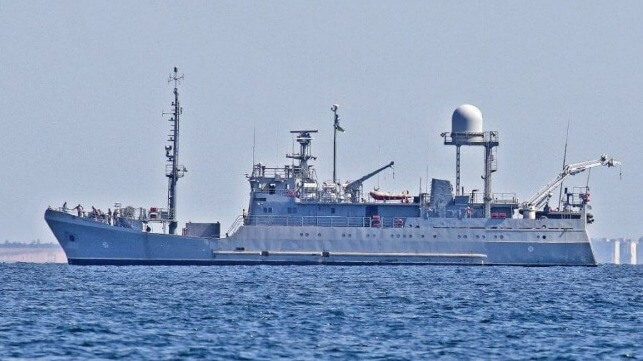
Ukrainian spy ship
Simferopol (2020 commissioning photo) was reportedly damaged by the first successful Russian naval drone attack (Ukrainian Navy)

Published Aug 29, 2025 10:52 AM by The Maritime Executive


The Ministry of Defense of Russia released a video and announced it had successfully attacked a Ukrainian surveillance vessel in what reports say is its first successful naval drone attack. Ukraine’s Navy confirmed an attack, reporting the death toll has risen to two sailors, while others are missing or injured.

Neither side released extensive details, but reports are identifying the vessel as the Simferopol, a reconnaissance vessel built in Ukraine in 2019 based on a trawler. The vessel is 1,220 tons displacement and about 55 meters (180 feet) in length and was designed for 29 crew. It was outfitted with electronic intelligence and surveillance equipment in support of the Ukrainian Navy’s operations.

The vessel was reported to be operating in the Danube Delta region when it was struck on August 28. Russia’s statement claimed the vessel was sunk, but a spokesperson for the Ukrainian Navy today on television said they could not confirm that the vessel had sunk.


Ukraine initially confirmed one death, but today raised the death count to two sailors while saying a search and rescue mission was proceeding. They declined to say how many sailors are missing or injured, with the spokesperson emphasizing that most of the sailors were safe.

They said the Russian naval drones were known and that there had been attempts in the past to deploy them in the Black Sea. This was the first known successful attack using the naval drones.

Ukraine has successfully deployed a range of naval and aerial drones during the campaign, inflicting a range of losses on the Russian Navy and support vessels. Yesterday, Ukraine claimed that it had successfully attacked a Russian naval vessel deep inside Crimea in what was being described as a bold attack far behind enemy lines.

Last month, a Ukrainian dredger working in the Danube reportedly struck a mine, killing three crewmembers. The canal connecting to the Danube was closed for weeks before it reopened.


Video: Ukraine Damages Russian Missile Boat in the Sea of Azov

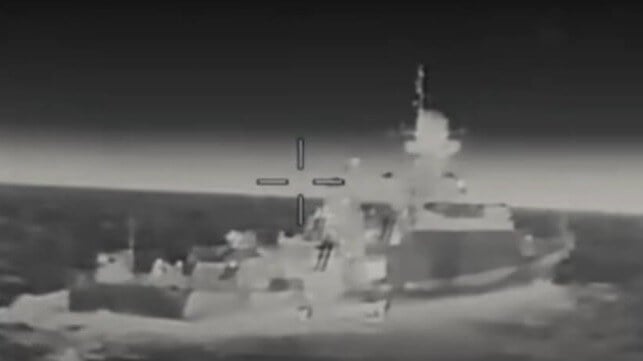
Missile boat attack
Ukraine military intelligence video showing the targeted corvette moments before impact

Published Aug 28, 2025 11:22 AM by The Maritime Executive


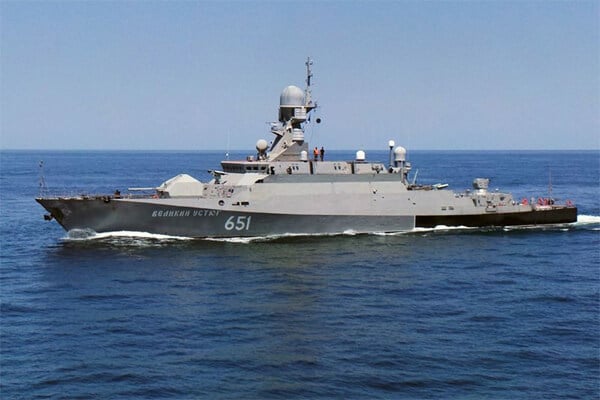
Ukraine military intelligence has released a video showing one of its one-way attack aerial drones attacking a Buyan-M Class Project 21631 missile corvette in the Sea of Azov. The corvette was hit and damaged on August 28, but it is not yet clear if the vessel has been able to recover to port.


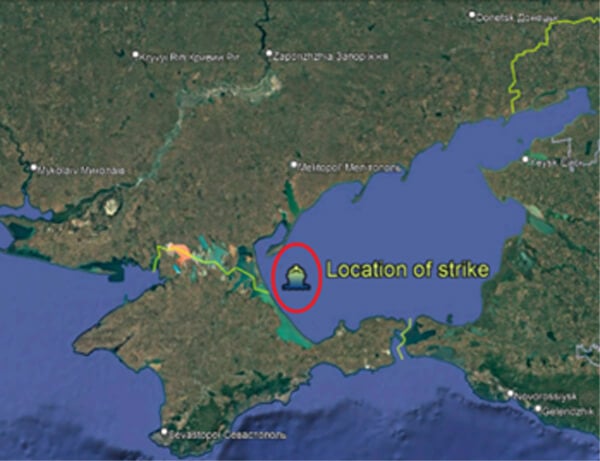
The attack is noteworthy because of the location of the attack. The Sea of Azov is effectively a Russian lake, Ukraine having lost its control of coastline in Donetsk and Zaporizhzhia in 2022. Hence Ukraine will have had to fly the attack drone either through Russian land-based air defenses in Donetsk and Zaporizhzhia, or taken a longer route over the sea and around Crimea. The drone’s pilots will then need to have locked onto the target at this long range. 


Location of the corvette when struck in the Sea of Azov (45°42′N 35°18′E ) (Google Earth, Landsat Copernicus, CJRC)


Ukraine has demonstrated it can do this against static targets at extreme range. However, to be able to do so against a moving target at long range is technically a considerable accomplishment. This should once again cause Russian naval commanders to consider the security of their naval assets even in ports far distant from Crimea such as Novorossiysk, to where vessels have already been pulled back for safety. The attack may have been mounted by Ukraine to demonstrate that it can control sea approaches to the Sea of Azov ports of Mariupol and Berdyansk, which Russia has recently sought to open to foreign shipping.


Buyan-M Class Project 21631 missile corvette (Ministry of Defense of the Russian Federation)


Buyan-M Class corvettes are primarily designed for littoral coastal defense, and are the mainstay of both what remains of the Black Sea Fleet and the Caspian Flotilla. They are however armed with two vertical launch cells, each able to hold four Kalibr missiles. The Kalibr is designed to be an anti-ship weapon, but has frequently been used to hit ground targets in Ukraine. In its land-attack version, the Kalibr has a range of 1,500 miles, and can therefore hit targets anywhere in Ukraine form the Black Sea and Sea of Azov.


Nord Stream Suspect Also Under Investigation for Tanker Attack in Italy

Gas bubbles from one of the Nord Stream pipeline breaches, 2022 (Swedish Coast Guard)

Published Aug 28, 2025 9:14 PM by The Maritime Executive


The Ukrainian military veteran arrested last week in connection with the Nord Stream pipeline attack is also under investigation for involvement in the blast that hit the tanker Seajewel, according to Italian media reports. 

Serhii Kuzientsov, an ex-Ukrainian special forces soldier, was detained in the Italian resort town of Rimini last week by the Carabinieri. He has an outstanding warrant in Germany for involvement in the 2022 attack on the Nord Stream pipeline system, which badly damaged three out of the four Russian gas lines under the Baltic. According to Corriere della Sera, Kuzientsov had driven to Rimini in a car with Ukrainian plates, accompanied by his family, and had registered for lodging under his own name - hardly attempting to evade detection. 

Kuzientsov faces extradition to Germany to stand trial for charges related to the Nord Stream attack, and he is fighting that process in court. At a hearing on Monday, he told the Bologna Court of Appeal that he was in Ukraine at the time of the Nord Stream attack, and denied any knowledge of it. He is in detention while the legal process moves forward, according to Corriere de Bologna - but there is a possibility that he could also be charged in Italy for a separate incident. 

Prosecutors in Genoa have been conducting a terrorism investigation in connection with the attack on a crude oil tanker at Savona in February, and have previously told local media that they suspect a Ukrainian nexus. The vessel, Seajewel, is one of seven tankers that were hit by mysterious explosions in the first half of the year. All previously carried Russian cargoes, prompting speculation over possible Ukrainian involvement; Ukraine has invested significant resources in attacking the Russian energy industry, which is the financial foundation of the ongoing invasion. 

The Genoa investigation is looking into Kuzientsov's potential involvement in the attack on the Seajewel, according to Corriere della Sera. That inquiry is ongoing, and could lead to additional charges of wrecking a vessel with an aggravating factor of terrorist intent. 

Other arrests could be coming: German authorities have identified five more suspected accomplices in connection with the Nord Stream attacks, and have filed at least one other outstanding warrant. 


"Black Box" on Tanker Eagle S Failed to Record During Cable Break

Tanker Eagle S after the cable breaks, December 2024 (Finnish Border Guard)

Published Aug 27, 2025 10:52 PM by The Maritime Executive


Investigators who boarded the tanker Eagle S after it severed a subsea power cable found that its voyage data recorder (VDR) had failed to record the time period of the casualty - not because of tampering, but because of an inherent design flaw that turned it off.

On Christmas Day, a power transmission cable and multiple telecom cables in the Gulf of Finland were suddenly severed. Eagle S happened to be under way in the area, and her trackline corresponded to the damage sites. Within hours, Finnish police boarded the vessel by helicopter and diverted it to Porvoo for arrest and examination. At the time of interdiction, the tanker had its port side anchor chain in the water, and a follow-up survey found a 50-nautical-mile drag line on the bottom - along with the damaged anchor.

In early March, Finnish authorities released Eagle S, but detained the master and the first and second officers to await criminal charges. Prosecutors have charged them with aggravated vandalism and aggravated interference with telecommunications, with potential penalties of up to 2.5 years in jail if convicted. The trial is now under way.

Any investigation of potential wrongdoing at sea will start with VDR data, including key parameters of vessel status (heading, speed, engine RPM) and audio of crew conversations on the bridge. But investigators found that Eagle S' VDR had ceased recording on the afternoon of December 18, before the incident, and resumed at about 1300 hours on the 25th. Eagle S crossed and severed the subsea power cable about 30 minutes earlier, while the VDR was not recording. 

The investigators found no evidence of tampering with the VDR, but discovered a curious technical cause. The VDR was an older design from the 2000s, and its time stamp system relied on GPS timing signals, without which it could not function. When the Eagle S sailed into the Russian end of the Gulf of Finland - one of the world's most GPS-denied environments - it lost its GPS signal, and the VDR's time reverted to 2005. The system then  auto-deleted these older 2005 files to save space in its limited memory, according to YLE. When Eagle S regained GPS, recording resumed - but only after the ship had already cut the power cable. 

The officers maintain that they could not reasonably have known that they were dragging an anchor along the bottom, but prosecutors contend that they were negligent in overlooking it. One key piece of evidence presented to the jury this week is an electronic log of the ship's speed, which dropped precipitously in the minutes before the cable break, falling from 12 knots to 9 knots. Engine RPM fell at the same time. 

The prosecutors contend that the speed change was a clear indication that something was wrong, and that the crew should have checked the anchors. However, the defense countered that the bridge team had noticed the speed drop and contacted the chief engineer, who informed them that the vessel was having engine problems. The chief engineer (who has not been charged) told the court that the engine was indeed having problems on that voyage, and had been an issue well before the casualty. The officers did not think to go forward and check the anchors, the defense contends, because they were relying upon the chief engineer's professional assessment.


Crowley Replaces Fire-Damaged Tanker to Support US Tanker Security Program

tanker
Crowley took over management of the tanker as a replacement in the US Tanker Security Program (Crowley)

Published Aug 28, 2025 7:21 PM by The Maritime Executive


Nearly six months after the tragic incident in which one of the tankers Crowley manages for the US’s Tanker Security Program was damaged after it was hit by a containership, the shipping manager reports it has received US permission for a replacement. The program administered by the Maritime Administration (MARAD) is critical as it transports fuel supplies for the U.S. Department of Defense.

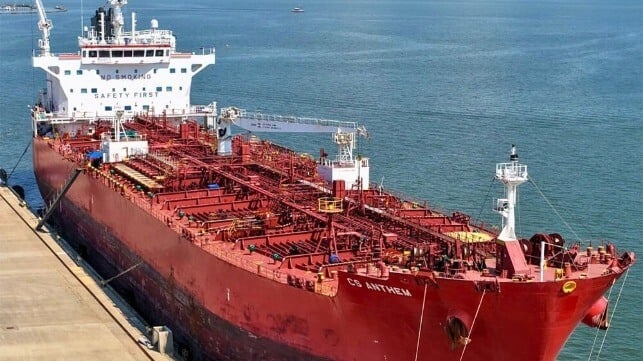
Crowley Stena Marine Solutions, the joint venture between Crowley and Stena Bulk, reports that MARAD recently approved operating the MR tanker CS Anthem under the Tanker Security Program. The companies note that the vessel will advance the nation’s strategic sealift capabilities.

"The addition of the CS Anthem demonstrates our commitment to strengthening U.S. maritime security and providing reliable, U.S.-crewed tanker capacity in support of national defense," said Tucker Gilliam, vice president of fleet operations for Crowley Shipping. "Together with Stena Bulk, we are proud to continue advancing solutions that serve both commercial and government energy transportation needs."

The new vessel is largely a swap with the same characteristics as the damaged ship. Built in 2017, CS Anthem had been operating for India’s Scorpio. It is 49,990 dwt compared with 49,729 dwt for the Stena Immaculate, which was also built in 2017, and which it replaces. The databases show CS Antheim was recently transferred to the U.S. flag from the Marshall Islands and now has a homeport of Jacksonville, Florida. 

Crowley is responsible for crewing and managing the tanker under a bareboat charter through the joint venture. The company also manages the tankers Stena Imperative and Stena Impeccable in the Tanker Security Program.

Stena Immaculate was anchored off the east coast of England after transporting a cargo of jet fuel. It was waiting for its berth when the containership Solong hit the tanker at anchor. The resulting fire engulfed both vessels, but Crowley’s crew acted heroically, starting fire suppression systems before they were safely evacuated. 

The tanker survived with portions of its cargo intact. They arranged for another tanker to receive the fuel, and the damaged vessel was towed to Great Yarmouth in the UK, where it appears to still be berthed. The Solong recently arrived at a recycling yard in Belgium, while the master of the vessel is facing trial for the incident that killed one of the crewmembers aboard the containership.