Saturday, August 30, 2025

Bahri’s Dark Geopolitical Ties


Bahri or National Shipping Company of Saudi Arabia is a giant maritime company in the Middle East. 

But, behind this commercial image, there is a provocative and worrying history of its geopolitical process, especially the means of transporting weapons and the manner in which Saudi Arabia participates in the geo conflict such as in Yemen and Gaza.. Since 2015, Saudi Arabia has been a major component of the Saudi-led coalition in Yemen, which also comprises the UAE, Bahrain, Egypt, Sudan, Jordan, Morocco and Kuwait. This military effort by this coalition has caused high civilian fatality, dislocation of millions of people and in humanitarian terms is one of the worst disasters in the world, as reported by the United Nations. This article will attempt to create an enlightened balanced discussion of these controversies as it gives some background and insight to a novice reader yet with the professional and analytical style.

Bahri Saudi Shipping Company

Bahri, which is a national shipping company of the Saudi Arabia, engages mostly in international marine logistics as well as the transport of crude oil, chemicals and bulk products and general merchandise. It also has big ships in oil products, dry bulk and specialised transportation. In an area of the world where maritime trade is one of the most essential veins, strategically based in the Red Sea and other trade gateways, the location of Bahri activities puts it in the realm of intersections between regional and international political dynamics, and as such, extends its operational being beyond commerce.

Weapons Transport to Israel Amid Gaza Genocide

In August 2025, the Saudi-owned Bahri Yanbu was at the centre of an international outcry after dockworkers in the port of Genoa, Italy, intercepted the ship after suspicions rose that it was carrying a heavy load of weapons bound to Israel. Independent observers and humanitarian organisations reported that among the cargo were Italian produced armed materials like Oto Melara naval guns, armoured vehicles, tanks, ammunition and explosives. The interception came at a time when Israel was actually undertaking heavy handed military actions in Gaza which are generally regarded as genocidal in character. A moral stance on becoming participants in the further crime in Gaza was one of the factors that drove the dockworkers into a blockade.

The consequences of this happening are huge. It brought into the spotlight the secret dealings-or at least acquiescence by Saudi Arabia to supply Israeli war machine despite the fact that Saudi Arabia holds official stands in favour of the Palestinian cause. According to critics, these moves are not only defied to the international humanitarian law, but go further to normalise and entrench the military and economic relations between both nations (Saudi Arabia and Israel). This change belongs to the larger scheme of things in Middle East where traditional enmity towards Iran and strategic interests have muted the old Saudi public opinion on the Palestine case in a silent bid of geopolitical balance.

However, Bahri made a formal refusal to have any relations with supply of arms to Israel. The company made outright claims that it has never ever travelled to Israel in any form and fully complies with the formal policies of the Kingdom of Saudi Arabia in supporting Palestine and the entire international maritime laws. Bahri highlighted that it has strict monitoring and auditing practices that are aimed at striving to comply. Nonetheless, despite the rebuttals, the incident in Genoa has initiated combined efforts to conduct independent operations and exert more investigation to the maritime affairs of Saudi Arabia, which exemplified a cloudy backdrop of the policy regarding Saudi Arabia compared to its ethical statements.

Yemen’s Conflict and Arms Supply

Probably the most sinister one in the recent history of Saudi Arabia foreign policy is the invasion of Yemen that the Saudi Arabia government has been carrying out since 2015. Saudi Arabia is at the forefront of a coalition that has been involved in large volume airstrike campaigns, naval blockade and ground offensives against the Houthi rebels, who have forced the internationally recognised Yemeni government out of big sections of their country. The ongoing conflict in Yemen is viewed by many observes, including the analysts in Al Jazeera and other local media stations as a kind of proxy warring between the majority-Sunni Saudi Arabia and the majority Shia Iran with the two nations, most times, supporting conflicting sides on the ground. Saudi Arabia also supports the Yemeni government of President Abdrabbuh Mansur Hadi that had been recognised by the UN Security Council resolutions in Resolution 2216 (2015).

The maritime activities of Bahri are once more in the limelight as it transports weapons and military equipment to Saudi forces that partake in Yemen. Research carried out by anti-war movements and human rights groups in Europe found out that the Bahri ships are regularly transporting arms to Saudi Arabia including ammunition, explosives and heavy arms through European ports like Antwerp. The CSO estimates by Amnesty international reveal that since the commencement of the war, Bahri has delivered hundreds of millions of euros of American and European, military equipment.

This weapon provision has been closely associated with a high number of the war crime charges charged against Saudi-led coalition such as civilian target attack and starvation weapons used in blocking of the sea by the coalition. The condition in Yemen is termed the worst humanitarian crisis in the world since more than 24 million people approximately 80 percent of the total population are in need of aid and millions have been starved, stricken by diseases, displaced, and basic services are becoming non-functional due to continuous conflict as stated by the United Nations and various humanitarian agencies. The importance of Bahri in this war as a logistic lifeline highlights the corporate aspects of this Saudi war machine and the intense intertwining of the business interests with devastating geopolitics.

Geopolitical Agenda

To appreciate the role of Bahri Saudi Shipping Company in such conflicts, it is important to understand Saudi geopolitical agenda in general. Saudi Arabia is a traditional foe of the occupation policies of Israel but over the past ten years is slowly moving towards an avoidance of confrontation with Israel over mutual fears of allowing Iran to consolidate its influence in the region. In the past, Saudi Arabia has opposed the occupation policies of Israel, but over the last ten years there has been growing signs of it engaging in limited relations with Israel due to a shared worry of Iran and its growing role in the region, especially in Syria, Lebanon, and Yemen (Israel-Saudi Arabia relations).

According to the reports this rapprochement has involved activities such as secret intelligence-sharing at least on the issue of Iranian missile programs, discreet delegations meeting each other in the third nations and initial discussions of prospective technology and trade association. In the example, Wall Street Journal (2025) and Congress.Gov (2025) cover the cases when Israeli and Saudi officials met to align security policies against Iran.

At the same time, Saudi Arabia still tends to regard Yemen as the essential buffer area that must be maintained to ensure access to the important strategic waterways, such as the Bab el-Mandeb Strait, which is essential to overall oil traffic and vital to the regional security. The kingdom views the Houthi movement as a proxy of Iranian policy and a serious direct threat to its southern borders, which influenced the long and violent military operation that is criticised by the international community and labeled as war crimes.

The fact that Saudi Arabia publicly defends Palestinian rights and at the same simultaneously advances its strategic relations with the state of Israel and intensifies its military operations in Yemen presents a complex, at times self-contradictory policy based on the logic of realpolitik, the calculations of regional power interests, and the unification of the domestic and foreign policy of the Crown Prince Mohammed bin Salman.

Conclusion

The controversies surrounding Bahri Saudi Shipping Company reveal much more than a logistics enterprise; they expose a nexus of geopolitical interests, ethical dilemmas, and the harsh realities of Middle Eastern conflicts. The ship interception in Genoa spotlighted Bahri’s alleged role in facilitating arms shipments during an ongoing genocide in Gaza, while its broader operations underpin Saudi Arabia’s war efforts in Yemen, exacerbating one of the world’s worst humanitarian disasters.

While the company officially denies transporting weapons to Israel and asserts full compliance with policies and international law, evidence from protests, investigations, and independent reports portrays a different picture—one of a state and its corporate instruments engaged in complex and controversial power plays with severe human costs.

For novice readers, it is essential to recognise that Bahri operates at the intersection of commerce and conflict, reflecting Saudi Arabia’s evolving and contentious role on the world stage. The ongoing scrutiny of these activities underscores the urgent need for transparency, accountability, and adherence to international humanitarian norms in international shipping—and for the global community to hold such actors to those standards.

Syed Salman Mehdi is a freelance writer and researcher with a keen interest in social, political, and human rights issues. He has written extensively on topics related to sectarian violence, governance, and minority rights, with a particular focus on South Asia. His work has been published in various media outlets, and he is passionate about raising awareness on critical human rights concerns. Read other articles by Syed.

MOVE THE UN FROM THE U$A

France says US should not refuse Palestinians access to UN summit

Under an agreement as host of the United Nations in New York, the United States is not meant to refuse visas for officials heading to the world body.

France has insisted there should be no restrictions on access to next month's UN General Assembly, after the United States said it would deny visas to members of the Palestinian Authority. Under an agreement as the host of UN headquarters in New York, the US is not supposed to refuse visas for officials heading to the world body.

Issued on: 30/08/2025 - RFI

Palestinian President Mahmoud Abbas, addressing the UN General Assembly in 2022, was reportedly intending to attend the upcoming UN meeting in September where nations are expected to vote in favour of a Palestinian state. AP - Julia Nikhinson


"A UN General Assembly meeting... should not be subject to any restrictions on access," French Foreign Minister Jean-Noël Barrot said at a meeting of EU foreign ministers in Denmark on Saturday.

A string of ministers in Copenhagen echoed France's call for the United States to allow access to the Palestinian delegation.

In a statement on Friday, the US State Department said that it was "denying and revoking visas from members of the Palestine Liberation Organization (PLO) and the Palestinian Authority (PA) ahead of the upcoming 80th United Nations General Assembly, which begins on 9 September.

"The Trump administration has been clear: it is in our national security interests to hold the PLO and PA accountable for not complying with their commitments, and for undermining the prospects for peace," the statement said

US to refuse visas to Palestinian officials at UN summit on state

'Clear contradiction to international law'

The extraordinary step by Washington comes as France is leading a global appeal to recognise the Palestinian state at the gathering of world leaders in New York.

The move further aligns US President Donald Trump's administration with Israel's government, which has been waging a war in Gaza since Hamas launched terror attacks on Israeli territory on 7 October 2023.

Israel adamantly rejects a Palestinian state and has sought to conflate the West Bank-based Palestinian Authority with its rival Hamas, which rules Gaza.

Israeli Foreign Minister Gideon Saar, writing on X, thanked the Trump administration "for this bold step and for standing by Israel once again".

Israel slams French plan to recognise Palestinian state as a 'prize for terror'

The Palestinian Authority called for the United States to reverse its decision, which it said "stands in clear contradiction to international law and the UN Headquarters Agreement".

Palestinian Authority president Mahmud Abbas, a veteran 89-year-old leader who once had cordial relations with Washington, had planned to attend the UN meeting, according to the Palestinian ambassador to the UN, Riyad Mansour..

Under an agreement as host of the United Nations in New York, the United States is not meant to refuse visas for officials heading to the world body.

(with AFP)

US urged to reinstate visas of Palestinian delegation heading to UN General Assembly


The EU and the Palestinian president’s office on Saturday urged the Trump administration to reconsider its decision to revoke the visas of Palestinian President Mahmoud Abbas and 80 other officials who had planned to attend next month’s annual meeting of the UN General Assembly in New York.


Issued on: 30/08/2025 -
By: FRANCE 24


In this file photo, United Nations Secretary-General Antonio Guterres addresses the 78th Session of the UN General Assembly in New York City, US, on September 19, 2023. © Mike Segar, Reuters
01:20


The Palestinian president’s office on Saturday urged the US government to reverse its unusual decision to revoke his visa, weeks before he was meant to appear at the UN’s main annual meeting and an international conference about creating a Palestinian state.

The 27-nation European Union asked the Trump administration to reconsider the move, which drew broad criticism.

US Secretary of State Marco Rubio rescinded the visas of Palestinian President Mahmoud Abbas and 80 other officials ahead of next month’s annual high-level meeting of the UN General Assembly, the State Department disclosed Friday, citing national security interests. Abbas has addressed the General Assembly for many years, and generally leads the Palestinian delegation.

“We call upon the American administration to reverse its decision. This decision will only increase tension and escalation,” Palestinian presidential spokesperson Nabil Abu Rudeineh told The Associated Press in Ramallah on Saturday.

“We have been in contact since yesterday with Arab and foreign countries, especially those directly concerned with this issue. This effort will continue around the clock,” he said.

He urged countries to put pressure on the Trump administration to reverse the decision, notably those nations that organized a high-level conference on Sept. 22 about reviving efforts for a two-state solution in Israel and the Palestinian territories. It is co-hosted by France and Saudi Arabia.


© France 24
02:11


French Foreign Minister Jean-Noël Barrot said he “deplores” the US decision.

“The UN headquarters is a sanctuary in the service of peace. It should not be subject to any access restrictions,” he posted on X Saturday after meeting with his counterparts from around the EU.

The EU’s foreign policy chief Kaja Kallas issued a statement about the revoked visas saying: ‘’In light of the existing headquarters agreements between the UN and its host state, we urge for this decision to be reconsidered.”

Abu Rudeineh also called for an end to Israel’s offensive in Gaza and “escalation in the West Bank, because none of this will lead to any solution.”

The move came as the Israeli military declared Gaza’s largest city a combat zone. Israel says Gaza City remains a stronghold of Hamas.

The Trump administration has taken several steps to target Palestinians with visa restrictions.

“It is in our national security interests to hold the PLO (Palestine Liberation Organization) and PA (Palestinian Authority) accountable for not complying with their commitments, and for undermining the prospects for peace,” the State Department said in a statement.

The Palestinian Authority denounced the visa withdrawals as a violation of US commitments as the host country of the United Nations. UN spokesman Stephane Dujarric said the world body would be seeking clarification from the State Department.

(FRANCE 24 with AP)


US to refuse UN summit visas for 80 Palestinians, including Abbas: US official

A US official has said that Palestinian Authority president Mahmoud Abbas is among 80 officials who will be denied visas to attend next month’s UN General Assembly, where France is leading a push to recognise a Palestinian state, AFP reports.

“Abbas is affected by this action along with approximately 80 other PA officials,” a State Department official said in a statement, detailing those impacted by the extraordinary decision announced on Friday by the United States, a key Israeli ally.


US revokes visas of Palestinian officials ahead of UN General Assembly, State Department says

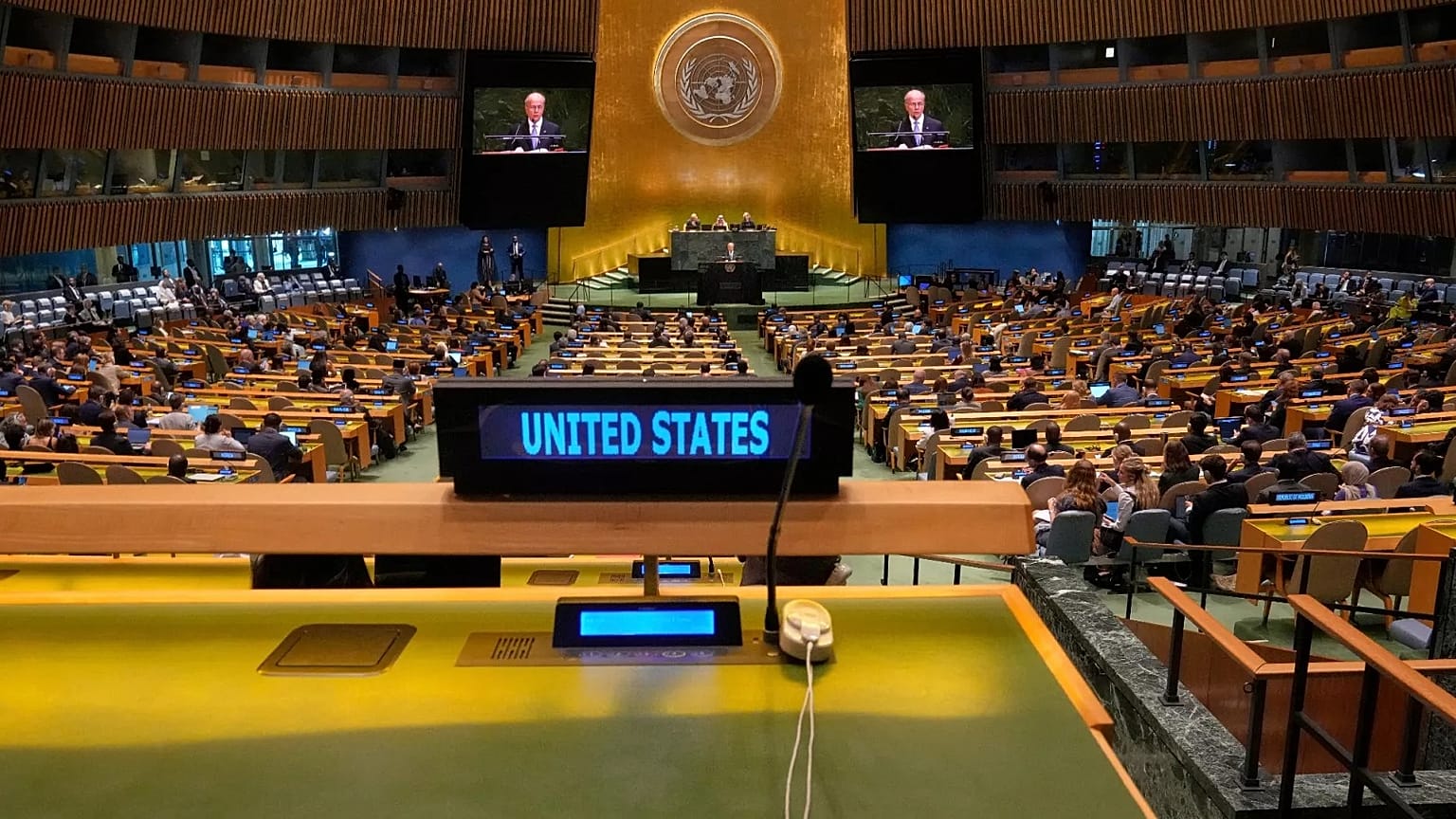
The US delegation seat is unoccupied as Palestinian Prime Minister Mohammed Mustafa addresses the UN General Assembly, 28 July, 2025
Copyright AP Photo

By Gavin Blackburn
Published on 

The State Department also suspended a programme that had allowed injured Palestinian children from Gaza to come to the US for medical treatment after a social media outcry by some conservatives.

US Secretary of State Marco Rubio has revoked the visas of a number of Palestinian Authority and Palestine Liberation Organisation officials ahead of next month’s annual meeting of the UN General Assembly, where the groups previously have been represented.

The State Department said in a statement on Friday that Rubio also had ordered some new visa applications from Palestinian officials be denied.

The move is the latest in a series of steps the Trump administration has taken to target Palestinians with visa restrictions and comes on the same day as the Israeli military declared Gaza City a combat zone.

The State Department also suspended a programme that had allowed injured Palestinian children from Gaza to come to the US for medical treatment after a social media outcry by some conservatives.

The State Department didn’t specify how many visas had been revoked or how many applications had been denied. The department did not immediately respond to a request for more specifics.

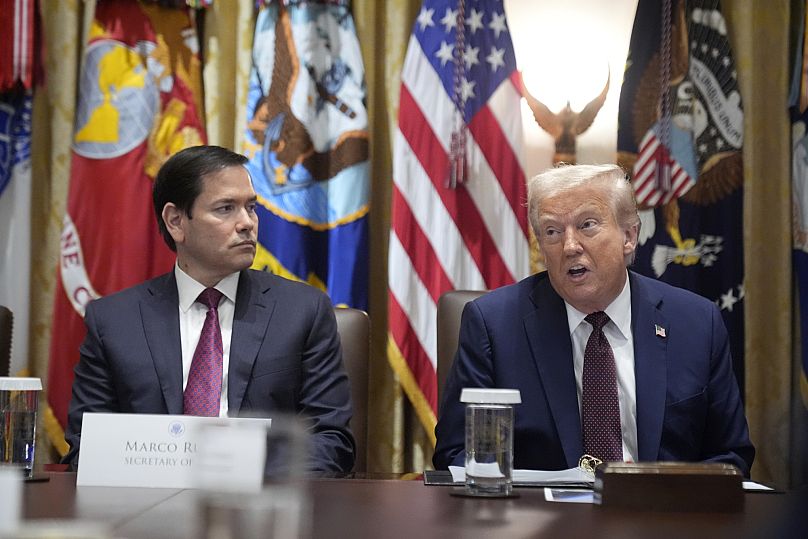
US President Donald Trump speaks during a cabinet meeting in Washington while Secretary of State Marco Rubio looks on, 26 August, 2025 AP Photo

It wasn't immediately clear if Palestinian President Mahmoud Abbas would be affected.

The agency's statement did say that representatives assigned to the Palestinian Authority mission at the United Nations would be granted waivers under the US host country agreement with the UN so they can continue their New York-based operations.

"It is in our national security interests to hold the PLO and PA accountable for not complying with their commitments, and for undermining the prospects for peace," the statement said.

"Before the PLO and PA can be considered partners for peace, they must consistently repudiate terrorism — including the October 7 massacre — and end incitement to terrorism in education, as required by U.S. law and as promised by the PLO.

The Palestinian ambassador to the UN, Riyad Mansour, told reporters on Friday that he had just learned of Rubio's decision and was assessing its impact.

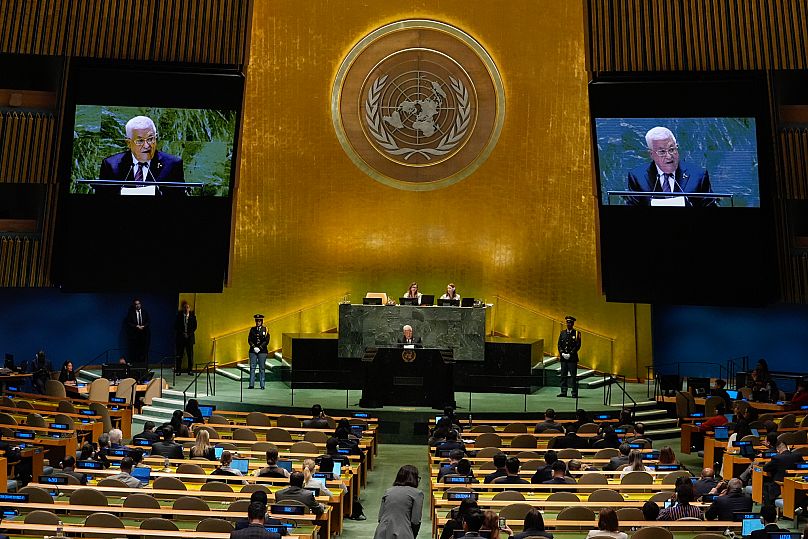
Palestinian President Mahmoud Abbas addresses the 79th session of the United Nations General Assembly, 26 September, 2024 AP Photo

"We will see exactly what it means and how it applies to any of our delegation, and we will respond accordingly," he said.

Mansour said Abbas was leading the delegation to next month's UN meetings and was expected to address the General Assembly, as he has done for many years.

He also was expected to attend a high-level meeting co-chaired by France and Saudi Arabia on 22 September about a two-state solution, which calls for Israel living side-by-side with an independent Palestine.

At the UN, 147 of the organisation’s 193 member states recognise Palestine as a country and at the General Assembly it has had the status of non-member observer state since 2012.


MADAGASCAR

Malagasy families 'turn the dead' with silk and song to honour ancestors

In Madagascar, winter brings with it a unique family gathering. Across the central highlands, communities practise the famadihana – the “turning of the dead”. The ritual, rooted in Austronesian culture and dating back to the 16th century, involves exhuming ancestors, wrapping them in fresh silk shrouds and celebrating them in a lively, joyful ceremony.


Issued on: 30/08/2025 - RFI

Families gather in Ambohidranandriana, in Madagascar’s central highlands, to celebrate their ancestors during the famadihana ritual on Friday, 25 July 2025. © Guilhem Fabry / RFI

In Ambohidranandriana, a village about an hour’s drive south of Antsirabé, in the volcanic Vakinankaratra region, music and laughter rise from a noisy procession weaving between the family tombs.

For Fitahina, 25, the day is deeply personal. She came to honour her grandmother, who died before she was born.

“I am happy to meet her because I never knew her. I have been waiting for this moment for a very long time. I miss her a lot," Fitahina tells RFI.

"When the body comes out of the tomb, I will go closer and talk with her. I will tell her the good and the bad things in my life. I know she can still hear me.”

Nearby, guests share plates of vary be menaka – rice with fatty zebu meat – while men begin to open the vast family tomb, buried under dust.

Meet the tiny tuft-tailed saviour of Madagascar's endangered baobabs

Fitahina's aunt, Claudine, wears an elegant hat for the commemoration of her late mother.

“I am proud that my family is gathered for this famadihana,” she says. “I will pray for my mother and ask her for blessings – health and a long life for my children.”

One by one, the bodies are carried out. Descendants lift them high in their arms as the crowd moves in jubilation.

Alphonse, a neighbour invited like hundreds of others, describes the ritual.

“We wrap the ancestors in a new silk shroud, the lambamena,” he explains. “It is a sign of love and consideration for the good they did for us. This is how we honour them.”

A little toaka gasy – traditional Malagasy rum – is poured on to the fresh silk. Only at nightfall, when dusk settles over the rice fields, are the ancestors returned to their family tombs.

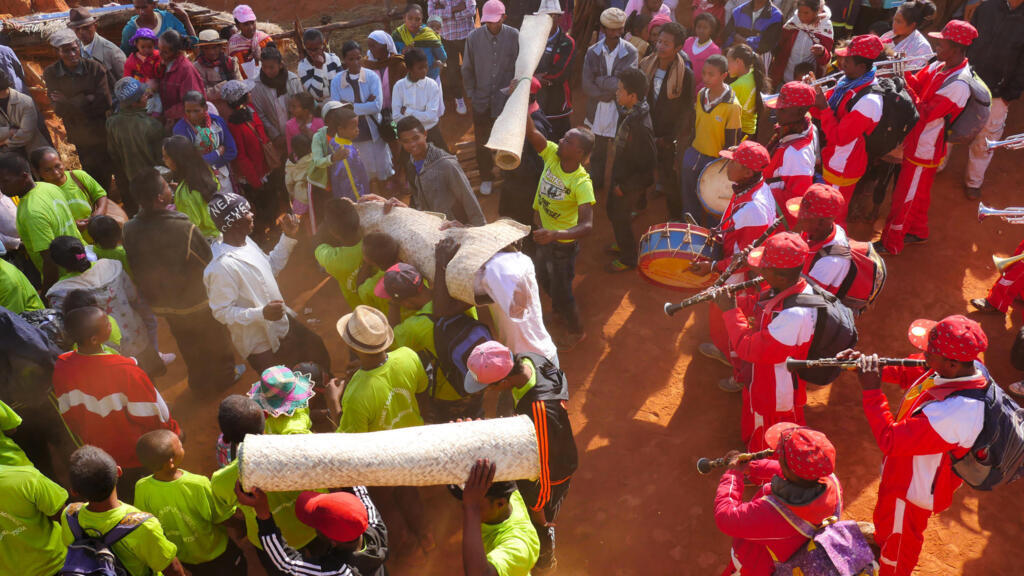
Families dance with remains wrapped in old shrouds as a brass band plays during a famadihana ceremony in Madagascar in 2019. RFI/Sarah Tetaud

Financial pressures

The famadihana usually takes place every five or seven years, depending on a family’s means, but it is a costly event. Food, drink, musicians and services for hundreds of guests add up, and donations rarely cover the full expenses.

The financial demands are pushing some families away from the ritual, anthropologist Annie Raharinirina, from the University of Antananarivo, tells RFI.

“Some families go into debt to organise the famadihana, but young people in the cities do not really practise it any more,” she says.

Others still commit to large-scale celebrations, calling on professional event organisers for their famadihana.

“They invite famous artists, hire catering services. Families save for years. They sell their zebus [humped cattle, a traditional sign of wealth] or use them as food for the guests," Raharinirina says.

"Some sacrifice a lot, and there are even some who go into debt to organise a celebration worthy of the name. Some people say it is better to save and spend money for the living than for the dead.”

Madagascar's master artisans sail through time to revive lost ships


Tradition in transition

However younger generations are increasingly divided over the practice of this centuries-old ritual, Raharinirina explains.

“Young people in the cities no longer really practise the famadihana, but young people in rural areas like the Itasy region or Antsirabé, many still do,” she adds.

For now, in villages like Ambohidranandriana, the tradition remains a major event. Families and neighbours gather in large numbers, carrying out rituals passed down for centuries.

For participants like Fitahina, it is a chance to come face to face with ancestors and speak with them across generations.

This story was adapted from RFI's original version in French
Eight French cities ban tuna from school canteens citing high mercury levels

Eight cities, including Paris and Lyon, are taking tuna off their school menus from the start of the new term on Monday after research showed high levels of mercury in tinned tuna fish, prompting fears over risks to children's health.


Issued on: 30/08/2025 - RFI

The tail fin of a tuna fish at Rungis International Market, south of Paris. 
AFP - STEFANO RELLANDINI

The French municipalities of Paris, Lille, Lyon, Grenoble, Montpellier, Rennes, Bègles and Mouans-Sartoux have "temporarily removed" the popular fish in their school meals.

The decision came after a study last year by campaign groups Bloom and Foodwatch revealed the tinned fish can contain toxic levels of mercury. Samples from the 148 cans of tuna bought in France, Germany, England, Spain and Italy all tested positive for mercury contamination. Some cans contained levels four times higher than EU regulations allow, the study said.

The World Health Organization (WHO) classifies mercury as one of the 10 most dangerous chemicals threatening public health.

"Mercury is a powerful neurotoxin that binds to the brain and is very difficult to get rid of," said reseacher Julie Guterman, one of the report's authors


Alerts can't be ignored

The eight cities said they felt obliged to take the initiative.

"No action has been taken by national and European political leaders or the tuna industry to protect consumers, especially children" the eight deputy mayors responsible for food said in a joint press release sent to France Inter public radio on Thursday.

"We try to be consistent and serve food that respects both health and the environment," said Gilles Pérole, deputy mayor of Mounas-Sartoux. "So when we get alerts like this, we can't ignore them."

The EU and French regulations set the mercury limit in tuna at 1mg/kg – three times higher than the 0.3 mgs/kg threshold set by the WHO and which applies to other fish species.

"So why is there an exemption for tuna, with a level of one milligram per kilo? It's because, in reality, they realised that tuna couldn't meet this standard," Pérole said. "So we decided to suspend tuna until the mercury level accepted in tuna returns to the standard for other fish."


Why is there mercury in tuna?


Over the past two centuries, the concentration of mercury in the oceans has increased by 300 per cent.

The toxic metal first builds up in the air, released by mining and burning coal. Some 2,500 tonnes are emitted into the atmosphere in this way every year.

Mercury then passes into the oceans through rainfall, but mainly through gas exchange.

Once in the water – scientists have found traces of mercury down to depths of 4,500 metres, with bacteria transforming the mercury into methylmercury.

This organic form is particularly dangerous since it's easily absorbed by living organisms and stored in their bodies.

As a predator at the top of the food chain, tuna accumulate heavy metals from the already-contaminated smaller fish they consume.


Respecting EU thresholds


According to the Bloom and Foodwatch report, the highest concentration of mercury was found in French brand Petit Navire at 3.9 mg/kg.

But the supplier has denied the claims and maintained it respects French and European mercury threshold regulations.

“Consuming Petit Navire products is perfectly safe for consumers. The safety and well-being of our consumers is a top priority” Petit Navire spokesperson Cyrine Triki said in an interview, adding that monthly test on tuna species in various supply zones were carried "with the support of independent laboratories accredited by French and European health authorities".

"The results of these tests have never revealed mercury levels in excess of current European standards, averaging between 0.2 and 0.3 mg/kg, or 70 to 80 per cent of mercury levels” she said.

The eight local councils are calling on the agriculture and health ministries to defend the lowering of tuna-specific standards both within France and at the EU level.


Lord Hanuman as ‘First Space Traveler’: Mythology as Science


Ram Puniyani 


The Indian Constitution with scientific temper stands for social change, while Hindu nationalist ideology stands for reversing the gains of freedom movement.

Mythologies, all over the world, are pleasant flights of imagination. While our childhood fascination with these is everlasting in our memories, the trend from the past few decades is that Right-wing ruling parties’ leaders are flaunting mythologies as if they happened the way we read them or hear them. The beginning of this in the public space began with Prime Minister Narendra Modi reminding the medical fraternity and the nation that there might have been a plastic surgeon, who transplanted the head of a baby elephant on the Lord Ganesh.

I don’t mean to hurt any sentiments but I tried to understand it from the medical point of view and found that it is a biological impossibility, as of now. At the same time, I did come to know that in Egyptian mythology also there are “Egyptian gods and goddesses with animal heads? The interesting thing about Egyptian gods and goddesses is that each animal has an obvious explanation. The connection between the gods and goddesses to the animals is the combination of the god’s power and the animal’s characteristics. Like the Egyptian goddess of war, Sekhmet, had a lioness’ head to show how ferocious she was. There are many more of such awesome gods and goddesses…”

Equally interesting was that during Zia Ul Haq’s regime in Pakistan, the idea that jinns are an infinite source of power was floated and even in Science Congresses, and these were discussed seriously. The idea was “for creating a jinn-based telecommunications network. Another promising direction could be radar-evading jinn-powered cruise missiles. Jinn chemistry, a research subject activated in the Zia ul Haq era, could be another growth point. (they) could also pursue a proposal from the 1970s, initiated by a senior director of the Pakistan Atomic Energy Commission, to replace fossil and nuclear fuels with jinn power.”

One hopes such fanciful solutions based on mythology are not being implemented there!

One was reminded of this as two recent statements by the top Bharatiya Janata Party (BJP) leaders’ statements about space travels were made in recent times. Anurag Thakur, several times MP and ex-Minister in the Union Cabinet, while talking to school children on the occasion of National Space Day, asked them as to who was the first person to travel in space. The students in unison uttered the name of Neil Armstrong. To this Thakur said “no, that’s a wrong answer, the correct answer is Lord Hanuman. Thakur urged teachers to look beyond “textbooks given to us by the British". He asked them to look toward “our Vedas, our textbooks and our knowledge... As per the prevalent story, Lord Hanuman flew and brought the mountain on which the lifesaving herb was there!

Not to be left behind, Union Agriculture Minister Shivraj Singh Chouhan stated that Pushpak Viman preceded the Wright Brothers flight. Quite a thought!

Even if one has some elementary knowledge of aviation science, one can know the type of infrastructure needed for flying machines. And individual flying has been human ambition for a long time, that’s what made the scientists burn the midnight oil and struggle in the labs and on the ground to make the first flight possible. One is not sure that these worthies who are claiming mythological stories as real technological achievements really believe in that or saying so to undermine the scientific temper.

Not only this, Chouhan went on to say that India was well developed technologically during the Mahabharat (an epic)period. As per him “drones and missiles that we have today were already with us for thousands of years, we have read this all in Mahabharat.”

This is not all there has been a free for all to claim the glorious achievement of the past. Once Modi opened the floodgates of mythology as science, various BJP leaders started making various claims about the present technological achievements, already being there in the ancient times. “Just like Narada, Google is the source of information” (BJP leader Vijay Rupani, former Chief Minister of Gujarat, April 30, 2018).

BJP leader Biplab Kumar Deb, former Chief Minister of Tripura (April 17,2018, The Tribune) stated that “India has been using internet since ages. In Mahabharat, Sanjay was blind but he narrated to Dhritrashtra, what was going on in battlefield. This was due to internet, satellite also existed during that period.”

BJP leader Harsh Vardhan, a medical doctor and former Union Minister of Science and Technology, said that each and every custom of Hinduism was steeped in science, “every modern achievement is steeped in ancient scientific achievement.” (March 16, 2018).

These are just a few of the samples from the vast wisdom dished out by BJP leaders. All this violates the scientific temper, the foundations on which modern Indian scientific institutions were founded. One wonders if this ideology was ruling immediately after Independence, one shudders to think as to what would have happened to all this if this type of ideology had been in the driving seat of planning.

After Independence, for the initial few decades, the country saw the laying foundations of scientific institutions taking India into the status of one of the major countries with scientific manpower and research.

How do we understand as to why BJP government leaders are propagating mythological imaginations as scientific truth. Basically, faith-based knowledge is ruling the roost currently. The babas (godmen) and the glorification of the past is very much in the air. Knowledge is a process which develops with time and does not know national boundaries. Ancient India had great contributions in the field of science, Aryabhat, Sushrut and many like them contributed immensely to the field of knowledge. This runs parallel to the development of society.

Faith and rational thinking have crossed each other’s path time and over again. Those for status quo in the society stick to faith-based understanding while those for social change for equality and against injustice harp on rational knowledge, scientific temper. BJP and the whole RSS (Rashtriya Swayamsevak Sangh) combine are primarily based on the social values of inequality. While the Indian Constitution has a scope for social change toward equality, it gives an importance to scientific temper. The RSS-combine, BJP included, look backwards and have opposed the Indian Constitution (including scientific temper) in many ways.

Political ideologies are a package deal. The Indian Constitution with scientific temper stands for social change, while Hindu nationalist ideology stands for reversing the gains of freedom movement (as reflected in Indian Constitution), while the peddlers of faith standing opposed to scientific temper are trying to push the country backward by undermining scientific temper on the one hand, and the concept of Liberty, Equality and Fraternity on the other.  

The writer is a human rights defender and a former professor at the Indian Institute of Technology, Bombay. The views are personal.


Hanuman

Hindu god and a companion of the god Rama

Hanuman, also known as Maruti, Bajrangabali, and Anjaneya, is a deity in Hinduism, revered as a divine vanara, and a devoted companion of the deity Rama. Central to the Ramayana, Hanuman is celebrated for his unwavering devotion to Rama and is considered a chiranjivi. He is traditionally believed to be the spiritual offspring of the wind deity Vayu, who is said to have played a significant role in his birth. In Shaiva tradition, he is regarded to be an incarnation of Shiva, while in most of the Vaishnava traditions he is the son and incarnation of Vayu. His tales are recounted not only in the Ramayana but also in the Mahabharata and various Puranas. Devotional practices centered around Hanuman were not prominent in these texts or in early archaeological evidence. His theological significance and the cultivation of a devoted following emerged roughly a millennium after the Ramayana was composed, during the second millennium CE.