Sunday, August 31, 2025

‘Every pound of public investment should back British jobs’
SOCIAL DEMOCRATIC PROTECTIONISM


© Michael715/Shutterstock.com

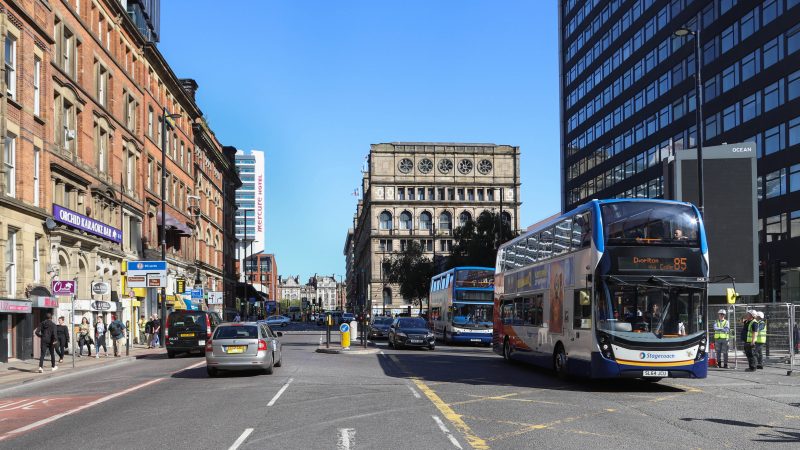
If new transport infrastructure was made in Britain, Greater Manchester could spark new jobs, back industry and set a model for our regions.

When we talk about building a stronger economy, we often focus on numbers like growth, productivity, or inflation. But for most people, what really matters is whether investment creates good jobs, keeps industries alive, and gives communities confidence in the future. That is why how we spend public money is so important.

In Greater Manchester, we are investing in the Bee Network and the next generation of trams. These new vehicles will allow us to expand services, connect more communities, and introduce modern technology.

But we need to ask ourselves an important question: where will these trams be built, and who will benefit?

Build new trams with British Steel

I believe the answer should be clear. Our new trams must be built in Britain using British Steel. This is not just about local pride, although I know people in Greater Manchester would feel proud of it. It is about creating skilled jobs, supporting local businesses, and making sure the money we invest circulates in our local economy.

Public spending already covers billions of pounds of infrastructure, vehicles, and transport projects every year. Too often, these contracts are awarded to overseas companies. That means the work, the jobs, and the skills go abroad, while our communities miss out. We can change that.

Greater Manchester has real influence through its purchasing power. By insisting that new trams are made in the UK, we could create work for local engineers, steelworkers, and designers. We could strengthen supply chains, give companies confidence to invest, and support the industries of the future.

The case for building in Britain has never been stronger

Building trams in Britain could create hundreds of jobs directly in manufacturing, while supporting thousands more in related industries such as design, engineering, and logistics. Local factories would see more work, apprentices could be trained, and the skills we need for the next generation of transport projects would be retained in our region. This is how investment turns into opportunity for communities.

The case for building in Britain has never been stronger. The pandemic showed how fragile global supply chains are. Rising energy costs and international uncertainty have reminded us that resilience matters. If we want a strong, secure economy, we need the capacity to make things ourselves.

Modern British manufacturing is not about nostalgia. It includes the manufacture of advanced steel, engineering, and green transport technology. These industries will grow if there is demand. Public procurement can provide that demand. By committing to building trams in Britain, we will give businesses the certainty they need to expand, hire and innovate.

This is what Labour should be about: using the tools of government to deliver for working people. We should not accept a system where taxpayers pay for transport projects while jobs, profits, and benefits go abroad. Every pound invested should strengthen communities, industries, and pride in British work.

This is the kind of investment that changes lives

Transport is about more than timetables and tickets. It is about shaping our economy and giving communities opportunities to thrive. Choosing to build our trams in Britain would be a simple but powerful step toward a stronger, fairer economy where workers and industry benefit side by side.

Imagine apprentices in Greater Manchester learning to weld and construct, engineers designing next-generation vehicles, and local suppliers providing essential components. This is the kind of investment that changes lives, strengthens communities, and ensures the region does not miss out on the economic opportunities that public spending can create.

Other regions have shown what is possible when procurement is used strategically. Local supply chains are revitalised, jobs are created, and skills are passed down to the next generation. Greater Manchester can do the same. We have the people, the expertise, and the ambition to make it happen.

This is also about pride. British-made trams would be a visible sign of what public investment can achieve. They would show that we value our workers, our skills, and our industries. They would signal to the world that Britain can still produce high-quality, high-tech vehicles that meet modern needs while supporting communities at home.

We now have the chance to make a real difference. By choosing to build our trams in Britain, we could create skilled jobs, keep supply chains local, and rebuild our industrial foundations. Greater Manchester could show how public investment can deliver for people, not just move vehicles from place to place.

This is the kind of bold, practical action that Labour should champion. It connects investment with opportunity, transport with industry, and public money with public benefit. It is a way to deliver lasting change for communities while strengthening the economy and ensuring Britain remains a place where people can build a career, support a family, and be proud of what we make.

Choosing British-made trams is not a small decision. It is a choice about the kind of future we want for Greater Manchester and for the UK. We can either let public investment slip away overseas or we can use it to create opportunities at home. I know which choice I want to make, and I believe the people of Greater Manchester want the same.

By backing British manufacturing, we can show that public money matters, that local jobs matter, and that Greater Manchester is ready to lead the way in building a stronger, fairer, and more resilient economy.

The Progressive Case for Tariffs



 August 28, 2025

Sara Steffens is the worker power director at the Congressional Progressive Caucus Center.

UK

Labour ‘must examine people working in rail industry after Hull dispute’ – Aslef


Photo: The Deep, in Hull.

Labour should “take a look” at people operating within the rail industry, the general secretary of Aslef has said, ahead of a solidarity rally over an industrial dispute with Hull Trains.

Trade union activists will join Aslef at the rally at Hull Paragon station today, as the union continues to battle Hull Trains over the dismissal of one of its members.

The union claims the driver was unfairly dismissed after raising fears of fatigue at a safety meeting. In solidarity, the general secretaries of 30 trade unions – including several affiliated with Labour – have written to Hull Trains warning that sacking the driver damaged the safety culture on Britain’s railways.

In the letter, Fire Brigades Union general secretary Steve Wright said: “We want to make it really clear. The FBU will stand by all workers in struggle, as that solidarity is fundamental to what makes our unions powerful.”

Speaking to LabourList, Aslef general secretary Mick Whelan said that railways will be less safe if drivers can’t come forward with personal issues without fear of dismissal.

“If they get away with this in Hull Trains, the culture that we spent 23 years applying, trying to get people to come forward if they’ve got family issues, or had a traumatic event, or have got a medical issue, people just won’t come report anymore, and we’ll have a less safe railway.”

He said: “The government should have a look at people operating within the industry.”

He added the press had been briefed that the driver was asleep at the wheel, but this was “untrue”.

According to the union, when the company downloaded the black box it discovered the driver had driven perfectly and correctly throughout his journeys.

“It is interesting that I’m more than willing to have an open debate with anybody from Hull Trains, with the press – or anybody else present – to make our case, yet they keep hiding,” Whelan said.

In the latest ballot, drivers for Hull Trains voted to continue strike action by 17 members to 15. There have been, to date, 72 days of strike action at Hull trains.

A spokesperson for Hull Trains, said: “Hull Trains follows highly regulated industry standard agreements and procedures for safety. We have stringent safety reporting processes and provide extensive ongoing training and health and wellbeing support for our colleagues which has secured industry recognition.

“The company has made a number of proposals for a resolution of this matter with Aslef. We remain committed to open dialogue to resolve this situation and avoid further disruption to our customers.”

“Something wicked this way comes”: finding my Jenny Greenteeth

AUGUST 27, 2025

By David Renton

My novel, The Story of Jenny Greenteeth, is published today. The editors of Labour Hub have been kind enough to offer me this chance to explain why I wrote it. Around five years ago, during the early days of Covid, I was asleep at home when I dreamed of drowning. On waking, I was capable of summoning only the most meagre scraps of this encounter which were as follows: my face had been below the water’s surface with my feet far beneath me, I gasped for air, the water invaded my lungs and I could not breathe. That memory excited me. It felt authentic, real, and I wrote it down at the first chance.

When I thought about the dream, two obvious contenders presented themselves as explanations for why I’d reacted so strongly. At the age of one or thereabouts, but at any event before I was verbal, my parents took me sailing on their 30-foot, two-sail, yacht. At some point in the day, I fell into the water, whether from the boat itself or from the small rubber dinghy on which they liked to row to land while they left the yacht anchored to the sea floor. All I know is that my father plucked me out of the water. To this day, I still have stitching on the little finger of my right hand. My mother told me that my scar dates back to my rescue. Was I replaying this incident in my head; did I remember the event itself, or only being told about it? 

Here is the other possibility – when I was about 25 years old, I was walking one late December evening through Hackney on my way back to the room I rented. My partner suggested that we strip our clothes off and dive in the nearest canal. I, who’d drunk less than her, was horrified and objected, raising the cold, the dirt of the water, the risk of infection. Ever since, it has been one of those moments we tease each other about, a symbol of her recklessness or my caution, or possibly those values in reverse (that’s the thing about long-term relationships, you get to see all of the person you love, and their different reactions to similar opportunities). On the birth of our children, I wrote a love poem in which that moment became the fulcrum around which our relationship has turned. Maybe, as I dreamed, I was imagining what would have happened if I had indeed jumped into the water with her?

Within moments of waking from the dream, the conviction had settled on me that this incident meant enough so that I could write a novel exploring what exactly had been going on – either in the dream itself or in my enthusiasm at its memory. And there were other figures I’d be thinking about too – a wronged woman from the distant past, her accusers. Alongside them, I’ve long been mulling questions with which the book engages: the violence of the oppressed and its necessity; whether and when it’s right to forgive.

Quite a few novels, I suspect, have similar origins. Dracula, for example, is said to have begun at Bram Stoker’s waking from a dream; in his case, of being menaced by three inhuman women, plus a man who asserted his control, not of the women but over Stoker himself. That scene makes it into his novel’s early pages, just as mine is my story’s inciting incident.

My Jenny Greenteeth is a monster, a metaphor perhaps but of a wild and unchained sort, neither parable nor allegory. Readers who remember London in 2013, in the aftermath of the student protests and the London riots, will I hope find the atmosphere familiar. Tell me if the monsters frighten you, as they scare me. Let me know if you side with the book’s protagonist as she tries to make a principled way through a world not of her choosing. This is gentle, horror fiction, comrades. Urban horror, folk horror, but horror all the same. Read it if you believe that sometimes fiction can tell the truth about or world and its never quite closed-off possibilities.

David Renton is a barrister and the author of Against the Law: Why Justice Requires Fewer Laws and a Smaller State, which was published by Repeater in 2022 and of Horatio Bottomley and the Far Right Before Fascism, which was published by Routledge in November 2022. He blogs here.

\

 UK

Alarming increase in housing insecurity for older people: new report

AUGUST 27, 2025

new report by Crisis shines a light on a growing and devastating issue: older people in Britain are being swept into the housing and homelessness crisis.

What should be a time of security and dignity is instead becoming a daily battle to keep a roof overhead, pay rent, heat homes, and afford food. For too many, the dream of a peaceful retirement has been replaced by the fear of homelessness.

A Growing Crisis

Crisis’ research reveals that older people are now facing housing insecurity at alarming rates. Households unable to save, people experiencing poor health and Black, Asian, and other minoritised ethnic communities are especially vulnerable.

Homelessness among older people has risen sharply over the past five years. In the last two years, England saw a 35% increase in the number of households aged 55 and over forced into temporary accommodation. With an ageing population, the situation is only set to worsen unless urgent action is taken.

The Human Cost

As housing and living costs spiral, many older people are being pushed into desperate measures to cope: turning off heating and hot water, cutting back on food and electricity, relying on food banks and avoiding social outings to save money, leading to isolation and loneliness.

For some, debt becomes the only way to survive, with credit cards and loans filling the gaps. Others delay retirement because they simply can’t afford to stop working. The numbers of over-65s who are working has doubled in the last twenty years.

Caring for loved ones also becomes harder, while barriers like digital exclusion and age discrimination make finding work more difficult.

Over two-fifths of respondents surveyed said they suffered from increased stress about rising housing costs. Perhaps most worryingly, nearly half of older people on low incomes told Crisis they would have nowhere to go if they lost their home. In some heart-breaking cases, people have resorted to sleeping in sheds or living in unsafe conditions, with devastating effects on both physical and mental health.

Why This Is Happening

This crisis is the result of years of chronic undersupply of social housing, rising rents and an inadequate welfare system. What was once a safety net for older generations has eroded, leaving many exposed and vulnerable.

Without intervention, homelessness could become a grim reality for an increasing number of older people across Britain.

What Needs to Change

Crisis is calling for urgent action to prevent this crisis from becoming entrenched:

  • Significant investment in social housing to ensure safe, genuinely affordable homes
  • Affordable private renting, with stronger protections for tenants
  • Housing benefit that truly covers the lowest third of rents across Great Britain

Anything less will mean more older people suffering needlessly in poverty, instability, and homelessness.

“‘I didn’t expect to be living the way I am’: Older people’s experiences of housing precarity and homelessness” can be accessed here.


UK 

Local activists fight Green Belt developers


AUGUST 28, 2025

Kent villagers are organising against an ill-conceived plan that would destroy local amenities and increase pollution, reports Dave Mitchelmore.

Two villages adjacent to Maidstone are facing housing developments on three sites that would eat into Green Belt land and make existing traffic congestion and pollution levels even more intolerable.

Wateringbury and East Malling lie a stone’s throw from the western section of the M20 in Kent. This proximity, coupled with the lack of an up to date Local Plan for Tonbridge and Malling Borough Council, (TMBC), renders these semi-rural villages susceptible to the relentless drive to build new homes, irrespective of the suitability of such developments for the area.

The vulnerability to these developments that the villages face has local and national features. TMBC’s local plan expired more than five years ago and the Council therefore does not have an adopted strategy for meeting housing needs, meaning that developers are able to propose new residential schemes within sustainable locations and expect to receive a positive outcome.

In December 2024, the Government revised the National Planning Policy Framework which included changes to the Metropolitan Green Belt. One change was to introduce a Grey Belt Policy, which allows residential development of Green Belt sites that are within a sustainable location and would not undermine the purposes of the wider Green Belt. The three sites under threat lie either within or adjacent to the Metropolitan Green Belt.

The so called ‘Golden Rules’ surrounding this policy demand that submitted developments must prove 50% of homes would be ‘affordable’, clearly a very loaded stipulation. As TMBC can demonstrate only 3.1 years of a five-year housing land supply there is clearly an ‘un-met housing need’.

Faced with this situation, opponents of one of the latest proposed developments in East Malling, on land currently an orchard, rejoiced when a full meeting of TMBC rejected an application to build 52 homes on the site in April this year. Unfortunately, Esquire, the builder, have sought to appeal the decision and in August word came that another development is proposed within the village boundary.

Wateringbury, which is directly adjacent to East Malling, would lose the wonderful amenity of a glorious view of the Medway Valley should this application to build be successful. This loss of amenity would also be felt by neighbouring villages. The proposed development would occupy a site currently consisting  of fields where horses and ponies are stabled.

 Dozens of residents in both villages are currently working together to oppose these proposals. The villages are linked by a crossroads which already experiences urban levels of pollution and traffic congestion. This is set only to significantly deteriorate if the developers get their way.

East Malling has a long tradition of opposing these developments, with some stalwart support from individual councillors. This is not the case in Wateringbury, but the threat of this development has galvanised the village into action via word of mouth and, you’ve guessed it, WhatsApp. Three meetings have been held with over 60 residents signed up to the Protect Our Medway Valley group (POMV). At the time of writing, the tenant has finally been served with an application for planning permission after six months of shadow boxing between Croudace, the developers, and POMV.      

We have approached Tom Tugenhat, the local MP and local councillors, but clearly our strength lies in pinpointing where proposals clash with local and national policies, doing our homework and organising opposition to these developments that not only would further blight the West Kent countryside but also avoid tackling the underlying housing crisis that Labour is emphatically failing to address.

Dave Mitchelmore is Convenor of Protect Our Medway Valley and a resident of Wateringbury. 

Image: Wateringbury. https://www.flickr.com/photos/adambowie/36653935146/in/photostream/ Author: Adam Bowie. Licence: Attribution-NonCommercial-ShareAlike 2.0 Generic CC BY-NC-SA 2.0 Deed

UK

Migrants are not the problem – this is just another distraction

AUGUST 29, 2025

The current situation is largely the creation of successive governments, argues Nadine Finch.

The growth of activity by and support for the far right is at a level that has not been witnessed in Britain since the 1970s and 1980s. Its primary targets are migrants and their communities. This time the fascist regalia and narrative are not so much in evidence, but the racist ideology is just as clear. The flying of flags from lampposts and the drawing of the St George’s flags on roads and pavements are also all too reminiscent of the no-go Loyalist areas in Northern Ireland. But both the Northern Ireland Assembly and the Northern Ireland Human Rights Commission have recognised the adverse effects of the use of flags and symbols to intimidate and denigrate communities seen to be different.

Here the Prime Minister rarely makes statements without being framed by Union Jacks and the Government’s social media repeatedly portrays asylum seekers as illegal entrants. It also does nothing to call out the hate directed at them. The added irony is that it is the Government itself that is continuing to place asylum seekers in hotels run by contractors who make millions by providing sub-standard accommodation.  

Over the summer, Farage ramped up anti-immigrant falsehoods. The Government has sought to appease him by implicitly accepting them and issuing a raft of responses that are not capable of solving the largely economic and social basis for the growing support for populist racist views. It agrees that asylum seekers should not be housed in hotels, but does not provide alternative accommodation, which would meet the needs of traumatised individuals and stop the profiteering by private accommodation providers. It also agrees that applications and appeals should be determined within a reasonable time, but does not provide funding for this to be achieved in a manner that will meet the requirements of international law.

In the context of the ‘asylum hotels’, prior to 1999 asylum seekers were provided with a percentage of income support and were dispersed to available public and private accommodation. But that Labour Government then created a separate asylum support scheme with its own costly bureaucracy and increasingly entered into expensive contracts with private accommodation providers, all too willing to be paid well for accommodation they had not been able to persuade others to rent at such a profit. This eventually led to three private contractors entering into even more profitable contracts with the Government to use hotels standing empty, as a result of Covid and the economic downturn.

Yes, there is an increase in the numbers of asylum seekers arriving here who require accommodation whilst their claims are determined. But they are not illegal entrants. That is just the terminology created by the previous Government and happily adopted by the current Government. Compliance with international law, in the form of the Refugee Convention, requires the UK to determine claims from individual refugees, who have arrived on its territory. In the past, they were granted temporary admission for this purpose. This was not leave to enter and remain but provided limited legal status during asylum proceedings.

And yes, 88% of asylum seekers do now arrive in small boats. They do so as the so-called safe routes are not open to the majority of those fleeing persecution and deprive individual asylum seekers of any agency to seek protection for themselves and their families. Covid, the closure of certain routes due to the war in Ukraine, increased penalties on those operating ferries and aircraft, hostility to migrants in large parts of Europe, existing family and community in Britain and, most importantly, the persecution they are fleeing have forced women, men and children into small boats to make the dangerous crossing from France and Belgium.  The majority are fleeing persecution in well-publicised war zones and/or repressive regimes in Afghanistan, Eritrea, Syria, Iran and Sudan.

The Government is obliged by the Refugee Convention to determine their applications. The ability to return adult asylum seekers to EU states they may have passed through, or have a connection with, ended when the UK left the EU. The bilateral agreements the Government is now boasting about are extremely limited and still to be proved effective.

The last Government virtually brought decision-making in asylum cases to a halt in order to emphasise its one solution: giving asylum seekers a one-way ticket to Rwanda for their applications to be resolved there.  Since taking office, the Government has done little to address a major obstacle to swift decision making; that of the Immigration Service within the Home Office. It is said to have a reputation within the Civil Service itself for seeing its major task as being to reduce the number of asylum seekers and migrants being permitted to remain here and having failed to build an internal culture of excellence and expertise based on compliance with international law.

Concern about this is also widespread amongst the legal profession and UNHCR has tried to raise standards within the Service for decades. Many working in the sector have experienced ‘the culture of disbelief’ that persists and are aware that the Home Office management has consistently adopted a fire-fighting approach, moving asylum case workers to ad hoc teams; working at one time on settlement for EU citizens and more recently on processing deportations. This de-skills case workers and destroys morale.

Targets for deportation, anti-migrant rhetoric by the Government and instructions to speed up processing applications for asylum seekers may then blend together into a form of negative case-hardening against all applicants. Lack of expertise and increased targets for decisions can also lead to mistakes. In the year from June 2024 to June 2025, the number of asylum applications allowed by the Home Office decreased from 58% to 48%. The conditions in the countries from which asylum seekers were fleeing did not decrease at a similar rate. For example, discrimination and repression by the Taliban in Afghanistan against women and political opponents appears to be increasing. Yet the numbers of applications allowed from Afghan asylum seekers, decreased from 96% to 40% in that year.

It is not possible to quantify the effect of all of the factors referred to above, as no data on the quality of decisions has been released by the Home Office for 2024/5. But statistics do show that in 2023/4 only 52% of decisions passed Home Office internal quality checks.

In terms of asylum appeals, the Rwanda effect and the efforts of the current Government to ramp up the number of decisions has led to the number of appeals to the First Tier Immigration and Asylum Chamber rocketing from 7,173 at the start of 2023 to 34,814 at the end of 2024.

In November 2024, Lady Chief Justice Carr, told the House of Commons Justice Select Committee that the key issues facing the judiciary and the courts were increasing backlogs, chronic underfunding, staffing shortages and a lack of capacity affecting both courts and tribunals. She also noted that there had been an increase in 82% in cases being appealed to the First Tier Tribunal of the Immigration and Asylum Chamber.

She went on to explain that some 150 new fee-paid First Tier Tribunal Judges were being recruited and should be in post by the autumn of 2025.They will join existing salaried and fee-paid judges. Fee paid judges sit for a certain number of days per year, but usually also remain in practice as barristers and solicitors. This gives the Tribunal the flexibility to respond to the ebb and flow of arrivals of asylum seekers in response to invasions, civil unrest and persecution and their consequent appeals.

The ceiling of sitting days can be increased very quickly but this, of course, is dependent on the Treasury releasing its steel grip on the supply of financial resources to the Ministry of Justice. It also depends on the Government refraining from populist faux-solutions and assessing with competence the money and staff needed to respond to the current flood of appeals.

But in another example of soundbite government, it announced over the Bank Holiday weekend that there would be a new system of independent adjudicators. There was no explanation about why they would be replacing the salaried and fee-paid judges that had already been recruited. There was no confirmation that they would be sufficiently trained and experienced to reach decisions on complicated cases in accordance with international law.  There has been no consultation with the Tribunal judiciary or any indication about how legislation would be amended to make the soundbite a reality.

It is also unclear how the creation of independent adjudicators outside the existing Tribunal system will affect the role of the Upper Tribunal of the Immigration and Asylum Chamber, which operates at a High Court level. It has a number of very important roles in addition to the core one of hearing appeals from the First Tier. One of these is the issuing of country guidance decisions.

One of the most challenging of tasks for both Home Office case workers and immigration judges is assessing the subjective fear of an individual asylum seeker in the context of the current conditions in their country of origin. The Immigration Service does have its own guidance on countries from which asylum seekers arrive. But this is over-reliant on desk research of other sources, which also rely on desk research, and largely ignores the opinions of academic and legal experts, who are often deemed to be ‘hired guns’ favouring applicants. This leads to many appeals against Home Office decisions.

To combat this trend and assist immigration judges, the Upper Tribunal created a system in which experienced Upper Tribunal Judges selected test cases where they reviewed a wide range of documentary and expert evidence in order to issue Country Guidance Decisions for other immigration judges.

By this and other means, the judiciary has worked hard to combat the high level of errors made by the Immigration Service, which is apparent from the fact that since 2019/2020, just under 50% of appeals have been allowed. At the same time, many judges have to ensure that appellants, who can longer access a legal representative due to a shortage of legal aid provision, have a fair chance of understanding the proceedings and presenting their case.  

Choices made to restrict funding to legal aid and the Tribunal system and the failure to address the endemic inadequacies within the Immigration Service have real-world consequences. These affect not only asylum seekers and their communities but the cohesion of the society around them by feeding the lies and prejudices of those seeking to exploit racism and economic and social deprivation.

Nadine Finch is a former Upper Tribunal Immigration Judge.

Image: c/o Labour Hub

Saturday, August 30, 2025


Where are they? ¿Dónde están?

Today, August 30th, is designated International Day of the Victims of Enforced Disappearances. To explain its importance, Helia López Zarzosa considers the experience of the Chilean dictatorship.

The purpose of enforced disappearance is to erase the very existence of unwanted human beings. The enforced disappearance of people is above all a brutal practice that constitutes the most serious form of torture of all the crimes against humanity. In this way, the disappearance of a loved one turns into one of the worst psychological torture techniques. It is superior to the cross, the guillotine, the electric chair and, I would say, even the gas chambers of the Nazi genocide. There are neither explanations nor corpses to honour or say goodbye to, no successful legal dealings to pursue or even perpetrators to prosecute. For many years there is only silence and uncertainty and no one knows about the forced disappeareds’ whereabouts.

Many dictatorial and authoritarian regimes have practised, and are practising, the enforced disappearance of those people they consider internal ‘enemies’ and a threat to national security. Southern Cone Latin American right-wing dictators of the 1970s were no exception. They used enforced disappearance as a tool of terror, which played a key role in the structuring of violence as state terrorism in those societies. Augusto Pinochet in Chile was one of them.

After the September 11th 1973 civil-military coup d’état in Chile, mass detention without trial in military establishments and detention camps was an extensive practice. In December 1973, by Decree Law N° 228, the Military Junta granted itself the powers (retrospectively) to make such mass arrests. From that fateful day until June 1974, when the DINA was created, there was total arbitrariness and widespread random repression.

The DINA, the National Intelligence Directorate, was characterised by its systematic and secret repressive activities and was equipped with an infrastructure of secret agents, unmarked vehicles, the creation of numerous nationwide clandestine torture centres and total freedom of action for its agents. The DINA started a more targeted phase of repression.  Its ‘politicide’ started with the intended extermination of the MIR (Movement of the Revolutionary Left), then the Socialist Party and the Communist Party. Between 1974 and 1977, the DINA was responsible for national and international repressive actions and would be the intelligence service with greatest responsibility for the gross violation of human rights.

In September 1974, the DINA assassinated General Carlos Prats, former head of the Army, and his wife Sofía Cuthbert in Buenos Aires. In September 1976, the DINA assassinated Orlando Letelier and his American secretary Ronni Moffit in Washington D.C. Letelier had been Allende’s Foreign Affairs, Interior and Defence Minister. With the recent release and re-imprisonment of ex-Army Brigadier and DINA agent José Zara, a key perpetrator of these assassinations,  the DINA is in the news again.

Enforced disappearance of people, along with extrajudicial executions, became a ‘game’  for the extermination of ‘enemies’. It was during this chaotic and terrorising first stage of repression that our family relative, Héctor Roberto Rodríguez Cárcamo, my sister’s fiancé, was arrested by Carabineros (Chilean police) at around midnight from his parents’ house and made to disappear on September 19th 1973. His ID number was 258.835, Concepción.

A new category of citizens had emerged in Pinochet’s Chile, the relatives of the disappeared, who would bravely form the Agrupación de Familiares de Detenidos Desaparecidos (AFDD) in 1974 that was formally constituted in 1975. They were the first in Chile to denounce the atrocities of the dictatorship.

During the Pinochet dictatorship, lies and misinformation became one of the ideological underpinnings of his civil-military regime. Lies justified their denial of the gross violations of human rights that were taking place in Chile and their de facto legislation. We must remember that after the 1973 civil-military coup, the Chilean Constitution of 1925 was virtually superseded by over 3,500 decree laws and Constitutional Transitory articles. The purpose of this de facto legislation was supposedly to guarantee national security, legitimise the dictatorial regime, act ‘legally’ in public and suppress opposition. To illustrate the degree of authoritarianism, between  September 11th 1973 and November 6th 1973, the Junta promulgated one hundred decree laws. The political and human cost would be catastrophic, something never experienced on such a scale before in Chile.

Confronted with such repressive architecture and the ensuing tortuous silence, relatives desperately tried to find out the fate and whereabouts of their loved ones. There were 1,469 cases of enforced disappearances in Chile. According to the Servicio Médico Legal, out of all the victims of enforced disappearance certified by the Truth Commissions, the remains of 307 victims have been recovered, identified  and returned to their relatives. This means that there are still 1,162 disappeared persons whose circumstances of disappearance and/or death has not yet been clarified.

In each case, the relatives’ painful journey started with the search (‘La Búsqueda’). They enquired at police stations, hospitals, jails, military headquarters and Registration Offices. When answers were negative, they went to nationwide ad hoc detention centres like the National Stadium  and Estadio Chile in Santiago. In all these places authorities denied their relatives’ arrest and usually told them either to “don’t look for him/her anymore!” or to “go to the morgues”.

As Roberto’s family was so distraught and my sister close to a nervous breakdown, my father decided to go to the  morgue and asked me to go with him. I agreed. What I saw there in the midst of a potent stench of the unclaimed piles of corpses has stayed with me ever since. Some of the victims lying there had been so badly tortured that they would only be identified from their teeth. As the mortuary attendant showed us the teeth of some of the victims we could not see Roberto but saw people we knew. We kept the macabre scenes we saw to ourselves, and only said to the family and my sister that Roberto wasn’t there. It was a most overwhelming experience, yet again, there were no answers. Our quest to find Roberto and that of many other relatives who had visited the morgues was chillingly mirrored in Costa Gavras’ 1982 film Missing. This Hollywood thriller wasbased on Thomas Hauser’s book The Execution of Charles Horman. An American Sacrifice (1978).

Given this agonising silence, relatives embarked on lengthy, risky and futile legal proceedings such as ‘complaint for presumed misfortune’ (querella por presunta desgracia) and writ of habeas corpus (recurso de amparo), but the judiciary and the Chilean Supreme Court were complicit. They allowed the Carabineros and all branches of the Armed Forces through their respective intelligence services, in collusion with right-wing civilians, to continue with their savage repression.

Writs of habeas corpus were also interfered with by the Home Office (Ministerio del Interior). In November 1973, a response letter by the Intendente (highest regional authority) to Roberto’s mother stated: “It has been impossible to find your son. I was informed that it was necessary to identify your son with other detained members of the MIR. Your son was released the following day and he was advised to leave Concepción in order to avoid a vendetta that could put his life at risk from other members of the MIR.” This was a misleading lie.

In June 1977, Roberto’s parents received a letter from the Foreign Office Minister Patricio Carvajal. It informed them that their son had been killed on September 19th 1973 in Santiago. According to the forensic pathologist, Roberto had been killed at 10.25am that day and his body arrived at the morgue in Santiago September 19th 1973 at 22.30pm. His ID card number was 289.515 from Santiago. Indeed, this ID did not correspond to his real ID.

This and other types of false and contradictory versions or accounts appeared in misleading official reports that reached courts, foreign embassies and even the United Nations. Amnesty International UK reported that “information provided to the UN in 1975 claimed that many names of supposedly ‘disappeared’ prisoners did not correspond to names of people whose existence had ever been officially recorded and suggested that the names were assumed or invented.”

Throughout this long and painful search, relatives encountered only cynical and hurtful lies as responses. There was always a refusal to acknowledge the fate of the disappeared or their whereabouts. When relatives asked: “Where is my son?’” “Where is my daughter?’” “Where is my husband?’” “Where is my fiancé?” “Where is my brother or sister?’” – WHERE ARE THEY? – they were ordered to keep calm and told cruel lies. These falsehoods ranged from “He/she ran away with a lover”, “He/she is in exile abroad now”, “He/she committed suicide” or the classic ‘vendetta’ argument: “He/she was killed by his/her own comrades!”

Regarding the latter, the security Operación Colombo or the ‘Case of the 119’, as it is also known, was a case of fake news. The mutilated bodies of 119 missing people who had been detained in 1974 (mainly MIR) were discovered in 1975 in Argentina and other countries. The right-wing press El Mercurio, La Segunda and La Tercera printed sensationalist stories blaming deadly vendettas.

However, extreme cruelty did not stop there in Chile. On one occasion when Roberto’s mother, whose psychological survival strategy was the religious cleaning and airing of her son’s room, went to the Registry Office with her husband to get a copy of Roberto’s birth certificate, she was asked “Are you sure you had that son?” Behind this despicable question was the Office’s ‘failure’ to find Roberto’s birth certificate which, we all thought, was intentional. They wanted to erase his existence; he had ‘disappeared’.

In fact, when victims were arrested, mothers, sisters, wives, fiancés, fathers and other members of the family, ignored what was behind the regime’s lies. There were only rumours. Their loved ones had been tortured, interrogated, moved from prison to prison, assassinated and then buried in secret graves. Other times they were assassinated abroad or, under the effect of the drug Pentothal, thrown alive from Puma helicopters into the Pacific Ocean, a French practice during the Algerian War (1954-1962) known as the infamous “death flights”.

Unbelievably, one  of these Puma helicopter’s empty hulk, the H-255, is being used for ‘recreation’ at the Dogtag Airsoft Park in Horsham, UK! (“Participants use low-power airguns to simulate combat”. See “How a Pinochet ‘death flight’ helicopter became UK gamepark prop”, The Guardian, Friday August 4th 2023.) A campaign for the repatriation of the fuselage started in January 2024.

But Chile’s dictatorship went further. In 2000, when it was revealed that two companies (shipping and haulage) were linked with the disappearance of political dissidents, Viviana Díaz, the President of the AFDD whose father was disappeared in 1976 and thrown into the Pacific Ocean, commented on the “monstrosities” revealed by Pastor Enrique Vilches during the ‘Month of Dialogue’. (Mesa de Diálogo: following the arrest of Pinochet in London in October 1998, the Chilean government convened a Mesa de Diálogo de Derechos Humanos (1999-2001) in which members of the Armed Forces, human rights lawyers, religious, culture and science representatives discussed the unresolved human rights issues in Chile. The objective was to revisit the seriousness of human rights violations during the Pinochet dictatorship but above all to know the whereabouts of the forcibly disappeared.)

Pastor Vilches had testified that, in the case of those victims thrown into the sea, in order “to cut costs, the perpetrators didn’t use lead to weigh the bodies down, they used rail sleepers instead and sprayed their bodies with a liquid so that fish would eat them quickly and also that the bones would dissolve in less than five days.” (Patricio Guznán’s documentary film El Botón de Nácar deals with the horrors of both the ravages of colonialism and Pinochet’s dictatorship in Chile. The button, in the purchase of an indigenous young man (‘Jeremy Button’) and the encrusted button of a disappeared person, whose tied body to a railway sleeper had been thrown into the sea from a helicopter, connected the horrors in Chilean history. The film is available here.)

Heinous crimes such as these, perpetrated in Pinochet’s Chile, should not be emulated elsewhere, never, ever! The disappearance of a loved one is perverse both ethically and juridically. It is also a horrific historic and political tragedy, a hurtful truth in Chile. For the relatives it is a continuous psychological torture that should never be forgotten, let alone forgiven.

Today, when there is a government Plan Nacional de Búsqueda de Verdad y Justicia (National Plan to Seek Truth and Justice) for forcibly disappeared persons in progress in Chilebiological impunity is running against justice. Many perpetrators are dead. Those who are still alive and old, still refuse to contribute with truth and justice. Older relatives have died as well. That is the case of our beloved Roberto. His parents and elder sister have died and there is only one sister who can once again contribute with her DNA to the Plan.

A true democracy would be achieved only when human rights atrocities such as the enforced disappearance of people is no longer practised and when the fate and whereabouts of those who are disappeared are clarified and justice and accountability are achieved for them.

As the fight for justice for the disappeared has been an extremely long one, on this August 30th, the International Day of the Victims of Enforced Disappearances, let’s honour their lives and memory and make sure that we will never forget them!

Helia López Zarzosa is a sociologist and former refugee from Chile. She is a former co-ordinator of the Association of the Relatives of the Disappeared Prisoners in Chile, UK Section.

Image: Images of three of 119 people forcibly disappeared in Chile between 1974 and 1975 1 , taken from a protest in Santiago in July 2023. Source: https://www.pressenza.com/2023/08/a-montage-in-three-acts-a-crime-unresolved-in-48-years-links-argentina-and-chile/ Creator: Paulo Slachevsky  Copyright: Paulo Slachevsky Licence: Atribución – NoComercial – CompartirIgual 3.0 Chile CC BY-NC-SA 3.0 CL Deed (CC BY-NC-SA )

UK

Ed Davey will boycott Donald Trump’s state banquet to send a message on Gaza

28 August, 2025 
Left Foot Forward

Priti Patel tried to attack the Lib Dem leader’s decision but it backfired spectacularly


Ed Davey has said he will boycott a state banquet that will be hosted by King Charles for President Donald Trump next month.


The Lib Dem leader has said he will not attend the banquet to protest against Trump and Keir Starmer’s failure to use their influence to end the war in Gaza.

Since October 7, over 60,000 Palestinians have been killed by Israeli attacks on Gaza. In addition, Israel is continuing to target journalists, killing five media workers in a military strike last week.

Meanwhile, a famine is spreading across Gaza as Israel continues to obstruct food from entering the territory.

Davey said: “If Donald Trump tells Benjamin Netanyahu to stop this, it ends tomorrow.

“If Donald Trump uses his influence over Qatar and other Gulf states that Hamas relies on, all the hostages could come home tomorrow.

“Boycotting the banquet is the one way I can send a message to Donald Trump and Keir Starmer that they can’t close their eyes and wish this away. We have to speak up, they have to act. Donald Trump has to end this humanitarian crisis.”

Shadow foreign secretary Priti Patel tried to criticise Davey of disrespecting the royal family. However, it backfired tremendously.

Patel said: “This is an act of deep disrespect to His Majesty the King. It shows appalling judgment.”

“America is our closest ally and security partner, and the world’s biggest economy. Ed Davey has once again proved he is not a serious leader and more interested in pathetic gesture politics.”

In 2017, Patel was forced to step down as international development secretary after she used the cover of a “holiday” to go to Israel for secret meetings with Israeli ministers and businesspeople.

A Lib Dem source hit back: “Priti Patel has a brass neck to talk about disrespecting the royal family. The Conservatives partied in Downing Street while our Queen mourned her husband.”

They added: “Ed deeply respects the King and hasn’t taken this decision lightly.

“He has had to weigh up the most effective way to send Donald Trump a message on Gaza. This is about principles, not gestures, so it’s no wonder the Conservatives don’t understand it.”

Olivia Barber is a reporter at Left Foot Forward
UK Windfall tax on bank profits could raise £8bn a year, report says

29 August, 2025 

IPPR says these two policies could save the taxpayer over £100 billion over the course of this parliament giving the government much needed fiscal headroom and allowing them to support households.


Chancellor Rachel Reeves has been told that a tax on bank profits could raise up to £8 billion a year for public services.

The Institute for Public Policy Research says that the move would give the chancellor much needed fiscal headroom, should a levy on the windfalls from major firms such as Barclays, Lloyds, HSBC and NatWest be imposed.

The Independent reports: “The think tank argues the UK is an international outlier in having its Treasury pay for central Bank losses on its bond-buying quantitative easing (QE) programme.

“After a period of making profits on this programme, the Bank of England is facing record losses, estimated to cost the taxpayer £22 billion a year, as interest rates have risen since 2021, it warned.

“This money is then partly being funnelled to bank shareholders due to a “flawed” policy design, boosting profits while millions across Britain continue to face cost-of-living pressures, the report says.”

The IPPR recommends that the Treasury introduce a “QE reserves income levy” to raise much needed funds which can then be used to improve public services and balance the books.

In addition, the IPPR also recommends that the Bank of England slow down its sale of bonds – so-called quantitative tightening (QT) – to save more than £12 billion a year.

IPPR says these two policies could save the taxpayer over £100 billion over the course of this parliament giving the government much needed fiscal headroom and allowing them to support households.

Carsten Jung, associate director for economic policy at IPPR, said: “The Bank of England and Treasury bungled the implementation of quantitative easing. What started as a programme to boost the economy is now a massive drain on taxpayer money. Public money is flowing straight into commercial banks’ coffers because of a flawed policy design. While families struggle with rising costs, the government is effectively writing multi-billion-pound cheques to bank shareholders.

“This is not how QE was meant to work – and no other major economy does it this way. A targeted levy, inspired by Margaret Thatcher’s own approach in the 1980s, would recoup some these windfalls and put the money to far better use – helping people and the economy, not just bank balance sheets.”

Basit Mahmood is editor of Left Foot Forward
Reform UK would allow MAGA-linked fossil fuel company to open fracking site in Lincolnshire


29 August, 2025 


Farage's party has had meetings with the Trump donor’s company


Reform would allow a fossil fuel firm owned by a Donald Trump donor to open a huge fracking site in Greater Lincolnshire.

The investigative environmental newspaper DeSmog has reported that the Reform mayor of Greater Lincolnshire Andrea Jenkyns recently met with Egdon Resources, an oil and gas company owned by Texas-based Heyco Energy.

George Yates, who owns Egdon and Heyco, has donated more than $130,000 to Trump and other MAGA politicians since the beginning of 2019, according to DeSmog’s analysis.

The firm says it has discovered huge deposits of natural gas which is trapped in rock formations in the Gainsborough Trough basin, and would need to be extracted through hydraulic fracturing, or fracking.

Jenkyns has said a Reform government would allow companies to extract the gas via fracking.

Fracking may be even worse for the environment than oil and gas extraction, as it uses toxic chemicals that release pollutants into the air and water.

The process can also cause small earthquakes that cannot be controlled, which was what led to it being banned in 2019, despite Liz Truss’ government briefly lifting the ban in 2022. The ban was then reinstated under Rishi Sunak’s government.

Fracking has also been banned by previous governments since 2011.

Yet Reform, which received £2.3 million in donations from fossil fuel interests between the 2019 and 2024 elections, is in favour of it. No surprise, given Reform has repeatedly said it would scrap net zero policies.

Tessa Khan, executive director at the research and campaign group Uplift, told DeSmog: “Reform’s pledge to hand out fracking licences to a Trump donor’s company shows exactly whose interests they serve – and it’s certainly not ordinary people. Fracking is dangerous, unpopular and has next to no chance of improving our energy security or bringing down bills”.

Olivia Barber is a reporter at Left Foot Forward