Sunday, August 31, 2025

EPSTEIN FILES

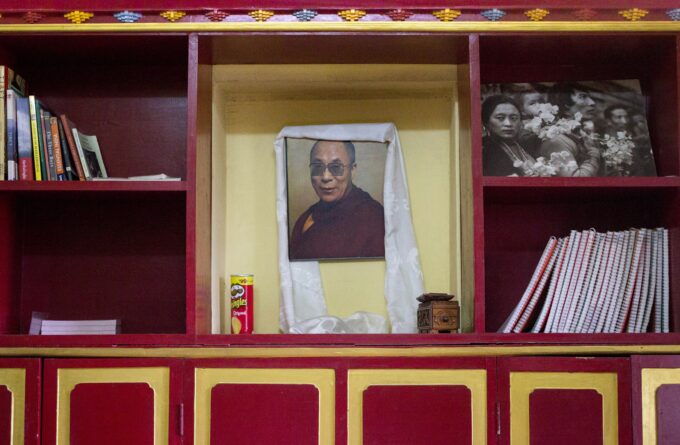
Why Was The Dalai Lama At Jeffrey Epstein’s House?


 August 29, 2025

Last month, on the Daily Beast podcast, journalists Joanna Coles and Michael Wolff took turns reeling off a list of famous people who Wolff met while visiting Jeffrey Epstein’s Manhattan home. The recited names were a who’s who of rich, powerful, and perverted men, many of them recognized Friends of Jeffrey. But one name stood out as unusual: the Dalai Lama. (The list of names starts at about the 18:25 timestamp on the full recording.)

Coles thought so too, asking Wolff, “Did you actually meet the Dalai Lama at Jeffrey Epstein’s?”

“Indeed,” said Wolff.

Asked why the Dalai Lama was there, Wolff said that a lot of people hung out with Epstein to try to wheedle money out of him. And there was something compelling about the upscale salon-like scene: “It was always extraordinary,” said Wolff.

Wolff said that he started spending time at Epstein’s house in 2014, six years after the infamous pedophile was given an extremely favorable plea deal for sex crimes charges because, former U.S. district attorney Alex Acosta once said, “I was told Epstein ‘belonged to intelligence’ and to leave it alone.” Wolff was working on a potential book about Epstein and was given access to the now-deceased sex offender’s wealthy social milieu. Epstein later became an important source for Wolff’s best-selling books about President Donald Trump.

Any writing about Michael Wolff seems to require the proviso that his reliability has been questioned by assorted enemies and media critics. Wolff is a gossip hound, practicing the art at a very high level, and he hangs out with unsavory politicians and oligarchs who might like the idea of having a famous journalist around — until he publishes a book about them. Wolff gets into marble-floored rooms that many journalists don’t, so his comments are worth considering.

With that throat-clearing aside, let’s consider why His Holiness the Dalai Lama may have been at now-deceased sex trafficker and pedophile Jeffrey Epstein’s house. People generally hung out with Epstein for two reasons: sex and money. Wolff suggested that, in this case, it was the latter. Did the Dalai Lama, or an organization with which he’s associated, receive a donation from Epstein?

The Dalai Lama’s press office did not respond to an emailed list of questions. I was unable to reach Michael Wolff for comment about the Dalai Lama’s visit to Epstein’s home.
It wouldn’t be the first time the Dalai Lama had received money from a sex trafficker. In 2009, the Tibetan spiritual leader spoke at an event for NXIVM, the abusive sex cult whose leader, Keith Raniere, was convicted in 2019 on seven criminal charges and sentenced to 120 years in prison. During the 2009 appearance, the Dalai Lama gave a speech and placed a ceremonial Tibetan scarf on Reniere’s shoulders. For his efforts, the Dalai Lama reportedly received $1 million. The deal was made by billionaire heiress Sara Bronfman, who, along with her sister Clare, gave Raniere and NXIVM at least $150 million. Sara Bronfman was alleged to be having an affair with the Lama’s personal peace emissary Lama Tenzin Dhonden, who was later removed from his post for corruption.

Despite evidence that he ran a child sex trafficking operation, the source of Epstein’s wealth has never been sufficiently accounted for. People who spent time around him have said that they didn’t know what he did for a job and that he seemed to do very little actual work. For some reason, billionaires liked to give Jeffrey Epstein huge amounts of money. Les Wexner gave Epstein tens of millions of dollars — he later said that Epstein misappropriated $46 million from him — along with one of the most valuable residential properties in New York City. Leon Black, who has been accused of rape in civil suits, paid Epstein $158 million for “tax advice.”

Whatever Epstein was as a financier — sometimes he was described as a financial bounty hunter, reclaiming assets stranded overseas — he was adept at moving money around the world. And he had help from pliant bankers, as demonstrated by victims’ lawsuits against JPMorgan Chase and Deutsche Bank, which led to nine-figure settlements. Sen. Ron Wyden recently said that the Treasury Department has documents about banks looking the other way for more than $1.5 billion in Epstein-related financial activity, and that Treasury should release the documents. Wyden, who has overseen a long-running investigation into Leon Black’s taxes, also said that Black’s payments to Epstein should be investigated by the IRS.

In short, there’s still so much we don’t know about where Epstein’s money came from and where it went — and to what ends. But following the money trail as far as it leads can tell us something about Epstein’s network, how he operated, and who enabled him. And sometimes a single $50,000 payment can open up the aperture, letting in some light.

In the official 2020 MIT report regarding Epstein’s relationship with the university, two partners from the law firm Goodwin Procter “analyzed all donations received by MIT, both those made directly by Epstein (whether individually or through his charitable foundations) and those made by third parties at Epstein’s alleged behest.” The report found that, during a 15-year period, Epstein donated a combined $850,000 to Seth Lloyd, a physics professor, and to the MIT Media Lab, which was then headed by Joi Ito. Michael Wolff mentioned Joi Ito as one of the prominent guests who attended Epstein’s regular home gatherings.
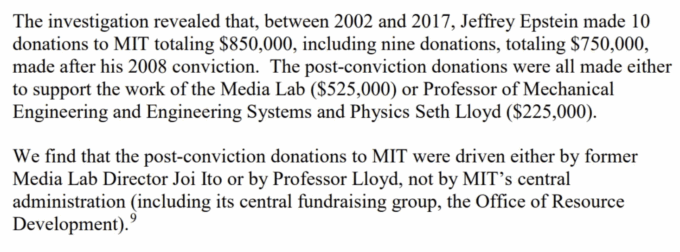
The report claims that Lloyd, who was placed on administrative leave before being allowed to return to teaching, accepted transfers from Epstein in his personal bank account and tried to conceal the source of the donations. The report similarly describes MIT officials as trying to keep quiet Epstein’s donations to the Media Lab and his visits to campus.

The report doesn’t look at relationships between MIT staff and Epstein that occurred outside the university. While the authors write that they looked into donations that may have come through Epstein proxies, it’s not clear how far that investigation went, or was allowed to go. Former MIT Media Lab director Joi Ito received at least $1.2 million from Epstein for his own venture capital firm, which the MIT report mentions in a footnote.

The MIT Media Lab had an uncommonly high profile for a university organization, with an orbiting network of billionaire tech moguls, scientists, writers, government officials, politicians, and TED-talking NGO types. That made the Media Lab’s director, Joi Ito, an important relationship for the prestige-obsessed Epstein. The two seemed to be in close contact, with Ito once “strategizing with [Epstein] as to how he might be able to ‘mollify the bad press’ after a series of articles were published concerning a civil lawsuit brought by Epstein victims,” according to the MIT report. Ito, who sat on the boards of the New York Times and the MacArthur Foundation, repeatedly solicited Epstein for more money for the university. MIT’s investigators claimed that his big-money asks weren’t answered:
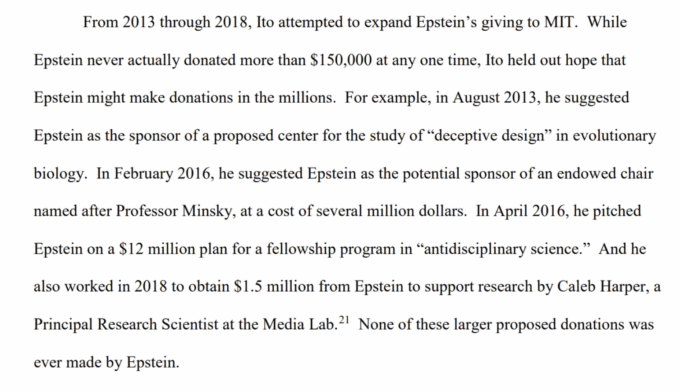
Epstein used ostensibly philanthropic donations in order to win favors, borrow academics’ intellectual prestige, or to move money where it wouldn’t normally be allowed to go. The MIT report describes Epstein using Professor Lloyd (with the professor’s participation) to see if he could make donations to the university without setting off alarm bells:
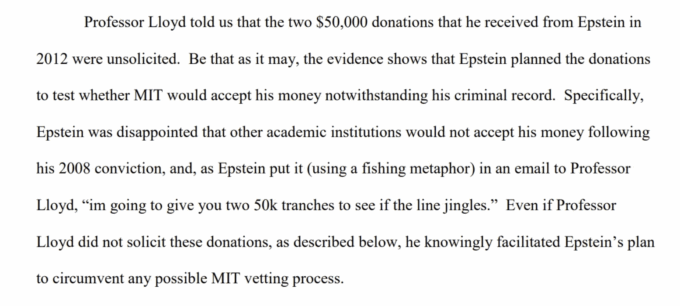
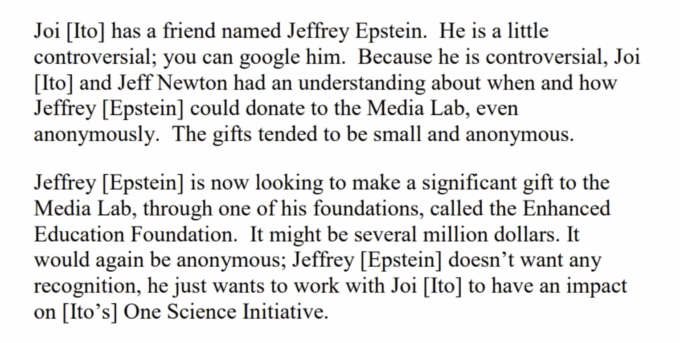
In November 2013, Linda Stone, who first introduced Epstein to Ito, sent an email to Ito suggesting that a 501(c)(3) might be used to mask Epstein’s donations, although, she wrote, “there may be disclosure issues.” Ito then took the idea to MIT’s VP of Development, according to the MIT report.
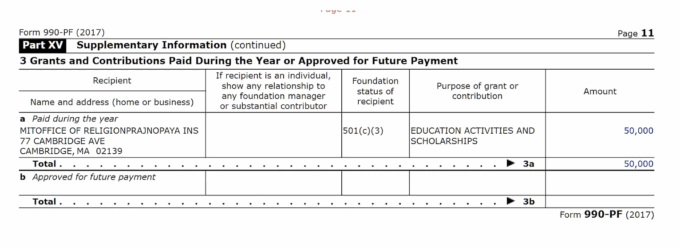
In 2017, a 501(c)(3) nonprofit called Education Advance donated $50,000 to the Prajnopaya Institute at MIT. The money for that donation came from an entity called “J Epstein Virgin Islands FD Inc,” which that same year gave Education Advance $55,000, according to IRS filings. Education Advance took in an additional $1,500 in 2017, which appears to be the only year it was ever in operation. Its IRS filings report no other donations or dispersal of funds, suggesting that Education Advance might have been purpose-made for the Prajnopaya Institute gift. After 2017, Education Advance never filed another Form 990, leading to its nonprofit status being revoked.
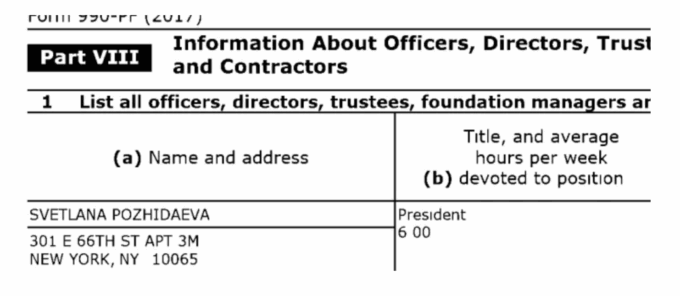
Education Advance was overseen by Svetlana Pozhidaeva, a Russian model who worked for MC2, a modeling agency run by Jean-Luc Brunel, an Epstein accomplice accused of rape and sex trafficking who died in a French prison in 2022. Education Advance was registered to an Epstein-owned Manhattan building. Pozhidaeva, who had been photographed leaving Epstein’s house, also shared a lawyer with him: Darren Indyke, who is now co-executor of Epstein’s estate. Epstein’s Virgin Islands-based foundation, the initial source of the funds, was sometimes called Enhanced Education.
The Prajnopaya Institute transaction isn’t mentioned in the 2020 MIT report, which covers the years “between 2002 and 2017.” The existence of the transaction had been reported a year earlier by the Daily Beast. MIT’s media office did not respond to questions about why the Prajnopaya Institute donation did not appear in its 2020 report on the university’s relationship with Epstein.

The lack of official acknowledgement from MIT is another indicator that Epstein’s money flows remain poorly charted. Some parties might prefer it that way. Epstein also helped muddy the waters by lying and exaggerating about the scope of his charitable giving — a deception that included Epstein making edits to Wikipedia pages about himself, his foundation, and some of his associates.

The Prajnopaya Institute told the Daily Beast in 2019 that it returned the $50,000 donation. The Institute didn’t respond to an email asking how the donation was brokered and if the Dalai Lama or Tenzin Priyadarshi was involved. A separate inquiry to Priyadarshi, sent through his website imonk.org, received no reply.
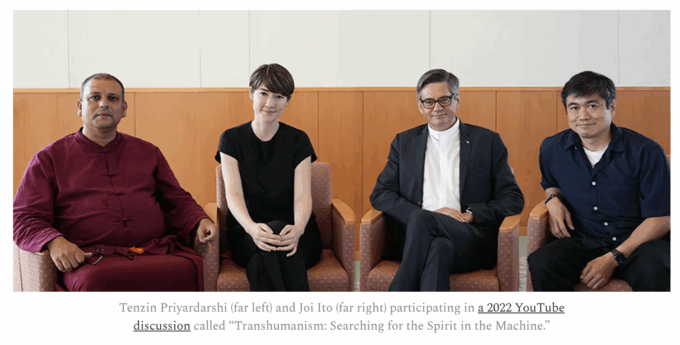
Priyadarshi has long been associated with the Media Lab and Joi Ito, who described Priyadarshi as his friend. They podcasted together and co-taught an MIT class called Principles of Awareness. Ethics programs that began in the Media Lab later moved to the Dalai Lama Center, where Priyadarshi is CEO. Ito and Priyadarshi have appeared on discussion panels together. Ito, a prolific photographer, has posted photos of Priyadarshi and the Dalai Lama, and he’s cited them in his writing. The Dalai Lama has attended at least three events hosted by the MIT center named after him.

Dr. Babak Babakinejad, an MIT whistleblower and research scientist who first alerted me to the Prajnopaya Foundation donation, offered the following statement:

“The MIT Epstein report is institutionally compromised. MIT has persistently resisted transparency regarding Epstein’s connections to the Media Lab and its associated initiatives, particularly regarding Open Agriculture and its Food Computers. This project is implicated in fraudenvironmental misconduct, and retaliation. These are issues I have been actively challenging as part of an ongoing lawsuit.”

Epstein’s interest in MIT was about more than just showering a couple programs he liked with cash. Epstein visited MIT’s campus at least nine times and attended MIT Media Lab events, which could attract wealthy tech and political figures like billionaire Reid Hoffman. Epstein spent time with MIT professors and staffers, some of whom he met through the literary agent John Brockman, who acted as a connector between Epstein and scientists and academics. It’s hard to think that Epstein’s MIT-related contributions during a 15-year period only amounted to $850,000, especially when the donations that are now documented were once obfuscated. As shown here, the Prajnopaya Institute donation means the real amount that Epstein gave to MIT is at least $900,000.

It’s not clear why Epstein, who as far as I can tell never mentioned Buddhism or had any association with Tibetan culture or causes, made a $50,000 donation to a Buddhist organization at MIT. Perhaps someone influential asked him. Perhaps he was once again looking “to see if the line jingles.”

The alarm did go off after all, but it was too late for anyone to care.

This piece first appeared on Jacob Silverman’s Substack.

Jacob Silverman’s next book, Gilded Rage: Elon Musk and the Radicalization of Silicon Valley, will be published in October by Bloomsbury. He’s the author of Terms of Service: Social Media and the Price of Constant Connection and the co-author of Easy Money: Cryptocurrency, Casino Capitalism, and the Golden Age of Fraud, which was a New York Times best seller.

UK WORSE THAN CHINA

‘Turning over the two-child cap: a moral imperative’


© DGLimages/Shutterstock.com

Let me be very clear: scrapping the two-child benefit cap is morally right.

In fact, it is the most cost-effective, immediate, and powerful lever we have at our disposal to lift children out of hardship. Yet this cruel policy continues to punish families simply for having three or more children.

Every single day, 109 more children are unnecessarily pushed into poverty because of this cap. Children who should be loved and supported are instead penalised by a system that denies them access to Universal Credit or Child Tax Credit if they are the third or subsequent child born after April 2017.

In Britain in 2025, around 1.6 million children are affected by the two-child limit. That’s almost one in nine children across the UK. And in my constituency of Bradford East, where half of all children are growing up in poverty, the impact is especially severe.

According to the seasoned campaigners like the Child Poverty Action Group (CPAG), scrapping the policy outright would instantly lift 350,000 children out of poverty and reduce the depth of poverty for another 700,000. That is more than one million children whose lives could be transformed immediately with one logical, targeted policy change.

By comparison, other reforms, such as increasing the child element of Universal Credit by £17 a week, would cost more (around £3 billion) to deliver a similar result.

However, we must not reduce this down into numbers alone. In Bradford East and many communities across the country, families are under tremendous strain. Nationwide, we are seeing children living in what some are calling “almost Dickensian levels of poverty,” denied access to sufficient food, safe housing, and basic hygiene.

This is absolutely unacceptable for a country as wealthy as ours.

A moral commitment with political momentum

After a year of scrutiny, this Government now recognises that there is no credible path to reducing child poverty without scrapping the two-child limit in full.

That view is widely shared. The growing chorus of belief spans non-profits to political advocates. A coalition of anti-poverty leaders — including Alison Garnham (CPAG), Anna Feuchtwang (National Children’s Bureau), Baroness Anne Longfield (Centre for Young Lives), and the CEOs of UNICEF UK, the Trussell Trust, Save the Children, Barnardo’s, Action for Children and others — have written openly and collectively that “getting rid of the two-child limit is the most cost-effective way to lift 350,000 kids out of poverty, while reducing the depth of poverty for 700,000 more.”

In Parliament, Sir Keir Starmer pledged that “my ministers will leave no stone unturned to give every child the best start at life.” This is the very stone that must now be overturned.

Funding is possible and responsible

One common objection is cost. But Labour Chancellor Rachel Reeves is already exploring new revenue streams — including a proposed rise in online gambling taxes from 21% to 50%. This alone could raise more than £3 billion annually — enough to scrap the cap without increasing income tax, National Insurance, or VAT. Likewise, a modest 2% levy on extreme wealth could raise up to £24 billion each year.

Former Prime Minister Gordon Brown has spoken out forcefully, arguing that the gambling industry’s excess profits should be utilised to support our children and deliver on Labour’s moral duty.

If we accept that poverty is a cancer in our society — language Brown has not used lightly — then we must act both decisively and responsibly.

And now, another former Labour leader, Neil Kinnock, has joined the call to scrap the two-child cap. He has made it clear: ending this policy would be the most immediate and direct way to tackle child poverty. His intervention shows just how widespread the consensus has become. From campaigners and communities to leaders past and present, it is evident that this unjust policy must go.

Time to follow through

As we approach the Government’s upcoming autumn Child Poverty Strategy, an obvious choice stands before us: use this opportunity to deliver real change or fall short when families need action the most.

We know the facts. The options are low in cost compared with their societal value. The benefits to children, communities, and our moral fabric as a society are undeniable.

In Parliament, I voted to scrap the two-child cap. I lost the Labour whip over it. And I will keep fighting until the policy is scrapped for good. I will not stop campaigning and pushing until it is gone.

No child in Bradford East — or anywhere in Britain — should be punished for having siblings. No child should go hungry, live in the cold, or have their future stunted by poverty.

Let’s turn over this stone now.


UK

‘You’re competing with cats’: Gordon McKee on TikTok, authenticity and why Labour must catch up online


Photo: House of Commons/Flickr

Few MPs have mastered the art of TikTok, but Gordon McKee is determined to try. The 30-year-old Labour MP for Glasgow South has seen several of his short videos on the platform go viral, from assembling flatpack furniture to explain why Britain hasn’t built big things recently, to being stuck at an airport to reveal how Labour is working to cut delays to flights – drawing more viewers than most Westminster speeches or TV appearances could dream of.

McKee is clear about why he first logged on as a politician: because he already used the platform himself. “I think the key thing is that I actually do watch TikTok,” he said. “I spend about an hour a day watching this content, and I was seeing no Labour politicians. Nigel Farage, unfortunately, does it extremely well [so] we should try and be on the platform.”

For McKee, whose constituency is younger and more diverse, the appeal is obvious. “I’m very lucky to represent a very young diverse constituency, where probably more of my constituents use it than many of my colleagues, so it’s just a good way of reaching a young demographic.”

‘You can’t boringly sit in front of a camera and talk about policy’

Being on the app is not the same as being good at it, however. TikTok, like many other social media platforms, is a crowded place – where attention is scarce. “Twenty or thirty years ago, politicians were competing with The Weakest Link or Who Wants to Be a Millionaire,” McKee reflects. “They had their slot on TV [and] you either watched it or you didn’t. Now, on Instagram, YouTube and TikTok, you’re competing with videos of cats on the internet. That’s much more difficult. That is much more difficult. You can’t boringly sit in front of a camera and spend four minutes talking about policy – it won’t work. You have to make it engaging and entertaining.”

For help, McKee received advice from people who already know how to thrive in that environment. Earlier this year, he did a collaboration in Parliament with Ukrainian content creator Max Klymenko, who has more than seven million followers on TikTok. “I tried to learn from him about what works. Making good, engaging videos is a real skill – I definitely haven’t mastered that yet. One of the bits of advice that Max gave was that you really want to minimise the effort each video takes. You’re not making a feature film, you’re just making a 30 second video – so you don’t want to spend hours of time thinking through that.”

McKee’s best performing clip, with close to a million views on TikTok, was on the government’s Employment Rights Bill, which has sought to expand protections for workers. “Had we, as a party, done enough back then to sell the bill to the generation of people that it was really going to impact? Probably not,” he admits. “So the idea was: how we can we make this legislation really meaningful and really impactful and digestible in a 30 second video? We picked out the clauses that we thought would be most relevant to an audience on TikTok – zero-hours and flexible contracts, protections for young workers – and just ahead and made it.”

Since he started posting after the start of the general election campaign, McKee has noticed that certain content works better with his colleagues in “the bubble” around SW1, while others will perform best among the general public. While Employment Rights Bill video is McKee’s most viewed video, it did not get the same traction as another video of him touting the benefits of improved animal welfare rules for zoos, which saw him ‘interview’ a llama named Leo – which received around 14,000 views. “You realise how much cut-through you get with these videos. There are some things that do really well in ‘the bubble’ but don’t do really well in real life, and vice versa. I feel like your job as a politician is to try and communicate with actual people, not Westminster insiders.”

‘People can smell inauthenticity immediately’

If there is a golden rule, McKee believes it is authenticity. “Your content has to be authentic. People can smell inauthenticity immediately,” he said. That can mean sometimes leaning into humour and comedy to sell a message, while other times being serious. After Reform UK narrowly won the Runcorn and Helsby by-election left his team and the wider party downbeat, McKee recorded a short reflection of his thoughts.

“Everybody was a bit down about it and I was like ‘why don’t we just do a video where I just say what I think and just talk – not some manufactured thing’ – and we edited together a 45 second video of thoughts.” The clip is one of his best performing videos with more than 25 thousands views. “The key thing is to be yourself,” McKee said.

Subscribe here to our daily newsletter roundup of Labour news, analysis and comment– and follow us on BlueskyWhatsAppX and Facebook.

‘Viewing habits are only going in one direction’

McKee is not the only MP investing in social media. He name-checks his Labour colleague Mike Tapp, whose videos take a different approach. “I’m not planning to go and sail a boat around Dover, but he clearly thinks about it, which is good.”

He also cites Zohran Mamdani, the Democratic candidate for Mayor of New York City in November’s election – whose online videos captivated younger voters and helped him secure a convincing win in his party’s primary. “I’m not saying it’s just because of those great videos he made, but it’s probably quite a big part of the reason that he got the momentum to get the position he’s in.”

The broader trend is undeniable, McKee argues. “Viewing habits are only going in one direction – they’re moving away from terrestrial TV and towards people sitting on their phones. Whether that’s good or bad for society, it’s definitely happening – and if you as a politician want to reach people, you’ve got to be where they are – and that’s increasingly on social media.”

That, for McKee, comes with an urgency. “We’ve got to be honest with ourselves: Nigel Farage has more followers than every other MP combined. He does well on that platform because he makes videos people engage with. I disagree with the content of them all, but you’ve got to recognise that he’s doing it. We’ve got to try and counter that.”

McKee insists much of the credit should go to his team, who help with filming and editing. He sees his approach as part of a wider shift Labour has to embrace if it wants to connect with voters outside the Westminster bubble.

‘From passports to policymaking: where AI can boost the public sector’

Photo: Yarrrrbright/Shutterstock

The public sector in the UK employs almost six million people and is responsible for 20% of the country’s economic output. The sheer size means that, in theory, the scope for benefits from AI-driven innovation is huge.

So what might that look like in practice? This is a big question, and one way to simplify it is to think about what government does – and where AI can really help.

We look at three massive government tasks that constitute the bulk of public sector work: communicating with the public, conferring rights to individual citizens, and making policy decisions.

Communicating with the public

Government needs to exchange information with the public. Indeed, it has an obligation to do so. People need official, reliable information about public services, benefits, subsidies, rules, regulations, policies and so on.

And government needs to get information from citizens. Observing how people encounter public services provides insight into public sector performance and can help to identify emerging problems. Understanding how people experience policy change, can provide evidence of public acceptance and legitimacy (or otherwise) of policy decisions.

AI can help with these tasks. LLM-based chatbots can respond to citizens’ queries and help them to find the information they need. LLMs can be used to automate public consultations, so that they can reach far more widely across the general public than they have before.

A key question is how we can encourage public organisations to think beyond what they currently do?  For the first time ever, we can use generative AI to create feedback loops between the public and government, at scale.

Conferring rights

Another massive chunk of government work involves conferring rights to individual citizens, such as a license or passport, entitlement to a benefit or service, or rights to residency or citizenship.

The dream for large parts of the public sector is to automate entire processes. In general, we see a lot of public backlash and poor design, development, and deployment practices in precisely these types of projects, where the aim is to automate everything.

What we advise government to do is to think of any administrative process as a string of micro-transactions. If you apply for a passport, for example, there is a string of micro-transactions that need to be made to get one. These are small things like validating a photo or cross-checking text data from the application.

Our study found that central government alone completes about one billion of these micro-transactions per year, of which 120 million micro-transactions have very high automation potential with AI. These are complex repetitive tasks like checking photos, extracting salient text, triaging documents. There lies a lot of the potential for AI in government.

The key question is how to get officials excited about automating the minutiae of government’s bureaucratic practices? It does not sound like the stuff of which dreams are made. It won’t make front page news – but this is where AI – at the moment – can lead to substantial efficiency gains.

AI for public policymaking

The third area of government work where AI can be a game-changer is improving policy decisions.

In the UK, more than 52,000 policy decisions underpin how over a trillion pounds of public money gets allocated each year. Improving the way in which policy decisions are made can lead to substantial benefits. Data science and AI can do that in ways in which traditional statistical techniques cannot.

We have a tremendous opportunity to adapt our economic models for an age when every individual and company generate massive amounts of data on a daily basis, where the technologies that we have allow us to develop better answers to the questions that policy-makers have been asking for years. What happens if a big company closes? Can the excess capacity be absorbed by the local economy? Where are the skill shortages and who are the workers that can most easily be retrained to fill them?

How to make it happen? Adoption is key.

These three areas of AI opportunity correspond to massive government tasks: communicating with the public, conferring rights to individual citizens, and making policy decisions. These are ripe with potential to achieve efficiency and productivity gains.

But they won’t happen by magic. The government have bold aspirations for AI, detailed in the AI opportunities action plan and other policy documents. Adoption is crucial to achieving their aims. But the question of how to drive adoption receives less attention.

AI will only lead to better public services if citizens adopt them in a widespread way. If productivity is the most hoped-for benefit of AI, inequity is the most feared harm. So it is crucial to avoid AI exacerbating existing inequalities. There is mounting survey evidence to suggest that those with low incomes perceive less benefits and hold more concerns about AI applications. So do those with low levels of digital access and skills. The government needs to ensure that their digital inclusion plan is integrated with AI plans.

AI adoption must be stimulated right across the public sector in a comprehensive way. That means integrating AI tools into public services and bureaucratic processes. Economic modelling for policy requires the generation of good local data. Public service professionals are already using AI but in a disorganized fashion without clear guidelines. Governmentwide deals with AI giants will not resolve problems caused by legacy systems that lock departments in the past.

That will mean AI capability and expertise being distributed across government. There is now a strong digital centre for government – the remodeled Government Digital Service. They will need to work in concert with departments and agencies at all tiers of government to reassure citizens that AI-powered public services are progressive, easy-to-use and trustworthy. And to help and inspire public servants to make the most of AI.


UK

Two-thirds of Labour members oppose rebel MP suspensions, poll reveals


Photo: House of Commons/Flickr

More than two-thirds of Labour members think Keir Starmer was wrong to suspend four MPs for rebelling against proposed welfare cuts, an exclusive poll for LabourList reveals.

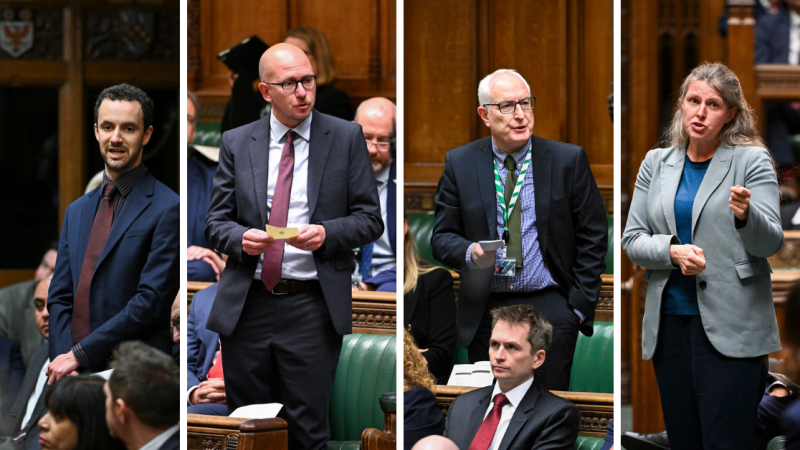
Brian Leishman, Chris Hinchliff, Neil Duncan-Jordan and Rachael Maskell were suspended from the Labour Party over “repeated breaches of party discipline” in July, following a significant rebellion over welfare reform.

In a poll conducted by Survation, some 68% of members were opposed to the suspension, with 28% supportive of the leadership’s decision.

Among members who voted for Rebecca Long-Bailey in the 2020 leadership election, almost all (98%) opposed the leadership’s decision, compared to 67% among those who backed Lisa Nandy and 54% for those who supported Keir Starmer.

A majority of Labour members are also opposed to the leadership’s suspension of Diane Abbott from the party over comments she made about racism in 2023.

More than half (55%) said the Mother of the House should not have been suspended for a second time over her comments, while 37% agreed with the decision to remove the whip.

Support for the leadership’s position was strongest among younger members, with over 50% of 25-34-year-olds backing the move, while those aged 65 and over were the most strongly opposed at almost two to one (62%).

Survation surveyed 1,021 readers of LabourList, the leading dedicated newsletter and news and comment website for Labour supporters, who also said they were Labour Party members between August 5 and August 9.

Data was weighted to the profile of party members by age, sex, region and 2020 Labour leadership vote, targets for which were derived from the British Election Study and the results of the 2020 leadership election.