Sunday, August 31, 2025

New documentary casts Marianne Faithfull in new light

Venice (AFP) – A new documentary about British singer-songwriter Marianne Faithfull urges viewers to take a fresh look at the extraordinary life of the "Swinging 60s" icon who died in January this year.


Issued on: 31/08/2025 - RFI
In the 1960s Marianne Faithfull was best known as the girlfriend of Rolling Stones singer Mick Jagger, overshadowing the launch of her own singing career

In the 1960s Marianne Faithfull was best known as the girlfriend of Rolling Stones singer Mick Jagger, overshadowing the launch of her own singing career – Copyright

"Broken English" is an out-of-competition entry in the prestigious festival from British directing duo Jane Pollard and Iain Forsyth, which casts the singer-songwriter's legacy and reputation in a new light.

After being discovered in 1964, Faithfull shot to fame with the hit "As Tears Go By", written by her former boyfriend, Mick Jagger, and Rolling Stones guitarist Keith Richards.

"Broken English" includes archival footage and conversations with Faithfull -- who died at age 78 during production -- but the film's unique format means it mixes fiction and multiple genres.

It features a fictional Ministry of Not Forgetting -- whose director is played by Tilda Swinton -- charged with rectifying the historical memory of Faithfull, whose outspokenness and no-holds-barred lifestyle fuelled a backlash from the British press.

Her relationship with Jagger ended up overshadowing her own career, while sudden fame and fortune brought on drug addiction and eventually homelessness.

Her 1979 album "Broken English" breathed new life into her career, and she worked relentlessly, collaborating with a stream of younger artists keen to work with her.
'Rightfully wary'

In seeking to set the story straight on her life, the real-life Faithfull is presented with photographs or other materials by a fictional archivist (George MacKay), even as contemporary musicians interpret Faithfull's work or reflect on her influence.

Filmmaker Forsyth said he saw the film as a portrait of the artist, rather than a documentary.

"If you think of all of the great portraits throughout history, the paintings, the photography, that has captured the essence of someone, they all do it in some sort of way collaborating with their subject," Forsyth told a press conference Saturday.

As a format, documentary "carries with it a journalistic kind of baggage" that did not fit the filmmakers' purposes, Pollard said.

She conceded that Faithfull was initially "rightfully wary" of the idea of the fictional institution scouring her past.

"But I think she could recognise very quickly in the days that we were filming with her how it allowed a freedom to be able to open up and explore to look back and reconsider," Pollard said.

She called for "urgent recalibration of some brilliant artists' legacies that are just simply going to be forgotten or misrepresented."

In recent years, the British pop-rock balladeer, who released more than 20 albums during her career, battled illness, including breast cancer and a severe bout of Covid.

In the film, Faithfull is in a wheelchair and wearing a nasal cannula for oxygen.

The film on her is one of several documentaries by international directors in the Venice festival running through September 6 on the Lido, including Gianfranco Rosi's ode to Naples, "Sotto le Nuvole" (Under the Clouds) and "Ghost Elephants" from Werner Herzog.


- Hidden worlds -

"Sotto le Nuvole" is a black-and-white look at Naples and the volcanoes hovering around it, Mount Vesuvius and the Phlegraean Fields, where near-daily earthquakes "are a source of destabilisation, fear and a sense of precariousness," Rosi told journalists.

Cutting back and forth with images of steam rising from the volcanoes, the film goes underground, under the yet-unexcavated depths of Herculaneum or the bowels of Naples' archaeology museum, where dusty statues and busts are silent witness to past eras.

A sense of unease hovers throughout the film, which follows tomb raiders' tunnels and includes calls from anxious citizens to the fire department after earthquakes.

The film, which took three years to edit, is the only documentary in the main competition, where 21 works are vying for the top Golden Lion prize.

"Ghost Elephants" by Herzog, who received a lifetime achievement award during the festival's opening ceremony, follows the search for an elusive -- and possibly nonexistant -- new species of elephant in the high-altitude forests of Angola.

Another documentary taking the viewer to hidden worlds is Massimiliano Camaiti's "Agnus Dei", shot inside a Rome cloister where each spring the nuns raise a pair of lambs for their wool, which they weave into a vestment for the pope.

The documentary was filmed during the hospitalisation and death of Pope Francis, and the election of new Pope Leo.

© 2025 AFP

Kyivstar rings Nasdaq bell in landmark listing for Ukraine amid reconstruction push

Kyivstar rings Nasdaq bell in landmark listing for Ukraine amid reconstruction push
Ukrainian officials described the Kyivstar listing as an important signal that the country’s businesses continue to thrive and attract foreign investment despite the strains of war. / Nasdaq
By bne IntelliNews August 31, 2025

Ukraine’s largest digital operator Kyivstar marked its historic debut on the Nasdaq Stock Market on August 29, becoming the first Ukrainian company to trade on a US exchange, in a move its executives and government officials said underlined the country’s resilience and reconstruction ambitions, Nasdaq said in a press release.

The opening bell ceremony featured Kyivstar president Oleksandr Komarov, members of its board, Ukrainian Prime Minister Yuliia Svyrydenko, the head of the president’s office Andriy Yermak and Economy Minister Oleksii Sobolev, alongside parent company VEON Ltd. and invited investors.

“Kyivstar is privileged to serve as an example of how Ukrainian businesses combine resilience with development and growth,” Komarov said. “This week, as the flagbearer of Ukraine in US stock markets, we set an example for our peers in Ukraine and accelerate the conversation with US and global investors for opportunities that Kyivstar and Ukraine present. We look forward to carrying this conversation further and into action.”

The bell-ringing capped a week of activities in New York that spotlighted Kyivstar’s listing and wider opportunities for investors in Ukraine’s war-hit but determined economy.

“For me, there's nothing more special than what we're doing right here in New York with Kyivstar and for Ukraine,” said Augie K Fabela II, chairman and founder of VEON. “This week’s engagements demonstrated once again the strong interest not only in Kyivstar’s successful business, but in the opportunity to invest in Ukraine and participate in the country’s rebuilding and recovery.”

VEON, which is listed on Nasdaq, is the parent company of Kyivstar and operates digital and telecom services across five countries, serving about 160mn customers.

“Kyivstar’s listing on Nasdaq is a major milestone for VEON, but this week’s engagements have been so much more than that,” added VEON Group CEO and Kyivstar board chairman Kaan Terzioglu. “This is also about Ukraine putting its flag up here in New York, at the heart of global business and finance, and saying ‘we are here to grow’. We look forward to creating more value for all our stakeholders – our company, investors and Ukraine itself.”

The ceremony followed a series of investor-focused events during the week. VEON and Kyivstar convened a meeting with more than 160 participants both in person and online, followed by the first “Invest in Ukraine, NOW!” US-Ukraine Business Symposium.

The symposium gathered senior American and Ukrainian business leaders, investors and officials to discuss Ukraine’s innovation ecosystem, the resilience of its economy during the war and the potential of its reconstruction. At all events, including the Nasdaq bell-ringing, participants observed a moment of silence for victims of recent attacks on Ukraine.

A symbol of resilience

The Odesa-headquartered company, which has operated in Ukraine for more than 27 years, serves 22.4mn mobile customers and 1.1mn home internet subscribers. Its services span 4G, digital TV, cloud computing, cybersecurity and big data. Together with VEON, Kyivstar plans to invest $1bn in Ukraine between 2023 and 2027 in infrastructure, social projects, technological upgrades, charitable initiatives and acquisitions.

For Ukraine’s government, the listing is being framed as a powerful symbol. Officials accompanying Kyivstar executives in New York described the step as an important signal that the country’s businesses can continue to thrive and attract foreign investment despite the strains of war.

“Selling the story of Ukraine as an investable country is as critical as securing support from partners,” Svyrydenko said.

Analysts welcomed the listing as an unprecedented step for a Ukrainian company, but noted the risks. A financial analyst quoted by GuruFocus said the move could “enhance visibility and attract investors”, while cautioning that “investors should be mindful of the geopolitical risks and market volatility that could impact the company’s performance”. 

For VEON and Kyivstar, the listing is intended not only as a capital markets event but also as a diplomatic and economic milestone. By securing a place on the Nasdaq, Kyivstar becomes the first Ukrainian investment opportunity available to American equity investors.

Executives emphasised the dual role of the listing – to raise capital and to anchor Ukraine more firmly within global markets. “This is about confidence, both in Kyivstar as a business and in Ukraine’s future,” Terzioglu said.

Kyivstar’s management also pointed to its role in maintaining critical connectivity during the war, helping Ukraine’s businesses and citizens remain linked through mobile and fixed networks despite heavy damage to infrastructure. The company has invested in backup energy, satellite redundancy and cybersecurity since 2022.

With its US market debut, Kyivstar hopes to leverage international capital for expansion while reinforcing its position as a pillar of Ukraine’s digital economy. Investors, meanwhile, face a choice between betting on Ukraine’s eventual recovery or holding back amid the uncertainties of a protracted war.

As VEON chairman Fabela put it: “This week has been about showing that even in the toughest circumstances, Ukraine is open for business and growth. That is the message we brought to Wall Street.”


Court rejects release of Moroccan woman on trial in blasphemy case, lawyers say

RABAT, Morocco (AP) — Her arrest has polarized public opinion across Morocco. Some see it as a valid response to provocation and others view it as a violation of democracy and freedom of speech.


Akram Oubachir
August 28, 2025

RABAT, Morocco (AP) — Attorneys for a Moroccan feminist on trial for blasphemy said their request for her to be released due to health concerns was rejected Wednesday.

Attorneys for Ibtissam Lachgar asked the presiding judge to grant her provisional freedom while the court in Rabat considers whether messages on a T-shirt she was wearing in a selfie she posted online violated part of Morocco’s criminal code outlawing offending the monarchy or Islam.

Naima Elguellaf, her attorney, said Lachgar was battling cancer and struggling while cut off from needed care.

“She has a surgery planned in September, where doctors will decide whether she will still live with a prosthetic arm or have her arm amputated,” Elguellaf told reporters after court adjourned.

One of Lachgar’s attorneys said in the evening that the court had rejected the request.

Lachgar’s health concerns are the latest chapter in a case that has captured global attention and fragmented public opinion at home in Morocco.

Long known for provocative activism, Lachgar was arrested last month after posting the photo of herself in the shirt with writing referring to the sexual identity of a deity and calling Islam fascist and misogynistic. She was charged with blasphemy and with disseminating the image online.

She faces up to five years in prison and up to $20,000 in fines if convicted.

Blasphemy has long been illegal in Morocco and cases like Lachgar’s occasionally make headlines, including in 2022, when a 32-year-old blogger was sentenced to five years after sharing satirical posts in which she mocked the Quran.

Lachgar, 50, is a psychologist and co-founder of the Alternative Movement for Individual Freedoms, known by its French acronym MALI. She is a vocal defender of women’s and LGBTQ rights in Morocco.

Though the country is politically moderate compared to others in the Middle East and North Africa, same-sex relations are illegal, certain kinds of speech can bring criminal charges, and feminists say gender inequality persists.

Lachgar has called for decriminalizing sex outside of marriage, which remains illegal. In 2009, she staged a midday picnic during Ramadan to protest the ban on eating and drinking in public during the holy month when a majority of the country fasts.

She also made headlines more than a decade ago when she organized a demonstration outside Morocco’s parliament, where couples kissed to support two teenagers facing indecency charges after posting a photo of themselves kissing on Facebook.

In court on Wednesday, Lachgar wore an arm sling and a headscarf as her attorneys protested how she was kept in isolation while behind bars.

Her arrest has polarized public opinion across Morocco. Some see it as a valid response to provocation and others view it as a violation of democracy and freedom of speech.

“The scope of the right to freedom of expression is broad and broad, but it does not extend to mocking people’s beliefs, nor does it tolerate grave insults to their religion,” said Mustapha Ramid, a former government minister and member Morocco’s largest Islamist party.

Morocco’s Federation of Women’s Rights Associations has said the case is deeply concerning, merits “strong condemnation,” and violates laws protecting freedom of expression.


LGBTQ RIGHTS ARE HUMAN RIGHTS


Men charged with hugging and kissing are among group publicly caned by Indonesian Islamic court

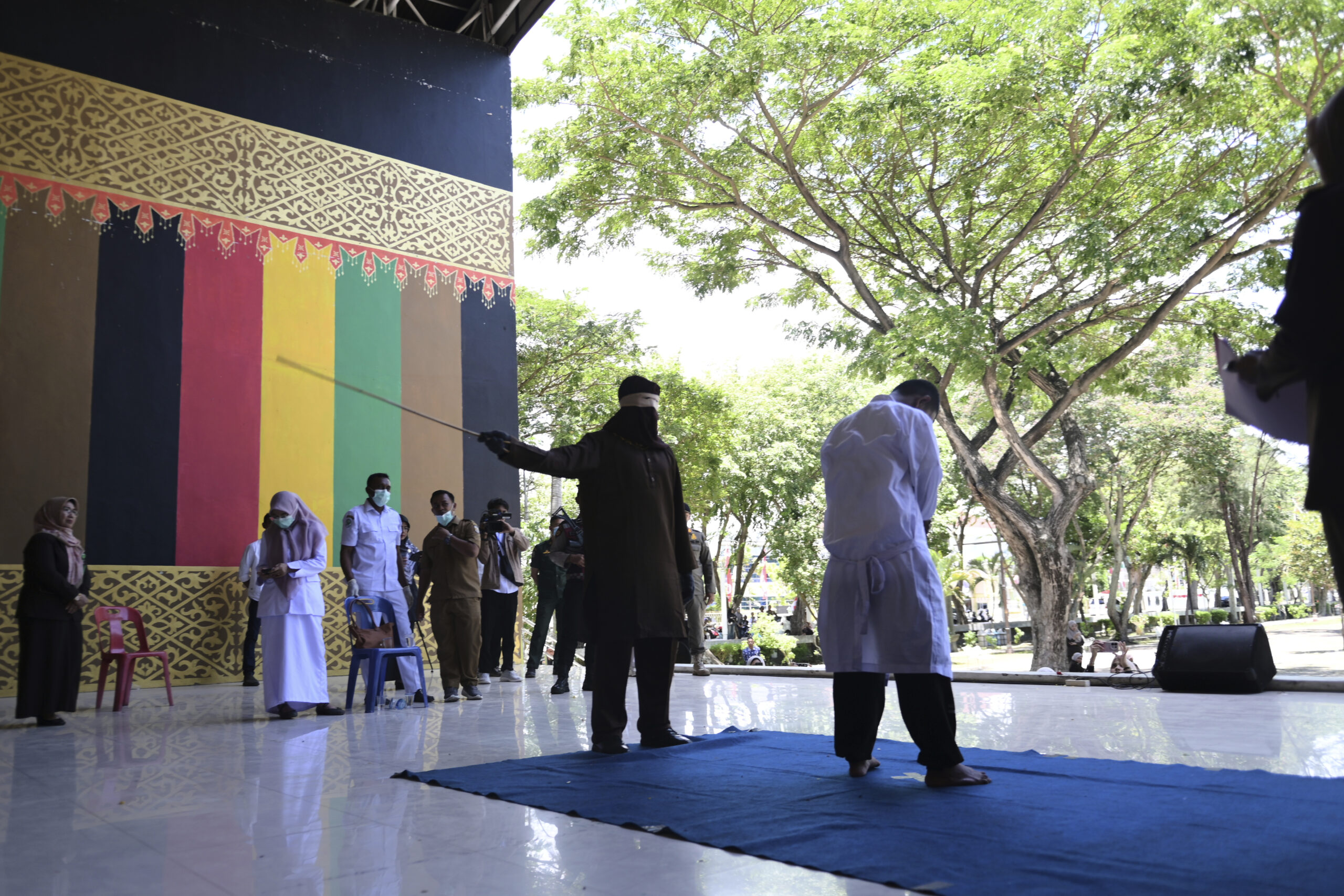
BANDA ACEH, Indonesia (AP) — The court in Aceh sentenced the men to 80 strikes each after Islamic religious police said they caught them engaged in what the court deemed were the sexual acts of hugging and kissing in a bathroom of a public park, court records said.


Edna Tarigan and Yayan Zamzami
August 27, 2025


BANDA ACEH, Indonesia (AP) — Two men in Indonesia’s conservative Aceh province were among a group of people publicly caned on Tuesday after an Islamic Shariah court convicted them of violating Islamic law by hugging and kissing, which the court ruled can lead to banned sexual relations.

An audience of about 100 people witnessed the caning on a stage in Bustanussalatin city park in Banda Aceh on Tuesday. The men, aged 20 and 21, were whipped across their backs with a rattan cane dozens of times by a group of people wearing robes and hoods.

Aceh allows up to 100 lashes for morality offenses including gay sex and sex between unmarried people. Caning is also a punishment in Aceh for gambling, drinking alcohol, women who wear tight clothes and men who do not attend Friday prayers.


The court in Aceh sentenced the men to 80 strikes each after Islamic religious police said they caught them engaged in what the court deemed were the sexual acts of hugging and kissing in a bathroom of a public park, court records said.

Eight other people were publicly caned Tuesday for adultery and gambling.

The men were arrested in April at Taman Sari city park in Banda Aceh after residents told a police patrol they saw the men enter the same park bathroom. The police found the men inside kissing and hugging. Prior to meeting in the park, the pair made contact through an online dating app, court records said.

Aceh is the only province in Indonesia to practice Shariah law. There have been four previous canings for cases related to homosexuality since the province implemented Islamic law and established a religious police and court system in 2006. The change was a concession by the national government to end a long-running separatist uprising.

Indonesia’s national criminal code does not regulate homosexuality but the central government cannot strike down Shariah law in Aceh. However, the central government previously pressured Aceh officials to drop an earlier version of a law calling for people to be stoned to death for adultery.

Aceh expanded its Islamic bylaws and criminal code in 2015, extending Shariah law to non-Muslims, who account for about 1% of the province’s population.

Two other men were publicly caned in February at the same Aceh park after a Shariah court convicted them of having sex.


A coalition of human rights groups filed a petition to Indonesia’s Supreme Court in 2016 seeking a review of Aceh’s regional regulations allowing caning, but the request was rejected. Indonesia’s Ministry of Home Affairs issued a letter in 2016 to Aceh’s governor about caning, noting regional laws in Indonesia should be enforced for minor crimes.

Canning is a corporal punishment and Indonesia has ratified a convention mandating the abolition of inhumane punishments, said Maidina Rahmawati, acting executive director of the Institute for Criminal Justice Reform in Indonesia.

“That public caning, even the act of caning itself, is contrary to various laws and regulations and also contrary to human rights interests in Indonesia because its exposure is not good for Indonesia,” Rahmawati said.

Shifting political dynamics played a role in the implementation of the policy, Rahmawati said.

“Because it seemed like this was the right thing to do, it had to be done, it had to be narrated to support the Sharia-based government in Aceh,” Rahmawati said.

Amnesty International issued a statement Tuesday calling the caning of the two men “a disturbing act of state-sanctioned discrimination and cruelty.”

“This punishment is a horrifying reminder of the institutionalized stigma and abuse faced by LGBTQ+ individuals in Aceh. Intimate relationships between consenting adults should never be criminalized,” Amnesty’s Regional Research Director Montse Ferrer said in the statement.

Aulia Saputra, a Banda Aceh resident who attended the caning, said the punishment may prevent other violations of Shariah law.

“I hope that with the implementation of this caning punishment, it can serve as a lesson for the offender and also create a deterrent effect, so that such incidents do not happen again in the future,” Saputra said.

___

Tarigan reported from Jakarta, Indonesia.


Opinion

Labor Day and Catholic teaching esteem a better kind of politics. Militarizing our cities isn't it.

(RNS) — Believers know that this is not how we are meant to live with one another.


Soldiers from the District of Columbia National Guard patrol along the National Mall near the U.S. Capitol, Aug. 14, 2025, in Washington. (AP Photo/Jacquelyn Martin)

Steven P. Millies
August 28, 2025

(RNS) — Labor Day is approaching, and just a few days later I will begin teaching my fall classes. Like every fall semester, the largest class I’ll teach will be on Catholic social teaching. This coincidence — thinking about Catholic social teaching just after celebrating the American worker — always puts in concrete terms what Catholic social teaching means.

A deeply Catholic city, Chicago always has been a city of workers. The 1886 bombing of Haymarket Square in Chicago played a significant role in why we have a Labor Day, and the labor movement still is important here.

Modern Catholic social teaching began in 1891 with Pope Leo XIII’s teaching on labor in an encyclical letter where Leo linked human labor to human dignity. A century and more later, Pope Leo XIV has pointed to Catholic social teaching as an inspiration behind his choice of papal name.


Today, Catholic social teaching is sometimes organized into seven principles, or nine principles, or 10 principles, or 12 principles — all of them tools to help us understand what the Catholic Church says about the life of and life in society. But the heart of Catholic social teaching can be found in the Greatest Commandment — “You shall love the Lord, your God, with all your heart, with all your soul, and with all your mind. This is the greatest and the first commandment. The second is like it: You shall love your neighbor as yourself.”

This restatement of the Jewish Shema’s call to faithfulness commits us to keep faith with the God who created everything and everyone by loving all that God has created and all whom God loves.

Naturally, because Scripture is so frequently insistent about it, we always show our faithfulness with a preference for anyone who is vulnerable, because, as Jesus showed us, God loves the poor. Just as naturally, Catholic social teaching gets much more specific about labor and economic life, our care for the Earth, the dignity of the human person and all sorts of other cases. 

Cardinal Joseph Bernardin, Chicago’s archbishop from 1982 to his death in 1996, suggested a different way to approach Catholic social teaching. He gathered all of its strands together in what he called a consistent ethic of life, a perspective later embraced by Pope John Paul II. The consistent ethic simply asks us to put this perspective of Catholic social teaching above our partisan preferences, and always to approach social questions as moral questions that invite us into closer relationship with God.

Pope Francis breathed new life into the ethic with his 2020 encyclical letter, “Fratelli Tutti,” and not long before his election, Francis’ successor, Leo, praised the consistent ethic of life. 

As I’ve written before, though, something else must come first before we can live our faith in this way. Before we can be of use to the poor and the vulnerable, we need to have institutions to act through. Catholic social teaching reminds us that we need each other and our created nature calls us always to act as a community; individual acts are not enough. Our faith calls on us to support a healthy politics.


There’s another reason Catholic social teaching and healthy politics are top of mind as I prepare to start classes. Right now, President Donald Trump is in the public warm-up phase of his promised deployment of the National Guard here in Chicago. There is no fact-based rationale for a Guard deployment to address crime in my city: Trump’s motivations are nakedly partisan, and his method is sickeningly despotic, something our nation’s founders would recognize for what it is.

As Joseph Nunn of the Brennan Center for Justice has said, “The last person who asserted the authority to use military personnel for routine law enforcement anywhere in the country for any reason was King George.”

Illinois Gov. JB Pritzker has made a compelling and scathing case against Trump on the facts and the politics. But Pritzker wisely also urged Chicagoans to “look to the members of the faith community … for guidance on how to mobilize.” That is where Catholic social teaching can help us. It reminds us why it is important to mobilize against this militarization of domestic spaces.

There are far better ways to address violent crime that are supported by research and use public policy to address people’s needs. Moreover, people who live in the often poorer neighborhoods that will be garrisoned and the people who may be brutalized and arrested by the Guard will suffer from all this. So will members of the National Guard themselves whose lives are disrupted and who are put in terrible situations.

But there is a more fundamental problem. The militarization of our cities is an expression of a sort of politics that is contrary to Catholic faith and Catholic social teaching. It is a politics based on force rather than persuasion, one which says we must be pitted against each other rather than always for each other.

This is a constant understanding of the Catholic Church. It is not only Francis who urged us to adopt “A Better Kind of Politics” that is based on how much we all need each other. John Paul condemned exactly the sorts of things Trump is contemplating when the Philippine and Polish governments did them. The use of military forces against civilians is as wrong at home in our streets as it is in some other place during war. 


The Catholic tradition — really, Christianity and every faith tradition — can speak forcefully to why a deployment in cities like Chicago and others are morally repugnant. Believers know that this is not how we are meant to live with one another. 

Labor Day always is an opportunity to reflect on what Catholic social teaching calls “solidarity,” that way we all depend on one another because none of us can survive without the labor of others. As this Labor Day approaches, that reflection is even more timely for Catholics and all Americans.

Pritzker was right. This is not an issue with two sides, and Catholic social teaching agrees. We all simply must cooperate together to live justly in peace. We all owe to each other our commitment to live in cooperation that way. And there is no way that a military deployment can ever take the place of that better kind of politics.

(Steven P. Millies is professor of public theology and director of the Bernardin Center at Catholic Theological Union. The views expressed in this commentary do not necessarily reflect those of Religion News Service.)