DEREGULATION
Kirsten Donald, a marine biologist, educator, and advocate with the Pacific Marine Mammal Center, explains why the animals she works with need more protections, not fewer.
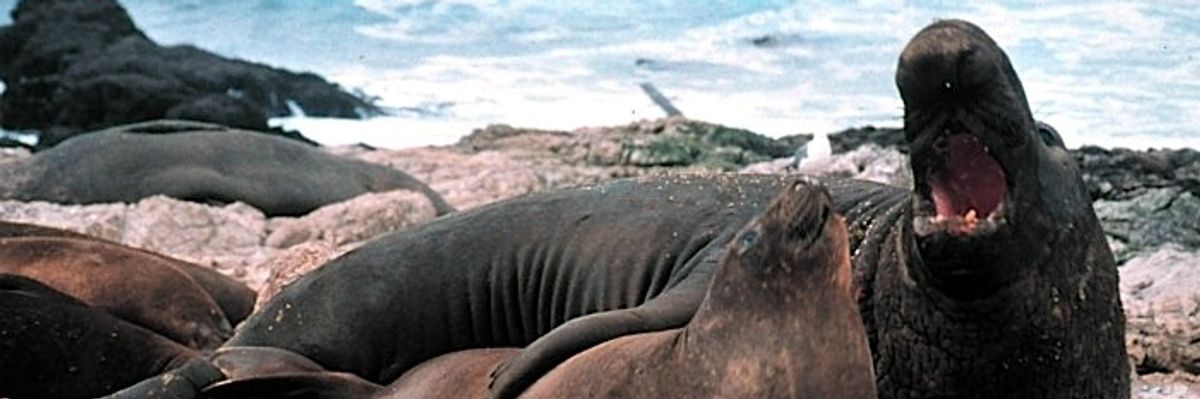
A male and female northern elephant seal are seen in the Gulf of the Farallones National Marine Sanctuary in California.
(Photo by Jan Roletto/ NOAA)
David Helvarg
Aug 31, 2025
Aug 31, 2025
Common Dreams
In July MAGA Rep. Nick Begich of Alaska introduced draft legislation that aims to gut the 1972 Marine Mammal Protection Act at a time when marine mammals are at greater risk than they've been in decades. It would get rid of protections against "incidental takes" from ship strikes, fishing gear entanglement, or deafening sounds from oil exploration, leaving it illegal only to directly shoot or harpoon a mammal.
Rep. Jared Huffman of California, the top-ranking Democrat on the House Resources Committee, calls these proposed changes "a death sentence" for marine mammals. I decided to have a conversation with someone who deals with marine mammals every day to help clarify the situation. Kirsten Donald is a marine biologist, educator, and advocate with the Pacific Marine Mammal Center (PMMC) in Laguna Beach, California.
It's one of California's leading marine mammal rescue centers where they care for, rehabilitate, and release hundreds of sick and injured animals each year. Before coming to California, Kirsten worked for 18 years at the Dolphin Research Center (DRC) in the Florida Keys. In her 30-year-career she's worked with whales, dolphins, manatees, harbor seals, elephant seals, and sea lions. So thanks, Kirsten.
Kristen Donald (KD): A pleasure. Ever since I was a little girl, I got the thrill of being able to go to the ocean because my family had lived in Maryland for a time and I was just utterly fascinated and I just remember seeing dolphins swimming by and being absolutely enamored by them (and wanting to study marine mammal science).
And then, initially when I went to college, I didn't know what I wanted to do. I was kind of lost and went into communications. And when I was about 26, I had a midlife crisis early and went back to career counseling and realized that I needed to be back in science and reminded myself that I loved animals. I happened to hear about this place called the Dolphin Research Center that offered a program called the Dolphin Lab, which allowed people to come down for a week and interact with their dolphin colony there. So, I traveled all the way down to Florida and I just fell in love with the dolphins and the mission to educate the public to be more compassionate to the issues that we face with these guys in the wild. And after a bit they asked me to apply for a job and that was in 1997 and I've been doing it ever since.
David Helvarg (DH): And the Dolphin Research Center, just so people understand, it's not SeaWorld, it's not all about entertainment?
KD: Oh, no. The, dolphin Research Center has some of the highest standards in the world for the care of the animals.They are an educational, nonprofit, and research facility that has a colony of dolphins that were born there mostly and some retired from other facilities. They also had some that stranded as babies and needed homes because they could not be put back in the wild. And so now the dolphins participate in everything from interactions with humans so people can realize that these animals should be conserved to a significant amount of research on the capabilities of these animals, both acoustically and cognitively so that we can understand the other species in the ocean and the parts they play in the ecosystem. It's a really wonderful place. It's all about the dolphins first.
The stranding coordinator came up to me and said, "You're the only person I have left. Here's a net, here's a kennel (like a dog carrier). Take the car and go to this beach." And I'm like, "I've never done this before."
I remember whenever we would do a session, you come down and if you had something in mind and the dolphins are like, "No," you had to change gears. That was your job, you gotta figure out what they want to do because it's not about making them do anything. But the thing was we made everything a game and exciting and fun. And so, the dolphins were always excited to come over and play. And really the drive behind it is the fact that we are not the owners of this planet. We share it.
I also got involved a bit in the research, whether it was taking behavioral research observations or later on developing a field research program on bottlenosed dolphins in the middle Keys, which had never been done before. And they're still doing that and have expanded that program today, which is really phenomenal. I became the director of education. And I became the director of the College of Marine Mammal Professions, which basically took all of the different Dolphin Lab weeklong classes… to create our own college and be able to grant an associate's degree in marine mammal behavior and care training, which was the first one in the world.
DH: So, you were 18 years there in Florida. What got you connected with the Pacific Marine Mammal Center?
KD: At the time I'd been at DRC for 18 years and believe me, it was the hardest change I ever had to make because all of those dolphins were very much a part of my family. But my daughter was growing up and I wanted her to have more opportunities. The Keys are kind of rural in a way and all of a sudden, this job popped up at Pacific Marine Mammal Center to run the Education Department.
And so, I decided to check it out and it reminded me very much of DRC when I first started. When I started at DRC, there were only 30 employees. And by the time I left there was over a 100 and even more volunteers. When I came to PMMC, we only had about 15 people at the time and just a handful of education programs. And I could see that there were so many opportunities to widen the educational opportunities and really reach a more diverse audience. Also, it gave me the chance to learn more about pinnipeds…We're dealing with the problems that are happening right now in the ocean and so, PMMC rescues typically in any given year, anywhere from like 100 to 200 pinnipeds and a few cetaceans as well.
DH: That would be seals, sea lions, and dolphins.
KD: Exactly. Seals, sea lions, and dolphins. And there have been years also where it was crazy. Like my first year happened to be the worst year on record for strandings. That was back in 2015. And from 2013 to 2016, we had an unusual mortality event because of that warm water blob (a massive marine heatwave known as "the blob") overlapping with the El Niño (cyclical Pacific warming). The waters were ridiculously warm.
And PMMC rescued over 500 animals, much more than we'd typically rescue. And it was due to the fact that since the warm water is there, the fish like colder water. So, they would either go deeper or further out to sea or further up north. And the pups that are on the Channel Islands (breeding colonies off Central California) couldn't swim that far in order to get nutrition. In addition, the mothers that are tied to the islands can't swim very far away because they've got to nurse their pups. And so, it became a situation where mothers were abandoning pups. Pups weren't getting enough to eat, and so there was just a constant influx of these animals.
And it was crazy because my second week at PMMC all the trucks are out, all the rescuers are out. And then the stranding coordinator came up to me and said, "You're the only person I have left. Here's a net, here's a kennel (like a dog carrier). Take the car and go to this beach." And I'm like, "I've never done this before."
"It's fine. You just pick them up and put them in the kennel, you know?" And I'm like, "Okay, I'll give it a try." And so, I went and the sea lion happened to be a very small pup that was on a pier, San Clemente Pier, curled up. Didn't even move when I picked him up, he was so emaciated. And so, I popped him in the kennel and then this lady ran up to me and she's like, "There's another one over there."
And he is really skinny. And you know, I'm from a different background in terms of when you work with animals that are in human-managed care, you introduce them slowly, you know, you let them get to know each other. And I only had one kennel and I'm like, how could I put another animal in this kennel? I can't do that. What should I do? So, I call her and she goes, "Oh no, just get them both. They don't care. Just shove them in. They'll be fine."
DH: This is triage. This is emergency room type activity?
KD: Yeah. And this is also me not being as familiar at the time with sea lion behavior because they do lie over each other. They create piles, especially as pups. And so, this one was going in and out of the water and I had to actually get the net and get between it and the water so I could net it and then put it in the kennel (with the first pup) and bring it back. So, that was my very first rescue, and I named the animals Yin and Yang because they were very different (personalities). And it was quite the experience.
DH: And as you say, it was a traumatic time because the blob was the worst of these major marine heatwaves that we've experienced linked to climate change. So, there was loss of prey, there was starvation at the time. And these marine heatwaves have also supercharged Harmful Algal Blooms (HABs) that can also poison marine mammals.
KD: Exactly. And that's what's happened. This year we have had the worst harmful algal bloom on record. These animals are struggling right now with regard to climate change as well as plastics and chemicals in the ocean. I can give you two really good examples. Number one the gray whale, which was actually a huge success under the Marine Mammal Protection Act (MMPA). It was one of the major successes of the MMPA. They were the first large whale species to be delisted (taken off the Endangered Species Act list) after whaling (was banned). They were almost decimated, and they came back 27,000 strong. And between 2019 and 2023, their population has plummeted down to 13,000 animals. So, half the population is gone and scientists looked into it and discovered that this was very much connected to climate change.
Basically, what was happening is that since the (polar) ice cover was receding earlier and the algae that grows underneath it, instead of falling to the bottom and feeding the amphipods (tiny shrimp-like crustaceans that the whales feed on) the ice would recede. The fish go in and eat up all the algae and the amphipods die. And these guys (the migrating gray whales) go up there to eat the pods but there's not enough up there. And so, they spend longer and longer trying to eat, expending more and more energy. But they're still coming back emaciated. And they are dying in droves all up and down the coast from Canada to Mexico.
I think that's what everything going on in society is telling us, that people really need to step up and get involved.
So, it was an international event. And actually, they closed the Unusual Mortality Event (National Oceanic and Atmospheric Administration designation) after 2023. And just this year we are already having a ton of these animals stranded up north around the Monterey Bay area, starting again. It's considered an unusual mortality event because it's something that we normally don't see and is not a natural cycle. So, they thought it was over in 2023, but just this year, in 2025, it's begun again. So, these guys (gray whales) are not out of trouble. In fact, if they can lose half their population in just a few years, this is the worst time to take away their protections.
The other example is California sea lions that breed around the Channel Islands. And one of the studies that our veterinarian did was in looking at the high levels of DDT in these sea lions because there's DDT that was dumped back in the 60s near those islands (by the Montrose Chemical Corp. and others via LA storm drains).
And DDT is a very toxic persistent organic pollutant, which is basically a fertilizer but it stays in the environment for thousands of years. These animals are accumulating it through nursing as well as the food that they eat. And what we've discovered is that they will develop cancer because the DDT interacts with a herpes virus, which pretty much they all have, and is a catalyst for cancer. And so about 25% of the adult patients that come through PMMC are diagnosed with terminal cancer unfortunately, and that's the highest rate of cancer in any mammal on the planet. So again, we're dealing with, human impacts on these species and so they need the protections. In fact, they need more protections than the MMPA provides currently.
DH: We had a few decades where the Marine Mammal Protection Act was working well. The Florida manatees went from 1,000 to 10,000, right?
KD: The Marine Mammal Protection Act is great. It has helped a lot of species, but there are still species that need even more protection like the North Atlantic right whale. There's only 370 of them left. And the changes that are proposed (in the MMPA) actually will delay any action to help them by reducing entanglements (in fishing gear) or ship strikes which are the two major things that are hurting their population. And they don't have 10 years to wait because they've lost half their population since 2017. So, you can see the trajectory that they're already on.
DH: They're trying to roll back all environmental protections. With something like NEPA, the National Environmental Policy Act, people may not know what it's about, but with the Marine Mammal Protection Act, it's right there in the name. In the 1990s popular movements got us to dolphin-free tuna where they used to put the nets around schools of dolphin knowing tuna where underneath them and they'd kill hundreds of thousands of dolphins along with the tuna. Under this so-called MAGA "reform" of the Marine Mammal Protection Act, there's nothing to stop them from doing that again.
KD: Exactly, and we do need the power of the public right now. I think that's what everything going on in society is telling us, that people really need to step up and get involved.
DH: People need to not only volunteer with the Pacific Marine Mammal Center and other marine animal rescue centers for example but also to call their congresspeople and senators and say, "This is not acceptable."
KD: Exactly, that's something that we talk about all the time, and this is why I am such a big proponent of education, helping people understand that they have power, they have a voice. To stand up and call your congressmen if everybody is doing that and letting them know that they care about these issues. If you're a congressperson and not listening to your constituents, you're probably not going to get reelected. And you're there to represent the people's interest. And so, we need people to express that interest.
DH: And again, there's this disingenuous argument being put forward by Republican sponsors of rolling back the Endangered Species Act and Marine Mammal Protection Act, which is these laws have worked so well that these animals are no longer at risk. And this is simply bunk. Like who are some of your patients right now?
KD: Well, actually our patients are all gone right now. We're very excited. We had a really tough year with the unusual mortality event we went through, with the harmful algal bloom because I gotta tell you, it was very rough. Literally most of the animals that came in, or at least half of them, had to be euthanized because they had too many toxins in their system that damaged their brain. Because that's what happens with domoic acid poisoning. It's produced by the algae, and the fish eat it. And then the sea lions eat the fish and get concentrated doses and that toxin goes to the brain, damages it, and it doesn't allow them to be able to navigate spatially. They do things they're not normally doing…
DH: Wandering up on the highways. There was a lot of publicity recently about a sea lion that was biting surfers.
KD: Exactly. People were up in arms about sea lions biting and they don't normally do that. They normally leave you alone. But the animals were so out of their minds because their brains were damaged, that they were being aggressive. And so, there were quite a number, a large number of animals that we had to euthanize. And what was even sadder is that the majority of California sea lions that came in should be doing what they do every year—breeding.
The biggest help that we can provide is standing up for the Marine Mammal Protection Act and the Endangered Species Act because they're the two strongest, most important (animal protection) acts that have been passed in the United States.
And so many were pregnant. And they were not yet close to term. They were about three-quarters of the way through their pregnancies. But they were having to euthanize these females and in some cases, they'd have to induce abortions to try to save the females because there are so many toxins in the amniotic fluid that the female can reabsorb those unless we induce abortion.
And so, what's even sadder is when they would induce these abortions, some of the pups would try to take a breath, even though that they were not viable yet, they were not fully developed. And so, literally as the babies were coming out, they were brought to the veterinarian who then had to turn around and euthanize them.
It was a really traumatic year for our animal care. And it's really worrisome that again, this is the fourth year in a row that we've had a harmful algal bloom, and this was the worst on record. What are we in store for in the years to come? That's a real concern of ours. So, yes, it was a tough year.
DH: And again, at the federal level, we're both denying the reality of climate change and now trying to deny the reality that marine mammals are in serious trouble.
KD: Right. And when you look at things happening in the ocean, there's no denying climate change anymore. There's absolutely none. It's happening. It's affecting the animals. They're showing it to us. It's sad when we have these animals. We get them back up to speed, they're ready to go out, they're healthy. And then we realize we're releasing them into a damaged home, a broken home that we need to help fix because we broke it. And so, it's really personal to us.
DH: Okay. I really appreciate the work you're doing, and so let's end on a happy note. What was your last release?
KD: The last release I was on, it was great because I got to go with my entire staff and with some animal care people out on a boat release, because sometimes it's better to release the animals off boats (rather than from beaches), especially if they're like adult animals.
We get them further away from the beach so they don't present a hazard to people. That's where they're normally meant to be anyway, further out in the ocean. And so, we had three different animals, and you would basically move the crate up to the edge of the boat and open the kennel and they look around, they dunk their head in the water and look around and then slowly climb in.
And then you just do one after the other. And it's sometimes funny because I've seen elephant seals do the same thing where one will like stick his head in the water, then look at his buddy and wait for the buddy to go in. And then look in the water again and make sure, I'm thinking he's making sure there's no sharks, you know, let his buddy go in first.
So, it's neat and sometimes they'll look back at us too you know, and we like to think it's a "Thank you for helping me." And then they just swim away and do what they're meant to be doing. So, it's really gratifying to see them go home, but it gives us even more motivation to try to help get word out about these issues so that people can take action in their own lives to help, because there are all these simple things that we can do… The biggest help that we can provide is standing up for the Marine Mammal Protection Act and the Endangered Species Act because they're the two strongest, most important (animal protection) acts that have been passed in the United States and that also are unique.
This story is based on my interview with Kirstin Donald for Blue Frontier's Rising Tide Ocean Podcast that aired on August 25, 2025.
Our work is licensed under Creative Commons (CC BY-NC-ND 3.0). Feel free to republish and share widely.
David Helvarg
David Helvarg is an author, former war correspondent, and licensed private investigator.
Full Bio >
In July MAGA Rep. Nick Begich of Alaska introduced draft legislation that aims to gut the 1972 Marine Mammal Protection Act at a time when marine mammals are at greater risk than they've been in decades. It would get rid of protections against "incidental takes" from ship strikes, fishing gear entanglement, or deafening sounds from oil exploration, leaving it illegal only to directly shoot or harpoon a mammal.
Rep. Jared Huffman of California, the top-ranking Democrat on the House Resources Committee, calls these proposed changes "a death sentence" for marine mammals. I decided to have a conversation with someone who deals with marine mammals every day to help clarify the situation. Kirsten Donald is a marine biologist, educator, and advocate with the Pacific Marine Mammal Center (PMMC) in Laguna Beach, California.
It's one of California's leading marine mammal rescue centers where they care for, rehabilitate, and release hundreds of sick and injured animals each year. Before coming to California, Kirsten worked for 18 years at the Dolphin Research Center (DRC) in the Florida Keys. In her 30-year-career she's worked with whales, dolphins, manatees, harbor seals, elephant seals, and sea lions. So thanks, Kirsten.
Kristen Donald (KD): A pleasure. Ever since I was a little girl, I got the thrill of being able to go to the ocean because my family had lived in Maryland for a time and I was just utterly fascinated and I just remember seeing dolphins swimming by and being absolutely enamored by them (and wanting to study marine mammal science).
And then, initially when I went to college, I didn't know what I wanted to do. I was kind of lost and went into communications. And when I was about 26, I had a midlife crisis early and went back to career counseling and realized that I needed to be back in science and reminded myself that I loved animals. I happened to hear about this place called the Dolphin Research Center that offered a program called the Dolphin Lab, which allowed people to come down for a week and interact with their dolphin colony there. So, I traveled all the way down to Florida and I just fell in love with the dolphins and the mission to educate the public to be more compassionate to the issues that we face with these guys in the wild. And after a bit they asked me to apply for a job and that was in 1997 and I've been doing it ever since.
David Helvarg (DH): And the Dolphin Research Center, just so people understand, it's not SeaWorld, it's not all about entertainment?
KD: Oh, no. The, dolphin Research Center has some of the highest standards in the world for the care of the animals.They are an educational, nonprofit, and research facility that has a colony of dolphins that were born there mostly and some retired from other facilities. They also had some that stranded as babies and needed homes because they could not be put back in the wild. And so now the dolphins participate in everything from interactions with humans so people can realize that these animals should be conserved to a significant amount of research on the capabilities of these animals, both acoustically and cognitively so that we can understand the other species in the ocean and the parts they play in the ecosystem. It's a really wonderful place. It's all about the dolphins first.
The stranding coordinator came up to me and said, "You're the only person I have left. Here's a net, here's a kennel (like a dog carrier). Take the car and go to this beach." And I'm like, "I've never done this before."
I remember whenever we would do a session, you come down and if you had something in mind and the dolphins are like, "No," you had to change gears. That was your job, you gotta figure out what they want to do because it's not about making them do anything. But the thing was we made everything a game and exciting and fun. And so, the dolphins were always excited to come over and play. And really the drive behind it is the fact that we are not the owners of this planet. We share it.
I also got involved a bit in the research, whether it was taking behavioral research observations or later on developing a field research program on bottlenosed dolphins in the middle Keys, which had never been done before. And they're still doing that and have expanded that program today, which is really phenomenal. I became the director of education. And I became the director of the College of Marine Mammal Professions, which basically took all of the different Dolphin Lab weeklong classes… to create our own college and be able to grant an associate's degree in marine mammal behavior and care training, which was the first one in the world.
DH: So, you were 18 years there in Florida. What got you connected with the Pacific Marine Mammal Center?
KD: At the time I'd been at DRC for 18 years and believe me, it was the hardest change I ever had to make because all of those dolphins were very much a part of my family. But my daughter was growing up and I wanted her to have more opportunities. The Keys are kind of rural in a way and all of a sudden, this job popped up at Pacific Marine Mammal Center to run the Education Department.
And so, I decided to check it out and it reminded me very much of DRC when I first started. When I started at DRC, there were only 30 employees. And by the time I left there was over a 100 and even more volunteers. When I came to PMMC, we only had about 15 people at the time and just a handful of education programs. And I could see that there were so many opportunities to widen the educational opportunities and really reach a more diverse audience. Also, it gave me the chance to learn more about pinnipeds…We're dealing with the problems that are happening right now in the ocean and so, PMMC rescues typically in any given year, anywhere from like 100 to 200 pinnipeds and a few cetaceans as well.
DH: That would be seals, sea lions, and dolphins.
KD: Exactly. Seals, sea lions, and dolphins. And there have been years also where it was crazy. Like my first year happened to be the worst year on record for strandings. That was back in 2015. And from 2013 to 2016, we had an unusual mortality event because of that warm water blob (a massive marine heatwave known as "the blob") overlapping with the El Niño (cyclical Pacific warming). The waters were ridiculously warm.
And PMMC rescued over 500 animals, much more than we'd typically rescue. And it was due to the fact that since the warm water is there, the fish like colder water. So, they would either go deeper or further out to sea or further up north. And the pups that are on the Channel Islands (breeding colonies off Central California) couldn't swim that far in order to get nutrition. In addition, the mothers that are tied to the islands can't swim very far away because they've got to nurse their pups. And so, it became a situation where mothers were abandoning pups. Pups weren't getting enough to eat, and so there was just a constant influx of these animals.
And it was crazy because my second week at PMMC all the trucks are out, all the rescuers are out. And then the stranding coordinator came up to me and said, "You're the only person I have left. Here's a net, here's a kennel (like a dog carrier). Take the car and go to this beach." And I'm like, "I've never done this before."
"It's fine. You just pick them up and put them in the kennel, you know?" And I'm like, "Okay, I'll give it a try." And so, I went and the sea lion happened to be a very small pup that was on a pier, San Clemente Pier, curled up. Didn't even move when I picked him up, he was so emaciated. And so, I popped him in the kennel and then this lady ran up to me and she's like, "There's another one over there."
And he is really skinny. And you know, I'm from a different background in terms of when you work with animals that are in human-managed care, you introduce them slowly, you know, you let them get to know each other. And I only had one kennel and I'm like, how could I put another animal in this kennel? I can't do that. What should I do? So, I call her and she goes, "Oh no, just get them both. They don't care. Just shove them in. They'll be fine."
DH: This is triage. This is emergency room type activity?
KD: Yeah. And this is also me not being as familiar at the time with sea lion behavior because they do lie over each other. They create piles, especially as pups. And so, this one was going in and out of the water and I had to actually get the net and get between it and the water so I could net it and then put it in the kennel (with the first pup) and bring it back. So, that was my very first rescue, and I named the animals Yin and Yang because they were very different (personalities). And it was quite the experience.
DH: And as you say, it was a traumatic time because the blob was the worst of these major marine heatwaves that we've experienced linked to climate change. So, there was loss of prey, there was starvation at the time. And these marine heatwaves have also supercharged Harmful Algal Blooms (HABs) that can also poison marine mammals.
KD: Exactly. And that's what's happened. This year we have had the worst harmful algal bloom on record. These animals are struggling right now with regard to climate change as well as plastics and chemicals in the ocean. I can give you two really good examples. Number one the gray whale, which was actually a huge success under the Marine Mammal Protection Act (MMPA). It was one of the major successes of the MMPA. They were the first large whale species to be delisted (taken off the Endangered Species Act list) after whaling (was banned). They were almost decimated, and they came back 27,000 strong. And between 2019 and 2023, their population has plummeted down to 13,000 animals. So, half the population is gone and scientists looked into it and discovered that this was very much connected to climate change.
Basically, what was happening is that since the (polar) ice cover was receding earlier and the algae that grows underneath it, instead of falling to the bottom and feeding the amphipods (tiny shrimp-like crustaceans that the whales feed on) the ice would recede. The fish go in and eat up all the algae and the amphipods die. And these guys (the migrating gray whales) go up there to eat the pods but there's not enough up there. And so, they spend longer and longer trying to eat, expending more and more energy. But they're still coming back emaciated. And they are dying in droves all up and down the coast from Canada to Mexico.
I think that's what everything going on in society is telling us, that people really need to step up and get involved.
So, it was an international event. And actually, they closed the Unusual Mortality Event (National Oceanic and Atmospheric Administration designation) after 2023. And just this year we are already having a ton of these animals stranded up north around the Monterey Bay area, starting again. It's considered an unusual mortality event because it's something that we normally don't see and is not a natural cycle. So, they thought it was over in 2023, but just this year, in 2025, it's begun again. So, these guys (gray whales) are not out of trouble. In fact, if they can lose half their population in just a few years, this is the worst time to take away their protections.
The other example is California sea lions that breed around the Channel Islands. And one of the studies that our veterinarian did was in looking at the high levels of DDT in these sea lions because there's DDT that was dumped back in the 60s near those islands (by the Montrose Chemical Corp. and others via LA storm drains).
And DDT is a very toxic persistent organic pollutant, which is basically a fertilizer but it stays in the environment for thousands of years. These animals are accumulating it through nursing as well as the food that they eat. And what we've discovered is that they will develop cancer because the DDT interacts with a herpes virus, which pretty much they all have, and is a catalyst for cancer. And so about 25% of the adult patients that come through PMMC are diagnosed with terminal cancer unfortunately, and that's the highest rate of cancer in any mammal on the planet. So again, we're dealing with, human impacts on these species and so they need the protections. In fact, they need more protections than the MMPA provides currently.
DH: We had a few decades where the Marine Mammal Protection Act was working well. The Florida manatees went from 1,000 to 10,000, right?
KD: The Marine Mammal Protection Act is great. It has helped a lot of species, but there are still species that need even more protection like the North Atlantic right whale. There's only 370 of them left. And the changes that are proposed (in the MMPA) actually will delay any action to help them by reducing entanglements (in fishing gear) or ship strikes which are the two major things that are hurting their population. And they don't have 10 years to wait because they've lost half their population since 2017. So, you can see the trajectory that they're already on.
DH: They're trying to roll back all environmental protections. With something like NEPA, the National Environmental Policy Act, people may not know what it's about, but with the Marine Mammal Protection Act, it's right there in the name. In the 1990s popular movements got us to dolphin-free tuna where they used to put the nets around schools of dolphin knowing tuna where underneath them and they'd kill hundreds of thousands of dolphins along with the tuna. Under this so-called MAGA "reform" of the Marine Mammal Protection Act, there's nothing to stop them from doing that again.
KD: Exactly, and we do need the power of the public right now. I think that's what everything going on in society is telling us, that people really need to step up and get involved.
DH: People need to not only volunteer with the Pacific Marine Mammal Center and other marine animal rescue centers for example but also to call their congresspeople and senators and say, "This is not acceptable."
KD: Exactly, that's something that we talk about all the time, and this is why I am such a big proponent of education, helping people understand that they have power, they have a voice. To stand up and call your congressmen if everybody is doing that and letting them know that they care about these issues. If you're a congressperson and not listening to your constituents, you're probably not going to get reelected. And you're there to represent the people's interest. And so, we need people to express that interest.
DH: And again, there's this disingenuous argument being put forward by Republican sponsors of rolling back the Endangered Species Act and Marine Mammal Protection Act, which is these laws have worked so well that these animals are no longer at risk. And this is simply bunk. Like who are some of your patients right now?
KD: Well, actually our patients are all gone right now. We're very excited. We had a really tough year with the unusual mortality event we went through, with the harmful algal bloom because I gotta tell you, it was very rough. Literally most of the animals that came in, or at least half of them, had to be euthanized because they had too many toxins in their system that damaged their brain. Because that's what happens with domoic acid poisoning. It's produced by the algae, and the fish eat it. And then the sea lions eat the fish and get concentrated doses and that toxin goes to the brain, damages it, and it doesn't allow them to be able to navigate spatially. They do things they're not normally doing…
DH: Wandering up on the highways. There was a lot of publicity recently about a sea lion that was biting surfers.
KD: Exactly. People were up in arms about sea lions biting and they don't normally do that. They normally leave you alone. But the animals were so out of their minds because their brains were damaged, that they were being aggressive. And so, there were quite a number, a large number of animals that we had to euthanize. And what was even sadder is that the majority of California sea lions that came in should be doing what they do every year—breeding.
The biggest help that we can provide is standing up for the Marine Mammal Protection Act and the Endangered Species Act because they're the two strongest, most important (animal protection) acts that have been passed in the United States.
And so many were pregnant. And they were not yet close to term. They were about three-quarters of the way through their pregnancies. But they were having to euthanize these females and in some cases, they'd have to induce abortions to try to save the females because there are so many toxins in the amniotic fluid that the female can reabsorb those unless we induce abortion.
And so, what's even sadder is when they would induce these abortions, some of the pups would try to take a breath, even though that they were not viable yet, they were not fully developed. And so, literally as the babies were coming out, they were brought to the veterinarian who then had to turn around and euthanize them.
It was a really traumatic year for our animal care. And it's really worrisome that again, this is the fourth year in a row that we've had a harmful algal bloom, and this was the worst on record. What are we in store for in the years to come? That's a real concern of ours. So, yes, it was a tough year.
DH: And again, at the federal level, we're both denying the reality of climate change and now trying to deny the reality that marine mammals are in serious trouble.
KD: Right. And when you look at things happening in the ocean, there's no denying climate change anymore. There's absolutely none. It's happening. It's affecting the animals. They're showing it to us. It's sad when we have these animals. We get them back up to speed, they're ready to go out, they're healthy. And then we realize we're releasing them into a damaged home, a broken home that we need to help fix because we broke it. And so, it's really personal to us.
DH: Okay. I really appreciate the work you're doing, and so let's end on a happy note. What was your last release?
KD: The last release I was on, it was great because I got to go with my entire staff and with some animal care people out on a boat release, because sometimes it's better to release the animals off boats (rather than from beaches), especially if they're like adult animals.
We get them further away from the beach so they don't present a hazard to people. That's where they're normally meant to be anyway, further out in the ocean. And so, we had three different animals, and you would basically move the crate up to the edge of the boat and open the kennel and they look around, they dunk their head in the water and look around and then slowly climb in.
And then you just do one after the other. And it's sometimes funny because I've seen elephant seals do the same thing where one will like stick his head in the water, then look at his buddy and wait for the buddy to go in. And then look in the water again and make sure, I'm thinking he's making sure there's no sharks, you know, let his buddy go in first.
So, it's neat and sometimes they'll look back at us too you know, and we like to think it's a "Thank you for helping me." And then they just swim away and do what they're meant to be doing. So, it's really gratifying to see them go home, but it gives us even more motivation to try to help get word out about these issues so that people can take action in their own lives to help, because there are all these simple things that we can do… The biggest help that we can provide is standing up for the Marine Mammal Protection Act and the Endangered Species Act because they're the two strongest, most important (animal protection) acts that have been passed in the United States and that also are unique.
This story is based on my interview with Kirstin Donald for Blue Frontier's Rising Tide Ocean Podcast that aired on August 25, 2025.
Our work is licensed under Creative Commons (CC BY-NC-ND 3.0). Feel free to republish and share widely.
David Helvarg
David Helvarg is an author, former war correspondent, and licensed private investigator.
Full Bio >