Monday, September 01, 2025

‘Fueling sexism’: AI ‘bikini interview’ videos flood internet


By AFP
September 1, 2025


AI slop is blurring the distinction between truth and fabrication, experts say - Copyright AFP Oliver Contreras

Anuj Chopra with Sumit Dubey in New Delhi and Michelle Fitzpatrick in Frankfurt

The videos are strikingly lifelike, featuring bikini-clad women conducting street interviews and eliciting lewd comments — but they are entirely fake, generated by AI tools increasingly used to flood social media with sexist content.

Such AI slop — mass-produced content created by cheap artificial intelligence tools that turn simple text prompts into hyper-realistic visuals — is frequently drowning out authentic posts and blurring the line between fiction and reality.

The trend has spawned a cottage industry of AI influencers churning out large volumes of sexualized clips with minimal effort, often driven by platform incentive programs that financially reward viral content.

Hordes of AI clips, laden with locker-room humor, purport to show scantily clad female interviewers on the streets of India or the United Kingdom — sparking concern about the harm such synthetic content may pose to women.

AFP’s fact-checkers traced hundreds of such videos on Instagram, many in Hindi, that purportedly show male interviewees casually delivering misogynistic punchlines and sexualized remarks — sometimes even grabbing the women — while crowds of men gawk or laugh in the background.

Many videos racked up tens of millions of views — and some further monetized that traction by promoting an adult chat app to “make new female friends.”

The fabricated clips were so lifelike that some users in the comments questioned whether the featured women were real.

A sample of these videos analyzed by the US cybersecurity firm GetReal Security showed they were created using Google’s Veo 3 AI generator, known for hyper-realistic visuals.

– ‘Gendered harm’ –

“Misogyny that usually stayed hidden in locker room chats and groups is now being dressed up as AI visuals,” Nirali Bhatia, an India-based cyber psychologist, told AFP.

“This is part of AI-mediated gendered harm,” she said, adding that the trend was “fueling sexism.”

The trend offers a window into an internet landscape now increasingly swamped with AI-generated memes, videos and images that are competing for attention with — and increasingly eclipsing — authentic content.

“AI slop and any type of unlabeled AI-generated content slowly chips away at the little trust that remains in visual content,” GetReal Security’s Emmanuelle Saliba told AFP.

The most viral misogynistic content often relies on shock value — including Instagram and TikTok clips that Wired magazine said were generated using Veo 3 and portray Black women as big-footed primates.

Videos on one popular TikTok account mockingly list what so-called gold-digging “girls gone wild” would do for money.

Women are also fodder for distressing AI-driven clickbait, with AFP’s fact-checkers tracking viral videos of a fake marine trainer named “Jessica Radcliffe” being fatally attacked by an orca during a live show at a water park.

The fabricated footage rapidly spread across platforms including TikTok, Facebook and X, sparking global outrage from users who believed the woman was real.

– ‘Unreal’ –

Last year, Alexios Mantzarlis, director of the Security, Trust, and Safety Initiative at Cornell Tech, found 900 Instagram accounts of likely AI-generated “models” — predominantly female and typically scantily clothed.

These thirst traps cumulatively amassed 13 million followers and posted more than 200,000 images, typically monetizing their reach by redirecting their audiences to commercial content-sharing platforms.

With AI fakery proliferating online, “the numbers now are undoubtedly much larger,” Mantzarlis told AFP.

“Expect more nonsense content leveraging body standards that are not just unrealistic but literally unreal,” he added.

Financially incentivized slop is becoming increasingly challenging to police as content creators — including students and stay-at-home parents around the world — turn to AI video production as gig work.

Many creators on YouTube and TikTok offer paid courses on how to monetize viral AI-generated material on platforms, many of which have reduced their reliance on human fact-checkers and scaled back content moderation.

Some platforms have sought to crack down on accounts promoting slop, with YouTube recently saying that creators of “inauthentic” and “mass produced” content would be ineligible for monetization.

“AI doesn’t invent misogyny — it just reflects and amplifies what’s already there,” AI consultant Divyendra Jadoun told AFP.

“If audiences reward this kind of content with millions of likes, the algorithms and AI creators will keep producing it. The bigger fight isn’t just technological — it’s social and cultural.”

burs-ac/st

New wave: Sea power turned into energy at Los Angeles port


By AFP
August 31, 2025


Sea change: the floaters convert the power of waves into an electrical current - Copyright AFP Patrick T. Fallon


Romain FONSEGRIVES

Floating blue paddles dance on the waves that lap a dock in the Port of Los Angeles, silently converting the power of the sea into useable electricity.

This innovative installation may hold one of the keys to accelerating a transition away from fossil fuels that scientists say is necessary if the world is to avoid the worst effects of climate change.

“The project is very simple and easy,” Inna Braverman, co-founder of Israeli start-up Eco Wave Power, told AFP.

Looking a little like piano keys, the floaters rise and fall with each wave.

They are connected to hydraulic pistons that push a biodegradable fluid through pipes to a container filled with accumulators, which resemble large red scuba tanks.

When the pressure is released, it spins a turbine that generates electrical current.

If this pilot project convinces the California authorities, Braverman hopes to cover the entire 13-kilometer (eight-mile) breakwater protecting the port with hundreds of floaters that together would produce enough electricity to power 60,000 US homes.

Supporters of the technology say wave energy is an endlessly renewable and always reliable source of power.

Unlike solar power, which produces nothing at night, or wind power, which depends on the weather, the sea is always in motion.

And there is a lot of it.

– Tough tech –

The waves off the American West Coast could theoretically power 130 million homes — or supply around a third of the electricity used every year in the United States, according to the US Department of Energy.

However wave energy remains the poor relation of other, better-known renewables, and has not been successfully commercialized at a large-enough scale.

The history of the sector is full of company shipwrecks and projects sunk by the brutality of the high seas. Developing devices robust enough to withstand the fury of the waves, while transmitting electricity via underwater cables to the shore, has proven to be an impossible task so far.

“Ninety-nine percent of competitors chose to install in the middle of the ocean, where it’s super expensive, where it’s breaking down all the time, so they can’t really make projects work,” Braverman said.

With her retractable dock-mounted device, the entrepreneur believes she has found the answer.

“When the waves are too high for the system to handle, the floaters just rise to the upward position until the storm passes, so you have no damage.”

The design appeals to Krish Thiagarajan Sharman, a professor of mechanical engineering at the University of Massachusetts Amherst.

“The Achilles heel of wave energy is in the costs of maintenance and inspection,” he told AFP.

“So having a device close to shore, where you can walk on a breakwater and then inspect the device, makes a lot of sense.”

Sharman, who is not affiliated with the project and whose laboratory is testing various wave energy equipment, said projects tend to be suited to smaller-scale demands, like powering remote islands.

“This eight-mile breakwater, that’s not a common thing. It’s a rare opportunity, a rare location where such a long wavefront is available for producing power,” he said.

– AI power demand –

Braverman’s Eco Wave Power is already thinking ahead, having identified dozens more sites in the United States that could be suitable for similar projects.

The project predates Donald Trump’s administration, but even before the political environment in Washington turned against renewables, the company was already looking beyond the US.

In Israel, up to 100 homes in the port of Jaffa have been powered by waves since December.

By 2026, 1,000 homes in Porto, Portugal should be online, with installations also planned in Taiwan and India.

Braverman dreams of 20-megawatt projects, a critical capacity needed to offer electricity at rates that can compete with wind power.

And, she said, the installations will not harm the local wildlife.

“There’s zero environmental impact. We connect to existent man-made structures, which already disturb the environment.”

Promises like this resonate in California, where the Energy Commission highlighted in a recent report the potential of wave energy to help the state achieve carbon neutrality by 2045.

“The amount of energy that we’re consuming is only increasing with the age of AI and data centers,” said Jenny Krusoe, founder of AltaSea, an organization that helped fund the project.

“So the faster we can move this technology and have it down the coastline, the better for California.”
The US Supreme Court Asks Why It Shouldn’t Gut the Voting Rights Act

We may well see the elimination of the 11 Black-majority districts — all Democratic — in GOP-controlled Southern states.

August 29, 2025

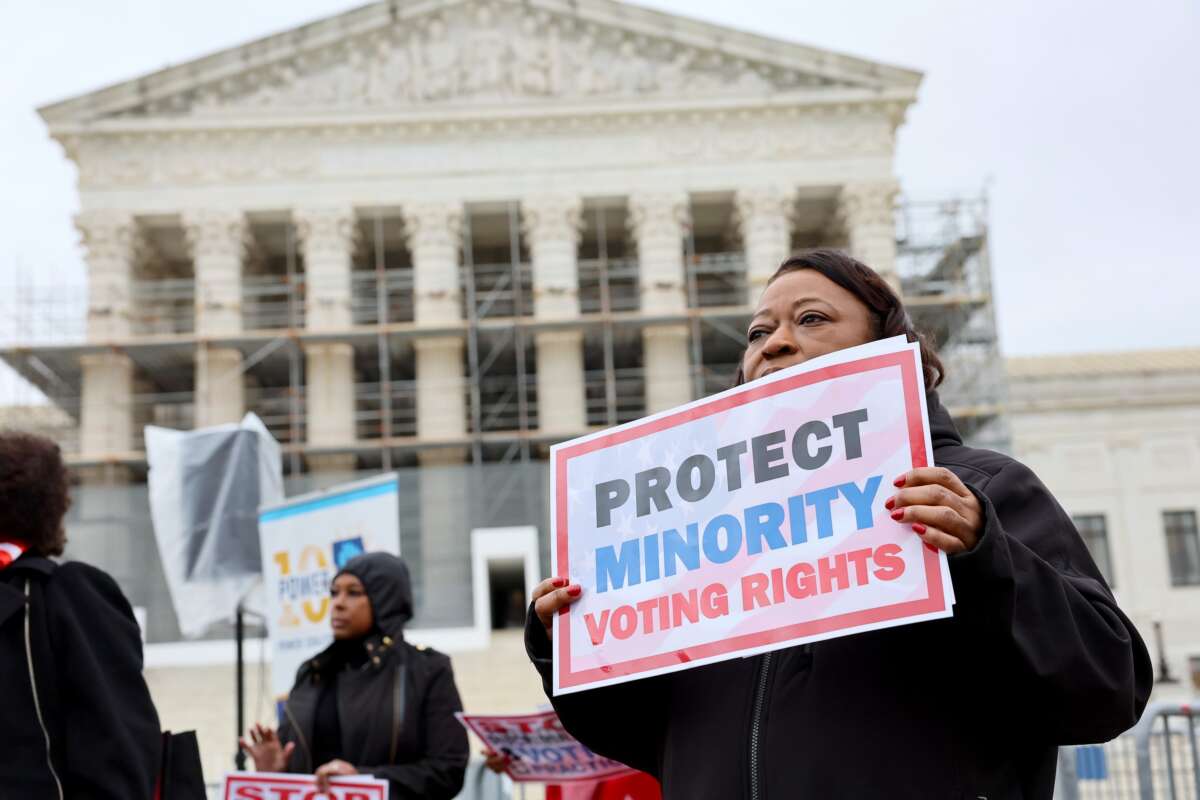
Black Louisiana voters and civil rights advocates call on the Supreme Court to uphold a fair and representative congressional map in Louisiana v. Callais at the Supreme Court of the United States on March 24, 2025, in Washington, D.C.
Jemal Countess / Getty Images for Legal Defense Fund

In what may prove to be the most consequential redistricting case to come before the Supreme Court, Louisiana is urging the court to gut the main provision of the Voting Rights Act of 1965 (VRA) and ban any consideration of race in redistricting. Louisiana filed its brief after the high court on August 1 asked the parties whether compliance with Section 2 of the (VRA) violates the Constitution’s 14th or 15th Amendments. By framing that question, the court may be signaling its intention to eviscerate the VRA.

Louisiana v. Callais reached the Supreme Court after a coalition of civil rights organizations and Black voters sought to reinstate a map that the state legislature had adopted in 2024. The map, which established a second majority-Black congressional district in the state, had been drawn in response to a 2022 U.S. district court ruling. In that case, the court ruled that a prior map, drawn in 2020, likely violated Section 2 because it included only one majority-Black district out of the state’s six congressional districts. The coalition had argued that the old map diluted the votes of Black residents, who constitute about one-third of the population of Louisiana.

The Fifth U.S. Circuit Court of Appeals had affirmed the district court’s ruling that the old map probably violated Section 2, and the appellate court ordered Louisiana to adopt a new map by January 15, 2024. The Louisiana Legislature complied and drew a map with a second majority-Black district.

A group of self-described “non-African American” voters then filed a federal legal challenge to the 2024 map, alleging that it was an unconstitutional racial gerrymander because it separated voters primarily on the basis of race. A three-judge panel of the U.S. district court agreed with them, but the Supreme Court stayed the district court’s ruling and allowed the 2024 map to be used in the 2024 elections while it considered the merits of the case.

In March 2025, the high court heard arguments but didn’t make a decision, instead delaying a ruling on the merits until the following term this fall. In its June 27 order, the court said it would “issue an order scheduling argument and specifying any additional questions to be addressed in supplemental briefing.”

Related Story

The Voting Rights Act Dodged a Bullet — for Now
Five House seats may well shift to Democrats in the wake of “Allen v. Milligan.”
By Marjorie Cohn , Truthout June 12, 2023


That more specific order came on August 1, when the court directed the parties to brief the question of the constitutionality of Section 2 of the VRA. Reargument is scheduled for October 15.

In its brief filed on August 27, Louisiana asked the Supreme Court to overrule its 1986 decision that set forth the legal test used to determine when a congressional map dilutes the voting power of minorities and thus violates Section 2. Relying on the case that ended race-based affirmative action in higher education, Louisiana argued for a “color blind” Constitution — a euphemism for allowing racial discrimination to continue.
VRA Section 2 Forbids the Government From Denying the Right to Vote Based on Race

The 14th Amendment’s Equal Protection Clause prohibits the government from treating people differently without a compelling or rational basis.

The 15th Amendment forbids the government from abridging or denying the right to vote “on account of race, color, or previous condition of servitude.”

Section 2 of the Voting Rights Act was enacted to enforce the 15th Amendment. It prohibits any voting qualification or prerequisite to voting, or practice or procedure that “results in a denial or abridgment of the right of any citizen of the United States to vote on account of race.” That happens when voters of color “have less opportunity than other members of the electorate to participate in the political process and to elect representatives of their choice.”

In its August 1 order, the Supreme Court directed the parties to file briefs addressing a question raised across three pages in the brief from the “non-African American” voters: “Whether the State’s intentional creation of a second majority-minority congressional district violates the Fourteenth or Fifteenth Amendments to the U. S. Constitution.”

The voters wrote in that brief: “Section 2 is no longer constitutional in Louisiana because the voter data from Louisiana … shows that Black voters in Louisiana today have an equal opportunity to participate in the political process and elect representatives of their choice.” The brief goes on to say: “Section 2 imposes burdens on constitutional redistricting laws that cannot be justified by Black Louisianans’ needs.” Finally, the brief contends:


Section 2 is abused to set racial quotas and elevate some groups over others. Such practices violate “the twin commands of the Equal Protection Clause that race may never be used as a ‘negative’ and that it may not operate as a stereotype.”

By zeroing in on those three pages, the high court appears amenable to deciding that Section 2 violates the 14th or 15th Amendment.
Fifth Circuit Court of Appeals Sides With Black Louisiana Voters

The district court had held a seven-day trial in late 2023, where data analysis was presented, and expert witnesses and Black voters throughout Louisiana testified about the discriminatory effect of the 2022 congressional map.

On August 14, 2025, the Fifth Circuit Court of Appeals affirmed the district court ruling that the 2022 map violated Section 2 of the VRA. The appellate court held that the old map diluted the voting power of Black voters by unfairly dividing communities into districts, in order to reduce their voting power and thereby deny them an equal opportunity to elect candidates of their choosing. The Fifth Circuit — which is considered the most conservative federal appeals court in the country — rejected the assertions that the 2024 map violated the 14th or 15th Amendment.

When it takes up the merits of the case next term, the Supreme Court will review the Fifth Circuit’s opinion.

What Will the Supremes Do?

The question before the court is whether the 2024 map with the additional Black-majority district will be used in 2026 and subsequent elections. If the high court strikes down the 2024 map, it will create a presumption of illegal racial gerrymandering when map drawers craft majority-minority districts — districts in which people of color are the majority of voters — effectively destroying Section 2 of the VRA.

If the high court finds Section 2 unconstitutional, we may well see the elimination of the 11 Black-majority districts — all Democratic — in Republican-controlled Southern states.

In 2013, Chief Justice John Roberts wrote the opinion in Shelby County v. Holder, gutting Section 5 of the VRA, which had required federal preclearance before changes to election rules could go into effect in jurisdictions with a history of discriminatory voting practices.

But in Shelby, Roberts provided assurances that Section 2 of the VRA would still be available to protect voting rights.

Two years ago, the Supreme Court struck down a racist congressional district map in the 5-4 decision of Allen v. Milligan. Although Brett Kavanaugh joined Roberts in voting with the three liberal members of the court in that case, Kavanaugh asked the Solicitor General during the March argument in Louisiana v. Callais whether the VRA’s requirement of race-conscious drawing of majority-minority districts can still be a constitutional remedy for voting discrimination. Kavanaugh noted that “the Court’s long said, that race-based remedial action must have a logical end point, must be limited in time, must be a temporary matter. Of course, in school desegregation and university admissions.” In Milligan, Kavanaugh flagged the question of an expiration date for Section 2, but he noted that Alabama had not raised the issue.

The Voting Rights Act, one of the greatest victories of the Civil Rights Movement, has been targeted by the right since its enactment in 1965. Roberts noted in Shelby that “largely because of the Voting Rights Act, voting tests were abolished, disparities in voter registration and turnout due to race were erased, and African-Americans attained political office in record numbers.”

But, as Ruth Bader Ginsburg wrote in her Shelby dissent, “Throwing out preclearance when it has worked and is continuing to work to stop discriminatory changes is like throwing away your umbrella in a rainstorm because you are not getting wet.”

By the end of June 2026, we should learn whether Kavanaugh and Roberts think that discrimination has ceased enough to warrant throwing away the VRA’s Section 2 umbrella.


This article is licensed under Creative Commons (CC BY-NC-ND 4.0), and you are free to share and republish under the terms of the license.


Marjorie Cohn is professor emerita at Thomas Jefferson School of Law, dean of the People’s Academy of International Law and past president of the National Lawyers Guild. She sits on the national advisory boards of Veterans For Peace and Assange Defense, and is a member of the bureau of the International Association of Democratic Lawyers and the U.S. representative to the continental advisory council of the Association of American Jurists. Her books include Drones and Targeted Killing: Legal, Moral and Geopolitical Issues
.
FEMA Employees Speak Out After Attacks on Workers Warning of Looming Disaster

“The danger posed to our collective communities … is very real,” said one employee who signed a public letter.
August 30, 2025
A Federal Emergency Management Agency (FEMA) sign is displayed at the entrances to their headquarters on June 13, 2025, in Washington, D.C.Kevin Carter / Getty Images

Nearly 200 employees of the Federal Emergency Management Agency (FEMA) signed an extraordinary letter sent to Congress on August 25, denouncing the current administration’s erosion of their work and warning that it risks the occurrence of another Hurricane Katrina-sized disaster. More than 30 provided their names; the rest signed anonymously.

Named the Katrina Declaration, the letter was one of the most powerful written so far by beleaguered federal employees attempting to salvage their agencies from a predatory administration seemingly intent on bulldozing basic government functions. They have followed up on this by asking people around the country to join them in their protest by endorsing the letter.

“I knew that if I didn’t sign this letter I would feel as though I was failing in my duty to protect the public I swore an oath to serve; that I would feel complicit in the false narratives this administration has been working so hard to drive about their intentions with FEMA when I’ve seen only evidence to the contrary,” one of the signatories told me. Like most of those who spoke to me, she requested anonymity, fearing retribution from the Trump administration. “In the end, I knew that more people would die if I did not help raise the alarm. So I did. And I am. And I will continue to do so.”

The authors didn’t pull punches, arguing that the administration is violating the Post-Katrina Emergency Management Reform Act, which Congress passed in 2006 to improve FEMA’s performance after the agency’s dismal failures following the devastation the hurricane wrought upon New Orleans twenty years ago this week. The Trumpified Department of Homeland Security (DHS), the parent department to FEMA, is slashing funding to vital FEMA services. And the department is insisting that all grants in excess of $100,000 be personally approved by DHS Secretary Kristi Noem — a choice that has created a huge backlog in contracts.

Due to the new influx in red tape, residents of states facing the aftermath of natural disasters, such as Texas, which faced devastating floods in July; and North Carolina, which suffered huge storm-related losses earlier this year, have already faced huge delays in receiving assistance from FEMA. Contractors who run phone help lines and other vital services connecting the public to the agency have been mothballed and specialists have been taken off their regular jobs to help staff these cratering phone systems. Throughout the year, the department has systematically placed obstacles in the way of disaster preparedness and risk-mitigation programs around the country. And it has blocked all climate change-related disaster preparation and mitigation work, as well as analysis of future risks generated by climate change, despite the overwhelming evidence indicating climate change is real and is accelerating.

Related Story

FEMA Suspends Staff Who Warned Trump Cuts Risk Another Katrina-Level Disaster
The administration is illegally retaliating against federal employees for whistleblowing, one advocate said. By Elizabeth Weill-Greenberg , Truthout  August 27, 2025


“Our shared commitment to our country, our oaths of office, and our mission of helping people before, during, and after disasters compel us to warn Congress and the American people of the cascading effects of decisions made by the current administration,” the FEMA signatories explained in their letter. “We the undersigned — current and former FEMA workers — have come together to sound the alarm to our administrators, the US Congress, and the American people so that we can continue to lawfully uphold our individual oaths of office and serve our country as our mission dictates.”

“I desperately want it [the letter] to make a difference,” Katherine Landers told Truthout. A geospatial risk analyst, Landers helps generate the census tract-level National Risk Index — used by home-owners, businesses, town planners and insurance companies to estimate potential environmental hazards facing neighborhoods throughout the country. “I don’t want this to be in vain,” Landers said.

Landers was motivated to sign the letter by a growing sense of horror at how vulnerable the administration was leaving the general public to disasters, due to the cuts and the bureaucratic requirements they were imposing on FEMA staff. In particular, she was stunned by the war on science. And she, along with her colleagues, was outraged at how chaotic the response was to the deadly floods in Texas this summer — and by the fact that the contractors who ought to have been helping flood victims apply for relief funds and other services weren’t able to work because Noem hadn’t approved their contracts.

In December 2024, Landers and her colleagues released a Future Risk Index, based on years of climate change research from FEMA and other government science agencies. The index analyzed how risks from a slew of natural hazards would shift over the coming years as climate change accelerated, and also identified which communities would be left most vulnerable. In February 2025, in the wake of Trump’s executive orders clamping down on climate change research and anything that could be seen as bolstering diversity, equity, and inclusion, FEMA was forced to remove the index — taking offline not only the climate change research but also the analysis of how differing socio-economic conditions would create disparate impacts across different communities in the face of a warming planet. Landers and her colleagues were also sent a long list of climate change-related words that they were no longer allowed to keep up on their website. “The executive orders are forcing us to turn a blind eye to where the best science is,” Landers said. “It’s forcing us to turn our heads and completely ignore the science. It’s scary. Our hands are tied right now.”

Days after the letter was released, the more than 30 staff who had gone public with their names, Landers among them, were summarily placed on administrative leave, locked out of their government email accounts, and ordered not to work and not to enter the FEMA offices.

Truthout spoke to three other signatories who asked to remain anonymous given the continued blowback to the letter. “It was very sudden,” one said. “I was at work and we all received emails that we were placed on administrative leave.” She continued, “We’re in a state of purgatory. We can’t do our jobs but we’re also not free to do anything else. That’s very unusual.”

But the suspensions haven’t succeeded in stopping the growing chorus of outrage at the administration’s gutting of the agency. One signatory talked about the massive brain drain that FEMA is experiencing as employees are fired, quit, or take early retirement — upwards of thirty percent of the permanent full-time staff have been lost since Trump’s inauguration — leading to a broad loss of institutional knowledge.

Another, who works on FEMA’s mitigation strategies, likened the agency to the hub of a wheel, helping to coordinate disaster preparation, mitigation and response strategies with community groups, residents, and local governments around the country. “Without the hub,” she explained, “your spokes don’t fit in; your wheel can’t turn.” She said some employees are so down-in-the-dumps because of the cuts that they are getting ill and taking sick days, while others are so demoralized that they are even taking leave without pay, finding it too stressful to work in such a toxic environment.

A third talked about the extraordinary levels of burnout, and the rock-bottom morale plaguing employees. She expressed her fear that the government is so under-prepared as hurricane season gets underway that it will almost certainly cost lives.

There is a sense among FEMA employees that the country is perched on an abyss, and that at some point a major disaster will occur that a denuded agency cannot even begin to address. “The public is currently staring down the barrel of a gun held by the administration as it plays Russian Roulette, with natural disasters serving as the bullet. It may not be the next pull of the trigger — or tomorrow — but the outcome is inevitable unless meaningful, lasting change, as outlined in the Katrina Declaration, is implemented and with haste,” one of the signatories explained. “And this isn’t just hyperbole for the sake of it; the danger posed to our collective communities, especially those on the coast, in tornado alley, or in areas prone to fire and flooding, is very real.”


This article is licensed under Creative Commons (CC BY-NC-ND 4.0), and you are free to share and republish under the terms of the license.

Sasha Abramsky is a freelance journalist and a part-time lecturer at the University of California at Davis. His work has appeared in numerous publications, including The Nation, The Atlantic Monthly, New York Magazine, The Village Voice and Rolling Stone. He also writes a weekly political column. Originally from England, with a bachelor’s in politics, philosophy and economics from Oxford University and a master’s degree from the Columbia University Graduate School of Journalism, he now lives in Sacramento, California.
INTERVIEW

Leftist Vermont Rep Tanya Vyhovsky Toured Ukraine. Here’s What She Learned.


A Ukrainian American DSA politician shares eyewitness thoughts on efforts to build solidarity with the Ukrainian left.
August 28, 2025

Children sit on the pavement outside a residential building after a Russian ballistic missile struck a bank building in the city center on August 28, 2025, in Kyiv, Ukraine.
Pierre Crom / Getty Images


Did you know that Truthout is a nonprofit and independently funded by readers like you? If you value what we do, please support our work with a donation.

Wednesday night, Russia staged its largest attack on Ukraine since President Donald Trump started the so-called peace process. Moscow launched 598 drones and 31 missiles on targets in Ukraine. Most of them were shot down, but many others still evaded Ukraine’s air defense systems, hitting over 20 locations in the capital, Kyiv, and severely damaging a building next to the European Union mission.

That came on the heels of a Russian missile strike on a U.S.-run factory in the country. Thus, despite the recent two summits that Trump called to reach a peace deal, Russia is in fact escalating its war on Ukraine.

In Alaska, Trump met with Russian President Vladimir Putin, who has an arrest warrant on his head from the International Criminal Court. In Washington, he met with Ukrainian President Volodymyr Zelenskyy along with several European heads of state. Trump has promised to orchestrate another meeting between Putin and Zelenskyy, something that now seems highly unlikely, as Ukraine opposes the imperialist conditions Russia expects from any settlement — annexation of land and a veto for Moscow on any security guarantees against future Russian attacks

Trump wanted to cut a deal with Putin for the partition of Ukraine. He hoped that would ensure U.S. corporations opportunities to plunder Ukraine’s mineral reserves and profit from the neoliberal reconstruction of the country. Likely above all he wanted a settlement so that he could turn Washington’s attention to its main imperial rival, China.

Trump and Putin planned to bully Zelenskyy into accepting “land swaps,” essentially agreeing to Russia’s illegal conquest of a whole swathe of Ukraine in return for peace. But the Ukrainian President is legally barred by the country’s constitution from surrendering sovereign land.

Related Story

“Sappers” Are Working to Demine Ukrainian Fields at Great Personal Risk
Humanitarian volunteers are doing perilous work to remove land mines that Russian soldiers left behind in 2022. By Theia Chatelle , Truthout July 15, 2025


Moreover, 70 percent of Ukrainians oppose any such land for peace deal. They know such a compromise would likely doom people under occupation to brutal oppression and that Putin will at best pause his war only to start it again to achieve his stated goal of subordinating Ukraine in Russia’s imperialist sphere of influence.

During this charade of a peace process, Putin actually escalated the war with increased missile strikes and drone attacks with the aim of annexing more land. In the midst of Putin’s escalation, Vermont State Senator Tanya Vyhovsky was in Ukraine on a speaking tour to build solidarity with the country’s progressive movement.

Vyhovsky is a Ukrainian American, clinical social worker, and a member of Vermont’s Progressive Party and the Democratic Socialists of America. In this exclusive interview, which has been lightly edited for clarity and concision, she speaks with Truthout about conditions in Ukraine, its progressive forces, and why the U.S. left should rally to support the country’s struggle for self-determination.

Ashley Smith: You were in Ukraine on a speaking tour to build solidarity with the Ukrainian resistance to Russia’s invasion and occupation of the country. What were conditions like?

Tanya Vyhovsky: I met with the broad progressive movement, including unions, political parties, leftist NGOs, and student unions. It was a powerful experience to connect to the people fighting for real leftist social change in Ukraine amid a full-scale invasion.

The war’s impact really depends on where you are in the country. In the capital, Kyiv, I saw many buildings that had been bombed — apartment buildings, factories, and small businesses. These were generally outside of the city center. But it’s not as bad as in other cities. The indirect impact of the war, though, is everywhere.

For example, you can’t visit the parliament, the Rada, because it is protected by razor wire and military patrols in order to keep the government safe and functioning. All the cities’ fountains have been turned off to save money. All the statues are sandbagged and wrapped, and in certain districts, the lower windows are sandbags. So, at first glance, Kyiv may not seem like a war zone, but if you look just beneath the surface, you see the signs of the war.

In Kryvyi Rih, which is closer to the front line, the war is in your face. The Russian forces bombed one of the city’s parks in April. There is a memorial there for the 19 people, including nine children, who were killed when the Russian military targeted the park with cluster munitions. I couldn’t stay in the city’s hotels because they have been bombed by Russia. Schools have been relocated to bomb shelters.

Dnipro was functioning much as usual, except that the windows all have sandbags and there are above-ground bomb shelters on nearly every corner. Three hours after I left the city, they suffered multiple ballistic missile attacks.

In Lviv, it feels for the most part like there isn’t a war. The statues are netted, people casually mention a church statue whose head fell off during a bombing, and there were occasional air raid sirens. But the curfew is very loosely adhered to. When I was there, there hadn’t been a Russian attack in six weeks. But the day after I left, there was a massive missile attack that killed people. So, despite differences, everywhere I felt like I was in a country under siege.

I spoke to many soldiers about what it’s been like for the past nearly four years. People say they’re tired but not broken and that they are not willing to give up. The vast majority of Ukrainians — from citizens to soldiers — oppose Trump’s attempt to cut a deal with Putin for the partition of their country. If that deal were struck, many service members told me there would have been a revolt among the troops.

While I was not able to go to cities on the front, I did speak to a lot of people particularly in Lviv that had been internally displaced from Zaporizhzhia, Kharkiv, and Kherson. They’ve had to try and rebuild their lives in Lviv and other cities where they’ve found refuge. They described the horrors of living under constant bombardment, especially for their kids, and felt like they had no choice but to flee.

These internally displaced people have put a strain on housing and the cost of living in the cities where they resettled. But everyone I spoke with said it was the duty of all Ukrainians to ensure that internally displaced people are welcomed, cared for, and protected.

While you were in Ukraine, President Trump held his two summits, first in Alaska and then in Washington. What were the various responses to these summits from Ukrainians?

While I was there, I watched all the coverage of Trump’s summit in Alaska with Putin. Because of my travel dates, I was only able to watch parts of Zelenskyy’s summit in D.C. Frankly, neither I nor any Ukrainian I spoke with think that Putin or Trump are looking for peace. The plan they’re putting forward is unacceptable on its face.

A lot of Ukrainians did not watch the summit and did not expect it to yield any results. Russia is making demands that Ukraine can in no way agree to. It is demanding that Ukraine give up sovereignty and accept occupation. Trump has positioned the U.S. as a middleman but with clear sympathies with Russia. The Ukrainians rightfully demand sovereignty and the return of all their land. So, with such diametrically opposed positions, it’s hard for Ukrainians to take this so-called peace process seriously.

Ukrainians often asked my advice on what Ukraine should do. That’s a question that I have no right to answer. Here in the U.S., I don’t face air raids, fighting on the front, and occupation. Only Ukrainians can decide what to do. But I can say, based on Ukraine’s history and the geopolitical situation in Eastern Europe and globally, that if Ukraine accepts a “deal” that includes occupation and further annexation of land, it will not end this war and lead to lasting peace.

Such a deal will simply pause Russian aggression until Putin has time to regroup and come back for more Ukrainian land. This is, of course, what happened after Russia’s first invasion in 2014. Putin took Crimea and sections of Donbas, bided his time, cut a deal, and then launched the war again in 2022.

Any deal will banish people in annexed areas to brutal Russian oppression. Currently, Ukrainians suffer terrible oppression under occupation. They certainly have not found peace and safety. The stories from Crimea are horrific. I really worry that an occupation will lead to full-scale genocide as it has in Palestine after 75 years of occupation.

Finally, I worry about the implications for democracy and sovereignty if Putin’s aggression is rewarded.

People in the U.S. know little about Ukraine’s progressive forces. What kinds of groups did you meet with? What were their main struggles, and how do they combine those with support for the liberation struggle?

There is a surprisingly vibrant and diverse progressive movement. I met with the federated unions, which are run by the state, as well as with the independent trade unions, which are much more politically active. I talked with members of the student unions (both federated and independent). I visited NGOs that are doing a variety of different work supporting civil society, supporting the armed forces, and supporting veterans.

I also met with a new grassroots political party, as well as with leaders of the feminist movement, young LGBTQ activists, and small groups of volunteers making food and mats for the military. They are all organizing around their issues and demands. They all voiced demands for better working conditions, higher wages, fair taxation, and expanded rights and access to reproductive health care, as well as for a more representative government. These are the same challenges we as working people face in the United States.

But, astonishingly, Ukraine is not as neoliberalized as the U.S.

Ukrainians have universal health care, strong public schools, and affordable if not always free university education. They are actually concerned that the West will condition its support for Ukraine with a pledge to enact a neoliberal reconstruction of the country with the usual requirements of privatization, deregulation, and austerity.

The Ukrainian left was critical of the status quo and critical of the government. But they know that their fight for expanded democratic rights and better social programs, wages and benefits cannot be separated from the struggle to defend the country. In fact, they contend that the more those issues are addressed, the more united the country will be in fighting to preserve its independence.

Recently, Zelensky passed a bill that undermined the independence of the government’s anti-corruption agency. But after popular protest, he reversed course. Various forces you met with played a major role in organizing the protests. What is the significance of these protests?

I met with many of the leaders and participants in these protests. While they are of course thankful that this catastrophic law was halted, they all feel that these anti-corruption agencies need to be strengthened, not just returned to the status quo.

We should recognize that these protests occurred under martial law. They were illegal. But unlike in Russia, where they would have been met with brutal repression, they were allowed to happen, and they scored a victory. That shows the vibrancy of Ukraine’s democratic freedoms even amid this war, something that Russian conquest — as we know from the occupied territories — would eradicate.

People are very critical of Zelensky and his neoliberal policies. But there was also a recognition that the war is a major obstacle to addressing these issues. At this point, they said, there is also no major left party that has representatives in parliament or grassroots power to advance their demands. But people are trying to build such a party to ensure that their country does not become a carbon copy of the United States. They want social and economic justice for all in a free and sovereign Ukraine.

As a Vermont State Senator, you are one of DSA’s prominent elected officials. While the left has uniformly supported Palestine’s struggle for self-determination, it has not extended the same solidarity to Ukraine’s struggle. Why?

I think the answer to this is complicated and the result of a flawed way of approaching the question of Ukraine and its struggle for self-determination. Some on the left believe that anything the United States is involved in must be bad and therefore because the U.S. has supported Ukraine they should oppose such support.

This is a form of American exceptionalism in reverse — the idea that everything the U.S. supports must be reactionary. This leads some on the left to oppose not just the U.S. but also Ukraine’s struggle for self-determination and, in some cases, even to support Russian imperialism. Others simply know little about the history of Ukraine’s resistance, including left-wing resistance to Russian imperialism. So, there is not the same kind of knee-jerk sympathy with Ukraine as there rightly is with Palestine.

There are also those who oppose all funding of any war. They hold the naive belief that if Ukraine just stops fighting it will bring about peace. That’s obviously not the case. If Ukrainians didn’t resist, Russia would simply conquer the country and impose dictatorial colonial rule. The truth is that if Russia stops fighting, there will be peace, but if Ukraine stops, there will be no Ukraine.

Finally, there is a subset of the left that mistakenly thinks that Russia is not an imperialist power but a progressive force standing up to the U.S. In reality, Putin heads a neoliberal, capitalist dictatorship. So, people on the left have various justifications for not supporting Ukraine’s struggle against occupation, genocide, and imperialism, but they are all wrong.

In your meetings with Ukraine’s progressive forces, what message did they want conveyed to the U.S. left? What do they want us to advocate here?

The Ukrainian left wants the U.S. left to know that they exist, that they are strong and united, and that they cannot fight for leftist values and ideals under Russian occupation. They told me so many stories from the long history of Ukraine’s struggle for freedom and justice all the way up to today. They implored me to ask the U.S. leftists to open their minds and hearts to their fight for collective liberation in Ukraine.

We should actually follow the example of the Ukrainian left that just organized a demonstration against Israel’s manufactured famine in Gaza at the memorial of the Holodomor, the famine Stalin imposed on Ukraine. The international left should follow the words of the chant, “from Ukraine to Palestine, occupation is crime.”

Finally, with Trump collaborating with Putin on plans to partition the country so he can turn his attention to Washington’s imperial rivalry with China, what can people here in the U.S. do to materially support Ukraine’s people?

There are many opportunities for people to provide desperately needed material support. They can donate to the Ukraine Solidarity Network’s fund drive to support the Ukrainian Nurses Union, Be Like We Are, to purchase essential life-saving equipment to treat their patients.

But the list is really endless. People can donate to campaigns that make freeze-dried emergency food for soldiers at the front and tarps to protect soldiers. The independent unions need money to rebuild houses and provide more care to wounded veterans. The teachers need help to renovate their bomb shelter schools, and the feminists need funding for comprehensive reproductive rights education.

There really isn’t any part of civil society or the military in Ukraine that would not benefit from material support. But, most importantly of all, all people of conscience must stand with Ukraine and support its struggle for self-determination. Their struggle is our struggle — one for peace, justice, and equality.


This article is licensed under Creative Commons (CC BY-NC-ND 4.0), and you are free to share and republish under the terms of the license.

Ashley Smith  is a socialist writer and activist in Burlington, Vermont. He has written in numerous publications including Truthout, The International Socialist Review, Socialist Worker, ZNet, Jacobin, New Politics, and many other online and print publications. He is currently working on a book for Haymarket Books entitled Socialism and Anti-Imperialism.
Canada Considers Anti-Immigrant Bills as Haitian Immigrants in the US Flee North

Canada is not making it easy for asylum seekers from the US to find safe harbor.
PublishedAugust 28, 2025

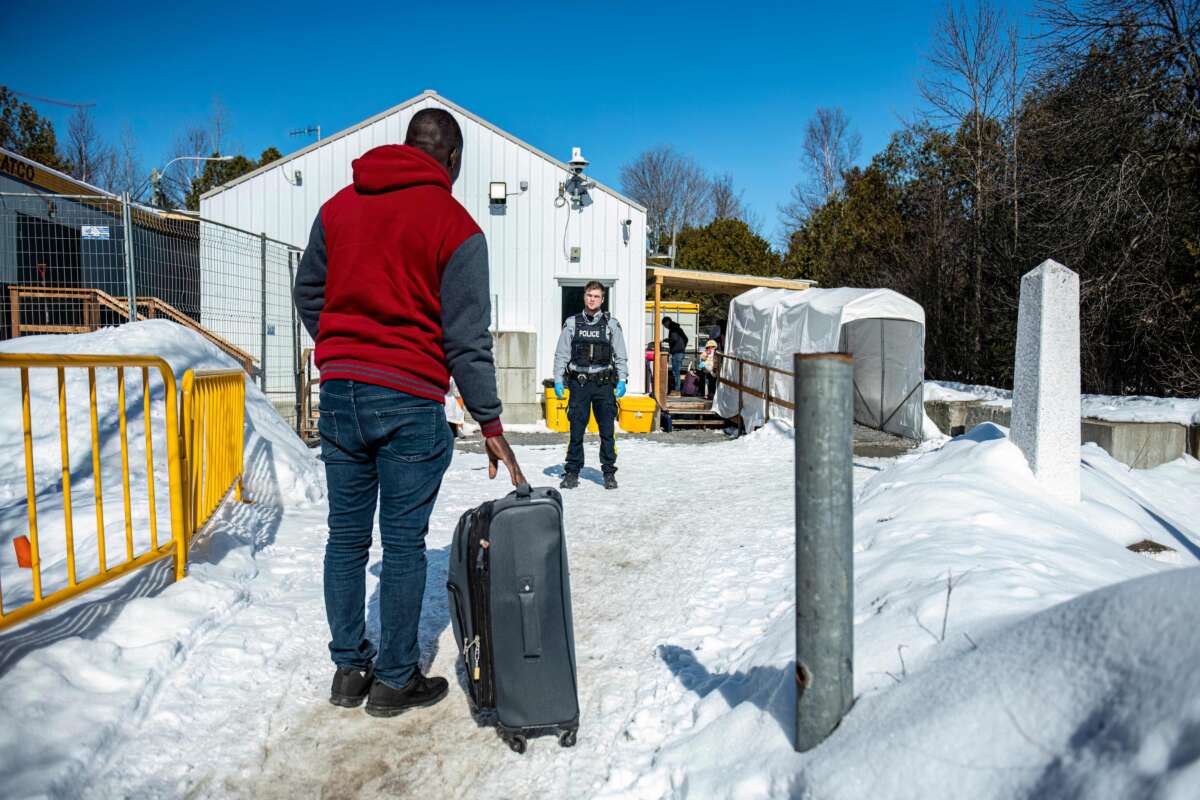
Marcello, who is Haitian and came via Mexico, then the United States, arrives at the Roxham Road border crossing in Roxham, Quebec, on March 3, 2023
.SEBASTIEN ST-JEAN / AFP via Getty Images

For several hours, the woman and her children lay in the mud, hoping not to be found by Canadian authorities. She was in the middle of her 14 days — the amount of time that a person who entered via the United States has to be in Canada before making an asylum claim. During those 14 days, asylum seekers cannot be caught. They have to live underground. And even harder, they have to be able to prove that they were in Canada for 14 days when they go to make their asylum claims. If they’re found or caught, or if they can’t prove Day 1 or Day 14, their claim will be denied, and they will be deported.

On July 13, a U.S. citizen driving an SUV allegedly drunk in southern Quebec crashed into a van carrying 12 people who had entered Canada from the United States. Another van following behind, also carrying migrants, veered away to not be caught by authorities. The first van rolled over, and four people were injured and brought to a hospital. Frantz André, coordinator of the Comité d’Action des Personnes Sans Statut (a committee that supports people without legal status in Canada), is helping some people from both vans, and he says that the remaining eight fled into the woods, as did the passengers in the other van to avoid being caught. The mother who hid in the mud with her children was among this group. After the crash, they lay in the mud for four hours, until another van came to get them.

Experts insist that these kinds of events will continue to increase.

“It’s inhumane” says Jean-Pierre, a Haitian refugee who crossed into Canada from the United States with his wife and child and made his request for refugee status in 2021. Sharing his story in an interview with Truthout, he asked to be identified by a pseudonym to avoid repercussions to his refugee claim. He and his family had been living in Indiana and are now in Western Canada. Jean-Pierre cannot work as he’s been waiting for a work permit since April.

Haitians in the United States have had a Temporary Protected Status since 2010, and the status has been canceled, appealed, and renewed many times since then. After U.S. Secretary of Homeland Security Kristi Noem declared that Haiti no longer meets the program requirements for Temporary Protected Status, the status was set to expire on September 2, 2025. A judge has temporarily blocked this order, extending the Temporary Protected Status designation again until February 3, 2026, but the Trump administration says it “vehemently disagrees” with the judge’s ruling and “is working to determine next steps.”

Related Story
Canada Is Poised to Become a Partner in the US Assault on Immigrants
Canada is rapidly militarizing its borders as a sweetener deal to placate Trump and dodge the worst of his tariffs. By Ray Mwareya , Truthout March 23, 2025


All of this uncertainty has driven many Haitians, like Jean-Pierre, to cross into Canada, usually at Quebec. But now, people are even more afraid, and Canada has made it even harder than before for Haitians and anyone else fleeing the United States to be given asylum.

Already, the largest group of migrants ever tried to enter Canada in the back of an unventilated cube van, just a few weeks ago. The Canadian Press reports that 44 people, mostly Haitians, crossed into Canada on foot on August 3, and were picked up by the cube van. Once the van was intercepted, the migrants were sent to be processed. If they don’t have a first-degree relative living in Canada, it is likely that they will be sent back to the United States.

That’s because the primary way for someone who is Haitian to stay in Canada is to have a first-degree relative, rather than simply claiming asylum, and Canada has no plans to make it easier for anyone coming from the United States to claim asylum in Canada. Immigration, Refugees and Citizenship Canada spokesperson Matthew Krupovich told Truthout that the government of Canada has extended to November 19, 2025, a temporary measure in place to allow people who have a first-degree relative in Canada to enter through a special program. “These measures help keep families together and give Haitian nationals in Canada a safe place to work and study,” he said.

André is critical of the program, which he describes as being a family reunification program rather than a true asylum program. André argues that by allowing Haitians who have first-degree relatives to stay in Canada while not accepting people who are claiming asylum from the United States, Canada is not upholding its responsibilities under international law to accept refugees. Moreover, he says he has seen situations where families are broken up because one person has a direct relative in Canada but the other person in a couple does not.

There are 80,000 Haitians who live in Montreal, and 47,550 of them were born in Haiti, and 140,000 people of Haitian descent who live in Quebec. The vast majority chose Quebec because it is North America’s only majority French-speaking jurisdiction.

But the passage into Canada has been made particularly perilous due to the “Safe Third Country Agreement” — a policy that says immigrants who are crossing into Canada from the U.S. cannot immediately seek refugee status in Canada because they are coming from a country deemed to be “safe”; once they have been in Canada for at least 14 days, however, they are then allowed to seek refugee status in Canada.

While the Supreme Court of Canada found parts of the Safe Third Country Agreement to be constitutional in 2023, it bounced the question of rights violations back to a lower court. In February, the Canadian Council of Refugees and Amnesty International renewed their call for the agreement to be scrapped. They wrote, “Canada’s assertion that the United States remains a safe country for refugees under the Trump administration is a cruel irony to those fleeing persecution today. It must be urgently rescinded, and tariff threats must not blur the plight of those at immediate risk.”


“Canada’s assertion that the United States remains a safe country for refugees under the Trump administration is a cruel irony to those fleeing persecution today.”

Canada has no plans to eliminate the agreement, though. In fact, rather than preparing for more people to come to Canada as a result of the end of the American Temporary Protected Status, Canada’s new Liberal government’s second bill would make it even more difficult for people to seek asylum from the United States. If passed, Bill C-2 will eliminate the 14-day period that people are currently waiting before they make a refugee claim and instead make it impossible for someone to make a claim at all if they cross into Canada from the United States, whether via an official port of entry or not. The bill was presented on June 3, 2025.

André says Canada’s confusing asylum rules aren’t enforced evenly and can change depending on which agent someone deals with, and the stakes are considerably higher now that Trump’s administration has stepped up deportations. He tells the story of a man living in the United States who had both a Canadian and American visa, and who had applied for Temporary Protected Status. He planned to visit Canada for a few weeks. Upon trying to enter Canada, he was told that he couldn’t bring a scooter he had with him to give to a family member, as it didn’t meet certain standards. The man was given two choices: either leave the scooter at the border or go back. The man decided to go back into the United States with the scooter and within days, he was captured by Immigration and Customs Enforcement and sent to an immigration jail where he currently awaits deportation.

What’s worse is that while the Canadian government is squeezing migrants at the border, the government of Quebec has doubled down on ethnic nationalism as a political strategy, demonizing immigrants and refugees in general and Haitians in particular. While the federal government controls Canada’s asylum system, Quebec is the only province that manages its own immigration levels. The province is currently in a process to determine its immigration levels for the next four years, though the governing Coalition Avenir Québec has made it clear that it does not support making it easier for people to claim asylum from the United States.

In a statement given to Truthout in French, Xavier Daffe-Bordeleau, a representative of Quebec’s Ministry of Immigration, Francisation and Integration, explained, “Quebec remains committed to offering a dignified and secure welcome to asylum seekers, with help from … community groups, who have already done a lot over the years to welcome asylum seekers. The cumulative effect over the past many years has placed pressure on the Quebec public and we have largely surpassed our capacity.”

Quebec’s government has formally requested that the Canadian government reduce the number of work permits and refugee status granted from 416,000 in 2024 to 200,000 by 2029, especially in the greater Montreal region, even though cutting immigration levels has already placed Quebec into population decline.

Neither the Canadian nor the Quebec governments have demonstrated meaningful regard for the humanity of asylum seekers, and neither have any plans for the inevitable wave of people who will request asylum in Canada when the Temporary Protected Status ends. The situation in Haiti continues to deteriorate, with the UN-coordinated police force from Kenya having largely been a failure. And with Erik Prince’s Vectus Global about to deploy mercenaries in Haiti, most Haitians in North America are left with only one option: asylum in either the U.S. or Canada.

Despite the crisis, Canada knowingly sends people back to the U.S. where they can face deportation, a kind of deportation by proxy, says André, when really, all they want is the safety and security that every person wants.

“What they need and are looking for is a safe place to rebuild, to build a life and to eventually have their family reunite with them,” André told Truthout. “That was the perception of Canada years ago, which is no longer what’s happening.”


This article is licensed under Creative Commons (CC BY-NC-ND 4.0), and you are free to share and republish under the terms of the license.

Nora Loretois a writer and activist based in Quebec City. She is also the president of the Canadian Freelance Union.


Tribes Condemn Trump for Backing Out of Columbia River Deal for Salmon Recovery


Tribal leaders and environmental advocates warn salmon populations will go extinct without remediation efforts.
PublishedAugust 31, 2025
Aerial view of Columbia River and Lake Chelan, Washington.Marli Miller / UCG / Universal Images Group via Getty Images

Time is running out for wild salmon in the Columbia River Basin in the Pacific Northwest. Their populations, as well as those of some other native fish, have been declining for decades. Now, President Donald Trump is attacking the progress that had been made to restore those once-abundant salmon runs.

In June 2025, Trump signed a memorandum signaling his administration’s unwillingness to consider dam removal on the lower Snake River, a tributary of the Columbia River, and reneging on a landmark agreement that would have provided more than a billion dollars over the next decade to Pacific Northwest tribes for renewable energy projects and salmon recovery.

The federal government entered into the Resilient Columbia Basin Agreement under the Biden administration in December 2023 after two years of negotiations. Other parties to the agreement include environmental advocates; Oregon; Washington; and the Umatilla, Nez Perce, Warm Springs, and Yakama tribes. Those tribes entered into treaties with the U.S. government in the mid-1850s, ceding land but maintaining a perpetual right to their fishing grounds in the Columbia River Basin. The government has failed to ensure the tribal fishing rights it promised to protect in those treaties.

Yakama Nation Tribal Council Chair Gerald Lewis said in a statement that the Trump administration’s withdrawal “echoes the federal government’s historic pattern of broken promises to tribes.” Still, others who were involved in negotiations to secure that agreement have vowed to continue efforts to restore salmon populations and fulfill treaty obligations even as the federal government seeks to undermine them.

“The Trump administration’s decision to pull out of this agreement is short-sighted and regrettable,” Miles Johnson, legal director at Columbia Riverkeeper, told Truthout. “But folks in the Pacific Northwest who care about salmon, and salmon cultures and our rivers, we don’t get to stop working on this just because it becomes more challenging.”

Related Story

Forest Protectors Launch Tree Sit and Lawsuits to Stop Ecocidal Logging in WA
Forest protectors are defending mature forests from logging after dam removal and restoration on the Elwha River.
By Curtis Johnson , TruthoutJuly 6, 2025


Dozens of hydroelectric dams built beginning almost a century ago on the Columbia River and its largest tributary, the Snake River, eliminated spawning grounds, blocked fish passage between spawning and rearing habitats, and altered river ecology in ways that can impair a salmon’s immune system or undermine their natural migration instincts. More recently, climate change has placed additional stress on salmon populations.


Experts now agree that dam removal is essential to stop the decline of native fish populations.

The dams in the Columbia River Basin have been disastrous for fish populations: The number of wild Chinook salmon on the Snake River fell from about 90,000 in the mid-1950s, when there was just one dam on the waterway, to a mere 10,000 in 1980, seven additional dams later. Four species of salmon in the Columbia River Basin have been listed for protection under the Endangered Species Act since 1991.

Congress acknowledged that wild salmon populations in the Columbia River Basin were dwindling and committed to funding hatcheries meant to stop their decline more than 80 years ago. But the facilities have fallen short of that goal. Today, even the hatcheries are threatened, as salmon survival rates have dropped so low that some struggle to collect enough fish for breeding.

“The truth is that extinction of salmon populations is happening now,” Shannon Wheeler, chairman of the Nez Perce Tribe, said in a June 2025 statement in response to the Trump administration’s withdrawal from the Resilient Columbia Basin Agreement.

Experts now agree that dam removal is essential to stop the decline of native fish populations. One proposal, in particular, which argues for the removal of four dams on the lower Snake River in southeastern Washington, has garnered widespread support from scientists and advocates, as well as other tribal leaders. “We’ve learned over the last 30 to 40 years of studying these fish intensely that those four dams on the lower Snake River are four dams too many,” Johnson told Truthout.

The Resilient Columbia Basin Agreement stopped short of calling for the removal of those dams, but it committed to meaningful steps in that direction. The agreement promised funding to study and develop solutions to mitigate the effects of dam breaching on transportation, recreation, irrigation and energy production in the region. It also committed funding to tribal-led alternative energy projects, which could have compensated for the eventual winddown of the hydroelectric dams.

“The concepts behind that agreement remain a really responsible, well-thought-out and careful path that sought to ensure a win-win scenario for all the different constituencies that depend on a healthy Columbia River,” Michael Garrity, special assistant at the Washington Department of Fish and Wildlife (WDFW), told Truthout.

Even though the agreement takes what Garrity and other experts characterize as a measured approach, Trump called it “radical environmentalism” in an effort to slander it and labeled concerns about climate change “misplaced” in his memorandum.

Critical funding will be lost with the Trump administration’s decision to withdraw from the agreement. This includes $500 million to improve underfunded and aging hatcheries across the Pacific Northwest and $100 million for wild fish restoration efforts. Much of the promised federal funding would have been disbursed via the Bonneville Power Administration (BPA), a federal agency that operates like a business, marketing power from dams on the Columbia River.


“The NGOs, states, and tribes are not going to quit on this issue.”

Still, many aspects of the agreement will move forward in some form thanks to continued buy-in from state and tribal governments and the committed backing of environmental advocates. “The partnership between our four tribes and the states of Oregon and Washington endures,” said Jeremy Takala, chair of the Columbia River Inter-Tribal Fish Commission and a tribal councilman of the Yakama Nation, in a statement. “We are still united in the cause of protecting salmon and rivers.”

Amanda Goodin, an attorney at Earthjustice representing the environmental advocates that signed the Resilient Columbia Basin Agreement, echoed Takala. “The NGOs, states, and tribes are not going to quit on this issue,” she told Truthout. “We’re going to be looking for other avenues for the next few years and waiting for the moment that we have a federal administration that actually cares about our natural heritage, obligations to tribes, and following the law, and we’ll be ready when that time comes.”

Those other avenues are almost sure to include legal battles over the impact of hydroelectric dams on salmon in the Columbia River Basin. Litigation had been ongoing for decades before it was halted as part of the Resilient Columbia Basin Agreement. Federal agencies have lost in court in previous cases. Even John Hairston, administrator and CEO of BPA, welcomed the agreement when it was signed, saying it would help provide “a reliable, affordable power supply to the Pacific Northwest” and put an end to “costly, unpredictable litigation.” Now, Goodin told Truthout, “It’s likely we’re going to see continued litigation.”

Earthjustice is also advocating for Columbia River Basin fish in Congress, where a series of bills have been introduced that could further undermine plans laid out in the Resilient Columbia Basin Agreement. “Those bills are not just salmon extinction bills, they’re also anti-solution bills,” Cameron Walkup, an associate legal representative working for Earthjustice in Washington, D.C., told Truthoutof the Northwest Energy Security Act, the Defending Our Dams Act, and the Protecting Our Water Energy Resources Act. “These bills would essentially double down on what the president did in June in terms of trying to turn back the clock on progress toward comprehensive solutions for salmon recovery, and also dealing with interconnected issues like making sure we have reliable and affordable energy.”

Columbia Riverkeeper, Earthjustice, and NGO partners are engaged in organizing sign-on campaigns to demonstrate support for dam removal and oppose the harmful bills introduced in Congress. Walkup also told Truthout that his organization is prepared to engage with members of Congress if it appears the bills could garner enough support to come to a hearing. “We’re certainly doing everything we can to uplift all the issues with these bills to make sure that if Republicans do choose to make this part of their agenda, that they’re fully opposed by the Democrats and don’t make it through Congress,” he told Truthout.

For their part, Washington’s state agencies responsible for studying the effects of dam breaching on the lower Snake River are continuing that work even as federal partners have withdrawn. “WDFW, working with the governor’s office, is committed to finding a path forward to restore healthy and abundant salmon and steelhead in the Columbia Basin in a way that respects and addresses the non-salmon benefits of the river,” Garrity told Truthout.

Johnson of Columbia Riverkeeper said his message to those who are concerned about the Trump administration’s decision to renege on the historic Resilient Columbia Basin Agreement is simple: “We absolutely need our representatives to understand how much people care about salmon and steelhead and having enough fish in our rivers that people can go fishing, we can meet our obligations to tribes and protect tribal cultures,” he told Truthout. “That starts with individuals, businesses, leaders and anyone else making their voices heard. It’s critical to build a groundswell of support.


This article is licensed under Creative Commons (CC BY-NC-ND 4.0), and you are free to share and republish under the terms of the license.


Marianne Dhenin is an award-winning journalist and historian. Find their portfolio or contact them at mariannedhenin.com.
Trump threatens American capitalism with profits that may only enrich the elite


August 31, 2025 

Is the Trump administration trying to reshape American capitalism? Recent moves by Washington, such as taking a 10% share of semiconductor maker Intel, point to a shift in that direction. For decades, Washington has supported free-market capitalism. Today, the government appears to be supporting a new direction – state-directed capitalism.


As a professor at the Questrom School of Business who studies different economic systems, I find this reversal striking. My research is supported by the Ravi K. Mehrotra Institute, which is trying to understand how business, markets and society interact. My previous research – finding, for example, that U.S. news coverage of capitalism was far more negative in the 1940s than it is now – suggests capitalism isn’t in retreat but is rather evolving.

In what direction is the Trump administration pushing it?

Types of capitalism


While many people bandy around the term “capitalism,” it actually comes in many different forms. The most basic definition of capitalism is when the means of production – such as factories, farms and offices – are owned by private individuals.

Capitalism is driven by profit. Some of the earliest descriptions of the profit motive that drives the whole system come from Adam Smith. As he wrote in 1776, “It is not from the benevolence of the butcher, the brewer or the baker that we expect our dinner, but from their regard to their own interest.”

Who gets the profits and who controls the means of production determine the specific forms of capitalism. While there are many types, I want to focus on three of the most important.

Free-market capitalism, also called laissez-faire capitalism, is when the government takes a hands-off approach to the economy. The U.S. after the Civil War is a good example of free-market capitalism. During the late 1800s, the federal government imposed few regulations on businesses.

State-guided capitalism is when the government chooses industries or companies to support. Favored sectors are given money and face looser regulations than nonfavored sectors. China today is an example of state-guided capitalism, where the state provides support for industries such as shipbuilding, steel and AI.

Oligarchic capitalism is when a very small part of the population owns key industries and controls the economy. Russia today is an example of this type of capitalism.

Each form of capitalism has its strengths and weaknesses. For example, free-market capitalism provides the most incentives to grow the economy, but the lack of rules often leads businesses to run roughshod over consumers. U.S. historians describe the late 1800s as the era of robber barons.

State-guided capitalism can dramatically boost the output of favored industries. However, if the government invests in the wrong industries, huge amounts of money can be wasted propping up dying firms.

Oligarchic capitalism can rapidly invest in new areas and shift resources, but the profits enrich only a tiny elite.

Recent changes


The U.S. currently appears to be operating under a hybrid model of capitalism, blending free-market principles with elements of state capitalism.

One of the most recent changes is the Trump administration’s decision to take a 10% stake in Intel. Congress passed the multibillion-dollar CHIPS and Science Act in 2022 to bolster U.S. computer chipmakers. Intel is slated to receive US$11.1 billion in grants from the program and other government funding. The current administration has converted that public support into a 10% ownership of the semiconductor maker.

Intel isn’t alone. The government has recently become a shareholder in other companies it views as strategically important – a trend that seems likely to continue and possibly result in the creation of a “sovereign wealth fund.” In July 2025, the Department of Defense agreed to buy $400 million of convertible preferred stock in MP Materials. MP Materials is the only U.S. rare-earth minerals mine with integrated production capacity. The company said the Department of Defense would be positioned to become its largest shareholder.

The government is also requiring a share of revenue from large computer chip manufacturers. Nvidia and AMD will have to remit 15% of revenue from certain chip sales to China as a condition for export licenses.

Why the US change is important

The CHIPS and Science Act has already funneled billions into U.S. semiconductor manufacturing via grants, tax credits and R&D support. MP Materials and Intel could serve as pilot models for further strategic intervention. However, the U.S. government spends trillions each year, and the amounts invested in American industries and companies represent only a small percentage of total spending.

While the CHIPS and Science Act was passed in 2022 under the Biden administration, the implementation relied on traditional tools of industrial policy such as grants, tax credits and milestone-based funding. In contrast, the Trump administration has converted these grants into equity arrangements, with officials stating the government should get a return on its investment.

This shift from an incentive-based approach to a direct ownership model represents one of the most fascinating experiments in modern American capitalism. The real question is what happens if – or when – this strategy expands. The government could become more involved in energy, biotech and AI, or any place where markets show signs of lagging or supply chains are geopolitically fragile.

The U.S. isn’t rejecting capitalism but recalibrating its boundaries. The next few years will show exactly how Washington’s interventions will reshape U.S. capitalism.

H. Sami Karaca, Professor of Business Analytics, Questrom School of Business, Boston University

This article is republished from The Conversation under a Creative Commons license. Read the original article.

'Ugly tradition': Paul Krugman drops bombshell concern of being targeted in bogus Trump probe


Economist Paul Krugman in Rio de Janeiro, Brazil on September 25, 2023
 (A. Paes/Shutterstock.com)

August 30, 2025 
ALTERNET

President Donald Trump is not only trying to remove Lisa Cook as a U.S. Federal Reserve governor — he also wants her investigated for mortgage fraud allegations, although she hasn't been charged with anything.

Liberal economist and former New York Times columnist Paul Krugman discussed Trump's campaign against Cook during a Saturday, August 30 appearance on MSNBC. Krugman warned that a range of Trump economic policies — from steep new tariffs to efforts to destroy the Fed's independence — risk getting the United States into a major economic crisis. And he pointed to the mortgage fraud claims about Cook as a glaring example of Trump's willingness to use the U.S. Department of Justice (DOJ) as a weapon against political opponents regardless of a case's merit.

Trump, Krugman warned, is risking an "inflation crisis" and a "financial crisis" with his "completely insane" policies.

The economist told host Ali Velshi, "We have Donald Trump saying, at a time when inflation is rising, that he wants the Federal Reserve to cut interest rates by 300 basis points — three full percentage points, which is completely insane. We have him insisting that there is no inflation, which is false…. He gets a bad jobs report, he fires the head of the Bureau of Labor Statistics….. We already know that we have somebody who shouldn't be allowed within a mile of setting monetary policy…. So this is not a hypothetical disaster. This is something where we know that things will go very, very badly if he gets away with this."

Krugman noted that friends are wondering if he could be targeted for some type of bogus investigation by the Trump Administration given how critical of the president he has been.

"You know, once you have the principle that we can rummage through your records and try to find something that can be considered dirt, anybody could be in the line of fire," Krugman told Velshi. "I mean, I've been getting a bunch of e-mails from friends saying: I bet the FHA is rummaging through your mortgage records right now. Me personally, which seems quite likely. And, you know, I think it was (Josef) Stalin's chief of secret police who said, 'Show me the man, and I'll find you the crime.' And that's kind of the America that we're becoming."

Attorney Lauren Libby examined the Trump Administration's use of mortgage fraud allegations as a weapon in an article published by Slate on August 30.

Libby observed, "It's a new twist on a long, ugly tradition. Trump's use of mortgage fraud is relatively novel, but he's far from the first president to use the federal government's vast trove of financial data as a political cudgel. Just this Monday, Trump fired Federal Reserve Board Governor Lisa Cook after accusing her of falsifying records on past mortgage applications. In recent weeks, Sen. Adam Schiff and New York Attorney General Letitia James have faced the same allegation. Mortgage fraud, for the uninitiated, typically means intentionally misstating something on a loan application, such as income, assets, or even whether you intend to live in the house."

Watch the full MSNBC video with Paul Krugman below or at this link.