Saturday, September 06, 2025

UK

New independent anti-racist reporting and monitoring organisation set up

SEPTEMBER 5. 2025

Former Tribune editor and award-winning writer Taj Ali has set up an independent anti-racist reporting and monitoring organisation to document racist attacks, support victims, pressure authorities to act, and amplify the voices of smaller, more isolated Black and Asian communities across Britain.

“Far too often, racism is either unreported or dismissed as anti-social behaviour,” he writes.  “Our platform will gather verified reports and push to ensure they’re taken seriously by the media and public institutions. Share, report, support.”

RADAR (Reporting and Documenting Acts of Racism) outlines it mission as:

  • Develop and maintain a professional website for reporting and engagement
  • Provide editorial support to ensure accuracy and reach
  • Collect and analyse data to strengthen advocacy and reporting
  • Expand communications and outreach
  • Purchase equipment to enhance coverage
  • Travel to areas where support and documentation are needed most

Last summer marked the worst instance of racist violence in over a century,” says its new website. “Across Britain, more than a dozen towns and cities were impacted, with smaller, more geographically isolated Black and Asian communities particularly vulnerable.

“Since then there has been further violence. In January this year, seven London mosques were daubed with anti-Muslim graffiti. In the following months, others were attacked in Luton, Aberdeen and Sheffield. In April, Muslim graves in Watford were vandalised. In June, worshippers were evacuated from the Belfast Islamic Centre when its windows were smashed and a bomb was thrown inside.

“Most racist attacks against individuals go unreported. When they are reported, they are often dismissed as low level anti-social behaviour and receive scant attention from out political and media class.

“We say enough is enough.”

The organisation aims togather accurate and verified accounts of racist incidents and work to ensure they receive attention from both the media and public institutions. It seeks to provide practical tools and guidance for supporters to contact local MPs, engage the media, and advocate for meaningful responses to racist attacks.

It also aims to ensure victims of racism are linked with supportive networks, organisations, and resources to ensure they are not left to face these challenges alone.

“As a point of principle, we will never accept state funding,” Taj Ali writes on X.  “We are an autonomous independent organisation. And we intend to hold state institutions to account on racism too.”

The left needs more than enthusiasm – we need a real plan


SEPTEMBER 5, 2O25

Gordon Maloney looks forward to The World Transformed 2025.

Keir Starmer’s first year in government has been nothing short of a disaster.

Despite an enormous mandate at the last election, the past year has seen him fall to becoming one of the most unpopular political figures in the UK. Despite repeatedly trying to ingratiate himself with far-right voters for Reform or the Tories, including bizarre attempts to show everyone how much he loves the English flag, this has won over no voters from these parties. At the same time, his repeated betrayals of workers, renters, migrants, and perhaps most consequentially the Palestinian people, have cost him dearly in support from progressives.

Starmer famously quipped that if leftists didn’t like the direction of his new party, “the door is open and you can leave.” It seems like many have. 

And the polling speaks for itself. Labour now routinely trails double digits behind Nigel Farage’s Reform. Starmer’s personal approval ratings, along with those of his cabinet members, are in free fall. Unless something truly enormous happens, Starmer will be handing over the keys to Number 10 straight to Nigel Farage at the next election.

Meanwhile, after a wave of far-right street violence last summer, anti-migrant mobs are once again terrorising Britain’s communities. Rather than confronting their bigotry or addressing the genuine grievances these movements prey on, Starmer’s Labour have offered them political and ideological cover. The contrast with the way Starmer and the police have attacked and criminalised Palestine solidarity activists is yet another example of his revolting hypocrisy.

Starmer’s strategy is not working, and there is a clear and desperate need for a different direction. We cannot continue like this. And that demand for a different direction has been made very explicit in the last few weeks. Eight hundred thousand people have flocked to Jeremy Corbyn and Zarah Sultana’s new party, and eco-socialist Zack Polanski has won a landslide victory in the Green Party leadership election. Across the UK, hundreds of thousands of people are clamouring for something genuinely different – not Reform’s snake oil. People understand what’s at stake, and they know what will happen if Starmer stays on this path.

But enthusiasm alone is not enough. If we want to stop Farage from winning the next election, if we want to stop the far-right thugs emboldened by his politics, if we want to stop militarism, if we want to stop landlords, bosses, and warmongers, the left in the UK needs strategy. We need deep coordination. We need to learn from movements across the world. And we need to plan meticulously for the months and years ahead.

That is exactly what The World Transformed is for. This October, over the course of four days, The World Transformed 2025 will bring together individuals, organisations, and movements from every corner of Britain and beyond to share, to learn, to debate, and most importantly, to plan. Sessions will cover everything from our response to two years of genocide in Palestine, enthusiastically backed by the British government, to the housing struggles that have ignited an unprecedented wave of tenant organising across the UK, and from the rise of militarism to confronting the far-right both directly and by tearing away the poverty and desperation they prey on.

The World Transformed will be a vital place to cut through the impasse and to begin, in earnest, our collective response to the failures not just of Starmer, but of the entire political class since the economic collapse of 2008.

The conference will also, and crucially, be a place for the full movement of the British left to shape these crucial discussions. Delegations from organisations across the UK will be taking part, from trade unions to Black Lives Matter, tenant groups, and international allies such as the Democratic Socialists of America. Because this is not just about conversation, it’s about building the capacity and shared strategies that our movement needs to be able to win. 

The stakes could not be higher. How the left responds to Reform, to Labour, to genocide, will not only determine the electoral fortunes of the next five years and beyond – it will determine life and death for thousands of people both at home and abroad. 

We cannot afford to get this wrong. Join the movement at The World Transformed 2025 to help forge the path forward. 

Gordon Maloney is a member and activist of Living Rent, Scotland’s Tenants’ Union.

QUESTION PERIOD

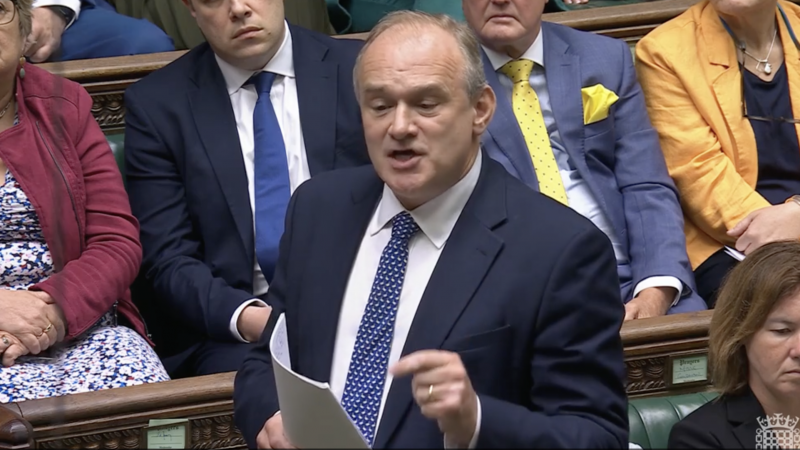
PMQs: Ed Davey slams Reform and Tories for wanting to pull out of the ECHR

3 September, 2025 
Left Foot Forward


The European Convention on Human Rights "protects all our basic rights and freedoms"


The Lib Dem leader Sir Ed Davey condemned Reform UK and the Tories for calling for the UK to withdraw from the European Convention on Human Rights at PMQs today.

In one of his questions to the prime minister, Davey slammed Nigel Farage and Kemi Badenoch for wanting to join Russia and Vladimir Putin by withdrawing from the convention.

Farage and Badenoch want to pull the UK out of the ECHR and other international human rights treaties, as they claim this will make it easier to deport people arriving on small boats.

The Lib Dem leader highlighted that the ECHR protects all of our basic rights and freedoms, including the rights of children, disabled people, domestic abuse survivors and “victims of horrific crimes”.

“It protects care home residents from abuse and families from being spied on by councils,” Davey added.

He asked Keir Starmer “will the prime minister categorically rule out withdrawing from the ECHR or suspending it or watering down our rights in any way.”

The PM said his government will not pull out of the ECHR, however he said “we do need to make sure the convention and other instruments are fit for the circumstances we face at the moment.”

“Therefore, we have been looking at the interpretation of some of those provisions.”

Starmer went on to say “it would be a profound mistake to remove from these instruments”, warning that the first thing other countries who adhere to the convention would do is end their agreements with the UK.

“That would be catastrophic for dealing with the problem we’re actually dealing with,” Starmer added.

Olivia Barber is a reporter at Left Foot Forward
UK

Asylum seekers living in hotels: ‘The narrative that is being painted is not the truth’
Yesterday
Left Foot Forward


Left Foot Forward speaks with refugees about right-wing protests, narratives about asylum seekers and the hotels


Stacey explains that before she came to the UK and was placed in an asylum hotel in Bristol, she Googled asylum seekers’ experiences. “It was like a jail for them and the conditions were really bad,” some people had said online. Stacey didn’t know what awaited her, but when she arrived, she was surprised to find lots of organisations set up to help her and said, “the majority of people were so welcoming and helpful”.

The welcoming atmosphere that Stacey describes has shifted over this summer. Echoing the fevered atmosphere that culminated in the Southport Riots last summer, there has been a rise in protests outside hotels housing refugees. Protests started at the Bell Hotel in Epping, Essex on 13 July, after a resident was charged with sexually assaulting a young girl. Reform and far-right groups have jumped on this case and used it to claim that small boat crossings are making British women and girls unsafe. Since then dozens of protests have taken place in other towns and cities, including Manchester, Dover, Portsmouth, Cardiff, Liverpool and Bristol.

Narratives are circulating that asylum seekers are living in luxury hotels, while Reform’s Richard Tice claimed this week that UK governments “focus more on humans from overseas than British humans”.
The protests

Just before Stacey arrived in Bristol, she heard there had been a protest outside the hotel. A couple of weeks ago, people from an anti-migrant group pitched up outside the hotel and started filming residents.

“There were a couple of people with phones, and they even posted it on YouTube”, she said.

Multiple right-wing, anti-migrant YouTube accounts, including one that posted about Stacey’s hotel, have been circulating videos from asylum hotels, claiming that residents enjoy four-star luxury, receive NHS care on-site, and take part in activities like bike lessons.

Stacey explains as she is fleeing persecution in her country, people videoing residents at the hotel is “frightening”.

“People are looking to kill my family and I, so when I’m in a hotel and I’m coming and going out and people are filming and putting it on social media, they put my life and my family’s life at risk because they’re publicising the name of the hotel,” she says.

Yonas* (not his real name) had to flee worn-torn Eritrea. He moved into a hotel in Bristol in July. He explains that there have been protests outside the hotel twice since he moved in. He says the police came to protect residents, but that the anti-migrant protestors were the minority.

There were around 30 to 40 anti-immigrant protestors compared to over 100 counter protestors.

Yonas says “the majority of people are just welcoming people, they can say hi, they have no problem with you.”

However, he adds: “There are some small groups of people and they just hate to see you.”

He explains that it can make him feel on edge as some people “just insult you or they just look at you in a bad way like they’re looking for trouble”.
Asylum hotels ‘not a luxury’

Yonas, (not his real name), a refugee from Eritrea, says that while people who are against asylum hotels focus on the idea that residents are living in luxury, it’s not the reality.

He tells Left Foot Forward: “In the hotel, it’s just basic things that you can get, you can have a bed and a meal three times a day, just a regular meal.

“It’s not like the way they’re quoting like a fancy place or fancy food. It’s just like regular things, basic things.”

Stacey says: “In one of the videos they mention that we’re having the time of our lives because we have access to a pool, spa and gym, but we have absolutely no access to the gym, pool and spa. None of that is available to us.”

“The residents in the hotel, they are being demonised, and we’re just a product of the system.”

Stacey and Yonas receive £8 a week from the Home Office. Asylum seekers living in a shared house get around £48 per week.

Yonas says, “At least for basic things you can manage with that, but it is not luxury.”
‘Staying in a hotel is not our choice’

Both Stacey and Yonas explain that they would like to be able to work, but as asylum seekers they can’t, which means they have to rely on government support.

“Staying in a hotel is not our choice. They don’t let us work. If they let us work, maybe you fund yourself and your taxes will help the country, but they don’t let us work,” Yonas says.

“A lot of us want to work, want to take care of ourselves, it’s not like we want to depend on the government,” Stacey says, adding “it’s not like you’re getting a decision [on an asylum application] today or in a couple of months”. On average, it currently takes between six months to a year to receive an asylum application decision.
Reform’s linking of asylum seekers and crime

The right is trying to make a link between asylum seekers and crime, in order to push their anti-migrant agenda.

Yonas acknowledges that some asylum seekers may get into trouble, but stresses that this is not representative. “There are really kind people. Most of us are fleeing persecution, torture, and war,” he says. “So because of those small peoples that they don’t need to generalise all,” he adds.

Data from the Centre of Expertise on Child Sexual Abuse shows that in the year to December 2023, where the ethnicity of defendants was recorded (69% of cases), nine in ten were from white backgrounds. White British men were over-represented compared with the general population of England and Wales, and 99% of defendants were men.

Yonas adds: “Whoever did that we condemn it. The majority of this abuse is not only [being committed by] asylum seekers. It’s men in general.”

He says that instead of focusing on the real problems, these narratives “are just scapegoating asylum seekers or those who cannot defend themselves”.
The narrative is wrong

Both Yonas and Stacey say that to some extent they understand the frustration of the British public.

Stacey says that she can see why people would be angry if they’re receiving a negative narrative about immigration.

She says: “If I was getting that narrative just like the British people are getting, I understand why they would be angry, why they would feel like they’re paying taxes just to feed us and so we can live a life they’re not even living.

“But I just want it to be clarified that the life and narrative that is being painted is not the truth within hotels.”

She adds: “We are not here and just receiving benefits, living in a hotel and living a wonderful life as the narrative has been propagated.”

Yonas says: “I understand them somehow [anti-migrant protestors], they are furious, there are a lot of things going on here, but maybe they lose a tree for a forest.”

“I understand their concern but that’s not the main issue. Issues with housing and the NHS are not caused by asylum seekers. Maybe the government’s not funding it. Instead of focusing on the main problem, they need a scapegoat,” he says.

Olivia Barber is a reporter at Left Foot Forward


Opinion

How successive UK governments have created a new rentier economy


Yesterday
 Left Foot Forward.

Governments appease corporations and the super-rich by following the old policies which benefit a few.


A new rentier economy has been constructed and the UK remains trapped in low economic growth. The government must adopt alternative policies.

An often-told story is that Albert Einstein once set an exam paper for his graduate class, and one of his colleagues noticed that the questions were exactly the same as the ones on the last year’s exam paper. How could he set the same exam again, s/he asked? Einstein smiled and admitted that the questions were the same, and added “but the answers have changed”.

Thomas Kuhn in his The Structure of Scientific Revolutions explained that normal science advances by assessing the usefulness of theories in solving puzzles. Unresolved anomalies pave the way for emergence of rival paradigms with better ability to understand and address puzzles.

In contrast, politics isn’t a rational science and is driven by power, appeasement and subservience. The recurring questions about economic stagnation, low investment, faltering public services and poverty are answered with privatisation, arbitrary fiscal rules, real cuts to wages and benefits, and unchecked profiteering as governments feel comfortable with defunct theories.

Here are a few examples of the defunct thinking.

The Private Finance Initiative (PFI) was launched by the Conservative government in 1992 and greatly expanded by the Labour administration of Tony Blair and Gordon Brown. Under PFI, the government contracts with the private sector to design, build, finance and maintain long-life public assets, such as schools, hospitals, roads, prisons, office buildings bridges and tunnels. Since its inception, around £60bn of private money has gone into 700 PFI projects. In return, the government will pay £306bn. For just £13bn of investment, the National Health Service (NHS) has been landed with an £80bn bill. The escalating costs eat into the NHS budget and leave less for frontline services. Around 6.23m people in England are waiting for 7.37m hospital appointments.

It is always cheaper for governments to borrow and build, but they chose the PFI route which ultimately required even more borrowing. Undeterred, the government has revived PFI in guise of Public Private Partnerships (PPPs). This will guarantee corporate profits, constrain the ability of future governments to borrow and put public services under strain.

Privatisation of utilities and public services was supposed to unleash investment and lower bills for customers. That hasn’t been the case. In 1989, water industry in England and Wales was privatised at a price of around £7.6bn. The government wrote-off its debt of £5bn and handed a dowry of £1.5bn to new corporate owners. Thereafter, shareholders invested little in productive assets. Instead, capital has been raised from customers through inflation-busting rise in bills with a promise of investment in infrastructure. No new reservoirs have been built. Over a trillion litres of water a year is lost to leaks. In 2024, raw sewage was dumped in rivers, seas and lakes for 3.61m hours. Since privatisation, companies have paid around £85.2bn in dividends, and have financial liabilities of around £91bn. The government is still looking for a ‘market-based solution’ for an industry with captive customers, no substitute products, no competition and over 1,135 criminal convictions.

Energy is another sector at the heart of the rentier economy. Gas, oil, electricity and the national grid were privatised in the decade to 1990, leading to exploitation. In the 1960s and 1970s, the UK found large quantities of oil and gas in the North Sea. Soon they were privatised and production was subjected to comparatively low rates of tax. Norway also found oil and gas deposits at around the same time but did not privatise. It retained majority equity stake in most oil/gas fields. Since the 1970s, due to privatisation, lower royalty and tax rates, the UK government has collected around $11 a barrel. Norway collected $30 a barrel. Norway ring-fenced the oil/gas revenues whilst the UK squandered them in tax cuts for corporations and the rich. Today, Norway has a sovereign fund of nearly $2 trillion, which funds government spending, whilst the UK faces a public finance crisis and real cuts in public services.

Relatively few companies dominate the UK energy sector. Since the pandemic electricity generation companies have increased their profit margins by 198%, and electricity and gas supply companies have increased their margins by 363%. The fossil fuel industry receives £17.5bn in subsidy and support a year. Since 2002, the government has provided some £22bn of support for electricity produced from biomass. Since 2020, twenty biggest energy companies have made operating profits of over £514bn, a major source of inflation and poverty. The UK has the most expensive household electricity in the world.

To soothe public anxieties, companies promise to spend on infrastructure but then quietly renege. Companies responsible for Britain’s electricity and gas infrastructure have spent £490m a year less than promised on replacing and refurbishing existing assets. The creaking infrastructure is unfit for purpose.

During periods of high wind, the government pays companies up to £180,000 an hour to switch-off wind turbines. At the same time gas plants are paid extra sums to produce more electricity to balance the system and meet demand. For the period September 2021 to April 2025, the cost of balancing the electricity grid came to £11.8bn, and is expected to hit £8bn a year by 2030. Since privatisation, National Grid has returned £27.8bn to shareholders in dividends and another £600m in share buybacks.

Social care has been privatised since the 1980s. On average, 61% of local authority budgets are spent on social care. Private sector, mostly corporations, controls 96.5% of the adult social care market and over 85% of children’s homes. Profitability among the largest care home chains ranges from 11% to 42% of revenues. A 2022 report by the Competition and Markets Authority found the 15 largest children’s home providers made average annual profit of 23% per year. Between 2011 and 2023, 804 out of 816 adult care homes forcibly closed by regulators were run for profit. In the period 2014-2023, 48 of the 53 children’s homes forcibly closed were operated by corporations.

Corporate sector gets easy ride elsewhere too. The NHS is doling out cataract surgery contracts to the private sector, operating on profit margins of between 32% and 43%. Cash extraction reduces resources for other NHS services, and endangers people’s lives. Governments could expand the NHS capacity by building new facilities or by buying out private sector clinics, but they haven’t. They could support local authorities and not-for-profit organisations to take over social care, but haven’t. The government has promised to “develop a business case for the use of Public Private Partnership (PPP) for Neighbourhood Health Centres” i.e. further parts of the NHS will be handed to the private sector with guaranteed profits. Cash extraction would ensure that money buys less.

Exploitation and lack of investment isn’t confined to monopolies, oligopolies and the privatised sector. BHS was a major high street clothing, home furnishings and electrical goods retailer. In 2005, its parent company paid a dividend of £1.3bn, equivalent to next five year’s profits. The necessary distributable reserves were manufactured through a series of intragroup transactions. £1.2bn went to the CEO’s wife and was funded by borrowing of about £1bn. As a result, the company was unable to make sufficient investment. In 2015, BHS was sold for £1, and collapsed in 2016. It owed around £1.3bn to creditors. Its pension scheme had a deficit of £571m. The company always received a clean bill of health from its auditors PricewaterhouseCoopers. For the 2015 audit, the firm had programmed its audit partner to spend just two hours on the audit of BHS and its parent company. No government wants to upset giant corporations and the City of London by imposing meaningful reform of company law, corporate governance, or auditing requirements.

A major reason for low economic growth is that a large proportion of the population lacks money to buy goods and services. This is compounded by transfer of what was once pubic debt to household debt. Unlike many other European countries, England charges university tuition fees and there are no general maintenance grants. At the end of March 2025 students and their families were hobbled by debt of £267bn, depleting the spending power of households.

Governments ritually transfer wealth from poor to the rich. Successive governments manage inflation by hiking interest rates, which forces people to handover a larger portion of their money to banks. This boosts bank profits, enriches shareholders and widens inequalities. Millions struggle to pay mortgages, rents and other bills, and cut consumption. Faced with lower demand many businesses reduce investment in productive assets, the very thing that governments lament. An alternative would be to remove cash through selective higher taxes from those with bulging wallets. But governments continue with failed policies, and the UK economy continues to stutter.

The above are a handful of examples to show that major political parties are locked in a silo of neoliberal policies. Regardless of the crisis and circumstances, same dose of policy prescriptions is repeated; privatisation, PFI, unchecked profiteering and reduction is purchasing power of the masses. This has not delivered investment or economic rejuvenation. A new rentier economy has been constructed and the UK remains trapped in low economic growth, deepening inequalities and rising public discontent. Rival paradigms exist but governments appease corporations and the super-rich by following the old policies which benefit a few.

Image credit: Lauren Hurley / Number 10 – Creative Commons


Prem Sikka is an Emeritus Professor of Accounting at the University of Essex and the University of Sheffield, a Labour member of the House of Lords, and Contributing Editor at Left Foot Forward.

Friday, September 05, 2025


Ukraine Drones Hit One of Russia’s Biggest Refineries

Ukraine attacked with drones Rosneft’s Ryazan refinery in Russia, again, the commander of Ukraine’s drone forces, Robert Brovdi, said on Friday, as eyewitnesses reported explosions, a fire, and thick smoke near the refinery in the region southeast of Moscow. 

The Ryazan refinery operated by oil giant Rosneft is one of the biggest crude processing plants in Russia with a capacity to process more than 260,000 barrels per day (bpd) of crude—or 5% of Russia’s refining capacity. 

Ukraine also attacked early on Friday an oil depot in the Luhansk region, which is occupied by Russia, the Ukrainian army said. 

The hit on the Ryazan refinery is one of several Rosneft has sustained at its facility this year, including a drone hit in August, when Ukraine intensified attacks against key energy infrastructure in Russia. 

Several refineries in Russia sustained damages during Ukrainian drone strikes last month.  

Ukraine also targeted in August Rosneft’s Saratov Refinery in the Volga region with the capacity to process 140,000 bpd of crude. The facility had to temporarily suspend intake of crude and processing operations. 

A Lukoil refinery in the Russian city of Volgograd caught fire after being hit by Ukrainian drones in the middle of August. The Volgograd refinery is Lukoil’s second-biggest crude processing facility in Russia and a key fuel supplier to the southern federal district in the country.

Over the past four weeks, Ukrainian drones have caused various degrees of damage at at least half a dozen refineries in Russia and at the fuel loading and gas processing complex at the Ust-Luga port on the Russian Baltic Sea. Repairs at the most seriously damaged unit at Ust-Luga could take up to six months, according to reports. 

Due to crippled domestic operating refining capacity, Russia is expected to sharply increase crude oil exports in the coming weeks.    

By Charles Kennedy for Oilprice.com


Ørsted Secures $9.4 Billion to Navigate U.S. Offshore Wind Crisis

Danish offshore wind developer Ørsted won shareholder approval Friday for a $9.4-billion emergency rights issue, shoring up its balance sheet as U.S. projects face mounting political and operational setbacks. The move follows weeks of uncertainty triggered by President Donald Trump’s directive halting work on Equinor’s Empire Wind 2 project, a decision that also rippled into Ørsted’s nearby Sunrise Wind venture, according to Reuters.

Two-thirds of the capital raised will be directed toward Sunrise Wind, where financing gaps emerged after co-investors withdrew. At the same time, Ørsted is fighting a stop-work order on the nearly completed Revolution Wind project. Court filings show the company and partners are already carrying costs of roughly 100 million Danish crowns ($15.7 million) per week on Revolution Wind, plus an additional 60–70 million crowns weekly on Sunrise Wind linked to vessel utilization.

Ørsted and partner Skyborn have filed suit in U.S. federal court challenging the administration’s halt to the 704-megawatt Revolution Wind project, arguing the stop-work order unlawfully disrupts an almost completed facility and threatens billions in sunk investment. The companies are seeking an injunction to resume construction, warning that prolonged suspension will inflate costs and breach offtake contracts, and further strain their already weakened balance sheets.

The rights issue and lawsuit come against a backdrop of weakening earnings expectations. Earlier this week, Ørsted cut its 2025 core profit outlook to between 24–27 billion crowns, down from 25–28 billion, citing poor summer wind speeds in Europe and commissioning delays at the Greater Changhua 2b project in Taiwan.

Credit pressures have been intensifying. S&P Global last month downgraded Ørsted to BBB-, its lowest investment-grade rating, warning that persistent delays could erode the benefits of any equity injection within months. That warning helped set the stage for Friday’s decisive shareholder vote, which passed with broad support.

Among the largest backers of the capital raise is Equinor, which holds a 10% stake in Ørsted and pledged to subscribe for up to 6 billion crowns (about $941 million) in new shares, as confirmed by The Wall Street Journal.

By Michael Kern for Oilprice.com


Prometheus and Conduit Partner on Hybrid Power for Texas Hyperscale Data Centers

Prometheus Hyperscale has partnered with Conduit Power to deliver hybrid bridge and backup power solutions for next-generation data centers co-located at ENGIE’s carbon-free facilities in Texas.

The collaboration aims to support the rapid buildout of AI-ready hyperscale infrastructure by combining Conduit’s hybrid natural gas-plus-battery systems—developed with Gruppo AB—with Prometheus’ liquid-cooled, sustainable data center designs. The model prioritizes reliability, low-carbon power, and speed-to-market, addressing one of the sector’s biggest challenges: securing clean and resilient energy at scale.

The first two Texas projects will each support up to 300 MW of computing capacity, with the initial facility slated to come online in 2026 and further sites planned for 2027 and beyond.

“This partnership reflects our commitment to building the infrastructure AI needs—fast, clean, and at scale,” said Prometheus CEO Trenton Thornock. Conduit CEO Matt Herpich emphasized that extending proven low-carbon power systems into data centers would allow operators to grow “with speed, confidence, and sustainability.”

The deal highlights the growing convergence between the energy and digital infrastructure sectors. Hyperscale data centers—particularly those serving AI workloads—require enormous amounts of reliable electricity. By leveraging hybrid power systems and co-location with ENGIE’s renewable assets, Prometheus and Conduit aim to reduce both carbon intensity and project execution risks.

Conduit, backed by Grey Rock Investment Partners, specializes in distributed natural gas and battery generation. Prometheus, meanwhile, is developing liquid-cooled data centers using proprietary geothermal technology designed to eliminate water use, setting new sustainability benchmarks for the sector.

The Texas builds underscore the state’s emergence as a hotspot for both renewable energy and hyperscale development, as operators seek to align AI-driven demand with secure, low-carbon power sources.

Petronas-Operated Tartaruga Verde Draws Interest from Brazilian Offshore Players


PRIO, Brava Energia, and BW Energy are weighing bids for Petronas' 50% stake in Brazil’s Tartaruga Verde oil field, according to people familiar with the process. The trio has signed non-disclosure agreements and is reviewing data, but talks remain preliminary and may not result in a deal, the people said.

Petronas is working with Bank of America to run the sale and is seeking around $1 billion for its half of the asset, Oilprice.com previously reported. Petrobras operates Tartaruga Verde with the remaining 50% and would retain operatorship under most scenarios.

Located in deepwater Campos Basin, off Rio de Janeiro state, Tartaruga Verde produced about 35,000 barrels per day in July, per Brazil’s regulator ANP. For mid-cap offshore players like PRIO, Brava, and BW Energy—each already active in Brazilian waters after acquiring packages from Petrobras—the field offers immediate, material volumes and brownfield upside in Latin America’s largest oil producer.

Petronas acquired its stake in 2019 as part of a broader transaction with Petrobras. A sale now would mark another step in portfolio high-grading by international players in Brazil, while continuing the second-wave privatization that has opened mature and mid-life assets to independent operators. For prospective buyers, Tartaruga Verde’s established production profile, Petrobras operatorship, and Campos Basin infrastructure could support near-term cash flow and targeted infill or debottlenecking investments.

Whether the process advances will hinge on price, tax, and decommissioning assumptions, and alignment with Petrobras on future work programs. With multiple qualified bidders in the data room and a relatively clean structure, the asset is likely to draw competitive offers—though market volatility and financing costs could still sway timing and outcome.


Canada to unveil promised aid for aluminum soon

Melanie Joly, Canada’s Industry Minister. (Image by the World Economic Forum, Flickr.)

Canada will soon unveil a series of promised measures to help the steel and aluminum sector deal with US tariffs, and will also aid canola farmers, government officials said on Thursday.

Industry Minister Melanie Joly told reporters in Toronto that aid designed to help aluminum companies overcome uncertainties caused by the tariffs would be rolled out in the coming days.

Joly also said Ottawa would help the steel sector pivot away from US markets, but did not give details.

Separately, the office of Prime Minister Mark Carney said the government would shortly announce measures to help canola farmers, who have been hit by Chinese tariffs against the oilseed crop.

The iPolitics news service, citing sources, said the government was preparing to make a series of major announcements on Friday, focusing on economic and industrial competitiveness. Carney’s office declined to comment.

Canada is still hoping for relief from US tariffs on steel, aluminum, and autos, and work to have the measures lifted is continuing, the federal minister in charge of bilateral trade said earlier on Thursday.

Dominic LeBlanc, speaking to reporters in Toronto, said Canada was seeking common ground with Washington on the matter.

(By David Ljunggren and Promit Mukherjee; Editing by Rod Nickel)