It’s possible that I shall make an ass of myself. But in that case one can always get out of it with a little dialectic. I have, of course, so worded my proposition as to be right either way (K.Marx, Letter to F.Engels on the Indian Mutiny)
Saturday, September 06, 2025
Diplomatic tour de force: China’s Xi shows he’s ‘totally in charge’
Chinese President Xi Jinping speaks during a military parade marking the 80th anniversary of the end of World War II, in Beijing, China, in this picture released by the Korean Central News Agency, on September 3, 2025. — Reuters/File Photo
When Chinese leader Xi Jinping organised his first parade to mark the anniversary of the end of World War II, in 2015, he placed his two predecessors by his side in a show of respect and continuity of leadership.
Ten years on and having eliminated domestic opposition as he serves an unprecedented third term as president, Xi was flanked on Wednesday at the 80th anniversary parade by Russia’s Vladimir Putin and North Korea’s Kim Jong Un.
Chinese Communist Party leaders were interspersed among overseas guests. The parade followed Xi’s high-profile summit with Indian Prime Minister Narendra Modi at a weekend meeting of the Shanghai Cooperation Organisation (SCO) in Tianjin, and the Chinese leader’s rare visit to Tibet last month.
This display of diplomatic clout, stamina and geopolitical ambition has helped quell concerns among some China observers about the 72-year-old president’s vitality, linked to sporadic absences and — so far unknown — succession plans. It has also helped divert domestic attention from slowing growth, experts say.
Indian Prime Minister Narendra Modi talks with Russian President Vladimir Putin and Chinese President Xi Jinping ahead of the Shanghai Cooperation Organisation Summit 2025 at the Meijiang Convention and Exhibition Centre in Tianjin, China, on September 1, 2025. — Reuters
Longevity was on the leaders’ minds as they walked up to the rostrum at Beijing’s Tiananmen Square — Xi and Putin were caught in a hot mic moment discussing organ transplants and the possibility that humans could live to 150 years old.
“This week of triumphant diplomacy for Xi shows that he remains totally in charge of the elite politics of the Communist Party,” said Neil Thomas of the Asia Society, a New York-based think tank. Unable to get the same legitimacy from economic growth as his predecessors, Xi has turned toward nationalism “to try and make up for it”, Thomas said.
“It’s a way to divert attention from economic challenges and to make his citizens proud to be Chinese, even if it’s harder to feel that from the day-to-day experiences of unemployment, falling house prices and stagnant wages.”
Graphics showing China’s 2025 military tech highlights.
Xi underscored his elder statesman image with fashion choices: a grey suit in the style of those worn by Mao Zedong, matching his greying hair, in contrast to the black suits of his counterparts and his own black attire from a decade earlier.
His number two, Premier Li Qiang, whose role has diminished at home, was charged with relatively minor meetings with leaders of Malaysia and Uzbekistan. High-profile engagements with Kim, Modi, Turkish President Tayyip Erdogan and several others fell to Cai Qi, who heads the party’s Central Secretariat, responsible for its sprawling administration.
In response to a Reuters request for comment, China’s foreign ministry referred to news conference transcripts related to the recent diplomatic events, showcasing China’s partnerships with developing nations and positioning Beijing as committed to peaceful development and international cooperation.
Chinese President Xi Jinping and Democratic People’s Republic of Korea (DPRK) leader Kim Jong Un shake hands at the Great Hall of the People in Beijing, China, on September 4, 2025. — Reuters
Many countries that sent their leaders to China in the past week have been hit by US President Donald Trump’s trade tariffs this year, including India, which remains a significant buyer of Russian oil, hit by sanctions over Putin’s invasion of Ukraine.
In one of the most memorable moments in the flurry of diplomatic encounters, Modi and Putin walked over for a chat with Xi while holding hands, underscoring personal tensions between Trump and Modi, as well as Washington’s failure to draw historically non-aligned India in to counter Russia and China.
“Ultimately one of the biggest driving factors of the SCO show of solidarity has been US policy,” said Even Pay, a director at strategic advisory firm Trivium China.
Trump, who called the military parade “beautiful” and “very, very impressive”, made a barbed post on social media saying China was working with Putin and Kim to “conspire against The United States of America”.
The Kremlin responded that they were not conspiring and suggested Trump’s remarks were ironic.
Russian President Vladimir Putin and Chinese President Xi Jinping take part in a photo ceremony at the Shanghai Cooperation Organisation summit in Tianjin, China, on September 1, 2025. — Reuters
Hit by Trump, welcomed by Xi
Analysts say Xi’s whirlwind of activity underscores China’s ambition in presenting itself as a reliable partner to developing nations on the global stage, offering advantages like investment opportunities and even a new development bank — a major step forward for the SCO, which has expanded markedly over past decades to also include India, Pakistan and Iran.
“China’s message as a more reliable, stable alternative to the United States is resonating with large swathes of the world, particularly across Asia, which sees the United States as an increasingly belligerent force in world affairs,” said Eric Olander, editor-in-chief of the China-Global South Project, a research agency.
“A lot of developing countries and middle-power states may still be a bit ambivalent about what China’s proposing with its new governance and development initiatives, but at least what China is talking about is forward-looking, which is crucial for economies with large populations of young people looking for better employment opportunities,” Olander said.
Xi faces considerable challenges in managing this large and often fractious coalition as he eyes a potential fourth term of office in 2027 to further cement his legacy as the most powerful Chinese leader since Mao.
Leaders, including Chinese President Xi Jinping and Russian President Vladimir Putin, attend a photo ceremony at the Shanghai Cooperation Organisation summit in Tianjin, China, on August 31, 2025. — Reuters
Entrenched Chinese foreign policy positions, including territorial disputes and industrial subsidies that have flooded foreign markets with cheap exports, will likely remain friction points, experts say, while India’s deep distrust of China will not dissipate because of one brief meeting.
“It’s not necessarily a big-picture shift towards a more China-led international order,” said the Asia Society’s Thomas.
RELIGIONS, particularly Islam, are supposed to address the ethical ills that afflict mankind. In fact, in Islamic tradition, akhlaq (morals, ethics) is a well-developed science, deriving lessons from the Quran and ahadith on how to deal with ethical situations across the spectrum of life. Moreover, the Holy Prophet (PBUH), whose noble birth we celebrate today, is considered the perfect ethical exemplar, who taught us how to behave in family settings and in the workplace, during war and during peace, individually and socially, etc.
Amongst the biggest ethical evils, as per the Quran and the teachings of the Blessed Prophet, are arrogance and pride, which, unfortunately, are found in abundance in all settings. This can range from states practising arrogance, for example, when the powerful and unaccountable unleash death and destruction upon innocents, as Israel and the US are currently doing in Gaza. It can also include how we treat those with less power and money than us, for example domestic staff, street vendors etc.
The Quran is very clear on how arrogance is a reviled trait in the eyes of the Almighty. One of the archetypes of arrogance repeatedly mentioned in the Holy Book is pharaoh, whose haughty utterances and actions are thoroughly condemned. For example, in Surah Naziyat pharaoh, a mere mortal, boasts that “I am your lord, most high.” Elsewhere, in Surah Zukhruf, pharaoh wrongly claims that Egypt’s mighty Nile flows under his feet. Compare this to the clear warning in Surah Isra, where man is commanded not to walk on the earth arrogantly.
Authentic ahadith are equally critical of the arrogant. As per one hadith, it is stated that “there is a special section for the arrogant people in hell”. At another point it is stated that “the one who is arrogant will be degraded by Allah”, while yet another tradition warns that “the worst kind of pride is considering the creatures lowly”.
The Holy Prophet (PBUH) treated the weakest with dignity.
Throughout his blessed life, the Holy Prophet displayed disdain for arrogance, and preferred humility and simplicity to vanity and ostentation. In fact, apart from his insistence on tauheed (monotheism), the tribal aristocrats of Makkah took exception to the fact that he treated the weakest individuals in that society — slaves, women, children, orphans, those without strong tribal affiliation — with dignity and respect. How could a ‘low-born’ slave be considered equal in the eyes of the Almighty to a ‘high-born’ merchant of Makkah belonging to a powerful tribe, they wondered. For them, this amounted to ‘blasphemy’. Sadly, these pre-Islamic prejudices, with roots in jahiliya, have survived, as even in our society caste, tribe and financial position can define an individual’s status in society, rather than the strength of their character.
In fact, these prejudices are not limited to tribal or rural parts of the country; such attitudes thrive even in the cities where wealth — gained by means fair or foul — is the marker of success and status. The poor are an afterthought, not worthy of human dignity. Islam strongly condemns such vile attitudes. In the view of the Most High, the best among humanity are the “most righteous”, while in a hadith, those with the best character are equated with those with the best faith. In the divine hierarchy, money, family connections and other ephemeral affiliations have no value; only a person’s character counts. And nothing destroys character like arrogance.
The most knowledgeable individual to ever walk the earth — the Holy Prophet, described as the ‘City of knowledge’ in a hadith — was a picture of humility. Thrtoughout history, even apart from prophets, the people of knowledge have always been humble. When they reflect on the realities of the universe — the vastness of the cosmos, the ancientness of time, the deeper mysteries of creation — they realise they know nothing, and prostrate before Allah Almighty, who “taught man which he knew not”. When the people of knowledge express their total helplessness and humility before the Most High, on what basis do the arrogant walk haughtily on the land?
And when arrogance mixes with ignorance, the results are lethal. After all, as per a saying of Hazrat Ali, “ignorance is death for the living”. Unfortunately, in our society the arrogant and the ignorant — the ‘living dead’ in the light of this saying — appear to dominate, while the people of knowledge are brushed aside as weak and unworthy, or harassed for speaking the truth.
But we must remember that arrogance is a death sentence in this world and the next, as the fate of pharaoh and those of his ilk demonstrates. The only solution, as per the Quran and the Holy Prophet’s example, lies in humility and character-building, while giving dignity and respect to all, regardless of ‘social’ and monetary status. The writer is a member of staff.
THE Shanghai Cooperation Organisation (SCO) summit in Tianjing, followed by the grand military parade in Beijing’s Tiananmen Square, was all about optics and signaling.
Looking at the reaction from the US and EU it would be safe to say that the messages hit bull’s eye.
But let’s first look closer to home. Before the summit, India’s Foreign Secretary Vikram Misri said India would be looking for a categorical condemnation of cross-border terrorism, which in common language means that India’s allegations against Pakistan are upheld.
You may recall in this column last week, there was a mention of the SCO principle of collective or indivisible security and once again that was upheld as both the Pahalgam terror incident and the Jaffar Express and the Khuzdar school bus terror attacks, in which many innocent lives were lost — with India blaming Pakistan for the first and Pakistan saying India was responsible for the second and third incidents — were condemned but neither country was named.
Despite lack of success on this issue, as in the SCO foreign ministers meeting in June, Indian Prime Minister Narendra Modi was triumphantly holding hands with Russian President Vladimir Putin and laughing in videos captured of their stand-up chats with China’s strongman Xi Jinping.
China may still not be militarily as strong as the US but it seems to be catching up fast.
Knowledgeable sources suggested Mr Modi was keen to thumb his nose at the US and its ‘unreliable’ leader and his erstwhile friend President Donald J. Trump whom he has courted in the past, even raising the slogan, ahead of the US elections: Abki baar, Trump Sarkar (The next administration will be Trump’s).
India is smarting at the ‘unfair’ 25+25 per cent tariffs with the latter being punitive for continued purchases of Russian oil when China and many other countries have not been penalised for their bulk oil/ energy procurement from Russia. But the size of the rapidly growing Indian economy, its human capital and enormous market means that despite its current tribulations, India won’t be ignored by either the US and its allies or the Global South for long. That is a certainty.
Moving out of the region into the global arena, it was clear that the summit and the parade signalled what China sees as a return to a multipolar world and not the unipolar arrangement that evolved after the collapse of the Soviet Union and facilitated the massive eastward expansion of the Nato military alliance.
The Russian military assault and the war it triggered in Ukraine are attributed to that unipolar world, which meant initially that Moscow lacked the ability to stop the Western military alliance’s eastwards march. Later, however, after internal consolidation Russia started to flex its muscles first in Crimea and then in the Donbas region and made rapid advances in eastern Ukraine to pre-empt Nato’s further expansion.
President Joe Biden pumped billions of dollars into the ideological military campaign directly and via the Nato members and slowed the pace of the Russian advance. With Trump’s assumption of office, all that changed as the new US president announced he wanted to end the war and that his friend Vladimir Putin was on board. So far it appears he got played by the Russian leader.
It was not surprising then that looking at the SCO summit and the grand spectacle put on display by the People’s Liberation Army in Beijing to mark the 80th anniversary of the Chinese victory over the Japanese military, Trump wrote a congratulatory message on his Truth Social platform and then said words that could be likened to a child throwing his toys out of the pram: “Give my warmest regards to Vladimir Putin, and Kim Jong Un, as you conspire against The United States of America.”
China’s response was measured as its spokesperson underlined the fact that the commemoration was to mark the end to World War II and that foreign guests had been invited for it. China said its development of diplomatic relations with any country is never directed against a third party.
Trump’s political appointee as ambassador to Nato Matthew Whitaker seemed to have lost it in an interview with Fox News when, in a fit of rage, he accused China of putting on display lethal weaponry “in all likelihood stolen from us”.
EU foreign policy chief, the former right-wing Estonian politician, Kaja Kallas also criticised the parade and said that Xi, Putin and Kim appearing together was part of efforts to build an anti-Western “new world order” and was a direct challenge to the international rules-based system.
China described the remarks by a “certain EU official” as being full of ideological bias, lacking basic historical knowledge and a blatant attempt to stir up confrontation. Beijing found the remarks misguided, utterly irresponsible and arrogant.
It was laughable that the hawkish EU foreign policy chief referred to the rules-based international system when she and her grouping has supported the Gaza genocide and the shredding of any so-called rules-based order by the apartheid state on a daily basis by the mass murder of civilians by bombs, missiles, drones and starvation.
To many an impartial observer, China’s awesome military display translated into the introduction of a semblance of welcome balance in our unipolar world. China may still not be militarily as strong as the US but it seems to be catching up fast as its various arms and armaments including new hypersonic missiles, stealth fighter-bombers, lasers and microwave air defence and unmanned aerial and submarine military vehicles displayed.
One hopes this doesn’t unhinge Trump completely. He should realise that his desire of winning the Nobel Peace Prize was nearly non-existent, because he greenlit and enabled the Gaza genocide, a grave crime against humanity. Equally, no end to the Ukraine war on terms unfavourable to Russia is now likely. Trump’s threatened tariffs and sanctions can cause pain but not in any decisive way.
It will be interesting to watch the White House’s next move. The writer is a former editor of Dawn. abbas.nasir@hotmail.com Published in Dawn, September 6th, 2025
UK
Angela Rayner’s treatment shows the double standards that punish the ambition of working class women
James Barber-Chadwick 6th September, 2025
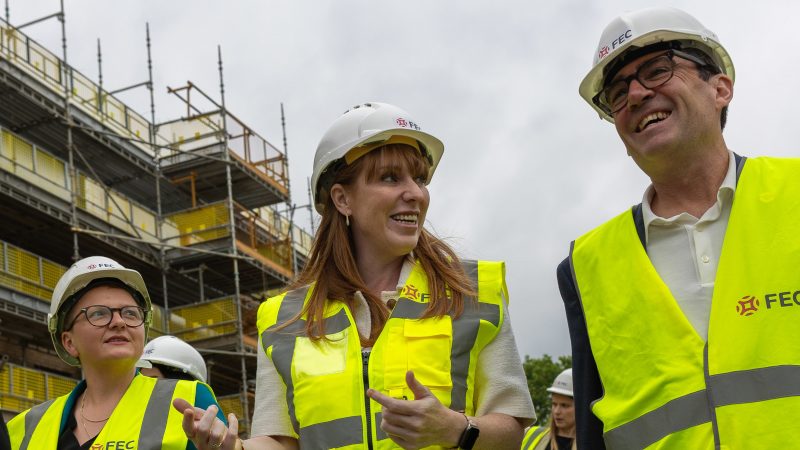
Photo: HCLG/Flickr
On 28 March 1980, a girl was born into a working-class family in Stockport. Raised in poverty on a council estate, she defied the odds to become Deputy Prime Minister of the United Kingdom. Her name is Angela Rayner — and her resignation this week is more than a political moment. It is a stark reminder of the snobbery and double standards that still shape Britain’s relationship with class.
Rayner’s journey has always been a lightning rod for prejudice. Her accent, her appearance, her unapologetic pride in her roots — these have been weaponised against her by a media and political class that claim to represent ordinary people, yet recoil when one of them rises to power. To many, her departure feels like a cruel message: that no matter how high you climb, class contempt follows close behind.
Her resignation, prompted by her mistakenly underpaying stamp duty and thus breaching the ministerial code, was handled with integrity, and was the correct thing to do. She self-reported, cooperated fully, and stepped down — restoring a sense of ministerial responsibility absent for over a decade. Compare this with the evasions and cover-ups of Conservative ministers, and the contrast is stark. But the bigger story is how Rayner has been treated throughout her time in public office.
When she was photographed vaping on a boat, she was mocked relentlessly. When she danced behind DJ decks in Ibiza, she was branded irresponsible. When she wore designer clothes — purchased with her own money — she was vilified. Yet Nigel Farage smokes cigars on magazine covers and is praised for his “authenticity.” The message is unmistakable — working people shouldn’t aspire, shouldn’t enjoy success, shouldn’t step beyond the limits imposed on them.
Reform UK likes to brand itself the party of patriotism. But what could be less patriotic than tax avoidance? Millionaires lecture the public on thrift while dodging their obligations to the state. Their deputy leader, Lee Anderson, once claimed meals could be cooked for 30p — a soundbite that trivialises poverty and insults those living through it. Yet these are the self-styled champions of the working man.
Few politicians in recent memory have been subjected to such sustained personal attacks as Rayner. That she withstood them as long as she did is testament to her resilience — and to the popularity that made her such a threat to the right. After news broke of the investigation, her property in Hove was vandalised with graffiti. Online abuse directed at her, and worse, at her family, has risen sharply in recent days — emboldened by right-wing politicians seeking cheap political points. The contempt is laid bare.
Of course, Labour must do more and do it faster. Working people are still waiting for the transformative change they were promised. Rayner’s departure should be a moment for the party to ask itself how it protects working-class voices within its own ranks, and how it ensures social mobility is not just celebrated for a single figure but made real for millions. That means serious investment in education and skills, genuine action on housing, fixing the economy and implementing a tax system that ensures the wealthiest pay their fair share.
You only need to listen to Farage’s Party Conference speech this year to understand who he is seeking to protect. A key claim he made around how ‘rich people are leaving the country’ demonstrates Reform’s priorities. They aren’t seeking to help normal working people. They simply need their votes to protect the rich elite who they exist to serve.
Angela Rayner represents everything that Nigel Farage and his ilk despise – a woman who worked her way from a council estate to the Cabinet table, carrying her politics with her. For the Labour movement, her rise remains a source of pride — and a reminder of the kind of social mobility we should be striving to make possible for the next generation.
To every young working class woman out there who sees Angela Rayner as a role model – do not let the hate and bile deter you from this. Because across our country, there are millions of young people with huge potential but are being held back by a broken society that works against them. Angela’s story is one of hope and hard work, and regardless of the circumstances behind her departure from Government, her story stands strong.
If Britain is to become a fairer society, we must confront the double standards that punish working-class ambition and shield elite entitlement. Angela Rayner’s story is not just about one politician. It is a mirror held up to a nation still deeply uncomfortable with the idea that power might come with a Stockport accent. Her absence from government will be felt — but her example endures as a challenge to Labour, and to the country, to prove that social mobility can be more than a story of one exceptional woman.
James Barber-Chadwick
James Barber-Chadwick is the Labour and Co-operative Councillor for Macclesfield Central
'Angela Rayner has achieved more in the last year than most politicians achieve in a lifetime - a trailblazer for working class kids from backgrounds like ours.'
Tributes are being paid to Angela Rayner after she resigned from the government after the prime minister’s ethics adviser found she had breached the ministerial code over her underpayment of stamp duty on her £800,000 seaside flat.
Rayner has resigned as deputy prime minister and housing secretary as well as deputy leader of the Labour Party. The Prime Minister’s ethics adviser Sir Laurie Magnus said Rayner had “acted with integrity” but concluded that she had breached the ministerial code.
Sir Magnus said that although Rayner had sought legal advice when buying the property, she failed to seek further expert tax advice as recommended.
Writing to the PM, Rayner said she accepted she “did not meet the highest standards” when purchasing her property. “I deeply regret my decision to not seek additional specialist tax advice given both my position as housing secretary and my complex family arrangements”, she said.
News of her resignation has prompted a number of senior Labour Party MPs to pay tribute to Rayner, including the Prime Minister who wrote a handwritten letter, saying he is “very sad” to see her go.
The Prime Minister also said that Rayner would “remain a major figure in our party” and would “continue to fight for the causes you care so passionately about”, adding: “I have nothing but admiration for you and huge respect for your achievement in politics. I know that many people of all political persuasions admire that someone as talented as you is the living embodiment of social mobility.”
Wes Streeting also paid tribute to Rayner, writing on X: “Angela Rayner has achieved more in the last year than most politicians achieve in a lifetime – a trailblazer for working class kids from backgrounds like ours.
“When those kids have a council house, when their mums and dads have better rights and pay, they’ll have her to thank.”
Ed Miliband wrote: “Angela Rayner is one of the great British political figures of our time.
“Generations will grow up with stronger rights at work and in new homes because of her vision and leadership.
“I know she will continue to stand at the front of the fight for social justice in this country.”
Darren Jones, Chief Secretary to the Prime Minister added: “Angela Rayner achieved a huge amount for the country this past year – record investment in council housing and better pay and rights at work.
“For our Labour movement Angela is the embodiment of social mobility and an inspiration to those of us from working class backgrounds.”
Emily Thornberry also praised Rayner for her work on workers’ rights, adding: “She has made a real difference and improved the lives of millions of people.
“That is something to which we should all aspire.”
Labour Unions posted on X: “Our solidarity and thanks to Angela Rayner – a proud trade unionist and a tireless advocate for working people.
“In Government, she has championed workers’ rights by driving through the Employment Rights Bill, when the usual suspects lined up to block it. She’s put collective rights front and centre, to give power back to working people.
“We look forward to continuing to work with Angela to stand up for working people and their families, and to continuing to work with the Labour Government to deliver the New Deal for Working People in full.”
Basit Mahmood is editor of Left Foot Forward
Angela Rayner resigns from government and as deputy leader over tax scandal
Luke O'Reilly 5th September, 2025
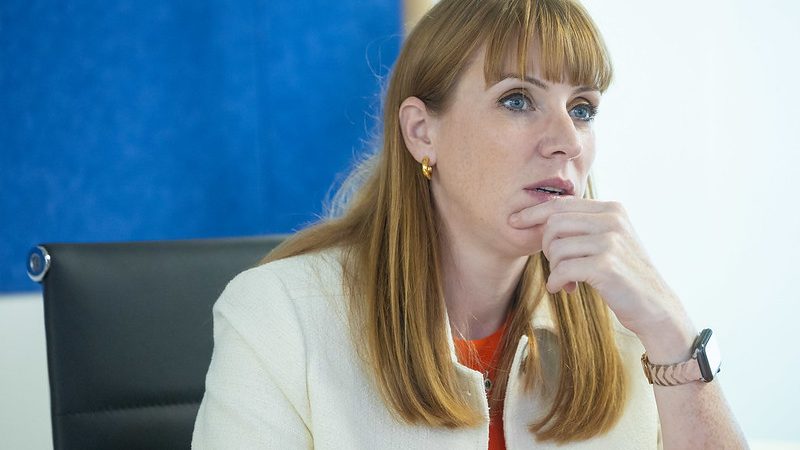
Angela Rayner. Photo: Ministry of Housing, Communities and Local Government.
Angela Rayner has resigned from the government over a scandal involving her tax affairs.
It comes after the deputy Labour leader referred herself to the Standards Advisor after admitting she did not pay enough tax on a second home.
Rayner had claimed she had paid the right amount of stamp duty on the apartment in Hove following legal advice, but referred herself to the Sir Laurie Magnus after a senior barrister found she should have paid a £40,000 surcharge on the property.
However, following an investigation by Sir Laurie, the deputy Labour leader today resigned from her roles as Deputy Prime Minister, Housing Secretary, and deputy leader of the Labour party.
Her departure has triggered a reshuffle, and there will now have to be an election for deputy leader of the Labour party too.
It is understood the NEC will be meeting shortly to set a timetable and procedural guidelines for the election.
In a letter published to X, Rayner thanked Keir Starmer for his “personal and public support”.
“I deeply regret my decision to not seek additional specialist tax advice given both my position as Housing Secretary and my complex family arrangements. I take full responsibility for this error.
“I would like to take this opportunity to repeat that it was never my intention to do anything other than pay the right amount.”
However, she said she had decided to resign due to “the findings, and the impact on my family”.
In a handwritten response letter, Starmer said he was “very sad” her time in government had ended this way.
“Although I believe you have reached the right decision, it is a decision which I know is very painful for you. You have given your all to making the Labour government a success, and you have been a central part of our plan to make Britain thrive for working families.”
A supportive backbench MP told LabourList: “We all knew she was doing a good job in the housing brief. What’s happened seems to owe more to carelessness (than) to avarice.
“I’m sure she will play a big role in politics in the future”.
Luke Akehurst MP said the news was “very sad”.
“My heart goes out to Angela and her family. Nothing can take away her achievements in the Labour Party, in getting us back into power, and in delivering for working people in government.”
Alex Charilaou, Momentum Co-Chair, said: “This is an opportunity for a well overdue debate about the change of direction the country and Labour so desperately need.
“We need a full contest, per the Party rulebook, to debate vital points like a wealth tax, an end to the privatisation of our services and action to halt the genocide in Gaza.”
While campaign group Compass said her resignation was “an issue of technicality not morality”
“If the Prime Minister wanted to put his arm round her and keep her then he could have.
“With Labour tanking in the polls and shedding members in their droves Keir Starmer has the opportunity to reset his administration in a way that reflects all wings of Labour and changes not just the top team but the direction of the government.
“While some might call for the post of Deputy Leader to be scrapped, the need for debate, democracy and accountability in the party has never been greater.”
UK
Could electoral reform rein in the right?
SEPTEMBER 3, 2025
A new report from Compass says that proportional representation helps tame the populist right, while first past the post leads to their ideas being adopted wholesale. Mike Phipps considers the arguments.
One of the most potent arguments often used against electoral reform – proportional representation in particular – is that it would allow far right parties like Reform UK, which currently win only a handful of seats under first past the post, to win scores, perhaps hundreds, of seats and wield real influence over the governmental process. A new report from Compass, The Temper Trap: How Proportional Representation Tames the Populist-Right, aims to tackle that argument head-on.
Compromise versus explosion
Across Europe, in countries that use PR, populist right movements have not only surged in support but have entered government. Britain under first past the post has been spared this fate. But for the report’s author Stuart Donald, the picture is not so clearcut. He believes that proportionality, with its insistence on political compromise, moderates populist right party participation in coalition governments – and subverts their ability to posture as anti-establishment outsiders.
“PR tempers populist voices, forcing compromise and limiting damage,” he argues. “By repressing their representation, FPTP acts like a pressure cooker, generating resentment that then erupts in massive political ruptures away from the two-party duopoly.”
Worse, we now face the prospect, if polls are accurate, of a Reform UK majority in Parliament based on just a third of the votes cast. But even if that does not happen, considerable damage has already been done.
The UK, suggests Donald, “has delivered some of the most extreme policy outcomes in Europe on immigration, asylum, EU relations, social justice and climate – not through fringe parties, but via its ‘centre-right’, the Conservative Party. Despite never having a parliamentary majority, Reform UK and its spiritual predecessor UKIP have transformed the political landscape under FPTP. They never needed seats to have power. Instead, the last 15 years have shown how they have forced the Conservatives, and now Labour, to continually bank to the right for fear they lose vote share.”
He adds: “The electoral dynamics of FPTP appear to compel Labour in the same direction, offering a tepid, triangulated version of Tory and Reform policies not out of conviction but out of political paranoia.”
The Netherlands provides the core case study in Donald’s report. In 2023, Geert Wilders’ PVV (Party for Freedom) won the most votes but had to surrender its most extreme policies to enter government. Eventually the coalition collapsed when it refused further compromise. Finland, Austria, and Sweden tell a similar story.
“Even in Italy, where Populist-Right voices are in the majority in cabinet, PR has slowed and softened their agenda,” Donald contends. “But in the UK, supposedly protected from extreme politics by their lack of representation, FPTP has delivered a hard Brexit, Europe’s most brutal deportation policy, rampant austerity, reckless deregulation, and some of the most aggressive net zero rollbacks enacted in Europe to date – all at the hands of a party that is still labelled both by itself and the UK political establishment as a ‘centre-right’, mainstream voice. Arguably too much of this agenda has continued under a centre-left Labour government.”
Is this really so?
As a supporter of proportional representation, I wanted to be persuaded by these arguments. But they are not flawless. PR in the countries Donald cites may have tempered the extremism of populist right parties but it has also given them legitimacy. It could further be argued that it was PR elections to the European Parliament that gave legitimacy to UKIP – Farage’s original incarnation – and more importantly, financial resources too.
Equally, while Donald is right to say that first past the post discourages moderation and produces more extreme choices, that also makes it harder for the populist right to claim that the entire political establishment is identical – a key feature of their campaign against consensus politics across Europe.
Donald’s argument that FPTP has forced the Conservatives – and now Labour – to adopt the agenda of the populist right is also problematic. While it is indisputable that this drift has happened, it is by no means clear that this is a consequence of FPTP. New Labour’s lurch to the right in the 1990s was a political choice. It was not the case that a more left wing programme would have risked political defeat, as Donald suggests. In reality, public opinion was consistently to the left of what Tony Blair was offering in 1997.
As I have previously pointed out: “Over 70% of voters in May 1997 wanted an income tax increase to fund better education and public services. 74% wanted no further privatisations. 58% wanted wealth redistribution. Blair would disappoint on all these fronts.”
Similarly, the Tory lurch rightwards this century was a political choice, starting with the Cameron government’s lazy miscalculation that it could win a referendum on continued EU membership, and continuing through the May-Johnson years. The Tories’ need to move rightwards because of the rise of UKIP on their right can be overstated: Farage’s party picked up only one seat in the 2015 general election.
Equally, the continued rightward trajectory of the Conservative Party was not guaranteed in advance. The quest for an ever-harder Brexit was less about UKIP calling the shots and more to do with Boris Johnson’s determination to seize the Tory Party leadership.
The limits of this ‘moving right show’ were underlined by the disastrous Truss government and the decisive rejection of the Tories at the 2024 general election. Reform UK;s surge was important – but their continued popularity has much to do with the complete failure of the Starmer government to map out a popular and engaging vision of reconstruction. This vacuum has allowed the nationalist right to dominate the headlines.
If Labour is now borrowing from the populist right playbook in the hope of puncturing Farage’s popularity, that too is a political choice – and a doomed one. Anti-migrant exclusionary nationalist ideas will not be defeated by adopting them but by challenging the entire narrative that drives them.
This helps explain why Labour is doing so poorly in the polls, just fifteen months into its term. On key economic issues, like public ownership, austerity and welfare, the public is to the left of Starmer – in fact, more aligned with current Green Party and Your Party thinking. But to move in this direction would be unthinkable to the likes of Morgan McSweeney and others around Starmer, whose primary political passion is a desire to smash any remnants of Corbynite thinking – even if the consequences are electorally toxic. And this too is a conscious political choice, not some inevitable outgrowth of first past the post.
The fact that Donald’s argument falls short does not exonerate our current voting system. Proportional representation is fairer on many counts, but for socialists, a central question must be agency and engagement. A closed party list system, even if strictly proportional, would be useless from this standpoint, if it allowed party leaders to appoint their hardcore loyalists to all the most winnable positions. That would be no better than a first past the post system where democratic selection is increasingly supplanted by the parachuting into safe seats of leadership favourites, as is increasingly the case.
We need a proportional system with a constituency link which not only improves democratic accountability for voters but also enhances democratic selection of candidates too. Open primaries should be considered, alongside other reforms to improve participation and engagement.
Ultimately, you cannot leave the business of dealing with the far right to any electoral system. If you want to defeat them, you have to defeat their ideas and persuade people not to vote for them. There are many good reasons to have PR, but this report’s argument that a fairer voting system can neutralise the populist right – at the price of giving them legitimacy – is not persuasive.
The Temper Trap: How Proportional Representation Tames the Populist-Right is available here, by Stuart Donald, published by Compass is available here.
Mike Phipps’ book Don’t Stop Thinking About Tomorrow: The Labour Party after Jeremy Corbyn (OR Books, 2022) can be ordered here.
The government is consulting on “How to implement social rent convergence”. The Labour Campaign for Council Housing explains what convergence is and why we are opposed to it.
Rent convergence was a policy introduced by John Prescott in 2002. Council housing and housing association rents were to be brought into alignment over ten years. As the House of Commons Library explains, “A rent formula was established with actual rents moving towards a national formula rent which took account of property values and local earnings relative to national earnings.”
It’s a complicated formula (see Note below). It set annual rent increases at the level of the Retail Price Index + 0.5% + up to £2 a week, the latter being the ‘catch-up’ element. The policy was justified on the spurious grounds of overcoming ‘confusion’ over the difference between council and housing association rents and giving tenants greater choice.
In fact council rents were historically around 20% lower than housing association rents, for a reason well known. Councils could borrow money more cheaply from the government’s Public Works Loans Board, whereas housing associations had to borrow money at higher interest rates from commercial sources.
In practice, convergence meant driving council rents up to housing association levels. It was designed to facilitate ‘stock transfer’ of council housing to housing associations. The government set a target of transferring 200,000 homes a year. Chancellor Gordon Brown saw it as a means of removing council housing debt from the Public Sector Borrowing Requirement. He was even prepared to write off council housing debt if tenants voted ‘the right way’, for transfer.
Convergence was also designed to undermine the resistance of tenants to ‘stock transfer’. If council and housing association rents were the same, council tenants would have less reason to oppose transfer, it was thought. The Green Paper, Quality and Choice: A Decent Home for All, which proposed convergence, gave the game away when it said: “A coherent approach for rent setting in the two tenures would be more equitable and could make it easier for stock transfers.”
As a result of this policy, rent increases outpaced inflation. In England, the average council rent was £41.17 in 1997. As a result of this policy, by 2010 it had risen to £67.83, 64.7% higher, compared to inflation of 38.8% (ONS).
The Coalition government revised the convergence date to 2015/16. In 2013 they announced that they would change the rent formula to CPI+1%. They subsequently ended convergence and introduced a 1% rent cut, for four years, essentially to cut the housing benefit bill as part of their austerity programme. In 2020 they reintroduced CPI+1% for five years.
The current government consulted on continuing with the Tories CPI+1% for at least five years. (See our submission to the consultation opposing above-inflation rent increases. Government rent consultation: NO to above inflation rent increases – Labour Campaign for Council Housing). As a result of pressure from landlords, they have decided on CPI+1% for 10 years, and the reintroduction of rent convergence. The consultation is on “How to implement social rent convergence” not if to implement it. It poses two possibilities, £1 or £2 a week, and asks for preferences on how many years convergence should be applied.
Rent arrears have doubled
In the 23 years since convergence was first introduced,tenants have had above inflation rent increases in 19 of them. It’s no wonder that since 2015-16 rent arrears in England have nearly doubled from £203 million to £397 in 2023/4.
The English Housing Survey 2023/24 showed 59% of social housing households have at least one member in long-term ill-health or disabled. Some of these will lose money from the cut to the Universal Credit health element. The scale of poverty is reflected in their estimate of 73% households having no savings, making them especially vulnerable to the smallest change of circumstances. The phenomenon of tenants faced with the choice of ‘eating or heating’ increasingly impacts on more tenants. CPI+1% and rent convergence will surely drive up arrears and will increase the housing benefit bill for the government. Their impact assessment says that a £2 a week convergence increase will cost the exchequer £4 billion in increased social security spending.
The gap between actual rents and formula rent does not appear to be that great – an average of £5.74 in England (though £9.14 in London). Yet when tenants are struggling to get by financially, month by month, even relatively small increases can push them over the edge. Combined with CPI+1%, convergence will hit hard those people whose rent is not covered by housing benefit or the housing component of Universal Credit. Pensioners will be heavily impacted. The impact assessment estimates that pensioners who receive no housing support will see their rent increase to 26.6% of income nationally, and 36.9% in London.
How long would convergence take? Of 179 local authorities for which data is available, 167 of them have an average rent below the formula rent level. With the £2 a week option, just 14% of them would converge in the first year of the policy, while 17 would take five or more years.
Even when rents reach the formula, its connection to house values is likely to push them further upwards (similar to ‘affordable rent’ which is linked to 80% of market rent). Council housing is not part of the market and rent should not be linked to the market through house prices.
Housing Revenue Account funding crisis
These policies are a substitute – to the detriment of tenants – for adequately funding Housing Revenue Accounts. They will not resolve their funding crisis. The councils that signedSecuring the Future of Council Housing warned that Housing Revenue Accounts are unsustainable without more support from central government. They have estimated that they need £12 billion extra over the next five years just to enable councils to improve all the stock to Energy Performance Certificate C. They estimated at least £23 billion would be needed to decarbonise existing homes. Without funding on this scale the condition of existing council homes is likely to deteriorate.
The impact assessment reports that: “In aggregate across all 162 council landlords with Housing Revenue Accounts, spending has exceeded turnover in four of the past five years, leading to a corresponding decrease in aggregate reserves as they are used to cover the shortfall in the ring-fenced account.”
A recent survey by Southwark Council, responded to by 76 councils, found 9 in 10 council housing budgets under financial stress, taking or expecting to need to take substantial action or use emergency funds to balance their books by 2029. For example, 61% of councils have already cancelled, paused or delayed housebuilding projects and more than one third have cut back on repairs and maintenance of council homes.
The scale of the funding crisis of Housing Revenue Accounts is reflected in the proposal of the Chartered Institute of Housing, suggesting that a debt write-down of £17 billion would be necessary to make them sustainable. We have suggested going further, explaining why there is a good case for cancelling council housing debt.
We believe there needs to be a campaign for adequate funding for HRAs and an end to above-inflation rent increases rather than trying to increase funding by making rents increasingly unaffordable for those who don’t have it all covered by housing benefit. As the Chartered Institute of Housing has observed: “In theory, it would be possible to change rent policy to allow rents to increase faster and to a higher level – but there would be extra costs in terms of increased benefits payments and risks in terms of social rents beginning to approach or exceed market rents if this was pursued over an extended period.”
In fact rents are now high enough that it has become more common for tenants on the waiting lists to be turned down for a tenancy because they are judged to be unable to afford the rent. If they cannot afford a council or housing association rent, what can they afford?
The declared objective of the government in implementing ten years of above-inflation rent increases and rent convergence is “to provide private registered providers and local authority registered providers with the rental income and stability they need to be able to borrow and invest in both new and existing homes, while ensuring there are appropriate protections for both existing and future social housing tenants and taking account of the impact on the government’s fiscal rules.”
In reality this means that the fiscal rules preclude the government from investing beyond its current parsimonious level. “The scale of investment pales by comparison to the scale of housing need…” This is a political choice, of course. They are making tenants pay more for investment in their own and new homes, though at the cost to the Exchequer of up to £4 billion because rents will become increasingly unaffordable to more tenants.
Housing Revenue Accounts have little scope for more borrowing. They pay more than £1 billion a year on debt servicing. In addition, because of the government’s borrowing policy (determined by the Bank of England) interest rates for Public Works Loans Board loans are exorbitantly high at 5.95% for a thirty-year maturity loan (payment of the loan at the end of the loan period). Even with a 0.6% reduction for council housing, they are still well over 5%. In the case of housing associations they are already loaded up heavily with debt. Last year, for the first time since 2009, debt servicing cost more than their income.
Like most consultations, the government has already decided what it will do. The only open question is whether landlords will be able to increase rents above CPI+1% by £1 a week or £2. Most landlords are likely to call for the £2 option. It seems likely that the government will accede to them.
These policies need overturning. Funding councils and housing associations by further impoverishing already poor tenants is no solution to the crisis. The social consequences are unacceptable.
Tenants should not be forced to pay unaffordable rents to substitute for insufficient funding of Housing Revenue Accounts or to subsidise a commercialised housing association sector. Rather than support above inflation rent increases, councils should be seeking the support of tenants to press the government for the funding needed to improve the quality of existing homes, decarbonise them and build/acquire the new homes necessary to bring down the numbers on the waiting list and in temporary accommodation.
A Note on ‘formula rent’
Social rent is set by local councils in line with a formula set by central government. It is a complicated and frankly, bizarre system. The same formula applies to housing association properties.
The basis for the calculation of formula rent is:
30% of a property’s rent is based on relative property values
70% of a property’s rent is based on relative local earnings
a bedroom factor is applied so that, other things being equal, smaller properties have lower rents
Weekly formula rent is equal to: 70% of the national average rent, multiplied by relative county earnings, multiplied by the bedroom weight, plus 30% of the national average rent, multiplied by relative property value. However, that is the national (England) average rent from way back in April 2000!
Relative county earnings means the average manual earnings for the county in which the property is located, divided by national average manual earnings, both at 1999 levels!
Relative property value means an individual property’s value divided by the national (England) average property value, at January 1999 prices. These figures are set out in Appendices produced by the Ministry.
Having set the formula rent for 2000-01 for a property it then has to be uprated, for each year thereafter, based on the annual inflation figure. The national average rent to be used in the calculation, is £54.60 for April 2000. The national average property value from January 1999, is £49,750. There is a table for county earnings from 1999 which has to be applied, the average being £316.40.
Example
The Ministry provided an example of a calculation using this formula based on a three-bed property in Leicestershire, for which the capital value for January 1999 was £55,000. The figures on which to apply the formula are:
Average rent at April 2000 £54.62
Average earnings in Leicestershire £303.10
National average earnings £316.40
Bedroom weight 1.10
National average property value in January 1999 £49,750.
Putting these figures into the formula we have
70% of the average rent 70% x £54.62
£38.23
Multiplied by relative county earnings x £303.10 / £316.40
£36.62
Multiplied by bedroom weight x 1.10
Sub-total £40.29
Subtotal 30% of the average rent 30% x £54.62
£16.39
Multiplied by relative property value x £55,000 / £49,750
Sub-total £18.12
Adding together the sub-totals £40.29 + £18.12 £16.39 £18.12