Saturday, September 06, 2025

Trump Throws Tantrum After EU Shows What It Looks Like to Hold Tech Giants Like Google to Account


"They should get their money back!" Trump said while defending America's tech giants.


Brad Reed
Sep 05, 2025
COMMON DREAMS

US President Donald Trump on Friday angrily lashed out after the European Commission slapped tech giant Google with a $3.45 billion fine for violating antitrust laws.

The European Commission ordered Google to end its anticompetitive practices such as its payments to ensure its search engine receives preferential treatment on internet browsers and mobile phones. The commission also demanded that Google "implement measures to cease its inherent conflicts of interest along the adtech supply chain."

EU competition chief Teresa Ribera said that the decision demonstrated that "Google abused its dominant position in adtech harming publishers, advertisers, and consumers" and that it must "must now come forward with a serious remedy to address its conflicts of interest, and if it fails to do so, we will not hesitate to impose strong remedies."

Shortly after the ruling, Trump took to Truth Social to blast Europe for enforcing its antitrust laws.

"Europe today 'hit' another great American company, Google, with a $3.5 billion fine, effectively taking money that would otherwise go to American investments and jobs," Trump wrote. "Very unfair, and the American taxpayer will not stand for it! As I have said before, my administration will NOT allow these discriminatory actions to stand. Apple, as an example, was forced to pay $17 billion in a fine that, in my opinion, should not have been charged—they should get their money back!"

Trump added that "we cannot let this happen to brilliant and unprecedented American Ingenuity and, if it does, I will be forced to start a Section 301 proceeding to nullify the unfair penalties being charged to these taxpaying American companies."

Max von Thun, Europe director for anti-monopoly think tank Open Markets Institute, had a decidedly different take from the president, and praised the European Commission for taking an "important first step in breaking Google's chokehold over the underlying architecture not merely of the internet, but of the free press in the 21st century."

"It is only right that Google pays the price for its blatant and long-standing lawbreaking," he added. "More importantly however, the commission has given Google two months to end its illegal practices and resolve the profound conflicts of interest which arise from its control of every layer of the adtech stack."

The European Commission's decision stood in stark contrast to a decision issued earlier this week from Judge Amit Mehta of the US District Court for the District of Columbia, who declined to force Google to sell off its Chrome web browser or share all requested data with its competitors despite finding that the company had violated American antitrust laws

US Navy SEALs 'Slaughtered' Civilians During Botched 2019 North Korea Mission

Congress was reportedly never informed about the covert attempt by the first Trump administration to plant a listening device in North Korea during high-stakes nuclear negotiations.


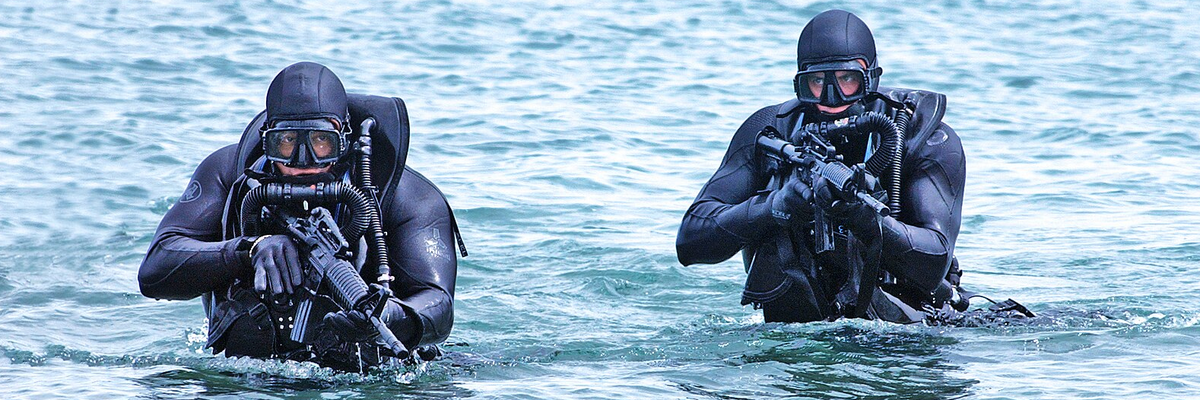
US Navy SEALs are seen training in this undated photograph.
(Photo by US Navy/cc)

Brett Wilkins
Sep 05, 2025
COMMON DREAMS


US Navy SEALs shot dead a number of civilians during a botched secret mission to plant a listening device inside North Korea during tense nuclear negotiations between the first Trump administration and the government of Kim Jong Un in 2019, The New York Times reported Friday.

Dave Philipps and Matthew Cole reported for the Times that President Donald Trump personally approved the covert operation, which was tasked to SEAL Team 6's Red Squadron, the same unit that assassinated Osama bin Laden. Although the elite sailors rehearsed the nighttime mission for months, things fell apart when a small fishing boat appeared out of the dark in what the SEALs thought was a deserted area.

"Flashlights from the bow swept over the water. Fearing that they had been spotted, the SEALs opened fire," wrote Philipps and Cole. "Within seconds, everyone on the North Korean boat was dead. The SEALs retreated into the sea without planting the listening device."

Officials familiar with the mission told the Times that the SEALs then pulled two or three bodies from the boat, punctured the victims' lungs with knives so their bodies would sink, and threw the dead fishers into the sea.


According to the Times:
The 2019 operation has never been publicly acknowledged, or even hinted at, by the United States or North Korea. The details remain classified and are being reported here for the first time. The Trump administration did not notify key members of Congress who oversee intelligence operations, before or after the mission. The lack of notification may have violated the law...


The aborted SEAL mission prompted a series of military reviews during Mr. Trump's first term. They found that the killing of civilians was justified under the rules of engagement, and that the mission was undone by a collision of unfortunate occurrences that could not have been foreseen or avoided. The findings were classified.

It is not known whether or how much North Korea's government knew about the mission. While Trump's erstwhile untried tactic of direct negotiations with Kim averted escalation of the 2018-19 standoff, the high-profile summits between the two leaders yielded no substantial progress toward denuclearization or a peace treaty.

The US and North Korea are technically still at war. Between 1950-53 US forces killed an estimated 20% of all North Koreans—around 1.9 million men, women, and children—according to Gen. Curtis "Bombs Away" LeMay, who served as strategic air commander during the war after overseeing World War II firebombing raids on Japanese cities that killed hundreds of thousands of civilians.

US Navy SEALs botched secret 2019 mission in North Korea: report

AFP 
September 6, 2025 


US military personnel train in Coronado, California, US in this file photo from August 2023. — Reuters


Elite United States Navy SEALs launched an audacious operation in 2019 to plant a listening device in North Korea to spy on the country’s reclusive leader, Kim Jong Un, The New York Times (NYT) reported on Friday, but the mission quickly unravelled and culminated in the deaths of multiple civilians.

The operation came in the first administration of US President Donald Trump during sensitive nuclear talks with Kim, whom the US leader met three times.

The mission was considered so risky that it required direct presidential approval, the NYT said, but Trump insisted on Friday he had no knowledge of the operation.

“I don’t know anything about it. I’m hearing it now for the first time,” the president told journalists.

Despite months of practice, the mission still went horribly wrong, the * NYT* reported.

The SEALs — from the same unit that killed Osama bin Laden in 2011 — approached North Korea in mini-submarines that exposed them to frigid water for hours, then swam ashore, according to the newspaper, which interviewed two dozen people to piece together the account.

The special forces personnel thought they were alone, but didn’t see a small boat in the area. The boat later approached the mini-subs, with the crew carrying flashlights. One person jumped into the water.

Thinking the mission was compromised, the senior enlisted SEAL ashore opened fire on the boat, as did the others with him. When they reached the boat, they found two or three bodies, but no guns or uniforms: the dead were apparently civilians who were diving for shellfish.

The SEALs used knives to puncture the lungs of the boat’s crew so the bodies would sink, and were able to escape unharmed.

The NYT said the operation prompted a series of military reviews that found the killings were justified. The results of the reviews were classified, and key congressional leaders were kept in the dark.

While the failed mission did not create a major international crisis, it easily could have, and the incident highlights both the impunity and secrecy under which America’s elite forces operate around the globe.
The Court Said Trump Was Above the Law — And Now 11 People Are Dead at Sea

Trump simply ordered human beings erased. This isn’t just about a boat off Venezuela. It’s about whether America will allow a president, blessed by the Court, to kill without evidence, without process, without even the pretense of law.


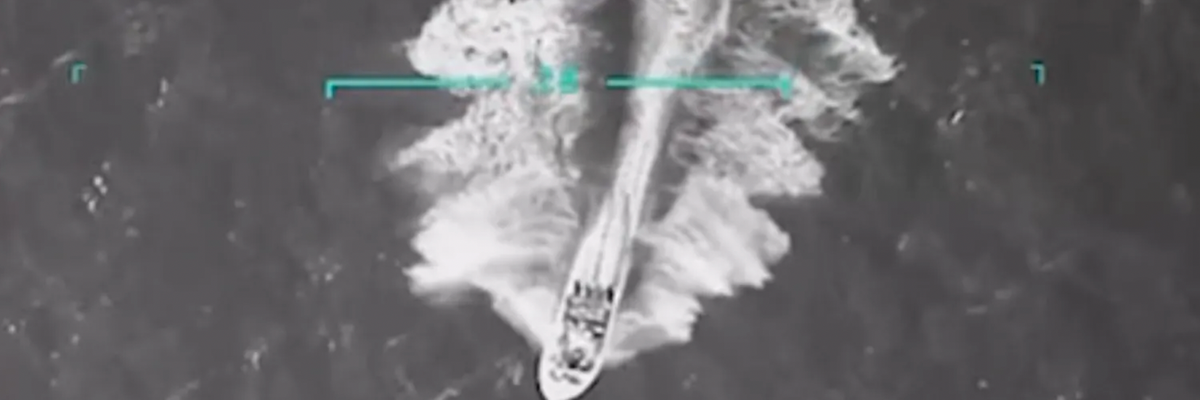
This image was posted on social media by President Donald Trump and shows a boat that was allegedly transporting cocaine off the coast of Venezuela when it was destroyed by US forces on September 2, 2025.
(Photo: President Donald Trump/Truth Social)


Thom Hartmann
Sep 05, 2025
Common Dreams

When the Court says Trump is above the law, who speaks for the eleven dead on that boat? Their lives ended not in a battlefield crossfire or a clash between nations, but at the whim of one man emboldened by six justices who declared him untouchable.

Trump simply ordered human beings erased, confident the Court had given him immunity from any consequence and the leaders of his military would obey an illegal order. Eleven souls were sacrificed not just to his cruelty, but to a judicial betrayal that transformed the presidency into a license to kill.

For most of our history, American presidents have at least gone through the motions of cloaking lethal force in some form of legal justification.

Abraham Lincoln suspended habeas corpus during the Civil War but sought Congress’s approval. Franklin Roosevelt went to Congress for Lend-Lease before escalating aid to Britain, and sought a declaration of war against Japan. George W. Bush and Barack Obama leaned heavily on the post-9/11 Authorizations for Use of Military Force to justify everything from Afghanistan to drone strikes in Yemen and Somalia to killing Bin Laden.

It looks like Trump has taken Miller’s reported hypothetical and turned it into policy. What was once an outrageous musing has become a bloody precedent.

The principle has always been that the United States does not simply kill people without some kind of legal process. It may be stretched, it may be abused, but it has been invoked.

What Donald Trump has now done with the strike on a small boat off Venezuela’s coast is to break that tradition in a way that is both lawless and unprecedented. He gave the order to kill eleven human beings with no congressional approval, no international authorization, and no visible evidence justifying it.

This was simply murder on the high seas. And the world knows it.

He did it in the full knowledge that six Republican appointees on the Supreme Court have granted him immunity for crimes committed while in office, even international crimes. That ruling opened the door to precisely this sort of extrajudicial killing and stripped away one of the last guardrails protecting both our law and our global standing.

The official claim is that the boat carried members of the Venezuelan gang Tren de Aragua. But eleven people on a small vessel that couldn’t possibly travel as far as America doesn’t sound like a cartel’s drug shipment (typically there’s only one or two people manning such a boar); it sounds like desperate migrants fleeing a collapsing country.

That possibility makes the strike even more chilling when paired with a story Miles Taylor has told about Trump’s senior advisor Stephen Miller. Taylor recounts traveling with Miller and a Coast Guard admiral after a drug war event in Key West.

On that trip Stephen Miller asked the admiral if it would be legal to use a Predator drone to obliterate a boat full of migrants in international waters. Miller’s reasoning was that migrants weren’t covered by the Constitution, so what was to stop us from blowing them out of the water?

The admiral reportedly shot back that it would violate international law, that “you cannot kill unarmed civilians just because you want to.” At the time it was an alarming glimpse into the sadistic mind of a man who saw immigrants as less than human.

Now it looks like Trump has taken Miller’s reported hypothetical and turned it into policy. What was once an outrageous musing has become a bloody precedent.

This has profound legal and moral implications.

By attacking a vessel flying the flag of a sovereign state, Trump risked triggering a direct military confrontation. Venezuela could have fired back at American forces in the region. A firefight at sea can escalate quickly into a regional war, and Venezuela’s leader Nicolás Maduro would have every incentive to turn to Russia and China for protection.

Leaders of both of those nations are eager to deepen their presence in our hemisphere, and this gives them an opening. It’s not inconceivable that Moscow or Beijing could send ships or aircraft to Venezuela in response.

That would put foreign military forces hostile to us within thirteen hundred miles of Miami. If shots were fired between American forces and Russian or Chinese deployments in the Caribbean, the slide toward a larger war would be real, very much like the Cuban Missile Crisis of 1963 (except then we had a statesman as a president, instead of a corrupt buffoon).

World War I began with a simple assassination that pitted one nation against another and then the sinking of the civilian boat the Lusitania; this is how great power conflicts can begin. Trump’s reckless strike doesn’t just risk Venezuelan lives. It risks American troops, regional stability, and, in the most ominous scenario, world peace itself.

Meanwhile, at home, the timing is impossible to ignore. Authoritarians throughout history have turned to foreign crises to distract from domestic scandals.

Nixon expanded the war into Cambodia as Watergate began to close in. Reagan invaded Grenada days after hundreds of Marines were killed in Beirut. Trump has lived for decades under the shadow of allegations of sexual predation, including reports that Jeffrey Epstein recorded him with underage girls during the years he owned and ran Miss Teen USA.

If new evidence of that were to surface, Trump would need a distraction on a scale large enough to blot out the outrage. Creating a crisis with Venezuela, complete with martial language and threats of escalation while renaming the Department of Defense to Department of War, serves that purpose. It’s the oldest play in the authoritarian book: wag the dog.

Except this time the stakes are far higher. This time we’re dealing with a president who’s been told by six corrupted members of the highest court in the land that he’s above the law.

When Miles Taylor first revealed Miller’s macabre question about bombing migrant boats, some dismissed it as idle cruelty. It now looks like a glimpse into the inner workings of Trump’s policy mind. In this worldview, immigrants are vermin, human rights are optional, Democrats are “extremists,” and lethal force is just another tool of politics.

Combine that with the Supreme Court’s gift of immunity and you have a recipe for lawless violence on a scale America has never contemplated. The entire edifice of international law is designed to prevent precisely this sort of conduct.

Extrajudicial killings, violations of sovereignty, the targeting of civilians: these are the acts that international courts prosecute when they can, and that history condemns when courts cannot stop them.

And now we’re learning that Trump did something similar in 2019 when he was last president. He authorized a SEAL Team strike against North Korea, where they killed three civilians in a boat who were simply out fishing.

Extrajudicial killings, violations of sovereignty, the targeting of civilians: these are the acts that international courts prosecute when they can, and that history condemns when courts cannot stop them.

If America embraces this new Putin-like assertion of America’s power to bomb anybody, anywhere, on the whim of the president, we’ll have abandoned any claim to moral leadership.

Worse, we will have normalized the authoritarian logic that anyone the president labels an enemy can be eliminated without trial, without evidence, without process. We’ll have handed Xi a rationale to attack Taiwan; all he has to do is claim that a non-governmental gang within that nation is importing drugs into China (or something similar).

The international reaction has already been severe. America’s allies are horrified, our adversaries have been emboldened, and human rights groups are openly appalled.

But the real test is here at home. Do we still believe in the principle, famously cited by our second President John Adams, that America is a nation of laws and not of men? Do we still insist that presidents cannot kill at will? If Trump can strike a boat off Venezuela today, what is to stop him from ordering lethal force against dissidents, protesters, or political opponents tomorrow?

Do we still insist that presidents cannot kill at will? If Trump can strike a boat off Venezuela today, what is to stop him from ordering lethal force against dissidents, protesters, or political opponents tomorrow?

Keep in mind, the same Stephen Miller — who reportedly wanted to blow up boats of immigrants to kill more brown people — just in the past week claimed that the Democratic Party is a “domestic extremist organization.”

The doctrine of immunity means there is no legal backstop. The only remaining check is political will. And Trump’s fascist toadies are all in on more extrajudicial killings.

Yesterday, Defense Secretary Pete “Kegger” Hegseth said:
“We’ve got assets in the air, assets in the water, assets on ships, because this is a deadly serious mission for us, and it won’t stop with just this strike.”


Secretary of State “Little Marco” Rubio echoed the sentiment, saying during a speech in Mexico City yesterday that similar strikes “will happen again.”

This is why Democrats, independents, and every American who values the rule of law must call this out for what it is: an atrocity against eleven people, an assault on international norms, and a direct threat to American democracy.

Trump has shown us exactly how far he’s willing to go. He’s willing to risk a war in our hemisphere. He’s willing to put our troops in danger. He’s willing to risk drawing Putin and Xi into a confrontation with us that could spiral out of control. He’s willing to destroy lives to protect himself. And he’s doing it because six Republicans on the Supreme Court told him he could.

If Congress doesn’t act now to confront and contain this lawless behavior, if we don’t restore accountability to the presidency, then we’ll have surrendered not just our moral authority but our future.

The question is not whether Trump wants a distraction from his scandals; of course he does. The question is whether we’re willing to let Trump and his fascist toadies drag America and the world into catastrophe to get it.

This isn’t just about a boat off Venezuela. It’s about whether America will allow a president, blessed by the Court, to kill without evidence, without process, without even the pretense of law.

Eleven dead migrants are the proof of what immunity means in practice: impunity. If Trump can slaughter refugees today, what stops him from targeting dissidents, protesters, even political opponents tomorrow?

The answer, unless Congress and the people act, is nothing. And “nothing” is what those justices have left to protect us, our laws, and our humanity.


Our work is licensed under Creative Commons (CC BY-NC-ND 3.0). Feel free to republish and share widely.


Thom Hartmann is a talk-show host and the author of "The Hidden History of Monopolies: How Big Business Destroyed the American Dream" (2020); "The Hidden History of the Supreme Court and the Betrayal of America" (2019); and more than 25 other books in print.
Full Bio >
Fascism: A Word That Matters Here and Now

We call Trump a fascist because with each passing day, it rings increasingly true.


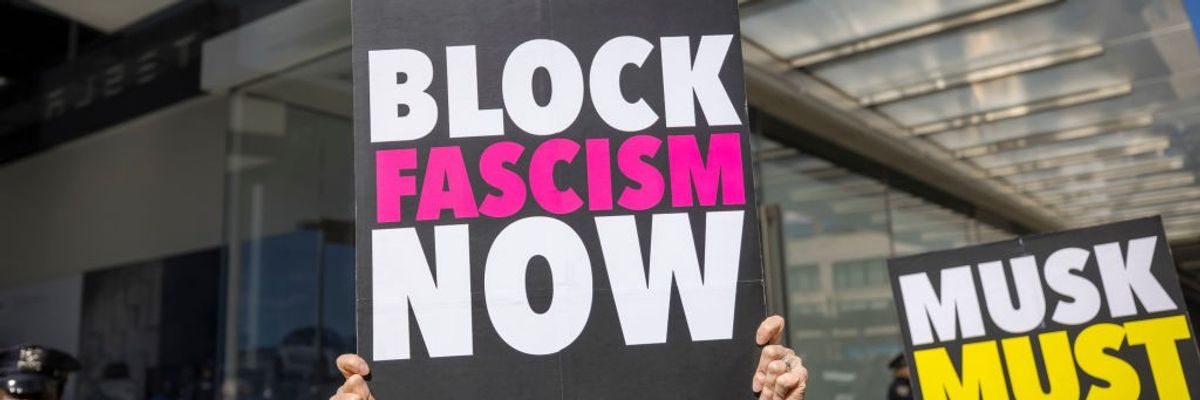
A protestor outside a Tesla showroom in Manhattan holds a sign that reads "Block fascism now."
(Photo by Michael Nigro/Pacific Press/LightRocket via Getty Images)

Robert Ivie
Sep 06, 2025
Common Dreams


Words matter in life generally and politics particularly. They are the medium of thought, the means of sensemaking, the vehicle of communication and persuasion. They shape us collectively and individually.

Words, political scientist Francis Beer writes, are “the defining framework for political authority” and “a primary means of motivating political actors.” Our physical and verbal worlds are interconnected and “inseparable,” thus “the political importance of language”: political rhetoric carries and constructs meaning that shapes conduct.

Verbal action “operates parallel to” nonverbal action in multiple ways, Beer notes, formulating and conveying perception, memory, history, story, myth, and message, differentiating friend from foe, articulating preferences, describing trends, developing plans, policies, and strategies, expressing feelings, structuring motives, and constructing identities, interests, and hierarchical relations. In these ways, words matter for citizens, not just political leaders.

Language is structured and structuring, settled and dynamic. It enables us to stabilize and communicate meaning but also to reflect thoughtfully on the key terms of our discourse, to describe, critique, destabilize, revise, and apply them productively as circumstances warrant. As linguistics professor Sally McConnell-Ginet illustrates in Words Matter: Meaning and Power (Cornell University Press, 2020), words are politically potent means of domination but also cooperation, of oppression but also resistance, because their significance can be unsettled and reassigned. Thus, we might come to see their application in new and unexpected ways.

The celebrated achievement of America’s “greatest generation” was their military victory over fascism in defense of democracy. Fascism was perceived as un-American, a threat from abroad, an alien and malevolent enemy of freedom and self-government.

The word "fascism" is a case in point. A label we are not accustomed to associating with American governance, it is increasingly featured in critiques of the Trump administration’s authoritarianism as a way of both describing and rallying resistance to Trump’s escalating overreach and oppression.

A conventional definition of fascism, drawn from the Merriam Webster’s Collegiate Dictionary (10th edition), is “a political philosophy, movement, or regime (as that of the Fascisti) that exalts nation and often race above the individual and that stands for a centralized autocratic government headed by a dictatorial leader, severe economic and social regimentation, and forcible suppression of opposition”; the same entry defines fascism succinctly as “a tendency toward or actual exercise of strong autocratic or dictatorial control.” (A Fascista refers to “a member of an Italian political organization under Mussolini governing Italy 1922–1943 according to the principles of fascism.”)

Benito Mussolini is the embodiment of fascism in our collective memory along with Adolph Hitler, Germany’s more brutal Nazi Führer, and to a lesser extent the Japanese militarists allied with Germany and Italy in World War II. The celebrated achievement of America’s “greatest generation” was their military victory over fascism in defense of democracy. Fascism was perceived as un-American, a threat from abroad, an alien and malevolent enemy of freedom and self-government.

Yet the seeds of fascism sprouted in US soil during the years leading up to World War II. One notorious example of American Nazi proclivity occurred on February 20, 1939, when over 20,000 people attended a Madison Square Garden rally sponsored by the pro-Hitler German American Bund, one of several pro-Nazi organizations in the US. Film footage of the event was compiled in 2017 by documentarian Marshall Curry “as a cautionary tale to Americans.”

The Bund, as Sarah Kate Kramer recounted in 2019 on NPR’s “All Things Considered,” was “one of several organizations in the United States that were openly supportive of Adolf Hitler and the rise of fascism in Europe. They had parades, bookstores and summer camps for youth. Their vision for America was a cocktail of white supremacy, fascist ideology, and American patriotism.”

At the Madison Square Garden rally, swastikas were on full display complete with a 30-foot tall portrait of George Washington (modeling him as America’s first fascist), US and Nazi flags, Nazi arm bands and salutes, martial drummers and music, the American national anthem, a German-accented pledge of allegiance, and a “vigilante police force dressed in the style of Hitler’s SS troops.” Speakers called for a return of the country to the rule of true American white gentiles. Fritz Kuhn, the Bund’s leader, opened his speech with the call to “Wake up! You, Aryan, Nordic and Christians, to demand that our government be returned to the people who founded it!”


New Yorkers, numbering 100,000, protested the event; the US government took steps to suppress the Bund after the rally; and the Bund met its demise with Germany’s declaration of war on the US. Yet, as Kramer concludes, “the white supremacist ideology they championed remains.” Indeed, the 1939 Bund rally has been cited as precedent for the violent August, 2017 “Unite the Right” white-nationalist rally in Charlottesville, Virginia. The Nazi outburst in pre-war Depression years grew out of a history of American authoritarianism. The Bund rally in Madison Square Garden is one of the country’s own fascistic precedents.

Trump was President in 2017 when the Charlottesville rally occurred, a rally that turned violent and that the Virginia state police declared unlawful. It consisted of neo-fascists, neo-Nazis, white nationalists, Klansmen, and far-right militias. Some carried weapons, some chanted racist and antisemitic slogans, some carried Confederate battle flags. Violence occurred when the protesting marchers engaged counter protesters. A white supremacist drove his car into a group of counter protesters, killing one woman and injuring 35 other people. Trump condemned “the display of hatred, bigotry, and violence on many sides” and subsequently said there were “very fine people on both sides” and “blame on both sides,” suggesting an equivalency between the two sides for which he was roundly criticized. (See “Unite the Right Rally” on Wikipedia for a detailed account of the rally.)

There has been no hedging by Trump since he took office for a second term on January 20, 2025. He stated during his campaign that he intended to be a dictator on Day 1, an intention that has extended in quick order from Day 1 forward. An onslaught of executive power overwhelming Constitutional checks and balances and assaulting democratic principles was immediately recognized by critics as the work of an authoritarian and increasingly is seen as fascistic.

The difference between authoritarianism and fascism is largely a matter of degree. An authoritarian expects blind submission and a concentration of power unhampered by responsibility to a people who are allowed only restricted political freedoms. A fascist is an extreme right-wing authoritarian with totalitarian propensities, pursuing total control over the state while propagandizing a racist brand of nationalism and viciously suppressing dissent. Acting as a right-wing populist, the fascist demagogue claims to “represent” the people and actively mobilizes their sometimes-violent support.

As Robert Longley recently put the matter of fascism:
The foundation of fascism is a combination of ultranationalism—an extreme devotion to one’s nation over all others—along with a widely held belief among the people that the nation must and will be somehow saved or “reborn.” Rather than working for concrete solutions to economic, political, and social problems, fascist rulers divert the people’s focus while winning public support by elevating the idea of a need for a national rebirth into a virtual religion. To this end, fascists encourage the growth of cults of national unity and racial purity.

Further, Longley and others report, fascist (or neo-fascist) dictators typically extol militarism and promote military readiness, assert dominance over other countries, undertake aggressive military actions, engage in territorial conquest and expansion, suppress domestic opposition (with police and military force, propaganda, and/or mass violence), attack universities, advance state-controlled corporate capitalism with protectionist policies such as tariffs, aim for national self-sufficiency, portray themselves as defenders of traditional Christian family values, manipulate elections to remain in power, and cultivate a cult of personality in which the dictator symbolically embodies the nation.


By this account, Trump—followed by his MAGA cult—is no less than an aspirational neo-fascist pursuing policies that closely resemble fascism. Some experts have maintained that he is better described as an authoritarian; other experts, including Yale University historian Timothy Snyder, have fled to Canada in the belief that the US is becoming a fascist dictatorship. Serena Dash, writing for the Fordham Political Review, concluded that “after the first month of Trump’s second term, no doubt should remain of whether or not the ‘fascist’ label applies.” It does.

The fascistic trajectory of Trump’s rule is manifested in his actions since Day 1. Some glaring examples include military occupation of cities governed by elected Democrats; deployment of masked ICE agents by the massively funded Immigration Enforcement and Customs agency and its growing prison system; defying court orders; attacking universities to undermine academic freedom, dictate curriculum, and bar student protests; aggressive gerrymandering and other election maneuvering to retain power; repressing news media for unfavorable news coverage, editorials, and programing; targeting critics for federal prosecution; imposing his will on key industries in the private sector, including keeping track of which corporations are loyal to him and therefore candidates for tax and regulatory benefits and exclusion from federal lawsuits; enriching himself at the public’s expense; and so on.

Fascism is no longer a word relevant only to other countries and applicable to a threat from abroad. As Serena Dash observes:
The discourse around Donald Trump being a fascist is not just an academic exercise; it is essential for recognizing and addressing the potential dangers he poses to democratic institutions and social equality and knowing how to combat it. The utility of using a term like “fascism” is that it has successfully been thwarted and fought before.Words matter. And right now, the words we use to describe Trump’s rule matter greatly. There is a reason why growing numbers of commentators, activists, and political leaders are calling Trump a fascist—because with each passing day, it rings increasingly true. The remnant of the country’s founding aspirations of liberty and self-governance “seems now to be shrinking day by day,” writes political scientist Jeffrey Isaac. “Whether it will survive the next few years [of Trump’s repression] is an open question.”


Our work is licensed under Creative Commons (CC BY-NC-ND 3.0). Feel free to republish and share widely.


Robert Ivie is Professor Emeritus in English (Rhetoric) and American Studies at Indiana University, Bloomington. His latest book, with Oscar Giner, is After Empire: Myth, Rhetoric, and Democratic Revival (2024). Others books include: Hunt the Devil: A Demonology of U.S. War Culture (2015), with Oscar Giner; Dissent from War (2007); and Democracy and America’s War on Terror (2005). For additional information and blogposts see his website and blog.
Full Bio >


Submarine cable damage may degrade internet services during peak hours: 
Pakistan Telecommunications Limited 

Umaid Ali 
September 6, 2025 
DAWN


The Pakistan Telecommunications Limited (PTCL) announced on Saturday that cuts to submarine internet cables in Saudi waters may impact internet services in the country during peak hours.

In a statement shared on X, the telecom giant said the submarine cable cuts near Saudi capital Jeddah had impacted the partial bandwidth capacity SMW4 (South Asia-Middle East-West Asia) and IMEWE (India-Middle East-Western Europe) networks.

“Internet users in Pakistan may experience some service degradation during peak hours,” the PTCL statement read. “Our international partners are working on priority to resolve the issue while our local teams are actively arranging alternative bandwidth to minimise the impact.”

The Ministry of Information Technology has not issued any statement on the development yet.

This is not the first time that damage to undersea internet cables has affected services in Pakistan.

Internet users across Pakistan complained of slow internet and hindered access to services throughout 2024. On January 3 this year, PTCL said teams were “diligently” working to resolve the matter of disruptions faced by users after a fault in the AAE-1 subsea internet cable connecting Pakistan slowed down the network speed in the country.

On January 16, PTCL announced that internet services were “now fully operational” after the complete restoration of the Asia-Africa-Europe-1 (AAE-1) undersea internet cable.
NCSW calls for standardising minimum marriage age across Pakistan

The Newspaper's Staff Reporter 
Published September 6, 2025 
DAWN

ISLAMABAD: National Commission on the Status of Women (NCSW), in collaboration with UNFPA and Legal Aid Society, convened a consultation on Friday to address the pressing issue of child marriage in Pakistan.

Opening the session, Ume Laila Azhar, who is NCSW chairperson, stressed the urgent need to standardise the minimum age of marriage across Pakistan, highlighting persistent gaps in the implementation despite Sindh pioneering law.

Key insights were shared by government representatives, law enforcement, civil society and community stakeholders emphasising on more female station house officer (SHOs) and specialised training for handling child marriage cases.

Reforms in nikah registration through digitisation and mandatory CNIC verification were also emphasised by participants. Among other demands was on strengthening Sindh Child Protection Authority’s role with resources and awareness. Participants also emphasised on government ownership to ensure sustainability and real improvements.

Shaheena Sher Ali, who is Minister Women’s Development Department Sindh, reaffirmed strong government commitment, stating, “We have been personally taking on cases of child marriage, abuse, and abduction, and we know firsthand challenges survivors face.”

The consultation concluded with a joint call to action on strengthening CMRA implementation, scaling up community awareness, engaging religious leaders, and ensuring coordinated government and civil society efforts. Participants stressed on wearing team jackets to protect the rights of girls and ensure a safer future for every child.

Published in Dawn, September 6th, 2025
HPV vaccine


Editorial 
Published September 6, 2025
DAWN


BY and large, it is the low-income countries that face the greatest burden of disease. Several factors contribute to this sobering reality including poor access to healthcare and inadequate resources. Which is why regular vaccine campaigns, undertaken to prevent the onset of many of the illnesses seen mostly in developing nations, are absolutely crucial in a country like ours. In this context, the planned addition of a new vaccine to the Expanded Programme on Immunisation is a welcome development. The campaign for the phased rollout of the human papillomavirus vaccine to prevent cervical cancer is set to begin on Sept 15. In Sindh, the aim is to immunise 4.1m girls from nine to 14 years against the virus — although once incorporated fully in the EPI, the focus will shift to nine-year-olds and hopefully become part of a school-outreach programme. The campaign will be rolled out in Punjab, ICT and AJK at the same time; in KP in 2026; and in Balochistan and GB in 2027.

Without regular screening cervical cancer can go undetected in females, especially as symptoms may be absent in the early stages. And in a country like Pakistan, where routine pelvic examinations are not actively recommended, negligence can cost lives. Around 5,000 women in the country are diagnosed with cervical cancer each year; 60pc of them succumb to the disease. And these are only the numbers recorded. It is safe to assume that the actual number of cases for this cancer — the second most common one among women of child-bearing age — is far higher. By including the vaccine in the EPI, then, it is hoped that awareness levels are heightened — perhaps, the mothers of the young girls that the HPV vaccine will target under the EPI will learn enough about the risks of cervical cancer to take precautionary steps themselves through inoculation or regular screening. It appears to be a goal worth pursuing.

Published in Dawn, September 6th, 2025
PAKISTAN

Power shift

Raza Ahmed Khan | Jamshed Ali 
September 5, 2025 
DAWN

PAKISTAN is in the grip of another extreme monsoon season. Once again, cloudbursts and flash floods in KP and parts of Punjab have damaged infrastructure, displaced communities and laid bare the country’s deep vulnerability to climate change. We no longer need to ask whether climate disasters will strike. They are here and they are escalating. What we must ask instead is: how do we redesign our systems to survive these shocks and reduce the risks that fuel them?

The answer begins with how we produce and use energy. While attention often falls on fuel prices, power plants, or the national grid, one major sector remains overlooked: industry. Factories are seen as consumers of energy, but they can become a key part of the solution. Cleaner, more efficient industrial systems will make Pakistan more self-reliant, cost-efficient and climate-resilient.

The textile and apparel sector alone accounts for over half of Pakistan’s export revenues. So if just one segment of industry carries that much weight, imagine how deeply the entire export base depends on stable, reliable energy for industrial production. Power outages and unstable supply lead to missed deadlines, rising costs and lost contracts. If we want to keep our economy afloat and our exports competitive, we must start treating industrial energy security as a national priority.

Currently, the industrial sector consumes more than 37 per cent of Pakistan’s total energy. Less than 30pc of that energy comes from renewable sources. This lack of diversification exposes industries to global fuel price fluctuations, rising import bills and tightening international emissions standards. In 2023 alone, Pakistan’s energy import bill crossed $11.9 billion, while industrial emissions continued to climb.

Other countries have shown what’s possible. China has steadily electrified its manufacturing sector, improving efficiency while maintaining growth. Germany helped its industries switch to renewables by offering long-term contracts and guaranteed grid access. These transitions improved both environmental and economic outcomes.

Pakistan has set clear targets for renewables: 20pc of electricity by 2025 and 30pc by 2030. But these goals are unlikely to be met without industrial participation. Ambition on paper will not drive change unless it is backed by financing, implementation, and accountability.

Industrial energy security should be a national priority.


There are some encouraging signs. By mid-2025, Pakistan’s industrial zones were sourcing over 1,800 megawatts from wind and more than 500 MW from solar. The textile, cement and agro-processing sectors are beginning to lead this transition. Biomass plants in sugar and rice mills are also starting to show commercial and environmental promise. Still, significant barriers remain. Much of Pakistan’s industrial infrastructure is outdated. SMEs, which make up over 90pc of all businesses, often lack the capital to invest in cleaner technologies. Compliance with energy efficiency standards is inconsistent and energy audits are often overlooked.

To accelerate change, Pakistan must mobilise targeted financing. Green bonds, concessional loans and public guarantees can reduce risk for industrial investment. Tax credits for solar, biomass and energy-efficient upgrades would send a strong market signal and make clean choices more viable.

The transition also depends on people. Pakistan needs a new generation of engineers, auditors, and energy managers trained in efficiency solutions and renewable technologies. Partnerships with universities, vocational institutes and the private sector can help build this critical ca­­pacity. Public-private partnerships can ex­­p­and the scale of cha­n­­ge. Under CPEC, joint ventures have already supported large solar and wind projects. Similar models could accelerate rooftop solar and biomass adoption in industrial zones, particularly if they are aligned with green priorities. Development partners like the Asian Development Bank, International Finance Corporation and GIZ continue to support Pakistan’s energy goals. But their contributions will only go so far without domestic clarity, consistency and political will.

This transition is not just about climate targets. It is about energy security, cost competitiveness, and economic survival. Cleaner energy reduces costs, builds supply chain resilience and opens new markets. For Pakistan’s industries, this is an opportunity to lead, while the rest of the world catches up. The country’s energy future will not be shaped in power plants alone. It will be shaped in factories, where decisions about energy, innovation and investment will determine whether Pakistan powers ahead or falls behind.

Raza Ahmed Khan is Research Economist at the National Energy Efficiency and Conservation Authority. Jamshed Ali is Joint Director Policy at Neeca.

Published in Dawn, September 5th, 2025
PAKISTAN

COMMENT: WHY THE INDUS WATERS TREATY MATTERS GLOBALLY

September 6, 2025
DAWN


A view of the River Indus near Skardu in the Gilgit-Baltistan region of Pakistan | Creative 


Picture this: the United States, the United Kingdom, Germany, Canada, New Zealand, Pakistan, India and the World Bank sitting around the same table with a shared mission — creating one of the world’s most successful examples of international cooperation. This isn’t diplomatic wishful thinking; it’s exactly what happened in the 1950s when these nations came together to forge the Indus Waters Treaty (IWT).

While headlines today focus on border skirmishes and political discord between India and Pakistan, this remarkable partnership of countries quietly built something extraordinary: a regional public good that has fed 300 million people, powered two economies, and survived the Cold War and border skirmishes for over 60 years.

THE STAKES — THEN AND NOW

When Pakistan gained independence in 1947, potential water wars in the Subcontinent posed a global threat. Rather than leaving it to chance, the international community acted decisively. Each country brought different strengths — financial resources, technical expertise, diplomatic capital and local knowledge — to build infrastructure and institutions that have lasted over six decades.


Today, both India and Pakistan stand at critical economic junctures. India races to realise its potential as a global economic powerhouse. Pakistan struggles with economic stability amid mounting climate threats, economic instability and regional tensions that have begun eroding half a century of development gains.


Forged by an unlikely alliance of world powers, the treaty is a stunning example of international cooperation that has survived wars and nuclear stand-offs. Now, it faces a new enemy in political collapse and climate change…

For India, continued cooperation isn’t diplomatic nicety. It is an economic necessity. The country’s ambitious manufacturing and technology sectors depend on stable agricultural supply chains and regional trade routes. Water conflicts would disrupt these foundations just as India seeks larger shares of global markets.

Pakistan faces starker realities. Climate change has intensified flooding and drought cycles, making predictable water flows guaranteed by the treaty literally lifesaving. The country’s economic recovery plans depend heavily on agricultural exports and energy generation, both impossible without the water security the IWT provides.

Regional trade between these nuclear neighbours remains far below potential, partly due to political tensions. This precarious situation is exactly what the treaty’s architects sought to prevent, building a system so robust it has defied the odds for over six decades

WHY THE TREATY WORKS

The IWT represents something unique in international relations: a genuine multilateral success story, where developed and developing nations pooled resources to create lasting regional prosperity. What economists call a “regional public good” — a resource that benefits everyone in a region regardless of contribution — was deliberately constructed through unprecedented international cooperation.

The scale of commitment was extraordinary. The founding partners, working through the World Bank (WB), invested what amounts to $8 billion in today’s money. This wasn’t charity. It was strategic investment in regional stability and economic development that has paid dividends for decades.

The treaty succeeded because it aligned individual national interests with collective regional benefits. Every participating country gained something valuable: India and Pakistan secured predictable water access, contributing nations advanced regional stability objectives, and the WB established a template for successful development cooperation.

The numbers demonstrate the treaty’s economic impact. The Indus basin supports the world’s largest contiguous irrigation system, feeding millions directly. The Green Revolution that transformed South Asia from food-deficit to food-surplus was built on the foundation of reliable water-sharing provided by the treaty. Rice paddies in Punjab, wheat fields in Sindh, and cotton farms across the basin all depend on this cooperative framework.

This ingenious treaty not only serves as an economic engine, but also functions as a bulwark against a shared and devastating failure.

THE COST OF FAILURE

Without this framework, agricultural collapse would trigger food insecurity across South Asia and beyond. The treaty prevents what economists call “tragedy of the commons” — destructive competition over shared resources that leaves everyone worse off.

Beyond immediate economic benefits, the Indus Basin represents something more profound: a piece of humanity’s shared heritage that transcends national boundaries. The Indus Valley was home to humanity’s earliest civilisations, where agriculture, cities and trade first flourished 5,000 years ago. The river system that sustained those ancient societies continues to support one of the world’s most densely populated regions today.

The scientific community increasingly recognise major river systems, such as the Indus, as global commons — ecosystems whose health affects the entire planet — joining other critical systems such as the Amazon Rainforest, the Congo Basin, the Great Barrier Reef and Antarctica, which are viewed as a common heritage of humankind. The Indus basin’s glacial systems help regulate regional climate patterns. Its wetlands provide crucial biodiversity habitat. Its agricultural output contributes to global food security.

The treaty’s importance will only grow as climate change intensifies. The Himalayas, source of the Indus system, are warming faster than the global average. Glacial melt patterns are shifting. Monsoon cycles are becoming less predictable. Extreme weather events are increasing in frequency and intensity.

These changes don’t respect national borders. India and Pakistan must adapt together or fail separately. The treaty’s existing framework for data sharing, joint technical committees and dispute resolution provides institutional foundation needed for emergent issues. Article VII of the treaty provides the legal foundation for “future cooperation” and “optimum development” of the rivers, yet it has remained largely unutilised.

Forward-looking economists argue that disaster-resilient infrastructure and cooperative resource management will be key competitive advantages in the coming decades. Countries that maintain stable agricultural production, reliable water supplies and peaceful regional relationships will attract investment and trade partnerships.

The model that averted failure — and managed complex pressures — now serves as a blueprint for the world.

THE GLOBAL BLUEPRINT

The WB’s role demonstrates how international institutions can facilitate regional public goods, while maintaining neutrality. Despite governance structures that give major donors significant voting power, the WB keeps treaty functions strictly neutral and technical. This preserves credibility as an honest broker, while ensuring stakeholders maintain oversight.

The Bank served as both architect and guarantor of the IWT, channelling international contributions while maintaining operational independence necessary for neutral facilitation. This governance model — combining board oversight with institutional neutrality — has proven remarkably durable, surviving multiple wars, political crises and leadership changes in all participating countries.

This model has global implications. From the Mekong River in Southeast Asia to the Nile in Africa, transboundary water systems worldwide face similar pressures. The IWT offers a template for how international coalitions can facilitate regional public goods that benefit entire regions while respecting national sovereignty.

THE PATH FORWARD

The IWT stands as proof that international partnerships can create enduring regional public goods when they commit sufficient resources and design proper institutions. The choice facing the original coalition partners isn’t about water allocation — it’s about preserving a mechanism that has served global stability for over six decades.

The smart economic choice, the environmentally responsible choice and the globally minded choice all point toward protecting this remarkable achievement. In a world seeking models for successful multilateral cooperation, this eight-nation vision offers a blueprint for the kind of collective action that will define prosperity and stability in the 21st century.

However, the original leadership now faces a critical choice. Their investments in regional stability, their stake in South Asian prosperity, and their share in global trade and resilience all depend on preserving this cooperative framework. As nuclear tensions rise and climate pressures mount, these eight partners must actively intervene to protect not just a treaty, but their own strategic interests in regional peace, economic stability, and the multilateral cooperation model they pioneered.

The IWT isn’t just South Asia’s treasure — it’s proof of what the international community can achieve when it commits to building something bigger than itself.

The writer is a climate change and sustainable development expert


Published in Dawn, EOS, September 6th, 2025

Floods and fertility — a necessary crisis
September 1, 2025
DAWN


Several boats carrying fishermen are seen downstream at Kotri barrage on August 30, which has remained in low floods for the past several days. — Umair Ali

The magnitude of damages caused by the recent floods in southern Punjab is huge. People of the area are reeling from floods triggered by the release of water from dams by India. Painful scenes are being televised showing human and livestock displacements at a large scale.

The situation in Sindh, however, is different. Those dependent on the Indus River find themselves in a kind of euphoria. Riverine floods — provided they pass safely from three barrages — are always considered a positive sign by people for their socioeconomic conditions, especially in deltaic regions.

A riverine flood is in fact a volume of water passing safely between two dykes of the river into the Arabian Sea. Such volumes of water are also described as environmental flows necessary for reviving the otherwise dying Indus delta that once used to thrive in terms of agriculture and other resources.

Come every summer cropping season, growers always paint a gloomy picture as far as water flows at Kotri Barrage are concerned for the cultivation of Kharif crops. For most of the period during early summer, water flows remain unavailable till May. It is only in monsoon-cum-flood season when flows start showing improvement and water becomes available.

As Punjab grapples with the harsh reality of urban flooding, Sindh’s riverine dwellers rejoice over the abundance of fish, fertile silt and soil, and a recharged groundwater table

Similar shortages were seen earlier in 2025 when mango orchards were hit by unavailability of water at critical growing times, and water shortages were recorded as high as 65 per cent at Kotri Barrage and 85pc at Guddu barrage. This year Sindh lost 35pc of its cotton acreage, as per agriculture department figures, due to severe water shortages in critical times.

Flows do start improving around June-July when Kotri barrage starts receiving adequate flows in August after the Guddu and Sukkur barrages. Kotri barrage was in low floods until Saturday amidst reports that discharges from eastern rivers would increase flows in Sindh, too.

Such flows are expected to reach Sindh in September’s first week. A discharge of close to 1.1 million cusecs was recorded until August 27 in Punjab at Qadirabad and Khanki barrages over Chenab. These flows would — after spreading within southern Punjab — ultimately enter Sindh to reach the Arabian Sea.

Guddu and Sukkur barrages have already passed high and medium riverine floods in July and August. With the anticipation of more floodwaters by Sindh irrigation minister Jam Khan Shoro and officials — this time generated in eastern rivers — Sindh would again be bracing for a ‘very high’ flood, prompting authorities to make arrangements for flood fighting accordingly.

“Let more water reach us,” says Munawar Baloch, a resident of the Indus delta region Kharrochhan, where the Indus meets the Arabian Sea. According to him, people in his region are rejoicing over these flows that support aquatic life. “We see an increase in fish production besides crabs and shrimps. Not only this, but mangrove forests show impressive growth in their health,” he said, alluding to the coastal trees that serve as natural barriers against cyclones by dissipating tidal waves’ energy.

He pointed out that livestock health improves after drinking the river’s water. Mr Baloch had to relocate to Bagan city, situated around 27km away from Kharrochhan — a victim of massive sea intrusion that has been devouring land in the delta. Baloch himself deals in the crab trade. Crabs are mostly exported to China and other countries.

“Palla fish is mostly caught here [the delta], and, yes admittedly, banned nets are used by the fishing community here to catch plenty of this species for income generation,” he said. Palla, known for its aroma and taste, remains available in the river only for a limited time — flood season. It is found and caught in Kotri barrage’s downstream. Fishermen are always excited for catching Palla during the monsoon, as it gives them an extra buck when compared with the price of other fish.

Floods also inundate riverine area — commonly known in Sindh as katcha. This is considered beneficial for katcha dwellers and the area. These floods bring silt that is deposited in the floodplains to make soil fertile and soak river embankments. Agriculture in katcha areas is common between two dykes of the river. Even large-scale commercial farming of sugarcane, a high delta crop, is performed in the area.

Sindh had witnessed a super flood 15 years back (August 2010) when one-fourth of Pakistan was hit by massive floods and rainfall. The infamous Tori Dyke breach had caused unprecedented displacement of people in upper Sindh in 2010 and then in lower Sindh due to another breach at Kot Almo in undivided Thatta. The two breaches had led to the formation of a Supreme Court-led judicial commission that came up with important findings.

Kotri barrage had then passed a flow of 939,442 cusecs on Aug 27, 2010, after Guddu passed a discharge of 1,148,200 cusecs and Sukkur 1,108,795 cusecs. Later, it was in 2015 and 2022 when the Kotri barrage had passed a high flood in August and September, respectively.

“After a long gap and severe drought, the Indus delta is receiving necessary environmental flows. The [Indus] Delta was once a pristine ecosystem that’s degrading due to persistent water scarcity,” comments Naseer Memon, who regularly writes on Sindh’s water issue. According to him, deltaic communities eagerly wait for monsoon rains and flows below Kotri barrage as the livelihoods of millions of katcha dwellers is linked to groundwater that is recharged after inundation of floodplains.

Floods are also attributable to climate change-induced weather patterns in the country, the impacts of which have become more pronounced in the recent past, especially after the late 90s, when climate change became a point of heated debate.

Statistics on the downstream Kotri barrage flows assessed between the 1956-57 and 2023-24 periods by the irrigation department. A reading of the chart shows that annual Kotri downstream flows were 61.2m acre feet (MAF) between 1956-57 and 1975-76; 40.7 MAF between 1976-77 and 1998-99; 26.8 MAF between 1976-77 and 2023-24; and 14.04 MAF between 1999-2000 and 2023-24. The month-wise Kotri flows record a declining trend between April-March of 1999-2023 when compared with the 1976-1998 period.

Published in Dawn, The Business and Finance Weekly, September 1st, 2025

Blood moon


Rafia Zakaria 
September 6, 2025 
DAWN


THIS Sunday, almost six billion people in many parts of the world will witness a total lunar eclipse and blood moon. The strange and eerie darkness of an eclipse has a mystical quality about it that has fascinated human beings since the dawn of time. If the sky is not covered by thick monsoon clouds, people in Pakistan will be able to witness the eclipse as well.

Why a blood moon? As per National Geographic, “During totality, sunlight streaming through Earth’s atmosphere is bent and scattered, filtering out the blue light and letting the redder wavelengths shine onto the moon. … Depending on our planet’s atmospheric conditions, the shade can range from bright orange to a deep, rusty red.” The science of eclipses is fascinating but the myths accompanying them and the history surrounding them are even more so.

Eclipses are mentioned in the scriptures, including in Muslim traditions. Many have interpreted eclipses as a negative sign. For instance, one interpretation of the Talmud is that it is a bad omen for the world, including Israel. Describing the end times, the Christian Bible mentions them as well: “The sun shall be turned into darkness, and the moon into blood, before the great and terrible day of the Lord.” Evangelical Christian and some Jewish religious scholars have linked their reading of eclipses to prophetic symbolism, citing groups of four eclipses taking place during a short period (tetrad). Some may well see Sunday’s eclipse as the second in such a tetrad.

As if this mix of fact and fiction were not enough for those fascinated by the convergence of science and belief, there are chronicles of historical events that supposedly occurred during a ‘blood moon’ eclipse. One spectacular event was the Ottoman conquest of Const­antinople (Istanbul). The year was 1453 and the Ottomans had their sights set on Constantinople. They had wanted the city for decades and had carried out several unsuccessful sieges of it.


Sunday’s eclipse will make for a haunting spectacle.

The Christian city was the last bulwark of the declining Roman Empire in the East. The Ottomans had encircled the city. The citizens of Constantinople were weary of war and they were scared of what would befall them. Apparently, the people believed in an ancient prophecy that the city would fall under the shadow of a blood moon and when such a moon actually appeared they must have been terrified. The Ottomans, on the other hand, must have seen it as a sign of victory.

According to some historians, this dual imagery created a potent psychological weapon that had not been present in earlier sieges of the city. In short, the Christians living in the city were convinced that the end of their city was near, despite its strong fortifications. Conversely, the Ottoman warriors felt that this blood moon would lead them to victory and the conquest of Cons­tantinople. The night sky, with a glowing red moon, resembling the one that will be seen on Sunday evening, could well have contributed to the fall of a city that many had believed could not be conquered.

This was not the only time an eclipse became a psychological weapon. Chri­stopher Columbus, the Spanish explorer who sailed out to ‘discover’ America, managed to calculate the date of an upcoming total lunar eclipse — Feb 29, 1504. Since eclipses are always eerie spectacles, he capitalised on the fact and told the Native American Arawaks that the divine powers were angry at them for denying him and his crew food and supplies. When the eclipse actually took place a few days later, the people were frightened into giving him and his crew food and water and Colum­bus and his men were saved.

For time immemorial, eclipses have also been given an astrological hue, with the water sign Pisces, that is supposed to affect marine events, believed to have a ‘deep connection’ with the cosmic event. New beginnings and a cosmic reset are predicted by astrologers for those born under the water sign.

But regardless of your zodiac sign, you will be able to witness an extraordinary and spectacular event on Sunday evening — if the night skies are uncovered. When you experience the sight of a glowing red moon against the deep darkness of the universe above, you might reflect on the same haunting spectacle as ancient soothsayers, Ottoman soldiers and the Arawak people, who were duped by Christopher Columbus via an expected celestial event, did. The history of the world is not just told through history books but also through the night sky.

The writer is an attorney teaching constitutional law and political philosophy.
rafia.zakaria@gmail.com
Published in Dawn, September 6th, 2025