Saturday, September 06, 2025

Trump rebrands Department of Defense as ‘Department of War’

By AFP
September 5, 2025


Defense Secretary Pete Hegseth has repeatedly touted the push to restore a 'warrior ethos' in the Pentagon - Copyright POOL/AFP Ludovic MARIN

President Donald Trump is changing the name of the Department of Defense to the Department of War, the White House announced Thursday, insisting the rebrand will project a more powerful image.

While the department’s official name is set in law, Trump in an executive order is authorizing use of the new label as a “secondary title” by his administration, a White House document said.

Defense officials are permitted to use to use “secondary titles such as ‘Secretary of War,’…in official correspondence, public communications, ceremonial contexts, and non-statutory documents within the executive branch,” according to the document.

It was not immediately clear when Trump planned to sign the order, but his public schedule for Friday said he would be signing executive orders in the afternoon as well as making an announcement in the Oval Office.

The president, a marketing-savvy real estate developer, has repeatedly said in recent weeks that he was mulling such a change.

Late last month, the 79-year-old Republican claimed the Defense Department’s title was too “defensive.”

The Department of War “was the name when we won World War I, we won World War II, we won everything,” he told reporters on August 25.

According to the White House document, the name change “conveys a stronger message of readiness and resolve.”

Established in the early days of US independence, the Department of War historically oversaw American land forces.

A government reorganization after World War II brought it along with the US Navy and Air Force under the unified National Military Establishment, which in 1949 was retitled to the Department of Defense.

“Restoring the name ‘Department of War’ will sharpen the focus of this Department on our national interest and signal to adversaries America’s readiness to wage war to secure its interests,” the White House document said.

The move is the latest overhaul at the Pentagon since Trump took office in January and appointed former Fox News host Pete Hegseth to lead the sprawling department.

Hegseth, a combat veteran, has repeatedly touted the push to restore a “warrior ethos” in the department, and has lambasted prior administrations for policies he and Trump have derided as “woke.”

Hegseth notably has sought to expel transgender troops from the military and change the names of bases that honored Confederate troops back to their original titles, after they were renamed under former president Joe Biden.

While Trump’s order could potentially be rescinded by a future president, it “instructs the Secretary of War to recommend actions, to include legislative and executive actions, required to permanently rename” the department, the White House document said.

'Marketing gimmick': Military expert slams Trump's 'faux alpha male' stunt


A member of the national guard looks on while standing guard during the No Kings protest against U.S. President Donald Trump’s policies, in Los Angeles, California, U.S., June 14, 2025. REUTERS_Daniel Cole

September 06, 2025   
ALTERNET


MSNBC national security analyst John Brennan called President Donald Trump’s recent maneuvers to parade troops through US cities and the renaming of the Department of Defense to the “Department of War” as the flexing of personal imaginary strength.

“This sort of faux alpha male strongman image and marketing that Donald Trump is involved in really just sends a wrong signal — speaking to the ‘Department of War’ particularly — with things that have been going on recently we don't want to send a signal to our friends and allies around the globe that we are committed to a very aggressive posture, and we're going to be engaging in [inane] war.”

Brennen added that the image the U.S. has traditionally presented was one of strength with restraint.

“We should do everything possible to make sure we keep this country strong and safe and secure and also work closely with our allies and partners around the world,” Brennen said, adding that he resented Trump’s “marketing gimmick” tearing down the nation’s hard-won image.

“Donald Trump has been involved in for so many years these branding efforts to try to show that he is a strong man. It really, hopefully is not going to do anything at all to the ethos, the real ethos of the Department of Defense, which is, again, to serve their country valiantly, nobly and also fully consistent with us laws.”

VoteVets Senior Adviser Max Rose reminded MSNBC that the nation “just had an atrocious jobs report while the president's spending his time giving the Secretary of Defense a new nickname.”

"So now it's the Department of War, and they have service members deployed in cities throughout the United States of America, so who exactly are we at war with?” Rose said. “But there's an underlying cultural and intellectual motivation behind this nickname change and that is this belief that we have not had a respectable military since World War II. This is so disrespectful to every living veteran who they very clearly now think are actually suckers and losers.”

Watch the video below or at this link.


Trump threatens Department of War invasion of Chicago in menacing post

Alexander Willis
September 6, 2025 
RAW STORY


Truth Social screenshot

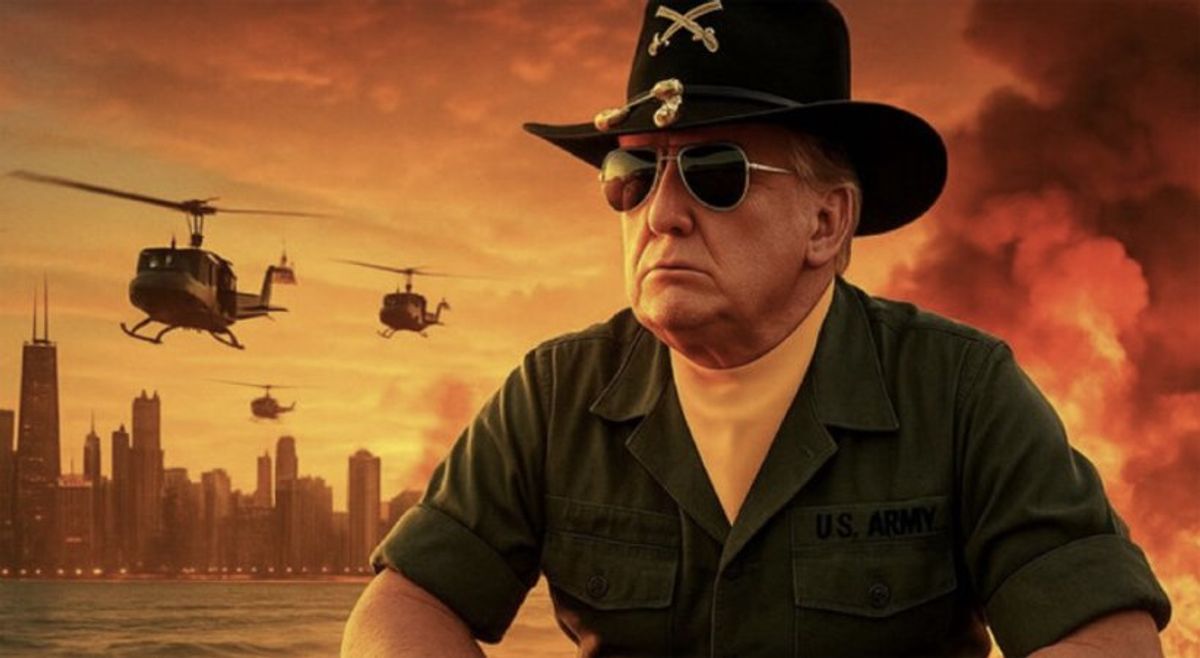
President Donald Trump ramped up his threats to enact a federal takeover of Chicago, Illinois on Saturday after sharing an image on social media depicting an AI-generated version of himself standing in front the city’s skyline, with military helicopters flying overhead and flames burning in the background.

The image included the phrase ‘Chipocalypse Now,” a reference to the 1979 war film “Apocalypse Now,” and a quote that reads “I love the smell of deportations in the morning,” another reference to one of the film’s most notable lines: “I love the smell of napalm in the morning.”

“Chicago about to find out why it’s called the Department of WAR,” another line plastered on the image reads.

Trump has ramped up threats to deploy federal officers to Chicago in recent weeks, having declared the city as the “worst and most dangerous city in the world, by far,” and that a federal takeover could “solve the crime problem fast.” The threats come in the wake of Trump’s ongoing takeover of Washington, D.C., which has seen thousands of federal officers and National Guard members, some armed with long rifles, patrolling the city’s streets.Democratic Illinois Gov. JB Pritzker has pushed back against Trump’s threats, labeling the president as a “wannabe dictator
,” and pledging to oppose any deployment of federal officers to his state’s capital.


WTF IS 'WOKEY'

'Amazingly stupid’: Trump shredded for claim US only lost wars because it got 'wokey'

Matthew Chapman
September 5, 2025 
RAW STORY


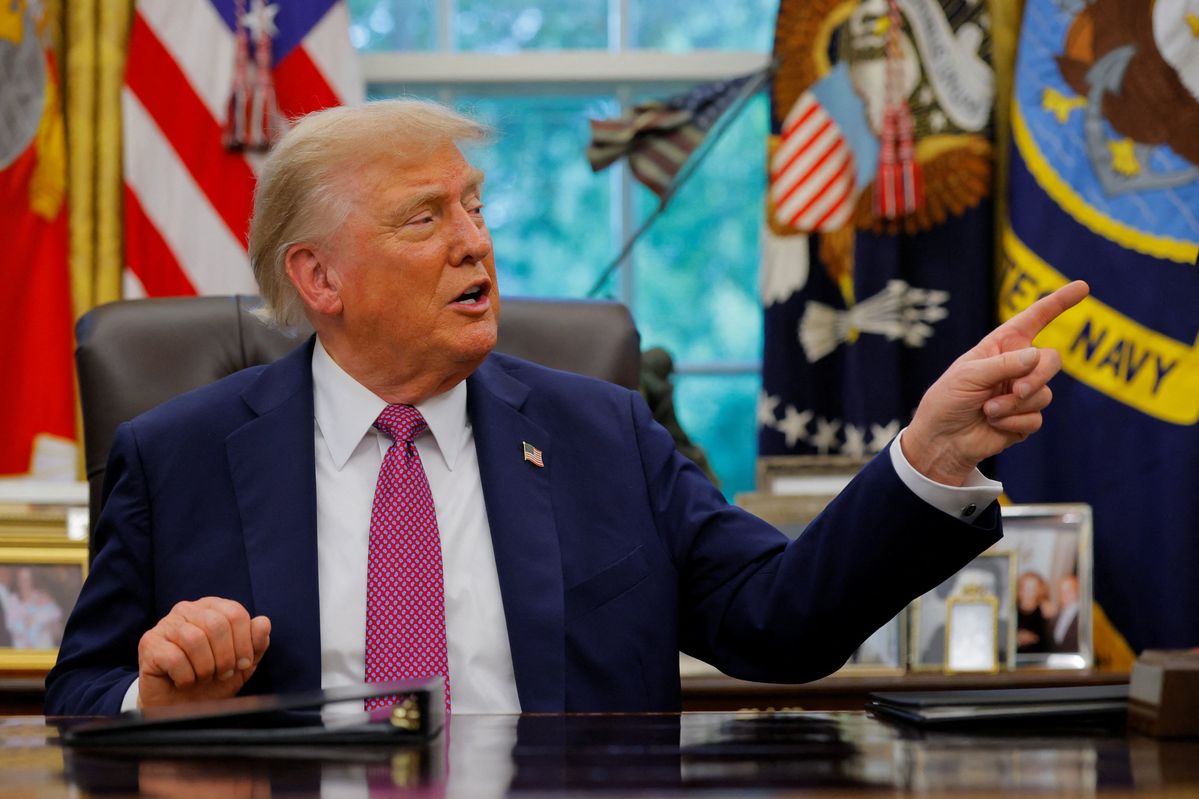
U.S. President Donald Trump speaks with the media in the Oval Office, at the White House in Washington, D.C., U.S., September 5, 2025. REUTERS/Brian Snyder

President Donald Trump triggered outrage on Friday during a signing of his executive order to rebrand the Department of Defense to the "Department of War," when he suggested the United States only loses wars due to "woke" cultural values

"We should have won every war," said Trump. "We could have won every war, but we really chose to be a very politically correct—wokey. We never wanted to win."

Commenters on social media tore into the president, with many noting that he used a questionable medical diagnosis to get out of serving in Vietnam, one of the wars America did actually lose

"This is, even for him, amazingly stupid and an insult to the thousands who died in Korea and Vietnam and the other conflicts we were too 'wokey' to win,"
wrote retired Naval War College professor Tom Nichols. "But then, can't expect any better from a man who thinks American war dead are 'suckers' and 'losers.'"

"Remember when he dodged the draft because of ... bone spurs?" wrote former MSNBC host and Zeteo News founder Mehdi Hasan.

"Yeah, Vietnam, a war famously lost because we were Too Woke," wrote American Immigration Council senior fellow Aaron Reichlin-Melnick.

"President who avoided combat because of 'bone spurs' and calls those who served suckers and losers has thoughts about war," wrote Huffington Post political correspondent S.V. Dáte.

"He would have called ending slavery woke," wrote Bridgeport, Pennsylvania, city councilman Tony Heyl.

"Not only is this an asinine thing to say, it’s also insulting. Nothing like an armchair quarterback, eh?" wrote the official account for The Seneca Project.


"I would love to hear what was 'wokey' to Trump about the loss in the Vietnam War. Too few bone spurs?" wrote University of North Georgia rhetoric professor Matthew Boedy


Stephen Miller boasts about 'rich resources' in nation targeted by Trump for regime change

Alexander Willis
September 6, 2025 
RAW STORY


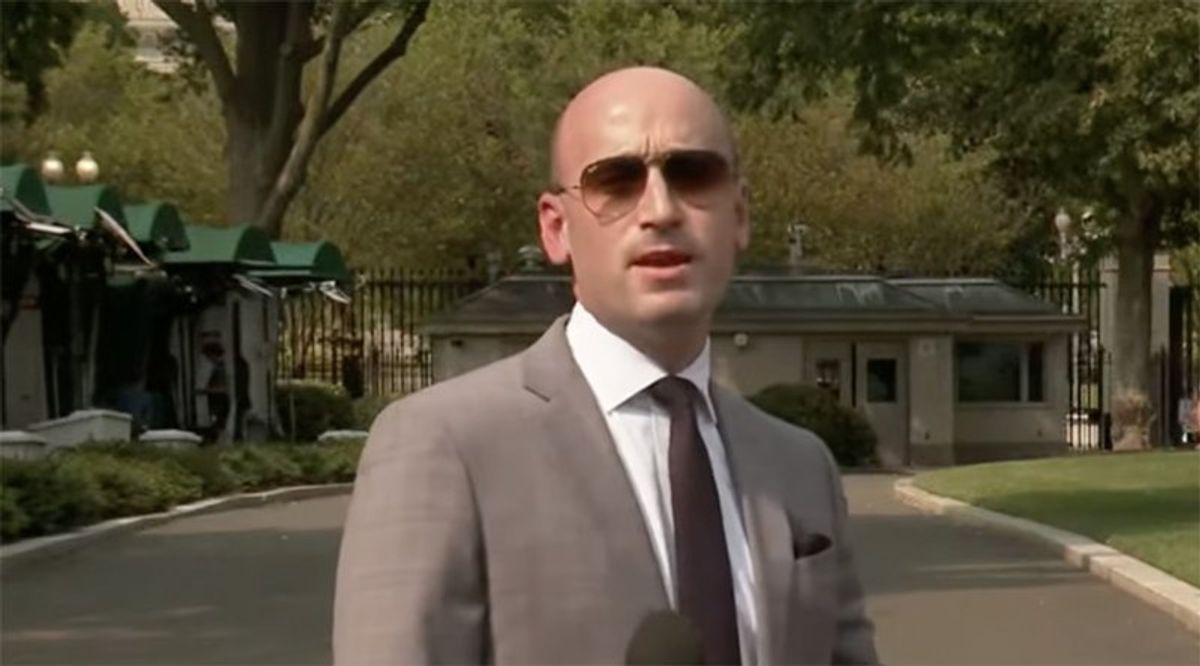
Stephen Miller (Screenshot)

White House Deputy Chief of Staff Stephen Miller couldn’t help but note Venezuela’s “rich resources and reserves” Saturday when speaking to a reporter in Washington, D.C., his comments made amid the Trump administration’s growing fixation on enacting regime change in the South American nation.

“It is a drug cartel that is running Venezuela; it is not a government, it is a drug cartel, a narco-trafficking organization that is running Venezuela,” Miller said, fielding questions from reporters. “The people of Venezuela have been suffering and struggling under the reality of a nation that is so rich in resources, so rich in reserves, that is run by (Venezuelan President Nicolas] Maduro, the head of the cartel.”

Tensions between the United States and Venezuela have risen in recent weeks, especially after the deadly U.S. precision strike this week on a supposed drug vessel heading toward American shores, an execution-style strike that has widely been condemned as amounting to murder.

President Donald Trump escalated tensions further when on Friday, he indicated that the United States would shoot down Venezuelan jets were they to fly over American naval ships, with at least eight warships and one submarine currently deployed off of Venezuela's coast.

“Many Americans may not realize that the drugs killing their kids are coming from Maduro; also, the criminal aliens killing their kids are coming from Maduro,” Miller continued.

“So he's sending his drugs, he is sending his killers, his assassins into our communities, and he's working directly with other designated foreign terrorist organizations like the [Revolutionary Armed Forces of Colombia], and all the Mexican drug cartels, so it's one continuous loop.”

Maduro was indicted by the Justice Department on narco-terrorism and drug trafficking charges in 2020, with the Trump administration issuing a $50 million bounty for his capture.

Given the Trump administration’s designation of drug cartels as terrorists, which permits the administration to carry out execution-style strikes on drug traffickers, a Trump official has admitted that Trump is keeping the idea of assassinating Maduro via strike “as an option.” Trump officials have also spoken favorably about the idea of enacting regime change in Venezuela.

“Maduro is an indicted drug trafficker, a fugitive from justice in America,” Miller said.

Watch the video below or use this link.

The GOP CDC assault began long before RFK's Senate car crash

The Conversation
September 5, 2025 


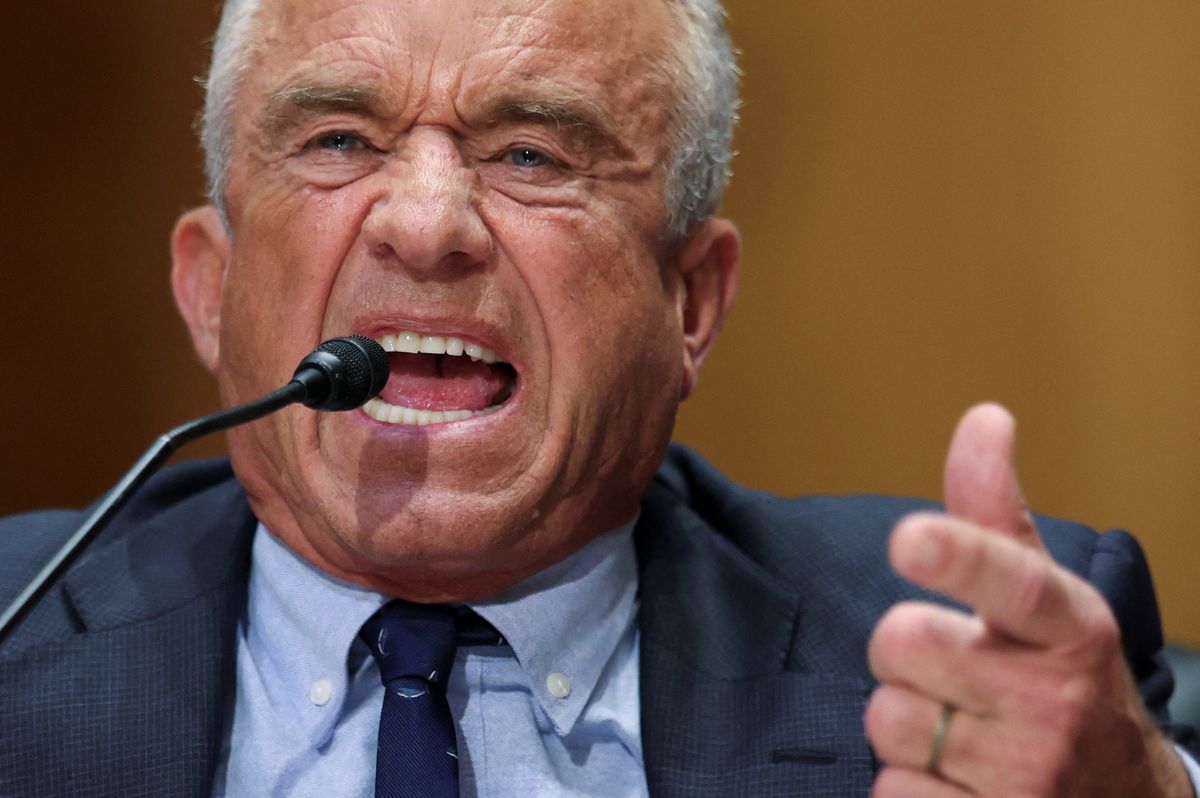
Robert F. Kennedy Jr. testifies before a Senate Finance Committee hearing. REUTERS/Jonathan Ernst

By Jordan Miller, Teaching Professor of Public Health, Arizona State University.

The Centers for Disease Control and Prevention (CDC), long considered the nation’s — if not the world’s — premier public health organization, is mired in a crisis that not only threatens Americans’ health but also its very survival as a leading public health institution.

The degree of this crisis was on full display during Health and Human Services Secretary Robert F. Kennedy Jr.’s Sept. 4, 2025, testimony before the U.S. Senate.

In the hearing, Kennedy openly criticized CDC professionals’ response to the COVID-19 pandemic, saying “the people at CDC who oversaw that process, who put masks on our children, who closed our schools, are the people who will be leaving.”

Kennedy’s hearing came on the heels of a contentious week in which Kennedy fired the CDC director, Susan Monarez, spurring 12 members of the Senate Finance Committee — 11 Democrats and independent Bernie Sanders — to call on Kennedy to resign from his position.

At least four top CDC leaders resigned following Monarez’s ouster, citing pressure from Kennedy to depart from recommendations based on sound scientific evidence.


I am a teaching professor and public health professional. Like many of my colleagues, the disruption happening at the CDC in recent months has left me scrambling to find alternate credible sources of health information and feeling deeply concerned for the future of public health.

The CDC’s unraveling

These leadership shakeups come on the heels of months of targeted actions aimed at unraveling the CDC’s structure, function and leadership as it has existed for decades.

The turmoil began almost as soon as President Donald Trump took office in January 2025, when his administration enacted sweeping cuts to the CDC’s workforce that health experts broadly agree jeopardized its ability to respond to emerging health threats.

Trump used executive orders to limit CDC employees’ communication with the public and other external agencies, like the World Health Organization.

Within weeks, he ordered as much as 10 percent of the overall workforce to be cut.

Soon after, Kennedy — who was newly appointed by Trump — began undoing long-standing CDC institutions, like the Advisory Committee on Immunization Practices, replacing all 17 of its members in a move that was widely denounced by health experts.

Critics pointed to a lack of qualifications for the new committee members, with more than half never having published research on vaccinations and many having predetermined hostility toward vaccines.

In June, more than 20 authoritative organizations, including the National Medical Association and American Academy of Pediatrics, expressed serious concerns for the health impacts of overhauling the advisory committee.

Monarez’s removal

Public health leaders had cheered the July confirmation of Monarez as the CDC’s new director, seeing her nomination as a welcome relief to those who value evidence-based practice in public health. Monarez is an accomplished scientist and career public servant.

Many viewed her as a potential voice of scientific wisdom amid untrained officials appointed by Trump, who has a track record of policies that undermine public health and science.

In her role as acting director, to which she was appointed in January, Monarez had quietly presided over the wave of cuts to the CDC workforce and other moves that drastically reshaped the agency and weakened the country’s capacity to steward the nation’s health.

Yet Monarez had “red lines” that she would not cross: She would not fire CDC leadership, and she would not endorse vaccine policies that ran contrary to scientifically supported recommendations.

According to Monarez, Kennedy asked her to do both in an Aug. 27 meeting. When she refused, he asked her to resign.

Her lawyers pushed back, arguing that only the president had the authority to remove her, stating: “When CDC Director Susan Monarez refused to rubber-stamp unscientific, reckless directives and fire dedicated health experts, she chose protecting the public over serving a political agenda. For that, she has been targeted.”

Ultimately, the White House made her dismissal official later that evening.

Agency in turmoil

Further exemplifying and deepening the crisis at the agency, on Aug. 8, a gunman who had expressed anger over COVID-19 vaccinations opened fire on CDC headquarters, killing a police officer.

Many health workers attributed this directly to misinformation spread by Kennedy. The shooting amplified tensions and made tangible the sense of threat under which the CDC has been operating over the tumultuous months since Trump’s second term began. One employee stated that “the CDC is crumbling.”

Public health experts, including former CDC directors, are sounding the alarm, speaking out about the precariousness of the agency’s position. Some are questioning whether the CDC can even survive.


Crisis of trust


Even before the most recent shock waves, Americans said they were losing trust and confidence in CDC guidance: In April, 44 percent of U.S. adults polled said that they will place less trust in CDC recommendations under the new leadership. This would undoubtedly undermine the U.S. response if the country faces another public health challenge requiring a rapid, coordinated response, like COVID-19.

In addition to installing new members on the vaccine advisory committee, Kennedy abruptly changed the recommendations for flu and COVID-19 vaccines without input from the CDC or the vaccine advisory committee, and contrary to data presented by CDC scientists.

Public health professionals and advocates are now warning the public that vaccine recommendations coming from the CDC’s Advisory Committee on Immunization Practices may not be trustworthy. They point to the lack of credibility in the review process for the new committee, the fact that members have made statements contrary to scientific evidence in the past, and failure to apply an evidence-to-recommendations framework as compromising factors. Critics of the committee even describe a lack of basic understanding of the science behind vaccines.

Health impacts are being felt in real time, with health care providers reporting confusion among parents as a result of the conflicting vaccine recommendations. Now, those who want to be vaccinated are facing barriers to access, with major retailers placing new limits on vaccine access in the face of federal pressure. This as vaccination rates were already declining, largely due to misinformation.

The end result is an environment in which the credibility of the CDC is in question because people are unsure whether recommendations made in the CDC’s name are coming from the science and scientists or from the politicians who are in charge.

Filling the gaps


Reputable organizations are working to fill the void created by the CDC’s precariousness and the fact that recommendations are now being made based on political will, rather than scientific evidence.

The American Academy of Pediatrics and the American College of Gynecology have both released recommended vaccination schedules that, for the first time, diverge from CDC recommendations.

And medical organizations are discussing strategies that include giving more weight to their recommendations than the CDC’s and creating pathways for clinicians to obtain vaccines directly from manufacturers. These measures would create workarounds to compensate for CDC leadership voids.

Some states, including California, Oregon, Washington and New Mexico, are establishing their own guidance regarding vaccinations. Public health scientists and physicians are attempting to preserve data and surveillance systems that the Trump administration has been removing. But independent organizations may not be able to sustain this work without federal funding.

What’s at stake

As part of its crucial work in every facet of public health, the CDC oversees larger-scale operations, both nationally and globally, that cannot simply be handed off to states or individual organizations. Some public health responses — such as to infectious diseases and foodborne illnesses — must be coordinated at the national level in order to be effective, since health risks are shared across state borders.

In a health information space that is awash with misinformation, having accurate, reliable health statistics and evidence-based guidelines is essential for public health educators like me to know what information to share and how to design effective health programs. Doctors and other clinicians rely on disease tracking to know how best to approach treating patients presenting with infections. The COVID-19 pandemic made clear the importance of laboratory science, a unified emergency response and rapid distribution of effective vaccines to the public.

One of the strengths of the American system of governance is its ability to approach challenges – including public health – in a coordinated way, having a federal level of cooperation that unifies state-level efforts.

The CDC has been the nation’s preeminent public health institution for more than eight decades as a result of its vast reach and unparalleled expertise. Right now, it’s all sitting at a precarious edge.
‘Serious misinterpretation’: Analysis finds right-wing SCOTUS justice’s book twists law and Bible


Matthew Chapman
September 5, 2025 
RAW STORY


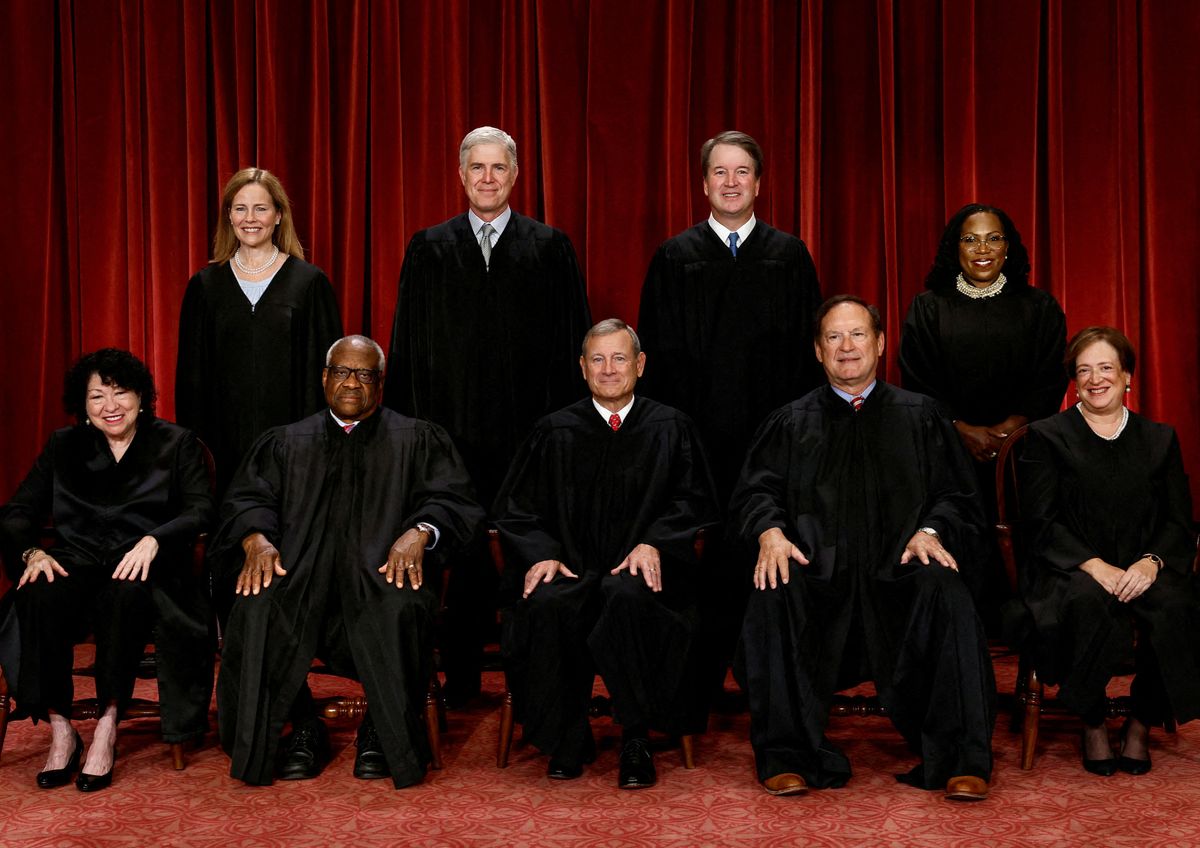
FILE PHOTO: U.S. Supreme Court justices pose for their group portrait at the Supreme Court in Washington, U.S., October 7, 2022. Seated (L-R): Justices Sonia Sotomayor, Clarence Thomas, Chief Justice John G. Roberts, Jr., Samuel A. Alito, Jr. and Elena Kagan. Standing (L-R): Justices Amy Coney Barrett, Neil M. Gorsuch, Brett M. Kavanaugh and Ketanji Brown Jackson. REUTERS/Evelyn Hockstein/File Photo

Supreme Court Justice Amy Coney Barrett's book manages not only to misinterpret the law, but also the Bible, wrote Steven Lubet in a scathing analysis for Slate published Friday.

Barrett's new book has come under fire for other controversies, including a passage in which she complains that overturning Roe v. Wade spoiled her vacation.

In one passage of the book, Barrett contrasted the role of American judges with that of the Biblical King Solomon, who in one famous story was presented with two women both claiming to be the mother of one infant. Solomon ordered the baby to be divided in half, knowing that the false mother would accept this and the true mother would relinquish custody rather than see it killed.

"To Barrett, 'Solomon’s wisdom came from within,' rather than from 'sources like laws passed by a legislature or precedents set by other judges,'" wrote Lubet. "His authority was 'bounded by nothing more than his own judgment.' In contrast, Barrett says, American judges, including Supreme Court justices, must apply the rules found 'in the Constitution and legislation,' without consideration of their personal values, no matter how Solomonic they may seem."

But this, Lubet wrote, is a "serious misinterpretation" of the Bible story.

"Solomon was neither making a moral judgment nor applying his own understanding of right and wrong. Instead, he was reaching a purely factual determination while carefully adhering to the background law," wrote Lubet. "The pure legal principle in the dispute, from which Solomon never strayed, was that the true mother must be awarded custody of the child. We might call that biblical common law, a rule beyond question. Thus, Solomon never considered the best interest of the child or the women’s respective nurturing abilities ... Solomon’s sole objective was to decide which woman was the actual mother and which was the mother of another boy, one who had passed away — his goal was not to invoke his personal concept of justice."

"Solomon then figured out how to expose the liar," wrote Lubet. "His threat to divide the baby was a credibility test, the equivalent of high-stakes cross-examination. It may well have been a bluff. The true mother’s immediate outcry was demeanor evidence, which allowed Solomon to render an accurate verdict, conforming to the underlying law."

That Barrett misunderstands this story is incredibly revealing, Lubet argued, because what she misinterpreted as Solomon rendering a personal belief was actually just him engaging in fact-finding — a standard and important part of any judge's ability to apply the law, including in the American legal system.

"Apart from three years as an associate at a law firm, she has spent her whole career in academia or appellate courts. It is entirely possible that she has never examined a witness at trial," wrote Lubet. "Accurate fact finding, however, is the essential first step in any judicial system, a process the justice mentions not at all." By contrast, "Justices Sonia Sotomayor, a former prosecutor, and Ketanji Brown Jackson, a former public defender, would not have made the same mistake. Their years of experience in the trial courts surely taught them that there is more to justice than a review of the appellate record."

"Like her mentor, the late Justice Antonin Scalia, Barrett claims to be a strict textualist," Lubet concluded. "It is therefore unsettling that even the Bible is not sacrosanct when she wants to make a point."
KULTURKAMPF

Artists facing '80% empty seats' or more at Kennedy Center after Trump takeover: report

Tom Boggioni
September 6, 2025 
RAW STORY


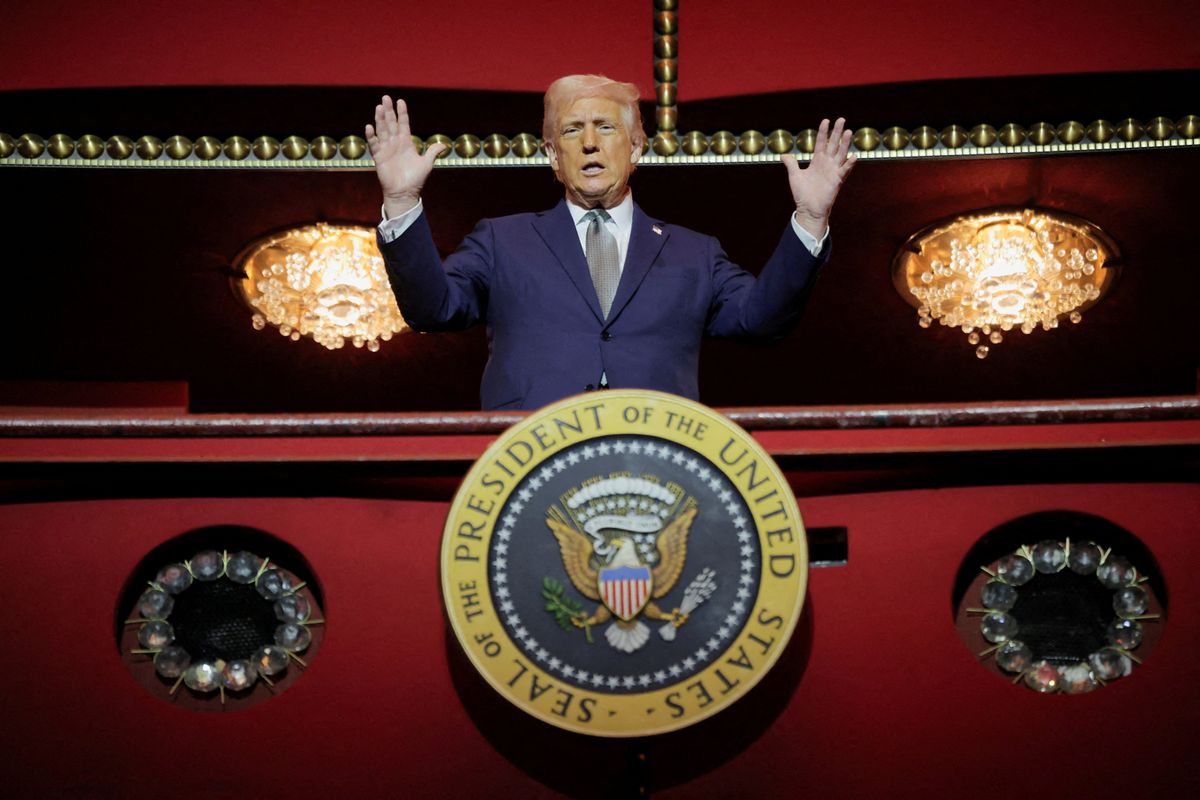
FILE PHOTO: U.S. President Donald Trump gestures while he poses for a picture at the presidential box at the Kennedy Center, in Washington, D.C., U.S., March 17, 2025. REUTERS/Carlos Barria/File Photo

The death spiral is continuing for the John F. Kennedy Memorial Center for the Performing Arts since Donald Trump’s takeover with ticket sales in free-fall, artist cancellations and now artists who are showing up are facing the prospect of rows upon rows of empty seats.

According to a new report from the Guardian’s Richard Luscombe, “Audiences are ‘voting with their feet to skip out’ on shows that would once have been packed,” with the popular Stuttgart Ballet faced with poor ticket sales that indicate only 20 percent of the seats will be filled.

The report notes that The Washingtonian is reporting, the ballet troupe is looking at “between 4 and 19% full based on reservations so far, and BodyTraffic, a Los Angeles troupe booked for two performances in the smaller Eisenhower Theatre at the end of the month, is only booked so far at 12% capacity.”

The venue has already been plagued by artists cancelling on the Kennedy, subscribers fleeing, after the president purged the board and installed loyalists intent on changing the type of entertainment being presented based upon the president’s tastes.

Speaking about the ticket sale collapse, one Kennedy Center employee could only utter “Yikes.”

According to Luscombe’s report, “The Washingtonian report paints a damning portrait of the health of the John F Kennedy Center for the Performing Arts in the months since its takeover by Trump, who last month announced he had ‘reluctantly’ agreed to personally host its annual arts awards signature show in December.”

The report notes that sources in Germany indicated the Stuttgart Ballet may cancel their appearance out of fear of poor turnout, adding, “The reported slump extends an already worrying slide in patronage. By June, the Kennedy Center had seen subscription sales fall by about $1.6m, or roughly 36%, compared with 2024.”


You can read more here.
475 Immigrants Arrested in Raid of Hyundai EV Plant in Georgia

A spokesperson for South Korea's foreign ministry said that "the economic activities of our companies investing in the US and the rights and interests of our nationals must not be unfairly violated."


A drone captured construction progress on the Hyundai Motor Group plant in Ellabell, Georgia in October 2023.
(Photo by Hyundai Motor Group)

Jessica Corbett
Sep 05, 2025
COMMON DREAMS

The South Korean Ministry of Foreign Affairs on Friday expressed "concern and regret" after US agents arrested 475 immigrants at a Hyundai electric vehicle plant in Ellabell, Georgia and turned them over to Immigration and Customs Enforcement.

ICE was among several agencies involved in "the largest single-site enforcement operation in the history of Homeland Security Investigations," Steven Schrank, the special agent in charge for HSI Atlanta, said during a Friday morning press conference.

The immigrants worked for a variety of companies and were arrested "as part of an ongoing criminal investigation into allegations of unlawful employment practices," Schrank explained. The probe continues, but no criminal charges are being filed at this time.

While Schrank only confirmed that a large number of those arrested on Thursday are South Koreans, a diplomatic source told the news agency Yonhap that the figure is over 300.

Yonhap also reported on a press briefing in which a spokesperson for South Korea's foreign ministry, Lee Jae-woong, said that "the economic activities of our companies investing in the US and the rights and interests of our nationals must not be unfairly violated."

"We conveyed our concern and regret through the US Embassy in Seoul today," Lee added.

According to The Associated Press:
Hyundai Motor Group, South Korea's biggest automaker, began manufacturing EVs a year ago at the $7.6 billion plant, which employs about 1,200 people, and has partnered with LG Energy Solution to build an adjacent battery plant, slated to open next year.

In a statement to The Associated Press, LG said it was "closely monitoring the situation and gathering all relevant details." It said it couldn't immediately confirm how many of its employees or Hyundai workers had been detained.

"Our top priority is always ensuring the safety and well-being of our employees and partners. We will fully cooperate with the relevant authorities," the company said.


Hyundai's South Korean office didn't respond to AP's requests for comment. Forbes highlighted that the raid comes shortly after the company "announced it would invest $26 billion in the US over the next three years," which is expected to create 25,000 jobs.

During the Friday press conference, Schrank appeared to try to distinguish these arrests from President Donald Trump's mass deportation agenda, saying that "this was not an immigration operation where agents went into the premises, rounded up folks, and put them on buses—this has been a multimonth criminal investigation."

However, Tori Branum, a firearms instructor and Republican candidate for Georgia's 12th Congressional District who is publicly taking credit for the raid, made the connection clear.

"For months, folks have whispered about what's going on behind those gates," Branum wrote on Facebook. "I reported this site to ICE a few months ago and was on the phone with an agent."

"This is what I voted for—to get rid of a lot of illegals," she told Rolling Stone after the arrests. "And what I voted for is happening."

In addition to raids of other workplaces such as farms in California, Trump's mass deporation agenda has featured an effort to illegally deport hundreds of children to Guatemala over Labor Day weekend, masked agents in plain clothes ripping people off US streets, arresting firefighters while they were on the job, revoking Temporary Protected Status for various foreign nationals, and locking up immigrants in horrific conditions in facilities including "Alligator Alcatraz."

American Immigration Council legal director Michelle Lapointe, who is based in the Atlanta area, said in a Friday statement that "these raids don't make anyone safer. They terrorize workers, destabilize communities, and push families into chaos."

"This historic raid may make dramatic headlines, but it does nothing to fix the problems in our broken immigration system: a lack of legal pathways and a misguided focus on punishing workers and families who pose no threat to our communities," she added. "Raiding work sites isn't reform, it's political theater at the expense of families, communities, and our economy."

This article was updated with comment from the American Immigration Council.


Trump to Sidestep Cold War Arms Control Treaty to Sell More Drones: Report

The policy shift—which began during the first Trump administration—came after lobbying from US drone makers and amid stiff competition from Chinese, Israeli, and Turkish manufacturers.


A US Air Force MQ-9 Reaper drone, armed with GBU-12 Paveway II laser guided munitions and AGM-114 Hellfire missiles and piloted by Col. Lex Turner, flies a combat mission over southern Afghanistan in this undated photo..
(Photo by Lt. Col. Lex Turner/US Air Force)

Brett Wilkins
Sep 05, 2025
COMMON DREAMS


After years of lobbying from US weapons makers, President Donald Trump is reportedly set to implement his first-term reinterpretation of a Cold War-era arms control treaty in order to sell heavy attack drones to countries including Saudi Arabia, according to a report published Friday.

In July 2020, Trump announced that his administration would reclassify unmanned aerial vehicles (UAVs) with flight speeds under 500 miles per hour—including General Atomics' MQ-1 Predator and MQ-9 Reaper and Northrop Grumman's Global Hawk—as exempt from certain restrictions under the Missile Technology Control Regime (MTCR).

Signed by the United States in 1987 during the administration of President Ronald Reagan, the 35-nation MTCR "seeks to limit the risks of proliferation of weapons of mass destruction by controlling exports of goods and technologies that could make a contribution to delivery systems" for such weapons, as the US State Department website explains.

The end of Trump's first term limited his first administration's implementation of the MTCR policy shift, which was not continued under former President Joe Biden, who adopted a somewhat stricter stance on arms exports to some gross human violators including Saudi Arabia, but not others—most notably Israel.

Now, a US official and four people familiar with the president's plan tell Reuters that Trump is preparing to complete the MTCR revision, a move that "would unlock the sale of more than 100 MQ-9 drones to Saudi Arabia, which the kingdom requested in the spring of this year and could be part of a $142 billion arms deal announced in May."

As Reuters reported:
Under the current interpretation of the MTCR, the sale of many military drones is subject to a "strong presumption of denial" unless a compelling security reason is given and the buyer agrees to use the weapons in strict accordance with international law.

The new policy will allow General Atomics, Kratos, and Anduril, which manufacture large drones, to have their products treated as "Foreign Military Sales" by the State Department, allowing them to be easily sold internationally, according to a US official speaking to Reuters on condition of anonymity.

This effort is the first part of a planned "major" review of the US Foreign Military Sales program, the official said.

The US State Department did not respond to Reuters' request for comment on the policy shift.

Trump's move comes as US arms makers face stiff competition from Chinese, Israeli, and Turkish drone manufacturers. Neither China nor Israel are signatory to the MTCR, and Turkey, which did sign the agreement, features lighter and shorter-range UAVs not subject to the same restrictions as the heavier Reaper.

The US official who spoke to Reuters said the new guidelines will allow the US "to become the premier drone provider instead of ceding that space to Turkey and China."

Daryl Kimball, director of the Arms Control Association—a longtime critic of MTCR revision—warned that Trump's planned reinterpretation "would be a mistake."
Why Is Big Tech Using the Energy of the Past to Power the Future?

As these companies invest billions in technology for AI, they must re-up investments in renewables to power our future and protect our communities.


An abstract image shows a data. center.
(Photo: Yuichiro Chino/Getty Images)
Sep 06, 2025
OtherWords


AI is everywhere. But its powerful computing comes with a big cost to our planet, our neighborhoods, and our wallets.

AI servers are so power hungry that utilities are keeping coal-fired power plants that were slated for closure running to meet the needs of massive servers. And in the South alone, there are plans for 20 gigawatts of new natural-gas power plants over the next 15 years—enough to power millions of homes—just to feed AI’s energy needs.

Multibillion dollar companies like Microsoft, Google, Amazon, and Meta that previously committed to 100% renewable energy are going back to the Jurassic Age, using fossil fuels like coal and natural gas to meet their insatiable energy needs. Even nuclear power plants are being reactivated to meet the needs of power-hungry servers.

At a time when we need all corporations to reduce their climate footprint, carbon emissions from major tech companies in 2023 have skyrocketed to 150% of average 2020 values.

AI data centers also produce massive noise pollution and use huge amounts of water. Residents near data centers report that the sound keeps them awake at night and their taps are running dry.

Many of us live in communities that either have or will have a data center, and we’re already feeling the effects. Many of these plants further burden communities already struggling with a lack of economic investment, access to basic resources, and exposure to high levels of pollution.

To add insult to injury, amid stagnant wages and increasing costs for food, housing, utilities, and consumer goods, AI’s demand for power is also raising electric rates for customers nationwide. To meet the soaring demand for energy that AI data servers demand, utilities need to build new infrastructure, the cost of which is being passed onto all customers.

These companies have the know-how and the wealth to power AI with wind, solar, and batteries—which makes it all the more puzzling that they’re relying on fossil fuels to power the future.

A recent Carnegie Mellon study found that AI data centers could increase electric rates by 25% in Northern Virginia by 2030. And NPR recently reported that AI data centers were a key driver in electric rates increasing twice as fast as the cost of living nationwide—at a time when 1 in 6 households are struggling to pay their energy bills.

All of these impacts are only projected to grow. AI already consumes enough electricity to power 7 million American homes. By 2028, that could jump to the amount of power needed for 22% of all US households.

But it doesn’t have to be this way.

AI could be powered by renewable energy that is nonpolluting and works to reduce energy costs for us all. The leading AI companies, who have made significant climate pledges, must lead the way.

Microsoft, Google, Amazon, and Meta have all made promises to the communities they serve to tackle climate and pollution. They all have climate pledges. And they have made significant investments in renewable energy in the past.

Those investments make sense, since renewables are the most affordable form of electricity. These companies have the know-how and the wealth to power AI with wind, solar, and batteries—which makes it all the more puzzling that they’re relying on fossil fuels to power the future.

If these corporate giants are to be good neighbors, they first need to be open and honest about the scope and scale of the problem and the solutions needed.

As these companies invest billions in technology for AI, they must re-up investments in renewables to power our future and protect our communities. They must ensure that communities have a real voice in how and where AI data centers are built—and that our communities aren’t sacrificed in the name of profits.

This column was distributed by OtherWords.


Dan Howells is the climate campaigns director at Green America.
Full Bio >
Todd Larsen is Green America’s executive co-director.
Full Bio >

AI crossroads


OPINION
Asad Baig 
September 5, 2025
DAWN

IT’S earnings season. Once again, the markets are moving to the rhythm set by the ‘Magnificent Seven’ dominating the Nasdaq. Their numbers are in, and the mood on Wall Street is electric. Much of that excitement, let’s be honest, is about just one thing: AI.

What started as a buzzword a few years ago has turned into a full-blown economic engine. Investors are no longer just buying into hype, but the results. Nvidia has pos­t­­ed a staggering year-over-year revenue inc­rease of nearly 70 per cent, underscoring the explosive demand for its AI chips. Meta is investing heavily in AI for its core ad fu­­nctionality, boosting engagement, margins and investor confidence through more efficient monetisation. Microsoft, Amazon, Go-ogle, they are all re-architecting their business models around AI, and the market is rewarding them with soaring valuations.

The logic is simple: the future has arrived early, and investors have already priced in the gains, undermining the ‘bubble theory’, which suggests that the AI-based company valuations are inflated without real substance and could burst like a figurative bubble. Much like the Dot Com crash of the early 2000s.

But the earnings of the ‘Mag 7’ tell another story. They signal that AI has moved beyond being the next big thing, to the thing. And we are only beginning to tap its full potential.


Critical gaps risk undermining the AI policy’s promise.

With the US gradually easing chip export restrictions to China, a new phase of AI acceleration is taking shape. Automation is giving way to autonomy, and cars, drones and infrastructure systems are beginning to operate as intelligent agents, capable of learning, adapting and coordinating with other machines in real time.

The next AI wave will reinvent entire sectors. Generative design in manufacturing. AI-discovered drugs. Language models embedded in judicial, health and financial systems. Smart cities built not around traffic lights but predictive analytics. If this feels like science fiction, you haven’t been paying attention. We are moving fast, past the age of data, deep into the age of autonomous decisions.

Now here is the uncomfortable part: are we as a country ready for any of this? The answer is complicated.

On one hand, the newly released National AI Policy signals intent: it outlines large-scale commitments, from training a million professionals in AI and related technologies to integrating AI into key areas of governance, healthcare, education and agriculture. The policy envisions the use of AI to streamline civic services, enhance public sector efficiency and enable data-driven decision-making at scale. It also proposes the establishment of oversight bodies to ensure ethical deployment, data privacy and algorithmic accountability, an attempt to build a governance framework around a rapidly evolving technology.

In essence, the document offers a blueprint for a future where AI moves beyond being an abstract innovation reserved for elites or those who can afford it, and beco­mes a foundational part of national infrastructure and a key driver of state capacity.

On the other hand, several critical gaps risk undermining the policy’s promise. First, while the vision is bold, the execution framework is vague. Ambitious targets, like training a million people or deploying national-scale civic AI projects, lack operational detail, funding clarity and realistic timelines. Without institutional capacity-building, these goals may remain rhetorical.

Second, the policy assumes that ministries, boards and provincial departments will be able to digitise, standardise and share data rapidly. However, it does not fully address existing challenges related to fragmented syst­ems, limited inte­roperability and bureaucratic hurdles that may im­­pede effective im­­­-plementation.

Third, it does­n’t take into acco­unt geopolitical constraints. With ongoing chip exp­ort controls and rising global competition over compute, Pakistan’s lack of sovereign AI infrastructure, whether in silicon, data or foundational models, poses a major strategic vulnerability. Without plans to build resilience, the country risks dependence without capability.

And perhaps the most important question is this: if a policy repeatedly invokes ethics and responsible use but does not clarify, in concrete, actionable terms, how AI systems will safeguard fundamental rights such as privacy, freedom of expression, and protection from discrimination (especially where regulation operates in legally ambiguous digital spaces, and where explicit safeguards against algorithmic bias, data misuse or non-transparent decision-making remain absent or vague), can such governance truly protect the most marginalised?

And if not, should it not be anchored much more firmly and explicitly in constitutional and human rights principles? Food for thought.

The writer is the founder of Media Matters for Democracy.


Published in Dawn, September 5th, 2025