Sunday, September 07, 2025

Egypt says describing displacement of Palestinians as voluntary is 'nonsense'

Reuters
Sat, September 6, 2025


FILE PHOTO: Egyptian Foreign Minister Badr Abdelatty visits Cyprus

CAIRO (Reuters) -Egyptian Foreign Minister Badr Abdelatty, whose country is a key mediator in efforts to end the Gaza war, said on Saturday that describing the displacement of Palestinians as voluntary was "nonsense".

Israel earlier called on Gaza City residents to leave for the south, as its forces advance deeper into the enclave’s largest urban area.

"If there is a manmade famine (in Gaza), it is to push residents out of their land. It is nonsense to say that this is voluntary displacement," Abdelatty said in a joint press conference with the commissioner-general of the U.N. agency for Palestinian refugees, Philippe Lazzarini.

Israeli Prime Minister Benjamin Netanyahu has supported the idea that Palestinians in Gaza should be allowed to voluntarily leave and suggested that other countries should accept them.

Netanyahu's office said on Friday that he had spoken about the basic human right of every individual to choose where they live, particularly during times of war.

The Egyptian minister also said he spoke with U.S. special envoy Steve Witkoff on Friday and discussed intensifying efforts to implement the latest ceasefire proposal.

He blamed Israel for what he described as its intransigence over the delay in reaching a ceasefire.

Hamas agreed in August to a proposal for a 60-day ceasefire with Israel that included the return of half the hostages held in Gaza and Israel's release of some Palestinian prisoners.

An Egyptian official source said the proposal accepted by Hamas included a suspension of Israeli military operations for 60 days and outlined a framework for a comprehensive deal to end the nearly two-year-old conflict.

Netanyahu said days later that Israel would immediately resume negotiations for the release of all hostages held in Gaza and an end to the war, but on terms acceptable to Israel.

(Reporting by Ahmed Tolba and Jaidaa Taha, additional reporting by Alexander Cornwell; Editing by Jan Harvey and Alex Richardson)
'Trump's legacy crumbles', Israelis call on U.S. President to end Gaza war

Alexander Cornwell
Sat, September 6, 2025
REUTERS


Rally in Jerusalem to release all hostages and ending the war in Gaza

TEL AVIV (Reuters) -Thousands of Israelis rallied in Tel Aviv on Saturday night, issuing direct appeals to U.S. President Donald Trump to force an end to the Gaza war and secure the release of the hostages.

Protesters packed a public square outside the military headquarters, waving Israeli flags and holding placards with images of the hostages. Some carried signs, including one that read: 'Trump’s legacy crumbles as the Gaza war persists'.

Another said: "PRESIDENT TRUMP, SAVE THE HOSTAGES NOW!"

"We think that Trump is the only man in the world who has authority over Bibi, that can force Bibi to do this," said Tel Aviv resident Boaz, 40, referring to the Israeli prime minister.

There is growing despair among many Israelis at Prime Minister Benjamin Netanyahu who has ordered the military to capture a major urban centre where hostages may be held.

Families of the hostages and their supporters fear the assault on Gaza City could endanger their loved ones, a concern the military leadership shares, according to Israeli officials.

Orna Neutra, the mother of an Israeli soldier who was killed on October 7, 2023 and whose body is being held in Gaza by militants, accused the government of abandoning its citizens.

"We truly hope that the United States will push both sides to finally reach a comprehensive deal that will bring them home," she told the rally. Her son, Omer, is also American.

Tel Aviv has witnessed weekly demonstrations that have grown in size, with protesters demanding that the government secure a ceasefire with Hamas to obtain the release of hostages. Organisers said Saturday night's rally was attended by tens of thousands. A large demonstration was also held in Jerusalem.

There are 48 hostages held in Gaza. Israeli officials believe that around 20 are still alive. Palestinian militants abducted 251 people from Israel on October 7, 2023, when Hamas led its attack. Most of the hostages who have been released were freed after indirect negotiations between Israel and Hamas.

Trump had pledged a swift end to the war in Gaza during his presidential campaign, but nearly eight months into his second term, a resolution has remained elusive. On Friday, he said that Washington was engaged in "very deep" negotiations with Hamas.

Israeli forces have carried out heavy strikes on the suburbs of Gaza City, where, according to a global hunger monitor, hundreds of thousands of Palestinians are facing famine. Israeli officials acknowledge that hunger exists in Gaza but deny that the territory is facing famine. On Saturday, the military warned civilians in Gaza City to leave and move to southern Gaza.

There are hundreds of thousands of Palestinians sheltering in the city that was home to around a million before the war.

A video released by Hamas on Friday featured Israeli hostage Guy Gilboa-Dalal, 24, saying that he was being held in Gaza City and feared being killed by the military's assault on the city. Rights groups have condemned such videos of hostages as inhumane. Israel says that it is psychological warfare.

The war has become unpopular among some segments of Israeli society, and opinion polls show that most Israelis want Netanyahu's right-wing government to negotiate a permanent ceasefire with Hamas that secures the release of the hostages.

"The war has no purpose at all, except for violence and death," said Boaz from Tel Aviv. Adam, 48, said it had become obvious that soldiers were being sent to war for "nothing".

Tens of thousands of Palestinians have been killed by the Israeli military since it lauched its retaliatory war after Hamas fighters attacked Israel from Gaza in October 2023. Around 1,200 people were killed in that attack on southern Israel.

Hamas has offered to release some hostages for a temporary ceasefire, similar to terms that were discussed in July before negotiations mediated by the U.S. and Arab states collapsed.

The militant group, which has ruled Gaza for nearly two decades but today controls only parts of the enclave, on Saturday once again said that it would release all hostages if Israel agreed to end the war and withdraw its forces from Gaza.

Netanyahu is pushing for an all-or-nothing deal that would see all of the hostages released at once and Hamas surrendering.

The prime minister has said Gaza City is a Hamas stronghold and capturing it is necessary to defeat the Palestinian militant group, whose October 2023 attack on Israel led to the war.

Hamas has acknowledged it would no longer govern Gaza once the war ends but has refused to discuss laying down its weapons.

(Reporting by Alexander CornwellEditing by Nick Zieminski)
After largely ignoring suffering in Gaza, Israeli media start to report on Palestinian hardships


MELANIE LIDMAN
Sat, September 6, 2025 


FILE - An Israeli activist bangs a pot with a wooden spoon to protest the starvation of Palestinian civilians in the Gaza Strip, outside the U.S. Embassy branch office in Tel Aviv, Israel, July 24, 2025. (AP Photo/Maya Alleruzzo, File)ASSOCIATED PRESS

FILE - People take part in a protest demanding the immediate release of all hostages held by Hamas and calling for an end to the war in the Gaza Strip, in Tel Aviv, Israel, Tuesday, Aug. 26, 2025. (AP Photo/Ohad Zwigenberg, File)ASSOCIATED PRESS

FILE - A poster depicting Israeli hostage Alon Ohel is displayed in Re'im, southern Israel, at the Gaza border, Feb. 26, 2024, at a memorial site for the Nova music festival site where he was kidnapped by Hamas on Oct. 7, 2023. (AP Photo/Maya Alleruzzo, File)ASSOCIATED PRESS

FILE - People hold photos of Palestinian children killed during Israeli military operations in the Gaza Strip as they call for an end to the war and to the starvation of Palestinians, during a protest in Tel Aviv, Israel, Saturday, Aug. 23, 2025. (AP Photo/Maya Levin, File)ASSOCIATED PRESS

FILE - Palestinians run for cover during an Israeli airstrike on a high-rise building in Gaza City, Friday, Sept. 5, 2025, after the Israeli army issued a warning. (AP Photo/Yousef Al Zanoun, File)ASSOCIATED PRESS


TEL AVIV, Israel (AP) — The war in the Gaza Strip is starting to look different these days on the Israeli news.

For most of the past two years, television stations in Israel have paid little attention to suffering in Gaza, giving viewers a steady stream of stories about Israeli heroism, the agony of hostages’ families and the deaths of soldiers in combat.

But that is changing. In recent months, some Israeli stations have begun to share graphic images of malnourished children and a few deeply reported stories about the difficulties of daily life for Palestinians.

This subtle shift comes as Israel faces unprecedented global outrage over the ongoing war, and it reflects deep divisions over whether the military offensive should be halted, though the growing protests and the media coverage have had little effect on Israel’s policies.

“It’s not just truly caring about the situation in Gaza, but also from an Israeli perspective, are we acting correctly in a way that serves the aims of this war?” said Eran Amsalem, a communications professor at Israel’s Hebrew University.

Prime Minister Benjamin Netanyahu has largely ignored a mass movement calling for an end to the war that is focused on returning the hostages. After the Oct. 7, 2023, attack by Hamas and two years of regional fighting, appeals on behalf of Palestinians have even less traction.

The shock of Oct. 7

The first images from the war were of Hamas-led militants storming the border and marauding through Israeli army bases and farming communities. Footage out of Gaza showed people celebrating as hostages were paraded through the streets, bloodied and beaten.

Around 1,200 people, mostly civilians, were killed, and 251 taken hostage. Forty-eight remain in Gaza, around 20 of them believed to be alive, after most of the rest were returned in ceasefires or other deals.

It was the worst attack ever carried out on Israel’s homefront and still dominates local newscasts. In the early months, Israelis rallied around the flag after what some referred to as their 9/11, while international media quickly shifted focus to the invasion of Gaza.

“During most of the war, the Israeli media really reported very little on the suffering in Gaza or the hunger or destruction,” said Raviv Drucker, a prominent Israeli news anchor. “If they did report it, it’s only from the Israeli perspective," he explained, in terms of how effective it was in destroying Hamas.

Israel has barred international journalists from Gaza since the start of the war, outside of visits organized by the military. The U.S.-based Committee to Protect Journalists says it’s the deadliest conflict for reporters the group has ever documented, with at least 189 Palestinian journalists killed by Israeli fire.

“It’s a strange war, because it’s the 21st century, and everyone has a phone to broadcast,” Drucker said. “But there’s no one on the ground, so you can’t say, ‘There’s someone on the ground that I trust.’”

The perils of highlighting Gaza suffering


Some newscasters who have highlighted the humanitarian catastrophe have faced backlash.

Yonit Levi, a prominent news anchor known for her cool demeanor, made an uncharacteristic comment during a report in July about international media coverage of the famine.

“Maybe it’s time to understand that this is not a failure of public diplomacy, but a moral failure, and to start from there,” she said. Levi, who declined to speak to The Associated Press, was called a “Hamas spokesperson” by an analyst on the pro-Netanyahu Channel 14, and a right-wing activist accused her of “spitting in the face of Israeli soldiers.”

Commentators from right-wing outlets, including Channel 14, regularly cheer the killing of Palestinians and the demolition of their homes, saying there are no innocent civilians in Gaza and that the military should act with even greater force.

The offensive has killed over 64,000 Palestinians, according to the Gaza Health Ministry, which does not say how many were civilians or combatants. The ministry is part of the Hamas-run government and staffed by medical professionals. Its figures are seen as reliable by U.N. agencies and many independent experts. Israel disputes the figures but has not provided its own.

Zvi Yehezkeli, an Arab affairs correspondent for Israel’s i24 TV, welcomed the killing of five journalists in an Israeli strike on a hospital last week, accusing them — without evidence — of working with Hamas to disseminate fake news harmful to Israel. “Better late than never,” he said.

The Israeli military has said none of the journalists, including Mariam Dagga, who worked for the AP and other publications, were suspected militants, and it denies targeting them.

Signs of change

Still, the coverage has slightly shifted in recent weeks, with some longer stories about Palestinians appearing in major outlets.

Israeli journalists have given more airtime to the starvation crisis fueled in part by Israel’s 2 1/2 month ban on all humanitarian aid — including food and medicine — earlier this year.

Mainstream TV news programs now feature a few interviews with Palestinians in Gaza, though digitally altered to preserve the safety of those who speak to Israeli media despite pressure from Hamas. But those stories are still far outweighed by a focus on domestic issues.

Nir Hasson and his colleagues at Israel’s left-leaning Haaretz newspaper have reported extensively on the Palestinians both before and during the war, in articles that are frequently critical of Israel’s conduct. But it’s an outlier in the current media landscape.

“After Oct. 7, there’s no doubt that something was broken, and it became completely illegitimate to deal with the pain of the other side,” Hasson said


“But I think the Israeli public is more mature than the media gives them credit for,” he added. “I think the public has an ability to listen. I think the media is censoring itself too much.”

___

Sanders, Mamdani Bring 'Fighting the Oligarchy' Tour to Brooklyn

Sanders blasted Democratic Party leaders for withholding their support from Zohran Mamdani


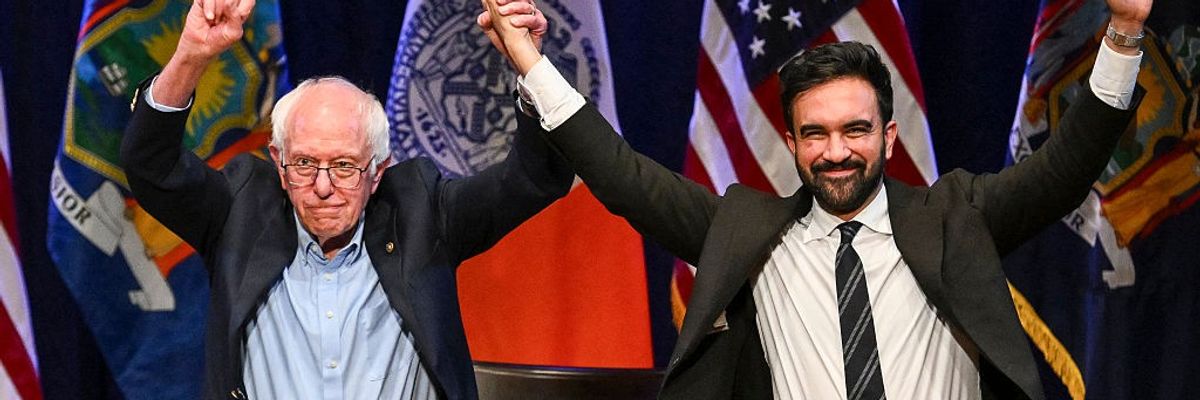
US Senator Bernie Sanders (I-VT) and New York City Mayoral candidate Zohran Mamdani hold hands during the town hall "Fighting Oligarchy: A Town Hall on Making New York City Affordable" at Brooklyn College in the Brooklyn borough of New York City on September 6, 2025. (Photo by ANGELA WEISS/AFP via Getty Images)

Common Dreams Staff
Sep 07, 2025

U.S. Senator Bernie Sanders (I-VT) has been crisscrossing the country on his Fighting the Oligarchy Tour, a series of fiery town halls meant to rally progressive voices from coast to coast. On Saturday night, the movement came home for Sanders, as he returned to his alma mater, Brooklyn College, to share the stage with New York City mayoral hopeful Zohran Mamdani in a packed town hall that echoed with calls for change.

Watch Saturday night's rally here:


Sanders blasted Democratic Party leaders for withholding their support from Zohran Mamdani, hailing Mamdani instead as “the future of the Democratic Party.”

“I find it hard to understand how the major Democratic leaders of New York state are not supporting the Democratic candidate,” Sanders said. “If a candidate started at 2% in the polls, gets 50,000 volunteers, creates enormous excitement, gets young people involved in the political process, gets nontraditional voters to vote, Democratic leaders would be jumping up and down!”

“So we’ve got another fight on our hands,” Mr. Sanders said. “And that is the future of the Democratic Party.”

Sanders and Mamdani turned their fire on Donald Trump’s agenda and the wealthy donors bankrolling efforts to derail Mamdani’s campaign. Sanders warned that America’s richest wield far too much influence, casting the mayoral race as “a test case of whether or not democracy can prevail.”

Sanders highlighted that Mamdani’s rising popularity—and the White House’s backlash—were signs of a progressive wave gaining unstoppable momentum.

“What they fear is Mamdani becoming a model for what could sweep across the country,” Sanders told the cheering supporters.


80 Years Ago, A Jewish Radical and Two Negro League Stars Led a Crusade to Integrate Baseball That Paved the Way for Jackie Robinson

The little known story about Sam Nahem, Leon Day, and Willard Brown who in 1945 played on a field in the shadow of Adolph Hitler's Nazi Germany and broke down historic barriers.


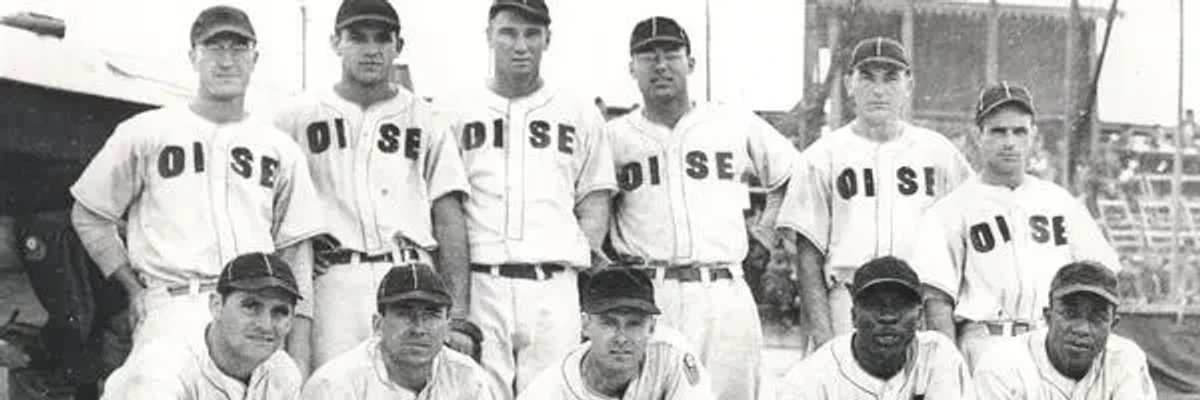
The Oise All-Stars featuring Willard Brown (front row, 2nd from right) and Leon Day (far right, front row), both of whom are Cooperstown Enshrinees. Sam Nahem is in the back, far left

(Image source: Baseball in Wartime)

Peter Dreier
Sep 07, 2025
Common Dreams

Eighty years ago this week—on September 8, 1945—a little-known episode in the struggle to challenge racial segregation took place in, of all places, Germany’s Nuremberg Stadium, where Adolf Hitler had previously addressed Nazi Party rallies. It was led by Sam Nahem, a left-wing Jewish pitcher who had a brief career in the major leagues, and included two Negro League stars, Leon Day and Willard Brown, who, like other African Americans, were banned from major league teams.

Their efforts were part of the wider “Double Victory” campaign during the war to beat fascism overseas and racism and anti-Semitism at home.

For more than a decade before Jackie Robinson broke the sport’s color line in 1947, black newspapers, civil rights groups, progressive white activists and sportswriters, labor unions, and radical politicians waged a sustained protest movement to end Jim Crow in baseball. They believed that if they could push the nation’s most popular sport to dismantle its color line, they could make inroads in other facets of American society. They picketed at big league ballparks, wrote letters to team owners and Baseball Commissioner Kenesaw Mountain Landis demanding tryouts for Black athletes, and interviewed white players and managers, most of whom expressed a willingness to integrate major league rosters. Most white newspapers ignored the Negro Leagues, but black newspapers (and the Communist Party’s Daily Worker) covered their stars and games, including exhibition contests between Black teams and teams comprised of white major leaguers, many of which were won by Negro League players.

Nahem’s parents immigrated to America from Aleppo, Syria in 1912. Born in New York City in 1915, Nahem, one of eight siblings, grew up in a Brooklyn enclave of Syrian Jews. He spoke Arabic before he learned English.

Nahem demonstrated his rebellious streak early on. When he was 13, Nahem reluctantly participated in his Bar Mitzvah ceremony, but refused to continue with Hebrew school classes after that because “it took me away from sports.” To further demonstrate his rebellion, that year he ended his Yom Kippur fast an hour before sundown. Recalling the incident, he called it “my first revolutionary act.”

The next month—on November 12, 1928—Nahem’s father, a well-to-do importer-exporter, traveling on a business trip to Argentina, was one of over 100 passengers who drowned when a British steamship, the Vestris, sank off the Virginia coast. Within a year, the Great Depression had arrived, throwing the country into turmoil. With his father dead, Nahem’s family could have fallen into destitution.

“Fortunately we sued the steamship company and won enough money to live up to our standard until we were grown and mostly out of the house,” Nahem recalled. He remembered how, at age 14, he “used to haul coal from our bin to relatives who had no heat in the bitterly cold winters of New York.” So, despite his family’s own relative comfort, “I was quite aware of the misery all around.” That reality, Nahem remembered, “led to my embracing socialism.”

Education was Nahem’s ticket out of his insular community and into the wider world of sports and politics. In the early 1930s, he enrolled at Brooklyn College. The campus was a hotbed of radicalism. Like a significant number of his classmates, Nahem joined the Communist Party, but he primarily focused his time and energy on sports and his literature classes. He was a star pitcher for Brooklyn College’s baseball team and a highly-regarded fullback on its football team, gaining attention from the New York newspapers and baseball scouts.

Signed by the Brooklyn Dodgers in 1935, after his sophomore year, he spent several years in the minor leagues, where he confronted anti-Semitism among his teammates and other players.

“I was aware I was a Jewish player and different from them. There were very few Jewish players at the time,” Nahem said. (There were only 10 Jews on major league rosters in 1938, Nahem’s rookie year.)

“Many of them came from where they probably had never met a Jewish person. You know, they subscribed to that anti-Semitism that was latent throughout the country. I fought it whenever it appeared.”

Because he was from New York, someone gave him the nickname “Subway Sam” while he played in the minors, and it stuck throughout his baseball career. During the off-seasons, Nahem, a voracious reader, earned a law degree at St. John’s University. He passed the bar in December 1938.

Two months earlier, he made his major league debut on October 2, 1938, the last day of the season. The 22-year old Nahem pitched a complete game to beat the Phillies 7-3 on just six hits. He also got two hits in five at bats and drove in a run.

Despite his stellar start, the Dodgers sent Nahem back to the minors, then traded him to the Cardinals, who assigned him to their minor league team in Houston and brought him up to the big league club the next season. In his first starting assignment for the Cardinals, on April 23, 1941, Nahem pitched a three-hitter, beating the Pittsburgh Pirates 3 to 1. That season, Nahem won five games, lost two, and registered an outstanding 2.98 earned run average.

Despite that performance, the Cardinals sold Nahem to the Philadelphia Phillies before the 1942 season. He made 35 appearances, posting a 1-3 won-loss record and a 4.94 ERA.

Like most radicals in those years, Nahem believed that baseball should be racially integrated. In both the minor and major leagues, he talked to teammates to encourage them to be open-minded.

“I did my political work there,” he told an interviewer years later. “I would take one guy aside if I thought he was amiable in that respect and talk to him, man to man, about the subject. I felt that was the way I could be most effective."

Nahem entered the military in November 1942. He volunteered for the infantry and hoped to see combat in Europe to help defeat Nazism. But he spent his first two years at Fort Totten in New York, where he pitched for the Anti-Aircraft Redlegs of the Eastern Defense Command. In 1943 he set a league record with a 0.85 earned run average, finished second in hitting with a .400 batting average, and played every defensive position except catcher. In September 1944, he and his Ft. Totten team beat the major league Philadelphia Athletics 9-5 in an exhibition game.

Sent overseas in late 1944, Nahem served with an anti-aircraft artillery division based in France. After Germany surrendered in May 1945, the American military expanded its baseball program. Over 200,000 troops, including many professional ballplayers, played on American military teams in France, Germany, Belgium, Austria, Italy, and Britain. Nahem, based in Rheims, France, managed and played for a team that represented the army command in charge of communication and logistics, headquartered in Oise, an administrative department located in the northern part of the country.

The team was called the OISE All-Stars. Besides Nahem, only one other OISE player, Russ Bauers, who had pitched for the Pittsburgh Pirates, had major league experience. The rest of the team was comprised mainly of semi-pro, college, and ex-minor-league players who were so little-known that news stories simply identified them by their hometowns.

Many top Negro League ballplayers were in the military, but they faced segregation, discrimination and humiliation, at home and overseas, assigned to the dirtiest jobs and typically living in separate quarters from white soldiers. Most black soldiers with baseball talent, including Jackie Robinson, were confined to playing on all-black military teams.

Monte Irvin, a Negro League standout who later starred for the New York Giants, recalled: “When I was in the Army I took basic training in the South. I’d been asked to give up everything, including my life, to defend democracy. Yet when I went to town I had to ride in the back of a bus, or not at all on some buses.”

Although the military was segregated during the war, some white and Black soldiers found opportunities to form friendships across the color line, or at least had enough exposure to challenge stereotypes and biases. Despite pervasive racism, some interracial camaraderie developed out of necessity or shared experiences. During the Battle of the Bulge in late 1944, for example, a shortage of infantrymen led General Dwight D. Eisenhower to temporarily desegregate units. Black and white soldiers fought alongside each other, and their teamwork on the battlefield was often better than expected. For many, these encounters helped shift opinions when they returned to their normal lives after the war. In addition, civilians in many European countries extended hospitality and friendship to Black Americans, which was the first time they felt welcome and equal among whites.

Defying the military establishment and baseball tradition, Nahem insisted on having African Americans on his team. He recruited Willard Brown, a slugging outfielder with the Kansas City Monarchs, and Leon Day, a star pitcher for the Newark Eagles, both of whom were stationed in France after the war in Europe ended.

In six full seasons before he joined the military, Brown, who grew up in Shreveport, Louisiana, led the Negro leagues in hits six times, home runs four times, and RBIs five times, batting between .338 and .379. Brown participated in the Normandy invasion as part of the Quartermaster Corps, hauling ammunition under enemy fire and guarding prisoners.

Day, who grew up in segregated Baltimore, was the Negro League’s best hurler with the exception of Satchel Paige and helped the Monarchs win five pennants. In 1942, he set a Negro League record by striking out 18 Baltimore Elite Giants batters in a one-hit shutout. Day also saw action in the Normandy invasion as part of the 818th Amphibian Battalion. He drove a six-wheel drive amphibious vehicle (known as a duck) that carried supplies ashore.

Nahem’s OISE team won 17 games and lost only one, and reached the European Theater of Operations (ETO) championship, known as the G.I. World Series. The opposing team, the 71st Infantry Red Circlers, represented General George Patton’s 3rd Army. One of Patton’s top officers assigned St. Louis Cardinals All-Star outfielder Harry Walker, a segregationist from Alabama, to assemble a team and pulled strings to get top major league players on its roster—even lending him a plane to bring players to the games. Besides Walker, the Red Circlers included seven other major leaguers, including Cincinnati Reds’ 6-foot-6 inch sidearm pitcher Ewell “the Whip” Blackwell.

The GI World Series took place in September, a few months after the U.S. and Allies had defeated Germany. Few people gave Nahem’s OISE All-Stars much chance to win against the hand-picked Red Circlers.

They played the first two games in Nuremberg. Allied bombing had destroyed the city but somehow spared the stadium, where Hitler spoke to huge rallies of Nazi followers, highlighted in Leni Riefenstahl’s infamous propaganda film, “Triumph of the Will.” The U.S. Army constructed a baseball diamond within the stadium and renamed it Soldiers Field.

On September 2, 1945, Blackwell pitched the Red Circlers to a 9-2 victory in the first game of the best-of-five series in front of 50,000 fans, most of them American soldiers. In the second game, Day held the Red Circlers to one run. Brown drove in the OISE team’s first run, and then Nahem (who was playing first base) doubled in the seventh inning to knock in the go-ahead run. OISE won the game 2-1. Day struck out 10 batters, allowed four hits and walked only two hitters.

The teams flew to OISE’s home field in Rheims for the next two games. The OISE team won the third game, as the New York Times reported, “behind the brilliant pitching of S/Sgt Sam Nahem,” who outdueled Blackwell to win 2-1, scattering four hits and striking out six batters. In the fourth game, the 3rd Army’s Bill Ayers, who had pitched in the minor leagues since 1937, shut out the OISE squad, beating Day by a 5-0 margin.

The teams returned to Nuremberg for the deciding game on September 8. Nahem started for the OISE team, again in front of over 50,000 spectators. After the Red Circlers scored a run and then loaded the bases with one out in the fourth inning, Nahem took himself out and brought in pitcher Bob Keane, who got out of the inning without allowing any more runs and completed the game. The OISE team won the game 2-1. The Sporting News adorned its report on the final game with a photo of Nahem.

Back in France, Brigadier Gen. Charles Thrasher organized a parade and a banquet dinner, with steaks and champagne, for the OISE All-Stars. In Victory Season, about baseball during World War 2, Robert Weintraub noted: “Day and Brown, who would not be allowed to eat with their teammates in many major-league towns, celebrated alongside their fellow soldiers.”

Although major white-owned newspapers, and the wire services, covered the GI World Series, no publication even mentioned the historic presence of two African Americans on the OISE roster. Almost every article simply referred to Day and Brown by name and position, but not by race or their Negro League ties. One exception was Stars & Stripes, the armed forces newspaper, which in one article described Day as “former star hurler for the Newark Eagles of the Negro National League,” and Brown as “former Kansas City Monarchs outfielder,” hinting at their barrier-breaking significance.

If there were any protests among the white players, or among the fans—or if any of the 71st Division’s officers raised objections to having African American players on the opposing team—they were ignored by reporters.

It isn’t known if Brooklyn Dodgers president Branch Rickey was aware of this triumph over baseball segregation in the military. But in October 1945, a month after the OISE team won the GI World Series, Rickey announced that Jackie Robinson had signed a contract with the Dodgers. In April 1947, Robinson became the first African American player in the modern major leagues.

On July 26, 1948, President Harry S. Truman signed Executive Order 9981, which mandated the desegregation of the U.S. armed forces, including equality of treatment and opportunity regardless of race, color, religion, or national origin.

After the war, Nahem returned to Brooklyn and played baseball on weekends for a top-flight semi-pro team, the Brooklyn Bushwicks, who often played and beat the best Negro League teams and sometimes even defeated teams comprised of major league All-Stars. In October 1946, Nahem captained the Bushwicks team that represented the U.S. at the Inter-American Tournament in Venezuela. Nahem led the team to the championship, including winning the final game over Cuba. He remained in Venezuela to play for Navegantes del Magallanes, a racially integrated team in the professional winter league, pitching 14 consecutive complete games to set a league record that still stands today.

In 1948, Nahem got a second fling in the majors, but he lasted only one season with the Phillies. In one game, he threw an errant pitch that almost hit Roy Campanella, the Dodgers’ African American rookie catcher.

“He had come up that year and had been thrown at a lot, although there was absolutely no reason why I would throw at him,” Nahem later explained. “A ball escaped me, which was not unusual, and went toward his head. He got up and gave me such a glare. I felt so badly about it I felt like yelling to him, ‘Roy, please, I really didn’t mean it. I belong to the NAACP.”

Nahem pitched his last major league game on September 11, 1948. In his four partial seasons in the majors, he logged a 10–8 won-loss record and a 4.69 ERA. After leaving the Phillies, Nahem pitched briefly in the Puerto Rican League, then rejoined the Bushwicks for the 1949 season.

Nahem worked briefly as a law clerk but was never enthusiastic about pursuing a legal career. He took jobs as a door-to-door salesman and as a longshoreman unloading banana boats on the New York docks. The FBI kept tabs on Nahem, as it did with many leftists during the 1950s Red Scare. Agents would show up at his workplaces and tell his bosses that he was a Communist. He lost several jobs as a result.

To escape the Cold War witch-hunting, and to start life anew, Nahem, his wife Elsie, and their children moved to the San Francisco area in 1955. Nahem got a job at the Chevron fertilizer plant in Richmond, owned by the giant Standard Oil Corporation. During most of his 25 years at Chevron, he worked a grueling schedule — two weeks on midnight shift, two weeks on day shift, then two weeks on swing shift. He left the Communist Party in 1957, but he remained an activist. He served as head of the local safety committee for the Oil, Chemical and Atomic Workers union at the Richmond plant. Nahem was often offered management positions, but he refused to take them, preferring to remain loyal to his coworkers and his union. As late as 1961, the FBI kept Nahem under surveillance, according to his FBI file.

In 1969, he lead a strike among Chevron workers that attracted support from the Berkeley campus radicals. Nahem died in 2004 at 88.

Upon his release from the military, Day returned to the Newark Eagles, leading the Negro Leagues that season in wins, strikeouts, and complete games. Alongside other WW2 veterans Larry Doby, Monte Irvin, and Max Manning, he lead the team to the 1946 Negro League World Series. Day spent two years playing in the Mexican League for better pay, then spent the 1949 season with the Baltimore Elite Giants, helping them win the Negro World Series.

Day spent the rest of his baseball career in the minor leagues. In 1951, when he was 34 and well past his prime, he pitched for the Toronto Maple Leafs of the Triple-A International League. He retired in 1955 at age 39, then found work as a bartender and security guard. Day was elected to the Baseball Hall of Fame on March 7, 1995, but he had been admitted to St. Agnes Hospital in Baltimore with a heart condition a few days earlier and died on March 14, at aged 78, and thus unable to attend his induction in Cooperstown. (Negro League players were banned from the Hall of Fame until 1971).

After the war, a few months after Jackie Robinson broke the major league color barrier, the American League’s St. Louis Browns signed Brown for the 1947 season. Despite becoming the first Black player in the league to hit a home run, he was a bust, batting only .179 in 21 games. The Browns let him go and he returned to the Monarchs for the 1948 season. For the next decade, he played in Mexico, Puerto Rico, Venezuela, the Dominican Republic and in minor and independent leagues. When his playing days ended, Brown retired to Houston. He suffered from Alzheimer’s disease for several years and died in 1996 at age 81. He was elected posthumously to the Baseball Hall of Fame in 2006.

Understandably, most Americans know about Jackie Robinson’s feats inside and outside of baseball. Almost forgotten are the Jewish Communist who had been an average major league pitcher and two Negro League superstars who were banned from major league baseball during their peak years. They, too, played a part in the crusade to battle racial injustice.


Our work is licensed under Creative Commons (CC BY-NC-ND 3.0). Feel free to republish and share widely.


Peter Dreier
Peter Dreier is the E.P. Clapp distinguished professor of politics at Occidental College. He joined the Occidental faculty in January 1993 after serving for nine years as Director of Housing at the Boston Redevelopment Authority and senior policy advisor to Boston Mayor Ray Flynn. He is the author of "The 100 Greatest Americans of the 20th Century: A Social Justice Hall of Fame" (2012) and an editor (with Kate Aronoff and Michael Kazin) of "We Own the Future: Democratic Socialism, American Style" and co-author of "Baseball Rebels: The Players, People and Social Movements That Shook Up the Game and Changed America" (2022).
Full Bio >
Watch: Trump booed while attending US Open

David Edwards
September 7, 2025
RAW STORY


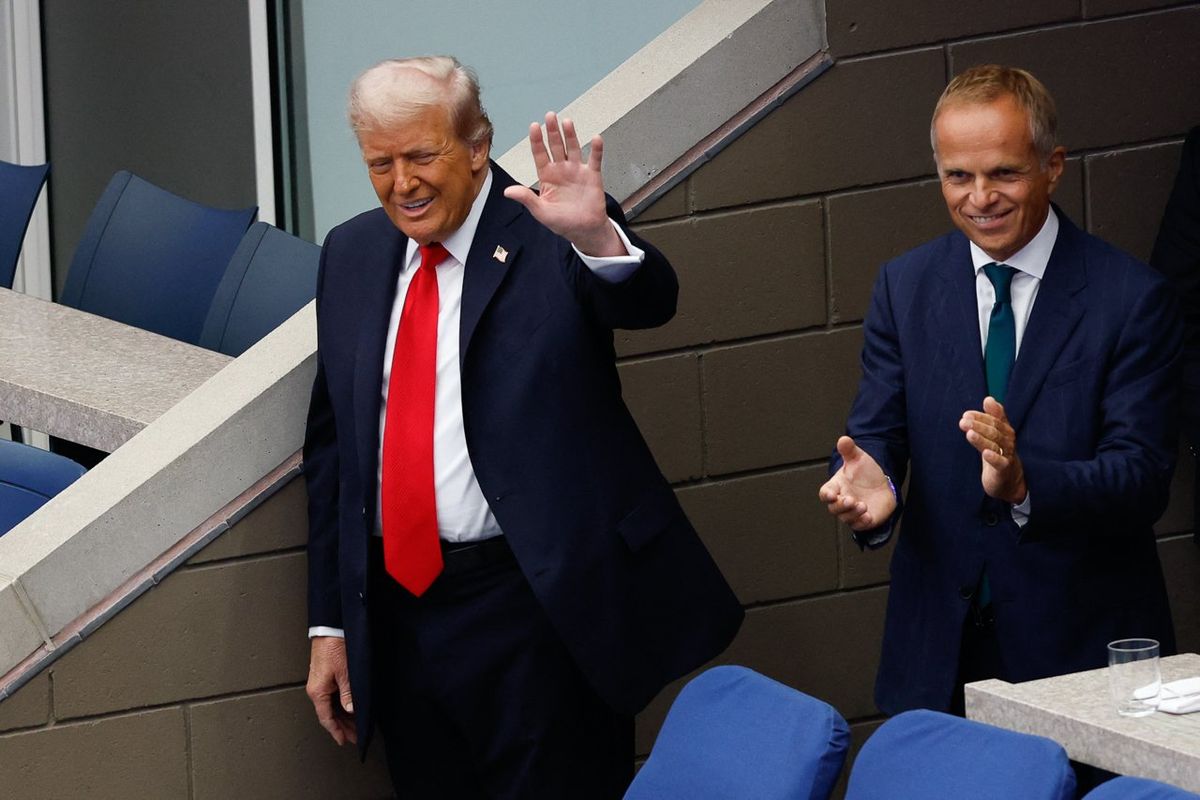
Sep 7, 2025; Flushing, NY, USA; President Donald Trump and Rolex ceo Jean-Frederic Dufour prior to the final of mens singles at Billie Jean King National Tennis Center. 
Mandatory Credit: Geoff Burke-Imagn Images

President Donald Trump faced boos and cheering while attending the final men's match at the US Open.

Although the United States Tennis Association (USTA) asked broadcasters not to highlight any negative reactions when the president visited Arthur Ashe Stadium on Sunday, loud boos could be heard in video clips that circulated on social media.

A clip shared by Fox News, however, featured cheering when the president first appeared at the stadium.

US Open organizers announced at the last minute that the match between Jannik Sinner and Carlos Alcaraz had been delayed due to the extra security.

Watch the video below.


Trump is returning to where he was epically booed — this time 'disruptions' are censored

David McAfee
September 7, 2025 
RAW STORY


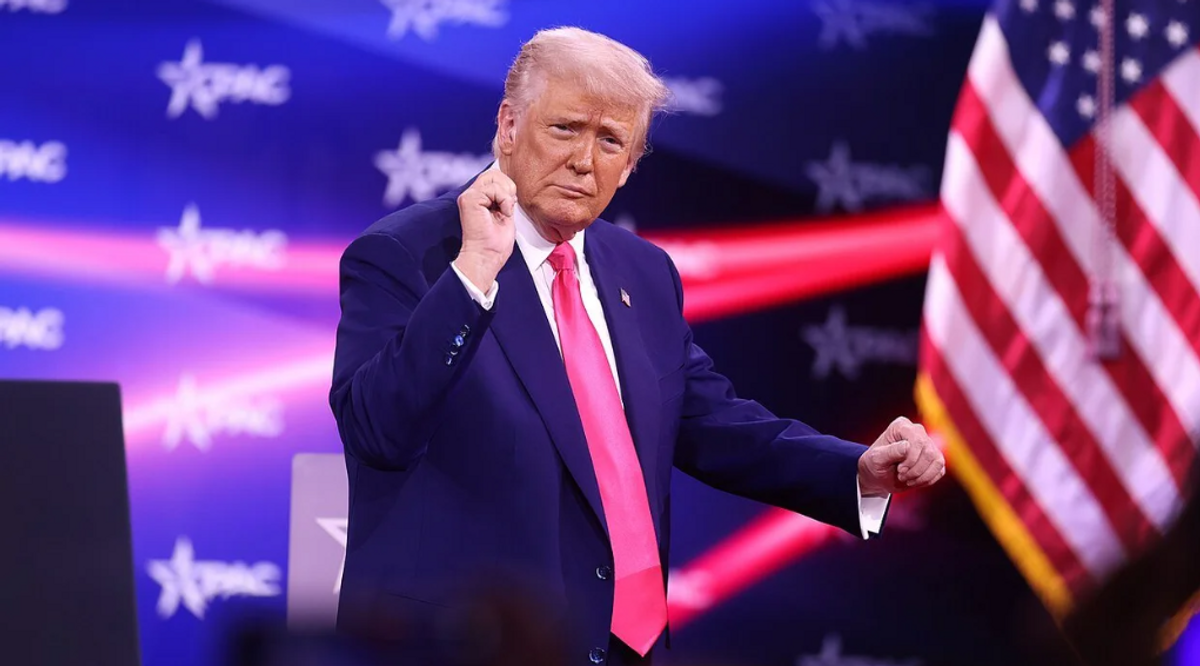
President Donald Trump at the 2025 Conservative Political Action Conference (CPAC) in National Harbor, Maryland on February 22, 2025 (Gage Skidmore/Flickr)

Donald Trump made headlines when he was booed at Arthur Ashe Stadium back in 2015, and now he's set to return to the stadium for the US Open men's final on Sunday, but broadcasters have been warned not to air any "disruptions" this time around.

In 2015, CNN reported that "Trump found himself the target of audible boos... as he entered the U.S. Open quarterfinals in New York." Now, Trump is heading back, but you aren't likely to see a repeat of the 2015 booing, at least not on television, according to the Guardian's reporting.

"US Open broadcasters have been asked not to show any negative crowd reactions to Donald Trump at Sunday’s men’s final," according to the outlet. "The president is expected to attend the match between Jannik Sinner and Carlos Alcaraz in New York, with security at Flushing Meadows being heightened in preparation."

The Guardian further details an email sent to broadcasters, preemptively seeking to shut down the booing.

"An email sent to broadcasters by organisers reveals that the 79-year-old will be shown on screen during the singing of the national anthem ahead of the match," the outlet reports. "The message adds: 'We ask all broadcasters to refrain from showing any disruptions or reactions in response to the president’s attendance in any capacity.'"

Read the full report here.

'Cowards': Internet pounces after broadcasters warned to censor booing of Trump at US Open

David McAfee
September 7, 2025 
RAW STORY


Supporters of Republican presidential nominee and former U.S. president Donald Trump raise MAGA hats, on the day Trump returns for a rally at the site of the July assassination attempt against him, in Butler, Pennsylvania, U.S., October 5, 2024. REUTERS/Brian Snyder

" Trump is about to face the loudest boos of his life," according to one conservative group responding to the latest censorship news involving the president.

Onlookers were stunned this weekend as they discovered that the US Open had warned its broadcasters to censor any potential boos of Donald Trump's appearance.

Organizers of the tennis event reportedly emailed broadcasters with a message saying in part, "We ask all broadcasters to refrain from showing any disruptions or reactions in response to the president’s attendance in any capacity."

Online, political analysts and observers ridiculed the president and the organizers themselves.

Conservatives over at Republicans against Trump noted that, "The US Open sent an email to broadcasters instructing them to censor any crowd reactions or protests during Trump’s appearance," and added, "Trump is about to face the loudest boos of his life."

Wu Tang is for the Children, a popular liberal X account boasting hundreds of thousands of followers, said those at the United States Tennis Association "are cowards."'

Political analyst The Shallow State said, "As you may know, Trump plans to attend the US Open Men's Final. It's in NY. Tomorrow. I expect if he's announced to the crowd, he'll be booed."

"Apparently, under pressure from Trump's team, the US Open has sent an email to broadcasters, ordering them to censor any reactions or protests from the crowd to Trump. I kid you not," the account wrote late Saturday. "Here's hoping there's so much sustained booing, for so long, that it's impossible to censor, and play gets delayed."

A self-identified professional scientist using the screenname Mug of Glop also chimed in, saying, "lmao Trump is the absolute weakest b---- in history."

Ex-MSNBC host Keith Olbermann said, "Tennis Association demands broadcasters CENSOR reactions to Trump at U.S. Open."

"There's a reason tennis has sunk to triviality in this country in the last 40 years," he added. "It's terrified, condescending management like this."


People Are Absolutely Losing It Over Donald Trump Getting Booed At The US Open Final

Mychal Thompson
Sun, September 7, 2025 
BUZZFEED


Donald Trump made his first appearance at the US Open in ten years and was welcomed with very mixed reactions.


CHARLY TRIBALLEAU / AFP via Getty Images

Here's Trump at the US Open back in 2015:

Jean Catuffe / GC Images

Here's Trump now:

Kevin Dietsch / Getty Images

Moments before Jannik Sinner and Carlos Alcaraz took the court to play for the world No. 1 ranking and US Open title, Trump walked out to very mixed reactions from the tennis fans.

Matthew Stockman / Getty Images

Unfazed, the president stood there doing his trademark fist pump to the crowd.


CHARLY TRIBALLEAU / AFP via Getty Images

When he reemerged at his seat just before the national anthem, he even interacted with a spectator, which had to be staged because who just approaches the President of the United States so easily like that?


CHARLY TRIBALLEAU / AFP via Getty Images

Related: Nicole Byer Just Spotted A "Dangerous" Truth About DC Crime Amid Trump Crackdown Plans

In most broadcasts of Trump's appearance, you can hear the crowd's reaction, but apparently, there's a catch.


@OliviaRubin / Twitter: @OliviaRubinABC

According to a memo reviewed by The Athletic, the United States Tennis Association asked "all broadcasters to refrain from showcasing any disruptions or reactions in response to the President's attendance in any capacity."


Kevin Dietsch / Getty Images

But that memo didn't stop the internet from sharing what really happened.

In this viral video, you can hear the mix of boos and subtle cheers as Trump was shown on the Jumbotron during the national anthem.

@allenanalysis / Twitter: @allenanalysis

In another viral video, you can clearly hear that people are, in fact, boo'ing the president. Yikes.


@DemocraticWins / Twitter: @DemocraticWins

As the videos of his appearance make their rounds on the internet, people share their frustrations with the president's appearance, which many say disrupted the entire experience.

x.com

The New York Times reported that Trump's presence at the US Open heightened security and caused delays for guests, and the final.


Advertisement


One person pointed out that the final was delayed by 45 minutes and had people "wait like cattle" outside the court.

x.com

Related: Gavin Newsom Has Been Roasting MAGA Left And Right, And WOW, Is It Entertaining

Aside from being upset over the delays, the internet is having a field day over Trump being booed at the US Open. "Love to see it," one person wrote.

x.com

Other people are praising folks for uploading cellphone videos of what went down.

x.com

And, if anybody tries to challenge the notion that the president was, in fact, booed, social media wants all the smoke.

x.com

​It’s Time for a National Mobilization Against Fascism

If we do not rise up in unprecedented, unified, coordinated resistance now, it will very soon be too late.


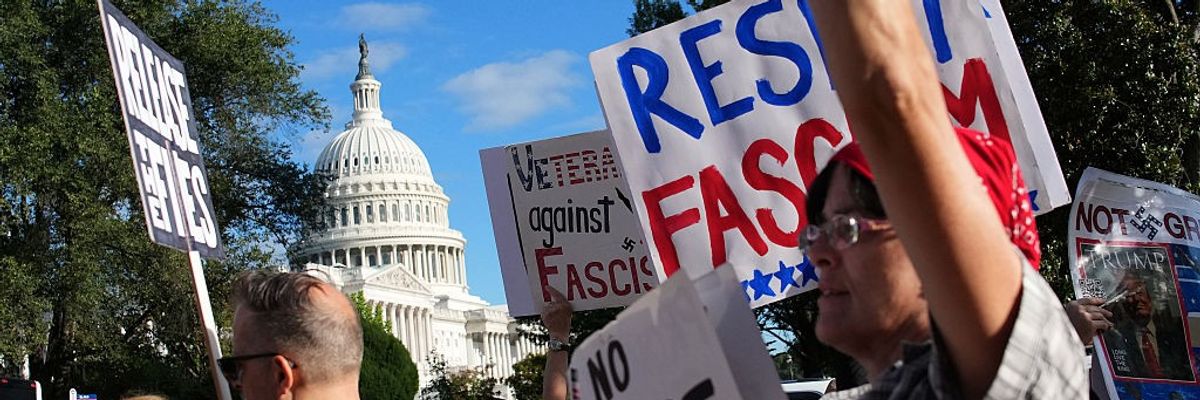
Protesters rally against National Guard deployment and President Donald Trump as they march on Capitol Hill on September 2, 2025 in Washington, DC.
(Photo by Kevin Dietsch/Getty Images)
Common Dreams

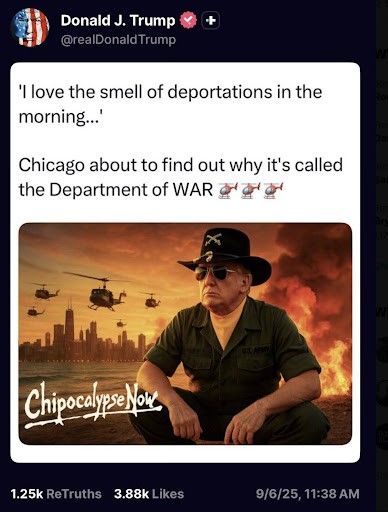
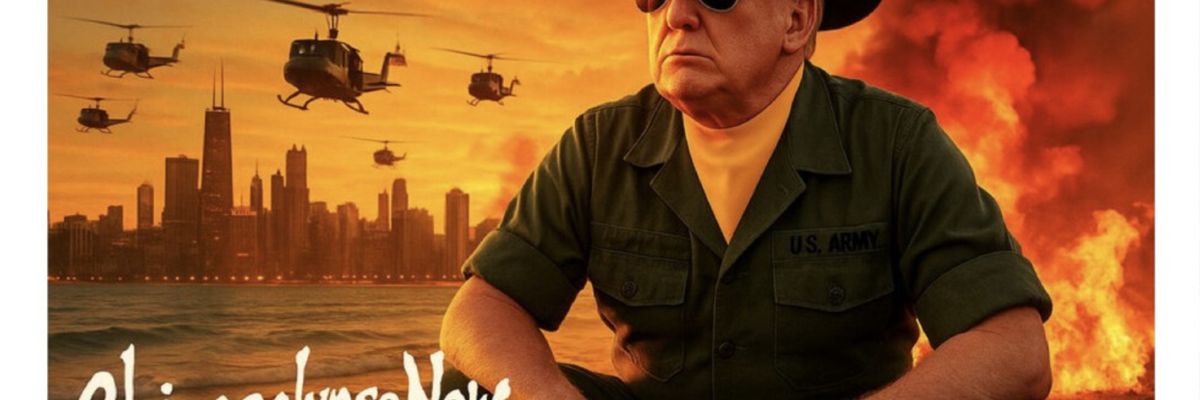
Saturday September 6, an even more-atrocious-than-usual Trump social media post pushed the fascist envelope further wide open, creating heightened alarm and urgency. “I love the smell of deportations in the morning,” taunted the text above an AI image ripped from Apocalypse Now, superimposing US President Donald Trump’s face on a warzone scene from the classic film. In the background, the Chicago skyline is filled with army helicopters and orange hellfire.

Yet more ominously, Trump’s post went on, “Chicago about to find out why it’s called the Department of WAR.” Yes—Trump is now directly and openly declaring war on American cities.


Sickeningly, the Trump “White House” (using quotes here to emphasize how utterly surreal and beyond-the-pale they are) reposted the open threat with helicopter emojis. As Aaron Reichlin-Melnick of the American Immigration Council noted, with this post Trump “drops all pretense and openly admits the mass raids in Chicago are about ICE raids and deportations (not crime), and essentially declares that he’s going to war with the city.”

The blatant, in-your-face nakedness, vicious meanness, and fearmongering are all the point—a central aspect of fascism is its normalization, the forceful imposing of a new normal. Trump’s ghoulish post this Saturday took this to new heights and depths and cannot be ignored or diminished.

Trump’s rapidly intensifying fascism is on daily display, everywhere: the military takeover of Washington, DC, and soon Chicago and other cities, violating both federal law and local will; unmarked vans with the masked, unidentified Immigration and Customs Enforcement (ICE) agents rounding people up and detaining and deporting them without any due process; his constant declarations that he can do whatever he wishes because he is president, such as violating court orders, profiting directly off the presidency, and endlessly, relentlessly more.

The time has come to take the resistance to a new level. Everyone who is outraged, upset, scared, anxious, and sickened by Trump’s rapidly intensifying fascism must unite in coordinated mass resistance. If we do not rise up in unprecedented, unified, coordinated resistance now, it will very soon be too late. If you are outraged and sickened by what this administration is doing, do not wait—the longer we wait, the worse and more irreversible Trump’s fascism will be.

The next mass protest action in Washington should be 1 million strong.

As I write this, a massive “We Are All DC” protest in Washington, DC could pave the way forward. A diverse, steadily growing, and loud crowd of many thousands took to the Capitol’s streets Saturday, marching near the White House and other sites of power, with shouts of “Shut it down” and “Trump must go now.” On October 18, an array of groups will hold a nationally coordinated “No Kings” protest. The last “No Kings Day” drew record crowds and marked a potential turning point in the growing movement against Trump’s fascism and bigotry.

The anti-Trump resistance movement is steadily growing and congealing. The question now is, when and how will this burgeoning uprising go beyond protests and mobilize coordinated actions that create concrete impacts? When do we coordinate a national General Strike, or similar effort that shuts things down for a time? When will we all go to Washington, DC and simply sit down, sit in, refuse to leave, and prevent this fascist administration from creating further harm?

Actions like these must be done thoughtfully, carefully, and strategically. This is not a time for whimsy or flippancy. We must create real infrastructure, systems of solidarity, support, and mutual aid, to sustain nonviolent direct action and civil disobedience, including a General Strike. Such efforts must include organized labor and other diverse major movements.

This is not a criticism of the current protests—I have been to and supported all the marches I can muster, while supporting online, signing petitions, and making phone calls daily; this is an urging in solidarity. Now is the time for a new level of national mobilization and resistance action that goes beyond marches and rallies.

Building on Saturday’s inspiring turnout in DC, we need to coordinate and organize a truly massive, nationwide “STOP FASCISM NOW” protest in Washington—one that people can plan for and that unites and coordinates the many uprisings across the country. The next mass protest action in Washington should be 1 million strong. Yes, 1 million.

It’s time to aim higher and dig deeper. All of us. The time to UNITE, COORDINATE, and MOBILIZE a MILLION people in DC is NOW. Of course, many can’t make the trip, and cities across the nation will continue their own protests—but mobilizing 1 million people in DC for a national day (or week) of action and, potentially, a General Strike Against Fascism, would be dramatic, powerful, and impactful.

One million against fascism and for democracy, diversity, love, solidarity, and a future that is equitable, inclusive, and sustainable. One million against fascism and for our shared futures.

Maybe we call it simply: The National Mobilization Against Fascism. The General Strike Against Fascism.

It’s time to imagine it, build it, and make it happen. Our country, our communities, and our future are on the line, and there is truly no time to lose. The time is now.


Our work is licensed under Creative Commons (CC BY-NC-ND 3.0). Feel free to republish and share widely.


Christopher D. Cook
Christopher D. Cook is an author and award-winning journalist who has written for Harper's, The Atlantic, The Economist, The Guardian, Mother Jones, the Los Angeles Times, The Christian Science Monitor, and many other national publications. He is the author of Diet for a Dead Planet: Big Business and the Coming Food Crisis. Contact him through www.christopherdcook.com.
Full Bio >


The Smell of Fascism: What the Absolute Flying​ Fuck


Meme from the unhinged Peace President of the United States
Photo from Truth Social

Abby Zimet
Sep 07, 2025
Further

Implausibly, it keeps getting weirder, darker, worse. Hankering to make war against his own citizens in the name of an imaginary crime wave, the deranged, draft-dodging Peace President of the United States just posted a mock Apocalypse Now meme of himself as Duvall's warmongering sociopath, warning Chicago is "about to find out why it's called the Department of War" and leering, "I love the smell of deportations in the morning." Sigh. Nothing to see here.

Wildly flailing in a job he is utterly unfit for and so eager to deflect from the looming, likely damning Epstein files he'll do pretty much anything even kill us, the old, bored, crumbling, makeup-caked man now defiling the White House randomly decided it was time to "send a message of strength" to an unlistening world by changing the longtime name of the Department of Defense to the Department of War. "We won the first World War, we won the second World War, we won everything before that and in between," he babbled, "and then we decided to go wokey and we changed the name to Department of Defense." Umm. Ok. So now he's changing it back except Congress would need to approve the change, so not really.

At least now Pete Hegseth gets to use a new bellicose name to show the U.S., in a break from its long tradition as global peacemaker, is "going to go on offense, not just on defense," a shift he explained in his best warrior-ethos gibberish as, "Maximum lethality, not tepid legality,” also, "Violent effect, not politically correct." In other words, given the "100,000 Americans killed each year" by Biden's "open border," the U.S. had "absolute" authority" to attack a Venezuelan boat carrying suspected gang members in the Caribbean - "We smoked a drug boat and there's 11 narco-terrorists at the bottom of the ocean" - though some would call that a war crime. Speaking for the regime, J.D. Vance chimed in: "I don't give a shit what you call it."

No wonder, then, the orange man-child seeking revenge on those who doubt his manly powers is threatening to send troops to Chicago, "the most dangerous city in the world" - "I have an obligation" - though it only has the 92nd highest violent crime rate among big American cities, where crime has been falling the last few years to unprecedented lows, and where Dem-led Chicago's crime rate remains far below the most murderous four cities, all in GOP-run states, of Jackson MS, Birmingham AL, St Louis MO, Memphis TN, which in turn are far below the world's most dangerous cities - Tijuana, Mexico, Colima, Mexico, Caracas Venezuela, Durán, Ecuador - and countries: Brazil, Venezuela, Honduras, Jamaica, South Africa, Colombia, and now, of course, Gaza.

Still, onward to Chicago, or at least the fever dream of Chipocalypse Now, an awkward word-play that prompted confused responses online: "So now he's declaring war on Chipotle?" "Wouldn't Chicagalypse be better?" "It sounds like the next Ben and Jerry's flavor," etc. Evidently re-posting a MAGA fan's AI slop, the peace president declared war on an American city, coincidentally blue, with a tacky meme rendering himself as an unhinged anti-hero of a smoldering, surreal anti-war movie, Francis Ford Coppola’s 1979 Apocalypse Now, which updates Joseph Conrad's Heart of Darkness to the Vietnam War that Private Bone Spurs, aka the fearful manchild who would be king of Chipocalypse, passed on five inglorious times.

Now he's cosplaying as Lieut. Col. Bill Kilgore, played by Robert Duvall, commander of 1st Squadron, 9th Cavalry Regiment, a gung-ho, racist, surfing madman who loves war, wears a black Cavalry Stetson hat straight out of America's Indian Wars - "Stolen valor at its worst"- and delivers the iconic line - after an attack on a village of innocents, to helicopters blaring Wagner's Ride of the Valkyries that Hitler played at his rallies, relishing the use of a flammable "stick-to-kids" gel that burned screaming children alive - "You smell that? Napalm, son. Nothing else in the world smells like that. I love the smell of napalm in the morning...It smells like...victory." "I love the smell of napalm in the morning." "I love the smell of deportations in the morning." Get it? Get the vile sick fucking joke?

This ghoul, these people, are vile sick fucking jokes. And they're so dumb they again utterly misunderstand - see Springsteen's Born In the USA - what's going on here. They think Duvall, a sociopath in a black hat, is a good guy. "Tell me this is not real, please," was one comment. Also, "More fucking fuckery" and, "I have a hard time comprehending how we got to this moment and why any of this is acceptable on any level for any human being." "(Trump) is threatening to go to war with an American city," notes Gov. Pritzer "This is not normal." "Kilgore is a psychotic, mass-murdering white supremacist, an embodiment of every evil American impulse and of (our) pointless, sadistic rampage through Southeast Asia," writes Peter Birkhead. "The President of the United States thinks he’s cool."


Our work is licensed under Creative Commons (CC BY-NC-ND 3.0). Feel free to republish and share widely.

Abby Zimet
Abby Zimet has written CD's Further column since 2008. A longtime, award-winning journalist, she moved to the Maine woods in the early 70s, where she spent a dozen years building a house, hauling water and writing before moving to Portland. Having come of political age during the Vietnam War, she has long been involved in women's, labor, anti-war, social justice and refugee rights issues. Email: azimet18@gmail.com
Full Bio >
Trump just became a murderer — let's say it like it is

Thom Hartmann
September 7, 2025 
RAW STORY


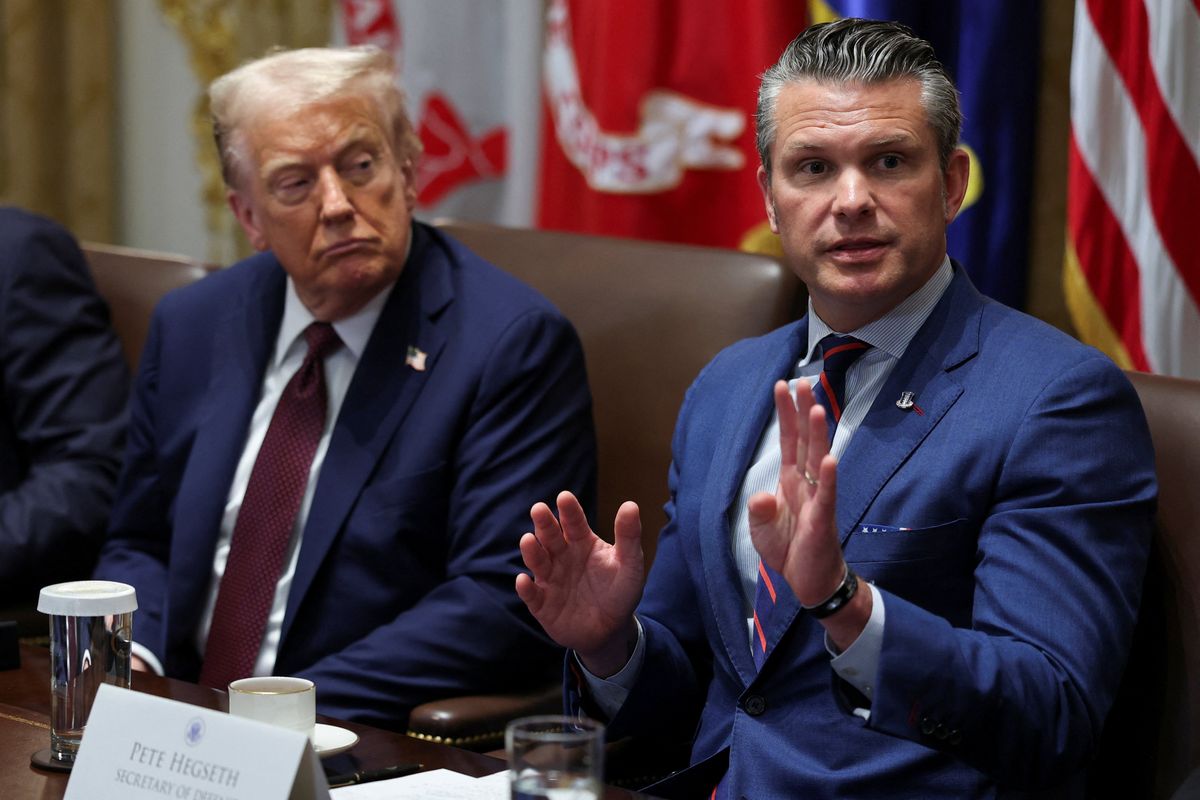
Donald Trump and Defense Secretary Pete Hegseth attend a cabinet meeting. REUTERS/Jonathan Ernst

When the Supreme Court says Donald Trump is above the law, who speaks for the 11 dead on that boat U.S. forces blew up in the Caribbean? Their lives ended not in a battlefield crossfire or a clash between nations, but at the whim of one man emboldened by six justices who declared him untouchable.

Trump simply ordered human beings erased, confident the Court had given him immunity from any consequence and the leaders of his military would obey an illegal order. Eleven souls were sacrificed not just to his cruelty, but to a judicial betrayal that transformed the presidency into a license to kill.

For most of our history, American presidents have at least gone through the motions of cloaking lethal force in some form of legal justification.

Abraham Lincoln suspended habeas corpus during the Civil War but sought Congress’s approval. Franklin D. Roosevelt went to Congress for Lend-Lease before escalating aid to Britain, and sought a declaration of war against Japan. George W. Bush and Barack Obama leaned heavily on the post-9/11 Authorizations for Use of Military Force to justify everything from Afghanistan to drone strikes in Yemen and Somalia to killing Osama Bin Laden.

The principle has always been that the United States does not simply kill people without some kind of legal process. It may be stretched, it may be abused, but it has been invoked.

What Trump has now done with the strike on a small boat off Venezuela’s coast is to break that tradition in a way that is both lawless and unprecedented. He gave the order to kill 11 human beings with no congressional approval, no international authorization, and no visible evidence justifying it.

This was simply murder on the high seas. And the world knows it.

He did it in the full knowledge that six Republican appointees on the Supreme Court have granted him immunity for crimes committed while in office, even international crimes. That ruling opened the door to precisely this sort of extrajudicial killing and stripped away one of the last guardrails protecting both our law and our global standing.

The official claim is that the boat carried members of the Venezuelan gang Tren de Aragua. But 11 people on a small vessel that couldn’t possibly travel as far as America doesn’t sound like a cartel’s drug shipment (typically there’s only one or two people manning such a boar); it sounds like desperate migrants fleeing a collapsing country.

That possibility makes the strike even more chilling when paired with a story Miles Taylor has told about Trump’s senior advisor Stephen Miller.

Taylor recounts traveling with Miller and a Coast Guard admiral after a drug war event in Key West.

On that trip, Miller asked the admiral if it would be legal to use a Predator drone to obliterate a boat full of migrants in international waters. Miller’s reasoning was that migrants weren’t covered by the Constitution, so what was to stop us from blowing them out of the water?


The admiral reportedly shot back that it would violate international law, that “you cannot kill unarmed civilians just because you want to.”

At the time it was an alarming glimpse into the sadistic mind of a man who saw immigrants as less than human.

Now it looks like Trump has taken Miller’s reported hypothetical and turned it into policy. What was once an outrageous musing has become a bloody precedent.


This has profound legal and moral implications.

By attacking a vessel flying the flag of a sovereign state, Trump risked triggering a direct military confrontation. Venezuela could have fired back at American forces in the region. A firefight at sea can escalate quickly into a regional war, and Venezuela’s leader Nicolás Maduro would have every incentive to turn to Russia and China for protection.

Leaders of both of those nations are eager to deepen their presence in our hemisphere, and this gives them an opening. It’s not inconceivable that Moscow or Beijing could send ships or aircraft to Venezuela in response.


That would put foreign military forces hostile to us within 1,300 miles of Miami. If shots were fired between American forces and Russian or Chinese deployments in the Caribbean, the slide toward a larger war would be real, very much like the Cuban Missile Crisis of 1963 (except then we had a statesman as a president, instead of a corrupt buffoon).

World War I began with a simple assassination that pitted one nation against another and then the sinking of the civilian boat the Lusitania; this is how great power conflicts can begin. Trump’s reckless strike doesn’t just risk Venezuelan lives. It risks American troops, regional stability, and, in the most ominous scenario, world peace itself.

Meanwhile, at home, the timing is impossible to ignore. Authoritarians throughout history have turned to foreign crises to distract from domestic scandals.


Nixon expanded the war into Cambodia as Watergate began to close in. Reagan invaded Grenada days after hundreds of Marines were killed in Beirut. Trump has lived for decades under the shadow of allegations of sexual predation, including reports that Jeffrey Epstein recorded him with underage girls during the years he owned and ran Miss Teen USA.

If new evidence of that were to surface, Trump would need a distraction on a scale large enough to blot out the outrage. Creating a crisis with Venezuela, complete with martial language and threats of escalation while renaming the Department of Defense to Department of War, serves that purpose. It’s the oldest play in the authoritarian book: wag the dog.

Except this time the stakes are far higher. This time we’re dealing with a president who’s been told by six corrupted members of the highest court in the land that he’s above the law.

When Miles Taylor first revealed Miller’s macabre question about bombing migrant boats, some dismissed it as idle cruelty. It now looks like a glimpse into the inner workings of Trump’s policy mind. In this worldview, immigrants are vermin, human rights are optional, Democrats are “extremists,” and lethal force is just another tool of politics.


Combine that with the Supreme Court’s gift of immunity and you have a recipe for lawless violence on a scale America has never contemplated. The entire edifice of international law is designed to prevent precisely this sort of conduct.

Extrajudicial killings, violations of sovereignty, the targeting of civilians: these are the acts that international courts prosecute when they can, and that history condemns when courts cannot stop them.

And now we’re learning that Trump did something similar in 2019 when he was last president. He authorized a SEAL Team strike against North Korea, where they killed three civilians in a boat who were simply out fishing.


If America embraces this new Putin-like assertion of America’s power to bomb anybody, anywhere, on the whim of the president, we’ll have abandoned any claim to moral leadership.

Worse, we will have normalized the authoritarian logic that anyone the president labels an enemy can be eliminated without trial, without evidence, without process. We’ll have handed Xi Jinping a rationale to attack Taiwan; all he has to do is claim that a non-governmental gang within that nation is importing drugs into China (or something similar).

The international reaction has already been severe. America’s allies are horrified, our adversaries have been emboldened, and human rights groups are openly appalled.

But the real test is here at home. Do we still believe in the principle, famously cited by our second president, John Adams, that America is a nation of laws and not of men? Do we still insist that presidents cannot kill at will? If Trump can strike a boat off Venezuela today, what is to stop him from ordering lethal force against dissidents, protesters, or political opponents tomorrow?

Keep in mind, the same Stephen Miller — who reportedly wanted to blow up boats of immigrants to kill more brown people — just in the past week claimed that the Democratic Party is a “domestic extremist organization.”

The doctrine of immunity means there is no legal backstop. The only remaining check is political will. And Trump’s fascist toadies are all in on more extrajudicial killings.

On Thursday, Defense Secretary Pete “Kegger” Hegseth said:
“We’ve got assets in the air, assets in the water, assets on ships, because this is a deadly serious mission for us, and it won’t stop with just this strike.”


Secretary of State “Little Marco” Rubio echoed the sentiment, saying during a speech in Mexico City that similar strikes “will happen again.”

This is why Democrats, independents, and every American who values the rule of law must call this out for what it is: an atrocity against eleven people, an assault on international norms, and a direct threat to American democracy.

Trump has shown us exactly how far he’s willing to go. He’s willing to risk a war in our hemisphere. He’s willing to put our troops in danger. He’s willing to risk drawing Putin and Xi into a confrontation with us that could spiral out of control. He’s willing to destroy lives to protect himself. And he’s doing it because six Republicans on the Supreme Court told him he could.

If Congress doesn’t act now to confront and contain this lawless behavior, if we don’t restore accountability to the presidency, then we’ll have surrendered not just our moral authority but our future.

The question is not whether Trump wants a distraction from his scandals; of course he does. The question is whether we’re willing to let Trump and his fascist toadies drag America and the world into catastrophe to get it.

This isn’t just about a boat off Venezuela. It’s about whether America will allow a president, blessed by the Court, to kill without evidence, without process, without even the pretense of law.

Eleven dead migrants are the proof of what immunity means in practice: impunity. If Trump can slaughter refugees today, what stops him from targeting dissidents, protesters, even political opponents tomorrow?

The answer, unless Congress and the people act, is nothing. And “nothing” is what those justices have left to protect us, our laws, and our humanity.


This Trump move is illegal and immoral and should chill you all to the bone

Ray Hartmann
September 7, 2025
RAW STORY

There is arguably no better canary in the coal mine for the death of democracy than a president who seizes for himself the power to wage war.

We seem to be headed there.

President Donald Trump’s recent — and ongoing — unauthorized military aggression against Venezuela fails to meet even the minimal legal standard for presidential war powers.

Trump and his henchmen have largely dispensed with pretexts.

Citing no particular provocation, Trump blithely declared Venezuelan President Nicolás Maduro America’s latest mortal enemy. That sort of gratuitousness is brought to you with a shrug by corporate media increasingly committed to a mission of stenography.

The administration has designated Tren de Aragua a “foreign terrorist organization” — which may well be accurate but does not seem to have come with any provable link to Maduro other than rhetorical. Even if true, nothing in U.S. law permits unilateral military action on that ground alone by a U.S. president.

But following the law has always ranked below the bottom of Trump’s “things to do” list in life.

Here’s how the United States has apparently begun to launch an illegal war almost overnight, without a millisecond of congressional debate. And with scant attention at best in the news media.

The Escalation — One Week, One Direction

August 8, 2025 — Trump designates Tren de Aragua as a foreign terrorist organization under the 2001 AUMF framework.
(AP)
Late August — U.S. naval and marine units mobilize in the southern Caribbean under an “anti-cartel” initiative.
(The Guardian)
September 2 — A U.S. drone strike sinks a speedboat allegedly linked to Tren de Aragua, killing 11. The administration justifies it as a drug interdiction.
September 3, 2025 — Venezuelan President Nicolás Maduro denounces the U.S. strike as a violation of sovereignty, orders militias to mobilize, and warns that Washington is laying the groundwork for regime change.
September 3–4 — Defense Secretary Pete Hegseth calls the strike “just the beginning.” Secretary of State Marco Rubio signals more strikes are being considered.
September 5 — Trump orders the Pentagon rebranded as the Department of War in communications and signage. Hegseth becomes “Secretary of War.”
September 5–6 — Ten F‑35 stealth fighters are deployed to Puerto Rico. Trump publicly states he’s weighing strikes inside Venezuela.

Trump’s posture toward Maduro wasn’t always so hostile. During his first term, he told Axios on June 21, 2020, he was “open to meeting” with Maduro and even called him “very smart.”

The timing was just astonishing, especially in today’s context. Trump publicly praised Maduro fewer than three months after his own Department of Justice had issued a press release headlined: “Nicolás Maduro Moros and 14 Current and Former Venezuelan Officials Charged with Narco-Terrorism, Corruption, Drug Trafficking and Other Criminal Charges.”

Apparently narco-terrorism didn’t concern Donald the First as much as it seems to concern Donald the Second.

Back in 2020, Trump did reverse himself on Twitter, but only after heads exploded among Florida Republicans. Taking issue with fellow strongmen has never ranked as one of Trump’s strengths.

Trump has always positioned himself as an isolationist — and his repeated campaign pledges of “no more endless wars” — arguably garnered more votes than most analysts credited. Trump mocked “globalist” entanglements, vowed to bring troops home and end foreign adventurism.

That’s all a thing of the past now that Trump openly aspires to become the world’s most dominant dictator.

He drools about invading and seizing Greenland. He muses obscenely about annexing Canada, or at the very least, waging a mindless economic war with it and many other close allies. He obsesses about seizing the Panama Canal.

His MAGA base has always been animated by extreme nationalism — ethnically and economically grounded — and it’s widely presumed that instinct mutates into isolationism. Even among those whose political philosophies can only be captured in five words or less.

It remains to be seen how Trump’s abandonment of isolationism might play out with the base. But never underestimate the power of a cult leader.

What’s more, we should not discount similarities to the dicey motives of previous U.S. adventurism — “war for oil” in Iraq springs to mind — especially given that Trump is exponentially more transactional than all previous U.S. presidents combined.

On Saturday, White House Deputy Chief of Staff Stephen Miller defended Trump’s Venezuela policy by calling the country “so rich in resources, so rich in reserves,” while describing Maduro as “the head of the cartel.”

In poker, that’s known as a “tell.”

Let’s hope I’m wrong in thinking this Venezuelan adventure is far graver than a few news cycles of an unstable Trump cosplaying as a warlord. But, to me, this one has real potential for disaster.

I don’t like the looks of that canary.