Tuesday, September 09, 2025

GOOD NEWS

Average rents dip 2.3 per cent in August, continuing downward trend

By The Canadian Press
September 08, 2025 

A for rent sign is displayed on a house in Ottawa on Friday, Oct. 14, 2022. THE CANADIAN PRESS/Sean Kilpatrick

TORONTO — A new report says average asking rents fell in August compared with a year ago to mark 11 months of straight declines.

The Rentals.ca and Urbanation report says the average rental rate across Canada was $2,137 in the month for a 2.3 per cent decline from a year ago, though still up one per cent from 2023.

Rents have been on the decline as the federal government has reduced immigration rates that slowed population growth, and as a wave of condo completions come onto the market.

The report shows condo rents were down 3.7 per cent in August from year ago while purpose-built rental rates were down 0.4 per cent. House and townhouse rates were down six per cent from last year.

Average rents in Canada went on the decline during the height of the pandemic, but began to rise in the summer of 2021, climbing from a low of under $1,700 a month at the time to around $2,200 last year.

Vancouver and Calgary saw some of the steepest rate declines among big cities over the past year, down 9.3 and 9.5 per cent respectively in August from last year, while Toronto saw a 3.3 per cent decline.

This report by The Canadian Press was first published Sept. 8, 2025.

Ian Bickis, The Canadian Press


Ottawa drafting public registry of AI projects as tech spreads through government

By The Canadian Press
September 09, 2025 

Minister of AI and Digital Innovation Evan Solomon speaks to media following an announcement during a visit to Scale AI in Montreal on Thursday, July 10, 2025. THE CANADIAN PRESS/Christopher Katsarov

OTTAWA — The federal government says it plans to launch a public registry to keep Canadians in the loop on its growing use of artificial intelligence.

“We are seeing a lot more activity across departments and agencies,” Stephen Burt, the government’s chief data officer, told The Canadian Press.

The registry will also help the government itself keep track of AI projects that are underway. Kara Beckles, executive director of privacy and responsible data at the Treasury Board, said that while AI platforms are being used in many ways across government, there is no “full and complete list.”

Beckles said that over the past few years, “departments have really started experimenting more and more with implementing AI in different ways.”

She cited Fisheries and Oceans Canada using AI to help find lost fishing gear, Agriculture Canada processing satellite data to help predict crop yields, and Transport Canada using AI to screen high-risk air cargo.

But these initiatives have been piecemeal and individual departments have been launching their own projects. The public service is now working on a more co-ordinated approach under an AI strategy launched earlier this year.

Prime Minister Mark Carney campaigned in the spring federal election on using AI to make the public service more efficient, while Finance Minister François-Philippe Champagne has asked his colleagues to identify cuts to program spending of 15 per cent by 2028-29.

In August, the federal government signed an agreement with Canadian artificial intelligence company Cohere to identify places where AI could enhance public service operations.

Burt said AI will be an important tool for making the government more efficient, but it’s not the only one.

“We are still plumbing the extent to which artificial intelligence as a specific technology is going to deliver specific savings and efficiencies,” he said.

The AI strategy notes that during consultations, the government heard from departments about the need for a central hub to support projects and share knowledge.

Through an initial project to test that central hub approach, the Treasury Board worked with the Translation Bureau to come up with an automated translation system for low-risk and low-value documents.

Burt said that tool is now available across Public Services and Procurement Canada and “is shortly going to be rolling out in a staged fashion across other departments and agencies.”

Beckles said the AI hub is meant to identify current uses of artificial intelligence that can be scaled up to operate across government. She said the translation tool was an appealing option because “all public servants need access to translation services at some time or another.”

Part of the idea behind the hub is to avoid duplication, Beckles said.

“We don’t want five different departments working on the same type of tool all at the same time,” she said. “We want to be able to consolidate those efforts and make sure that we’re building something once and then deploying it across the system.”


It will make for a more “mature” approach as AI use grows, Beckles said.

“We’re not dealing with a handful of projects across the system anymore,” she said. “Instead, it’s a handful of projects in every department, or at least all of the medium and larger size ones.”

The government’s AI strategy also acknowledged the need for transparency and pledged to prioritize establishing a public registry of AI systems.

Experts have previously attempted to collect data on the extent of AI use in the public service. Joanna Redden, an associate professor at Western University, pieced together a database launched last year that showed hundreds of cases of AI use within the federal government.

A ministerial briefing document prepared earlier this year by Shared Services Canada and released last month also outlined some ways AI is being used by government.

It lists an in-house alternative to tools like ChatGPT that can help employees at Shared Services Canada with tasks like writing emails or summarizing information. The document said it operates “within a controlled environment that ensures appropriate security and data integrity.”

Other examples cited in the document include Canadian Heritage using “automation and generative AI to refine the ministerial correspondence process,” and the Canada Revenue Agency allowing Canadians to access their accounts using a smartphone, government-issued ID and facial recognition technology.

It also said the Finance Department developed a tool “that automates the collection and processing of tariff consultations, summarizes industry data and drafts initial responses for analysts and stakeholders.”

Burt said the registry is still under development, and Beckles added there is no timeline yet for its launch.

Part of the work on the registry involves deciding which information will be included.

“We don’t want to capture every time an analyst uses Copilot to help write an email, but we do want to capture all the projects and systems that have AI embedded in them,” Beckles said.

Beckles said the idea is to “make sure that it’s built for transparency for the public, but also internally, so that we can use that full and complete list for our own purposes as well.”

This report by The Canadian Press was first published Sept. 9, 2025.

Anja Karadeglija, The Canadian Press

Strathcona Boosts MEG Bid With 11% Premium Over Cenovus Deal

Strathcona Resources lifted and extended its hostile offer for MEG Energy to 0.80 Strathcona shares per MEG share, valuing MEG at C$30.86 and topping MEG’s agreement with Cenovus by 11%, with the bid now expiring at 5:00 p.m. MT on October 20, 2025.

Key news/development:

  • Offer raised & extended: 0.80 SCR share per MEG share (“all-share”) worth C$30.86 based on Sept. 5 VWAPs—11% premium to the MEG–Cenovus deal currently valued at C$27.79.

  • Bid deadline: October 20, 2025 (5:00 p.m. MT).

  • Special distribution: Strathcona plans a C$2.142B payout in Q4; if the bid succeeds, ~C$5.22/share; if it fails, ~C$10.00/share to existing SCR holders.

  • Pro forma targets: ~410m shares outstanding, C$3.0B Net Debt, ~1.1x Net Debt/EBITDA at US$60 WTI.

  • Ownership mix post-deal: WEF/insiders 48%, other SCR 9%, MEG holders 43%.

  • WEF stance: Says it has no current plans to sell and is willing to lock up in a supported transaction.

  • MEG vote: Strathcona will vote its 14.2% MEG stake against the MEG–Cenovus deal at MEG’s Oct. 9 special meeting (requires 66?% approval).

Context & implications

  • MEG announced a cash-heavy sale to Cenovus on Aug. 22, 2025; Strathcona argues the structure “crystallizes” value and leaves MEG investors with only ~4% ongoing exposure via Cenovus shares.

  • Strathcona says Cenovus’ stock rose ~10% post-deal announcement (about C$3.9B in value), evidence—per Strathcona—of a lopsided outcome for MEG holders and of a “broken” sale process that excluded Strathcona unless it dropped its prior bid.

  • Strategically, Strathcona pitches a pure-play SAGD champion, claiming C$205M in annual synergies (C$50M overhead, C$55M interest, C$100M operating) and an expected investment-grade upgrade for the combined company.

  • Liquidity & index angle: Strathcona projects a ~12x jump in trading value to ~C$65M/day and eligibility for major Canadian equity indices, potentially drawing passive flows.

  • Accretion guidance (company-provided): MEG holders 13–40% per-share accretion on funds flow/production/NAV; SCR holders 7–14%. Metrics use non-GAAP measures and company assumptions, including reinvestment of the special distribution.

Why it matters for investors

  • The amended, all-share offer raises consideration and keeps upside in a cyclical oil sands asset with long reserve life, contrasting with MEG’s cash-heavy Cenovus deal.

  • The bid’s success likely hinges on shareholder sentiment ahead of MEG’s Oct. 9 vote and on whether MEG’s board opens the door to Strathcona or continues to back Cenovus.

  • Outcome could reshape Canada’s upstream landscape, creating what Strathcona calls the largest North American pure-play oil producer without mining/refining exposure.

Potash maker Nutrien to sell stake in Argentina’s Profertil for $600 million

By Reuters
September 08, 2025 


Nutrien said on Monday it will sell its 50 per cent stake in Argentina-based nitrogen producer Profertil for $600 million, as the world’s top potash producer shifts focus away from South America.

The stake will be acquired jointly by agribusiness companies Adecoagro and Asociacion de Cooperativas Argentinas (ACA) through an 80 per cent-20 per cent partnership, the companies said.

Nutrien said that oil and gas producer YPF, which holds the remaining 50 per cent stake in Profertil, will have 90 days to exercise its right of first refusal.

In March 2024, Reuters reported that Nutrien was mulling the sale of Argentina, Chile and Uruguay assets after steep losses in the region.

Its troubles in South America came as Russia’s invasion of Ukraine sent prices skyrocketing in 2022 only to collapse the next year as global supplies stabilized.

Earlier this year, Nutrien’s Brazilian unit said it would sell its fertilizer blending plants in the country.

The Canadian fertilizer maker reported about $60 million in proportionate earnings from its Profertil stake over the last four quarters.

“The agreement to sell our equity stake in Profertil advances our strategy to focus on assets and geographies that are core to our long-term vision,” Nutrien CEO Ken Seitz said in a statement.

Proceeds will be used for growth investments, share buybacks and debt reduction, the CEO added.

Profertil, based in Bahia Blanca, is the region’s largest granular urea producer, supplying about 60 per cent of Argentina’s demand and producing 1.3 million tonnes of urea and 790,000 tonnes of ammonia annually.

The transaction expected to close before the end of 2025.

(Reporting by Sumit Saha and Vallari Srivastava in Bengaluru; Editing by Sahal Muhammed)
China delays final ruling in canola dispute with top supplier Canada

By Reuters
Published: September 05, 2025 

Pumpjacks draw out oil and gas from well heads surrounded by Canola fields near Cremona, Alta., Monday, July 15, 2024. THE CANADIAN PRESS/Jeff McIntosh (Jeff McIntosh/The Canadian Press)

BEIJING - China on Friday prolonged its probe into Canadian canola imports, buying six more months for negotiations that could ease a year-long trade dispute sparked by Ottawa’s tariffs on Chinese electric vehicles.

The Ministry of Commerce said the anti-dumping probe would now run until March 9, 2026, citing the complexity of the case, a statement showed.

Beijing, the world’s largest importer of canola, imposed preliminary duties of 75.8 per cent on Canadian canola seed imports in August. A final ruling could result in a different rate, or overturn the decision.

“The extension buys some time for both sides to seek a negotiated solution,” said Even Rogers Pay, an analyst at Beijing-based Trivium China who specializes in agriculture.

“Ultimately, the best case scenario for Beijing would be to strike a deal in which it drops the investigation and Canada lifts tariffs on Chinese vehicles and metals. But given the complexities involved as Canada tries to keep its U.S. trade relationship stable, that will be easier said than done.”

Canada, the world’s largest exporter of canola, shipped almost $5 billion of canola products to China in 2024, about 80 per cent of which was seed. The steep duties on canola seed, if they remain in place, would likely all but end those imports.

China, which relies on Canada for nearly all of its canola seed supplies, also imposed tariffs on canola oil and meal in March. Canada, in turn, has imposed tariffs on Chinese steel and aluminum.

Ottawa has grown increasingly anxious about losing a key customer, especially as China appears to be pivoting towards Australian supplies.

On Wednesday, Prime Minister Mark Carney said he and other senior officials would work to resolve the canola dispute.

In July, Reuters reported that Canberra is close to an agreement with Beijing that would allow Australian suppliers to ship five trial canola cargoes to China.

The following month, Chinese state-run trading firm COFCO booked the first new-crop Australian canola, marking China’s first imports from Australia since 2020.

Reporting by Ethan Wang and Ryan Woo; Editing by Kevin Liffey and Sharon Singleton, Reuters
Carney touts Bay du Nord oilfield and Quebec energy deal in Newfoundland

By The Canadian Press
Updated: September 09, 2025 

Prime Minister Mark Carney speaks at a press conference in Mississauga, Ont., on Friday, Sept. 5, 2025. THE CANADIAN PRESS/Sammy Kogan

ST. JOHN’S — A proposed offshore oilfield and a hydroelectricity deal with Quebec are two major projects in Newfoundland and Labrador that can increase the competitiveness of Canada’s economy, Prime Minister Mark Carney said Monday in St. John’s, N.L.

Provinces are eager for their infrastructure and energy projects to be included on Carney’s list of what he calls “nation-building projects” that would get accelerated approvals from the federal government -- and Newfoundland and Labrador is no exception.

Alongside Carney at Monday’s news conference, Premier John Hogan pitched Equinor’s Bay du Nord oil project and a proposed energy deal between Hydro-Quebec and Newfoundland and Labrador Hydro as ideal candidates.

Carney praised both several times as he spoke to reporters in Canada’s easternmost capital city.

“I’m so proud of the progress that’s been made ΓǪ between Newfoundland and Labrador and Quebec,” Carney said.

The prime minister was in St. John’s to announce that $80 million of his government’s $1-billion tariff relief fund would be earmarked for businesses in Atlantic Canada. The funding will be administered by the Atlantic Canada Opportunities Agency, and available to sectors including manufacturing, technology and the seafood industry.

“For example: developing innovative packaging and product formats,” the prime minister said. “Think, in food processing and fishery, vacuum-sealed lobster tails or flash-frozen crab clusters tailored for high-demand European markets.”

China has hit Canada’s seafood industry with punishing tariffs in retaliation for Canada’s 100-per-cent levies on Chinese electric vehicles. The U.S., meanwhile, has hit Canada with tariffs on products such as steel and aluminum.

It’s in response to the trade war with the U.S. that Carney is hoping to accelerate major infrastructure and energy projects across the country as a way to boost the economy.

Carney also said the federal government is “working through the compensation” for people in Newfoundland who lost their homes to wildfires this summer. A fire in May near Adam’s Cove destroyed about a dozen homes, and another one in August burned down nearly 200 structures in the same region.

“We’re making huge investments in our satellite detection, which is helping us to move quickly, and our capacity to move quickly in any part of this country in order to limit the damage from the wildfires,” he said. “That’s everything from those first responders, our firefighters, to our water bomber capacity.”

Carney would not say Monday how Canada is planning to adjust its climate change targets, after recent policy announcements dialed back some of the Trudeau government’s climate initiatives. “We see becoming low-carbon in any industry as being a key driver of competitiveness,” Carney said, adding he’d have more to share in the coming weeks.

He said Equnior’s proposed Bay du Nord project, off the east coast of St. John’s, is intended to be “one of the lowest-carbon new oilfields, depending on how you develop it.”

“So we look at that as a way of being competitive in conventional energy,” he said.

The federal government gave Bay du Nord environmental approval in 2022, drawing sharp criticism from environmentalists. Equinor announced in 2023 it was putting the project on hold for up to three years as it looked for ways to make it more affordable.

Newfoundland and Labrador Hydro’s pending deal with Hydro-Quebec will create clean power and drive competitiveness, Carney said. The two utilities signed a memorandum of understanding in December that would end a 1969 contract that allowed Hydro-Quebec to buy the majority of the energy produced by the Churchill Falls power plant in Labrador for rock-bottom prices.

Under the new draft arrangement, Hydro-Quebec would pay much more for power: about $33.8 billion over the next 50 years. The two utilities would also partner on new developments along the Churchill River.

The provincial Opposition Progressive Conservatives have said the draft deal needs to be independently reviewed by a third party, and they walked out of the legislature earlier this year before the Liberal government voted to begin negotiations of final agreements.

This report by The Canadian Press was first published Sept. 8, 2025.

By Sarah Smellie

European Parliament president says there’s a market for Canadian oil and gas in Europe

By Spencer Van Dyk
Updated: September 08, 2025 

European Parliament President Roberta Metsola speaks during a media conference at an EU summit in Brussels, Thursday, June 26, 2025. (AP Photo/Omar Havana) (Omar Havana/AP)

European Parliament President Roberta Metsola says there is a market in Europe for Canadian oil and gas, and signalled European Union (EU) nations may be willing to pay a higher price for Canadian conventional energy, as member states work to divest further from Russian energy.

In an interview on CTV Question Period that aired Sunday, when asked directly by host Vassy Kapelos whether there is, in her view, a customer in Europe for Canada’s conventional energy exports, Metsola said: “yes.”

“If you see how we have pivoted over the last years, we found ourselves when Russia invaded Ukraine, that we were completely, to a certain extent, reliant on a very unreliable partner for gas and oil, and that meant that we have had to divest, uncouple ourselves, and we’re almost completely done,” she told Kapelos. “To do that, we need to find alternative sources.”

Metsola was in Ottawa last week for a meeting of the G7 countries’ speakers.

She added that while the EU has “doubled down” on its climate goals and plans for renewable energy, “that’s not enough.”


“And where do we go? Where do we look? We have to look across the Atlantic, and the discussions are absolutely in that direction,” she said.

The federal government, meanwhile, has signalled it will start announcing approved so-called nation-building projects in the coming weeks. In June, Parliament passed Bill C-5 — dubbed the Building Canada Act by the Liberals — aimed at giving government sweeping new powers to approve major projects of national interest.

When asked whether Europe is prepared to potentially absorb a higher cost of importing oil and gas in exchange for those products coming from a trusted partner, such as Canada, Metsola told Kapelos those discussions are happening “right now.”

“Where do we go? How do we pivot? At the end of the day, what do you mean by cost? We have had to go into very, very expensive divestment when we had to uncouple from Russia,” she said. “We also have other perhaps more unreliable partners in which we are importing fossil fuels, because we need to keep our energy bills low.”

Metsola said many European countries have been forced to rely on those “more unreliable partners” because of their physical proximity.

“That’s why we talk about joint partnerships,” she added. “We don’t only talk about defence; we don’t talk about security. We talk about strategic autonomy, which also means that we need reliable and predictable sources of supply, and Canada comes into the mix.”

Prime Minister Mark Carney has been pushing for months to strengthen energy and economic ties with Europe, in large part to expand the country’s export markets amid a protracted trade war with the United States.

In separate interviews on CTV Question Period last year, both Greek Prime Minister Kyriakos Mitsotakis and then-Polish president Andrzej Duda said they would be interested in purchasing Canadian LNG.

In a recent interview on The Vassy Kapelos Show, Energy Minister Tim Hodgson also said that he is confident “there are buyers” for Canadian LNG.

The push to sell LNG is a change in tone from the previous Liberal government under former prime minister Justin Trudeau, who publicly said in 2022 that there has “never been a strong business case” for LNG exports to Europe.

Canada has one major LNG export terminal up and running — LNG Canada, located in Kitimat, B.C. — which just began shipping Canadian gas in June of this year, primarily to Asian markets. There are currently six other LNG export projects in the works.


Spencer Van Dyk

Writer & Producer, Ottawa News Bureau, CTV News
Alberta urges teachers back to bargaining, union says old offer not good enough

Story by Lisa Johnson


Alberta Finance Minister Nate Horner presents the Alberta 2025 budget in Edmonton, Thursday, Feb. 27, 2025. THE CANADIAN PRESS/Jason Franson© The Canadian Press

EDMONTON — While the Alberta government is urging teachers to get back to the bargaining table to get out of an ongoing stalemate, their union says the province needs to move beyond reiterating a deal that teachers have already rejected.

Finance Minister Nate Horner is encouraging teachers to take a closer look at the latest offer, which he says shows respect for teachers.

"We've never left the table," Horner said in an interview Monday.

"We think this is a fair deal. We think this is a good deal."

More than a week after the Alberta Teachers' Association walked away from talks, president Jason Schilling told reporters the union is more than happy to come back.

However, he said the government needs to take teachers' concerns about classroom conditions and salary seriously.

"There is always two hands on this steering wheel when we talk about bargaining ... and when you come to an impasse, it means that both sides are unwilling to move forward," Schilling said.

The offer includes wage increases of 12 per cent over four years and a promise to hire 3,000 teachers over three years.

Horner said the government has put $2.3 billion on the table.

"We've heard it's about classroom complexity, not salaries. We feel that we've addressed both of those things, and yet we're still at this place," said Horner.


Meanwhile, the clock is ticking on a strike mandate given by the 51,000 rank-and-file members months ago.

The last possible day teachers could go on strike would be Oct. 7, and they would have to give 72 hours' notice.

The Teachers' Employer Bargaining Association, which represents school boards at the bargaining table, also has approval to initiate a lockout.

The union has long pointed to national statistics that indicate Alberta's per-student funding is among the country's lowest.

Schilling has said teachers have seen a 5.75 per cent salary increase over the past decade, an environment that doesn't catch up with inflation and won't attract and retain teachers.

On Monday, he said parents need to press the government.

"They need to ask them why this seems to be acceptable to government that we find public education in this province in a crisis," he said.

"Why do we find ourselves in a situation where 40 seems to be the new norm for class sizes in many schools across this province?"

Horner has said the government is in a new kind of squeeze, facing down a deficit projected to hit $6.5 billion.

“The big change since April — the first deal — is the deteriorating fiscal position of the province," he said.

Horner said there is a good reason for slight increases to teacher pay in Alberta over the last 15 years: they were paid "above market" when those conversations first began.

“We needed to align ourselves more closely with the comparator provinces. Alberta can't afford to be an outlier in that way, so we feel that this deal addresses that catch-up and places us strongly in market," said Horner.

This report by The Canadian Press was first published Sept. 8, 2025.

Lisa Johnson, The Canadian Press
WSJ editors warn Trump just made Republicans look like 'crony capitalism kings'

Matthew Chapman
September 8, 2025 
RAW STORY


The conservative Wall Street Journal editorial board laid into President Donald Trump on Monday evening for his latest $17 billion effort to interfere in the telecommunications market.

"President Trump has now rescued Charlie Ergen’s EchoStar from bankruptcy after his first-term attempt to boost the telecom company flopped," wrote the board, which has grown exasperated with Trump over his tariff wars in recent months. "EchoStar on Monday announced it will sell a large swath of wireless spectrum licenses to Elon Musk’s SpaceX for $17 billion to boost its Starlink satellite network. This follows EchoStar’s deal last month to sell $23 billion in spectrum licenses to AT&T. While the sales will benefit telecom consumers, the biggest winner is Mr. Ergen."

This entire deal, forced by Trump and his regulators to prevent embarrassing headlines about a major bankruptcy on his watch, essentially takes EchoStar out of the wireless industry, which it was only in because of another intervention by Trump in his first term, the board argued.

"As a condition for approving Sprint’s merger with T-Mobile in 2019, the Trump team required the carriers to sell spectrum and Sprint’s pre-paid Boost wireless business to Dish Network, now owned by EchoStar," wrote the board. "Dish had spent years stockpiling spectrum. The Administration’s goal was to stand up a fourth competitor to the Big Three carriers."

"We’re told that Mr. Ergen met with Mr. Trump in June in an effort to prevent the FCC from reclaiming EchoStar’s licenses and putting them up for auction," noted the board. "Republicans in Congress believed an auction could raise tens of billions of dollars for the government. It would also let companies bid competitively for EchoStar’s idle spectrum" — but Trump didn't want that to happen because it would make his economic record look worse.

Making the whole thing more embarrassing, the board wrote, EchoStar announced the AT&T sale as a move to “enable rapid deployment of the purchased spectrum to U.S. consumers across the country” — effectively a confession they are "being rewarded for warehousing spectrum and selling licenses for a higher value than he paid for them," which the law is supposed to stop.

Democrats, too, have interfered in telecom operations for political gain, the board concluded, but with the GOP in power now, "their rampant regulatory intervention in markets on behalf of businesses that do their bidding is giving Democrats the evidence to build a case that Republicans are the new kings of crony capitalism."


MDA Space caught off guard by EchoStar’s deal cancellation, CEO says

By The Canadian Press
Updated: September 08, 2025 

SpaceX's mega rocket Starship is prepared for a test flight from Starbase in Boca Chica, Texas, Sunday, Jan. 12, 2025. (AP Photo/Eric Gay) (Eric Gay/AP)

BRAMPTON — Shares of MDA Space Ltd. fell sharply Monday as the high-tech manufacturer lost a recently announced contract with EchoStar Corp.

EchoStar cancelled the deal as it separately announced an agreement to sell its spectrum licenses to SpaceX for about US$17 billion in cash and shares, as the Elon Musk-founded SpaceX pushes further into providing satellite-based internet services directly to smartphones.

The decision by EchoStar to abruptly abandon plans to develop its own space-based network, and instead sell its AWS-4 and H-block spectrum rights to SpaceX, caught MDA Space by surprise, said chief executive Mike Greenley.

“This is a very unexpected event,” he said on a hastily arranged analyst call.

“This is obviously very sudden and a drastic change to the entire trajectory of EchoStar’s business. And so that’s a highly, highly unusual situation.”

The about-face means MDA Space is losing its contract to be the primary supplier for EchoStar’s low Earth orbit satellite constellation. The initial contract announced on Aug. 1 was valued at about US$1.3 billion, while it had the potential to grow to US$2.5 billion.

MDA Space said the EchoStar contract termination is unrelated to its performance and that it will be compensated for all related termination costs and fees under the agreement. The amounts owed were not disclosed.

It also noted it still has a $4.6 billion backlog of deals excluding EchoStar, and the company reiterated its 2025 financial outlook and guidance, but shares were still down about $8.76, or 20 per cent, at $35.25 as of midday on the Toronto Stock Exchange.

The loss, however, puts its shares back to about where they were trading in early summer and still more than double the price of a year ago.

EchoStar was set to be MDA Space’s anchor customer for its new 5G-capable satellites, but the company is also in talks with other firms to be a provider in an accelerating market, said Greenley. He said the August deal caused thinks to perk up, and this latest development will likely add to interest.

“If now SpaceX has that spectrum, and they’re going to get on with building that same network that EchoStar was going to build, it at least equally if not further adds to the giddy-up feeling for those in the market, which is that we better get going here because things are moving.”

Interest in the satellite-provider market is also rising as geopolitical tensions rise globally, he said.

“We’ve already seen in 2025, a fair amount of geopolitical activity, of countries and corporations in countries outside the United States wanting to stand up a bit taller, and work on and improve their high-tech, their defence, their security, their sovereignty.”

MDA Space, originally known as MacDonald, Dettwiler & Associates, also has contracts in place to design and deliver the flight system for the Canadarm3, satellites for Globalstar’s broadband network and robotics on the International Space Station.

This report by The Canadian Press was first published Sept. 8, 2025.

By Ian Bickis


Expert flattens Trump's defense of alleged drug boat strike: 'How it works in the movies'


Matthew Chapman
September 8, 2025
RAW ST0RY

A national security expert set the record straight for MAGA supporters on Monday about President Donald Trump's fatal attack on an alleged drug boat off the coast of Venezuela, which many observers claimed is effectively murder under international law.

The strike, which took place in international waters, killed 11 people. The administration has claimed it was necessary because the vessel was running illegal narcotics to the United States, but hasn't put forward much evidence to support this or outlined what the basis would be for a military strike on the boat, even if this were true.

"In any other administration (including Trump's first one), someone in the Pentagon would have said: 'Mr. President, you cannot order the military to murder a bunch of people on a boat on the high seas,'" former Naval War College professor Tom Nichols, a frequent critic of the president, wrote on X over the weekend. "Designating them 'narco-terrorists' isn't a thing that lets you do that."

An account defending Trump jumped in later and replied to Nichols, "He made a decision that the people in the boat threatened the lives of young Americans. Lives were threatened. A president has the prerogative to eliminate the threat."

But Nichols was having none of that explanation.

"This isn't how anything works, not even during the GWOT, not when Reagan bombed Libya, not even when we invaded Grenada," wrote Nichols. "This is how it works in the movies, which is apparently how a lot of people now get their information about life and death matters of national policy."

As the controversy has unfolded, Trump has dropped cryptic hints that he may have more extrajudicial killings of suspected cartel members overseas planned, telling a reporter who asked whether such attacks could come in the future, "You're going to find out."


With the Strike on a “Drug-Carrying Boat,” Trump Returns to a Dangerous US Policy for Latin America

The attack on a ship off the Venezuelan coast is the first time the US has carried out a deadly military operation on its own in Latin America since the 1989 invasion of Panama.

Michael Fox
THE NATION
September 8, 2025


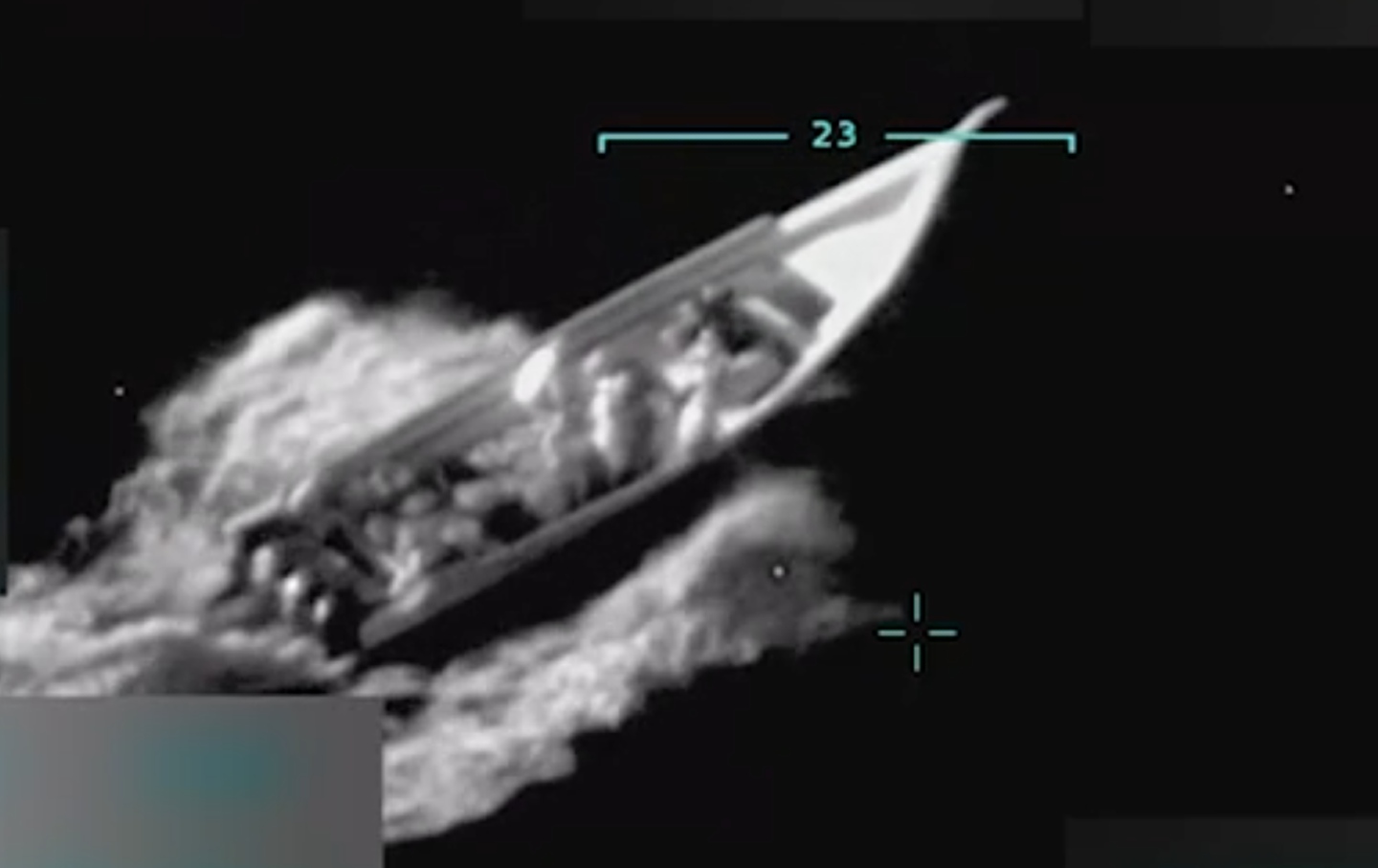
A still from the footage of the Trump administration striking an alleged boat carrying drugs in the Caribbean.(The White House)


On September 2, President Donald Trump announced from the Oval Office that the US Navy had carried out an air strike on a boat in international waters allegedly carrying drugs off the coast of Venezuela. “Over the last few minutes, [we] literally shot out a boat, a drug-carrying boat, a lot of drugs in that boat,” Trump told reporters.

He later posted on Truth Social a video of the alleged air strike. The footage is black and white. The post is labeled “unclassified.” A missile hits the boat, and it explodes. The White House said 11 “narcoterrorists” were killed. Trump promised, “There’s more where that came from.”

If Trump’s account of the attack on the vessel is accurate, it marks the first time the United States has launched a unilateral air strike or carried out a deadly military operation on its own in Latin America since the 1989 invasion of Panama.

The Caribbean strike and Trump’s boasting about it indicates an extremely dangerous shift in a US foreign and military policy toward Latin America, which has stood for more than 35 years.

During the last few decades, the United States has backed coups d’état and supported other countries’ military operations, especially in regard to battling drug trafficking. Through Plan Colombia, the United States provided military aid and assistance to Colombia for years to help the country battle drug trafficking. US Special Forces assisted the Mexican military’s capture of El Chapo. And the Drug Enforcement Administration has often collaborated with local forces, including in a deadly attack on civilians in Honduras in 2012.

But for three and half decades, the United States has withheld direct unilateral military action in the region.

When the United States last took military action with the 1989 Panama invasion, it was carried out a month after the fall of the Berlin Wall, and it marked a major shift in the justification for US action, away from the Cold War and toward the so-called War on Drugs.

At that time, the United States invaded under the pretext of removing, detaining, and extraditing President Manuel Noriega for alleged drug trafficking. The Trump administration is using the same rhetoric against Venezuela President Nicolas Maduro, without providing any evidence.

On December 21, 1989, 26,000 US troops descended on Panama. They attacked key locations around the country. They rained down missiles and bombs on the barracks of Noriega’s Panamanian Defense Forces in Panama City and on the surrounding working-class neighborhood of El Chorrillo. US forces destroyed 20,000 homes and killed hundreds of innocent Panamanians, dumping bodies into mass graves. Victims and their families are still demanding justice.

In my reporting on the legacy of the US invasion of Panama, I’ve spoken with victims who saw their neighbors killed or trapped in their homes as they were engulfed by flames. I’ve spent hours watching videos from that invasion, and there are disturbing parallels between that footage—shot from above, missiles and gunfire riddling the city below—and the video of the air strike in the Caribbean. They are also reminiscent of the videos of US airstrikes in the Middle East.

In most of these clips, the individuals on the receiving end of the US weapons are blurry dots on a screen. They don’t seem like people; they’re targets—labelled drug traffickers or terrorists—as if in a video game. The US military issues their death sentences without trial or evidence. No due process. No jury. No judge. No conviction. No appeal. In defiance of international law.

That is not an era we should return to in Latin America. Yet Trump seems to have his heart set on it. Trump, after all, signed an executive order changing the name of the US Department of Defense to the Department of War. It’s ironic, but not unexpected, that the supposed “anti-war president” and his administration have become unabashedly bellicose in Latin America.

US Defense Secretary Pete Hegseth says the air strike is just the beginning. “We’ve got assets in the air, assets in the water, assets on ships, because this is a deadly serious mission for us,” Hegseth told Fox News, “and it won’t stop with just this strike.”

For much of the 20th century, the United States justified its military actions in Latin America with the Monroe Doctrine—a 200-year-old amorphous foreign policy originally meant to defend the region against European intervention. Countless US invasions and actions were carried out in the name of Monroe, as US forces acted as the so-called police force of the Western Hemisphere.

Despite recent calls by some lawmakers in Washington to do away with the Monroe Doctrine, it now seems the Trump administration is looking to revive it with vigor.

In August, the United States deployed warships to waters near Venezuela’s coast in one of the most dangerous escalation of tensions between the United States and a Latin American country in years.

Trump has accused Venezuelan President Nicolas Maduro of being a narco-trafficking kingpin. But the United Nations and even the president’s National Intelligence Council have denied any links between members of the Venezuelan government and the cartel Tren de Aragua. Nevertheless, in August, Trump doubled a bounty for the arrest of Maduro to $50 million.

It is unclear what the Trump administration hopes to achieve by ramping up the pressure and the rhetoric against Venezuela. An invasion of Venezuela by the United States would be disastrous. Venezuela has a substantial military force and hundreds of thousands of members in the reserve. In recent weeks, videos have been shared widely of long lines of people signing up to join the reserves to defend Venezuela against a possible US threat. In August, Maduro said he had deployed 4.5 million militiamen around the country.

Venezuela is not a drug-trafficking haven nor a threat to the United States. A report by the UN Office on Drugs and Crime detail that most of the routes for cocaine trafficking into the United States go through Colombia, Peru, and Ecuador—not Venezuela. The UNODC says, “The majority of Colombian cocaine is being trafficked north along the Pacific coast.” And in 2024, Cocaine originating in Colombia accounted for more than 80 percent of seizures of cocaine in the United States, according to the US Drug Enforcement Administration.

It is ironic that Secretary of State Marco Rubio has continued to point the finger at Maduro, while he’s currently visiting Ecuador, where he’s met with Ecuadorian President Daniel Noboa.

Noboa is one of Trump’s top allies in Latin America, alongside El Salvador’s Nayib Bukele and Argentina’s Javier Milei. Trump invited Noboa to his inauguration in January. that Noboa and his family have ties to drug trafficking.

According to a March investigation published by the Colombian magazine Revista Raya, multiple shipments of cocaine were seized between 2020 and 2022 from containers belonging to the Noboa family’s banana export business, Noboa Trading. Not surprisingly, this reporting has been ignored by Trump administration officials while they continue to rail against Maduro and Venezuela.

“There’s no real credible evidence of serious drug trafficking, not only coming from Venezuela, but even less so having any ties to high-ranking Venezuelan officials,” said Ricardo Vaz, a longtime reporter with the independent news outlet Venezuelanalysis. “So it’s really a matter of how much the US wants to escalate.”

The United States has long used Latin America as a training ground for military attacks elsewhere around the world. The 1989 Panama invasion, for instance, preceded the Iraq wars. “The attack on a boat and murder of 11 people in international waters off of Venezuela is another example of this,” said John Lindsay-Poland, the author of the book Emperors in the Jungle, about the history of US intervention in Panama and the 1989 invasion. “A trial run—destructive of life in itself—but also a trial for further attacks to see what kind of political resistance there will be within the United States, as well as internationally.”

He added that “if the Trump administration is successful in this attack without paying political consequences, it is free to do so in other parts of the world or on other actors.”

Given Trump’s record of sharing dubious claims, inaccurate information, and lies, there is no reason we should take his assertion at face value that the boat hit by the air strike was, as he said, “a drug-carrying boat.” But even if it was, the United States has protocols in place for drug interdictions. This year, alone, the US Coast Guard has seized $2.2 billion in illicit drugs on open waters, as of August 25.

Instead, the United States is turning to violent attacks, and by describing those killed by the air strike as “narcoterrorists,” the Trump administration is blending the War on Terror with the War on Drugs. Trump is “creating a forever enemy,” researcher Chris Dalby told The World. “He can now justify without due process. Without showing too much evidence. It starts with destroying go-fast boats. But it can be snatch-and-grab operations on Venezuelan soil, and it can escalate all the way up to a prolonged military intervention in the likes of Mexico.”

It should shock the country that the United States would carry out an illegal targeted assassination of 11 people in international waters, and that the president would share a video of it freely over his social media account. In particular, we should worry about an act that rewrites US policy for Latin America, where Trump has carte blanche to take whatever measure he deems necessary without regard for international law, the sovereignty of other nations, or people’s lives. Such a move could have disastrous implications for the region. More missile strikes. Loss of innocent lives. And even wrapping the United States into war close to home.

But Trump clearly feels emboldened to do whatever he wants. And after decades of the so-called War on Terror and the genocide in Gaza, people in the United States have become desensitized to images of violence like this—and the US role in perpetrating them.

“This is just nuts, because they’re doing it out in the open,” said Alexander Main, the director of International Policy at the Center for Economic and Policy Research. “They’re proud of it. And it doesn’t matter if these people are guilty or not.”