Tuesday, September 09, 2025


MOL Develops Innovative Designs for Wind-Assisted LNG Carriers
wind-assisted propulsion
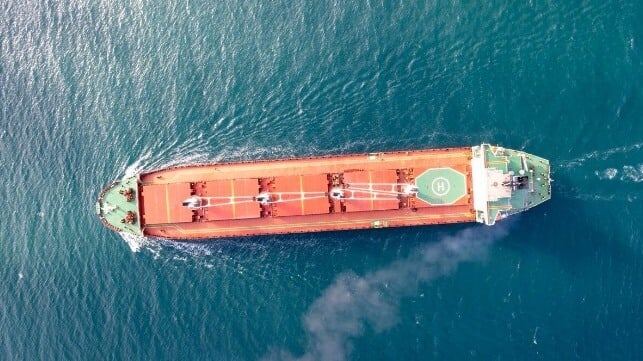
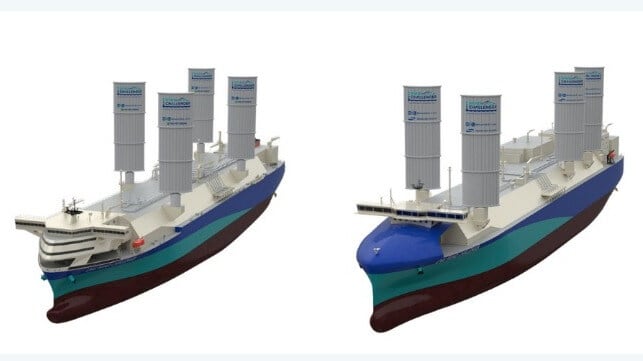
The innovative design with the forward bridge permits four rigid sails to optimize the design (MOL)

Published Sep 8, 2025 9:45 PM by The Maritime Executive


Mitsui O.S.K. Lines continues to work to advance wind-assisted propulsion, building on the concepts after deploying its first rigid, retractable sail on a bulk carrier in October 2022. The company has previously committed to installing its “Wind Challenger” on 25 vessels by 2030 and 80 vessels by 2035.

Working with HD Hyundai Heavy Industries and Samsung Heavy Industries, and Lloyd’s Register as the classification society, they developed innovative concepts for an LNG carrier that could achieve, they project, up to 30 percent fuel saving per voyage and 15 to 20 percent annually. The company previously released a design developed with Hanwha Ocean for a conventional LNG carrier with wind sails, but now has completed preliminary designs for an innovative vessel with four of the rigid sails.

A key element of the two designs moves the bridge toward the bow of the vessel to enable the increase from two to four rigid sails that would rise to a maximum height of approximately 160 feet (48 meters) in a three-tier design. It permits the design to optimize the placement of the sails and maximize the fuel efficiency gains. The ships would be between 938 feet (287 meters) and 951 feet (290 meters) in length, and each has a capacity of 174,000 cbm.

The Wind Challenger, a rigid sail system capable of automatic extension, retraction, and rotation. The first installation was on a 100,000 dwt coal carrier, Shofu Maru, and MOL reported it was able to reduce daily fuel consumption by up to 17 percent, equating to 5 to 8 percent per voyage on average on its first seven roundtrips to Japan from Australia, Indonesia, and North America. A second vessel was fitted with the sail, to be followed by nine additional vessels. The sail is made of fiber-reinforced plastic.

MOL reports that comprehensive risk assessments were undertaken for the new designs in collaboration with the shipyards, the classification society, and flag states. The assessments covered the sail arrangement, visibility impact, emergency operation procedures, and other safety measures. In addition, safety evaluations were conducted in collaboration with the respective flag states. 

The new vessel design developed with HD Hyundai Heavy Industries earned AiP from the Marshall Islands, while the vessel design jointly developed with Samsung Heavy Industries received AiP from Liberia. 

Having been awarded the AiP for the two designs, MOL reports detailed sign work for actual construction is currently underway.


U.S. Navy Retools its Unmanned Programs for Speed

DARPA
The first NOMARS hull, DARPA's Defiant (DARPA)

Published Sep 8, 2025 9:36 PM by The Maritime Executive


The U.S. Navy continues to restructure its unmanned-systems bureaucracy, pulling more responsibilities out of Program Executive Office for Unmanned and Small Combatants (PEO USC) and putting it in new places. Structural adjustments ordered by Navy Secretary John Phelan will reform the way that the Navy develops and administers its acquisition program for autonomous vessels, which promise to radically shrink and cost-optimize the idea of a fighting vessel - if they can be built and fielded in quantity. 

PEO USC handles multiple acquisition duties, including manned smaller-size combatants like the twin Littoral Combat Ship classes and the new Constellation-class frigate. The Constellation was delayed after significant Navy-specific design changes were imposed on the off-the-shelf FREMM design that the Navy selected from Fincantieri - a proven hull selected to minimize risk of delays in production. During detail design, the frigate was stretched in length and its internal layout was altered enough that it retained only 15% design commonality with the FREMM. PEO USC now holds responsibility for bringing that program to full-rate production. In a sign of the hurdles ahead, the Pentagon departed from the schedule for Constellation hull procurement this fiscal year and left the funds for one ship out of the budget. 

While PEO USC focuses on manned hulls, almost all of the Navy's development of oceangoing unmanned craft has happened in the Pentagon, outside of Naval Sea Systems Command. DARPA designed and built the Navy's first autonomous test vessel, Sea Hunter / ACTUV. The Defense Department's Strategic Capabilities Office built the Navy's next major testbed program, the Ghost Fleet Overlord crewboat series. And DARPA stepped in once again to design and build NOMARS, the fully-unmanned prototype completed at Nichols Brothers earlier this year. All have been or will be transferred to Navy ownership, but were conceptualized and developed outside of the service. 

The Navy is now under pressure to ramp up. In July, Defense Secretary Pete Hegseth ordered all of the service branches and combatant commanders to prioritize drone system development and put procurement closer to the front lines. "Modern battlefield innovation demands a new procurement strategy that fuses manufacturers with our frontline troops," Hegseth wrote. "Senior officers must overcome the bureaucracy's instinctive risk-aversion on everything from budgeting to weaponizing and training." He called for eliminating "self-imposed restrictions" on development, and warned that "our major risk is risk-avoidance" when it comes to drone systems. 

In a memo released last week and obtained by Federal News Network, Secretary Phelan ordered a 30-day "sprint" review of unmanned system purchasing, coupled with a pause of all "related acquisition decisions and contracting actions (including awards and modifications)" during the review period. The review will cover every Navy and Marine Corps unmanned program or initiative, and will streamline administration and lines of effort - to take effect within 90 days. 

This retooled enterprise will be housed under a new Program Executive Office for Robotic and Autonomous systems (RAS), giving Navy unmanned systems their own PEO. 

Separately, Breaking Defense and USNI have learned that the Navy has rebooted its long-dormant carrier-based drone fighter program, which has disappeared from public view since the X-47B prototype was canceled in 2015. Over the 10 intervening years, the U.S. Air Force has publicized its extensive R&D with unmanned combat aerial vehicles (UCAVs), and may have more undisclosed activity within its deep portfolio of classified projects; the Navy has not published much about its efforts - until now. According to Breaking Defense, Boeing, Northrop Grumman, General Atomics and Anduril have all been contracted to produce designs for a "loyal wingman" or "collaborative" fighter drone that is carrier-capable. Armed, attritable UCAVs could change the way that carrier aviation operates, extending its reach and improving the survivability of manned fighters.  


WSC Warns 11 Percent of Containers Have Safety Issues

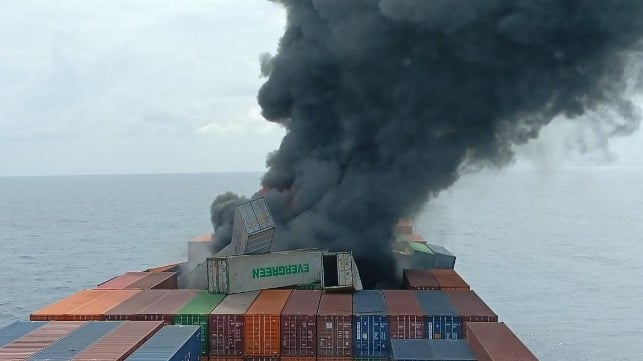
container fire at sea
Container fire is one of the dangers identified by WSC coming from mis-declared and improperly packaged cargo (Indian Coast Guard photo)

Published Sep 8, 2025 10:53 PM by The Maritime Executive


The issues of mis-declared or improperly packed cargo in containers are again being highlighted in new data from the World Shipping Council. The trade group reports based on port state inspection data that the number of containers found with potential safety issues has risen to more than 11 percent, which extrapolates to approximately 27.5 million containers annually based on an estimate that the industry transports 250 million boxes a year.

“With over one-in-ten shipments showing deficiencies, the message is clear: gaps in cargo safety remain far too common,” said Joe Kramek, President & CEO of the World Shipping Council. “Cargo deficiencies put crews, ships, cargo, and the environment at risk."

The council highlights that, by law, port state inspectors can check containers to ensure cargo complies with international regulations and standards. They are looking at issues such as proper declarations and packing of dangerous goods.

The data shows that 11.39 percent of containers were found with deficiencies, up from 11 percent in 2023. Between 2017 and 2022, the rate had been under 9 percent a year and fallen as low as 6.5 percent in 2019, but also jumped to 10.86 percent in 2021. The types of issues that are being identified include mis-declared and undeclared dangerous goods, incorrect documentation, and improper packing, all of which the World Shipping Council points out can lead to serious safety incidents, including ship fires.

While the causes have not been identified, the industry has suffered several high-profile incidents recently. In June, the Wan Hai 503 with a capacity of over 1,700 containers reported a fire that burned for weeks and devastated the vessel, while last month, Maersk reported a fire aboard one of its largest container ships, Marie Maersk (19,076 TEU). While firefighting teams were able to stop the spread of the fire and limit damage, Maersk recently declared General Average for the vessel, which is due to reach the Port of Tanjung Pelepas in Malaysia next week. Cargo owners will be required to share the cost of the firefighting effort.

The shipping industry has been working to address the issue, including new regulations, for example, on the shipment of charcoal. However, while it has been successful in reducing containers lost overboard (just 576 in 2024 according to World Shipping Council data), the dangers from mis-declared and improperly packaged cargo remain high.

The WSC is calling for strong safety measures and more reporting. It notes that currently, just seven port states are reporting cargo safety data. The 2024 report is based on information from 77,688 containers inspected, where 8,850 were found to have deficiencies. More data, the WSC says, would highlight trends and provide insights to address the problem. 


Video: Containers Fall from Ship into Long Beach Harbor

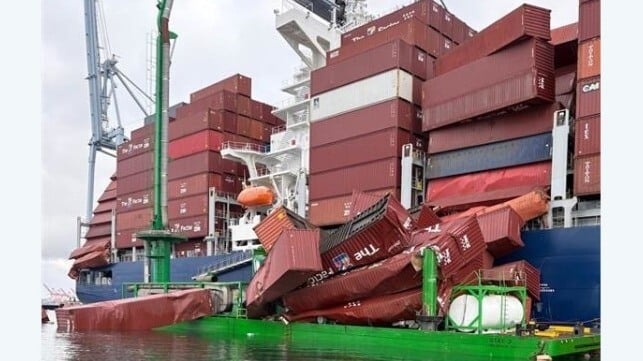
container collapse
Containers collapsed from the vessel docked in the Port of Long Beach (USCG)

Published Sep 9, 2025 3:51 PM by The Maritime Executive


[Breaking News] – The U.S. Coast Guard and the Port of Long Beach, California, are responding to a container collapse from a vessel that is at Pier G. According to the last report from the Coast Guard, at least 67 containers are in the harbor, but there were no reports of injuries.

The containership Mississippi (65,968 dwt) arrived from Yantian, China, early this morning, September 9, at the terminal. It is unclear if cargo operations had begun, but an emission capture barge from STAX was already alongside and in operation. 

Pictures show a stack collapse in the last bay at the stern of the vessel and an additional collapse midship on the starboard side. Some of the boxes have landed on the barge, while others are in the water. Local TV news reports indicated they appeared to be spraying water with high-power hoses possibly to stop the boxes from drifting in the harbor and a harbor boat was seen nudging some of the containers. The official reports said it was unclear what was in the containers. TV reports said they have seen apparel and shoes floating in the harbor.


The Coast Guard reports that a safety zone of 250 feet has been set up around the vessel, and all container operations were suspended at the terminal. 

The vessel, built in 2024, has a capacity of 5,500 TEU and is owned by MPC Container Ships of Norway. It is 836 feet (255 meters) in length.


Op-Ed: Insurers Must Play a Role in Eradicating Sexual Misconduct at Sea

iStock
iStock

Published Sep 9, 2025 12:09 AM by IUMI


Marine insurers must take an active role in eradicating sexual misconduct at sea, delegates at the International Union of Marine Insurance (IUMI) annual conference in Singapore heard today. Moderating the Legal & Liability Workshop, Charles Fernandez, Chair of the IUMI Legal & Liability Committee, called on the marine insurance sector to recognise its responsibility in combating this serious issue.

Women represent just 1% of the global seafaring workforce but a shocking 25% of women in maritime report having experienced physical or sexual assault.

“Sadly, almost all women in maritime have experienced some form of sexual misconduct at sea, ranging from unconscious bias to full-scale assault,” said Fernandez. “Sexual misconduct in any form is completely unacceptable and must be stopped. Our workshop highlighted a number of recent cases and served to bring this appalling practice to the consciousness of the marine insurance community.”

Fernandez emphasised that while marine insurers are not directly involved in vessel operations, they are a crucial part of the maritime supply chain and must use their influence to raise awareness and drive change.

“Marine insurers have a responsibility to do all they can to raise awareness of sexual misconduct at sea and to join the effort to eradicate it completely,” he stated.

The workshop heard that many offences go unreported. Some women fear damage to their reputation, career progression, or simply believe their claims would not be taken seriously.

Further complicating the issue is the fragmented legal landscape. In some cases, the law applied depends on the flag state of the vessel. In others, jurisdiction falls to the country or location where the harm was suffered. This inconsistency can make pursuing justice complex and intimidating for victims.

In most cases of sexual misconduct, shipowners could be held directly liable - particularly if there is evidence they were aware of a perpetrator’s previous history. Shipowners have a legal obligation to provide a safe working environment.

Several high-profile cases have recently come to light where victims have secured successful outcomes, resulting in significant compensation claims paid by liability insurers.

“Joining with others to prevent sexual misconduct at sea is not just the right thing to do, it is also a risk mitigation strategy,” Fernandez explained. “A number of recent cases have resulted, quite rightly, in large payouts for victims with claims being paid by insurers. As marine underwriters, we must be aware of the issue and do what we can to ensure our assureds are implementing effective safeguards and strategies to eradicate all forms of sexual misconduct.”

The International Union of Marine Insurance e.V. (IUMI) is a non-profit association established for the purpose of protecting, safeguarding and advancing insurers‘ interests in marine and all types of transport insurance.

The opinions expressed herein are the author's and not necessarily those of The Maritime Executive.


German Police Detain and Search Cargo Ship on Suspicion of Spying

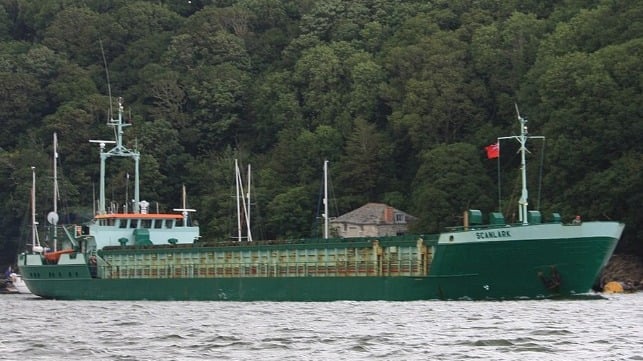
North Sea cargo ship
Small North Sea cargo ship was searched after a suspicious drone was spotted over Germany (Andrew Thomas - CC BY-SA 2.0)

Published Sep 9, 2025 3:07 PM by The Maritime Executive


German police in the northern state of Schleswig-Holstein confirmed media reports that they boarded a cargo ship on the suspicion that it was being used for launching drones and spying on critical infrastructure. It is the second incident this year when a vessel has been searched as part of the ongoing reports of drones spotted overflying critical infrastructure and military installations in Northern Europe.

The Scanlark, a 2,000 dwt North Sea cargo ship, according to the reports, was targeted, and the police trapped the vessel at the southern Kiel-Holtenau lock of the Kiel Canal on Sunday, September 7, at around 1600. The vessel, which is registered in St. Vincent and the Grenadines, was ordered to secure, and according to a report in Der Spiegel, a rubber police launch was circling the ship before special forces boarded the Scanlark.

“The reason for this was to avert threats to Germany's critical maritime infrastructure and an ongoing investigation by the Flensburg Public Prosecutor's Office on suspicion of spying for the purposes of sabotage and security-threatening imaging,” the police and prosecutors said in a joint statement. “It is suspected that a drone was launched from the searched vessel on August 26, 2025, and controlled via a naval vessel in order to reconnoiter it and take photographs.”

The Lower Saxony Interior Minister, Daniela Behrens, issued a statement saying the forces were working to “ward off hybrid threats and dangers to our security.” She repeated the accusation that the vessel was suspected of having served as a base for drone flights over critical infrastructure.

The vessel, which was built in 2006 and is 247 feet (75 meters) in length, was reportedly searched while divers were sent down to inspect the hull. It was coming from Rotterdam with a reported destination of Finland. AIS signals show it is still at the Kiel Canal. 

The Estonian Public Broadcasting service’s ERR outlet is quoting the shipping company Vista Shipping Agency of Estonia, which operates the ship, calling the actions “stupidity.” They told ERR that the allegations of spying against Germany were “laughable” and “nonsense.” 

German authorities have been on heightened alert due to the tensions in the region. ERR reports that there were 536 suspicious drone flights logged near strategic infrastructure in Germany in the first three months of 2025. The police in their statement referred to the current situation as an ongoing investigation.

German media previously reported in May that there were incidents where drones were spotted near a military site near Kiel, and 10 days later, a German patrol ship believed it was being followed by a drone. Another small cargo ship was identified as a suspect, and the police in Belgium were asked to search that vessel.

After the incidents in the spring, the media reports said German authorities do not have the resources to properly track and identify the drones.


Top image by Andrew Thomas of Scanlark in 2013 (CC BY-SA 2.0)


MAIB: Fishing Vessel Foundered off Falklands Due to Failed Shell Door

Argos Georgia
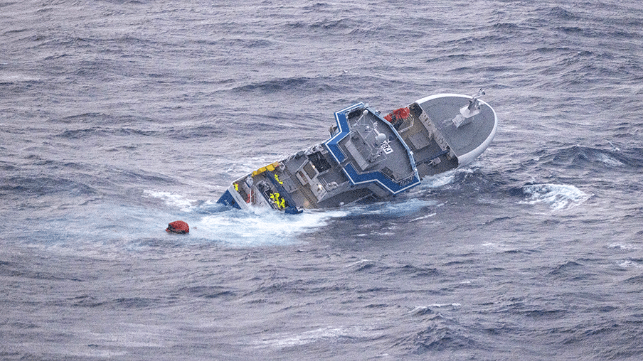
Argos Georgia going down (Royal Air Force / MAIB)

Published Sep 9, 2025 3:22 PM by The Maritime Executive


The UK Marine Accident Investigation Branch has released a report on the sinking of the fishing vessel Argos Georgia, which went down off the coast of the Falkland Islands in 2024 with the loss of 13 lives. 

On July 21, 2024, the 2018-built fishing vessel Argos Georgia got underway from Port Stanley, Falkland Islands and headed out to her fishing grounds with 27 crewmembers on board. On Monday afternoon, she reported a serious flooding incident at a position about 200 miles to the east of the port. As rescue assets mobilized to the scene, the situation on board deteriorated, and the crew was forced to abandon ship into their life rafts. The vessel sank after they departed. 

Some of the vessel's crew were lost at sea during the abandon-ship evolution, and some of the evacuees passed away due to exposure in the liferafts while waiting for a rescue. Ultimately 14 out of 27 survived and were returned to shore. 

MAIB launched an investigation into the cause of the sinking, and quickly focused in on problems with the shell door (exterior hatch) within the hauling compartment for the trawler's nets. CCTV cameras captured footage of the shell door closed in its elevated position, then slowly descending, allowing water to flood into the compartment. 

Once opened, the door was too difficult for crewmembers to close, and water flowed freely in. The hatches from the hauling compartment into the interior of the vessel were also open, and the water poured inside, putting Argos Georgia into a significant list and leading to progressive downflooding. 

The MAIB swiftly turned around an interim warning to all fishing vessel operators to check on their side shell doors and evaluate the risk of shell door failure - including the risk of progressive flooding through hatches and penetrations into other compartments.

MAIB also launched an evaluation of Argos Georgia's shell door design, using finite element analysis engineering. The review found an "unacceptable level of stress and potential failure of the shell door drive shaft, coupling and key" during operations. If the opening/closing mechanism failed during operation, there was no backstop and the door would lower to the open position. 

In July, MAIB recommended that the designer revise this design and share the findings with other vessel operators that have similar shell doors installed. The final report's findings are coming soon. 


Maersk Declares General Average After Container Fire Aboard Marie Maersk

containership
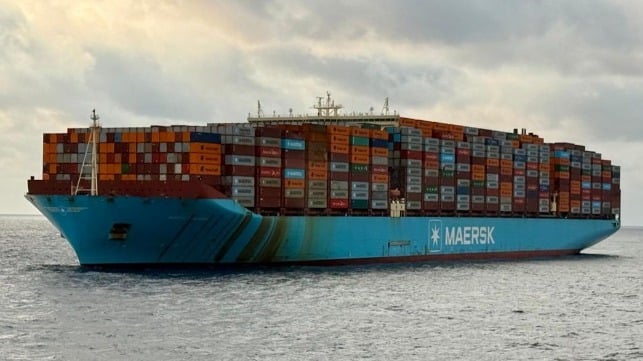
Marine Maersk as seen from one of the supply ships aiding in the firefight (Maersk)

Published Sep 9, 2025 5:18 PM by The Maritime Executive


The containership Marie Maersk is still making its way to Malaysia after fighting a box fire, and now the carrier reports it has declared General Average. Maersk is using the well-established law to share the cost of the firefight, which required bringing in additional resources but appears to have limited the scope of damage to the vessel and its cargo.

The carrier has not provided details on the extent of the damage on the vessel, which carries over 19,000 TEU. Pictures from one of the supply vessels that aided the Marie Maersk while it was off the coast of Africa did not show fire damage. Maersk had previously said that the full extent of the damage would only be known once the boxes were offloaded and inspected.

“We have declared General Average (GA) and have already asked affected cargo owners/customers to submit the respective securities for a fast cargo release,” a company spokesperson told The Maritime Executive. 

Cargo claims consultant WK Webster is informing customers that it believes Maersk intends to discharge the entire cargo of the vessel in Malaysia. The ship had been scheduled to proceed to China. Webster advises that General Average security will be required from all cargo interests before the delivery of their cargo. It has cargo surveyors standing by and fire experts to investigate the cause of the fire.

Maersk reported that the crew of the ship spotted smoke on August 13 and began firefighting procedures. They were working to keep the situation under control while external firefighting support was being organized. Initially, two tugboats with firefighting equipment reached the ship off Liberia, and within days, they reported the spread of the fire had been contained. An expert firefighting team boarded the vessel on August 19, and the decision was then made to resume the voyage.

The ship is expected to arrive at the Port of Tanjung Pelepas in Malaysia with the current ETA of September 14. Maersk and the insurance companies are planning an investigation into the cause of the fire.

While the causes of the fire on the Maersk ship are still unknown, the dangers of mis-declared and improperly packed cargo were highlighted in a new report from the World Shipping Council. Analyzing data from port state inspections in seven locations, the trade group reported inspectors had identified problems in 11.39 percent of containers (8,850 containers out of 77,688 inspected). The most frequent issues were with documentation, placarding, and labeling, but they also reported issues in about a third of the cases with stowage or securing freight in the containers, as well as a smaller number of cases of inappropriate or damaged packaging.


Pakistan

State Neglect and Corporate-Driven Development Deepen Rural Devastation: Punjab faces unprecedented flood challenge

Monday 8 September 2025, by Farooq Tariq, Qammar Abbas


Two million people have been impacted, 2200 villages and millions of acre of agri land are under water. Unprecedented Flood water now moving toward Sindh endangering lives of millions.

The Pakistan Kissan Rabita Committee (PKRC) expresses deep concern and outrage at the ongoing devastation caused by the 2025 floods across northern regions in Punjab Khyber Pakhtunkhwa, Gilgit-Baltistan, Kashmir & Sindh. Once again, it is peasants, small-scale food producers, sharecroppers, landless workers, and rural women who are paying the heaviest price for a crisis they did not create.
Massive Losses, Unequal Burdens

Since late June, unprecedented monsoon cloudbursts and glacial hazards have triggered deadly flash floods and landslides. Entire villages were swept away within minutes in Buner and Swat; South Punjab’s cotton, rice, and mango crops stand submerged; and in GB, terraces and irrigation channels have collapsed.

More than 1100 lives have been lost, hundreds remain missing, and thousands of homes, roads, and bridges destroyed. National figures confirm over 10,000 livestock deaths. For small farmers, the disaster has wiped out their seed stocks, crops, and animals—destroying both immediate harvests and future planting.
A Disaster Made by Climate Injustice and State Neglect

Pakistan contributes less than 1% of global greenhouse gas emissions but is once again on the frontlines of climate collapse. These extreme floods are climate-amplified, fueled by warming-driven intense rainfall and glacial lake outburst risks.

But the scale of destruction is not “natural.” It is the direct result of decades of state neglect, broken priorities, and neoliberal policies. Instead of investing in early-warning systems, embankments, and flood-resilient rural infrastructure, successive governments and the military elite have diverted resources to mega-canals, corporate farming zones, export crops, built housing societies on the path of rivers and military-led agribusiness projects under the Green Pakistan Initiative.

Ravi Urban Development (RUDA), a maga housing scheme on oblast 100,000 acre of land on both sides of River Ravi, played an important part in drowning almost 1/6th of Lahore under water. The land from small farmers was acquired forcefully using a colonial law that still exists.
These choices leave peasants unprotected while public wealth is funneled into corporate schemes. Relief and recovery measures remain slow, top-down, and exclusionary, once again abandoning the rural poor.

The 2025 floods are not an accident of nature. They are the outcome of state neglect, elite greed, and global capitalist exploitation. Each time, it is peasants and rural workers who lose everything, while those responsible enrich themselves. Relief alone is not enough. What is required is justice: redistribution of land and resources, recognition of peasant rights, and a decisive break from fossil fuel–driven, corporate-controlled models of development.

Pakistan Kissan Rabita Committee (PKRC) calls on all progressive forces—political parties, labour groups, women’s movements, and international allies—to stand with peasants in demanding a new social contract rooted in land, popular agrarian reforms, food sovereignty, dignity, and climate justice.

31 August 2025


Attached documentsstate-neglect-and-corporate-driven-development-deepen-rural_a9160-2.pdf (PDF - 905.1 KiB)
Extraction PDF [->article9160]


Farooq Tariq
Farooq Tariq is General Secretary, Pakistan Kissan Rabita Committee.
and President Haqooq Khalq Party. He previously played leading roles Awami Workers’ Party and before that of Labour Party Pakistan.

Qammar Abbas


International Viewpoint is published under the responsibility of the Bureau of the Fourth International. Signed articles do not necessarily reflect editorial policy. Articles can be reprinted with acknowledgement, and a live link if possible.

Trump Wants a More Militaristic, Bellicose America


Tuesday 9 September 2025

by Dan  La Botz

Trump last week renamed the U.S. Department of Defense, announcing that it is now the Department of War. The name change suggests that Trump wants a more warlike country, despite his claims that he is a peacemaker. In fact, the Trump administration already has a remarkable record of military action in various regions of the world.

Trump has been practically begging to be awarded the Nobel Peace Prize, claiming that he has ended six or seven wars in countries around the world. He says he has brought about peaceful relations between Israel and Iran, Rwanda and Democratic Republic of the Congo, Armenia and Azerbaijan, Thailand and Cambodia, India and Pakistan, Egypt and Ethiopia, and Serbia and Kosovo. Yet, despite his claim, none of those conflicts has actually been settled. And he has done nothing to bring peace in two of the most serious conflicts: Russia’s war on Ukraine and Israel’s war on Gaza.

The self-proclaimed president of peace has engaged in a number of spectacular violent and warlike acts. During his first term as president, on January 3, 2020, Trump ordered a drone strike that killed Iranian Major General Qasem Soleimani near Baghdad International Airport in Iraq. The assassination was not approved by the U.S. Congress and did not have the approval of the Iraqi government, and the United States was not at war with Iran. And on June 22, 2025, during the Israeli-Iran war, the U.S. Air Force and Navy attacked three nuclear facilities in Iran, though there was no declared war on Iran.

Last week, Trump authorized an attack on what he called a “Venezuelan drug boat” supposedly operated by the Tren de Aragua cartel, though the U.S. government offered no evidence of the claim. The boat was destroyed and 11 crew members were killed in an action in the Caribbean that was in clear violation of the law of the sea and international human rights law. The U.S. Congress had not sanctioned the attack. Republican Senator Lindsey Graham praised Trump for his illegal and violent attack, writing on social media, “The sinking of this drug-laden ship is the ultimate — and most welcome — sign that we have a new sheriff in town.” Trump, his Secretary of State Marco Rubio, and his Secretary of Defense Pete Hegseth promised more such attacks on drug smugglers.

The U.S. Navy has increased its presence in the Caribbean where it now has eight warships, an attack submarine, and several surveillance planes. Venezuela’s president, Nicolás Maduro has stated that the United States is preparing an invasion of is country. Karoline Leavitt, the White House press secretary, recently stated that Maduro’s government is illegitimate and Trump has just doubled to $50 million the reward for the arrest of Maduro who he accuses of being one of the world’s biggest drug dealers, working with cartels to flood the United States with fentanyl laced with cocaine. War with Venezuela? Maybe. And since taking office, Trump has suggested he would use military force to take over Greenland and to take back Panama.

For months Trump has been authorizing unpublicized military attacks in regions around the world. The Armed Conflict Location and Event Data Project (ACLED), reported this month that since Trump’s return to the presidency, the US has carried out 529 air attacks in 240 locations across the Middle East, Central Asia and Africa. This number is close to the total of the 555 attacks launched by the Joe Biden administration over his entire term from 2021 to 2025.

But Trump not only wants to use the military abroad, he is also preparing to make war on the American people. He now plans to send troops to Chicago as he has to Los Angeles and to Washington, D.C., Trump posted: “Chicago is about to find out why it’s called the Department of WAR.”

Trump has evolved into an aggressive dictator both abroad and at home, and it will be up to us to stop him.

7 September 2025