Tuesday, September 09, 2025

Second boat hit by suspected drone, say Gaza aid flotilla activists


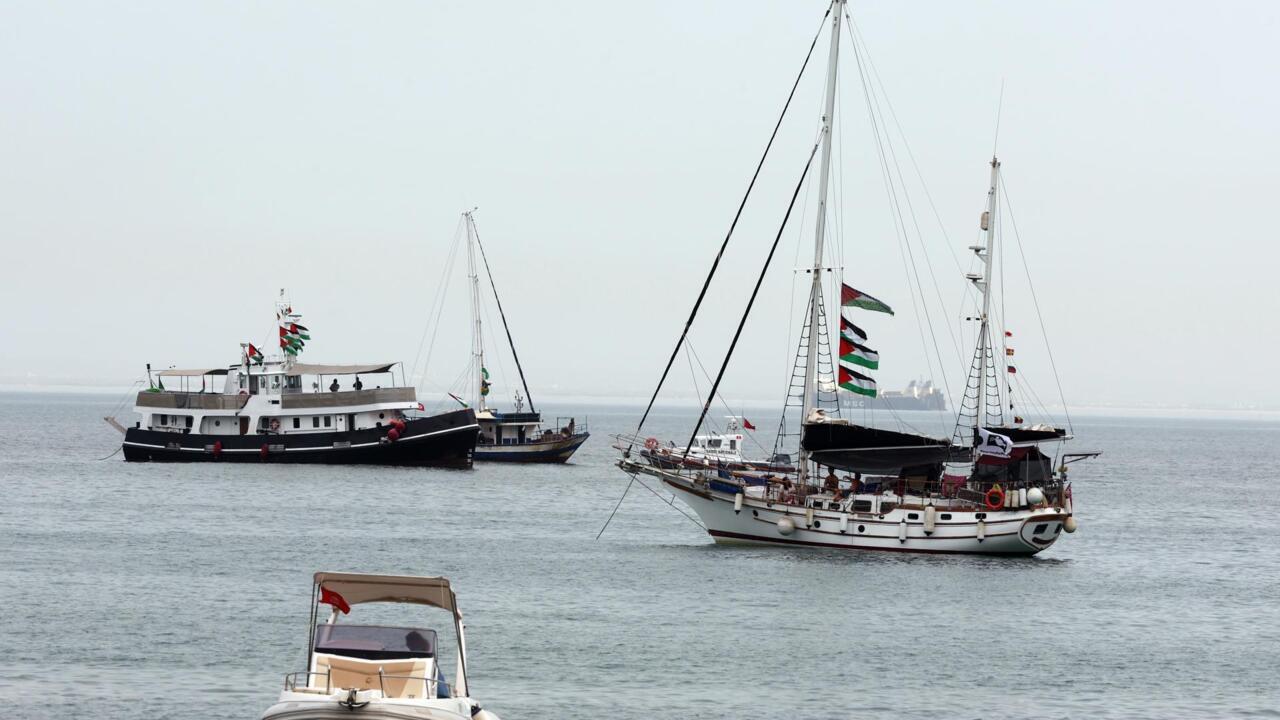
The pro-Palestinian activists sailing a flotilla carrying aid to Gaza said on Tuesday that another one of their boats had been hit while docked off the Tunisian coast, with some flotilla members saying they had seen a drone before the ship caught fire.


Issued on: 10/09/2025 -
By: FRANCE 24
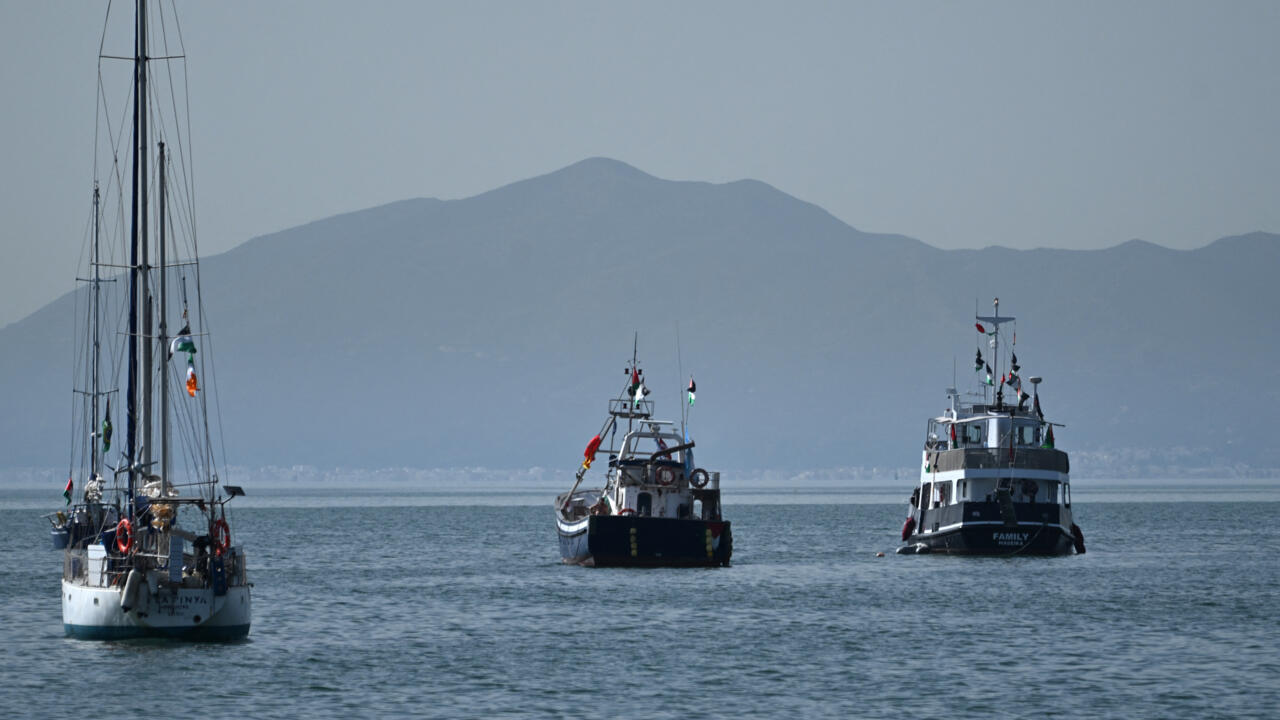
A ship (R), known as the "Family" and is part of the Global Sumud Flotilla, is anchored off the coast of the village of Sidi Bou Said on September 9, 2025. © Fethi Belaid, AFP

Organisers of a Gaza-bound flotilla carrying aid and pro-Palestinian activists said late Tuesday that another of their boats had been struck in a suspected drone attack off Tunisia's coast.

Aiming to break Israel's blockade of Gaza, the flotilla was due to resume its voyage on Wednesday after being delayed multiple times by weather conditions and other issues.

"Second night, second drone attack," Melanie Schweizer, one of its coordinators, told AFP.

The British-flagged Alma was docked in Tunisian waters on Tuesday, when it was "attacked" and "sustained fire damage on its top deck", the Global Sumud Flotilla said in a statement, adding no one was hurt.


Tunisia thumbnail © France24
01:31


AFP journalists at the scene saw a boat in the distance surrounded by Tunisian law enforcement vessels with flashing lights.

The incident comes a day after the activists said another of their boats was hit by a similar suspected UAV attack, but Tunisian authorities said "no drones" had been detected.

The activists said they would continue their "peaceful voyage" on Wednesday as planned, as the flotilla "presses forward with determination and resolve".
Two nights, two fires

Francesca Albanese, UN special rapporteur for the occupied Palestinian territories, posted video of the burning Alma and said it indicated a UAV attack.

"Video evidence suggests a drone -- with no light so it could not be seen -- dropped a device that set the deck of the Alma boat on fire," she wrote on social media.

The flotilla arrived in Tunisia at the weekend and was anchored off the coast of Sidi Bou Said, north of Tunis, when it reported the first incident.

Some members of the flotilla said they saw the drone, adding that the boat's bow caught fire immediately after.

But authorities dismissed reports of a drone strike as "completely unfounded", suggesting the fire may have been caused by a cigarette butt.

Tunisian national guard spokesman Houcem Eddine Jebabli told AFP overnight "no drones have been detected".

Security footage posted by the flotilla organisers showed a burning mass falling from a distance onto the ship.
'Distract and derail'

The activists did not blame Israel for the suspected attacks in their statement but said "they come during intensified Israeli aggression on Palestinians in Gaza, and are an orchestrated attempt to distract and derail our mission".

The Israeli military did not respond to AFP's request for comment on Tuesday.

The United Nations declared famine last month in parts of Gaza, warning that 500,000 people face "catastrophic" conditions.

Sumud means "resilience" in English, and the flotilla describes itself as an independent group not linked to any government or political party.

Among its high-profile participants is environmental activist Greta Thunberg.

(FRANCE 24 with AFP)


Gaza flotilla fire: What the surveillance videos


tell us


On the night of September 8-9, just after midnight, a boat that is part of a flotilla carrying humanitarian aid to Gaza was struck by an incendiary device off the coast of Tunisia. Members of the Global Sumud Flotilla say they heard a drone flying three or four metres above their heads before the device hit, causing a fire that damaged the boat but caused no injuries. A drone expert said that such devices can be dropped by commercially available consumer drones.


Issued on: 09/09/2025 -
By: The FRANCE 24 Observers
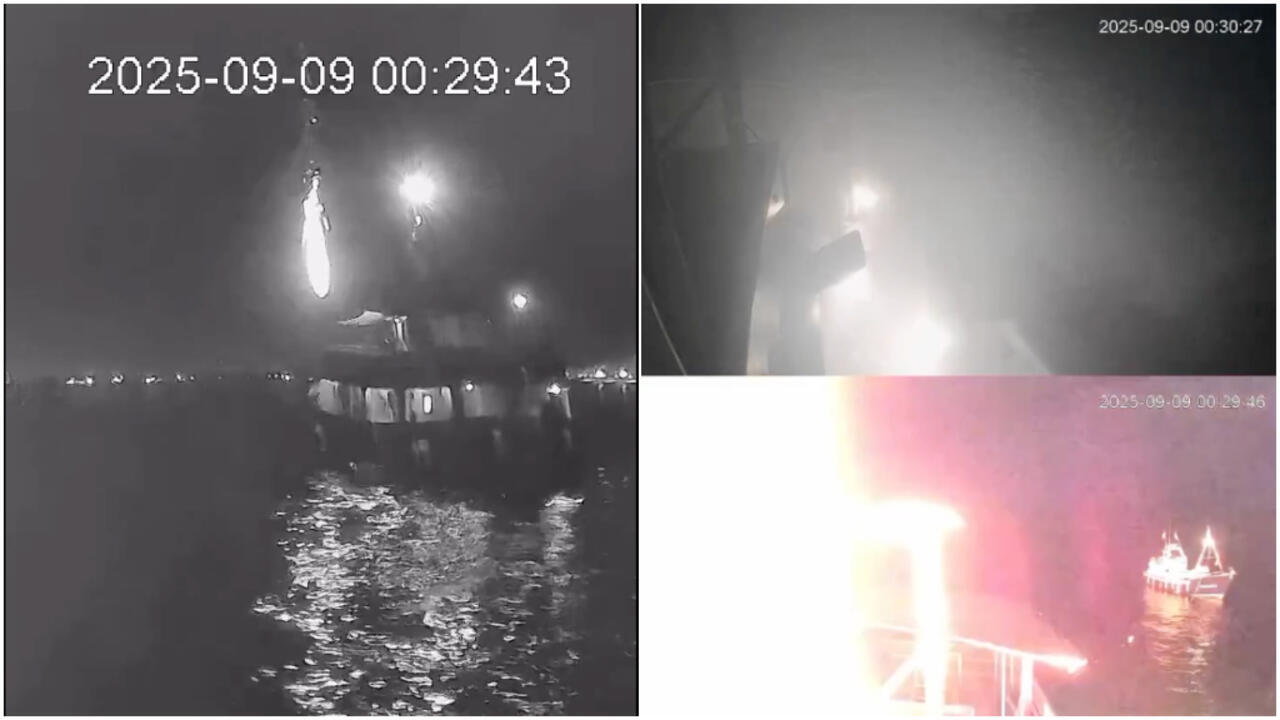

Left: A surveillance video posted by the Global Sumud Flotilla early September 9, 2025 shows the moment an incendiary munition hit the flotilla’s “Family boat”. Right: The group also published surveillance videos filmed on board the vessel that was struck. © Observers


Organisers of the flotilla, which is carrying humanitarian aid and pro-Palestinian activists including Greta Thunberg, said the Portuguese-flagged Family Madeira, known by the group as the "Family Boat", was targeted by a drone while in Tunisian waters.

Videos and expert analyses suggest the device was likely an improvised incendiary dropped from a commercial or retail drone, rather than a military-grade drone, or UAV (unmanned aerial vehicle). While members of the group suggested Israel might have been behind the attack, this kind of technology is widely accessible to the public, and such an attack could have been carried out by virtually anyone.

The flotilla, which aims to deliver aid to Gaza in defiance of Israel’s blockade, had arrived in Tunisia over the weekend. Tracking data on the group’s website indicates that the vessel was moored some 600 metres from the port of Sidi Bou Said.

]
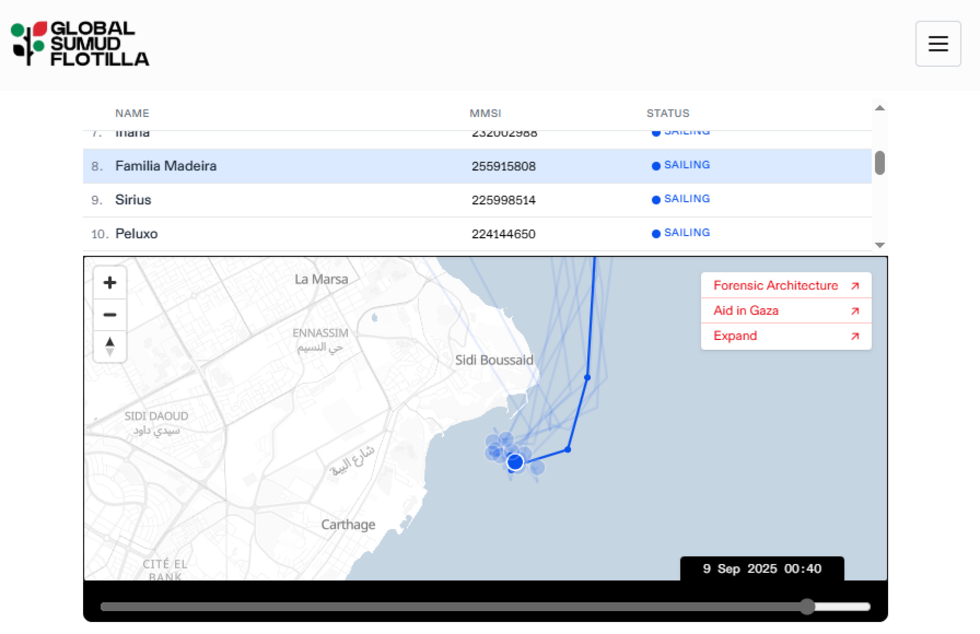
Tracking data on the Global Sumud Flotilla website indicates that the Family Madeira was moored off the coast of Tunisia on the night of 8-9 September 2025, approximately 600m from the port or Sidi Bou Said. © Observers


Tunisian authorities have denied claims that the boat was struck by a drone, insisting instead that the fire broke out on the vessel itself. A surveillance video filmed from another vessel in the flotilla shows an incendiary device falling vertically onto the Family Madeira from a height of at least three metres above its top deck, creating a bright flash as screams are heard from the vessel. Other videos filmed on board the vessel show a fire breaking out. No drone is visible in the surveillance videos, which are filmed from cameras with fixed angles.
Surveillance video published by the Global Sumud Flotilla early September 9, 2025 shows the moment just before 00:30 a.m. when an incendiary device hit one of the flotilla’s boats. The video was one of at least three videos published by the group that showed a projectile hitting the boat.

'The drone operator had prior experience'

Roy Gardiner, an online investigator specialising in drone warfare, analysed the images.


In the main video of the incident, we see a flaming object falling almost vertically from the sky. UAVs used in conflicts like Ukraine typically explode on contact or drop small bombs.

But we also see drones being used to drop incendiary munitions, and this video is consistent with that kind of drone. These drones don’t have to be very large, and the object would have been ignited upon release from the UAV.

In a media interview, one participant described a drone hovering around four metres over his head before “dropping a bomb on a pile of life jackets” located at the front of the boat.


A member of the Global Sumud Flotilla describes an overnight drone attack on one of the group’s boats early September 9, 2025.

Roy Gardiner continued:


Based on eyewitness accounts and the available video footage, this is exactly how a bomb-dropping UAV would operate. It hovers over the target to ensure a highly accurate drop.

It’s unlikely that someone could carry out such a precise strike by chance, so I’d suggest the drone operator had prior experience. This isn’t something easily done. The pilot could have been operating from as far as five to six kilometres away.


The Global Sumud Flotilla published two surveillance videos from the Family Madeira. At 0’10 in the top video (timestamp 00:29:45) a crew member looks up as he appears to see something. Two seconds later, at 00:29:47, the incendiary device hits. The bottom video shows the same scene from a different angle.

Members of the flotilla have suggested Israel as the likely perpetrator of the attack.

“It’s too soon to say who owns these drones, but we know very well who has been targeting humanitarian missions to Gaza for a long time,” a flotilla spokesperson told the media.


Footage published by the Global Sumud Flotilla on X early September 9, 2025 shows apparent fire damage after an overnight drone attack on one of their boats.

The expert emphasised that the low-grade technology used in the attack is easily accessible to the public:

Retail drones like the DJI Mavic 3 — available worldwide — are capable of carrying out missions of this kind. They are very quiet, easy to purchase, and relatively simple to operate, especially compared with FPVs [first-person view drones] widely used in Ukraine, which are far more difficult to fly.

There are standard, well-known methods for modifying these commercial drones to drop payloads. A basic 3D-printed release mechanism, which can be attached to the drone, is commonly used in Ukraine. Digital blueprints for such devices are routinely shared on Telegram channels.

The device used in this case was small and the attack wasn’t lethal. It didn’t cause significant damage. But we can’t rule out the possibility of a government being behind it. Using low-grade technology might be a deliberate choice to create distance and plausible deniability, while still delivering a warning.

There have been previous allegations of drone attacks on aid ships bound for Gaza. In May, the Freedom Flotilla said that its vessel The Conscience was struck by a drone off the coast of Malta.

A decade earlier, in 2010, Israeli commandos killed 10 people when they boarded the Mavi Marmara, a Turkish ship leading an aid flotilla to Gaza.

In August, a UN-backed body confirmed that famine was taking hold in Gaza, and the UN’s humanitarian chief described it as the direct result of Israel’s “systematic obstruction” of aid entering the territory.

The report was dismissed by Israel as an “outright lie”. Israeli officials continue to deny that there is starvation in Gaza.
Gaza flotilla says boat struck by drone in Tunisian waters, authorities deny claim


Organisers of a Gaza-bound flotilla carrying aid and pro-Palestinian activists said late Monday one of their boats was struck by a suspected drone. Tunisian authorities denied detecting any UAV activity, saying “no drones” had been identified in the area. No casualties were reported.


Issued on: 09/09/2025 -
By: FRANCE 24


Vessels, part of the Global Sumud Flotilla, off the coast 
of Sidi Bou Said, Tunisia, 08 September 2025. 
© Mohamed Messara, EFE

The organisers of a Gaza-bound flotilla carrying humanitarian aid and pro-Palestinian activists said late Monday that one of their boats was hit by a suspected UAV but Tunisian authorities said "no drones" had been detected.

The flotilla, which aims to deliver aid to Gazans in defiance of Israel's blockade, arrived in Tunisia over the weekend and was anchored 50 miles from the port of Sidi Bou Said when it reported the incident.

"The Global Sumud Flotilla (GSF) confirms that one of the main boats... was struck by what is suspected to be a drone," the organisers said on social media, adding no one had been hurt.

The boat was in Tunisian waters when a fire broke out onboard and was quickly extinguished, according to an AFP journalist who arrived shortly after the flames had been doused.

Houcem Eddine Jebabli, a spokesman for Tunisia's national guard, said their investigation was "ongoing" but "no drones have been detected".

"According to preliminary findings, a fire broke out in the life jackets on board a ship anchored 50 miles from the port of Sidi Bou Said," he said.

Reports of a drone are "completely unfounded", the national guard said in a statement on its official Facebook page, suggesting that the fire may have been caused by a cigarette.

The Global Sumud Flotilla describes itself as an independent group not linked to any government or political party. Sumud means "resilience" in Arabic.

Among its high-profile participants is Greta Thunberg, who addressed pro-Palestinian campaigners in Tunisia on Sunday.

Israel has already blocked two attempts by activists to deliver aid by ship to Gaza, in June and July.

The United Nations declared a state of famine in parts of Gaza, warning that 500,000 people face "catastrophic" conditions.

(FRANCE 24 with AFP)


Video: Gaza Flotilla Boat Struck by an Object in Tunisia Which Starts Fir

flotilla boat hit by falling object
Object falling from the sky hit the lead boat of the flotilla (Global Sumud Flotilla)

Published Sep 9, 2025 12:39 PM by The Maritime Executive


The organizers of the latest activist flotilla planning to sail to Gaza are reporting their vessel was struck by an object from the sky overnight, starting a small fire on deck. The group issued multiple videos while officials in Tunisia quickly rejected the claims of a drone attack.

The group, which is calling its effort the Global Sumud Flotilla, has been preparing in the Tunisian port of Sidi Bou Said since Sunday. Shortly before midnight local time on Monday, September 8, the group reports it saw a drone overhead at a height of 4 to 5 meters (13 to 16 feet), followed by an object falling from the drone and hitting the deck of the lead vessel of the flotilla.

A fire ensued, which the group said was caused by lifejackets on deck. They said the deck and the under-deck storage on the vessel registered in Portugal were damaged, but none of the six people aboard were injured. Among the individuals reported to be traveling on the vessel named Family and registered in Maderia is Swedish activist Greta Thunberg.


The incident coincided with the group's livestreaming reports. This morning, they held another press conference saying they are undeterred in their efforts to reach Gaza. Media reports are calling it a “luminous flying object,” while the group asserts the drone dropped a bomb onto their deck.

Tunisia’s Ministry of Interior issued a statement saying that the reports circulated “about a drone crashing onto a ship docked at Sidi Bou Said Port are completely false.” According to their version of the events, security units inspected the effects of the fire, saying it broke out in one of the life jackets and was quickly brought under control. They reported that the fire did not cause any human or material damage, except for the burning of several of the life jackets.

Since Sunday, boats that departed from Barcelona, Spain, and Genoa, Italy, have been massing in the Tunisian port. Organizers claim there are around 50 boats and activists representing 44 countries. They had previously been delayed by bad weather, but the current plan is to set sail on Wednesday. They hope to overwhelm the Israeli blockade, although reports from Israel show the navy staging exercises off Gaza.

Another effort in July with a single vessel was intercepted by the Israelis as it attempted to approach the coast and was escorted to port. The individuals aboard, including Greta Thunberg, were deported.

The first attempt was preparing off Malta in May when the group also claimed that its vessel was attacked by drones. The authorities in Malta aided with the firefight and reported minor damage to the vessel, which caused an end to the effort.

Organizers during their press event today asserted that a total of 37 boats have either been intercepted or turned away attempting to reach Gaza over the past 17 years. The Israelis have permitted international organizations to deliver aid from Cyprus and elsewhere under controlled conditions.

MONOPOLY CAPITALI$M

Mistral and ASML forge €1.7bn alliance to shape Europe’s AI future


Paris-based Mistral AI has achieved Europe’s largest fundraising round in artificial intelligence to date, securing €1.7 billion and bringing Dutch semiconductor giant ASML on board as a strategic partner in a deal seen as bolstering Europe’s drive for technological sovereignty.


Issued on: 09/09/2025 - RFI

French developer Mistral AI has €1.7 billion as Dutch tech group ASML becomes its top shareholder © wikimedia commons


France’s homegrown artificial intelligence champion Mistral has cemented its place among Europe’s tech leaders, announcing on Tuesday that it has raised €1.7 billion in fresh capital – a record for a French start-up.

The fundraising drive has brought the value of the company to €11.7 billion, almost double its worth just over a year ago.

The deal also brings in a heavyweight new ally – Dutch technology giant ASML, the world’s most important supplier of advanced semiconductor equipment, which is directly investing €1.3 billion in Mistral.

ASML emerged from the round as Mistral’s leading shareholder, in a move set to link Europe’s most prominent AI developer with the linchpin of global chip production.


European tech alliance

The partnership is being hailed as a milestone for European technological sovereignty at a time when the EU is seeking to reduce its reliance on US firms, especially under the renewed presidency of Donald Trump.

By joining forces, ASML and Mistral are positioning themselves to explore joint research and innovative solutions at the intersection of AI and advanced chipmaking.

ASML said its investment was designed to “generate clear benefits for ASML customers through innovative products and solutions enabled by AI”, while also holding out the prospect of deeper collaboration in research.

Arthur Mensch, Mistral’s co-founder and chief executive, struck an equally confident note.

He said Mistral’s technology could help ASML tackle “current and future engineering challenges”, boosting both the hardware that underpins semiconductors and the AI systems that rely on them.

ASML will take between an 11 to 15 percent stake in Mistral and secure a seat on its board, although neither company has confirmed the details.


From start-up to heavyweight contender


Mistral was founded in 2023 by Mensch, a former researcher at Google’s DeepMind, alongside Guillaume Lample and Timothée Lacroix, who both cut their teeth at Meta’s AI division.

In just two years, the Paris-based company has carved out a reputation as Europe’s most promising AI start-up.

Its flagship product, Le Chat, is a large language model chatbot pitched as a rival to OpenAI’s ChatGPT.

Beyond text, Mistral has also rolled out generative models capable of creating images and computer code.


French CEO of Agence France Presse, Fabrice Fries, shakes hands with French founder of artificial intelligence start-up Mistral AI, Arthur Mensch at the Mistral headquarters in Paris, on 15 January 2025. © Bertrand Guay / AFP


The company has expanded quickly, with offices now open in Paris, London, Luxembourg, New York, Palo Alto and Singapore.

Along the way, it has struck a string of headline-grabbing partnerships – from teaming up with Nvidia to develop a cloud computing platform, to joining forces with Saudi investment fund MGX on an AI campus outside Paris.

Mistral has also signed a deal with Agence France-Presse, allowing Le Chat to draw on AFP’s extensive multilingual news archives to answer users’ queries on current and historical events.


Playing catch-up with US rivals


Despite its rapid rise, Mistral remains a relative lightweight compared with American competitors.

Earlier this month, US firm Anthropic secured fresh funding at a staggering $183 billion valuation, underscoring the scale of investment flooding into AI across the Atlantic.

Yet Tuesday’s announcement marks a clear statement of intent.

For France and Europe more broadly, Mistral’s success is being held up as evidence that the continent can nurture its own champions in a sector increasingly seen as strategic.

With ASML now on board, Mistral has secured both deep pockets and a powerful partner at the heart of global chipmaking.

For Europe’s bid to assert itself in the AI race, that combination may prove invaluable.
EU backs tough legislation to slash food waste and reit fashion'

Binding targets for curbing food waste and fresh obligations for the textile industry are at the heart of a new EU drive to cut disgarded goods and protect the planet.


Issued on: 09/09/2025 - RFI


An employee throws food scraps into a bio-waste bin outside a restaurant in Paris, on 17 November 2021. © AFP / ERIC PIERMONT

EU lawmakers have given the final go-ahead to a sweeping new law designed to cut back Europe’s towering piles of wasted food and rein in the environmental footprint of fast fashion.

Brussels estimates that each person in the 27-nation bloc generates around 130 kilogrammes of food waste annually – that’s a staggering 60 million tonnes – along with some 15 kilos of discarded textiles.

By slashing food waste, the EU hopes to also reduce the water, fertiliser and energy used to produce, process and store food that too often ends up in the bin.

A similar rationale underpins the textile provisions: producing a single cotton t-shirt, the EU points out, requires around 2,700 litres of fresh water – the amount an average person drinks over two and a half years.


Binding targets for food

Under the law passed on Tuesday, member states will face binding food waste reduction targets, though they will have the freedom to decide how best to reach them.

By 2030, households, retailers and restaurants must cut their waste by 30 percent compared with 2021-23 levels, while the food industry must trim its losses by 10 per cent.

Rapporteur Anna Zalewska said “targeted solutions” could include encouraging sales of “ugly” fruit and vegetables, clarifying confusing date labels and boosting donations of unsold but still edible food.

Parliament initially pushed for even steeper reductions of 40 and 20 percent, but the final compromise was hammered out with the European Commission and EU capitals.

The hospitality industry lobbied against binding targets, arguing instead for a stronger focus on consumer education.

“The key is raising awareness – especially among consumers,” said Marine Thizon of the European hotel, restaurant and café association Hotrec, noting that households account for more than half of Europe’s food waste.
Workers producing garments at a textile factory that supplies clothes to fast fashion e-commerce company Shein in Guangzhou, China, 11 June 2024. AFP - JADE GAO


Textiles brought into the fold

The law also updates a 2008 directive on waste, for the first time extending its reach to textiles.

Producers will be made responsible for the cost of collecting, sorting and recycling clothing, carpets, mattresses and more.

With less than one per cent of textiles recycled worldwide, and over 12 million tonnes thrown out annually in the EU alone, lawmakers hope the measures will stem the tide of ultra-cheap fashion imports – many from China – sold by platforms such as Shein.

Brussels is already investigating the online giant over concerns about illegal products.

Separately, the EU has proposed a €2 flat import fee on small parcels, aiming to curb the flood of low-cost packages driven by fast-fashion sales.

Last year, 4.6 billion parcels entered the bloc – more than 145 every second – with nine in ten arriving from China.


Farm sector spared


One major gap remains, as the new law sets no waste-reduction targets for farmers, to the disappointment of environmental groups such as WWF.

“Losses before, during and after harvesting or livestock rearing make up a considerable amount of food waste across the value chain,” the organisation warned, saying it was “concerned” about the exemption.

Even so, the new law marks a significant step forward, with the potential to make Europeans more mindful of what they eat, wear and throw away – and to send a clear signal that wasteful habits can no longer be the norm.

(with newswires)


DP World Selected to Design and Operate Montreal’s New Container Terminal

Montreal Canada container terminal
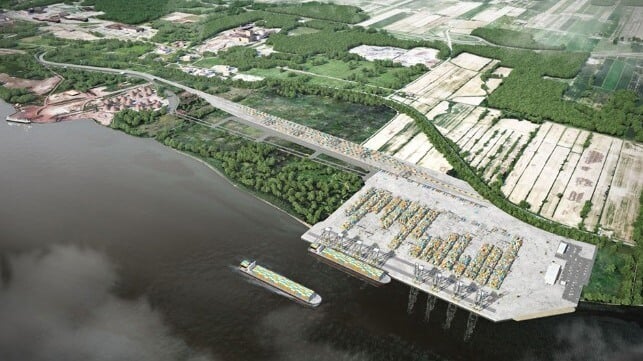
Rendering of the new container terminal for the Port of Montreal (MPA)

Published Sep 8, 2025 7:41 PM by The Maritime Executive


The Port of Montreal, Canada, and DP World Canada have entered into a joint development agreement for the land-based facilities for the port’s new container terminal at Contrecoeur on the St. Lawrence River. The facility has been in the planning stage for years, with work expected to start this year and completion by 2030.

On the terms of the agreement, DP World Canada will work with the port authority over the next few months to finalize the design for the terminal as well as the terms of the construction and operating contract. The contract will take effect with the start of land work, which is expected in 2027. DP World Canada will oversee the construction of the terminal, including the container yard, building, utilities, and rail connection, and will have a 40-year operating agreement.

The Montreal Port Authority began in the 1980s acquiring land in Contrecoeur, which is located approximately 50 miles to the north of the city on the south bank of the St. Lawrence. Port officials highlight that the current facilities on Montreal Island, which handled nearly 1.5 million TEU in 2024, will soon reach capacity. The plan for Contrecoeur calls for a capacity to handle 1.15 million TEU annually, a nearly 60 percent increase in the container handling capacity in the Port of Montreal. 

The new terminal will include two berths as well as container handling and storage areas. The flow of goods will also be improved in Montreal with integrated connections to road and rail networks at Contrecoeur.

The construction plan for the new terminal uses a hybrid model, splitting responsibility for the water-side to the port and Canadian Coast Guard, while DP World will have responsibility for the land-side facilities. The goal is to start site preparation this year, once the final approvals are granted, and in-water work in 2026.  The timeline calls for commissioning the new terminal in 2030.

DP World notes that it will be its entry into the Port of Montreal. The company currently operates six port facilities in Canada, including in Vancouver, Prince Rupert, Fraser Surrey, Nanaimo, and Saint John.


Second CSOV Newbuilding Delivered to Bernhard Schulte Offshore

Bernhard Schulte Offshore
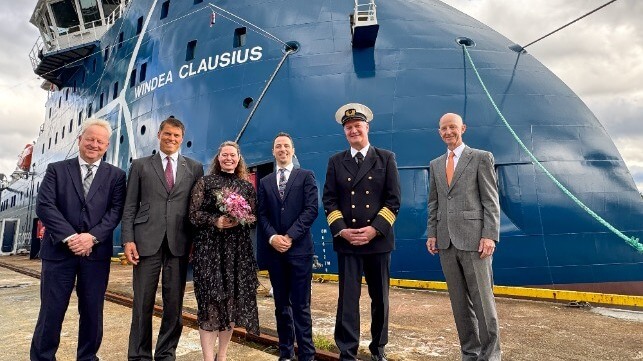
Lars Lühr Olsen, Managing Director Ulstein Verft; Matthias Müller, Managing Director BSO; Godmother Melanie Reinke, WINDEA Offshore; Martinus Warholm, Project Manager Ulstein Verft; Rainer Müller, Captain ‘WINDEA Clausius’; Ian Beveridge, CEO of BSO

Published Sep 8, 2025 5:47 PM by The Maritime Executive


[By: Bernhard Schulte Offshore]

Bernhard Schulte Offshore (BSO) has taken delivery of its newest Commissioning Service Operation Vessel (CSOV), built by Ulstein Verft in Norway. The vessel, named ‘Windea Clausius’, was officially christened on 4 September and will serve the global offshore energy industry.

“The new ‘Windea Clausius’ completes our modern offshore fleet which now comprises five state-of-the-art vessels,” says Matthias Müller, Managing Director at Bernhard Schulte Offshore. “The new ship and its sister vessel ‘Windea Curie’, which has been already delivered in June, are characterized by their innovative design features focused on reliability, operability, flexibility, and sustainability.”

“The delivery of ‘Windea Clausius’ marks another important milestone in our long-standing collaboration with Bernhard Schulte Offshore. This vessel represents the forefront of maritime innovation, with a strong focus on sustainability, flexibility, and safety. We are proud to contribute to the green transition in the offshore industry by delivering solutions that combine high performance with a low environmental footprint,” says Lars Lühr Olsen, Managing Director, Ulstein Verft.

‘Windea Clausius’ features two sterns and azimuth propellers at both fore and aft, ensuring optimal performance in Dynamic Positioning (DP) operations and enhancing fuel efficiency. Regardless of whether the vessel is facing towards or away from the weather, it maintains excellent operability and flexibility. With the Ulstein’s TWIN X-STERN design, the ship can minimise motion—critical for safe gangway operations as well as crew and personnel well-being.

Equipped with a large, height-adjustable, centrally located walk-to-work gangway and elevator tower for personnel and cargo transfers, the vessel also includes a 3D motion-compensated crane for offshore lifts of up to five tonnes. Onboard logistics are optimised with spacious storage areas and stepless access to offshore installations. In addition, ‘Windea Clausius’ features a height-adjustable boat landing system that allows for safe and stepless transfer of personnel and equipment between the CSOV and smaller crew transfer vessels—an important safety aspect especially while operating within offshore wind farms. 

The new ‘Windea Clausius’ offers up to 90 cabins with windows for charterers’ offshore personnel. In total, there are 111 cabins providing comfortable living conditions for up to 132 individuals. With hybrid battery propulsion and methanol fuel readiness, the vessel is designed for low-carbon operations and is ideally suited for both operations and maintenance (O&M) and construction support roles, particularly in harsh offshore environments.

The newbuilding is named after the German physicist Rudolf Clausius whose work on thermodynamics established fundamental principles for understanding energy transformations, including wind energy. The naming continues the tradition of naming BSO’s offshore vessels after outstanding personalities and scientists, as the ‘Windea La Cour’, ‘Windea Leibniz’, ‘Windea Jules Verne’, and ‘Windea Curie.'

The products and services herein described in this press release are not endorsed by The Maritime Executive.


Med Marine Launches Third RAmparts 2800 Tug to Reinforce OMMP’s Fleet

Med Marine

Published Sep 8, 2025 8:19 PM by The Maritime Executive


[By: Med Marine]

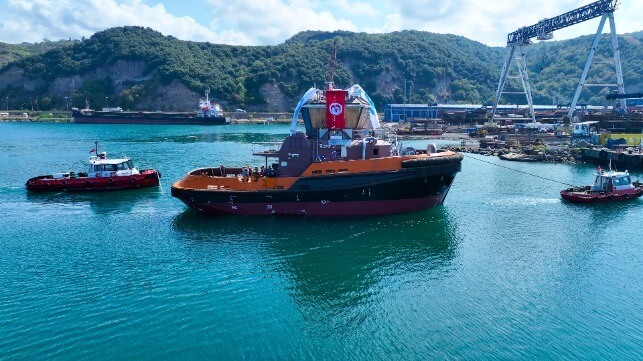
Turkey’s leading shipbuilder and tug operator, MED MARINE, proudly announces the successful launch of the MED-A2800SD tug on August 23, marking the third vessel in the six-unit RAmparts 2800 series ASD (Azimuth Stern Drive) fleet being built for Tunisia’s renowned port authority, OMMP. The launch, held at MED MARINE’s EREGLI SHIPYARD, underscores the steady progress of this fleet project and further strengthens the partnership established under the prestigious contract signed between OMMP and MED MARINE.

Measuring 28.20 meters in length and delivering a forward bollard pull of 60 tonnes, the MED-A2800SD tug has been engineered by the internationally renowned naval architecture firm Robert Allan Ltd. to meet the rigorous demands of modern port operations. Powered by twin medium-speed diesel engines and fully compliant with Class FIFI-E standards, the tug ensures both operational excellence and safety.

Thanks to its optimized hull design, the MED-A2800SD tug delivers exceptional manoeuvrability, stability, and fuel efficiency, even under the most demanding harbour conditions. Capable of performing a wide range of operations—including towing, mooring, escorting, firefighting, pollution control, and coastal support—this vessel exemplifies MED MARINE’s commitment to providing reliable and versatile assets for international operators.

This milestone represents a key advancement in the six-vessel fleet program, reaffirming MED MARINE’s ability to deliver world-class tugboats on schedule while maintaining the highest standards of quality. The launch of the RAmparts 2800 series tug highlights the ongoing progress of the project and OMMP’s strategic vision to strengthen its towing capabilities with future-ready assets.

Technical specifications of the tugboat:
Length: 28.20 m
Beam: 11.50 m
Depth: 5.49 m
Draft: 5.40 m
Gross Tonnage: 428
Bollard Pull: 60 tons
Speed: 12 knots @ 80% MCR
Crew: 8

The products and services herein described in this press release are not endorsed by The Maritime Executive


Ørsted and Iberdrola Are Trying to Save U.S. Offshore Wind Investments

offshore wind farm
Both Orsted and Iberdrola's Avangrid have partially-installed large offshore wind projects at jeopardy in the US (Avangrid photo of Vineyard Wind)

Published Sep 8, 2025 5:44 PM by The Maritime Executive


Two major offshore wind developers,  Ã˜rsted and Iberdrola, have efforts underway to save their offshore wind projects in the United States. The companies are reportedly trying to win over the Trump administration, which opposes offshore wind energy, by emphasizing the larger investments in the United States.

Energy Secretary Chris Wright, Bloomberg reports, confirmed that the administration is “actively engaged in discussions” with Ørsted over the future of the Revolution Wind project off the coast of Rhode Island and Connecticut. According to the reports, Wright, during a presentation at the Council of Foreign Relations, confirmed that there is “a very active dialogue,” saying the issues of the wind farm were being “worked and discussed.” 

Last month, the Trump administration issued a stop work order for the project, which Ørsted said is 80 percent installed. The company highlighted its large investment, saying that all of the foundations for the 704 MW wind farm are installed and that 45 out of the 65 wind turbines have also been installed. The export cabling and the onshore power substation are nearly complete. 

Ørsted filed a lawsuit challenging the legal authority to suspend the project, calling it a necessary step. The company, however, also said it was continuing to seek a resolution with the administration.

Spanish investment analysts are also saying that Iberdrola, the parent company of U.S. renewable energy company Avangrid, which is the developer for several major U.S. offshore wind farms, is also taking steps to protect its investment. It was revealed last week that the Trump administration was planning to challenge approvals for Avangrid’s New England 1 and 2 offshore projects granted in the last days of the Biden administration. Work was expected to begin this year on New England 1, a 791 MW project, and would be followed by the larger 1,080 MW second phase.

The Trump administration’s moves against the offshore wind energy sector are raising broader concerns, with Avangrid potentially one of the most exposed. In addition to the permits for the New England offshore projects, Avangrid is the developer of Vineyard Wind 1, with Iberdrola telling investors in July that the project was already exporting power from 17 out of 62 planned turbines, with 23 turbines installed, and supplying approximately 30 percent (241 MW) of its full capacity of 806 MW. Congressman Bill Keating told the MV Times last week he was afraid the administration might target Vineyard Wind with a similar stop work order. 

Avangrid also holds licenses for the Kitty Hawk wind farm offshore from North Carolina. It is also the developer for a potential 3 GW Gulf of Maine wind farm. Analysts note that the U.S. offshore wind energy sector is a major part of Iberdrola’s investment and growth strategy.

The analysts believe Iberdrola is highlighting its broader investment strategy to the Trump administration to protect its wind farm licenses. A third of the investments in the company’s 2024-2026 Strategic Plan, or more than $14.7 billion, are in the United States. 

The Trump administration has been proud to highlight the large investment commitments coming from foreign companies into the United States. Analyst Aranzazu Bueno at Bankinter believes the company will work to highlight its full investment potential to protect the offshore wind projects as its main growth avenue in the United States. The company will be presenting to investors on September 24, and there is some anticipation that it could grow its U.S. investment commitments to more than $21 billion.

Wright, however, continues to question the viability of offshore wind energy. Bloberg reports he said the U.S. government is not responsible for a company’s finances, countering the claims of the large investments made into the offshore wind projects, which are now in jeopardy. He called offshore power “costly” and said it has “limited job potential.”


Op-Ed: Facing the Fuel Facts About LNG

LNG carriers
SHansche / iStock

Published Sep 8, 2025 9:13 PM by Peter Keller


The current drive to decarbonize the maritime industry strikes me as a similarly important and dramatic change to that which Malcom McLean organized with his sailing of the Ideal X in 1956. The almost unbelievable growth we have seen in international trade, sparked by the now ubiquitous container, required a strong vision of the future combined with a focused, unrelenting forward drive. As the container and intermodal industries grew, everyone had much the same concentrated and almost prophetic view of what had to be accomplished to satisfy the entrepreneurial spirit created by Mr. McLean.

Now that we are in a new era of change to decarbonize the maritime industry, we need the same focus and vision of the future to ensure success. Great challenges require great people like Malcolm McLean with strong and realistic leadership. Like the growth of international trade facilitated by the container, challenges like decarbonization can only be achieved by identifying real benefits over the long term and showing a path forward that is realistic and practical.  Today, when we evaluate the past 10 years or so of the decarbonization journey, we need to recognize and admit that we have all too often been diverted from a strong yet realistic vision by the proverbial “shiny object.”

We know, and have known for years, that most alternative fuels are unlikely to be available in the quantities needed by shipping anytime soon. The exception is methane in the form of LNG. We know that liquid fuels and gases are often difficult to handle and can be unsafe for many reasons. Years and decades of experience handling these products is required to ensure the wellbeing of our seafarers, longshoremen and women, as well as those residing in or near port communities. LNG has a safety record that spans many decades. The energy value of fuels is also a critical matter. Not all fuels are created equal and many have energy densities that require a vessel to have almost double the tankage. This means more fuel and less revenue-generating capacity.  Shipowners want to carry cargo, not fuel. Again here, methane as LNG is the standard others are measured against.

With these facts, why have our industry and regulators been diverted from what might seem to be the focus and strong direction we need to realize local emissions and carbon reduction? In today’s modern world, opinions and ideas are available as never before. Opinions are often taken for fact and widely distributed in media and the Internet. Academics need to “publish or perish” and sometimes perform research based on unrealistic assumptions. Regulators and governments have a myriad of topics and concerns they need to deal with daily. Being pulled in many directions at once can and does create issues and concerns.

With this backdrop, and when considering low and zero carbon fuels, our industry must ask practical questions and demand clear, well-supported and candid answers:

  • Approximately three of the hundreds of ‘LNG-ready’ ships were actually converted to use LNG. What does ‘methanol-ready’ and ‘ammonia-ready’ actually mean?
  • When we say ‘methanol’ or ‘ammonia’ – is that a grey (fossil) or green (bio/e-) molecule?
  • What fuel will be used while waiting for adequate supplies of green molecules? 
  • How energy-dense is the fuel and how will this impact a vessel’s revenue cargo-carrying capacity?
  • Do future ‘bunkering locations’ include commodity infrastructure that would require significant investment to develop or convert?  
  • How reliable are the engine technologies, safety standards and bunkering supplies today?

Like Mr. McLean’s containerization, decarbonization demands we focus on the practical and realistic, face the fuel facts, and not get distracted by shiny objects. The reality is that, without a clear focus, no one will use any alternative fuel, they will simply continue with the status quo - heavy fuel oils.

Peter Keller is the chairman of SEA-LNG and the former executive vice president of TOTE, Inc. He has served on the boards of the Pacific Maritime Association (PMA), the Pacific Maritime Shipping Association and the United States Maritime Exchange (USMX), and he was inducted into the International Maritime Hall of Fame in 2006.

The opinions expressed herein are the author's and not necessarily those of The Maritime Executive.


MOL Develops Innovative Designs for Wind-Assisted LNG Carriers

wind-assisted propulsion
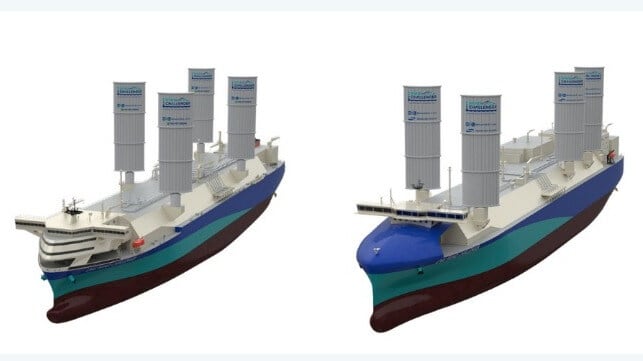
The innovative design with the forward bridge permits four rigid sails to optimize the design (MOL)

Published Sep 8, 2025 9:45 PM by The Maritime Executive


Mitsui O.S.K. Lines continues to work to advance wind-assisted propulsion, building on the concepts after deploying its first rigid, retractable sail on a bulk carrier in October 2022. The company has previously committed to installing its “Wind Challenger” on 25 vessels by 2030 and 80 vessels by 2035.

Working with HD Hyundai Heavy Industries and Samsung Heavy Industries, and Lloyd’s Register as the classification society, they developed innovative concepts for an LNG carrier that could achieve, they project, up to 30 percent fuel saving per voyage and 15 to 20 percent annually. The company previously released a design developed with Hanwha Ocean for a conventional LNG carrier with wind sails, but now has completed preliminary designs for an innovative vessel with four of the rigid sails.

A key element of the two designs moves the bridge toward the bow of the vessel to enable the increase from two to four rigid sails that would rise to a maximum height of approximately 160 feet (48 meters) in a three-tier design. It permits the design to optimize the placement of the sails and maximize the fuel efficiency gains. The ships would be between 938 feet (287 meters) and 951 feet (290 meters) in length, and each has a capacity of 174,000 cbm.

The Wind Challenger, a rigid sail system capable of automatic extension, retraction, and rotation. The first installation was on a 100,000 dwt coal carrier, Shofu Maru, and MOL reported it was able to reduce daily fuel consumption by up to 17 percent, equating to 5 to 8 percent per voyage on average on its first seven roundtrips to Japan from Australia, Indonesia, and North America. A second vessel was fitted with the sail, to be followed by nine additional vessels. The sail is made of fiber-reinforced plastic.

MOL reports that comprehensive risk assessments were undertaken for the new designs in collaboration with the shipyards, the classification society, and flag states. The assessments covered the sail arrangement, visibility impact, emergency operation procedures, and other safety measures. In addition, safety evaluations were conducted in collaboration with the respective flag states. 

The new vessel design developed with HD Hyundai Heavy Industries earned AiP from the Marshall Islands, while the vessel design jointly developed with Samsung Heavy Industries received AiP from Liberia. 

Having been awarded the AiP for the two designs, MOL reports detailed sign work for actual construction is currently underway.