Friday, September 12, 2025


EU decision on 2040 climate target to be delayed, diplomats say

Charlie Riedel
Copyright AP Photo

By Marta Pacheco
Published on 

At stake is the review of the EU’s Climate Law, which sets course for theEU to become climate neutral by 2050, but also called for a 2040 climate target to be set in stone.

A controversial 2040 EU climate emissions target decision will not come at ministerial level next week — as originally planned — since countries claim they need more time to mull the issue, according to EU officials.

The Danish EU Presidency — currently helming the European Council — wanted ministers to vote on the target on 18 September, during an environment Council.

But the EU official said that member states weren't yet ready and the issue will be pushed back to be discussed and agreed by EU heads of state during an October summit.

The Commission proposed a 90% emissions reduction target for 2040, compared to 1990 levels, in July this year.

The 2040 intermediary target is meant to follow on from the EU’s 2030 target, of at least 55% reduction by 2030 compared to 1990 levels.

“We cannot support the text as it stands right now. It is not an ideal geopolitical timing. Also, the text was put on the table quite late,” a second EU official told Euronews, adding that countries need to see more balance between targets and competitiveness.

The first EU diplomat said the aim at the Council level in October is to have a “decisive” discussion, rejecting the possibility of an unanimity vote which would “reward the lowest bidders”. However, the diplomat didn’t close the door to the possibility that no decision would come even in the October summit.

The 2040 climate target will impact the EU’s national climate action plans under the Paris Agreement, expected to be presented at the COP30 in Belém, Brazil.

Countries like Slovakia and Hungary have openly opposed to the Commission’s proposal to cut 90% of CO2 emissions by 2040, arguing the law is a death sentence to the country’s industry. France has said the decision should be taken by EU leaders rather ministers.

“These ideological proposals [2040 climate target] are more proof that Brussels bureaucrats have already lost basic contact with reality. They have no idea what economic danger the European and unfortunately the Slovak industry is in,” Tomas Taraba, Slovakia’s environment minister, said shortly after the proposal was announced.

Carbon credits

Some of the key aspects under discussion by EU diplomats include the contribution of international carbon credits — tradable certificates enabling the emission of a certain amount of CO2 — to reach the 2040 target, but also the clarification that such global credits would not interfere with the EU’s carbon market, the Emissions Trading System (ETS), according to an official document. The ability to store CO2 outside the bloc is also under consideration.

“We are not against this thought [carbon credits], but we would need more clarity on that,” the second EU diplomat added.

Austrian Lena Schilling, the Green/EFA lawmaker responsible for the 2040 climate target in the European Parliament, said consideration of carbon credits is “irresponsible towards taxpayers” and a “betrayal” of youth.

“Diluting the EU climate target with carbon credits will only mean spending billions on pollution rights abroad instead of delivering real climate action here in Europe. We need at least a 90% reduction by 2040 within the EU,” said Schilling.

Sven Harmeling, head of climate at Climate Action Network (CAN) Europe, urged caution in relation to the use of international carbon credits: “It would severely undermine the ambition and environmental integrity of the EU contribution, while only delaying and increasing the cost of the transition.”

“The EU would have to transfer outside of its borders up to tens of billions of euros that would have otherwise been invested in domestic decarbonisation," Harmeling said.


Carmakers to push EU for 2035 combustion-engine ban rethink

By AFP
September 11, 2025


European automakers say the EU's push for electric vehicles 'is too rigid to produce success' - Copyright AFP Jonathan NACKSTRAND
Umberto BACCHI

Europe’s biggest carmakers are to hold talks with EU chief Ursula von der Leyen on Friday as the industry pressures the bloc to revise plans to end combustion-engine vehicle sales by 2035.

Suffering from fierce Chinese competition and a stuttering transition towards electric vehicles (EVs), embattled European automakers are pushing for Brussels to reconsider its ambitious climate goals.

“The regulation that is applicable to us is too rigid to produce success, and really we believe must be adapted to reality,” said Sigrid de Vries, director of the European auto lobby ACEA. “We need to be more pragmatic.”

Friday’s meeting in Brussels is the third under an EU initiative launched in January to help a sector that employs 13 million people and accounts for about seven percent of Europe’s GDP.

The first gathering resulted in a reprieve for automakers, with the European Commission allowing them more time to meet the first carbon emissions target under plans to phase out sales of new combustion-engine vehicles by 2035.

But companies are now pushing for more systemic change.

– ‘Hands tied’ –

In an August letter to von der Leyen, carmakers and their suppliers lamented a series of challenges including dependency on Asia for batteries, high manufacturing costs and US tariffs, which have been upped to 15 percent under a deal struck with Brussels.

Paired with an uneven distribution of charging infrastructure, they said those obstacles are holding back sales of EVs, which account for about 15 percent of new cars sold across Europe.

“We are being asked to transform with our hands tied behind our backs,” Mercedes-Benz chief Ola Kaellenius and Matthias Zink, of the automotive parts supplier Schaeffler, wrote on behalf of their industries.

Describing the 2035 target as “no longer feasible”, they called for incentives such as tax breaks to boost demand for EVs.

They also want more room for plug-in hybrids, highly efficient combustion-engine vehicles and other low- but not zero-emission vehicles.

That is opposed by green groups and EV sector businesses, more than 150 of which wrote a letter to von der Leyen this week urging her to “stand firm”.

Road transport accounts for about 20 percent of total planet-warming emissions in Europe, and 61 percent of those come from cars’ exhaust pipes, according to the EU.

Michael Lohscheller, chief executive of Swedish EV company Polestar, said the 2035 target gave “clarity to industry, direction to investors and certainty to consumers”.

Weakening it “would harm Europe’s ability to compete”, he said.

– Europe’s ‘E-car’ –


The range of new European EVs unveiled at the Munich auto show this week showed that the targets were working, said William Todts, director of the clean transport advocacy group T&E, who is to take part in Friday’s talks.

“For the first time in 10 years, Germans can say we are as good as the Chinese, almost. And the only reason they’re doing that is because of the CO2 standards,” he told AFP.

“They’ve had to invest more than they wanted, and this has an impact on dividends and short-term profits, but it does make them more competitive,” he said.

Yet in a sweeping speech on Wednesday, von der Leyen hinted that tweaks might be on the cards.

“With respect for technology neutrality, we are now preparing the 2035 review,” she said, referring to carmakers’ demand that not only EVs but other low-emission technologies be allowed on the market after 2035.

The German politician also announced plans for a “small affordable cars initiative” for Europe to “have its own E-car” — but provided no detail about what that entailed.

And she repeated a pledge to make available 1.8 billion euros ($2.1 billion) to boost battery production in the bloc.

The talks come at a hard time for European producers, whose sales are being eroded by Chinese competitors such as BYD and GAC.

In Germany, the auto sector has already shed more than 50,000 jobs over the past year, according to the consulting firm EY.

Volkswagen is planning thousands of layoffs in the coming years while its subsidiaries Porsche and Audi, as well as many German auto suppliers, are also cutting jobs.


EU auto summit confirms strategic focus on electric cars
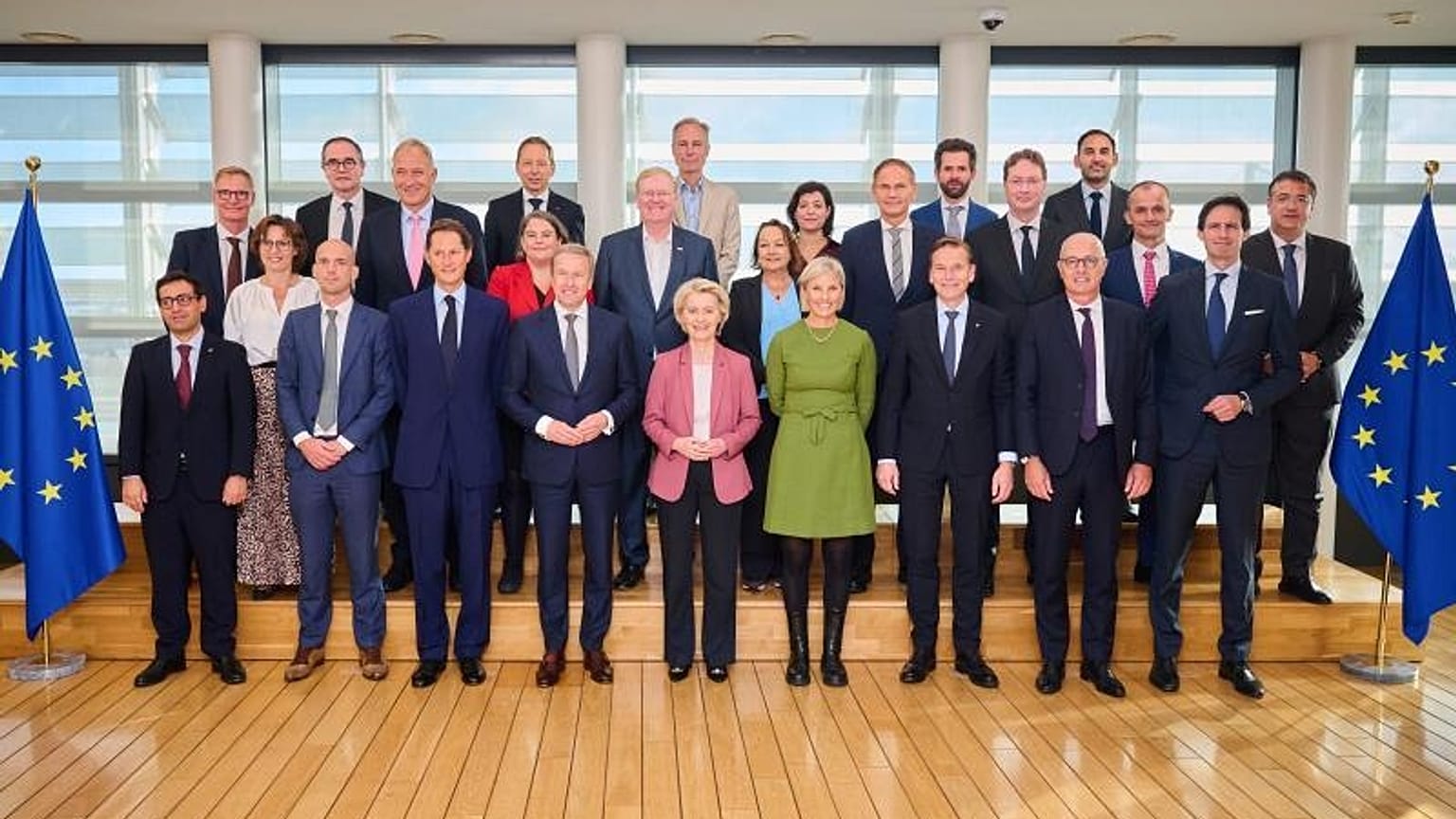
EU Commission president Ursula von der Leyen meeting representatives of the European car industry, in Brussels, Sept. 12, 2025 (EC Audiovisual Service/ Dati Bendo)
Copyright Euronews

By Stefan Grobe
Published on 

The meeting between the President of the EU Commission and top representatives of the automotive industry was highly anticipated. Brussels stood firm by its CO2 targets until 2035.

A high-level industry summit in Brussels on Friday has confirmed the clear strategic focus on electric cars in Europe.

“No matter what, the future is electric,” a person with knowledge of the talks between EU Commission president Ursula von der Leyen with top executives of the automotive sector told Euronews.

“The industry is extremely aware of the need to transition,” the person who asked not to be identified added.

Going into the meeting, European car manufacturers called for greater flexibility in the implementation of CO2 targets.

“But even if the Commission took down these targets, global competition would set them for the industry,” the person said.

Brussels is pursuing the goal of becoming climate neutral by 2050 and has, among other things, decided to phase out new vehicles with combustion engines by 2035.

In Friday’s talks the Commission seemed unwilling to move on the 2035 targets despite recent calls from business and politics for a departure from this goal.

"I know of no better technology than the electric car for advancing CO2 reduction in transportation in the coming years,” Audi CEO Gernot Döllner told German magazine Wirtschaftswoche.

Instead of emphasizing these advantages, new debates about preserving the combustion engine are constantly being kicked off – ”this is counterproductive and unsettles customers", he added.

A similar view was voiced by Michiel Langezaal, CEO of Fastned and president of ChargeUp Europe, who participated in the talks with von der Leyen.

"Ensuring that Europe can lead the e-mobility transformation globally requires more than standing robustly by a roadmap. It requires industry to have the courage to approach the challenges we face with a growth mindset and focus on the actions needed to make the transition towards e-mobility a success for people, industry and the environment," he told Euronews.

The Commission had convened the three-hour meeting as part of the “Strategic Dialogue” about the future of the car industry to address the current crisis. It was the third meeting of its kind since the beginning of the year.

The continent's car sector has taken a beating and is dealing with faltering sales, high energy prices, growing subsidised competition from China and a hostile trade environment due to US punitive tariffs.

Back in April, EU industry chief Stéphane Séjourné had described the sector as being “in mortal danger”.

"There is a risk that the future map of the global car industry will be drawn without Europe," Séjourné said then.

One of the biggest challenges remains the implementation of the European climate policy.

“The market share of battery electric passenger cars in EU-27 was at 15.6% and at 9% for vans. Widespread mass-market adoption has not happened yet. And it will not happen if we don’t speed up the infrastructure and bring down the total cost of ownership,” Sigrid de Vries, director general of the European Automobile Manufacturers' Association (ACEA) told Euronews.

“But governments and regulators have not invested in, nor demanded, sufficient levels of infrastructure and grid upgrades and incentives remain inconsistent. The consequence: the regulatory targets are no longer achievable,” she added.

For zero-emission vehicles to become an obvious choice for consumers and businesses, carmakers believe that purchasing or using these vehicles need to be more attractive than those with internal combustion engines.

That requires consistent purchase incentives, fairer taxation, lower charging costs and easier access to cities.

At the same time, Europe must accelerate charging and refuelling infrastructure, especially for heavy-duty vehicles, while modernising grids and reforming energy markets to bring down electricity prices – this is one of the key demands of the industry.

The automotive industry, a cornerstone of the European economy, employs over 13 million people (direct and indirect jobs) and contributes approximately 7% to the EU's GDP.



 

Asia’s gas utilities are politically shielded but economically exposed

Asia’s gas utilities are politically shielded but economically exposed
/ Pexels - Tom Fisk
By bno - Ho Chi Minh Office September 12, 2025

The balance sheets of Asia-Pacific gas utilities may look steady, but the domestic politics behind them matter as much as the numbers a new report shows.

Fitch Ratings’ latest sector review, released this week in Hong Kong, offers up an initially reassuring headline in “Asia-Pacific Gas Utilities’ Financials Remain Strong” with most companies comfortably within rating limits.

However, beneath that supposedly unrippled surface, regional disparities and shifting demand patterns, particularly in North and Southeast Asia tell a more convoluted story.

Many of the region’s gas distributors enjoy the safety net of being government-related entities and are thus ‘protected’ to a large extent. Their credit profiles are, in reality, extensions of sovereign ratings rather than stand-alone assessments according to the report. This implicit guarantee explains why ratings are expected to remain stable in the near term as any potential investor in the region or around the world knows that Beijing, New Delhi, Jakarta and Hanoi will not allow their national power entities to stumble, let alone fall.

Still, one name stands out on the Fitch report. Binhai Investment Company Limited, rated BB+/Stable, has little room to manoeuvre. Falling sales volumes and slower new connections are little-by-little eroding its financial buffer. Without stronger demand, Binhai’s stability depends less on fundamentals than on the willingness of Indian authorities to keep supporting it.

Across the region too, leverage is set to creep higher though. Fitch projects sector debt ratios to rise from 0.9x in 2024 to around 1.0x by 2027.

That increase reflects ambitious capital expenditure across the board, notably at India’s GAIL (currently rated as BBB-/Stable) and PetroVietnam Gas (BB+/Stable).

Governments in both New Delhi and Hanoi want their national utilities to extend infrastructure, secure supply and reduce dependence on dirtier fuels. In Vietnam this is particularly true with LNG related infrastructure projects rarely out of the news of late.

At the same time, purchasing costs reveal the region’s fault lines. Chinese utilities are enjoying an unusual tailwind of late, primarily on the back of an increase in domestic production, expanded storage on the east coast of the country coupled to higher volumes of pipeline imports in the past month that have driven costs down.

India, too, is benefitting to some degree with Brent-linked pricing translating lower crude benchmarks into cheaper gas imports even with the ongoing trade battle with Washington and talk of increased tariffs harming relations with the US making daily headlines.

Indonesia, however, is stuck on the wrong side of the equation according to Fitch. PT Perusahaan Gas Negara, now rated as BBB-/Stable, relies heavily on LNG purchases, and with global LNG markets still tight, its outlays are rising. In time, this will only serve to add to purchasing competitiveness across the region given Indonesia’s status as the biggest economy in Southeast Asia.

With ongoing political issues gripping much of the country and daily protests in major cities, Jakarta may well need to subsidise early to avoid further consumer discontent.

For now across Asia, with gas still seen as a stepping stone between coal and renewables – a position largely echoed by Fitch – it is more than likely that long-term demand will remain strong. But slowing near-term consumption raises questions and analysts need to look deeper at the role domestic politics is playing in regional capitals in propping up highly rated under-performers.


GoviEx, Niger extend arbitration pause on Madaouela uranium project valued at $376mn

GoviEx, Niger extend arbitration pause on Madaouela uranium project valued at $376mn
/ GoviEx
By Brian Kenety September 12, 2025

GoviEx Uranium Inc (TSX-V: GXU, OTCQB: GVXXF) and its subsidiary GoviEx Niger Holdings said in a press release dated September 11 they have agreed with Niger to extend a pause in ICSID arbitration over the Madaouela Uranium Project for six months, until March 2026.

Madaouela is one of the world’s largest uranium resources, with measured and indicated resources of 100mn pounds of U₃O₈ and a post-tax net present value of $376mn at a uranium price of $80 per pound.

The dispute over the project began when Niger’s military-led government revoked GoviEx’s mining permit in July 2024, citing its alleged failure to meet development conditions. The Canadian mineral resource company, which has been working on Madaouela since 2007, had a prior agreement with the government that was toppled in a coup in July 2023.

GoviEx holds an 80% interest in the operating company COMIMA, with the remaining 20% held by the Republic of Niger. After the permit’s cancellation, GoviEx launched arbitration proceedings in December 2024 to reclaim its rights.

“Madaouela was a project into which we poured over a decade of dedication, with more than 650,000 metres of drilling and the discovery of one of the world’s largest known uranium resources," GoviEx executive chairman Govind Friedland said in a release on January 6.

“Around the time these rights were revoked, we were actively pursuing financing opportunities for Madaouela, some at a very advanced stage. Despite this setback, we remain fully committed to pursuing every avenue available to protect GoviEx’s rights in relation to this project.”

The agreed pause in arbitration announced this week follows a letter of intent signed in February 2025 that outlined a framework for negotiations. While both sides have signalled their desire to reach an amicable resolution, GoviEx cautioned that talks may not produce a binding agreement, and arbitration could resume.

GoviEx said it will continue to provide updates as discussions over Madaouela progress. It also noted that the arbitration and related negotiations remain separate from GoviEx’s reverse takeover of ASX-listed Tombador Iron Limited announced in August.

Niger — one of the world's poorest countries — has uranium resources of 311,000 metric tonnes (mt) in total, the third highest in Africa after Namibia (470,000 mt) and South Africa (320,000 mt), according to Statista. It also has the continent's highest-grade uranium ores.

In 2022, it produced 2,020 mt of uranium, down from 2,991 mt in 2020, according to the World Nuclear Association (WNA), making it the world's seventh-biggest producer of uranium. But Niger accounted for only 4% of global production, well behind Kazakhstan (43%), Canada (15%), Namibia (11%) and Australia (8%), according to the WNA.

Key events in the GoviEx—Niger dispute over the Madaouela uranium project

  • 2007 — GoviEx begins exploration and development work on the Madaouela uranium project near Arlit, Niger.
  • July 2023 — Niger’s President Mohamed Bazoum ousted in a military coup. The junta later expels French troops and terminates a US security pact, while welcoming Russian instructors.
  • July 2024 — Niger’s military government revokes GoviEx’s mining permit for Madaouela, citing failure to meet development conditions.
  • December 2024 — GoviEx files for ICSID arbitration against Niger to reclaim its rights.
  • January 6, 2025 — Executive chairman Govind Friedland issues a statement, stressing over a decade of investment, 650,000m of drilling, and 100mn lbs U₃O₈ resources.
  • February 2025 — GoviEx and Niger sign a letter of intent (LoI) to create a negotiation framework.
  • September 2025 — Both parties agree to extend the pause in arbitration for six months, until March 2026, while negotiations continue.

Post-coup Niger pivots away from Western partners

After Niger's democratically elected President Mohamed Bazoum was overthrown in July 2023, the military leadership expelled French forces and ended a long-standing security agreement with the US, giving Washington two months to withdraw its troops. At the same time, 100 Russian military instructors arrived in Niamey in April that year to train Niger's forces on Russian air defence systems.

While boosting ties with Russia, Niger has taken a tough stance on foreign mining licences since the military coup, including cancelling French state-owned nuclear fuel company Orano’s permit for the Imouraren uranium project. Orano still holds exploration rights in Niger and has been negotiating with authorities about potential new projects.

Meanwhile, last month Russia proposed building Niger’s first nuclear power plant, signalling a deepening partnership in civilian atomic energy – and further challenging France’s longstanding role after Niamey seized and nationalised French-managed uranium assets.

Rosatom, Moscow’s state-owned nuclear agency, signed an agreement with Niger’s military authorities covering electricity generation, medical use of nuclear technology and training programmes.

“Our task is not simply to participate in uranium mining. We must create an entire system for the development of peaceful atomic energy in Niger,” Russian Energy Minister Sergei Tsivilev was quoted by the BBC as saying during a visit to Niamey. If realised, the project would represent the first nuclear power station in West Africa.

Russia has positioned itself as a partner offering industrial development, appealing to resentment that Niger was limited to raw materials exports under French control, the BBC wrote at the time, noting the approach reflects policies in neighbouring Mali and Burkina Faso, which have also strengthened ties with Moscow.

Why Is Taylor Swift’s Engagement Bigger News Than the Risk of AMOC Collapse?

Media’s obsession with one story—and its ignoring of the other—highlights the gaps that remain in treating the climate crisis like the cataclysm it has become.


A graphic shows changes in ocean bottom pressure due to a weakening Atlantic Meridional Overturning Circulation 
(Photo by the European Space Agency)

Mark Hertsgaard
Sep 12, 2025
The Nation

Chances are you’ve heard that Taylor Swift is getting married. When she and Travis Kelce announced their engagement last month, it was all over the news, all over the world.

Chances are equally good that you did not hear some other, literally Earth-shaping news that broke two days later. On August 28, some of the world’s foremost climate scientists dramatically revised their estimate of how soon one of the foundations of Earth’s climate system could collapse.

Media’s obsession with one story—and its ignoring of the other—highlights the gaps that remain in treating the climate crisis like the cataclysm it has become. While progress has been made in many newsrooms, old journalism habits linger, including sidelining important climate news out of misguided fears that it’s depressing or too complicated. As Covering Climate Now’s 89% Project has shown, that’s not how most readers or viewers see it.

The collapse of what is commonly called the Gulf Stream—the vast Atlantic ocean current that scientists refer to as the Atlantic Meridional Overturning Circulation, AMOC—would deal a crushing blow to civilization as we know it. Sometimes known as Europe’s “central heating unit,” the AMOC is why Britain, France, The Netherlands, and their northern neighbors enjoy relatively mild winters, even though they sit as far north as Canada and Russia.

AMOC originates in the Caribbean, where sun-warmed sea water flows northeast across the Atlantic toward Greenland. The amount of heat AMOC transports is staggering: 50 times more heat than the entire world uses in a year. Without AMOC, the history and present day of Europe would look very different. Winters would be much colder and longer. Food production would be much less, as would the human population and infrastructure the region could support.

The scientific study released on August 28 concluded that AMOC’s collapse “can no longer be considered a low-likelihood event,” to quote The Guardian, one of the very few outlets to report the news. Indeed, such a collapse is more likely than not if humanity’s greenhouse gas emissions remain on their current trajectory. If emissions continue to rise, there is a 7 out of 10 chance that AMOC will collapse, the scientists calculated. If emissions fall to a moderate level, the odds are 37%—roughly 1 in 3. Even if emissions decline in line with the Paris Agreement goal of limiting temperature rise to 1.5 to 2°C, there is a 1 in 4 chance of collapse.

“It’s like the saying that every disaster movie starts with scientists warning and being ignored.”

Although the collapse might not occur in this century, the scientists warned that the system could pass a “tipping point” in the next decade or two that makes its eventual collapse inevitable. As 44 scientists explained in an open letter to the Nordic Council of Ministers, AMOC might well collapse in this century, but there is an “even greater likelihood a collapse is triggered this century but only fully plays out in the next.”

The only hope, the scientists added, is a “global effort to reduce emissions as quickly as possible, in order to stay close to the 1.5 [°C] target set by the Paris Agreement.”

By no means is northern Europe the only region in peril. A collapse, or even significant slowdown, of AMOC would devastate agriculture in Africa and other parts of the Global South by massively disrupting rainfall patterns.

All of which helps explain why Stefan Rahmstorf of the Potsdam Institute for Climate Impact Research, who coauthored the new study, was frustrated by how little attention he and his colleagues’ warnings got. “What more can we do to get heard?” he asked. “It’s like the saying that every disaster movie starts with scientists warning and being ignored.”


© 2023 The Nation


Mark Hertsgaard
Mark Hertsgaard is the environment correspondent at The Nation, the executive director of Covering Climate Now, and the author of several books on climate change.
Full Bio >
MAGA BROWNSHIRTS
‘Expect retaliatory action’: extremists fuel fear of violence after Charlie Kirk killing

RAW STORY
September 12, 2025


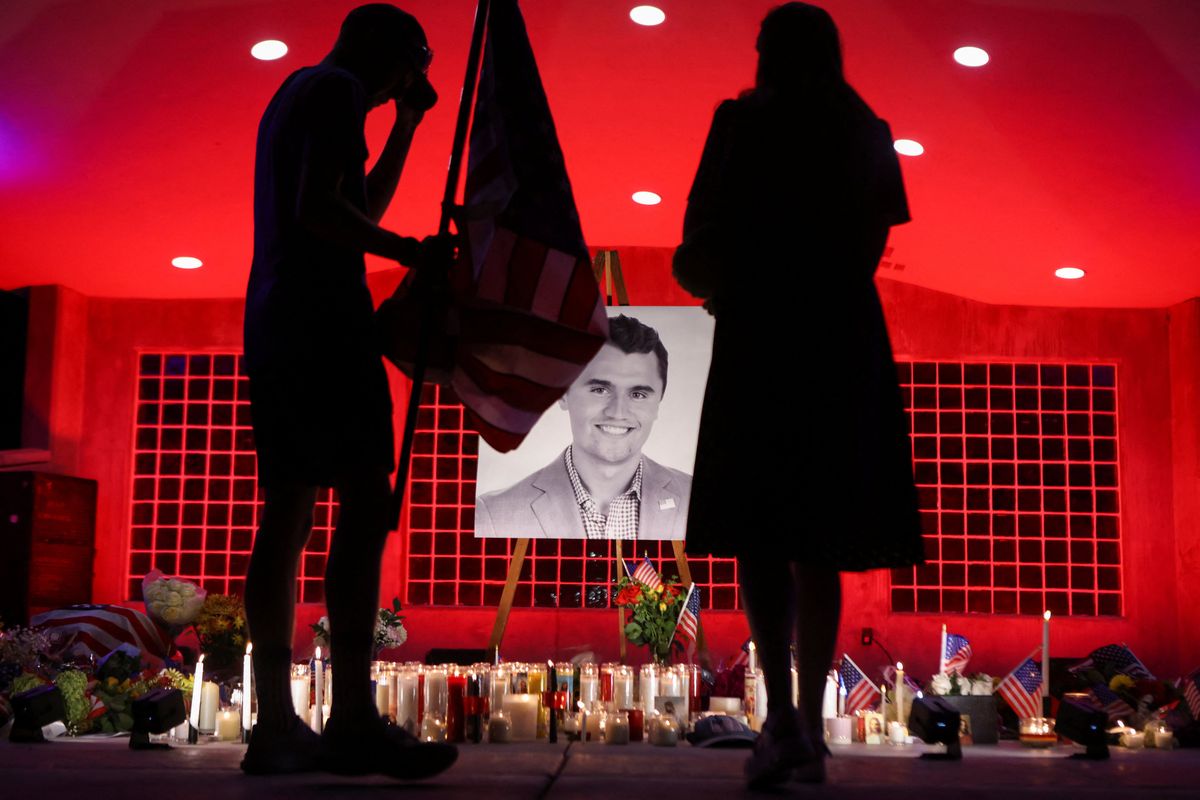
A vigil at Orem City Center Park for Charlie Kirk, in Orem, Utah. REUTERS/Jim Urquhart

After the assassination of Charlie Kirk, many Americans are realizing that political violence in the United States is undeniably on the rise.

Kirk was shot in the neck during a public appearance at a university in Utah on Wednesday. It was a shocking and graphic murder but it was not unique.

Last summer saw two assassination attempts on then-presidential candidate Donald Trump, one of which led to a trial playing out in federal court in Florida this week.

Only three months ago, a religious fanatic with a kill list assassinated Minnesota state Rep. Melissa Hortman and her husband, Mark Hortman.

Last December, a gunman killed United Healthcare CEO Brian Thompson outside a Midtown Manhattan hotel.

And in 2022, in San Francisco, a man obsessed with right-wing conspiracy theories attacked Paul Pelosi, husband of then-House Speaker Nancy Pelosi, with a hammer, during a home invasion.

“We really need to take stock of what’s happening,” Alexander Reid Ross, a geographer and lecturer at Portland State University who studies political extremism, told Raw Story.

Ross said he was seeing celebration of violence on “far-left, irony-poisoned hipster social media accounts,” making light of Kirk’s murder by joking that “he brought debate to a gunfight” and similar jibes.

That trend carried over from the celebration of Luigi Mangione, the alleged United Healthcare assassin.

“Right now, there is an entire culture of celebrity assassins, and it seems to have spilled over from the far right to the left,” Ross said.

“We see the iconic image of Luigi Mangione as a saint. That is directly attributable to the sainthood complex of far-right and nihilistic mass shooters. We’re seeing the spread of a kind of enabling culture of political violence that just did not exist on this level 10 years ago.”

On Wednesday, in the immediate aftermath of Kirk's murder, Trump did little to calm waters, blaming “the radical left” for comparing “wonderful Americans like Charlie to Nazis and the world’s worst mass murderers and criminals.”

He later said Kirk was “"an advocate of nonviolence” and “that's the way I'd like to see people respond.”


‘Full accelerationist’

So does Kirk’s murder mark a tipping point into a spiral of violence?

Early reporting that ammunition linked to the shooter was engraved with markings signifying antifascism and support for transgender people is fueling right-wing calls for retribution — notwithstanding caution from at least one law enforcement source “that the report had not been verified by A.T.F. analysts, did not match other summaries of the evidence and might turn out to have been misread or misinterpreted.”

Some neo-Nazis are heralding Kirk’s death as an opportunity for accelerationism — the idea that a moment of heightened political tension can open the door to tit-for-tat violence, creating conditions for revolutionary upheaval.

“Killing one of us is one thing,” an American neo-Nazi in Ukraine wrote on Telegram hours after Kirk’s death. “Killing one of the biggest conservative MAGA influencers is another.


“If the s---libs are going full accelerationist with the n-----s, then maybe I need to return to America.”

Users on another Telegram channel that caters to a transnational cohort of neo-Nazis who support Ukraine were at first divided, with some faulting Kirk for supporting Israel — or, in a contradictory swerve, speculating that an agent of Mossad carried out the hit because Kirk was perceived as wavering in his support for Israel.

Others worried that Kirk’s death would overshadow the killing of Iryna Zarutska, a Ukrainian refugee who was murdered on light rail in Charlotte, NC last month — a galvanizing event for the white nationalist movement that the Trump administration has also sought to exploit.


On Thursday night, one channel administrator offered an assessment of Kirk’s death.

“Kirk’s shooting is good for us,” the administrator wrote. “A gatekeeping cuckservative Jew shill got iced by maybe a left-winger. He will be remembered as a martyr for the cause and this shooting (along with the murder of the Ukrainian girl) will cause outrage and radicalize people to our side.

“Expect a retaliatory action on a prominent left-winger soon in some way, shape or form to come. The s--- has hit the fan now.”


‘Reckoning we need’


Mainstream MAGA figures have also linked the deaths of Kirk and Zarutska as part of an effort to paint the political left as an implacable foe.

Christopher Rufo, the intellectual architect of the right’s assault on diversity, equity and inclusion, posted on X early on Wednesday: “The psychotic trans shooter gunning down Catholic kids in Minneapolis. The psychotic black homeless man stabbing the beautiful woman in Charlotte. And now an assassination attempt on Charlie Kirk.

“The reckoning we need is more profound than you can imagine.”

Around the same time, Ian Miles Cheong, a Malaysian right-wing influencer with 1.2 million followers on X, posted: “Charlie Kirk wasn’t the first victim in this war. He was the second. The first victim was Iryna Zarutska. This is war.”

Prior to Kirk’s shooting, white nationalists organized a rally for Zarutska in Huntington Beach, CA, scheduled for Thursday. After Kirk’s death, fliers advertised the rally as “Justice for Charlie Kirk and Iryna Zarutska!”

“All nationalists need to mobilize in their cities tonight,” Ryan Sanchez, a neo-Nazi with ties to Southern California and Arizona, wrote on Telegram. “Our people are enraged, they need leadership and protection from the terrorist left.

“… Things are moving. Act accordingly.”

During the rally at the Huntington Beach Pier, participants chanted, “White man, fight back.”

In other posts, Sanchez wrote, “Iryna’s death cries out for vengeance,” and, “Death to the left.”

In response to left-wing accounts cautioning followers to avoid the rally, Sanchez gloated that “social media accounts are now warning all Leftists to evacuate Huntington Beach after sundown.”
‘Eruptions’

Despite such rhetoric from the right, Ross cautioned that there is no reason to assume an escalation of political violence is inevitable.

Researchers have studied tit-for-tat violence between the far-right English Defense League and Islamist groups in the UK, to see if “acts of violence lead to a downward spiral,” and the results were somewhat unexpected.

“That theory is not fully substantiated, because it seems that societies tend to have a kind of settling systemic function in that spirals of violence tend to exhaust themselves rather rapidly, unless there’s an actual full-blown war happening in which one side fully believes they cannot continue fully without destroying the other,” Ross said.

“The tit-for-tat killings tend to be eruptions that happen over the course of a few weeks and subside. And they subside into a current that continues and breaks out again.”

Political violence in the U.S. is not at the level and frequency as the period in Italy known as the “Years of Lead,” from the late 1960s into the 1980s, or the Troubles in Northern Ireland around the same time, Ross said.

But that doesn’t mean people should be complacent.

“Random assassinations and assassination attempts, even these kind of mass shootings that are happening — these are very bad, and they might even show a direction toward that low-intensity conflict,” Ross said.

“They’re more like signs of broader acceptance of violence. If that culture becomes sort of mainstream, then you end up with that very high level of social conflict. The biggest warning signs are the cheapening of assassination deaths and the lionization of assassins.”


Jordan Green is a North Carolina-based investigative reporter at Raw Story, covering domestic extremism, efforts to undermine U.S. elections and democracy, hate crimes and terrorism. Prior to joining the staff of Raw Story in March 2021, Green spent 16 years covering housing, policing, nonprofits and music as a reporter and editor at Triad City Beat in North Carolina and Yes Weekly. He can be reached at jordan@rawstory.com. More about Jordan Green.
Charlie Kirk’s Toxic Legacy of Hatred and Division

We can condemn political violence and this hideous murder while also condemning Charlie Kirk for the rotten, vile hatred he fomented.


Right-wing political activist Charlie Kirk, founder of Turning Point Action, speaks next to Tulsi Gabbard during a meeting on the campus of the University of Arizona in Tucson on October 17, 2024.
(Photo by Olivier Touron / AFP via Getty Images)


Christopher D. Cook
Sep 11, 2025
Common Dreams


In the wake of the Charlie Kirk assassination, part of a distressing wave of political violence stalking this country, it would seem that the United States is coming apart at the seams, poised at the precipice of disintegration. So much hatred, so much anger, so much toxic rot, and so many, many guns. We are boiling a poisonous stew. Can anyone save us? Is there anyone or anything that can possibly cool us to a simmer, at least? At this time, it appears not—in fact, frighteningly, the rage that got us to this grim, spooky moment seems only to be spiraling.

Charlie Kirk had barely been declared dead when President Trump hideously used his killing to falsely blame and attack the Left. Trump seized the moment of widespread mourning to spread more hatred and division, in a reckless, angry televised speech that hurled blame at the Left despite not a scintilla of evidence about Kirk’s assassin or their politics. In a predictable yet grotesque display, Trump raged, “For years, those on the radical Left have compared wonderful Americans like Charlie to Nazis and the world’s worst mass murderers and criminals. This kind of rhetoric is directly responsible for the terrorism that we’re seeing in our country today, and it must stop right now.”

Inflaming Tensions, Trump Threatens Political Left With Retribution Over Killing of Charlie Kirk

Trump went on to enumerate the attempts on his own life, the shooting of United Healthcare’s CEO, the shooting of Steve Scalise, and “attacks ICE agents”—zero mention of the assassinations of Democratic Minnesota lawmakers or others who don’t fit Trump’s vision of worthy right-wing martyrs.

It is not clear how we climb out of this cauldron we are boiling in. We must all condemn political violence on all fronts. We must also acknowledge that Kirk’s legacy of bigotry and division wages its own violence...

The man who said there were “good people on both sides” of the Charlottesville killings by right-wing white supremacists could not bring himself to even mention the tragic shootings of people on the other side of the political aisle.

Soon after Kirk’s murder, Rep. Nancy Mace (R-S.C.) lunged for the political jugular, telling reporters, “Democrats own what happened today....some raging leftist lunatic put a bullet through his neck.” Mace hurled this profoundly reckless, irresponsible attack without a shred of evidence about the assassin’s politics.

These are not the people who are going to lead us out of this ugly toxic pit. They, along with Charlie Kirk, led us into it. Kirk became a wealthy influencer by spreading toxic rage and fear and division.

We can honor the sadness millions are feeling over Kirk’s murder, and maintain basic civil human decency, while also being honest about the deeply harmful and offensive things Charlie Kirk said. We can condemn political violence and Kirk’s murder while also condemning Charlie Kirk for the rotten, vile hatred he fomented.

And yes, while respecting that many are mourning, this is precisely the time to remind people of the hatred and division Kirk sowed and profited handsomely from.

Consider what Kirk said about Black women leaders and affirmative action. Assailing affirmative action “picks” Joy Reid, Michelle Obama, Ketanji Brown Jackson, and Rep. Sheila Jackson Lee, Kirk said, sickeningly, “you do not have the brain processing power to otherwise be taken seriously” without affirmative action. “You had to steal a white person’s slot.”

Let’s sit with that for a moment. Charlie Kirk said these exceedingly smart, strong, successful Black women do not have brain processing power. This is the supposed hero for whom Trump lowered the flag to half-mast.

Kirk was an equal opportunity hater who called Martin Luther King, Jr. “awful,” and “not a good person,” while insisting, “We made a huge mistake when we passed the Civil Rights Act in the 1960s.”

In his gruesome rage against affirmative action and diversity, equity, and inclusion, Kirk also spat out, “If I see a Black pilot, I’m going to be like, ‘Boy, I hope he’s qualified.’” That is some deeply racist garbage.

Kirk called gay and transgender people “groomers” who are “destructive,” opposed gay marriage, and campaigned against gender-affirming care for transgender people, insisting, “We must ban trans-affirming care—the entire country. Donald Trump needs to run on this issue,” Media Matters reported.

The legacy Kirk leaves behind burns on, a flame of reactionary anger and bigotry that keeps this country at a boiling point.

When Zohran Mamdani shocked the nation by winning the New York City Democratic primary, Kirk vented, hideously, “Twenty-four years ago a group of Muslims killed 2,753 people on 9/11…Now a Muslim Socialist is on pace to run New York City.” Kirk peddled in paranoid, racist, and Islamophobic right-wing nonsense. He called Islam “the sword the Left is using to slit the throat of America.” How profoundly rotten and hateful can one be?

Because Kirk was so energetically prolific, one can find endless examples of his fearmongering and bigotry. What needs to be said now, even or especially in this moment, is that Charlie Kirk mightily helped foment the rage and division that seems to engulf and define our nation today. Kirk helped create this toxic, poisonous stew we are drowning in—he fed it and profited from it.

Despite the unseemly frothing of Trump, Mace, and others, we do not know—as of this writing—who shot Kirk or why. We do not know if it came from the left, the right, or something else altogether. It is reasonable and right to condemn all shootings and political violence. I absolutely condemn the violence and this murder, just as I condemn the bigotry Kirk fomented in his brief time on this earth.

It is not clear how we climb out of this cauldron we are boiling in. We must all condemn political violence on all fronts. We must also acknowledge that Kirk’s legacy of bigotry and division wages its own violence—a cultural, social violence that causes real pain, rage, enmity, fear, and isolation. The legacy Kirk leaves behind burns on, a flame of reactionary anger and bigotry that keeps this country at a boiling point.

No one person will save us. We can hope (and work) for a cooling period that at least lowers the flame and slows the spiral. We can all say, stop the violence, stop the shootings. And let’s also say, just as strongly—stop the hatred, stop the fearmongering, stop the bigotry.


Our work is licensed under Creative Commons (CC BY-NC-ND 3.0). Feel free to republish and share widely.


Christopher D. Cook
Christopher D. Cook is an author and award-winning journalist who has written for Harper's, The Atlantic, The Economist, The Guardian, Mother Jones, the Los Angeles Times, The Christian Science Monitor, and many other national publications. He is the author of Diet for a Dead Planet: Big Business and the Coming Food Crisis. Contact him through www.christopherdcook.com.
Full Bio >


Progressives—Who Reviled Charlie Kirk’s Politics—Repudiate His Murder

“Unconscionable acts of violence should have no place in our country,” said Congresswoman Ilhan Omar—whom Kirk wanted to denaturalize and deport. “Let’s pray for no more lives being lost to gun violence.”


Charlie Kirk speaks during the 2023 Young Women’s Leadership Summit hosted by Turning Point USA at the Gaylord Texan Resort and Convention Center in Grapevine, Texas on June 10, 2023.
(Photo by Gage Skidmore/Wikimedia Commons)

Brett Wilkins
Sep 10, 2025
COMMON DREAMS

Tuesday’s assassination of far-right firebrand Charlie Kirk in Utah drew widespread condemnation from many of the same progressive figures who have previously decried his rampant bigotry, dismissal of gun deaths, and promotion of conspiracy theories including the “stolen” 2020 election.

“Political violence has no place in this country. We must condemn this horrifying attack,” Sen. Bernie Sanders (I-Vt.) said on the social media site X. “My thoughts are with Charlie Kirk and his family.”

Inflaming Tensions, Trump Threatens Political Left With Retribution Over Killing of Charlie Kirk

Congresswoman Ayanna Pressley (D-Mass.) said on X that she was sending “sincere condolences to Charlie Kirk’s family.”

“Violence is unacceptable, always,” she added. “Though I disagree with nearly everything he said publicly, I never lose sight of others’ humanity. He was someone’s son. He was someone’s husband. He was a father to two young children. Praying for the [Utah Valley University] community impacted by this horrific act of gun violence.”

Another “Squad” member, Congresswoman Ilhan Omar (D-Minn.)—whom Kirk wanted to strip of her US citizenship and deport to Somalia—posted that “political violence is absolutely unacceptable and indefensible.”


“Unconscionable acts of violence should have no place in our country,” she added. “Let’s pray for no more lives being lost to gun violence.”

Kirk, the 31-year-old CEO and co-founder of the conservative youth organization Turning Point USA, was fatally shot during an event at Utah Valley University. The assassin’s identity is still not known; The Washington Post reported that “a person of interest is in custody and being interviewed by officials.”

Kirk’s last words were a characteristically racist attempt to deflect an audience member’s question about US mass shootings—one of which occurred at a Colorado high school on the same day as his assassination.


The irony of Kirk’s murder was not lost on numerous observers, some of whom posted video of him saying in 2023 that “I think it’s worth to have a cost of unfortunately some gun deaths every single year so that we can have the Second Amendment.”

Still, even staunch critics of Kirk and his politics in the United States and abroad condemned his murder.

“There is never any place for violence in our politics,” ACLU executive director Anthony Romero said in a statement. “The only way to work out differences in a democracy is to work them out together—peacefully through our political system.”

“The ACLU condemns this horrific act and extends its sympathies to the family of Charlie Kirk,” Romero added.

Scottish lawmaker and former First Minister of Scotland Humza Yousaf said on social media that “I couldn’t have disagreed more with Charlie Kirk on virtually every political issue he debated.”

“But that is the point, he debated,” Yousaf added. “In any society, let alone a democracy, violence can never be justified. I hope God eases the suffering of his wife, children, family, and friends.”

Civil rights attorney and transgender rights activist Alejandra Caraballo was among those who expressed deep concern over the direction in which the nation is heading.

“We are in a ‘years of lead’ scenario where political violence has become normalized,” she wrote on the social media site Bluesky. “This is not good for anyone and is deeply dangerous. This level of political violence is not compatible with a functioning society.”

“I’m honestly terrified of what the right will use this as justification for,” she said of Kirk’s assassination. “They’re itching to engage in violence against their enemies and this will give them the excuse to do so. This is why political violence is never acceptable. It just descends into uncontrollable chaos and more violence.”