Saturday, September 13, 2025


Some public service jobs will be cut as Ottawa adopts AI: chief data officer


By The Canadian Press
September 12, 2025 

People walk past an illuminated sign at the All In artificial intelligence conference on Thursday, Sept. 28, 2023, in Montrea
l.THE CANADIAN PRESS/Ryan Remiorz

OTTAWA — Ottawa’s chief data officer says he thinks the introduction of artificial intelligence to federal government operations will lead to “some” job cuts in the public service.

In a recent interview with The Canadian Press, Stephen Burt said he thinks the impacts are going to vary widely and will be job-specific, with different outcomes in different areas.

While he wouldn’t identify the risk of job losses in specific areas of government, Burt said the goal will be to ensure employees receive opportunities to retrain and change jobs.

“I think there will be some, but I couldn’t tell you specifically right now what the magnitude of that is going to be or where it’s going to be felt most acutely,” Burt said when asked about job losses.

Prime Minister Mark Carney campaigned in the spring federal election on using AI to make the public service more efficient. Finance Minister François-Philippe Champagne has asked his colleagues to identify cuts to program spending of 15 per cent over the next three years.


In August, the federal government signed an agreement with Canadian artificial intelligence company Cohere to identify places where AI could enhance public service operations.

The government says it plans to launch a public registry to keep Canadians in the loop on its growing use of artificial intelligence, and to help it keep track of AI projects already underway. There is no timeline yet for the registry’s launch.

Different departments and agencies have been using AI for years for tasks like analyzing satellite imagery and weather forecasting, predicting the outcome of tax cases and sorting temporary visa applications.

Burt said AI is one of many tools the government is using to boost its efficiency.

“There are going to be many things being done to help enhance efficiency and focus across government and AI is just going to be one piece of it,” he said.

Public Service Alliance of Canada national president Sharon DeSousa said in an email statement that AI “isn’t a shortcut to better public services.”

“Canadians need real help from real people — not chatbots, automated phone trees or AI dead ends,” DeSousa said.

DeSousa said AI won’t solve the core problems in departments and that cuts to the public service mean fewer services for people who need them.

“PM Carney must consult with unions and front line public service workers before rolling out AI across government,” DeSousa said.

Catherine Connelly is a professor and business research chair in the department of human resources and management at McMaster University. She said that when Canadians hear about AI in the public service, many fear a repeat of previous government debacles involving information technology, such as the Phoenix public service pay system and the ArriveCan app.

“It’s great that they are trying to be innovative and that they’re focusing on cost and that they’re focusing on performance and productivity,” she said. “It’s just that we’ve seen this before and I think it’s natural for Canadians to have some concerns about how this will be rolled out.”


Connelly said AI is not a good substitute for human decision-making and shouldn’t be deployed in any area where there’s a risk of liability, or in hiring decisions.

The federal government has said that in cases where AI use “can have significant impacts,” such as administrative decisions, its directive on automated decision-making requires an algorithmic impact assessment. Those assessments are then published in a public register.

Burt said the best thing the government can do to help employees get through any AI transition is to be clear in its communications.

“I think we need to be open with our employees where we do see those possibilities, and there’s lots of supports in place, through the various processes governments had established for a long time on how you manage workforce changes,” he said.

Burt added that the government spends “a fair amount of time” speaking to union bargaining agents about AI.

But Sean O’Reilly, president of the Professional Institute of the Public Service of Canada, said the government isn’t keeping the union adequately informed about AI adoption.

“There’s a lot of informing the bargaining agents about AI when it does happen and it’s usually after the fact, before we’ve had any chance to consult,” O’Reilly said, adding that the union has reached out to offer Ottawa advice and guidance on AI use several times.

“There’s never been real meaningful consultation.”

O’Reilly said that while he welcomes the use of AI in government, he worries it will be introduced in a way that eliminates human judgment and jobs.

“I look at the work that public servants do in general, yes, I think there’s probably some mundane tasks that we could assign to artificial intelligence,” he said. “It would give the public servant the ability to get those off their plate.”

— With files from Anja Karadeglija

This report by The Canadian Press was first published Sept. 12, 2025.

Catherine Morrison, The Canadian Press
AI, agriculture and Africa

How AI is helping some small-scale farmers weather a changing climate


By The Associated Press
 September 12, 2025 

A farmer uses the Ulangizi AI chatbot in Mulanje, southern Malawi, Tuesday, July 29, 2025. (AP Photo/Thoko Chikondi).

MULANJE, Malawi — Alex Maere survived the destruction of Cyclone Freddy when it tore through southern Malawi in 2023. His farm didn’t.

The 59-year-old saw decades of work disappear with the precious soil that the floods stripped from his small-scale farm in the foothills of Mount Mulanje.

He was used to producing a healthy 850 kilograms (1,870 pounds) of corn each season to support his three daughters and two sons. He salvaged just 8 kilograms (17 pounds) from the wreckage of Freddy.

“This is not a joke,” he said, remembering how his farm in the village of Sazola became a wasteland of sand and rocks.

Freddy jolted Maere into action. He decided he needed to change his age-old tactics if he was to survive.


He is now one of thousands of small-scale farmers in the southern African country using a generative AI chatbot designed by the non-profit Opportunity International for farming advice.

AI suggests potatoes


The Malawi government is backing the project, having seen the agriculture-dependent nation hit recently by a series of cyclones and an El Niño-induced drought. Malawi’s food crisis, which is largely down to the struggles of small-scale farmers, is a central issue for its national elections next week.

More than 80 per cent of Malawi’s population of 21 million rely on agriculture for their livelihoods and the country has one of the highest poverty rates in the world, according to the World Bank.

The AI chatbot suggested Maere grow potatoes last year alongside his staple corn and cassava to adjust to his changed soil. He followed the instructions to the letter, he said, and cultivated half a soccer field’s worth of potatoes and made more than $800 in sales, turning around his and his children’s fortunes.

“I managed to pay for their school fees without worries,” he beamed.

AI, agriculture and Africa

Artificial intelligence has the potential to uplift agriculture in sub-Saharan Africa, where an estimated 33-50 million smallholder farms like Maere’s produce up to 70-80 per cent of the food supply, according to the U.N.’s International Fund for Agricultural Development.

Yet productivity in Africa — with the world’s fast-growing population to feed — is lagging behind despite vast tracts of arable land.

As AI’s use surges across the globe, so it is helping African farmers access new information to identify crop diseases, forecast drought, design fertilizers to boost yields, and even locate an affordable tractor. Private investment in agriculture-related tech in sub-Saharan Africa went from $10 million in 2014 to $600 million in 2022, according to the World Bank.

But not without challenges.

Africa has hundreds of languages for AI tools to learn. Even then, few farmers have smartphones and many can’t read. Electricity and internet service are patchy at best in rural areas, and often non-existent.

“One of the biggest challenges to sustainable AI use in African agriculture is accessibility,” said Daniel Mvalo, a Malawian technology specialist. “Many tools fail to account for language diversity, low literacy and poor digital infrastructure.”
The man with the smartphone

The AI tool in Malawi tries to do that. The app is called Ulangizi, which means advisor in the country’s Chichewa language. It is WhatsApp-based and works in Chichewa and English. You can type or speak your question, and it replies with an audio or text response, said Richard Chongo, Opportunity International’s country director for Malawi.

“If you can’t read or write, you can take a picture of your crop disease and ask, ‘What is this?’ And the app will respond,” he said.

But to work in Malawi, AI still needs a human touch. For Maere’s area, that is the job of 33-year-old Patrick Napanja, a farmer support agent who brings a smartphone with the app for those who have no devices. Chongo calls him the “human in the loop.”

“I used to struggle to provide answers to some farming challenges, now I use the app,” said Napanja.

Farmer support agents like Napanja generally have around 150-200 farmers to help and try to visit them in village groups once a week. But sometimes, most of an hour-long meeting is taken up waiting for responses to load because of the area’s poor connectivity, he said. Other times, they have to trudge up nearby hills to get a signal.

They are the simple but stubborn obstacles millions face taking advantage of technology that others have at their fingertips.

Trust is critical, scaling up is difficult

For African farmers living on the edge of poverty, the impact of bad advice or AI “hallucinations” can be far more devastating than for those using it to organize their emails or put together a work presentation.

Mvalo, the tech specialist, warned that inaccurate AI advice like a chatbot misidentifying crop diseases could lead to action that ruins the crop as well as a struggling farmer’s livelihood.

“Trust in AI is fragile,” he said. ”If it fails even once, many farmers may never try it again.”

The Malawian government has invested in Ulangizi and it is programmed to align with the agriculture ministry’s own official farming advice, making it more relevant for Malawians, said Webster Jassi, the agriculture extension methodologies officer at the ministry.

But he said Malawi faces challenges in getting the tool to enough communities to make an extensive difference. Those communities don’t just need smartphones, but also to be able to afford internet access.

For Malawi, the potential may be in combining AI with traditional collaboration among communities.

“Farmers who have access to the app are helping fellow farmers,” Jassi said, and that is improving productivity.

___

Gregory Gondwe, The Associated Press
Prototype farming machine first of its kind in Saskatchewan

By Jacob Carr
September 11, 2025 

WATCH: A prototype farming machine, which has the ability to seed, fertilize, and harvest crops, is the first of its kind in Saskatchewan. Jacob Carr explains.

Saskatchewan farm owner Rhett Chute is operating a prototype farming machine that’s the first of its kind in the province.

Early this summer, Chute Farms Joint Venture just outside of Caronport, Sask., was approached by German company NEXAT to collaborate and use one of its state-of-the-art prototype machines.

“They were wondering, since we have bigger fields here,” recalled Chute, a part owner at the farm.

“NEXAT had two of their machines down in Nebraska and one out in Manitoba, so they approached us wanting a little bit o

f flatter land, bigger fields type of thing.”


The NEXAT system has a main carrier vehicle and multiple attachments that can be switched out, allowing for seeding, fertilizing, and harvesting of a crop.

Chute said one of the main draws for him to agree to use the machinery was its uniqueness.

“It’s cool,” he said. “There’s nothing out there that looks like this thing, so when you can combine beside it all day, it’s definitely interesting. That’s pretty much the real reason we said yes. I said, ‘This is kind of neat, I want to see this thing work.’”

A prototype farming machine, provided by German Company NEXAT, has a main carrier vehicle and multiple attachments that allow for seeding, fertilizing, and harvesting of a crop. (Jacob Carr / CTV News)

There are only 16 of the NEXAT machines in operation worldwide, and the three situated in North America all currently reside at Chute Farms Joint Venture.

Chute told CTV News he has been impressed with the performance of the NEXAT combine, saying he hasn’t really seen a downside to them and that they are performing the work of the farm’s normal combines, plus more.

Jeremy Welter, vice-president of the Agricultural Producers Association of Saskatchewan (APAS), said the NEXAT has piqued their interest, and it may have a role to play in the future of crop production in the province and all over the world.

“The NEXAT looks quite interesting and based on some of their initial data, it does seem to provide certain improvements to sustainability, certainly less compaction over the growing areas,” he said.

How much does it cost?


Despite the NEXAT’s impressive capabilities, APAS sees the price point as a potential issue for small to medium farmsteads in Saskatchewan.


The carrier vehicle for the NEXAT comes in a $1.3 million — and with all of the attachments, that price shoots up to over $2 million, which Welter said is probably unrealistic for the average-sized farm.

“Now, does that mean that the average farmer is going to be buying it today,” he said, “or is it something that most pieces of equipment start out on the larger operations, and some of the medium to smaller operations just sort of wait for those things to come down on price so that they’re realistically affordable?”

For Chute and his farm, he says the plan with the NEXAT is to continue using it until after the next harvest.

“We could very well be in this field in the spring seeding with that thing,” he said.


Jacob Carr

Videojournalist - CTV News Regina
USDA projects record U.S. corn crop, biggest harvested acres since 1933


By Reuters
September 12, 2025 

An ear of corn from a field in Wyoming, Iowa. Monday, Sept. 16, 2024 (AP Photo/Charlie Neibergall) (Charlie Neibergall/AP)

CHICAGO — U.S. farmers will harvest the most acres of corn since 1933 and produce more of the grain than previously expected, even though crop yields will miss earlier forecasts, the U.S. Department of Agriculture said on Friday.

The agency further increased its estimate for how many acres will be harvested in a monthly supply and demand report, after surprising grain traders with a large acreage increase in August.

The production increase kept a lid on benchmark corn prices on the Chicago Board of Trade Cv1.

“It didn’t matter that USDA reduced the corn yield, because of the amount of corn acreage they found,” said Susan Stroud, founder and analyst at No Bull Agriculture.

Grain supplies were set to swell due to the large harvest, benefiting livestock producers that use the crop for feed and ethanol manufacturers.


But grain farmers have struggled with low crop prices and rising costs for inputs such as fertilizer and seeds. Cash receipts for U.S. crops have been forecast to fall for a third straight year to the lowest level since 2007, when adjusted for inflation.

The USDA raised its 2025 U.S. corn production estimate to a record 16.814 billion bushels. It projected a record average yield of 186.7 bushels per acre, down from 188.8 bushels per acre in August. Both figures were above analysts’ expectations.

Favorable crop weather for much of the summer growing season boosted yield prospects until pockets of disease and dry late-season weather clipped potential, analysts said.

End-of-season U.S. corn stocks for the 2025/26 marketing year were projected at 2.11 billion bushels, down slightly from the USDA’s forecast a month earlier as record-large U.S. exports were seen absorbing more of the crop. Still, the supply outlook was the largest since the 2018/19 season, according to USDA data.

For soybeans, the USDA projected U.S. yield at a slightly higher-than-expected 53.5 bushels per acre, compared with 53.6 bushels in August. It pegged production at 4.301 billion bushels, up from 4.292 billion bushels a month earlier as the agency increased harvested acres.

The agency raised its U.S. soybean ending stocks forecast by 10 million bushels after cutting its export projection to the lowest since a U.S. trade war with top-importer China during President Donald Trump’s first term.

Export sales have slumped again due to a renewed trade dispute with Beijing, which has not yet booked any new-crop purchases from the United States.

(Reporting by Karl Plume in Chicago. Additional reporting by PJ Huffstutter in Chicago.Editing by Marguerita Choy)


Corn diseases lurk in bumper U.S. crop, threatening yields

By Reuters
September 12, 2025 

This is a cornfield in Mill Hill, Pa., on Aug. 29, 2023. (AP Photo/Gene J. Puskar)

CHICAGO — High levels of fungal disease are lurking in corn fields across the U.S. Midwest, threatening to reduce yields of a record-large crop and cause headaches for farmers during the autumn harvest, growers and crop experts said.

The outbreaks are a blow to farmers in the world’s biggest corn-producing country as they struggle to make money due to low grain prices and rising costs for fertilizer, seed and other inputs. Farmers had hoped to produce the biggest possible yields to offset low prices, and crop diseases put that plan at risk.

“I’ve never seen disease as severe as I’ve seen this year,” Iowa State University plant pathologist Alison Robertson said.

The U.S. Department of Agriculture projected in August that farmers would produce a record-breaking yield of 188.8 bushels per acre. However, most analysts in a Reuters survey expect the government to lower its estimate in a monthly report on Friday, due partly to disease. Their estimate for a yield of 186.2 bushels per acre would still set a record and produce ample supplies.

The main culprit is southern rust, which blows northward from tropical regions and can reduce yields by up to 45 per cent, according to the Crop Protection Network, a consortium of university experts.


The disease often reaches the Midwest in August, too late to impact output much. This year, it arrived by mid-July in Iowa, the biggest corn-producing state, leaving plenty of time to wreak havoc. It was the state’s second-wettest July on record, which created favorable conditions for fungus to spread.

“We kind of had the perfect storm” for rust, Robertson said.

Participants on a tour of Midwestern farms came face to face with outbreaks last month. After trekking into fields, they emerged with rust-colored dust covering their sleeves.


DISEASES ATTACK CORN LEAVES

Another disease, tar spot, was also widely detected.

Both fungal diseases attack corn leaves and interfere with photosynthesis. In corn plants, the process converts sunlight and water into sugars needed to produce grain. Infected corn plants often produce smaller kernels, reducing yields.

Fungicides can mitigate the damage, and many farmers applied them this summer. But applications cost money at a time when some growers can hardly cover their production costs.

In southwest Iowa, farmer Roger Cerven said southern rust was so bad that he feared losses of 30 bushels an acre even on fields he sprayed.

“The fungicide was a Band-Aid, and we needed a tourniquet,” Cerven said.

The full extent of yield losses won’t be known until farmers bring crops in from the fields.

Some growers already started harvesting in areas where disease prompted plants to stop growing and turn brown prematurely, said Brent Judisch, a farmer in Cedar Falls, Iowa.


Harvesting may be difficult, as infected plants tend to cannibalize their stalks and roots for sugars needed to fill kernels. The resulting hollowed-out stalks are prone to falling over.

“Imagine driving through a pile of Pick-Up Sticks, trying to harvest all the corn,” Robertson said. “It’s just a nightmare.”

(Reporting by Julie Ingwersen. Editing by Tom Polansek and David Gregorio)

WORK TO RULE

Canada Post union to lift overtime ban, stop delivering flyers
September 12, 2025 

Canada Post mail trucks are seen parked in their distribution centre in Montreal
THE CANADIAN PRESS/Christinne Muschi

The union representing Canadian postal workers is moving to end a ban on overtime work and will instead have members stop delivering commercial flyers as it seeks to get Canada Post back to the bargaining table.

The halt to flyer deliveries is set to come into effect Monday, said Canadian Union of Postal Workers president Jan Simpson, who warned of possible escalation ahead.

“Canada Post needs to get back to the table,” she said at a press conference in Ottawa on Friday.

“If Canada Post continues to stall, postal workers will have no choice but to consider stronger actions to move negotiations ahead.”

The warning comes as CUPW says Canada Post is refusing to talk until the union significantly changes its latest offer.

The union in early August voted down what Canada Post said was its final offer, and CUPW responded with its own proposal that the postal service said was a step backwards.

Simpson said the move away from an overtime ban came as the postal service has raised concerns about its impact on operations. She said she hopes the change will help restart talks and secure a deal before the lucrative holiday rush while minimizing the impact on Canadians.

“Our goal is to get collective agreements that are ratifiable before Christmastime,” she said.


Canada Post said the latest move to halt flyer delivery was a disappointment that will affect thousands of Canadian businesses that use the service.

“This latest strike activity will only increase the uncertainty that is having a major impact on the business,” said spokesman Phil Legault in a statement.

Canada Post says the gap between the two sides remains “substantial” after the union’s latest proposal maintained or hardened its positions on many issues.

“We encourage CUPW to come back with workable solutions that reflect our current reality and get the parties closer to a resolution,” said Legault.

Business groups also expressed disappointment in the latest union move.

Canadian Federation of Independent Business president Dan Kelly said there was nothing good in the latest union action as about 20 per cent of members use Canada Post for flyers as a low-cost advertising option.

“This is bad news, but even more than the loss of flyers, this inches us closer to an overall strike or lockout, and we are very close to the critical holiday season once again.”

A strike and lockout lasted more than a month in November and December last fall, ending only after then-labour minister Steven MacKinnon declared an impasse in the talks and asked the Canada Industrial Relations Board to order an end to the work stoppage.


While many might not be bothered by the loss of flyers, the Retail Council of Canada said it was very concerned by the move, especially as seniors and those in rural or underserved communities still use them to learn about potential savings.

“Canadians should not be caught in the middle of this dispute,” said Kim Furlong, head of the Retail Council, in a statement.

The impasse between the union and postal service comes as workers demand higher wages and other work improvements, while the Crown corporation has posted cumulative losses of more than $5 billion since 2018.

Kelly at the CFIB said that at some point the government will need to push through major reforms to make what is still a vital service for many Canadians and businesses a sustainable operation.

“They need to rip the Band-Aid off and get the major reforms made, and order the workers back on the job until such time as that is over.”

Simpson at CUPW said she was worried the government would indeed step in again as it did before in the Canada Post dispute and in many other times including for Air Canada, port and rail strikes.

“I’ve never seen more people on picket lines in my life, and this is because this government is enabling these employers to know they don’t have to come to the table and bargain collective agreements.”

By Ian Bickis, The Canadian Press

With files from Craig Lord in Ottawa.

This report by The Canadian Press was first published Sept. 12, 2025.


Internal government documents reveal grim housing climate in Canada

By The Canadian Press
September 12, 2025 

Minister of Housing and Infrastructure Gregor Robertson waits to appear as a witness at the House of Commons transport committee on Parliament Hill in Ottawa, on Aug. 1, 2025. THE CANADIAN PRESS/Adrian Wyld

OTTAWA — As Ottawa gears up to launch a new agency to build homes faster, internal government documents describe how dire the housing situation has become in Canada.

Briefing materials prepared for incoming Housing Minister Gregor Robertson this past May acknowledge that costly housing is hurting the economy and making it difficult for people to find places to live.

The documents say the government has fallen behind on investing in housing offered below market rates, a shortfall that is hitting newcomers and vulnerable Canadians especially hard.

Government figures show the cost of building the average home in Canada has increased 58 per cent since 2020 and could rise further, thanks to U.S. tariffs.

The federal government plans to create a new Build Canada Homes agency to ramp up the pace of affordable homebuilding and encourage builders to adopt new technologies.


Prime Minister Mark Carney said at the Liberal caucus retreat earlier this week that his government would launch the new agency in the coming days.

This report by The Canadian Press was first published Sept. 12, 2025.

Craig Lord, The Canadian Press

Ottawa is talking about building a sovereign cloud but what does that even mean?

By The Canadian Press
September 12, 2025 

Prime Minister Mark Carney announces five major projects as part of his plan for Canada to navigate changing trade relationships in Edmonton on Thursday, Sept. 11, 2025. 
THE CANADIAN PRESS/Amber Bracken

When Prime Minister Mark Carney revealed initial batch of projects Canada aims to fast-track, he mused about another endeavour that didn’t make the list: a sovereign cloud.

“This would build compute capacity and data centres that we need to underpin Canada’s competitiveness, to protect our security and to boost our independence and sovereignty,” Carney said Thursday.

“This will give Canada independent control over advanced computing power while reinforcing our leadership in artificial intelligence and quantum.”Latest updates on artificial intelligence news here

But what is a sovereign cloud? The Canadian Press asked Guillaume Beaumier, an assistant professor of political science and international studies at l’École nationale d’administration publique in Quebec, to break down the concept.
What is a sovereign cloud?

A sovereign cloud is a computing environment companies use to run services. They can be set up to comply with a specific country’s laws or core values.


Sovereign clouds can give users greater control over their data’s residency and privacy by allowing companies to decide where the information is kept, who can access it and what legal protections will safeguard it.

With a sovereign cloud, companies can ensure the data and infrastructure their services run on are confined to their own country, avoiding access from other nations, said Beaumier.
Why does Canada need a sovereign cloud?

Companies like Amazon and Microsoft have already started to develop sovereign clouds, Beaumier said.

“The issue with that is basically that since they are foreign companies, they remain subject to the laws of the United States,” said Beaumier.

The Cloud Act allows the U.S. government to ask American companies that have offices or infrastructure in other countries to hand over data they have abroad if it is needed for law enforcement.

This act and others could put Canadian data at risk, especially as the country is locked in a trade war with its southern neighbour.

“So the goal here from the current Canadian administration is to develop something that would be led by the government or by Canadian companies to avoid this risk,” Beaumier said.

What does it take to develop a sovereign cloud?

Lots of money.

Sovereign clouds are costly because they require a high number of chips and servers that can store and analyze data. They also require cooling systems that can keep them operating as they heat up, said Beaumier.

Last year, Amazon said it would invest the equivalent of about $12.7 billion in a sovereign cloud project in Europe.

In addition to money, powering sovereign clouds requires massive amounts of electricity.
Is Carney’s idea a good one?

Given the current trade war and increasing concerns about data privacy, Beaumier expects Carney to find a lot of support for a sovereign cloud.

However, he said that if the country ends up relying on one or a few Canadian companies for the cloud, it might develop a market that “lacks competition” and “we might not even get better services than before.”


“One issue with the current cloud market that we have is that it is highly concentrated. There are only a very few companies offering these services,” Beaumier said.

“(They) can then gain market power, basically, and they can try to extract more revenues from their users — either the governments or companies.”

---

Tara Deschamps, The Canadian Press

This report by The Canadian Press was first published Sept. 12, 2025.


Conservative Commentator James Moore: Carney’s ambitious ‘major projects’ is what Canada needs, but come with big risks
 September 12, 2025 
James Moore is a former federal cabinet minister under prime minister Stephen Harper, and a columnist for CTVNews.ca.

In Edmonton, Dawn Farrell, head of the new Major Projects Office (MPO) for the Government of Canada took to the podium to introduced Prime Minister Carney and summarized her mandate and the mission of the government thusly: “To get to one project, one review, one decision in a two-year timeline, (that) will set Canada apart globally and attract enormous inflows of capital.”

Yes, absolutely
.
The head of the new federal government Major Projects Office Dawn Farrell speaks, as Prime Minister Mark Carney, looks on, during the announcement of five major projects in Edmonton on Thursday, Sept. 11, 2025. THE CANADIAN PRESS/Amber Bracken

This is the clear ambition that Canada has needed for a long time. No matter what partisan commitment one might have, for Canada’s sake, we should hope this process is a success.

It did occur to me, however, that if “one project, one review, one decision in a two-year timeline” makes sense for large scale projects, why not have the same ethos for medium projects or smaller projects, of which there are plenty?

Surely if large multijurisdictional projects that require sophisticated financing, aboriginal engagement, stakeholder collaboration, strategic procurement, environmental assessments and more can be driven to such efficiency, why stop at a select few “major” projects? Why not drive the same ambition through the whole of catalogue of infrastructure opportunities, and not just a tight list of five projects every few months? I am hopeful that this question will be asked in the coming session of Parliament at some point, but I digress.Carney’s first five major projects include LNG, span across the country

None of the five projects that were announced by the prime minister were new, but they are all excellent. As a British Columbian it is great to see the Government of Canada continue to champion the expansion of Canada’s liquified natural gas opportunity by backing phase two of the LNG Canada’s expansion in Kitimat.

The terminus for the Coastal GasLink natural gas pipeline is seen at the LNG Canada export terminal under construction in Kitimat, B.C., on Sept. 28, 2022. THE CANADIAN PRESS/Darryl Dyck

A final investment decision on the expansion is expected in 2026 by LNG Canada’s owners, and I have to think that with the federal government offering their full support to drive the regulatory process to a positive outcome, the proposal to double the terminal’s capacity to almost 30 million tonnes per year could be on a path for approval to Canada’s benefit.

The Darlington New Nuclear Project has been in development for years and is already under construction. The project has already been cleared for approval by the Canadian Nuclear Safety Commission and construction is already underway with a reported finishing date in 2029.

When the project is fully operational, “Canada (will be) the first G7 country to have an operational small modular reactor (SMR), accelerating the commercialization of the technology… for use across the country and worldwide,” according to the government. Great ambition again, but there are enormous regulatory challenges to make this a reality, and I am hopeful the MPO can realize this potential.

An architect's vision of the new container terminal in Contrecoeur is shown in a handout. THE CANADIAN PRESS / Handout photo

The prime minister also highlighted the Contrecoeur Terminal Container expansion project at the Port of Montreal, the McIlvenna Bay Foran Copper Mine Project in Saskatchewan, and the Red Chris Mine Expansion in Northwest B.C. Again, all job-creating projects with billions already committed from governments before this week’s announcement.

Carney also announced projects that may be added to the fast-track list soon, including expansion of the Port of Churchill, high-speed rail through the Toronto-Ottawa-Montreal-Quebec City corridor; the “Pathways Plus” carbon capture and storage project proposed by Alberta’s biggest oilsands companies; and critical-minerals projects in Ontario’s Ring of Fire.

This is all good stuff, but two observations:

First, no oil pipelines made the first list, and that is a problem that can’t remain unresolved.

While Premier Danielle Smith remains hopeful, there is a chicken and egg dance happening where the federal government consistently suggests that there is no proposal for a pipeline, so there isn’t anything to add to a list, but the door is open if this changes.

But that won’t change in the current regulatory environment imposed by the federal government. Proposals are needed, but they won’t ever be drawn up and presented because the federal government has made moving forward a wholly unattractive enterprise.

As long as current laws on emissions caps and tanker bans remain unchanged, I don’t imagine the “Major Project Office” will be burdened with assessing many (or any) pipeline proposals.
Impressive, but risky

So, the choice is: Be sincere about nation building and change the status quo and incent a pipeline proposal; or stay as-is and stymie the energy opportunity for Canada by expanding our global market access to create wealth for Canadians.

Second, Prime Minister Carney’s decision to align himself with the fate of these individual projects – with all their complexities – is impressive leadership, and incredibly risky politics at the same time.

In his hour-long press conference, the prime minister went into significant detail on each of these projects and other prospective projects, demonstrating that he is as advertised: A substantive policy analyst who does his homework and cares about the details. This is good but comes with downside risk.

The MPO could well be announcing 20 to 30 projects for approval by next summer, and the idea that they will all be without controversy is a fantasy.

Projects of the magnitude that have been announced and those that will be announced in the future will, without question, at some point, have cost overruns, procurement controversies, delays, local opposition, shaky value propositions, questionable governance, perhaps legal challenges and more.

This will not be all smooth sailing, great photo-ops, peace and prosperity. This will get tough at times.

So, for the prime minister to take personal ownership of these projects as a direct proxy for the success or failure of his leadership is truly leading from the front and admirable.

Time will tell whether it will prove to be politically foolhardy or if this exercise will be as transformative and as nation-building as it is being advertised to be.

Day 1 was a good start, but tougher days lay ahead.
TWO AMIGOS

Mexico, Canada leaders to hold trade talks amid Trump pressure

By AFP
September 12, 2025 

The flags of Mexico and Canada fly near the Ambassador Bridge, Monday, Feb. 3, 2025, in Detroit. (AP Photo/Paul Sancya) (Paul Sancya/AP)

Mexican President Claudia Sheinbaum said Friday she will host Prime Minister Mark Carney for trade talks next week as the pair seek to protect their economies from Donald Trump’s trade war.

Mexico and Canada are, together with the United States, members of the USMCA North American free trade agreement.

U.S. leader Trump wants to renegotiate the deal, which he considers unfavorable to his country.

At the start of his presidency Trump lashed out at his neighbors to both the north and south over illegal migration and drug trafficking into the United States, repeatedly threatening them with stiff tariffs.

He has so far mostly spared Mexico punishment but hit Canadian goods not compliant with the North American trade deal with blistering 35-percent duties.


Carney and Sheinbaum will hold talks on Thursday.

“Both of us trade a lot with the United States but there is also a lot of Mexico-Canada trade,” Mexico’s leftist leader said.

The pair will also discuss Canadian investment in sectors such as Mexican mining, gas and rail, she added.

Last month, Canadian Finance Minister Francois-Philippe Champagne and Foreign Minister Anita Anand visited Mexico City to prepare for Carney’s visit.

U.S. tariffs are badly hurting Canada’s crucial auto, steel and aluminum sectors, leading to job losses.

Canada retaliated with tariffs on billions of dollars of US imports but, in a gesture aimed at facilitating a deal, Carney has since exempted US goods that fall under USMCA.
Report: Trump Administration Seeking to “Decimate” Asylum Seekers’ Rights at UN


Officials reportedly propose only allowing asylum seekers to seek protection in the first country they enter.
September 12, 2025

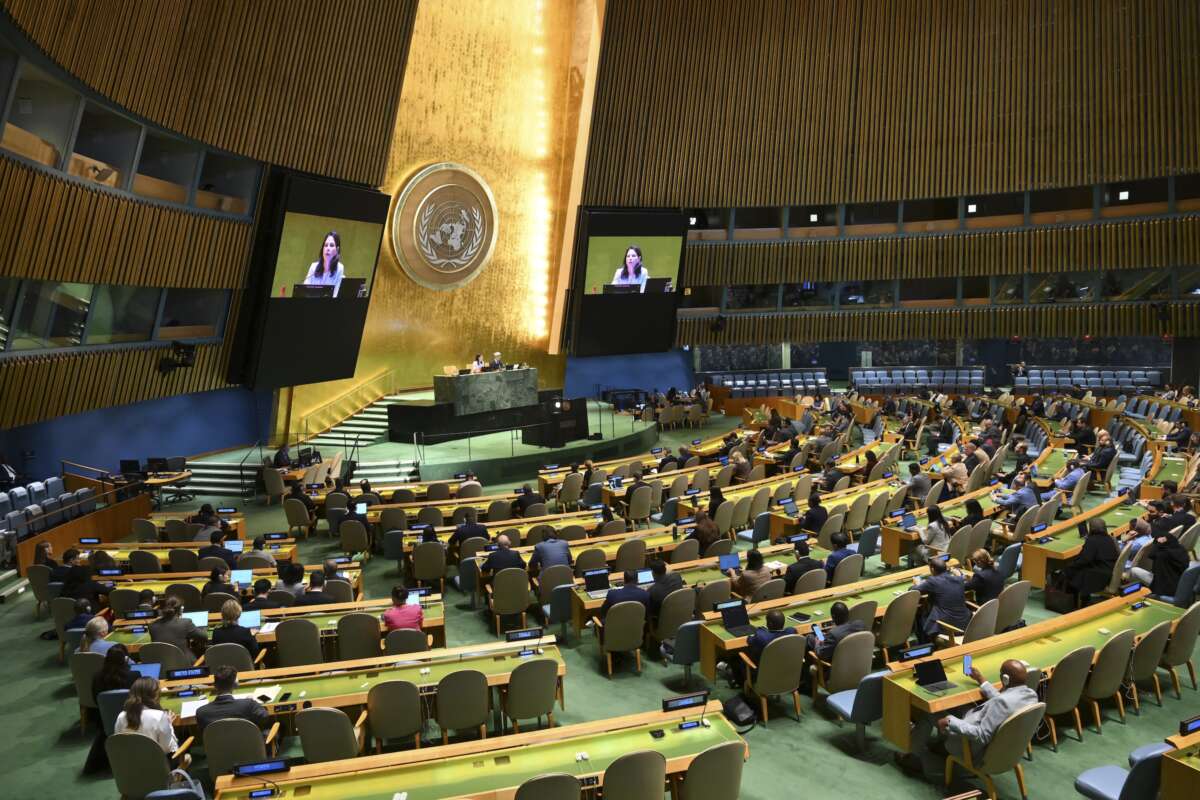
Former German Foreign Minister and President of the 80th session of the United Nations General Assembly Annalena Baerbock speaks at United Nations headquarters on September 12, 2025 in New York City.
ANGELA WEISS / AFP via Getty Images

The Trump administration is seeking sweeping changes to the rights of asylum seekers that experts say would “decimate” the global refugee system established after World War II, a new report finds.

Reuters, citing internal documents from the State Department and an agency spokesperson, finds the administration is proposing a framework in which asylum seekers would be forced to apply for protection in the first country they enter, not a country of their choosing. This asylum would be temporary, and that country would then decide when it’s safe for the refugee to return.

The administration has plans to hold an event on the sidelines of the UN General Assembly meeting later this month.

Officials have said that they sought to undo international asylum rights established after World War II. During and after the Holocaust, the U.S. denied refugees entry to the U.S., including Jewish people and other populations who had survived the Nazi Holocaust.

“Perhaps the most important root cause of the mass and illegal migration today is the abuse of refugee and asylum systems,” said Andrew Veprek, President Donald Trump’s pick to run the State Department refugee division, during a confirmation hearing on Thursday, per Reuters.

Related Story

Wealthy Countries Are Outsourcing Border Operations to Restrict Immigration
A migrant detention deal between Italy and Albania is part of a global trend that tramples on the right to asylum. By Andrea Umbrello , Truthout May 28, 2025

This is a circular statement that suggests that the effect of a phenomenon is the same as the cause. In reality, the root causes of emigration are most commonly violence in their countries of origin, as well as socioeconomic distress and climate change-fueled natural disasters.

“The current framework of international agreements and norms on migration developed after the Second World War in a completely different geopolitical and economic context. It cannot be expected to function in our modern world, and indeed it does not,” Veprek went on.

The Trump administration has already taken drastic steps to erode the right to asylum. Officials have sought to bar nearly all refugees from entering the U.S. — while giving preference to white South Africans, a blatantly racist policy.

The new proposal would severely limit options for people fleeing persecution, instability, and violence within a global system that is already extremely restrictive for refugees. Thousands of refugees die yearly trying to seek safe harbor in other countries — a crisis that could be mitigated, international migrant rights advocates say, with more permissive and safe immigration policies, or policies seeking to decrease causes of violence and economic instability.

“Trump plans to try to decimate the right to seek asylum, forcing refugees to seek asylum in the first country they enter (rarely safe) and for asylum to be temporary (so they can never rely on starting a new life),” said Kenneth Roth, former Human Rights Watch executive director and human rights advocate. “Other governments should reject his plan.”

The framework appears similar to some of the U.S.’s most restrictive and unlawful “transit” bans on asylum seekers, reflecting the U.S.’s sharp right turn on immigration and asylum policies in recent years. Europe has also become increasingly hostile to immigrants in recent decades, and The i Paper reported on Friday that the U.K.’s Home Secretary is reportedly also prepared to reform the UN-established rights to asylum to be more restrictive.
Poland pushes back on Trump comment Russian drone incursion might have been ‘mistake’

TRUMP GETS HIS INTEL FROM RT

Laura Kelly
Fri, September
 12, 2025 
THE HILL


Poland pushes back on Trump comment Russian drone incursion might have been ‘mistake’


Poland’s Foreign Minister Radosław Sikorski on Friday rejected President Trump’s suggestion that a Russian drone incursion into Poland earlier this week was a mistake.

Russia said it was attacking Ukraine when at least 19 of its drones crossed over into Polish airspace, triggering Polish and NATO aircraft to scramble and shoot down the drones.

Trump told reporters in Washington on Thursday, “It could have been a mistake,” mirroring Russian statements playing down the incursion.

Sikorski shot back on social media, posting in Polish, “No, that wasn’t a mistake.”

Polish Prime Minister Donald Tusk also responded, writing on social platform X, “We would also wish that the drone attack on Poland was a mistake. But it wasn’t. And we know it.”

Poland invoked NATO’s Article 4 pillar for consultations over the threats to its territory. NATO Secretary-General Mark Rutte said at the time that a full assessment of the incident ongoing, adding allies “are resolved to defend every inch of Allied territory.”

Trump told “Fox & Friends” Friday morning that his patience is running out with Russian President Vladimir Putin for failing to agree to a ceasefire and halt his war in Ukraine. Trump has imposed 50 percent tariffs on India to punish its purchase of Russian oil, but he has held back from more punitive measures targeting Russia’s war economy, despite threats of additional sanctions.

Bipartisan lawmakers on Capitol Hill have a veto-proof bill imposing tariffs on countries that enable Russia’s war in Ukraine, but Senate Majority Leader John Thune (R-S.D.) has held back bringing the bill to a vote without a green light from the White House.


'Here we go!' Trump issues 11-word statement on Russia's drone attack in Poland

Travis Gettys
September 10, 2025 
ALTERNET


U.S. President Donald Trump speaks to the press about deploying federal law enforcement agents in Washington to bolster the local police presence, in the Press Briefing Room at the White House, in Washington D.C., U.S., August 11, 2025.
 REUTERS/Jonathan Ernst

President Donald Trump issued a brief statement about the suddenly tense standoff between Poland and Russia.

Polish Prime Minister Donald Tusk warned the NATO member's parliament that Russia had crossed a line by sending drones into its airspace during an early Wednesday attack against Ukraine, saying "this situation brings us the closest we have been to open conflict since World War II," and the U.S. president briefly commented on social media.

"What’s with Russia violating Poland’s airspace with drones?" Trump posted on Truth Social at 11:09a.m. EST. "Here we go!"

European leaders condemned the incident as an escalation by the Kremlin, which has continued its attacks on Ukraine despite Trump's efforts to push Russian President Vladimir Putin and Ukraine President Volodymyr Zelenskyy into peace talks.

Polish military officials called the incursion “act of aggression" and said all of the drones were shot down with help from NATO allies, and Tusk said he has activated Article 4 of NATO’s treaty, which allows member nations to demand consultations with their allies.

That's only the eighth time since NATO was established in 1949 that Article 4, which does not trigger a military reaction, has been invoked by a member.