It’s possible that I shall make an ass of myself. But in that case one can always get out of it with a little dialectic. I have, of course, so worded my proposition as to be right either way (K.Marx, Letter to F.Engels on the Indian Mutiny)
Saturday, September 13, 2025
From Doha to the UN: Turning Israel’s Terror Into Global Action
by Medea Benjamin / September 12th, 2025
Funeral in Doha for 5 people killed in the September 10 Israeli strike. Photo: AFP
Responding to Israel’s September 10 attack aimed at Hamas negotiators in Qatar, all 12 members of the UN Security Council issued a toothless statement of condemnation that didn’t even mention Israel by name. This cowardly response underscores the pathetic international reaction to nearly two years of genocide.
Israel believes it can do whatever it wants, wherever it wants, with no consequences–which has been true for two years now. It has already destroyed Gaza. It is expanding settlements, annexing the West Bank, threatening Lebanon, Syria, Yemen, and Iran. It has attacked aid flotillas, bombed refugee camps, and assassinated negotiators. Now it has bombed a U.S.-allied Gulf capital. And still, the world hesitates.
One would think that the bombing of Qatar — a U.S. ally, the home of U.S. Central Command, and the very place where ceasefire negotiations were being brokered–would be a game-changer. The strike killed five Hamas staffers and a Qatari security officer. The senior Hamas leaders survived, but the real target was not just them. The target was diplomacy itself.
Trump, for his part, has been playing a double game: issuing ultimatums to Hamas while allowing Israel to bomb the very negotiators the U.S. asked Qatar to host. His excuse that his envoy “called too late” to warn Doha is laughable. The truth is simpler: Washington could have stopped this. Its air defenses sat idle. Its umbrella of “protection” never opened. The U.S. is not a bystander; it is complicit.
Netanyahu bragged about authorizing a “surgical precision strike” in Doha on what he called “terrorist chiefs.” But let’s be clear: this was state terrorism, carried out in broad daylight against a sovereign country at the heart of U.S. strategy in the Gulf. It was an assassination attempt deliberately timed to blow up the possibility of a ceasefire by killing the very negotiators needed to reach one. For nearly two years, the Israeli prime minister, Benjamin Netanyahu, has consistently obstructed ceasefire talks. The strike on Doha is final proof that Israel has no interest in peace — only endless war.
In Europe, close Israeli allies Germany, France, and Britain condemned the strike, as did China and Russia. Even in Israel, the attack provoked outrage from hostage families. Einav Zangauker, whose son is captive in Gaza, said Netanyahu had “essentially sentenced my Matan to death.” She asked the question millions are asking: Why does Israel blow up every small chance for a deal?
And the Arab world? Qatar’s prime minister Mohammed Al Thani called the attack “state terrorism,” warning the region that Netanyahu is destabilizing everything and that Netanyahu needs to be brought to justice. Saudi Arabia called it “a violation of international law and an unacceptable aggression against a fellow Arab state.” Jordan warned of “dangerous escalation.” The UAE expressed “grave concern.”
Yet words are cheap. Where is the action? Where is the red line? Arab states have watched Palestinians burned alive in tents, starved at aid lines, bombed in their homes for two years — and offered little more than statements.
If the world allows Israel to get away with bombing Doha, then no country in the Middle East is safe. Arab leaders who rushed to normalize with Israel under Trump’s so-called Abraham Accords–the UAE, Morocco, Bahrain, Sudan–now find themselves exposed as collaborators while Netanyahu bombs Arab capitals with impunity. The very least they must do right now is rescind those accords, and the rest of the Arab world must denounce any moves to normalize relations.
Qatar is convening an emergency Arab-Islamic summit and has called for a collective Arab response. This must be more than words: a coordinated campaign to cut trade, sever ties, and impose sanctions on the rogue Israeli state.
From there, the crisis will move to New York. As the new session of the UN opens and the U.S. continues to use its veto to stop the Security Council from taking action, the General Assembly must put the crisis at the top of its agenda. It must invoke the Uniting for Peace resolution to call for the following:
A UN protection force to deliver humanitarian aid, protect civilians, preserve evidence of war crimes, and facilitate reconstruction;
Comprehensive sanctions and military embargo;
Withdrawal of Israel’s General Assembly credentials;
Reactivation of the UN’s long-dormant anti-apartheid mechanism, and
Establishing a war crimes tribunal.
The world is watching, and millions of people across continents are demanding an end to this genocide. The UN General Assembly still has the opportunity to rise to the occasion, proving that international law is more than just words on paper. The bombing of Doha should be the breaking point — the moment the world finally acts.
Medea Benjamin is the co-founder of the women-led peace group CODEPINK and co-founder of the human rights group Global Exchange. She is the author of 11 books, including War in Ukraine: Making Sense of a Senseless Conflict, coauthored with Nicolas J.S. Davies. Her most recent book, coauthored with David Swanson, is NATO: What You Need to Know. Read other articles by Medea.
The desperation of Israel’s Qatar attack
by Paul Larudee / September 12th, 2025
Israel might claim that they were not attacking Qatar per se, but rather Hamas in Qatar, but that is neither a distinction nor a difference. Qatar is considered neutral territory in the region, a place where representatives of Hamas, the Israeli government, the US, Egypt, and other interlocutors could meet and negotiate safely. Qatari territory was, until now, tacitly inviolable.
Israel’s attack is clearly a sign of desperation. From Israel’s point of view, Hamas went too far in accepting Israel’s ceasefire terms. Those terms were designed to be unacceptable but to have the appearance of justification, so as to be able to condemn a Hamas rejection.
Apparently, Israel made an offer that was unintentionally reasonable enough for Hamas to accept. Israel doesn’t want a ceasefire, only another pretext to continue the Gaza genocide to its ultimate conclusion. Not that a pretext is needed, from Israel’s point of view, but a fig leaf is always preferable to cover the last bit of embarrassing exposure.
Nevertheless, the Israeli attack on Qatar reveals the depths of Israeli despair. Israel can no longer afford a ceasefire – not even to satisfy the demands for the release of Israeli captives. Its vaunted military consists of little more than an air force with unlimited US bombs and refueling facilities. The last ceasefire significantly reversed the ethnic cleansing of northern Gaza, and the infantry is so decimated by unaccustomed casualties, flight abroad, and refusal to serve, that it can barely muster the equivalent of a single division. A second ceasefire would be disastrous. Meanwhile, Hamas has more recruits than it can use, and an unlimited supply of unexploded Israeli ordnance to repurpose in workshops deep underground.
Increasingly, it appears that the outcome in Gaza may include no ceasefire or pause, much less a truce, dénouement, or agreement, but rather a fight to the finish, with only one side left standing. Alternatively, Israel could decide to withdraw strategically rather than see its population dwindle inside a fortress of die-hard fanatics unable to dominate the territory that it covets.
In fact, the uncertainties threaten to take us into unknown territory. Israel’s status as a pariah state is growing dramatically, while its dependence on a dwindling number of supporters makes the unthinkable increasingly plausible. Will the world finally defy or prevail upon the US to end the genocide? Will Israel use or threaten to use its nuclear arsenal on its neighbors to make them accept an unwilling Palestinian population into their territory? Will a joint Israeli-US attempt to destroy Iran unleash a global military conflict, with unpredictable consequences?
We can only hope that a receding supply of saner minds will be adequate to the daunting task ahead.
Paul Larudee is a retired academic and current administrator of a nonprofit human rights and humanitarian aid organization. Read other articles by Paul.
Buying Time: Israel’s Rogue Attack on
Qatar
by Binoy Kampmark / September 11th, 2025
It’s all part of a stratagem, bleak and brutal. With Palestinian recognition being promised by France, the UK, Canada and Australia at the 80th session of the United Nations General Assembly, Israeli aggression is becoming more brazen and panicked. Time must be bought on one vital front: creating a Greater Israel, involving the annexation of Gaza and extinguishing, as far as possible, the power of the Palestinian Authority in the West Bank. What follows from this is the termination of Palestinian statehood altogether, including its political representatives.
Israel’s efforts have, for that purpose, focused on killing Hamas militants at enormous cost to Palestinian civilians while also attempting to eradicate the diplomatic presence of the organisation. The attack on a building in Doha, Qatar on September 9 was a case in point. The intention of the attack by the IDF, involving 15 Israeli fighter jets and an unspecified number of drones, was killing senior Hamas officials involved in discussing a ceasefire proposal advanced by US President Donald Trump. Were it to be accepted, that proposal would see the release of all Israeli hostages (dead and alive) in exchange for Palestinian prisoners, followed by a ceasefire of 60 days duration and ongoing negotiations towards an agreement concluding the war. Qatar had been putting pressure on Hamas to accept the proposal.
While Hamas personnel were killed, such senior negotiators as Khalil al-Hayya (who lost his son), Zaher Jabarin, and Khaled Mashal, were spared. Seven perished in the strike, with Qatar losing two security officers. Yet again, Israel’s military action demonstrated a reading of international law that tilts towards anarchical self-assurance, indifferent to any sovereignty that is not its own. As Israeli Prime Minister Benjamin Netanyahu reasoned, Qatar was hosting terrorists. “I say to Qatar and all nations who harbour terrorists, you either expel them or you bring them to justice. Because you don’t, we will.”
Israeli officials, in keeping with an established, somewhat jaundiced view of international relations, advanced a novel, unhinged reading of the attack on Qatari soil. Israeli Ambassador to the US, Yechiel Leiter, offered his dash of drivel by suggesting that this would “actually advance the efforts for a ceasefire and peace.” And as for the Hamas leaders, “if we didn’t get them this time, we’ll get them the next time.”
A condemnation of Netanyahu’s comments followed from Qatar’s Ministry of Foreign Affairs, which described them as a “shameful attempt … to justify the cowardly attack that targeted Qatari territory, as well as the explicit threats of future violations of state sovereignty.”
Qatar’s Prime Minister Mohammed bin Abdulrahman bin Jassim Al Thani, undoubtedly stung that his country’s modernised military had failed to protect the capital, drew the obvious conclusion. The strike had been motivated by Israel’s desire to eliminate “any chance of peace” in Gaza, and effectively sealed the fate of the Israeli hostages still being held in the Strip. “Everything in the meeting is very well known to the Israelis and the Americans. It’s not something that we are hiding.”
He also demanded some “collective response” to the attack. “There is a response that will happen from the region. This response is currently under consultation and discussion with other partners in the region,” he explained to CNN. What that will look like is by no means clear, given the temperamental nature of relations between the various Gulf states. Al Jazeera’s Charles Stratford reports that a legal committee is being pooled to consider “all legal avenues to have Netanyahu tried for breaking international law.”
Even Israel’s least conditional sponsor felt that things had gone too far. “I’m not thrilled by it,” stated Trump as he arrived at a restaurant in Washington. “It’s not a good situation but I will say this: We want the hostages back, but we’re not thrilled about the way it went down today.” He went further, saying he was “very unhappy about it, very unhappy about every aspect.” The President had every reason to harbour such sentiments, given the value of US-Qatar relations and the hosting of US forces at Al-Udeid, the largest US airbase in the Middle East. If Doha can be attacked with impunity, an American military presence becomes less impressive. This was a point Iran’s state-run Press TV found too delicious to avoid. “Did you know,” went the network’s post on X, “that Qatar hosts one of the US’s biggest military bases in the Persian Gulf, with many air defense systems present, yet none of the American THAAD systems fired a single shot to defend Qatar against the Israel invasion?”
The Israeli PM’s list of legal woes is further reason time is being bought. Israel’s strikes across the Middle East this year have been efforts to keep war in the spotlight, peace suspended, and Netanyahu out of jail. The war in Gaza, the attacks on the Houthis in Yemen, the strikes on Iran’s nuclear facilities or the targeting of Syria, have all become matters of personal self-interest and prolongation. Were there a serious risk of pacific calm breaking out, if only momentarily, Netanyahu would have to face something he fails to take seriously: the force of the law.
The Killing of Hind Rajab: The Film, the Foundation, and the War Crimes
As The Voice of Hind Rajab is winning over Hollywood, the real-life story is fostering complicity allegations against the Israeli military and Western complicity.
Recently, The Voice of Hind Rajab won the Silver Lion Grand Jury Prize in Venice after a 23-minute standing ovation. The docudrama is about a five-year-old Palestinian girl killed in Gaza by the Israeli military.
The story is written and directed by a Tunisian filmmaker Kaother Ben Hania, who has won a set of awards in the past few years, including two Academy Award nominations.
The film tells the real-life story of Hind Rajab, a 5-year-old Palestinian girl who was killed by Israeli military along with her family in Gaza in early 2024, even as she pleaded for help over the phone while trapped in a car under fire. The Israeli soldiers riddled the car with 335 bullets.
The real-life catastrophe
The nightmare started on January 29, 2024, when the healthcare system in Gaza was collapsing and a famine was looming, due to the relentless Israeli bombing and blockade of humanitarian aid. the Rajab family hoped to flee the inferno of Gaza. Determined to find a safe place somewhere else, Rajab’s uncle and aunt hurried her cousins into the black Kia to rush away from Tel al-Hawa, a neighborhood of Gaza City.
That’s when an Israeli army tank shot the car, killing Hind Rajab’s aunt and uncle, and cousins.
The only other survivor, Rajab’s 15-year-old cousin Layan Hamadeh, called the Palestinian Red Crescent Society (PRCS) for emergency aid. When the dispatchers called back, Rajab answered the call, saying everyone else in the car was dead.
Rajab at her graduation ceremony for senior kindergarten. Source: Wikimedia
Injured in the back, hand and foot, the 5-year-old girl was told to hide in the vehicle. Since the area was besieged, the PRCS worked with the Gaza Health Ministry and the Israeli military to guarantee safe passage for their ambulance crew to rescue Rajab.
After hours of waiting, the PRCS was finally given the green light to send an ambulance. Now two ambulance workers, Yusuf al-Zeino and Ahmed al-Madhoun, rushed to the scene hoping to rescue the girl.
Yet, Rajab was killed by the Israeli army in what appears to have been a deliberately “planned execution,” according to an initial investigation from the Euro-Mediterranean Human Rights Monitor.
As if that wasn’t enough, the IDF, relying on a U.S.-made missile, killed the two paramedics sent to rescue her.
Shell fragments of an US-made M830A1 projectile were found at the site of the bombed Red Crescent ambulance. The sales of these particular projectiles to the Israeli military were approved by Secretary of State Antony Blinken in mid-December 2023 – just weeks before the Israeli Merkava tank killed Rajab, six of her family members and the paramedics coming to rescue.
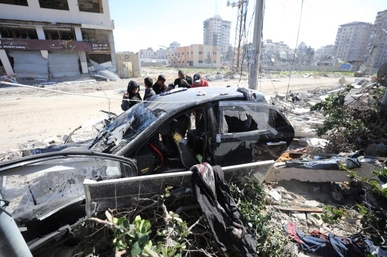
The destroyed car that belonged to Hind Rajab’s uncle Source: Wikimedia
Israeli war crimes
In mid-2024, independent experts appointed by the UN Human Rights Council stated Rajab’s killing might amount to a war crime. Subsequently, the legal foundation of the activist March 30 Movement was named the Hind Rajab Foundation (HRF).
The Movement itself had been created in memory of the Land Day of 1976, when Israeli security forces shot dead six Arab Israelis who were protesting the expropriation of Arab-owned lands. In turn, the HRF, a non-profit organization established in 2024, is based in Brussels, Belgium. It seeks to challenge what it describes as Israeli impunity concerning war crimes and human rights violations in Palestine, particularly in the Gaza Strip.
The Belgian political activist group has filed multiple lawsuits against people who have served in the Israeli military during the Israel-Gaza War.
In January 2025, after the announcement that a court in Brazil would investigate an Israeli soldier visiting the country for war crimes, the HRF co-head, the Belgian-Lebanese Dyab Abou Jahjah, was threatened on social media by Israeli Minister of Diaspora Affairs Amichai Chikli, an ambitious politician who often relies on hawkish intimidation. Chikli targeted Abou Jahjah: “Hello, our human rights activist. Watch your pager.”
It was an allusion to Israeli military’s lethal 2024 Lebanon electronic device attacks.
By March 2025, the HRF had sent the names of more than 1,000 Israeli soldiers to the International Criminal Court (ICC). It was also pursuing legal cases in many countries, including Argentina, Belgium, Brazil, Cyprus, France, Germany, Nepal, the Netherlands, Romania, Sri Lanka, Thailand, and the UK.
Database of digital evidence
During their lethal service in Gaza, as well as Lebanon and Syria, Israeli soldiers have left behind not just physical footprints but digital fingerprints. Just as they might have done in peacetime conditions, many soldiers posted thousands of selfie videos and photos on Instagram, Facebook, TikTok and YouTube. These posts provide abundant evidence of their commission of war crimes in Gaza.
Already in October 2024, a year after fighting in Gaza, Al Jazeera exposed Israeli war crimes in the Strip through the medium of photos and videos posted online by the soldiers themselves. Building up a database of more than 2,500 social media accounts, including thousands of videos, photos and social media posts, the network’s investigative arm (I-Unit) released damning materials revealing a range of illegal activities.
The conduct displayed in the photos and videos ranged from crass jokes and soldiers rifling through women’s underwear drawers to what seems to be the murder of unarmed civilians.
Most of the photos and videos fell into one of three categories: wanton destruction, the mistreatment of detainees and/or the use of human shields. All three may be violations of international humanitarian law (IHL) and war crimes under the Rome Statute of the International Criminal Court.
Highlighting complicity in mass atrocity crimes
Where the HRF has demonstrated the complicity of Israelis with dual citizenship in likely war crimes and genocidal atrocities, the I-Unit has exposed the complicity of Western governments, particularly the use of RAF Akrotiri in Cyprus as a base for surveillance flights over Gaza.
Historically, such complicity goes back to the 1956 Suez Crisis when the military airbase was used to serve British objectives in the Sinai Campaign, seeking to overthrow President Nasser’s government in Egypt in cooperation with French and Israeli troops.
Just as law enforcement organizations use social media posts as leads and evidence of crimes in peacetime conditions, many NGOs now scrutinize them hoping to bring Israeli soldiers to trial. In particular, the Hind Rajab Foundation hopes to have Israeli soldiers tried for war crimes or charges of genocide.
Global citizen activism can contribute to and greatly enhance the work of media and courts. That’s vital when governments and supra-national multilateral organizations fail to enforce the four mass atrocity crimes: genocide, war crimes, crimes against humanity and ethnic cleansing.
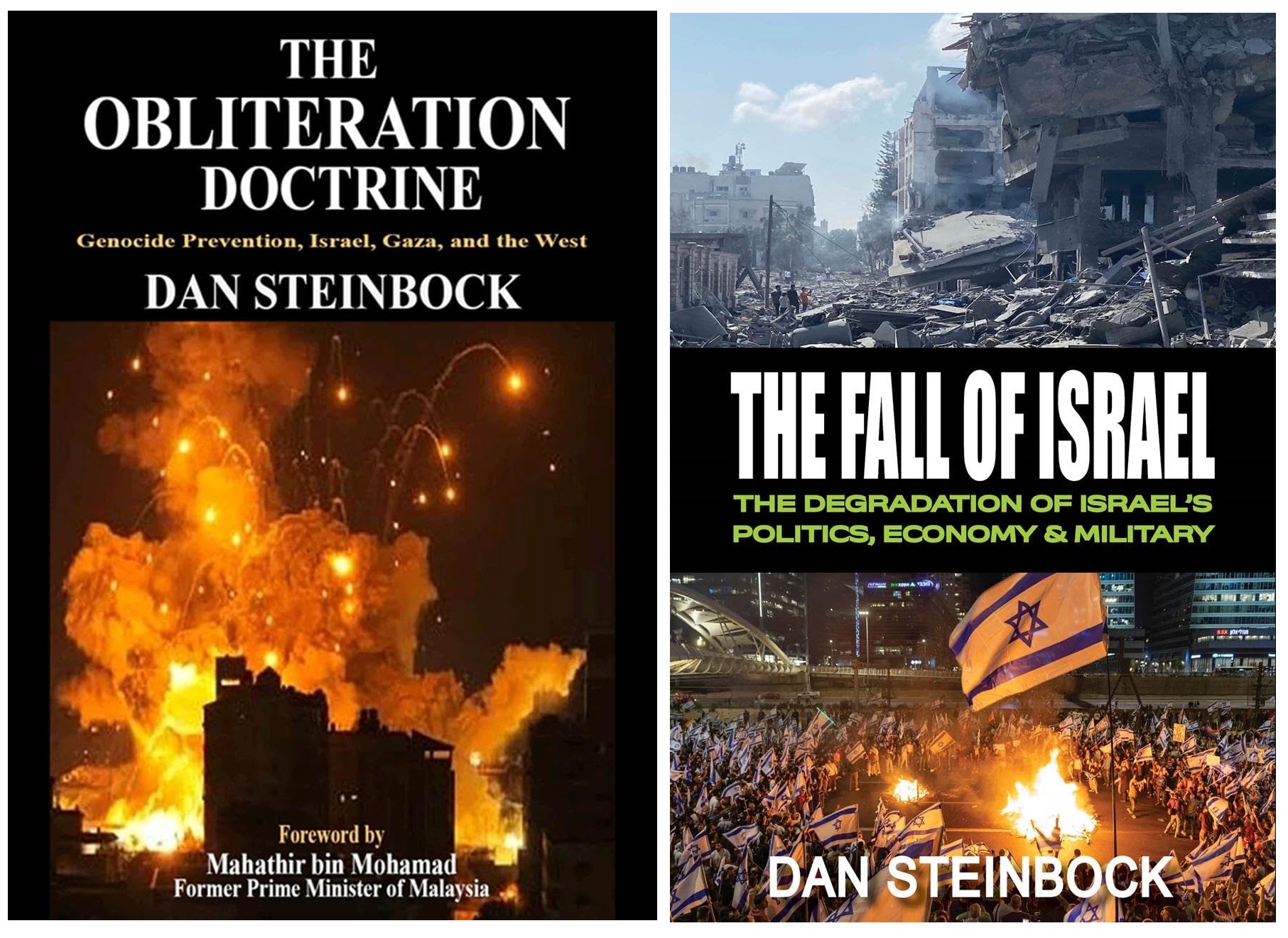
The author of The Fall of Israel (2024) and The Obliteration Doctrine (2025), Dr Dan Steinbock, a strategist of the multipolar world, is the founder of Difference Group and has served at the India, China and America Institute (US), Shanghai Institute for International Studies (China) and the EU Center (Singapore). For more, seehttps://www.differencegroup.net/.
The original version was published by Informed Comment (US) on Sept. 9, 2025.
Dr. Dan Steinbock is an internationally recognized visionary of the multipolar world and the founder of Difference Group. He has served at the India, China and America Institute (US), Shanghai Institutes for International Studies (China) and the EU Center (Singapore). For more, see https://www.differencegroup.net
Paramount criticises pledge by entertainers to boycott Israeli film institutions
Actors who signed the pledge include Olivia Colman, Emma Stone, Mark Ruffalo, Tilda Swinton, and Javier Bardem, among others.
Paramount said on Friday it condemned a pledge signed earlier this week by more than 4,000 actors, entertainers, and producers, including some Hollywood stars, to not work with Israeli film institutions complicit in the abuse of Palestinians by Israel.
Some organisations have faced calls for boycotts and protests over ties with the Israeli government as Israel’s military assault on Gaza grows, and images of starving Palestinians, including children, amid an officially declared famine, spark global outrage.
“We do not agree with recent efforts to boycott Israeli filmmakers. Silencing individual creative artists based on their nationality does not promote better understanding or advance the cause of peace,” Paramount said. “We need more engagement and communication — not less.”
The pledge from earlier this week said it was not urging anyone to stop working with Israeli individuals but instead “the call is for film workers to refuse to work with Israeli institutions that are complicit in Israel’s human rights abuses.”
Israeli film institutions had engaged in “whitewashing or justifying” abuse of Palestinians, it said, drawing parallels with how entertainers had made a similar pledge in the past against apartheid-era South Africa.
Signatories included actors Olivia Colman, Emma Stone, Mark Ruffalo, Tilda Swinton, Riz Ahmed, Javier Bardem, and Cynthia Nixon, among others.
US ally Israel’s assault on Gaza since October 2023 has killed over 60,000 Palestinians, internally displaced Gaza’s entire population, and set off a famine. Multiple rights experts and scholars assess that it amounts to genocide.
Netherlands joins Ireland and Slovenia in vowing boycott of Eurovision if Israel participates
State broadcaster AVROTROS said Dutch participation would 'not be possible as long as Israel remains admitted'.
Dutch public broadcaster AVROTROS has announced it will join other broadcasters in boycotting the Eurovision Song Contest if Israel is allowed to compete next year. In a statement issued on Friday, AVROTROS said it could “no longer justify Israel’s participation in the current situation, given the ongoing and severe human suffering in Gaza”. The broadcaster also accused the Israeli government of interference in Eurovision and using the platform as a “political instrument”.
AVROTROS — which is responsible for selecting and submitting the Netherlands’ entry to Eurovision — said it was in regular consultations with the European Broadcast Union (EBU) on the matter, but its participation “will not be possible as long as Israel is admitted by the EBU”. The broadcaster said it would gladly take part next year, “should the EBU decide not to admit Israel”.
Israeli participation in Eurovision has been a controversial issue after the country began its deadly war on Gaza in 2023. There was strong public backlash against Israeli participant Yuval Raphael — a survivor of the October 7 attack — who ended up winning second place. Raphael was jeered at during the competition as she performed her song ‘New Day will Rise,’ a reference to a day-after scenario for when the war ends. Israel’s entry the year before had to be rewritten for its more overt references to October 7, as competition organisers said they were intent on keeping the show apolitical.
Israeli contestant Yuval Raphael at the flag parade during the final round of the Eurovision Song Contest 2025. Photo: EBU/Corinne Cumming
AVROTROS joins Ireland’s RTÉ and Slovenian RTVSLO in the boycott, with other broadcasters expected to follow suit. The Spanish government has been vocal in its opposition to Israel’s participation, with the culture minister saying his country shouldn’t participate following a statement by their prime minister asking Israel to be excluded in line with similar actions taken against Russia. Spanish broadcaster RTV, which sent a letter to the EBU on the subject in April, has yet to confirm whether it will participate in the event. The winner of this year’s competition, Austrian operatic singer JJ, has also called for Israel to be left out of the competition.
Eurovision director Martin Green said in a statement on Friday, “Broadcasters have until mid-December to confirm if they wish to take part in next year’s event in Vienna,” adding that the organisers “would respect any decision broadcasters make”. The deadline for submissions is normally placed in October, but has been extended as several broadcasters are consulting with the EBU and each other on Israeli participation.
Israel’s brutal military campaign has killed 64,368 people in Gaza over 707 days. The United Nations General Assembly overwhelmingly adopted a resolution on Friday, calling for the establishment of a Palestinian state. Hamas meanwhile has said their chief negotiator in Doha survived Israel’s attacks on Monday, which the group said were a “direct hit” on a ceasefire proposal put forward by US President Donald Trump.