Saturday, September 13, 2025


‘We’re fighting, and we’re fighting to win’: Interview with Cyn Huang on the DSA National Convention

First published at Revista Movimento.

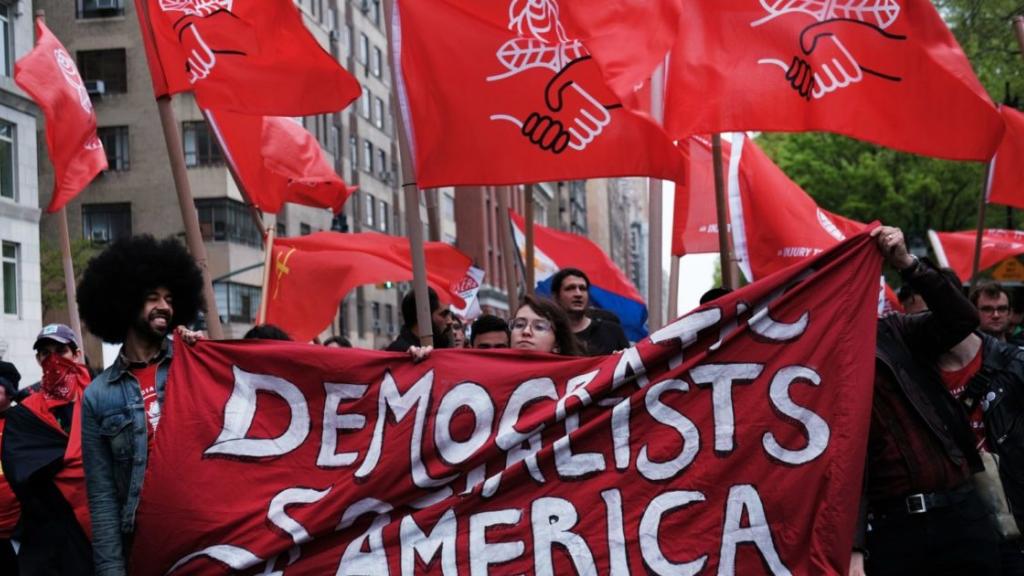
The DSA National Convention took place two weekends ago in Chicago, Illinois. The event brought together 1,200 delegates and around 1,600 attendees from across the country. Without a doubt, it was the most significant socialist gathering in the United States in recent years, occurring right in the middle of the Trump administration and its threats to both the American and global working class.

Our column spoke with Cyn Huang, a DSA member since 2019, currently active in the East Bay chapter in California. Cyn is part of Bread & Roses, a Marxist caucus within the DSA, a rank-and-file union activist, and an internationalist. He served as a delegate at the Convention and shared his insights with us on the event’s importance, its main resolutions, strengths, weaknesses, and challenges.

Cyn, thank you very much for the interview. Could you start by talking about the contextual background of the convention? At what moment did it take place, considering the situation in the United States, in the world, and also the internal development of DSA?

Thanks for having me! I rely quite a bit on the column “United States Today” in Fundação Lauro Campos and Marielle Franco to understand the world, so I’m glad to return the favor in a small way.

To speak to your question: DSA’s national convention really could not have taken place at a more consequential moment. It’s a moment marked by the growth of the far right, and by the bankruptcy of centrist and center-left regimes that essentially paved the way for that growth. Add to this the various economic, social, and ecological crises that have been increasingly visible since the 2008 financial crash.

Just in the past week or two, we’ve seen the international far right make very violent escalations. Of course, in Israel, with the backing of the U.S. and much of the Western world, we see the takeover of Gaza City, which is sure to result in incalculable death and destruction. In the U.S., Trump is using the power of the state to shore up the US ruling class’s dominance over the world. Domestically, that’s taken many forms: deployment of the National Guard to Washington, D.C., overhauling the judicial system, installing anti-scientific yes-men ready to give cover to the worst of Trump’s agenda. Internationally, the trade war has entered a new phase. Trump has bullied “allies” into crippling deals and issued direct attacks on BRICS countries — Brazil, as you know well, but also India, as a purchaser of Russian oil.

Conversely, though it hasn’t risen to the level of the challenge yet, the broad and fragmented anti-fascist movement has given important responses. Opposition to Trump has been growing both internationally and domestically through Bernie and AOC’s “Fight the Oligarchy” tour, protests at Democratic and Republican town halls, massive street mobilizations on symbolic days like “Hands Off” and “No Kings,” confrontations with ICE, and a lot of union-led initiatives.

This week, Zohran, the winner of NYC’s Democratic Party mayoral primary, has been touring the five boroughs to polarize the city against Trump. In the UK, over 700,000 people have expressed interest in an alternative to the Labour Party, which, like many other European parties of social democratic origin, has administered the most brutal austerity against the British working class and laid the groundwork for the rise of the far-right. In Brazil, a new front for anti-imperialist struggle has opened after Trump imposed a 50% tariff rate as punishment for the prosecution of long-time ally and coup plotter Jair Bolsonaro. And this weekend in the United States, the epicenter of global capitalism, there was a powerful reunion of about 1600 socialists who recommitted to the fight for a better world.

The convention comes at a unique moment in DSA’s growth. The theme and title of the convention –– “Rebirth and Beyond: Reflecting on a decade of DSA’s growth and preparing for a decade of party building” was fitting. The contemporary U.S. left really only began about a decade ago, on the backs of Trump’s election and Bernie’s presidential campaign. It’s been a tumultuous decade, with many challenges, but many lessons and victories to claim as well.

Though DSA is still not a decisive national force, it is a significant player in many meaningful processes, from Zohran’s primary victory in NYC, to union reform struggles, the pro-Palestine student encampments, and much more. Compared to 10 years ago, we are much more rooted and present across a diversity of struggles, which has important implications for recruitment, our political perspectives, the quality of leaders we develop, and our impact on the world. Internally, we have made progress on several questions, including democratic control over staff, the growth of caucuses, and the development of political –– not just organizational –– leadership.

I know a decade may not sound like a lot to Brazilian activists, who inherited a more sustained radical tradition, but it is very significant for us. The generation of DSA activists that began between 2016 and 2019 started at a very high point. To go from that to the political confusion and isolation caused by the pandemic and the collapse of the Sanders–Corbyn–Syriza-Podemos moment was very difficult. It was never inevitable that the left would survive and still have victories to claim on the other side.

The fact that we have an organization that is still fighting and growing against all odds is a very precious thing.

What were the main resolutions approved at the Convention?

The convention took important stances on many critical questions. I’ll try to summarize them using four main themes: Palestine, internal organizational questions, and the horizon of 2028, which can be analyzed either with an electoral or a labor emphasis.

Let’s start with the latter. The year 2028 had a lot of significance at this convention. It’s the year of the next presidential election, and it’s become a horizon that many elements of the left and labor movement have set their sights on, especially after UAW President Shawn Fain called for coordinated action and aligned contract expirations on May Day.

The debates around May Day and the 2028 elections helped clarify the organization’s thinking on our relationship to the Democratic Party, the role of DSA as an alternative, expectations for elected officials, and how electoral contests can be used to advance our broader political work. There’s a strong consensus in the organization that building an independent workers’ party is our aspiration, but there are differences about how that will come about. Some differences were explicitly debated; others could be inferred from resolutions that didn’t make it onto the floor.

These differences span a range of questions: how different tendencies read the balance of forces in society, what timeline we expect for a break from the Democrats, what role DSA should play in fostering a new party, and what kind of party that would be — a broad workers’ party or something explicitly socialist. Despite these differences, there’s a huge appetite to play a bigger role in national politics and to use nationally significant contests — like the presidential election, congressional elections, and Zohran’s mayoral race — to grow.

One resolution called for the organization to explore and prepare for a 2028 presidential run by the left. Another amendment to the National Electoral Commission’s consensus resolution proposed identifying five DSA members to run for congressional seats in 2028 with a clear platform centered on five key demands: affordability, Medicare for All, ending political corruption, reducing U.S. militarism, and so on.

It’s worth elaborating a bit on these consensus resolutions, because they’re a major way priorities are advanced in DSA. We have standing committees around long-term priorities — the National Electoral Commission, the International Commission, and the National Labor Commission. These bodies, made up of members from various tendencies, carry the main organizational weight behind national initiatives. They typically draft resolutions expected to have broad support at the convention.

For example, the electoral resolution emphasized running insurgent campaigns, promoting tactics that build DSA — like having elected members endorse each other and use their offices to empower struggles from below. The labor consensus resolution was also comprehensive and ambitious. It promoted more labor solidarity actions, standing on picket lines with workers, supporting members who are organizing in their workplaces, and pushing union reform struggles in more democratic, militant, and solidaristic directions. This is especially important since the union reform movement hit some roadblocks after the strike against the Big Three automakers in North America. The resolution also emphasized educating coworkers and moving unions to make 2028 a big priority. Right now, that call is mainly coming from leading elements of the labor movement, not yet from a broad grassroots campaign — so this was a welcome step.

Palestine was a dominant theme throughout the convention. It wasn’t just reflected in the votes and debates, but also Rashida Tlaib’s keynote speech, the self-organized breakouts, the experiences of the delegates. In terms of resolutions that passed, many focused on discipline, expectations for officials, red lines for expulsions, and the like. These are not unimportant matters, given the urgency of stopping genocide and the disappointing actions of figures like AOC on funding for the Iron Dome. But the strategic, outward-facing elements of the discussion were a bit lacking. Another resolution debated what Palestinian self-determination ultimately looks like. The convention affirmed a more ambiguous proposal that stopped short of advocating a secular, democratic, one-state solution. This outcome is consistent with longstanding debates in DSA: the organization easily affirms the primacy of fighting U.S. imperialism “in the belly of the beast,” but it has been more hesitant to engage critically with other international processes.

Lastly, on internal organization, many ongoing improvements were crystallized at this convention. Delegates supported efforts to subordinate staff to the will of the convention and membership, and to provide stipends so elected leaders can carry out priorities full-time. We defeated a proposal to move to a one-member-one-vote system, which would have depoliticized our national elections. And importantly, we accepted organizational reforms proposed by the Democracy Commission — a cross-tendency body that studies the internal democracy of parties, organizations, and social movements worldwide, drawing lessons to make DSA better. The overall trend is a desire for a more democratic and militant political culture.

Of course, approving resolutions is just the first step. Prioritization and implementation depend on the direction of the new leadership and the self-organization of the membership. Questions like our overarching strategy to confront Trump, our orientation toward Zohran’s campaign in New York City, and how we update DSA’s program are still under construction.

Sixteen hundred attendees, including twelve hundred delegates, is quite a large number. Could you tell us who these people are in general? Who are the DSA activists — what is their background, and how do they organize to fight for socialism?

The convention was a big affair — the biggest since DSA’s revitalization — with about 1,600 people in the building that weekend. Around 1,200–1,300 of them were elected from their local chapters as delegates to the National Convention. Those are the people with the power to deliberate and vote on resolutions on the floor.

But there was also a broader set of participants who contributed to the dynamism of the event: staff, volunteers, international guests, representatives of allied organizations, and DSA members who weren’t delegates but came to promote projects — like the National Electoral Commission or the Labor Commission. Others were there on behalf of initiatives aligned with DSA’s mission, such as the Emergency Workplace Organizing Committee, the Rank-and-File Project, and important voices in the left media ecosystem — Jacobin, Haymarket Books, and so on.

The number of delegates each chapter could send was proportional to chapter size, so we saw a big concentration from New York City, Los Angeles, and Chicago, the host city. But delegates also came from places beyond the metropolitan centers — I had conversations with delegates from Memphis, Tennessee, and Nebraska.

Organizers brought a wide range of experiences. Some are active in the labor movement as workplace activists, union reformers, leaders of solidarity actions. Others were deeply involved in the Palestine movement, whether on campus, in unions, in the streets, or on city council. There was also a visible layer of former student activists — reflected in important NPC candidates like Alex, Cerena, and Eleanor. And there was a big chunk of delegates mainly focused on building DSA itself: leading their chapters, running new member cohorts, organizing political education events, etc.

With the power of hindsight, you can see distinct “generations” or layers within the organization. The 2016–2018 generation, people who have been active since DSA’s revitalization, were there. Then there’s a middle layer that came in through Black Lives Matter, UAW strike solidarity campaigns, or the wave of workplace unionization at Starbucks and other retail stores. A new wave of growth can be attributed to Palestine solidarity and the excitement around Zohran Mamdani’s campaign for mayor of New York — although the delegate elections took place before his victory, so its full impact on DSA hasn’t played out yet.

Another important trend is ideological polarization. A decade ago, it was almost taboo to organize tendencies inside DSA. But this convention saw the largest number of organized formations since our rebirth, with a very complex balance of forces shaping the new national leadership. Many noted that more delegates this time were affiliated with a caucus or influenced by a caucus. That made outcomes more predictable, and it was harder to find persuadable delegates.

As for the balance of tendencies, people often describe three main blocs. There’s a more moderate or “right-wing” current, which has an electoral emphasis and is agnostic about breaking from the Democrats. On the other side, a far-left current has cohered around questions of discipline, Palestine, and a campist approach to international politics. And then there’s a Marxist center or center-left. It’s not a simple spectrum from right to left — each bloc is capable of advancing its own politics and polarizing the organization in different ways.

Right now, there isn’t an outright governing majority on the NPC. On each issue, a majority will have to be constructed depending on how different tendencies align. The development of distinct political poles is very valuable, but it is equally important to preserve DSA’s big-tent character and find opportunities for common initiatives in this next period.

What were the main conclusions drawn by Bread & Roses about the convention? From your point of view, what are the main challenges for DSA now?

I think everyone agrees that having a strong, independent, and internationalist DSA — rooted in the diverse struggles of the U.S. working class — is more important than ever. That’s true not only because of the crisis we’re living through, but also because of the opportunities it creates, including the historic unpopularity of the Democratic Party.

Right now, the main challenge is building opposition to the Trump administration on all fronts: in the student movement, the labor movement, Palestine solidarity, the defense of public services, the federal workforce, and LGBTQ rights. Our task is to broaden these struggles as much as possible while helping them develop the kind of independent, mass-action politics, democratic spaces, and solidarity needed to achieve their goals.

The solution isn’t as simple as electing Democrats in the 2026 midterms or just showing up to a protest once or twice. DSA members understand that facing the scale of the attacks will take more fights, more coordination, and more imagination. That’s why initiatives like the cross-organizational Political Exchange at DSA’s convention are so important. The political exchange was a new attempt to build links between DSA, partner organizations, and the broader working class — a big step forward in finding common initiatives for the struggle against Trump and for a better world.

Despite some heated debates, the convention was a powerful and unifying experience. And for me, the most striking impression is that, against all odds, socialists have made it clear: we’re fighting, and we’re fighting to win.

We are facing in Brazil the resurgence of the anti-imperialist struggle, considering the threats Trump has been making to Brazilian sovereignty. The new neofascist far right is organizing worldwide. In conclusion, what message would you like to convey to Brazilian activists at this moment?

Our struggles are connected. All around the world, the working class is fighting for self-determination. That struggle takes on different forms depending on the place, but all of our struggles are linked by that fundamental fact.

From our standpoint in the US, a regime that supports Israel in orchestrating and conducting a genocide, a regime that plunges the world into economic misery through punitive tariffs, is not a regime that works in our interests. If the working class here had the power to rule, we would use it for solidarity and cooperation across the international economy, to strengthen public services, and to improve people’s everyday lives.

That’s why we are laser-focused on bringing down Trump, whose administration poses the greatest threat to people’s autonomy around the world. If we succeed in pushing back against his administration “in the belly of the beast,” it will give working people around the globe more space to fight.

We see your struggles in Brazil. We followed the mobilizations against Trump’s tariffs and the Bolsonarists who do his dirty bidding there. We see you connecting the tariffs to the existential threat of climate change and predatory extractivist mining projects the Brazilian government is considering. Watching you assert yourselves strengthens our struggle here in the U.S., and we are in this fight with you until the end.




From protest to power: Lessons from Kenya’s Gen-Z revolt

Kenya Gen Z protests

First published at Zabalaza for Socialism.

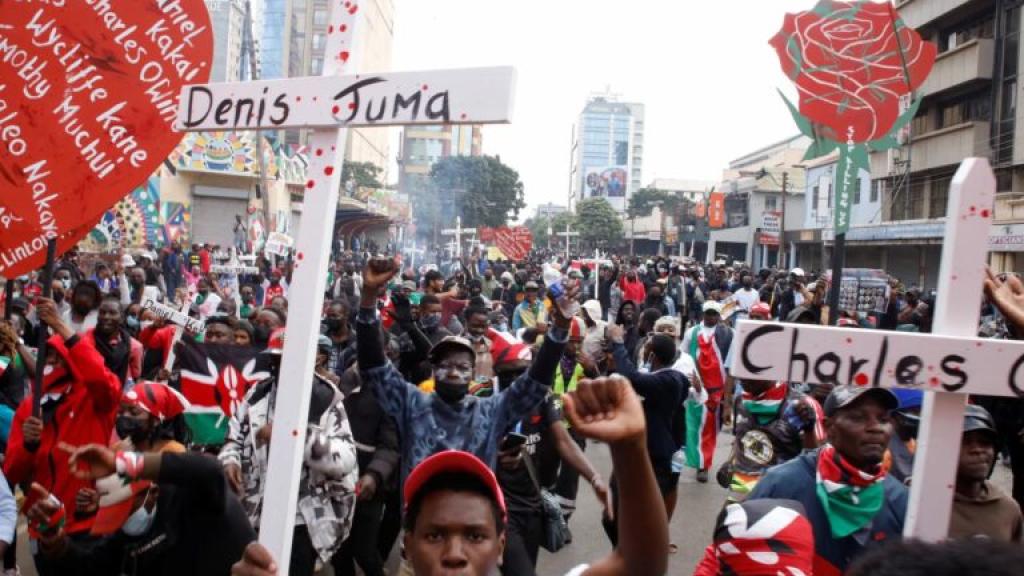
On June 25, 2024, Kenya witnessed a rupture in its post-2002 political consensus. What began as resistance to the Finance Bill — a set of regressive taxes backed by the IMF and marketed as “fiscal reform” — rapidly escalated into a nationwide revolt. The initial mobilizations, led primarily by young people outside of formal party structures, coalesced around a rejection of the rising cost of living, state corruption, and elite impunity. Within days, the protests spread from Nairobi to other urban centers. That afternoon, demonstrators breached the parliamentary compound. Security forces responded with lethal force. Dozens were killed, while hundreds were abducted, detained without trial, or tortured. Though President William Ruto ultimately withdrew the bill, that concession did not resolve the deeper political crisis. By then, the protests had evolved into a broader denunciation of the state’s coercive apparatus and the hollowness of the country’s democratic institutions.

The movement’s most striking feature was its lack of centralized leadership and formal political affiliation. What emerged was a diffuse but politically conscious network of youth-led organizing, facilitated by digital platforms and animated by a rejection of generational exclusion — what one account called a politically conscious network of youth-led organizing. While the protests eventually subsided, they left behind a politicized public — particularly among Gen Z — more attuned to the contradictions of the neoliberal state and more willing to contest them.

Over the following year, commemorations — both online and offline — kept the movement’s memory alive, from digital tributes to local organizing. Then the atmosphere shifted in June 2025, on the cusp of the uprising’s one-year anniversary. On June 8, 2025, Albert Omondi Ojwang — teacher, blogger, community activist — was arrested during a small Eastlands protest. Less than a day later, he was found dead in police custody. Officials claimed suicide; leaked photographs and an independent autopsy pointing to blunt-force trauma suggested otherwise. His death reignited public anger and catalyzed new mass demonstrations. Protests broke out across Nairobi and Kisumu on June 9, quickly spreading to Mombasa, Eldoret, and other regional centers.

By June 25, 2025 — exactly one year after the original peak — Kenya’s streets were again filled with demonstrators. But the emphasis had shifted. Where the 2024 protests centered material grievance and constitutional appeals, the 2025 actions focused squarely on state violence and police impunity, and on the political class’s instrumentalization of “law and order.” The killing of at least sixteen more protesters hardened the confrontation between state and society. The cry was no longer just for reform, but against the legitimacy of the current political order.

Weeks later, on July 7, the annual Saba Saba rallies — commemorating the pro-democracy struggles of the 1990s — drew similarly massive turnouts. What began as a confrontation around tax and policing had become something broader: an open challenge to political authority. These successive waves suggest June 2024 was not an isolated episode but a foundational rupture. The state’s failure to contain or co-opt dissent has exposed the limits of its current modes of governance and foregrounded a new political subjectivity — one that refuses deferential politics and is no longer oriented toward the promises of a compromised political class.

Kenya now sits in unresolved tension. The question is no longer whether this generation will engage in politics, but on what terms, and with what organizational vision.

The long betrayal

The June 2024 protests did not appear spontaneously. They were the consequence of long-standing political and economic grievances shaping Kenya’s post-authoritarian trajectory since the end of Daniel arap Moi’s rule in 2002. The early optimism of the National Rainbow Coalition quickly gave way to disillusionment as the new elite reproduced old practices. The 2010 Constitution introduced an expansive legal framework — extended rights, devolution — yet left intact a centralized, extractive, elite-serving state.

William Ruto’s presidency crystallized this pattern. Elected on a populist “hustler nation” platform — purporting to represent the poor against dynastic elites and promising to shield ordinary Kenyans from externally imposed austerity — Ruto’s government pushed the 2024 Finance Bill, imposing sweeping new taxes and burdening the working class and the poor, a turn charted in analyses of the “hustler nation” project. The bill became a flashpoint not only for its material effects, but for what it symbolized: the consolidation of an unaccountable technocratic state.

The protests that followed were not simply about taxation. They reflected a broader rejection of a political order that has persistently failed to deliver on its promises — what many described as Kenya’s “third liberation” moment. Years of high youth unemployment, surging prices, decaying public services, and routine police violence created the sense that the post-2010 settlement had lost legitimacy. Compounding the frustration was the perception that formal political actors — opposition parties, traditional civil society — had been neutralized or co-opted, leaving few channels for meaningful participation.

What distinguished June 2024 was not only scale but method. Coordination happened through encrypted group chats, crowd-sourced posters, livestreams, even AirDrop networks — a pattern observed in accounts of the digital infrastructure of the protests. Protesters used constitutional language and legal argumentation to justify their actions even as they doubted the state’s willingness to honor the very framework they invoked.

In that sense, June marked a rupture: a generational verdict on post-liberal governance. Rather than engage the substance of the critique, the state combined symbolic gestures with violent repression. But the anger — rooted in structural exclusion — was not easily pacified. The crisis was not about a single policy but the legitimacy of the post-2002 political compact.

Between spontaneity and strategy

One defining feature of the protest cycle has been the absence of formal leadership. The 2024 wave was coordinated through decentralized, online networks with no single figurehead. Horizontal organization helped prevent co-optation and facilitated rapid mobilization — but it also left fewer avenues for strategic consolidation.

This dynamic was clearest in the 2025 commemorations. Demonstrations erupted rapidly in response to Ojwang’s death, mobilizing thousands without centralized coordination. Yet as the state retaliated, the question of “what next” remained open. Without organizing infrastructure or mass political vehicles beyond the NGOs and parties of the status quo, the energy of revolt risked dissipating — or being metabolized by the very elites it rejected.

There is a deeper strategic problem here. The movement has repeatedly shown it can mobilize on short notice. But it lacks institutions capable of translating spontaneous refusal into durable counter-power. That gap reflects both the heterogeneity of the uprising and the political education of a generation whose experience has been one of betrayal: party manifestos promising change, elections shuffling elites, and austerity wrapped in “reform.” The suspicion toward formal politics is grounded in lived reality.

Left unaddressed, though, that suspicion can curdle into anti-politics. When all representation is read as co-optation and ideology as manipulation, movements become vulnerable to burnout, fragmentation, and moralism. Worse, the field is left open for counter-mobilization by actors willing to mimic the aesthetic of rebellion while defending hierarchy. Kenya has already seen versions of this: state-aligned personalities adopting the idiom of dissent, and elements of the political class repackaging Gen Z rhetoric. Neoliberal governance excels at neutralizing critique not by censorship, but by simulation.

None of this diminishes the protests’ achievements. The 2024–25 cycle marked a profound shift in Kenyan political life. But sustaining that rupture demands more than defiance. It demands organization. Socialist politics has a particular responsibility here — not to discipline the movement into doctrinal conformity, but to help build infrastructures that retain its energy and articulate alternative futures.

This tension — between mass mobilization and political organization — has shaped what scholars now call the “mass protest decade,” the global wave of uprisings since the 2008 crisis. Across contexts — from Tahrir to São Paulo, Gezi Park to Ferguson, #FeesMustFall to #EndSARS — youth-led movements assembled with startling speed, often online, disavowing parties, unions, and labels. Moral clarity was a strength; horizontalism a method; spontaneity an aesthetic. But these same features proved liabilities over time. As Jodi DeanVincent BevinsAnton Jäger and others have argued, the absence of durable organizational forms left many uprisings vulnerable to co-optation, repression, or exhaustion. The results were often not democratic breakthroughs but authoritarian reassertion or elite recalibration. Kenya now faces its own version of this pattern.

The lesson is not that protest is futile — far from it. But protest alone cannot substitute for strategy, and strategy requires organization. The Gen Z uprising has shown that collective action is possible in an age of cynicism, surveillance, and digital fragmentation; that ordinary people can coordinate across ethnic, class, and regional divides to confront state violence. What it has not yet produced — through no failure of courage — is the political infrastructure to sustain that energy beyond the flashpoint.

This is the left’s structural dilemma. Many institutions that once served as vehicles for socialist strategy — mass parties, trade unions, anti-colonial movements — have been hollowed out, folded into elite pacts, or made irrelevant to a new generation. In their absence, politics retreats into the moral, the aesthetic, the algorithmic: movements rich in affect but poor in staying power. Yet this is also a moment of possibility. If the state now governs through optics and platforms, counter-power must navigate that terrain without being absorbed by it. Socialist politics today cannot mean merely resurrecting old forms. It must mean constructing new ones — experimental, participatory, strategically clear, grounded in contemporary life. It must offer not only resistance to neoliberal violence but credible alternatives to its empty promises.

Kenya’s protest cycle does not lack leaders so much as containers. It does not lack ideology so much as channels where ideology can be debated, clarified, and enacted. If socialism is to matter here, it must step into that gap — not as a disciplinarian, but as an enabler. It must build the structures — educational, organizational, cultural — through which defiance becomes direction.

Toward a political vision

The most striking feature of the past two years is not the absence of political energy but the absence of a political vehicle capable of cohering it. Across 2024 and 2025, protesters displayed courage, clarity, ingenuity. They defied ethnic patronage, bypassed hostile media, and overwhelmed police. What they lacked was not imagination, but infrastructure — a mass political instrument with ideological clarity and organizational capacity to absorb that energy and move it forward.

There is no mass socialist project in Kenya (or, for that matter, most of the continent) with such capacity. Much “progressive” politics remains confined to NGO networks or elite policy circles. These actors do crucial rights-defense and documentation work, but they are structurally constrained: donor-dependent, program-bound, often disconnected from mass rhythms. The mainstream opposition, meanwhile, offers little beyond revolving-door neoliberalism — shuffling elites without challenging the architecture of inequality.

What socialism could offer now is not another faction in a tired party system, but a horizon: a way to connect immediate crises — taxation, police brutality, unemployment, femicide — to the deeper structures of capitalist domination. The Finance Bill was not simply unpopular; it functioned to discipline the poor while securing external debt repayments to institutions like the IMF. Police impunity is not accidental; it guarantees an order that cannot govern by consent. The cost of sanitary pads, the lack of public housing, collapsing healthcare and education — these are not policy mishaps, but the predictable outcomes of a system designed to extract, exclude, and abandon.

A socialist horizon insists these problems are connected. They are not moral outrages to be condemned, but political facts to organize against. And that organizing must be class-based — not narrowly economic, but structural: locating a shared position of subordination that links the precarious graduate, the informal worker, the evicted tenant, and the survivor of gendered violence. In this sense, socialism offers not just critique but a unifying frame: democratize the economy, expand public services, revalue reproductive labor, and break the power of finance — domestic and international — over democratic life.

Horizons do not walk themselves into being. They require strategy. Here the Kenyan left faces a generational challenge. Discredited party politics, weakened labor formations, and a retreat of radical intellectual life have left few ready-made instruments. What exists must be built from near-scratch: small formations, popular-education networks, workers’ associations, housing cooperatives, student caucuses. This work is slow and rarely visible. It is also indispensable.

To meet the moment, socialists must organize beyond elite NGO circuits and technocratic forums. They must build structures that can hold contradiction, foster debate, and endure repression. That includes recovering suppressed political traditions — Pan-Africanism, liberation theology, African Marxism — not as nostalgia, but as tools for present struggle. It also means crafting programs legible to the vast majority living these injustices daily: concrete, winnable demands rooted in lived conditions.

Start where people are, not where we wish them to be. Socialist politics should not begin with tired twentieth-century slogans but with plainspoken language that names familiar struggles and proposes achievable fights. If it cannot speak to the price of unga, the shortage of hospital beds, or school fees, it will be dismissed as irrelevant. But if it can show, through action, that collective struggle produces material gains — and that those gains point toward a different kind of society — it can expand the horizon of the possible. The task is not to impose a blueprint but to cultivate a common-sense socialism: building power by building confidence, and building confidence by delivering results.

There are faint but important beginnings. The formation of a National People’s Council by the Social Justice Movement — announced at Mathare Social Justice Centre in August 2025 — presents itself as a grassroots alternative to the discredited political establishment, with a clear commitment to political education and mass organizing. Its “road-map” document is already public: the Road Map to People’s Revolution in Kenya. While in its infancy and lacking institutional weight, the council signals an important effort to consolidate protest energy into structure. Whether it can grow beyond its urban base and avoid isolation and sectarianism remains to be seen; but its emergence suggests movements are beginning to ask not only what they oppose, but what they want to build.

Alongside this are electoral stirrings like the Kenya Left Alliance, a coalition of social-justice movements that has signaled intentions to contest widely in the 2027 general election. such efforts can navigate electoral politics without reproducing the traps of co-optation remains unclear. But if they can combine electoral ambition with movement-based organizing, resist the gravitational pull of elite compromise, and remain accountable downward rather than upward, they may begin to chart the political alternative this moment demands.

The moral clarity of the youth uprising is not in doubt. But clarity alone is not power. The vitality of meme culture, digital irony, and “vibe politics” has exposed the cynicism of the Kenyan political class — captured in readings of Kenya’s recent “vibe shift” — but cannot displace it. A movement capable of naming injustice must also be capable of transforming it. For that, it needs more than critique. It needs a plan.


Indonesia leader in damage control, installs loyalists after protests

Jakarta (AFP) – In removing Indonesia's finance minister and U-turning on protester demands, the leader of Southeast Asia's biggest economy is scrambling to restore public trust while seizing a chance to install loyalists after deadly riots last month, experts say.


Issued on: 14/09/2025 -

Thousands rallied across Indonesia in protests sparked by anger over lavish perks for lawmakers and the death of a delivery driver © Timur Matahari / AFP

Demonstrations that were sparked by low wages, unemployment and anger over lawmakers' lavish perks grew after footage spread of a paramilitary police vehicle running over a delivery motorcycle driver.

The ensuing riots, which rights groups say left at least 10 dead and hundreds detained, were the biggest of Prabowo Subianto's presidency and the ex-general is now calling on the public to restore their confidence in his government.

He vowed tough action on the officers who ran over 21-year-old Affan Kurniawan, backtracked on lawmaker housing allowances, and on Monday removed five ministers, including respected finance minister Sri Mulyani Indrawati.

"We can read this as damage control after the wave of public anger, especially at... the misdirected budget efficiency," Rani Septyarini, a researcher at the Center of Economic and Law Studies, told AFP.

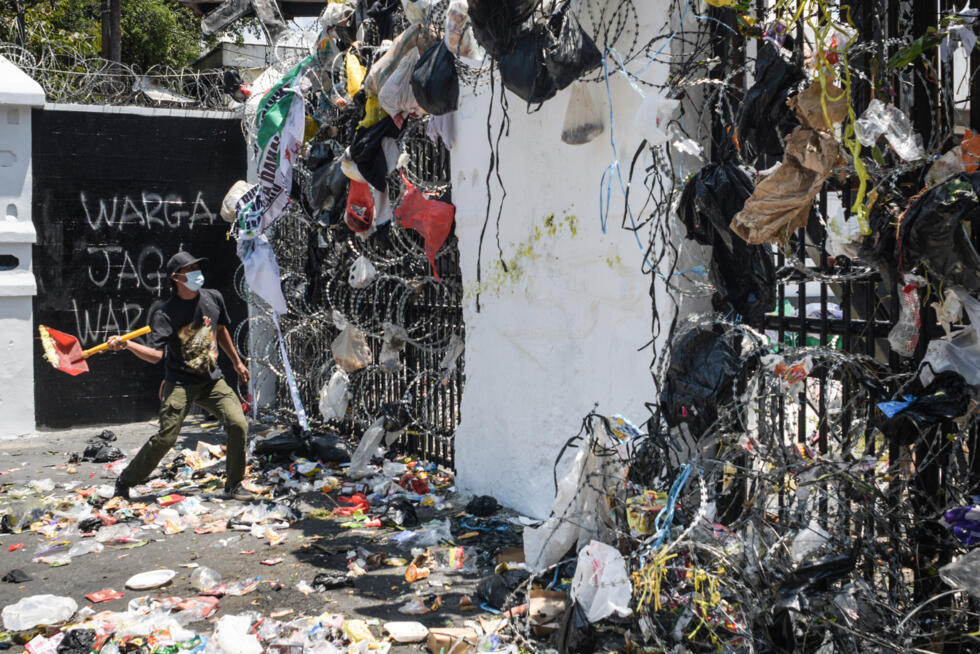
Protesters dump garbage at the gate of the West Java parliament building in Bandung, West Java © Timur Matahari / AFP

Prabowo has focused on expensive social mega-projects funded by widespread budget cuts that already roused protests in February. His flagship policies include a free meal programme and a new sovereign wealth fund.

But his new finance chief Purbaya Yudhi Sadewa said Wednesday he would inject an unprecedented $12 billion into the economy to spur growth and calm simmering public anger.

"Prabowo sees this problem as something that needs to be anticipated seriously," said Airlangga Pribadi Kusman, political analyst at Airlangga University.

"He wants to prevent further social damage."

Consolidating power

Prabowo surged to victory in last year's election and maintained a high approval rating of more than 80 percent 100 days after entering office in October, according to polls.

But the protests turned increasingly angry against the country's political elite, with mobs burning buildings and looting politicians' homes.

"This shows that the public has a real, legitimate problem with this administration," said Airlangga.

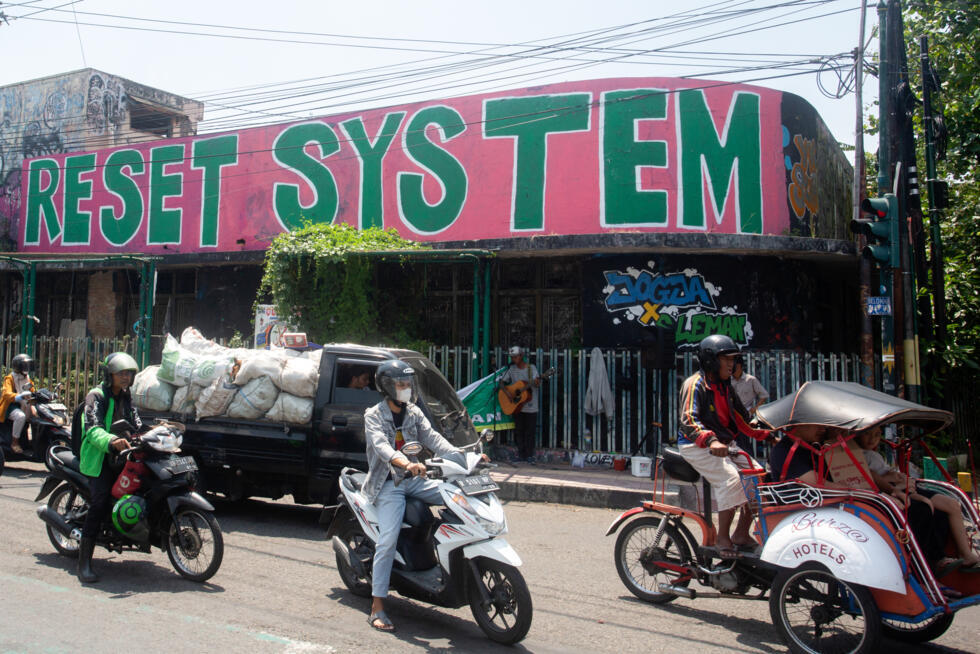
Graffiti painted during recent Indonesian protests during which at least 10 people were killed © DEVI RAHMAN / AFP

Yet the Indonesian leader has used the reshuffle to replace officials linked to popular predecessor Joko Widodo, more commonly known as Jokowi, with his own people.

Sri Mulyani served for eight years under Jokowi, while new finance minister Purbaya is close to key government economic adviser Luhut Binsar Pandjaitan -- an ex-military colleague of Prabowo.

"Prabowo is using the moment to slowly consolidate his political power by erasing Jokowi's influence," said Virdika Rizky Utama, a political researcher at think tank PARA Syndicate.

State Secretary Prasetyo Hadi said on Monday the replacements were the right people for the job.

The presidential palace did not respond to an AFP comment request.

To win back public trust, experts say Prabowo -- former son-in-law of late dictator Suharto -- needs to address an expanding wealth gap and weakening democracy in a nation long known for dynastic politics which only emerged from autocracy in the 1990s.

"What we need is the determination from the president, a political will, and real progress," said Airlangga.

'Closest circles'

But in installing loyalists to oversee budget and security, Prabowo appears to be trying to uphold his flagship programmes, rather than change course.

"Putting trust in people who are well-known becomes key to securing (his) policies," said Wasisto Raharjo Jati, political analyst at the National Research and Innovation Agency, who added those hired were from Prabowo's "closest circles".

"Prabowo will be more comfortable moving forward if his flagship programmes are handled by trusted figures."

Yet it's still unclear if Prabowo's new hires are up to the job of making life better for Indonesians.

While Sri Mulyani had stints at the World Bank and International Monetary Fund, Purbaya is a relatively unknown finance professional who immediately lauded Prabowo's ambitious growth goal of eight percent annually as achievable.

"Their competence, experience, and technological skills must still be demonstrated," said Wasisto.

Some say Prabowo should change course on his social projects as the country grapples with stagnant wages and rising unemployment.

"If the corrections are half-hearted... the perception of justice will worsen, and the social pressure will continue," said Rani.

The conciliatory moves and a call for calm appear to have bought Prabowo time.

But without addressing the root of the public's anger, analysts say another inflammatory incident could ignite bigger protests.

"This will be a time bomb," said Virdika.

"If things pile up, it will blow up."

© 2025 AFP

The Indonesian Protests Are a Revolt Against Oligarchy

Thursday 11 September 2025, by Michael G. Vann


The Indonesian president, Prabowo, would like to turn the clock back to the dark days of the Suharto dictatorship. But he’s been confronted with an unexpected wave of protest after the killing of a young man by police in Jakarta, the country’s capital.


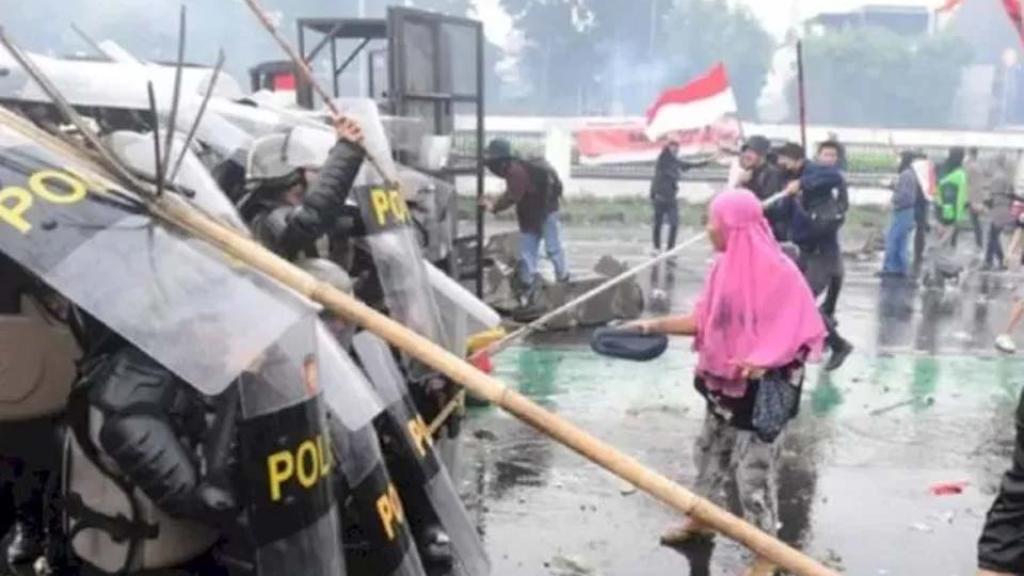
A woman strikes a police officer with a bamboo stick as police push back students during a protest outside the parliament building in Jakarta on August 28, 2025. (Bay Ismoyo / AFP via Getty Images)

Jakarta is burning. So are Makassar, Bandung, Surabaya, Mataram, and other cities throughout Indonesia. Discontent that started as outrage over the lavish perks of lawmakers evolved swiftly into a searing indictment of police brutality, elite privilege, economic precarity, wealth disparities, and democratic erosion.

The horrific death of a young man named Affan Kurniawan at the hands of the police pushed Indonesia over the edge. At the moment, it is unclear how far things will fall. But even Indonesia’s authoritarian president, Prabowo Subianto, is making concessions to the massive outburst of social anger.

Dark Indonesia

As the fourth-largest nation in the world and (at least for now) the world’s third-largest democracy, Indonesia has grappled with the legacies of authoritarianism and free-market discipline since the people power revolt that overthrew Suharto’s dictatorial New Order.

Over the past week, diverse acts of dissent, long simmering beneath the surface, coalesced into violent mass actions across the archipelago. With unprecedented ferocity and velocity, thanks to social media, thousands upon thousands of disillusioned citizens erupted in defiance.

Tension have been building through 2025. In February, a series of student demonstrations across Indonesia challenged Prabowo. Organized under the hashtag #IndonesiaGelap or #DarkIndonesia, the protesters opposed a range of policies, including massive budget cuts, the role of the military in domestic governance, nepotism, corruption, and a controversial free school lunch program.

The youth movement joyously embraced a punk DIY aesthetic and adopted Sukatani’s “Bayar, Bayar, Bayar” (“Pay, Pay, Pay”) as their anthem. The mixed-gender duo’s song blended punk, goth, and retro New Wave sensibilities in a raucous condemnation of police corruption.

While these demonstrations eventually dissipated, the pessimistic sentiment of Dark Indonesia spread. Many spoke about leaving their homeland. The hashtag #KaburAjaDulu, or “Just Run Away First,” went viral, reflecting widespread dissatisfaction among young Indonesians faced with weak domestic job opportunities and career prospects.

Prabowo and his administration reacted harshly, dismissing the trend, mocking the youth, and suggesting that it was part of a conspiracy. The opposition MP Charles Honoris countered by describing the hashtag as “a wake-up call, not a reason to label young people as unpatriotic or discourage them from returning. . . . Instead of reacting negatively to this trend, the government should focus on strengthening worker placement and protection programs.”

Rewriting History

In May, minister of culture Fadli Zon, a long-term Prabowo sycophant and rabid Sinophobe, appalled many Indonesians when he announced that he was writing a new national history. The project was an obvious exercise in the whitewashing of Suharto-era human rights violations. Zon then made dismissive remarks about the mass rapes of Chinese women during the chaotic last days of the New Order, implying that rumors had exaggerated the extent of these well-documented crimes.

The 1998 anti-Chinese violence was part of a strategy to redirect popular anger away from Suharto and toward a reliable scapegoat. Prabowo, then a high-ranking general and Suharto’s son-in-law, was dishonorably discharged for his role in kidnapping, torturing, and disappearing activists. In a committee hearing, opposition politicians Mercy Chriesty Barends and Bonnie Triyana publicly condemned Zon for trying to erase these crimes from the record.

Faced with dissent from various directions, Prabowo decided to unite the nation by literally rallying around the flag. As August 17 would mark eighty years since Sukarno’s declaration of independence, he ordered everyone to fly the red and white national flag in an act of patriotism. Flags and patriotic light displays quickly went up all over the nation’s 17,000 islands, weeks ahead of the date when communities would normally decorate for the holiday.

But then, something strange happened on Indonesia’s infamously busy roads. Truck drivers who were frustrated with long hours and burdensome regulations refused to fly the national flag. In a cheeky act of dissent, they flew the “One Piece flag,” a modified piratical Jolly Roger from a popular Japanese anime. After images of the truckers went viral on social media, the flags began to appear everywhere.

Prabowo was furious. In an act of pettiness comparable to Donald Trump’s various obsessions, Indonesia’s coordinating minister for political and security affairs, Budi Gunawan, warned of criminal consequences (such as five years in prison or a US$30,000 fine) for those who dared raised the comical skull and crossbones adorned with a straw hat. 

The absurdity of Prabowo’s overreaction only fueled flag sales.

In contrast, the Speaker of Indonesia’s House of Representatives, Puan Maharani, suggested a more conciliatory approach to the good-natured protest: “These expressions can be in the form of short sentences like ‘Kabur Aja Dulu,’ sharp satire such as ‘Dark Indonesia,’ political jokes like ‘Konoha country,’ [another anime reference] and new symbols like the One Piece flag and many more that are widely circulated in the digital space.”

As well as being the first female Speaker, Puan is the daughter of Indonesia’s first female president and the granddaughter of Sukarno, its first leader after independence. She reminded her listeners that democracies must allow dissent and criticism.

Flash Point

As Independence Day neared, frustration with the government took a violent turn in Central Java’s Pati Regency. Between August 10 and 13, at least 85,000 people poured into the streets to reject an outrageous 250 percent increase in land and building taxes. What began as a protest against regressive taxation metastasized into demands for the resignation of Regent Sudewo and the rollback of multiple unpopular local policies.

An indignant Sudewo taunted the demonstrators but soon found himself overwhelmed with popular anger. When he called in riot police — the infamous Brimob, or Mobile Brigade — to rescue him, he and the officers were pelted with garbage and chased from the town center. After several days of clashes between protestors and Brimob, the local legislature canceled the tax hike and began the impeachment of Sudewo. This rare victory empowered the activists in Jakarta.

By most accounts, the celebrations for Hari Merdeka, marking eighty years since Sukarno and Mohammad Hatta’s declaration of the end of Dutch rule, were large and joyous events. Admittedly many activists chose not to take part. Prabowo hosted a massive celebration at the Istana (the neoclassical presidential palace, formerly the headquarters of the governor of the Dutch East Indies), complete with military parades, honor guards, and a cavalry procession but also multiple coordinated dance routines with soldiers, officers, bureaucrats, and oligarchs joining in. Non-VIPs turned out for a large parade and aircraft flyovers around Monas, the national monument.

A week later, on Monday, August 25, the mood in the national capital was dramatically different. A dam broke when revelations surfaced that the 580 members of the House of Representatives had been receiving a monthly housing allowance worth 50 million rupiah — over US$3,000, or nearly ten times Jakarta’s minimum wage — on top of their salaries and other benefits. Student protesters, incensed at such grotesque displays of entitlement, moved to storm the parliamentary compound. Riot police unleashed tear gas; students retaliated with stones and set fires beneath an overpass. Roads were blocked, and the city convulsed.

The protests quickly widened and deepened. On August 28, labor unions joined the fray. Thousands of students, workers, and green-jacketed motorcycle rideshare (ojol) drivers marched demanding a halt to outsourcing, higher minimum wages, and protection from mass layoffs. The confrontation with police escalated into full-blown street battles. Using tear gas and high-pressure water cannons, Brimob battled protestors in the areas around parliament, spreading to malls, expressways, and train stations, and paralyzing Central Jakarta.

Uprising

A horrific death dramatically increased the stakes. On Thursday evening, outside Indonesia’s House of Representatives, an armored police vehicle struck and then proceeded to run over Affan Kurniawan, before fleeing the scene at high speed. The twenty-one-year-old victim was working as an ojol, an exhausting and dangerous low-wage job. The death was caught on video and immediately uploaded to social media. In a similar way to the 2020 police murder of George Floyd, the heartbreaking video went viral, producing sorrow and rage.

Suddenly the uprising spread out of Jakarta. More than twenty-five cities from Aceh to Papua became theaters of revolt. Protesters in Medan burned tires and erected barricades; in Pontianak, student leaders were arrested (then released on condition that they promised not to repeat their actions). In Makassar, a blaze engulfed the local parliament building, killing three public servants and injuring five in a horrific spectacle.

Youth in Lombok also burned the regional legislature, while in Surabaya, the governor of East Java’s offices were looted and set ablaze. In Yogyakarta, the provocation culminated in the burning of an integrated driving-license service building — a defiant act of symbolic resistance, even as the region’s sultan sought to quell tensions through dialogue. The violence echoed across Java, with buildings torched, police posts destroyed, and malls shuttered.

In most cases, the police completely lost control of the situation. Out of anger or panic, scores of officers responded with seemingly indiscriminate violence. Tear gas, water cannons, and gunfire has become common in all major cities and some smaller towns. There have been thousands of injuries, many serious, throughout the country. More deaths have been reported, and sadly more are expected as the violence does not seem to be abating after almost a week.

With evidence of police misconduct and acts of mass defiance being uploaded to social media, TikTok temporarily shut down its services in a vain effort to slow the rapid escalation and stop the spread of misinformation. Yet on all social media platforms, rumors are spreading of agent provocateurs encouraging the crowds in order to justify police violence.

In an all-too-familiar antisemitic trope, Russian media speculated that George Soros was behind the unrest. Left-wing activists have pointed out that attacks have focused on PolRI, the national police force and spared the army (Indonesian National Armed Forces, TNI). Considering the long and at times violent TNI-PolRI rivalry, it is possible that some elements within the military might use this opportunity for their own purposes.

Others note that as the unrest is tarnishing the reputation of both Prabowo and the House of Representatives, failed 2024 presidential candidate Anies Baswedan has the most to gain. Considering his past opportunistic use of Islamic identity politics, mass mobilizations, and Sinophobia to destroy the careers of rivals such as Basuki Tjahaja Purnama, the point is worthy of consideration.

Conciliation and Coercion

On Saturday, the violence continued. Multiple police stations in Jakarta and elsewhere came under attack, including groups throwing stones but also Molotov cocktails. The East Jakarta police station was burned to the ground. Social media was filled with hundreds of videos of skirmishes, some with alarming acts of violence.

In Jakarta’s wealthy enclaves, hundreds of people forced their way into gated communities and attacked the homes of particularly notorious politicians. Eko Patrio, who had posted messages on social media mocking the demonstrators, had his house looted. Videos showed people carrying chairs, lights, suitcases, studio speakers, and mattresses out of the house.

Lawmaker Ahmad Sahroni’s home was invaded and vandalized, the perpetrators making off with luxury bags, a large safe, a television, fitness equipment, a piano, and a life-size Iron Man statue. Finance minister Sri Mulyani Indrawati’s home was ransacked. Echoing the plot of the recent film Mountainhead, the attack on her residence may have been sparked by an AI-generated video of her allegedly ridiculing public school teachers.

Faced with a swarming revolt, President Prabowo canceled a scheduled trip to China to directly confront the crisis, expressing condolences and promising investigation. In a dramatic change from his response to similar unrest in 1998, he immediately visited Affan Kurniawan’s family and professed deep regret.

On Sunday, August 31, he delivered a mostly conciliatory speech that promised to eliminate excessive parliamentary stipends and other benefits. However, he did also encourage police to hunt down miscreants: “The rights to peaceful assembly should be respected and protected. But we cannot deny that there are signs of actions outside the law, even against the law, even leaning toward treason and terrorism.”

The state is cracking down on the demonstrations. Jakarta alone witnessed over a thousand arrests. With thousands more detained elsewhere, one wonders how the overburdened police and courts will handle due process. National police and the military were staged to restore “order” — a shorthand term increasingly used to justify suppressing dissent. Social media continues to document the heavy-handed tactics.

Usman Hamid, executive director of Amnesty International Indonesia, rejected the president’s speech as insensitive and missing the point. He urged Prabowo to seriously consider the people’s complaints.

Crisis Snapshot

The 2025 protests have thus become a snapshot of a broader crisis: austerity measures hitting civil institutions, the elite’s inexorable enrichment, and the underlying fragility of Indonesia’s democratic fabric. Citizens — notably youth, laborers, and gig-economy workers — posed a blunt question: Who exactly is this government serving?

These uprisings lay bare the fundamental contradictions of Indonesia’s political economy: the gap between the ruling class and the governed, the collusion of austerity and excess, and the simmering resentment of a generation that is seeing its future mortgaged.

The state’s twin impulses, concession and crackdown, expose its insecurity. Victories in Pati or the softening of rhetoric in Jakarta do little to change the structural tensions. If unchecked, the backlash could accelerate a collapse of democratic accountability. Neighboring countries such as Thailand, Cambodia, and the Philippines offer object lessons on the fragility of democracy.

In this sense, August 2025 is not just another cycle of protest. It is potentially a turning point at which Indonesia’s civic spirit collided, head-on, with elite impunity. How will the state respond? Repression or reform? Indonesia’s future has never been less clear.

4 September 2025

Source Jacobin.

Attached documentsthe-indonesian-protests-are-a-revolt-against-oligarchy_a9165.pdf (PDF - 899.5 KiB)
Extraction PDF [->article9165]


Michael G. Vann is a professor of history at California State University, Sacramento, and the coauthor of The Great Hanoi Rat Hunt: Empire, Disease, and Modernity in French Colonial Vietnam.


International Viewpoint is published under the responsibility of the Bureau of the Fourth International. Signed articles do not necessarily reflect editorial policy. Articles can be reprinted with acknowledgement, and a live link if possible.

GEBRAK (Indonesia): End violence against protesters, reform tax system, revoke elite privileges

Indonesian woman at protest

First published in Indonesian at Arah Juang. Translation from IndoLeft.

The end of August was marked by the widespread anger of the people. Spreading to various points, hundreds of thousands of people took control of the streets to protest the policies and character of the regime of President Prabowo Subianto and Vice President Gibran Rakabuming Raka and the House of Representatives (DPR), which have used their power to unilaterally raise lawmakers' incomes by hundreds of millions of rupiah per month and living luxuriously in the midst of the crisis experienced by the ordinary people.

The demonstrations were responded to brutally with violence by the apparatus of the TNI (Indonesian Military) and Polri (Indonesian Police). The latest information is that an online motorcycle taxi (ojol) driver named Affan Kurniawan has died and thousands of people, the majority being youths, have been forcibly arrested.

Affan (21), as he was greeting by fellow drivers and comrades, was a young man who was also anxious about a variety of government policies. Affan was the backbone of his family, who had to die after being crushed by a paramilitary police Mobile Brigade (Brimob) Barracuda tactical vehicle in the Hilir Dam area of Central Jakarta.

He had fled to avoid teargas but then fell. The statement by police in response to his death is a lie. A number of witnesses and a video recording prove that Affan was run over. Affan is a martyr who today is a symbol of resistance after the crimes of the regime through the security forces occurred in various places and times.

Affan was one of thousands of other demonstrators. Among the 600 people arrested, the majority were young people. Work uncertainty, expensive education costs and resentment over an uncertain future show that government policies are moving away from the interests of the working class. Besides Affan, many are lying in hospital. Fractured skulls, broken legs and other injuries suffered at the hands of an apparatus that is armed by the fascist and oligarchic government.

In the land of Papua, in Sorong to be specific, the state also carried out a massive repression in responding to a solidarity action opposing four political prisoners being transferred to Makassar, South Sulawesi. On August 28, the police and the TNI responded to the solidarity action with the arrest of 18 activists. The authorities also fired live rounds resulting in one person being injured.

The Labour Movement with the People (GEBRAK) views this situation as a manifestation of the economic and political crisis that is strangling the lives of the mass of ordinary people. A crisis of low wage politics, mass layoffs, the eviction of farmers and the urban poor from their land for corporate and state projects, high living costs, silencing human rights defenders and the oppression of women. At the same time, state officials and the rich throw money around and party with the wealth originating from the toil and sources of people's livelihoods.

Rising tax rates, increasing the salaries and allowances of state officials, the arrogance of the authorities and the brutality and violence of the TNI-Polri has ignited the awareness of the mass of people to fight. The working class, the urban poor, young people, high school and university students have actively initiated these brave actions.

In today's situation, we see that these actions in the struggle for democracy must be supported as widely as possible. These actions must be launched with a clear political position and in accordance with the pressing needs of the Indonesian people today.

The urgency of mass mobilisations today is to find a solution to the problems that are growing significantly, tiny teachers' wages, while at the same time the allowances and salaries of DPR members are skyrocketing, and the budget allocation for tools of state repression (the police and TNI), which should be cut significantly.

At the same time, the cost of education for young people today is also increasing, the free nutritious school meals (MBG) program continues to claim casualties due to poisoning, and also state spending in the defence security sector is increasing.

Of course, the struggle must continue. Don't let Prabowo-Gibran, the DPR, the ruling party elite and TNI-Polri officials just apologise. GEBRAK calls for rebuilding the unity of the organised movements, advancing demands that touch on changes to people's lives, and launching brave and sustainable actions to strike back at oligarchic power.

The GEBRAK Alliance is therefore putting forward the following demands:

1. Condemning the brutality of the police against the demonstrating masses;

2. Stop militarism and repression by the state apparatus against the demonstrating masses. Immediately free all the participants arrested at actions;

3. Cancel increases in tax rates born by the poor and middle class. Bring prosperity to workers, farmers, fishers, honorary teachers, lecturers, medical and health personnel. Increase progressive taxes for companies, banks and the conglomerates;

4. Lower the price of basic commodities, electricity tariffs, fuel, water and toll road rates;

5. Abolish the privileges and salaries of state officials, high-ranking military officers, non-ministerial institutions, commissioners and director of state-own enterprises (BUMN) and pay them the equivalent of an average worker's wage and use the savings for free education and healthcare, people's subsidies and welfare for workers and the ordinary people;

6. Cut the budget for state institutions, ministries and positions that are not related to the people's welfare, including the Ministry of Defence, the National Police, the Attorney General's Office, the State Intelligence Agency (BIN), the DPR and the People's Consultative Assembly (MPR) and so forth, and use the savings for free education and welfare, people's subsidies and welfare for workers and the ordinary people;

7. Arrest and try the corruptors, lower the salaries and allowances of DPR members and senior state officials;

8. Arrest, try and imprison the perpetrators of gross human rights violations, both those committed in the past as well as recently;

9. Cancel and revoke policies that oppress the ordinary people (the Omnibus Law on Job Creation, the Criminal Code, the Minerals and Coal Mining Law, National Strategic Projects, the Draft Criminal Procedural Code etc.);

10. Totally reform of the country's economic and political system for justice and the sovereignty of the Indonesian people. Realise genuine people's democracy;

11. Abolish outsourcing systems, realise job security, decent wages, genuine agrarian reform, quality and free education;

12. Reform the police, reduce the budget for the TNI and Polri;

12. Build a strong national industrialisation program under the control of the people and entirely for the welfare of the people.

Winning these urgent demands can only be realised with the unity of the oppressed people throughout Indonesia. Unity regardless of race, ethnicity, religion and specific beliefs. A victory that believes the only enemy of the people is the oligarchic political elite today. This means that the Prabowo-Gibran regime and its allies: the human rights violating military generals, the members of parliament in Senayan and the ministers that are the accomplices of the oligarchy.

GEBRAK comprises the following organisations:

1. The Indonesian Trade Union Congress Alliance (KASBI)
2. The Confederation of United Indonesian Workers (KPBI)
3. The National Trade Union Confederation (KSN)
4. The National Labour Movement Centre (SGBN)
5. The Media and Creative Industries Trade Union for Democracy (SINDIKASI)
6. The Banking Trade Union Communication Network (Jarkom SP Perbankan)
7. The Agrarian Reform Consortium (KPA)
8. The Progressive Students School (SEMPRO)
9. The United People's Struggle (KPR)
10. The Indonesian Workers Federation of Struggle (FPBI)
11. The Indonesian Students Union (SMI)
12. The Indonesian Student League for Democracy (LMID)
13. The Indonesian High-School Students Federation (FIJAR)
14. The Jakarta Legal Aid Foundation (LBH Jakarta)
15. The Indonesian Legal Aid Foundation (YLBHI)
16. United People's Struggle (KPR)
17. The Food and Beverage Trade Union Federation (FSBMM)
18. The Independent Trade Union Federation (FSPM)
19. The Industry Workers Federation (FKI)
20. The Indonesian Transport Workers Union (SPAI)
21. The Indonesian Forum for the Environment(WALHI)
22. Greenpeace Indonesia (GP)
23. Trend Asia (TA)
24. The Alliance of Independent Journalists (AJI)
25. Commission for Missing Persons and Victims of Violence (Commission for Missing Persons and Victims of Violence)
26. Jentera College of Law (STIH Jentera) Student Executive Council (BEM)
27. The Campus Employees Union (SPK)
28. Amartya House
29. Student Struggle Centre for National Liberation (Pembebasan)
30. The Sedane Labour Resource Centre (LIPS)
31. Free Women (Perempuan Mahardhika)
32. The Indonesian Revolutionary Education Committee (KRPI)
33. The Indonesian United Health and Medical Workers Trade Union (KSPTMKI)
34. Destructive Fishing Watch (DFW)
35. The Indonesian Planned Parenthood Association (PKBI)
36. The Socialist Union (Perserikatan Sosialis)
37. The Socialist Youth Group Organisation