It’s possible that I shall make an ass of myself. But in that case one can always get out of it with a little dialectic. I have, of course, so worded my proposition as to be right either way (K.Marx, Letter to F.Engels on the Indian Mutiny)
Monday, September 15, 2025
Busy Days in the Strait of Taiwan
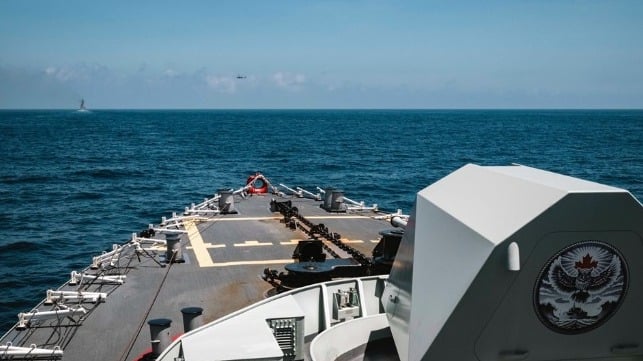
HMCS Ville de Québec in the Taiwan Strait (Canadian Joint Operations Command)
In recent days, the Taiwan Straits has been busy with allied warships.
Hobart Class destroyer HMAS Brisbane (DDG-41) and Halifax Class frigate HMCS Ville de Québec (FFH-332) transited the Straits on September 6. A People’s Liberation Army Eastern Theater Command spokesman objected to the transit in the normal manner, and said that the naval movements had been monitored.
While the transit was occurring, the Royal Navy carrier HMS Prince of Wales (R09), having completed a five-day port visit to Tokyo, sailed northwards along Japan’s eastern seaboard with HMS Dauntless (D33) and into the Sea of Japan, then southwards to commence a series of exercises with South Korean Chungmugong Yi Sun-sin Class destroyer ROKS Gang Gam-chan (DDH-979), minelayer ROKS Nampo (MLS-570) and Soyang Class fast combat support ship ROKS Soyang (AOE-51).
As this activity was winding up in the Sea of Japan on September 8, two ships from Russia’s Pacific Fleet based in Vladivostok, the flagship Slava Class cruiser RFS Varyag (D001 and the Steregushchiy Class corvette RFS Gromkiy (F335) were heading in the opposite direction, leaving the area through the Soya Strait off northern Hokkaido, and then cruising through the Sea of Okhotsk into the northern Pacific.
The Australian and Canadian innocent passage was followed up by Arleigh Burke Class destroyer USS Higgins (DDG-76) and Type 23 frigate HMS Richmond (F239) also transiting the Taiwan Straits on September 12. There had been some speculation in the British press that Foreign Minister David Lammy, to avoid upsetting the Chinese, had vetoed the passage of HMS Richmond, to the consternation of the Ministry of Defence - but Lammy was replaced as foreign minister a week before the transit took place.
The carrier strike group led by HMS Prince of Wales is now on its long return journey to Portsmouth. On its outward deployment, the CSG passed through the Middle East region during a short-lived lull. On its return, the CSG is likely to have to contend with a more complex security situation. But the CSG commander can feel reassured that his command is operationally at peak efficiency, after continuous training at sea with allies since it left Portsmouth in April.
School Children Injured as Historic Sailing Ship and Dredger Collide
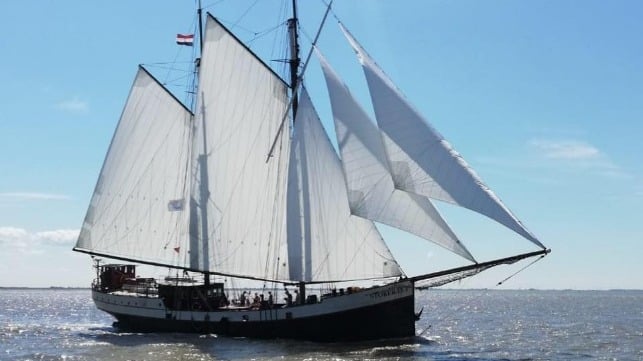
Historic sailing vessel was involved in a collision with a dredger off the Dutch coast (Storebaelt on Facebook)
The Dutch rescue service is reporting minor injuries among a group of school children who were on a class trip aboard a historic sailing ship. The vessel Storebaelt, which operates charter trips, was off the Netherlands coast on Sunday evening, September 14, when it and a dredger collided.
According to KNRM, the sailing vessel had 25 school-age children aboard along with five adults. They received a report of the collision at 2030 local time, and two rescue boats reached the vessels in 10 minutes. Five of the children were removed from the sailing ship and transferred to the shore of one of the rescue boats. Waiting ambulances and volunteers attended to the children.
“A few were shocked, and some have bumps on their heads,” a Coast Guard spokesperson said on Dutch broadcaster NOS. The remaining children remained aboard the 65-meter (213-foot) sailing vessel while it was towed to shore. They were transferred to a local hotel at 0100 on Monday morning.
The Coast Guard noted that there was bad weather, rain, and strong winds in the area, which could have been factors in the collision. It was also dark when the collision occurred.
Built in 1928, the Storeaelt has 420 square meters of sail and began its life as the motorized coastal vessel Drittura. According to the operator’s online profile, during World War II, the vessel transported goods and troops for the Allies and participated in Operation Neptune on D-Day in 1944. It was renovated in 1994 into a luxurious sailing ship with 13 cabins, and overnight it has accommodations for 32 people or 50 people on day trips.
The vessel was involved in a head-on collision with the dredger Prins 3, which is registered in Panama. The bow spirit of the sailing ship was broken off, and the bow and side showed damage. The dredger also sustained dents and scrapes, but none of the three crew aboard were injured. The dredger returned to Harlingen under its own power.
The police are investigating the incident.
China’s "Man in Peru" At Center of Chancay Megaport
Lima Mayor Rafael López Aliaga (left) and the Vice Mayor of Shanghai, People's Republic of China, Zhnag Xiaohong, sealed their twinning agreement with the signing of the Memorandum of Cooperation (Municipality of Lima file image)
A Florida Republican is warning the State Department about what he describes as China’s “growing influence” in Peru, and he’s pointing the finger at Lima Mayor Rafael López Aliaga, whose business interests are at the center of the story.
Rep. Greg Steube (R-Fla.) recently sent a letter to Secretary of State Marco Rubio urging the Trump administration to pay closer attention to developments in Peru, where Chinese-backed ventures have accelerated in recent years.
“I am writing to raise urgent concerns about China’s growing influence in and around Lima, the capital of Peru, as part of the Chinese Communist Party’s deliberate, wide-ranging campaign to expand its global reach,” Steube wrote.
At the center of the congressman’s concerns is the Chancay megaport, $3.4 billion facility developed by the Chinese state-owned shipping and logistics company COSCO Shipping Ports in association with the Peruvian company Volcan. The port — expected to be one of the largest in South America and reducing shipping times to China by 10 to 20 days —was inaugurated by Chinese President Xi Jinping and Peruvian President Dina Boluarte in November.
It’s also part of a plan announced by China and Brazil to construct more than 1,800 miles of railway tracks through parts of the Amazon rainforest to create the Bioceanic Corridor across the continent. Chancay would be connected by rail to Cusco, a key rail hub of PeruRail. Since 1999, Lopez Aliaga has been a co-shareholder of PeruRail.
All of this development is part of the CCP’s strategic Belt and Road Initiative to create political leverage for the Chinese regime.
Former U.S. Southern Command chief Gen. Laura Richardson has previously warned that the port could serve as a “gateway” for Chinese military and intelligence operations in the region.
“Mayor López Aliaga, a man with clear ties to Chinese state-backed enterprises, may soon seek the presidency of a nation whose capital, infrastructure, and minerals are already tethered to Beijing,” Steube wrote.
The Foundation for Defense of Democracies, a Washington-based think tank, recently published a report laying out López Aliaga’s financial entanglements with Chinese firms, describing him as “China’s man in Peru.”
Concerns about Aliaga and PeruRail have risen so high in the Trump administration that there are unconfirmed reports the U.S. Department of Energy rejected a proposed loan to the Peruvian rail company. The U.S. Department of Energy declined to respond to multiple requests for comment about the loan.
Analysts note that China’s interest in Peru is closely tied to copper. Peru is the world’s second-largest producer of the mineral, which is vital for electric vehicles, renewable energy, and electronics manufacturing. China already controls significant copper supplies from Chile and the Democratic Republic of Congo.
Between 2020 and 2023, Chinese firms invested more than $1 billion in Peru’s mining sector, according to FDD. One of the country’s largest mines, Minera Las Bambas, is majority-owned by a Chinese state conglomerate.
Steube argued that Washington has been too slow to counter Beijing’s moves in Latin America. “The United States cannot afford to ignore these subnational battlegrounds,” he wrote. “While Washington debates great-power competition in abstract terms, Beijing is executing a concrete playbook in Lima.”
He urged the State Department to monitor Chinese engagement at both the national and local levels in Peru, warning that Beijing’s influence could reshape the balance of power in the hemisphere.
The State Department has not yet issued a public comment in response to Steube’s letter.
Jessica Towhey writes on education and energy policy for InsideSources. This article appears courtesy of DC Journal / InsideSources and is reprinted here with permission for syndication.
The opinions expressed herein are the author's and not necessarily those of The Maritime Executive.
Ingalls Subcontracts Out Destroyer Blocks to Eastern Shipbuilding
Eastern Shipbuilding Group has reached a deal with Huntington Ingalls Industries to build blocks for the Ingalls yard's flagship product, the Navy's Flight III Arleigh Burke-class destroyers. The Flight III is the new backbone of the U.S. Navy's overseas presence, capable of escorting a carrier strike group, shooting down ballistic missiles or operating independently on blue water missions.
HII's high-spec warship programs are behind schedule, in part due to a workforce shortage, and the Navy is pushing hard to speed up production. One way to do it is to distribute some of the work of blockbuilding to subcontractors, as demonstrated by the Royal Navy's Queen Elizabeth-class carrier program, which relied on blocks built at subcontractor yards around Britain. HII is experimenting with similar trials with yards like Eastern, which has built a limited number of blocks for the DDG program under an HII pilot program. HII and ESG have now formalized the agreement.
“With nearly fifty years of experience delivering some of the most reliable and highest-performing steel and aluminum vessels, we’re proud to partner with HII to support production of the U.S. Navy’s destroyer fleet,” said Joey D’Isernia, CEO of Eastern Shipbuilding Group, Inc. “This collaboration strengthens our national shipbuilding capability—expanding industrial capacity and enhancing our nation’s competitive advantage.”
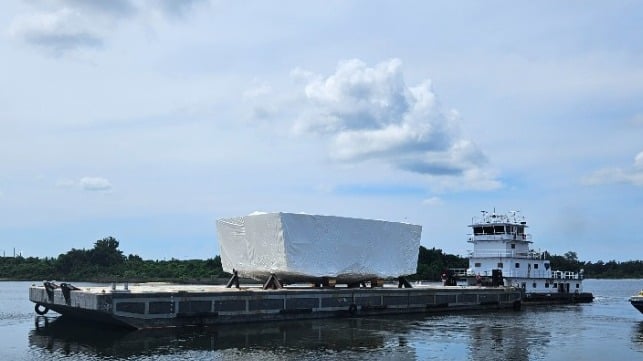
According to USNI, HII is initially focusing its outsourcing efforts on simpler modules, saving the complex hull shapes with more sophisticated contents for its own shipbuilders to build. The grand blocks built by ESG are sealed in plastic (like a superyacht in transit), loaded out on a deck barge, then shipped west to the Ingalls yard in Mississippi. ESG says that it is continuing to invest in its government-focused yard location to support more defense work, enabling it to "construct and deliver multiple ships per year."
HII's workload-distribution efforts extend beyond the Gulf Coast. It has multiple new subcontractors working for its Newport News Shipyard to build assemblies for carriers and subs (including Austal, which is constructing modules for Virginia-class attack subs). It has also bought its own new fabrication facility in South Carolina, drawing in a new workforce for HII without requiring the workers to relocate.
"This evolution to a more distributed shipbuilding model will expand production of the next generation [of warships]" HII said in a statement last week.
Rheinmetall Enters Shipbuilding by Consolidating the German Defense Sector
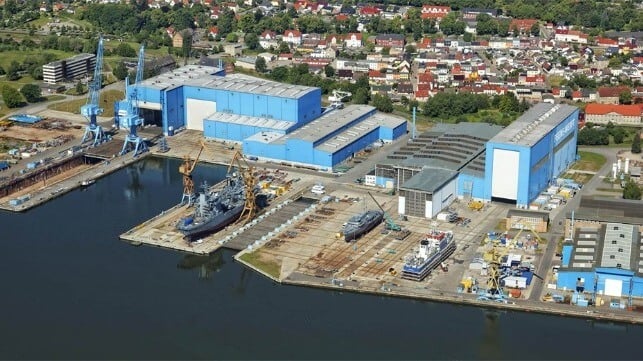
Peene-Werft in Wolgast and Blohm+Voss in Hamburg are the shipbuilders for NVL, which will become a subsidiary of Rheinmetall (NVL)
Rheinmetall, a German defense technology company best known for military equipment and as the largest European ammunition manufacturer, has agreed to acquire the naval shipbuilding operations of Lurssen Group. The deal had been rumored in recent weeks and is seen as the first step in the consolidation of the naval shipbuilding sector and German defense industries.
Naval Vessels Lurssen (NVL) was separated from the yacht division in 2021 into an independent company. Formerly known as Lurssen Defence, it has a 150-year heritage with the company reporting it has built around 1,000 ships and delivered them to over 50 navies and coast guards. NVL today operates four shipyards (Peene-Werft / Wolgast, Blohm+Voss and Norderwerft / Hamburg, Neue Jadewerft / Wilhelmshaven) and specializes both in newbuilds and maintenance.
Sales for the shipbuilder in 2024 were reported at around €1 billion. The companies say the terms of the acquisition were not being revealed, but Reuters is reporting NVL is being valued at approximately $1.59 billion. The companies said they expect to finalize terms in the coming weeks and, after antitrust approval, complete the transaction in early 2026.
“With the newly agreed acquisition, we are taking a decisive step forward in consolidating the defense industry in Germany and Europe. Combined with Rheinmetall’s expertise, we are creating a vital German powerhouse for state-of-the-art vessels,” said Armin Papperger, CEO of Rheinmetall. “This acquisition will not only make us a manufacturer of floating platforms, but as an integrated naval powerhouse, we want to offer complete system solutions.”
Rheinmetall, which is currently a supplier of system components for naval applications, highlights the opportunity to become a cross-domain systems company, saying that in time it will cover ground, land, sea, and space applications. Rheinmetall says it intends to meet the massive increase in demand from naval forces and rising procurement budgets with high-performance system solutions. It highlights the opportunities to provide an integrated solution from a single source for naval missiles and launchers, main and secondary guns for the navy, missile defense, sensors, and other electronics.
The company told investors it anticipates Germany alone will spend around €31 billion on naval vessels over the next decade.
“Especially in light of the heightened threat situation, we consider consolidation within the defense industry necessary and sensible,” said Friedrich Lürßen, Managing Partner of Lürssen Maritime Beteiligungen. “This is the only way to ensure our country's rapid defense capability.”
The company highlights the increasing complexity of command and weapon systems and that ships are increasingly networked with other units and supplemented by autonomous units in the air, on the water, and underwater. The company said that this requires a more extensive integration of such weapon systems.
Lurssen Group reports it will focus its operations on the construction of mega-yachts. It looks to focus on driving technological developments for the civilian sector.
The sale agreement comes as another major German naval shipbuilder, TKMS, is set to emerge as an independent public company. The builder of submarines and frigates is being spun off from Thyssenkrupp. The step comes after US-based private investment firm Carlyle Group ended discussions to purchase a controlling stake in German naval shipbuilder. Previously, reports had stated that Fincantieri had been interested in a partnership with TKMS
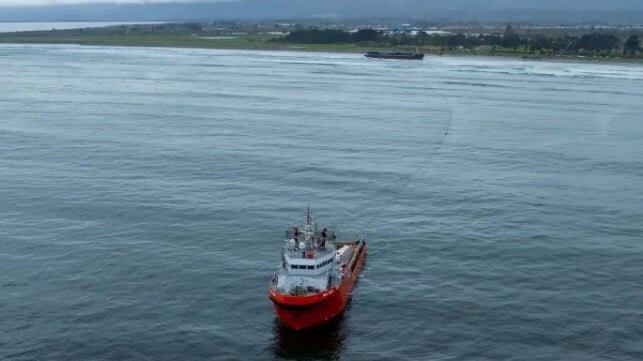
An ocean-going rescue tug has reached a stranded product tanker located south of New Zealand’s South Island. Maritime New Zealand is monitoring the situation and reports there is no immediate danger, but the tow will have to wait for a break in the current heavy weather.
The Japanese-owned product tanker Golden Mind (12,488 dwt) has been stranded near Stewart Island off the south coast of the South Island since Wednesday, September 10. AIS signals show the vessel departed the southern port of Bluff on September 9 and was bound for Timaru, New Zealand, where it was due to arrive on Saturday.
The tanker is registered in Panama. It is 407 feet (124 meters) in length
Maritime New Zealand reports it was advised the tanker, which was built in 2020, had experienced “steering difficulties.” The vessel’s owners contracted the ocean-going tug MMA Vision to aid the vessel. MMA Vision is under contract to Maritime New Zealand as a rescue tug in case of emergency for the Cook Strait ferries, but the authorities emphasized the tow was a private, commercial arrangement.
The reports indicate the tanker, which had traveled from Risdon, Australia, to Bluff, New Zealand, had not issued a distress call. The crew remained aboard the vessel.
Gale-force winds are currently impacting the region. Maritime New Zealand said the weather would determine when the tug was able to attach a line and begin towing the tanker. The plan is to take it to Timaru, a port on the east coast of the South Island.
Ants defend plants from herbivores but can hinder pollination
Analysis of the interaction between ants, plants that secrete sweet substances to attract them, “interested” in defending themselves from leaf-eating animals, and bees indicates that the ants may scare away pollinators.
Fundação de Amparo à Pesquisa do Estado de São Paulo
The research conclusions are the result of an analysis of data published in 27 empirical studies on the relationships between ants, pollinators, and plants with extrafloral nectaries
Around 4,000 plant species from different parts of the world secrete nectar outside their flowers, such as on their stems or leaves, through secretory glands known as extrafloral nectaries. Unlike floral nectar, extrafloral nectar does not attract pollinators; rather, it attracts insects that defend plants, such as ants. These insects feed on the sweet liquid and, in return, protect the plant from herbivores. However, this protection comes at a cost.
A study published in the Journal of Ecology by researchers supported by FAPESP points out that the presence of ants can reduce the frequency and duration that bees visit the flowers of plants with extrafloral nectaries.
Pollination is only impaired when extrafloral nectaries are close to the flowers. Plants with these glands in other locations, such as on their leaves or branches, had increased reproductive success, likely due to the protection against herbivores provided by ants.
On the other hand, butterflies, another group of pollinators, are not affected by ants. This may be due to the way these two groups feed. Butterflies use a long, straw-like organ called a proboscis to suck nectar from a distance, keeping them safe from ants.
“Bees, on the other hand, need to get very close to the flower to collect pollen and floral nectar, but ants don’t allow them to stay for long. Not surprisingly, our analysis showed that the presence of ants is detrimental to pollination when extrafloral nectaries are close to flowers, but has a positive effect on plant reproduction when they’re located further away,” explains Amanda Vieira da Silva, who conducted the study as part of her doctoral research with a scholarship from FAPESP in the Graduate Program in Evolution and Diversity at the Federal University of ABC (PPG-EvoDiv-UFABC) in São Bernardo do Campo (state of São Paulo, Brazil).
The conclusions are the result of an analysis of data from 27 empirical studies on the relationships between ants, pollinators, and plants with extrafloral nectaries. The articles were selected from an initial screening of 567 studies after applying inclusion and exclusion criteria. The data were compiled and analyzed with computational tools.
Multiple mutualisms
“Studies have typically focused on the effect of only one isolated interaction on plants. For example, they quantify how much ants favor the defense of plants against herbivores or how much pollinators favor plant reproduction. But these interactions can occur at the same time. So, to understand how these interactions influence plant growth and reproduction, we need to look at them in an integrated way,” explains Laura Carolina Leal, a professor at the Institute of Environmental, Chemical, and Pharmaceutical Sciences at the Federal University of São Paulo (ICAQF-UNIFESP) in Diadema. Leal supervised Silva’s doctoral studies and is also a co-author of the paper.
Evolutionary analyses of plant genera with extrafloral nectaries indicate that this trait can be easily acquired or lost over time. Therefore, the interference of ants in bee visits to flowers may have acted as a decisive selective pressure in the evolutionary trajectory of extrafloral nectaries in plants.
“If ants visiting extrafloral nectaries harm plant reproduction by scaring away bees, maintaining these nectaries can become disadvantageous for plants, and the glands may be lost over time,” Leal explains.
Not coincidentally, of the nearly 1,000 genera with extrafloral nectaries, only 46 depend exclusively on bees for pollination. The authors have a hypothesis for the simultaneous occurrence of plant interaction with defensive ants and pollinating bees, at least in some cases.
“We know that in some groups of plants with extrafloral nectaries and flowers pollinated by the vibration of bees, new leaves with active extrafloral nectaries and flowers are produced in different seasons throughout the year, which would avoid conflict between the two,” says Anselmo Nogueira, a professor at the Center for Natural and Human Sciences (CCNH) at UFABC, Silva’s co-advisor, and co-author of the study.
The research group is developing new studies to understand whether a third interaction can stabilize ant interference in the pollination of plants with extrafloral nectaries.
“If the resource is very good for the bee in the flower and for the ant on the leaf, perhaps they’ll never meet. In addition, some plants with extrafloral nectaries, such as certain legumes, harbor nitrogen-fixing bacteria in their roots, which promote plant productivity and may enable the plant to invest in high-quality resources for both animal partners,” comments Nogueira.
The researcher coordinates a project conducted under the FAPESP Research Program on Biodiversity Characterization, Conservation, Restoration, and Sustainable Use (BIOTA). This project investigates the evolution of multiple mutualisms in the same plant lineage. In a previous study, his group showed that the interaction between a species of legume and nitrogen-fixing bacteria increases the attractiveness of these plants to pollinating bees (read more at agencia.fapesp.br/52841).
About São Paulo Research Foundation (FAPESP) The São Paulo Research Foundation (FAPESP) is a public institution with the mission of supporting scientific research in all fields of knowledge by awarding scholarships, fellowships and grants to investigators linked with higher education and research institutions in the State of São Paulo, Brazil. FAPESP is aware that the very best research can only be done by working with the best researchers internationally. Therefore, it has established partnerships with funding agencies, higher education, private companies, and research organizations in other countries known for the quality of their research and has been encouraging scientists funded by its grants to further develop their international collaboration. You can learn more about FAPESP at www.fapesp.br/en and visit FAPESP news agency at www.agencia.fapesp.br/en to keep updated with the latest scientific breakthroughs FAPESP helps achieve through its many programs, awards and research centers. You may also subscribe to FAPESP news agency at http://agencia.fapesp.br/subscribe.
Ants on flowers: Protective ants impose a low but variable cost to pollination, moderated by location of extrafloral nectaries and type of flower visitor
NJIT student–faculty team wins best presentation award for ant swarm simulation
The student-faculty team's presentation highlights how studying biological swarm dynamics may lead to innovations such as self-healing concrete and smarter multi-agent systems.
Think twice about eliminating those pesky ants at your next family picnic. Their behavior may hold the key to reinventing how engineering materials, traffic control and multi-agent robots are made and utilized, thanks to research conducted by recent graduate Matthew Loges ’25 and Assistant Professor Tomer Weiss from NJIT's Ying Wu College of Computing.
The two earned a best presentation award for their research paper titled “Simulating Ant Swarm Aggregations Dynamics” at the ACM SIGGRAPH Symposium for Computer Animation (SCA), and a qualifying poster nomination for the undergraduate research competition at the 2025 ACM SIGGRAPH conference.
SIGGRAPH, Special Interest Group on Computer Graphics and Interactive Techniques, is considered among the most prestigious in the areas of computer graphics and AI.
Their study began in with the observation that ant swarms behave in a manner similar to both fluid and elastic materials and the duo got to work in the summer of 2024. Loges started being interested in research after he took an elective class with Weiss, IT 360 Computer Graphics for Visual Effects, at the Department of Informatics. This was his first project and research paper. According to Weiss, there is much motivation in replicating ant swarm behavior. Ants behave as a sort of active matter that morphs and adjust in shape as needed – if you try to cut a blob of ants, it will just reform to its original shape. This can lead to new discoveries in engineering materials such as smart, self-healing concrete, or innovations in navigation of multi-agent robots and traffic control.
Weiss’s broader research spans computer graphics, physics-based simulations and AI-driven modeling of natural phenomena. He notes that understanding how biological systems like ant swarms exhibit both fluid and elastic properties offers a foundation for creating new algorithms that bridge biology and computer science. His group’s aim is not only to simulate realistic behaviors but also to translate those findings into practical innovations in material science, robotics and large-scale systems.
The research team then went about successfully designing a computational simulation algorithm that could incorporate both the fluid and elastic real-world behavior of ants observed in lab experiments.