It’s possible that I shall make an ass of myself. But in that case one can always get out of it with a little dialectic. I have, of course, so worded my proposition as to be right either way (K.Marx, Letter to F.Engels on the Indian Mutiny)
Monday, September 15, 2025
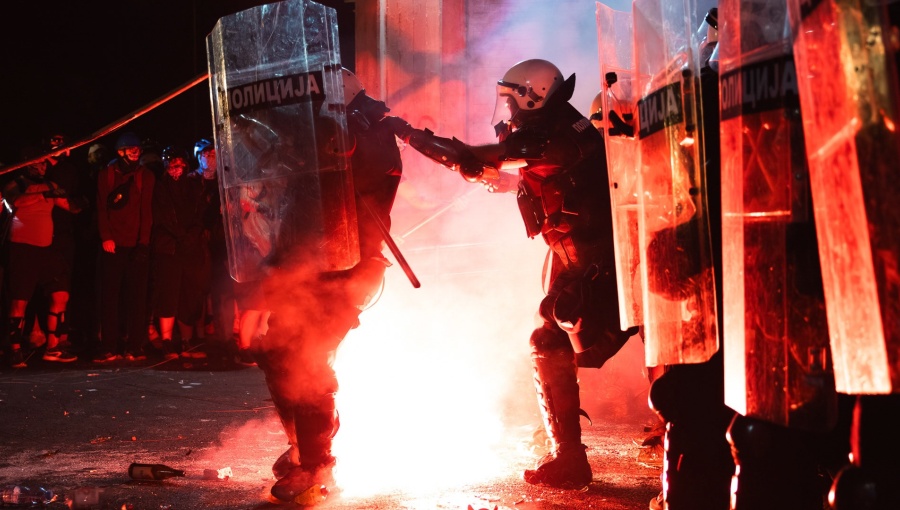
Serbian students allege police deployed toxic gas at protest
Toxic tear gas used on university protesters, students say / Gavrilo Andrić
Students at the University of Novi Sad said on September 14 that independent laboratory tests showed police had used a banned form of tear gas against demonstrators during clashes earlier this month, and demanded an investigation into those responsible.
The Faculty of Sciences (PMF) students said that analyses confirmed the presence of CS gas and CN gas, or chloroacetophenone, which was widely phased out in the 1970s due to its high toxicity. CN was banned by the United Nations in 1969.
“Due to its high toxicity and serious health consequences, CN gas was completely replaced by CS gas in the 1970s … the use of CN gas is not a means of control, but the poisoning of citizens,” the students said in a statement posted on social media. They urged criminal accountability for those who authorised its use and said they were ready to provide collected samples for further testing.
Thousands of people rallied in Serbia’s northern city of Novi Sad on September 5 against police violence and what they described as violations of university autonomy. Clashes broke out after police tried to disperse the demonstrators, who had earlier been evicted from occupied faculty buildings.
According to the students, dozens of discarded canisters were collected after the protest, some with markings removed. They said the tests were conducted using gas chromatography with mass spectrometry, the same method employed in accredited laboratories worldwide.
The interior ministry in Belgrade rejected the claims. “The Ministry of the Interior categorically denies the allegations … the police do not possess such a thing and therefore cannot use it,” it said in a statement.
Serbia has been rocked by protests for the past ten months, mostly peaceful until mid-August, when demonstrators clashed with police and set fire to ruling party offices.
Experts fired by Trump revive popular climate website
September 15, 2025 After cuts by US President Donald Trump forced the closure of the popular climate.gov website, experts have launched an independent successor. They say climate literacy is important in Trump's war against science.
https://p.dw.com/p/50Ozm
The Trump administration has fired many climate scientists and meteorologists, impacting international climate science as well as warning systems for extreme weather events
But the administration has also gutted agencies that produce climate information used by millions of Americans. In February, only weeks after taking office, around 800 people were dismissed from the National Oceanic and Atmospheric Administration (NOAA), which monitors ocean and climate conditions and issues weather forecasts and warnings via its National Weather Service.
The firings also impacted the agency's climate.gov website, the premier platform for climate information in the US that informs readers about extreme weather, sea level and temperature rise, and much else. It had around 15 million page views in 2024, noted the AFP news agency.
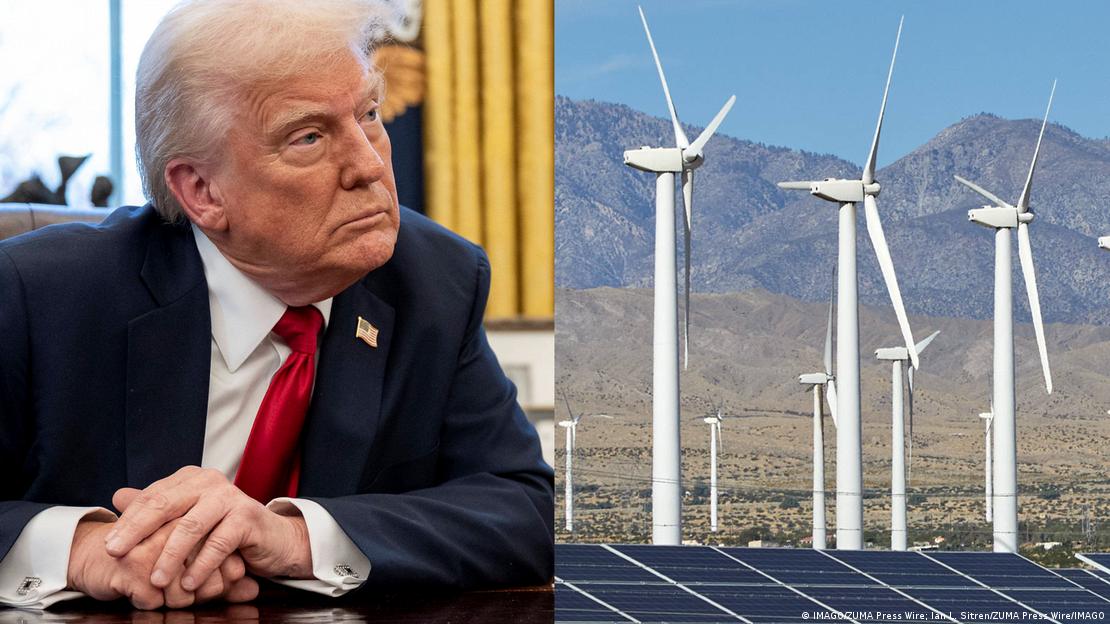
Trump is gutting renewable energy projects in favor of the oil and gas industry
Image: IMAGO/ZUMA Press Wire; Ian L. Sitren/ZUMA Press Wire/IMAGO
Due to Trump cuts, 'public lost access to a trusted source of climate information'
Trump administration-appointed officials at NOAA not only terminated climate.gov staff, they redirected the homepage to a site controlled by political appointees, noted Rebecca Lindsey, the former manager of climate.gov who was also sacked in February.
"Our project was likely targeted because of its high visibility," she said.
The site became virtually obsolete after nearly all its remaining staff were fired in early June.
"There is no longer a team to keep the mission going," Lindsey said of a once-dynamic climate portal that was updated weekly and monthly with explanations about the latest impacts of climate change.
"The public has still lost access to a trusted source of timely climate information," she added.
US climate community resists shutdown with independent site
But Lindsey is now leading an effort to relaunch climate.gov independently under the climate.us URL.
"At a moment when critical climate information is being deleted or distorted, we are stepping up to rescue key climate resources … and to ensure the public has continued easy access to the facts," states the recently launched website.
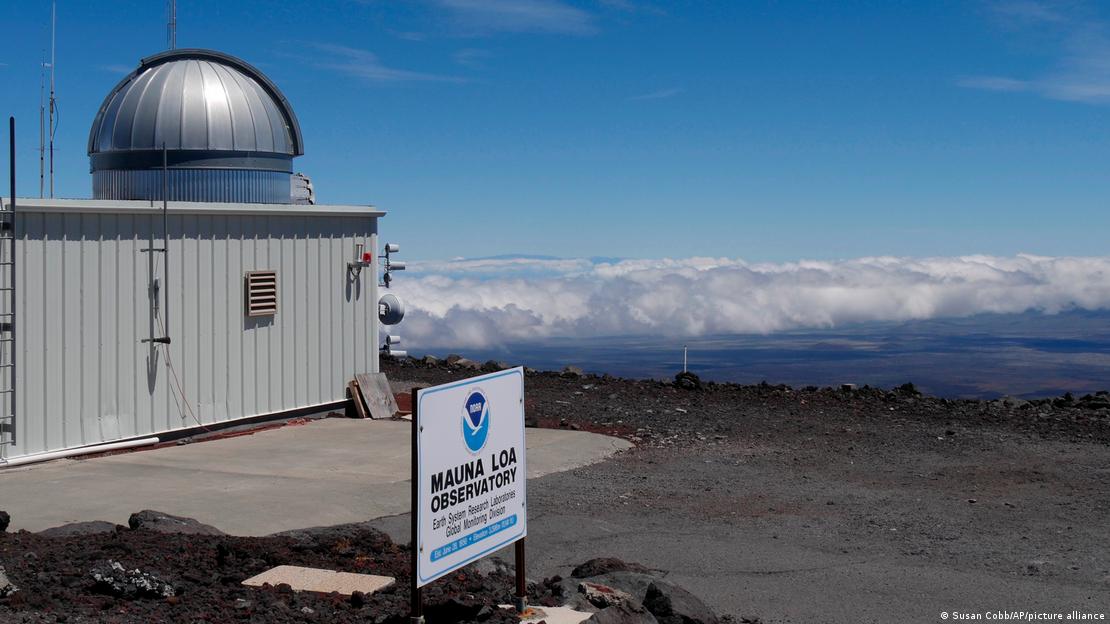
Crucial data needed for climate science has been deleted from US government websites; research into CO2 and other climate-related issues is being terminated
mage: Susan Cobb/AP/picture alliance
The successor to climate.gov is purposely outside the federal government domain to keep it free from political interference, and thus to protect the integrity of its climate information.
The plan is not only to revive and migrate all the climate data removed from the climate.gov site, but to platform the likes of the National Climate Assessment, the US government's flagship report on climate change impacts, risks and responses before its team of scientists were fired.
The dismantling of this key climate study was also part of the general defunding of "renewable energy and climate resilience projects" that were financed by Congress during the former Biden administration, Lindsey explained. In March, for example, some $20 billion (€18.3 billion) worth of clean power and climate grants issued by the former government were terminated.
Meanwhile, experts say the shuttering of climate.gov will limit preparedness for extreme weather events.
"Restricting the visibility of climate data blinds the country to climate effects and makes it that much harder to prepare," wrote the US-based Center for Climate and Security in a blog post in June.
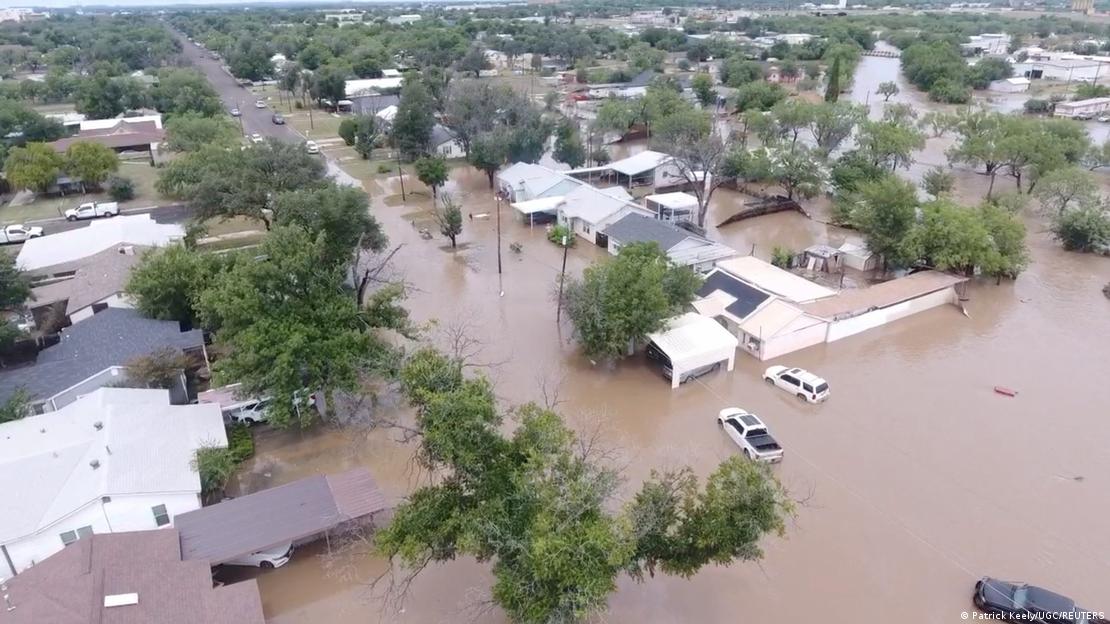
June, a flash flood following torrential rains in Texas killed more than 130 people. Staff cuts in weather services are hindering disaster preparedness and early warning systems
Image: Patrick Keely/UGC/REUTERS
"Without preparation, communities and the nation at large will be forced to react and rebuild, which is far more expensive than working towards prevention," it added, noting that the global economic cost of rebuilding after climate disasters in 2024 was $320 billion (about €272 billion). What information was actually purged from climate.gov?
The effort to reestablish a trusted source of climate information comes after much was purged from climate.gov because it referenced so-called "diversity, equity and inclusion," or DEI — a policy that was labelled "immoral" and "illegal discrimination" under a Trump executive order in January.
"Anything that had to do with the importance of diversity and inclusion in science, anything to do with equity, justice or the disproportionate impacts of climate change on historically disadvantaged communities," was deleted from the climate.gov site, Lindsey told DW.
Information mentioning the "Gulf of Mexico" that wasn't updated to "Gulf of America" was also erased after Trump signed another executive order — "Restoring Names That Honor American Greatness" — decreeing the name be changed in all federal agency documents.
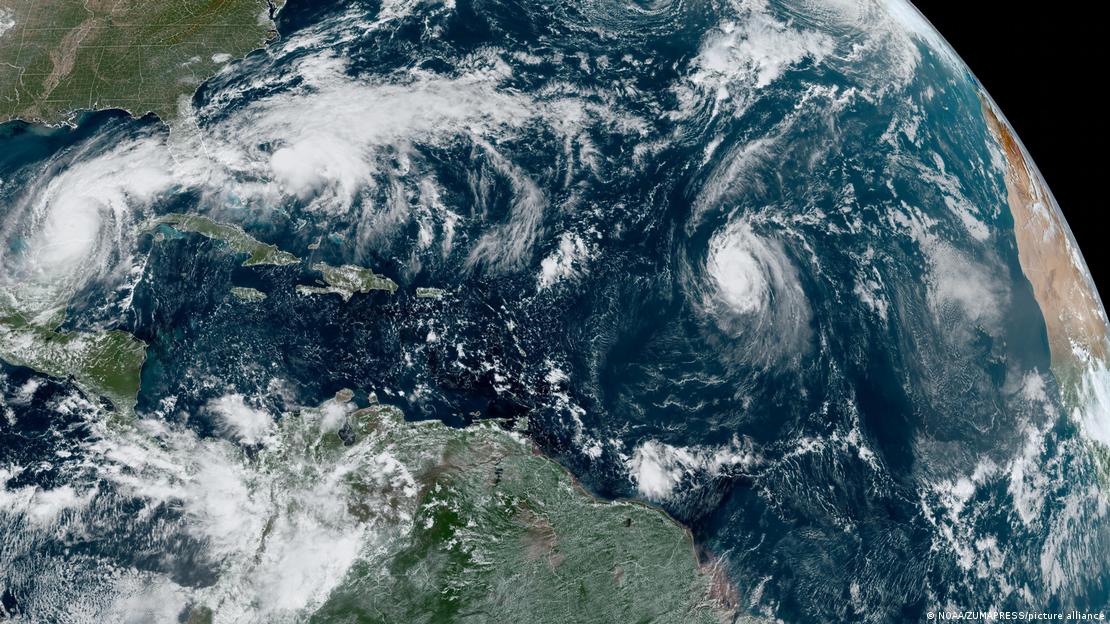
No matter how the gulf between Florida and Mexico is called, dozens of dangerous hurricanes form here every year. Increasing temperatures make them more frequent and worse
Image: NOAA/ZUMAPRESS/picture alliance
These executive orders coincided with others related to climate and renewable energy: one paused offshore wind permits, while another promised to "unleash" high emission oil-, gas- and coal-fired electricity. Meanwhile, in the first weeks of the administration, any mentions of climate change were scrubbed from multiple federal agency websites, including the Department of Energy and the Environmental Protection Agency.
Since it was not "technically possible" to remove all "forbidden" content from the voluminous climate.gov platform, Lindsey said whole sections were removed, including the latest version of the "Climate Literacy Guide," which was authored by the now-disbanded US Global Change Research Program.
While much of climate.gov's original content remains online, Lindsey speculates that only information deemed "acceptable" — such as blogs about the polar vortex that do not directly relate to climate change science — will be migrated to a new online location before the rest of the site is potentially shut down.
Can climate experts go it alone?
The first part of the plan for the nonprofit climate.us is to rebirth a complete version of climate.gov by restoring all censored content.
Then, if it can acquire adequate funding, a new editorial and content team will continuously update the site with the latest climate data and information, including maps and graphics for reuse.
The platform has said it will counter the Trump administration's war on climate science through a collaboration between experts, educators, organizations, universities and civic leaders.
"They're hiding the truth. We're fighting back," runs the climate.us slogan.
But "public donations" — which have already hit $85,000 — will be the key for the site to become fully functioning, said Lindsey.
"So many people are excited about this effort, so many people say it is giving them hope. And that gives me hope." Edited by: Tamsin Walker Stuart Braun Berlin-based journalist with a focus on climate and culture.
Donald Trump has made billions from the Nasdaq debut of crypto startup World Liberty Financial. With his sons in charge and favorable policies in play, critics see a troubling mix of presidential power and personal gain.
Trump has become a huge supporter of cryptocurrencies like bitcoin
Image: Ian Maule/AFP/Getty Images
US President Donald Trump and his family are pocketing billions from cryptocurrency ventures since his return to the White House, capitalizing on a loosely regulated market he has actively shaped.
From meme coins to stablecoins, digital currencies designed to stay at a fixed value, the financial windfall is estimated at over $5 billion (€4.25 billion) on paper, sparking accusations of unprecedented profiteering by a sitting president.
Two companies drive the Trump family's crypto profits: World Liberty Financial (WLF), a decentralized finance platform that lets users with $WLFI tokens help shape the platform’s lending rules, and American Bitcoin Corp. (ABTC), a Nasdaq-listed bitcoin mining company.
WLF has earned millions from $WLFI token sales tied to Trump’s name, while ABTC, backed by his sons, holds significant bitcoin assets and saw its stock jump 110% on its debut, before settling 16.5% higher than the opening price of $6.90.
Reuters news agency reported that a Trump business entity owns 60% of WLF and is entitled to 75% of revenue from coin sales.
Concerns over influence and access
Critics believe the Republican president’s dual role as crypto beneficiary and policymaker undermines public trust and blurs the line between governance and self-enrichment.
Ross Delston, an independent American attorney and expert witness, thinks the crypto ventures could offer unscrupulous actors the chance to buy influence with Trump just by investing in his digital coins.
"This is a new avenue to allow the President to get money from anyone, including foreign individuals and states that would be prohibited by US [election] campaign laws, or someone convicted of a crime or under investigation," Delston told DW.
Although Trump and his sons are barred from selling their own tokens in WLF for now, they are almost certain to profit big in the medium term. The White House insists, however, that there are no conflicts of interest.
Trump's favorable policies toward crypto after his return to office have come as a surprise to some after he called digital currencies like bitcoin a "scam" and a threat to the dollar during his first term. Now he wants to make the United States the crypto capital of the world.
Before returning to the White House, Trump nominated longtime crypto advocate Paul Atkins to lead the Securities and Exchange Commission (SEC), the US financial markets regulator. He was confirmed in the position in April.
One of Trump's first Executive Orders, signed in January, banned any US agency from creating or promoting a central bank digital currency (CBDC), a government-issued crypto version of the dollar.
In March, he established a Strategic Bitcoin Reserve, funded by cryptocurrencies seized by US authorities, and a Digital Asset Stockpile of other currencies. These assets are now treated as national reserves. This summer, Trump signed the Genius Act, the first federal framework for stablecoins.
Lavish dinners and political perks
The embrace of crypto has extended beyond policy into high-profile social events, most notably the White House-hosted dinners for digital asset moguls. These gatherings, often featuring lavish menus and exclusive access to the president, have drawn scrutiny for blending political power with private financial interests.
One standout event was the May 2025 Crypto Kings dinner at Trump National Golf Club in Virginia, where the top holders of Trump’s meme coin, $TRUMP, were invited after collectively spending $148 million.
The top 25 investors received private access to the president, while the four largest holders were gifted luxury Trump Tourbillon watches. Justin Sun, a China-born crypto billionaire and adviser to World Liberty Financial, was the top guest, spending $18.5 million.
Critics argue that such events serve less as forums for innovation and more as showcases for influence-peddling, where proximity to the presidency appears to be a perk of investment.
"This is maybe just one more step that this administration has taken of combining public office with private gain," Richard Briffault, a professor at Columbia Law School, told DW. "This includes making regulatory decisions, but also using the prestige of the White House and the presidency to advance the Trump family's fortunes."
Trump backer Justin Sun also bought a banana artwork at auction for $6.2 million and then ate it
Image: Peter Parks/AFP
How US regulators are handling crypto
US federal regulators have taken a markedly hands-off approach to crypto oversight, largely due to a sweeping executive order issued in January that dismantled many of the Biden-era guardrails and replaced them with a framework designed to promote innovation and accelerate adoption of cryptocurrencies.
Washington has removed some confusing rules about how crypto companies should report their finances, which made it hard for businesses to show crypto assets on their balance sheets or work with banks. By rolling them back, the administration is making it easier for crypto firms to operate and grow.
Before, the SEC was very strict, especially under its former leader, Gary Gensler. It launched many investigations and lawsuits against crypto firms. Those actions have mostly stopped under Trump 2.0.
While Biden’s approach was more about caution and control, Trump's was described by one industry insider as "crypto capitalism on steroids." While the crypto sector is now booming, the latest US policies are raising serious questions about ethics, transparency, and long-term stability.
Concerns over political loyalty within federal agencies have also intensified, with critics pointing to a growing pattern of dismissals targeting career officials seen as out of sync with the Trump administration’s agenda.
They include Federal Reserve Governor Lisa Cook, CDC Director Susan Monarez, railroad regulator Robert Primus and, most notably, Erika McEntarfer, the head of the Bureau of Labor Statistics.
"The administration has had no compunctions about firing people, including ordinary civil servants who are just doing their jobs, if they are politically out of step with the administration," said Briffault. "There's no greater signal than the firing of the head of the Bureau of Labour Statistics. If they're willing to do that, they're willing to fire anybody."
This climate of fear and retaliation has made regulators increasingly cautious about challenging Trump’s crypto ventures, even when ethical concerns arise.
US lawmakers are now pushing Congress to bring back stronger oversight and tighten control over the latest crypto policies. They're calling for clearer rules on digital currencies, more transparency from companies like WLF, and limits on officials who hold crypto themselves. Critics warn the current setup benefits insiders and puts everyday users at risk.
"The most likely outcome is a huge increase in criminal prosecutions, regulatory enforcement actions, as well as economic dislocation following in the wake of this presidency," warned Delston.
Edited by: Uwe Hessler
Why Trump's letter to NATO won't shift EU's course on Russia
Trump said the US will sanction Russia only if all NATO members end oil imports. Brussels sees it as pressure on Hungary and Slovakia and as an excuse for the White House to delay.
Image: Yves Herman/REUTERS
Trump has accused NATO member states of weakening the alliance by continuing to buy Russian oil and gas
When US President Donald Trump published a letter to NATO allies on his social network Truth Social on Saturday, Brussels braced for the usual storm.
Trump accused member states of weakening the alliance's negotiating position and bargaining power in relation to Russia's war in Ukraine by continuing to buy Russian oil and gas. He vowed that the US would be ready to impose "major sanctions" on Russia once all NATO countries had stopped such purchases.
"I am ready to 'go' when you are," he wrote.
He also called forsweeping tariffs on China, which he claimed would end this deadly, but ridiculous, war.
For many here in Brussels, the message might not have been entirely unwelcome. EU officials have long struggled to persuade Hungary and Slovakia, two EU member states still heavily reliant on Russian energy, to fall in line with sanctions. Trump's demand suddenly puts Hungarian Prime Minister Viktor Orban and Slovakian Prime Minister Robert Fico on the defensive, even if few believe that Trump will follow through. Hungary and Slovakia under pressure
Ian Bond, deputy director of the Centre for European Reform, sees a gap between Trump's rhetoric and his actions.
"The EU has dramatically reduced its reliance on Russian oil and gas," he told DW.
"If Trump wants the EU to stop buying oil from Russia, then leaning on his best friends would probably be a good move. I haven't seen any sign that he's doing that, however," he told DW.
For years, the European Commission has tried to push the Hungarian and Slovakian governments to diversify away from Russian energy. Progress has been slow, blocked by both government's insistence on higher costs and established infrastructure. Orban, in particular, has defended Russian-backed projects, such as the Paks II nuclear plant in southern Hungary, despite legal challenges in Brussels.
Viktor Orban has continuously defended Russian energy imports into Hungary
Image: Luka Dakskobler/ZUMA/imago images
Bond argues that Trump's letter tries to shift responsibility away from the White House. "This seems to me like Trump is looking for an excuse for continuing not to do anything. We've gone through the phase of 'I'll give him another two weeks,' and months later, Putin has still not stopped the war. Now we're into the stage of 'I would do this, but I need my allies to act first.'" Turkey remains outside EU control
Many in Brussels agree that Trump's demand that NATO member Turkey also stop buying Russian energy is harder to realize. Since 2023, Ankara has been the third-largest buyer of Russian oil, after China and India, according to the Centre for Research on Energy and Clean Air. It has given no sign of cutting those ties.
Unlike with EU states, Brussels has little leverage here. For European diplomats, Turkey illustrates the gap between NATO and the EU. Trump's conditions, covering all alliance members, are more ambitious than anything Brussels could realistically deliver.
Putin has shown no signs of wanting to end the war in UkraineImage: Vladimir Smirnov/TASS/picture alliance Rhetoric versus reality
Bond argued that by setting such a high bar for US sanctions, requiring all NATO members to end Russian oil and gas imports, Trump may have created conditions that are impossible to meet, shifting the blame onto the Europeans. That risks delaying the Trump administration's alignment with the EU just as Brussels finalizes its 19th sanction package against Russia.
Bond points out that Trump's economic threats are not always connected to real strategy, but also to blackmail. "It's very telling that almost the only country in the world on which Trump has not imposed tariffs is Russia," he said. "Trump managed to impose tariffs on uninhabited islands in April, so I don't see any reason why he shouldn't impose tariffs on Russia." Other ways to apply pressure to Russia
Bond argues that Europe still has more tools to constrain the Kremlin, such as going after the so-called "shadow fleet" of aging oil tankers the Russia is allegeldy using to circumvent oil sanctions.
"More pressure on the [Russian] shadow fleets would be a good thing. The UK sanctioned another 70 ships last week," he explained.
He also wants to see the EU put more pressure on the US, especially when it comes to oilfield services. "The company SLB, formerly Schlumberger, has continued to invest in Russia. That is helping Moscow preserve production capacity at a time when we should be trying to reduce it."
Expert Ian Bond wants Europe to put pressure on Putin's 'shadow fleet'
Image: ZDF
Meanwhile, Russia shows no sign of ending its war. Over the weekend, Romania reported that a Russian drone had breached its airspace, the second NATO violation in less than a week following incursions into Poland. For analysts in Brussels, such incidents underline how Moscow is edging the alliance ever closer to direct involvement in the conflict.
Europe may welcome Trump's sudden alignment on sanctions in theory, but the fundamentals remain unchanged. Hungary and Slovakia resist, Turkey remains outside EU control, and Russia shows no sign of compromise. For policymakers in Brussels, Trump's words could best be seen as a leverage inside the bloc, not as a guarantee of US support.
As Bond put it, Europe must keep doing what it can: cutting Russia's revenues, closing loopholes and pushing the White House to go further. The war in Ukraine will be shaped less by Trump's Truth Social posts than by Europe's ability to maintain unity and convince the Kremlin that time is not on its side.
Edited by: Davis VanOpdorp Tessa Walther Brussels-based Europe correspondent
Millions of Australians are facing dire consequences caused by climate change, a landmark report has revealed.
The report found that 1.5 million people living in coastal areas will be at risk of sea level rise by 2050
Image: David Gray/AFP
Rising oceans and flooding caused by climate change will threaten the homes and livelihoods of over a million Australians by 2050, a report warned on Monday.
Australia will endure more frequent and extreme climate events, often happening simultaneously, which will put pressure on industry, services and infrastructure, the report found.
The report revealed that rising temperatures will have "cascading, compounding, concurrent" impacts on life in the country that is home to some 27 million people.
"We are living climate change now," Climate Minister Chris Bowen said in a statement. "It's no longer a forecast, a projection or prediction — it is a live reality, and it's too late to avoid any impacts."
Millions at risk
The independent report found that 1.5 million people living in coastal areas will be at risk of sea level rise and coastal flooding by 2050.
By the year 2090, around three million people will be at risk.
"Australians are already living with the consequences of climate change today, but it's clear every degree of warming we prevent now will help future generations avoid the worst impacts in years to come," Bowen said.
Australia wants to cut carbon emissions by 43% by 2030 and achieve net-zero emissions by 2050.
Bowen said the government would soon announce an "ambitious and achievable" emissions reduction aim for 2035.
Edited by: Karl Sexton John Silk Editor and writer for English news, as well as the Culture and Asia Desks.
When the African Space Agency opened in April, spacefaring countries like Egypt, Nigeria and South Africa came together for the first time. But they have been collaborating with Europe and China for decades.
For space scientist Temidayo Oniosun, 'space is nothing new in Africa'
Image: Zoonar/picture alliance ADVERTISEMENT
For Temidayo Oniosun, the story is the same as it ever was: "Space is nothing new in Africa." But the dimensions have changed, said the space scientist and founder of Space in Africa , a think tank in Lagos, Nigeria.
During the early space race in the 1960s, African countries played an important role in the Apollo moon missions, Oniosun told DW. They hosted critical infrastructure, without which, "the missions wouldn't have been possible."
"But nobody talked about that," Oniosun said. "When America sent [NASA astronaut] Neil Armstrong to the moon, it wasn't like, 'This is good for America, and we thank Africa and other regions for their contribution.' But Africa played a role in that. And the reason we tell this story is to provide the context that space isn't a brand new thing in Africa."
What has changed, however, is that African countries don't just host infrastructure these days — they build and own the infrastructure, design and launch satellites, with space technology specific to the continent's needs.
Space science in Africa is 'niche'
According to Oniosun, it's important to understand that "space is a means to an end" in Africa. It is technology that people use to make their lives better.
"These guys are not thinking, 'We want to go to the moon or Mars.' They're thinking, 'I can use this satellite to provide connectivity to my village. I've got flooding issues, drought issues, my farm is not yielding, and I can use this satellite data to improve that.'"
A lot of satellite data is freely available. But African countries have needs that are specific to the equatorial region, and European and other satellite programs often don't cater to those needs.
Olugbenga Olumodimu, a space program manager at the University of Portsmouth in the UK, thinks African space science is "very niche."
"If I try to replicate [what I do here] in Africa, it is not going to work," he told DW. "So, I have to learn the physics of the equator. You need to understand what they do, to make what you know, applicable."
Sometimes it's a matter of using different instruments to measure region-specific data, or positioning a satellite at a particular angle to achieve the best measurements. But ultimately it comes down to the data people in Africa need.
Take, for example, solar storms — or space weather — which is a global threat. A severe solar storm has the potential to knock out national power grids, and that effect may be the same in more than one region at the same time.
Other effects may vary from region to region. In northern latitudes of the planet, solar storms are considered a threat to radio signals, such as communications between airplanes and ground control stations. In Nigeria, solar storms are considered a greater threat to the performance of petroleum pipelines, a major factor in its hydrocarbon economy.
But put both sets of data together and everyone gets a fuller picture of the effects of solar weather.
"If parts of the Earth are not sufficiently covered like other places, then the science is not complete," said Olumodimu. "We work together to make the science effective."
Olumodimu noted there were plans for a collaboration to design a satellite that will measure space-weather effects in the high- and mid-latitudes and in the equatorial region at the same time.
"When we have that sort of data, it is easier to do what we call global science," he said.
In South Africa, meanwhile, the military is also concerned about the effects of solar weather. It shares that data — for instance, with the European Space Agency — which then in turn makes the data available as a global service.
"Such services usually go on for decades," said Thomas Weissenberg, an external relations Africa expert at the European Space Agency. "A solar storm could hit satellites and simply destroy them. It could be the end of many Earth Observation satellites, communication satellites, Starlink and so on."
Europe and Africa have collaborated on space projects for 30 years. In January 2025, the European Commission recommitted with a new Africa-EU Space Partnership Programme worth €100 million ($117 million).
"[Our partnership] has gotten more intensive, especially in the past five to eight years due to developments in Africa and in Europe as well. Geopolitical reasons might play a role as well," Weissenberg told DW.
African Space Agency marks a new chapter
When the Africa Space Agency (AfSA) was inaugurated in April 2025 in Cairo, Egypt, it may well have marked a new chapter in Africa's space story. AfSA aims to bring countries together to work together, share infrastructure and data.
"You've got countries like Egypt, Nigeria, Algeria and South Africa — some of their national space programs are more than two decades old," said Oniosun. "Then you've got relatively young space programs — the Kenyan Space Agency was founded in 2017, Ethiopia and Rwanda. Countries like that are at a different level. Now, everybody is talking with each other."
It took 10 years to get the African Space Agency off the ground, but now that it's open for business space scientists hope it will enhance Africa-centric space missions
Image: Tinsae Alemayehu/DW
Olumodimu distinguishes between "spacefaring" and "space-aspiring" countries, without wishing to offend any of the younger space countries, as he added.
"When we started in Nigeria with the first communication satellite, part of the work was done at the Surrey Satellite Centre, UK, and the launch was done from Asia," said Olumodimu. "But right now, there is quite a lot going on within the African continent itself."
It's hoped that AfSA will aid the transfer of knowledge and technology on the African continent, no matter a country's level of expertise. And it seems to be working: everyone is looking to collaborate with Egypt, AfSA's host country.
"Egypt's ambition is to be at the forefront [of space in Africa]," said Olumodimu.
How AfSA's fortunes will develop, is, however, "uncertain," said Weissenberg. "Africa is even more complicated in Europe." Chances are they will succeed — if alone for the fact that they have the backing of China.
"One word on Egypt," said Weissenberg, "they are smart. They launched a strategic partnership with China."
Weissenberg stresses that China built the whole AfSA site, from the buildings to the technical infrastructure. And in return for their investment, "they get control over Africa. It's that simple."
Edited by: Uwe Hessler
Mapping the Universe, faster and with the same accuracy
A new JCAP study tests an “emulator” to reconstruct the large-scale structure of the cosmos
Two ‘fans’ corresponding to the two main areas DESI has observed, above and below the plane of our Milky Way (see this map). DESI is mounted on the U.S. National Science Foundation Nicholas U. Mayall 4-meter Telescope at Kitt Peak National Observatory (KPNO), a Program of NSF NOIRLab. DESI has made the largest 3D map of our Universe to date and uses it to study dark energy. Earth is at the center of the two fans, where bluer points indicate more distant objects. This is a still from an animated rotation of the DESI Year-3 data map.
If you think a galaxy is big, compare it to the size of the Universe: it’s just a tiny dot which, together with a huge number of other tiny dots, forms clusters that aggregate into superclusters, which in turn weave into filaments threaded with voids—an immense 3D skeleton of our Universe.
If that gives you vertigo and you’re wondering how one can understand or even “see” something so vast, the answer is: it isn’t easy. Scientists combine the physics of the Universe with data from astronomical instruments and build theoretical models, such as EFTofLSS (Effective Field Theory of Large-Scale Structure). Fed with observations, these models describe the “cosmic web” statistically and allow its key parameters to be estimated.
Models like EFTofLSS, however, demand a lot of time and computing resources. Since the astronomical datasets at our disposal are growing exponentially, we need ways to lighten the analysis without losing precision. This is why emulators exist: they “imitate” how the models respond, but operate much faster.
Since this is a kind of “shortcut,” what’s the risk of losing accuracy? An international team including, among others, INAF (Italy), The University of Parma (Italy) and the University of Waterloo (Canada) has published in the Journal of Cosmology and Astroparticle Physics (JCAP) a study testing the emulator Effort.jl, which they designed. It shows that Effort.jl delivers essentially the same correctness as the model it imitates—sometimes even finer detail—while running in minutes on a standard laptop instead of a supercomputer.
“Imagine wanting to study the contents of a glass of water at the level of its microscopic components, the individual atoms, or even smaller: in theory you can. But if we wanted to describe in detail what happens when the water moves, the explosive growth of the required calculations makes it practically impossible,” explains Marco Bonici, a researcher at the University of Waterloo and first author of the study. “However, you can encode certain properties at the microscopic level and see their effect at the macroscopic level, namely the movement of the fluid in the glass. This is what an effective field theory does, that is, a model like EFTofLSS, where the water in my example is the Universe on very large scales and the microscopic components are small-scale physical processes.”
The theoretical model statistically explains the structure that gives rise to the data collected: the astronomical observations are fed to the code, which computes a “prediction.” But this requires time and substantial compute. Given today’s data volume—and what is expected from surveys just begun or coming soon (such as DESI, which has already released its first batch of data, and Euclid)—it’s not practical to do this exhaustively every time.
“This is why we now turn to emulators like ours, which can drastically cut time and resources,” Bonici continues. An emulator essentially mimics what the model does: its core is a neural network that learns to associate the input parameters with the model’s already-computed predictions. The network is trained on the model’s outputs and, after training, can generalize to combinations of parameters it hasn’t seen. The emulator doesn’t “understand” the physics itself: it knows the theoretical model’s responses very well and can anticipate what it would output for a new input. Effort.jl’s originality is that it further reduces the training phase by building into the algorithm knowledge we already have about how predictions change when parameters change: instead of making the network “re-learn” these, it uses them from the start. Effort.jl also uses gradients—i.e., “how much and in which direction” predictions change if you tweak a parameter by a tiny amount—another element that helps the emulator learn from far fewer examples, cutting compute needs and allowing it to run on smaller machines.
A tool like this needs extensive validation: if the emulator doesn’t know the physics, how sure are we that its shortcut yields correct answers (i.e., the same ones the model would give)? The newly published study answers exactly this, showing that Effort.jl’s accuracy—on both simulated and real data—is in close agreement with the model. “And in some cases, where with the model you have to trim part of the analysis to speed things up, with Effort.jl we were able to include those missing pieces as well,” Bonici concludes. Effort.jl thus emerges as a valuable ally for analyzing upcoming data releases from experiments like DESI and Euclid, which promise to greatly deepen our knowledge of the Universe on large scales.
The study “Effort.jl: a fast and differentiable emulator for the Effective Field Theory of the Large Scale Structure of the Universe” by Marco Bonici, Guido D’Amico, Julien Bel and Carmelita Carbone is available in the Journal of Cosmology and Astroparticle Physics (JCAP).
Journal
Journal of Cosmology and Astroparticle Physics
Method of Research
Data/statistical analysis
Article Title
Effort.jl: a fast and differentiable emulator for the Effective Field Theory of the Large Scale Structure of the Universe
Article Publication Date
16-Sep-2025
UC3M participates in research to protect astronaut' cardiovascular and ocular health
Parabolic flights supported by the Spanish Space Agency
A pioneering international project led by prominent female scientists, involving research staff from the Universidad Carlos III de Madrid (UC3M) and promoted by the Spanish Space Agency (AEE), has just completed its parabolic flight campaign in Bordeaux (France). Its main objective is to study and counteract the adverse effects of microgravity on the human body, a key challenge for future exploration of the Moon and Mars.
The research is led by Professor Ana Díaz Artiles, from Texas A&M University (TAMU, USA) and honorary professor in the Department of Aerospace Engineering at UC3M. Her team tested an innovative countermeasure to protect the cardiovascular and ocular health of astronauts on long-duration missions. “The results of this research will not only be crucial for the future of human space exploration, but could also have important applications on Earth, such as in the treatment of vascular diseases and cardiovascular rehabilitation,” explains Ana Díaz Artiles.
This project marks a milestone due to its approach and its team members, which include a notable number of women and Spanish participants. Participants include: Sara García Alonso, reserve astronaut for the European Space Agency (ESA); Isabel Vera Trallero, director of the Office of Space and Society at the Spanish Space Agency; and Beatriz Puente-Espada, director of the Aerospace Medicine Training Center (CIMA) of the Air and Space Force. The Spanish team is completed by: Professor Óscar Flores Arias, director of the Department of Aerospace Engineering at UC3M; master's student Huc Pentinat Llurba at TAMU; and the participation of the National Institute of Aerospace Technology (INTA).
Cutting-edge science to counteract the challenges of microgravity
During space missions, the absence of gravity gradients causes a redistribution of body fluids towards the head, which can cause vision problems, increased intracranial pressure, and increased risk of blood clots in the neck. To combat these effects, the team tested a technique called Lower Body Negative Pressure (LBNP), which applies negative pressure to the legs to redistribute fluids back to the lower body and normalize circulation.
“The most interesting thing about this project is that we are evaluating such a promising countermeasure as LBNP in real microgravity conditions. This will allow us to analyze the effectiveness of LBNP in protecting the ocular and cardiovascular health of astronauts, two of the major challenges of long-duration space missions,” says Oscar Flores. In addition to marking a turning point in protecting the health of astronauts, “the validation of the LBNP technique may also open the door to medical applications here on Earth” he adds.
Throughout the parabolic flight, the effectiveness of this technique will be analyzed by measuring blood circulation in the neck and other cardiovascular and ocular parameters. This collaborative effort is an example of global research with renowned partners in the US, such as the University of California, Davis, and the University of Florida. The project is funded by ESA, NASA, TAMU, and Lockheed Martin Corporation, underscoring its international importance.