Monday, September 15, 2025


Phasor-FLIM visualizes and quantifies polluting nanoplastic particles in live organoids


Light Publishing Center, Changchun Institute of Optics, Fine Mechanics And Physics, CAS
Figure | Principle of the phasor-FLIM barcoding approach and its application to studying the MNP interactions with small intestinal organoids 

image: 

Figure | Principle of the phasor-FLIM barcoding approach and its application to studying the MNP interactions with small intestinal organoids. A, graphical representation of the approach. The polluting polymer is used for producing MNPs, labeled with the near-infrared dye, showing characteristic fluorescence lifetime. MNPs are exposed to the intestinal organoids (basal/apical-out…) with the polarity controlled by the live microscopy. Phasor-FLIM approach is used to analyze the uptake route, mechanism, physiological effect or quantifying the complex mixtures of the absorbed MNPs in the live organoid culture. B, confocal fluorescence images and corresponding phasor plots of organoids incubated with NPs (cyan), co-stained with Nile Red (yellow), demonstrate positive accumulation of only NP B and D, with the characteristic lifetimes confirmed by phasor-FLIM.

view more 

Credit: Okkelman, I.A., Zhou, H., Borisov, S.M. et al.


Plastics pervade every aspect of the human life, being present in packaging and household goods, agricultural, food and medical products. Their resistance to (bio)degradation has resulted in the global accumulation of micro- and nanoplastics (MNPs) across diverse ecosystems, including soils, animals, aquatic environments, the atmosphere, food sources, and plants. Disturbingly, MNPs have already been detected in human blood, the brain, the gut, the reproductive system, and various other organs, raising pressing demand to understand their potential health effects. Recent studies with rodents and human cells already demonstrate the potential negative impact of MNPs on cell metabolism, oxidative stress and inflammation. However, it remains unclear whether these effects occur in human tissues or across diverse animal species within a physiologically relevant three-dimensional context. Therefore, to establish a fundamental understanding of MNP uptake, mechanisms and their effects on three-dimensional gastrointestinal tissue must be elucidated.


In a new paper published in Light: Science & Applications, a team of scientists, led by Professor Dmitriev from Tissue Engineering and Biomaterials Group, Ghent University (Ghent, Belgium), and co-workers, have developed a novel live imaging approach, addressing the dynamics of the MNP interaction with live intestinal tissue, within 3D and near-to-physiological setting: the team has designed ‘model’ near-infrared (NIR) emitting nanoplastic particles, which display characteristic differences in fluorescence lifetime (intrinsic characteristic for every luminescent molecule, reflecting its excited state duration), dependent on the type of the polymer material and the (micro)environment. The predicted and ‘pre-calibrated’ nanoplastic particles fluorescence lifetimes are highly amenable for phasor-FLIM ‘barcoding’ method, allowing for quantifying and separating different MNP types. Subsequently, the team applied this approach to probe MNP interactions with pig and mouse small intestinal organoid cultures, present in either basal-out or apical-out topology, to reveal the structure-activity relationships for some widely present polluting polymers. This methodology enables deeper understanding of the MNP interaction with tractable in vitro and potentially multi-organ-on-a-chip and in vivo models. The presented ‘lifetime barcoding’ feature allows for detecting different types of MNP and potentially their interactions with a non-plastic matter, e.g. ions, biomolecules, toxic chemicals or metals. After observing the positive and “MNP type”-specific accumulation, the team also demonstrated how the proposed imaging pipeline can be combined with the studies of the mitochondrial dynamics, polarization and expression of inflammatory cytokines. Collectively, the presented approach is expected to help studying post-internalization intracellular fate of the absorbed or endocytosed MNPs, across the broad range of physiologically relevant biological models, including organoids, animal tissues and beyond, bringing improved understanding of the biological effects of the MNPs to the human, animals, inter-species communities and potentially other members of the kingdom of life.


“We evaluated internalization of the nanoplastics into the apical-out and basal-out organoids and their concentration-dependent uptake. Strikingly, when compared with conventional intensity-based quantification, phasor FLIM-based event counting demonstrated significantly improved sensitivity and specificity. Importantly, we did not detect any pixel counts in the control ‘no NP’ control organoids (40 organoids analyzed in total in both experimental replicates R1 and R2) with the chosen analysis settings, which made a rare event count value more significant.”


“In addition, the presented phasor-FLIM ‘barcoding approach’ can discriminate between the different types of nanoplastics within same organoid. By setting the fingerprint zones for NP B (PMMA-MA) and NP D (PS-MA), we quantified the percentage of total cluster points in NP D, D/B and B lifetime zones, enabling accurate detection of MNP composition inside intestinal organoids when exposed to a complex mixture of MNPs.”  


“Phasor-FLIM lifetime barcoding feature allows for multiplexed MNP detection and can be potentially applied to other fluorescent nanoparticles (e.g. ion-, biomolecule- or metal-related probes) to investigate their interaction with intestinal plasma membrane domain and their biological effect on gastrointestinal tissue across in vitro organoid, microphysiological on-a-chip platforms or in vivo live tissue models.” the scientists forecast.

Reliability assessment method of high grade steel large diameter natural gas transmission pipelines


KeAi Communications Co., Ltd.

OVERVIEW OF THE PROPOSED RELIABILITY ASSESSMENT METHOD 

image: 

Overview of the proposed reliability assessment method

view more 

Credit: Jiang Changliang


With the continuous optimization of China's energy structure and the rapid expansion of natural gas consumption, high grade steel large diameter gas pipelines have become increasingly indispensable in long-distance, high-capacity natural gas transmission systems.

Recent major pipeline failures, however, have revealed the limitations of traditional safety management approaches. To that end, Changliang Jiang from the National Petroleum and Natural Gas Pipeline Network Group proposed a reliability assessment method for high-grade steel large-diameter natural gas transmission pipelines. The method considers the correlations and nonlinear coupling effects among various types of defects.

The main innovations of this method, reported in the Journal of Pipeline Science and Engineering, are as follows:

1. The reliability assessment approach integrates multi-defect coupling analysis, addressing the current gap in engineering application research. A discussion is conducted on globally recognized tensile strain capacity models for pipeline defects, with a focus on summarizing and comparing the parameter selection ranges. This study introduces an Akaike information criterion (AIC)-based automatic optimization approach for Copula function selection, enabling rational modeling of multi-defect dependency structures.

2. The method is structured into three key steps: formulation of the limit state equation, multi-defects nonlinear coupling analysis, and pipeline reliability evaluation.

First, the limit state equations for pipeline corrosion defects and girth welds with inherent defects are established. The Monte Carlo method is employed to derive the marginal probability distribution of individual defects and calculate their respective failure probabilities.

In the second stage, the marginal probability distributions of individual defects are input as basic parameters, and the AIC-based automatic optimization approach for Copula function is incorporated to characterize the correlation between defects. This enables the derivation of the joint probability distribution of defects and their combined failure probability.

The third step involves employing the second-order narrow-bound theory to compute the pipeline failure probability, considering the interactive effects of multiple defects. Ultimately, this framework completes the reliability assessment of the pipeline by integrating failure probabilities under various defect scenarios.

3. A case study on a northeastern China natural gas transmission pipeline validates the method, complemented by sensitivity analyses of defect size mean, standard deviation variations and repair sequences. Results indicate that system failure probability obtained by the proposed method lies between the results of the traditional "maximum defect method" and the "independent series method", demonstrating its capability to better reflect the actual failure risk of high grade large diameter natural gas transmission pipelines under multi-defect conditions.

Moreover, the proposed method effectively reflects realistic risk levels in pipelines with multiple defects and provides practical guidance for risk-informed maintenance prioritization.

###

Contact the author: Changliang Jiang, National Petroleum and Natural Gas Pipeline Network Group Co., Ltd., Beijing, China, yuwc01@pipechina.com.cn

The publisher KeAi was established by Elsevier and China Science Publishing & Media Ltd to unfold quality research globally. In 2013, our focus shifted to open access publishing. We now proudly publish more than 200 world-class, open access, English language journals, spanning all scientific disciplines. Many of these are titles we publish in partnership with prestigious societies and academic institutions, such as the National Natural Science Foundation of China (NSFC).

Journal

DOI

Method of Research

Subject of Research

Article Title

UPDATED

Tens of thousands join Ankara protest against legal crackdown on Turkey's main opposition party


At least 50,000 people rallied in Ankara's vast Tandogan Square Sunday to protest against a year-long legal crackdown on members of Turkey's main opposition party, organisers said. The protest comes ahead of a court decision Monday that could invalidate the 2023 Republican People's Party congress, fundamentally reshaping the party.


15/09/2025 -
By: FRANCE 24


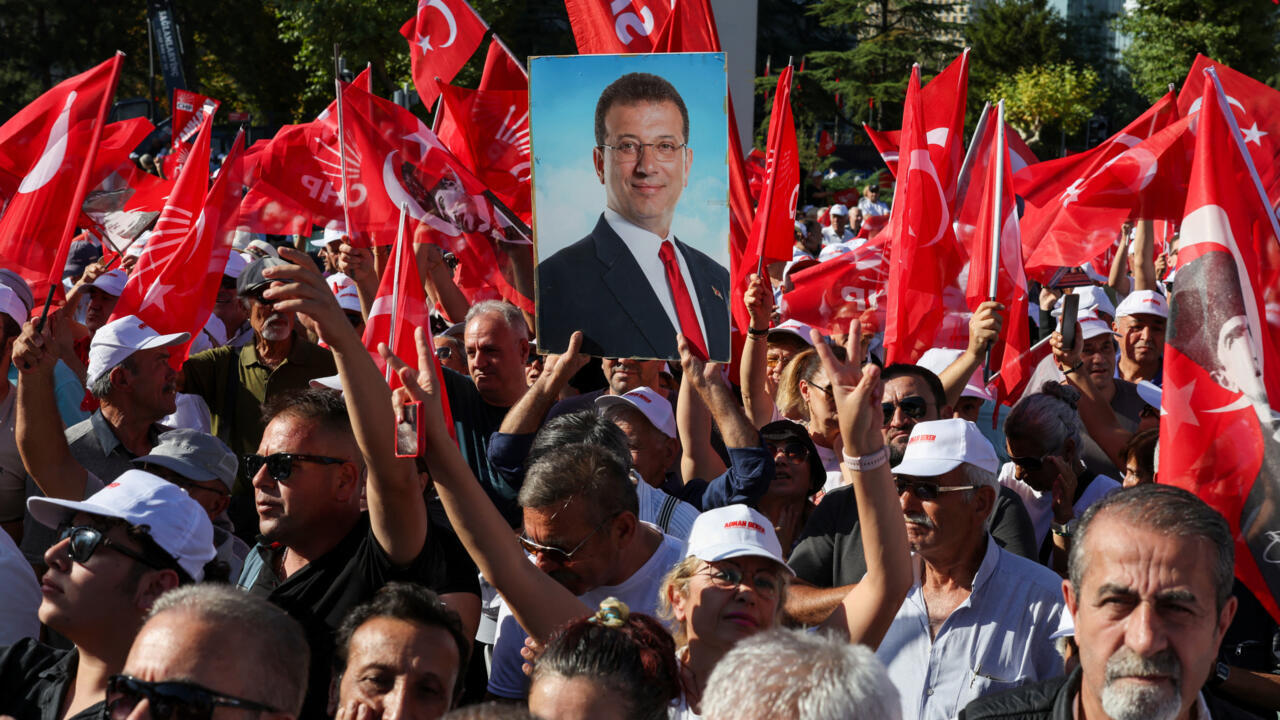
A supporter of the main opposition Republican People's Party (CHP) holds a portrait of jailed Istanbul Mayor Ekrem Imamoglu during a rally in Ankara, Turkey, September 14, 2025. © Umit Bektas, Reuters

Tens of thousands of people protested in the capital Ankara on Sunday against a court case that could oust the head of the main opposition on Monday after a year-long legal crackdown on hundreds of its members.

Live footage showed crowds chanting for President Recep Tayyip Erdogan's resignation while waving Turkish flags and party banners.

The court decision on Monday whether to invalidate the 2023 congress of the Republican People's Party (CHP) over alleged procedural irregularities could reshape the party, rattle financial markets and influence the timing of a general election set for 2028. The court could also delay the ruling.

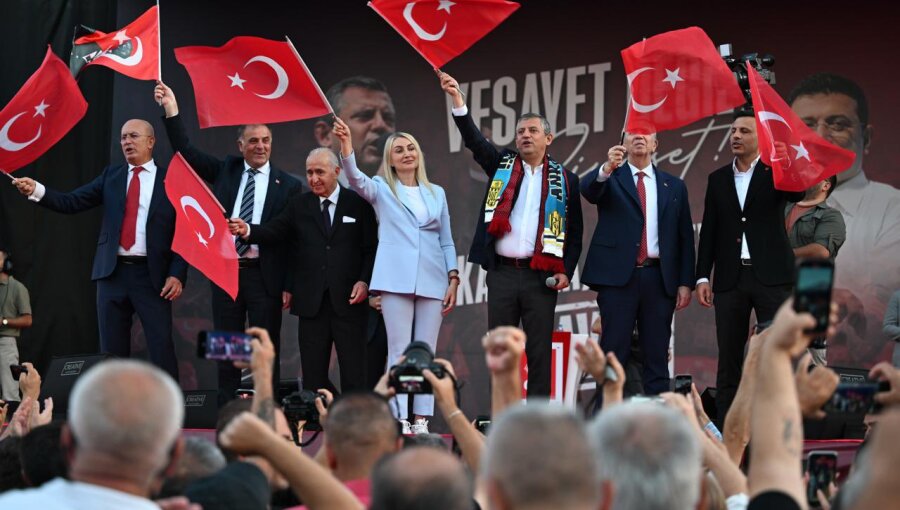
Speaking at Sunday's rally, CHP leader Ozgur Ozel – who was himself elected at the 2023 congress – said the government was trying to cling to power by undermining democratic norms and suppressing dissent following opposition victories in local elections over the past year.


Ozel also called for a snap general election.


Turkish opposition vows to resist

"This case is political. The accusations are slander. Our comrades are innocent. What's being done is a coup – a coup against the future president, against the future government. We will resist, we will resist, we will resist," Ozel said in his address to the crowd.

"This government does not want democracy," he said. "They know they cannot win the elections if there is democracy. They don't want justice: they know if there's justice they won't be able to cover up their crimes."

The government says the judiciary is independent and denies any political motives.

Turkey arrests more than 120 city hall members in opposition stronghold Izmir


Turkey has detained more than 500 people, including 17 mayors over the last year in Istanbul and other CHP-run municipalities around the country as part of corruption investigations, according to a Reuters review.

Hundreds of members of the CHP have been jailed pending trial in a sprawling probe into alleged corruption and terrorism links, among them President Tayyip Erdogan's main political rival – Istanbul Mayor Ekrem Imamoglu.

The arrest of Imamoglu in March sparked the country's largest protests in a decade where hundreds of thousands took to the streets, prompting a brief but sharp selloff in the lira and other Turkish assets.

In a letter sent from prison and read aloud at the rally in Ankara, Imamoglu wrote that the government is attempting to pre-determine the outcome of the next election by sidelining legitimate rivals. He also accused the government of undermining democracy through politically motivated judicial actions and other efforts to suppress dissent.

"The era of 'I' in this country will end, and the era of 'we' will begin. One person will lose, and everyone else will win," Imamoglu wrote.

The crowd applauded and chanted "President Imamoglu" after the letter read aloud.

(FRANCE 24 with Reuters and AFP)


BEYOND THE BOSPORUS: Performance postponed. Hotly anticipated “CHP” trial pushed into October

BEYOND THE BOSPORUS: Performance postponed. Hotly anticipated “CHP” trial pushed into October
Ozel (centre, wearing a scarf) held another big rally in Ankara on September 14. Given the court ruling, he can now rearrange his diary to fit in a few more rallies. / @eczozgurozel X account
By Akin Nazli in Belgrade September 15, 2025

The trial that Turkey had awaited for months was on September 15 postponed by the Ankara 42nd (Asliye Hukuk) civil court of first instance. It assigned the date of October 24 for the next hearing of the trial vital to the standing and future of Turkey’s main opposition party, the Republican People’s Party (CHP).

The court is examining whether alleged irregularities invalidate the CHP national congress held in November 2023. If the ruling is for an invalidation, the CHP’s leader, Ozgur Ozel, who was elected to his position at the congress, could be legally stripped of his chairmanship of the party.

Anticipation and tensions over the trial built after the Istanbul 45th (Asliye Hukuk) civil court of first instance on September 2 appointed a board of trustees to take over the CHP’s provincial headquarters in Istanbul.

Ozel’s leadership to last at least until October 24

Given the hearing postponement, Ozel will stay in post at least until October 24. The unfinished court process, meanwhile, will keep the fate of the CHP top of Turkey’s agenda.

Interval to keep everyone happy

Turkey loves the bunk and baloney generated by this kind of tripe. Every single Turk up and down the country has an idea about what is really going on, what President Recep Tayyip Erdogan has planned and where he will take things from here.

Some Turks are sure that the CHP has nullified Erdogan’s attempt to take over the party apparatus. Other Turks are sure that the country’s leader of 22 years is simply taking his time preparing the public and foreign investors for an upcoming seizure of the CHP.

With the mix of data to hand (the various courts and hearing dates, the dates selected for new congresses and other dates in this interplay), it is possible for the observer to produce an infinite number of likely scenarios that could develop in the weeks ahead.

Yes, the Turks have a lot to play around with. They have no time to complain.

The finance industry and the foreign media are also happy with where things stand. The Borsa Istanbul is running wild, offering some good exploitable volatility, while the foreign media can look forward to writing plenty more clickable headlines.

Turkey’s five-year credit default swaps (CDS), which have hovered in the 250-300+ band in recent years, fell into the 250s from the 270s prior to the hearing that brought the postponement.

De facto impact of CHP extraordinary congress very much in question

On September 21, the CHP will hold an extraordinary congress. Party officials believe that this will void any possible trustee appointments made by courts to take over the CHP management. The regime may have other ideas.

On September 24, the CHP will hold a provincial congress in Istanbul.

A court-ordered board of trustees has been put in place as the official representatives of CHP Istanbul, but party representatives have said that they also believe that the provincial congress will eliminate the mandate of these trustees. We will see.

On September 26, the Istanbul 45th court will evaluate a ruling issued by the Ankara 3rd civil court of first instance. That particular court decided last week that provincial headquarters of political parties do not have legal identities that allow them to be tried.

After the Ankara 42nd court holds the next hearing of the main trial on October 24, the Ankara 26th civil court of first instance will on November 4 hold the next hearing in a criminal case targeting individuals, including jailed Istanbul mayor and chief political rival to Erdogan, Ekrem Imamoglu, as regards actions they took during the November 2023 CHP congress.

There are even more trials and dates in the period ahead. See the details here.

Bayrampasa mayor detained, Beykoz mayor went over to Erdogan

Meanwhile, the CHP mayor of Bayrampasa district in Istanbul was detained at the weekend, bringing the total number of jailed CHP mayors to 19. He was yet to be dismissed.

In another development, the CHP mayor of the city’s Beykoz district, who was elected by the city parliament after the mayor elected by citizens was dismissed, joined Erdogan’s Justice and Development Party (AKP) last week.

So far, the government has taken over 12 CHP municipalities. See the details here.


“They are bankrupting hope in this country” – Imamoglu issues warning ahead of fateful day for Turkish democracy

“They are bankrupting hope in this country” – Imamoglu issues warning ahead of fateful day for Turkish democracy
Imamoglu enters the courtroom. / t.me/e_imamoglu
By bne IntelliNews September 14, 2025

Turkey is “on the brink of great danger”.

That was the warning from Ekrem Imamoglu, the jailed chief political rival to the country’s president, Recep Tayyip Erdogan, as the potentially fateful day of Monday September 15 loomed.

The day could see a court rule on the legitimacy of the 2023 congress held by Istanbul mayor Imamoglu’s party, the main opposition Republican People’s Party’s (CHP). If the judgement goes against the CHP over claimed irregularities, it could strip party leader Ozgur Ozel of his position.

Such an outcome would be seen by critics of the Erdogan regime as a major step to dismantling what remains in Turkey of meaningful democracy and opposition – though the CHP and Ozel have long come under fire for not being meaningful enough in the face of a powerful operator like Erdogan.

On September 14, tens of thousands protested in the capital Ankara against the court case that follows the arresting and detaining of hundreds of CHP members, including 17 mayors, over an alleged sprawling “octopus-like” network of corruption.

On social media, Imamoglu, who says he faces a range of trumped-up corruption charges in an effort by the regime to remove him from politics, said in a statement that “we are moving down a path where elections and the votes cast will lose their meaning”.

On September 12, Imamoglu was brought to court on charges pressed over the "forgery of an official document".

Authorities accuse him of forging papers related to establishing the legitimacy of his university degree. Imamoglu, jailed since mid-March after a dawn police raid on his home, is the CHP’s presidential candidate. Turkish law requires presidential candidates to hold at least an undergraduate degree.

The hearing took place in a courtroom within Marmara Prison Complex in Silivri, located on the outskirts of Istanbul. 

There was applause as Imamoglu entered the courtroom.

CHP leader Ozel arrived chanting the party's slogan, "Rights, law, justice", bianet reported.

It further reported that Imamoglu criticised the timing of the trial, referring to symbolic parallels with Turkey’s past: “The indictment was written by someone who knows I will defeat him in the next election. The very existence of this case is disgraceful. Today is September 12. This date evokes memories of military coups in the Turkish public’s collective memory. Be it military, civilian, political, or backed by the government or religious groups nurtured by the government, any kind of coup should be condemned. I strongly denounce all those who have staged, applauded, supported, or served as instruments for coups.”

He continued: “I hope our country will no longer face such interventions. But unfortunately, I must stress that we are currently going through a coup-like process. They are bankrupting hope in this country—but I won’t let them. I’m so free in my 12-square-metre cell that it would make those in their palaces burst with envy.”

Imamoglu requested that his detained lawyer Mehmet Pehlivan, held at Corlu Prison, be allowed to represent him. The judge approved the request. Pehlivan reportedly joined the hearing via the judicial video system.

In Ankara at the protest, live footage showed crowds chanting for Erdogan’s resignation while waving Turkish flags and party banners.

Ozel, accusing the government of trying to cling to power, called for a snap general election. “This case is political. The accusations are slander. Our comrades are innocent. What’s being done is a coup – a coup against the future president, against the future government. We will resist, we will resist, we will resist,” he said in his address to the crowd, as reported by Reuters.

In a message from Imamoglu read out to the crowd, clearly taking aim at Erdogan, Turkey’s leader of 22 years, Imamoglu said: “The era of ‘I’ in this country will end, and the era of ‘we’ will begin. One person will lose, and everyone else will win.”

The crowd applauded and chanted “President Imamoglu”.

Turkey’s Sozcu daily reported on September 12 that CHP youth groups, preparing for potential unrest, have stocked thousands of N95 gas masks, along with pasta, biscuits and lemons as remedies for tear gas.

Asked what a court ruling against the CHP congress could mean, Berk Esen, a political analyst at Sabanci University, told Reuters: “If such a judicial coup against the main opposition takes place, that would be the collapse of the multi-party system in Turkey.”

CHP vice president Murat Bakan told AFP: "What they're trying to create is an opposition in name only, that will not have any impact on election results like in Russia or Belarus."


COMMENT: How Brazil's judiciary stood up to authoritarian threat

COMMENT: How Brazil's judiciary stood up to authoritarian threat
Brazil’s example shows the importance of an independent judiciary capable of resisting both domestic and foreign pressures.
By Ricardo Martins in Utrecht September 15, 2025

The prosecution of former Brazilian President Jair Bolsonaro and seven co-conspirators marks the coming of age of Brazilian democracy. For the first time in the country's turbulent political history, an attempted coup has been tried in civilian courts rather than swept aside by a complicit or silent judiciary.

The Supreme Court's decision to convict Bolsonaro and his allies on September 11 draws a line under Brazil's past, when military interventions went unpunished and democratic institutions bent to authoritarian pressure. This time, the judiciary assumed the lead role in defending constitutional order.

The Prosecutor General's case was methodical and damning: Bolsonaro and his criminal organisation had constructed an elaborate plot to prevent the peaceful transfer of power after his 2022 electoral defeat. The conviction sends an unmistakable message that Brazil's democratic institutions, however imperfect, will no longer tolerate attempts to subvert the popular will.

Phase one: discrediting the electoral system

The first step in the attempted coup was an effort to undermine confidence in Brazil’s electronic voting system. Before the elections, civil society organisations, universities, and even the armed forces were invited to examine the system for vulnerabilities. They found none.

Dissatisfied with these findings, Bolsonaro pressured the Minister of Defence to alter their conclusions. He also summoned foreign ambassadors to cast doubt on the credibility of Brazil’s elections. These efforts, together with coordinated disinformation campaigns and fake news, were intended to delegitimise the election outcome in advance. In case of defeat, he would claim fraud and cancel the elections.

A four-star general, the Chief Security Advisor, was caught on camera saying: “We have to do something before the elections; afterwards it will be too late. If we have to upend the table, let’s do it.”

In Brazilian military parlance, the expression virar a mesa” — literally to turn over the table” — is used to signify carrying out a coup or forcibly provoking regime change.

Phase two: post-election organisation and threats

After losing the election to Luiz Inácio Lula da Silva, the plot intensified. Bolsonaro’s network sought to prevent Lula’s inauguration, planning the assassination of the president-elect, his vice-president, Geraldo Alckmin, and Supreme Court Justice Alexandre de Moraes.

The operation was given a patriotic yet violent name: “Punhal Verde-Amarelo” (Green-and-Yellow Dagger), a reference to Brazil’s national colours.

Surveillance of the Justice’s movements was carried out, while the creation of parallel intelligence channels formed part of a broader strategy to intimidate and manipulate institutional actors.

Phase three: mobilisation and the January 8, 2023 mayhem

Supporters of Bolsonaro were mobilised, culminating in the violent invasion of Brazil’s three branches of government on January 8, 2023. The aim was to provoke such chaos that the incoming administration would declare a state of emergency, enabling the military to seize control, effectively a coup d’état. The plan failed, in part because President Lula was absent from Brasília at the time, responding to a natural disaster, and the government refused to grant exceptional powers to the military.

Judicial outcome and notable votes

Bolsonaro and his aides—including generals, the former Justice Minister, the former Defence Minister, the former Vice-President candidate, the former heads of the navy and the army, the former Security Advisor, and the Information Chief—were sentenced to terms ranging from 27 years and three months to 16 years and one month’s imprisonment. However, the cooperating defendant, Bolsonaro’s aide-de-camp, received a two-year sentence, to be served outside a closed prison regime.

They were convicted of the offences of criminal organisation, attempted violent abolition of the democratic rule of law, attempted coup d’état, damage to federal property, and deterioration of protected heritage assets. The latter two charges relate to the events of January 8 2023, when violent demonstrators invaded and destroyed public buildings, objects, and furniture in Brasília, mirroring the storming of the Capitol by Trump supporters two years earlier in Washington.

Sentences were determined by aggregating the penalties for each of these crimes, according to the degree of individual involvement. The far-right leader received the heaviest penalty: 27 years and three months’ imprisonment, initially to be served under a closed regime, after being found guilty as the leader of the criminal group. Under Brazilian law, the head of such an organisation must serve their sentence in a maximum-security prison.

The point of contention now is whether the rapporteur judge will order Bolsonaro’s transfer to a maximum-security facility, or whether, by virtue of his status as a former president and a military officer, he will instead serve his sentence in a special Federal Police unit or a military barracks.

All defendants have been stripped of their political rights for eight years, meaning they are barred from running for any public office. One of them has also lost their seat in the federal legislature. The military personnel involved will receive a formal mark of dishonour within their respective branches and will be required to pay fines for damages to public property, in addition to a collective fine of approximately $5.5mn.

Yet the trial also revealed an unusual and striking divergence: dissenting Justice Luís Fux issued a vote that backed aspects of the defendant’s position more effectively than the collective defence presented by their lawyers, showcasing both the complexity and fairness of the judicial process.

Brazil as a warning for global democracy

This trial, televised as all Supreme Court trials in view of transparency and accountability, represents a critical precedent for the rule of law in Brazil and beyond, as put by The Economist in last week’s edition.

It demonstrates that even the highest political officeholders can be held accountable under civil law when they attempt to subvert democratic institutions. By bringing a former president and his associates to justice, especially high-ranked generals, the Brazilian judiciary has reinforced the principle that no individual is above the law—a cornerstone of constitutional democracy.

The implications extend far beyond South America’s largest democracy. Around the world, including Europe and the US, democratic institutions face growing stress from leaders seeking to concentrate power, manipulate electoral processes, and undermine independent judiciaries.

Brazil’s example shows the importance of an independent judiciary capable of resisting both domestic and foreign pressures. The trial also illustrates that protecting democracy is not merely about elections, but about maintaining credible rule-of-law mechanisms, safeguarding electoral integrity, transparent judgments, and ensuring accountability for those who attempt to subvert democratic processes.

Moreover, the Bolsonaro trial serves as a cautionary tale for everyone: disinformation campaigns, attempts to discredit elections, and overt pressure on courts are no longer distant threats; they have become tools that established political actors can deploy across continents.

Brazil’s judiciary has set a precedent not just for its own democracy but as a warning for the world: preserving democratic governance requires constant vigilance, robust legal frameworks, and the courage of judges to enforce them, even against the most powerful political figures or external pressure – as the US Embassy in Brasília and its current president did.

Impact on Brazil’s political landscape and the future of Bolsonarism

The conviction of Bolsonaro is poised to reshape Brazil’s political landscape. Domestically, it weakens the credibility of his core political network and the broader far-right, signalling that attempts to subvert democracy carry real legal consequences.

While Bolsonarism remains a potent political force with significant grassroots and evangelical support, the trial is likely to fracture its leadership and reduce its institutional influence.

Meanwhile, once-sympathetic traditional Brazilian elites—industrial, financial, and parts of agribusiness—have already distanced themselves from the former strongman president, considering him too uncivilised and a rude person. Many have shifted their support to Tarcísio de Freitas, governor of São Paulo and the emerging centre-right presidential candidate, who appears to be consolidating Bolsonaro’s former base while presenting a more palatable image for institutional and business interests. Bolsonaro and his family, however, retain popularity among far-right and evangelical voters.

The movement’s transnational dimension is also visible. Eduardo Bolsonaro’s relentless lobbying efforts in the US, combined with external pressures including President Trump’s sanctions and trade tariffs, underscore Bolsonarism’s reliance on international allies to counter domestic legal and political constraints.

The Independence Day celebrations on September 7 by Bolsonaro’s allies, featuring a massive American flag in São Paulo, showed that Bolsonaro’s far-right care less for national interests in the face of Trump’s agenda against Brazil.

While Tarcísio de Freitas embraced certain aspects of the far-right and pronounced hard words against the Supreme Court’s Justices to court Bolsonaro’s base support on Independence Day, widespread criticism from the mainstream conservative press has forced him to distance himself from Bolsonaro during the trial, dealing a fresh blow to the movement.

Looking ahead, Bolsonarism may recalibrate its strategy, concentrating on maintaining mobilised regional power bases and consolidating support among the evangelical and radical electorate.

These voters remain highly engaged in electing representatives and senators who could influence legislative outcomes, including attempts to pass an amnesty law aimed at pardoning Bolsonaro, despite the Brazilian Constitution explicitly stating that crimes against democracy cannot be subject to presidential pardon or legislative amnesty. However, their endgame remains to portray Brazil as being under a “judicial dictatorship.”

The trial sends a clear, didactic message: attempts to undermine democracy and the rule of law will face judicial scrutiny. While this may temper the most extreme strategies within Bolsonaro's movement, its ideological influence and populist appeal will inevitably continue to play a key role in Brazil's political debate and elections in the coming years.

Ricardo Martins is based in Utrecht, the Netherlands, and has a PhD in Sociology specialising in European politics, geopolitics and international relations.