It’s possible that I shall make an ass of myself. But in that case one can always get out of it with a little dialectic. I have, of course, so worded my proposition as to be right either way (K.Marx, Letter to F.Engels on the Indian Mutiny)
Tuesday, September 16, 2025
Med Marine’s Med-A2800SD Tug For OMMP Successfully Completes Sea Trials
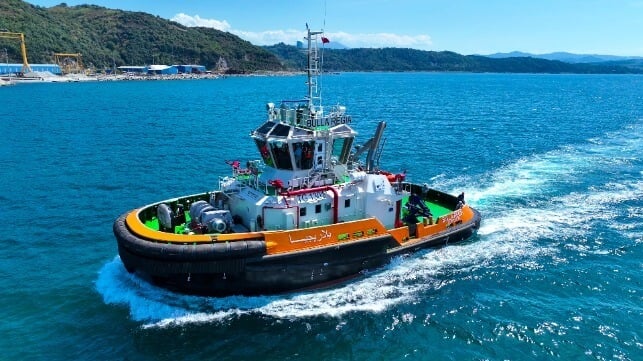
Med Marine proudly announced that the first of six next-generation RAmparts 2800 series tugboats, purpose-built for the Office de la Marine Marchande et des Ports (OMMP), successfully completed her sea trials in the Black Sea on August 27th. Conducted under the close supervision of MED MARINE’s engineering team and classification society surveyors, the trials confirmed the vessel’s full alignment with design performance, from powerful bollard pull to agile manoeuvrability and operational resilience.
This milestone comes just three months after the 28-meter harbor tug’s ceremonial launch on May 27th at MED MARINE’s Ere?li Shipyard, an event that marked the visible beginning of a six-vessel fleet project arising from the contract signed between OMMP and MED MARINE in November 2023. Having successfully completed her sea trials, MED MARINE is excited to continue advancing its collaboration with OMMP through this high-performance harbor tug.
Measuring 28 meters in length, this MED-A2800SD tug is engineered to deliver a minimum bollard pull of 60 tonnes ahead. Designed by Robert Allan Ltd., she meets Class FIFI-E requirements and is powered by two medium-speed diesel engines. Her open aft deck, capable of accommodating two 10-foot containers, ensures operational flexibility, while her robust configuration prepares her for a wide range of missions including ship handling, towing, mooring, escorting, pushing, and firefighting.
As the first in a series of six sister vessels, this tug embodies the fusion of MED MARINE’s advanced shipbuilding expertise and OMMP’s progressive vision for safer, more efficient port operations. More than just a technical achievement, the successful completion of her sea trials highlights the coordinated efforts, meticulous planning, and mutual dedication that define this partnership.
Technical specifications of the tugboat: Length: 28,20 m Beam: 11,50 m Depth: 5,49 m Draft: 5,40 m Gross Tonnage: 428 Bollard Pull: 60 tons Speed: 12 knots @ 80% MCR Crew: 8
The products and services herein described in this press release are not endorsed by The Maritime Executive.
Drew Marine, a global leader in maritime solutions, has acquired all rights, intellectual property, and technical documentation related to CD92 Mycronizer from Schiffs & Industrietechnik GMBH (SIT).
For decades, Drew Marine has offered a wide range of products and solutions designed to address various challenges associated with marine fuels. Drew Marine’s solutions are especially important as the marine industry incorporates fuel changes and adapts to more stringent environmental regulations. Our fuel treatment solutions include fuel mills and products to enhance fuel stability, improve combustion efficiency, prevent microbial growth, control sludge and deposits, optimize cold flow performance, and support water separation to ensure reliable, efficient, and compliant marine engine operation. The company’s latest offering, the CD92 Mycronizer, supports both environmental compliance and operational performance, making it a valuable addition to Drew Marine’s expanding Engineered Systems and New Build portfolios.
Compact and easily adaptable, the CD92 Mycronizer delivers two critical capabilities:
• Combustion Improvement – When located prior to the engine, it will break down agglomerated hydrocarbons (asphaltenes), ensuring the fuel droplets are the same size and as small as possible. This reduces specific fuel consumption, wear and tear on engine components, and reduces soot emissions.
• Sludge Reduction and Fuel Homogenization – When located prior to the purifier or in Settling Tank recirculation, it will reduce the amount of burnable fuel rejected by the purifier as sludge waste without jeopardizing catfine elimination. When utilized for storage tank circulation, this solves incompatibility issues.
With the addition of the wide capacity range of the CD92 Mycronizer line, Drew Marine offers a full line of fuel homogenization equipment, chemical treatments, and test monitoring solutions, along with remote and onboard technical support all designed to work in synergy. Our holistic approach to fuel management empowers shipowners and operators to optimize fuel quality, reduce waste, and ensure regulatory compliance across a wide range of fuel types.
“This acquisition aligns with our strategy of combining innovation with practical onboard solutions,” said Scot R. Benson, CEO of Drew Marine. “The CD92 Mycronizer offers immediate value to owners looking to increase efficiency and long-term reliability. This proven technology is an important addition to Drew's fuel management program. We are proud to partner with Heino Stache to continue to supply and develop this technology.”
“Heavy fuel management is a growing challenge,” added Heino Stache, Managing Director of SIT. “We’re confident Drew Marine will expand the technology’s impact globally.”
The CD92 will be integrated into Drew Marine’s New Build program and is now supported worldwide by the company’s technical service network.
Drew Marine has been providing the maritime industry with technical services and solutions for almost a century. Today, its global team brings the same dedication, expertise, and innovation to its services and products to help its customers find success in their businesses.
This article is sponsored by Drew Maritime. For more information about Drew Marine’s fuel treatment solutions, visit drew-marine.com.
The opinions expressed herein are the author's and not necessarily those of The Maritime Executive.
UK Government and Industry Pledge Over $1.4B to Shipping Decarbonization
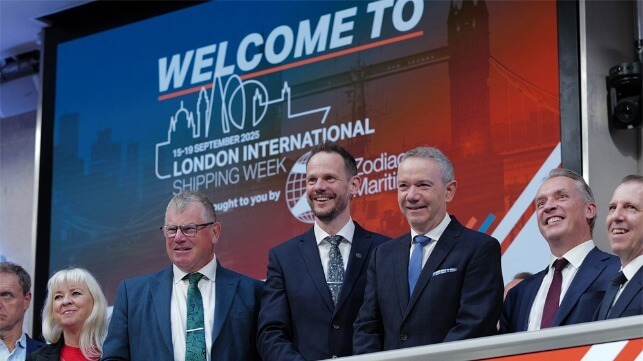
UK kicked off London International Shipping Week pledging over $1.4 billion in investments for decarbonization (London Stock Exchange)
Timed to the opening of the London International Shipping Week 2025, the UK government announced plans for another massive investment into the decarbonization of shipping that will also include further commitments from the private sector. The government is adding approximately $610 million to its UK Shipping Office for Reducing Emissions (UK Shore) program, while reporting that private industry will contribute another $952 million to programs to aid shore communities and spur decarbonization.
UK Shore was launched in 2022 and has already allocated $326 million to more than 200 projects. It has further leveraged an additional approximately $150 million direct private investment. They point to efforts developing electric and efficiency solutions for various vessel types, ranging from ferries to cargo and offshore wind vessels. It has also contributed to programs for hydrogen, ammonia, and methanol, and supports R&D and demonstrations of emerging technologies.
The conference kicked off with an opening ceremony at the London Stock Exchange with the UK Parliamentary Under Secretary for Local Transport, Simon Lightwood. He highlighted the critical role shipping plays in the UK economy and its contribution to technological progress.
A member of Parliament and the UK government’s recently appointed Parliamentary Under-Secretary of State for Transport, Keir Mather, wrote to Parliament informing them of the investment plan. He highlighted how it fits within the 2025 Department of Transport maritime decarbonization strategy and the goals to place the UK at the forefront. He said they intend the new funding for between 2026 and 2030 to accelerate technology for decarbonization and allow industry to plan for the next five years of clean maritime innovation.
During 2026, he said the government plans for the next round of the Zero Emissions Vessels and Infrastructure competition that funds efforts to build and conduct commercial trials of clean maritime solutions. They are also planning the seventh round of the Clean Maritime Demonstration Competition for demonstration projects by 2030. The new funding will also provide for two more rounds between 2027 and 2029 and fund the Clean Maritime Research Hub until at least 2028.
Mather traveled to the Cammell Laird yard near Liverpool to highlight $4.9 million of previous UK Shore funding for the installation of a zero-emission electric shore power system. The UK programs have also contributed to power across the South Coast of England and London, as well as the FastRig wingsail being developed in Scotland.
Among the private industry investments being announced is more than $400 million from Peel Ports for its Liverpool, Hunterston, and Great Yarmouth ports, while NatPower Marine reported $340 million for shore power. The Port of Tyne will invest more than $200 million in the North Side, creating opportunities in offshore wind and manufacturing.
London International Shipping Week continues all week and is designed to highlight advancements in the industry. The Transport Secretary and Maritime Minister will attend a series of events where they will champion UK shipping and highlight the potential for the industry.
Five Missing in Catastrophic Trawler Collision off Mauritania
A collision between two fishing boats left five people missing off the coast of Mauritania last week, prompting a large-scale search.
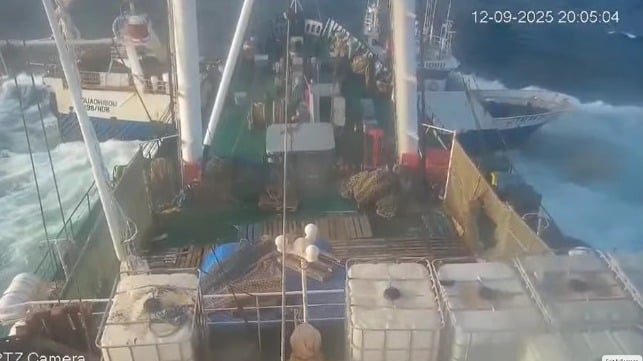
The Gambian-flagged Right Whale and the Mauritania-flagged Tafra 3 collided off the coast on Friday, in fine weather and calm surface conditions. A video obtained by Faro de Vigo and Voz de Galicia appears to show that Right Whale's bow hit Tafra 3 amidships on the starboard side; Tafra had trawl cables visibly trailing astern, indicating that she was engaged in fishing operations or working on gear over the side in the moments before impact.
After the collision, the two ships remained connected and Right Whale continued to push Tafra ahead for about two minutes. When Tafra finally drifted away, it became apparent that the smaller vessel had a wide-open tear in her hull all the way from the main deck level down. She listed further and further to starboard, then sank by the stern in about 50 meters of water.
Spanish outlet Informacion reports that the vessel sank so fast that the crew could not deploy their rafts. Instead, they all donned lifejackets, and the rafts popped up later by hydrostatic release.
21 survivors were rescued, including three Spanish nationals and at least one Russian citizen. One of the Spaniards sustained a head injury and required stitches. Five Mauritanian nationals remained missing, and SAR operations reportedly continued through the weekend.
The master and first officer of the Right Whale have reportedly been arrested, and a local investigation into the cause of the casualty is under way.
AI Tool Launched to Detect Misdeclared and Dangerous Goods in Containers
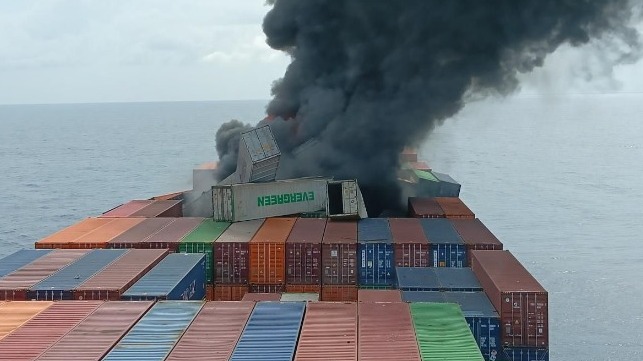
Explosions and a fire on the Wan Hai 503 in June 2025 resulted in the loss of four crewmembers and a fire that spread to consume most of the ship (Indian DGS)
The latest tool in the fight against misdeclared and undeclared dangerous goods in containers is being launched by the World Shipping Council in its Cargo Safety Program. The industry-led initiative is using a new AI-powered screening tool in an attempt to identify the dangers that are a leading cause of fires and increase protection for crew, vessels, and the environment. At launch, carriers representing more than 70 percent of global TEU capacity have joined the program.
Misdeclared dangerous goods are a leading cause of ship fires, reported as responsible for more than a quarter of all cargo-related incidents, according to data from Allianz's Safety and Shipping Review 2025. The insurer warned in its analysis that ship fires are at their highest level in over a decade, including several high-profile incidents in recent weeks.
The Marie Maersk reached Malaysia yesterday, September 14, a month after the crew saw smoke coming from a container while they were off the coast of Africa. While they were able to contain the fire, Maersk has declared General Average to share the cost of the extraordinary firefighting effort. Last week, the hulk of Wan Hai 503 also finally arrived in a port of refuge after a devastating container fire and explosions, which contributed to the loss of four crewmembers and a vessel that was largely burnt out.
“We have seen too many tragic incidents where misdeclared cargo has led to catastrophic fires, including the loss of life,” said Joe Kramek, President and CEO of the World Shipping Council. “The WSC Cargo Safety Program strengthens the industry’s safety net by combining shared screening technology, common inspection standards, and real-world feedback to reduce risk.”
At the heart of the program is a digital cargo screening tool powered by the National Cargo Bureau’s (NCB) technology. The program combines AI-powered cargo screening and common inspection standards to identify misdeclared and undeclared high-risk shipments before they are loaded. In addition, it incorporates machine learning to help the tool get smarter and to adapt to new and emerging risks.
The system will scan millions of bookings in real time using keyword searches, trade pattern recognition, and AI-driven algorithms to identify potential risks. Alerts are reviewed by carriers and, when needed, verified through targeted physical inspections.
The World Shipping Council says it does not replace the fundamental obligation shippers have to declare dangerous goods accurately. However, the program will also establish common inspection standards for verifying shipments and an incident feedback loop to ensure lessons from real-world cases strengthen prevention.
The World Shipping Council recently warned that an analysis of port state inspection data showed that more than one-in-ten (11.39 percent) had a problem in 2024 out of more than 77,600 containers inspected. The report highlighted that deficiencies were up slightly from 2023 and at a new, recent high, with issues including misdeclared and undeclared dangerous goods, incorrect documentation, and improper packing.
By improving cargo screening, the World Shipping Council believes it will help prevent incidents, protecting crew, vessels, other cargo, and the environment. A similar effort launched in the past few years to help educate crews about container collapses and the dangers of parametric rolling contributed to declines in the number of boxes being lost overboard.
Photos: Progress as More Containers Are Removed in Long Beach Recovery
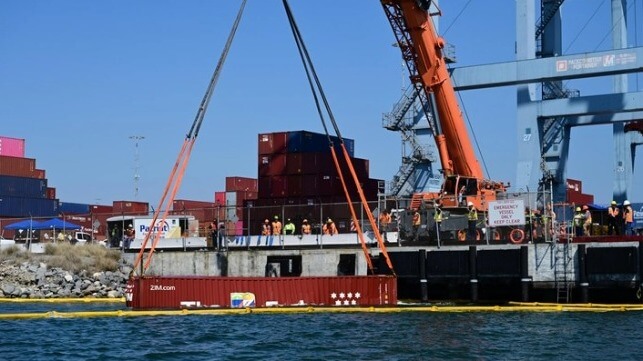
32 containers have been recovered as of Sunday as part of an estimate of 75 boxes that fell into the harbor (USCG)
Efforts are continuing in the Port of Long Beach to clean up from last week’s container collapse. The Unified Command overseeing the operations reported as of Sunday, September 14, that nearly half of the containers estimated to have fallen from the vessel have been recovered, while they have also secured containers remaining aboard the containership Mississippi.
The Southern California US Coast Guard reported on Sunday that eight more submerged containers had been located and that they were being removed. In total, it said 32 containers had been recovered as of Sunday out of the estimated 75 boxes that fell from the Mississippi on September 9. The first two containers were recovered on Wednesday, the day after the incident, while the Coast Guard said sonar surveys were underway to locate the submerged containers. The Unified Command reports it is continuing to conduct surveys, drone overflights, and dive operations.
Two bays on the Mississippi collapsed on Tuesday, leaving numerous boxes askew. Some later fell onto the dock. Now, the port and the Unified Command are reporting unaffected containers have been secured. A small fuel leak from the emissions barge was also secured last week.
“In just a few days, we have made significant progress in securing the vessel cargo and recovering containers,” said Capt. Stacey Crecy, Commander, U.S. Coast Guard Sector Los Angeles – Long Beach. “This progress was made possible due to the dedication of all participating agencies, vessel managers, the Port of Long Beach, the ITS terminal, and highly skilled ILWU labor working together.”
Cargo operations are largely unaffected, they report, except at the single berth. A 500-yard safety zone remains in place, and the USCG is helping to navigate vessels around the zone to continue port operations.
The incident comes as the port continues to see strong volumes. The Port of Long Beach reported today that it had its second-busiest August on record and the sixth-busiest month in its 114-year history. Container volume was 901,846 TEU, which was down approximately 4.5 percent from July but only 1.3 percent down from the record set a year ago in August. Imports were down 3.6 percent and exports off more than 8 percent, while empties leaving the port were up 3.7 percent. The Port of Long Beach notes its volume is up 8.3 percent so far in 2025 to nearly 6.6 million TEU.
The Port of Long Beach notes that retailers have continued to rush merchandise imports during the pause in tariffs. Recently, the National Retail Federation, however, predicted that container imports would continue month-to-month declines before leveling off at a reduced rate.
20-Foot Standard Containers: Why They Remain a Popular Choice
When it comes to storage and transportation needs, 20 ft standard containers continue to stand the test of time. These containers have been a staple in the shipping and logistics industry for decades. Their compact size, robust durability, and incredible versatility make them a go-to solution for businesses and individuals alike. Whether you’re moving cargo across the globe or seeking a reliable storage option, 20 ft standard containers deliver consistent performance without compromise.
Here’s a closer look at why these containers remain a popular choice for storage and transport.
What Are 20 ft Standard Containers?
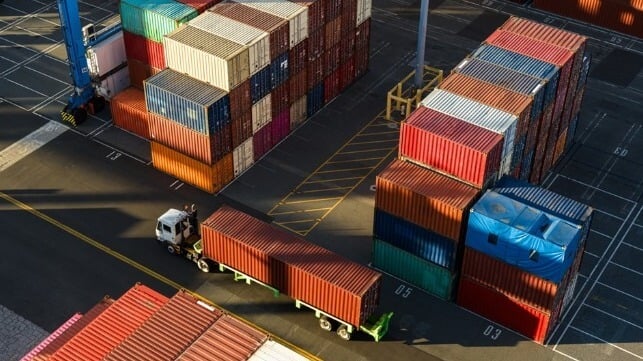
A 20 ft standard container is a universally recognized shipping and storage unit crafted to meet strict ISO (International Organization for Standardization) guidelines. Measuring 20 feet in length, 8 feet in width, and 8.5 feet in height, these containers are compact yet spacious enough to accommodate a variety of cargo types.
Made from high-strength Corten steel, they are built to endure harsh environmental conditions while safeguarding the contents inside. They are also highly compatible with intermodal transportation, allowing them to transition effortlessly between ships, trucks, and trains.
Key Characteristics
Dimensions (approximate):
External: 20 ft (6.06 m) long, 8 ft (2.44 m) wide, 8 ft 6 in (2.59 m) high
Internal: ~5.9 m × 2.35 m × 2.39 m
Capacity:
Volume: ~33 cubic meters (1,170 cubic feet)
Payload: up to 28,000 kg (61,700 lbs), depending on shipping line regulations
Material: Usually made of corten steel (weathering steel) for durability and rust resistance.
Structure: Fully enclosed, with rigid walls, floor, and ceiling; single set of double doors at one end.
ISO Standard: Fits intermodal transport (ships, trains, trucks).
Uses
Transporting general cargo (boxes, pallets, machinery, furniture, textiles, electronics, etc.).
Storage solution for businesses and construction sites.
Conversion into offices, kiosks, or modular housing units.
Advantages
Universal fit: Standard size for ships, trucks, and trains.
Cost-efficient: More economical than larger containers for smaller loads.
Versatile: Suitable for nearly any type of dry cargo.
Widely available: The most common container size globally.
Features of 20 ft Standard Containers
What sets 20 ft standard containers apart is their well-rounded design that combines practicality, durability, and versatility. Here are some of the key features that make them indispensable:
The size of these containers strikes a perfect balance — small enough to fit in tight spaces yet spacious enough to handle mid-to-large shipments.
Built with corrosion-resistant steel, these containers are designed to withstand extreme weather, heavy handling, and prolonged usage without compromising their structural integrity.
Their ISO compliance ensures easy integration into global shipping networks, making them a trusted choice for businesses operating across multiple channels.
Equipped with heavy-duty locking systems, 20 ft containers ensure the safety of your goods by preventing unauthorized access.
These containers keep your cargo safe from rain, wind, and pests, making them ideal for short- and long-term storage applications.
For businesses dealing with large inventories, these containers can be stacked securely, optimizing space usage at ports, warehouses, or job sites.
Benefits of 20 ft Standard Containers
The enduring popularity of these containers stems from the wide array of benefits they bring to the table:
Whether you’re in manufacturing, agriculture, construction, or retail, these containers adapt to your needs seamlessly.
Their manageable size makes them easy to transport and maneuver, yet they still offer plenty of interior space to store or ship cargo efficiently. With a total capacity of 33 cubic meters, they strike a perfect balance between size and usability.
These containers are renowned for their longevity. Their corrosion-resistant steel construction ensures they remain operational even after years of use, making them an excellent long-term investment.
Their compact size makes them more affordable to transport compared to larger containers. For businesses with smaller shipments or limited budgets, they provide an ideal cost-saving solution.
Whether you’re using them for international shipping or as stationary storage units, the 20 ft container is highly portable and fits well in diverse environments, from crowded city spaces to remote industrial sites.
When they’re no longer needed for shipping, these containers can be repurposed into innovative solutions like office spaces, storage sheds, or even homes, reducing waste and environmental impact.
Applications of 20 Ft Standard Containers
The adaptability of 20 ft containers has made them invaluable across various industries and operational scenarios. Here are some of the most common applications:
Global shipping.
On-site storage.
Emergency relief.
Construction industry.
Warehousing.
Entrepreneurs and architects are converting these containers into retail shops, pop-up restaurants, and even modern homes, celebrating their structural integrity and flexible design.
Why Pelican Containers?
Pelican Containers prides itself on offering high-quality container solutions that cater to diverse business and personal requirements. 20 ft standard containers are durable, affordable, and available in a variety of conditions to meet your specific needs — whether you’re looking for new, used, or refurbished containers.
With competitive pricing and unbeatable service, Pelican Containers is your trustworthy partner for container solutions. This post is sponsored by Pelican Containers.
The opinions expressed herein are the author's and not necessarily those of The Maritime Executive.
Massive trenches are swallowing homes across the DRC
Hundreds of thousands of people are at risk as giant trenches, known as "gullies," tear through the Democratic Republic of the Congo. Researchers attribute the growing crisis to climate change and poor urban planning.
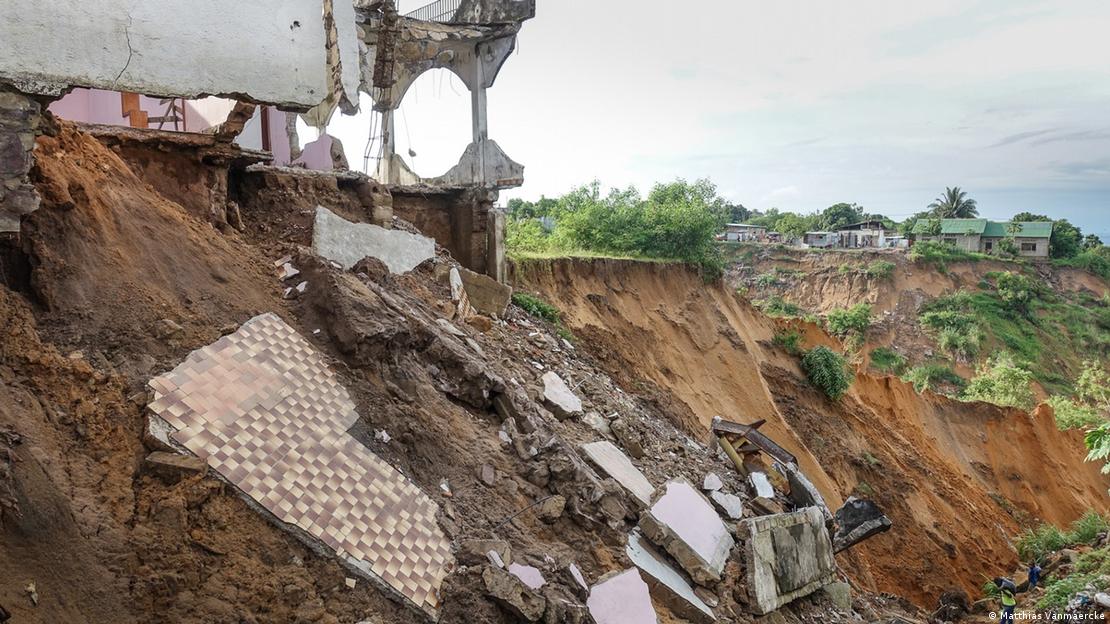
Urban gullies can stretch hundreds of meters in length and tens of meters wide.
The scale of the threat is striking. From 2004 through 2023, almost 120,000 people are estimated to have been displaced by urban gullies in the DRC. Scientists warn that hundreds of thousands more could lose their homes in the next decade. With millions of people currently living in potential hazard zones, understanding gullies is crucial.
Gullies are an extreme form of erosion. These huge channels are carved by water and can stretch dozens of meters wide and hundreds of meters long. In cities, they are a looming threat that eventually swallows houses, businesses and other infrastructure, such as roads and railways.
To track them, researchers combined population densities with satellite images, cross-checking against aerial photographs from the 1950s. They found that more than half of the cities investigated are affected. In almost all cases, gullies have expanded in the past decade.
How do gullies form?
Both natural and human-made factors drive gully formation. In the DRC, intense rainfall and erodible soils combine with rapid urbanization and inadequate urban planning, turning water into destructive flows.
"The main underlying causes appear to be deficiencies and gaps in urban planning and land-use management," said Guy Ilombe Mawe, study author and a researcher at the University of Bukavu. The DRC's rapid urban growth has left communities without sufficient drainage systems.
Kinshasa, Africa's third-biggest metropolis, is especially hard-hit, with more than 800 gullies. In 1950, it had just 200,000 residents. Today, nearly 18 million people live there.
"Congo is one of the countries that is urbanizing at an extremely rapid rate," Matthias Vanmaercke, a study author from KU Leuven in Belgium, told DW. "A lot of this urbanization is unplanned, rather chaotic," Vanmaercke said. "If people build houses," he added, "this is usually without proper infrastructure to capture the water."
With urbanization comes deforestation. Rooftops, roads and other sealed surfaces replace plants. This leaves less land able to absorb water. The study found that 98% of urban gullies are linked to local road networks.
Intense rainfall, sandy soils and rapid urbanization make the DRC prone to urban gullies
Image: Matthias Vanmaercke
Gullies often occur in areas with sandy soils that erode easily. Heavy rainfalls also have an influence and can expand already formed gullies. With climate change expected to bring increased rainfall, scientists warn that the risk is only growing. Are gullies the same as landslides?
Not quite. While both are destructive, landslides and gullies have some key differences. Gullies are typically found at the edges of plateaus with sandy soils, whereas landslides often occur in steep hilly areas with clay-based soils.
Both can be unpredictable. But there's a crucial difference — once a gully forms, it is permanent and grows with each heavy rainfall. That makes them especially dangerous in cities, where homes are constantly under threat.
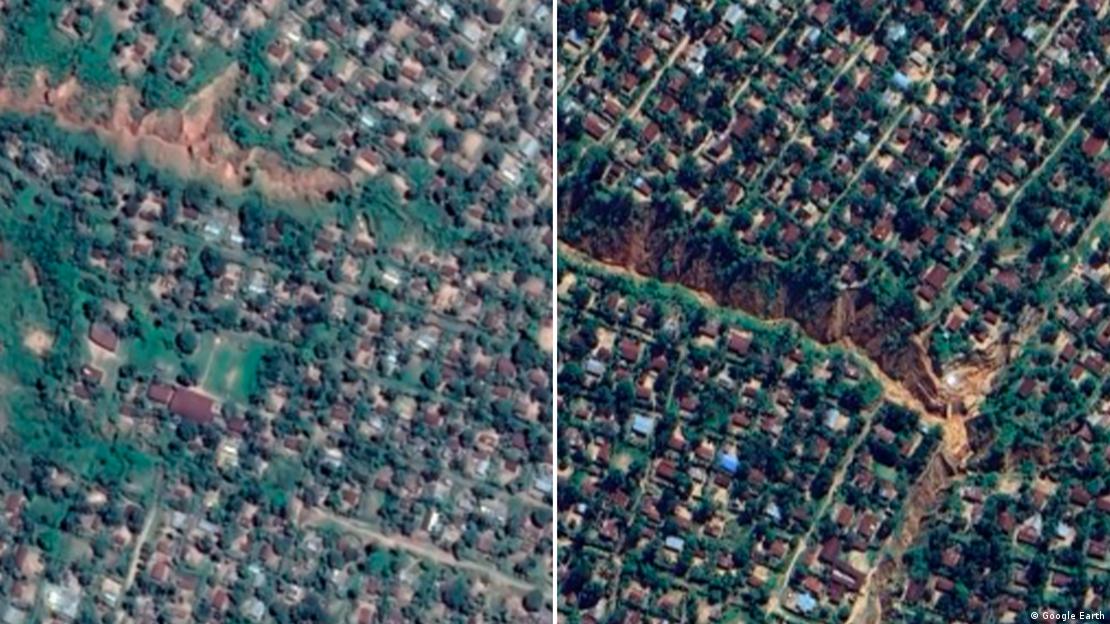
Google Earth shows gullies across DRC. This gully in Kikwit has grown since 2013, swallowing houses
Image: Google Earth
"Gullies, they can form very rapidly, within one rainfall event, and then this is often very dangerous because people don't expect it, and suddenly there's this huge gap destroying their house." Vanmaercke said. "But what also happens is that, once a gully is there, it stays there and then you have this huge gap in which new water can run every time there is a rainfall event."
Who is at risk from urban gullies?
Urban gullies threaten cities across Africa and in places such as Brazil. Since 2020, gullies have been expanding at an accelerated rate, often with devastating consequences in densely populated areas. On Google Earth, you can see how gullies expand over time in cities across the DRC.
The poorest communities are the most vulnerable.
"The population living in these exposed areas continues to grow denser over time," Mawe said. "Despite the existing hazard," he added, "residents appear to have little to no choice."
According to the researchers, 12,000 people in DRC are at risk of losing their homes every year, with about 60% of displacement caused by gullies widening rather than new gullies forming.
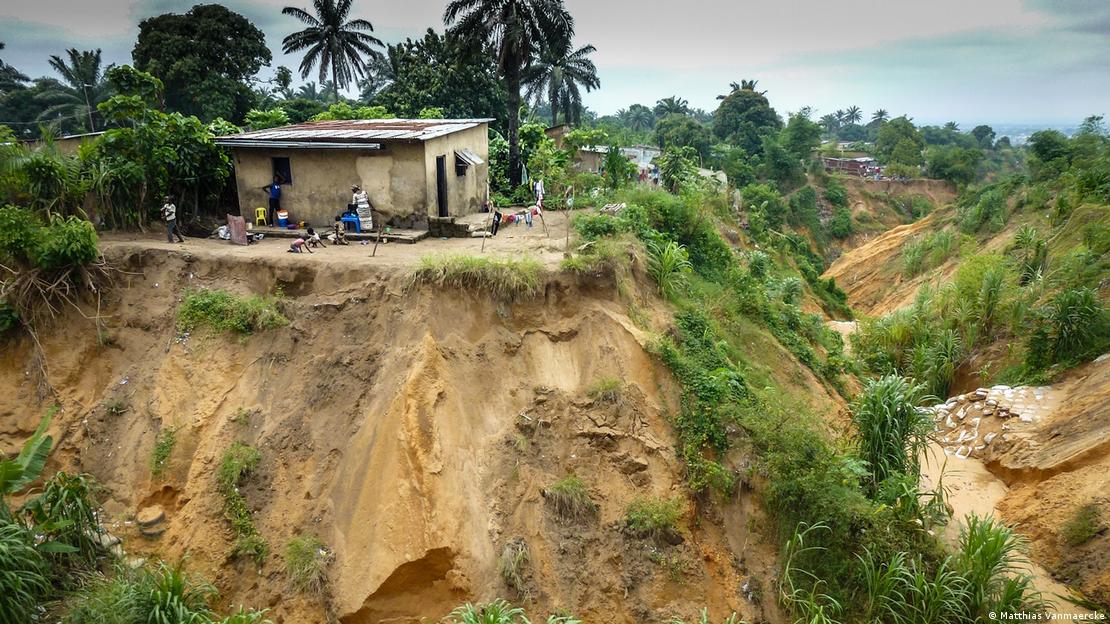
Gully expansion can be a slow process, but it threatens people living at the edges,
who are often unable to leave
Image: Matthias Vanmaercke
"People living at the edge always become a little bit more threatened 1 meter at a time," Vanmaercke said. The proximity to gullies takes a psychological toll, he said, as people stay awake in their home "every night that it rains, just hoping it will not be destroyed." Can gullies be predicted?
No, not yet, at least. Scientists say predicting when or where a gully might appear or widen is difficult, but crucial in preventing further destruction.
Researchers are working toward a better understanding of how gullies are formed and seeking solutions.
"One of the things we want to achieve is to develop early warning systems and ... send out warnings like: 'Tonight will be really dangerous, try and find shelter elsewhere,'" Vanmaercke said.
Stabilizing gullies is expensive — fixing just one can cost over $1 million (€920,000). That leaves local communities to act on their own.
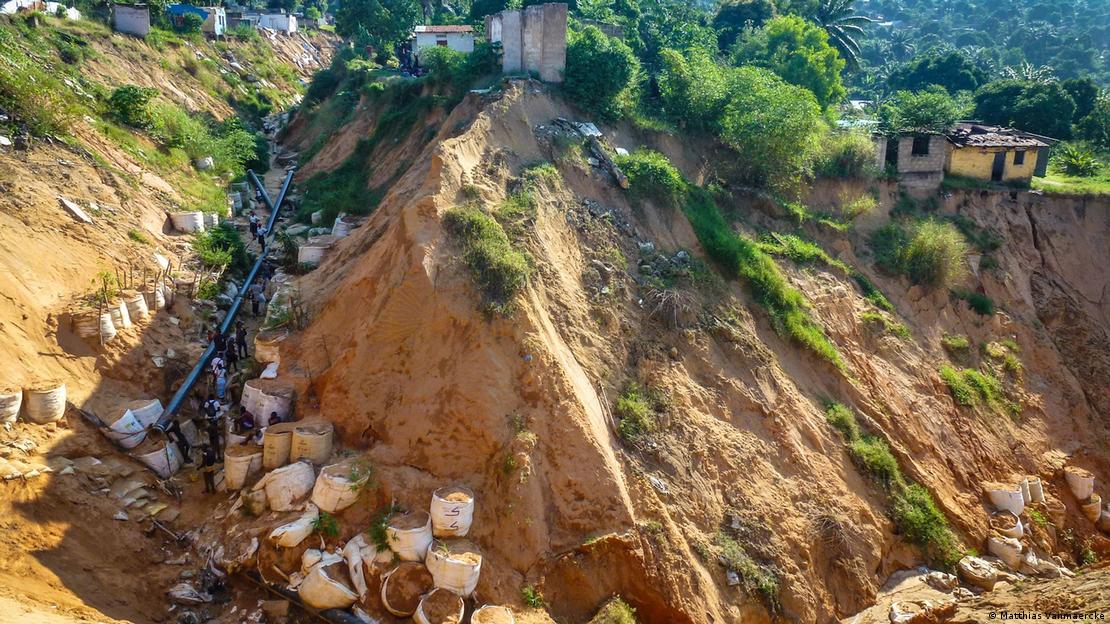
"There are local community initiatives aimed at trying to stabilize gully expansion," Mawe said. These include "planting bamboo and other vegetation to stabilize the soil, placing sandbags at the gully head, and digging pits or sometimes installing water tanks within plots to store runoff water."
But, Mawe said, these efforts often fall short and are not effective in stopping gully expansion.
"I think the most worrying and concerning thing: Once you live next to a gully, you basically become trapped ... because also the land value drops dramatically," Vanmaercke said.
With infrastructure to stabilize gullies costing over $1 million communities are working to prevent further erosion
Image: Matthias Vanmaercke
The most effective step, the researchers said, is to reduce the amount of water flowing into gullies in the first place.
For people living on the edge of a gully, every heavy rain brings the risk of losing their homes. Edited by: Chrispin Mwakideu Amy Stockdale Author and multimedia journalist from Northern Ireland.
Murder of the Dead. Page 2. In Italy, we have long experience of "catastrophes ... oppressor of the living, is the murderer also of the dead: "But as ...
Why TV weather forecasters are receiving online hate
Jennifer Collins
DW
16/09/2025 An email death threat marked the beginning of the end of one meteorologist's job. Experts say climate misinformation and conspiracy theories are fueling online hate.
Talking about the weather is no longer simply a matter of forecasting rain or shine — it has become political
Image: Chris Machian/Omaha World-Herald/AP Photo/picture alliance
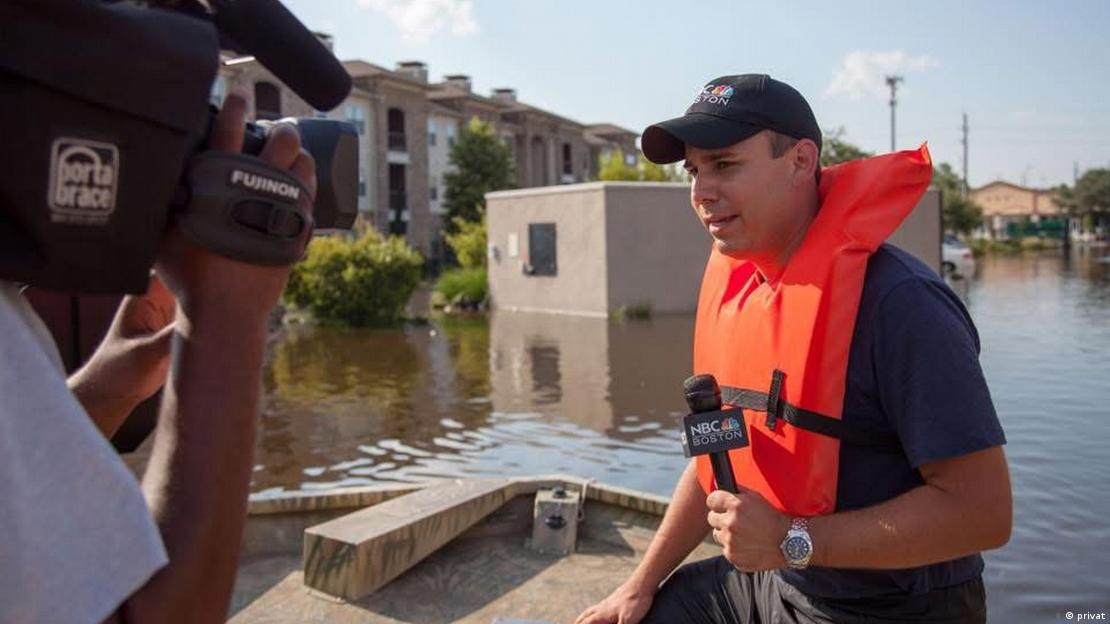
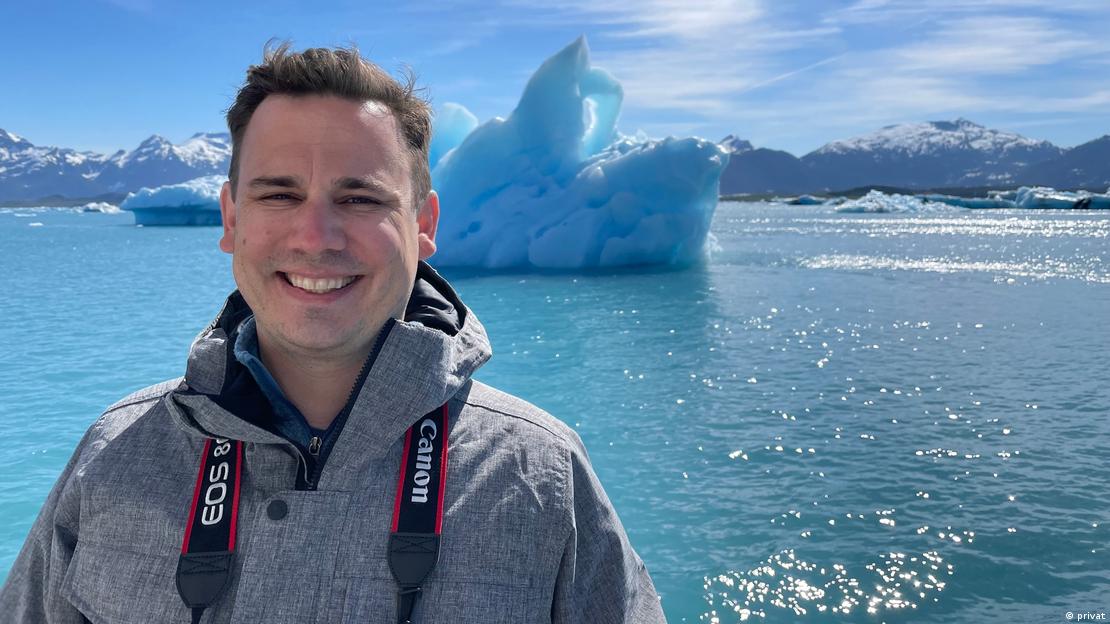
One morning, Chris Gloninger opened his emails to find a message from a viewer asking for his home address, saying they wanted to give him a welcome he would remember.
"My heart raced, and I felt paralyzed," said Gloninger, who at the time was presenting the weather on a TV station in Des Moines, in the Midwestern US state of Iowa.
The email referenced the case of a man who had been arrested for attempted murder of Supreme Court Justice Brett Kavanaugh, after showing up at his house with a gun and zip ties.
For Gloninger, it was the final straw after a string of harassment since taking the job as chief meteorologist. He called the police and rushed to a hotel with his wife. Rise in online hate targeting weather forecasters
As some of the most visible faces of climate change communication, TV weather forecasters have come to face heat from the rise in misinformation and conspiracies fueling online hate.
Viewing climate change as the most important issue of our time, Gloninger had actively championed its prominent inclusion in his TV work.
Gloninger enjoyed his job and sought to make the changing climate understandable to his audiencesImage: privat
After taking the Des Moines job, he tailored coverage to the more climate-skeptical leanings of Iowa, a state which been a conservative stronghold since the first election of President Donald Trump in 2016. He tried to link it to everyday experiences such as how drought might impact farmers in the largely agricultural area.
It was then that the emails started arriving in his inbox — at first the usual pushback and then ramping up to more aggressive threats. He noticed viewers were politicizing the science.
"They were saying, we're tired of this liberal agenda," said Gloninger. "It should never be about politics, because this is a science that has the support of 99% of its academic community."
A long history of misinformation
Today, climate misinformation and conspiracies are rampant online. This is despite overwhelming scientific consensus that climate change is causing more extreme weather that will only further escalate as global temperatures continue to rise.
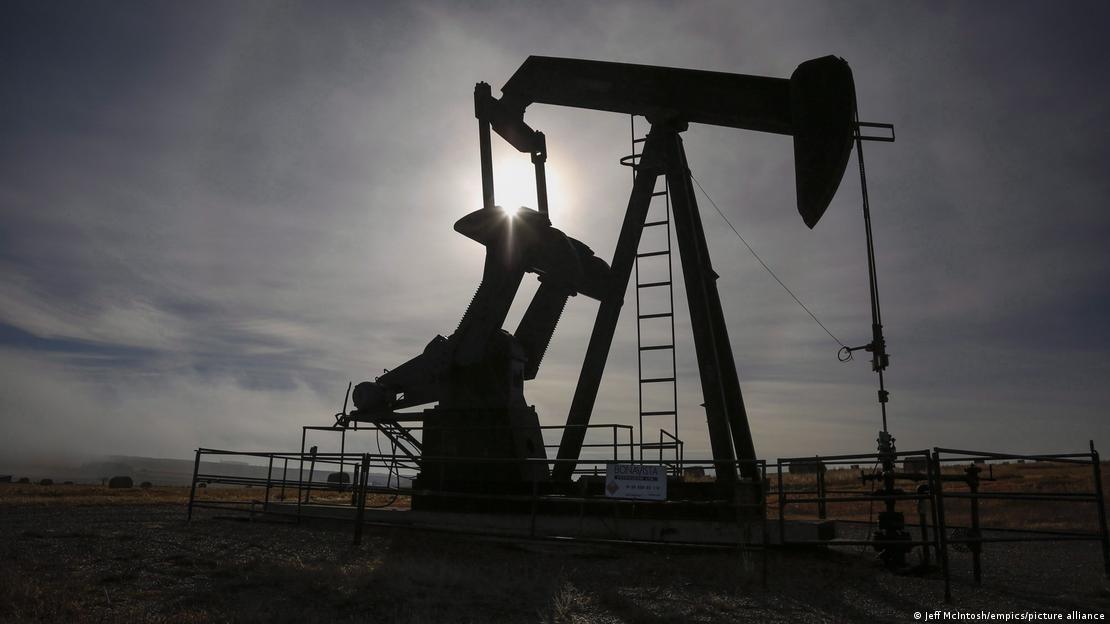
The roots of this can be traced back to the middle of the last century. Despite major fossil fuel companies uncovering the link between burning coal, oil and gas and global heating as early as the 1960s, many pursued an active strategy of denial and playing down the science.
Many fossil fuel companies were aware of climate change as early as the 1960s
Image: Jeff McIntosh/empics/picture alliance
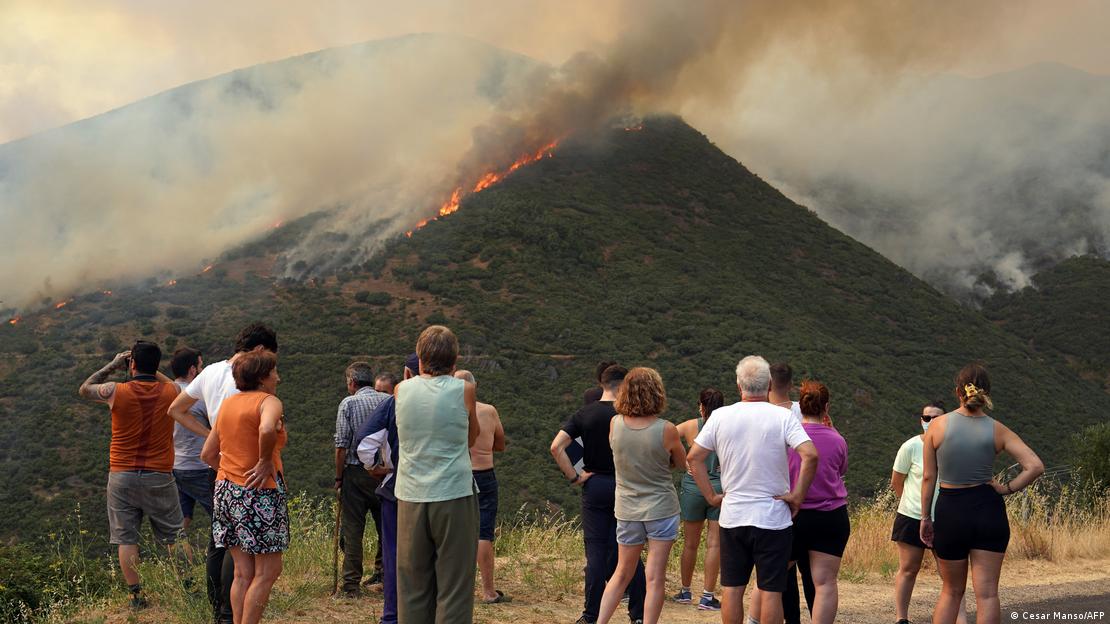
But as glaciers have melted, sea levels have risen and dangerous weather has intensified, that denial has become a harder sell. So instead, experts say misinformation has shape-shifted into a form of "delayism" — either by casting doubt on climate solutions or greenwashing companies to give the false impression that they are environmentally friendly.
Research in 2024 showed how fossil fuel and petrochemical companies spent millions on advertising that included misleading claims about their commitment to renewable energy. The sector actually spends just 1% of global investment on clean power and is actively exploring new oil and gas fields.
As climate change has become harder to deny, misinformation has shifted to 'delayism'
Image: Cesar Manso/AFP
Complex web of misinformation actors
The networks behind climate misinformation have become very intricate, said Ece Elbeyi, a researcher at the University of Copenhagen in Denmark.
It not only involves those with a vested interest in slowing climate action working with lobbyists and think tanks, but can include media outlets, trolls, Russian bot-farms, and influencers amplifying misinformation on social media platforms, where algorithms favor emotionally charged messaging.
Experts say political actors have exploited climate misinformation
Political actors, particularly those with nationalist or conservative platforms, have exploited misinformation to mobilize their base, said Elbeyi. "They might not explicitly deny climate change, but they frame climate solutions, like for instance international agreements or carbon regulations, as threats to national sovereignty or economic freedom."
Rallying against climate action has become an identity issue and therefore more difficult to challenge, said Elbeyi. Political identity, they added, is one reason a person might share misinformation or send angry messages to someone like Gloninger.
Fertile ground for conspiracy theories
Sometimes misinformation can veer into wild conspiracy theories, which can be particularly attractive to people with high levels of paranoia, insecurity or egocentricity, explained Daniel Jolley, an associate professor in psychology at the University of Nottingham.
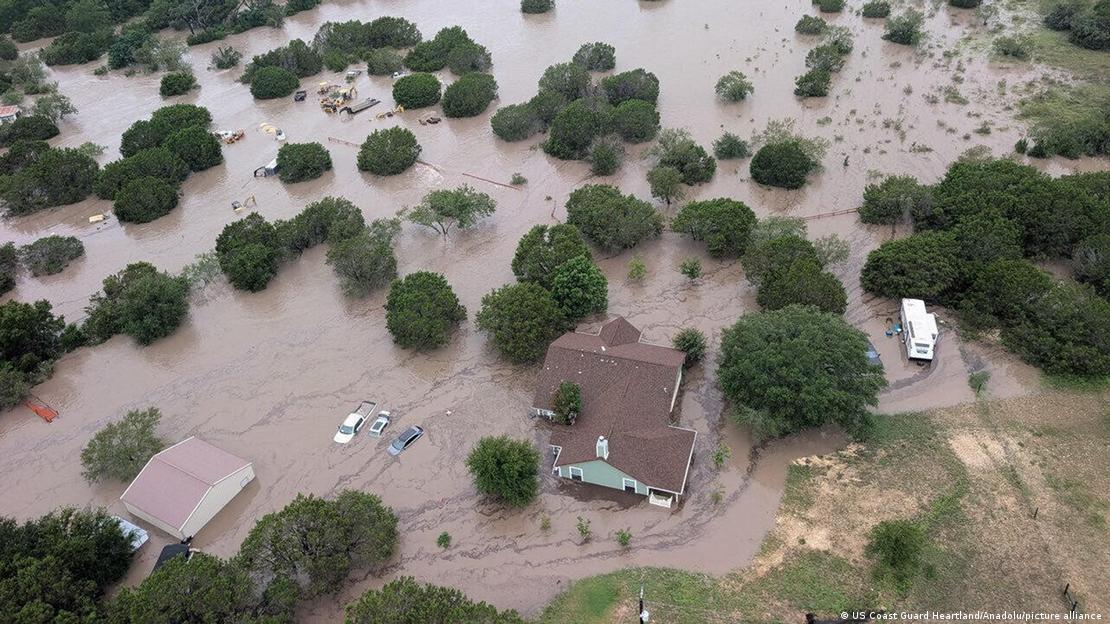
Jolley said conspiracies can often make people feel more valued or comforted by painting another powerful group as "evil," adding that they often spike after disasters.
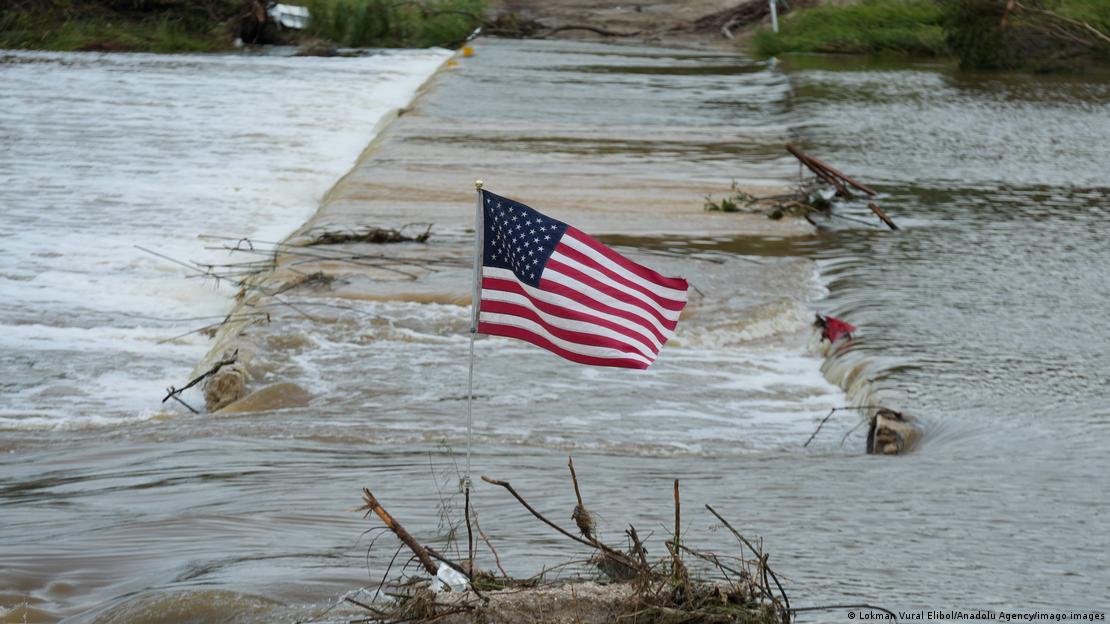
After the deadly Texas flash flooding this summer, conspiracy theories surged
Image: US Coast Guard Heartland/Anadolu/picture alliance
"People are trying to explain issues that are massive, issues that make us feel uncertain, anxious and perilous," said Jolley.
Jolley expects that because our climate is changing, misinformation and weather conspiracies will become increasingly prominent.
Meteorologists are among the most visible when it comes to communicators of climate science and therefore often come to bear the brunt of attacks, he said. What can be done to stop misinformation?
Both Jolley and Elbeyi see education as key to identifying misinformation.
Elbeyi said this must involve vulnerable groups in debates because the misinformation tends to thrive when groups feel decisions are made without, or even against, them. "And this exclusion can directly erode public trust in scientists and science more generally."
When it comes to conspiracy theories, building trust and being empathetic to why people may have those beliefs is a better tactic than debunking, said Jolley. He said support is also needed for those, like Gloninger, on the receiving end of abuse.
Gloninger ultimately gave up his dream job due to the impact of threats against him
Image: privat
In the aftermath of the death threat, Gloninger sought therapy and was diagnosed with post-traumatic stress disorder — or PTSD. He couldn't sleep and his health deteriorated, leading to a skin condition.
The police caught the perpetrator and fined him $150 (€129). Meanwhile, back at the TV station, Gloninger continued his work. But after management received a flood of emails from what he calls a loud minority, he was told to stop mentioning climate change.
Gloninger made the choice to leave his job rather than stay and ignore climate change. He said he still finds the decision hard to talk about.
Yet he did feel he made some impact in bringing climate change awareness to a new, conservative audience. He has kept a large folder filled with positive messages from viewers.
He thinks it would be a mistake if climate communicators and weather reporters backed off now because of online hate.
"I do think that there's less coverage of climate change because of the fear of retaliation," said Gloninger "And I encourage meteorologists to double down."
Edited by: Tamsin Walker
Holly Young adapted this story from an episode of DW's Living Planet podcast. Find the audio version here.
Photoclimat: Paris streets a canvas for stories of a planet in peril Giant portraits of forest guardians stare down from Paris’s city squares. Images of threatened landscapes line the riverbanks, while wooden yurts have been turned into pop-up pavilions. Photoclimat, a grassroots photo biennale, has transformed the French capital into an open-air gallery where photography and activism collide.
Issued on: 15/09/2025 - 14:14Modified: 15/09/2025 - 14:39
Now in its third edition, Photoclimat brings together 47 artists from around the world. Their installations trace the work of non-profit groups tackling climate change, protecting biodiversity and defending communities on the frontlines.
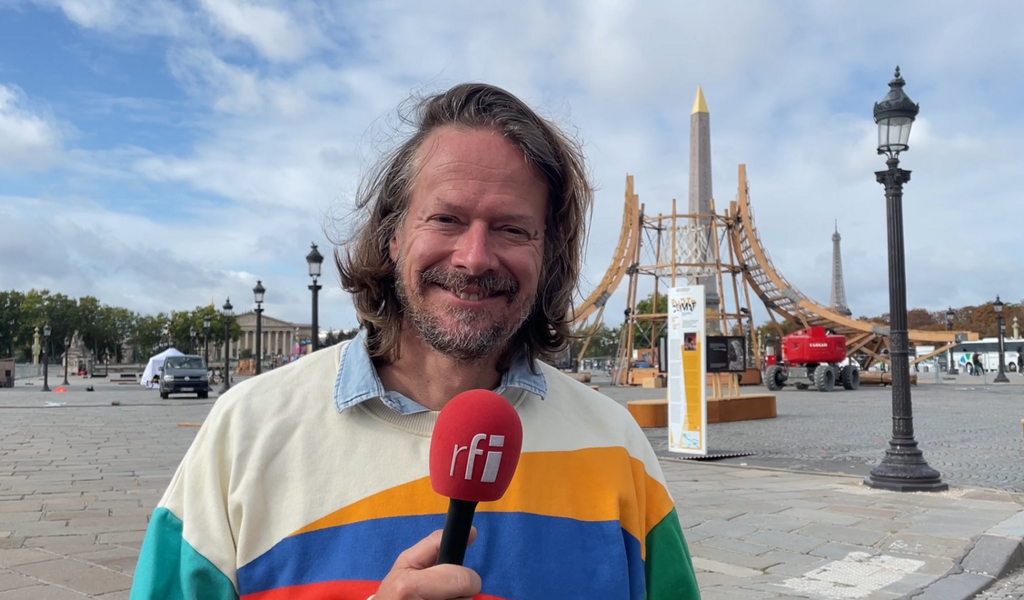
The Biennale was created in 2021 by French photographer Nicolas Henry, a member of Le tour d’un monde (A Journey Around a World), a cultural association that develops artistic projects with a social focus.
He says the idea is to use art as a bridge to the work of NGOs.
“The idea of this project is to combine the strength of artistic talent together with the stories of the work done by NGOs. We want to really wake people up – raise awareness,” he told RFI.
He hopes visitors will go further – learning more about the organisations, volunteering or donating.
“But it’s also all about giving meaning to what we do, bringing joy and a good mood that can transform people’s lives. It gives us a sense of direction and a sense of community,” he says.
Henry believes photography can open the door to difficult issues, especially for younger audiences. And photographry is a powerful tool to begin a discussion.
“It’s a way to introduce these NGOs to the younger generation who may not have heard of them – encouraging them to become ‘actors of society’ when it comes to ecology and social progress,” he says.
One of the headline works sits at Place de la Concorde. It is “Les Voix des Fôrets” (Voices of the Forest), a series by young Filipino photographer Gab Mejia. His black-and-white portraits are displayed on a circular wooden pavilion that doubles as a meeting space for artists.
Mejia worked with Laure d’Astorg from the French NGO Alliance pour la Préservation des Fôrets (Alliance for Forest Preservation) to find a way to celebrate the people behind the mammoth task of saving the world’s endangered forests.
“I wanted the work to share their messages and to transmit a call to action of what we can do to preserve the forests all across the world,” Mejia told RFI.
He says the Philippines, one of the world’s most biodiverse countries, has vast primary forests under threat. “It’s part of our identity; we have indigenous communities and local communities who really rely on the forest in the Philippines and the islands.”
Among his subjects was Hernando Chindoy, a Colombian leader working with the Alliance to fight deforestation. Mejia combined photography with digitally rendered sketches to portray the activists.
For d’Astorg, there’s the public message battle, and then there’s the legal one behind the scenes.
Her organisation strives to make sure raw materials derived from the forests, like wood, coffee, cacao are sustainably sourced.
“Forests are in danger, forests in Europe, but also in Amazonia and Basin of Congo and Southeast Asia," she says.
"The planet is burning and we really need to bring this message and this fight can only be won together with the businesses and the NGOs. We really need to work together to stop deforestation.”
Elsewhere at Photoclimat, visitors can see British photographer Tim Flach’s portraits of animals, the bold colours of Ghanaian artist Prince Gyasi and the abstract work of Dutch photographer Sanja Marusic.
On the banks of the Seine, other installations focus on oceans and rivers, underscoring the efforts of people and organisations working to protect them.
For Nicolas Henry, Photoclimat is just the beginning of a conversation: a wake-up call he hopes will transform awareness into meaningful action.
Photoclimat runs until 12 October – spanning 6 locations in central Paris and several locations in the Paris suburbs.