Tuesday, September 16, 2025

Protesting Peru residents block trains to Machu Picchu


By AFP
September 15, 2025


Machu Picchu receives some 4,500 visitors on average each day, many of them foreigners - Copyright AFP/File Carolina Paucar

Train services to the Inca citadel of Machu Picchu, Peru’s main tourist attraction, were suspended Monday as protesting residents placed logs and rocks on the tracks, police and PeruRail said.

A UNESCO World Heritage Site since 1983, the ancient fortified complex receives some 4,500 visitors on average each day, many of them foreigners, according to the tourism ministry.

Authorities have not given a figure for stranded tourists or an evacuation plan.

Residents are demanding that a new company be chosen to run the buses that ferry visitors from the Aguas Calientes train station at the foot of Machu Picchu, to the site itself.

Visitors arrive at Aguas Calientes from the city of Cusco — the Inca empire’s ancient capital — some 110 kilometers (68 miles) away.

The previous bus firm’s contract had come to an end after a 30-year concession, but services have continued — presumably by the same company.

Residents similarly pressed home their social demands in January last year, when some 1,200 tourists had to be evacuated from Machu Picchu — some without ever laying eyes on the site.

A year earlier, Machu Picchu was closed for 25 days during protests over the impeachment and arrest of then-president Pedro Castillo.

Machu Picchu was built in the 15th century at an altitude of 2,500 meters (about 8,200 feet) on orders from the Inca ruler Pachacutec.

It is considered a marvel of architecture and engineering.

Tourism is key to the economy of Peru.


Denmark may buy Boeing aircraft for Arctic surveillance, defence minister says

By Reuters
September 16, 2025 at 8:03AM EDT

A Boeing 737 Max jet prepares to land at Boeing Field following a test flight in Seattle
 (AP Photo/Elaine Thompson, File)

Denmark’s defence minister said on Tuesday the country’s military may buy a fleet of Boeing P-8 submarine-hunting maritime patrol aircraft to help boost the surveillance of the Faroe Islands and Greenland.

Denmark could potentially spend an amount corresponding to billions of dollars on an acquisition, Troels Lund Poulsen said, part of the Nordic nation’s plan to sharply boost its military hardware.

“I would prefer that we collaborate with other NATO countries in order to get the most value for our money and to have a greater degree of flexibility,” Poulsen said in a statement to Reuters.

“But if that proves impossible, then I am also willing to accept that we will have to acquire this P-8 aircraft capacity ourselves,” he said.

Danish broadcaster TV2 first reported the news late on Monday.

The defence ministry declined to comment on Tuesday on the exact sum it may spend or how many aircraft it could buy. Any acquisition must first be approved by parliament.

Poulsen said the threat level in the Arctic was increasing and that it was necessary to get a better picture of movements around Greenland and the Faroe Islands, both semi-autonomous Danish territories.

Russian and Chinese state vessels have appeared unexpectedly around Greenland in the past and U.S. President Donald Trump has accused Denmark of failing to keep the island safe from potential incursions. Both Russia and China have in the past denied any such plans.

(Reporting by Louise Breusch Rasmussen, editing by Terje Solsvik)
U.S. opens probe into 174,000 Tesla Model Y cars over door handle failures

TOO MUNDANE TO CORRECT

By Reuters
 September 16, 2025 

Tesla's Model Y is displayed at Tesla's design studio in Hawthorne, Calif. 
(Jae C. Hong / AP)

WASHINGTON — The U.S. National Highway Traffic Safety Administration said on Tuesday it had opened an investigation into about 174,000 Tesla Model Y cars from the 2021 model year over reports that electronic door handles can become inoperative.

NHTSA said it had received reports citing an inability to open exterior doors, including after parents exited the vehicle to remove a child or to place a child in the rear seat before starting a trip.

Tesla did not immediately respond to a Reuters request for comment.

NHTSA’s preliminary evaluation is the first step before the agency could seek a recall of the vehicles if it believes they pose an unreasonable risk to safety.

NHTSA said it has nine reports of parents being unable to open doors on 2021 Tesla Model Y vehicles. In those reports, parents were unable to reopen a door to regain access to the vehicle and in four instances parents resorted to breaking a window to regain entry into the vehicle.

The agency noted that Tesla vehicles have manual door releases inside, but children may not be able to access or operate the releases even if the vehicle’s driver is aware of them.

NHTSA said its initial review suggests this condition appears to occur when the electronic door locks receive insufficient voltage from the vehicle. The agency said repair invoices report replacement of the vehicle’s low voltage battery after incidents, but no owners reported seeing low-voltage battery warnings prior to exterior door handles failing.

(Reporting by Disha Mishra in Bengaluru; Editing by Anil D’Silva, Pooja Desa and Chizu Nomiyama i)
It’s ‘do or die’ for electric vehicle maker Rivian as it breaks ground on a US$5 billion plant


By The Associated Press
September 16, 2025 

A long line of unsold 2024 R1S electric utility vehicles sits at a Rivian service center Nov. 26, 2024, in east Denver. (AP Photo/David Zalubowski, File)

ATLANTA — It seems like a terrible time to build an electric vehicle plant in the United States, but Rivian Automotive leaders say they’re confident as the company starts long-delayed work on a US$5 billion facility in Georgia.

The money-losing California-based company breaks ground Tuesday east of Atlanta despite U.S. President Donald Trump’s successful push to roll back electric vehicle tax credits. Starting Sept. 30, buyers will no longer qualify for savings of up to $7,500 per car.

Rivian Chief Policy Officer Alan Hoffman said the company believes it can sell electric vehicles not for environmental or tax incentive reasons, but because they’re superior.

“We did not build this company based upon federal tax incentives,” Hoffman said. “And we’re going to prove that we’re going to be successful in the future.”

Georgia plant is key to a mass market and profitability

The Georgia plant, first announced in 2021, is Rivian’s key to reaching profitability. Now the company makes the high-end R1T pickup truck and the R1S sport utility vehicle in Normal, Ill., as well as delivery vans for Amazon and others. Its truck prices start at $71,000.

The Illinois plant will begin making smaller R2 SUVs next year, with prices starting at $45,000. An expanded Illinois plant will be able to assemble 215,000 vehicles yearly. But if the R2 is a hit, and if Rivian successfully produces an even smaller R3, it will need more capacity. The company has said the Georgia operation will be able to make 200,000 vehicles yearly starting in 2028. It plans another 200,000 in capacity in phase two, volume that would spread fixed costs over many more vehicles.

The projections would be a big leap from the 40,000 to 46,000 vehicles Rivian expects to deliver this year, down from 52,000 last year. The company says it’s limiting production now in part to launch 2026 models.

“For Rivian, it’s do-or-die time,” said Alex Oyler, North American director of auto research firm SBD Automotive. “We saw with Tesla that the key to profitability is scale, and you can’t scale if your cheapest vehicle is $70,000. So they need that plant online to achieve a level of scale of R2 and ultimately R3.”


Challenges in the electric vehicle market

Sales growth is slowing for electric vehicles in the United States, rising only 1.5 per cent in 2025’s first half, according to Cox Automotive.

Tesla accounted for almost 45 per cent of U.S. electric vehicle sales in that period, according to Cox. But the giant is losing market share as others gain: General Motors’ slice of American EV sales has climbed to 13%. By comparison, Rivian had a three per cent share in the first half of the year, behind Tesla and six traditional automakers.

But excluding Tesla, Rivian is the most successful of the startup automakers.

The company initially tapped a largely unfilled niche: demand for electric pickups and SUVs. But the competition now includes Ford’s F-150 Lightning and the electric Chevrolet Silverado.

After an initial public offering in 2021, Rivian shares have fallen by more than 80%, while automaker shares overall have outpaced the broader stock market. Rivian lost $1.66 billion in 2025’s first half.

At the same time, some automakers’ ardor for electric vehicles is cooling. Stellantis last week canceled Ram’s electric truck program. Ford has delayed production at a new Tennessee plant. And General Motors abandoned plans to build electric vehicles at a suburban Detroit plant.


“With all the competition out there in this market and the slowing growth of EVs, it does not play in Rivian’s favor,” said Sam Fiorani, a vice president at AutoForecast Solutions. “However, there still is an EV market out there.”

$1.5 billion in incentives for 7,500 jobs

Georgia has pledged $1.5 billion of incentives to Rivian in exchange for 7,500 company jobs paying at least $56,000 a year on average. Rivian can’t benefit from most incentives unless it meets employment goals, but the state is already spending $175 million to buy and grade land and improve roads.

Georgia Republican Gov. Brian Kemp, who has said he wants to make Georgia “the electric mobility capital of America,” acknowledges Rivian faces bumps, but says he remains confident the company can fulfill its promises.

While Tesla has thousands of employees in California and Texas, some new electric vehicle plants have sputtered. Two separate EV makers that hoped to assemble vehicles in a former GM plant in Lordstown, Ohio, went bankrupt. Georgia’s Hyundai complex near Savannah is faring better, with production underway. However, a battery plant there has been delayed by U.S. Immigration and Customs Enforcement arresting 475 people on site, including more than 300 South Koreans.

Rivian was supposed to be making trucks by now at the 2,000-acre (800-hectare) site near Social Circle, about 45 miles (70 kilometers) east of Atlanta. As the company burned through cash in 2024, it paused construction. But German automaker Volkswagen agreed to invest $5.8 billion in Rivian in exchange for software and electrical technology. And then-President Joe Biden’s administration in November agreed to loan Rivian $6.6 billion to build the Georgia plant.

Despite the Trump administration’s hostility toward EVs, Hoffman said Rivian hopes the U.S. Department of Energy will distribute the loan money, arguing it will boost domestic manufacturing.

Some neighbours still oppose the plant


Rivian also faces opposition from some residents who say the plant is an inappropriate neighbor to farms and will pollute the groundwater.

“I planned on dying and retiring on the front porch and the biggest project in Georgia has to go next door to me, of all places in the country?” asked Eddie Clay, who lives less than a mile away. He says his well water turned mud-choked after excavation at the Rivian site.

There are other challenges for Rivian, including tariffs costing $2,000 per vehicle, the Trump administration ending a tax-credit program that will cost the company $140 million in revenue this year, and long-term threats from low-priced, cutting-edge Chinese EVs. But Hoffman says Rivian is “in this for the long haul.”

“We think that we can compete with anyone out there and that once given the opportunity, we’re going to excel,” he said.

Jeff Amy And Alexa St. John, The Associated Press
Ford to drop up to 1,000 jobs at German plant as demand for electric cars in Europe lags forecasts

By The Associated Press
September 16, 2025 


FRANKFURT — Ford Motor Co. said Tuesday it would cut up to 1,000 jobs at its electric auto plant in Cologne, Germany due to lower than expected demand for battery-powered cars.

The job reduction would be carried out so far as possible with voluntary departures and buyouts, the company said. It follows a restructuring announced in November 2024 that would reduce Ford’s workforce by 4,000 positions in Europe and the UK, with 2,900 of those jobs lost in Germany.

The company said it was continually evaluating production volumes and adjusting them to demand. “In Europe, the demand for electric cars is significantly below industry forecasts,” it said. The plant, which makes an electric version of the Explorer SUV, would move to one shift per day instead of two beginning in January, the company said in a statement.

Electric vehicles captured 15.6 per cent of the European market in the year through July, up from 12.5 per cent in the same period last year. Growth has been slower than expected, in part due to the withdrawal of purchase subsidies in Germany. Ford sold 260,00 vehicles of all types in the first seven months, up 0.7 per cent, and maintained its market share of 3.3 per cent, according to the European Automobile Manufacturers’ Association.

The Associated Press


Trade dispute, consumer spending slowdown hurting small Canadian  businesses: Equifax

Equifax Canada's latest business credit trends report says more than 286,000 businesses missed at least one credit payment in the second quarter, up 5.6 per cent from a year ago.


By The Canadian Press
 September 16, 2025 

 People make their way around the Rideau Center Ottawa,
 THE CANADIAN PRESS/Spencer Colby

TORONTO — A new report shows some small businesses across Canada are facing challenges as consumers cut back on spending and navigate a complicated trade landscape.

Equifax Canada’s latest business credit trends report says more than 286,000 businesses missed at least one credit payment in the second quarter, up 5.6 per cent from a year ago.

Jeff Brown, head of commercial solutions at Equifax Canada, says small businesses are navigating a complex environment.

He says sectors tied to international trade and consumer discretionary spending are under stress, while other businesses are holding steady or even improving.

Equifax says delinquency levels in consumer-sensitive industries — such as accommodation and food services, retail trade, and arts and entertainment — remain elevated year-over-year.

Brown says the cost of essentials such as groceries and rent continues to climb, which limits household discretionary spending and, in turn, hurts businesses that provide non-essential goods and services.

This report by The Canadian Press was first published Sept. 16, 2025.

Ritika Dubey, The Canadian Press


NUCLEAR TRILATERALISM

Canada-US-UK Nuclear regulatory cooperation: Lessons so far


World Nuclear News

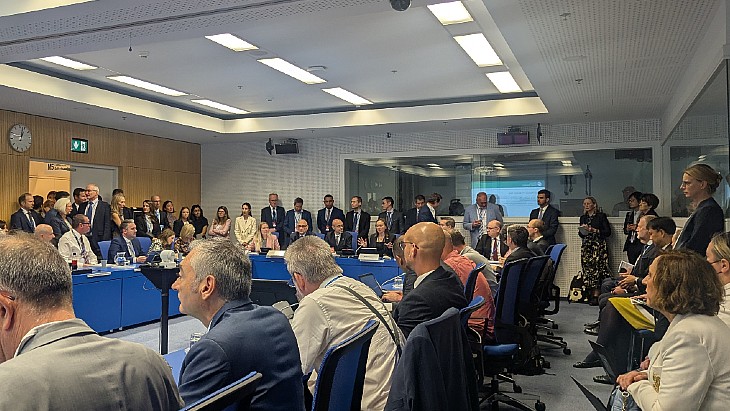
Senior figures from the three countries' regulators say that it takes time to establish mutual trust, but the benefits of sharing technical information has helped speed assessment processes and stress that the regulatory decision remains a sovereign one.
(Image: World Nuclear News)

The UK's ambassador to the international institutions in Vienna, Corinne Kitsell, opened the side event at the International Atomic Energy Agency's 69th General Conference by setting out the goal "to focus on how international collaboration between regulators can create more efficient, harmonised approaches to reactor design assessment, benefiting both industry and global nuclear safety, security, and safeguards".

She said that the key to making small modular reactors successful was regulation - "we must have a robust, yet agile, regulatory environment. We need to ensure the highest standards of safety, security and safeguards while enabling efficient global deployment".

She also noted that in addition to the trilateral collaboration between the UK, USA, and Canada, a memorandum of understanding had been signed this week by the UK's Office for Nuclear Regulation and the US Nuclear Regulatory Commission, which aimed to enable the "safe, efficient and accelerated deployment of next generation nuclear technologies".

Diego Lisbona, Head of Regulation for Advanced Nuclear Technologies at the UK's Office for Nuclear Regulation (ONR), said the UK Nuclear Regulatory Task Force had earlier this year "made strong recommendations for streamlined approaches" and "we recognise that we have a role to play to reduce unnecessary burden to focus on risk and accelerate and streamline regulatory assessment and approvals".

He noted the estimated 30% benefit of replication of units at Hinkley Point C and said "regulators should harness the benefits from replication and international cooperation, so when the regulators for like-minded countries are assessing the same design and the same timeframe, we can realise those efficiencies".

As an example, he said that there were five countries observing the design assessment process being carried out in the UK for the Rolls-Royce SMR.

Ramzi Jammal, Executive Vice-President and Chief Regulatory Operations Officer, Canadian Nuclear Safety Commission, stressed that the collaboration between Canada, the USA and the UK "did not happen overnight ... we started this discussion bilaterally around 2008".

He said that collaboration had not been easy and there had to be cultural changes and a lot of time spent to understand each other's processes and to build trust in the work of the other countries' regulators.

With that trust established in technical information being "solid", what "we're talking about is the fundamental principle of transportability of the technical information, but the regulatory decision stays national".

Mike King, acting Executive Director for Operations at the US Nuclear Regulatory Commission, said: "When a developer decides to develop a design with an intent to export that design in multiple countries, they are focused on trying to match as many of the regulatory requirements in the countries that they might deploy in. And so it's a natural opportunity for regulators for those countries to come together and, recognising their sovereign differences, explore ways to harmonise as much as possible to leverage each other's technical capabilities. And I think we've cited a couple of examples where even with one or two designs that we've had experience with so far, collaboration between the UK, US, and Canada, we've identified some significant efficiency gains. And so I think that's an early indication of the potential real opportunities down the road."

He echoed his Canadian counterpart's point about building trust: "It's one thing to establish an MoU ... it's another thing when you start digging into the design and you get your technical staff involved with the reviews. Initially, what we found is they were very cautious about trusting each other's opinions. But as you build more of these relationships over time, and build that trust relationship, you understand you're all trying to achieve the same goal. What we found was over time, we were more comfortable embracing each other's technical work and viewing it in a value-added context instead of more of a questioning kind of context."

The small number of countries/regulators involved helped with building the trust, he said, and said you also need the technology vendor's "willingness to share proprietary information". The example given of benefits was a 30% reduction in time in the UK relating to the review of the GE Vernova Hitachi BWRX-300 small modular reactor.

The UK's Lisbona said that when they engage with vendors and technology providers, they now discuss, where relevant, what stage they have got to in the US or Canadian process and what changes they might be proposing for the UK and have "frank discussions" aimed at aligning the "design preferences, scopes and timeliness that enable the realisation of efficiencies".

As far as wider international cooperation, Canada's Jammal said the collaborating regulators had to have the same maturity, experience and so they are all on the same level - "we are open to support, but if it's going to slow us down ... we're not doing ourselves any service ... we want to do it where there is a return from our collaboration".

Michelle Catz, GE Vernova Hitachi Nuclear Energy, asked the panel about the impact of the US President's executive orders and proposed sunsetting of some regulations and the impact on collaboration when other countries still had those regulations.

The US NRC's King said there were restrictions on what could be shared at the moment, but he said that they intended to ensure, during the review of regulatory requirements, "that we don't do it in a way that would disrupt things that are already on-going".

Another questioner asked whether there was potential in future for countries to accept the licensing approval in a different country. All replied that regulators would retain sovereignty over decisions in their country - the collaboration was more focused on sharing technical reports, assessments and information.

King said the key was to start early, to understand the differences between regulatory requirements.

The UK's Lisbona said, "it's not blind acceptance, it's acceptance of elements where they are understood and they are shared and have been checked with an appropriate level of due diligence". He said that his advice was to "plan, plan and plan early for international cooperation ... vendors, think about what jurisdictions you want to deploy in, what timescales, what your reference design is and plan for that and start those conversations early".

The US's King said: "I think from our experience we've kind of aligned that there's a lot of benefit to these arrangements, but I'll just reinforce a key point that benefit needs to be there for all entities involved. You've got to be at the right point in time with your own regulatory infrastructure. You've got to have the right developers at the right stage of maturity engaging you ... we're all stretched resources-wise as regulators, we have to spend time where we think it benefits us the most."

GUNBOAT DIPLOMACY

U.S. Jets Deployed to Guyana as Oil Boom Raises Caribbean Stakes

The U.S. has deployed fighter jets to Guyana, drawing its military footprint into the world’s fastest-growing offshore oil province as tensions with neighboring Venezuela escalate, as Washington adjusts its regional posture to accommodate the changing balance of power in the south Caribbean due to newfound oil wealth. 

The move comes as ExxonMobil and partners Hess and CNOOC continue expanding production from Guyana’s Stabroek block, which already exceeds 650,000 barrels per day and is forecast to reach 1.3 million bpd by 2027. That trajectory has made the country the hottest new oil frontier, with output rivaling OPEC members despite Guyana’s population of under 1 million. Any instability in its offshore zone has immediate global implications, with light sweet crude from Stabroek commanding strong premiums in Atlantic Basin markets.

Venezuela has revived claims over the Essequibo region, which comprises two-thirds of Guyana’s territory and lies adjacent to offshore oil fields. Caracas has staged military exercises near the border and raised threats to halt oil projects it views as contested. In his latest response, Venezuelan President Nicolás Maduro warned that any U.S. aggression would trigger “a stage of armed struggle,” casting Washington’s deployments as a direct challenge to Venezuelan sovereignty.

The deployment also comes just days after President Irfaan Ali secured a second term in Guyana’s elections, reinforcing a mandate built on expanding the benefits of oil production for the population. His administration has tied new spending on infrastructure and social programs to petroleum revenues, with voters backing continuity in energy policy.

Reuters separately reported that the Pentagon has been repositioning assets in the Caribbean, including F-35s in Puerto Rico, as part of a broader counter-narcotics mission. While officials frame deployments in that context, analysts note that the geography of operations directly overlaps with Guyana’s offshore sector, where more than 30 discoveries have been made since 2015.

Energy executives privately warn that insurance costs and investor sentiment could be rattled if military tensions worsen. For now, the U.S. presence is viewed as a signal of backing for Guyana’s government as it manages both rapid oil development and mounting regional pressure.

By Charles Kennedy for Oilprice.com


First Nigerian Gasoline Cargo Arrives in U.S.

The first cargo of Nigerian gasoline produced at the Dangote refinery has reportedly arrived at its destination in the United States.

Reuters, citing unnamed sources in the know and ship-tracking data, said the gasoline cargo was arranged by Sunoco and commodity trader Vitol. VesselFinder reported that Gemini Pearl, a Panama-flagged oil product carrier, was currently located in the Port of New York, arriving there on Sunday.

Most of the cargo, which stands at 320,000 barrels, was sold to Sunoco, with Vitol set to keep the rest for itself.

Reuters further reported that another cargo of gasoline produced at the Dangote refinery had been sold by Glencore to Shell and was set to be delivered in New York on September 19.

The publication noted in its report that the two cargoes were evidence that the Dangote refinery had met the strict U.S. requirements for the quality of fuels that can be marketed in the United States. According to Reuters, it was a major milestone for the Nigerian refinery.

The 650,000-barrels-daily refinery is the first in Nigeria, property of Africa’s richest man, Aliko Dangote, whose ambition is to both secure fuel supply for the domestic market in Africa’s top crude oil exporter, and turn the country into a fuel exporter as well. The refinery’s capacity should allow it to satisfy domestic demand in full and export the excess.

The first fuel cargo out of Nigeria was reported in June, with the destination said to be in Asia. Then, earlier this month, the Dangote facility had to suspend gasoline production because of a problem with its catalytic cracking unit.

Meanwhile, Nigerian media reported the refinery had exported a total of .1 billion liters of gasoline in the three months from June and the first week of September, hitting a major export milestone.

By Irina Slav for Oilprice.com

 WAIT, WHAT?!

California Passes Bill to Boost Oil Production Amid Refinery Shutdowns

THEY BUY ALBERTA CRUDE

California lawmakers this weekend passed Senate Bill 237, a sweeping measure designed to revive in-state crude production in response to declining refining capacity, rising import dependence, and widespread concern about gasoline prices. The new law allows up to 2,000 new oil well drilling permits per year in Kern County beginning January 2026, with the explicit objective of pushing California oil producers to supply close to 25% of the crude used by the state’s refineries.

According to the California Energy Commission, the state produces approximately 119,000 barrels per day (bpd) of crude oil, which currently supplies around 23% of crude feedstocks for its in-state refineries. That means nearly three-quarters of its crude comes from out-of-state, fueling concerns about supply stability and cost.

The loss of refining capacity in California has only added to the need for reform, with two major refineries set to shut down by late 2025 or April 2026. Combined, these closings are expected to remove about 17% of the state’s gasoline production capacity, greatly increasing California’s reliance on imported fuels. 

SB 237 reflects shifting political priorities in Sacramento. With Governor Gavin Newsom widely anticipated to run for president in 2028, gas prices at the pump have become especially politically sensitive. Lawmakers are under pressure from constituents, particularly as refining capacity drops and fuel supplies tighten.

Opponents of the bill warn that it will undermine environmental protections, increase local pollution, and may do little to actually lower gas prices. They point out that refinery closures stem not only from lack of crude supply but from regulatory, market, and climate policy pressures. Even with increased oil well permits, the bottlenecks of refinery capacity, transportation, blending requirements, and environmental compliance may still limit how much benefit accrues to consumers.

Starting in January 2026, Kern County will become the focal point for implementation. The practical effects will depend heavily on how quickly well permits are approved, how much additional crude is produced, and whether refineries can ramp up or sustain operations. At the same time, closures of Phillips 66 and Valero refineries may leave physical infrastructure gaps that simply cannot be immediately filled, especially given California’s unique fuel specification requirements and environmental regulatory environment.

By Charles Kennedy for Oilprice.com