Thursday, September 25, 2025

Nigerian women push for ‘Special Seats Bill’ to boost political representation

Issued on: 24/09/2025


Hundreds of women from across the country gathered in the Nigerian capital this week in support of those leading a push to introduce a quota for female legislators. Currently, only four out of 109 senators and 16 out of 360 House of Representatives members are women. The "Special Seats Bill" would allocate one additional seat for a woman in both the House and Senate in each of the country's 36 states and the Federal Capital Territory. However, this ambitious push has encountered obstacles before. We speak to Brenda Anugwom, CEO of the Nigerian Women's Trust Fund.


Also in this edition:

Supporters of Malawi's former president, Peter Mutharika, celebrated on Wednesday when his rival, incumbent leader Lazarus Chakwera, conceded defeat in last week's vote. Mutharika secured his return to power with 56.8 percent of the vote in an election dominated by the soaring cost of living. However, even before the official results were announced, Chakwera revealed that he had phoned Mutharika to congratulate him on his victory and wish him well. Chakwera's MCP party had claimed there were irregularities in the polling, but calls for the electoral commission to delay the release of results were rejected. In his concession speech, Chakwera said that the anomalies did not mean that Mutharika's win did not reflect the will of the people.

Finally, in the Republic of Congo, young people are at the forefront of efforts to protect their coastal environment. Many have joined forces for a programme that tackles the issue of plastic waste polluting their shores.


14:19 min PLAYING TIME 

Colombia's top drug cartel in decline, may lay down arms: negotiator

Bogotá (AFP) – Colombia's largest drug-trafficking cartel has reached its "peak" and is entering a decline that could see it lay down its arms, a government negotiator involved in peace talks with the group told AFP.


Issued on: 25/09/2025 - FRANCE24
Colombian government negotiator Alvaro Jimenez says the country's largest drug-trafficking cartel has reached its "peak" and is entering a decline that could see it lay down its arms © Raul ARBOLEDA / AFP

The Clan del Golfo, which has origins in right-wing paramilitary organizations and calls itself the Gaitanista Army of Colombia, concluded a first round of peace talks in Qatar last week with the leftist government of Colombian President Gustavo Petro.

The talks are aimed at the group's demobilization in exchange for judicial benefits and security guarantees.

Alvaro Jimenez, the president's chief negotiator, said Wednesday that the Clan's "main activity" was illegal gold mining, and the government is offering them the chance to lay down their arms in exchange for "seeing their children grow up," even if they have to serve a few years in prison.

"They also know that this is an important moment and that they cannot grow any more, they have reached their peak," Jimenez told AFP in Bogota.


"What is beginning is a 'decline', from our point of view."

The cartel has suffered blows such as the arrest and 2022 extradition to the United States of its top commander Dairo Antonio Usuga, alias "Otoniel."

Its new leaders agreed to approach Petro to end the conflict that dates back to the mid-2000s.

The cartel, which also engages in racketeering, migrant smuggling and drug trafficking, counts between 6,000 and 7,000 members and collaborators, of whom at most 2,400 are armed, according to Jimenez.

Prison terms

While the price of gold is breaking records and global demand for cocaine is increasing, the government is offering Clan del Golfo members "a place to live within the Colombian legal system" so they can return to their families, Jimenez told AFP.

"It may not seem like much, but today that element is important for the leadership" of the cartel, he said.

Petro has been criticized for his policy of negotiating with armed groups, without having yet signed any peace agreements. Experts say that many such groups have grown more powerful in the meantime.

Congress is due to debate a bill to determine the legal benefits for armed groups that agree to disarm.

Any pact with the Clan del Golfo will involve prison terms, according to Jimenez.

"The discussion may revolve around how much (time) and how or where" they will have to serve prison sentences, the negotiator said.

No ceasefire

Petro's negotiations come as US President Donald Trump has removed Colombia from the list of countries allied in the fight against drugs, considering its efforts insufficient. Colombia reached historic highs in drug crops and cocaine production in 2023.

While Trump's advisors "persist in their vision of a permanent armed war on drugs," the Colombian government believes negotiations can provide an opportunity to end the conflict, Jimenez told AFP.

This is the second time Petro has reached out to the Clan del Golfo. A first attempt at a ceasefire failed in March 2023 after illegal gold miners blocking roads in northwestern Colombia, allegedly on the orders of drug traffickers, attacked security forces.

Jimenez said a truce is not currently being considered, nor is an end to the bombing of the cartel, an unprecedented action ordered by Petro.

There is a "clear criterion that we are not going to suspend operations against them," the negotiator said.

Qatar's experience

Confidential talks with the cartel's leadership began in December 2023, leading to the public meetings this month in Qatar.

Talks in Doha saw the Clan del Golfo and the Colombian government agree to develop a plan to "transfer power from the armed group" in five municipalities of the Antioquia and Choco regions -- strongholds of the cartel -- to "institutional power" with a government presence, according to Jimenez.

The group will also eradicate its drug crops there and, he said, has committed to respecting next year's general election process, when Colombians will decide Petro's successor.

© 2025 AFP


Colombia’s Antidrug Efforts And The ‘Failed Demonstrably’ Designation – Analysis


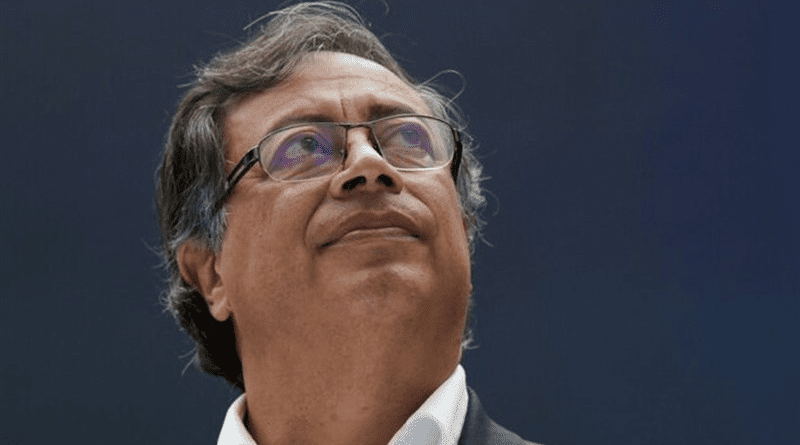
Colombia's Gustavo Petro. Photo Credit: Tasnim News Agency


September 25, 2025 
By CRS
By Shelby B. Senger and Clare Ribando Seelke

On September 15, 2025, President Trump determined Colombia had “failed demonstrably,” for the first time in nearly 30 years, to meet its international counternarcotics obligations and to take the measures required by Section 489(a)(1) of the Foreign Assistance Act of 1961 (hereafter FAA).

This process is sometimes referred to as “decertification.” Pursuant to this designation, President Trump also determined, in accordance with Section 706(3)(A) of P.L. 107-228, that continuing U.S. assistance to Colombia in FY2026 is vital to U.S. national interests. Nevertheless, U.S. diplomatic disputes and drug policy differences with the government of President Gustavo Petro, whose “political leadership” the Presidential Determination faults for Colombia’s “failed” counternarcotics efforts, could intensify.

Congress may consider the impact of Colombia’s designation on bilateral security and counternarcotics cooperation as it considers whether to fund FY2026 assistance in support of such efforts. Congress also may assess how the designation may affect U.S.-Colombia relations and political conditions in Colombia in the lead-up to a presidential election scheduled for May 2026.
Designation and Assistance Restrictions

Pursuant to 22 USC 2291j-1, the President is to report to Congress not later than September 15 of each year his determination on the list of major illicit drug producing and drug transit countries as defined in 22 USC 2291(e). The President’s report also is to identify any such countries found during the previous 12 months to have “failed demonstrably” at making “substantial efforts” to counter illicit drugs by meeting the goals of and adhering to bilateral and international counternarcotics commitments, as well as taking legal and law enforcement measures to prevent and punish public corruption that facilitates illicit drug production and trafficking.

Pursuant to 22 USC 2291j-1, countries determined by the President to have failed demonstrably in their counternarcotics efforts are barred from receiving certain U.S. assistance at the start of the following fiscal year, unless the President determines that provision of such aid is “vital to the national interests of the United States.”


Types of U.S. Assistance Withheld

Pursuant to Section 481(e)(4) of the FAA (22 USC 2291(e)), U.S. assistance that can be withheld from designated countries includesmost forms of bilateral assistance authorized in the FAA (other than emergency, humanitarian, and counternarcotics assistance);
arms sales and financing under the Arms Export Control Act;
financing under the Export-Import Bank Act of 1945;
certain provisions of agricultural commodities;
assistance that furthers the objectives of the Human Rights and Democracy Fund;
assistance to combat trafficking in persons; and
certain global health assistance.

Withholding exceptions for counternarcotics-related assistance generally apply to funding provided through the International Narcotics Control and Law Enforcement (INCLE) foreign assistance account, as well as narcotics-related alternative development assistance and narcotics-related Economic Support Fund (ESF) assistance. The same exemption applies to funds for U.S. military-led security cooperation programs and activities to support foreign country drug interdiction and counter-drug activities.
Designation with a Waiver

Since the United States began designating countries in 1986, the United States has, with a few exceptions, restricted assistance only from countries with which it has adversarial relationships and to which it provides little assistance. Although the United States has issued a waiver from foreign aid restrictions, Colombia’s decertification may, nonetheless, have political and diplomatic ramifications.

Colombia has been a key U.S. security partner in South America for decades, though counternarcotics cooperation has been tested by President Petro’s opposition to forced coca eradication and his government’s peace negotiations with armed groups. Plan Colombia, a U.S.-funded counternarcotics and security initiative, supported Colombia to modernize its security forces, regain territory from illegally armed groups, and end a 50-year civil conflict.

U.S. assistance has also helped Colombia to become a leader of multinational maritime interdiction operations, serve as the primary U.S. and regional source of drug-related intelligence, and train security forces from other countries. While cooperation with Colombian security forces has continued, Congress has reduced assistance to Colombia and placed additional conditions on that assistance since Petro took office. The Presidential Determination praised “Colombia’s security institutions and municipal authorities,” while criticizing President Petro’s drug policies and “failed attempts to seek accommodations with narco-terrorist groups.”

President Petro has reportedly halted U.S. weapons purchases while denouncing the U.S. decertification and questioning what the U.S. government had done to address domestic fentanyl and cocaine consumption. He reportedly vowed to ignore U.S. pressure to use forced eradication on coca crops, despite coca crop eradication levels having declined by 83% from 2022 through 2024 and violence related to eradication efforts having occurred. In August 2025, for example, armed groups reportedly used a drone to shoot down an antinarcotics helicopter, killing 12 Colombian police eradicators.

While some analysts are uncertain of how decertification might affect future U.S.-Colombia relations, others expect it to worsen political polarization ahead of upcoming elections. Some assert that there are several indicators that the United States and Colombia will continue to partner on antidrug efforts, including the waiver permitting the continuation of assistance and statements by President Trump that he would change the designation if Colombia improves its coca eradication efforts and works with the United States to bring criminal leaders to justice.

Others argue that Petro has strongly opposed U.S.-backed drug policies to penalize coca growers and publicly criticized U.S. military strikes in Venezuela. With Colombia’s security conditions are worsening, some observers assert that Petro may pursue closer ties with the People’s Republic of China, which has offered security cooperation to countries in the region.


About the authosr:Shelby B. Senger, Analyst in Foreign Affair
Clare Ribando Seelke, Specialist in Latin American Affairs
Source: This article was published by the Congressional Research Service (CRS)

CRS

The Congressional Research Service (CRS) works exclusively for the United States Congress, providing policy and legal analysis to committees and Members of both the House and Senate, regardless of party affiliation. As a legislative branch agency within the Library of Congress, CRS has been a valued and respected resource on Capitol Hill for nearly a century.

Scientists announce that 7 of 9 key 'planetary boundaries' have been crossed

A team of global scientists issued a new report on Wednesday, noting that seven out of nine of key "planetary boundaries" have been crossed. Carbon dioxide emissions have increased ocean acidification, which could have dire impacts on marine life.


Issued on: 24/09/2025
By: FRANCE 24

Coral reefs are under pressure from multiple presures including global warming, pollution and ocean acidification. © David Gray, AFP/File

Humans are gambling with the very stability of Earth’s life support systems, scientists warned on Wednesday, cautioning that ocean acidity was yet another key planetary threshold to be breached.

A team of global scientists assessed that seven of nine so-called “planetary boundaries” – processes that regulate Earth’s stability, resilience and ability to sustain life – had now been crossed.

Climate change, biodiversity loss, deforestation, freshwater depletion, overuse of agricultural fertilisers, and the release of artificial chemicals and plastics into the environment were all already deep in the red.

In their new report, the scientists said all seven were “showing trends of increasing pressure – suggesting further deterioration and destabilisation of planetary health in the near future".


Destructive and polluting activities, particularly the burning of fossil fuels, are driving these further into risky territory and increasingly interacting with each other.

“We are putting the stability of the entire life support system on Earth at risk,” said Johan Rockström, Director of the Potsdam Institute for Climate Impact Research (PIK), at a press conference to launch the research.

The concept of planetary boundaries was first coined in 2009, when only global warming, extinction rates and nitrogen levels had transgressed their limits.

Read moreClimate change caused more than two thirds of heat deaths in European cities this summer, study says

“We are moving even further away from the safe operating space, risking destabilising our Earth and with an increasing risk growing year by year,” said Levke Caesar, co-lead of Planetary Boundaries Science at PIK.

Many of the causes of deterioration are interlinked, showing both the wide-ranging impact of human activities but also avenues for action.

The use of fossil fuels is a key example, driving climate change as well as fuelling plastic pollution and the rise in ocean acidification.


Safety net ‘unravelling’

The world’s seas are estimated to have absorbed roughly 30 percent of the excess carbon dioxide released into the atmosphere from the burning of oil, gas and coal.

This alters the pH of the ocean, affecting the ability of organisms such as corals, shellfish and some forms of plankton to form shells and skeletons.

Increased ocean acidification since last year’s report was partly due to better data and revised calculations.

Scientists said there was already evidence of shell damage, particularly for marine animals in polar and coastal regions.

“What we see in the data is no longer abstract. It is showing up in the world around us right now,” said Caesar.

One positive in this year’s report is an improvement in global air quality, as aerosol emissions fall across the world, despite the continued scourge of severe particulate pollution in some regions.

The final boundary – ozone depletion – remains comfortably within safe bounds, which scientists said demonstrates the success of global co-operation to restrict ozone-depleting pollutants.


Researchers have quantified safe boundaries for these interlocking facets of the Earth system, which feed off and amplify each other.

For climate change, for example, the threshold is linked to the concentration of heat-trapping carbon dioxide (CO₂) in the atmosphere.

This hovered close to 280 parts per million (ppm) for at least 10,000 years prior to the Industrial Revolution, and researchers suggest the boundary is 350 ppm. Concentrations in 2025 are 423 ppm.

The assessment of the world’s biodiversity and ecosystems is even more perilous.

“Nature’s safety net is unravelling: extinctions and loss of natural productivity are far above safe levels, and there is no sign of improvement,” the report said.

(FRANCE 24 with AFP)
China announces plans to significantly reduce greenhouse gas emissions

At a climate leaders' summit at the United Nations on Wednesday, Chinese President Xi Jinping announced that China would reduce greenhouse gas emissions by 7-10%, and increase consumption of non-fossil fuels domestically. Xi discouraged developed nations from "going against the trend" of climate action, merely a day after Trump called climate change a "con job."


Issued on: 25/09/2025 - 00:09Modified: 25/09/2025
By: FRANCE 24
Video by: FRANCE 24

01:34


Chinese President Xi Jinping on Wednesday told the United Nations that by 2035, his country plans to reduce its greenhouse gas emissions by 7%–10% below its peak, and called out “some countries” for moving against the global clean energy transition.

Xi addressed a climate leaders’ summit hosted by UN Secretary-General António Guterres in a live video message from Beijing, announcing China’s national climate plan ahead of the COP30 climate summit in Brazil in November.

Alongside the economy-wide emission reduction goal, Xi said that within 10 years, China plans to increase its installed capacity of wind and solar power to over six times its 2020 levels. It also plans to boost the share of non-fossil fuels in domestic energy consumption to over 30%.

At the same time, he called on the world’s developed countries to take the lead in stronger climate action. He referred, though not by name, to the United States for moving away from the goals of the Paris Agreement on climate.


“Green and low-carbon transformation is the trend of our times. Despite some countries going against the trend, the international community should stay on the right track, maintain unwavering confidence, unwavering action, and undiminished efforts,” Xi said, calling for increased global climate cooperation.

On Tuesday, US President Donald Trump used his UN General Assembly speech to dismiss climate change as a “con job” and to criticise EU member states and China for embracing renewable energy technologies. Trump ordered a second withdrawal by Washington from the 10-year-old Paris Agreement on climate, which aimed to prevent global temperatures from rising beyond 1.5 degrees Celsius through national climate plans. The United States is the world’s biggest historical greenhouse gas emitter and the second biggest current emitter behind China.

Environmental groups and observers said the announcements by some of the world’s biggest economies fell well short of where they should be in emissions reductions, given the rapidly worsening impacts of climate change.

Brazilian President Luiz Inácio Lula da Silva, host of the upcoming UN climate summit, warned fellow leaders that the Belém gathering and the updates of national climate plans will show the world “whether or not we believe in what the science is showing us.”

Brazil has committed to reducing emissions by 59%–67% by 2035 and stepping up efforts to combat deforestation.

“Society is going to stop believing its leaders,” he said. “And all of us will lose because denialism may actually win.”

Guterres hosted the summit on the sidelines of the UN General Assembly. He asked countries to announce their new climate targets.

“The Paris Agreement has made a difference,” Guterres said in prepared remarks. He added that since it was adopted in 2015, the projected rise in global temperature is now 2.6°C, down from the 4°C rise projected before the Paris conference.

“Now, we need new plans for 2035 that go much further, much faster,” he said.

The European Union has not reached agreement on its new UN-mandated climate target in time for Wednesday’s summit, and has instead drafted plans to submit a temporary goal, which could change.

EU President Ursula von der Leyen said at the summit that the EU is on track to reach its 2030 target of slashing emissions by 55% and that its 2035 reduction goal would range between 66% and 72%.

Australia, which plans to host a 2026 UN climate summit, announced a pledge that by 2035 it would cut greenhouse gases by between 62% and 70% below 2005 levels.

“We want to bring the world with us on climate change, not by asking any nation to forgo the jobs or security that its people deserve, but by working with every nation to seize and share those opportunities,” said Australian Prime Minister Anthony Albanese.

Palau, representing the 39-member Alliance of Small Island States, announced its own goal of slashing emissions to 44% of 2015 levels by 2035. It reminded leaders of the advisory opinion issued by the International Court of Justice earlier this year that affirmed an “obligation grounded in international law” for governments to take stronger measures to curb their greenhouse gas emissions.

Surangel Whipps, President of Palau, called on major economies to take more aggressive action.

“Those with the greatest responsibility and the greatest capacity to act must do far more,” he said.

Ambition falls short

Li Shuo, director of the China Climate Hub at the Asia Society, said China’s announcement underwhelmed in light of its rapid production of renewable energy and electric vehicles.

“Beijing’s commitment represents a cautious move that extends a long-standing political tradition of prioritising steady, predictable decision-making but also hides a more significant economic reality,” he said.

But China’s dominance as a green technology superpower, combined with Washington’s retreat from the clean energy transition, could push China towards a more proactive role on the global stage, he said.

Teresa Anderson, Global Lead on Climate Justice at Action Aid International, said the EU’s “lowball statement of intent” signals a “deeper political sickness” reflecting a lack of will to push back against corporate polluters.

“Rich polluting countries like the EU must go much further in practice than these lowball statements of intent,” she said.

(FRANCE 24 with Reuters)

Russia performs a balancing act with Israel and Palestine

Since the war in Gaza erupted in 2023, governments around the world have been making their voices heard, whether they are staunch supporters of Israel or pleading the Palestinian cause. But Russia's position, which has received little media coverage, is harder to define.


Issued on: 25/09/2025 - RFI


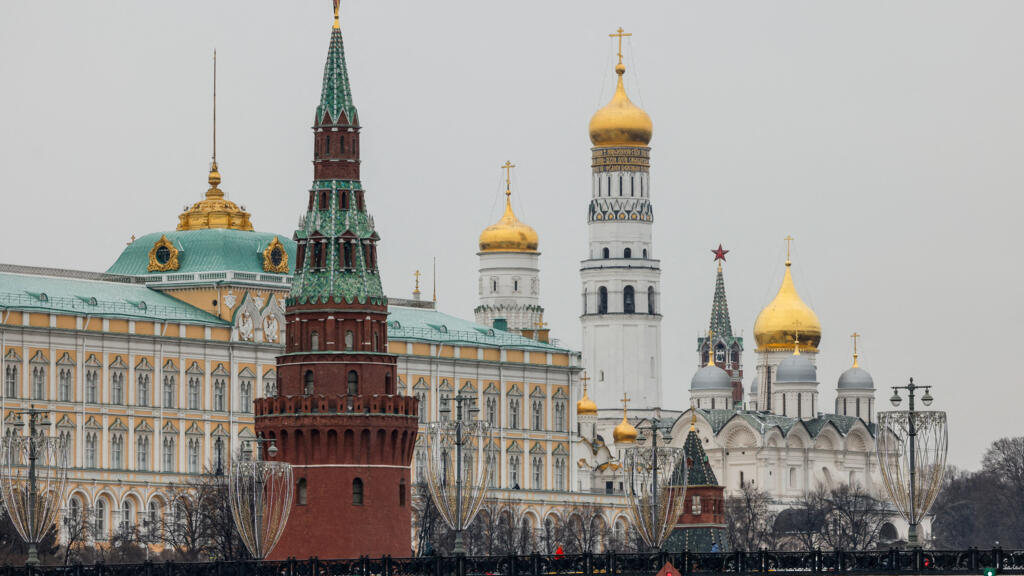
A view of the Kremlin in central Moscow, Russia, 13 February 2025. 
© Maxim Shemetov / Reuters

"I’m struck by the silence of the Russian press on the latest events in Gaza,” says Jean de Gliniasty, research director at the French Institute for International and Strategic Affairs (Iris) and a former ambassador to Moscow. “So far, there’s been no strong reaction.”

Yet Moscow’s involvement in the Middle East crisis goes back decades, and it has played a significant role.

In 1948, the Soviet Union became the first state to recognise Israel, which at the time appeared to have socialist leanings – partly in hopes of speeding up Britain’s withdrawal from Palestine.

However, as Israel grew closer to the West and with the rise of Arab nationalism, the Kremlin switched tack, forging close ties with Palestinian resistance groups.

By 1988, the USSR had become one of the earliest countries to recognise Palestine.

Russia's Putin searches for allies in meeting with Iranian and Turkish leaders


Russian diaspora


After the collapse of the Soviet Union, Russia tried to keep doors open on all sides – with Israel, the Palestinians and the wider Arab world.

The controls that had previously prevented Russian Jews from emigrating were lifted. And for more than 75 years, Russia has advocated a two-state solution and the implementation of United Nations resolutions on the Israeli-Palestinian issue.

When he was elected president in 2000, Vladimir Putin cultivated warm relations with Israel, which is home to 1.3 million Russian speakers – representing 15 percent of the population and making Russian the third most common native language in Israel after Hebrew and Arabic.

He struck up personal ties with prime ministers Ariel Sharon and, later, Benjamin Netanyahu.

"During his various terms as prime minister, Benyamin Netanyahu has visited Moscow no less than four times, more than any other capital city – except, of course, Washington," says David Rigoulet-Roze, a researcher at the French Institute for Strategic Analysis.

"Some of these meetings even took place during the civil war in Syria, when the Israeli army was regularly bombing pro-Iranian militias and Iran's Al-Quds force, despite the fact that Iran was Russia's ally in Syria. Moscow pretended not to know what was going on, much to Tehran's dismay."

At the same time, Putin has shown his support for the Palestinian cause. In 2022, his foreign minister welcomed former Hamas leader Ismail Haniyeh, in an attempt to capitalise on his role as mediator and on Russia's return as a new power in the Middle East.

'A turning point'


However, the Hamas attacks on Israel on 7 October 2023, followed by the devastating war in Gaza, have shifted the dynamics.

"This was a turning point," said Rigoulet-Roze. "The depth of the ties that had existed until then between Israel and Russia is beginning to be called into question due to Moscow's continued relations with Hamas."

The Kremlin received a delegation from the group on 26 October 2023, barely three weeks after the massacre, he noted. Israel denounced this as an “act of support for terrorism”, while the Kremlin insisted the visit was about securing the release of Russian-born hostages.

Putin waited several days before offering condolences to Israeli families, and the Kremlin criticised Israel’s “indiscriminate” bombing of Gaza, sparking the fury of Netanyahu – who had always treated Putin carefully due to the situation in Syria.

Moscow then called for a ceasefire, tabled a UN Security Council resolution – vetoed by Washington – and revived talk of the long-dormant Quartet, established in 2002 to facilitate the Middle-East Peace Process negotiations and involving the UN, the European Union, Russia and the United States.

For Rigoulet-Roze: "Russia has felt somewhat marginalised since the launch of its war in Ukraine. It would like to get back in the game. The Quartet was, in a way, the format of the great powers of the Cold War era, for which Vladimir Putin paradoxically feels a kind of nostalgia. It was a kind of consensus for a process that would lead to the implementation of the two-state solution."

Macron, Putin discuss Iran, Ukraine in first talks since 2022

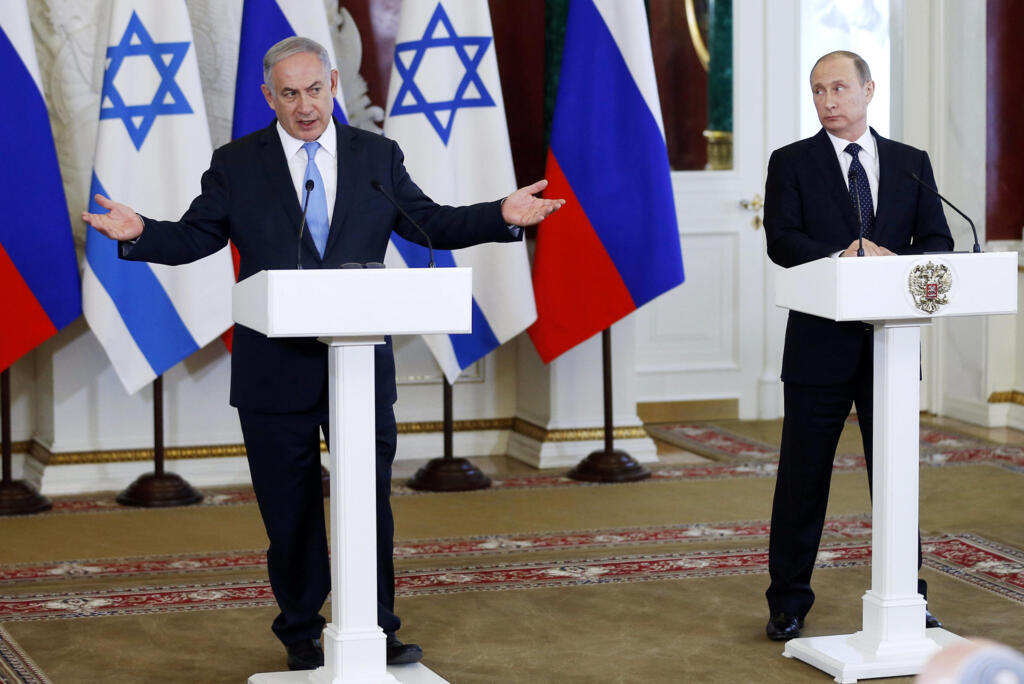
Vladimir Putin and Benjamin Netanyahu at a news conference at the Kremlin, 7 June, 2016. REUTERS/Maxim Shipenkov/Pool

Between Tel Aviv and Tehran

In February 2024, Moscow hosted numerous delegations from Palestinian organisations, including the Palestinian Authority, Islamic Jihad and Hamas – for whom the support of a member of the UN Security Council is essential.

In January 2024, the Russian deputy minister of foreign affairs also received a delegation of Houthis from Yemen.

At the same time, the Kremlin continued to forge closer ties with Iran, Hezbollah, the Emirates and Saudi Arabia – all hostile to Israel.

Yet links with Israel remain. Daily flights connect Moscow and Tel Aviv, and Russia sees its large diaspora there as an important lever of influence.

However, the collapse of Bashar al-Assad’s regime in Syria in December 2024 has weakened Moscow’s hand in this regard; without a reliable ally in Damascus, Russia has lost much of its regional leverage.

According to Rigoulet-Roze: "From that moment on, Moscow's geopolitical position weakened. On the Israeli side, Moscow also lost importance. From the moment Assad fell, in a way, the implicit deal with Putin on Syria was strategically devalued because Israel no longer needed Moscow's tacit agreement to carry out military strikes against anything that could be seen as maintaining a pro-Iranian presence."

Moscow's motives

Moscow's shift in its hitherto moderate approach to the Israeli-Palestinian conflict is motivated partly by the desire to divert attention from the war in Ukraine. Russia also wants to take a stand against the US, which unconditionally supports Israel – with Putin calling the 7 October attacks and their aftermath "a clear failure of US policy".

The Kremlin hopes to win favour in the Global South too, particularly in Africa, where rhetoric about ending Western colonialism – particularly French – plays well.

Flexing its muscles in the Middle East is a way for Moscow to remind the world that it’s still a global player. "All the skill of Russian diplomacy, which is real, which is very good, is not enough to compensate for the considerable weakening of the country," points out de Gliniasty.

"They are losing ground in Central Asia and the Caucasus, and the agreement signed in Washington between Azerbaijan and Armenia is a slap in the face for Russia. So they are seeking to remind the world, as much as possible, of the global nature of their power."

By maintaining good relations with Hamas, Moscow is also seeking to ensure it does not support Islamist groups within Russia – which is home to nearly 30 million Muslims.

Some made their voices heard at the end of October 2023 when they stormed the tarmac at the airport in Makhachkala, capital of the Muslim-majority Russian republic of Dagestan, after the arrival of a flight from Israel was announced.


Bridge builder?

Later this year, Putin plans to host the first Russian-Arab summit in Moscow, hoping to showcase Russia as a bridge builder and power broker, and inviting the leaders of all Arab League member states to participate.

“It remains to be seen which countries will actually attend and at what level of representation,” Rigoulet-Roze told RFI. "He wants to reposition himself in the Middle East and maintain a foothold in the region, because the fall of Bashar al-Assad’s regime has largely pushed him out of the game.”

In this regard, it is no coincidence that Syria's new president, Ahmed al-Sharaa, has been invited to the event.

However, according to de Gliniasty: "The problem is that Arabs are even less responsive than Westerners to what is happening in the Gaza Strip.

"If there were suddenly a chorus of protests from the Arab side, the Russians would probably raise their voices. They are very much aligned with Saudi Arabia because Riyadh controls the price of oil, which is vital for the Russians. So if Saudi Arabia raises its voice, the Russians will do the same."

This article was adapted from the original French version by RFI's Anne Bernas.

Slovenia bans Israeli PM Netanyahu

Slovenia bans Israeli PM Netanyahu
By bne IntelliNews September 25, 2025

Slovenia on September 25 prohibited Israeli Prime Minister Benjamin Netanyahu from entering the country, deepening its diplomatic rift with Israel and reinforcing its support for Palestinian statehood.

The government said the travel ban was approved unanimously by the cabinet and follows measures already taken against two extremist Israeli ministers earlier this year. 

“Proceedings are underway against the Israeli Prime Minister for committing war crimes and crimes against humanity,” a government statement said, citing a July 19, 2024 ruling by the International Court of Justice that “several Israeli policies and practices violate both international humanitarian law and human rights law.”

“With this move, the government sends a clear message to the State of Israel that Slovenia expects consistent respect for the decisions of international courts and international humanitarian law,” it added, calling the step evidence of Ljubljana’s “commitment to international law, universal human rights values, and a principled and consistent foreign policy.”

The new ban follows a series of actions by the EU member. In July, Slovenia previously declared two far-right Israeli cabinet ministers persona non grata, citing their rhetoric and policies toward Palestinians.

In August, it became the first European country to impose a comprehensive arms embargo on Israel, halting all exports, imports and transit of weapons and military equipment. Days later, the government announced a ban on imports of goods produced in Israeli settlements in the occupied Palestinian territories, saying the trade of such goods violated international law.

Prime Minister Robert Golob has said those steps reflect “Slovenia’s duty to act when international humanitarian law is breached,” while stressing that Ljubljana supports a negotiated two-state solution.

Alongside the Netanyahu ban, the government unveiled fresh financial assistance for the Palestinian Authority. “In 2025, the government of the Republic of Slovenia will allocate a contribution to the operation of the Palestinian Authority in the total amount of €1,200,000, which the Ministry of Foreign and European Affairs will implement through the EU PEGASE mechanism,” the statement said.

Officials described the funding as a means to help maintain Palestinian governance amid the conflict. “The continuous operation of the Palestinian Authority is essential for the establishment and preservation of Palestinian statehood,” the government said, noting that Slovenia recognised Palestine as a state on June 4, 2024.

Ljubljana also said it had been invited to join an Emergency Coalition for the Financial Sustainability of the Palestinian Authority launched in September by France, Spain, Norway and Saudi Arabia to provide $200mn per month over six months to bolster the Palestinian Authority. After the initial period, the coalition plans to evaluate the effectiveness of the aid.

Slovenia’s moves come as debate intensifies within the European Union over how to respond to Israel’s conduct in Gaza and the West Bank, where humanitarian conditions have deteriorated sharply. Several EU member states have expressed concern over Israeli settlement expansion, but few have gone as far as Ljubljana in imposing punitive measures.

Relations between Slovenia and Israel had already been tense. Slovenia and Palestine have established diplomatic relations, and Golob’s government has urged the EU to take a stronger stance on upholding international law in the region.

The dispute has spilled into cultural arenas. Slovenia’s public broadcaster said this month it may reconsider participation in the 2026 Eurovision Song Contest unless the European Broadcasting Union sets clearer rules on Israel’s involvement, citing “political and ethical concerns” voiced across several member states.

Hamas will have no role in a post-war Gaza, Palestine's President Mahmoud Abbas says

Abbas heads the Palestinian Authority (PA), the government body run by the Fatah party which has partial civil control over areas in the occupied West Bank.


Copyright AP Photo
By Gavin Blackburn
Published on 25/09/2025 - EURONEWS

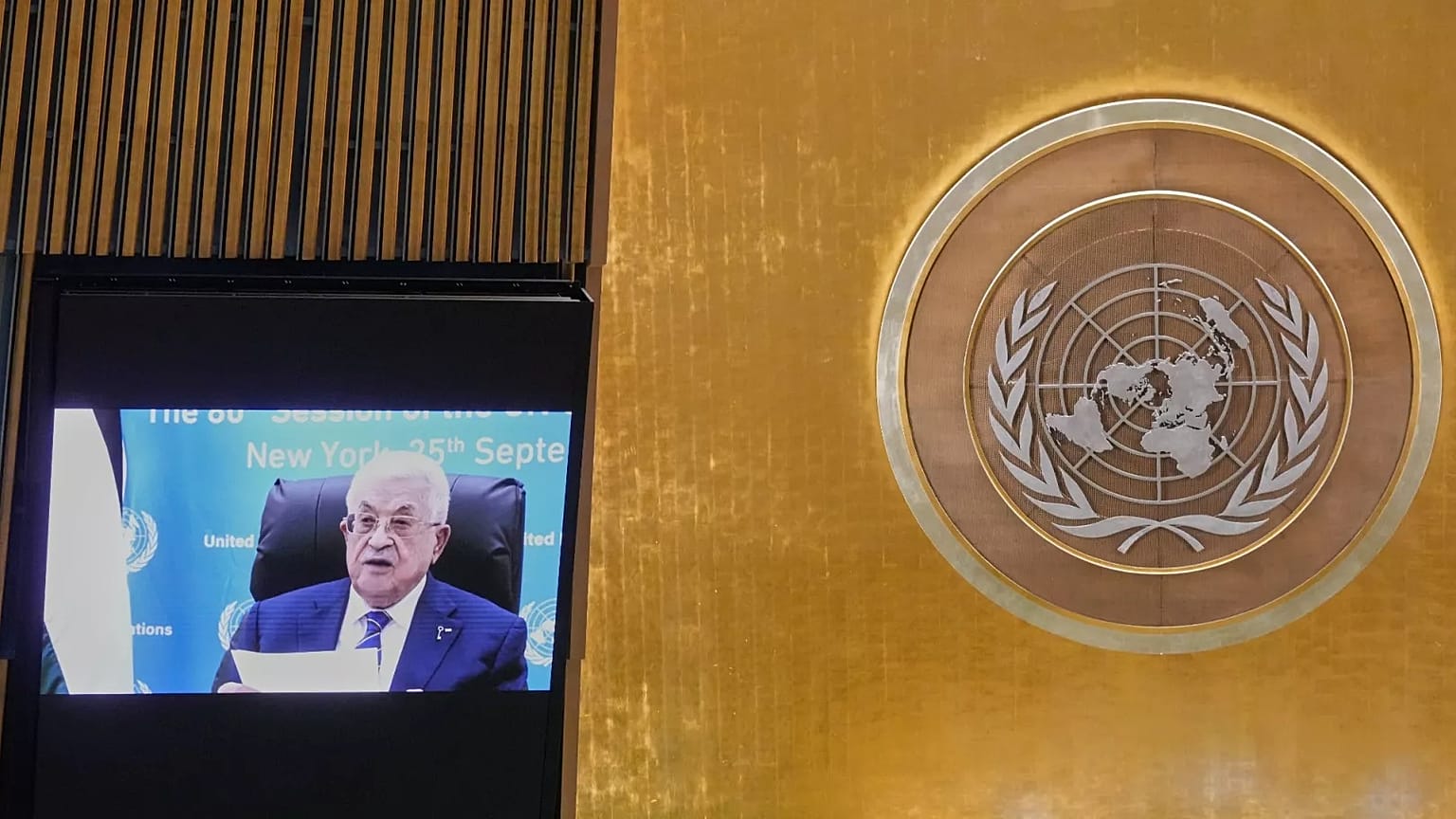
Palestine's president told world leaders on Thursday that his people "reject" the 2023 Hamas-led attack on Israel and pledged that the militant group would have no role in governing Gaza after the ongoing Israel-Hamas war ends.

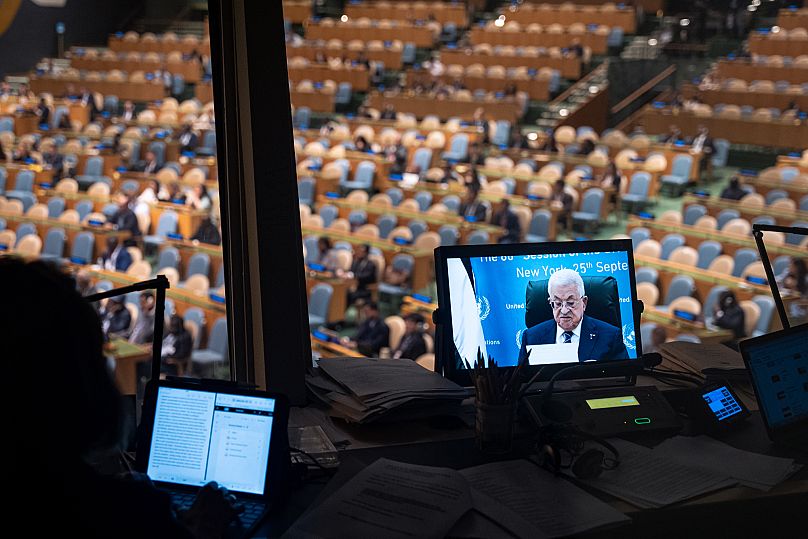
Speaking via video after the United States revoked his visa, Mahmoud Abbas told the UN General Assembly that Palestinians in Gaza "have been facing a war of genocide, destruction, starvation and displacement" by Israel.

His speech came as Israeli Prime Minister Benjamin Netanyahu heads to New York to give his own address in person on Friday.

After laying out in detail the death and destruction in Gaza, Abbas said the Palestinian Authority (PA) — which he presides over — rejects the incursion Hamas carried out on 7 October 2023 and that it does not represent their people.

In that attack, Hamas and other militant groups killed around 1,200 people, most of them civilians. A further 251 people were taken as hostages back to Gaza, where 48 are still being held, 20 of whom Israel believes are alive.

Palestinian President Mahmoud Abbas addresses the United Nations General Assembly via video, 25 September, 2025 AP Photo

Abbas also laid out his vision for what government would look like in territories once the war is over, saying that the PA is "ready to bear full responsibility for governance and security."

He added that "Hamas will have no role to play in governance," and that it will have to hand over all weapons to the PA.

"There can be no justice if Palestine is not freed," Abbas said.

In a short but resolute speech, Abbas thanked the world leaders who have stood up for Palestinians throughout the Gaza war, saying that the recent recognition of Palestinian statehood has presented his people with hope for peace and an end to the conflict.

He welcomed recent announcements from France, the UK and Canada to recognise Palestine as an independent state and called on the remaining countries to do the same.

But, he added, that symbolic recognition is not enough to address the present moment.

"The time has come for the international community to do right by the Palestinian people, so that they may obtain their rights for their legitimate rights to be rid of the occupation and to not remain a hostage to the temperament of Israeli politics, which denies our rights and continue in their injustice, oppression and aggression," Abbas said.

Before concluding, he sent a message of hope to the Palestinian people, saying that no matter how long the suffering continues, "its results will not break our will to live and survive."

"The dawn of freedom will emerge, and the flag of Palestine will fly high in our skies as a symbol of dignity, steadfastness and being free from the occupation," Abbas said. "We will not leave our homeland. We will not leave our lands."

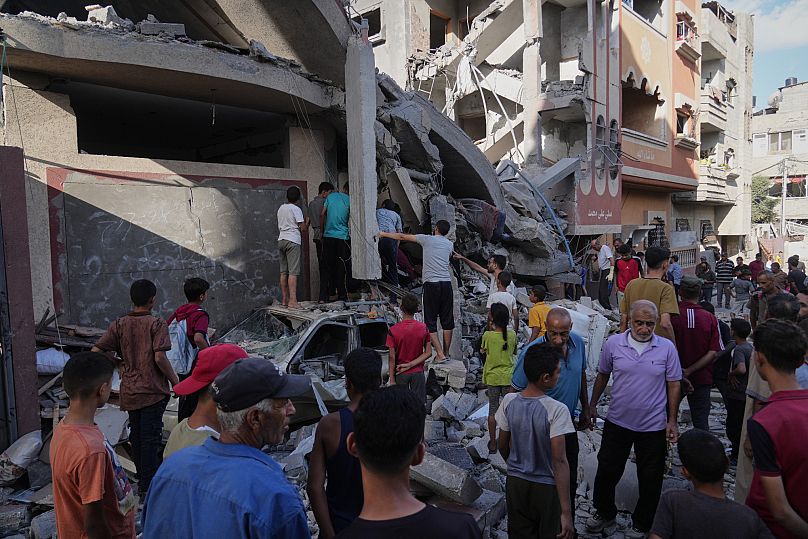
Palestinians survey the aftermath of an Israeli military strike on the Abu Dahrouj family home in Zawaida, 25 September, 2025 AP Photo

Fatah and Hamas

Abbas heads the PA, the government body run by the Fatah party which has partial civil control over areas in the occupied West Bank.

The PA also governed Gaza until elections in 2006 saw Hamas win the most seats but not enough for a clear majority.

A proposed power-sharing deal between Fatah and Hamas proved impossible to reach and in 2007, Hamas seized power, taking de facto control of the Strip and effectively splitting the Palestinian territories into two separate entities.

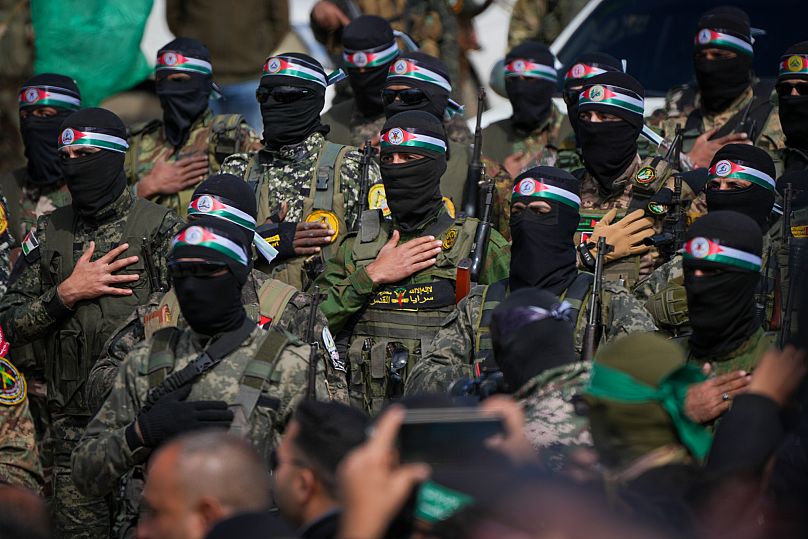
Hamas fighters stand in formation as they prepare for the ceremony of Israeli hostages hand over to the Red Cross in Nuseirat, 22 February, 2025 AP Photo

Since then there has been little in the way of collaboration between the two groups, and their political positions diverge significantly.

Fatah recognises Israel and is in favour of dialogue to resolve issues, while Hamas' ideology calls for the destruction of Israel and the restoration of traditional Palestinian lands.

Hamas, which describes itself as armed resistance, also sees Fatah as complicit in the Israeli occupation of the West Bank as both sides coordinate on security issues.

The rift between Fatah and Hamas has also led to the repeated postponement of legislative elections in Gaza, making the 2006 vote the last time to date that Palestininans in Gaza were able to choose their leaders.


Israel's FM Gideon Sa'ar says Abbas 'continues to encourage terrorism' after UNGA speech


Published on 25/09/2025 - EURONEWS


Mahmoud Abbas heads the Palestinian Authority, the government body run by the Fatah party which has partial civil control over areas in the occupied West Bank.

Israel's Foreign Minister Gideon Sa’ar has said the Palestinian President Mahmoud Abbas "continues to encourage terrorism" following his speech on Thursday to the UN General Assembly.

"Mahmoud Abbas, in his Zoom speech to the UN General Assembly, said that he is ready to receive the Gaza Strip, which he so easily lost to Hamas in 2007. How nice of him," Sa’ar said in a post on X.

"Not only does he not fulfill the commitment — on the basis of which the Palestinian Authority was established — to fight terrorism. He also continues to encourage terrorism by paying salaries to terrorists and their families."

Abbas told world leaders on Thursday that his people "reject" the 2023 Hamas-led attack on Israel and pledged that the militant group would have no role in governing Gaza after the ongoing Israel-Hamas war ends.

Speaking via video after the United States revoked his visa, Mahmoud Abbas told the UN General Assembly that Palestinians in Gaza "have been facing a war of genocide, destruction, starvation and displacement" by Israel.

His speech came as Israeli Prime Minister Benjamin Netanyahu heads to New York to give his own address in person on Friday.

After laying out in detail the death and destruction in Gaza, Abbas said the Palestinian Authority (PA) — which he presides over — rejects the incursion Hamas carried out on 7 October 2023 and that it does not represent their people.

In that attack, Hamas and other militant groups killed around 1,200 people, most of them civilians. A further 251 people were taken as hostages back to Gaza, where 48 are still being held, 20 of whom Israel believes are alive.

Abbas also laid out his vision for what government would look like in territories once the war is over, saying that the PA is "ready to bear full responsibility for governance and security.

He added that "Hamas will have no role to play in governance," and that it will have to hand over all weapons to the PA.

"There can be no justice if Palestine is not freed," Abbas said.

In a short but resolute speech, Abbas thanked the world leaders who have stood up for Palestinians throughout the Gaza war, saying that the recent recognition of Palestinian statehood has presented his people with hope for peace and an end to the conflict.

He welcomed recent announcements from France, the UK and Canada to recognise Palestine as an independent state and called on the remaining countries to do the same.

But, he added, that symbolic recognition is not enough to address the present moment.

"The time has come for the international community to do right by the Palestinian people, so that they may obtain their rights for their legitimate rights to be rid of the occupation and to not remain a hostage to the temperament of Israeli politics, which denies our rights and continue in their injustice, oppression and aggression," Abbas said.

Before concluding, he sent a message of hope to the Palestinian people, saying that no matter how long the suffering continues, "its results will not break our will to live and survive."

"The dawn of freedom will emerge, and the flag of Palestine will fly high in our skies as a symbol of dignity, steadfastness and being free from the occupation," Abbas said. "We will not leave our homeland. We will not leave our lands."

Fatah and Hamas

Abbas heads the PA, the government body run by the Fatah party which has partial civil control over areas in the occupied West Bank.

The PA also governed Gaza until elections in 2006 saw Hamas win the most seats but not enough for a clear majority.

A proposed power-sharing deal between Fatah and Hamas proved impossible to reach and in 2007, Hamas seized power, taking de facto control of the Strip and effectively splitting the Palestinian territories into two separate entities.

Since then there has been little in the way of collaboration between the two groups, and their political positions diverge significantly.

Fatah recognises Israel and is in favour of dialogue to resolve issues, while Hamas' ideology calls for the destruction of Israel and the restoration of traditional Palestinian lands.

Hamas, which describes itself as armed resistance, also sees Fatah as complicit in the Israeli occupation of the West Bank as both sides coordinate on security issues.

The rift between Fatah and Hamas has also led to the repeated postponement of legislative elections in Gaza, making the 2006 vote the last time to date that Palestininans in Gaza were able to choose their leaders.

Additional sources


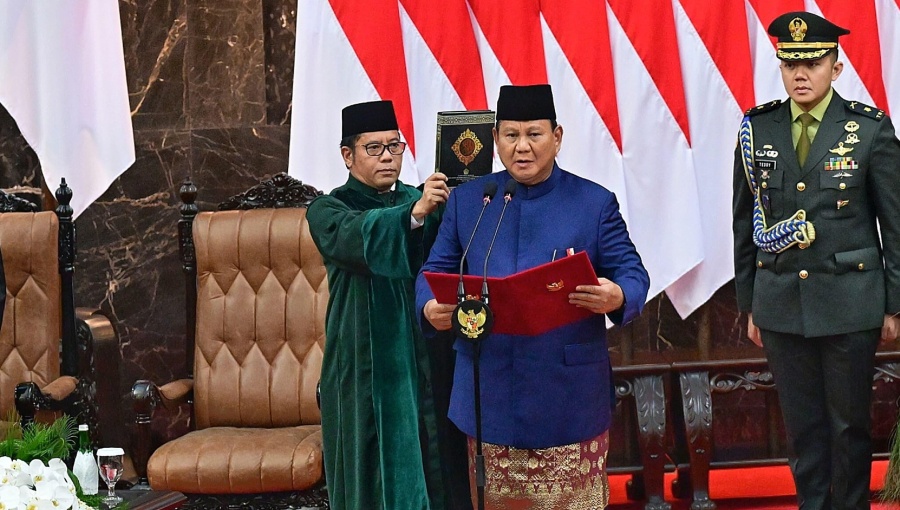
Prabowo at the UN: Indonesia pushes two-state solution, possible recognition of Israel

Prabowo at the UN: Indonesia pushes two-state solution, possible recognition of Israel
/ Ministry- State Secretariat - Indonesia - PD
By bno - Surabaya Office September 26, 2025

President Prabowo Subianto’s first speech at the United Nations was not a cautious introduction but a bold intervention, as Antaranews extensively reports. Addressing the High-Level Conference on 'Palestine and the Two-State Solution' in New York, he delivered a stark condemnation of the violence in Gaza, framing Israel’s military campaign as genocidal. His words underscored the scale of the humanitarian catastrophe: tens of thousands of Palestinians killed, the majority women and children.

Yet Prabowo did more than condemn. He laid out a political and diplomatic roadmap that sought to move beyond rhetoric, combining Indonesia’s moral voice with concrete offers to help shape peace on the ground.

Endorsing the two-state solution

Central to his address was the unequivocal endorsement of the two-state solution as “the only path to lasting peace.” Prabowo pressed UN member states to act decisively, urging immediate recognition of Palestine’s sovereignty. Recognition, he argued, is not merely symbolic but the foundation for meaningful peace. The message was clear: history does not stand still, and delaying recognition only prolongs suffering and instability.

The timing of this declaration was deliberate. Only days earlier, the UN General Assembly had adopted the New York Declaration, endorsed by 142 states, setting out commitments to ceasefire, humanitarian access, and a pathway to Palestinian statehood. Prabowo’s speech aligned Indonesia squarely with this momentum, reinforcing the sense of urgency.

Perhaps the most striking element of Prabowo’s intervention was Indonesia’s readiness to send peacekeepers under a UN mandate. By signalling willingness to commit forces, Jakarta moved from advocacy to actionable diplomacy. Indonesia is already one of the largest contributors to UN peacekeeping missions, but a Gaza deployment would carry vastly higher stakes, given the volatility and political sensitivities of the conflict.

Operational hurdles remain significant. A mission would require Security Council authorisation, agreement on rules of engagement, and cooperation from parties on the ground. Nonetheless, the pledge is a powerful statement of intent: Indonesia is not only condemning violence but offering to shoulder responsibility for stabilisation.

Prabowo also introduced a new element into Indonesia’s long-standing Palestine policy: a conditional pathway to recognising Israel. He declared that Indonesia would recognise Israel immediately if Israel first recognised Palestine as an independent and sovereign state. In effect, he positioned recognition as a reciprocal bargain that could unlock normalisation.

This is a rare move for a major Muslim-majority nation and could reframe regional diplomacy. For countries seeking leverage to bring Israel to negotiations, Indonesia’s conditional recognition offers both incentive and political cover. Yet it also carries risks: without reciprocal gestures from Israel, the proposal could harden positions or invite criticism from constituencies opposed to any recognition.

Diplomatic calculus

Prabowo’s approach blends moral leadership with pragmatic statecraft. By calling out atrocities in Gaza, he consolidates domestic and regional support for Indonesia’s long-standing pro-Palestine stance. By pledging peacekeepers and signalling conditional recognition of Israel, he casts Indonesia as a responsible international actor prepared to transform words into commitments.

This dual posture strengthens Indonesia’s credibility as a bridge-builder. It appeals simultaneously to domestic audiences demanding solidarity with Palestine and to international partners searching for workable solutions. In this sense, the speech was as much about Indonesia’s global positioning as it was about Palestine.

The effectiveness of Prabowo’s gambit depends on several factors. First, the politics of the UN Security Council: authorising a mission for Gaza will be contentious, with the risk of vetoes from permanent members. Second, the feasibility of deploying troops into such a volatile environment: logistics, mandate clarity, and casualty risks will be daunting. Third, the reception of Indonesia’s conditional recognition proposal: while applauded at the UN, it requires careful diplomacy to avoid alienating allies or being dismissed as unrealistic.

A turning point for Indonesia

Prabowo’s UN debut demonstrates Indonesia’s willingness to take on greater responsibility in shaping international peace and security. It marks a pivot from being a consistent moral advocate for Palestine to becoming a strategic actor offering concrete pathways to resolution. Whether these proposals translate into action will depend on global diplomacy, but the speech itself was significant: it repositioned Indonesia as more than a bystander and elevated its influence in the Palestinian question.

The closing words of Prabowo’s speech: “Peace now. PeacPrabowo at the UN: Indonesia’s pivot from moral outcry to strategic diplomacy immediately. We need peace”, were met with applause in New York. Beyond the applause, however, lies the test of whether Indonesia’s blend of moral clarity and pragmatic offers can help shift a decades-old conflict toward a more just and peaceful horizon.