It’s possible that I shall make an ass of myself. But in that case one can always get out of it with a little dialectic. I have, of course, so worded my proposition as to be right either way (K.Marx, Letter to F.Engels on the Indian Mutiny)
Tuesday, September 30, 2025
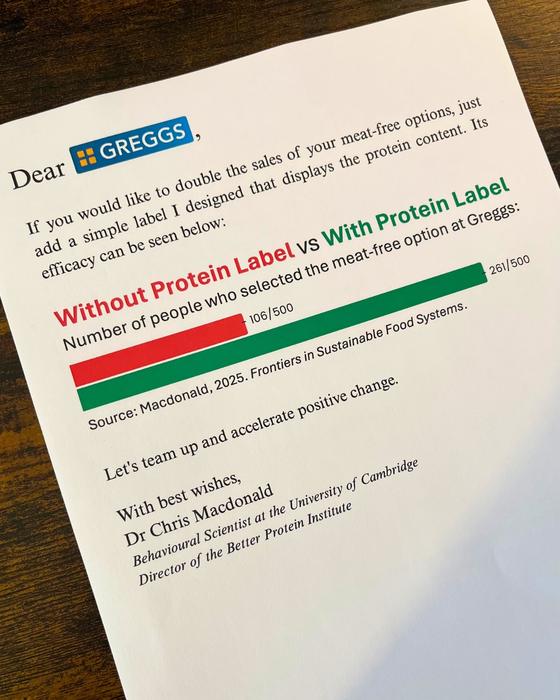
Cambridge scientist uncovers cunning way to double the sales of the famous Greggs Vegan Sausage Roll – and in an open letter, shares the technique with key people at Greggs
Cambridge research finds unique nudge approach that significantly outperforms carbon labelling for increasing sustainable food consumption
UNIVERSITY OF CAMBRIDGE, UK – New research published in Frontiers in Sustainable Food Systems reveals a highly effective new strategy to increase low-emission food consumption.
The study, led by Cambridge scientist and Director of the Better Protein Institute, Dr Chris Macdonald, demonstrates that his "nudge by proxy" approach, which calls attention to consumer motivations rather than environmental impacts, more than doubled the selection of meat-free meals in controlled choice experiments with 3,000 participants. This approach proved significantly more effective than traditional carbon footprint labelling.
Dr Macdonald explains, “People often think that their own beliefs and values are more common than they actually are. This is called the false consensus effect. Accordingly, researchers who are also environmentalists might tend towards interventions that highlight negative environmental impacts because it is what influences them, and they may assume that it will be equally persuasive to the average consumer. I call this the environmentalist bias. To avoid this potential bias, prior to designing a new label intervention, I engage directly with consumers.”
The research began with 1,500 consumers who identified protein as the most significant perceived barrier to adopting a meat-free diet. This "insufficiency illusion"—the false belief that meat-free options must lack essential nutrients—emerged as a key insight and informed the creation of a simple protein label. Shocking as it may be to consumers, not only does the Greggs Vegan Sausage Roll come with fewer greenhouse gas emissions and lower fat content, but it also comes with more protein than its meat-based counterpart (this is also the case for their breakfast roll range).
Dr Macdonald notes, "By simply highlighting the protein content, we were able to shift an unprecedented number of consumers towards meat-free choices. As noted in the paper, in the second experiment, the meat-free meal choice was selected by less than a quarter of the participants in the control group and by over half of the participants in the protein label group—a finding consistent for men and women. This increase of more than 100% made the selection of the meat-free item the majority decision and thus marked an unprecedented step-change.”
Dr Macdonald sent the results to Greggs; he published an open letter on social media and sent letters directly to key stakeholders: • Roisin Currie – CEO • Paul Irwin-Rhodes – Head of Sustainability • Hannah Squirrell – Customer & Marketing Director • Sarah Graham – Product Development & Innovation • Fiona Mills – Brand Communications & Creative Lead • Ian White – Head of Brand and Communications
Dr Chris Macdonald says, “At the Better Protein Institute, we are committed to turning research into tangible impact. In service of this, I have shared the results with Greggs, and I have also offered to collaborate with them, and they have my contact information. They have a unique opportunity to not only increase sales but also cement themselves as leaders in sustainability. The ball is in their court now.”
Dr Macdonald concludes, “A rising tide of global meat consumption fuels an increasingly dangerous narrative: that changing consumption habits is simply too difficult. My work provides a defiant counter-narrative. With a data-driven approach, I continue to uncover new approaches that significantly outperform popular interventions. The secret is simple: returning to first principles, engaging with the consumer, and not acquiescing to external pessimism. Data-driven, defiant optimism in action."
About Frontiers in Sustainable Food Systems: Frontiers in Sustainable Food Systems is a leading journal dedicated to publishing high-quality research on all aspects of sustainable food production, distribution, and consumption.
Link to paper: https://www.frontiersin.org/journals/sustainable-food-systems/articles/10.3389/fsufs.2025.1656336/full
About the author: Dr Chris Macdonald is a behavioural scientist, founder, and author. Dr Macdonald is a Fellow and Lab Director at Lucy Cavendish College, University of Cambridge; a Fellow at the Institute of Corporate Responsibility and Sustainability; a Supervisor at the University of Cambridge Institute for Sustainability Leadership; and Director of the Better Protein Institute. Dr Macdonald was recently named winner of the 40 Under 40 Award for Science and Innovation.
About the Better Protein Institute (BPI): Protein is essential for a healthy diet. But not all protein sources are created equal. Some of the most popular come with significant hidden costs, from environmental damage to serious health risks. To address this, the Better Protein Institute facilitates and accelerates the transition to better sources of protein. To achieve this, it conducts critical research from first principles, and tackles three core questions: 1. What are the best sources of protein currently available? 2. Why aren’t more people consuming them? 3. How can we increase consumption of them?
Contact: Dr Chris Macdonald, chris.macdonald@lucy.cam.ac.uk
Caption
Label exaple from https://www.frontiersin.org/journals/sustainable-food-systems/articles/10.3389/fsufs.2025.1656336/full
Reducing meat consumption with consumer insights and the nudge by proxy: the anomaly of asking, the power of protein, and illusions of insufficiency and availability
Article Publication Date
23-Sep-2025
An archaeological breakthrough will facilitate the mapping of underground spaces - The technology will enable 3D imaging of the subsurface for archaeological excavations.
. Schematic illustration of cosmic-ray muons penetrating the overburden from various angles.
Muons continually bombard the ground at a known rate and angular distribution. As muons lose energy when passing through matter, their flux is attenuated depending on the integrated density along their path. A higher-than-expected flux from a specific direction indicates reduced attenuation, suggesting the presence of a void or low-density region (marked here as yellow lines). The muon telescope detects these angular flux variations to create maps of subsurface structures.
A technological breakthrough at Tel Aviv University revolutionizes the world of archaeology: a proof of feasibility for using cosmic radiation detectors to discover underground spaces. The detectors identify muons – particles created when cosmic radiation collides with Earth’s atmosphere, which penetrate the ground before losing their energy and coming to a stop. Thus, by detecting muons, archaeologists can map hidden voids such as tunnels and channels. The research team demonstrated the technology's effectiveness at the City of David archaeological site in Jerusalem, showing how the system successfully maps underground spaces based on changes in the soil's absorptivity to cosmic radiation particles.
The study was led by Prof. Erez Etzion from TAU's Raymond and Beverly Sackler School of Physics and Astronomy, and Prof. Oded Lipschits from TAU's Jacob M. Alkow Department of Archaeology and Ancient Near Eastern Cultures. Other participants included: Prof. Yuval Gadot from the Department of Archaeology and Ancient Near Eastern Cultures; Prof. Yan Benhammou, Dr. Igor Zolkin, and doctoral student Gilad Mizrachi from the School of Physics and Astronomy; Dr. Yiftah Silver and Dr. Amir Weissbein of Rafael Advanced Defense Systems; and Dr. Yiftah Shalev of the Israel Antiquities Authority. The study's results were published in the Journal of Applied Physics.
“From the pyramids in Egypt, through the Maya cities in South America, to ancient sites in Israel, archaeologists struggle to discover underground spaces,” says Prof. Lipschits. “Above-ground structures are relatively easy to excavate, and there are also various methods for identifying walls and structures below the surface. However, there are no effective methods for conducting comprehensive surveys of subterranean spaces beneath the rock on which the ancient site is situated. In the Judean Foothills, for example, the top layer of hard limestone overlies soft chalk, in which the ancients easily carved out vast spaces for water reservoirs, agricultural uses, storage, or even dwellings. Clearly, in such regions, most above-ground archaeological sites resemble Swiss cheese beneath the rock, but we have no way of knowing this. If by chance we excavate above ground, reach the rock, and identify an entrance to a cavity, we could excavate it, but we have no way of locating the subterranean spaces in advance. In the current study, we propose for the first time an innovative method that has been proven very effective in detecting underground spaces with detectors of cosmic radiation, specifically muons.”
The researchers explain that a muon is an elementary particle similar to an electron but 207 times more massive. Muons are created in the atmosphere when energetic particles, mainly protons, collide with the nuclei of molecules in the air. This collision generates unstable particles called pions, which decay very quickly into muons. Muons also have a very short lifetime, decaying after 2.2 microseconds, but they move at speeds close to the speed of light, and thanks to Einstein’s special relativity theory, many of them manage to reach and penetrate the ground.
“The muon shower hits the ground at a fixed and known rate,” explains Prof. Etzion. “Unlike electrons, which are stopped by the ground at just a few centimeters deep, muons lose energy slowly as they pass through the ground, and some can penetrate much deeper – even up to 100 meters for highly energetic particles. Therefore, by placing muon detectors underground and monitoring the environment, we can identify empty cavities where energy loss is minimal. This process is similar to X-ray imaging: the X-ray beam is stopped by bones but passes through soft tissue like flesh or fat, and a camera on the other side captures the resulting image. In our case, the muons act as the X-ray beam, our detector is the camera, and the underground features are the human body.”
As noted, the researchers conducted an impressive demonstration in a rock-hewn installation known as Jeremiah’s Cistern at the archaeological site of the City of David. Combining a high-resolution LiDAR scan of the interior cavity with simulations of the muon flux, they were able to map structural anomalies. Detecting changes in soil penetrability to muons, the system demonstrated the feasibility of using muon tomography for archaeological imaging.
“This article is a first milestone,” says Prof. Lipschits. “We ask physicists to respond to the archaeological need and develop smaller, simpler, cheaper, more durable, more accurate, and more power-efficient detectors. In the next stage, we intend to combine physics and archaeology with AI to produce a 3D image of the subsurface from the vast data generated by the detectors. Our test site will be Tel Azekah in the heart of the Judean Foothills, overlooking the Elah Valley.”
“This is not our invention,” adds Prof. Etzion. “Already in the 1960s, muons were used to search for hidden chambers in the pyramids in Egypt, and recently the technology was revived. Our innovation lies in developing small and mobile detectors and learning how to operate them at archaeological sites. After all, there is a difference between a detector in laboratory conditions and a detector that must be taken to a cave or excavation, where practical problems of electricity, temperature, and humidity inevitably arise. Detection ranges depend on measuring time; the farther the detector's location, the fewer particles reach it, but realistically, it is possible to analyze images from a distance of up to 30 meters within a reasonable timespan. Therefore, our goal is to place several detectors or move one detector from place to place to produce a 3D image of the entire site eventually. And we have just begun. The next stage involves sophisticated analysis, which will allow us to map everything beneath our feet – even before the excavation begins.”
(Top): An artist’s representation of the detector, showing the main elements and relevant sizes, the optical fibers were omitted for clarity.
(Bottom): The muon detector during its commissioning inside the cistern.
A recent Finnish study investigated the effects of A2 milk, marketed as a gut-friendly alternative, and protein-hydrolysed lactose-free milk on gastrointestinal symptoms and inflammation levels. The study found that protein-hydrolysed lactose-free milk was as tolerated as A2 milk by lactose-tolerant individuals and better tolerated by lactose-intolerant individuals.
The best-known cause of milk-induced gastrointestinal symptoms is lactose intolerance, which is an inability to digest lactose, a sugar found in dairy products. However, many people experience gut symptoms when ingesting milk and avoid dairy products even though they are lactose-tolerant according to their genotype.
Cow's milk products sold in Finland typically contain both A1 and A2 beta-casein proteins. However, some cows naturally produce only A2 beta-casein, and their milk has long been available globally as a separate product. This A2 milk is marketed as a gut-friendly alternative to regular A1A2 milk, even though previous research on the symptoms caused by A2 milk has, for example, neglected the role of lactose as a cause of symptoms.
In addition to the lactose content and the type of beta-casein in the milk, the partial break down of milk proteins during processing called hydrolysis can affect how the gut reacts to milk.
A recent clinical study conducted at the Food Sciences Unit of the University of Turku in Finland investigated the effects of A2 milk and protein-hydrolysed lactose-free A1A2 milk on gastrointestinal symptoms and inflammation in people who experience gut symptoms from milk. In the study, lactose-tolerant and lactose-intolerant participants were divided into two groups, and the symptoms of each group were monitored separately during the trial periods of the different milk alternatives.
Least stomach symptoms were observed with lactose-free protein hydrolysed A1A2 milk
The results of the study show that breaking down milk proteins is a promising method for people who are sensitive to milk, as A2 milk and protein-hydrolysed A1A2 milk caused equally less stomach symptoms for lactose-tolerant individuals. In contrast, lactose-intolerant participants had a clear increase in gut symptoms when the lactose content in the milk increased.
“Of the milks investigated in our study, the lactose-free, protein-hydrolysed A1A2 milk was the best milk choice for lactose-intolerant people, and it was at least as stomach-friendly as A2 milk for those who can tolerate lactose," says Principal Investigator Kaisa Linderborg, Professor of Molecular Food Sciences at the University of Turku.
However, some participants got gastrointestinal symptoms from all types of milk, and also during the research period when they were entirely without dairy products. The researchers found no differences in inflammatory markers, such as high-sensitivity CRP and faecal calprotectin, between the dairy-free diets and the different milks. In addition, no significant changes were observed in the levels of individual cytokines.
“This was the third study conducted in our unit on milk-related gastrointestinal symptoms. We found the same challenge as with the previous studies, namely that milk is not the only cause of gut symptoms, but that there are usually also other factors behind them. This time, however, the genotyping of the participants by lactase enzyme and the partial protein hydrolysis added novelty to the study," says Linderborg.
The study had 36 participants. Participants were divided into two groups based on their lactase enzyme genotype, which allowed the researchers to study the groups according to their lactose tolerance. The study was conducted as a randomised, three-leg, crossover trial, with participants completing all the study periods in a random order. The participants started with a wash-out of milk-free week for baseline measurements, and continued with study periods of consuming regular A2 milk, A2 milk with lactase enzyme, and lactose-free protein hydrolysed A1A2 milk. In the study, the researchers examined gastrointestinal symptoms, faecal calprotectin, and plasma inflammation markers. During the study periods, the participants avoided other dairy products and gave blood and stool samples after each period.
“We would have liked to include, for example, a lactose-containing A1A2 milk and a dairy-free option as controls, but it was not possible this time. In such long nutrition studies, participants must be highly motivated to complete the study,” says Professor Linderborg.
The lack of an answer to the symptoms of lactose-tolerant participants indicates a great diversity in the cause and experience of gut symptoms. The results highlight the importance of individual lactose tolerance and suggest that gut symptoms may be caused by several factors, even if they are perceived to be caused by a single food group. The study provides new insights into the source of diet-induced gastrointestinal symptoms and may help in the development of dairy products for sensitive consumers.
“Milk and milk products are nutritionally and culturally major components of the Western diet, so it is important to continue to study their impact on gastrointestinal symptoms," Linderborg concludes.
Tolerance of protein-hydrolyzed lactose-free A1 milk and A2 milk in lactose-tolerant and lactose-intolerant volunteers: A randomized crossover trial with 2 parallel groups
Nordic dietary guidelines associated with longer life
The new Nordic dietary guidelines, which consider both our health and the health of the planet, are associated with longer life according to a new study from Aarhus University.
Eat less meat, added sugar – and more whole grains, legumes, fish, and low-fat dairy products. Such are the recommendations of the Nordic dietary guidelines. Published in 2023, the guidelines were designed with both health and climate in mind. Now, research from Aarhus University shows that following them is directly linked to lower mortality. The study was led by Associate Professor Christina Dahm along side with PhD-Student Anne Bak Mørch.
“Our study shows that among middle-aged Swedish men and women who follow the guidelines, mortality is 23% lower compared with those who do not – even when factors such as education, income, and physical activity are taken into account. The study also reveals lower mortality from cancer and cardiovascular disease among those who are best at adhering to the guidelines,” she explains.
The researchers examined data from more than 76,000 Swedish men and women across two large population studies: the Swedish Mammography Cohort and the Cohort of Swedish Men. Since 1997, participants have reported their dietary and lifestyle habits, providing a unique foundation for exploring the link between diet and health. The findings are significant for both human and planetary health, says Christina Dahm.
“Our results are relevant across the Nordic and Baltic countries, since national dietary guidelines are based on the Nordic Nutrition Recommendations. We show that following the guidelines as a whole benefits public health. But our results also go further: because the recommendations take into account both nutritional value and climate impact, our research demonstrates that a sustainable Nordic diet benefits public health and the climate – and could serve as a model for other regional sustainable diets worldwide.”
Diet is a major contributor to climate change: around 30% of human-made greenhouse gas emissions come from our current food consumption and production. The Nordic dietary recommendations are therefore designed to balance human health with sustainability. This is the first study to examine the overall health benefits of the new guidelines.
“The study confirms that we can follow a Nordic diet to improve both our health and the climate – at least when it comes to preventing premature death,” says Christina Dahm.
Whether the diet also affects other health outcomes, such as obesity, type 2 diabetes, cardiovascular disease, or cancer, remains to be seen. Dahm and her research team hope to investigate this further in a forthcoming study.
About the study
Study type: Prospective cohort study
Collaborators: Associate Professor Daniel Borch Ibsen, AU. Professor Alicja Wolk, Karolinska Institutet –
External funding: Faculty scholarship awarded to Anne Bak Mørch
Conflicts of interest: None declared
Peer review status: No deviations – the results are based on a peer-reviewed article published in a scientific journal