Wednesday, October 01, 2025


GRAPHIC: Grasberg mine accident tightens global copper supply estimates
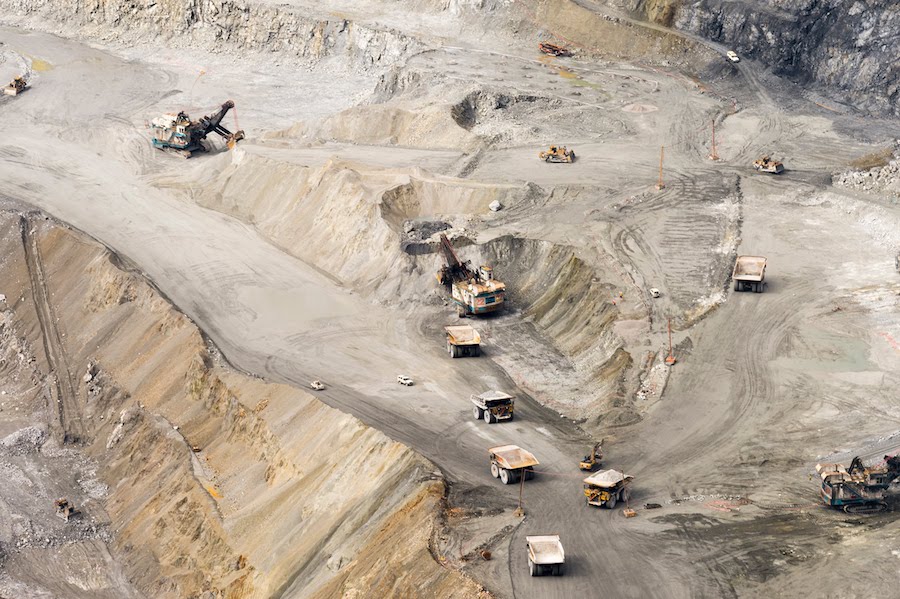

Grasberg is responsible for more than a quarter of Freeport’s total output. (Screenshot of Bando Tamayo’s video | YouTube)

Metals analysts are cutting their estimates of global copper supplies for this year and next after an accident at the giant Grasberg mine dramatically tightened the outlook for the market.

Copper prices hit 15-month highs of $10,485 a metric ton last week after Freeport-McMoRan declared force majeure at its Grasberg mine and cut sales forecast from the Indonesian unit for this year and 2026.

Freeport’s Grasberg operation located in Indonesia suspended operations on September 8 after a deadly mud slide.

The world’s second-largest copper mine behind Chile’s Escondida faces a lengthy damage assessment process and a clear-up while the search for missing workers continues.

“The scale of this disruption is very big,” said Albert Mackenzie, a copper analyst at Benchmark Mineral Intelligence.

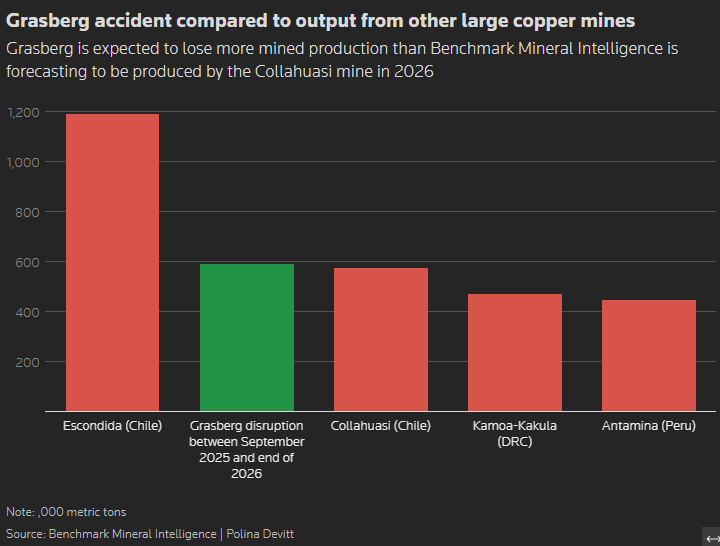
Benchmark’s analysis suggests the disruption will amount to 591,000 tons of lost copper output between September 2025 and the end of 2026.

This amounts to 2.6% of the 2024 global mine production estimated at around 23 million tons by analysts.

Supply losses from Grasberg mean the global copper market is facing a significantly wider deficit of around 400,000 tons in 2025, according to Benchmark Minerals.
The disruption has shifted Goldman Sachs’ 2025 copper market balance from a projected surplus of 105,000 tons to a deficit of 55,500 tons. It expects a small surplus in 2026.

With the losses in Grasberg’s September-December production, the copper market faces the largest deficit since 2004, Societe Generale said on Monday.

The suspension at Grasberg follows other large disruptions this year including Kamoa-Kakula in the Democratic Republic of Congo and El Teniente mine in Chile.
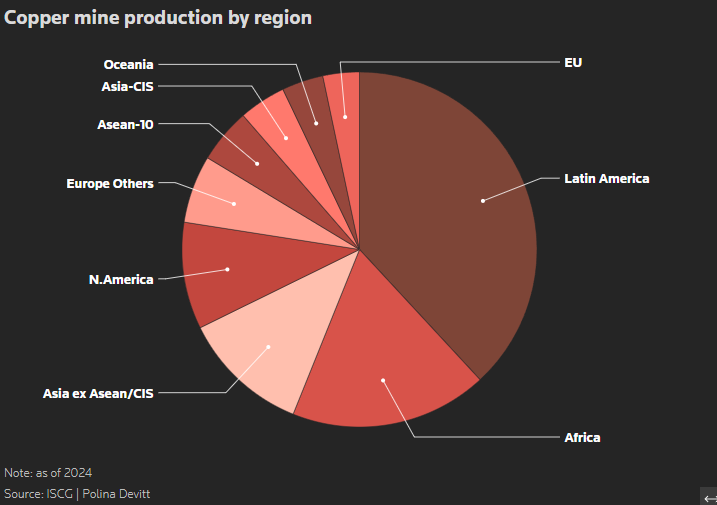
This year’s mine supply was already expected to come in below every forecast over the past 15 years and this is now exacerbated by unexpected supply disruptions, Bank of America analyst Michael Widmer said in a note.

BofA raised its estimate of the 2026 copper market deficit to 350,000 tons from a previous 162,000 tons and upgraded its 2026 and 2027 copper price forecast by 11% and 12.5% to $11,313 a ton and $13,500 respectively.
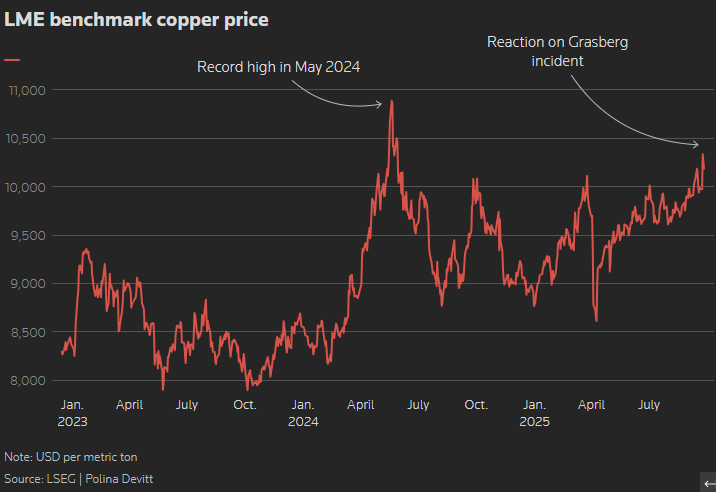
Copper’s record high was in May 2024, when it hit $11,104.50 a ton.


Anglo American's Strategic Moves Reshape Global Copper Landscape

  • Anglo American and Codelco have finalized an agreement to merge operations at their Los Bronces and Andina copper mines, aiming to unlock up to $5 billion in value and increase copper production by 2.7 million metric tons over 21 years
  • .
  • The copper market is facing an expected deficit by the end of the decade due to a lack of greenfield projects and increased demand from the energy transition, particularly for battery technology.

  • Anglo American also announced a merger with Canadian company Teck Resources, forming a critical minerals conglomerate that will be one of the world's largest copper producers, with over 70% exposure to copper.

The copper market recently experienced a significant development that could have big implications for global supply. Metals and mining multinational Anglo American has finalized an agreement with National Copper Corporation of Chile (Codelco) to merge operations at their respective Los Bronces and Andina copper mines, putting them among the top 5 largest sites in the world. According to a September 16 announcement, the agreement will unlock up to $5 billion in value from the adjacent sites.

“The joint mine plan has been developed to unlock an additional 2.7 million metric tons of copper production over a 21-year period once relevant permits are in place, currently expected in 2030,” the company said in its announcement. The firm later added that, “The expected additional copper production of about 120,000 metric tons per year is to be shared equally, with about 15% lower unit costs relative to standalone operations and with minimal incremental capital expenditure.”

Details of the Deal, Ownership Stakes

A new operating company, jointly owned by Anglo American’s 50.1%-owned subsidiary, Anglo American Sur (AAS), and Codelco, will coordinate the execution of the joint mine plan and optimize processing capacity across the two sites. The fact that AAS had signed a memorandum of understanding with Codelco on the joint operations was originally announced in February.

“Each party will retain full ownership of its respective assets (including mining concessions, plants and ancillary infrastructure) and will continue to exploit their respective concessions separately,” the company stated.It is worth noting that Japan’s Mitsubishi Corporation holds 20.4% in AAS, while the Codelco/Mitsui joint venture Becrux holds the remaining 29.5%.

According to information in Anglo American’s 2024 results, Los Bronces has approximately 8 million metric tons of copper ore reserves. However, annual production at that site was down 20% year on year to 172,400 metric tons, from 215,500 metric tons. This was mainly due to one of the sites being on care and maintenance since July 2024 and the anticipation of lower ore grade. In comparison, Codelco indicated in a 2016 report that Andina has reserves equivalent to 36.8 million metric tons, with an average ore grade of 0.78%.

Copper Market Faces Deficit, Rising Prices

Copper market watchers have warned of an expected deficit in copper by the decade’s end. These insiders cite the lack of greenfield projects and increased demand for the base metal in the energy transition, particularly with regard to battery technology.

For instance, a September 8 report by Reuters citing London-headquartered multinational professional services network EY indicated that battery electric vehicles will exceed half of new light vehicle sales in Europe by 2032 as well as exceed hybrid sales by 2030. Meanwhile, copper’s three-month price on the London Metal Exchange was $9,964 per metric ton on September 17, off 1.78% on the day from $10,145. The latest price is nonetheless 47% higher than the $6,737.50 reported on September 17, 2020.

Anglo American Also Merging with Teck Resources

Anglo American’s announcement of its operations tie-up comes one week after the company declared it had reached an agreement to merge with Canadian company Teck Resources. That transaction will form a critical minerals conglomerate and offer over 70% of exposure to copper.

“Anglo Teck will be one of the world’s largest copper producers, and will benefit from some of the world’s highest quality copper endowments, with major brownfield and greenfield copper development projects, located in attractive and well-established mining jurisdictions, to further grow the business,” Anglo said in its September 9 announcement.

The deal creates $800 million in synergies and gives Anglo American shareholders approximately 62.4% of the new company, to be called “Anglo Teck.” Meanwhile, shareholders in the Canadian firm will hold the remaining 37.6%. Representatives added that the new company will have a total of six copper assets as well as premium iron ore and zinc operations.

A Look at Anglo American’s Assets

Anglo American’s copper assets include the Quellaveco copper mine in Peru, which started operating in 2022. Information on the company’s website states that the site has a forecasted copper production of 300,000 metric tons per year over the next 10 years.

Anglo also has the Shishen and Kolomela iron ore mines in South Africa, along with the wholly owned Minas-Rio asset. This is in addition to two ferronickel mines in Brazil’s Goías state, Baro Alto and Codemin, as well as the Niquelândia processing plant. Finally, Anglo possesses sites in Australia and South Africa for the mining and production of manganese, which is used as a deoxidizer in steelmaking as well as a hardening agent.

Teck Resources Holdings, Copper Market Reaction

Meanwhile, information on the New York- and Toronto-listed company’s website states that Teck has one operating copper asset in Canada and a 22.5% stake in the Antamina zinc-copper deposit in Perushowed. Teck also owns 90% of the Chilean copper mine Carmen de Andacollo and a 60% stake in the Quebrada Blanca copper project, the latter of which is also ramping up production.

In 2024, Teck produced 446,000 metric tons of copper concentrate, a 50% increase from the previous year due to the ramp-up of the Quebrada Blanca project. Teck had 270,000 metric tons of copper produced in 2022 from its three operations in South America and Canada. According to information from the company’s website, Teck Resources’ total proven and probable copper reserves amount to 33 million metric tons.

One industry watcher praised the deal with Anglo. “It keeps the assets out of Chinese hands or Glencore’s,” that source told MetalMiner. He also pointed to several synergies between Quebrada Blanca and Collahuasi mine. “Teck owns most of QB, whilst Anglo has 44% of Collahuasi. There should be some opportunities for shared infrastructure and maybe blending when Collahuasi has high arsenic.”

By Christopher Rivituso


Giant sinkhole in Chilean mining town haunts residents, three years on

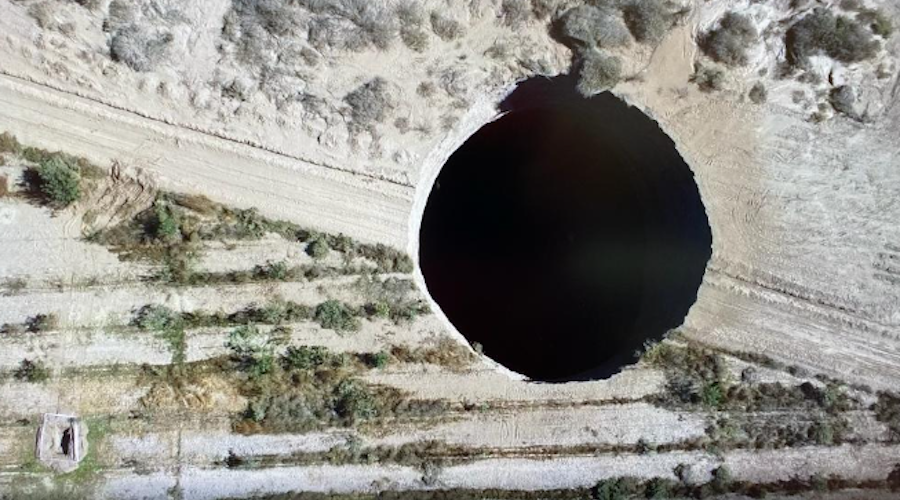
Sinkhole at the Alcaparrosa mine. (Image by Sernageomin, Twitter).

Residents in the mining town of Tierra Amarilla in the Chilean desert are hopeful that a new court ruling will allay their fears about a giant sinkhole that opened near their homes more than three years ago and remains unfilled.

A Chilean environmental court this month ordered Minera Ojos del Salado, owned by Canada’s Lundin Mining, to repair environmental damage related to activity at its Alcaparrosa copper mine, which is thought to have triggered the sinkhole that appeared in 2022.

The ruling calls on the company to protect the region’s water supply and refill the sinkhole. The cylindrical crater originally measured 64 meters (210 ft) deep and 32 meters (105 ft) wide at the surface.

That has provided a small measure of relief to those in arid Tierra Amarilla in Chile’s central Atacama region, who fear that without remediation the gaping hole could swallow up more land.

“Ever since the sinkhole occurred … we’ve lived in fear,” said Rudy Alfaro, whose home is 800 meters from the site. A health center and preschool are nearby too, she said.

“We were afraid it would get bigger, that it would expand, move toward the houses.”

The sinkhole expelled clouds of dust in a recent earthquake, provoking more anxiety, she said.

The court upheld a shutdown of the small Alcaparrosa mine ordered by Chile’s environmental regulator in January, and confirmed “irreversible” damage to an aquifer, which drained water into the mine and weakened the surrounding rock.

“This is detrimental to an area that is already hydrologically stressed,” said Rodrigo Saez, regional water director.

Lundin said it will work with authorities to implement remediation measures.

(By Daina Beth Solomon; Editing by Rosalba O’Brien)


Union rejects contract offer at Antofagasta’s Los Pelambres Cu mine in Chile

Los Pelambres is the company’s flagship mine. (Image courtesy of Antofagasta plc.)

The union for supervisors at Antofagasta’s Los Pelambres copper mine in Chile has rejected a contract offer, paving the way for a potential strike if further negotiations fail, the group said on Tuesday.

Some 94% of the union’s 550 members voted against the proposal, union leader Waldo Perez said in an interview.

In a statement, the union said its members found key clauses insufficient regarding base salary, annual performance bonus, remote work and additional hours. It also said the company’s proposal is 14% less than what was agreed in 2022.

Chilean law calls for government-led mediation during contract talks, with the aim of preventing strikes.

Antofagasta said it hoped to reach agreements as negotiations continue.

“There are still stages ahead in which we trust that, through dialogue and collaboration, we will be able to reach agreements,” the company said in a statement.

Los Pelambres last year produced 331,200 metric tons of copper.


(By Fabian Cambero and Daina Beth Solomon; Editing by Natalia Siniawski)

TRUMPIAN STATE CAPITALI$M

US government to take 5% stake in Lithium Americas and joint venture with GM


Image courtesy of Lithium Americas Corp.

The US Department of Energy will take a 5% stake in Lithium Americas and a separate 5% stake in the company’s Thacker Pass lithium mine joint venture with General Motors, a source familiar with negotiations said.

Shares of Vancouver-based Lithium Americas listed in New York rose 34% in after-hours trading on Wednesday after the stake negotiations were finalized.

It will be the latest private sector investment by President Donald Trump’s administration after recent stakes in Intel and MP Materials , seeking to boost industries seen as vital to US national security.

Last week, Reuters reported that administration officials were in discussions with Lithium Americas about an equity stake as they renegotiated terms of a $2.26 billion government loan for the mine, slated to become the largest source of the battery metal lithium in the Western Hemisphere.

Representatives for Lithium Americas and GM were not immediately available to comment.

On Tuesday, US Energy Secretary Chris Wright said on Bloomberg TV that Washington would take a stake in the company. Details of the stake’s percentage and the separate stake in the GM joint venture have not previously been reported.

The government, which will acquire the stakes via no-cost warrants, requested an unspecified amount of equity during discussions in recent months over the loan’s amortization schedule, Reuters previously reported.

In response to that request and in order to secure the first tranche of loan funding, Lithium Americas last week offered the government no-cost warrants that would equate to 5% to 10% of its common shares.

The investment terms were being finalized throughout last week and as recently as yesterday, according to the source.

GM, which invested $625 million in the mine last year for a 38% stake, has the right to buy all of the project’s lithium from its first phase and a portion from the second phase for 20 years.

Administration officials had initially sought a guarantee that GM would buy the metal regardless of market conditions, a request the automaker pushed back on and which led to the equity stake request, Reuters previously reported.

The Thacker Pass project has long been touted by both Republicans and Democrats as a key way to boost US critical minerals production and cut reliance on China, the world’s largest lithium processor.

The US produces less than 5,000 metric tons of lithium at a Nevada facility owned by Albemarle. Thacker Pass’s first phase is expected to produce 40,000 metric tons of battery-quality lithium carbonate per year, enough for up to 800,000 EVs.

China plays a dominant role in the global lithium supply chain, producing more than 40,000 metric tons each year, making it the third-largest producer after Australia and Chile. China’s influence is far greater in refining, where it processes over 75% of the world’s lithium into battery-grade material.

(By Ernest Scheyder; Editing by Chris Reese, Veronica Brown and David Gregorio)


Trump Mulls More Direct Investment in Critical Minerals

Three months ago, shares of rare earths companies ripped higher after MP Materials (NYSE:MP) unveiled a game-changing deal with the U.S. Department of Defense that marks the most aggressive federal intervention in the rare earths space in decades. The DoD-backed investment package will see the Nevada-based producer build out a fully domestic magnet supply chain and lock in long-term pricing support for neodymium-praseodymium, the critical alloy used in everything from fighter jets to iPhones. 

MP shares doubled in a matter of days, with the shares now up 330% in the year-to-date and re-rating the entire Western rare earths complex. Shares of other rare companies have enjoyed similar outsized gains: NioCorp Developments (NASDAQ:NB) has rocketed 332.2% YTD, Ramaco Resources (NASDAQ:METC) has gained 214.5%, Lynas Rare Earths (OTCPK:LYSCF) has returned 178.6% while USA Rare Earths (NASDAQ:USAR) has gained 51.0%.

The MP Materials deal wasn’t just about cash; it’s about control. Under the agreement, the Pentagon will take a 15% equity stake in MP through a $400 million preferred share issuance and secure warrants for additional common stock down the road. The government is also extending a $150 million loan, while JPMorgan and Goldman Sachs are syndicating $1 billion in private financing to bring MP’s so-called “10X Facility” online.

Construction is already underway, with commissioning slated for 2028. The real deal sweetener is a $110/kg floor price guarantee for NdPr magnets, nearly double today’s spot price of $63. That pricing mechanism, backed by the full faith and credit of the U.S. government, creates a bulletproof margin environment for domestic producers and resets the cost basis for long-term buyers across defense, autos, and consumer electronics, according to Reuters

And now news has emerged that Trump is mulling more investments in critical minerals. Indeed, the Trump administration has proposed an equity stake in Lithium Americas (NYSE:LAC), with the Canadian company looking to negotiate terms for a $2.2 billion loan for its Thacker Pass mine in northern Nevada. The giant lithium mine is set to become one of the largest sources of lithium in North America, with a starting date in late 2027.

According to Mark Chalmers, CEO of Energy Fuels (NYSE:UUUU), the Trump administration needs to strike more such deals with U.S. miners if the United States is to secure its critical minerals supply and break its heavy dependence on China. Chalmers says that multiple investments would lower the risk that comes with depending on just one company. The White House is open to this idea, and is “not ruling out other deals with equity stakes or price floors as we did with MP Materials, but that doesn’t mean every initiative we take would be in the shape of the MP deal,” a Trump administration official told CNBC.

China was the hardest hit by Trump’s tariffs, with the Middle Kingdom now facing an effective tariff of 64.9%, including an additional 34% duty imposed by former President Trump on top of existing tariffs from previous administrations.

Beijing announced a slew of countermeasures, including extra levies of 34% on all U.S. goods as well as export curbs on rare earth minerals. Under the new restrictions, Beijing requires exporters to apply for a license from the Ministry of Economy and also disclose the final use of materials like dysprosium, gadolinium, scandium, terbium, samarium, yttrium, and lutetium.

This is not the first time Beijing has leveraged its dominance in rare earths in a trade war with its biggest rival. Back in December, China banned exports of antimony, gallium and germanium to the U.S., minerals are used in specialty applications in chipmaking, defense and communications industries. In 2023, China banned the export of technology to extract and separate rare earths in a bid to protect its rare earths industries.

However, the MP deal has demonstrated that Washington is willing to play Beijing’s game by breaking with free market ideals and mimicking China’s model of strategic capitalism when and where necessary. According to Rich Nolan, CEO of the National Mining Association, federal investments in other critical minerals like cobalt, graphite and lithium can help lower price volatility that frequently undermines U.S. miners. Kent Masters, CEO at lithium miner Albemarle (NYSE:ALB), says the lithium sector would welcome government investments in deals similar to MP Materials’, “What you want to do is move the market such that private industry can invest behind it,” Masters told CNBC in July.

By Alex Kimani for Oilprice.com


China approves CATL mine reserves in relief for lithium outlook

Yichun city, China. Credit: Xwn0122, Wikimedia Commons, under licence CC BY-SA 4.0.

Chinese authorities have green-lit reserve reports from two major lithium producers operating in the mining hub of Yichun, easing concerns around output disruptions at a time when the sector’s excess capacity is under close government scrutiny.

Contemporary Amperex Technology Co. Ltd., whose Jianxiawo mine has been halted since last month, has now received the reserve approval, according to people familiar with the matter, who asked not to be named as they aren’t authorized to speak publicly. That brings the site one step closer to a mining permit and to a restart, though there is no guarantee, they said.

Gotion High-Tech Co. Ltd., which has continued to produce through the period, has also won the approval from the Ministry of Natural Resources, it told Bloomberg News on Monday.

The two miners were among eight asked by authorities in Yichun, in the southern Chinese province of Jiangxi, to submit reports on reserves by the end of September, following an audit that uncovered administrative shortcomings. The lithium hub has been in the spotlight in recent months as supply concerns led to heightened price volatility for the vital battery metal.

The Jianxiawo mine has been the center of the turmoil, after CATL, the world’s largest manufacturer of EV batteries, said in August that it would suspend operations after failing to extend an expired mining permit. Earlier this month, news that executives were now asking employees to ready the resumption of work triggered a slide in lithium stocks and in the price of the material.

Gotion has separately received approval for its mining design and ecological restoration plans at its Yichun site, it said. Its lithium unit is currently allowed to mine at the company’s discretion on production needs, it added.

CATL declined to comment. Yichun’s local government didn’t immediately respond to requests for comment.

(By Annie Lee and Alfred Cang)


WWIII

EU and NATO Consider Denying Russia Baltic Access

  • EU/NATO states are weighing a blockade or port denial strategy in the Baltic to counter Russia’s hybrid warfare and dark fleet operations.

  • Denial measures—insurance restrictions, STS policing, and port bans—could sharply raise Russia’s costs, disrupt exports from key ports, and pressure its revenues.

  • Global oil markets face added volatility, with higher transport costs, regional product price spikes, and longer-term rerouting toward Asia if Baltic denial persists.

The northern European countries are currently embroiled in a Russian hybrid warfare attempt, a situation that demands immediate and decisive attention. Denmark, a member of both the EU and NATO, is set to host a European Union Summit in Copenhagen this week, with the primary focus on Russian aggression in Ukraine and its hybrid warfare tactics. The Danish transportation ministry has already taken steps to ban all civilian drone flights in Danish airspace, underscoring the urgency of the security situation. Norwegian, Swedish, Finnish, and other Baltic Sea region countries are currently under threat from drone attacks linked to the Russian naval presence in the region, or originating from Russian or dark fleet vessels.

The current crisis has again pushed EU and NATO members to reassess options to counter these developments, including a complete blockade of the seas for Russian assets. Current EU, UK, and US sanctions on Russia are already impacting Putin’s revenues, but Moscow still holds access to the seas, particularly Baltic outlets. Growing calls are being heard for a blockade of the Baltic Sea and its gateways, seen as a measure that could hurt Putin severely. The options are on the table; however, the risks and rewards remain unclear. What is clear, however, is the need for a coordinated EU/NATO response.

The Baltic Sea and its gateways—including the Skagerrak, Kattegat, Danish Straits, and Øresund—are not only narrow waterways but also vital maritime arteries for commerce, energy, and communication. These routes connect Northern and Central Europe to global markets, making them strategically important. The growing threat of Russian interference in these areas is a cause for concern.

Since Russia’s invasion of Ukraine, the Baltic Sea has been contested—not primarily militarily but through ageing “shadow” tankers, suspicious anchor-dragging incidents severing subsea cables, and repeated drone and airspace probes. Moscow’s hybrid warfare also involves associated actors, as evidenced by reports of Chinese vessel operations. The threats are real and increasing, but options to counter them have been limited until now. Western politicians and military leaders are examining possible NATO and EU coastal state actions to block Russian dark fleet movements in the Baltic. Such steps could profoundly affect Russia’s revenues, NATO’s risk calculus, and global oil markets.

Lawful measures to block Russian access exist but have not yet been implemented. European coastal states could establish port denials, targeted sanctions, insurance and financial interdictions, and naval patrols under clear legal mandates—options that may now be discussed in Copenhagen. Grey-zone measures, such as persistent interdiction of ship-to-ship transfers and denial of bunkering and port services, should also be considered. Some are even discussing kinetic interdiction (seizing or sinking vessels), but this remains too far-fetched for many NATO members. The UNCLOS rules have until now prevented such measures, as kinetic action in peacetime against broadly flagged merchant tonnage carries a high risk of legal breach and escalation. Still, hybrid warfare may soon push some toward black ops strategies. To be effective, the Copenhagen Summit should adopt a layered civil-military strategy leveraging peacetime authorities such as customs, port-state control, sanctions enforcement, insurance leverage, naval presence, and monitoring.

Global oil markets, already volatile, could face sharp disruptions if Baltic access is denied. The region hosts key Russian export nodes for crude and petroleum products, and also serves as a hub for ship-to-ship logistics and dark fleet operations. Coordinated denial strategies among Baltic states, combined with insurer participation, would raise Russia’s operational costs. Port denials, STS policing, and insurance withdrawals would increase transport costs and logistical friction as dark fleet tankers reroute and pay higher premiums. This would reduce Russia’s market access and force heavier discounts on its barrels. While Russia has alternative routes (Arctic, Black Sea), these are unattractive in winter or vulnerable to Ukrainian attacks.

The effects are not yet clear but warrant close assessment. If interdiction is implemented without kinetic escalation, the likely consequences include higher freight rates and insurance premiums in the Baltic, as well as regional price spikes for refined products such as diesel and heating oil due to supply chain reconfiguration. The most significant impact will be pressure on Russian fiscal receipts as throughput and netbacks fall. In the long term, markets may adapt through rerouting to Asia, but the real impact will depend on the duration and scope of EU/NATO measures. Baltic denial would mainly affect Russia’s western ports, such as Primorsk and Ust-Luga, which handle crude and refined exports for Europe and beyond. The greatest pressure on Russia will come if such measures are sustained over time.

Ultimately, Russia’s hybrid warfare and its revenue base must be targeted. A new, more proactive denial strategy in the Baltic, combined with Ukraine’s drone and missile strikes on Russian energy infrastructure, could deal a serious blow. Oil markets must factor not only supply–demand fundamentals but also the strategic decisions of European leaders and military actions on the ground.

By Cyril Widdershoven for Oilprice.com


US Navy Logistics Ship Arrives in Korea for Maintenance at Hyundai Yard

USNS arriving Korea for maintenance
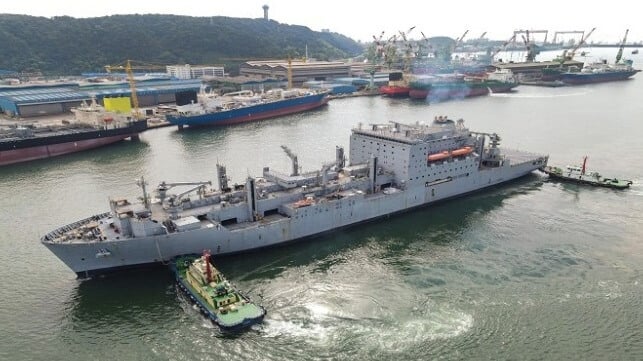
USNS Alan Shepard is the first MRO contract for HD Hyundai as it loosk to grow this business (Hyundai)

Published Sep 30, 2025 4:49 PM by The Maritime Executive


The first U.S. Military Sealift Command support ship has arrived at the HD Hyundai shipyard in South Korea for maintenance. It is the first U.S. MRO (Maintenance, Repair, and Overhaul) assignment for Korea’s largest shipbuilder and part of its strategy to expand repair work and to support the United States.

Hyundai Heavy Industries reported in August that it had won the repair assignment for the USNS Alan Shepard, a 41,000-ton displacement Lewis and Clark-class dry cargo ship that entered service in 2007. It is currently assigned to the U.S. Navy’s 7th Fleet for replenishment.

Hyundai reports the vessel recently arrived at the Yeompo Pier near HD Hyundai Mipo in Ulsan, and starting today, September 30, the maintenance work is fully kicking off. They report the project entails propeller cleaning, various tank maintenance, and safety and equipment inspections. The ship is scheduled to be delivered back to the MSC at the end of the year.

The shipbuilder had reported last year that it qualified for MRO contracts and had entered into agreements permitting it to bid for contracts. However, the yards were busy with construction work, and Hyundai reportedly lost the bidding for a prior contract. Competitor Hanwha Ocean won two MRO contracts in 2024 and reported a third this year.

HD Hyundai said the arrival of Alan Shepard marked the start of its full-scale maintenance and repair operations. It looks to grow this segment and noted that after the planned merger between HD Hyundai Heavy Industries and Hyundai Mipo that it looks to expand its international business. The company highlights that it has been providing MRO services to the Philippines since 2022 as part of a contract to build patrol ships for the Philippine Navy. 

The company also looks to take a leadership role in Korea’s Make American Shipbuilding Great Again program. It has already announced partnership agreements with Huntington Ingalls (HII), and for commercial shipbuilding, it will be working with ECO Edison Chouest Offshore. The company has also said it was exploring the possibilities of acquiring a shipyard in the United State


U.S. Coast Guard Orders First New River Buoy Tender From Birdon

The new series is much-needed to recapitalize an aging fleet

Waterways Security Cutters
Courtesy Birdon America / USCG

Published Sep 30, 2025 6:11 PM by The Maritime Executive


The U.S. Coast Guard is moving quickly to capitalize on the massive supply of cash for shipbuilding and repair work that it received in the One Big Beautiful Bill Act. It has finalized orders for more Offshore Patrol Cutters and Fast Response Cutters, commissioned major upgrades at several bases, and is investing to expand its aircraft fleet. On Monday, the service announced that it has put in orders for more Waterways Commerce Cutters, the new inland "black hull" working vessels that will replace aging boats (up to 80 years old) in the service's riverine fleet. 

The Coast Guard has ordered the start of production for the first river buoy tender in the series, plus the long lead time materials needed for the second inland construction tender. It has also put in an order for three more sets of long lead time materials for future orders. All told, the new contracts for shipbuilder Birdon America come to about $110 million, including $51 million from the One Big Beautiful Bill Act. 

The two vessel types have much in common, but serve different tasks. The construction tenders are fitted out for pile driving, tower erection and structural repairs for fixed ATON. The buoy tenders are designed for setting and relocating buoys, and can also be used to maintain fixed lights and daybeacons. Both are covered by the same procurement contract, as they are structurally similar. The need is significant: the average age of the current fleet is about 60 years, and there are more than 28,000 ATON units to service on the inland waterways. 

“Our nation’s marine transportation system facilitates over $5.4 trillion in economic activity every year and supports millions of jobs throughout the United States,” said Rear Adm. Mike Campbell, the Coast Guard's Director of Systems Integration and Chief Acquisition Officer. “Putting new waterways commerce cutters on contract ensures we have the capabilities needed to support the safe and efficient flow of commerce in our inland waterways systems.”


Report: After Review, AUKUS Submarine Sales Will Go Forward

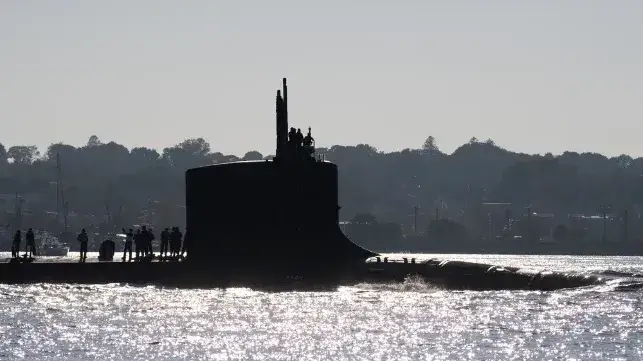
The Virginia-class attack sub USS Hyman G. Rickover under way, 2023 (USN file image)

Published Sep 30, 2025 11:40 PM by The Maritime Executive


The AUKUS submarine pact between the United States, Australia and the UK has survived a Pentagon review, according to Nikkei Asia. After careful scrutiny of the Biden-era agreement, the Trump administration will continue with a planned sale of three attack submarines to the Royal Australian Navy, with the first delivery in 2032. According to Nikkei's sources, the pact will be approved before Australian Prime Minister Anthony Albanese visits Washington on October 20. The administration has not formally confirmed the report.

The overall program is worth billions of dollars for Electric Boat and Huntington Ingalls Newport News, as well as their suppliers and subcontractors in the submarine industrial base. As of 2023, the initial plan called for the U.S. to sell Australia two secondhand Block IV Virginia-class attack submarines from U.S. Navy inventory in 2032 and 2035, plus one more new Block VII hull in 2038. The deal calls for up to five hulls in total, and Australia made the first $500 million down payment on that plan in March 2025. Each new Virginia-class boat is worth $3 billion, and climbing. 

In addition to revenue for the defense industrial base, the sale would have value for the U.S. Navy: it would be accompanied by new basing and repair arrangements for U.S. submarines in Western Australia, and a subtle expectation that the Australian subs could be called upon to help in the event of a future conflict.

The downside of the arrangement is in the additional pressure it would create for the U.S. Navy's submarine supply chain. The Virginia-class and Columbia-class sub programs are mission-critical for the U.S. Navy, and the two yards that build these subs - GD Electric Boat and HII Newport News - are already behind schedule and over budget. If the submarine industrial base could not build AUKUS program boats on time, it could slow U.S. Navy fleet growth. Parts availability could also be strained by the addition of the Australian orders, both for new construction and for maintenance - a critical challenge.

In June, the Financial Times reported that the Pentagon had appointed undersecretary of defense for policy Elbridge Colby to review the AUKUS program. At the time, the department confirmed that a review was under way "as part of ensuring that this initiative of the [Biden] Administration is aligned with the President’s America First agenda."

A Pentagon spokesperson told the Guardian on Tuesday that the review was still under way and that no decision had been made, contrary to Nikkei's report of a green light. Senior Australian officials also suggested that the review was still in progress, but expressed confidence that it would ultimately be approved. 

 PHILIPPINES

Subic Bay Regains its Importance as a Forward Base

SSGN
Cruise missile submarine USS Ohio arrives at Subic Bay, September 23 (USN)

Published Sep 30, 2025 8:48 PM by The Maritime Executive


Subic Bay was once a key strategic facility for the U.S. Navy, and may soon be again: the service is ramping up plans for forward equipment storage and repair capacity in and around the area, preparing the sheltered anchorage for wartime use if the need ever arises.

After its liberation from the Japanese near the end of WWII, Subic Bay became a major U.S. military base. It grew throughout the Cold War, and it provided a major staging point during the war in Vietnam. At one point, it handled more fuel oil and more duty-free retail volume than any other naval facility in the world, a measurement of its importance for supporting personnel and vessel operations near the theater. But in 1991, after the U.S. and Philippine governments failed to agree on financial terms for a lease renewal, the base closed; with the Cold War and its military usefulness over, it became a commercial free zone under Philippine control, and the U.S. Navy withdrew to other bases in Guam, Okinawa and Yokosuka. 


Busy piers at Naval Station Subic Bay, 1981 (USN)

With China's expansionist ambitions on the rise in the South China Sea and Taiwan Strait, Subic Bay is strategic once again. This defensible and well-equipped harbor is positioned within easy reach of contested waters: it lies about 300 nautical miles south of the Strait of Luzon and 300 nautical miles northeast of the Spratly Islands. For a destroyer at flank speed, that is less than a 10-hour commute to and from the battle zone for repairs, refueling, and vertical reloading of VLS missile cells -  a task that requires sheltered-water surface conditions. 

The Navy and Marine Corps both have an interest in Subic Bay for their basing needs. A new solicitation - first reported by USNI - requests proposals for a 270,000 square foot (six acre) warehouse and shop facility within the Subic Bay free zone. The giant building must be climate controlled, and will be used for "storage and maintenance of vehicles and vehicle equipment." The Marine Corps already has a 57,000 square foot storage warehouse in Subic Bay, and the RFP calls for real estate options close to this existing site. 

The added storage and repair capacity would support a heightened American presence in the Philippines, including near-constant training rotations and joint exercises. As China ramps up its activities in nearby waters, Subic Bay also supports an increased U.S. Navy and Coast Guard presence. Just last week, the cruise missile sub USS Ohio (SSGN-726) made a rare appearance in Subic Bay to rendezvous with the USS Frank Cable, one of the service's two remaining sub tenders.

The SSGNs carry more than 150 Tomahawk missiles each, plus lockout chambers for use by special forces divers. They have been tested on covert and overt missions for decades: one of the four vessels in the class, USS Florida, played a role in the successful foreign intervention in Libya in 2011, which culminated in regime change. Given the SSGNs' deep magazine, stealth and general warfighting utility, the disclosure of their location is often viewed as geopolitical signaling, as seen before in the Mideast.