Wednesday, October 01, 2025


Shell Starts Gas Production at UK’s Victory Field

Shell UK has begun production from the Victory gas field in the North Sea, located about 47 km northwest of the Shetland Islands. The field is expected to play a key role in supporting Britain’s energy security by maintaining domestic gas supply for households, businesses, and power generation.

Gas is being extracted from a single subsea well and connected to existing pipeline infrastructure, which transports it to the Shetland Gas Plant. From there, it is piped to the Scottish mainland at St Fergus near Peterhead and fed into the national grid. Using existing infrastructure is designed to keep costs competitive while reducing operational emissions.

At peak output, Victory is expected to produce around 150 million standard cubic feet of gas per day—equivalent to roughly 25,000 barrels of oil per day. That’s enough to heat close to 900,000 homes annually. Most of the field’s recoverable gas is projected to be extracted before the end of the decade.

“Gas fields like Victory play a crucial role in the UK’s energy security, and the country will rely on them for decades to come,” said Simon Roddy, Shell UK’s Upstream Senior Vice President. “They provide an essential fuel we need now, and act as a partner to intermittent renewables as we move through the energy transition.”

Currently operated and fully owned by Shell, the Victory field will be transferred to Adura, a new joint venture that Shell and Equinor will each own 50%. Work toward securing regulatory approval for Adura is ongoing, with the venture expected to be finalized by the end of 2025.

By combining domestic production with renewable growth, Shell aims to support Britain’s energy transition while reducing reliance on imports. Victory underlines the continuing importance of North Sea gas as both a bridge fuel and a stabilizer in the country’s energy mix.

India's Energy Tightrope: Balancing Decarbonization and Development

  • India is under international pressure to decarbonize its energy sector, but it prioritizes energy security and economic development, arguing that developed countries should fund the global clean energy transition due to their historical emissions.

  • Despite being the third-largest greenhouse gas emitter, India's per-capita emissions are low, and the country is already experiencing the negative impacts of climate change and its own fossil fuel industry.

  • India is expanding its clean energy capacity, targeting 500 gigawatts of non-fossil fuel power by 2030, but faces significant funding hurdles and continues to advocate for accountability from G7 countries regarding past emissions and unfulfilled climate financing promises.

India is facing considerable international pressure to decarbonize its energy sector, but balancing energy security and a just transition with international climate accords is no easy feat. While India has historically adopted an ‘all of the above’ approach to energy policy, a more organized and comprehensive strategy is needed to walk the tightrope of the energy trilemma – establishing an energy mix that is sufficient, affordable, and sustainable. As energy demand rapidly increases, Indian electric grids require more and more energy each year, straining the nation’s production capacity and making decarbonization goals ever harder to reach.

The most populous country in the world, India is also one of the poorest, despite considerable economic development in recent decades. And increasing energy access is an absolutely critical part of India’s continued climb out of poverty. “Tackling the energy access gap is a critical step in meeting the country’s economic and social development ambitions, and it has been a top priority for successive Indian governments,” reports the Guardian. 

Indian leadership has never tried to hide its prioritization of energy security over energy greenification. Moreover, India has always pushed back on international agreements stressing the country’s role and responsibility in fixing a climate crisis that it contributed very little to. Rather, Indian representatives have argued that developed countries responsible for the lion’s share of historic greenhouse gas emissions should primarily fund the global clean energy transition for poorer countries that bear relatively little guilt but almost all of the consequences for global warming. 

While India is the third-largest greenhouse gas emitter in the world after China and the United States, Indians still have relatively low per-capita energy emissions compared to countries in Europe and North America. The average refrigerator in the United States consumes nearly half as much energy as an Indian person does in an entire year – and considerably more than someone living in sub-Saharan Africa. And yet people in these countries are experiencing the brunt of global warming. This injustice and hypocrisy, Indian leadership argues, merits that the West should concern themselves with their own energy transitions before they start mounting pressure on countries like India.

While G7 countries have pushed hard on Indian leadership to phase out coal, the Indian government has fought hard to water down such agreements, while also firing back at rich nations for their string of broken promises to provide climate financing to the developing world. In 2009, at the UN’s annual climate conference, rich countries promised to deliver $100 billion in climate financing each year starting in 2020. That money never even came close to materializing

This is not to say that India isn’t rapidly expanding clean energy capacity – it is. And Prime Minister Nerendra Modi’s government is targeting the addition of 500 gigawatts of non-fossil fuel power by 2030. However, the country’s clean energy plans continue to face major funding hurdles. India’s economy has hit a lag, and international investment has not been forthcoming. 

But India is already feeling the heat of a changing climate, as well as disrupted weather patterns. This is a major driver of the country’s rising energy demand, as air conditioning becomes increasingly necessary for public health and safety. Moreover, India is also feeling the negative public health consequences of its own dirty fossil fuels industry. So whether or not the burden of responsibility for decarbonization is fair, it’s undeniably necessary – and in short order.

“Based on health science alone, expanding fossil fuels goes against the human right to development because of the multigenerational harm caused to human health and food systems,” Elisa Morgera, UN special rapporteur on climate change, was quoted by the Guardian. “These impacts in and of themselves worsen climate impacts on human wellbeing and economies, on top of the direct harm to the climate system caused by fossil fuels.”

India will likely continue to try to hold G7 countries accountable for past emissions, fighting for an international agreement based on "common but differentiated responsibilities." But it cannot afford to maintain its reliance on fossil fuels – particularly coal. It’s a sticky situation, but India’s government is slowly but surely investing in the renewable energy transition while it also fights for climate financing follow-through. 

By Haley Zaremba for Oilprice.com 

  Tariff Rate Quota (TRQ) 


Canada's TRQ System Reshapes Oil Country Tubular Goods Market

  • Canada's new tariff rate quota (TRQ) system for oil country tubular goods (OCTG) and linepipe, implemented in two stages, aims to protect domestic producers but has created structural tightness in the market due to modest quarterly quotas and punitive 50% surtaxes on overages.

  • The TRQ system introduces significant risks for suppliers and buyers, leading to dual-price offers and increased transaction costs due to the unpredictability of import permits and the application of surcharges even on products not manufactured in Canada.

  • While OCTG and linepipe prices have remained stable in the near term, increased volatility is expected as quotas deplete, particularly during project-heavy quarters, ultimately strengthening domestic mill pricing power and raising structural landed costs in Canada.

Recent months have underscored how Canada’s implementation of its tariff rate quota (TRQ) system is reshaping the market for oil country tubular goods (OCTG) and linepipe. The system, rolled out this summer, is already influencing procurement strategies as companies adapt to tighter import channels and higher costs. Rystad Energy expects mild upward pressure on Canadian OCTG and linepipe prices in the medium term as demand from pipeline projects grows and competition for limited import quotas intensifies.

The TRQ system took effect in two stages this summer: on 27 June for non-Free Trade Agreement (FTA) countries and on 1 August for FTA exporters, excluding the US and Mexico. At its core, the policy aims to shield domestic OCTG and linepipe producers from diverted steel flows following US tariffs and to prioritize Canadian-made material for government projects. However, modest quarterly quota volumes—such as just 7,816 tonnes per quarter for OCTG from non-FTA origins and 5,086 tonnes for large-diameter linepipe—and punitive 50% surtaxes on overages create structural tightness in the market. Imports that include Chinese-melted steel face an additional 25% levy, further restricting viable supply options. All quotas are administered on a first-come, first-served basis, with no breakdown by country, supplier or product type.

This structure creates significant risks for suppliers and buyers alike. Since import permits are allocated in real time without clear visibility, it remains extremely difficult for foreign suppliers to control whether their shipments will fall inside or outside quota volumes. Once exhausted, material arriving at Canadian ports becomes subject to the 50% surtax. To manage this uncertainty, many suppliers now issue dual-price offers to Canadian buyers—one reflecting standard landed cost and another including the surcharge in case the shipment is taxed upon arrival. This lack of predictability adds further complexity to procurement strategies and raises overall transaction costs.

In practice, the TRQ regime applies equally to products not manufactured in Canada, meaning domestic buyers may still need to import and pay premiums due to limited local alternatives. As a result, the burden ultimately falls on Canadian buyers, who face higher costs and reduced flexibility. While the system is intended to shield domestic mills, in practice it also extends to non-competing products, amplifying procurement challenges.

Despite these headwinds, OCTG and linepipe prices have held steady in Canada. Stability is expected to persist through year-end, supported by controlled inventory levels, disciplined distributor pricing, and limited import arrivals. Looking ahead, volatility will likely increase as quotas approach exhaustion, particularly during project-heavy quarters when demand spikes. For OCTG, qualification requirements make substitution difficult, leaving end users vulnerable to late-quarter cost surges. In linepipe, large-diameter project tenders could quickly deplete quotas, forcing buyers to turn to domestic mills or face surcharges. This dynamic supports a firmer domestic price floor for OCTG and linepipe.

Overall, the TRQ system tightens Canada’s import channels, strengthens domestic mill pricing power, and raises structural landed costs. While near-term impacts remain muted, the system is set to weigh more heavily in 2026 as sourcing flexibility narrows and procurement risks mount.

By  Marina Bozkurt, Vice President, Supply Chain Research at Rystad Energy

Iraqi Kurdistan Oil Exports Resume To Turkey, But For How Long?

  • Oil exports from Iraq’s Kurdistan region through the Iraq-Turkey Pipeline resumed on 27 September after U.S.-brokered agreements between the KRG, Baghdad, Turkey, and foreign operators.

  • Disputes persist over unpaid debts exceeding $1 billion to foreign oil firms, Baghdad’s rejection of Kurdish autonomy, and Turkey/Iran’s opposition.

  • The U.S. views the KRI as a strategic partner, pressuring Baghdad to cut reliance on Iran and backing the restart, while China, Russia, and Iran support Baghdad’s drive to centralize control.

Crude oil flows from the semi-autonomous Kurdistan region of Iraq (KRI) through the Iraq-Turkey Pipeline (ITP from Kirkuk to Ceyhan resumed on Saturday (27 September) for the first time since 25 March 2023. This followed agreements between the various interested parties, comprised of the Iraq Kurdistan regional government (the KRG), the foreign oil and gas firms operating in the KRI, the Federal Government of Iraq (FGI), Turkey, and the U.S. This latter entrant into the two-and-a-half-year fray is the key reason for the sudden lack of objections from the FGI and Turkey, a senior oil industry source who works closely with Iraq’s Oil Ministry exclusively told OilPrice.com last week. Turkey had been insisting that any new agreement between it and the FGI (and by extension the KRG) should be for ‘full usage’ of the ITP. This would involve 1.5 million barrels per day (bpd) going through the pipeline, despite around 80% of Iraq’s total 3.5 million bpd currently going in the opposite direction to Asia.  The FGI had consistently reiterated that it would only allow such a resumption of oil flows to Turkey if the country finally paid it the US$1.5 billion in damages for unauthorised exports by the Kurdish regional authorities ordered by the International Chamber of Commerce. However, the outlook for the continuation of these various deals and therefore for the ongoing flows of oil from the KRI into Turkey is bleak.

Related: Forget OPEC Warnings The Real Oil Shock Is Happening Inside Russia

As it stands, up to 190,000 barrels per day (bpd) of crude oil will flow through the ITP from Kirkuk to Ceyhan, but this is planned to increase again to the 230,000-bpd level seen just before the pipeline’s closure in 2023, and then back to even higher levels over time. This is also the level the KRG committed the previous week to delivering to Iraq’s State Organization for Marketing of Oil (SOMO), while keeping a further 50,000 bpd for domestic use. As previously reported by OilPrice.com, US$16 of the sales price per barrel will be transferred to an escrow account and distributed proportionally to the KRI’s oil producers, with the rest going to SOMO. This effectively acts as a subsidy for production costs incurred by international oil companies operating in the KRI and replaces the previous offer of US$7.90 per barrel that was rejected by the KRG. All of this is thematically the same as the initial supposed landmark deal between the KRI and the FGI that was drawn up in November 2014, as analysed in full in my latest book on the new global oil market order. This laid out that the FGI would pay the KRG 17% per month of the central government of Iraq’s budget after sovereign expenses (around US$500 million at that time) in exchange for the KRG organising the export up to 550,000 bpd of oil from the Iraqi Kurdistan oil fields and Kirkuk to SOMO. Thes deal never worked properly, with both sides accusing the other of shortfalls in their respective deliveries. Even before this, though, problems could arise in the very short term from the foreign oil firms, as they are collectively still owed over US$1 billion by the KRG for oil produced and then sold previously. Norway’s DNO and its joint venture partner Genel Energy have long made it clear that they would not fully re-engage with crude oil exports through the ITP until they received assurances from the KRG that it would properly address the US$300 million or so of debt to the two firms. The eight other foreign oil producers that signed the initial agreement on Saturday to restart exports to Turkey will meet within the 30 days following the recent resumption of flows (so, 27 October at the latest) to flesh out a mechanism with the KRG whereby these debts can finally be settled. At a 12 July meeting of foreign oil firms operating in the KRI, the companies attending stressed the need for future export payments that are consistent with each’s existing, legally valid contracts, and transparent and prompt payments, either in cash or through in-kind transfers of crude oil entitlements.

In addition to potential disruption to the current oil flows resumption pact from the foreign oil firms, is the longstanding fundamental opposition to such an arrangement from the FGI in Baghdad, from Turkey, and from Iran, China, and Russia. In very basic terms from Baghdad’s side, it is in no way beneficial for it to have a semi-autonomous region with any real power, let alone one that has oil and gas riches which – if it was simply a regular region subsumed into the rest of Iraq – would be Baghdad’s to develop with whichever firms its wished and to freely bank the revenues. Whilst the U.S. and the Western allies continued to support the KRG – even promising full independence to the region for the crucial help of its Peshmerga in fighting Islamic State – Baghdad had little choice but to put up with it. However after the U.S.’s end of mission in Iraq in December 2021, the move was on in Baghdad to end all independence for the KRI, as also detailed in my latest book. Following the September 2017 Kurdish referendum on independence – which saw over 90% of voters in favour of the idea – the FGI’s then-Prime Minister Haider al-Abadi called the vote ‘unconstitutional’ and added that Baghdad would take control of border crossings linking the Kurdistan Region with neighbouring countries. He also restricted international flights to and from the region’s Erbil and Sulaymaniyah airports and sent troops to the disputed oil-rich region of Kirkuk – over which the FGI said it held sovereignty, despite it being recaptured by Kurdish Peshmerga troops in 2014. He further called on “neighbouring countries and countries of the world” to stop buying crude oil directly from Kurdistan, and only to deal with the FGI. Baghdad’s current view on any KRI independence was made extremely when Iraqi Prime Minister, Mohammed Al-Sudani stated that the new unified Oil Law -- run, in every way that matters, by the FGI out of Baghdad -- will govern all oil and gas production and investments in both Iraq and the Kurdistan region and will constitute “a strong factor for Iraq’s unity”. Turkey and Iran – both with very sizeable Kurdish populations themselves – also aggressively moved against the KRI after the independence vote, as they believe an independent Kurdish state would catalyse Kurdish independence movements in their own countries. The FGI’s stance on ending all independence for KRI aligns perfectly with the views of its key sponsors China and Russia. This was relayed to OilPrice.com some time ago by a senior energy source who works closely with Iran’s Petroleum Ministry: “By keeping the West out of energy deals in Iraq, the end of Western hegemony in the Middle East will become the decisive chapter in the West’s final demise.”

At the same time, the KRI’s determination to maintain its semi-independent status, and to expand it if possible, equally reflects the view of its principal sponsors – the U.S. and its key allies. They want the Kurdistan region to act as a bridge from NATO member Turkey into the Middle East and therefore wants the KRI to terminate all links with Chinese, Russian, and Iranian companies connected to the Islamic Revolutionary Guards Corps over the long term. The U.S. and Israel also have a further strategic interest in utilising the Kurdistan Region as a base for ongoing monitoring operations against Iran. It is little wonder, then, that early congratulations on the 27 September resumption of KRI oil flows to Turkey came from U.S. Secretary of State Marco Rubio, who also stated that Washington helped to facilitate the deal. In this context, Washington had begun to ratchet up the pressure on Baghdad to agree such a deal with the KRI in March of this year when -- in what was exclusively described by a senior Washington legal source to OilPrice.com as “a very frank conversation” -- Rubio also impressed upon Prime Minister al-Sudani the importance the U.S. attaches to Iraq becoming energy independent, and therefore to stop supporting Iran through continued purchases of its gas and electricity. It was made clear at that point that if Baghdad moved in these directions, then it would receive a lot more investment from the U.S, but if it did not then there would be no further investment, and more sanctions would be slapped on it and then laddered up in severity very quickly indeed. That said, with both the Global North and Global South having significant interests in KRI/FGI outcome, it remains to be seen which side’s carrots and sticks prove the most compelling for Baghdad.

Brazil Is Destined to Become One of the World's Top Five Oil Producers

  • Brazil set a new production record in June 2025, lifting 4.9 million BOE/day, with crude output alone hitting 3.8 million barrels per day.

  • Petrobras plans $111 billion in investments through 2029, with $77 billion directed to upstream projects and 10 new FPSOs to boost output.

  • Big Oil players, including Shell, TotalEnergies, and Equinor, are ramping up investments in Brazil’s pre-salt fields, pushing total sector investment to $122 billion by 2029.

Recently, the International Energy Agency (IEA) identified Brazil as a key non-OPEC oil producer responsible for driving global production growth. A swathe of world-class ultra-deepwater pre-salt oil discoveries, the first made in the Lula field during 2006, are driving a massive offshore oil boom. Not only is Brazil Latin America’s largest oil producer, but the country is receiving substantial investment from Big Oil, which is driving production to record highs. By July 2023, petroleum output for the first time eclipsed 3.5 million barrels per day, placing Brazil on track to lift five million barrels by 2030, making it a top-five global producer.

Data from Brazil’s hydrocarbon regulator, the National Agency for Petroleum, Natural Gas and Biofuels (ANP), shows that for June 2025, Brazil lifted an average of 4.9 million barrels of oil equivalent per day. That is the largest volume of hydrocarbons Brazil has ever pumped, setting a new record high for Latin America’s largest oil producer. Crude oil output also hit a new record, reaching 3.8 million barrels per day, with the balance comprised of natural gas. This bodes well for further strong production growth and Brasilia’s plans to become a top-five global oil producer.

Key to achieving this goal is the investment made by Brazil’s national oil company Petrobras, which is 37% owned by the federal government in the capital, Brasilia. The integrated energy major plans to spend $111 billion across its operations between 2025 and 2029, a $9 billion increase over the $102 billion budgeted in the 2024 to 2028 investment plan. This considerable investment will be predominantly directed toward upstream assets, with Petrobras earmarking a whopping $77 billion for exploration and production operations, $4 billion more than the earlier plan. 

Nearly $8 billion of the exploration and production budget for 2025 to 2029 will be directed to drilling 51 new wells, 78% of which will be undertaken in Brazil’s offshore hydrocarbon basins. A significant proportion of the $69 billion will be spent on bringing 10 new floating production storage and offloading (FPSO) vessels online by the end of 2029. There are also a further five FPSOs to be added during 2030 and after, with six further projects to be studied. 

Petrobras forecasts this massive investment will boost operated hydrocarbon output to 4.5 million barrels of oil equivalent per day by 2029, a nearly 10% increase over 2025. This will be comprised of an estimated 2.5 million barrels of crude oil, with the remaining two million barrels made up of natural gas and associated liquids. The national oil company believes that 80% of its hydrocarbon production by the end of 2029 will be generated by pre-salt assets.

To support that massive investment, Petrobras is focused on developing assets that have a low breakeven price, a strategy adopted in the wake of the pandemic-induced oil price crash. Indeed, Brazil’s national oil company claims to have an industry-low portfolio-wide breakeven price of $28 per barrel Brent, even less than super majors Exxon and Chevron. That, coupled with growing demand, especially from China, for Brazil’s light sweet pre-salt crude oil and its low carbon intensity to extract, will ensure Petrobras’ operations remain profitable even in low price environments.

It is not only Petrobras that is investing heavily in Brazil’s oil patch. Latin America’s largest economy and oil producer is attracting considerable attention from foreign investors, notably Big Oil. Indeed, Big Oil’s deep pockets will ensure spending on Brazil’s booming offshore oil industry continues expanding at a solid pace. It is global supermajor Shell, which over the last decade has emerged as a major player in offshore Brazil. The South American country now accounts for around 15% of Shell’s production, and the supermajor is Brazil’s second-largest petroleum producer, responsible for nearly 11% of crude oil output. 

During late May 2025, Shell announced first oil from the Mero-4 project in the Mero oilfield situated in the pre-salt area of the Santos Basin. This occurred after the FPSO Alexandre de Gusmão was connected to the project's 12 wells, with the operation having a nameplate capacity of 180,000 barrels of oil per day. Shell holds a 19.3% working interest in the Mero field, which is operated by Petrobras with a 38.6% working interest. The remaining 42.1% is held by several energy companies, including Big Oil companies with French supermajor TotalEnergies holding 19.3% and Chinese state-controlled CNPC and CNOOC with 9.65% each.

Earlier this year, in March 2025, Shell disclosed that it had made a final decision to invest in the Gato do Mato project. This is a pre-salt discovery situated in Brazil’s prolific Santos Basin. Shell, which holds a 50% working interest, is the operator while partners Colombian national oil company Ecopetrol and France’s TotalEnergies control 30% and 20%, respectively. The project is targeting a resource estimated to contain 370 million recoverable barrels of crude oil. The Gato do Mato oilfield is expected to commence operation in 2029 with a 120,000-barrel-per-day FPSO supporting production.

French supermajor TotalEnergies holds 11 of Brazil’s oil-producing licenses, four of which are operated. The company is Brazil’s third-largest oil producer, accounting for nearly 4% of the South American country’s petroleum output. TotalEnergies continues to invest in offshore Brazil, targeting pre-salt oil discoveries for development. As previously discussed, the supermajor’s latest projects are the Mero-4 field and the Gato do Mato development. TotalEnergies anticipates boosting oil production in Brazil to 200,000 barrels per day by the end of 2026.

Norway’s state-controlled global supermajor Equinor also operates in Brazil. The company considers South America’s largest petroleum producer to be a leading source of production growth. Back in June 2025, Equinor announced winning the S-M-1617 block situated in the Santo Basin during Brazil's 5th Open Permanent Concession bid round. Equinor is also progressing interests in a range of oil and gas projects, which, on completion, will further boost Brazil’s overall hydrocarbon output.

According to the ANP, Brazil’s oil patch will attract a whopping $122 billion of investment by 2029, most of which is destined for prolific offshore ultra-deep-water pre-salt oilfields. While Petrobras will contribute a significant amount of that capital a large portion will come from foreign energy companies, notably Big Oil. It is easy to understand Big Oil’s attraction to Brazil and the offshore pre-salt reservoirs. Average breakeven costs for projects are estimated to be less than $40 per barrel brent, falling to $30 per barrel or less for pre-salt assets. On top of which oil lifted from Brazil’s offshore fields has a low carbon intensity of around 15 kilograms of CO? per barrel a significantly lower amount than the estimated global average of 20 kilograms of CO? per barrel. 

By Matthew Smith for Oilprice.com

BP Approves $5B Offshore Project in Gulf of Mexico

  • BP is moving forward with plans to develop an offshore drilling project in the Gulf of Mexico worth $5 billion.

  • The new platform will develop the Tiber and Guadalupe fields, which combined are estimated to hold recoverable resources of about 350 million barrels of oil equivalent.

  • BP wants to close the gap with rivals Exxon Mobil and Shell, which have outperformed it in recent years on shareholder returns

BP (NYSE:BP) is moving forward with plans to develop an offshore drilling project in the Gulf of Mexico worth $5 billion.

It is expected to take five years for the Tiber-Guadalupe oil and gas project to come online. In 2030, the floating platform will have the capacity to produce 80,000 barrels of oil per day, en route to BP increasing its US upstream output to more than 1 million barrels of oil equivalent per day.

Reuters said the announcement underscores the British energy major’s commitment to the US region to rebuild its oil and gas business, following a strategic shift in February away from renewables and back to its core oil and gas competencies.

The new platform will develop the Tiber and Guadalupe fields, which combined are estimated to hold recoverable resources of about 350 million barrels of oil equivalent, according to the company.

It will help BP to meet its production target of 400,000 barrels of oil equivalent per day (boepd) from the Gulf by 2030, compared to 341,000 boepd in 2024.

BP wants to close the gap with rivals Exxon Mobil (NYSE:XOM) and Shell (NYSE:SHEL), which have outperformed it in recent years on shareholder returns, Reuters said.

Related: OPEC Rejects Media Reports of Major Output Hike Ahead of G8 Meet

In January, BP announced it was cutting 5 percent of its workforce or 4,700 jobs and 3,000 contractors.

The UK-based company said the reductions were part of a cost-cutting plan that began a year ago, when it identified $500 million of cost savings to be delivered in 2025 — 25 percent of the $2 billion target set for the end of 2026.

In May, my Oilprice.com colleague Alex Kimani reported that U.S. energy executives are forecasting a significant increase in offshore oil production under a second Trump administration, attributing this to streamlined permitting processes, sustained investments, and technological advancements. The Gulf of Mexico’s output is projected to rise from 1.8 million barrels per day (bpd) to 2.4 million bpd by 2027, according to estimates from the U.S. Energy Information Administration (EIA) and the Bureau of Ocean Energy Management (BOEM).

While shale oil offers flexibility, its growth is expected to plateau, prompting companies to focus more on offshore drilling. The Trump administration's commitment to expediting oil and gas project approvals on federal lands is anticipated to further bolster offshore activities…

Recent BOEM assessments estimate the Gulf holds 29.59 billion barrels of oil and 54.84 trillion cubic feet of gas in technically recoverable, undiscovered fields. A 2023 update added 1.3 billion barrels of oil equivalent (boe), marking a 22.6% increase after analyzing more than 37,000 reservoirs across 1,336 fields…

Offshore U.S. production could fill key gaps left by a slowing shale sector…

(Shale wells typically bleed off 70 to 90% in their first three years and drop by 20 to 40% a year without new drilling. A recent IEA Report confirms this, stating that the world’s oil and gas fields are declining at a faster rate than previously thought, leaving the energy sector facing a costly battle to maintain output.)

In 2024, federal offshore areas produced 668 million barrels of oil and 700 billion cubic feet of natural gas—figures that are expected to climb as new projects come online and lease activity increases.

Analysts note that despite trade disputes and policy shifts, U.S. offshore oil remains globally competitive. Its high-volume, low-decline profile offers a degree of reliability that investors and buyers increasingly value. Even in the face of Chinese tariffs on U.S. LNG, American energy exports continue to expand.

More recently, Oilprice author Tsvetana Paraskova wrote that European majors BP and Shell reversed their pledges from the early 2020s to reduce oil and gas production by the end of the decade. This year marked the return to boosting oil and gas production, and with it increased exploration efforts in key basins and promising new frontiers…

BP, the last of Europe’s Big Oil to switch back to the core business of raising oil and gas production, [in August] struck a major oil and gas discovery in Brazil’s prolific offshore Santos Basin, the supermajor’s biggest in 25 years.

By Andrew Topf for Oilprice.com

Glencore’s top oil and gas trader becomes latest senior exit

Glencore’s Ulan Coal complex, located near the village of Ulan in central-west New South Wales. Credit: Glencore

The head of Glencore Plc’s oil and gas trading team is planning to leave the company, becoming the latest high profile departure from one of the world’s biggest commodity traders.

Alex Sanna, who has been at the company for almost 20 years, will leave at the end of this year after deciding to step down, according to an internal memo seen by Bloomberg News. He will be replaced by Maxim Kolupaev, who currently leads LNG, gas and power trading.

Sanna’s departure comes just a few months after the company posted one of the worst performances from its energy- and coal-trading unit on record. Bloomberg reported the same week that coal-trading head Ruan van Schalkwyk was retiring, amid a wider shakeup of the trading unit leadership.

Sanna and van Schalkwyk’s departures are the latest in a series of senior exits from Glencore’s trading business. Jason Kluk, Glencore’s head of nickel and ferroalloy trading, left the company last November, while Sam Imfeld, a longstanding trader in Glencore’s aluminum and alumina team, left for rival Vitol Group earlier this year.

Sanna headed the oil and gas team for the past six years. During that period the company has pushed to expand its energy assets — it’s had much fewer operations compared with its metals and minerals business, where it both produces and trades large volumes.

Last year, the company bought Shell Plc’s refining and chemicals business in Singapore, and earlier this year a Glencore joint venture bought into Africa’s biggest oil storage site.

Reuters earlier reported Sanna’s departure.

Some of Glencore’s senior traders have also been targeted by energy trading rivals who are expanding into metals markets. Bloomberg previously reported that head of iron ore trading Peter Hill and Jyothish George, who was since promoted to head of metals, iron ore and coal trading, both had job offers from Vitol last year, before deciding to stay at Glencore.

(By Thomas Biesheuvel)


Peru’s large miners fear their exploration rights are at risk

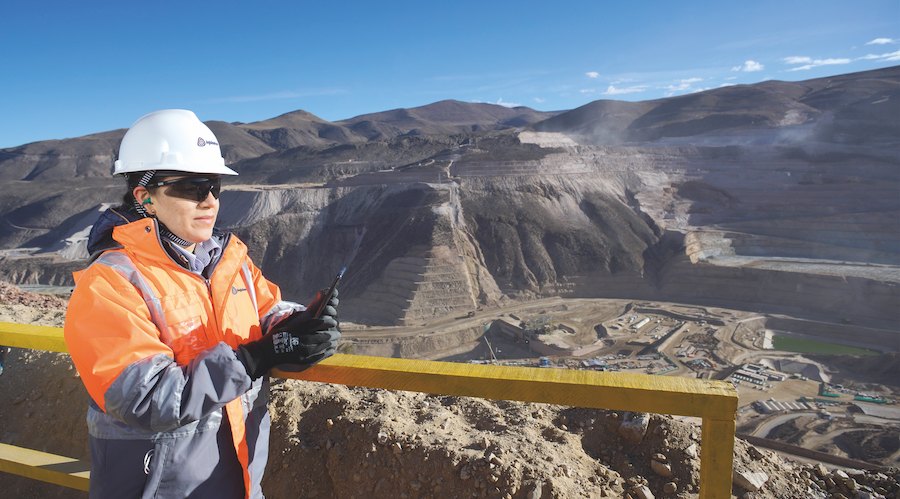
Quellaveco copper mine, in Peru. (Image courtesy of Anglo American | Flickr.)

Peru’s large miners are getting increasingly worried lawmakers may tamper with rules around mineral rights as congress prepares to discuss a proposed law favoring small-scale operators.

Peru, the world’s No. 3 copper producer and South America’s top gold exporter, grants concessions that allow mining giants such as BHP Group, Glencore Plc and Anglo American Plc to explore huge swaths of territory for decades before starting production.

The concessions are a cornerstone of the country’s mining industry, and potential changes could jolt Peru’s economy and discourage global investment. However, the rise of illegal mining as well as years of production delays have prompted some lawmakers to call for giving more and shorter-term concessions to smaller operators that can start production immediately.

The concessions were a key topic in private conversations at last week’s Perumin conference. One of the few open mentions came from Peruvian President Dina Boluarte, who said at the closing ceremony that her government had made proposals to congress, including “changes to the concessions regime.” She didn’t elaborate.

Peru’s congress is discussing bills to update the legal framework for small-scale miners in a way that will encourage their formalization. Some of those bills include provisions to revoke concessions deemed to be idle or underutilized. It is unclear if congress will pass any of those bills, but regardless, the issue is likely to spill over to presidential and legislative elections next year.

Ivan Arenas, who consults mining companies on how to navigate social conflicts, said illegal miners are behind the push and are “making up lies to try to legitimize taking over third parties’ concessions that aren’t theirs. It feels like their message is starting to stick.”

Peru’s mining ministry declined to comment.

Mining executives voiced similar concerns during private conversation on the sidelines of the conference, which drew 60,000 people to Arequipa.

“It takes about 40 years to start production at a mine in Peru,” said Carlos Gallardo, the general manager at the Peruvian Institute of Economics. “So to consider cutting down concession time periods to 10 years or so is nonsense that will ultimately disincentivize large-scale formal mining investment.”

Many said red tape makes it all but impossible to expedite the construction of mines. In fact, cumbersome permitting was the reason the Peruvian Institute of Mining Engineers recently commissioned the Peruvian Institute of Economics, an industry-funded think tank known as IPE, to produce a study on the importance of maintaining the concessions.

The study, co-authored by Gallardo, concluded proposals to revoke concessions over claims they have been unused for too long “ignore the reality of the sector” and just how long it takes to bring a mine online in Peru.

IPE estimates illegal gold mining will account for $12 billion in exports in 2025. It also estimates that about $7 billion in future copper projects are stalled because concessions have been invaded by illegal miners. Those include Southern Copper Corp’s Michiquillay and Los Chancas projects, as well as First Quantum’s Haquira copper project.

With so many issues complicating the concessions process, Jose Farfan, legal adviser for Anplaben, a trade association that represents processing plants that buy ore from artisanal producers, said the conversation might be moot.

“There is no consensus right now in congress,” Farfan said. “It is a taboo subject.”

(By Marcelo Rochabrun)