Wednesday, October 01, 2025


Daniel Ek steps down as Spotify CEO: Are artist protests responsible for the leadership shake-up?
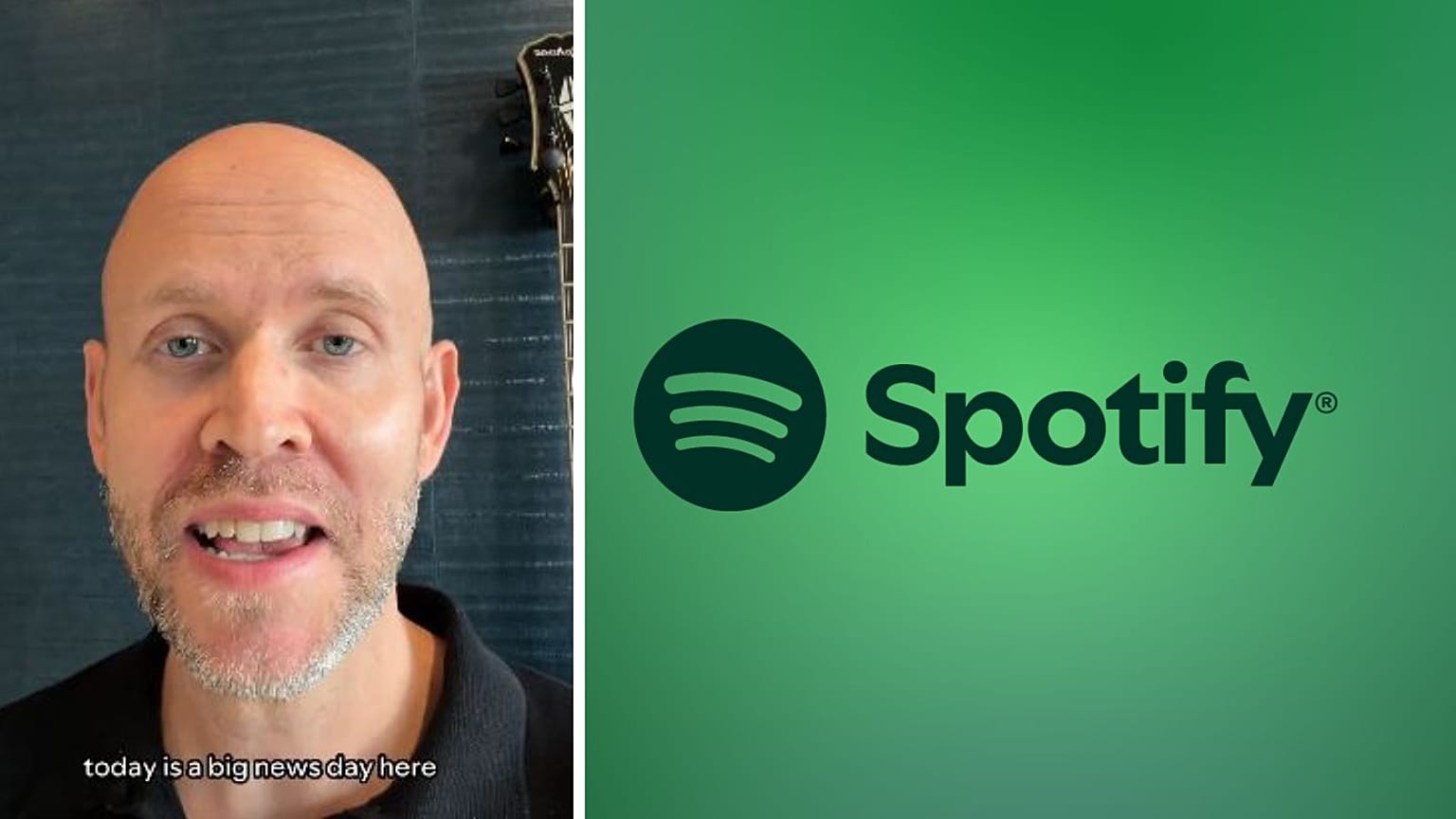
Daniel Ek steps down as Spotify CEO during serious backlash
Copyright Spotify - X Daniel Ek

By David Mouriquand
Published on 


Daniel Ek stepping down as CEO of the company he founded comes during much backlash aimed at Spotify, ranging from issues regarding artist payment and Ek’s investments in weapons.

Spotify founder Daniel Ek has formally ended his tenure as CEO of Spotify, the increasingly controversial streaming giant he founded two decades ago. 

As of 1 January 2026, Ek will “transition” to the role of executive chairman of Spotify, according to the company. Gustav Söderström, currently co-president and chief product and technology officer, and Alex Norström, co-president and chief business officer, will become Spotify’s co-CEOs. 

According to a company statement, the executive change “formalizes how Spotify has successfully operated since 2023 with the co-presidents largely leading strategic development and operational execution of Spotify.” As executive chairman, Ek’s role “will more closely reflect a European chairman setup,” where he will oversee capital allocation and scope out the long-term future and strategy for Spotify while continuing to provide support and guidance to its senior team.

Ek added that the move has been made to allow him to shift his focus towards other businesses.

“A personal note on what’s next for me. I am often asked, ‘How do we build more Spotifys out of Europe?’ That’s why several years ago, I announced my intention to help create more of these supercompanies - companies that are developing new technologies to tackle some of the biggest challenges of our time,” he added.

One of the businesses outside of Spotify that Ek is involved in is his investment company Prima Materia – one which has caused headache for Spotify.  

Indeed, over the summer, the brand led a €600million investment into Helsing – a Munich-based company creating drones and artificial intelligence for military operations. 

Ek's increasing ties with the arms industry have led a number of high-profile artists to pull their music from Spotify, including prolific Australian psych-rock group King Gizzard & the Lizard Wizard and American indie group Deerhoof, who said they don't want their "music killing people", describing Spotify as a “data-mining scam.” 

Another high-profile name recently added itself to the boycott: celebrated British trip-hop collective Massive Attack. 

In a statement on Instagram, the band wrote: “In light of the (reported) significant investments by [Spotify’s] CEO in a company producing military munition drones & Al technology integrated into fighter aircraft, Massive Attack have made a separate request to our label that our music be removed from the Spotify streaming service in all territories.” 

This comes as Massive Attack and more than 400 artists – including Fontaines D.C.Kneecap, Primal Scream, Wednesday, Amyl & The Sniffers, MØ and Björk - joined the No Music For Genocide cultural boycott initiative, which encourages artists and rights-holders to pull their music from streaming platforms in Israel.

These protests add to a growing list of controversies and concerns surrounding the streaming platform.

In 2024, Ek’s comments relating to the cost of “creating content” sparked backlash from users and musicians.

Ek did release a statement saying that he didn’t mean to use the “reductive” label of “content”. Still, the Spotify platform has frequently given the impression of being dismissive of the struggles faced by artists. Worse, underpaying and exploiting the vast majority of musicians.

Unlike physical sales or downloads, which pay artists a fixed price per song or album sold, Spotify pays royalties based on the artist’s “market share”. The likes of Radiohead’s Thom Yorke and Taylor Swift have criticised this policy and have temporarily withdrawn their music from the service in the past.

The backlash was not helped by Spotify making record profits of more than €1billion last year, following staff being laid off (17% of its work force cut down) and subscription prices rising. And again, all at the expense of artists struggling to make any income from streaming – especially after 1 April 2024, when Spotify officially demonetised all songs on the platform with less than 1,000 streams. 

At the time, Primal Scream bassist Simone Marie Butler said that Ek was “sitting on his yacht laughing at your Spotify top five while he cashes in on music he had nothing to do with, calls it ‘content’ and artists still get £0.04 per stream.” 

While Spotify announced in its Loud & Clear 2024 report that it paid over $10 billion (€9.2 billion) to the music industry in 2024 alone, critics have argued that most of those payouts go to just a small percentage of top artists and labels, and that the platform still exploits the vast majority of musicians.

Artists like Björk, James Blake and Nine Inch Nails’ Trent Reznor have slammed the streaming platform. The Icelandic singer said that Spotify “is probably the worst thing that has happened to musicians,” Blake bemoaned how “the brainwashing worked and now people think music is free”, while Reznor shared how streaming has “mortally wounded” artists. 

Spotify also recently came under fire after allowing an AI-generated band called Velvet Sundown, which has managed to rack up millions of streams, to appear on its platform with a “verified artist” badge. 

We described Spotify’s role in allowing the AI band on the platform as "a prime example of autocratic tech bros seeking to reduce human creation to algorithms designed to eradicate art." 

While these protests multiply, they may not be able to claim they forced the leadership shake-up - even if the timing could be read as fortuitous and a move to ease some pressure.

Spotify board director Woody Marshall claims that the recently announced leadership changes had been in motion for years.

Nevertheless, co-CEOs Gustav Söderström and Alex Norström will have to work double shifts to claw back some goodwill, which seems to be in short supply at the moment.  

The two lieutenants have been with Spotify for more than 15 years and will report to Ek, so any hopes of major changes with regards to the treatment of artists and their “content” isn’t likely to change. 

Morningstar analyst Matthew Dolgin wrote in a research note: “Leadership transition always brings risk, but succession is inevitable, and this one appears to be as orderly as possible.” That said, he added: “Naming co-CEOs and still having Ek overseeing long-term strategic direction can bring more risk than having a more singular authority.” 

Spotify shares, which doubled in the past year, fell more than 3 per cent in early morning trading after Ek’s announcement. The platform still remains the clear market leader with nearly 700 million monthly users, far ahead of Apple Music's roughly 90 million subscribers.

 

Is Kneecap’s Mo Chara considering legal case against British state after terror charge thrown out?

Is Kneecap’s Mo Chara considering legal case against British state?
Copyright AP Photo

By David Mouriquand
Published on 

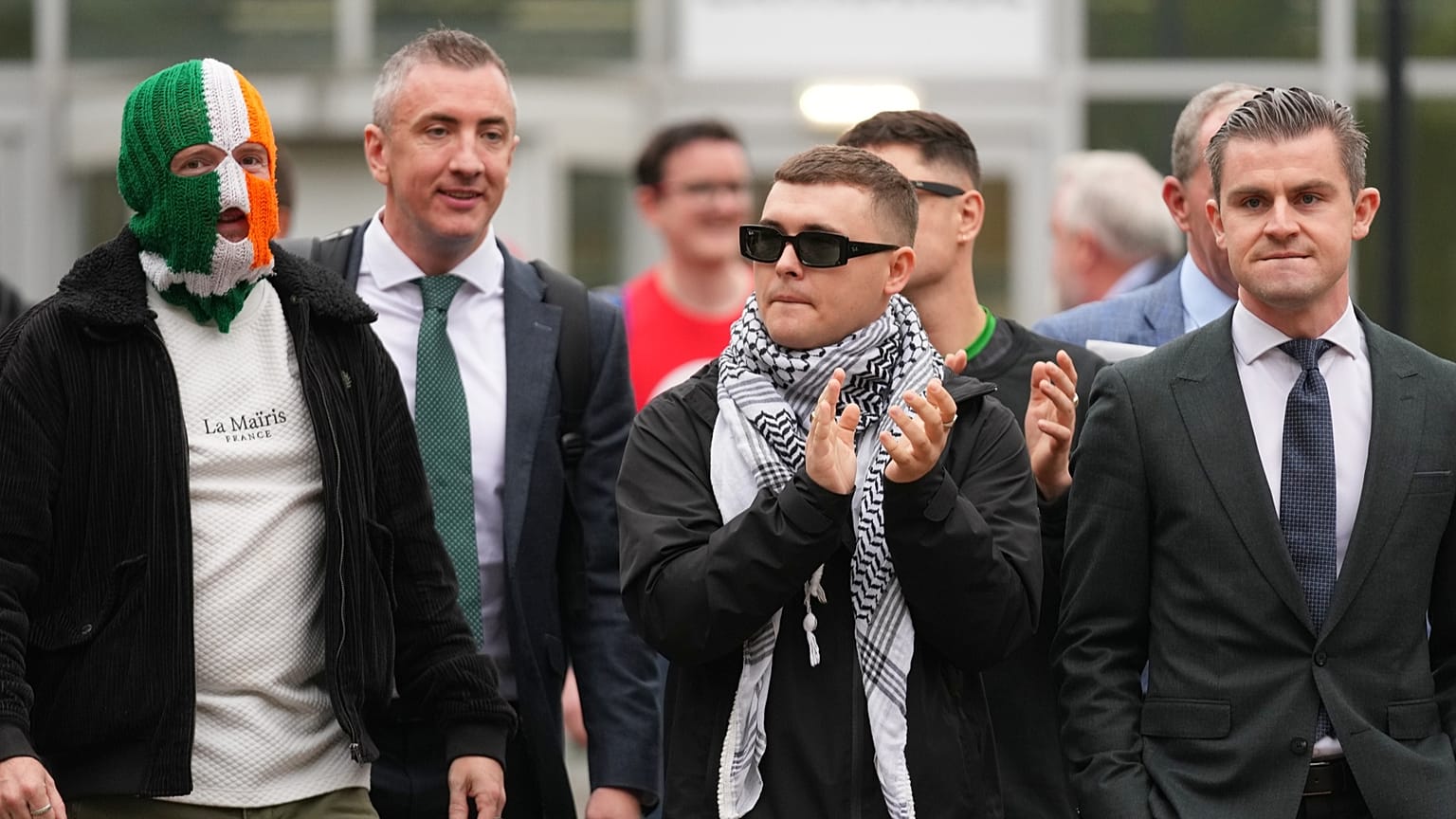
“It was a complete circus, it was a carnival, a distraction from what’s actually going on," said Kneecap's Mo Chara in his first interview after the terror charge against him was dismissed last week.

Kneecap’s Mo Chara – real name Liam Óg Ó hAnnaidh – is “definitely” considering legal action against the British state, following the dismissal of his terror charge last week.  

The Belfast rapper had been charged over an alleged incident where he reportedly waved a Hezbollah flag at a London gig last November. 

On Friday (26 September), the case was thrown out on a technicality, with Chief Magistrate Paul Goldspring agreeing that the charge against Ó hAnnaidh fell outside the statute of limitations and telling the court that it was “unlawful” and “null”. 

Mo Chara and his Kneecap bandmates have consistently denounced Hezbollah and Hamas, two militant groups that are considered terrorist organizations by the United Kingdom, and said that they do not incite or condone violence. They have been vocal advocates for Palestinian rights and have used their platform to criticise Israel's actions in Gaza and those who condone genocide. They have also denied accusations of anti-Semitism, claiming that “those attacking us want to silence criticism of mass slaughter.” 

“This entire process was never about me,” Mo Chara told supporters outside the courthouse. "It was never about any threat to the public; it was never about terrorism - a word used by your government to discredit people you oppress.” 

“It was always about Gaza, about what happens if you dare to speak up,” he added.

Now, Mo Chara has given his first interview since the verdict.

“Even if it had’ve went to court, we would’ve won anyway,” Mo Chara said in an interview with Virgin Media. “It was a complete circus, it was a carnival, a distraction from what’s actually going on. And the more that they dragged this out, the longer they could keep this in the news, rather than talk about the actual issues.” 

“Obviously for me personally, it’s just a relief that it’s finished,” he said, describing the experience as “a bit of a nightmare”, although he added: “If we’re talking comparisons, I’ll get over it. There’s a lot of stuff that’s irreparable in Gaza already. I’ll bounce back.” 

“Better luck next time,” he told British Prime Minister Keir Starmer, and said legal action against the British state is “definitely something we’re going to look into.”

Check out the interview below:

In a statement posted after the case was thrown out of court, Mo Chara wrote: “As people from Ireland we know oppression, colonialism, famine and genocide. We have suffered and still suffer under ‘your empire’."

He added: "Your attempts to silence us have failed, because we are right, and you are wrong. We will not be silent.” 

Trump pulls nomination to lead US Bureau of Labor Statistics

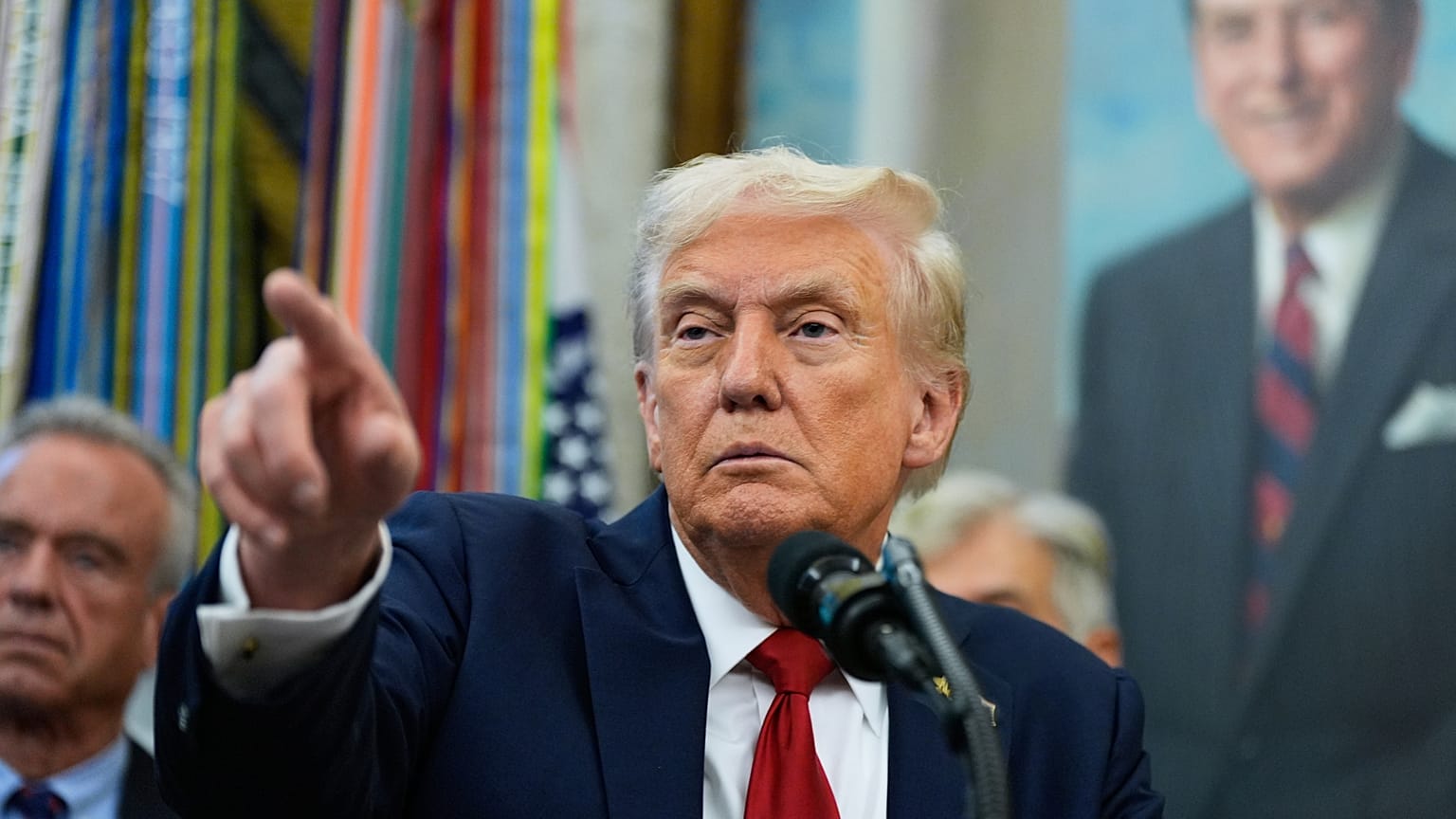
FILE. President Donald Trump points to a reporter in the Oval Office of the White House. 30 Sept. 2025.
Copyright AP/Alex Brandon

By AP with Euronews
Published on 


E.J. Antoni's nomination, announced in August, was an attempt by Trump to gain greater control over the federal agency responsible for producing key economic data.

US President Donald Trump is withdrawing the nomination of E.J. Antoni to lead the Bureau of Labor Statistics (BLS), according to a White House official.

The reasons for withdrawing the nomination have not been disclosed, and the official cited by AP simply noted that Antoni was a talented economist and that President Donald Trump planned to announce a new nominee soon.

The Senate received paperwork formally withdrawing Antoni’s nomination on Tuesday.

Antoni’s nomination, announced in August, was an attempt by Trump to gain greater control over the federal agency responsible for producing key economic data, including the monthly jobs report and the consumer price index, which is used to measure inflation.

As the chief economist at The Heritage Foundation, a conservative think tank, he was a major critic of the BLS. Yet most economists saw him as overtly partisan and warned that his basic misreads on recessions, import prices, and other measures made him a risk to lead the federal agency.

Concerns over Antoni's suitability

Kyle Pomerleau, a tax expert for the conservative American Enterprise Institute, wrote on X after Antoni's nomination in August: “There are a lot of competent conservative economists that could do this job. E.J. is not one of them.”

Kevin Roberts, president of The Heritage Foundation and Heritage Action, said in a statement that Antoni “continues to be one of the sharpest economic minds in the country” and that he “was the right man for the job” at the BLS. But the statement said that Antoni would remain at the conservative think tank instead of taking a job in the government.

Other details emerged about Antoni that raised concerns about his credibility as an economic scorekeeper. NBC News reported that Antoni was in the crowd outside the US Capitol during the 6 January insurrection in 2021. And observers found that the wall art behind Antoni during interviews on TV was of the German battleship Bismarck used by the Nazis in World War II.

Financial disclosures show that Antoni earned in excess of $495,000 (€421,000) for his work at The Heritage Foundation, in addition to other payments for speeches and consulting.

Trump's quest to control economic decisions

Trump fired Erika McEntarfer as BLS commissioner on 1 August after the July jobs report showed a rapid slowdown in hiring, with job gains in May and June revised much lower than initially estimated.

The White House has maintained that it wants accurate figures after a series of downward revisions to the jobs report, but Trump has said on his social media site that the numbers were rigged to undermine him politically.

In the four months after Trump initially announced his country-by-country tariffs, job gains have averaged less than 27,000 a month. The slowdown was severe enough for the Federal Reserve in September to cut its benchmark rate in hopes of stabilising the job market.

The White House also on Tuesday withdrew the nomination of Brian Quintenz to join the Commodity Futures Trading Commission as chairman.

A White House official, insisting on anonymity to discuss the decision, called Quintenz a trusted ally and said that a new nominee would be forthcoming.

CNN first reported the withdrawal of Antoni's nomination.


What to know about OpenAI’s new AI video app Sora that could rival TikTok

OpenAI image created by prompt
Copyright OpenAI

By Pascale Davies
Published on 

OpenAI announces a new AI video app that lets you drop yourself into the action.

OpenAI has announced its next-generation audio and video generator called Sora 2, but it also teased a new social platform that might rival TikTok.

Here is everything we know about the latest developments. 

On Tuesday, the company showed off its video-making tech, which is powered by artificial intelligence (AI).

Users will be able to make almost any scenario come to life with a simple prompt once they film themselves with audio on the Sora app–effectively, creating their own deepfakes.

For example, one demonstration video featured an ice skater gliding across the ice and then performing a triple axel – all while holding a cat on her head. 

Another showed a realistic-looking man backflipping on a paddleboard, complete with splashes.

“Prior video models are overoptimistic—they will morph objects and deform reality to successfully execute upon a text prompt,” OpenAI wrote in a blog post.

The original Sora tool launched last year, but the latest version is better at generating more complex movements, the company said. 

The new Sora app aims to serve as a social platform for AI-generated videos. 

The app will allow users to view and edit AI-generated video clips and feature friends who are also registered on the app.

However, OpenAI said there are robust protections and identity safeguard measures in place to prevent someone's identity from being inserted into AI videos without their consent.

‘Protecting the wellbeing of teens’

The app has a similar feeling to TikTok in that it has a vertical video feed with a swipe-to-scroll navigation. 

However, OpenAI said that the app will prioritise the discovery of videos that may inspire creativity, rather than focusing on maximising time scrolling.   

“We are giving users the tools and optionality to be in control of what they see on the feed,” the company said. 

“Using OpenAI's existing large language models, we have developed a new class of recommender algorithms that can be instructed through natural language,” it added. 

The company also said that protecting the “wellbeing of teens” is important to the company, so there are default limits on how many generations teens can see per day in their feeds

It also said there are “stricter permissions on cameos for this group” and that OpenAI is adding human moderators “to quickly review cases of bullying if they arise”. 

Sora is, for the moment, invite-only, and will be available first on iOS in the United States and Canada. 


The next Natalie Portman? Meet Tilly Norwood, the AI actress sparking controversy

For Your Consideration: Meet the AI actress sparking controversy
Copyright Instagram - Canva

By David Mouriquand
Published on 


Meet the AI ‘talent’ who is reportedly getting agency representation very soon. Until then, many are speaking out on how Tilly Norwood is deeply misguided and devalues human artistry – despite her creator’s calls to “welcome AI as part of the wider artistic family.”

There’s an emerging talent in Hollywood and she may be about to make her big screen debut.

The buzz is there, the red carpet is waiting, and talent agencies are reportedly eyeing her up.

There’s a twist though. A significant one at that. She’s 100 per cent AI.

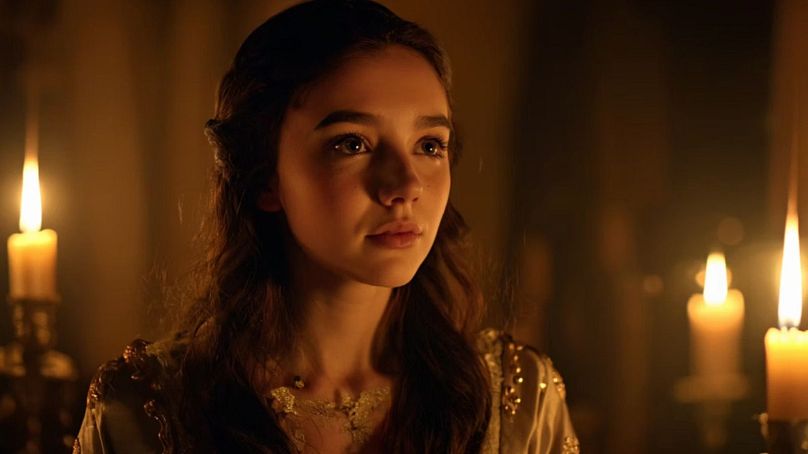
Tilly Norwood was brought to life by Dutch actress and tech creator Eline Van der Velden. Her AI studio Xicoia - a spin-off from Van der Velden’s AI production studio Particle6 - is aiming to push digital ‘talent’ into film and television.

“We want Tilly to be the next Scarlett Johansson or Natalie Portman, that’s the aim of what we’re doing,” Van der Velden told Broadcast International in July – when she soft-launched Norwood with various social media accounts. Norwood currently has 39,1k followers on Instagram, where the "actress (aspiring)" asks: "What role do you see me in?"

And apparently, Van der Velden is not the only one. At this year’s Zurich Summit – held as part of the industry programme at the Zurich Film Festival – she revealed that studios have been discreetly advancing AI projects.

“We were in a lot of boardrooms around February time, and everyone was like, ‘No, this is nothing. It’s not going to happen.’ Then, by May, people were like, ‘We need to do something with you guys,’” she shared with Deadline.

Tilly has already bagged a role in a comedic sketch titled AI Commissioner, which she posted on Facebook with the caption: “Can’t believe it... my first ever role is live!” She added: “I may be AI generated, but I’m feeling very real emotions right now. I am so excited for what’s coming next!”

“When we first launched Tilly, people were like, ‘What’s that?’," shared Van der Velden. “Now we’re going to be announcing which agency is going to be representing her in the next few months.” 

In a LinkedIn post, Van der Velden commented: “Audiences? They care about the story - not whether the star has a pulse. Tilly is already attracting interest from talent agencies and fans. The age of synthetic actors isn’t ‘coming’ - it’s here.”

An insulting and deeply reductive way of considering audiences... and Euronews Culture aren’t the only ones who think so...

Tilly Norwood
Tilly Norwood Xicoia - Instagram

Indeed, the prospect of Tilly Norwood securing professional representation (something traditionally reserved for real-life talent) has sparked debate. And by ‘debate’, read: heated backlash surrounding cinema’s equivalent of The Velvet Sundown.  

Social media kicked things off with comments like: "This is literally the mark of the end of the industry as we know it… say goodbye to actors”; “No one should be supporting this”; “This is deeply misguided”; "It'll do the world a huge favour to pull the plugs on AI."

Then, actual performers weighed in.

Real-life actress and Golden Globe winner Toni Colette posted a series of screaming-face emojis.

Fellow real-life actress and filmmaker Natasha Lyonne said that "any talent agency that engages in this should be boycotted by all guilds”, while real-life actress and Screen Actors Guild Award winner Emily Blunt said the creation was terrifying on a podcast with Variety.

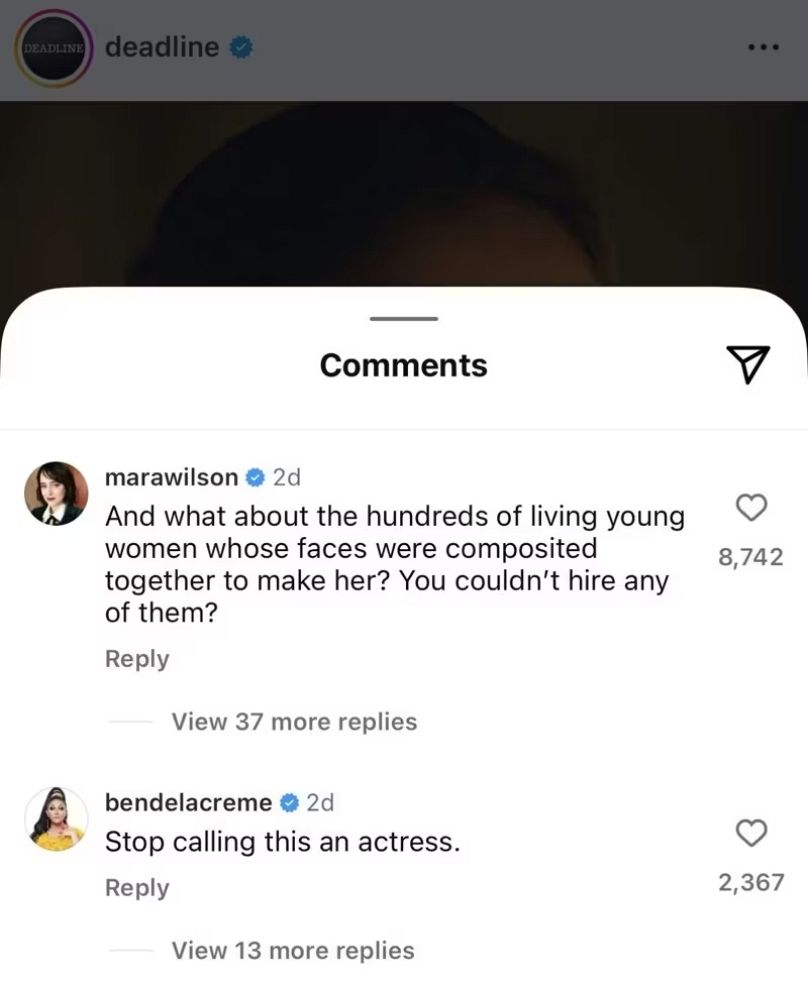
Elsewhere, real-life DopeJustice League and The Flash actress Kiersey Clemons demanded transparency, calling for the names of the agencies involved to be made public. As for real-life Matilda actress Mara Wilson, she said on Instagram: “Shame on these people. They have stolen the faces of hundreds of young women to make this AI ‘actress.’ They’re not creators. They’re identity thieves.”

Mara Wilson's reaction
Mara Wilson's reaction Screenshot Instagram

All fair and reasonable reactions, considering the existential threat that AI poses to creative industries. And even Hollywood’s actors union SAG-AFTRA responded to the news that talent agents are looking to sign Tilly Norwood.

“SAG-AFTRA believes creativity is, and should remain, human-centered. The union is opposed to the replacement of human performers by synthetics,” the guild said in a statement. “To be clear, ‘Tilly Norwood’ is not an actor, it’s a character generated by a computer program that was trained on the work of countless professional performers – without permission or compensation. It has no life experience to draw from, no emotion and, from what we’ve seen, audiences aren’t interested in watching computer-generated content untethered from the human experience.” 

SAG-AFTRA previously secured protections for actors’ likenesses and performances against AI, in the wake of the 2023 strike.  

The statement continued: “It doesn’t solve any ‘problem’ - it creates the problem of using stolen performances to put actors out of work, jeopardizing performer livelihoods and devaluing human artistry. Additionally, signatory producers should be aware that they may not use synthetic performers without complying with our contractual obligations, which require notice and bargaining whenever a synthetic performer is going to be used.” 

Faced with growing backlash, Eline Van der Velden responded in a statement posted on Instagram, saying that she saw Tilly Norwood not as “a replacement for a human being, but a creative work - a piece of art.”

“I see AI not as a replacement for people, but as a new tool, a new paintbrush,” she wrote. “Just as animation, puppetry, or CGI opened fresh possibilities without taking away from live acting, AI offers another way to imagine and build stories. I’m an actor myself, and nothing – certainly not an AI character – can take away the craft or joy of human performance.”  

“It takes time, skill, and iteration to bring such a character to life,” she added.

Yes, and not to mention the theft involved in training the AI-generated character on the work of real performers, all without permission.

This part was not addressed in the statement.

Granted, all forms of creativity should be celebrated. But when when artists are expressing real, legitimate concerns over the lack of AI regulations, the ubiquity of artificial intelligence in a tech-dominated world and the use of their craft in the training of AI tools, maybe read the room.

After all, the threat of AI in the film world was a key issue during labour strikes that shut down the industry only two years ago, with writers and performers demanding protections from the technology.

So, the red carpet remains rolled up for Tilly Norwood for the time being. Unless audiences decide they actually don’t care about human artistry. Or a pulse.

As of writing, neither Scarlett Johansson nor Natalie Portman have commented on their would-be successor.


Italy's art police seize 21 suspected forged Salvador Dalí artworks after show opens in Parma

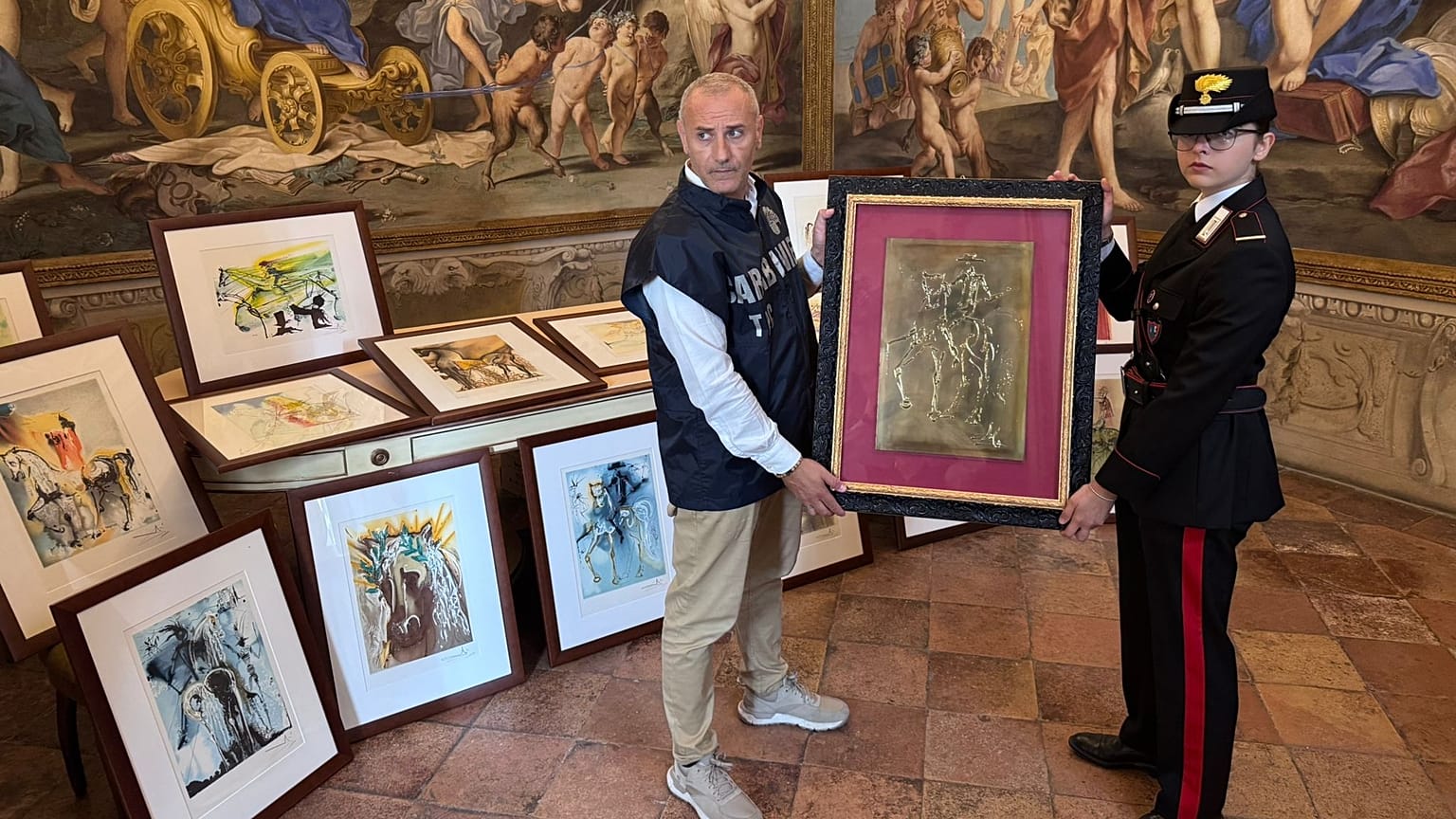
Italian police seize 21 suspected forged Salvador Dalí artworks after show opens in Parma
Copyright Carabinieri Cultural Heritage Protection Command via AP

By Euronews with AP
Published on 


Italy’s art police say they seized 21 artworks purportedly by Salvador Dalí on suspicion they were forgeries. The investigation is ongoing.

Italy’s art police have seized 21 artworks purportedly by Salvador Dalí on suspicion they were forgeries, after being tipped off by the Surrealist's foundation in Spain about suspected anomalies in the works.

The works were part of an exhibition, “Salvador Dalí, tra arte e mito” (“Salvador Dalí, between art and myth”) that had been on show in Rome for the first half of the year. Last week, it opened at Parma’s Palazzo Tarasconi.

Italy’s carabinieri art squad said while the show was open in Rome, it had received a report about suspected anomalies in some of the works from the Fundaciòn Gala - Salvador Dalí.

The artist had created the non-profit foundation in 1983 to “promote, foster, disseminate, enhance, and defend Dalí’s world worldwide,” according to the foundation’s website.

This morning, with a judge’s warrant, the police seized 21 works from the Parma museum, including tapestries, drawings and engravings. Police stressed that the investigation was continuing.

Dalí is among the most-forged artists along with Pablo Picasso and Amadeo Modigliani, according to ArtNews.