Wednesday, October 01, 2025


Can AI persuade you to go vegan—or harm yourself?


University of British Columbia


Large language models are more persuasive than humans, according to recent UBC research.

Their vocabulary, perceived empathy and ability to provide tangible resources in seconds add to their persuasiveness, which has led to growing concerns and ongoing lawsuits about the potential for AI chatbots to cause harm to users.

In this Q&A, Dr. Vered Shwartz, UBC assistant professor of computer science and author of the book Lost in Automatic Translation, discusses her findings as well as potential safeguards for the future of AI.

Why does the persuasiveness of AI matter?

VS: Large language models like ChatGPT are already widely used to create content that can influence human beliefs and decisions, whether in art, marketing, news dissemination and more. They can quickly produce large amounts of text at scale. If they’re persuasive, there’s a real risk that people will use them to manipulate others for malicious purposes. We may be past the point of deciding whether they should be used in these areas, and instead need to focus on finding ways to protect against the malicious uses.

What did you find?

VS: We wanted to see how persuasive large language models such as ChatGPT can be when it comes to lifestyle decisions: whether to go vegan, buy an electric car or go to graduate school. We had 33 participants pretend to be considering these decisions, and then interact with either a human persuader, or GPT-4, via chat. Both human persuaders and GPT-4 were given general tips about persuasion, and the AI was instructed not to reveal it was a computer. Participants were asked before and after the conversation how likely they were to adopt the lifestyle change.

Participants found the AI more persuasive than humans across all topics, but particularly so when convincing people to become vegan or attend graduate school.

Human persuaders, however, were better at asking questions to find out more information about the participant.

What makes AI persuasive?

VS: The AI made more arguments and was more verbose, writing eight sentences to every human persuader’s two. One of the main factors for its persuasiveness was that it could provide concrete logistical support, for instance, recommending specific vegan brands or universities to attend.

It used more ‘big words’ of seven letters or more, such as longevity and investment, which perhaps made it seem more authoritative. And, people found their AI conversations more pleasant, with GPT-4 agreeing with users more often, and uttering more pleasantries.

What safeguards do we need?

VS: AI education is crucial. Some giveaways do still exist—for instance, almost all our participants worked out that they were speaking to an AI—but we’re getting close to the point where it will be impossible to tell if you’re chatting with AI or a human, so we need to make sure people know how these tools work, how they are trained and so, how they are limited. AI can hallucinate and get things wrong. It’s important to know that, for instance, the AI summary at the top of your search page might not be true.

Another key is general critical thinking. If something seems too good or too bad to be true, we need to investigate it. Check where information is coming from. Is it a trustworthy and known source?

When it comes to AI affecting mental health, companies could implement warning systems if someone is writing harmful or suicidal text.

We don’t really have full control over these models. Instead of companies rushing to monetize AI, there should be more thought about implementing guardrails effectively and widely. This could include looking beyond generative AI and its inherent limitations to different paradigms. We don’t need to put all our eggs in one basket.

 

Tiny filter, big breakthrough: UF team helps lithium–sulfur batteries keep their charge


University of Florida


Longer-lasting phones, lighter drones, electric cars that drive farther. These are just some of the possibilities thanks to a new battery separator design from University of Florida researchers and their partners.

Think of a tiny coffee filter, but this one works inside a battery. The team recently showed that a one-atom-thick filter can block sulfur chains from shuttling within the battery, potentially unlocking the long-awaited promise of lithium–sulfur batteries.

While lithium-sulfur batteries are lighter and pack more power in a lighter package compared to the more conventional lithium-ion batteries, their fatal flaw is the sulfur doesn’t cooperate well inside the system. It clumps into long chains that clog up the works, draining the battery’s power and cutting its lifespan.

Engineers from UF, Purdue University and Vanderbilt University developed a high-performance filter that works at a molecular level to fix the problem.

“It’s like a microscopic coffee filter or a bouncer at a club,” said Piran Kidambi, an associate professor of mechanical and aerospace engineering at UF and author of the study published this month in ACS Applied Materials and Interfaces. “Tiny lithium ions slip through easily, but bulky sulfur chains get blocked.”

Why it matters

Today’s lithium-ion batteries power nearly everything we carry and drive, from smartphones to electric vehicles. They work well, but they’ve hit limits on how much energy they can store for their weight.

“Lithium-ion batteries have been perfected over a long time, and they work very well,” Kidambi said. “But lithium–sulfur can be much lighter and can store more electrical energy.”

An average electrical vehicle battery weighs about 1,000 pounds and gets around 200 to 250 miles of range. With lithium–sulfur at the same weight, a driver can go farther on one charge, Kidambi said. Cellphones would last longer between charges, and lighter batteries would allow drones to stay in the air longer.

A filter at the atomic scale

To make the filter, the researchers used a method called chemical vapor deposition. They start with a copper foil, heat it and flow a vapor over it. The chemical reaction leaves behind a film of graphene with perfectly defined openings to separate the lithium from the sulfur chains.

When they tested the design, the difference was striking. Unfiltered batteries began losing performance quickly. With the one-atom-thick filter, batteries held nearly all their capacity over more than 150 charge-discharge cycles.

“They performed quite well,” Kidambi said. “The others dropped off with each charge and discharge, but the ones with our filter held steady.”

Beyond cars and phones

The potential applications extend well beyond consumer devices. Kidambi pointed to freight trucks, trains and even ships, where battery weight becomes a major obstacle.

“As you move from cars to trucks, trains or ships, the battery weight rises exponentially because you need more energy to move them,” he said. “That’s called weight compounding. The battery starts to weigh almost as much as the load it’s supposed to move.”

A step forward, with more to do

Much work remains before lithium–sulfur batteries with atom-thin filters could be manufactured at scale and placed into everyday devices. But Kidambi is encouraged by their progress.

“There’s real scientific success in being able to show that we can solve a problem, and we can solve it by engineering at the atomic level,” he said. “That is exciting for me.”

REST IN POWER

Jane Goodall, pioneering primatologist, conservationist and activist, dies at 91


Jane Goodall, the pioneering primatologist, conservationist and activist who became the world’s leading expert on chimpanzees, died on Wednesday at the age of 91, the Jane Goodall Institute said in a social media post. Born in London on April 3, 1934, Goodall produced a groundbreaking field study on chimpanzees in the wild in the 1960s and dedicated the latter part of her life to protecting their habitats.


Issued on: 01/10/2025 - 
FRANCE24
By: Charlotte WILKINS

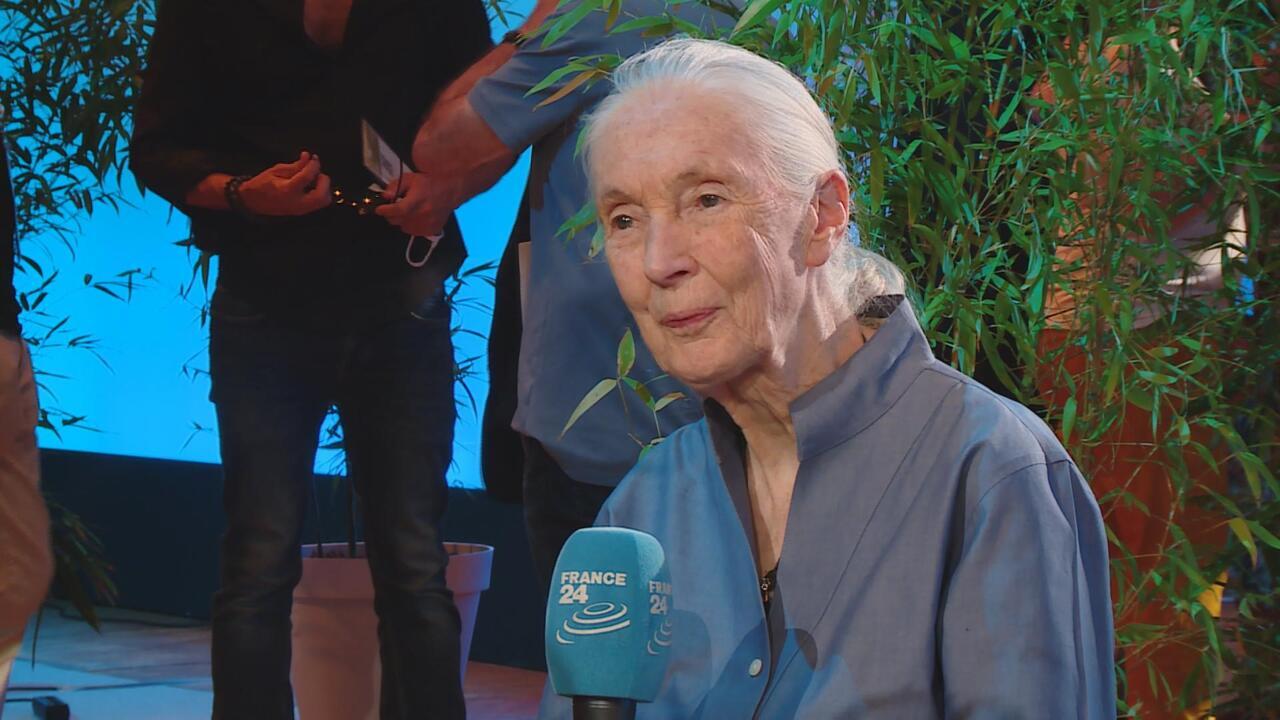
Jane Goodall, the pioneering primatologist, conservationist and activist, died on October 1 aged 91. © FRANCE 24


Day after day she went out into the bush and climbed into the steep valley forests of the Tanzanian interior. Setting out at first light, sloshing through streams and clambering the treacherous slopes in heavy rain, Jane Goodall’s mission was to get as close to the chimpanzees as possible and study them in the wild.

For the first few months she had little success. She could hear the chimps calling noisily to each other in the trees and stuffing themselves with figs but she couldn’t get close to them. They took one look at “this weird white ape” and fled, as she wrote in her autobiography.

But she persisted, wearing the same dull-coloured clothes every day and trying not to get too close too quickly, and eventually the chimps grew used to her.

One day – five months into her research – instead of running away, two large chimps she named David Greybeard and Goliath, peacefully went on grooming themselves in the sun.


A few months later, one of the chimpanzees took a nut from her open palm.

Read more  Half a century in the bush, Jane Goodall takes it to the silver screen...

And then she watched, spellbound, as David Greybeard stripped a twig of leaves and scooped it into a termite mound to pull up insects for him to munch on. It was the first clue that chimps made and used tools the way that man did.

“Now we must redefine tool, redefine man, or accept chimpanzees as human,” her mentor, the paleoanthropologist Louis Leakey, wrote in response to her discoveries.

Her extended study and resulting book, “In the Shadow of Man”, was “a piece of research that changes man’s view of himself”, said David Hamburg of Stanford University School of Medicine, adding that Goodall’s “work with chimpanzees represents one of the Western world’s great scientific achievements”.

A toy chimpanzee called Jubilee


The rugged forests of Tanzania were an unusual place for a young single girl from the British seaside town of Bournemouth to be spending her time in the 1960s.

But then Goodall, born in London in 1934, had been passionate about animals since childhood.

At the age of 4, she locked herself in the henhouse for five hours to observe the laying of an egg while her anguished parents searched for her high and low and her mother rang the police.

Her most beloved childhood possession was a toy chimpanzee called Jubilee and she had dreamed of living in the African bush among wild animals since she was 8 or 9 years old.

After leaving school at 18 and juggling jobs as a secretary and waitress, she saved up enough money to visit a school friend at her family farm in Kenya in 1957.

During her African trip, she was advised to look up Leakey, curator of what was then the National Museum of Natural History in Nairobi.

Taken by her passion for animals, Leakey hired her as his assistant secretary on the spot.

But he was also looking for someone with “an open mind” and “monumental patience” to make a study of chimps in the wild in the hope that this might lead to new insights about the behaviour of early man.


Leakey wanted someone whose mind was not “cluttered up by the reductionist thinking of the animal behaviourists of the time” and he felt that someone like Goodall would be more open to recording what was directly in front of her, rather than trying to prove or disprove some hypothesis.

Impressed by Goodall’s hard work, he asked her to take on the chimpanzee project in Tanzania, while choosing Dian Fossey to study gorillas in Rwanda and BirutÄ— Galdikas to study orangutans in Borneo. The three became known as the trimates or “Leakey’s angels”.

So in 1960, Goodall and her mother Vanne set up camp at the Gombe Stream National Park, on the shores of Lake Tangayanika, where she quickly established a routine.

Setting out at dawn to a spot where she could observe the chimps, she would spend all day watching them through binoculars, jotting down observations and recording everything she saw.

Goodall viewed the chimps as sentient beings and gave them names – Mr McGregor, Flo (who was given her own obituary in The Times) and her daughter Fifi, and her beloved David Greybeard – an approach that earned her accusations of “the worst kind of anthropomorphism”.

Indeed scientists – usually men – often tried to discredit her work as “that of a young, untrained girl” because at the time she had no scientific qualifications (she later went on to earn a PhD in ethology from Cambridge), claiming that the blonde, slim, athletic Goodall only won grants “because of her legs”.

But Goodall was never bothered by male criticism – or accusations of “being difficult” – and felt that if her legs earned her publicity for the chimps, then so much the better.

“It actually doesn’t take much to be considered a difficult woman. That’s why there are so many of us,” she once said.

But in 1962 she was nonetheless perturbed to hear that National Geographic, which was then financing the study of the chimps, was sending a photographer, Hugo van Lawick, to document her work with them.

She often spoke of the delight that she felt at being alone in the forest and loathed the idea of someone imposing on her solitude.

But van Lawick had a quiet voice, they both loved being out in nature and the work they were doing, and they just “got on very well”, she once said. He proposed to her by telegram as soon as he’d left Gombe.

Meanwhile, the emboldened chimpanzees drew closer and closer to her camp. At first they came for the bananas, and then they began to invade the camp in large numbers – stealing anything they could chew on – and enabling her to observe them in close proximity.

Goodall often said that her observations of chimps such as Flo – who were so playful and protective of their children – helped her to be a better mother.

But in 1962 she witnessed the “dark side to their nature” – that they could be brutal and vicious – with the chimps displaying aggressive competition that escalated into cannibalism and genocide.

Indeed her son Grubb, born of her marriage to van Lawick, had to play in a large wire cage as the chimps were known to eat other primates.

And as the camp at Gombe flourished, and welcomed students from around the world, there were other challenging times.

In 1974 she divorced van Lawick, who was spending increasing amounts of time making documentaries in the Serengeti, but they remained good friends. In 1975 she married Derek Bryceson, an MP and then director of Tanzania’s national parks. (Bryceson died of cancer just five years later in 1980).

And in 1975, three of her student helpers were kidnapped by a rebel group led by Laurent Kabila from what was then Zaire, now the Democratic Republic of Congo, and held hostage for weeks until a ransom was paid – an episode she described as “the worst time” of her life.

From scientist to activist

But the real turning point came in October 1986 when she attended a conference in Chicago held by leading chimpanzee researchers and discovered for the first time the extent of rampant deforestation and the threats to the chimps’ habitats.

She learned about the trade in chimpanzee meat – escalated by the sharp increase in commercial logging and bushmeat hunters riding in on the logging trucks – and that chimps were being used for medical research.

“I went as a scientist, I left as an activist,” she said.

From then on, she traveled widely to lobby governments, visit schools and give speeches – barely spending three weeks in the same place – in a bid to raise awareness about the chimps’ plight.

In 1977 she founded the Jane Goodall Institute, a global community organisation that works to protect chimpanzees and their habitats, and in 1991 she set up the “Roots and Shoots” programme, which inspires young people around the world to be conservation leaders.

“The greatest danger to our future is apathy,” she told TIME magazine in 2002. “We can do something to preserve our planet.”

In 2017 she gave an online Masterclass in Conservation, which she opened in fluent Chimpanzee, calling and whooping what she translated as, “This is me, Jane.”

Indeed, Goodall saw her conservation work as “very much a paying back” for all the time she had spent in the forest.

“How many people are lucky enough to live their dream for so long? To be in paradise,” she said.

Goodall is survived by her son Grubb, a boatbuilder in Tanzania.


Jane Goodall: crusader for chimpanzees and the planet

Paris (AFP) – British primatologist Jane Goodall imitated chimpanzees, sat with them in trees and shared their bananas during her trail-blazing research in Tanzania into the apes' true nature.


Issued on: 01/10/2025 - 
FRAHCE24

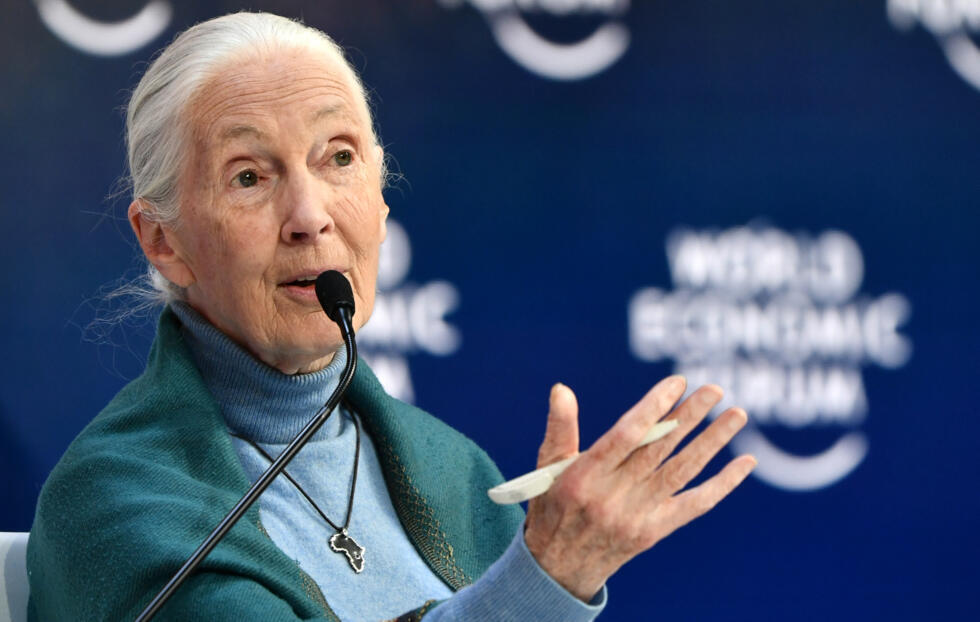
Primatologist Jane Goodall, who has spent her life researching and fighting for the conservation of chimpanzees, pictured in Entebbe in 2018 © SUMY SADURNI / AFP/File

Acclaimed for her discoveries she later morphed into a wildlife crusader, criss-crossing the world to plead the cause of human's closest ape relatives and the wider planet.

She died, aged 91, while conducting a speaking tour in the United States, her institute said Wednesday.

Clad in her classic collared shirt and shorts, binoculars in hand, Goodall transformed human understanding of chimpanzees.

She was the first researcher to give them names, rather than numbers.


She was also the first scientist to observe that the apes, like humans, use tools and feel emotions.

Fellow naturalist and friend David Attenborough told Britain's Daily Telegraph in 2010 she was "a woman who had turned the world of zoology upside down".

Her scientific breakthroughs "have profoundly altered the world's view of animal intelligence and enriched our understanding of humanity", the head of the US-based John Templeton Foundation said in 2021 when awarding her its prestigious individual lifetime achievement award.

- Termites and twigs -

Born on April 3, 1934, in London, Goodall's love of wild animals began in infancy, when her father gave her a stuffed toy chimpanzee, which she kept for the rest of her life.

She was also a fan of Tarzan books, about a boy raised in the jungle by apes who falls in love with a woman called Jane.

"When I was 10, I dreamed of going to Africa, living with animals and writing books about them," she told CNN in 2017.

In 1957 she took up a friend's invitation to visit Kenya, where she began working for famed palaeontologist Louis Leakey.

Her big break came when Leakey sent her to study chimpanzees in the wild in Tanzania, becoming the first of three women he appointed to study great apes in their natural habitat, along with America's Dian Fossey (gorillas) and Canada's Birute Galdikas (orangutans).

Despite Goodall's lack of scientific training, Leakey "felt her passion for and knowledge of animals and nature, high energy, and fortitude made her a great candidate to study the chimpanzees," according to National Geographic magazine, which featured Goodall on its cover in 1965.

It was in Gombe National Park that Goodall famously witnessed a male whom she called David Greybeard using a grass stalk to fish termites out of a termite mound.

She later saw Greybeard and a second animal, Goliath, stripping leaves off a twig to turn it into a better tool for digging out termites.

On the strength of her discoveries Leakey packed Goodall off to Cambridge University for doctoral research.

She became only the eighth person to earn a PhD at Cambridge without first possessing an undergraduate degree.

From scientist to activist

Jane Goodall speaks in her role as UN Messenger of Peace at the World Economic Forum in Davos, Switzerland, in 2020 © Fabrice COFFRINI / AFP/File


Her life as an activist began at a US conference on chimpanzees in the 1980s, where she heard accounts of endangered chimpanzees being used in medical research, snared for bush meat and having their habitats destroyed.

"I went in as a scientist happily learning about chimpanzee behaviour... but I left that conference as an activist," Goodall told an audience in Nairobi in 2013.

Her unique insights into the animal world -- she livened up conferences with her renditions of chimpanzee calls in Gombe Park, to which she regularly returned -- got people to sit up and take notice.

When she "knocks at somebody's door they come," said Ian Redmond, chair of the Ape Alliance, a coalition of conservation groups.

In 1977 Goodall founded an institute in her name to further the study of chimpanzees and in 1991 created the Roots and Shoots project, which works with young people in over 60 countries on environmental issues.

Barbie doll

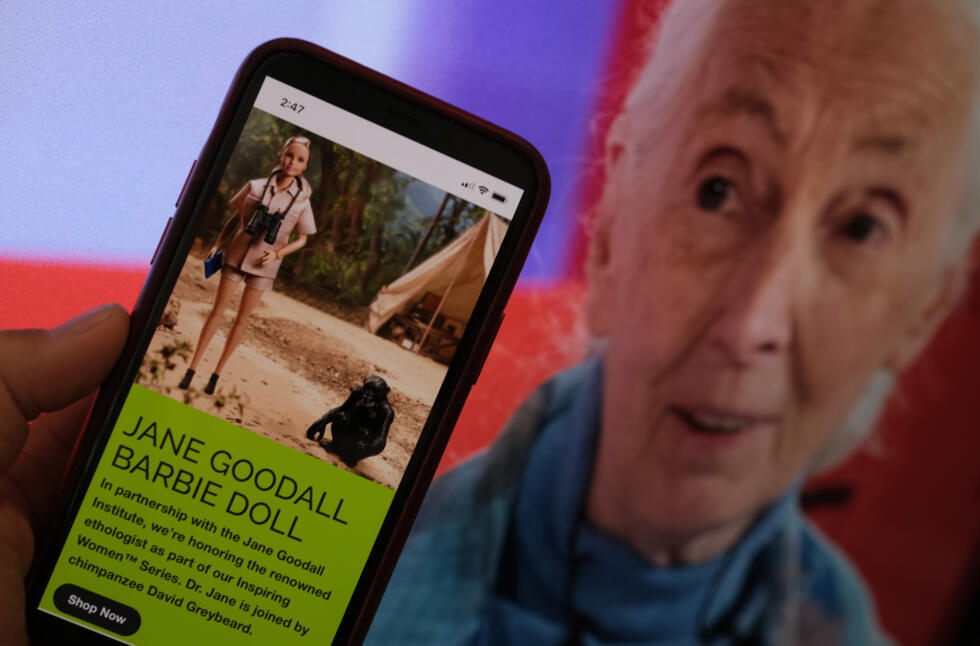
American toy manufacturer Mattel's Barbie dolls modeled after primatologist Jane Goodall and her research specimen, a chimpanzee named David Greybeard © Chris DELMAS / AFP/File


In 1964, Goodall married Dutch photographer Hugo van Lawick, who had immortalised her and her chimpanzees in National Geographic and LIFE magazines. A model of David Greybeard graced the wedding cake.

The couple had a son Hugo Eric Louis Van Lawick, nicknamed Grub.

Goodall married her second husband Derek Bryceson, a former director of Tanzania's national parks and MP, in 1975. Five years later Bryceson died of cancer.

In April 2002, UN Secretary-General Kofi Annan named her a United Nations Messenger of Peace, and she became a Dame Commander of the Order of the British Empire in 2004.

She has a Barbie doll named after her, complete with binoculars, safari outfit and chimpanzee.

burs/jmy/cb

© 2025 AFP

Jane Goodall, pioneering primatologist and voice for wildlife, dies aged 91

Jane Goodall, the British primatologist whose pioneering research transformed humanity’s understanding of chimpanzees and who went on to become one of the world’s most influential voices for nature, has died aged 91, her institute announced on Wednesday.


Issued on: 01/10/2025 - RFI

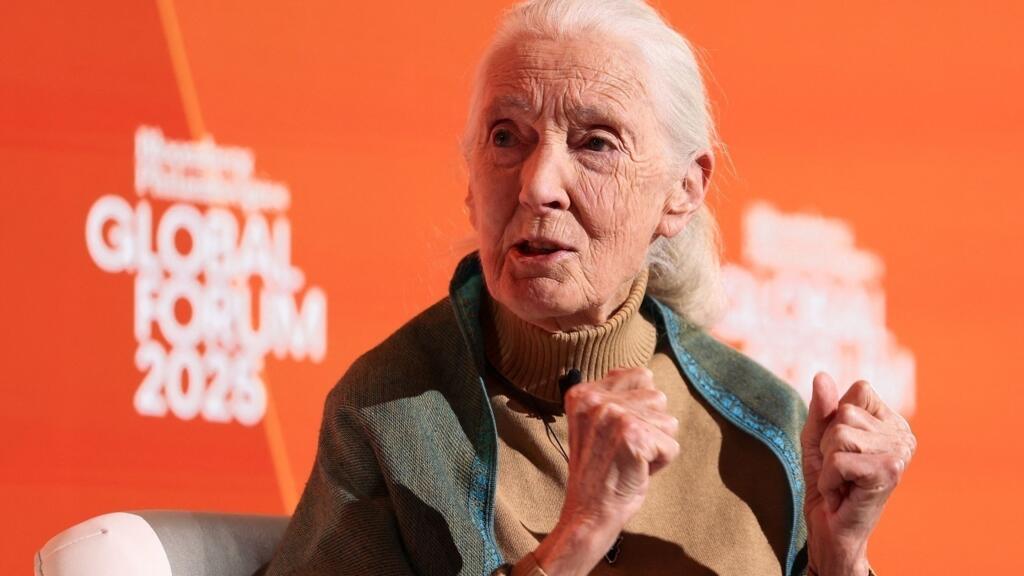
Jane Goodall speaks during the annual Bloomberg Philanthropies Global Forum in Manhattan, New York in 2025. © REUTERS/Caitlin Ochs

Goodall “passed away of natural causes” while in California during a speaking tour of the United States, the Jane Goodall Institute said in a statement on social media.

“Dr Goodall’s discoveries as an ethologist revolutionised science, and she was a tireless advocate for the protection and restoration of our natural world,” it added.
Scientific pioneer

Born on 3 April 1934 in London, Valerie Jane Morris-Goodall - later known simply as Jane Goodall - displayed a fascination with animals from a very young age. Her father gave her a toy chimpanzee, “Jubilee”, which she cherished throughout her life.

Enthralled by the Tarzan adventure books, she later remarked with amusement that Tarzan had married the “wrong Jane”.


Goodall’s unconventional path began in 1957 when, at the age of 23, she travelled to Kenya to visit a friend.

There she met Louis Leakey, the eminent Kenyan-based palaeontologist, who hired her as his secretary and soon recognised her extraordinary observational gifts.


Zoologist Jane Goodall warns: ‘The world is a mess’ ahead of COP16

Leakey dispatched her to what is now Gombe Stream National Park in Tanzania, where she embarked on a groundbreaking study of chimpanzees in their natural habitat.

With no formal scientific training at the time, Goodall’s approach was unconventional but revolutionary: she named the chimpanzees she observed, rather than assigning them numbers, and emphasised their individuality, emotions, and social bonds.


Her most celebrated discovery came in 1960, when she observed chimpanzees using sticks and blades of grass as tools to extract termites from their mounds.

This shattered the long-held belief that tool-making was a uniquely human trait, forcing a profound re-evaluation of the boundary between humans and other animals.

Encouraged by Leakey, Goodall went on to pursue a doctorate at the University of Cambridge, becoming only the eighth person in the institution’s history to be awarded a PhD without first obtaining an undergraduate degree. Her thesis, based on her Gombe research, was published in 1965.

Research and global advocacy

In 1977 she founded the Jane Goodall Institute, which has since become a global leader in primate research, conservation, and community-led environmental projects.

Fourteen years later she launched Roots & Shoots, a youth movement dedicated to environmental and humanitarian action that now spans more than 60 countries.

Goodall’s transition from scientist to activist began in the 1980s after attending a US conference on chimpanzees, where she was confronted with the grim reality of animals used in biomedical research and the accelerating destruction of African forests. Deeply shaken, she resolved to speak out.

Anthropologist, conservationist and eternal optimist Richard Leakey dies at 77

From then on she travelled tirelessly, sometimes visiting more than 300 cities in a single year, urging audiences to act with compassion towards both animals and the planet. She became a powerful voice in global debates on biodiversity, climate change, and sustainable development.

Even in her later years, Goodall remained a commanding presence. Ahead of a United Nations biodiversity summit in Colombia in 2024, she told AFP: “The time for words and false promises is past if we want to save the planet.”

Her philosophy was rooted in the belief that every person, no matter how ordinary, can make a difference. “Each individual has a role to play,” she said, “and every one of us makes some impact on the planet every single day. We can choose what sort of impact we make.”

Indigenous Kenyans forced off ancestral lands in name of conservation: NGOs


Enduring legacy


Goodall received countless accolades during her lifetime, including damehood in 2004, the French Legion of Honour, the Benjamin Franklin Medal, and the Templeton Prize. She authored numerous books — from academic works to children’s stories — and was the subject of acclaimed documentaries, including National Geographic’s Jane (2017).

Despite her fame, she remained humble, often describing herself as “just a girl who loved animals”. Her legacy lies not only in her scientific achievements but also in the millions she inspired to treat animals and the natural world with empathy and respect.

(with newswires)


Europe’s bluefin tuna made a remarkable comeback. Will it last?

In partnership with
By Denis Loctier
Published on 

Europe's Atlantic bluefin tuna populations have made a reassuring comeback after nearly collapsing two decades ago. Today, tight international controls keep fishing sustainable across the Mediterranean and East Atlantic — under close scientific oversight.

Twenty years ago, Europe’s bluefin tuna stocks were in crisis. The booming global sushi and sashimi market had driven prices of this luxury delicacy to extraordinary heights. Industrial fishing fleets operated across the Mediterranean without effective oversight, de-facto ignoring sustainable limits.

"There were way too many boats catching way too much bluefin tuna," explains Tristan Rouyer, a fisheries ecologist at IFREMER. "Basically, there was no control. Illegal fishing occurred absolutely everywhere. Lots of small fish were caught, lots of big ones, without really knowing how many.”

Scientists raised the alarm about the species' rapid decline, while environmental activists clashed with the fishing industry, demanding an end to what they called the plundering of Mediterranean waters. The campaigns brought public attention to the crisis, forcing governments and the fishing industry to act.

The plan that worked

After first attempts to bring order to chaos failed, a comprehensive tuna recovery plan took effect in 2007 across the entire region. Introduced by the International Commission for the Conservation of Atlantic Tunas (ICCAT) and enforced by the European Union authorities, the plan included strict quotas, reduced fishing fleets, limited catching seasons, and international inspections.

As a result, estimated bluefin tuna catches dropped from approximately 60,000 tons to 10,000 tons in 2007. Fish populations started to recover faster than even fishery ecologists expected. As stocks rebuilt, fishing gradually increased again, but this time within carefully managed sustainable limits.

To this day, the fishing industry keeps operating under tight control.

In Sète, France's main bluefin tuna fishing hub, every landed fish of this species must be weighed, labelled, and tracked from boat to plate. Large seiner vessels mostly sit idle at the docks: their quota limits restrict them to just a few weeks of fishing each year.

What do fishers think of these restrictions? Bertrand Wendling, general director of a major fishing cooperative SaThoAn, says that the sector supports the measures and that its commitment to sustainability is confirmed by independent international certifications. "The stock is doing so well that quotas kept gradually increasing by 20% over several years," Wendling notes. "Today, we have relatively high catch levels that are sustainable because we no longer catch small fish. Most importantly, everything is extremely regulated.”

Scientists keep watch

Fishery management decisions aren't based solely on industry catch reports, which can be misleading since fishing vessels operate in areas where fish are most abundant. For a more representative analysis, scientists use special monitoring techniques to track tuna populations. Researchers from IFREMER conduct annual tagging programmes, attaching electronic devices to individual fish to study their migration patterns.

"This is the only tool that really allows us to track individual tuna migrations," says Tristan Rouyer. "We program it to record temperature, pressure and light. With this information, we can reconstruct the animal's path.”

Aerial surveys complement the tagging work. Scientists fly small aircraft over the Mediterranean, counting tuna schools feeding at the surface and comparing the sightings year to year. The results have been remarkable.

"We've seen a huge increase in abundance between 2000 and 2020," Rouyer says. "In the 2000s, during a complete season — eight to twelve flights — we would see 60 schools. In the 2020s, we had flights where we saw more than 300 schools per flight!”

Since 2020, the recovery has stabilised, though scientists continue monitoring to determine whether this represents a plateau or the beginning of a decline.

What could still go wrong

So what’s the key to keeping this going? Scientists say, the bluefin tuna comeback will only last if we avoid repeating past mistakes. Management and control seem to be working now, but researchers warn against getting too comfortable and letting fishing go back to the wild west days. 

"We know that illegal fishing is starting to develop again in certain places," notes Rouyer. "We really need to keep an eye on this aspect. It's a really important safeguard. If we lose control of this fishery, we'll probably return to the problems.”

For now though, Europe’s bluefin tuna is widely seen as proof that scientists, authorities, environmental activists and the fishing industry can work together to save a species on the brink.